

Account-based marketing (ABM) is how high-performing B2B teams focus on the deals that matter. It aligns sales and marketing around a shared set of high-value accounts and drives what operators expect: faster cycles, higher win rates, and better ROI.
This playbook breaks down practical account-based marketing strategies and tactics. It’s built for marketers and strategists ready to turn ABM into a revenue engine.
What is the Account-Based Marketing (ABM) Playbook?
This ABM Playbook is a systematic guide for B2B teams to execute personalized marketing and sales strategies for high-value accounts. Account-based marketing focuses your go-to-market strategy on the accounts with real revenue potential. ABM works when sales and marketing operate from a unified plan grounded in shared targets and real buyer signals.
Benefits of ABM
Focuses GTM efforts on the accounts most likely to close
Sharpens messaging by role, channel, and timing
Creates alignment between sales and marketing on who to target and how to engage
Speeds up deals and improves conversion by acting on real intent
Shows what’s working across the funnel, from outreach to closed won
ABM vs traditional marketing: key differences
Traditional marketing floods the funnel. It measures success by volume such as leads captured, emails sent, and impressions served. But volume doesn’t close deals. ABM starts with a defined set of high-fit accounts and builds every play to convert them.
Targeting gets sharper. Messaging becomes account-specific. And success is measured by pipeline and revenue, not form fills.
ABM Team Alignment: How to Get Sales and Marketing on the Same Page
Before implementing strategies outlined in this ABM Playbook, it is important to ensure sales and marketing alignment. ABM works when sales and marketing operate as one team. That requires a unified view of ownership and progress, built to adjust quickly when priorities shift or deals stall.
Most breakdowns happen when outreach and follow-up aren’t connected. Marketing often runs campaigns sales reps don’t see. Sales can end up chasing a lead that has been active for weeks with no context. That disconnect slows everything down.
A weekly ABM standup becomes the reset point. It gives teams an opportunity to surface blockers and compare signals, adjusting plays before time is wasted. The strongest teams ground these conversations in live data so decisions are driven by what buyers are actually doing. Tools built around marketing account intelligence software make it easier to surface those real-time signals in one place.
How to Build your Company’s ABM Playbook
A successful ABM strategy starts by locking in your ideal customer profile (ICP). Focus on accounts that reflect your best customers and demonstrate real buying behavior. Build and tier your list based on fit and revenue potential, and make sure every campaign, sequence, and follow-up maps back to those accounts. When motions drift from that focus, ABM breaks down.
Here’s how top teams run it:
Define your ICP: Dial in on accounts that mirror your best customers based on firmographics, tech stack, behavior, and deal history.
Build and prioritize your account list: Use data to separate strategic accounts from mid-fit ones, then tier them based on revenue potential and urgency (see image below).
Assign clear ownership: Decide who runs point for each account so ownership is clear and nothing falls through the cracks. Sales and marketing should both know who’s accountable.
Develop account-specific content: Build messaging and assets that speak directly to account challenges and role priorities.
Launch coordinated plays across channels: Run outbound, ads, and nurtures in sync. If a buyer gets five disconnected touches, you’re doing it wrong.
Track engagement at the account level: Focus on buying behavior such as intent signals, multi-threading activity, and meaningful page engagement, not just email opens.
Refine based on what’s working: Use rep feedback and real data to drop what’s not landing and double down on what is. ABM should improve every quarter.
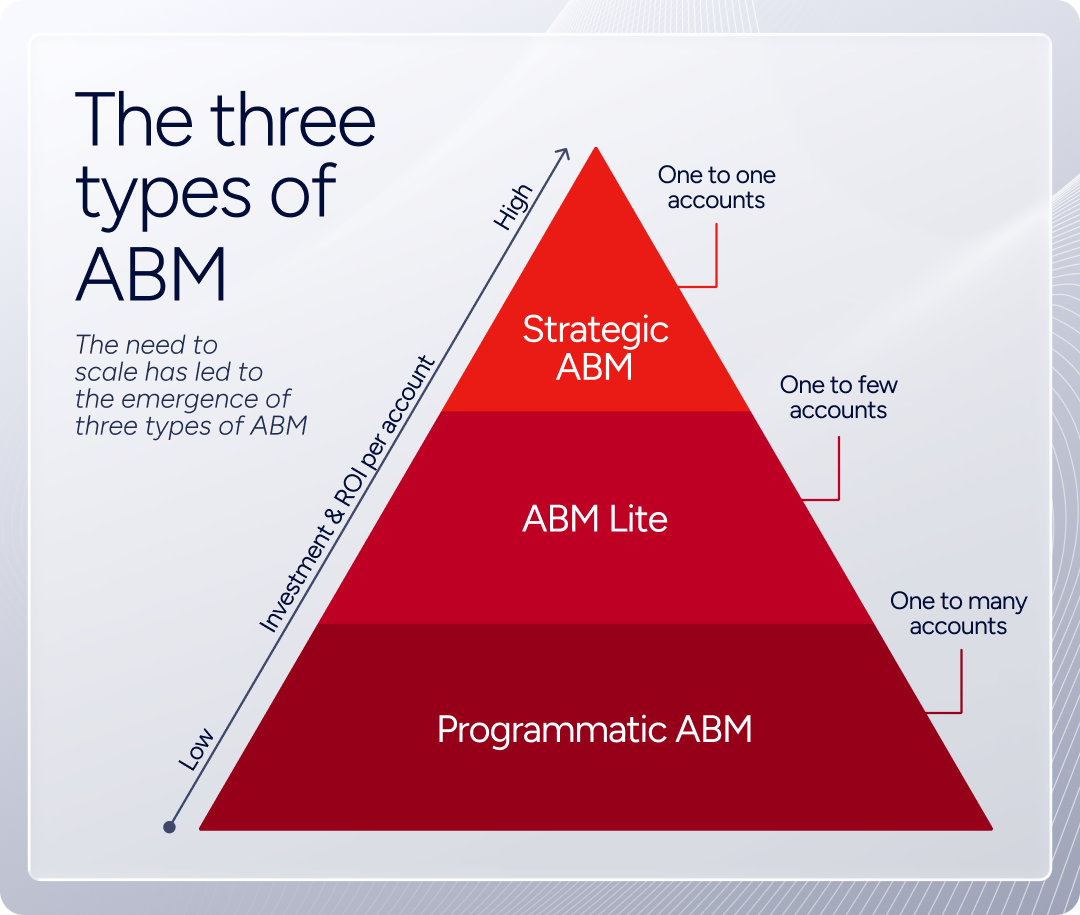
1:1 - Strategic ABM
A one-to-one approach for your highest-value accounts, built on deep research and tight sales alignment. Each account gets a bespoke plan, executive sponsorship, and tailored content, messaging, and experiences across the buying committee.
Investment per account is highest, but so is potential ROI — measured in deal creation, multi-threaded relationships, expansion, and renewals.
1:Few - ABM Lite Strategy
A one-to-few model that clusters lookalike accounts by industry, challenge, or solution. Plays, content, and offers are semi-custom, mixing shared assets with modular personalization for key roles and stages.
It balances relevance and scale, coordinated by small marketing–sales pods and measured by pipeline creation, velocity, and win rate improvements.
1:Many - Programmatic ABM Strategy
A one-to-many motion that uses data, intent signals, and automation to deliver scalable, light personalization at volume. Always-on campaigns across ads, email, and web identify and engage in-market accounts, then route qualified interest to higher-touch tiers. Success metrics emphasize reach, engagement, MQAs, and efficient lead-to-account progression.
Tools That Make ABM Scale
ABM scales when your ABM tech stack connects data, signals, and execution so GTM teams move in sync.
The essentials:
Clean CRM: ABM runs on a solid data foundation, and a cluttered CRM stalls progress before teams can build momentum.
Intent data: Shows which accounts are actively researching or in-market so you’re not just working from static criteria.
Marketing automation: Drives coordinated outreach across email, ads, and nurtures without burning out your team.
Sales orchestration tools: Aligns outbound motions across roles and channels, so buyers get a consistent experience.
Unified dashboards: Gives teams a real-time view of engagement, pipeline movement, and campaign performance without waiting on a weekly report.
For tighter coordination, add engagement orchestration tools that manage timing across outbound, ads, and nurtures so accounts don’t receive conflicting or mistimed messaging. The goal is a consistent cadence of engagement that supports buying teams without overwhelming them.
None of these tools deliver on their own. They work when connected in a system that reflects buyer behavior, where data flows into action, and engagement translates into measurable outcomes. ZoomInfo powers that system by giving GTM teams a real-time view of buyer intent and behavior that drives smarter prioritization and faster movement across every stage of the deal. Teams that want to wire that same buyer intelligence directly into their own AI tools and agents can do so through GTM AI, ZoomInfo's agent-native context layer, which connects ZoomInfo's B2B data and intent signals to any agent or AI workflow via MCP or one API.
How to Personalize ABM Outreach That Actually Lands
If your outreach could be sent to any account in your CRM, it’s not ABM. Buyers don’t respond to recycled value props or generic talking points. Personalization has to prove you understand what they’re dealing with, right now.
That starts with context. Mentioning their industry isn’t enough. A CMO at a growth-stage SaaS company under pressure to reduce CAC prioritizes speed and experiments. An enterprise CMO, concerned with compliance and scale, leans toward risk mitigation and operational control. Intent signals and technographics can tell you which motion to run and when to pivot.
Use real account signals. Hiring spikes, funding rounds, layoffs, tech changes, and leadership moves are the moments when buyers are open to change. That’s where your outreach should anchor.
Effective personalization connects your message to something the account is already doing or struggling with. For example, reference their new product launch and how it likely impacts their sales process, or call out a competitor’s recent move and what it means for their market.
And don’t stop at one contact. Build messages that speak to different roles in the deal. What matters to a CFO isn’t what matters to a RevOps lead. Each one needs a reason to care.
How to use ZoomInfo for Account-Based Marketing
ZoomInfo gives ABM teams a system built for precision. Marketing and Copilot surface firmographic, technographic, and intent data for list building while AI-driven signals highlight heating accounts and active roles. Outreach stays aligned because sales and marketing operate from the same system, and engagement analytics show what’s landing across the buying committee.
High-performing teams use these signals to ground decisions and move accounts forward with evidence.
ZoomInfo ABM Playbook
What follows is a practical, repeatable sequence you can run to plan, activate, and measure account-based programs inside ZoomInfo. Adapt the steps to your tiers, sales model, and campaign calendar.
1. Define your ICP and tiers with data you trust
Enrich your CRM/MAP first to normalize firmographic and technographic fields. This ensures consistent filters and accurate matching.
Build your ICP criteria in ZoomInfo using firmographics (industry, employee bands, revenue, HQ/region), technographics (key systems your solution complements or replaces), and growth indicators (funding, hiring, expansion).
Tier accounts (Tier 1/2/3) based on fit, potential value, and penetration. Keep Tier 1 lists small and high-touch; scale tiers 2–3 with programmatic tactics.
2. Build a dynamic Target Account List (TAL)
Create saved searches that reflect your ICP and automatically update as new companies match.
Import strategic accounts from Salesforce/HubSpot and exclude customers, active opps, and disqualified accounts with suppression rules.
Segment the TAL by tier, region, vertical, and installed tech to align with field coverage and personalized content tracks.
3. Map the buying committee and fill coverage gaps
Identify core roles by stage: economic buyer, technical evaluator, champion, procurement, security/compliance.
Use company and org insights to add decision-makers and influencers with verified emails and direct dials.
Create coverage thresholds by tier (e.g., Tier 1 requires primary + 3 influencers minimum) and set alerts when coverage drops below target.
4. Prioritize with intent, signals, and engagement
Monitor topic-level intent for early- and mid-funnel interest. Combine with company news, tech changes, and hiring “heat” to spot windows of opportunity.
Layer first-party signals with WebSights (de-anonymized site visits, pages viewed) and campaign engagement to create an account-level score.
Define Marketing Qualified Account (MQA) logic by tier. Example: Tier 1 = intent on 2+ topics OR WebSights visit to pricing page + 2 engaged contacts.
5. Align with sales from the start
Sync TALs, contacts, and MQAs to your CRM with clear ownership rules. Pipe account insights, recent activity, and next-best actions to account pages.
Trigger real-time alerts in Slack/Teams when a target account spikes in intent or hits MQA so reps can respond within minutes.
Share weekly shortlists of “heating accounts” and what to do next for each role. Keep one shared source of truth.
6. Activate coordinated, multichannel programs
Advertising: Launch account- and role-based display and social campaigns to reach known and unknown members of the committee. Use creative variants per segment (industry, role, use case).
Email and sequences: Add verified contacts to stage-specific nurtures or SDR sequences. Gate by intent to prioritize high-propensity roles first.
Website and chat: Personalize pages and CTAs for target accounts. Prompt high-fit visitors with fast-lane chat to book meetings with the right rep.
Events and webinars: Build pre- and post-event plays that invite, remind, and follow up at the account and role level; route high engagement to SDRs.
7. Personalize at scale with Copilot
Summarize each target account’s context (industry shifts, tech stack, news) and ask Copilot for role-specific messaging angles by stage.
Generate email, ad, and landing page copy variants tied to the account’s intent topics and pains. Keep a library of approved prompts and brand voice guardrails.
Use Copilot to draft call prep briefs that combine recent signals, engaged contacts, and likely objections by persona.
8. Route and convert inbound with fewer fields
Use FormComplete and Enrich to reduce friction on forms while appending the data sales needs for routing.
Route high-fit, high-intent leads and MQAs to the correct owner instantly; auto-create tasks and calendar holds where appropriate.
For anonymous but high-fit visits via WebSights, trigger account ads and SDR outreach to known contacts at that company.
9. Measure account progression and prove impact
Coverage: % of target accounts with required roles identified; contacts per account.
Reach: Ad impressions and on-site visits from target accounts; unique engaged contacts per account.
Engagement: Content consumption depth, meeting rates, MQA rate, sequence reply rates by role.
Pipeline and revenue: Opportunities created, pipeline per account, velocity, win rate, ACV lift by tier/segment.
Influence: Compare lift in engagement and pipeline among exposed vs. non-exposed target accounts.
10. Maintain data quality and governance
Refresh and dedupe regularly so reps never chase bad records.
Enforce suppression lists for customers, competitors, and compliance.
Review MQA thresholds quarterly to reflect seasonality and campaign learnings.
Three packaged plays to run now
Here are three example plays you can execute using the principles outlined in the playbook above.
Play 1: Competitive Takeout
List: Accounts using a competitor’s platform in your ideal segments.
Signals: Intent on migration topics + org change “scoops” + WebSights visits to integration pages.
Activation: Comparison ads; SDR sequence with a migration checklist asset; webinar with a customer story from the same tech stack.
Copilot prompt idea: “Draft a 120-word outreach for a VP RevOps using [Competitor] highlighting migration risk reduction and 60-day time-to-value. Reference our security certifications.”
Play 2: Expansion into customers
List: Existing customers missing adjacent products or seats.
Signals: New hiring in relevant teams, new regions, or intent on topics your add-on solves.
Activation: Customer-only ads and email nurtures; AM outreach with ROI calculator; executive briefing offer.
Copilot prompt idea: “Summarize expansion angles for [Customer] based on recent hiring and tech adds; suggest a 3-slide talk track for the QBR.”
Play 3: Event-centric ABM blitz
List: Tiered accounts within the event’s ICP radius or sponsor list.
Signals: Pre-event intent spikes and site visits to agenda/sessions.
Activation: Pre-event VIP invites; geo-targeted ads; at-event fast-lane booking; post-event recap tailored by role.
Copilot prompt idea: “Write post-event follow-up for a Security Director who attended our session, anchoring on three key takeaways and a 20-minute assessment CTA.”
Operating cadence
Weekly: Review “heating accounts,” refresh shortlists for SDRs/AEs, and adjust ad budgets toward MQAs
Biweekly: Content and offer testing by role and segment; retire low performers and scale winners
Monthly: Re-score tiers, tune MQA thresholds, and publish an ABM scorecard to marketing and sales leadership
Quick start tips
Start with 50–100 Tier 1 accounts and 3–5 clear signals that predict meetings
Standardize 2–3 hero offers per persona and 2 alternates for testing
Instrument every touch at the account level so you can see progression, not just clicks
This playbook helps teams use ZoomInfo’s data, intent, and activation capabilities to find timing advantage, personalize at scale, and keep marketing and sales locked on the same set of accounts and signals.
How to Use LinkedIn for Account-Based Marketing
LinkedIn is where your buyers spend time before they enter a sales cycle. They scan for trends. They size up competitors. They form opinions about the problem you solve before any outreach reaches them. That’s why LinkedIn should be the first surface where your ABM motion shows up and where it continues as deals progress.
Start by syncing your target account list to LinkedIn Matched Audiences. Use that to run ads that align with where those buyers sit in the funnel. Early-stage? Push trends and timely problems. Mid-funnel? Drop role-specific case studies or comparisons that show how you help teams like theirs win.
Don’t just post product content and hope it sticks. Strong LinkedIn content usually does three things:
Frames a problem your target account is already feeling
Offers a timely POV on their industry or buyer journey
Connects your solution to a priority they’ve shown interest in
Sequence matters. Paid campaigns can open the door, but organic engagement builds trust. Have your SDRs interact with posts from target buyers before reaching out. When a cold email hits after three or four lightweight LinkedIn touches, it doesn’t feel cold.
ZoomInfo data helps teams time it right. Use intent signals and contact-level engagement to trigger ad delivery and outbound when buyers are showing real interest.
What you measure should reflect account progress. Watch which accounts engage, how many stakeholders enter the process, and how LinkedIn touchpoints show up in your pipeline. If your campaigns aren’t driving sales activity, it’s not a LinkedIn problem. It’s a strategy problem.
How to Run Multi-Channel ABM Campaigns
ABM builds coordinated pressure across the channels that actually move buyers. That means running campaigns where your targets already spend time and delivering a message that evolves as they move through the funnel.
Use digital ads to stay visible with buying committees across accounts. Tailor them by role, industry, or trigger. A CFO and a RevOps lead shouldn’t see the same creative.
Pair that with sales outreach and email that shows real research. Templates rarely land. Outreach hits when it reflects what the account’s doing and what the contact actually owns.
Content is the fuel across every channel. Think ROI calculators for the economic buyer, trend reports for the exec, and use-case stories for the day-to-day users. Build for relevance, not volume.
Web personalization matters too. If an account visits your site, they should see messaging that reflects who they are, not a generic homepage CTA.
Use events and webinars to create real-time interaction. Small formats often work best. Fewer signups, more signal. Let your buyers talk, not just listen.
And don’t ignore direct mail or gifting, but use it with precision. A well-timed, relevant send can reopen a stalled deal or surface a new stakeholder.
ABM Metrics That Will Define your Account Playbook
You can’t optimize ABM if you’re not measuring what moves revenue. The strongest teams track both strategic and operational signals to see what’s working and where the motion breaks down.
Strategic metrics show impact:
Account engagement: Are the right people in the right accounts showing real activity across channels?
Pipeline created: How much qualified pipeline is tied to your named accounts?
Win rate: Are targeted accounts closing at a higher rate than non-targeted ones?
Revenue influence: What deals were touched by ABM plays and converted?
Pipeline velocity: How quickly are targeted accounts moving from engagement to closed-won, and is that faster than your broad-based motion?
Operational metrics show execution:
Meetings booked: Are reps turning account interest into real conversations?
Stakeholder coverage: Are you multi-threaded, or stuck with a single contact?
Content signals: Are key roles engaging with content designed for them?
Channel performance: Which plays such as email, ads, or events are driving measurable movement?