
Buyers rarely start a purchase with a blank page. By the time someone fills in your demo form, they usually have a few vendors in mind, chosen over months of reading, asking peers, and asking AI assistants. If you are not on that list, you are competing for a place that is already taken.
This guide shows how the B2B buyer shortlist forms and gives six ways to get on it, including how to get recommended in AI answers. It also covers how to spot buyers while they are still researching, and how to tell whether you made the list.
What Is a B2B Buyer Shortlist?
A B2B buyer shortlist, or vendor shortlist, is the small group of vendors a buying team seriously considers for a purchase. It is often called the day-one shortlist, because it usually exists before the formal stages of the B2B buyer journey begin.
Buyers build it from what they already know and trust. Four sources do most of the work:
Past experience and familiarity. Vendors they have used before, or have heard of often enough to trust.
Peers and communities. Recommendations from colleagues, industry groups, and people in similar roles.
Search and AI answers. The vendors that come up when they search for the problem or ask an AI assistant.
Reviews and coverage. Review sites, analyst reports, and editorial content that confirm a vendor is a safe choice.
The timing is what makes the shortlist so hard to break into. Forrester's 2024 Buyers' Journey Survey found that 92% of B2B buyers start with at least one vendor in mind, as reported by Digital Commerce 360. The formal evaluation then tends to confirm a choice that is already half made.
For marketing, that changes the goal. A vendor added late has to displace a favorite the buyer trusts. A vendor on the list from the start only has to confirm what the buyer believes.
Why Late Signals Miss the Shortlist
Many marketing teams still prioritize accounts from signals they own, such as website visits, chat conversations, and demo requests. ZoomInfo's 2026 marketing predictions flag the problem with that. Those signals usually arrive after opinions have formed and shortlists have taken shape.
The research has moved to places marketers cannot easily track. Buyers learn from editorial sites, newsletters, communities, Reddit, YouTube, and AI answers, and they consume a lot before they talk to sales. Buying decisions also involve more people than before, and each of them forms a view of your company along the way, often without ever visiting your site.
The answer is to work on both ends at once. Earn familiarity before the buyer starts looking, and detect latent demand early enough to engage while the list is still forming.
How to Get on a Buyer's Shortlist
The six steps below cover both ends. The first three build preference before a buyer starts looking. The last three help you find and win buyers while the shortlist is still open.
1. Be Known for One Problem Before Buyers Start Looking
Buyers shortlist vendors they associate with the problem they are trying to solve. If your message changes by channel or by quarter, no single association sticks.
Own one problem. Pick the problem your best customers bought you to solve and make it the center of your brand storytelling. Use the same words on your site, in ads, and in sales conversations.
Write for the people who buy. Build messaging around real buyer personas and your ideal customer profile, so the right accounts recognize themselves in it.
Stay consistent over time. Familiarity builds through repetition. A clear message repeated for a year does more than a new campaign every quarter.
2. Get Recommended in AI Answers
AI assistants now do much of the early research for buyers. ZoomInfo's 2026 predictions describe an era in which AI agents handle the initial research, evaluation, and shortlisting. If your value proposition is not structured in a way AI can parse, summarize, and recommend, you are invisible before the conversation starts.
Getting recommended in AI answers is the job of answer engine optimization (AEO). The same report says your messaging should answer four questions clearly, in a form both people and AI can read:
Why you go to market. The problem your company exists to solve.
Who the product is for. The company types, sizes, and roles you serve.
What problem it solves. In the words buyers use when they search or ask an AI assistant.
What outcome it delivers. The measurable result a customer can expect.
Then make those answers easy to find and hard to misread:
Lead pages with the answer. Put a plain one-sentence description of what you do at the top of key pages, followed by detail.
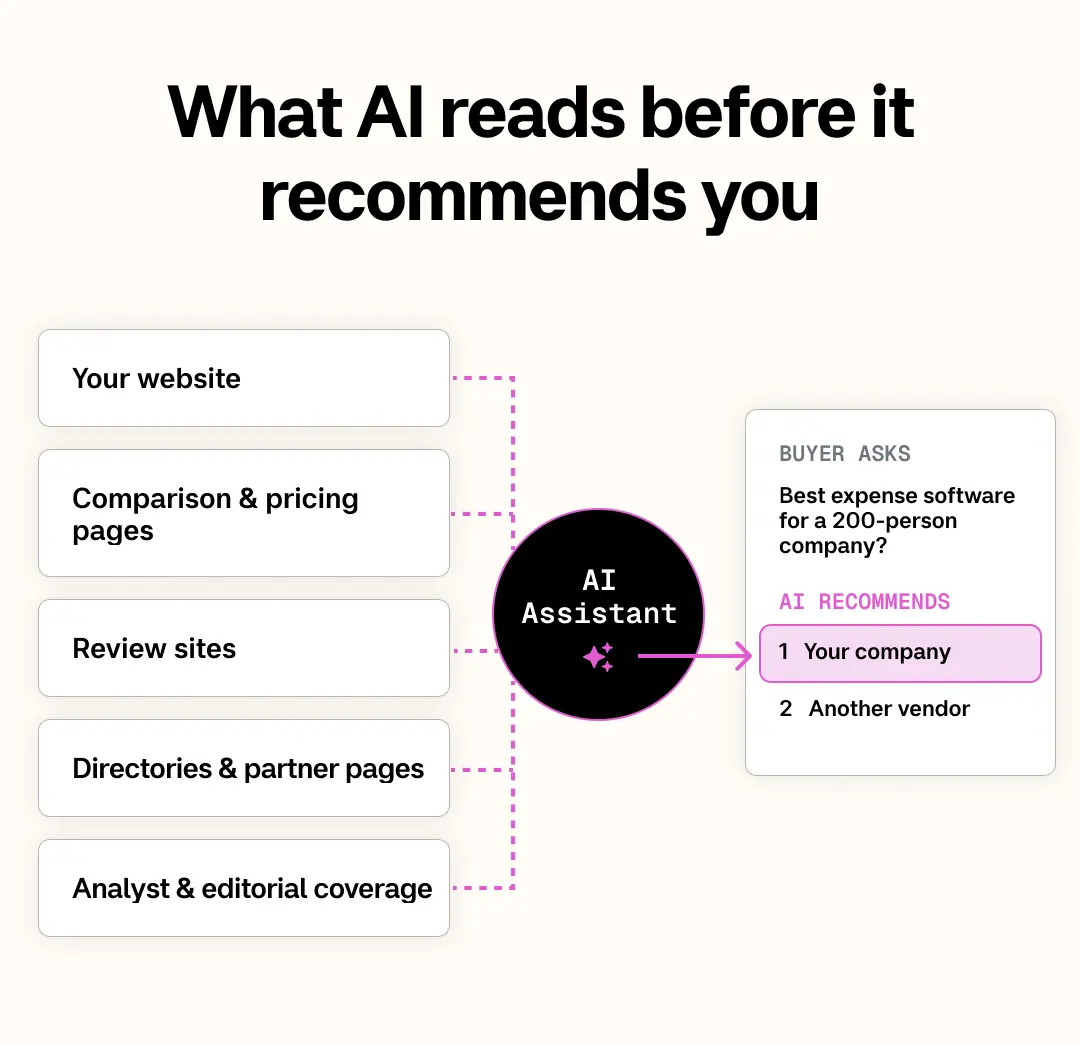
Publish the pages buyers ask about. Comparison pages, pricing information, use cases, and FAQs give AI assistants specific content to cite.
Describe yourself the same way everywhere. Keep your category, audience, and core claims consistent across your site, review sites, directories, and partner pages, so AI tools see one clear picture.
Earn third-party mentions. AI answers draw on reviews, analyst coverage, and editorial content, which makes word of mouth and referrals part of AEO too.
Test it monthly. Ask the major AI assistants the questions your buyers ask, such as "best tools for [your problem] for [your segment]," and track whether you appear and how you are described.
3. Show Up Where Buyers Research
Buyers form opinions in channels you do not own, so your presence has to go to them. That means LinkedIn and social media, industry newsletters, podcasts, communities, events and webinars, and review sites.
Programmatic content distribution is one of the most scalable ways to do it. Place useful offers alongside the content buyers already consume, then turn that attention into opted-in leads you can follow up with. It bridges the gap between what buyers learn off your site and what they do on it.
ZoomInfo Marketing runs this kind of motion. It targets programmatic and display advertising using more than 300 company attributes and buying signals. When a signal fires, the campaign launches across the open web automatically, without manual list building.
4. Spot Buyers During the Invisible Research Phase
Buyers leave buying signals while they research, even when they never visit your site. Reading those signals early, the core of intent-based marketing, lets you engage while the shortlist is still forming.
Intent data. Intent data shows which accounts are researching your category or your competitors. Person-level intent goes a step further and shows who inside the account is leaning in.
Website visitors. Website visitor identification turns anonymous visits to pricing, comparison, and case study pages into named accounts.
Job changes. A new executive often reviews existing vendors in their first months. Job change alerts flag those arrivals as they happen.
Company events. Funding rounds, expansions, and leadership changes reset priorities. Scoops surface them as they break.
Speed decides whether the signal is still worth anything. John Lloyd, Manager of Go-to-Market Consulting at ZoomInfo, said on ZoomInfo's Revenue Architects podcast:
"If that trigger is based on a signal, that signal has to have recency... you're deprecating so quickly if you're waiting too long to take action on those signals."
The same podcast puts numbers on it. In an episode on signal decay, Florin Tatulea and John Lloyd note that acting on a website visit within 20 minutes can lift conversion 2x to 3x. One team raised its call connect rate from 3% to 12% in a week by triggering outreach on an in-market score that combined intent, website, and social engagement, rather than on any single signal.
Seismic's sellers work from research-phase signals like these every day. Here is what that did for their pipeline.

"The AI chatbot that's given all that context has helped us craft very specific account- and persona-based messages. And people have responded to them right away."
That is why real-time intent data matters more than a weekly report. ZoomInfo connects these signals in one place. Its AI signal stacking combines account and contact signals to identify moments of buyer readiness, and GTM Studio routes the accounts, launches campaigns, and triggers rep actions in real time. Sales sees the same signals in GTM Workspace, alongside verified contacts for the people doing the research. It all draws on the GTM Context Graph, which processes more than 1.5 billion data points a day.
5. Reach the Whole Buying Committee
The shortlist is a group decision. Winning over one contact leaves everyone else on the committee forming their views without you.
Map the committee. Use stakeholder mapping to identify the roles that influence the decision, from the economic buyer to the technical evaluator.
Tailor content by role. Finance, IT, and the end-user team each care about different outcomes. Multi-threading campaigns by persona gives each role a reason to put you on the list, and personalization at the account level keeps the message relevant.
Run it as one account motion. Follow an ABM playbook so account-based marketing and sales outreach target the same people with the same message. Shared signals and targets keep sales and marketing aligned.
6. Make Yourself the Safe Choice
Buyers shortlist vendors they can defend to their colleagues. Reducing perceived risk is often what turns familiarity into a place on the list.
Show proof from similar companies. Case studies and logos from the buyer's industry and size reassure more than a generic customer count.
Make reviews easy to find. Buyers and AI assistants both read review sites. Ask happy customers for reviews, and respond to negative reviews openly.
Signal pricing and implementation. Even a price range or a typical implementation timeline answers questions buyers would otherwise take to a competitor.
Publish security and compliance information. For many buying committees, IT and legal can remove you from the list before anyone else weighs in.
A trustworthy brand is built from all of these, and it makes every other step work harder.
How to Tell If You're on the Shortlist
Lead volume will not tell you whether you are on the shortlist. These signals track presence in the buyer's mind, often months before a form fill.
Signal | What it tells you | How to track it |
AI answer presence | Whether AI assistants recommend you for your category | Run the same set of buyer prompts every month and record where you appear |
Branded search | Whether more people know your name | Search volume for your brand and your brand plus category terms |
Target-account research | Whether your accounts are researching your category | Intent data and identified visits to pricing and comparison pages |
Self-reported source | Where buyers first heard of you | A "How did you hear about us?" field on demo and contact forms |
Evaluation invites | Whether you are included in formal processes | RFPs and evaluations you are invited into, compared with last year |
Inbound win rate | Whether buyers arrive already convinced | Win rate on deals that start inbound compared with outbound |
Combine these with your attribution model and ABM success metrics to see which demand generation programs build shortlist presence and which only capture demand that already exists.
Common Mistakes That Keep You Off the Shortlist
A few habits quietly keep good vendors off the list. Watch for these:
Waiting for the form fill. By the time a buyer asks for a demo, the shortlist is usually set. Engage during the research phase, especially as inbound demand declines.
Leading with features. Buyers shortlist vendors that understand their problem. Lead with the problem and the outcome.
Targeting a single contact. One champion cannot carry a decision made by a whole buying committee.
Acting on stale signals. An intent spike from last month is history. Signals lose value fast, so route them to the right team the same day.
Passing signals without context. A rep told only that an account is in market sends a generic email. Share what the account researched and who is involved.
Get on the List Before the Buyer Starts Writing It
Getting on a buyer's shortlist comes down to two things. Build familiarity before buyers start looking, by owning one problem, showing up in AI answers and the channels buyers trust, and making yourself the safe choice. Then read the research-phase signals early enough to engage the whole buying committee while the list is still open.
See which accounts are researching your category before they reach out. Book a ZoomInfo demo to spot buyers in the research phase and engage them while the shortlist is still open. ZoomInfo is free to start with consumption credits based on usage.
Frequently Asked Questions
These are the questions marketing and revenue teams ask most often about buyer shortlists.
How do you get on a buyer's shortlist?
Build familiarity before buyers start looking by owning one clear problem, showing up in AI answers and the channels buyers research in, and reducing the perceived risk of choosing you. Then use intent and website signals to spot accounts in the research phase and engage the whole buying committee before the shortlist closes.
What is a vendor shortlist?
A vendor shortlist is the small group of vendors a buying team seriously evaluates for a purchase. In B2B, it usually forms during independent research, before buyers contact any vendor, and most buyers end up choosing from it.
When do B2B buyers build their shortlist?
Usually during independent research, before they contact any vendor. Buyers draw on past experience, peer recommendations, reviews, search, and AI answers, then use the formal evaluation to confirm a choice that is largely made.
How do you get recommended in AI answers?
Make it easy for AI assistants to understand what you do, who it is for, what problem it solves, and what outcome it delivers. Lead key pages with a plain description, publish comparison, pricing, and FAQ content, keep your description consistent across your site and third-party sites, and test buyer prompts in AI assistants every month.
How do you know if you're on a buyer's shortlist?
Look for signals beyond lead volume. These include whether AI assistants recommend you, growth in branded search, intent and pricing-page activity from target accounts, how buyers say they heard of you, and how often you are invited into formal evaluations.
What signals show a buyer is building a shortlist?
Common signals include rising intent on your category or competitors, repeat visits to pricing and comparison pages, new executives in key roles, and company events such as funding or expansion. Acting on these signals quickly matters, because their value drops fast.
