
AI transformation is often described as a technology initiative. Our experience has shown that it is much more than that. It is a shift in how teams work, how decisions are made, and how quickly an idea can move from a business need to a working solution.
Over the past several months, our Enterprise Technology product and engineering teams have been evolving toward an AI-first operating model. This transformation has been made possible through strong executive commitment. Our CEO, Henry Schuck, has actively championed and steered AI transformation across the company, with support from the executive leadership team.
That leadership has helped create the focus and momentum for teams to rethink how work gets done.
AI-first is more than using AI tools
For our team, becoming AI-first does not mean adding AI to a few isolated tasks. It means incorporating AI into the full product-delivery lifecycle—from scoping and prototyping to development, testing, and deployment.
We support a broad range of finance functions, including procurement, accounts payable, accounting, tax, and FP&A. These functions involve complex processes, high expectations for accuracy, and important governance requirements. AI gives us an opportunity to make these experiences more efficient while maintaining the operational discipline enterprise systems demand.
The goal is not automation for its own sake. It is to identify where intelligent, targeted solutions can remove friction, reduce manual effort, and help our business partners make better and faster decisions.
The product manager role is changing rapidly
One of the most meaningful parts of this transformation has been the evolution of the product manager role.
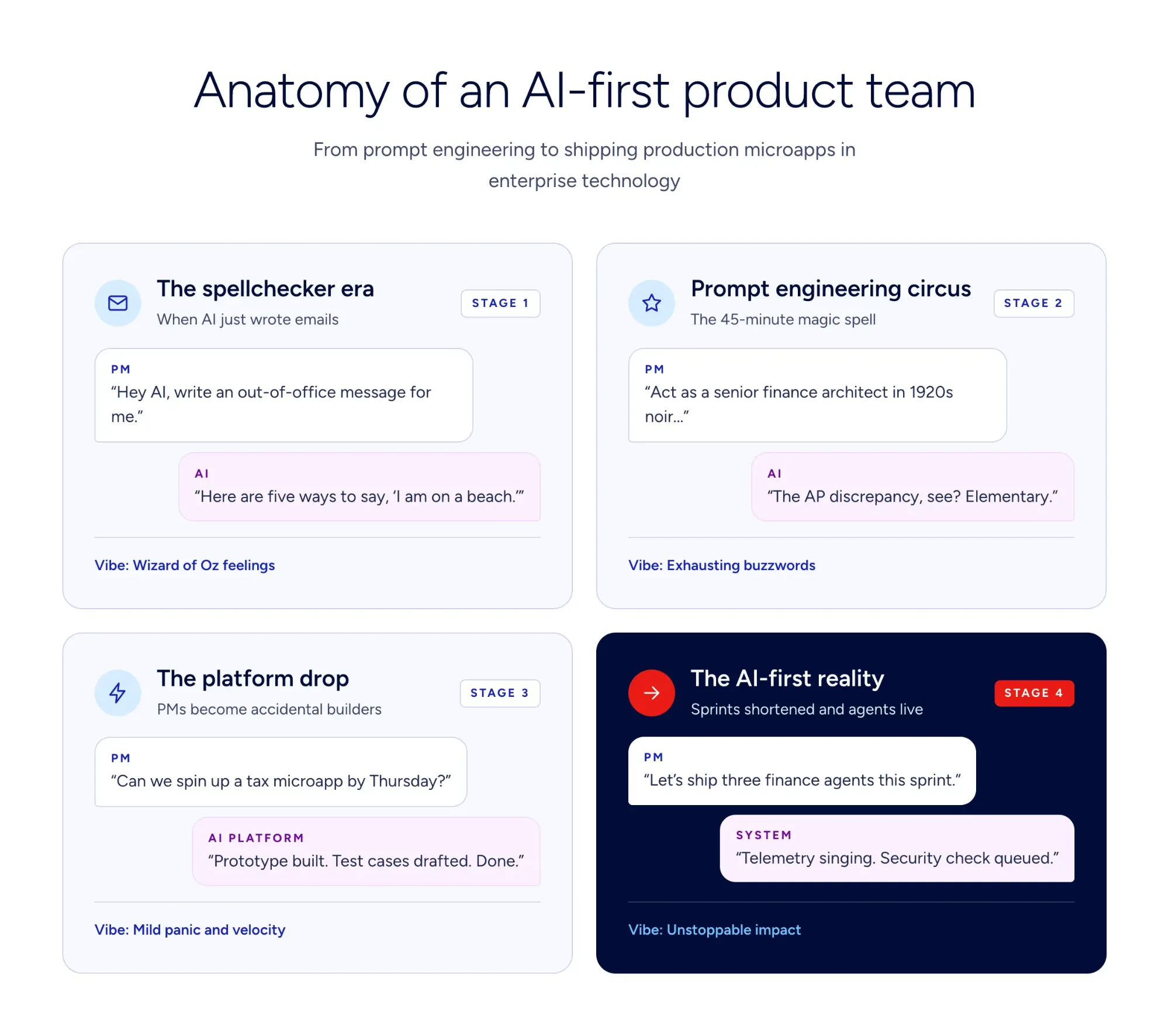
Traditionally, product managers identified requirements, aligned stakeholders, prioritized backlogs, and worked closely with Enterprise Technology software engineers to turn requirements into delivered capabilities. Those responsibilities still matter. But AI has expanded what is possible.
Our product managers are no longer limited to defining an opportunity and handing requirements to engineering. With an AI platform built by our R&D engineering organization, they can create quick prototypes, demonstrate solutions early, and help turn ideas into microapps and AI agents.
That changes the nature of product work.
Instead of waiting for a fully developed solution to validate an idea, product managers can bring a prototype into a discussion much earlier. Instead of relying only on written requirements to communicate a vision, they can demonstrate an experience. And instead of waiting through long feedback cycles, they can gather input, refine, and iterate more quickly.
This does not eliminate the need for engineering, product rigor, or cross-functional collaboration. It makes those partnerships more effective by enabling better conversations and earlier validation.
Shortening the path from idea to production
The biggest business impact has been the compression of the end-to-end delivery cycle.
Our traditional sprint-planning model remains valuable for larger, more complex initiatives. For the right use cases, however, the AI-first model has enabled a much faster path through:
Scoping the problem and defining the value
Building a functional prototype
Validating the experience with business stakeholders
Developing and testing the microapp or agent
Refining the solution and moving it into production
We are now able to deliver microapps and agents in less than half the time it took through a traditional sprint-planning cycle. Many have already moved into production in record time.
The benefit is not simply speed. Faster delivery creates a shorter learning loop. We can validate whether a solution is useful earlier, refine it based on real feedback, and focus product and engineering capacity on the opportunities with the greatest potential impact.
Moving quickly requires responsible guardrails
An AI-first operating model must be built with governance at its foundation.
As we moved quickly, we also had to navigate important questions around data governance, security controls, access controls, and responsible use. In many cases, the platform itself was evolving while product managers were building microapps and agents on top of it.
That required close partnership among product, engineering, security, platform teams, and business stakeholders. It also reinforced an important lesson: speed without controls is not transformation. Sustainable transformation requires both innovation and discipline.
For enterprise teams, responsible AI needs to be part of the product process from the beginning—not added at the end as a compliance checkpoint.
Leadership support made the difference
Transformations of this scale do not happen through individual enthusiasm alone. Leadership sponsorship matters.
Our CEO’s commitment to AI transformation and the support of our executive leadership team have helped create the conditions for teams to experiment, move with urgency, and learn quickly.
That focus has helped shift AI from a future-looking concept into a practical way of working today.
What we have learned so far
Our journey is still underway, but several lessons are already clear:
Start with business problems, not technology. The strongest AI use cases address meaningful workflow, decision-making, or productivity challenges.
Prototype early and make ideas tangible. A working prototype can create better feedback and alignment than a document alone.
Equip product managers to build and experiment. Giving product managers the ability to prototype and demonstrate solutions accelerates discovery and improves product conversations. It complements—not replaces—the work of engineers.
Build governance into the process. Data, security, access, and platform controls must evolve alongside the pace of innovation.
Measure outcomes, not activity. Success is not simply the number of agents or microapps created. It is the business value they deliver and the cycle time they improve.
Looking ahead
The most exciting aspect of becoming AI-first is not just the delivery speed we are seeing today. It is the new capability we are building as a team.
Our product managers are evolving into more strategic, hands-on, and technically fluent leaders. Our teams are learning how to turn ideas into usable solutions more quickly. And our business partners are seeing what becomes possible when product, engineering, and AI platforms work together in a more integrated way.
We are still learning, strengthening our controls, and evolving our platform. But one thing is clear: the way we build enterprise capabilities is changing rapidly.
AI is not replacing the core disciplines of product management and engineering. It is helping us apply those disciplines with greater speed, creativity, and impact.
I am proud of how quickly our product managers, engineers, platform teams, and business partners have embraced this change. The progress so far is only the beginning.