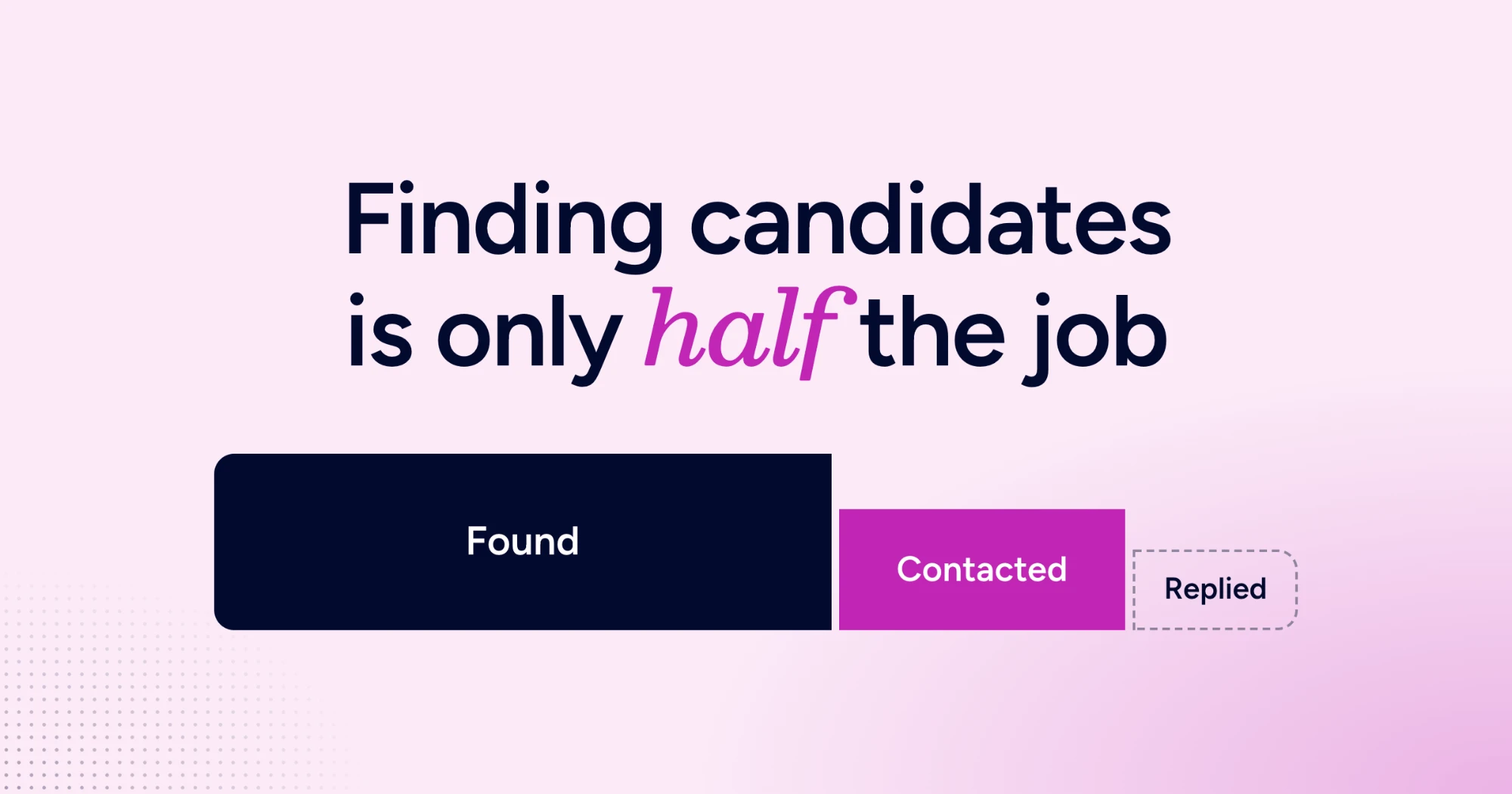

I have often said that recruiting is not about how fast you find talent. It is about whether you can get them to respond.
That distinction seems to get lost every time a new recruiting technology promises to make sourcing faster.
How quickly can you build a shortlist? How many candidates can an AI agent discover? How much time can we eliminate from the process? We celebrate speed as though the recruiter with the fastest search is automatically the recruiter with the best results.
Meanwhile, the candidate we spent all that time finding hasn't answered the email.
And there we are, staring at another beautifully organized list of qualified people who may never become anything more than names in a database.
Finding talent matters. Of course it does. But the real work begins when we try to turn that discovery into a conversation.
Engagement is the part of recruiting we do not talk about nearly enough. It is the quiet hinge between identifying someone who could do the job and discovering whether they might actually want it.
Artificial intelligence has made candidate discovery faster and outreach easier to produce. What it has not done is eliminate the need for relevance, accurate information or a message worth answering.
That is why the next evolution of AI recruiting should focus on connecting candidate discovery with meaningful engagement, not simply generating more activity.
What Is AI Candidate Sourcing and Engagement?
AI candidate sourcing and engagement is the use of artificial intelligence to help recruiters identify qualified candidates, evaluate their relevance and support personalized communication with those individuals.
Sourcing answers the question of who might be qualified. Engagement helps answer whether that person is interested in having a conversation.
Those are different problems, but they are closely connected.
A recruiter might find someone through a sourcing platform, verify their professional information elsewhere, locate contact details through another provider and then open an email application to write a message.
If the candidate responds, the recruiter may need to update another system to document the interaction.
We have become remarkably comfortable with this collection of disconnected activities.
AI recruiting agents create an opportunity to bring more of that work together. Rather than simply returning search results, an agent can interpret a hiring objective, discover relevant candidates and support subsequent steps such as evaluation and recruiter-approved outreach.
The objective should not be to remove the recruiter from the process. It should be to eliminate unnecessary work between identifying a promising candidate and beginning a meaningful conversation.
Why Sourcing Speed Is the Wrong Measure of Recruiting Success
Imagine two recruiters working on the same difficult position.
The first uses AI to identify 300 candidates in minutes. The second spends more time refining the search and produces a shortlist of 40 people whose experience is closely aligned with the opportunity.
Which recruiter is more productive?
We cannot answer that question by looking at the size of the lists or the time required to produce them.
We need to know what happens next.
How many candidates are actually relevant? How many have accurate contact information? How many respond? How many express genuine interest? And how many conversations ultimately progress toward a hiring decision?
Those are the outcomes that give sourcing activity meaning.
A list of 300 candidates may be enormously valuable. It may also create hours of additional work if the recruiter needs to validate employment histories, locate contact information and eliminate people who were never particularly relevant.
Speed is useful when it removes unnecessary work. It becomes considerably less impressive when it simply delivers the next pile of work faster.
This is why the conversation about candidate quality and AI recruiting needs to extend beyond discovery.
A qualified candidate is not necessarily an interested candidate. And a candidate who never receives the outreach is not much of a recruiting opportunity.
The Research Is Clear: Engagement Is a Craft
We have plenty of evidence that how recruiters communicate matters.
Between January and June 2025, a recruiting email benchmark study examined 2.7 million recruiter emails to understand what influenced candidate engagement.
The findings revealed meaningful differences in how messages performed.
AI-written emails recorded a 60.4% open rate compared with 56.3% for human-written emails. Reply rates were also higher, at 17.6% compared with 13%.
Those results suggest AI can be useful in recruiting outreach. They do not mean every recruiter should hand the entire process to a language model and hope for the best.
The same research showed how much the details mattered.
Emails between 50 and 150 words generally performed best, with reply rates reaching 17.2% for messages between 50 and 100 words. Subject lines containing five to nine words performed well, while adding two meaningful variables, such as candidate and company names, was associated with reply rates of 23.9%.
The study also found that three to four emails captured approximately 90% to 95% of replies within the sequences analyzed, with very little incremental return beyond the fourth message.
These are historical observations from one large outreach dataset, not universal rules for every recruiting campaign. But they reinforce something experienced recruiters already understand.
Engagement requires thought.
The subject line matters. The length of the message matters. The relevance of the opportunity matters. And knowing when to stop contacting someone matters just as much as knowing when to follow up.
AI can help with the mechanics. The recruiter still needs to understand the person receiving the message.
Bad Contact Data Can Ruin Excellent Outreach
Before we debate whether an email should contain 80 or 120 words, perhaps we should establish whether it is going to reach the right person.
That seems like a reasonable place to start.
Unfortunately, inaccurate contact information remains a persistent problem in recruiting.
In its 2026 report, The Confidence Gap: Why Verified Data Is the Foundation of Modern Recruiting, Aptitude Research found that 73% of respondents said candidate emails bounce often or sometimes.
Another 66% estimated that at least 15% of their outbound candidate outreach never reaches the intended recipient because of inaccurate contact information.
Think about the work involved in building a candidate list, evaluating profiles, researching professional backgrounds and developing personalized outreach.
Now consider how much of that effort becomes irrelevant when the message never arrives.
The recruiter could write the greatest email in the history of talent acquisition. It could have the perfect subject line, a compelling opportunity and an irresistible call to action.
If the address is wrong, none of that matters.
This is why verified talent data is not simply a sourcing consideration. It is an engagement requirement.
Accurate professional information helps recruiters identify relevant candidates. Reliable contact information gives those recruiters an opportunity to reach them.
And current career and company context helps make the communication more meaningful.
The quality of the data underneath the recruiting workflow affects every step that follows.
Personalization Is Not a First Name and a Compliment
Candidates are not impressed because you inserted their first name into a template.
They are also unlikely to be overwhelmed by the revelation that you came across their impressive profile and wanted to share an exciting opportunity.
Please stop telling people you came across their profile. We know how sourcing works.
The problem with generic recruiting outreach is not that it lacks enthusiasm. It is that it rarely explains why the recipient should care.
Meaningful personalization begins with relevance.
Why did you identify this person? What about their professional experience makes them a potential fit? What might make the opportunity interesting enough to justify a conversation?
Those are the questions that should inform the message.
If someone has built enterprise risk dashboards and the hiring team needs a leader with experience developing similar systems, say so.
If a candidate has spent years managing complex customer relationships in a highly regulated industry, explain why that experience matters to the role.
Give the person a reason to believe you understand their background.
AI can help recruiters translate that information into concise, thoughtful outreach. It can draft messages, suggest subject lines and reduce the time required to get started.
But without accurate professional context, it can also produce a remarkable amount of polished nonsense.
Candidates see through superficial personalization.
It is parsley on a bad steak, and no one is coming back for seconds.
What AI Does Well, and Where Recruiters Still Matter
I am not particularly interested in the argument that AI-written recruiting emails are inherently good or bad.
That debate misses the point.
AI is useful when it helps recruiters perform work more effectively. It can provide a starting structure, generate message variations, summarize relevant professional information and help maintain consistency across outreach.
Those are worthwhile capabilities.
But recruiters still need to decide which information matters.
A language model might produce three paragraphs explaining why a candidate is a strong fit. A recruiter with good judgment can recognize that the recipient needs two sentences and a straightforward question.
AI may suggest several subject lines. The recruiter needs to determine which one accurately represents the opportunity without sounding like another marketing campaign.
And when a message feels generic, the recruiter needs to recognize that the problem is not necessarily the writing.
It may be that the person should never have been on the outreach list in the first place.
That is where discovery and engagement become inseparable.
Better candidate discovery provides the context for better outreach. Better outreach creates the opportunity for meaningful conversations. And those conversations help recruiters understand whether the initial assessment was correct.
Let AI get you to good. Then apply your own judgment to make the communication worth answering.
Why More Recruiting Emails Are Not the Answer
There is an uncomfortable temptation in recruiting automation.
When response rates disappoint, the easiest solution is often to increase volume.
Send another hundred messages. Add another follow-up. Expand the list. Adjust the cadence.
Eventually, the dashboard looks more productive, even if the underlying problem remains exactly the same.
But if the candidates are poorly matched, the contact information is inaccurate or the message gives people no reason to respond, increasing outreach volume simply magnifies those weaknesses.
Consider a recruiting campaign with a 10% reply rate.
Before doubling the number of emails, I would want to understand why the other 90% did not respond.
Were the candidates relevant? Did the messages reach the intended recipients? Was the subject line too generic? Did the outreach explain the opportunity clearly? Was the recruiter contacting people whose backgrounds made sense for the role?
Not every unanswered message represents a mistake. Candidates are busy, timing matters and some people simply are not interested.
But those are reasons to examine performance, not reasons to stop thinking.
A good recruiting strategy uses data to learn.
A bad one uses automation to repeat the same activity at a higher volume.
How AI Recruiting Agents Connect Discovery and Engagement
Traditional sourcing software primarily helps recruiters find people based on search criteria.
The recruiter defines the titles, keywords, companies, locations and other parameters, reviews the results and determines what happens next.
That approach can work well, but it depends heavily on the recruiter's ability to anticipate the relevant backgrounds worth searching for.
An AI recruiting agent can approach the problem differently.
Rather than relying exclusively on exact titles and keywords, an agent can interpret a hiring objective and reason across professional information to help identify people whose skills, career paths and experience may align with the opportunity.
That can expand discovery beyond the obvious candidate pool.
But the more interesting opportunity is what happens when the information used to identify a candidate also supports the next step.
If someone was discovered because of relevant industry experience, that context can inform the outreach. If their career progression suggests transferable skills, the recruiter can explain why those skills are relevant. If accurate contact information is available, the recruiter has a practical way to initiate the conversation.
Discovery becomes more useful when it leads naturally into engagement.
The goal is not to have an AI agent send as many emails as possible.
It is to help recruiters find people worth contacting, understand why those people matter and take the next step without reconstructing the entire candidate profile across multiple systems.
How Talent Autopilot Supports Candidate Discovery and Engagement
Talent Autopilot is ZoomInfo Talent Solutions' AI recruiting agent, powered by ZoomInfo's verified professional data.
Recruiters begin by describing the person they need to hire.
Talent Autopilot interprets the hiring objective and reasons across professional information, including skills, career history and company intelligence, to help discover qualified candidates traditional searches might miss.
Recruiters can review the candidates it identifies, refine the hiring objective and determine which people warrant further consideration.
The workflow does not stop at discovery.
Once recruiters approve candidates for outreach, Talent Autopilot supports personalized email engagement through connected Gmail or Outlook accounts.
The agent also provides engagement tracking and candidate response classification, helping recruiters understand what happens after outreach begins.
This is where the relationship between better data and better discovery becomes particularly important.
The professional information supporting candidate discovery can also provide relevant context for engagement. Recruiters can move from understanding why someone may be a fit to initiating a conversation without treating those activities as unrelated tasks.
Talent Autopilot does not predict whether someone is interested in changing jobs, and it does not guarantee a response.
Recruiters remain in control of outreach approval and candidate decisions.
The purpose is to help recruiters spend less time on manual sourcing work and more time engaging relevant people.
Learn more about Talent Autopilot.
A Candidate's Interest Is Not Something You Can Automate
There is one part of recruiting I would be reluctant to hand over to any algorithm.
Deciding whether someone wants the job.
Professional data can tell us a great deal about a person's career. It can provide employment history, skills, company information and useful context about professional progression.
But it cannot reliably tell us what someone wants next.
A candidate who accepted a promotion last month might still be interested in a different opportunity. Someone who has remained at the same organization for years may be perfectly happy.
And a person who appears ideal for the role may have personal or professional priorities that make the opportunity completely irrelevant.
That uncertainty is not a flaw in recruiting technology.
It is the reality of working with human beings.
AI can help recruiters identify someone worth contacting. Accurate data can help them understand the person's professional circumstances. Personalized outreach can create a better opening for a conversation.
But interest is established through engagement.
The candidate still gets to decide whether to respond, whether to learn more and whether the opportunity makes sense.
Recruiting technology should respect that distinction rather than pretend it can eliminate it.
How Should Recruiting Teams Measure Candidate Engagement?
If recruiting organizations want to understand whether AI is improving their results, they need to measure more than sourcing speed and outreach volume.
The first question is whether the candidates being discovered are genuinely relevant to the hiring objective.
A large candidate list may be useful, but only if the people on it have experience that makes sense for the opportunity.
The second question is whether recruiters can reliably contact those individuals.
Email delivery and contact data accuracy matter because outreach that never reaches the intended recipient cannot produce a conversation.
The third question is whether candidates are engaging.
Total response rates provide useful information, but interested responses are often more meaningful than replies alone. Someone declining an opportunity has responded, but that response does not represent the same recruiting outcome as someone requesting a conversation.
The fourth question is whether those conversations progress.
Qualified conversations, hiring manager acceptance and interview progression can help teams understand whether their sourcing and engagement efforts are producing candidates worth considering.
These metrics should be interpreted together.
A high response rate is not necessarily a success if the candidates are poorly matched. A fast sourcing process is not especially valuable if recruiters spend the time they saved correcting inaccurate information.
And sending more emails is not evidence of better recruiting unless those emails contribute to meaningful outcomes.
The objective is not to make the activity report look impressive.
It is to understand whether the work is helping the organization hire.
What to Look for in AI Candidate Sourcing and Engagement Software
Recruiting teams evaluating AI sourcing and engagement technology should begin by understanding where their current process breaks down.
If recruiters repeatedly find the same candidates, the challenge may be discovery.
If they spend hours correcting professional information or locating contact details, the challenge may be data quality.
If outreach generates little interest despite strong candidate relevance, the challenge may involve messaging, timing or the way engagement is managed.
Different problems require different capabilities.
For discovery, organizations should examine how an AI recruiting agent interprets hiring objectives and identifies relevant experience beyond exact job titles and keywords.
For data quality, they should understand the professional information supporting the technology, how that information is verified and whether reliable contact details are available.
For engagement, they should evaluate how the technology supports personalized outreach, what level of recruiter approval is required and how candidate responses are tracked.
And across the entire workflow, they should ask a straightforward question: Is this technology helping our recruiters have better conversations, or is it simply helping them generate more activity?
That distinction should matter more than the number of features on a product comparison sheet.
Recruiting Isn't About Filling Inboxes
I have spent enough time in recruiting to know that there is no magic subject line, perfect cadence or clever piece of technology that will make every candidate respond.
Some people are not interested. Some opportunities are not compelling. Sometimes the timing is simply wrong.
That is recruiting.
But we can do considerably better than celebrating how quickly we found someone while ignoring whether we ever managed to reach them.
We can improve the quality of the information behind our searches. We can use AI to discover people we might otherwise miss. We can write messages that demonstrate we understand someone's experience. And we can stop confusing the number of emails we send with the number of conversations we create.
That is the opportunity I see in Talent Autopilot, and in the broader shift toward AI recruiting agents.
Not another excuse to fill an inbox. A better way to get to the conversation.
Because recruiting is not about filling inboxes. It is about filling teams.
And no one has ever accepted a job offer from an email they never received.
Frequently Asked Questions About AI Candidate Sourcing and Engagement
What is AI candidate sourcing and engagement?
AI candidate sourcing and engagement uses artificial intelligence to help recruiters discover qualified candidates, evaluate professional relevance and support personalized outreach. AI recruiting agents can connect parts of the sourcing and engagement workflow, helping recruiters move from identifying candidates to initiating conversations.
Why is candidate engagement important in recruiting?
Candidate engagement is important because identifying a qualified person does not establish whether that person is interested in an opportunity. Engagement allows recruiters to communicate the role, understand candidate motivations and determine whether there is mutual interest.
How can AI improve recruiting email response rates?
AI can help recruiters draft concise messages, personalize outreach using relevant professional information and support consistent communication. However, response rates also depend on candidate relevance, accurate contact data, timing and the quality of the opportunity. AI does not guarantee that candidates will respond.
What is the difference between candidate sourcing and candidate engagement?
Candidate sourcing focuses on identifying people whose experience may align with an open position. Candidate engagement focuses on contacting those individuals, establishing interest and developing recruiting conversations. Both are necessary to turn a potential candidate into an active hiring opportunity.
Why does verified talent data matter for recruiting outreach?
Verified talent data helps recruiters understand candidates' current professional backgrounds and reach them using accurate contact information. Outdated employment details and incorrect email addresses can undermine personalization, create failed outreach and prevent conversations from happening.
What is the difference between AI sourcing software and an AI recruiting agent?
AI sourcing software generally helps recruiters search for and identify candidates. An AI recruiting agent can take on additional work by interpreting hiring objectives, reasoning across professional information, discovering relevant candidates and supporting activities such as evaluation and outreach. Specific capabilities vary by product.
How does Talent Autopilot help with candidate engagement?
Talent Autopilot combines AI-powered candidate discovery with personalized email outreach capabilities. Recruiters can review candidates, approve outreach and use connected Gmail or Outlook accounts to engage selected individuals. Talent Autopilot also supports engagement tracking and candidate response classification.
Does Talent Autopilot automatically contact candidates?
Talent Autopilot supports personalized outreach after recruiter approval. Recruiters retain control over which candidates are selected for engagement and whether outreach should proceed.
Can AI recruiting agents predict whether someone wants a new job?
AI recruiting agents cannot reliably determine someone's willingness to change jobs based solely on professional information. Employment history, career progression and company context can inform recruiting decisions, but candidate interest must ultimately be established through communication.
What metrics should recruiters use to evaluate AI sourcing and engagement?
Useful measures include candidate relevance, contactability, email delivery, interested response rates, qualified conversations, hiring manager acceptance and candidate progression. Together, these metrics help organizations evaluate recruiting outcomes rather than simply measuring sourcing speed or outreach volume.