
Choosing between ActiveCampaign vs. Maropost for your marketing often comes down to five questions:
Are you a small marketing team that needs automation to multiply output, or a mid-market ecommerce brand that needs commerce and marketing under one roof?
Do you need a platform that excels at email and SMS automation, or one that also manages your storefront, inventory, and point-of-sale?
Is your business B2B, B2C, or a mix, and does your marketing platform need to know who your buyers are before you can engage them?
Are you comfortable paying based on contact list size, or would you rather pay based on email volume?
Do you need AI that builds campaigns for you, or AI that tells you which accounts to target in the first place?
In short, here's what we recommend:
ActiveCampaign is the marketing automation platform built for small and mid-size teams that need sophisticated campaigns without enterprise complexity.
Its visual automation builder handles branching logic, behavioral triggers, and cross-channel orchestration across email, SMS, and WhatsApp, while Active Intelligence lets marketers describe goals in plain language and have AI build, launch, and optimize campaigns from that prompt.
With 1,000+ integrations, a built-in CRM, and plans starting at $15/month, ActiveCampaign gives growing businesses real automation capability. The tradeoff: pricing climbs as your contact list grows, advanced features carry a learning curve, and the CRM won't replace a dedicated sales tool.
Maropost is the commerce platform for mid-market ecommerce brands generating $20-$200M in revenue that want to stop stitching together separate tools for storefronts, email marketing, customer service, and point-of-sale.
Its Marketing Cloud handles email, SMS, and Meta campaigns with a visual journey builder, while Commerce Cloud manages catalogs of 1M+ SKUs, multi-storefront operations, and fulfillment. Maropost charges based on emails sent rather than contacts stored, which favors brands with large databases and moderate sending volume.
The tradeoff: a steep learning curve, a 12-month minimum commitment starting at $251/month for Marketing Cloud, and a data layer across its Clouds that is still being integrated through 2026-2027.
Both platforms are strong at marketing execution. ActiveCampaign builds campaigns, Maropost runs commerce operations. But for B2B teams, execution is only half the equation. The other half is knowing who to target, when they're ready to buy, and what will resonate. That intelligence layer is what separates productive marketing from expensive guesswork.
ZoomInfo is a B2B data and GTM platform built on 500M contacts, 100M companies, 135M+ verified phone numbers, and 200M+ verified business email addresses.
Its GTM Context Graph processes 1.5B+ data points daily, fusing this data with your CRM records, conversation transcripts, and behavioral signals to reveal the full context of your accounts (not just what happened, but why it happened and what to do next). Your team accesses that intelligence through GTM Workspace for sellers, GTM Studio for marketers and RevOps, or APIs and MCP in any other front-end.
If your marketing needs start with finding the right accounts and contacts, see how ZoomInfo's data and intelligence can power your GTM strategy.
ActiveCampaign vs. Maropost vs. ZoomInfo at a glance
ActiveCampaign | Maropost | ZoomInfo | |
|---|---|---|---|
Core focus | Marketing automation + CRM for SMBs | Commerce platform for mid-market ecommerce | B2B data intelligence + GTM orchestration |
AI capabilities | Active Intelligence: campaign building, predictive sending, AI agents | Da Vinci AI (coming soon), eRFM behavioral segmentation | GTM Context Graph: contextual reasoning across deals, intent signals, and buying committees |
Email marketing | Core strength; 250+ templates, AI Campaign Builder | Core strength; journey builder, pay-per-send model | Multi-channel orchestration via GTM Studio (display, email, LinkedIn, Meta, CTV) |
CRM | Built-in lightweight CRM with deal pipelines | Service Cloud helpdesk (not a traditional CRM) | Contact and company intelligence with 500M profiles; integrates with Salesforce, HubSpot, Dynamics |
Ecommerce | Integrations with Shopify, WooCommerce, Square | Native Commerce Cloud with 1M+ SKU management | Not applicable (B2B focus) |
Integrations | 1,000+ | Limited; growing ecosystem | 172+ marketplace partners + API + MCP for any AI agent |
Pricing model | Contact-based (scales with list size) | Send-based (pay for emails sent, not contacts stored) | Consumption-based (custom-quoted) |
Starting price | $15/month (Starter, 1,000 contacts) | $251/month (Marketing Cloud Essential) | Custom pricing; free tier (ZoomInfo Lite) available |
Free option | 14-day trial | 14-day trial | ZoomInfo Lite (permanent free tier) + 7-day trial |
Best for | Small marketing teams needing sophisticated automation | Ecommerce brands consolidating their tech stack | B2B teams that need to find, understand, and engage buyers |
Built for different buyers, built for different problems
These three platforms look similar from a distance. All three touch marketing. All three use AI. But they solve different problems for different buyers.
ActiveCampaign was founded in 2003 and has spent over two decades refining marketing automation for resource-constrained teams. It fits best with a marketing team of one to five people at a growing business that needs behavioral triggers, conditional branching, and multi-channel campaigns without hiring a marketing operations specialist.
The platform serves 180,000+ businesses across 170+ countries, and the company has stayed focused on the SMB-to-mid-market segment while adding depth (AI, WhatsApp, transactional email) rather than sprawling into unrelated verticals.
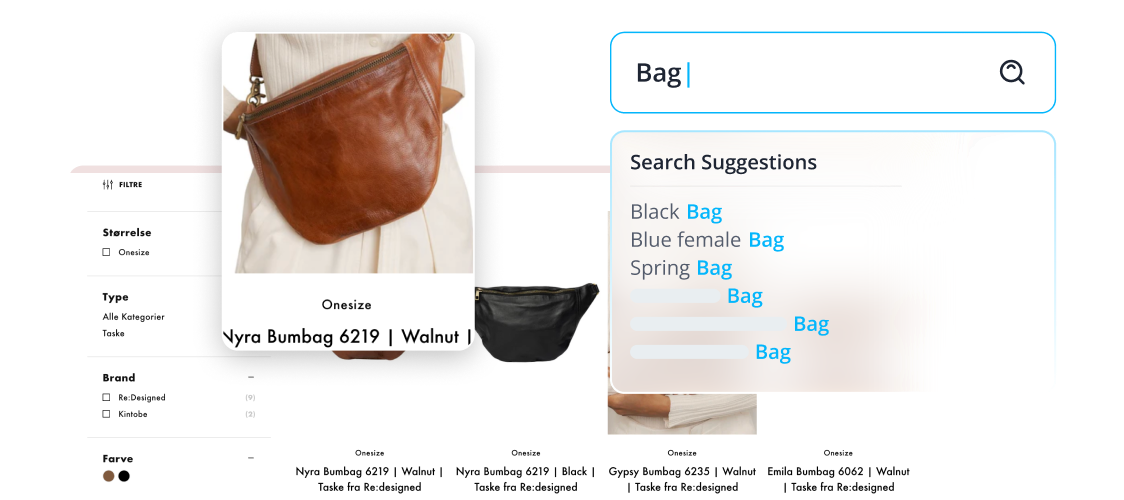
Maropost started as an email marketing platform in 2011 and pivoted into commerce through three acquisitions: Neto (ecommerce, 2021), Retail Express (POS, 2022), and Findify (AI merchandising, 2022).
Source: Maropost
Today, its ideal customer is a growing ecommerce brand managing tens of thousands of SKUs, multiple storefronts, and marketing campaigns from what used to be four or five separate tools. That consolidation is the value proposition: customers report 3x reduced technology costs from moving their stack into Maropost.
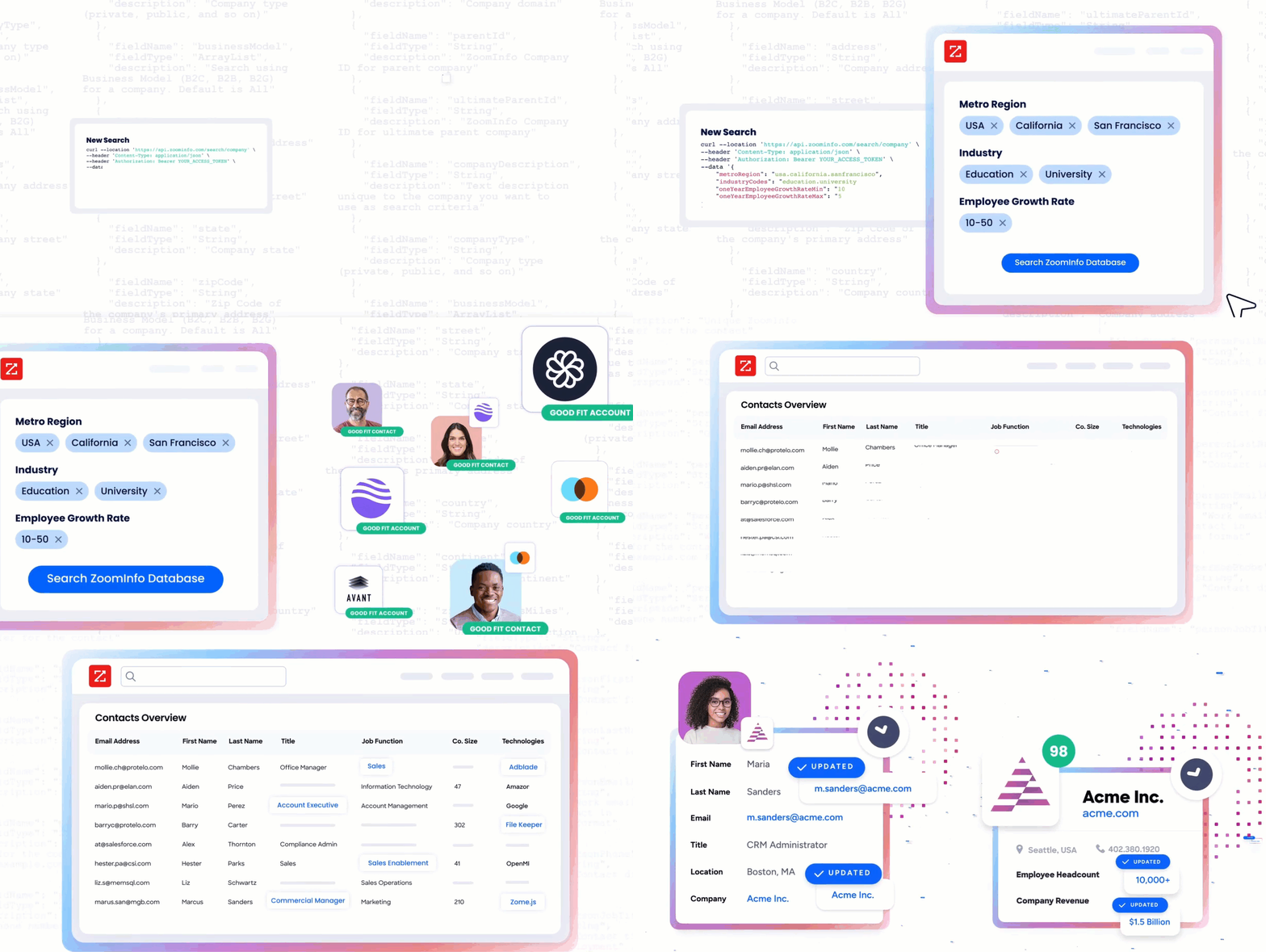
ZoomInfo operates upstream of both. Founded in 2007, it built a large-scale B2B data platform over nearly two decades, then layered intelligence, orchestration, and AI on top.
Source: ZoomInfo
For B2B teams, the challenge isn't building a welcome email sequence or managing a product catalog. It's identifying which accounts are in market, understanding the buying committee, and reaching verified decision-makers before a competitor does.
ZoomInfo's data (verified by 300+ human researchers with up to 95% accuracy on first-party data) feeds that entire motion, whether you run it through ZoomInfo's own products or push it into any other tool via API.
ActiveCampaign wins on automation depth
If your primary job is building multi-step, behavior-driven campaigns, ActiveCampaign is hard to beat at this price tier.
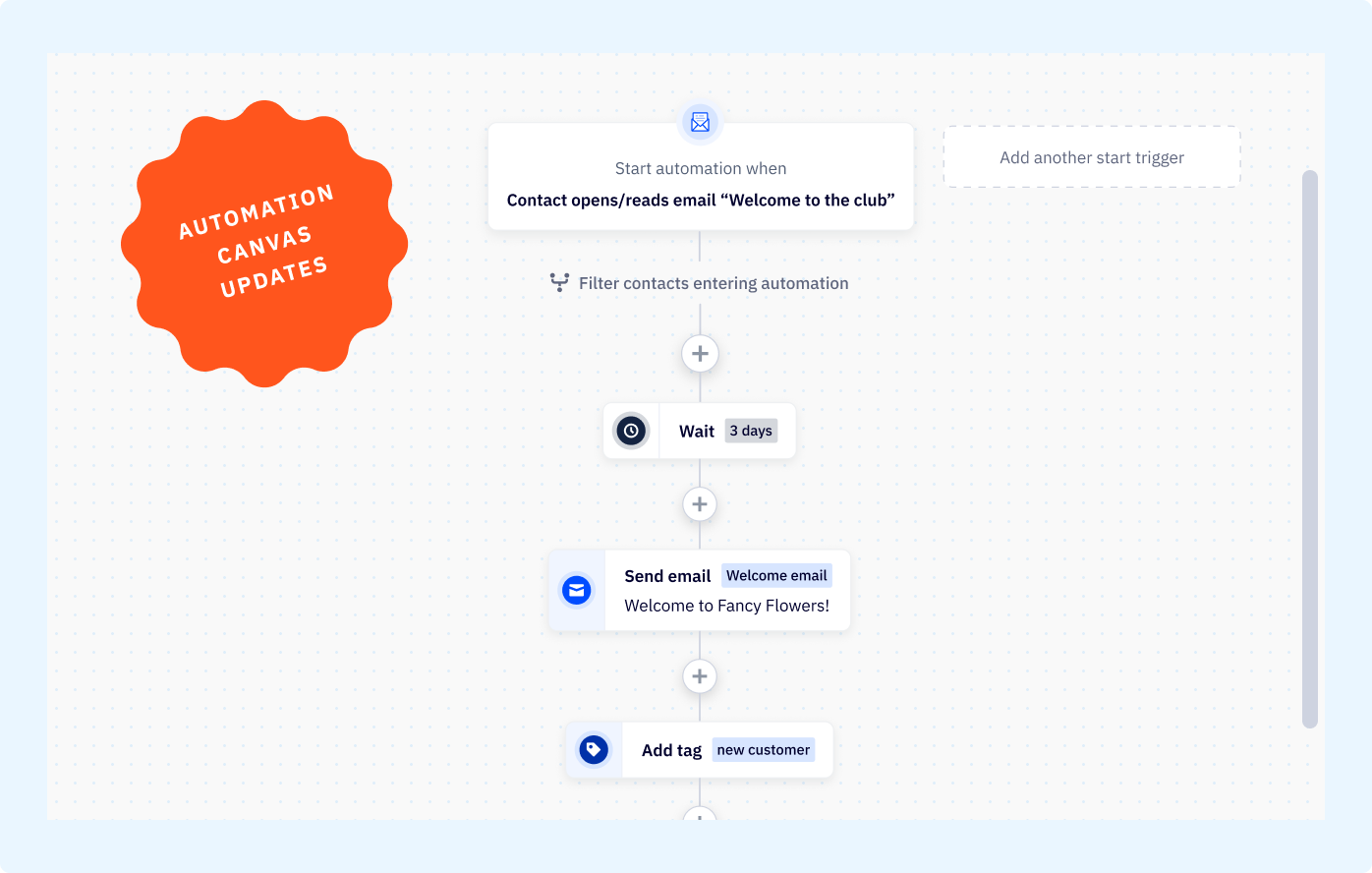
The visual automation builder supports branching logic that responds to behavioral triggers in real time. A contact clicks a product link, visits a pricing page, and opens three emails in a week? The automation can route them into a high-intent sequence, update their lead score, create a deal in the CRM, and notify a sales rep, all without manual intervention. Plus plans and above have no cap on automation actions.
Source: ActiveCampaign
Active Intelligence, launched in May 2025, takes this further. Instead of building automations step by step, marketers describe a business goal in plain language and AI agents handle strategy, execution, and optimization.
The system draws on billions of anonymized data points from similar businesses, so recommendations reflect real industry patterns. Predictive Sending analyzes each contact's engagement history to deliver emails when that person is most likely to open, not at a single optimized time for the whole list.
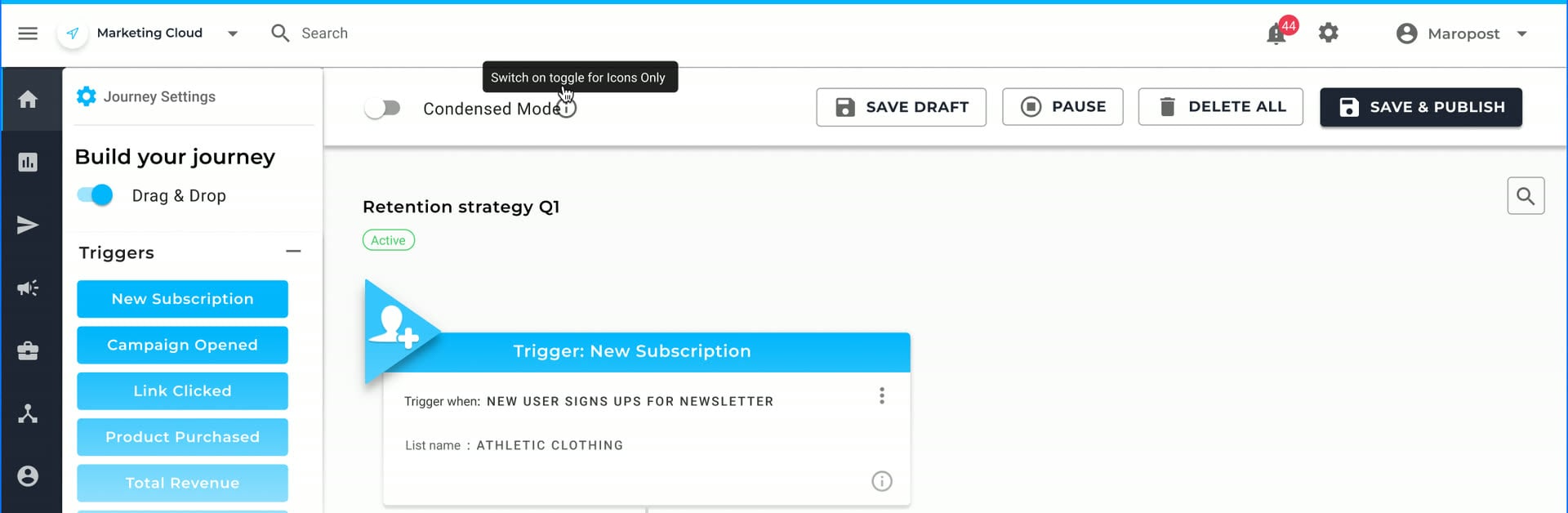
Maropost's Marketing Cloud has its own journey builder and offers both send-time optimization and a separate conversion-time optimization (which optimizes for when a recipient is most likely to purchase, not just open).
Source: Maropost
That distinction is uncommon at this price tier. But the journey canvas itself is undergoing a major overhaul through Q2-Q4 2026, and multiple reviewers describe the current interface as unintuitive for new users.
ActiveCampaign's automation builder is more polished and more proven. It earned 300+ G2 badges in Spring 2026, including Leader badges across company sizes and top rankings for fastest implementation, easiest admin, and highest user adoption. For teams that live inside their automation workflows, this maturity matters.
Maropost consolidates commerce and marketing under one roof
Maropost's pitch isn't about doing one thing better than ActiveCampaign. It's about eliminating the gap between marketing and commerce.
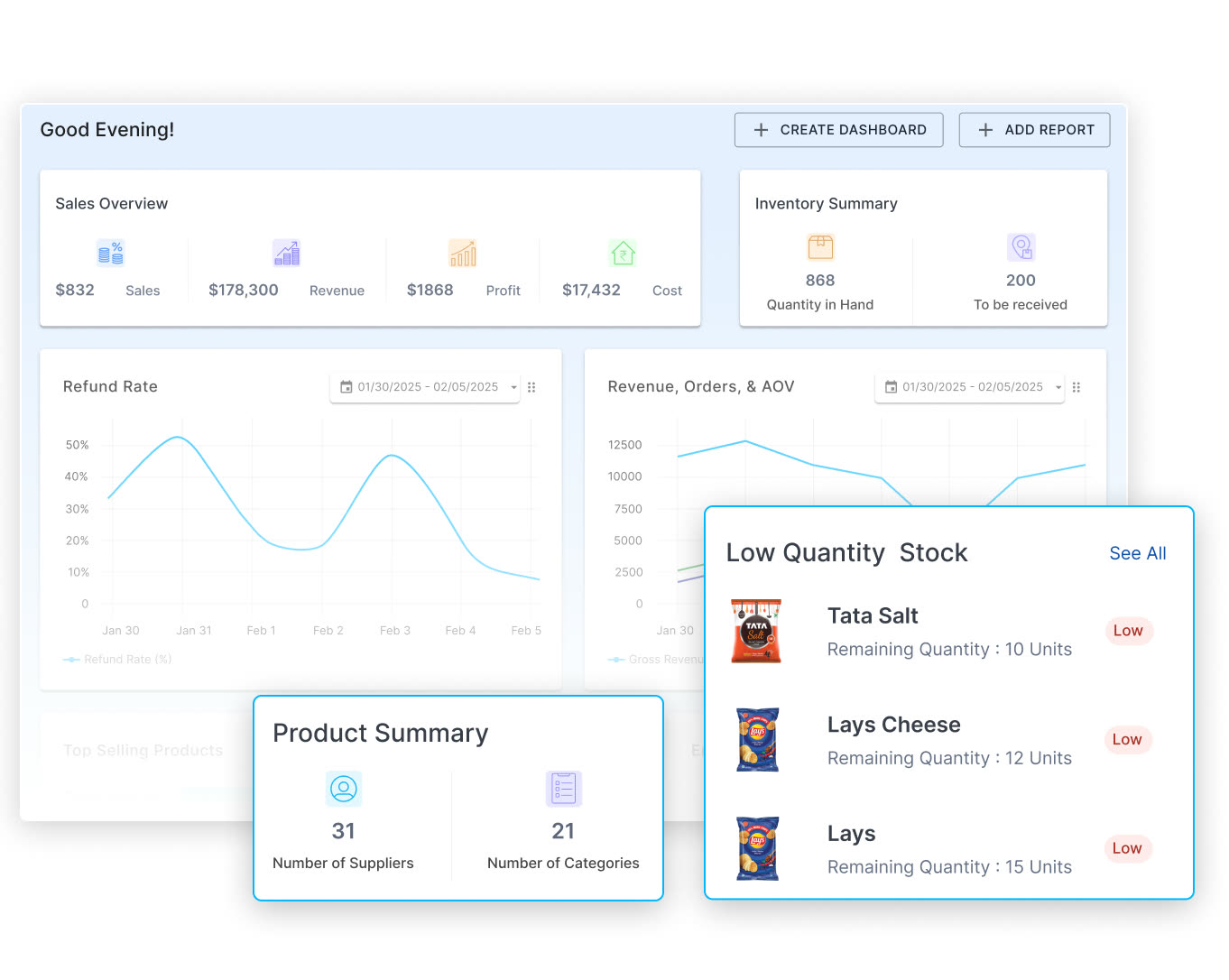
Commerce Cloud, launched in November 2025, manages storefronts, product catalogs of 1M+ SKUs, multi-location inventory, and order fulfillment alongside the marketing platform.
Source: Maropost
A mid-market ecommerce brand using Maropost can run multiple storefronts from a single back office (up to five on the Professional plan), sync inventory across warehouses in real time, and trigger personalized email and SMS campaigns based on purchase behavior, all from one system.
Merchandising Cloud (built on the acquired Findify technology) adds AI-powered product search and recommendations. The machine learning engine begins re-ranking products based on observed shopper patterns within roughly two weeks of installation, requiring no manual retraining. The platform reports an average 12% lift in search-driven conversions and 10-20% increase in average order value.
Marketing Cloud also takes a different approach to pricing that favors high-volume retailers: you pay for emails sent, not for total contacts stored. For brands sitting on large historical databases but sending to active segments, this model can be cheaper than contact-based pricing.
At the Professional tier, you also get a dedicated Customer Success Manager, dedicated Deliverability Manager, and onboarding as standard.
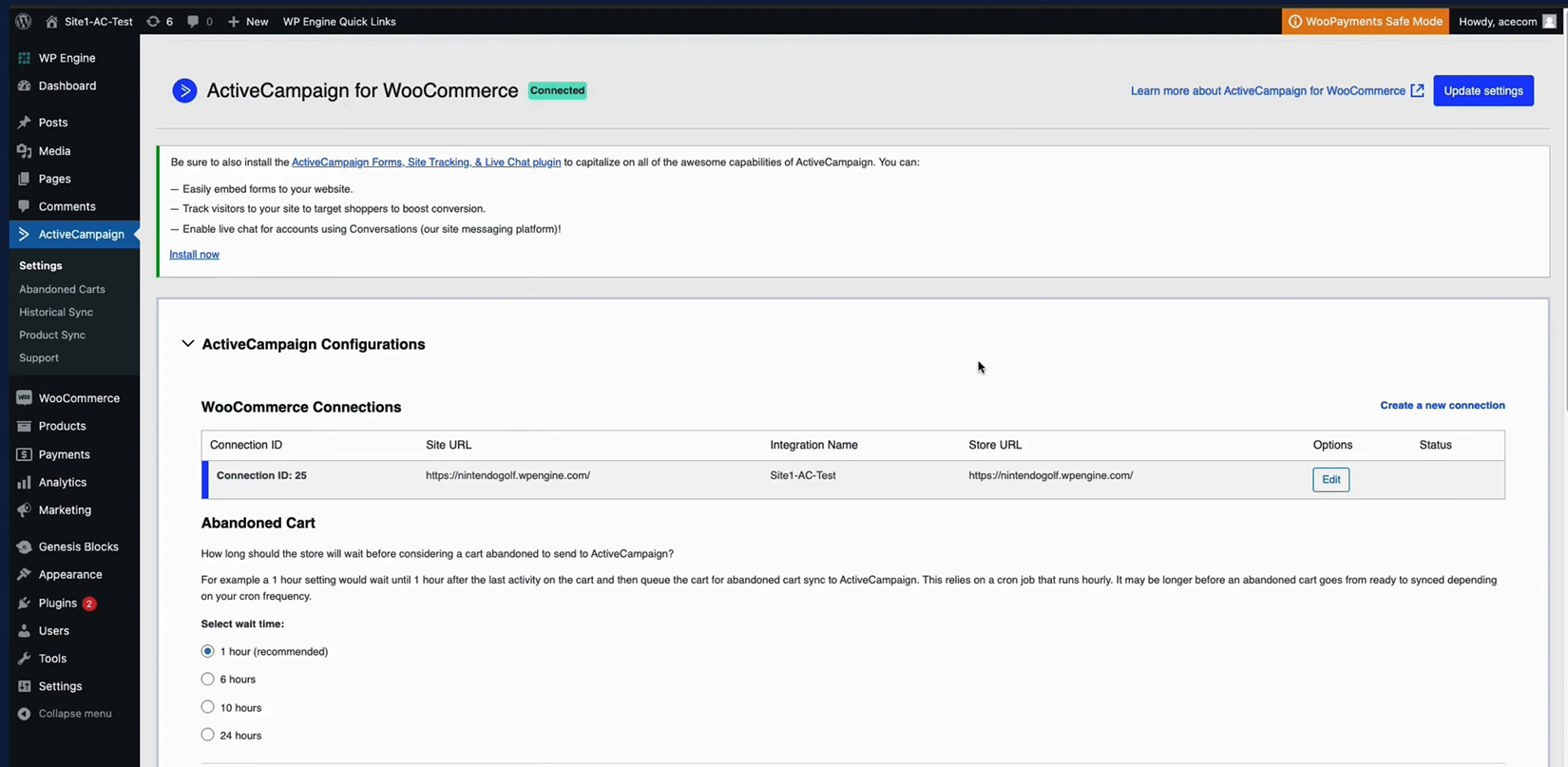
ActiveCampaign can integrate with ecommerce platforms like Shopify and WooCommerce, but the integration is exactly that: a connection between separate systems.
Source: ActiveCampaign
Maropost eliminates the connection layer. When a customer buys a product in-store via Retail Cloud, that purchase history is immediately available for segmentation in Marketing Cloud. No sync delay, no middleware, no data reconciliation.
The limitation is scope. Maropost's vision is still being built. Unified Products & Orders (merging data across Clouds) spans Q2-Q3 2026 on the roadmap. Da Vinci AI, the cross-platform intelligence layer, is listed as "coming soon" with no GA date. And Retail Cloud is only commercially available in Australia and New Zealand, with global availability marked as upcoming.
The platform is heading somewhere ambitious, but buyers evaluating today should distinguish between the vision and the current state.
For B2B teams, the data layer changes the equation
ActiveCampaign and Maropost are both marketing execution platforms.
They assume you already know who to market to. For B2C and ecommerce businesses, that assumption holds: your customers find you through ads, search, and referrals, and then you nurture them. For B2B teams, the assumption breaks down.
B2B buying committees have multiple stakeholders. Deals take months. The person filling out your web form may not be the economic buyer. And the company researching your category right now may never visit your website. Execution tools can't solve these problems because they were never designed to.
ZoomInfo was designed for exactly this.
The platform's 500M contacts and 100M companies give B2B teams a continuously verified census of their addressable market.
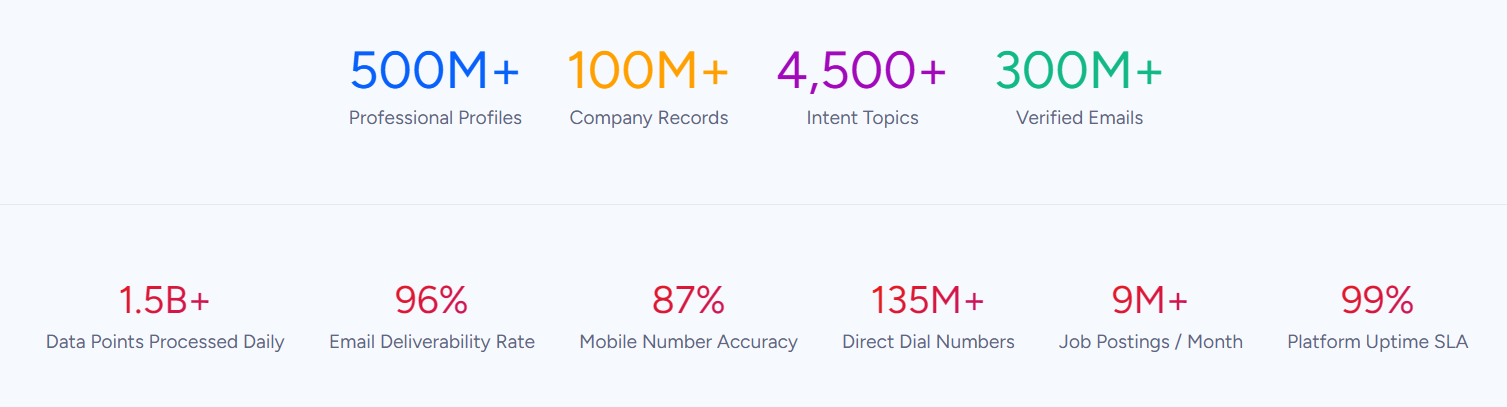
Buyer Intent data tracks signals from 210 million IP-to-Organization pairings and 6 trillion+ new keyword-to-device pairings monthly, identifying companies that are researching your category before they engage a vendor. Guided Intent, exclusive to ZoomInfo, identifies topics historically correlated with deal success rather than requiring marketers to guess which keywords matter.
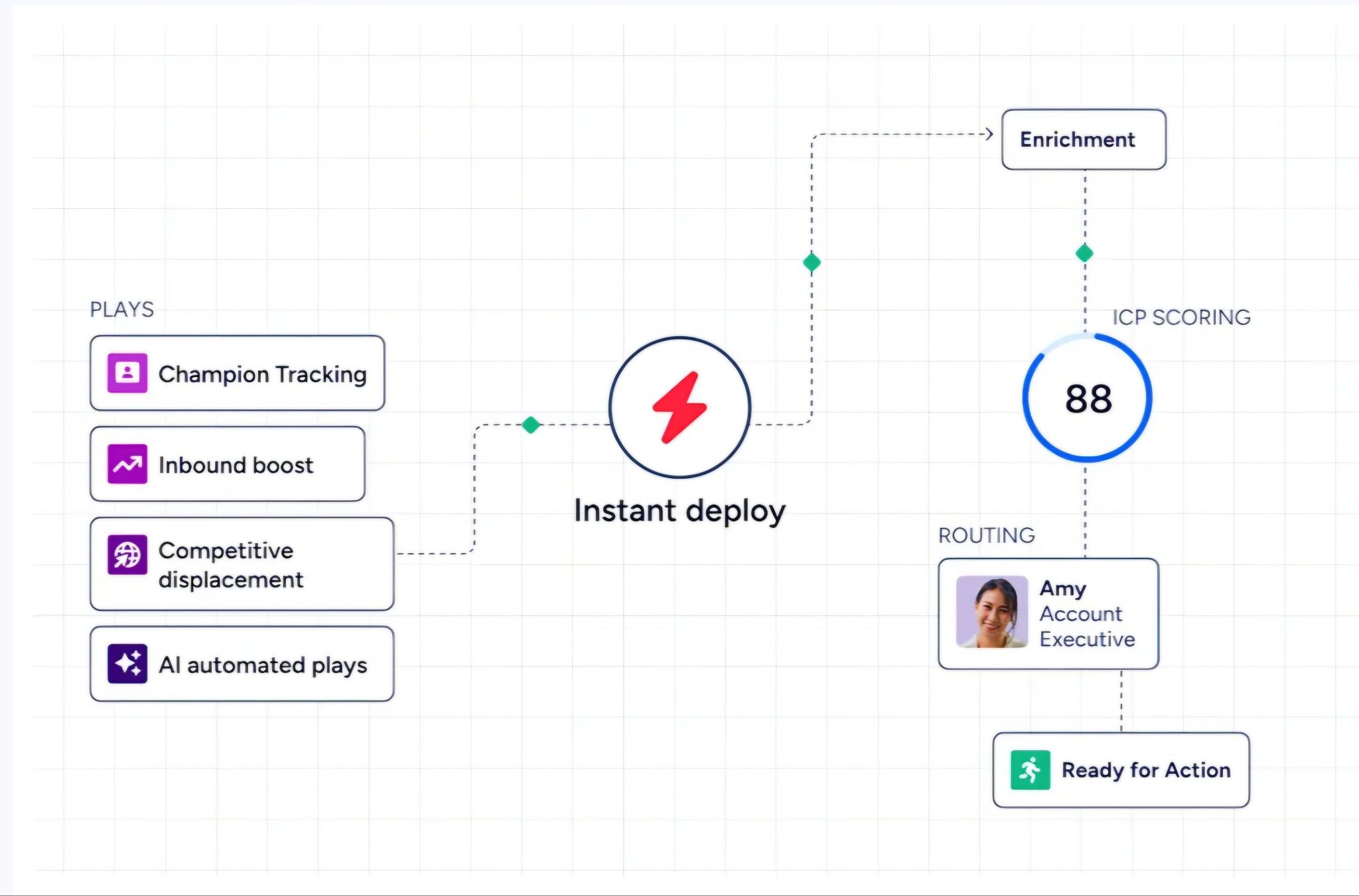
This intelligence flows into marketing through GTM Studio, where marketers and RevOps teams build audiences using natural language, launch multi-channel plays across email, display ads, LinkedIn, Meta, and Connected TV, and watch pipeline impact in real time.
Pre-built GTM plays cover inbound acceleration, champion tracking, competitive displacement, and ICP targeting, all launchable in one click. Plays run continuously and get smarter as prospects respond.
The structural difference: ActiveCampaign and Maropost optimize how you engage contacts already in your database. ZoomInfo identifies which accounts and contacts should be in your database in the first place, and surfaces the intelligence that makes every subsequent touchpoint more relevant.
"It's not just the data itself. It's more about the right data at the right time to help us reach out with the right message across that full buyer journey." (Chelsea Kenyon, Senior Director of Digital Strategy, Redwood Logistics)
AI approaches reflect different visions
All three platforms have invested in AI, but their approaches reveal different assumptions about what marketers need.
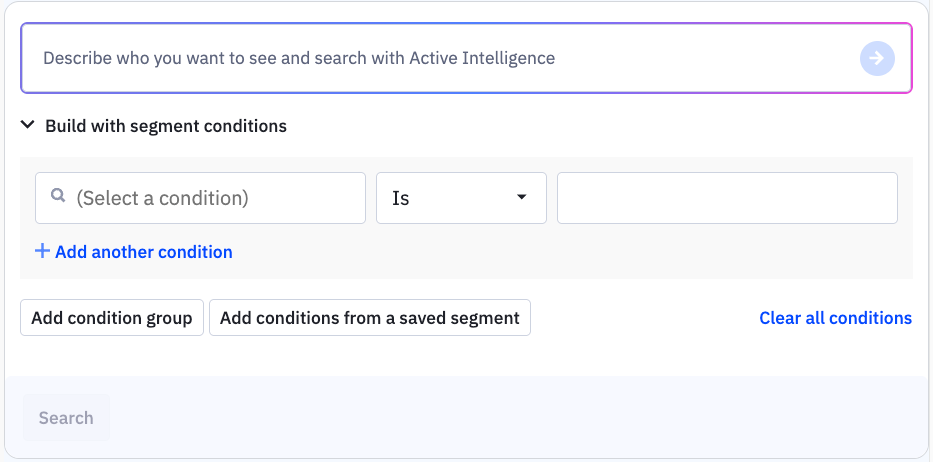
ActiveCampaign's Active Intelligence is the most mature execution-side AI in this comparison.
The system spans 12+ AI agents covering campaign creation, automation building, content generation, segmentation, and analytics. The AI Campaign Builder generates complete campaigns (subject lines, preheaders, body content, CTAs, images) from a single plain-language prompt.
AI-Suggested Segments analyze audience data and surface high-value groups a marketer might not have identified manually. The company reports that AI users save 13+ hours per week. Several agents remain in beta as of early 2026, so reliability and feature completeness are not yet at GA quality across the board.
Source: ActiveCampaign
Maropost's AI focuses on specific capabilities rather than a unified system.
eRFM behavioral segmentation (launched December 2024) processes recency, frequency, monetary value plus social engagement, website interactions, and email engagement to identify high-value and at-risk accounts automatically. Merchandising Cloud's machine learning engine continuously optimizes product discovery.
Da Vinci AI, intended to be the unifying intelligence layer, is still in development with the first components (journey orchestration, domain reputation warmup) expected through Q2-Q3 2026.
ZoomInfo's GTM Context Graph operates at a different level.
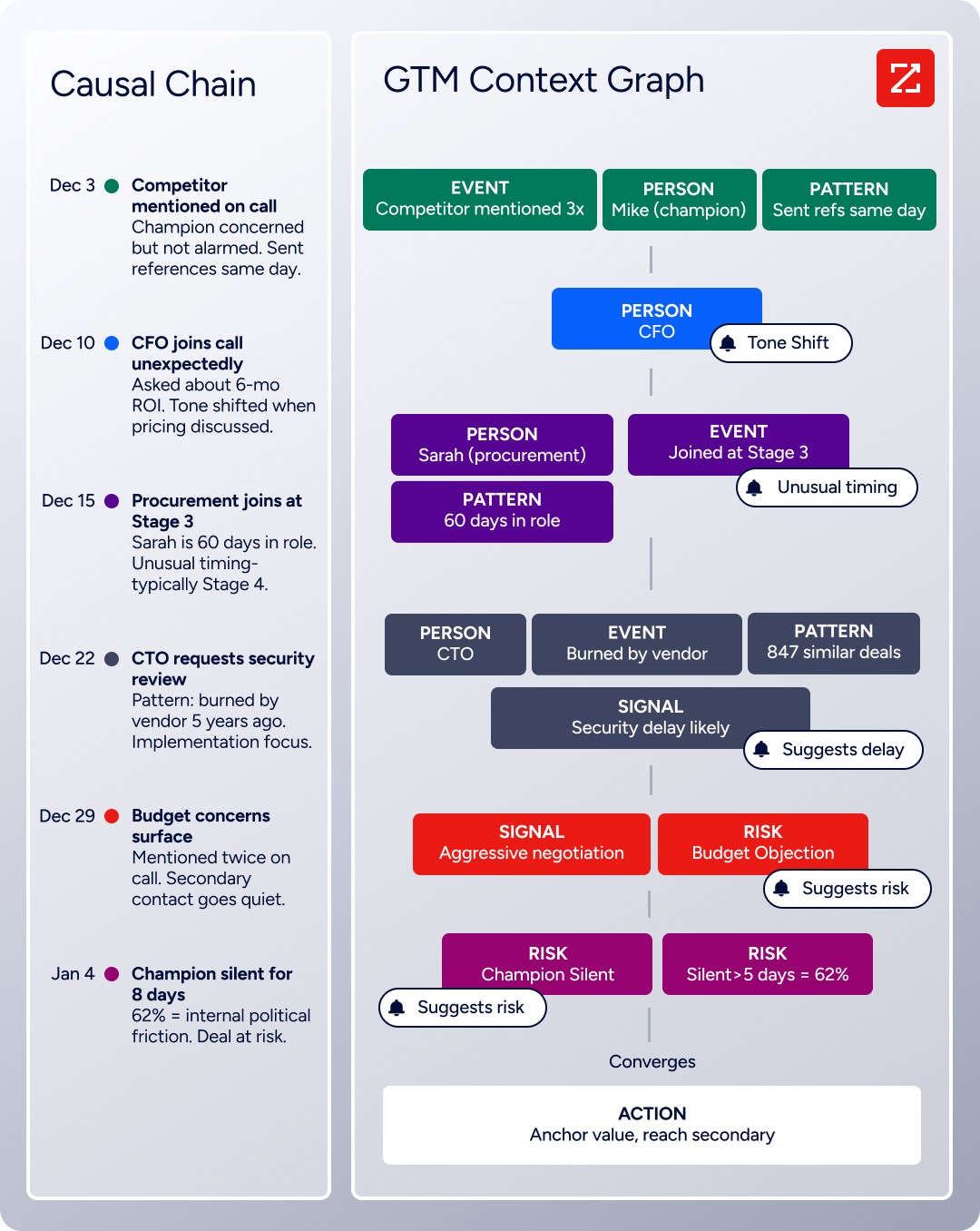
Rather than optimizing email subject lines or product recommendations, the GTM Context Graph reasons across your complete deal history, conversation intelligence, CRM data, and ZoomInfo's third-party signals to understand why deals move or stall. A CRM records that a deal advanced to Stage 4. Conversation intelligence captures that the CFO joined the last call and asked about six-month ROI.
The GTM Context Graph connects those signals to recognize that executive sponsorship entering at this stage, combined with ROI-focused questions, matches the pattern behind closed-won deals in your segment. That reasoning then informs every downstream action, from the follow-up message a rep sends in GTM Workspace to the audience a marketer builds in GTM Studio.
"That combination of our internal CRM data, external signals, and AI that's given all that context has helped us craft very specific account- and persona-based messages. And people have responded to them right away." (Toby Carrington, Chief Business Officer, Seismic)
Email deliverability is strong across the board, with different channel mixes
All three platforms take deliverability seriously, though each serves a different sending profile.
ActiveCampaign reports 99.88% email deliverability, with EmailToolTester naming it the Best Email Marketing Tool of 2025.
The platform routes emails through a private network rather than the public internet, supports dedicated IP management, DKIM and DMARC authentication, and includes a BotSense feature that strips bot click activity from engagement metrics. 93% of surveyed customers report better deliverability than competitors.
The platform processed 109 billion emails in 2025. Channels span email, SMS (including 2-way SMS), WhatsApp (via Hilos acquisition), and transactional email via Postmark.
Maropost claims a 98% deliverability rate backed by Deliverability Score, Spam Checker, and dedicated IPs on Professional plans.
Marketing Cloud includes a dedicated Deliverability Manager from the Professional tier up, which is uncommon at comparable price points. The platform earned G2 "High Performer" badges in Transactional Email. Channels cover email, SMS, Meta social ads, and push notifications (Professional and Enterprise).
ZoomInfo approaches deliverability from a different angle.
Rather than sending high-volume campaigns itself, ZoomInfo ensures the contacts feeding into your campaigns are verified and accurate. 200M+ verified business email addresses means fewer bounces, cleaner lists, and protected sender reputation regardless of which sending platform you use.
For direct campaign execution, GTM Studio orchestrates across display ads (via a native DSP), email sequences, LinkedIn, Meta, and Connected TV, triggered by buyer behavior signals rather than static schedules.
Source: ZoomInfo
Pricing models suit different buying patterns
The pricing structures tell you who each platform was built for.
ActiveCampaign uses contact-based pricing.
The monthly cost scales with the number of contacts stored in your account, regardless of how many emails you send. Starter is $149/month for 10,000 contacts. ActiveCampaign charges once per unique contact regardless of how many automations, tags, or segments that contact appears in.
Advanced features (predictive sending, revenue attribution, conditional content) require Professional or Enterprise plans. There is no permanent free plan, but a 14-day free trial and 30-day money-back guarantee reduce evaluation risk.
Maropost uses send-based pricing for Marketing Cloud.
You pay for emails sent, not contacts stored. This is cheaper for brands with large historical databases but moderate sending volumes. Marketing Cloud Essential starts at $251/month, with Professional at $849/month and Enterprise at $1,699/month.
All plans require a 12-month commitment. Commerce Cloud adds another layer: $199/month (Essential) to $1,999/month (Enterprise). Running both Clouds together is a significant monthly spend, though the consolidation argument is that you're replacing multiple tools.
ZoomInfo uses consumption-based pricing with no publicly listed prices.
Costs scale around data access, API consumption, AI activity, and user seats. The company offers ZoomInfo Lite as a permanent free tier with access to the B2B database, 10 monthly export credits, and WebSights Lite (up to 10 website visitor reveals per day).
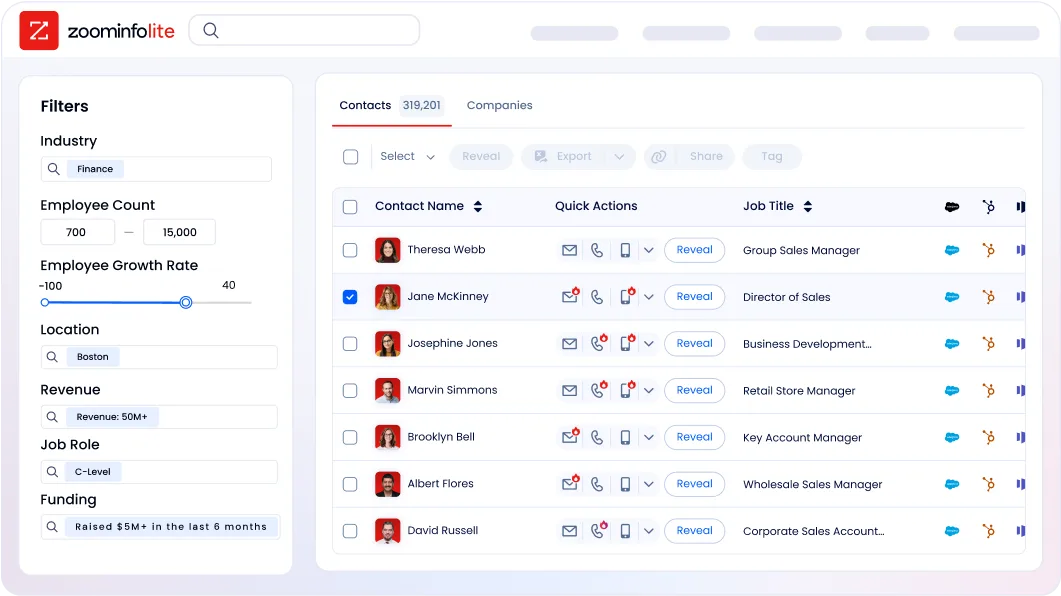
A 7-day free trial of the full platform is also available. ZoomInfo is premium-priced, but the ROI math differs: customers are buying data accuracy and intelligence that improves every downstream marketing and sales motion, not just a sending tool.
"You'll get 10x the value if you think of ZoomInfo as a full platform and not just a tool for one team." (John Kotsuros, Founder and CEO of SpringDB)
Integration ecosystems reflect different strategies
ActiveCampaign has the largest integration ecosystem in this comparison, with 1,000+ app integrations covering CRM, ecommerce, forms, advertising, communication, and developer tools.
Key connections include Shopify, Salesforce, WordPress, Zapier, and Make. The platform also operates as the first marketing platform in Claude's connector directory via MCP. A full REST API and developer sandbox accounts support custom builds.
Maropost takes a more insular approach.
The platform's strategy centers on keeping customers within the Maropost ecosystem rather than connecting outward. Native integrations include Shopify, BigCommerce, Salesforce, Google Analytics, and Stripe, with Zapier as the primary iPaaS connector.
G2 reviewers note limited integrations and a need for API work to connect non-native platforms. The Partner Portal launched in May 2026 signals investment in building an agency and integration ecosystem, but the gap with ActiveCampaign's 1,000+ connections is large today.
ZoomInfo connects at the infrastructure level.
The App Marketplace lists 172+ partner integrations across CRM, marketing automation, sales engagement, data warehouses, and AI. Native integrations with Salesforce, HubSpot, and Microsoft Dynamics 365 feed verified data directly into CRM records.
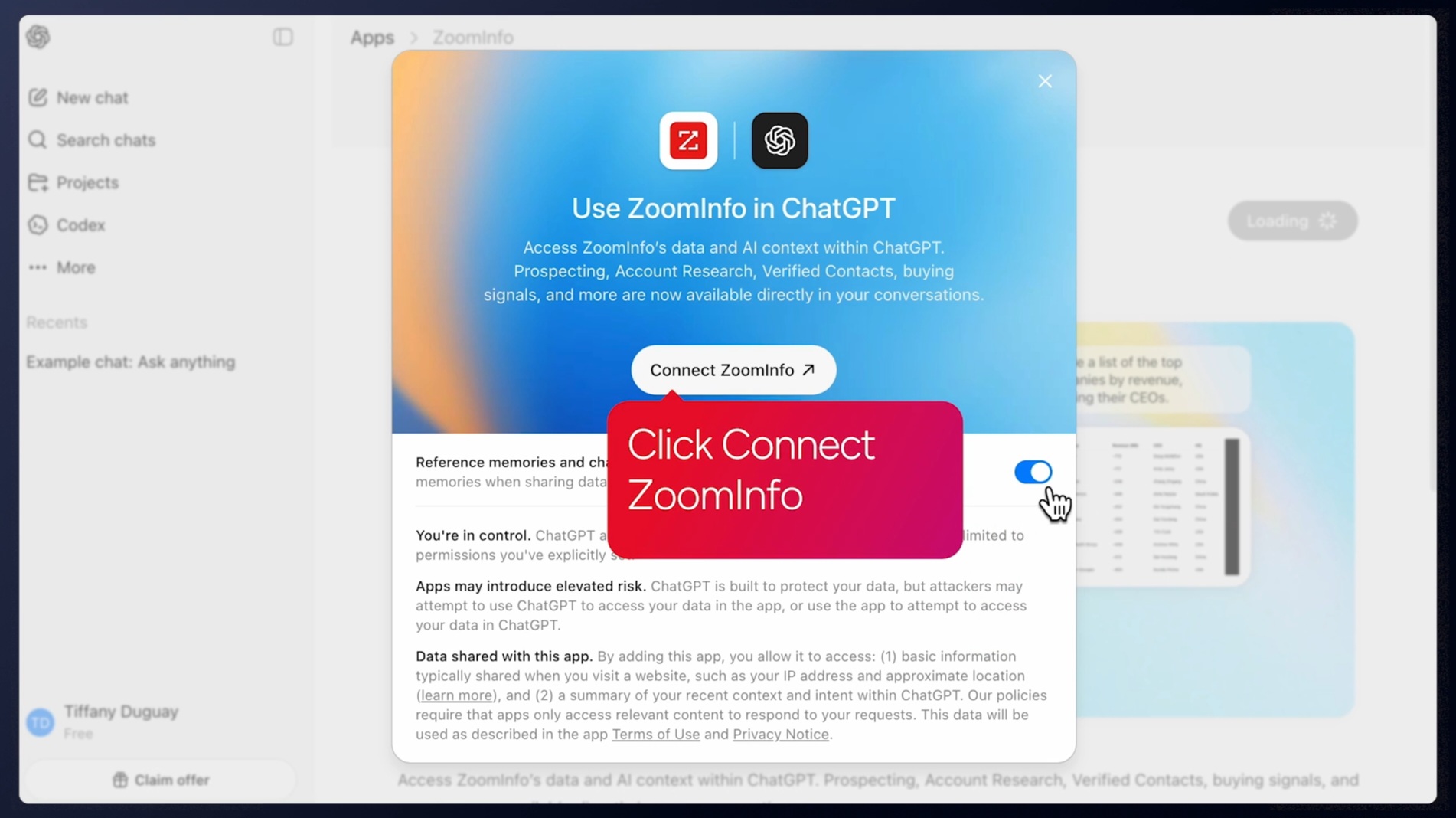
Cloud Partners deliver data into AWS, Google Cloud, Snowflake, and Databricks. The Enterprise API and MCP server expose ZoomInfo's intelligence to any tool, any AI agent, any custom application. API Access is included in all relevant plans.
Source: ZoomInfo
The practical implication: ActiveCampaign connects broadly to the tools you already use. Maropost wants to replace them. ZoomInfo powers them with intelligence regardless of which ones you choose.
ActiveCampaign vs. Maropost vs. ZoomInfo: Which should you choose?
The right platform depends on what your business needs, not which category has the most features.
Choose ActiveCampaign if:
You're a small or mid-size business that needs sophisticated marketing automation
Your team is small and wants AI to handle campaign creation and optimization
Email and SMS marketing are your primary customer engagement channels
You need broad integrations with your existing tech stack
You want to start small and scale pricing with your contact list
You value a proven platform with a large community and strong G2 track record
Choose Maropost if:
You're a mid-market ecommerce brand managing a complex product catalog
You want commerce, marketing, merchandising, and customer service in one platform
You're spending more on your fragmented tech stack than a consolidated solution would cost
Your database is large but your sending volume is moderate (pay-per-send saves money)
You operate multiple storefronts or sell across physical and online channels
You're willing to commit to a 12-month contract for platform consolidation
Choose ZoomInfo if:
You're a B2B company that needs to find and understand your buyers before marketing to them
Your marketing effectiveness is limited by data quality, not tool functionality
You want AI that reasons about deal patterns and buying committees, not just campaign metrics
You need verified contact data and intent signals to power your outbound and ABM motions
You want intelligence that works in your existing tools via API and MCP, not another silo
You're ready to invest in the data layer that makes every marketing and sales tool more effective
See how ZoomInfo's intelligence can strengthen your GTM strategy, or start for free with ZoomInfo Lite.
"Without ZoomInfo, it would be extremely difficult, if not impossible, to achieve our business objectives. Without it, we wouldn't be able to understand the market, have the right contact data, and make meaningful connections." (Thor Sanderson, Senior Manager of Sales Technology Enablement, Smartsheet)
The distinction between these platforms is less about features and more about where your business's real constraint lives.
If the constraint is executing campaigns efficiently, ActiveCampaign gives you the best automation engine at the most accessible price. If the constraint is managing commerce operations alongside marketing, Maropost eliminates the integration layer between them.
And if the constraint is knowing who to target, when they're ready, and why they'll care, ZoomInfo provides the intelligence that makes every downstream tool more effective.
ActiveCampaign vs. Maropost vs. ZoomInfo FAQ
What is the core difference between ActiveCampaign, Maropost, and ZoomInfo?
ActiveCampaign is a marketing automation platform for small and mid-size teams, focused on email, SMS, WhatsApp, and CRM with a visual automation builder and AI-powered campaign creation.
Maropost is a commerce platform for mid-market ecommerce brands, combining storefronts, product catalogs, marketing automation, customer service, and POS under one system.
ZoomInfo is a B2B data intelligence and GTM platform with 500M contacts, 100M companies, and a GTM Context Graph that processes 1.5B+ data points daily to surface buying signals, intent data, and contextual account intelligence.
Which platform is the most affordable to get started with?
ActiveCampaign has the lowest entry point, with paid plans starting at $15/month for 1,000 contacts.
ZoomInfo offers a permanent free tier (ZoomInfo Lite) with 10 monthly export credits and access to the B2B database.
Maropost is the most expensive to start, with Marketing Cloud Essential at $251/month and a 12-month minimum commitment. All three offer free trials: ActiveCampaign for 14 days, Maropost for 14 days, and ZoomInfo for 7 days.
How do the pricing models differ?
ActiveCampaign charges based on the number of contacts stored in your account, with costs climbing as your list grows.
Maropost charges based on emails sent rather than contacts stored, which favors brands with large databases and moderate sending volume.
ZoomInfo uses consumption-based pricing that scales around data access, API usage, and AI activity, with all pricing custom-quoted through sales.
Which platform has the best AI capabilities?
Each platform's AI serves a different purpose. ActiveCampaign's Active Intelligence is the most mature for campaign execution, with 12+ AI agents that build campaigns from plain-language prompts, optimize send times per recipient, and suggest segments.
ZoomInfo's GTM Context Graph is the most advanced for intelligence and reasoning, connecting CRM data, conversation transcripts, and intent signals to explain why deals move and predict what happens next.
Maropost's AI is strongest in merchandising (via Findify's machine learning) and behavioral segmentation (eRFM), with its broader Da Vinci AI layer still in development.
Can I use ZoomInfo alongside ActiveCampaign or Maropost?
Yes. ZoomInfo is designed to power other tools, not replace marketing automation platforms. ZoomInfo's API and MCP server can feed verified contact data, intent signals, and account intelligence into any platform. ActiveCampaign is listed as an integration in ZoomInfo's ecosystem.
The most common pattern for B2B teams is using ZoomInfo for upstream intelligence (who to target, when they're in-market) and a marketing automation platform for downstream execution (email sequences, nurture campaigns, lead scoring).
Which platform is best for ecommerce businesses?
Maropost is built for ecommerce, with Commerce Cloud managing catalogs of 1M+ SKUs, multi-storefront operations, real-time inventory sync, and AI-powered merchandising.
ActiveCampaign integrates with ecommerce platforms like Shopify and WooCommerce but does not manage storefronts, inventory, or fulfillment natively.
ZoomInfo is focused on B2B intelligence and is not designed for B2C ecommerce.
Which platform has the strongest email deliverability?
Both ActiveCampaign and Maropost have strong deliverability records. ActiveCampaign reports 99.88% deliverability and earned EmailToolTester's Best Email Marketing Tool of 2025 designation.
Maropost claims a 98% deliverability rate and includes a dedicated Deliverability Manager from the Professional tier.
ZoomInfo contributes to deliverability indirectly by providing 200M+ verified business email addresses, reducing bounces and protecting sender reputation regardless of which sending platform you use.
How do the learning curves compare?
ActiveCampaign balances power with accessibility. Basic automations are approachable, but mastering conditional logic, tagging systems, and advanced reporting takes real ramp-up time.
Maropost's breadth across commerce, marketing, merchandising, and service creates a large onboarding surface, with reviewers noting that features are oriented toward power users rather than newcomers.
ZoomInfo invested in a redesigned 90-day onboarding program that produced a 25% improvement in customer satisfaction scores, and offers ZoomInfo University with role-specific learning paths.
