
Choosing between Adobe Experience Cloud and Salesforce for your enterprise marketing and customer experience stack comes down to five questions:
Is your primary goal orchestrating content-driven customer experiences, or managing sales relationships and pipeline?
Do you need a platform that starts with creative production and content, or one that starts with CRM and sales data?
How important is native integration between your marketing tools and your sales team's daily workflow?
Are you prepared for a 9 to 12 month implementation, or do you need faster time to value?
Does your go-to-market strategy depend more on knowing your customers' digital journeys, or on knowing exactly who to contact, when, and why?
In short, here's what we recommend:
Adobe Experience Cloud (rebranded "Adobe CX Enterprise" in April 2026) is the platform for enterprises that lead with content and experience.
Built on Adobe Experience Platform (AEP), it connects creative production, content management, analytics, personalization, and journey orchestration into a single data layer.
If your organization already runs on Creative Cloud and needs to manage thousands of pages, assets, and campaigns across brands and geographies, Adobe's content supply chain (from Firefly and GenStudio through AEM and Workfront to journey orchestration in AJO) has no peer.
The trade-off: implementation typically takes 9 months before the platform is in active use, costs regularly exceed $2M in services alone, and there are no public list prices for anything.
Salesforce is the platform for enterprises that lead with relationships and revenue. The world's #1 CRM by IDC market share, Salesforce unifies sales, service, marketing, commerce, and analytics on a single customer record.
Its Agentforce AI agents can resolve 85% of support requests without human escalation, and Data Cloud has ingested 112 trillion records. If your organization runs on Salesforce CRM and needs marketing, service, and commerce to share the same customer data natively, nothing else integrates as tightly.
The trade-off: pricing complexity across multiple clouds, add-ons, and consumption tiers creates unpredictable costs, and the full platform requires dedicated administrators to configure and maintain.
Both platforms are large enterprise ecosystems. But neither solves a specific problem: knowing exactly who to reach at target accounts, when those accounts are actively in-market, and why the deal is moving or stalling. That's what ZoomInfo was built for.
ZoomInfo is an AI-powered go-to-market platform built on B2B data at scale: 500M contacts, 100M companies, 135M+ verified phone numbers, and 200M+ verified business emails.
By combining this data with your CRM records, conversation transcripts, and behavioral signals, ZoomInfo's GTM Context Graph (which processes 1.5B+ data points daily) reveals the full context of your accounts.
That intelligence shows not just what happened in a deal, but why it happened, and which actions to take next.
Your team accesses it through the GTM Workspace for sellers, GTM Studio for marketers and RevOps, or APIs and MCP in any front-end, including both Adobe and Salesforce.
If knowing who to reach and why they're ready to buy sounds like the missing layer in your enterprise stack, see how ZoomInfo works.
Adobe Experience Cloud vs. Salesforce vs. ZoomInfo at a glance
Adobe Experience Cloud | Salesforce | ZoomInfo | |
|---|---|---|---|
Core strength | Content creation, experience orchestration, analytics | CRM, sales automation, customer 360 | B2B data, buyer intelligence, GTM execution |
Starting point | Content and creative production | Customer relationships and pipeline | Who to target, when, and why |
AI approach | Firefly (content generation) + AEP agents (orchestration) | Agentforce (autonomous agents across CRM) | GTM Context Graph (deal reasoning + signal intelligence) |
Data foundation | Adobe Experience Platform (XDM profiles) | Data Cloud (112T records ingested) | 500M contacts, 100M companies, 1.5B+ daily data points |
Marketing automation | AJO + Marketo Engage | Marketing Cloud Engagement + Account Engagement | GTM Studio (orchestration) + Marketing (ABM/ads) |
CRM integration | Connector to Salesforce; not native | Native CRM | Integrates with Salesforce, HubSpot, Dynamics |
Content management | AEM Sites + Assets (full enterprise CMS/DAM) | Basic CMS for portals | N/A |
Pricing transparency | No public prices; quote-only | Published tiers + consumption add-ons | Custom-quoted; free Lite tier available |
Implementation timeline | 9+ months typical | Weeks to 12 months depending on scope | Deploys in weeks |
Best for | Content-led enterprises ($1B+ revenue) | Relationship-led enterprises of any size | B2B revenue teams needing buyer intelligence |
These platforms solve different primary problems
Comparing Adobe and Salesforce as direct substitutes is misleading. They overlap in marketing and personalization, but they start from different places.
Adobe starts with content. The platform's structural advantage is the content supply chain: creative teams produce assets in Creative Cloud, manage them in AEM, approve them through Workfront with Frame.io review, generate variants in GenStudio, personalize them through Target, and orchestrate delivery through AJO.
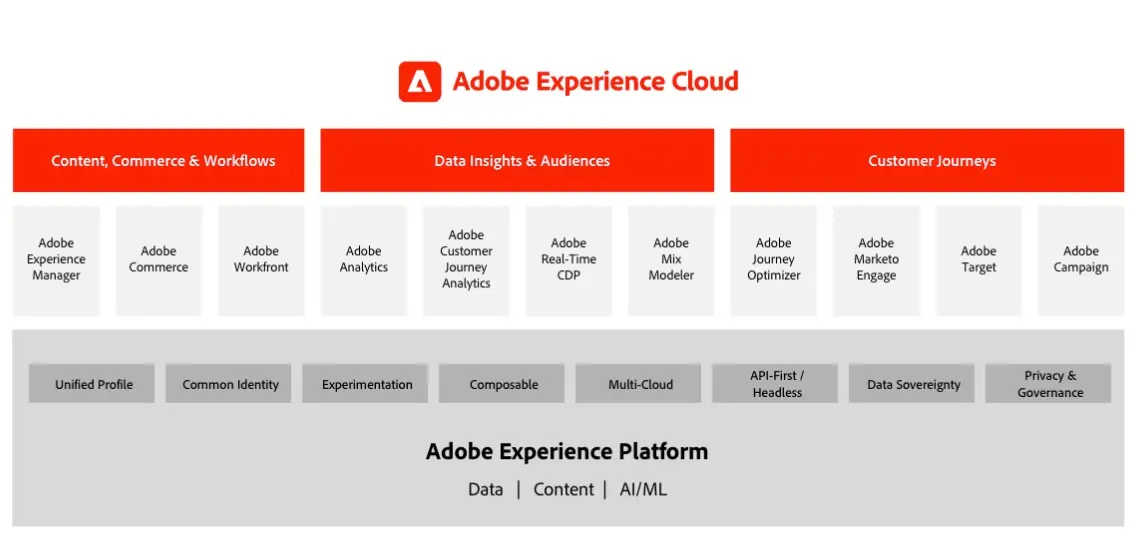
All of this runs on AEP's unified customer profiles. No other vendor offers this full pipeline from creation to activation under one roof.
Salesforce starts with relationships. Every product in the Salesforce ecosystem shares the same customer record. When a service agent resolves a case, the sales rep sees it.
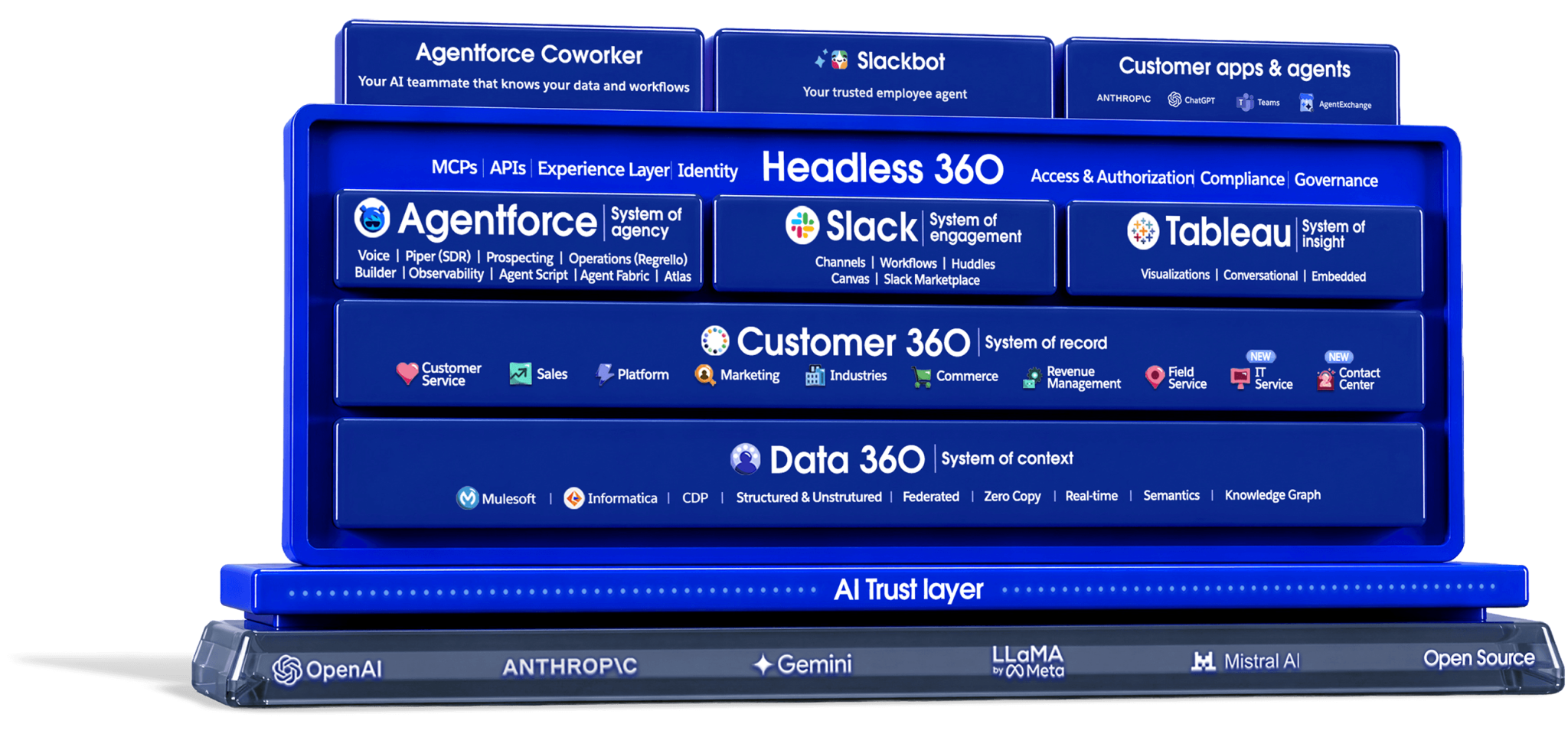
When marketing sends a campaign, the engagement data appears on the contact record. When commerce processes an order, the full transaction history is visible across teams.
This CRM-native architecture means every team works from one source of truth about the customer.
ZoomInfo starts with intelligence. Neither Adobe nor Salesforce tells you who your next best prospect is, whether they're actively researching solutions, or which members of the buying committee you haven't reached.
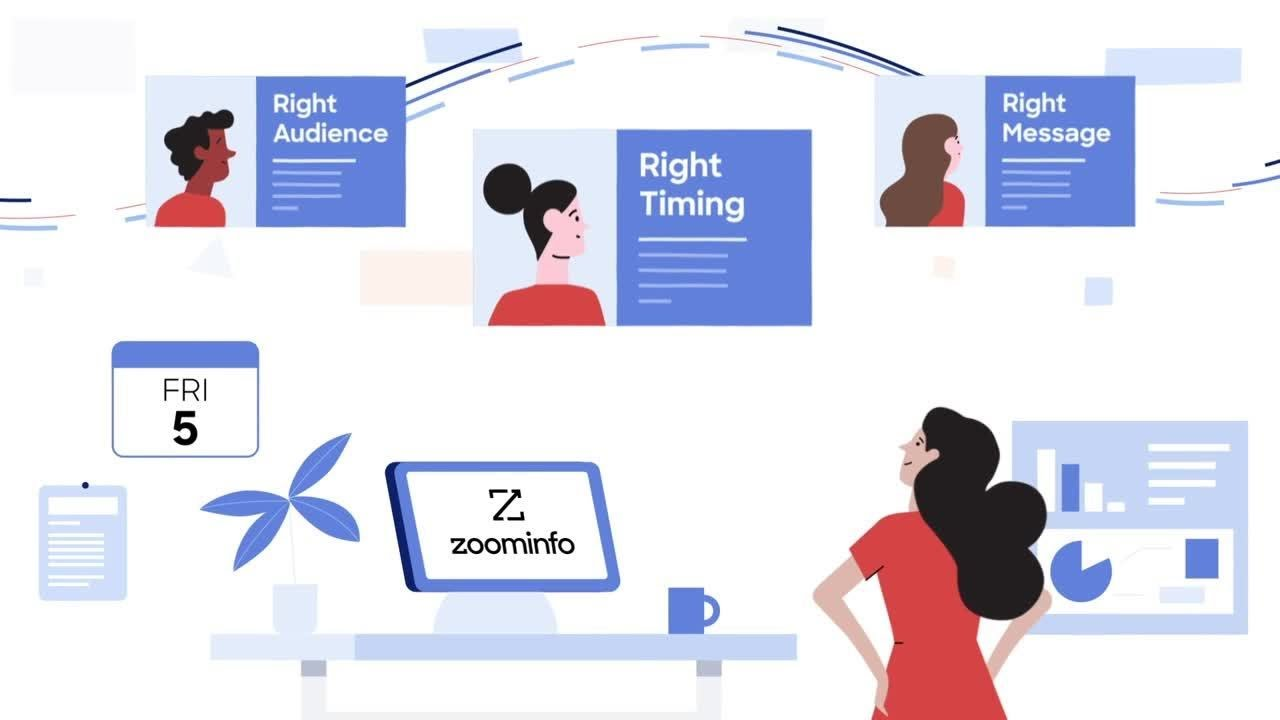
ZoomInfo's data layer (500M contacts, 135M+ verified phone numbers, 200M+ verified business emails) combined with intent signals and the GTM Context Graph answers the questions that come before any marketing campaign or sales conversation: who, when, and why now.
Marketing automation takes different forms
Adobe and Salesforce both offer marketing automation, but the architectures reflect their origins.
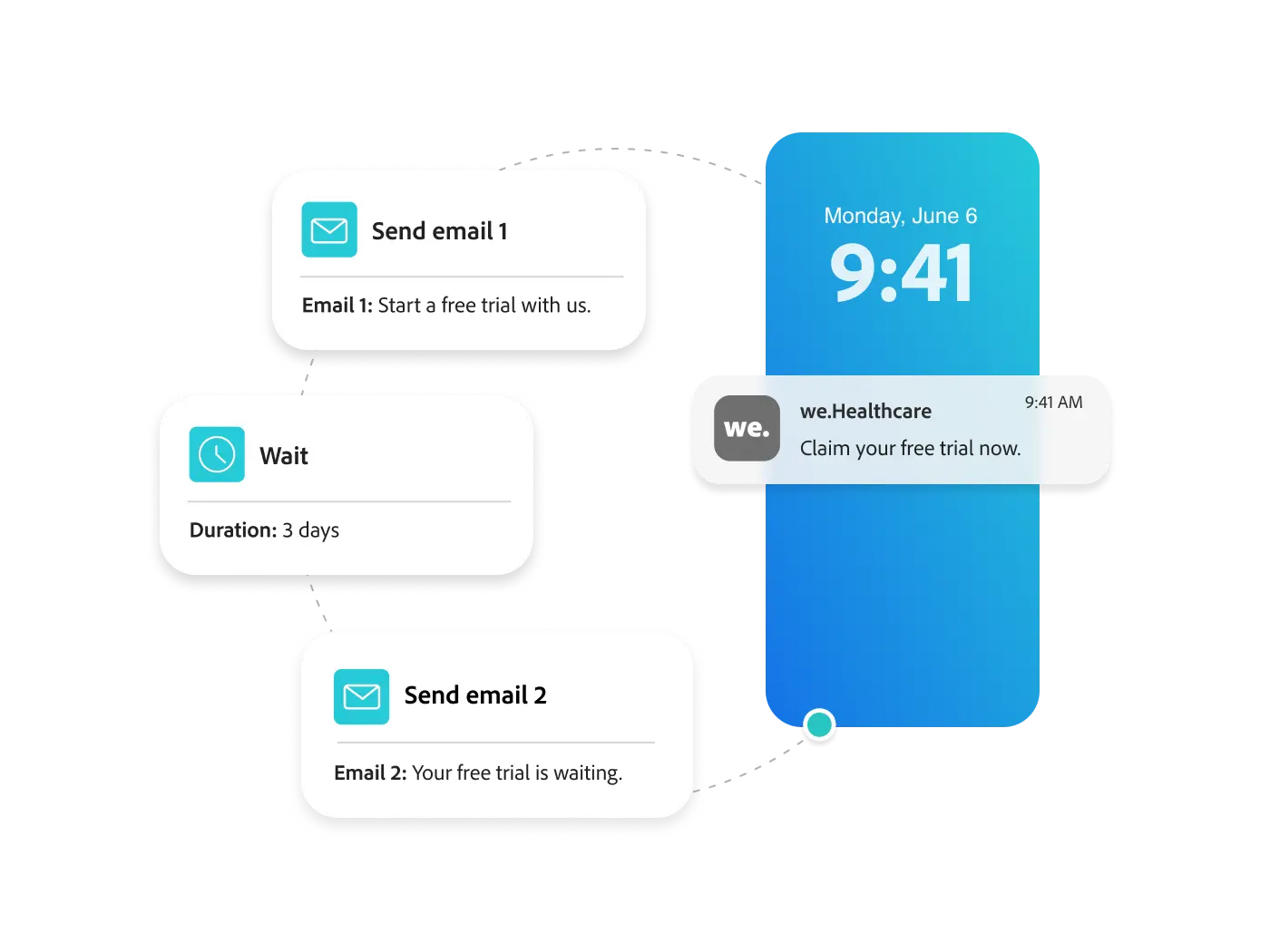
Adobe splits B2B and B2C across two products. Marketo Engage handles B2B demand generation with Smart Campaigns, engagement programs, and lead scoring.
Source: Adobe Experience
Its Marketo Measure (formerly Bizible) multitouch attribution tracks every buyer touchpoint across email, web, events, paid media, and offline channels back to closed CRM opportunities.
For B2C, Adobe Journey Optimizer orchestrates real-time, event-triggered journeys across email, SMS, push, in-app, and web channels, evaluating live AEP profiles at every decision point.
The strength of Adobe's approach is real-time profile evaluation. When a customer makes a purchase, AJO can reference that updated profile within seconds for the next journey step.
The limitation: Marketo's CRM integration, while functional with Salesforce, lacks the native depth that Salesforce's own marketing tools provide. Organizations centered on Salesforce CRM report a "two-system" experience that lowers sales team adoption.
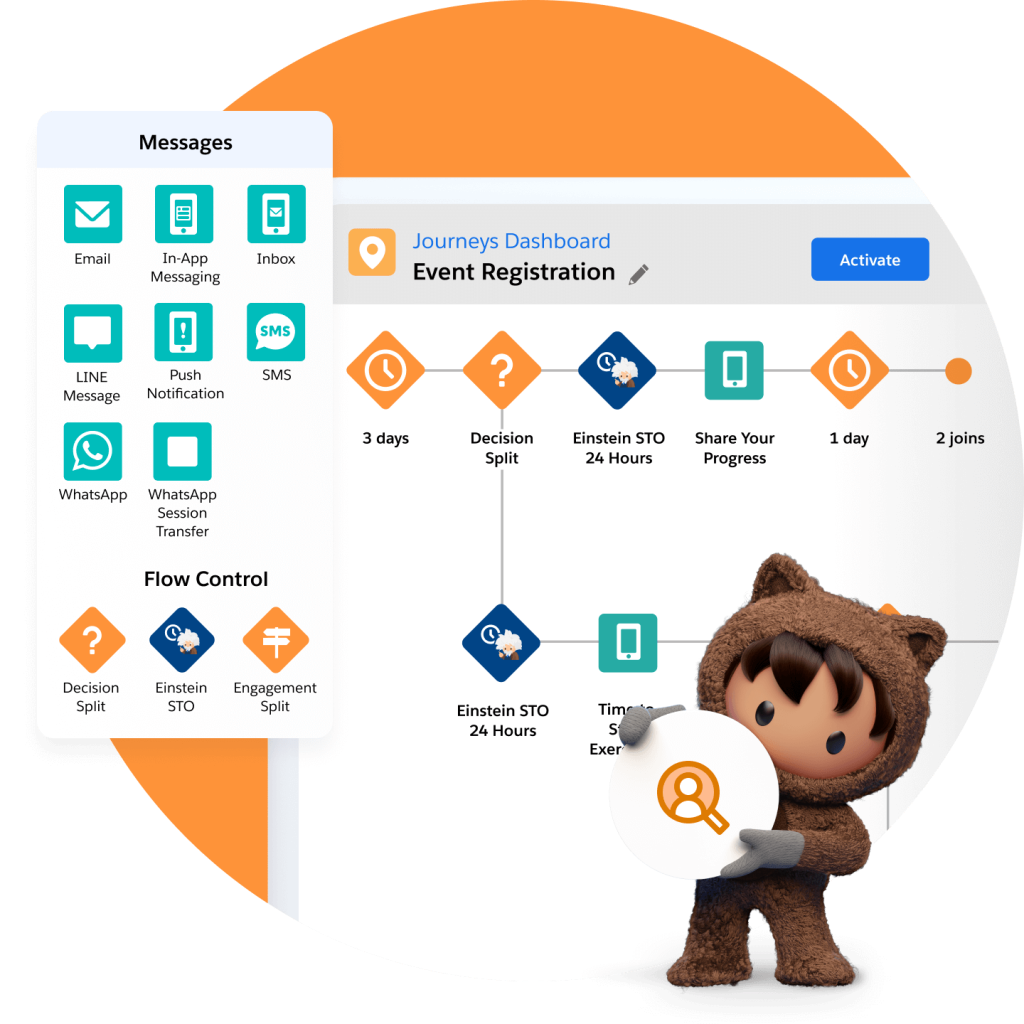
Salesforce Marketing Cloud also spans B2B and B2C, but with native CRM connectivity. Journey Builder orchestrates multi-step, event-driven campaigns. Account Engagement (formerly Pardot) handles B2B lead nurturing with native Salesforce data. Data Cloud provides the unified profile layer.
Source: Salesforce
The structural advantage: marketing engagement data flows directly into the sales rep's CRM view without integration middleware.
The limitation: Salesforce lacks Adobe's content creation and management depth. There's no equivalent to AEM, GenStudio, or the creative-to-activation pipeline.
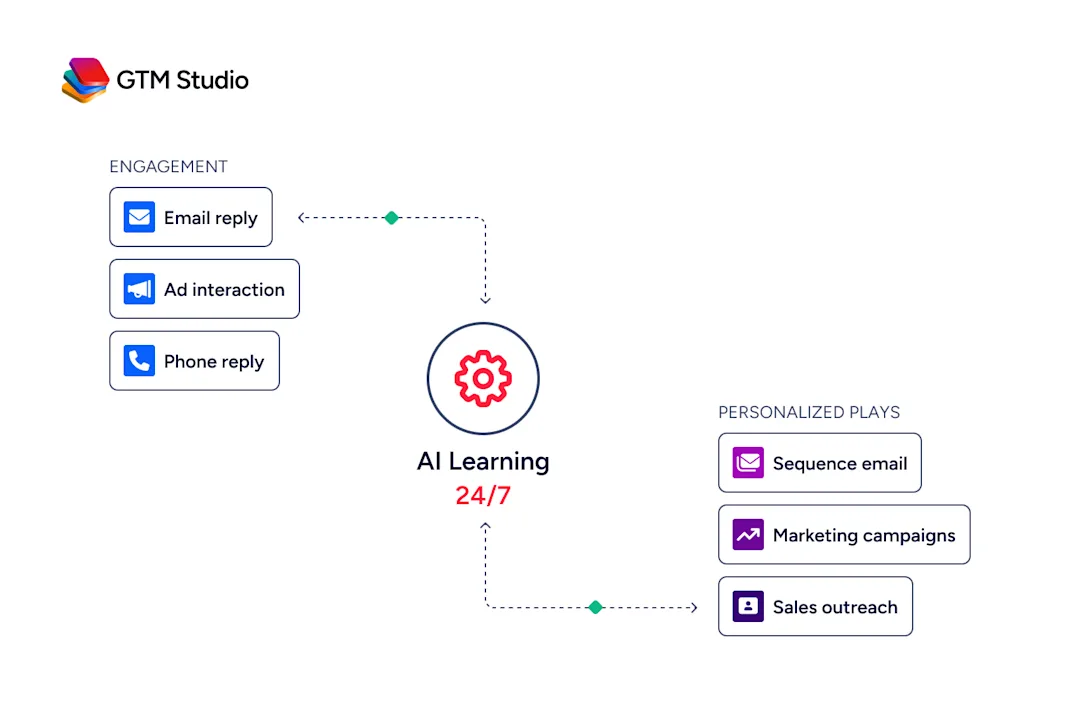
ZoomInfo approaches marketing from the intelligence layer. Rather than competing on campaign orchestration, GTM Studio lets marketers describe audiences in natural language, enrich them with first- and third-party data, and launch multi-channel plays (email, ads, calls, direct mail) triggered by buyer behavior.
Source: ZoomInfo
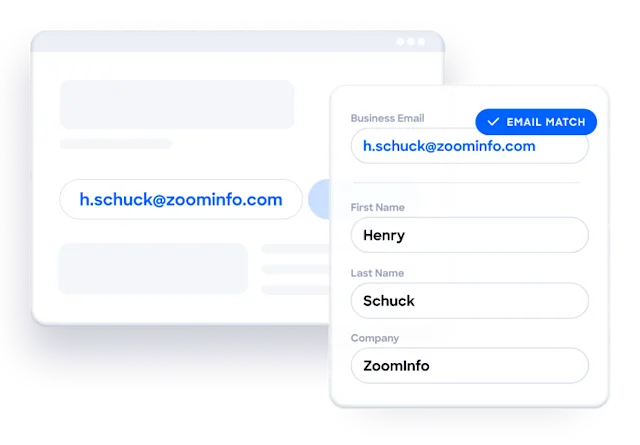
The platform includes a native demand-side platform for display advertising based on 300+ company attributes, and FormComplete reduces web forms to a single field while auto-appending the rest.
Source: ZoomInfo
Smartsheet reported a 40% increase in form fills and 84% increase in MQLs using FormComplete.
The difference: Adobe and Salesforce excel at orchestrating campaigns once you know your audience. ZoomInfo excels at identifying the audience in the first place, including which accounts are in-market and which contacts within those accounts to reach.
"ZoomInfo's not just a contact data company anymore. They've built a full system of execution. GTM Intelligence works the list, writes the outreach, triggers the play, and helps drive predictable growth." (Levanta)
AI strategies reflect each platform's DNA
All three companies are investing heavily in AI, but the implementations differ sharply.
Adobe's AI centers on content. Adobe Firefly generates images and copy trained exclusively on licensed content, with IP indemnification for enterprise customers.

Source: Adobe Experience
The AEP Agent Orchestrator (GA September 2025) deploys five agents: Audience Agent, Journey Agent, Experimentation Agent, Data Insights Agent, and Product Support Agent.
GenStudio for Performance Marketing uses Firefly (plus third-party models from Black Forest Labs, Google Veo 2, and Runway) to produce ad variants at scale, then tracks performance at the individual creative element level, not just the campaign level.
Adobe's AI advantage is content-to-performance attribution. GenStudio can tell you which headline variant, image composition, or CTA drove the highest conversion rate across Meta, LinkedIn, Google, TikTok, and other ad platforms. That granularity doesn't exist in competing platforms.
Salesforce's AI centers on autonomous action. The Atlas Reasoning Engine powers Agentforce agents that perceive, reason, and act across the CRM without constant human prompting. These agents handle prospecting, case resolution, coaching, shopping assistance, and campaign creation.
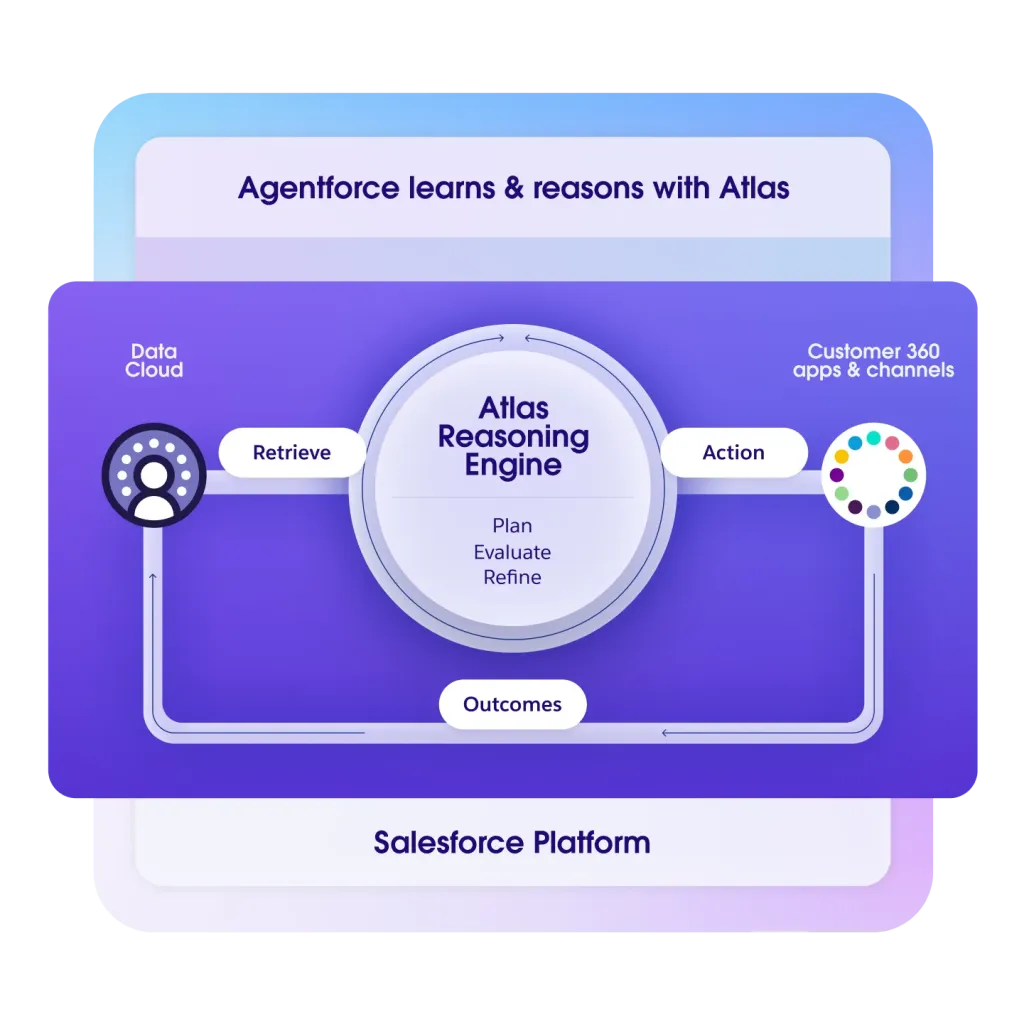
Source: Salesforce
The Einstein Trust Layer enforces zero data retention with LLM partners, PII masking, and toxicity detection.
Salesforce's AI advantage is the breadth of autonomous action across the customer lifecycle. From generating sales quotes (75% faster) to resolving service cases to optimizing ad spend, Agentforce agents operate across every Salesforce cloud.
ZoomInfo's AI centers on deal intelligence. The GTM Context Graph doesn't just record that a deal moved stages. It reasons across CRM data, conversation transcripts, intent signals, and behavioral patterns to understand why the deal moved.
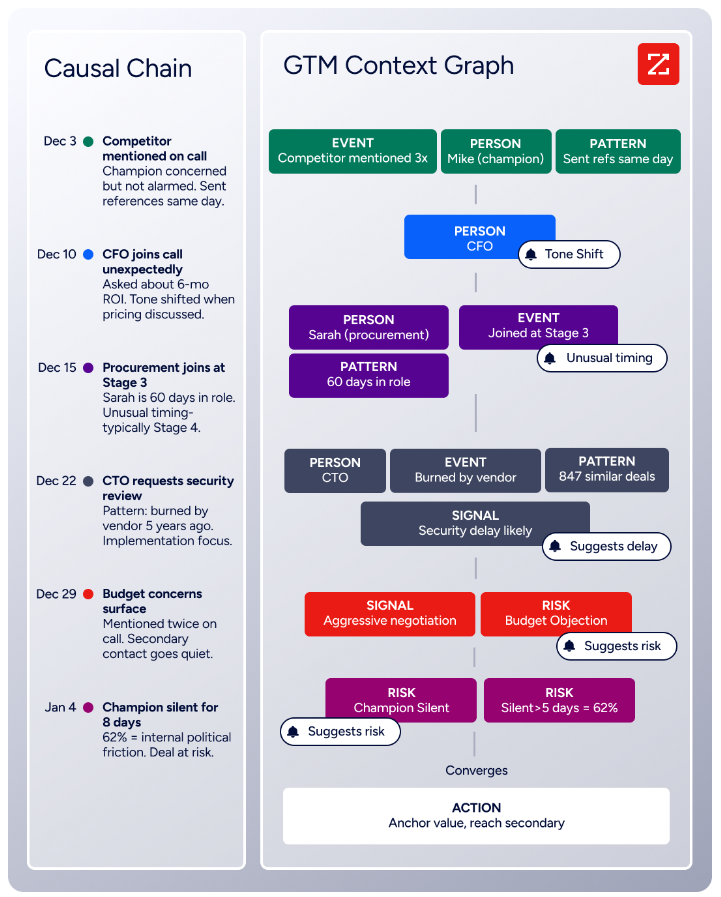
Source: ZoomInfo
As ZoomInfo's CPO Dominik Facher writes: "The CRM recorded the state change. It has no record of why it happened."
The AI agents in GTM Workspace, built on Anthropic's Claude, use this contextual reasoning to tell sellers who to contact, when to engage, and what to say.
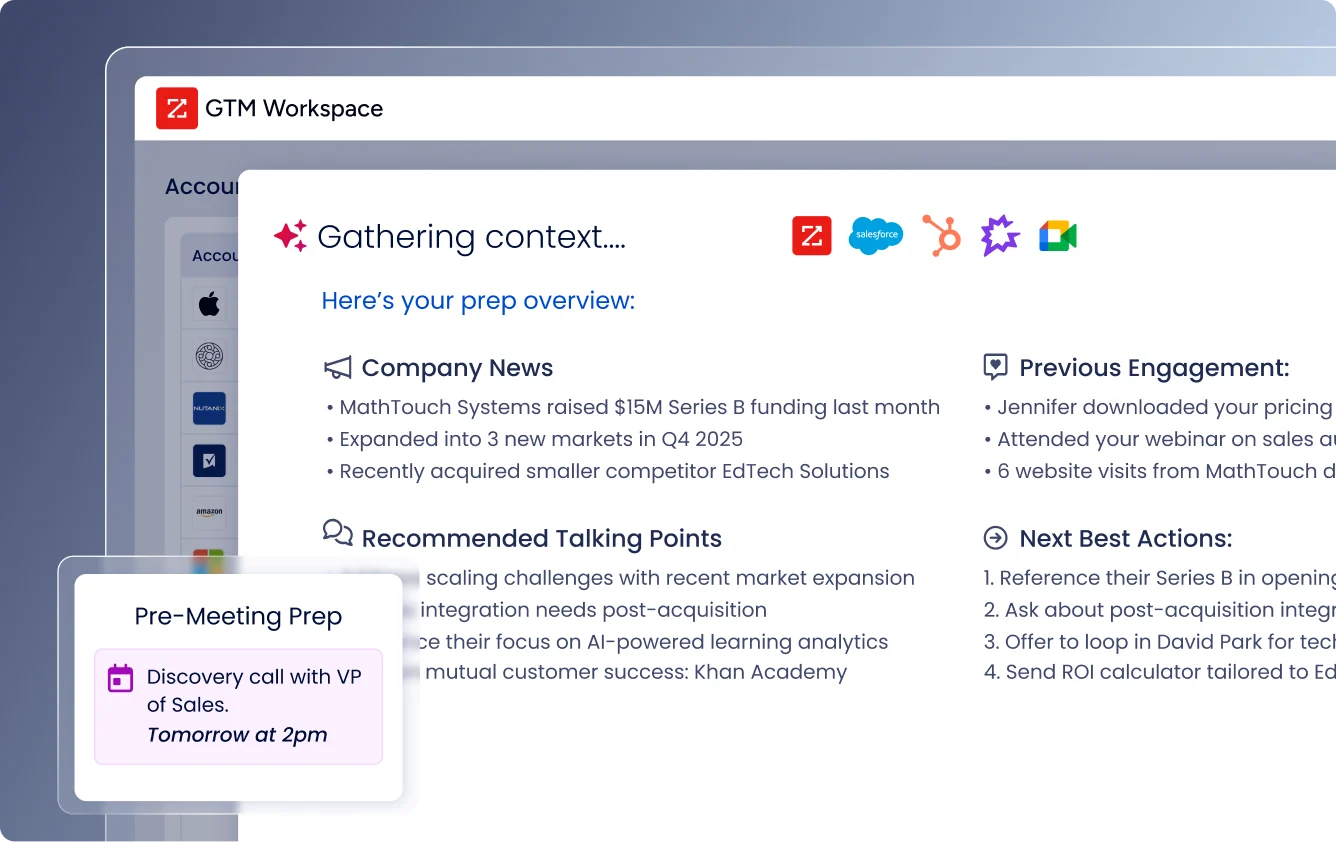
Source: ZoomInfo
ZoomInfo's AI advantage is contextual reasoning about deals and buyers. The system connects a CFO joining a call, asking about ROI, while the company hires three new VPs and researches a competitor. That pattern matching across thousands of deals produces recommendations that generic CRM AI cannot.
Data architecture determines what's possible
The data layer is where these platforms diverge most, because each was designed to answer different questions.
Adobe Experience Platform (AEP) unifies customer behavioral data into Real-Time Customer Profiles using the Experience Data Model (XDM).
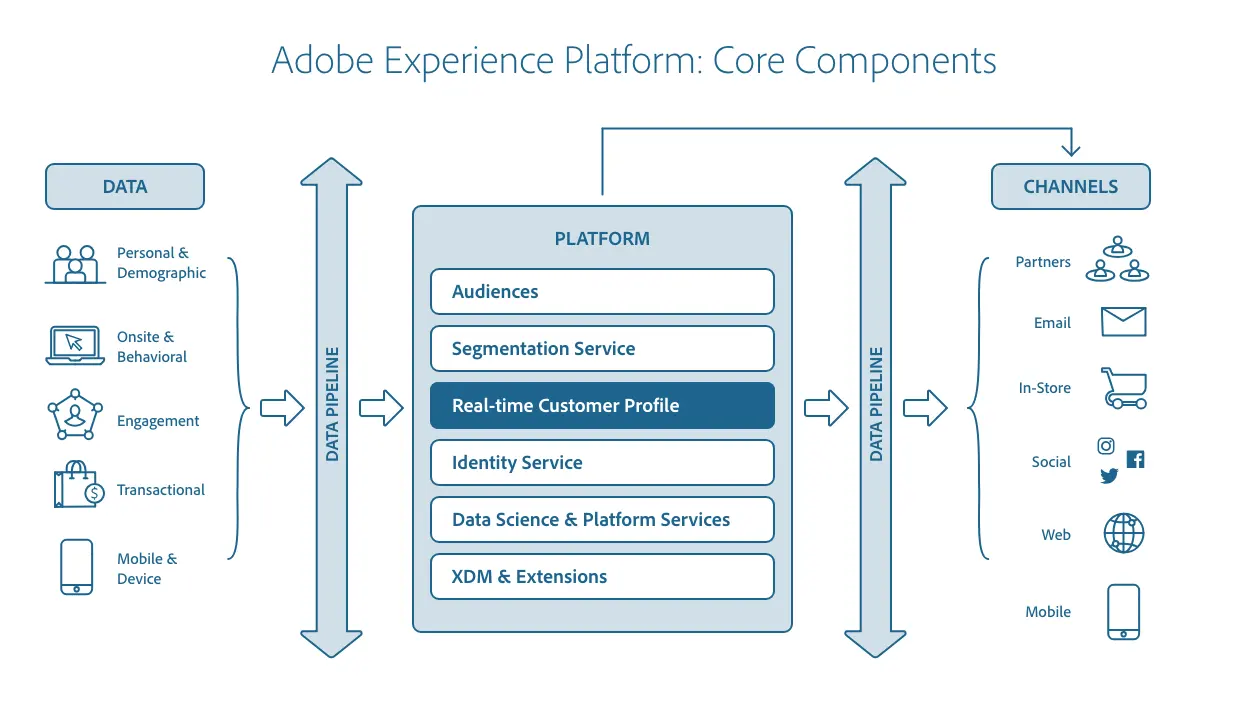
Source: Adobe Experience
It ingests data from web, mobile, commerce, and offline sources, resolves identities across up to 50 namespaces per profile, and makes those profiles available for segmentation and activation within milliseconds.
The DULE (Data Usage Labeling and Enforcement) framework automatically prevents governed data from flowing to unauthorized destinations. Customer Journey Analytics extends analysis beyond digital channels to include call center, IoT, and partner data.
AEP excels at understanding customer behavior across channels. It answers questions like: "Which journey path leads to the highest conversion?" and "How did this customer interact with us across web, email, and store visits?"
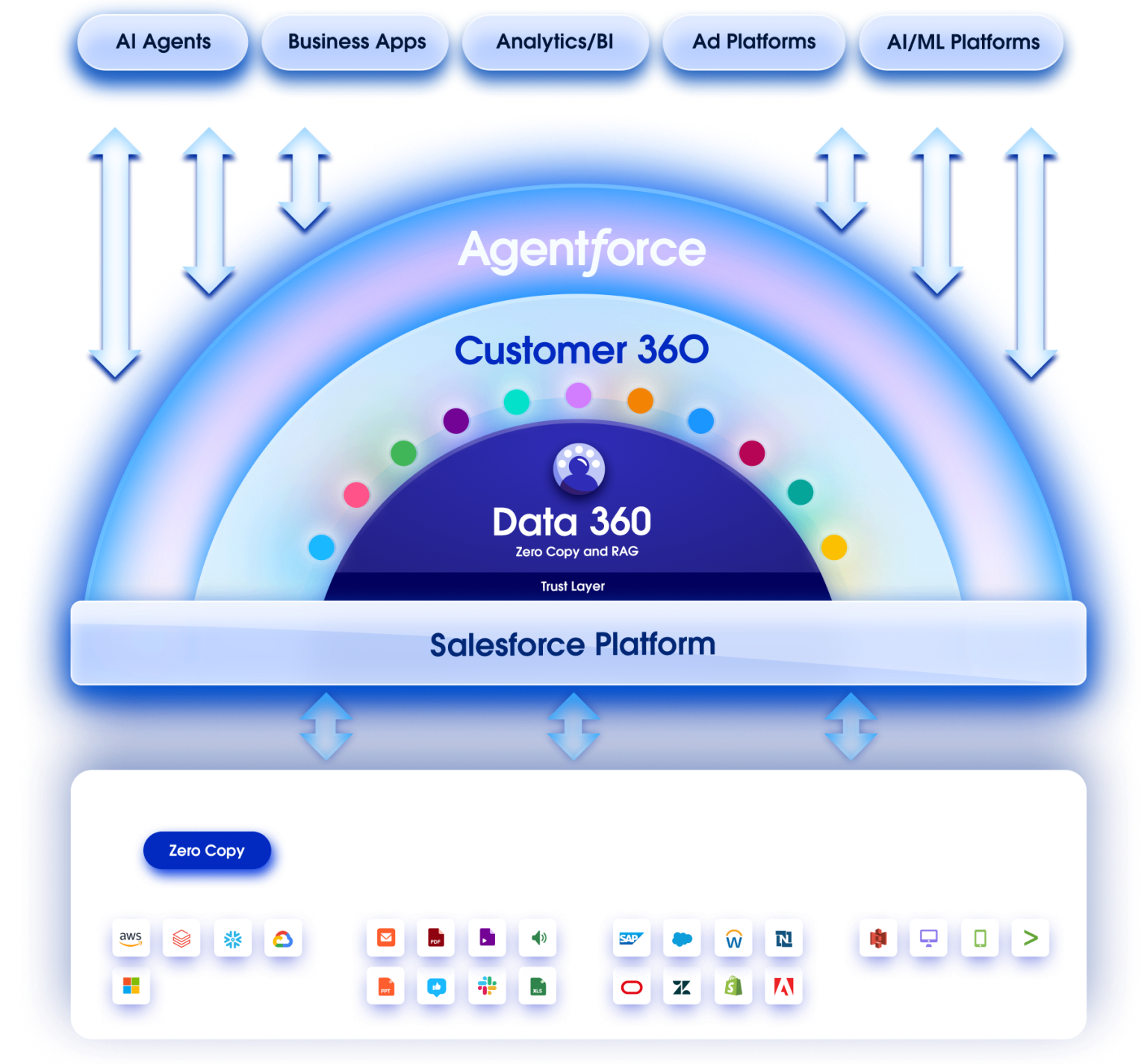
Salesforce Data Cloud takes a different approach, connecting to live data in Snowflake, Databricks, Google BigQuery, and AWS without copying it (zero-copy architecture).
Source: Salesforce
It has 200+ pre-built connectors and has ingested 112 trillion records in FY26. Identity resolution matches customer identities across sources into unified profiles. Vector search indexes support RAG-based AI grounding for Agentforce. Nearly half the Fortune 100 are active Data Cloud customers.
Data Cloud excels at making CRM and operational data available for AI reasoning. It answers questions like: "What does this customer's full history tell us about their next need?" and "Which accounts match our ideal customer profile?"
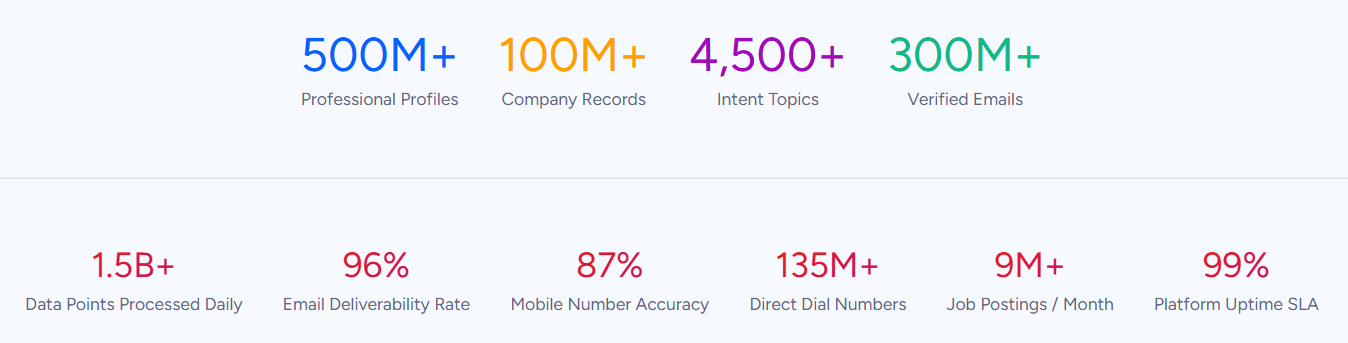
ZoomInfo's data layer operates differently. Rather than unifying your own customer data (both Adobe and Salesforce do that), ZoomInfo provides external intelligence your own systems can't generate: 500M contacts, 100M companies, 135M+ verified phone numbers, 120M direct dials, and 200M+ verified business emails. Intent data tracks signals from 210 million IP-to-Organization pairings and 6 trillion+ new keyword-to-device pairings sourced monthly. Technographics cover 30,000+ technologies across 30+ million companies.
Source: ZoomInfo
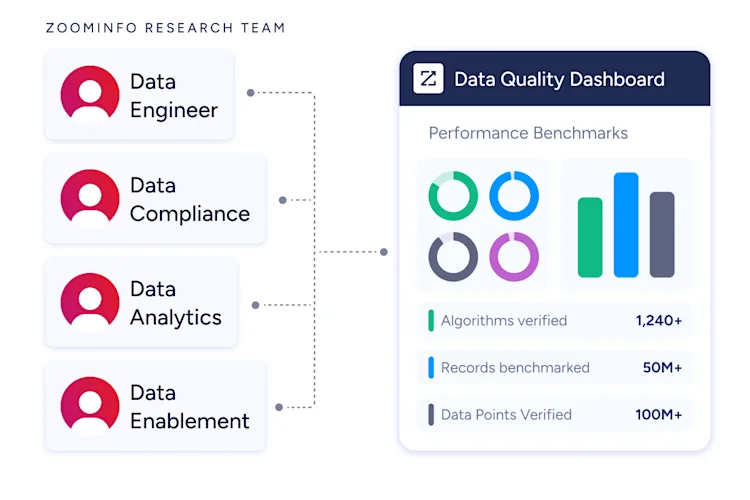
ZoomInfo verifies this data through automated ML scanning of 28 million site domains daily, a community of 200,000+ users who share data back, and 300+ human researchers, reaching up to 95% accuracy on first-party data.
Source: ZoomInfo
In a Fortune 500 competitive RFP analyzing 25 million contacts across vendors, an independent consultant concluded that "no other competitor came even close."
ZoomInfo answers the questions that neither Adobe nor Salesforce can answer from their own data: "Who should we be targeting that we haven't found yet?" "Which accounts are researching our category right now?" "Who are the decision-makers, and how do we reach them directly?"
"ZoomInfo is our one source of truth for account data, and even more so for contact data. There's no other provider in the market that gives you that level of detail." (Smartsheet)
Content management and commerce capabilities
This is where the comparison gets asymmetric. Adobe and Salesforce both offer content and commerce tools, but at different levels of depth. ZoomInfo doesn't compete here and doesn't try to.
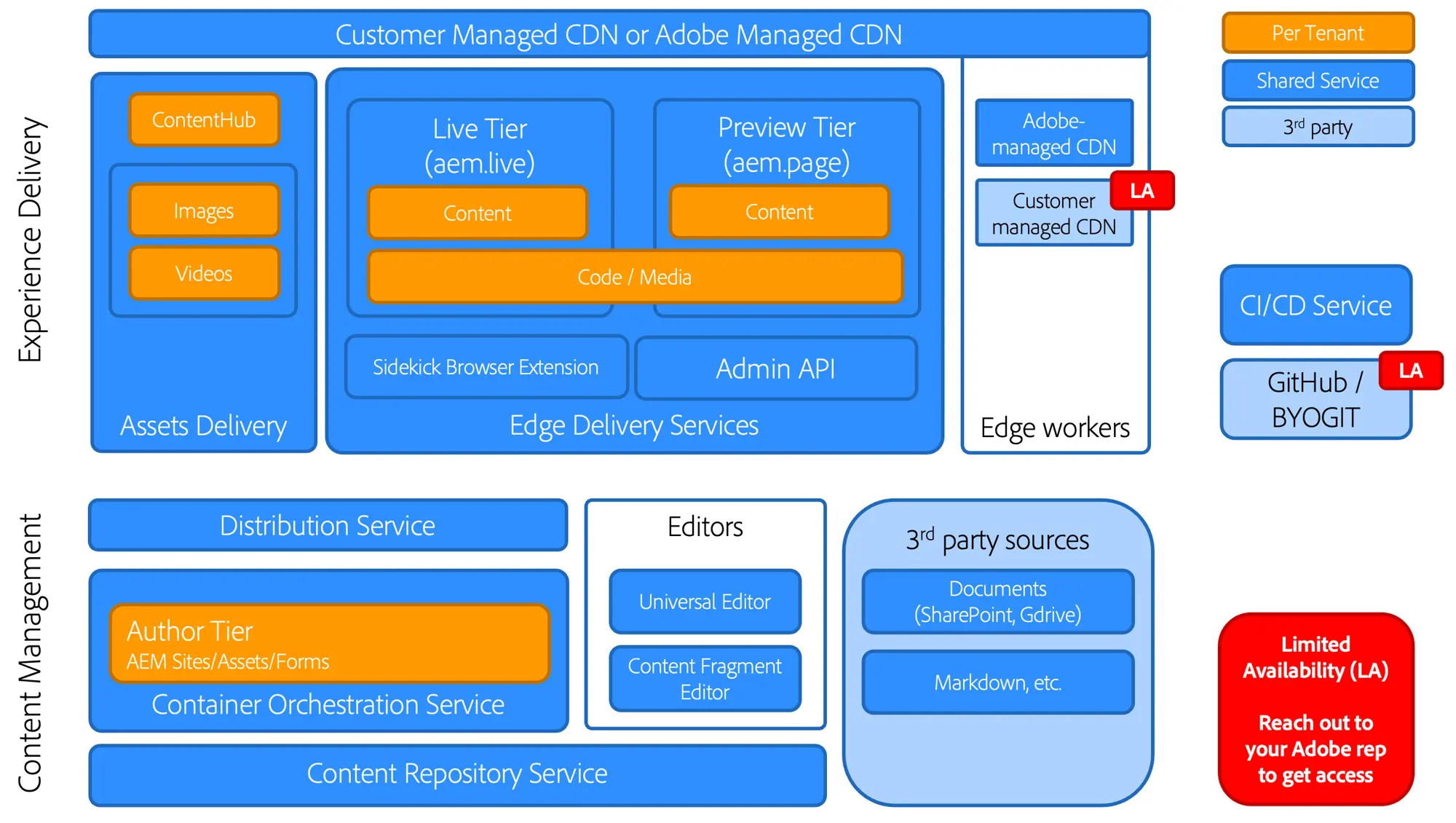
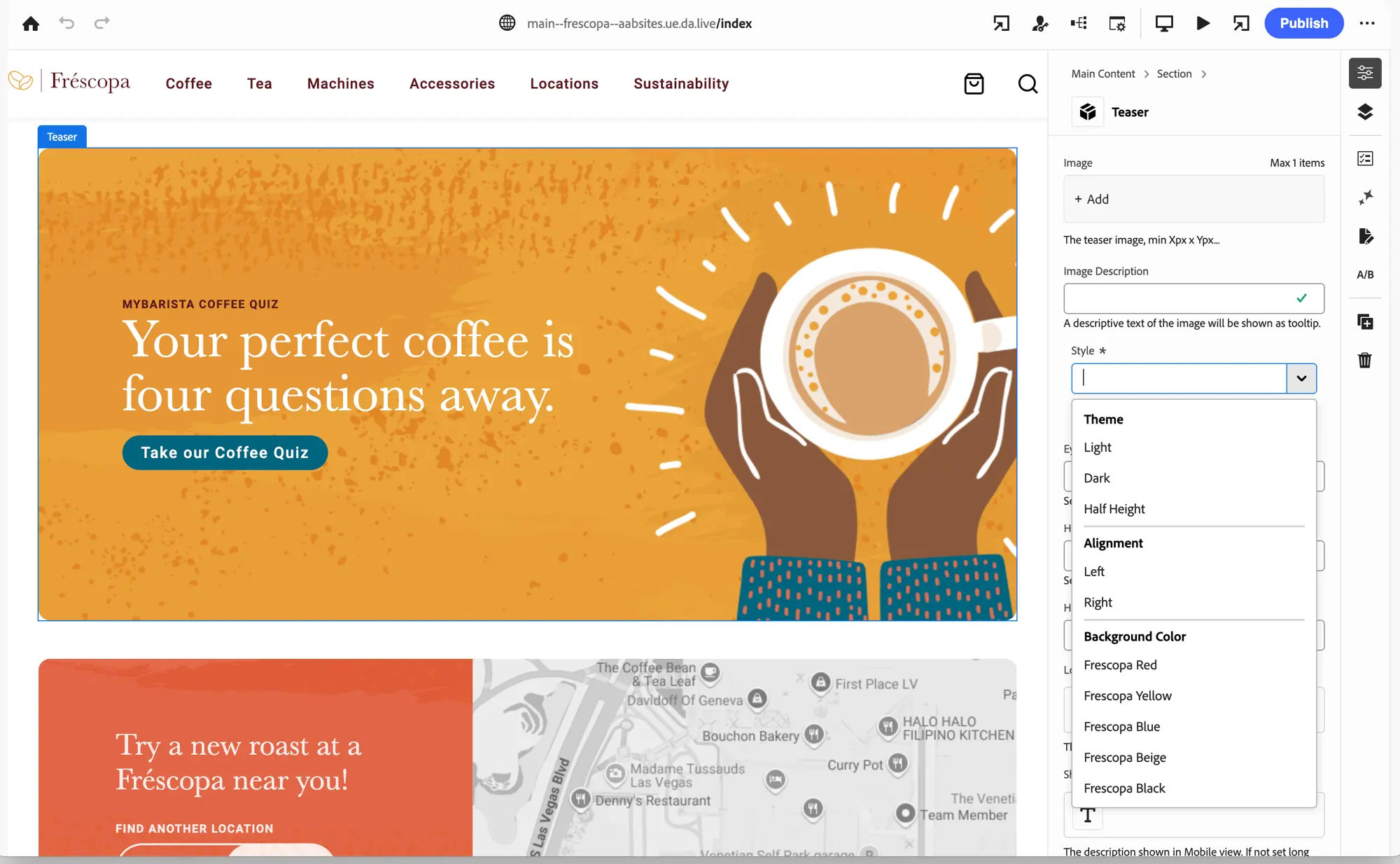
Adobe Experience Manager is an enterprise CMS and DAM in one. AEM Sites supports headful and headless content delivery. Edge Delivery Services achieves 100 Lighthouse performance scores.
Source: Adobe Experience
The dual authoring model (rich CMS editor plus document-based authoring in Word or Google Docs) removes the training barrier that causes many enterprise CMS deployments to fail.
Source: Adobe Experience
AEM Assets provides cloud-native DAM with AI-powered tagging, smart cropping, and the Adobe Asset Link plugin that embeds directly into Photoshop, Illustrator, and Premiere Pro.
Adobe Commerce (built on the Magento codebase) handles B2C and B2B storefronts with native negotiable quotes, purchase order approvals, and shared catalogs. The June 2025 Cloud Service launch eliminates the infrastructure management burden that was the top complaint against Adobe Commerce.
Salesforce Commerce Cloud is strong in B2C. It has been a Gartner MQ Leader for Digital Commerce for 10 consecutive years.
The advantage over Adobe Commerce: native CRM integration means order history, service cases, and marketing engagement all appear on the same customer record.
For content management, Salesforce offers basic CMS capabilities for portals and help centers, but nothing comparable to AEM's depth.
ZoomInfo doesn't offer content management or commerce. What it offers is the intelligence layer that makes content and commerce more effective.
When Adobe or Salesforce delivers a personalized experience, the quality of that personalization depends on knowing who the buyer is and what they care about. ZoomInfo's data, intent signals, and contextual reasoning improve the inputs that feed those personalization engines.
Pricing and total cost of ownership
Pricing is where enterprise buyers get the most unpleasant surprises with both Adobe and Salesforce.
Adobe Experience Cloud has no public list prices.
Everything is quote-only through enterprise sales or authorized partners. Implementation costs typically range from $500K to $5M+ for systems integrator fees alone; a full AEP + AEM + AJO + Marketo deployment frequently exceeds $2M in services costs.
Consumption metering creates cost escalation across multiple dimensions: page views in AEM, messages in AJO, profile volumes in Real-Time CDP, AI Credits for agentic features, and report suite traffic in Analytics.
Salesforce publishes tier pricing, but the published numbers are only the starting point. Sales Cloud and Service Cloud run from $25/user/month (Starter) to $550/user/month (Agentforce 1).
Marketing Cloud starts at $1,500/org/month and scales to $30,000+/org/month for enterprise email volumes. Agentforce consumption adds $2 per conversation or $0.10 per action via Flex Credits.
Data Cloud charges $500 per 100,000 credits. Premier Success Plan costs 30% of net license fees on top of everything else. A
June 2025 restructuring raised Enterprise and Unlimited list prices by 6%. Over 70% of implementations are partner-led, adding further cost.
ZoomInfo uses custom-quoted, consumption-based pricing with no published dollar amounts for paid tiers. Pricing scales around seats and credits (1 credit = 1 exported profile).
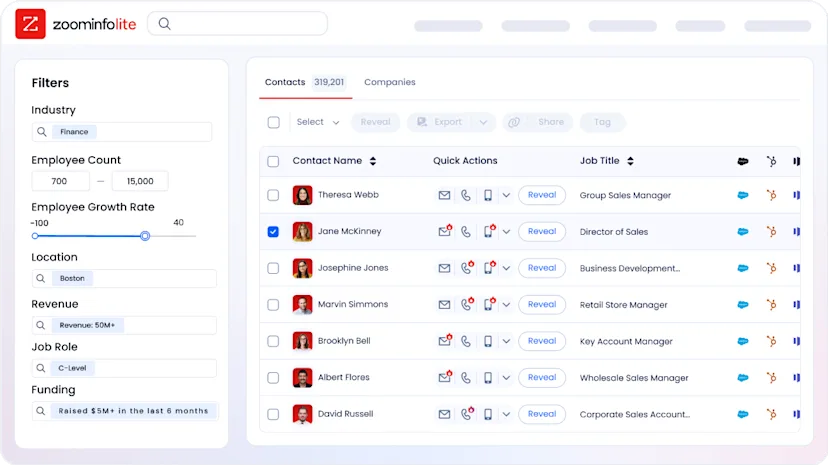
Three product lines (Sales, Marketing, and standalone products like Chorus and Chat) each have their own tier structures. Notably, ZoomInfo offers ZoomInfo Lite, a permanent free tier with access to the B2B database, 10 monthly export credits, advanced search, a Chrome extension, and HubSpot integration.
Source: ZoomInfo
A separate 7-day free trial provides fuller access. API access is included in all relevant plans. The deployment timeline is weeks, not months.
The cost comparison depends on what you're buying. Adobe and Salesforce are full enterprise platform investments with multi-year payback periods. ZoomInfo is a focused intelligence layer that deploys quickly and shows ROI in pipeline impact. Many organizations use ZoomInfo alongside either Adobe or Salesforce rather than choosing between them.
Integration and ecosystem comparison
Adobe's integration story centers on its internal ecosystem. The content supply chain (Creative Cloud to GenStudio to AEM to Workfront to AEP to AJO) operates with native data flows and no ETL.
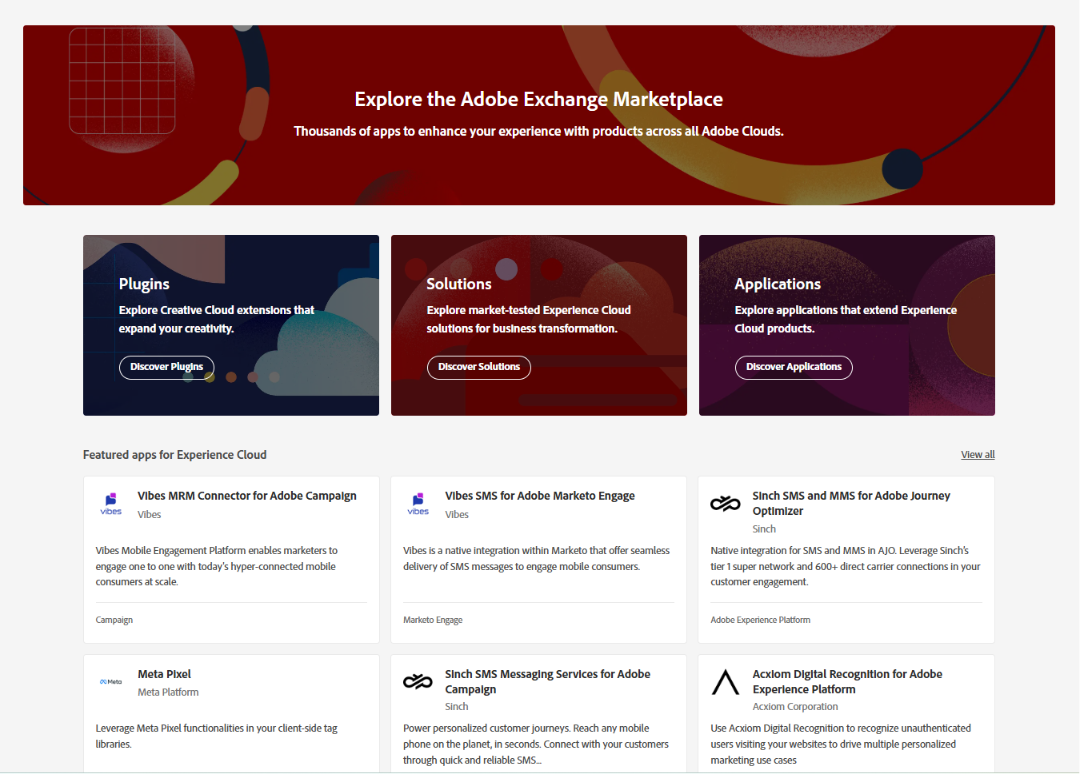
The Adobe Experience lists 500+ pre-built integrations. AEP's API-first architecture exposes 20+ API namespaces.
Source: Salesforce
Workfront Fusion provides low-code automation with 1,000+ connectors. Strategic AI partnerships include AWS, Microsoft, SAP, ServiceNow, and Workday for agent interoperability.
The weakness: Salesforce CRM integration, while available through Marketo's connector, lacks the bidirectional depth that Salesforce's own marketing tools provide. Organizations running Salesforce as their CRM will feel friction.
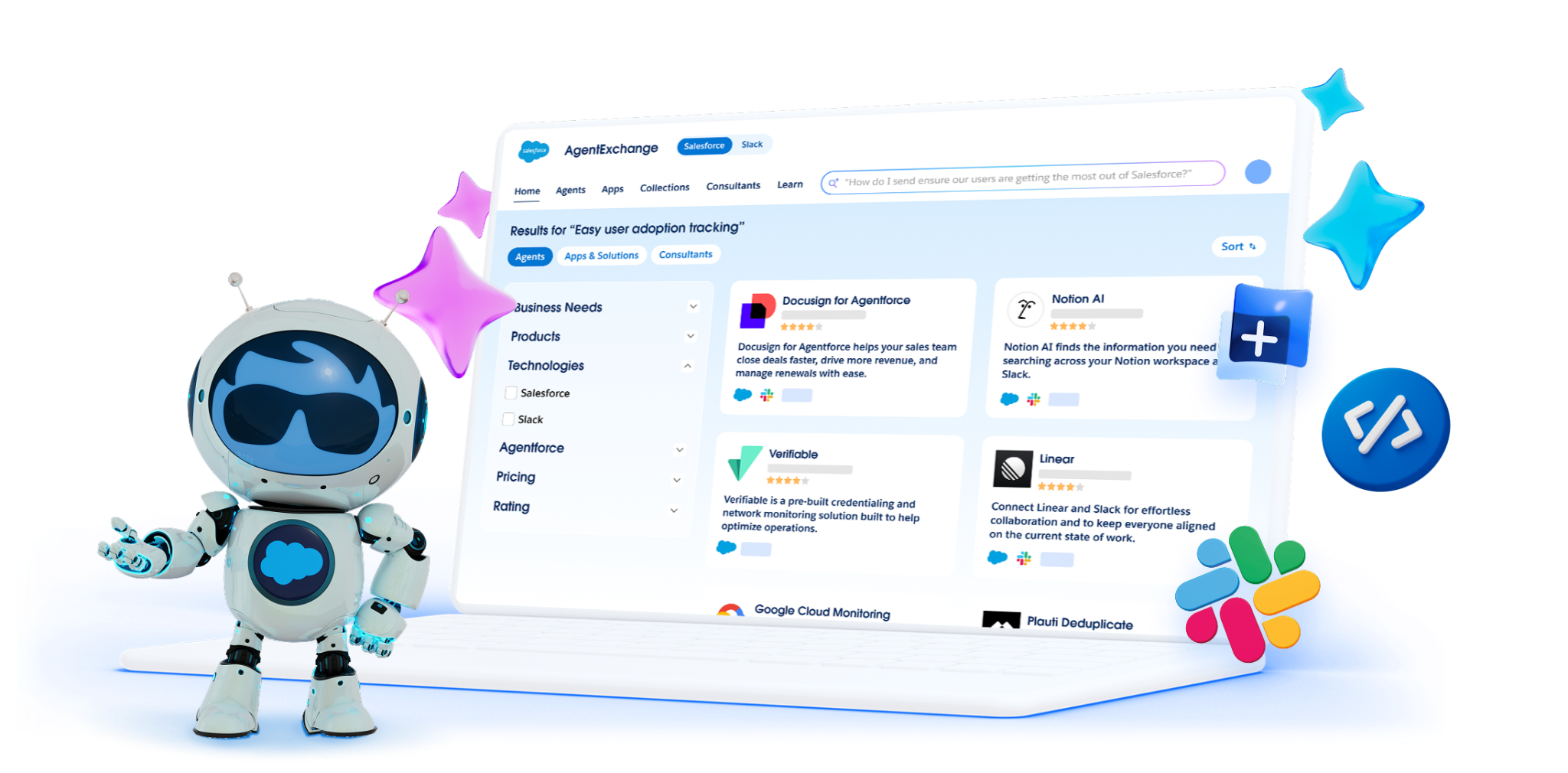
Salesforce's integration story is the broadest in enterprise software. AppExchange hosts 9,000+ partner apps with 14+ million installs.
Source: Salesforce
MuleSoft's Anypoint Platform provides hundreds of pre-built connectors for complex enterprise integrations. The REST, SOAP, Bulk, Metadata, and Pub/Sub APIs cover every CRM operation.
Native integrations with Google Workspace, Microsoft Outlook, Teams, and Slack (bidirectional CRM data in channels) reduce context-switching.
The strength: 91% of Salesforce customers use at least one AppExchange app. The ecosystem is roughly five times larger than Salesforce itself. For organizations standardized on Salesforce, nearly every tool they need already connects.
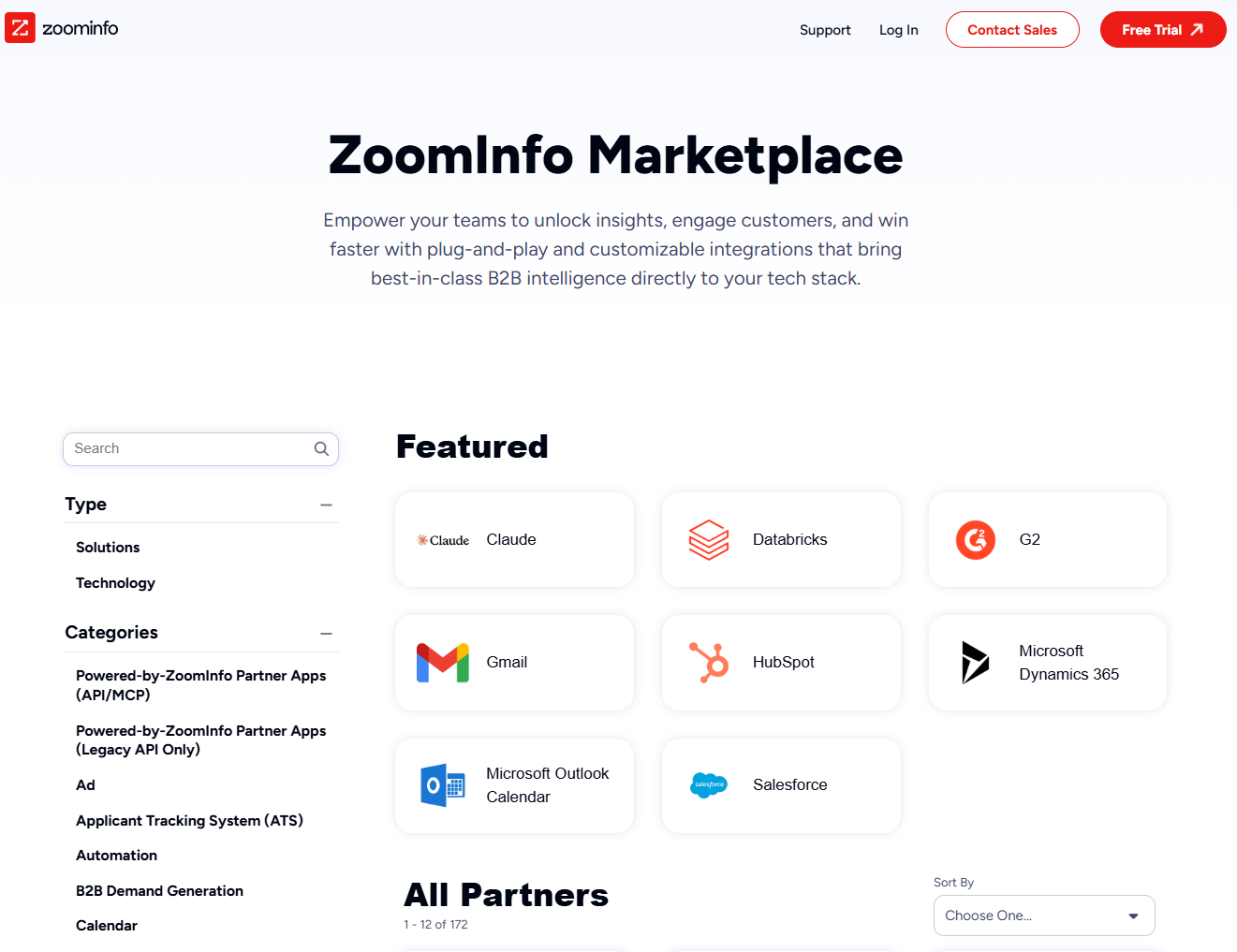
ZoomInfo's integration approach prioritizes go-to-market tools. The App Marketplace lists 120+ partner integrations across CRM, marketing automation, sales engagement, and data warehouse categories. Native integrations with Salesforce, HubSpot, Microsoft Dynamics 365, Snowflake, and others cover the core GTM stack.
Source: ZoomInfo
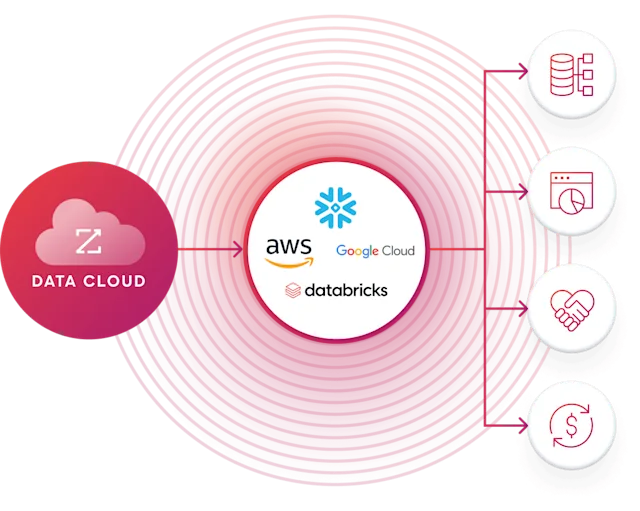
Cloud Partners enables direct data ingestion into AWS, Google Cloud, Snowflake, and Databricks.
Source: ZoomInfo
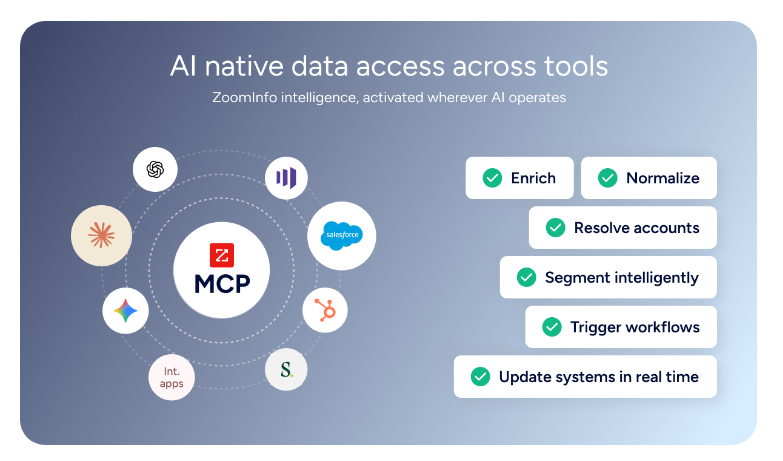
The Enterprise API and MCP server expose ZoomInfo's intelligence to any custom agent or application, including Claude and ChatGPT.
Source: ZoomInfo
The key point: ZoomInfo is designed as infrastructure that feeds intelligence into whatever systems a company already uses. A Salesforce shop gets ZoomInfo data in their CRM. An Adobe shop can enrich AEP profiles with ZoomInfo intelligence. A team building custom AI agents can call the same data through MCP. Nothing is locked to a single application.
"The plug-and-play aspect of the API means I can integrate it easily into any process and get information at a moment's notice." (BDO Canada)
Implementation complexity and time to value
This is where the three platforms differ most in practical terms.
Adobe Experience Cloud implementations are the most complex. The typical timeline is 9 months before active use. AEP schema design (XDM) is a foundational architecture decision that is expensive to reverse after data collection begins.
The XDM expertise gap means quality depends heavily on which systems integrator you hire. Several enterprise deployments report AEP going live but not achieving full Real-Time CDP activation for 12 to 18 months post-contract.
Support tiers range from Expert (included, with 1-hour P1 response) to Elite (paid upgrade with 15-minute P1 response, dedicated TAM, and named support engineer).
Salesforce implementation timelines vary widely. A simple Sales Cloud deployment can go live in weeks. A multi-cloud enterprise deployment (Sales + Service + Marketing + Commerce + Data Cloud) can take 3 to 12 months.
Salesforce provides three Success Plan tiers: Standard (free, self-service), Premier (30% of net license fees, with 1-hour P1 response and coaching), and Signature (custom pricing, with dedicated CSM and 15-minute P1 response).
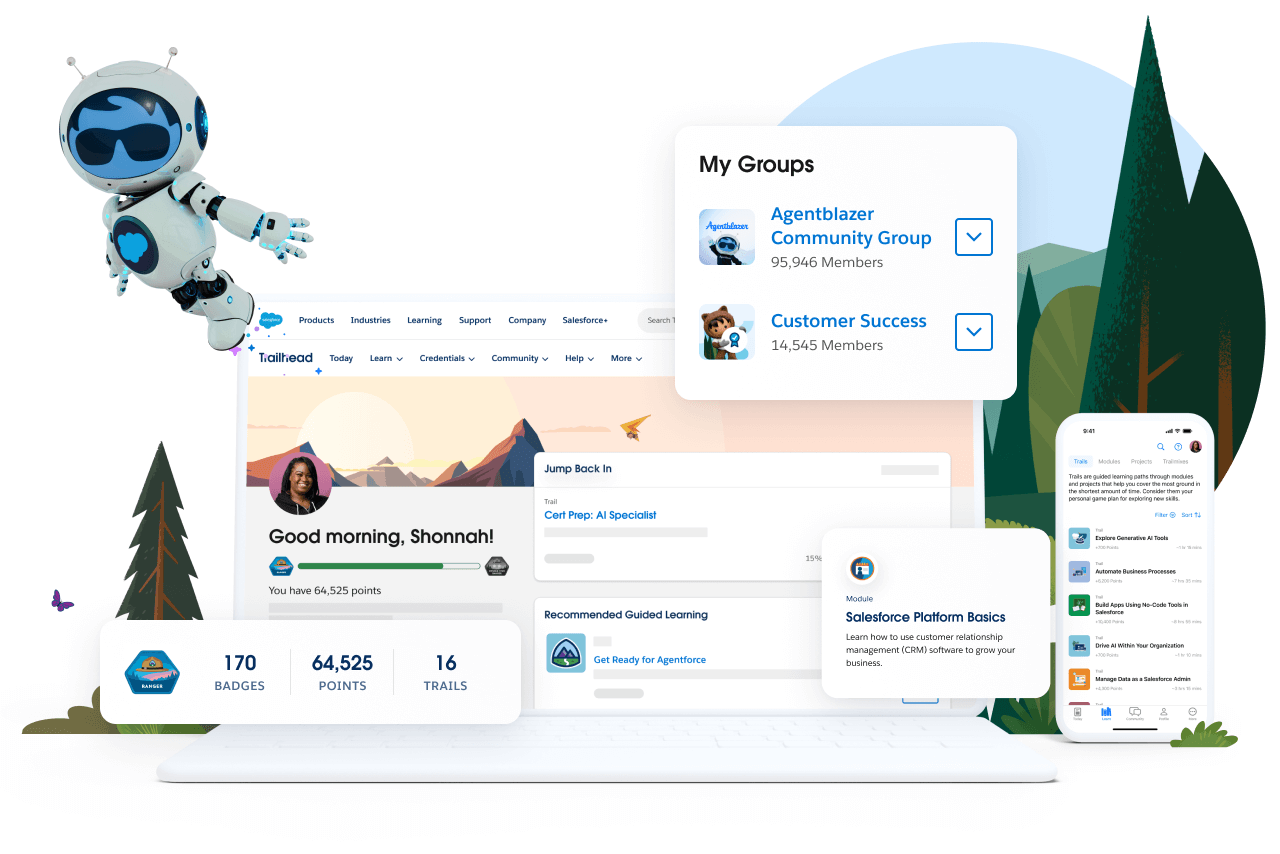
The Trailblazer Community of 20 million members and Trailhead learning platform (6+ million learners, 1,500+ badges) create a training and support ecosystem that Adobe doesn't match.
Source: Salesforce
ZoomInfo deploys in weeks, not months. The onboarding program runs 30 to 90 days across planning, technical implementation, education, and adoption phases, producing a 25% improvement in customer satisfaction scores and winning Rocketlane's Golden Comet award for Best Customer Onboarding Team of 2024.

Source: ZoomInfo
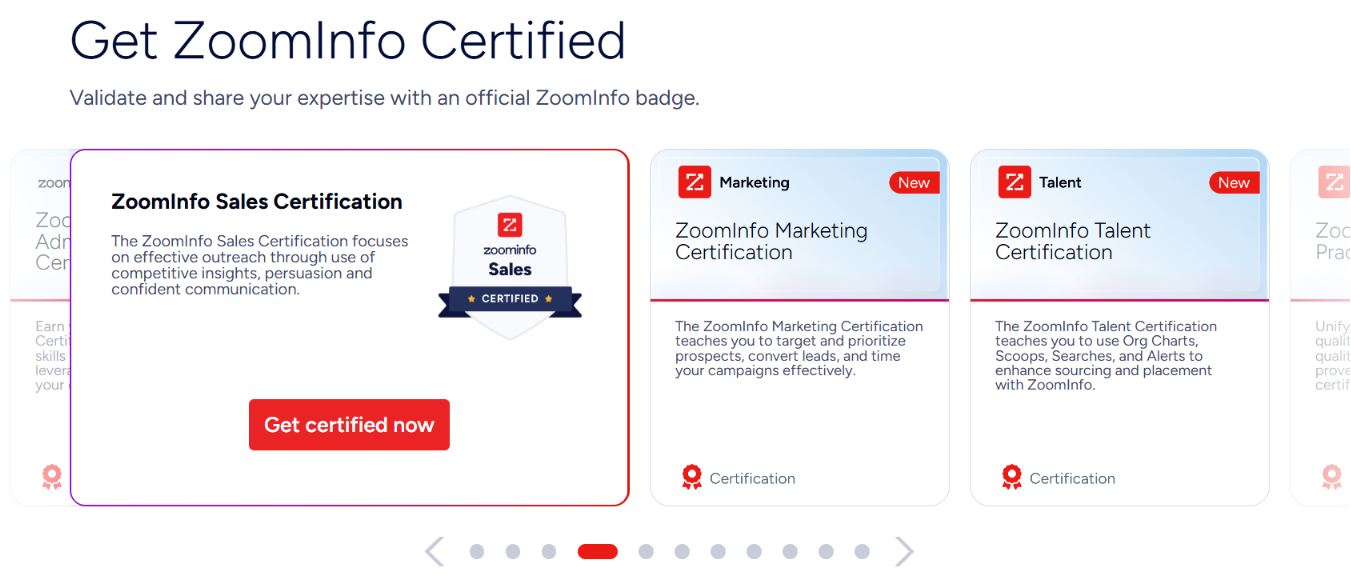
ZoomInfo University provides role-specific learning paths and certifications. CRM integrations with Salesforce, HubSpot, and Dynamics are pre-built and require minimal configuration.
Source: ZoomInfo
For enterprise buyers evaluating all three, implementation risk is a real consideration. Adobe and Salesforce implementations can stall, exceed budget, or fail to deliver expected ROI for years. ZoomInfo's focused scope means value appears in pipeline metrics within weeks of deployment.
Adobe Experience Cloud vs. Salesforce vs. ZoomInfo: Which should you choose?
These three platforms aren't interchangeable. The right choice depends on where your go-to-market strategy starts.
Choose Adobe Experience Cloud if:
You lead with content and customer experience across multiple brands and geographies
You need enterprise content management, DAM, and creative production tools
Your marketing strategy depends on real-time cross-channel journey orchestration
You're willing to invest 9+ months and $2M+ in implementation for long-term returns
Commercially safe AI-generated content with IP indemnification is a requirement
Choose Salesforce if:
Your organization already runs on (or plans to standardize on) Salesforce CRM
You need sales, service, marketing, and commerce sharing one customer record
Autonomous AI agents for case resolution, sales coaching, and campaign management are priorities
You want the largest enterprise app marketplace and partner ecosystem
Your implementation timeline can accommodate multi-cloud complexity
Choose ZoomInfo if:
You need to know exactly who to target, when they're in-market, and how to reach them
B2B data quality and coverage are critical to your pipeline
You want AI that reasons about why deals move or stall, not just what happened
Fast deployment and near-immediate pipeline impact matter more than long-term platform transformation
You need intelligence that works inside any tool (Salesforce, HubSpot, custom agents, or your own systems) through APIs and MCP
See ZoomInfo's GTM intelligence in action with a free trial.
Many enterprise organizations don't choose just one. Adobe or Salesforce handles the customer experience and CRM layer. ZoomInfo provides the intelligence layer that tells you who to reach and why now. Combining an enterprise platform (Adobe or Salesforce) with ZoomInfo's data and GTM Context Graph creates a go-to-market stack where your marketing campaigns target the right accounts, your sales reps contact the right people, and your pipeline reflects real buying intent rather than guesswork.
"That combination of our internal CRM data, external signals, and AI that's given all that context has helped us craft very specific account- and persona-based messages. And people have responded to them right away." (Seismic)
Adobe Experience Cloud vs. Salesforce vs. ZoomInfo FAQ
What is the fundamental difference between Adobe Experience Cloud, Salesforce, and ZoomInfo?
Adobe Experience Cloud is a content-and-experience orchestration platform built on Adobe Experience Platform. It excels at content creation, digital asset management, analytics, personalization, and cross-channel journey orchestration.
Salesforce is a CRM-first platform where sales, service, marketing, and commerce share a single customer record, with autonomous AI agents operating across the customer lifecycle.
ZoomInfo is a B2B intelligence platform providing verified contact data (500M contacts, 135M+ verified phone numbers, 200M+ verified business emails), buyer intent signals, and contextual deal reasoning through its GTM Context Graph.
Can I use ZoomInfo with Adobe Experience Cloud or Salesforce?
Yes. ZoomInfo is designed as an intelligence layer that integrates with your existing systems. It has native integrations with Salesforce, HubSpot, and Microsoft Dynamics, plus APIs and an MCP server that connect to any application.
Many enterprise organizations use ZoomInfo alongside Adobe or Salesforce to enrich their customer data with external B2B intelligence, buyer intent signals, and verified contact information.
Which platform is most expensive to implement?
Adobe Experience Cloud has the highest implementation cost and longest timeline. Implementations typically take 9 months and range from $500K to $5M+ in systems integrator fees alone, with full ROI often not realized until years 2 and 3.
Salesforce implementation varies widely from weeks (simple Sales Cloud) to 12 months (multi-cloud enterprise), with over 70% of deployments requiring partners.
ZoomInfo deploys in weeks with an onboarding program of 30 to 90 days.
Which platform has the best AI capabilities?
Each platform's AI excels in a different area. Adobe's AI (Firefly plus AEP agents) is strongest at content generation with IP indemnification and attribute-level creative performance tracking.
Salesforce's AI (Agentforce with the Atlas Reasoning Engine) is strongest at autonomous CRM actions, resolving 85% of its own support requests without human escalation.
ZoomInfo's AI (GTM Context Graph) is strongest at reasoning about deal dynamics, identifying why opportunities move or stall by combining B2B data with CRM records, conversation intelligence, and behavioral signals.
How does marketing automation compare across the three platforms?
Adobe offers Marketo Engage for B2B and Adobe Journey Optimizer for B2C, both built on AEP's real-time customer profiles.
Salesforce provides Marketing Cloud Engagement for B2C and Account Engagement for B2B, natively connected to CRM data.
ZoomInfo's GTM Studio lets marketers build audiences in natural language and launch multi-channel plays (email, display ads, calls, direct mail) triggered by buyer signals, with a native demand-side platform for advertising.
Adobe and Salesforce are stronger at campaign orchestration; ZoomInfo is stronger at identifying the right audience before the campaign starts.
Which platform offers the most transparent pricing?
None of the three is fully transparent. Adobe has no public pricing at all. Salesforce publishes starting tier prices but adds consumption-based charges (Agentforce credits, Data Cloud credits, Premier Support at 30% of license fees) that make total costs hard to predict.
ZoomInfo uses custom quoting but offers a permanent free tier (ZoomInfo Lite) with real data access and a 7-day free trial, giving buyers a way to evaluate before committing.
Does Adobe Experience Cloud integrate well with Salesforce CRM?
Adobe has a Salesforce connector through Marketo Engage, but integration depth is a known weakness. Organizations centered on Salesforce CRM report friction with bidirectional data sync that doesn't match what Salesforce's own marketing products provide natively.
If your revenue operations run on Salesforce, Adobe's marketing tools will require more integration work than Salesforce's native Marketing Cloud.
Which platform is best for a B2B sales team focused on pipeline generation?
ZoomInfo is built for this use case. Its data layer provides verified direct dials and emails for target buyers, intent signals identify accounts actively researching your category, and the GTM Context Graph reasons about deal dynamics to prioritize outreach.
GTM Workspace gives sellers a single interface with AI-drafted outreach, account briefs, and signal-triggered actions.
Salesforce Sales Cloud is the strongest CRM for managing pipeline once you have it. Adobe Experience Cloud is not designed for direct sales execution.
For a direct comparison of Salesforce and ZoomInfo for B2B sales teams, see Salesforce vs. ZoomInfo.
