
Choosing between Agile CRM and HubSpot for B2B sales and marketing comes down to a few questions:
Are you a small team looking for an affordable all-in-one tool, or a growing company that needs automation at scale?
Do you have budget for premium software, or does every dollar count right now?
How important is it that your CRM data is accurate before you start automating?
Are you comfortable managing multiple tools, or do you want everything under one roof?
Do you need AI that stores data, or AI that understands your deals and tells you what to do next?
Here's what we recommend:
Agile CRM serves small teams that need sales, marketing automation, and help desk without enterprise prices. Its free plan supports up to 10 users, and paid plans start at $8.99/user/month. You get a visual deal pipeline, email campaigns, lead scoring, web tracking, and a ticketing system in one platform. The trade-off: the interface hasn't been updated in years, performance can lag, and marketing automation workflows sometimes behave inconsistently. Agile CRM works for teams of 1-50 who need basic automation at low cost.
HubSpot is the CRM for companies ready to invest in growth. With 288,706 customers and $3.13 billion in revenue, it offers a suite spanning marketing, sales, service, content, and commerce, all sharing one Smart CRM database. Breeze AI agents handle prospecting, customer support, and data management. The downside: pricing climbs fast. Marketing Hub Professional runs $890/month with a $3,000 onboarding fee, and mixing hub tiers forces all seats to the highest tier's rate. For teams that can afford it, HubSpot's range justifies the cost.
Both platforms manage customer relationships and automate outreach. But neither solves the underlying problem: the quality of data flowing into your CRM determines the quality of everything that comes out. Incomplete contact records, missing phone numbers, and stale company data mean your automation targets the wrong people, your pipeline reports mislead, and your AI recommendations miss.
ZoomInfo is a B2B intelligence platform that sits underneath your CRM. With 500M contacts, 100M companies, 135M+ verified phone numbers, and 200M+ verified business emails, ZoomInfo gives B2B teams the verified data that makes CRM automation work. Its GTM Context Graph, processing 1.5B+ data points daily, combines this data with your CRM records, conversation transcripts, and behavioral signals to show not just what happened in a deal, but why. Whether you use HubSpot, Agile CRM, or another system, ZoomInfo integrates directly to enrich records, surface buying intent, and drive AI outreach through GTM Workspace for sellers, GTM Studio for marketers and RevOps, or APIs and MCP for any tool in your stack.
If accurate data and deal intelligence sound like the missing piece in your CRM strategy, see how ZoomInfo works with a free trial.
Agile CRM vs. HubSpot vs. ZoomInfo at a glance
Agile CRM | HubSpot | ZoomInfo | |
|---|---|---|---|
Primary function | All-in-one CRM for SMBs | CRM platform for scaling companies | B2B data intelligence + GTM execution |
Marketing automation | Included at all paid tiers | Requires Marketing Hub ($800+/month for Pro) | Not a marketing automation tool |
B2B contact database | Only your own contacts | Only your own contacts | 500M contacts, 200M+ verified emails |
Buyer intent signals | None | None native | Intent data from 210M IP-to-org pairings |
AI capabilities | None | Breeze AI agents (Pro/Enterprise) | GTM Context Graph + AI agents |
CRM integration | Is the CRM | Is the CRM | Integrates with HubSpot, Salesforce, Dynamics |
Support | Email, variable quality | Tiered: community to phone | Dedicated support + ZoomInfo University |
Paid starting price | $8.99/user/month (annual) | $15/seat/month (Starter, annual) | Custom-quoted, consumption-based |
Free plan | Up to 10 users, 1,000 contacts | Unlimited contacts, 2 users max | ZoomInfo Lite (permanent) + 7-day full trial |
Best for | Teams under 50 on tight budgets | Growth-stage companies investing in automation | B2B teams needing verified data and buyer intent |
The scope gap between these two CRMs is enormous
Agile CRM and HubSpot occupy different market positions, despite both calling themselves CRMs.
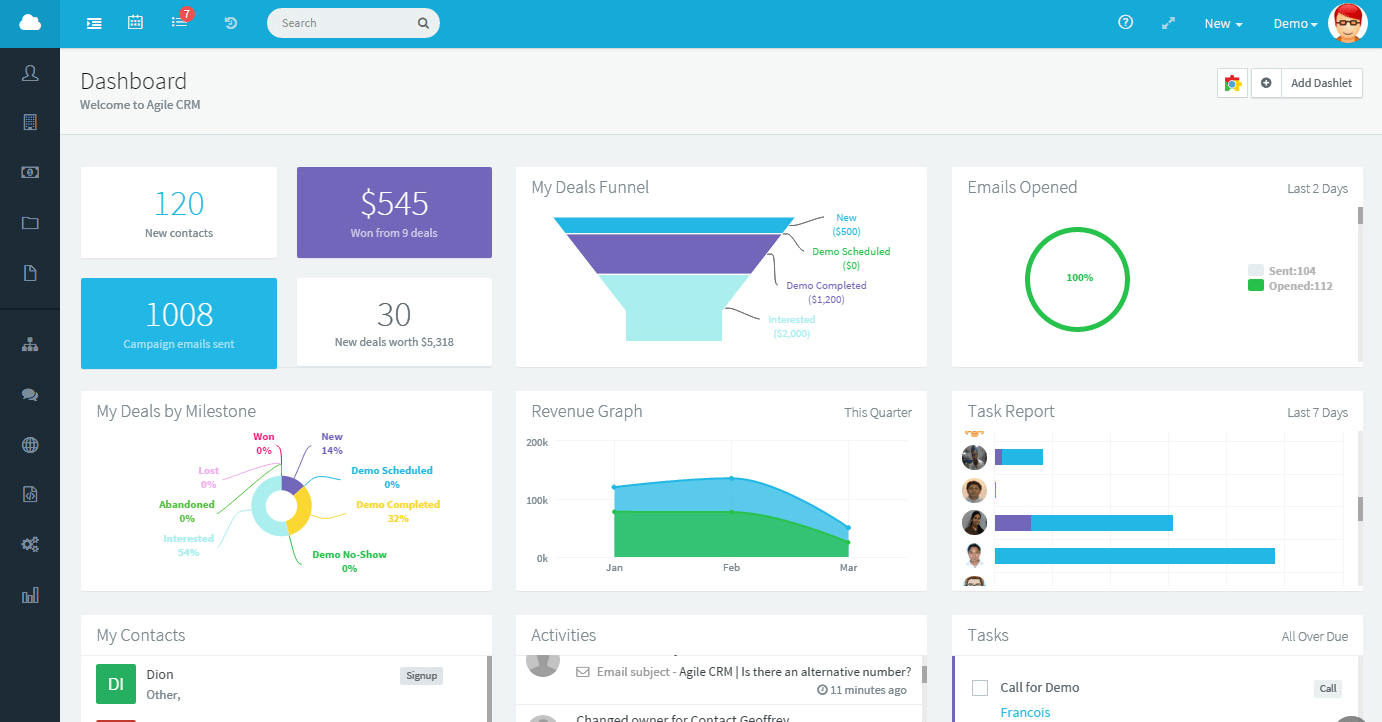
Agile CRM serves micro-businesses: 75.4% of its customers have 1-10 employees. The company has around 124 employees and was bootstrapped with no venture funding. It's a lean product for lean teams.
Source: Agile CRM
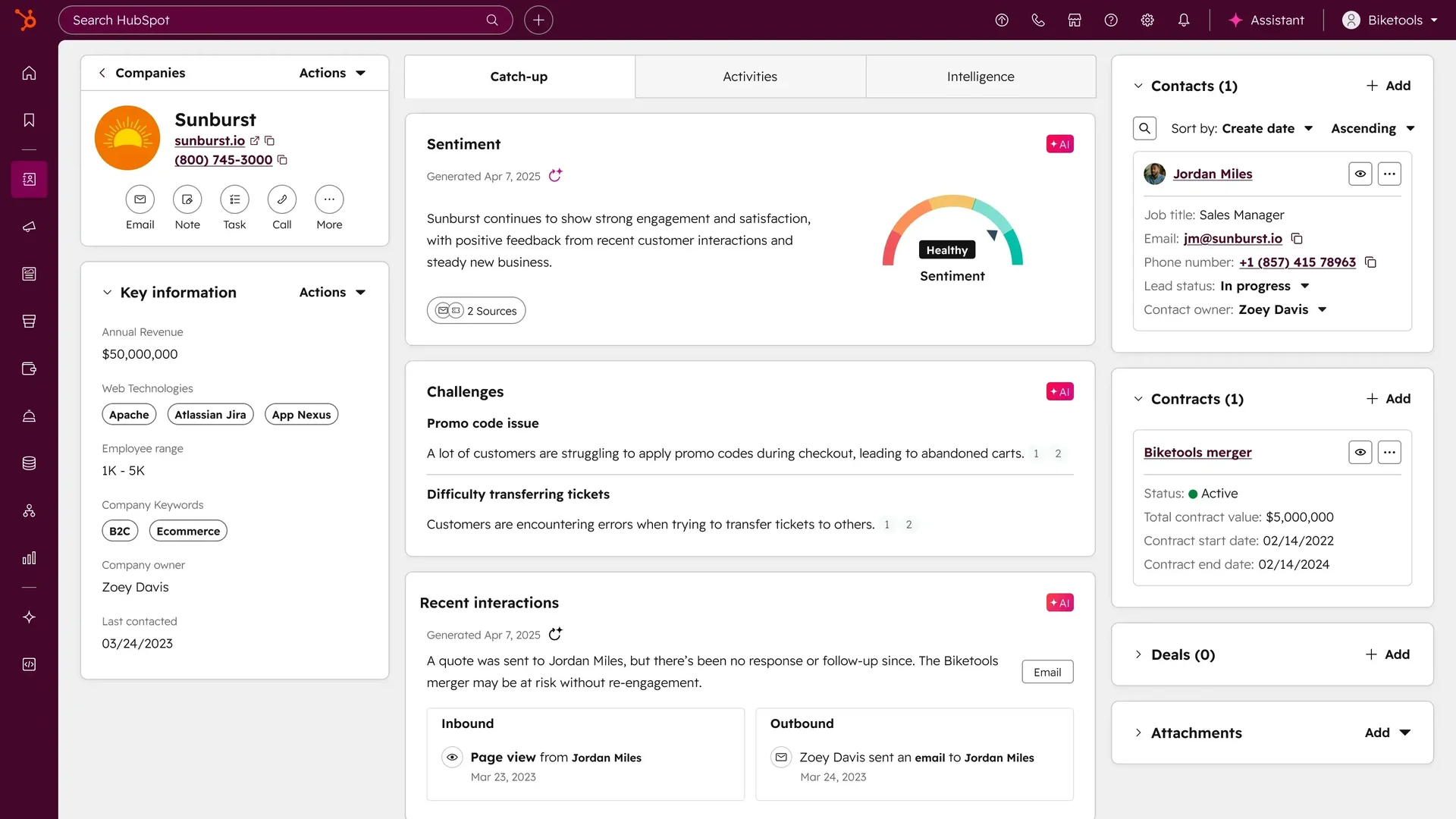
HubSpot operates at a different scale. With $3.13 billion in revenue, offices in 10 countries, and customers like eBay, DoorDash, Reddit, and TripAdvisor, HubSpot competes with Salesforce for enterprise deals. The platform supports up to 15 million contacts (expandable to 50 million), with custom objects, field-level permissions, and sandbox environments.
Source: HubSpot
This matters because it tells you where each platform stops growing with you. Agile CRM caps contacts at tier-based limits: 1,000 free, 10,000 Starter, 50,000 Regular. HubSpot absorbs millions. If you're starting small and plan to stay small, Agile CRM's limits won't hurt. If you're building past 50 people, you'll outgrow it.
Marketing automation: included vs. gated
This is where Agile CRM punches above its weight.
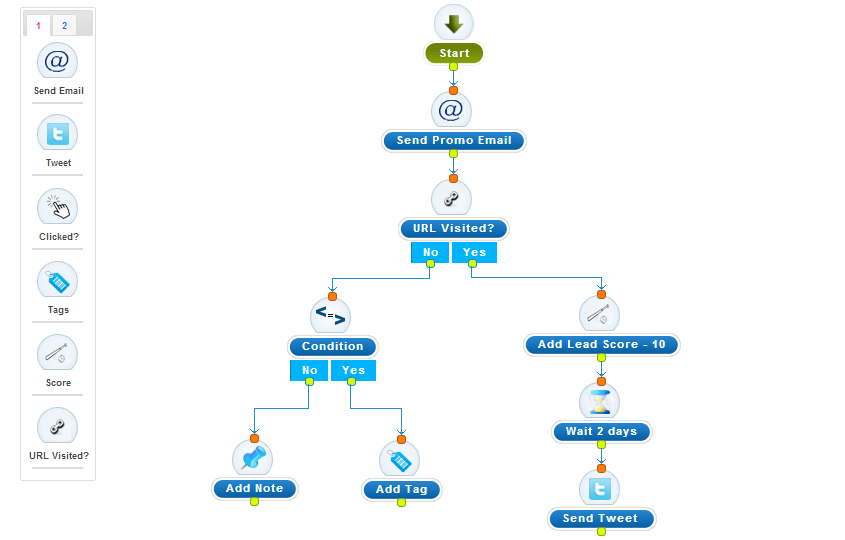
Agile CRM includes marketing automation at all paid tiers. At $8.99/user/month, you get a visual campaign builder, email drip sequences, lead scoring, web tracking, landing pages, and multichannel campaigns combining email, SMS, and social. The Starter plan limits you to 5 campaigns, but the Regular plan ($29.99/user/month) unlocks unlimited campaigns, SMS marketing, and the social suite.
Source: Agile CRM
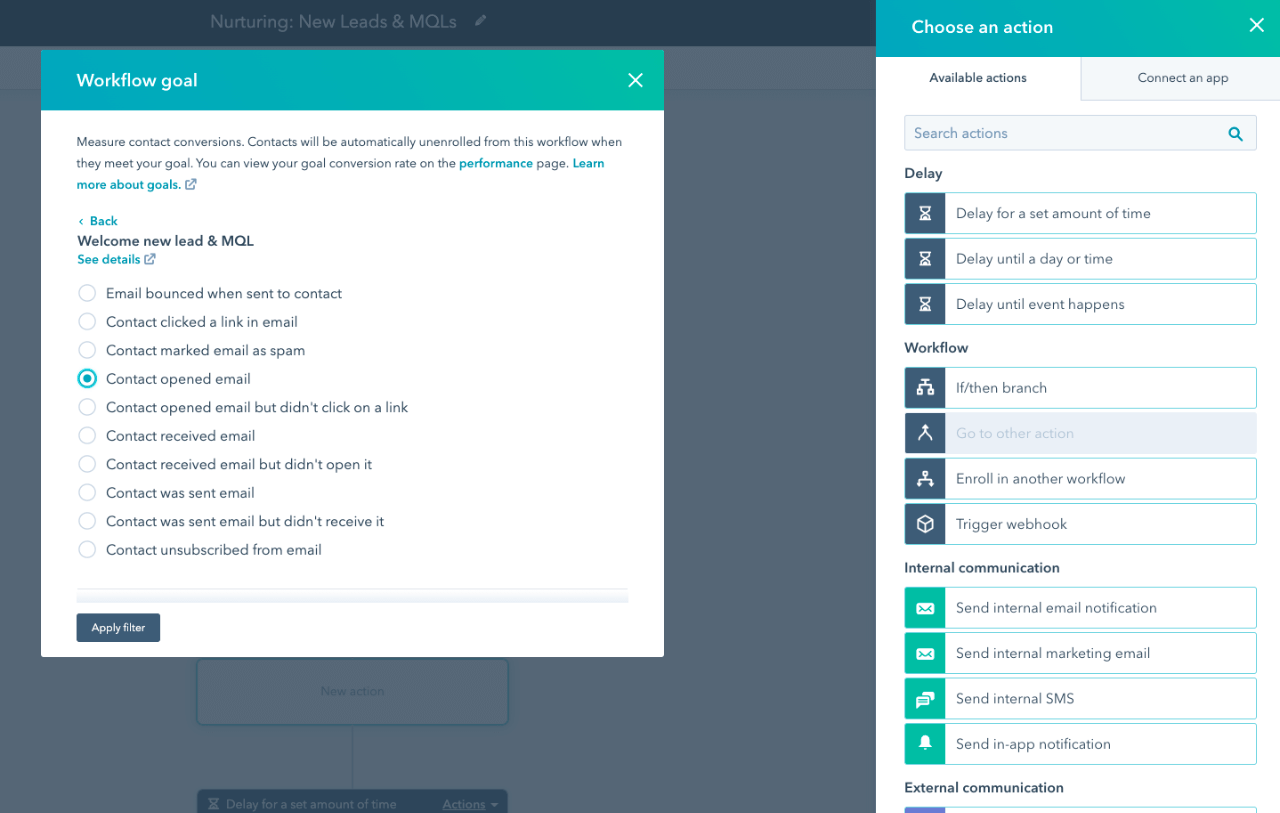
HubSpot gates marketing automation behind its Marketing Hub Professional tier at $800/month annual ($890/month monthly), plus a $3,000 onboarding fee. The free and Starter tiers include basic email marketing and forms, but visual workflows, A/B testing, and advanced segmentation all require Professional. At that tier, the capabilities run deeper than Agile CRM's: multi-touch attribution, AI-driven content personalization, and the Breeze Social Agent that automates posting across channels.
Source: HubSpot
The gap is quality and reliability. HubSpot's automation is polished and predictable. Agile CRM's, while feature-rich for the price, has a documented history of workflows behaving inconsistently. For campaigns where reliability matters (most of them), this is a real concern.
Pricing comparison reveals different worlds
Agile CRM's pricing is straightforward:
Plan | Annual (per user/month) | Contacts |
|---|---|---|
Free | $0 | 1,000 (up to 10 users) |
Starter | $8.99 | 10,000 |
Regular | $29.99 | 50,000 |
Enterprise | $47.99 | Unlimited |
HubSpot's pricing is layered. The Starter Customer Platform bundles all hubs at $15/seat/month (annual), which is reasonable. But the moment you need professional features, costs jump:
Marketing Hub Professional: $800/month + $3,000 onboarding
Sales Hub Professional: $90/seat/month + $1,500 onboarding
Service Hub Professional: $90/seat/month + $1,500 onboarding
Marketing Hub Enterprise: $3,600/month + $7,000 onboarding
A hidden multiplier: if you subscribe to multiple hubs at different tiers, HubSpot bills all Core Seats at the highest tier. A team mixing Marketing Hub Professional with Sales Hub Starter pays the Professional seat rate across the board.
For a 10-person team needing CRM and marketing automation, the annual cost comparison looks like this: Agile CRM Regular at ~$3,600/year versus HubSpot Marketing Hub Professional at ~$12,600/year (before onboarding fees and additional seats). The 3.5x price difference buys more capability, but the question is whether your team needs it today.
The data problem neither CRM solves
Both Agile CRM and HubSpot share a fundamental limitation: they only know what you put into them.
Your CRM starts empty. You add contacts from form fills, business cards, manual entry, and list imports. Over time, that data decays. People change jobs, companies restructure, phone numbers go dead, email addresses bounce. Neither Agile CRM nor HubSpot maintains an external database of verified B2B contacts. They manage relationships; they don't create market intelligence.
This creates three problems:
Prospecting is manual. Sales reps spend hours searching LinkedIn, company websites, and other sources to find contacts. Then they enter that data into the CRM by hand, often with errors or missing fields.
Data quality degrades. Without continuous verification, your CRM fills with outdated records. Agile CRM users have reported up to 30% of emails sent through the platform not reaching recipients. That's not just a deliverability issue; it's a data quality problem the platform compounds.
Intelligence is absent. Neither CRM tells you which companies are researching solutions like yours right now. Neither identifies the buying committee at a target account. Neither monitors job changes, funding rounds, or hiring signals that indicate buying readiness.
This is the gap ZoomInfo fills.
ZoomInfo provides the intelligence layer
ZoomInfo doesn't compete with Agile CRM or HubSpot. It makes both more effective by solving the data and intelligence problem at the source.
Verified contact data at scale. ZoomInfo maintains 500M contacts with 200M+ verified business emails and 135M+ verified phone numbers, backed by 300+ human researchers and achieving 95% accuracy on first-party data. In a Fortune 500 competitive RFP analyzing 25 million contacts across vendors, an independent consultant concluded that "no other competitor came even close."
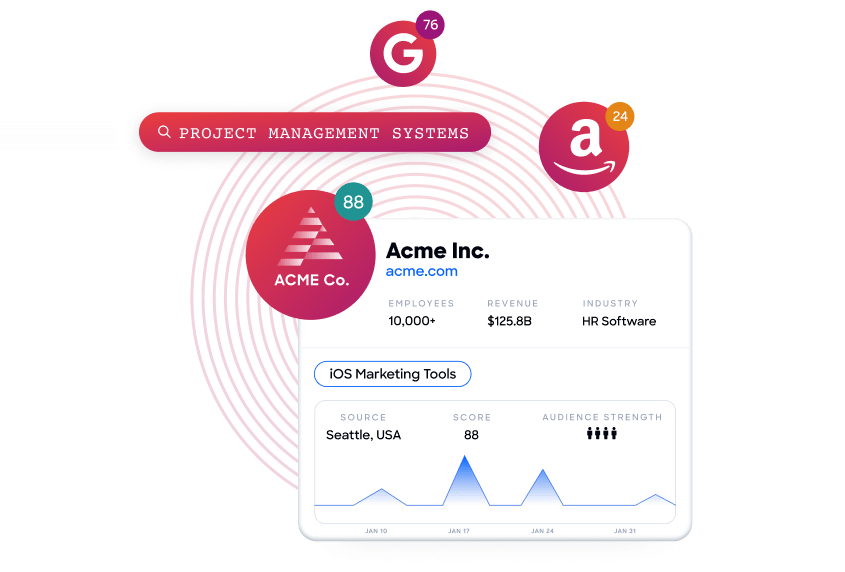
Buyer intent signals. ZoomInfo Intent tracks signals from 210M IP-to-Organization pairings and 6 trillion+ new keyword-to-device pairings sourced monthly. Guided Intent, exclusive to ZoomInfo, identifies topics correlated with deal success rather than requiring manual topic selection. This tells your team which accounts are in-market right now.
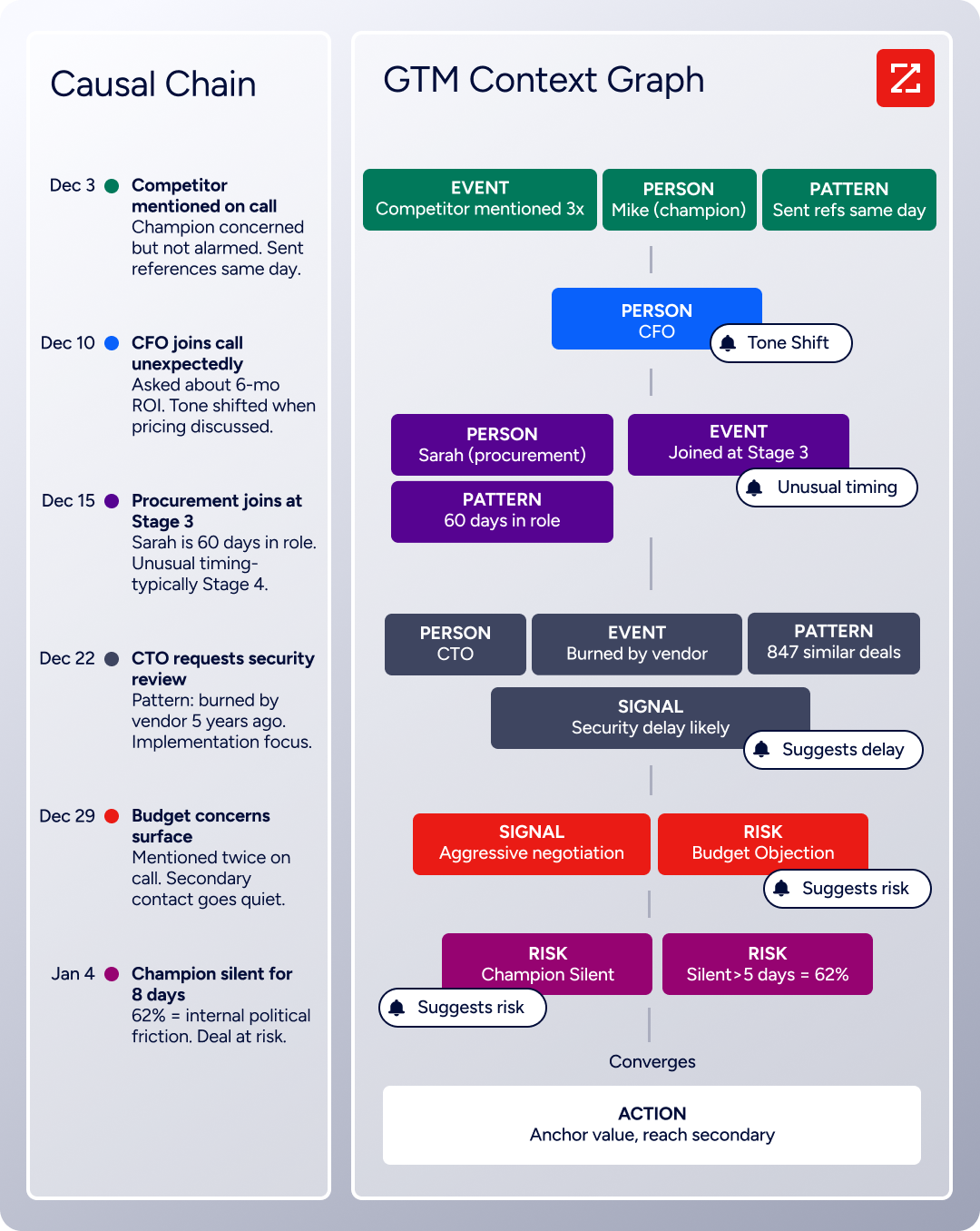
The GTM Context Graph. ZoomInfo's GTM Context Graph processes 1.5B+ data points daily, combining its third-party intelligence with your CRM records, conversation transcripts, and behavioral signals. The result: AI that understands not just what happened in a deal, but why. Your CRM records that a deal moved to Stage 3. ZoomInfo captures that the CFO joined the last call and asked about six-month ROI, which is what accelerated the deal.
Direct CRM integration. ZoomInfo integrates natively with HubSpot and connects to Agile CRM through Zapier and its Enterprise API. Data flows into your CRM without manual entry, keeping records enriched and current.
"ZoomInfo gives us the information we need to execute. We don't have to go through and spend our time digging. It's already there, so we can be three steps ahead." (Vensure)
AI capabilities: none vs. embedded vs. contextual
The three platforms represent three levels of AI maturity.
Agile CRM has no AI features. No AI-written emails, no predictive lead scoring, no conversation intelligence. The platform predates the current AI wave and hasn't caught up. Automation exists, but it's rules-based: if X happens, do Y. Nothing learns from outcomes.
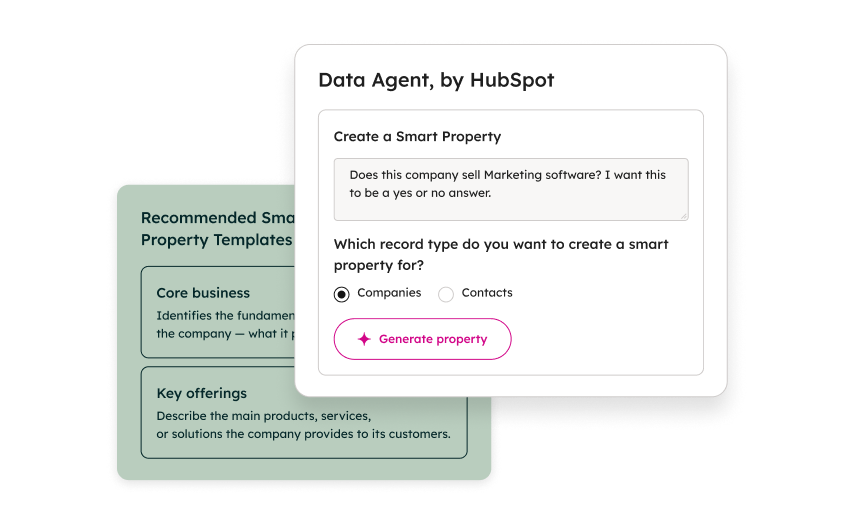
HubSpot embeds AI through Breeze. The Breeze AI layer runs across all hubs: a Customer Agent that resolves 65%+ of inquiries, a Prospecting Agent that drafts personalized outreach, and a Data Agent that answers natural-language questions about your customers. These agents draw on HubSpot's internal data (your CRM records, emails, calls) to personalize their output.
Source: HubSpot
ZoomInfo builds contextual AI on external intelligence. ZoomInfo's AI agents in GTM Workspace don't just reference your CRM data; they draw on the GTM Context Graph, which combines your internal data with ZoomInfo's external intelligence. The difference: HubSpot's Breeze knows what your CRM contains. ZoomInfo knows what your CRM contains plus what's happening across 500M contacts, 100M companies, and billions of buying signals.
In practice, ZoomInfo can tell a seller that a target account hired three new VPs, started researching competitor solutions, and received Series C funding, then draft outreach addressing the concern raised on the last call. That context requires both first-party data (your CRM, your calls) and third-party intelligence (the broader B2B landscape) working together.
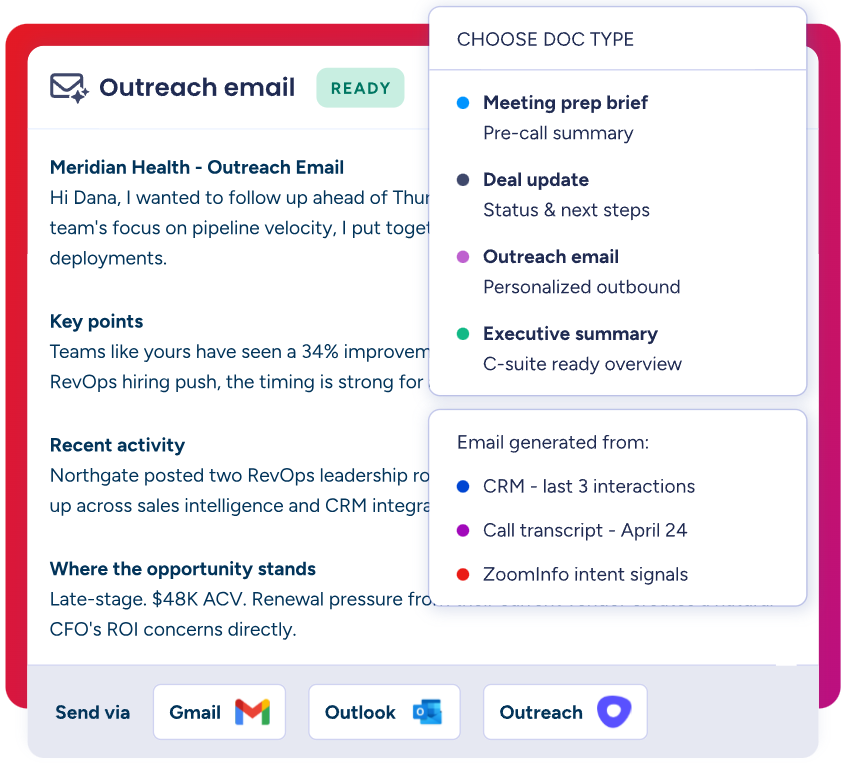
"That combination of our internal CRM data, external signals, and AI that's given all that context has helped us craft very specific account- and persona-based messages. And people have responded to them right away." (Seismic)
For a deeper look at how HubSpot and ZoomInfo compare across data, AI, and integrations, see our HubSpot vs. ZoomInfo comparison.
User experience and daily workflow
Agile CRM is functional but dated. The interface hasn't had a visual update in years, and slow loading times are a recurring complaint. Basic CRM tasks (adding contacts, moving deals through a pipeline, sending emails) work for non-technical users. Advanced features like building multi-step automation or configuring custom reporting take real time to learn. Onboarding isn't guided; you configure the system yourself.
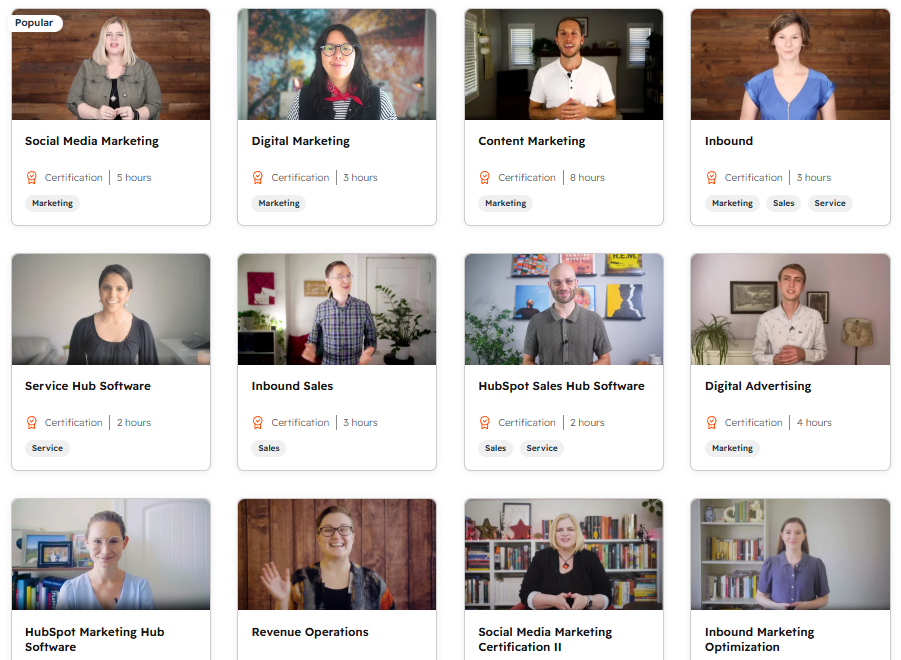
HubSpot sets the standard for CRM usability. The interface is clean and consistent across all hubs. Getting started with the free CRM takes minutes, and the platform scales complexity as you grow into Professional and Enterprise tiers. HubSpot Academy offers free certifications, with 200,000+ certified professionals to date. The downside: HubSpot's breadth (eight products, each with multiple tiers) means there's always another feature to learn. Teams routinely use a fraction of what they pay for.
Source: HubSpot
ZoomInfo operates differently. It's not a daily CRM workspace for most users. Sellers work in GTM Workspace, where AI agents surface prioritized accounts, draft outreach, and update CRM without context-switching. RevOps and marketing teams use GTM Studio to build audiences and launch plays in natural language. Teams that prefer their existing CRM get ZoomInfo's data and signals through native HubSpot or Salesforce integrations. ZoomInfo redesigned its onboarding from 30 to 90 days, producing a 25% improvement in customer satisfaction scores.
Integration ecosystems and data flow
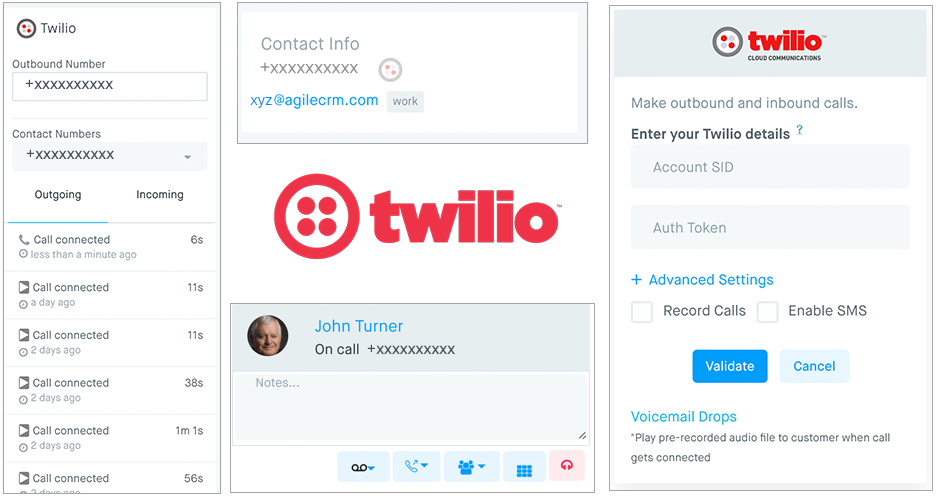
Agile CRM has over 60 integrations: Twilio for calling, Stripe for payments, Shopify for e-commerce, and Gmail/Exchange for email sync. It connects to Zapier and Make for broader automation. The REST API is available on all plans (including free), though documentation lives on GitHub rather than a developer portal.
Source: Agile CRM
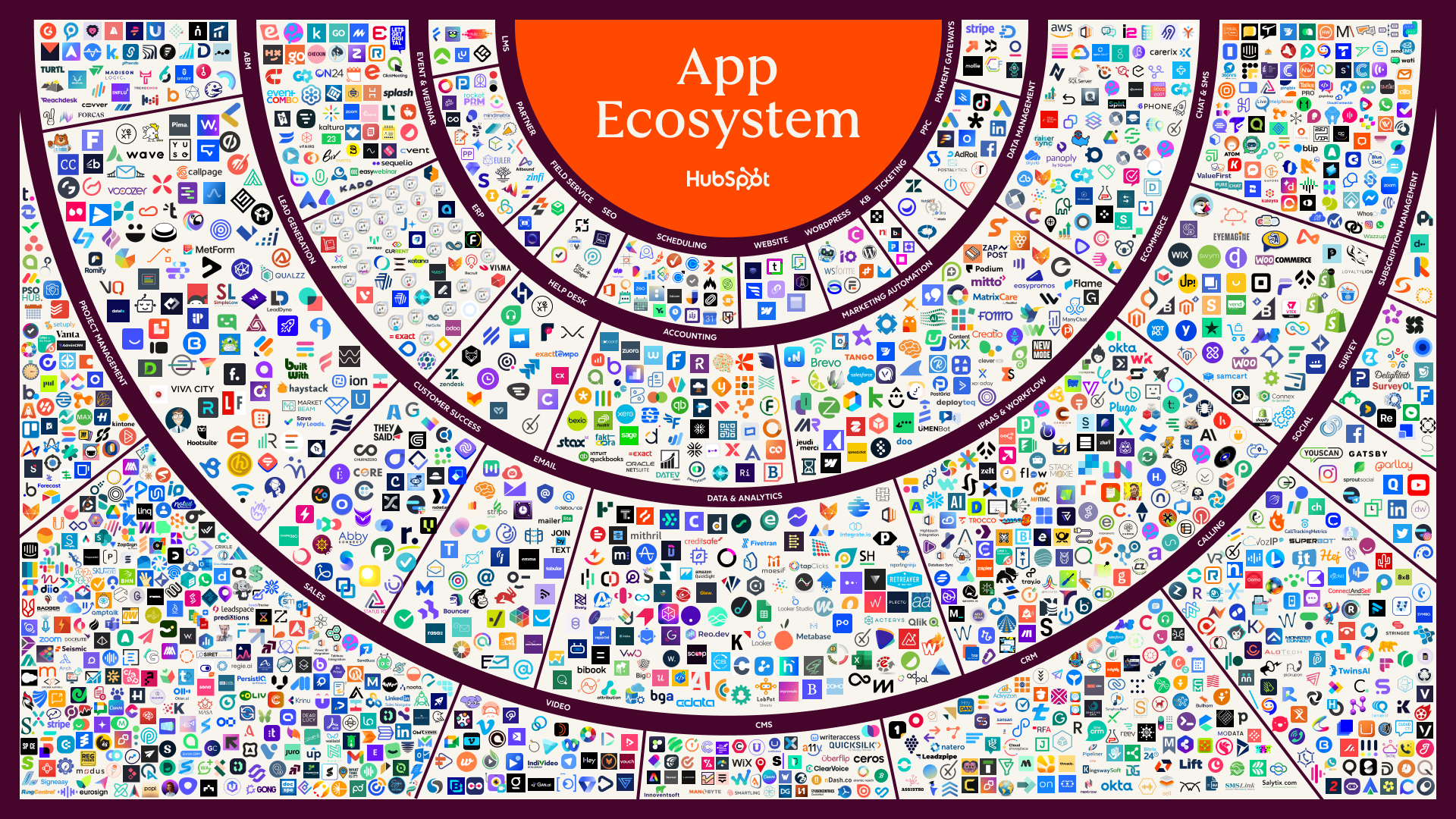
HubSpot offers 2,000+ app integrations with 2.5 million active installs. The developer ecosystem is mature: official SDKs in six languages, a date-based versioning system with 18-month support windows, and a developer portal with interactive documentation. The remote HubSpot MCP server (GA since April 2026) lets AI agents read and write HubSpot CRM data directly.
Source: HubSpot
ZoomInfo takes a different approach. Rather than serving as a hub that other tools connect to, it feeds intelligence into other hubs. The ZoomInfo Marketplace lists 172+ integration partners. Native integrations with Salesforce, HubSpot, and Dynamics 365 push enriched data into those CRMs. Cloud Partners deliver data into AWS, Google Cloud, Snowflake, and Databricks. The ZoomInfo MCP server connects AI models to ZoomInfo's B2B data, currently supporting Claude and ChatGPT. API access is included in all relevant plans.
"The plug-and-play aspect of the API means I can integrate it very easily into any process and get information at a moment's notice." (BDO Canada)
Scalability and long-term fit
Consider where each platform takes you in three years.
Agile CRM works for a team of 5-15 people managing a few thousand contacts. But it shows strain as you grow. Performance issues at scale, limited reporting, no AI features, and a slow development pace all point toward a ceiling. The company's bootstrapped structure and small team make it unlikely to match the pace of well-funded competitors.
HubSpot scales from solopreneur to enterprise. The Starter tier gets you started; Professional and Enterprise grow with you. The challenge is cost: a 50-person team on Professional hubs with marketing automation can reach $3,000-5,000/month. But HubSpot's financial stability ($1.8 billion in cash, GAAP profitable) and fast innovation (Breeze AI, Loop Marketing, AEO tools) mean you're betting on a platform that will keep evolving.
ZoomInfo scales alongside your CRM, not instead of it. As your team grows, the value of verified data and intent signals compounds. A 5-person team benefits from accurate contact data. A 50-person team benefits from intent-driven account prioritization. A 500-person organization benefits from the GTM Context Graph drawing on thousands of deals to predict which actions drive outcomes. With $1.25 billion in revenue and $455 million in free cash flow, ZoomInfo invests in all three pillars: data, intelligence, and access.
Agile CRM vs. HubSpot vs. ZoomInfo: Which should you choose?
These three tools serve different functions in a B2B tech stack. The real question is which combination matches your stage and budget.
Choose Agile CRM if:
You have fewer than 50 employees and fewer than 50,000 contacts
Budget is your primary constraint
You need basic marketing automation, CRM, and help desk in one tool
You can tolerate a dated interface and occasional workflow inconsistencies
Your sales process is straightforward and doesn't require advanced analytics
Choose HubSpot if:
You're a growing company ready to invest in a platform you won't outgrow
Your team needs professional marketing automation, sales tools, and service management
AI automation across marketing, sales, and service matters to your workflow
You value ease of use and a consistent interface across all functions
You can commit to Professional/Enterprise pricing
Add ZoomInfo if:
You sell B2B and need verified contact data beyond what's in your CRM
You want to know which accounts are in-market before your competitors do
Your sales team wastes hours researching prospects manually
You need AI that draws on external intelligence, not just your CRM records
You want the same data and intelligence accessible in any tool: your CRM, your AI agents, your custom workflows
Try ZoomInfo free to see how verified data and buyer intent transform your pipeline.
The strongest B2B teams don't choose between a CRM and an intelligence platform. They use both. Your CRM manages the relationship. ZoomInfo tells you which relationships to build, when to act, and why a deal is moving. Whether you pick Agile CRM for its affordability or HubSpot for its depth, the quality of your go-to-market execution depends on the data and intelligence feeding your system.
That's not a software preference. It's a structural advantage.
Agile CRM vs. HubSpot vs. ZoomInfo FAQ
What is the fundamental difference between Agile CRM, HubSpot, and ZoomInfo?
Agile CRM and HubSpot are CRM platforms that manage contacts, automate marketing, and track deals. Agile CRM targets small teams on tight budgets with an all-in-one tool starting at $8.99/user/month. HubSpot targets growing companies with a full platform (free to start, $800-3,600/month for professional features). ZoomInfo is a B2B data intelligence platform, not a CRM. It provides verified contact data (500M contacts, 200M+ emails), buyer intent signals, and AI-driven deal intelligence that feeds into either CRM.
Which platform is most affordable for a small team?
Agile CRM. Its free plan supports 10 users with 1,000 contacts. Paid plans start at $8.99/user/month and include marketing automation at every tier. HubSpot's free CRM limits you to 2 users, and meaningful automation requires the $800/month Marketing Hub Professional tier. ZoomInfo offers a permanent free tier (ZoomInfo Lite) with 10 monthly export credits, but paid plans are consumption-based and custom-quoted.
Can ZoomInfo replace my CRM?
No. ZoomInfo complements your CRM; it doesn't replace it. It integrates natively with HubSpot, Salesforce, and Microsoft Dynamics to push enriched contact data, company intelligence, and buying signals into your existing system. GTM Workspace gives sellers an execution layer, but deal management, support tickets, and marketing campaigns still run in your CRM.
Does HubSpot have a built-in contact database like ZoomInfo?
No. HubSpot's CRM contains only data you or your team put into it: form fills, imports, and manual entry. HubSpot offers some data enrichment through its Smart CRM (pulling from emails, calls, and external sources), but it does not maintain an independent database of 500M+ B2B contacts with verified phone numbers and emails. That's ZoomInfo's core function.
How does Agile CRM's marketing automation compare to HubSpot's?
Agile CRM includes visual campaign builders, lead scoring, drip emails, and multichannel campaigns (email, SMS, social) at all paid tiers, starting at $8.99/user/month. HubSpot gates comparable workflow automation behind the Marketing Hub Professional tier at $800/month. HubSpot's automation is more reliable and more sophisticated (multi-touch attribution, AI-driven personalization, AEO tools), backed by a larger ecosystem. Agile CRM users report workflows that sometimes fail or behave inconsistently.
What buyer intent data does each platform offer?
Agile CRM offers none. HubSpot has no native third-party intent data, though it tracks engagement within its own platform. ZoomInfo provides intent data from 210 million IP-to-Organization pairings and 6 trillion+ keyword-to-device signals monthly. Its Guided Intent feature identifies topics correlated with closed deals in your business, rather than requiring manual topic selection.
Which platform has the best AI capabilities for sales teams?
ZoomInfo offers the strongest AI for B2B sales, combining its GTM Context Graph (which draws on CRM data, conversation intelligence, and external signals) with AI agents in GTM Workspace that research accounts, draft outreach, and surface buying committee insights. HubSpot's Breeze AI handles automation within its own platform well, including prospecting and customer service agents. Agile CRM has no AI.
How do the platforms handle data security and compliance?
ZoomInfo holds ISO 27001, ISO 27701, SOC 2 Type II, and TRUSTe GDPR/CCPA certifications, renewed annually. It is a registered data broker in California and Vermont. HubSpot holds SOC 2 Type II, HIPAA attestation, and GDPR/CCPA compliance, with EU data center availability and AES-256 encryption at rest. Agile CRM's security certifications are not publicly documented; the API uses HTTPS for data in transit, but no SOC 2, ISO, or GDPR compliance claims appear in available sources.
