
Aligned occupies a specific niche in B2B sales: a shared workspace where sellers and buyers collaborate on complex deals without drowning in email threads, scattered attachments, and disconnected follow-ups. The platform pulls every element of a deal (stakeholders, documents, timelines, conversations) into a single room both sides can access. For teams running multi-stakeholder enterprise deals, this changes how work gets done between meetings.
To create this Aligned review, we analyzed the platform extensively. We believe it's the right choice if:
You run complex B2B deals with multiple stakeholders on the buying side
You need a shared workspace to replace email-based deal coordination
You want visibility into how buyers engage with your content between meetings
You need mutual action plans to keep both sides accountable
You want to standardize deal execution across your sales team
However, Aligned might not be sufficient on its own if:
You need help identifying the right accounts to target in the first place
You lack verified contact data for the full buying committee
You want intent signals to know which accounts are researching before they engage
You need enriched company intelligence (org charts, tech stacks, company attributes) to prepare for deals
You require a data layer that powers prospecting, outreach, and CRM hygiene alongside deal execution
Aligned excels at running deals once they're in motion, but the work of finding accounts, building complete buying committees, and reading market signals happens upstream.
This is where ZoomInfo fits: an AI-powered GTM platform built on comprehensive B2B data, an intelligence layer called the GTM Context Graph that reveals why deals move or stall, and access methods that deliver that intelligence through any tool, workflow, or AI agent your team uses.
We've included a detailed look at ZoomInfo later in this review, as it complements Aligned for teams that need both intelligence and execution. If you're ready to explore ZoomInfo's data and AI capabilities, you can start with a free trial here.
What is Aligned?
Aligned is a cloud-based AI Deal Workspace founded in 2021 by Gal Deitsch (CPO), Yotam Sela (CTO), and Gal Aga (CEO) in Israel. The company grew from a specific frustration: Deitsch, who had managed sales departments at Yotpo and Syte, saw buyers and sellers buried in scattered information and disjointed processes. Aga, a CRO with experience at Sisense, Syte, and Anagog, joined first as a strategic advisor before becoming co-founder and CEO.
The platform started as a Digital Sales Room (shared buyer-facing workspaces replacing email threads and scattered attachments). In February 2026, Aligned repositioned itself as an AI Deal Workspace, calling the product "the missing execution layer between your CRM and your buyer." The thesis: CRMs record deals, but the actual work of moving deals forward (coordinating stakeholders, equipping champions, maintaining momentum) scatters across email, Slack, and file shares. Aligned says it fills that gap.
The company has raised $14M in total funding across a $5.8M Seed round and an $8M Series A. Aligned reports that 50,000+ sales and CS teams run deals on the platform, with 1M+ monthly buyer engagements. Its customer base includes Deel, Salesforce, HubSpot, ServiceNow, SimilarWeb, and Productboard.
Source: Aligned
Aligned Pros & Cons
Pros | Cons |
|---|---|
- Intuitive drag-and-drop room builder | - Native CRM sync (Salesforce, HubSpot) restricted to Enterprise plan |
- Buyers access rooms via a single link with no login required | - Limited design customization and branding flexibility |
- Strong engagement analytics showing who viewed what and for how long | - Files must be uploaded one-by-one (no bulk upload) |
- Mutual action plans with bidirectional task assignment | - AI features gated to Pro tier and above |
- AI auto-builds rooms and generates deal assets after calls | - Can feel like overkill for simple, short-cycle deals |
- Covers sales through customer success in one workspace | - No confirmed mobile app or public API |
- Permanent free plan with no time limit | - Annual billing has no refund policy |
Aligned Review: How it Works & Key Features
Digital Sales Room: A shared workspace that replaces email chaos with structured buyer-seller collaboration.
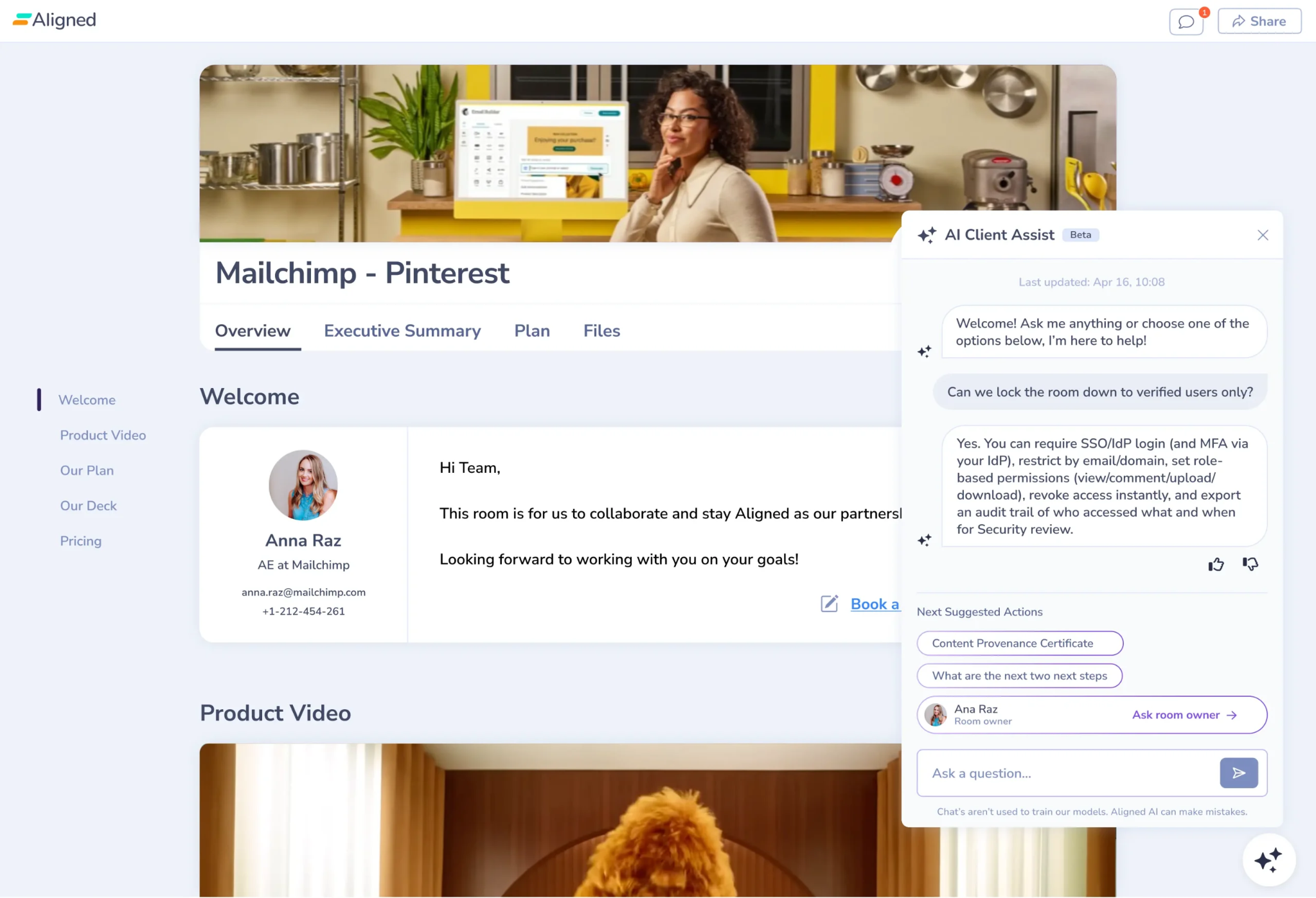
Aligned's Digital Sales Room creates a dedicated workspace for each deal. A seller builds a room in minutes using a drag-and-drop editor, fills it with relevant content (decks, case studies, videos, proposals), and shares it with the buying team via a single link. Buyers need no installation or login.
The room organizes content by topic, not chronology. Instead of a linear email thread where pricing discussions, security questions, and contract negotiations blur together, each topic gets its own threaded channel. Sellers can tag specific stakeholders to control who sees what, collaborate internally with pre-sales or management in the same space, and share async video messages instead of written follow-ups.
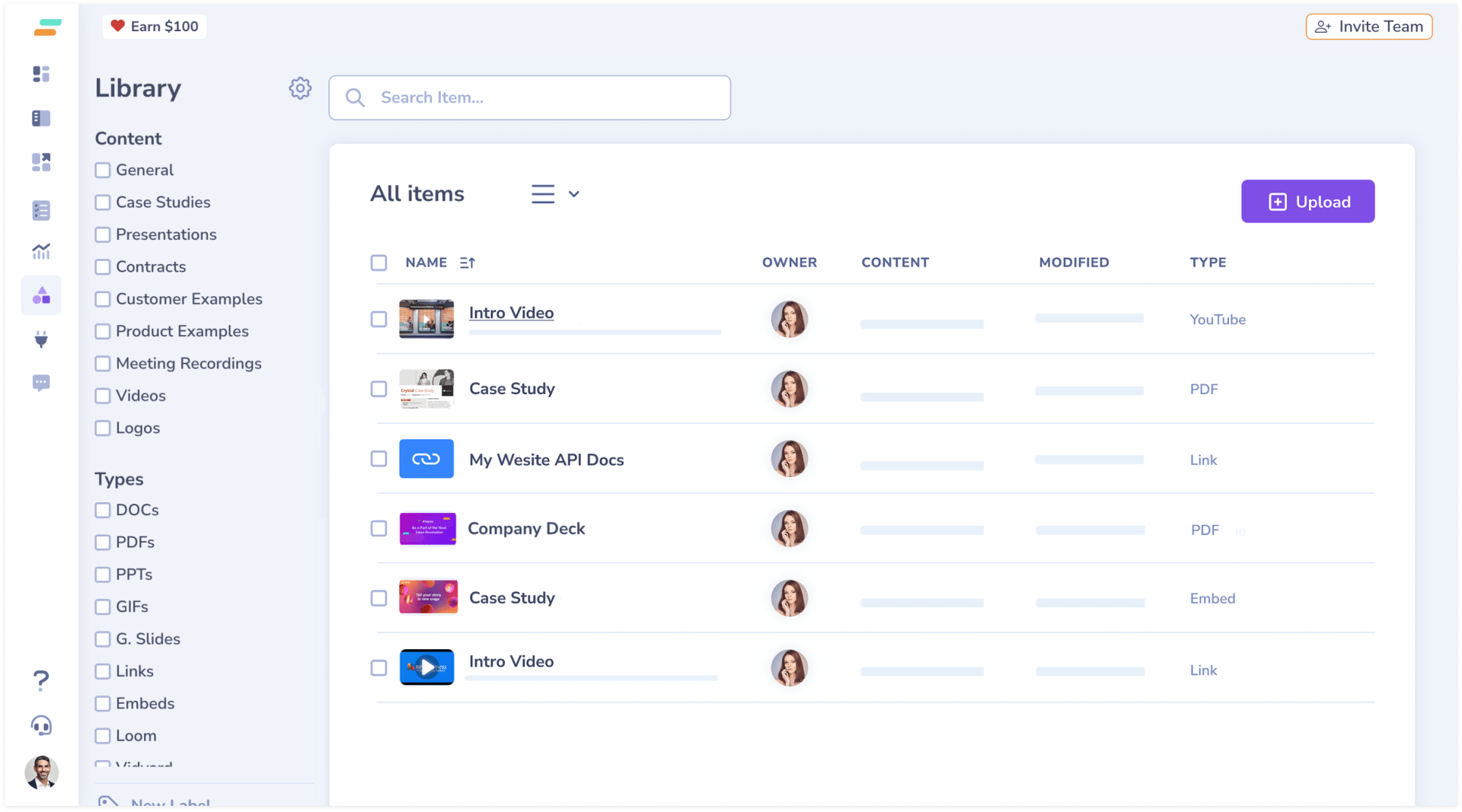
A central library manages all content. Sellers upload assets once, and updates propagate to every relevant room automatically. This eliminates the version-control problem in email-based selling, where buyers review outdated documents because the seller sent a newer version to a different thread.
Source: Aligned
The room persists across the customer lifecycle. The same workspace used for the sale transitions into onboarding and customer success, preserving every conversation, document, and decision. This solves a common problem: context lost during the handoff from sales to CS.
AI Deal Workspace: AI that reads cross-channel signals and acts on them inside the buyer-facing workspace.
Aligned AI runs throughout the workspace across five connected loops. After a call, the AI creates or updates the workspace with an executive summary, organized content, and assigned action items, without manual follow-up from the rep.
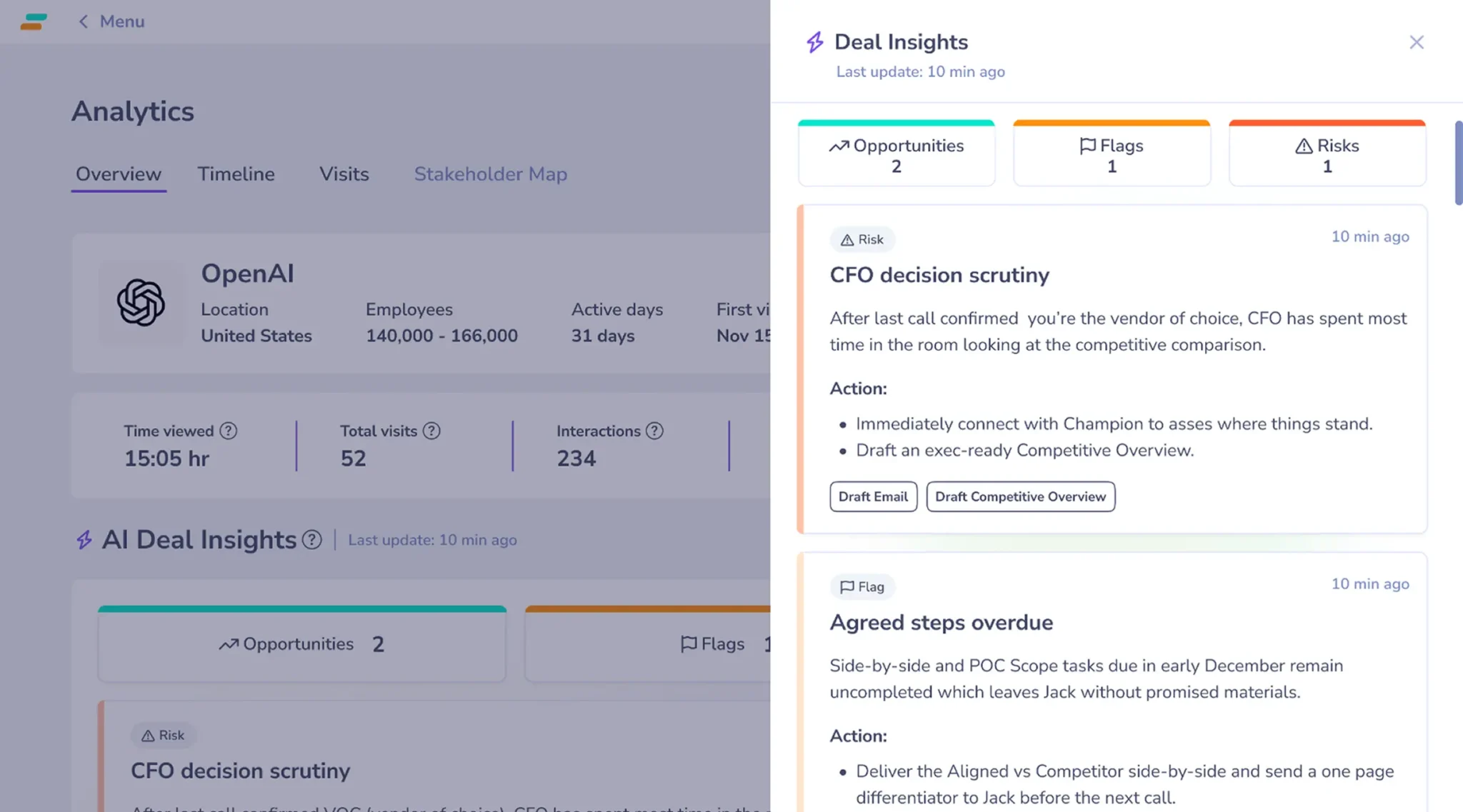
The AI reads signals across calls, email, CRM, and workspace engagement to flag risk and slippage early, identify what changed and why, and surface the next action. It maps hidden influencers and decision makers, tracks roles and engagement, and guides reps on who to loop in next.
Source: Aligned
The AI also generates deal assets (business cases, executive summaries, POC plans, mutual action plans) from deal context and drafts follow-up emails based on meeting notes.
On the buyer's side, the AI works inside the workspace. Buyers can ask questions, summarize decks, and get answers to security or compliance queries without leaving the room. This enables asynchronous decision-making between meetings, which matters because 95% of the buying cycle happens when the seller is not present (per Gartner).
AI features (Room Builder, Content Generator, Deal Builder, Client Assist) are available on the Pro plan ($49-$60/seat/month) and above. Full cross-channel AI insights (syncing CRM, call transcripts, email, and calendar data) require the Enterprise tier.
Mutual Action Plans: Shared timelines with bidirectional task assignment to keep deals on track.
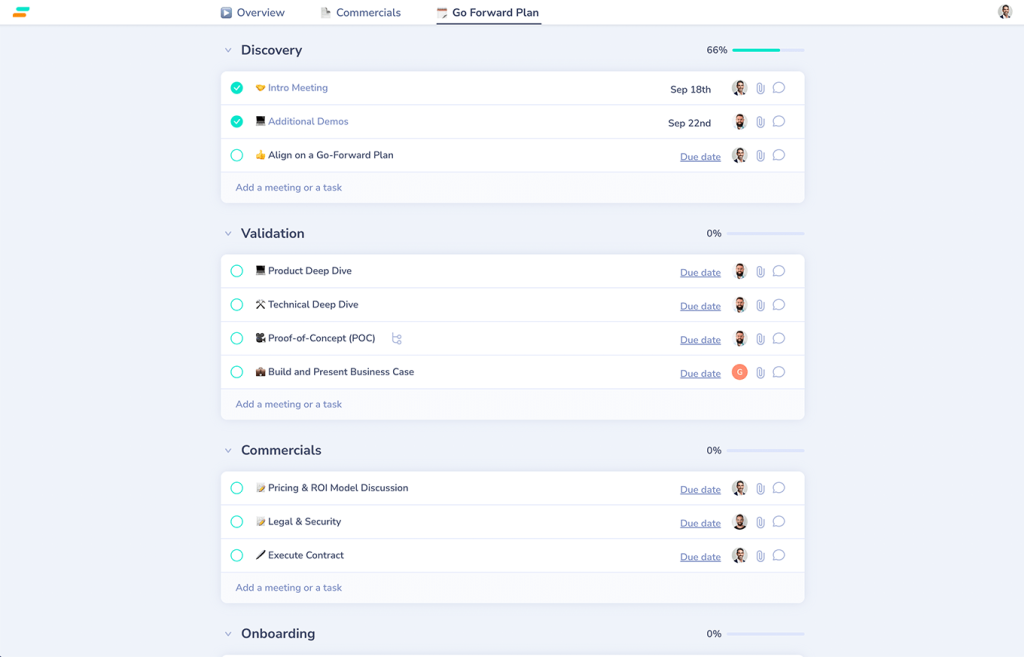
Aligned's Mutual Action Plan (MAP) is a project management tool built into the deal workspace. Unlike static spreadsheet-based plans, it lives in the same room where discussions, content, and engagement data reside.
Source: Aligned
Both seller and buyer create tasks, assign owners, set deadlines, add sub-tasks, attach files, and hold discussions in context of each task. Automated email reminders go to customers for every activity, removing the manual follow-up burden. The AI can auto-generate the MAP after each call, populating action items with owners based on what was discussed.
The MAP supports three use cases: Close Plans (for sales), Onboarding Plans (for CS), and Go-Forward Plans (for ongoing partnerships). Templates are available for each, with CRM integration to pull customer data and sync progress bidirectionally.
The MAP is available starting from the Basic plan ($29-$35/seat/month).
Revenue Intelligence: Buyer engagement analytics that show what happens between meetings.
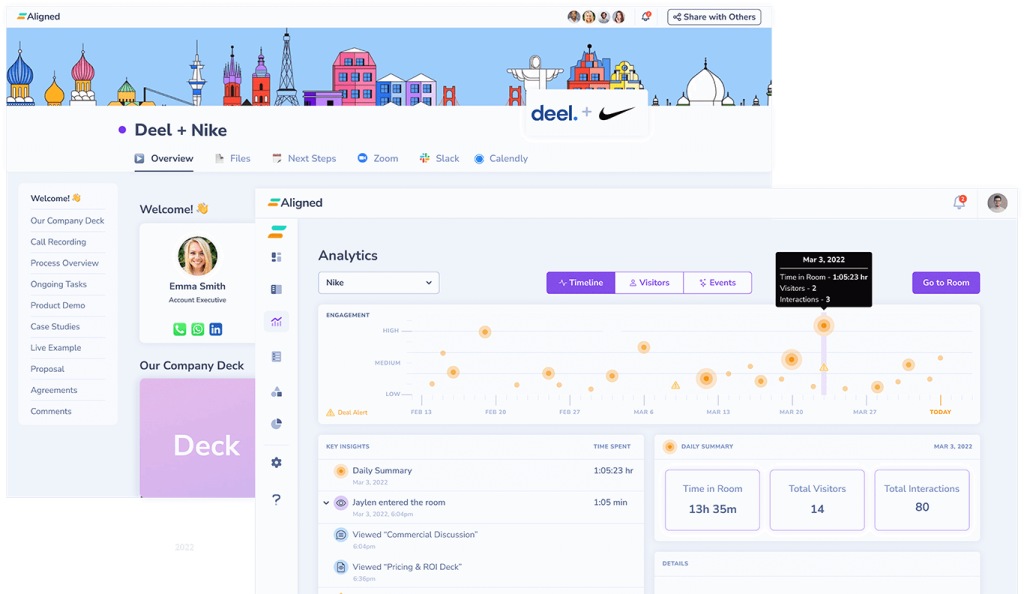
Aligned's Revenue Intelligence layer captures buyer behavior inside the workspace. Since the deal runs inside Aligned, every interaction generates data: which stakeholders opened the room, which sections they reviewed, how long they spent, which documents they downloaded, and when previously unknown stakeholders entered.
Source: Aligned
Sellers receive this data as real-time alerts. When Finance reviews the pricing section at 10 PM, the seller knows before the next call. When a new stakeholder enters the room, the seller gets an alert with data on that person's engagement. The AI processes these signals to flag risk, identify momentum, and recommend next moves.
A notable capability: the platform captures buyer-side AI interactions as intent signals. When a buyer queries the workspace AI about security requirements or pricing, those questions are recorded and surfaced to the seller, revealing evaluation criteria the buyer never stated outright.
Where Aligned Falls Short
Aligned does one job: executing deals once they're in motion. It does that well, but several limitations appear when you consider the full go-to-market workflow. These gaps aren't failures. They're the natural result of building a product for deal execution rather than the intelligence and prospecting layers that feed it.
No upstream intelligence or prospecting. Aligned's positioning makes this explicit: the platform is a post-discovery execution tool, not a top-of-funnel engine. It doesn't help you identify which accounts to pursue, find contact data for buying committee members, or detect intent signals that a company is researching solutions. Before you can build a deal room, you need to know who belongs in it, and that intelligence comes from outside Aligned.
CRM integration gated to Enterprise. Native Salesforce and HubSpot sync requires the Enterprise plan (custom pricing). This is the most cited friction point in G2 reviews. Teams on Basic or Pro must manually transfer deal data between Aligned and their CRM or use Zapier as a workaround. For teams that depend on CRM as their system of record, this creates a gap between where deals are managed and where they're reported.
Limited visibility beyond the workspace. Aligned's analytics work well inside the room but can only see what happens there. They can't tell you that a target account raised a funding round, that their CTO changed jobs, that they're researching your competitor's category, or that their tech stack shifted. These broader signals require a separate intelligence layer.
Customization and operational constraints. G2 reviewers note limited template freedom, restricted ability to match room colors to prospect branding, and the requirement to upload files one-by-one rather than in bulk. These friction points compound with daily use across a high-volume sales team.
Not built for simple sales cycles. G2 consensus is clear: Aligned adds unnecessary complexity to transactional deals with one or two decision-makers and cycles under 30 days. The platform's value scales with deal complexity, so it's wasted on straightforward transactions.
These limitations point to a gap: Aligned needs an intelligence layer upstream that identifies the right accounts, surfaces buying signals, provides verified contact data, and enriches the CRM that feeds deal execution. That's where ZoomInfo fits.
The Natural Complement to Aligned: ZoomInfo
ZoomInfo is an AI-powered GTM platform that covers the stages Aligned doesn't: finding the right accounts, understanding the full buying committee, detecting in-market signals, and feeding intelligence into every deal room. Where Aligned sits between the CRM and the buyer, ZoomInfo sits between the market and the CRM, providing the data and intelligence that feed everything downstream.
Comprehensive B2B Data: A verified dataset for identifying buyers and building complete account pictures.
ZoomInfo's B2B data platform spans 500M contacts, 100M companies, 135M+ verified phone numbers, 120M direct-dial phone numbers, and 200M+ verified business email addresses. A multi-source verification pipeline backed by 300+ human researchers achieves up to 95% accuracy on first-party data.
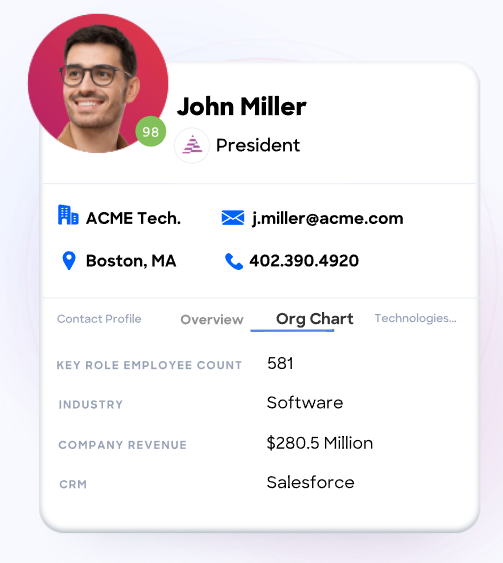
For teams using Aligned, this data solves a specific problem: before you can build a deal room, you need to know who should be in it. ZoomInfo provides department org charts with decision-makers' direct dials and emails, 300+ company attributes for market segmentation, and technographics tracking 30,000+ technologies across 30M+ companies. When you're setting up a mutual action plan in Aligned, ZoomInfo shows which stakeholders you haven't yet identified and how to reach them.
The data quality is externally validated. In a Fortune 500 competitive RFP analyzing 25 million contacts across vendors, the independent consultant concluded that "no other competitor came even close." ZoomInfo holds 133 No. 1 rankings on G2 across Sales Intelligence, Buyer Intent, Data Quality, and Account Data Management.
Vensure scaled prospecting with ZoomInfo's data, with VP of Revenue Operations William Kenimer noting: "ZoomInfo gives us the information we need to execute. We don't have to go through and spend our time digging. It's already there, so we can be three steps ahead." (Vensure)
GTM Context Graph: An intelligence layer that captures why deals move or stall, not just that they did.
ZoomInfo's GTM Context Graph processes 1.5B+ data points daily, combining ZoomInfo's B2B data with a customer's CRM records, conversation transcripts, email interactions, and behavioral signals into a single intelligence layer. The result: AI that understands the context behind deal movements, not just the CRM stage change.
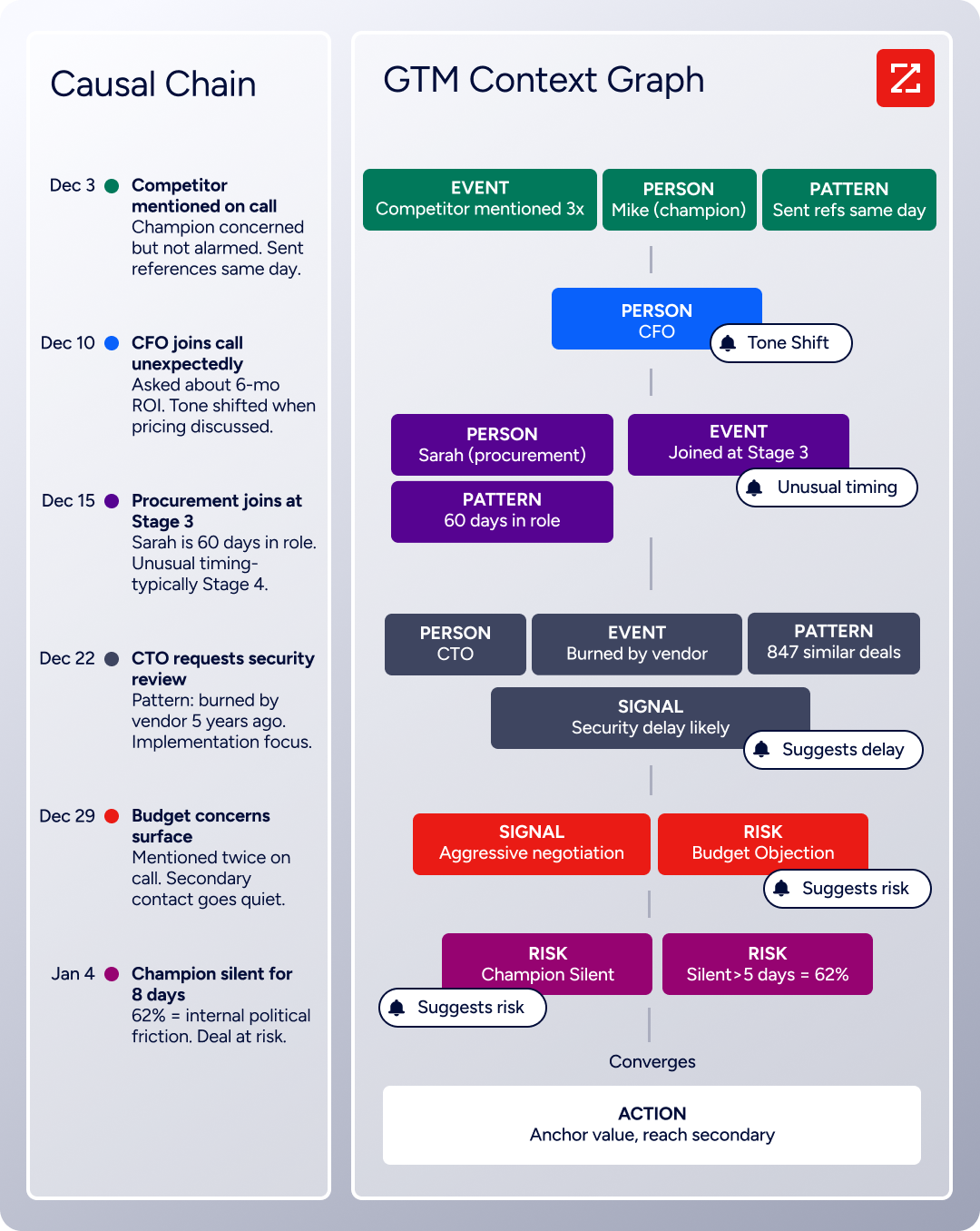
As ZoomInfo's Chief Product Officer Dominik Facher explains: "The CRM recorded the state change. It has no record of why it happened." Maybe the CFO joined the last call and asked about ROI. Maybe the VP went quiet for eight days because of an internal budget battle. CRMs don't capture these signals. The GTM Context Graph does.
For Aligned users, this intelligence matters at two points. Before the deal enters Aligned's workspace, the GTM Context Graph identifies which accounts are in-market through intent data tracking 210 million IP-to-Organization pairings and 6 trillion+ new keyword-to-device pairings sourced monthly. This helps teams prioritize which deals deserve dedicated workspace investment. During the deal, the GTM Context Graph captures signals from outside the workspace (CRM activity, email threads, call transcripts, market movements) that Aligned's in-room analytics can't see, giving sellers a fuller picture.
Seismic attributed 39% of active pipeline to opportunities identified or influenced by ZoomInfo signals, with CBO Toby Carrington noting: "That combination of our internal CRM data, external signals, and AI that's given all that context has helped us craft very specific account- and persona-based messages. And people have responded to them right away." (Seismic)
GTM Workspace: The seller's AI workspace for research, outreach, and deal preparation.
GTM Workspace is ZoomInfo's front-end for sellers, launched in October 2025. It brings CRM data, ZoomInfo's B2B intelligence, conversation history, and market signals into a single view. AI agents handle account research, outreach drafting, CRM updates, and signal monitoring so sellers spend less time on admin and more time selling.
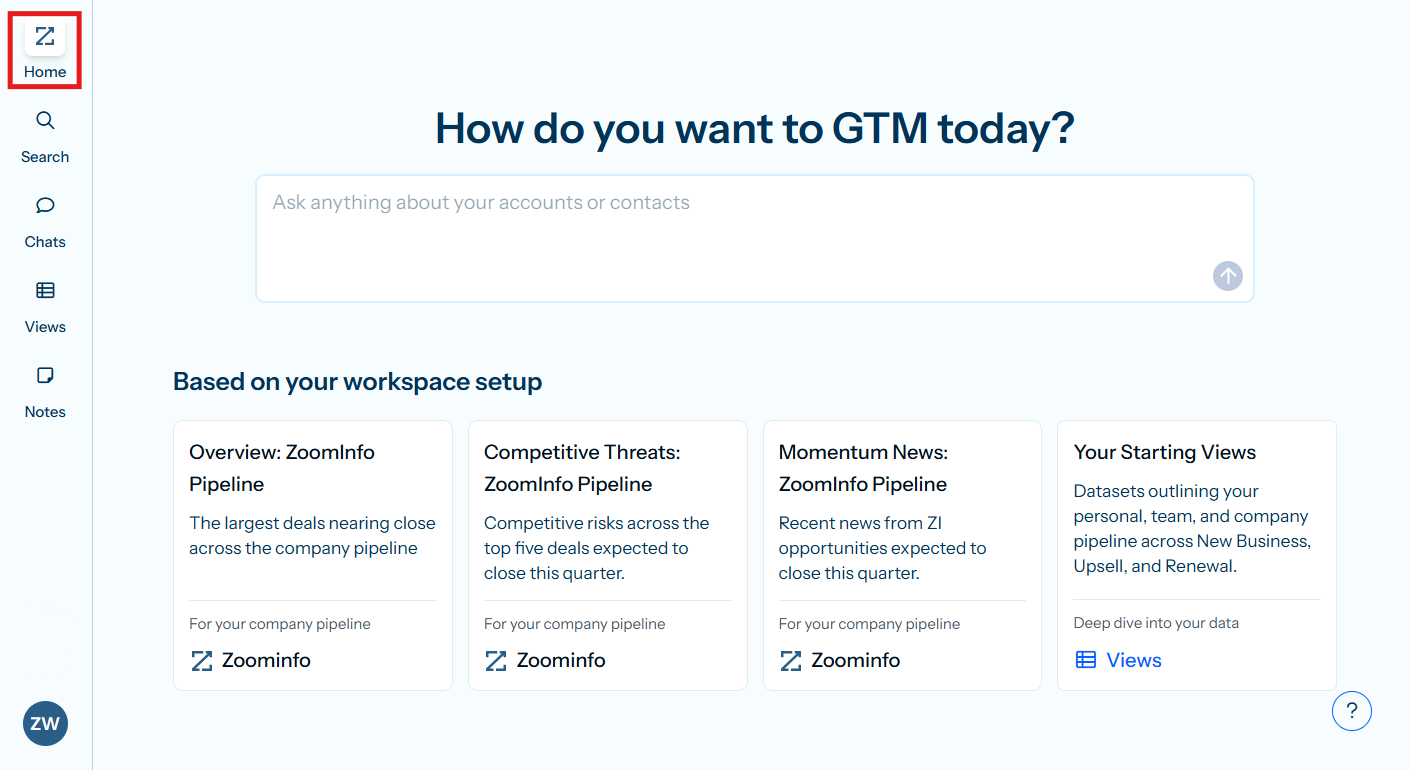
The workflow between GTM Workspace and Aligned is sequential. GTM Workspace is where sellers identify priority accounts, research buying committees, and prepare outreach. Aligned is where the deal runs once the prospect engages. GTM Workspace answers "who should I talk to and why right now?" Aligned answers "how do I move this deal forward with the people already involved?"
Key capabilities include an Action Feed (a live stream of in-market buyers matched to target criteria with pre-drafted actions on every signal), AI-generated outreach from full account context, and buying group intelligence that surfaces hidden stakeholders. Customer results include Databricks reaching prospects 50% faster, Thomson Reuters increasing closed-won deals by 40%, and Spekit seeing opportunities at higher-scoring accounts 43% more likely to become qualified pipeline.
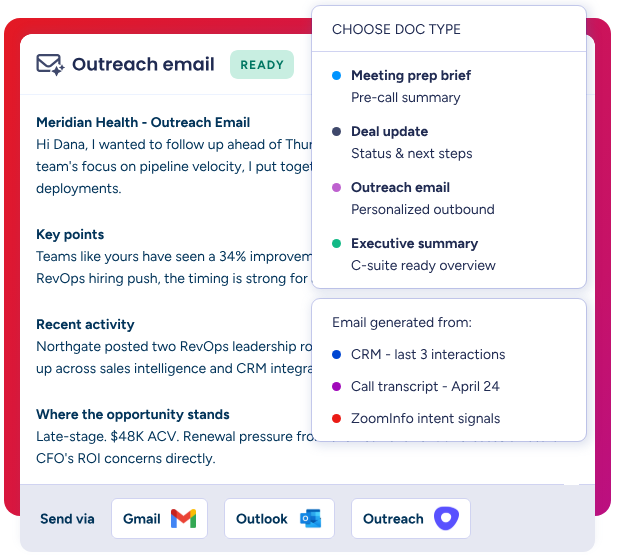
Spekit's RevOps Manager Ben Perceval noted: "Anything that minimizes our team's need to switch contexts is beneficial. ZoomInfo offers a unified view, eliminating the need to navigate between systems." (Spekit)
Universal Access: ZoomInfo's intelligence available in any tool, workflow, or AI agent.
ZoomInfo delivers its data and intelligence through three channels. Beyond GTM Workspace for sellers, GTM Studio gives marketers, RevOps, and GTM engineers a canvas where audience definition, campaign orchestration, and pipeline measurement happen in natural language. For teams building beyond ZoomInfo's own products, APIs and MCP expose the same intelligence to any custom agent, internal tool, or partner platform.
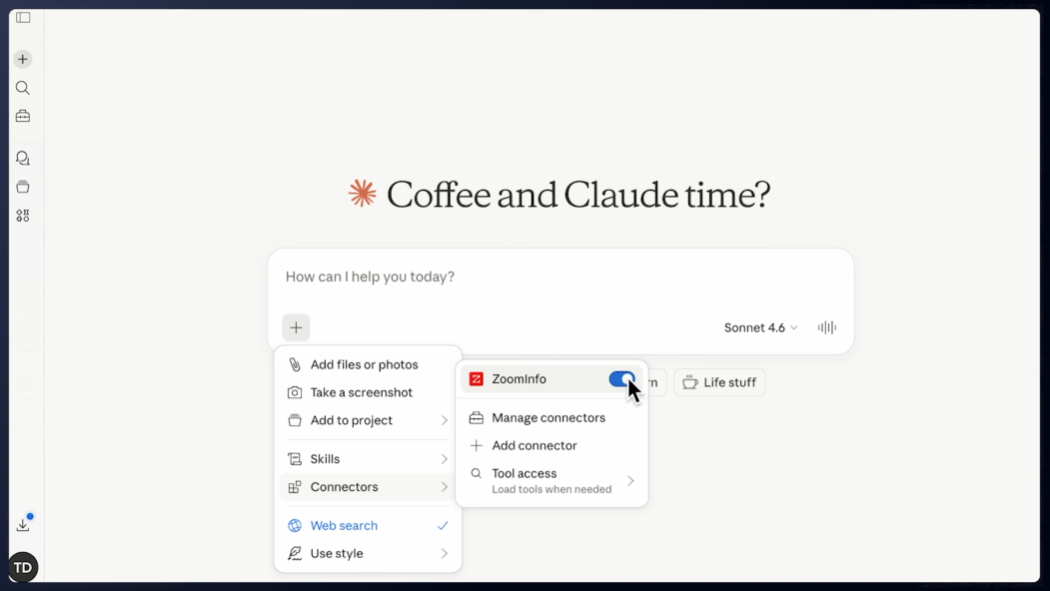
The ZoomInfo MCP server connects AI models directly to ZoomInfo's B2B data, currently supporting Claude and ChatGPT. Users interact with ZoomInfo data through natural language. API access is included in all relevant plans, keeping the architecture open so the intelligence isn't locked inside one application.
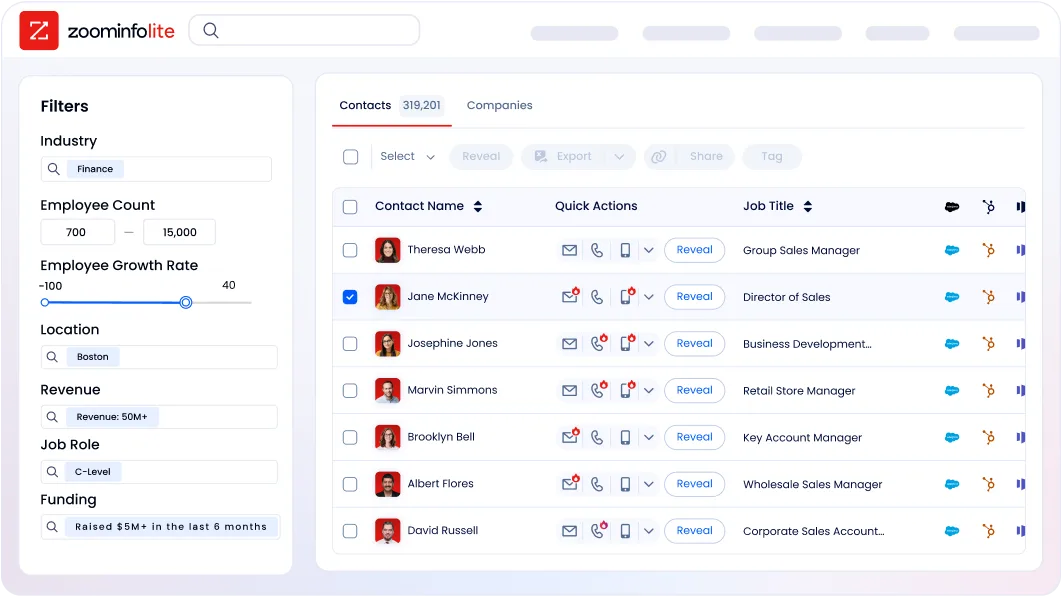
ZoomInfo offers a permanent free tier through ZoomInfo Lite (no credit card, no time limit) with access to the B2B database, 10 monthly export credits, and basic search filters. Paid plans use custom-quoted, consumption-based pricing scaled to usage, number of users, and feature requirements. A 7-day free trial with expanded access is also available.
BDO Canada activated ZoomInfo data within internal systems via the API, with Senior Marketing Intelligence Analyst Jerry Wilson noting: "The plug-and-play aspect of the API means I can integrate it very easily into any process and get information at a moment's notice." (BDO Canada)
Aligned and ZoomInfo: Workflow Summary
Aspect | Aligned | ZoomInfo |
|---|---|---|
Primary focus | Deal execution and buyer collaboration | Account intelligence, prospecting, and GTM orchestration |
Workflow stage | Post-discovery: running deals with engaged buyers | Pre-discovery through deal support: finding, prioritizing, and understanding accounts |
Core strength | Shared buyer-seller workspace with engagement analytics | B2B data, intent signals, and the GTM Context Graph |
Buyer visibility | In-workspace behavior (content views, time spent, AI queries) | Market signals (intent data, tech stack changes, funding, hiring, job changes) |
Contact data | None (requires external source) | 500M contacts, 120M direct dials, 200M+ verified business emails |
AI capabilities | Auto-builds deal rooms, maps stakeholders, generates deal assets | AI agents for research, outreach drafting, account prioritization, and CRM updates |
CRM integration | Salesforce/HubSpot sync on Enterprise only | Native CRM integrations across tiers, plus 120+ marketplace integrations |
Free tier | Starter plan (4 rooms/seat, no time limit) | ZoomInfo Lite (permanent, 10 exports/month) + 7-day free trial |
Paid pricing | $29-$60/seat/month (annual) | Custom-quoted, consumption-based |
Best for | Managing complex, multi-stakeholder deals after engagement begins | Identifying, researching, and prioritizing accounts before and during deals |
Final Verdict
Aligned and ZoomInfo serve different stages of the same revenue motion. Together, they cover the arc from account identification to deal close and beyond.
Aligned is the right tool for teams running complex, multi-stakeholder B2B deals who need a structured way to collaborate with buyers between meetings. Its shared workspace, mutual action plans, and engagement analytics give sellers visibility into how buying committees evaluate their solution, while AI handles the administrative work of updating rooms, generating deal assets, and mapping stakeholders. The platform delivers the most value when deals involve three or more stakeholders, cycles stretch beyond 30 days, and the buying committee needs resources and structure to build internal consensus. It extends into customer onboarding and success, making it a single environment for the post-engagement lifecycle.
ZoomInfo is the intelligence and data layer that makes every deal room more effective. It identifies which accounts to pursue, provides verified contact data for building complete buying committees, detects intent signals that reveal when companies are in-market, and surfaces contextual intelligence (through the GTM Context Graph) that explains why deals move or stall. Through GTM Workspace, sellers get an AI workspace for research and outreach. Through APIs and MCP, the same intelligence flows into any tool in the stack.
Get started with ZoomInfo here.
The ideal workflow uses both: ZoomInfo to find, understand, and prioritize the right accounts, then Aligned to run the deal through a shared workspace that keeps both sides aligned. ZoomInfo provides the intelligence that gets you into the right rooms. Aligned provides the room itself.
Aligned FAQ
What is Aligned used for?
Aligned is an AI Deal Workspace for B2B sales teams running complex, multi-stakeholder deals. It provides a shared workspace where sellers and buyers collaborate, consolidating documents, conversations, mutual action plans, and engagement analytics into a single room accessible via a link. It extends into customer success and onboarding, covering the full post-engagement lifecycle.
Does Aligned have a free plan?
Yes. Aligned offers a permanent Starter plan at no cost. It includes unlimited seats, 4 rooms per seat, room analytics, a personal subdomain, and secured room sharing. No credit card is required and there is no time limit. Paid plans start at $29/seat/month (billed annually) for the Basic tier, which adds unlimited rooms, mutual action plans, and a content management system.
Does Aligned integrate with Salesforce and HubSpot?
Native bi-directional CRM integration with Salesforce and HubSpot is available only on the Enterprise plan (custom pricing). Teams on Basic or Pro tiers can use Zapier as a workaround. This Enterprise gating is the most cited limitation in user reviews, particularly for mid-market teams that need CRM sync but cannot justify Enterprise pricing.
What does Aligned's AI do?
Aligned AI operates inside the shared buyer-seller workspace. After calls, it generates executive summaries, organizes content, and assigns action items. It maps hidden stakeholders across the buying committee, flags deal risks based on engagement signals, generates business cases and mutual action plans, and drafts follow-up emails. On the buyer side, AI answers questions, summarizes decks, and helps with security or compliance queries in the workspace. AI features require the Pro plan or higher.
Who is Aligned not a good fit for?
Aligned is not designed for transactional deals with one or two decision-makers and cycles under 30 days. A shared workspace adds friction without corresponding benefit at that speed. It also does not provide prospecting, contact data, or market intelligence, so teams using Aligned still need a separate data and intelligence layer (such as ZoomInfo) to identify accounts, source contacts, and detect buying signals before deals enter the workspace.
How does Aligned track buyer engagement?
Aligned captures every buyer interaction inside the workspace: who opened the room, which sections they viewed, how long they spent, when new stakeholders entered, and which documents they downloaded. It also records questions buyers ask the in-room AI, surfacing evaluation criteria the buyer never stated directly. Sellers receive real-time alerts on these activities. Aligned reports that rooms with 4+ hours of buyer engagement achieve an 86% win rate.
What is an AI Deal Workspace?
Aligned coined the term in February 2026 to describe a category it claims to define. The concept positions the platform as the execution layer between a CRM (the system of record) and the buyer, where AI orchestrates deal progress by reading signals from calls, emails, CRM data, and buyer engagement inside the workspace, then acting (building rooms, mapping stakeholders, generating assets, drafting follow-ups) rather than just summarizing information.
Can Aligned be used for customer success and onboarding?
Yes. Aligned extends from sales into customer success and onboarding within the same workspace. The Customer Success Hub provides customer portals with bidirectional task assignment, centralized resources, and account health analytics. The Customer Onboarding feature replaces static spreadsheets with a collaborative project plan supporting self-service onboarding. Both features use the same engagement analytics and AI available in the sales workspace, preserving full context from the deal through the post-sale lifecycle.
Looking beyond Aligned? Compare the strongest alternatives side by side:
