

Allego has built a reputation as the platform that brings sales training, content management, coaching, and digital selling under one roof. Rather than bolting together acquisitions, the company built its modules on a single architecture, which means learning data, content analytics, conversation insights, and deal activity all live in the same system.
For organizations tired of switching between five or six disconnected tools just to onboard a rep and track whether training actually changed behavior, that consolidation is the core appeal.
To create this Allego review, we've analyzed the platform extensively. We believe it's the ideal choice if:
You need to consolidate sales training, content management, coaching, and conversation intelligence into one platform
You operate in a regulated industry (financial services, life sciences, medical devices) where compliance certification and content governance are non-negotiable
You want AI-powered coaching and role play that scales without consuming all of your managers' time
Your sales team is distributed and needs mobile-first, flow-of-work learning rather than a traditional LMS
You're looking for Digital Sales Rooms that connect directly to your enablement content and CRM
However, while Allego prepares your team to sell effectively, it doesn't answer a prior question: who should they be selling to, and when? Knowing how to handle objections matters less if you're calling the wrong accounts at the wrong time.
This is where ZoomInfo enters the picture: an all-in-one AI GTM platform that provides the intelligence layer Allego doesn't cover. Where Allego equips your reps with skills, content, and coaching, ZoomInfo identifies which accounts are actively in-market, surfaces verified contact data for the right decision-makers, and reasons about why deals move or stall through its GTM Context Graph.
Because of that, we've included a detailed look at ZoomInfo later in this Allego review, as the natural complement for teams that want both the intelligence and the enablement to run a complete go-to-market motion. If you're ready to explore how ZoomInfo's data and AI can power your team's prospecting and deal execution, you can start with ZoomInfo's free plan here.
What is Allego?
Allego is a revenue enablement platform founded in 2013 by Yuchun Lee and Mark Magnacca in the greater Boston area.
The founding idea came from a practical problem: Magnacca, then running a financial services sales training consultancy, watched a client distribute iPads to its entire sales force and realized there was no good way for reps to record practice presentations, get manager feedback, and certify readiness without a purpose-built tool. That observation became the start of Allego.
What began as a mobile video learning app has evolved through three distinct phases. From 2013 to 2018, Allego focused on mobile-first video learning for sales teams. From 2018 to 2023, it expanded into a full sales enablement platform, adding content management and conversation intelligence (through its acquisition of Refract, a UK-based conversation intelligence company).
Since 2023, Allego has repositioned around "revenue enablement," aligning with Gartner's category nomenclature and reflecting the platform's broader scope.
Today, the Allego 8 platform covers five product areas: Sales Content Management, Modern Learning, AI Role Play & Coaching, Digital Sales Rooms, and Conversation Intelligence.
Its customer base includes one quarter of Dow Jones Industrial Average companies, five of the 15 largest U.S. banks, and all five of the largest asset management companies.
Allego targets enterprise and mid-market B2B organizations in verticals with complex, regulated, or consultative sales motions, including financial services, life sciences, high tech, and manufacturing.
Allego Pros & Cons
Pros | Cons |
|---|---|
- Unified platform replacing up to 7 point solutions | - No publicly listed pricing; contracts typically require 3-year commitment |
- AI capabilities included at no extra cost | - Search within large content libraries needs improvement |
- Strong regulated-industry compliance (FINRA, FDA, SOC 2) | - Steeper learning curve for administrators vs. end users |
- Mobile-first design with offline access | - Video playback lacks resume-from-where-you-left-off functionality |
- Gartner and Forrester Leader recognition | - Integration depth beyond Salesforce could be broader |
- AI role play with adaptive, unscripted conversations | - No free plan or self-serve trial |
- 120+ integrations across CRM, LMS, and productivity tools | - Content governance at scale can be challenging |
Allego Review: How it Works & Key Features
Sales Content Management: Allego centralizes sales content with version control, compliance governance, and analytics tied to revenue outcomes.
Allego Sales Content Management solves a problem that plagues most sales organizations: reps can't find the right content, so they build their own decks or circulate outdated materials.
An industry finding cited by Allego suggests approximately 70% of content created by marketing never gets used by sales.
The system works through centralized ingestion (connecting to SharePoint, Google Drive, AEM, and other repositories via the Universal Content Connector), role-based delivery that surfaces relevant content based on a rep's role and deal context, and AI-powered discovery that lets reps search content using generative AI or mobile voice commands.
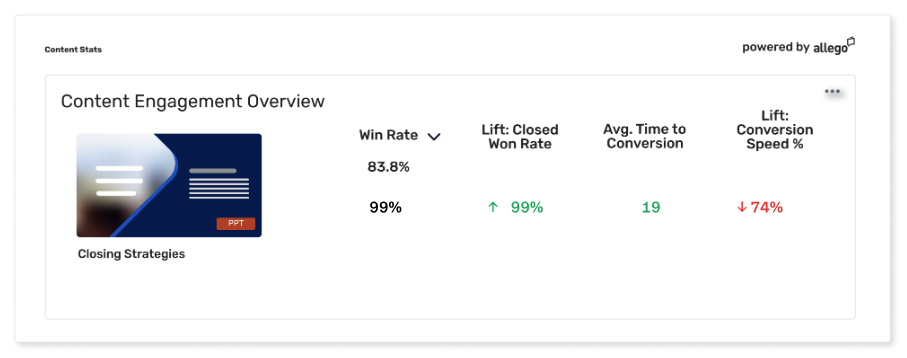
What distinguishes Allego's approach from a basic document repository is how tightly content connects to revenue data.
The platform lets you track which content appears in opportunities, which versions are current, and which assets influence pipeline and win rates. Approved content stays compliant; expired content disappears automatically. Documents can auto-fill with real-time CRM and source data, and engagement data writes back to the CRM record.
Source: Allego
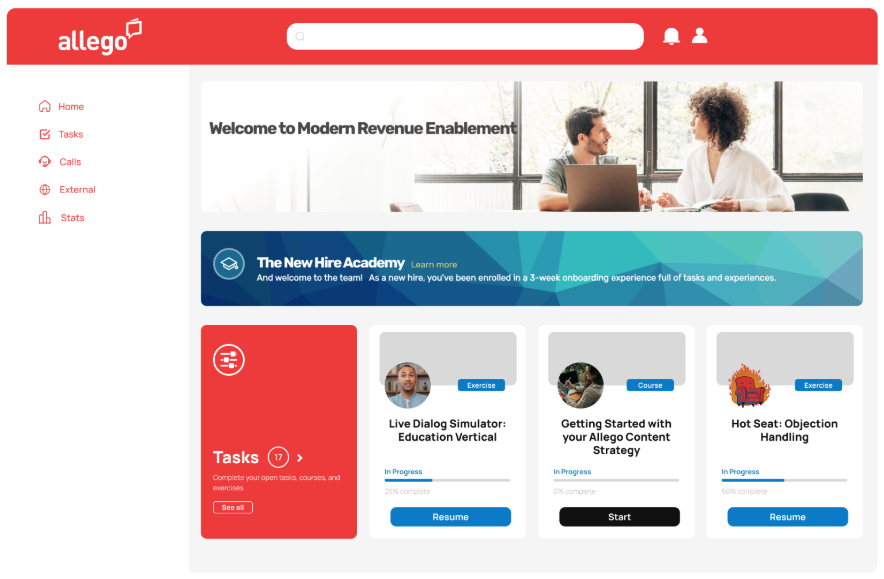
Modern Learning: Allego embeds training into daily workflows instead of requiring reps to visit a separate LMS.
Allego Modern Learning is designed around a simple observation: conventional LMS platforms aren't built for sellers.
Source: Allego
They require weeks of instructional design, live in separate environments, and can't respond quickly to competitive shifts or regulatory changes.
Allego's alternative embeds learning where sellers already work. With 120+ integrations spanning CRM, LinkedIn, web browsers, and email, reps access approved answers and talk tracks without leaving their current application.
AI converts existing training materials into complete learning programs, including courses, reinforcement sequences, and reminder cadences, reducing the content creation burden on enablement teams.
Reinforcement happens through AI-driven digital flash card games that identify individual knowledge gaps and close them over time. Skill validation comes through AI role plays tied to specific products, messaging, and objection types, with Conversation Intelligence connecting practice back to actual call behavior.
The platform supports mobile-first learning with native iOS and Android apps, offline access for field reps, and an interface localized in 12 languages. Transcription, translation, and AI capabilities extend to more than 99 languages. Asynchronous video collaboration lets managers, peers, and subject matter experts exchange feedback with point-in-time comments on a video timeline.
AI Role Play & Coaching: Allego's Live Dialog Simulator uses adaptive AI to let reps practice against realistic buyer scenarios.
AI Role Play & Coaching is arguably Allego's most distinctive feature.
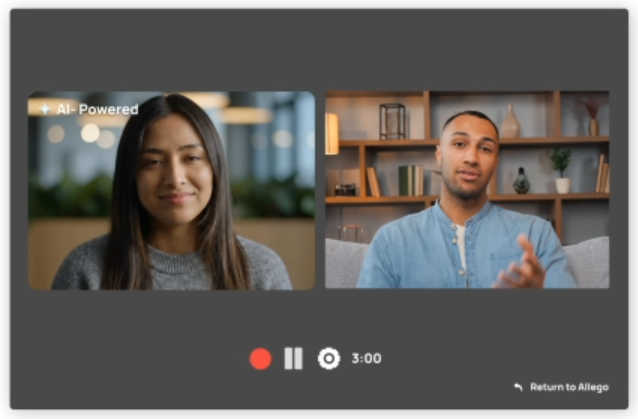
At the center is the Live Dialog Simulator, which generates a lifelike video avatar playing the role of a buyer, prospect, or interviewer.
Source: Allego
The key difference from scripted role play tools: the simulation is unscripted and adaptive. The avatar listens to the rep's spoken responses and adjusts in real time. Reps cannot memorize a path through the exercise. The AI can pause mid-session to deliver inline coaching advice before the rep continues, and at session end, reps receive structured, personalized feedback.
Enablement teams set up scenarios by describing the conversation context in natural language, with no manual scripting or branching logic required. The system supports 32 languages, 71 voices and accents, and scoring in 59 languages, making it practical for global teams.
Managers can apply shared rubrics and AI-driven scorecards that align coaching to defined skills across roles and regions. Skill signals from practice sessions surface in dashboards showing growth, gaps, and coaching priorities, so managers focus their limited time on high-priority interventions rather than first-pass review.
Allego has also announced a neuroscience study in partnership with cognitive neuroscientist Dr. Carmen Simon, exploring how the brain processes feedback during AI-led role play, grounding the coaching approach in behavioral science.
Digital Sales Rooms: Allego creates branded, trackable buyer spaces that replace scattered email threads and shared drives.
Allego Digital Sales Rooms give sellers and buyers a single secure destination to interact throughout a deal. Instead of content scattered across email threads and file-sharing tools, everything lives in one branded space: content, updates, next steps, and direct messaging.
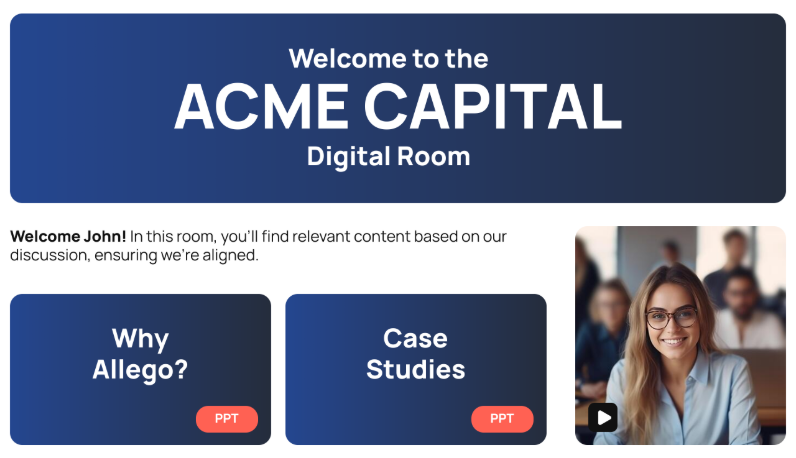
The workflow separates governance from flexibility. Marketing creates unlimited templates with pre-built structure and approved content. Sellers launch a room in one click and personalize messaging, videos, and materials within those guardrails. Rooms can be created and shared directly from CRM, email, or mobile.
On the buyer side, the platform captures email addresses and engagement data to identify stakeholders and map the buying committee. Sellers and buyers stay aligned through shared materials, mutual action plans, timelines, and direct messaging.
Deal Navigator brings together CRM data, content shared, Digital Sales Room activity, and buyer signals into a single view. AI Deal Alerts surface risk and next best actions only when defined criteria are met, reducing noise.
Conversation Intelligence: Allego captures, transcribes, and analyzes sales conversations to identify winning patterns and coaching opportunities.
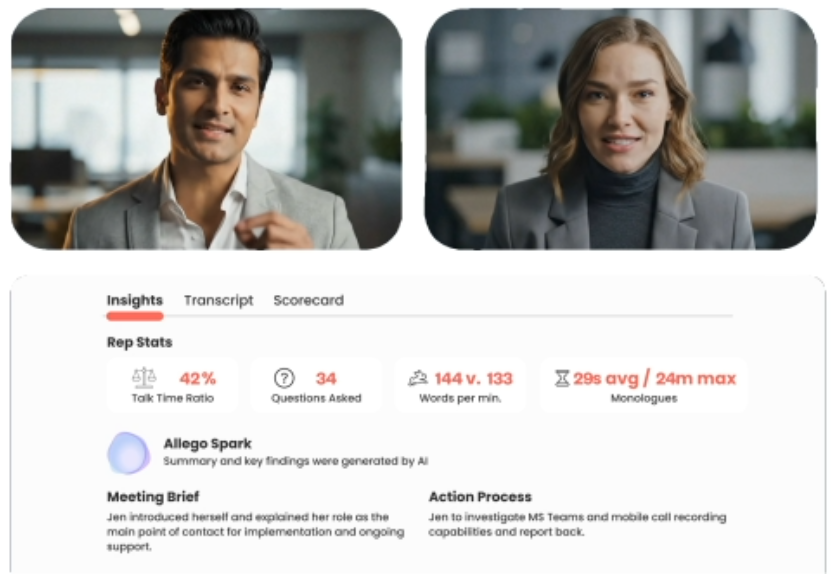
Allego Conversation Intelligence records and transcribes sales conversations across virtual meetings and dialers, then uses NLP to analyze spoken exchanges, identify patterns, and aggregate keywords across the full call archive.
Source: Allego
Teams can search transcripts for pricing discussions, competitor mentions, and common objections, and tag teammates to share key moments. AI generates clean summaries and action items so reps spend less time on manual note-taking. The system tracks talk-to-listen ratios and words-per-minute as concrete coaching indicators.
What makes Allego's approach different from standalone conversation intelligence tools is the closed loop with the rest of the platform. A coaching gap identified in a call can route a rep into a practice simulation, a knowledge module, or a content recommendation without leaving Allego.
Conversation signals combine with CRM context and cross-channel buyer engagement data spanning calls, email, content, and Digital Sales Rooms in a single view.
The system also applies sentiment analysis over the course of a deal to guide reps on next steps, and supports FINRA/SEC Rule 17a-4 compliance for financial services organizations that need to archive and retain conversation records.
Allego Pricing
Allego uses a per-user, per-month pricing model billed annually.
No public price points are listed; all contracts require a custom quote. Pricing varies by role type: standard revenue-generating users pay full rate, channel and partner users receive a lower rate, and non-revenue roles receive substantially reduced pricing.
All AI capabilities and customer support are included at no extra cost. Every deployment includes Premium Success Services covering implementation, key integrations, ongoing engagement, training, and technical support. Managed services (extra integration work or content-building assistance) are available at additional cost. Allego explicitly states there are no usage-based costs or surprise add-ons.
The typical contract length is 3 years paid annually upfront, though 2-year and 1-year options are also available. No self-serve free trial is advertised; the standard evaluation path is a scheduled demo. A buyout program is available for customers locked into contracts with competing vendors.
The platform consolidates what Allego describes as seven distinct tool categories into one: LMS/LXP, Coaching, Reinforcement, Conversation Intelligence, Content Management, Digital Sales Rooms, and Video Selling tools.
Where Allego Falls Short
Allego is a strong platform for revenue enablement, but several limitations become apparent with sustained use. These reflect deliberate design decisions rather than oversights.
Pricing and Commitment Barriers. With no public pricing, no free plan, and a default 3-year contract paid annually upfront, Allego creates significant friction for teams evaluating the platform. Smaller organizations or those with semester-based budgets face a substantial commitment before seeing results. The absence of a self-serve trial means every evaluation requires sales team involvement.
Search Quality in Large Libraries. Users on G2 and Capterra consistently flag the platform's internal search as needing improvement for locating specific content within large libraries. For a platform whose core promise includes content discoverability, this is a meaningful gap.
Administrative Complexity. While end users generally find the interface simple, administrators report a steeper learning curve for setup, configuration, and user management. The platform's depth creates onboarding friction for the people responsible for building and maintaining the enablement environment.
Video Playback Limitations. Users report that videos from external platforms cannot be imported directly, and videos must be restarted from the beginning rather than resumed mid-watch. For organizations with extensive video training libraries, these are daily friction points.
Integration Depth Beyond Core CRM. While Allego offers 120+ integrations, users express a desire for deeper connections beyond Salesforce, particularly bi-directional data flow with marketing automation platforms, HRIS systems, and revenue intelligence tools.
The Intelligence Gap. Perhaps the most structural limitation isn't something Allego got wrong but something it was never designed to do. Allego excels at equipping your team to sell. It teaches reps how to handle objections, which content to share at which deal stage, and how to run an effective buyer conversation. What it doesn't do is tell your team who to sell to.
Allego has no B2B contact database, no buyer intent signals, no account prioritization engine, and no prospecting infrastructure. Reps can be perfectly trained and still waste time on accounts that aren't in-market, with contacts whose information is stale, using talk tracks for deals they never should have pursued.
This gap creates a clear need for a platform purpose-built for the intelligence side of go-to-market: identifying the right accounts, surfacing the right contacts, and providing the buying signals that tell your team when to act.
The Natural Complement to Allego: ZoomInfo
ZoomInfo addresses the intelligence gap that Allego's enablement platform was never designed to fill. Where Allego answers "how should your team sell?", ZoomInfo answers "who should they sell to, and when?"
ZoomInfo is an all-in-one AI GTM platform built on the industry's most comprehensive B2B data: 500M contacts, 100M companies, 135M+ verified phone numbers, and 200M+ verified business email addresses.
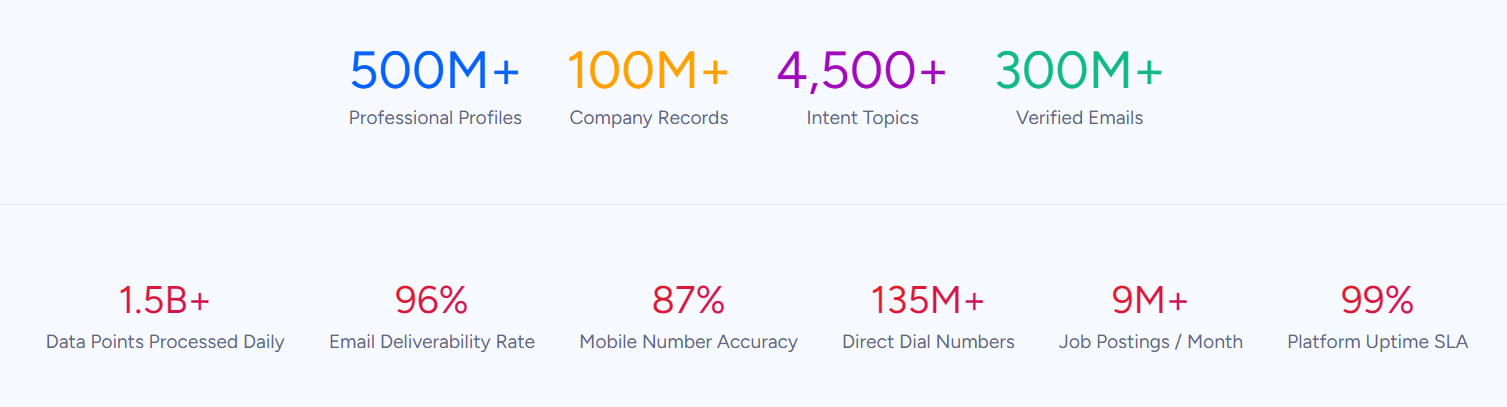
Fusing this data with your CRM records, conversation transcripts, and behavioral signals, ZoomInfo's GTM Context Graph (which processes 1.5B+ data points daily) captures not just what happened in a deal, but why it happened. Your team accesses that intelligence through the dedicated GTM Workspace for sellers, GTM Studio for marketers and RevOps, or APIs and MCP in any front-end.
For teams already using Allego, ZoomInfo adds the intelligence foundation that makes enablement investments pay off faster.
Comprehensive B2B Data: ZoomInfo provides the verified contacts and company intelligence that feed every prospecting and deal execution workflow.
Allego assumes your team already knows who to target. ZoomInfo makes sure they do.
The platform's data covers three dimensions simultaneously: identity data (who buyers are and how to reach them), company context (firmographics, org charts, technographics across 100M companies), and dynamic signals (buying activity indicating when an account is in-market).
The data is built and maintained through a multi-source pipeline: automated ML scanning of 28 million site domains daily, third-party partner data covering 95 million businesses, a contributory community of 200,000+ ZoomInfo Lite users, and an in-house Data Training Lab of 300+ human researchers. First-party data reaches up to 95% accuracy.
This matters for Allego users because the best content, coaching, and Digital Sales Rooms in the world are wasted on stale contacts and wrong accounts. With ZoomInfo feeding verified data into the CRM that Allego connects to, reps open Allego's enablement tools with confidence that the people and companies they're targeting are real, reachable, and relevant.
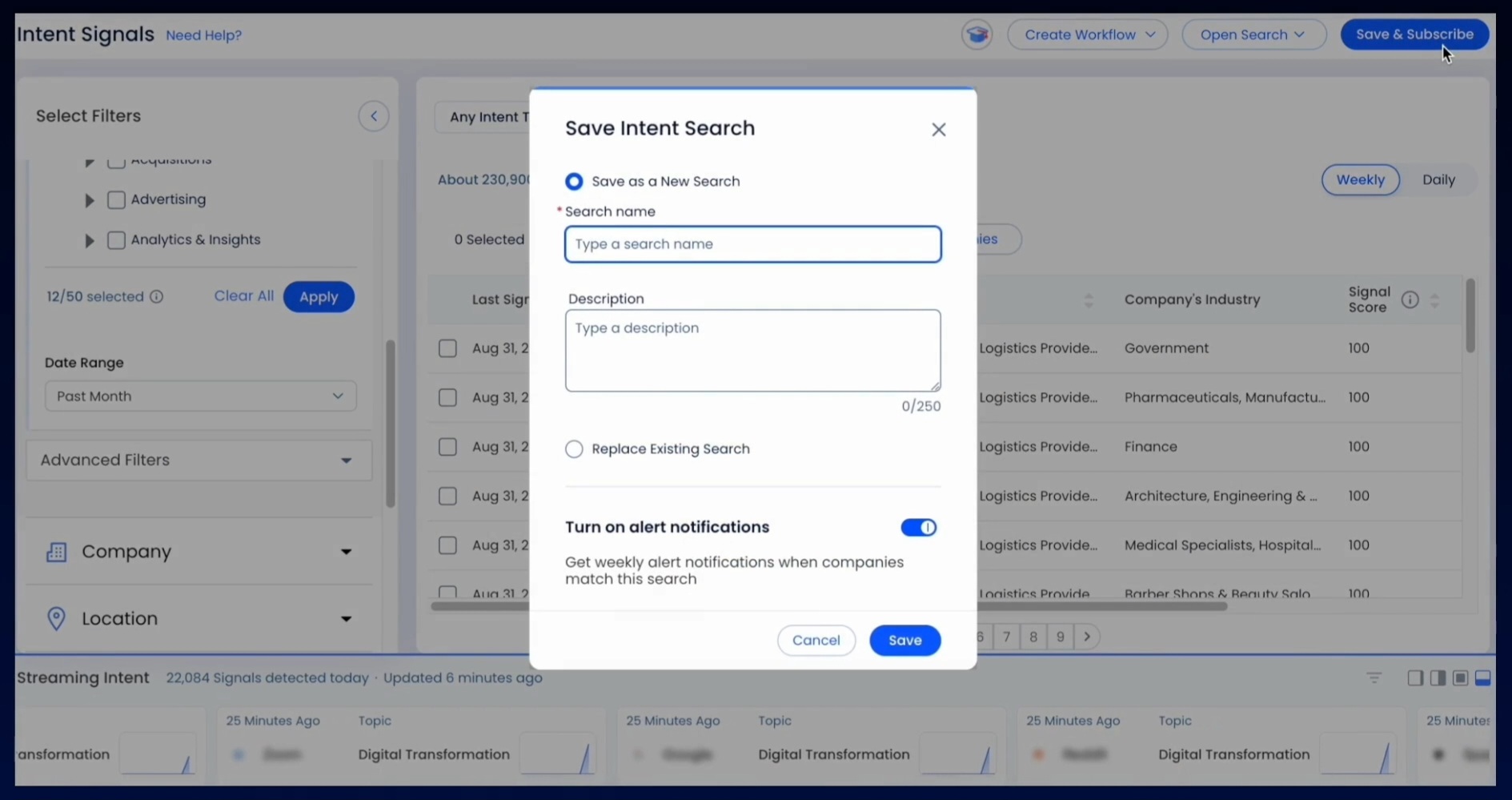
ZoomInfo Intent adds another layer: tracking signals from 210 million IP-to-Organization pairings to identify which companies are actively researching topics related to your product. Guided Intent, exclusive to ZoomInfo, identifies topics historically correlated with deal success rather than requiring manual topic selection.
Source: ZoomInfo
Seismic's sales team attributed 39% of active pipeline to opportunities identified or influenced by ZoomInfo signals, boosted productivity by 54%, and saved 11.5 hours per week. (Seismic Case Study)
GTM Context Graph: ZoomInfo reasons about why deals move or stall, turning raw data into actionable intelligence.
Allego's Conversation Intelligence captures what happened on calls. ZoomInfo's GTM Context Graph takes that a step further by reasoning about why things happened.
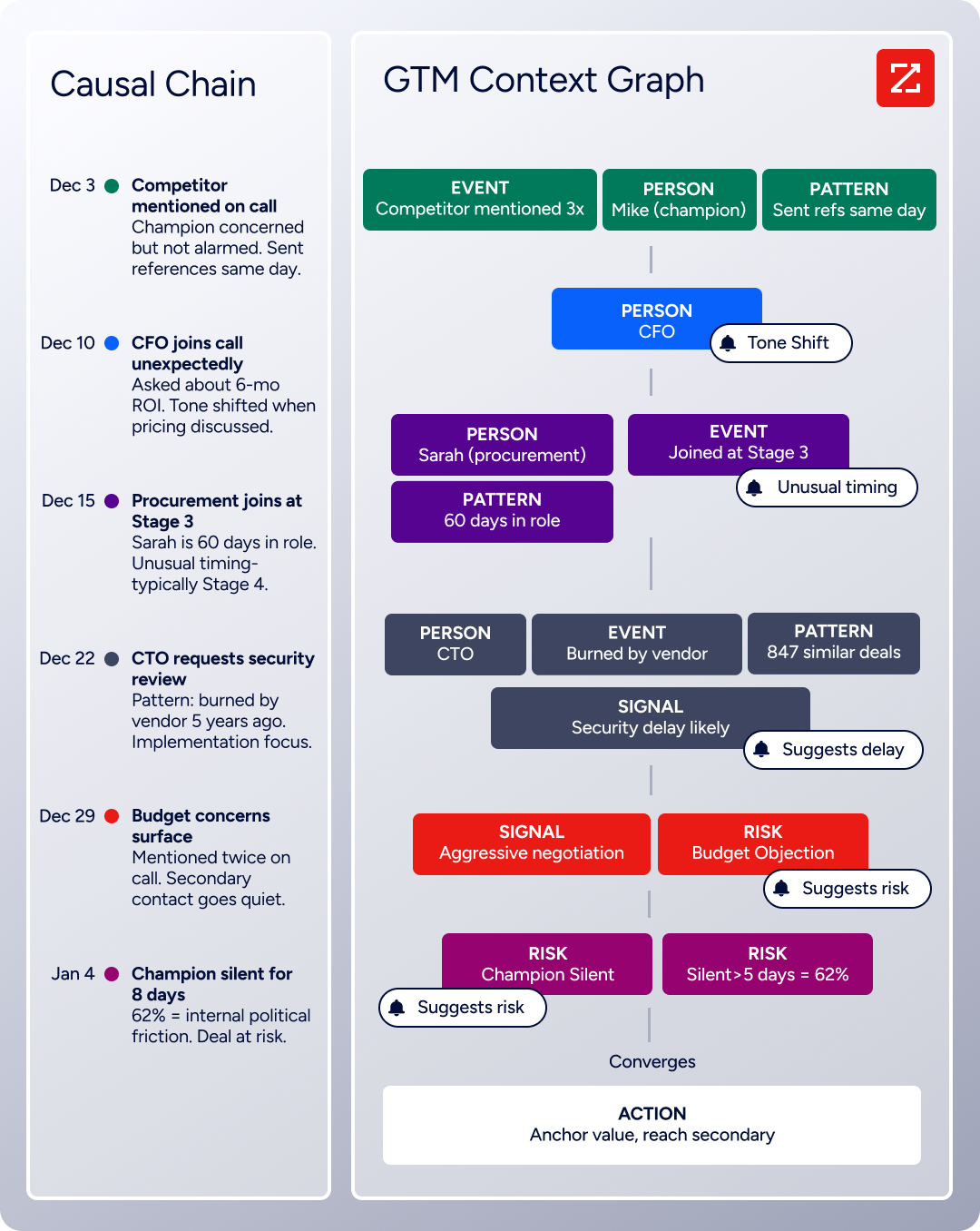
It fuses ZoomInfo's B2B data with a customer's CRM records, conversation transcripts, email interactions, and behavioral signals into a unified intelligence layer.
A CRM records that a deal moved from Stage 3 to Stage 4. Allego's conversation intelligence transcribes the call where the VP of Finance asked about ROI. The GTM Context Graph connects both: executive sponsorship entering at this stage, combined with ROI-focused questions, matches patterns behind closed-won deals in your segment.
That reasoning flows into the follow-up email, the play targeting similar accounts, and the forecast weighting deals by buying evidence rather than stage labels.
For teams using Allego for enablement and ZoomInfo for intelligence, this creates a feedback loop. ZoomInfo's signals tell your reps which accounts to prioritize. Allego's content management surfaces the right materials for those accounts.
ZoomInfo's data enriches the CRM context that Allego's Digital Sales Rooms draw from. And the GTM Context Graph gets smarter with every deal interaction, continuously improving the recommendations flowing to both platforms.
"It's not just the data itself. It's more about the right data at the right time to help us reach out with the right message across that full buyer journey." — Chelsea Kenyon, Senior Director of Digital Strategy at Redwood Logistics. (Redwood Logistics Case Study)
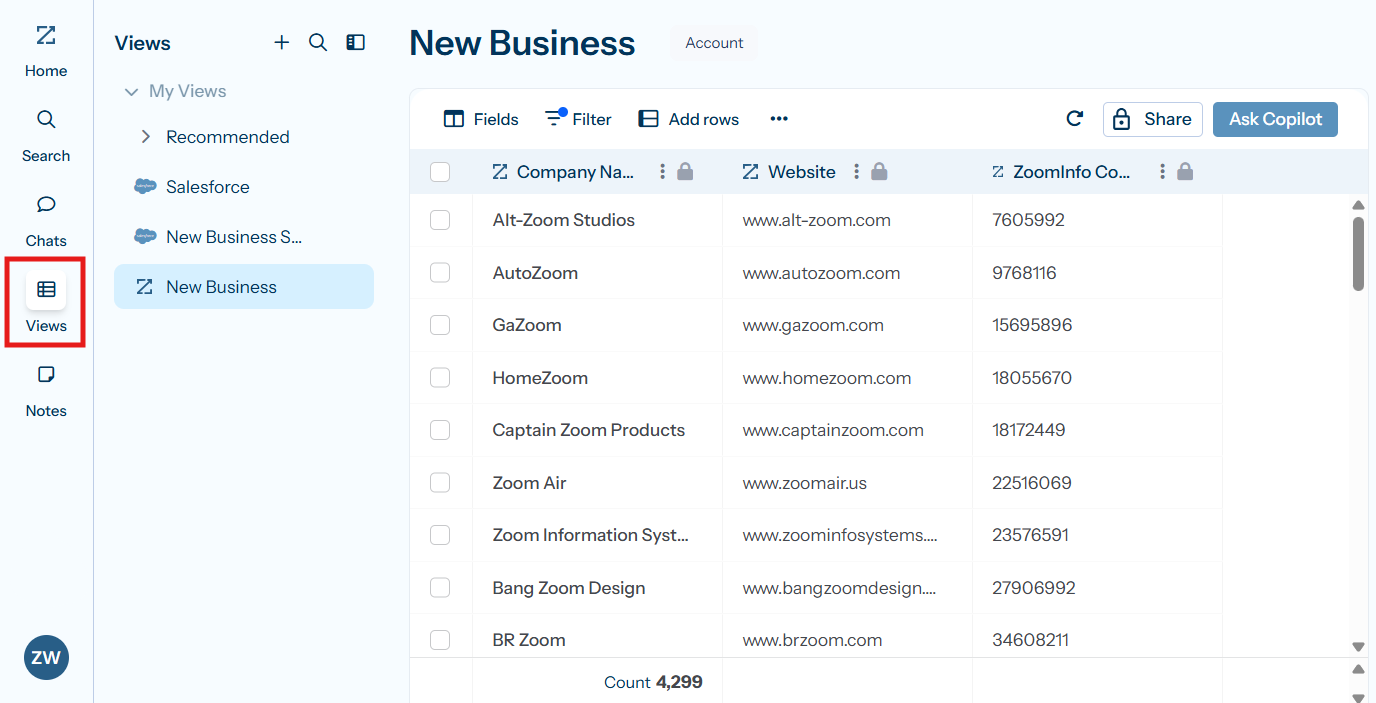
Universal Access: ZoomInfo delivers intelligence through native products, APIs, and MCP so it works inside any tool your team already uses.
Allego integrates with 120+ tools. ZoomInfo is designed to be one of them. The intelligence reaches teams through three access lanes:
GTM Workspace gives sellers a single surface where prioritized accounts, AI-drafted outreach, and deal execution converge. Specialized AI agents handle account research, outreach drafting, CRM updates, and signal monitoring. The Action Feed delivers a live stream of in-market buyers matched to target criteria, with pre-drafted actions on every signal.
Source: ZoomInfo
GTM Studio gives marketers, RevOps, and GTM engineers a builder environment where audience definition, campaign orchestration, and pipeline measurement happen in natural language. Expansion plays that used to take 3 weeks now launch in 30 minutes, without technical support.
APIs and MCP expose the same intelligence to any custom agent, internal tool, or partner platform. API Access is included in all relevant plans. The MCP server connects AI models directly to ZoomInfo's data with no custom coding required.
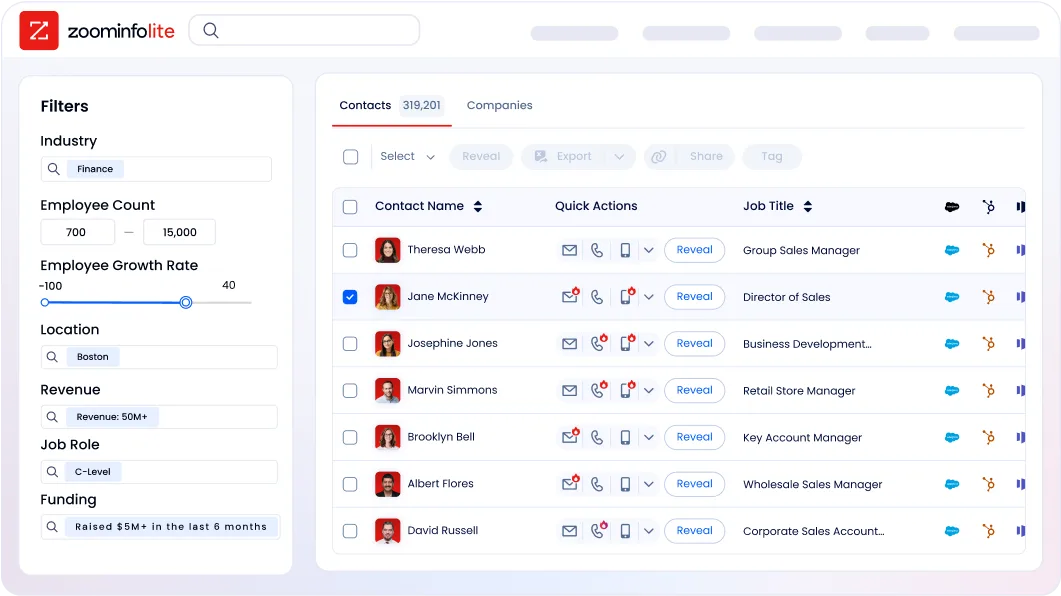
ZoomInfo also offers a permanent free tier. ZoomInfo Lite provides access to 100M+ verified profiles, 10 monthly export credits, individual and company searches, the ReachOut Chrome Extension, and WebSights Lite for website visitor identification, with no credit card or time limit.
"Anything that minimizes our team's need to switch contexts is beneficial. ZoomInfo offers a unified view, eliminating the need to navigate between systems." — Ben Perceval, RevOps Manager at Spekit. (Spekit Case Study)
Allego and ZoomInfo: How They Work Together
Aspect | Allego | ZoomInfo |
|---|---|---|
Primary Focus | Revenue enablement (training, content, coaching) | GTM intelligence (data, signals, AI-driven execution) |
Core Question Answered | How should your team sell? | Who should they sell to, and when? |
Target Users | Sales enablement leaders, L&D, sales managers | Sales reps, marketers, RevOps, GTM engineers |
Data Layer | Content analytics, learning progress, deal room engagement | 500M contacts, 100M companies, intent signals, technographics |
AI Focus | Role play simulation, coaching automation, content recommendations | Account prioritization, outreach generation, deal reasoning |
Conversation Intelligence | Call analysis tied to coaching and learning workflows | Call analysis tied to deal patterns and GTM Context Graph |
CRM Relationship | Reads CRM context to surface relevant content and training | Enriches and maintains CRM data; writes signals back to records |
Pricing Model | Per-user, custom-quoted, 1–3 year contracts | Consumption-based, custom-quoted; free tier available |
Free Access | No free plan; demo-based evaluation | ZoomInfo Lite (permanent free tier) + 7-day free trial |
Best For | Preparing reps to execute effectively | Identifying and prioritizing the right opportunities |
Final Verdict
Allego and ZoomInfo serve different but connected functions in the go-to-market workflow. Neither replaces the other; together, they address the full problem.
Allego is a strong revenue enablement platform for organizations that need to consolidate training, content management, coaching, and digital selling into a single system. It's particularly well-suited for enterprise teams in regulated industries where compliance certification, content governance, and mobile-first access are requirements rather than nice-to-haves.
The unified architecture, AI role play with the Live Dialog Simulator, and conversation-intelligence-to-coaching loop give enablement leaders a system where learning investments visibly connect to field behavior. The trade-offs (opaque pricing, multi-year contracts, admin complexity, no free trial) reflect an enterprise-first design.
ZoomInfo fills the intelligence side of the equation. The most prepared sales team still underperforms if it's calling stale contacts at companies that aren't in-market. ZoomInfo's comprehensive B2B data, GTM Context Graph, and universal access lanes ensure your team knows who to target, when to engage, and why a deal is moving or stalling.
For Allego users, ZoomInfo provides the verified account and contact data that makes every piece of enablement content, every coaching interaction, and every Digital Sales Room more effective because it's aimed at the right audience at the right time.
Get started with ZoomInfo for free here.
The strongest go-to-market teams don't choose between enablement and intelligence. They invest in both: Allego to build the skills and content that win conversations, ZoomInfo to ensure those conversations happen with the right people at the right moment.
Allego FAQ
What is Allego used for?
Allego is a revenue enablement platform that consolidates sales training, content management, AI-powered coaching, conversation intelligence, and Digital Sales Rooms into a single system.
Organizations use it to onboard new reps faster, certify regulatory compliance at scale, launch products consistently across distributed teams, and coach reps without relying solely on manager bandwidth. It replaces up to seven separate point solutions (LMS, coaching tools, content management, conversation intelligence, Digital Sales Rooms, reinforcement platforms, and video selling tools).
How much does Allego cost?
Allego does not publish pricing. The platform uses a per-user, per-month model billed annually, with custom quotes based on role type and deployment size.
Standard revenue-generating users pay full rate, while channel, partner, and non-revenue roles receive reduced pricing. The typical contract length is 3 years paid annually upfront, though 2-year and 1-year options are available. All AI capabilities and customer support are included at no extra cost.
ZoomInfo, by contrast, offers a permanent free tier (ZoomInfo Lite) and a 7-day free trial alongside its paid plans.
Does Allego offer a free trial?
No self-serve free trial is publicly available. Sales-facilitated trials may exist based on Allego's terms of use, but the standard evaluation path is a scheduled demo.
This differs from platforms like ZoomInfo, which offers both a permanent free tier (ZoomInfo Lite with 10 monthly export credits and access to 100M+ verified profiles) and a 7-day free trial requiring no credit card.
What industries does Allego serve best?
Allego is strongest in regulated, knowledge-intensive verticals: financial services (asset management, wealth management, insurance, banking), life sciences (medical devices, pharma, biotech), high tech (enterprise software, SaaS), and manufacturing with technical sales.
The platform holds FINRA/SEC Rule 17a-4 compliance and FDA 21 CFR Part 11 support, which few enablement platforms offer. Its customer base includes five of the 15 largest U.S. banks, four of the eight largest insurance providers, and four of the five largest global medical device companies.
How does Allego compare to a traditional LMS?
Allego was built as an alternative to traditional learning management systems. Where an LMS typically requires weeks of instructional design, lives in a separate environment, and measures completion rates, Allego embeds learning in the flow of work through 120+ integrations with CRM, email, LinkedIn, and web browsers.
Its AI converts existing training materials into structured courses automatically, and reinforcement happens through digital flash card games, AI role plays, and spaced repetition rather than scheduled training events. Conversation Intelligence closes the loop by connecting training outcomes to actual rep behavior in recorded customer conversations.
Does Allego integrate with Salesforce?
Yes, the Salesforce integration is Allego's most developed CRM connection. It natively embeds learning, content, coaching, Digital Sales Rooms, and AI directly inside CRM opportunity workflows, writes engagement data back to Accounts, Contacts, Leads, and Opportunities, and recommends next-best-action content in deal context.
Allego also integrates with HubSpot, Microsoft Dynamics 365, Pipedrive, Oracle, SAP, and Veeva, though users note that integration depth beyond Salesforce could be broader.
What AI features does Allego include?
Allego's AI capabilities span the full platform and are included at no extra cost. The Live Dialog Simulator provides unscripted, adaptive role play with lifelike video avatars in 32 languages. AI-driven scorecards automate coaching assessment across shared rubrics. Generative AI search surfaces answers from content, experts, and learning materials.
AI-powered microlearning identifies and closes individual rep knowledge gaps. Sentiment analysis tracks deal health over time. Mobile voice commands allow reps to search and share content in the field. The company has also announced agentic AI capabilities, moving from generative AI (which suggests) to agentic AI (which reasons and acts within sales workflows).
Can Allego and ZoomInfo work together?
Allego and ZoomInfo address different parts of the go-to-market workflow and complement each other naturally. Allego prepares your team with the skills, content, and coaching to execute effectively. ZoomInfo provides the verified contact data, company intelligence, buyer intent signals, and deal reasoning that ensure those efforts are directed at the right accounts at the right time.
Both platforms integrate with major CRMs like Salesforce and HubSpot, meaning ZoomInfo's enriched data flows into the same CRM context that Allego's content recommendations, Digital Sales Rooms, and coaching workflows draw from.
Looking beyond Allego? Compare the strongest alternatives side by side:
