

Ambition has built its reputation on a specific conviction: coaching is the most important driver of revenue performance. The platform gives frontline managers structured coaching workflows with AI-generated prep, gives reps visible targets through leaderboards and competitions, and gives leaders analytics connecting coaching effort to revenue. For revenue teams that have outgrown spreadsheet-based performance tracking, it fills a real gap.
To write this review, we analyzed Ambition in depth. It's a strong fit if:
You manage a quota-carrying sales team of 20+ reps and need consistent coaching across all managers
You want to gamify sales activities with leaderboards, competitions, and real-time recognition
You need to standardize onboarding and coaching programs across a growing or distributed team
You want to measure whether coaching programs actually move performance metrics
You already use a CRM like Salesforce or HubSpot and need a performance management layer on top of it
Ambition coaches teams and tracks execution, but it does not provide the data that makes those activities productive. It can tell you a rep made 50 calls today. It cannot tell you whether those calls targeted the right buyers, reached verified direct dials, or addressed accounts showing buying intent.
This is where ZoomInfo fits: a GTM platform providing verified contact data, account intelligence, and buying intent signals. Ambition coaches your team on how to sell. ZoomInfo tells them who to sell to and why now.
We've included a detailed look at ZoomInfo later in this review. If you're ready to explore how better data drives better execution, start with ZoomInfo's free trial.
What is Ambition?
Ambition is a sales performance management platform founded in 2013 in Chattanooga, Tennessee, by Travis Truett, Jared Houghton, and Brian Trautschold.
The company went through Y Combinator's Winter 2014 batch and raised approximately $15.5 million in Series B led by Primus Capital in October 2021, bringing total funding over $20 million.
The platform calls itself the #1 Execution Operating System for Revenue Teams. It is built around three modules: Coaching Orchestration for structuring manager-rep interactions, Sales Activation for driving daily rep behavior through gamification, and Performance Intelligence for connecting coaching and activity data to pipeline outcomes.
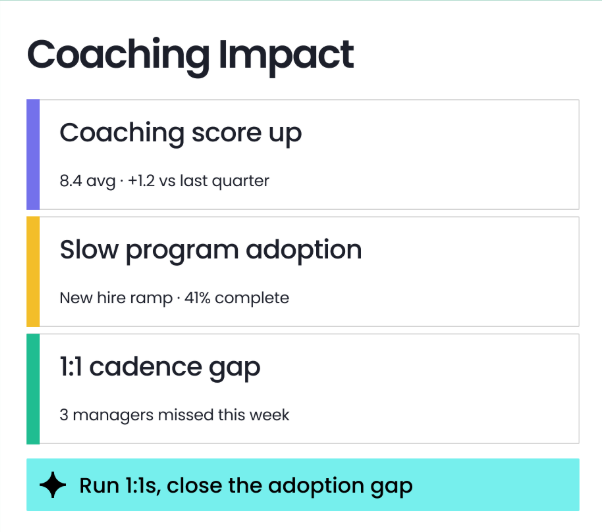
Source: Ambition
Ambition targets mid-market to enterprise revenue organizations, specifically revenue leadership: CROs, enablement leaders, revenue ops, and frontline sales managers. It serves teams across multiple industries including logistics, telecommunications, financial services, sports, and technology, with customers including T-Mobile, Zoom, ADP, Rubrik, Ryder, and the Dallas Mavericks.
In May 2026, Ambition launched a rebuilt platform architecture including a Performance Graph (a real-time data layer), an Ambition Agent for continuous performance monitoring, and configurable AI Skills. The company was also named a Notable Vendor in Forrester's Revenue Enablement Platforms Landscape for Q1 2026.
Ambition Pros & Cons
Pros | Cons |
|---|---|
- Structured coaching cadences that standardize manager-rep 1:1s at scale | - 2-year standard contract term with annual billing only |
- Three competition formats (Challenges, Fantasy, Bracket) beyond basic leaderboards | - No free trial or free plan publicly available |
- AI-generated coaching pre-reads that prep managers in under a minute | - AI capabilities require paid add-ons ($5-$9/user/month on top of base price) |
- Weighted scorecards tied to specific sales methodologies | - Setup complexity requires organizations to adapt workflows to Ambition's structure |
- Strong CRM integrations (Salesforce, HubSpot, Dynamics) plus Gong and Seismic | - Reports of occasional system downtime and data accuracy issues |
- Coaching Analytics with Attribution to prove program ROI | - Pricing starts at $45/user/month, reaching $84/user/month with all AI add-ons |
- Forrester Notable Vendor in Revenue Enablement Platforms (Q1 2026) | - No prospecting data, buyer intent, or contact intelligence included |
Ambition Review: How it Works & Key Features
Coaching Orchestration: Ambition turns ad-hoc manager coaching into a structured, trackable system.
Coaching Orchestration is Ambition's signature feature and the reason most teams evaluate the platform.
It replaces unstructured 1:1 meetings with recurring Check-Ins, multi-step Cadences, and documented Action Plans, all tied to live performance data.
The building block is the Check-In: a coaching session where both manager and rep arrive prepared.
Before a scheduled 1:1, the employee receives the agenda and submits responses so both parties have context before the conversation starts. During the session, current KPIs, coaching notes, historical performance, and goals are accessible in the interface. After the session, managers rate or excuse the check-in, creating a searchable archive. Group Check-Ins extend this format to team meetings.
Coaching Cadences scale this beyond individual managers. A Cadence is a multi-step program where each step has its own agenda built from ten item types: Questions, Metric Snapshots (up to 8 metrics), Pipeline Snapshots, Polls, Content Blocks, External URLs, embedded Gong or Zoom call reviews, Seismic Learning lessons, Checkboxes, and Multiple Choice.
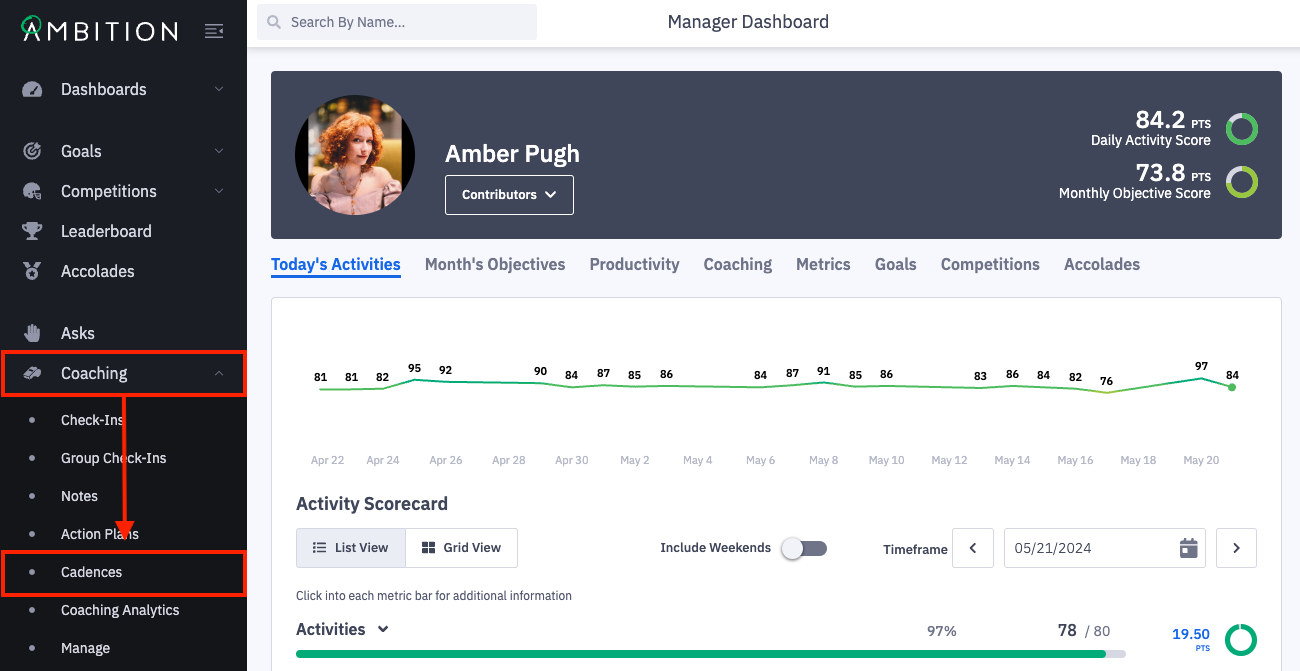
Source: Ambition
Enablement teams design the Cadence centrally, then enroll managers and their direct reports at scale. Coaching Instructions, visible only to the manager, guide how each step should be coached.
The AI layer adds Coaching Pre-Reads: before any 1:1, a manager can generate a briefing that analyzes performance trends, goal progress, and sentiment from prior coaching responses, then suggests questions for the upcoming session. Only the manager and co-coach see the pre-read.
Managed Programs let enablement leaders deploy a single coaching program across multiple managers and their teams at once.
Sales Activation: Ambition drives daily rep behavior through gamification, scorecards, and competitions.
Sales Activation makes performance visible on the sales floor. It translates strategy into daily rep accountability through three mechanisms: real-time scoring, structured competition, and automated recognition.
The foundation is the Scorecard system. Admins configure scorecards per role with two sections: short-term Activities (leading indicators like calls and demos, measured daily) and long-term Objectives (results like revenue, measured monthly or quarterly).
Each metric gets a target and a weight, producing a 0-100+ composite score per rep. A Calculate Target feature analyzes 12 weeks of historical data and recommends targets at the 80th percentile of team performance, grounding goals in data rather than guesswork.
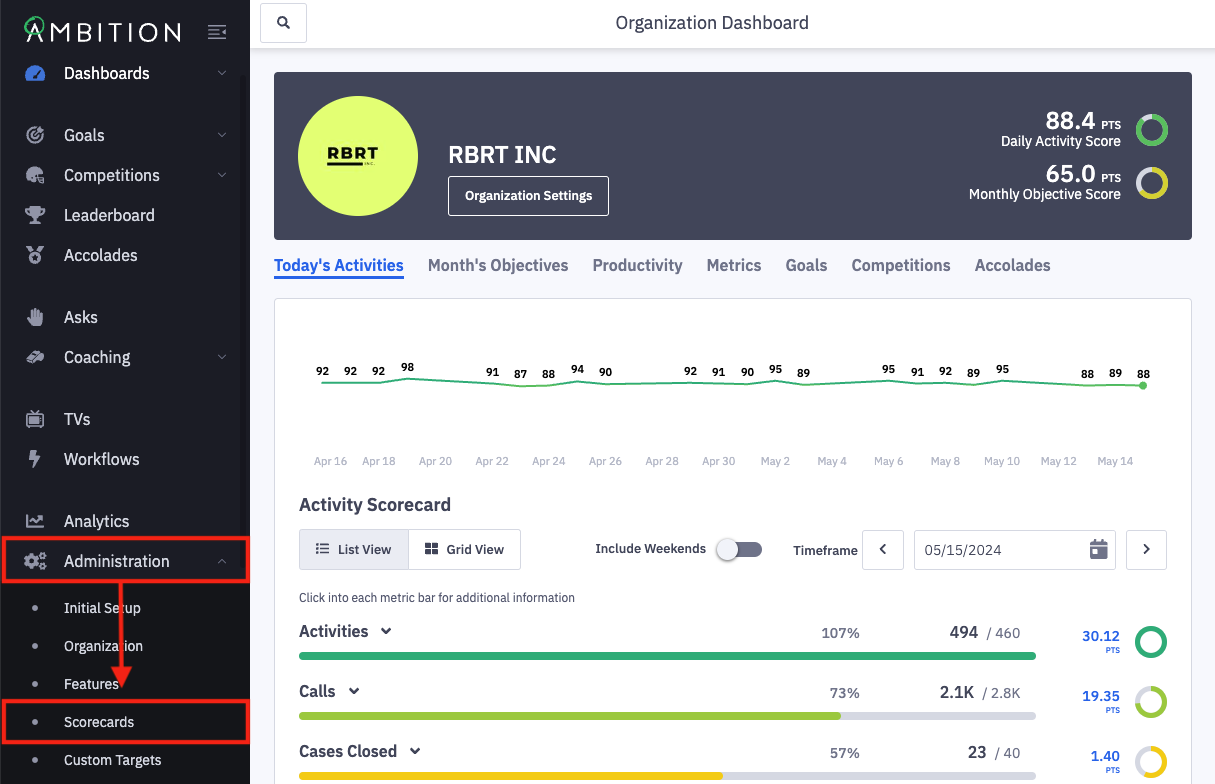
Source: Ambition
Ambition supports three competition formats, each designed for different outcomes:
Challenges: Head-to-head competitions where individuals or teams compete on a key metric over a defined period
Fantasy Competitions: Manager-drafted teams with weekly head-to-head matchups, playoffs, and consolation brackets (modeled after fantasy sports)
Bracket Competitions (Beta): Elimination-style contests with configurable round lengths from 1 hour to 2 weeks
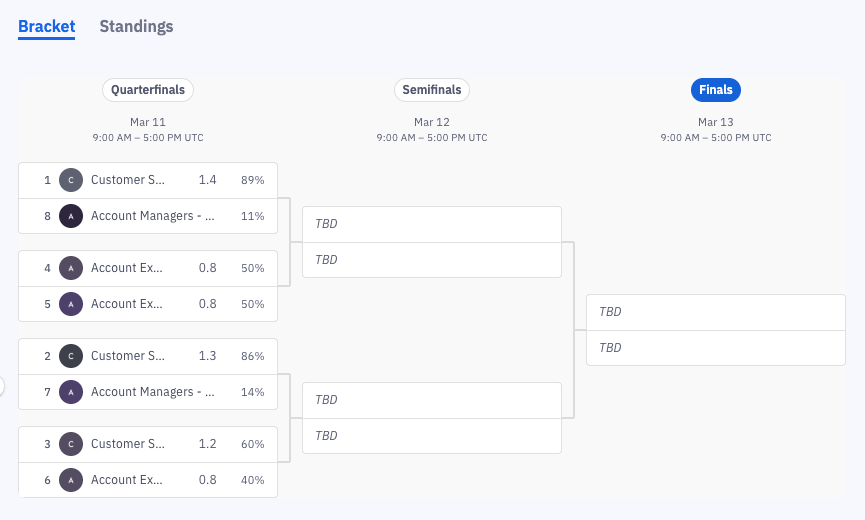
Source: Ambition
Accolades add a recognition layer with three types: single-threshold metric awards, multi-level progression milestones, and peer-nominated recognition. Reps can pin achievements to their profile and share them publicly.
Ambition TV provides configurable displays that broadcast live leaderboards, competition standings, and recognition across the sales floor. Automated workflows trigger notifications when performance thresholds are crossed, keeping reps and managers informed without manual monitoring.
Performance Intelligence: Ambition connects coaching effort, rep activity, and pipeline outcomes in one analytics layer.
Performance Intelligence is Ambition's analytics module, available on the Enterprise tier at $75/user/month.
It gives revenue leaders a connected view across three areas: Pipeline, Metrics, and Coaching Analytics.
Pipeline Intelligence monitors pipeline values including Open, Won, Lost, Commit, and Forecast, with deal stage movement tracking and change counts. Managers can update commit values directly from the pipeline view. They can save filtered views as automated reports delivered to email, Slack, Microsoft Teams, Webex, or Zoom as CSV or Excel files.
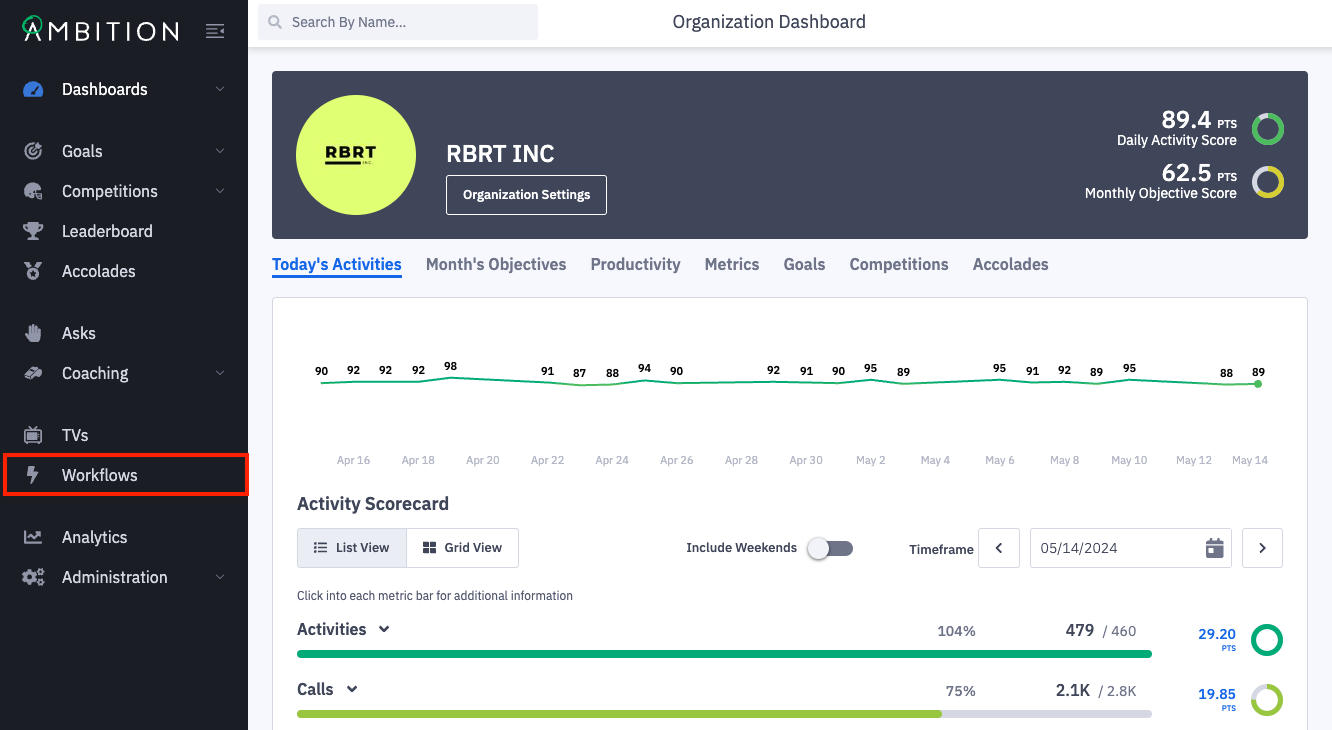
Source: Ambition
Metrics views display any tracked metric as a Table, Graph, or Quadrant (a two-axis view comparing two metrics), with shareable views and role-based access controls. Managers can compare call volume against pipeline generated to identify which activities predict revenue.
Coaching Analytics is where Performance Intelligence earns its keep. The Attribution feature establishes a baseline from the four-week metric average before a coaching program starts, then plots weekly percentage differences against that baseline. This lets managers distinguish programs that move performance from those that don't, using data rather than intuition.
Across all features sits Ambitious AI, a conversational agent that answers natural-language questions about pipeline and performance, including insights, trends, goal attainment, and coaching preparation. The agent accesses pipeline snapshots, opportunity stages, CRM-synced fields, goal progress, coaching session records, and org hierarchy.
Pricing Structure: Ambition uses per-seat pricing across three tiers with annual billing and 2-year standard contracts.
Ambition's pricing breaks into three tiers, each for a different scope:
Starter (Seller Activation): $45/user/month
Real-Time Leaderboards & Competitions
Activity & Objective Scorecards
Automated Accolades
Productivity Quadrant
Customer Success support and guided onboarding
PRO (Coaching Orchestration): $65/user/month
Everything in Starter
Coaching Pre-Reads
Calendar Sync Integration (Google and Microsoft)
Pipeline Snapshot
Conversation Data (embedded Gong and Zoom calls in coaching agendas)
Enterprise (Revenue Execution System): $75/user/month
Everything in PRO
Coaching Analytics with Attribution
Opportunity Changes and Forecasting
Quota Management
3 Sandbox Environments and Private Hosting
Dedicated CSM from Day One
White-Glove Integration Set-Up
AI capabilities are separate, available as two add-ons:
AI Insights: $5/user/month
AI Actions: $4/user/month
A team that wants full Enterprise with both AI add-ons pays $84/user/month. Additional AI credits beyond the base allocation can be purchased separately, though the base allocation per tier is not publicly disclosed.
Contracts require annual billing with a 2-year term. No self-serve free trial is publicly advertised. Pilot programs are available for qualified customers on a case-by-case basis. Volume discounts exist for large Enterprise teams, though thresholds are not published.
Where Ambition Falls Short
Ambition does specific things well, and its limitations reflect the boundaries of that focus. Understanding them helps buyers set realistic expectations.
No Data or Intelligence Layer. Ambition tracks and coaches on sales activities but provides no contact data, company intelligence, or buying intent signals. It cannot tell managers whether the 50 calls a rep logged today reached verified phone numbers, targeted in-market accounts, or connected with the right decision-makers.
The platform relies on whatever data flows in from your CRM. If that data is incomplete or stale, Ambition coaches around activities that may not reach real buyers.
Setup Requires an Established Coaching Framework. Ambition rewards organizations that have already defined their coaching methodology. Teams that haven't formalized how managers should coach will struggle with configuration.
Users on Capterra describe initial setup as time-consuming, with one account manager noting the experience was "not intuitive at all. Simple things seem complex." Expect significant admin time upfront, particularly for scorecard metric mapping and Cadence design.
Metric Misconfiguration Risk. A verified reviewer flagged the risk of Ambition "focusing on wrong activity if you don't calibrate right." Ambition amplifies whatever inputs it receives. If the wrong KPIs are configured, the platform gamifies and coaches reps toward the wrong behaviors with the same intensity it would apply to the right ones.
Initial configuration is a high-stakes decision requiring alignment between sales strategy and scorecard design.
Reliability Concerns. Multiple Capterra reviewers cite system downtime, speed issues, and delays in celebration playback. One user noted: "numbers aren't always right and it seems to be down a lot." For sales floors that depend on live scoreboards, even brief outages undermine trust.
Pricing Commitment. At $45-$84/user/month on a 2-year contract, Ambition requires a large budget commitment before teams can evaluate the product in production.
There is no publicly available free trial or free plan. For 50 reps on the Enterprise tier with both AI add-ons, the annual cost exceeds $50,000 before implementation fees. Several Capterra reviewers considered pricing high relative to the feature set, particularly compared to simpler gamification tools.
These limitations follow from Ambition's focus: it was built to solve the manager effectiveness problem, not the data problem. But coaching activities are only as productive as the data behind them. That gap is where ZoomInfo fits.
The Perfect Complement to Ambition: ZoomInfo
Ambition answers the question: "Are my reps executing consistently?" ZoomInfo answers the question that comes before it: "Are they targeting the right buyers?"
ZoomInfo is a GTM platform built on 500M contacts, 100M companies, 135M+ verified phone numbers, 120M direct dials, and 200M+ verified business emails.
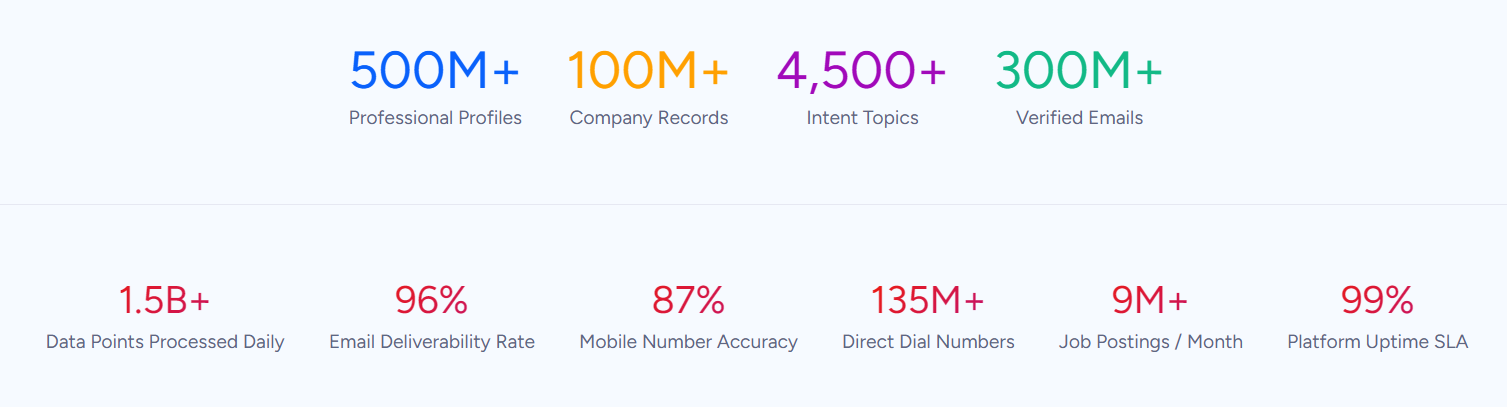
Its GTM Context Graph processes 1.5B+ data points daily, unifying this data with CRM records, conversation transcripts, and behavioral signals to reveal why deals move or stall.
That intelligence reaches your team through the GTM Workspace for sellers, GTM Studio for marketers and RevOps, or APIs and MCP in any front-end. For Ambition users, these tools supply the data behind every coached activity.
Comprehensive B2B Data: ZoomInfo provides verified contact data and account intelligence.
ZoomInfo's B2B data platform covers 500M contacts and 100M companies, 135M+ verified phone numbers, 120M direct dials, and 200M+ verified business emails.
ZoomInfo verifies this data through a multi-source pipeline backed by 300+ human researchers, reaching up to 95% accuracy on first-party data.
For teams using Ambition, this data layer determines whether scorecard metrics reflect real engagement or wasted effort. When scorecards track "calls made" and "demos set," the quality of those activities depends on whether reps are calling verified numbers and reaching real decision-makers.
ZoomInfo's Contact & Company Search provides 300+ company attributes, department org charts with decision-makers' direct dials and emails, and job-change alerts that keep records current.
Beyond contacts, Buyer Intent tracks signals from 210 million IP-to-Organization pairings and 6 trillion+ new keyword-to-device pairings sourced monthly, identifying when accounts are actively researching solutions. Guided Intent, exclusive to ZoomInfo, identifies topics historically correlated with deal success rather than requiring manual topic selection.
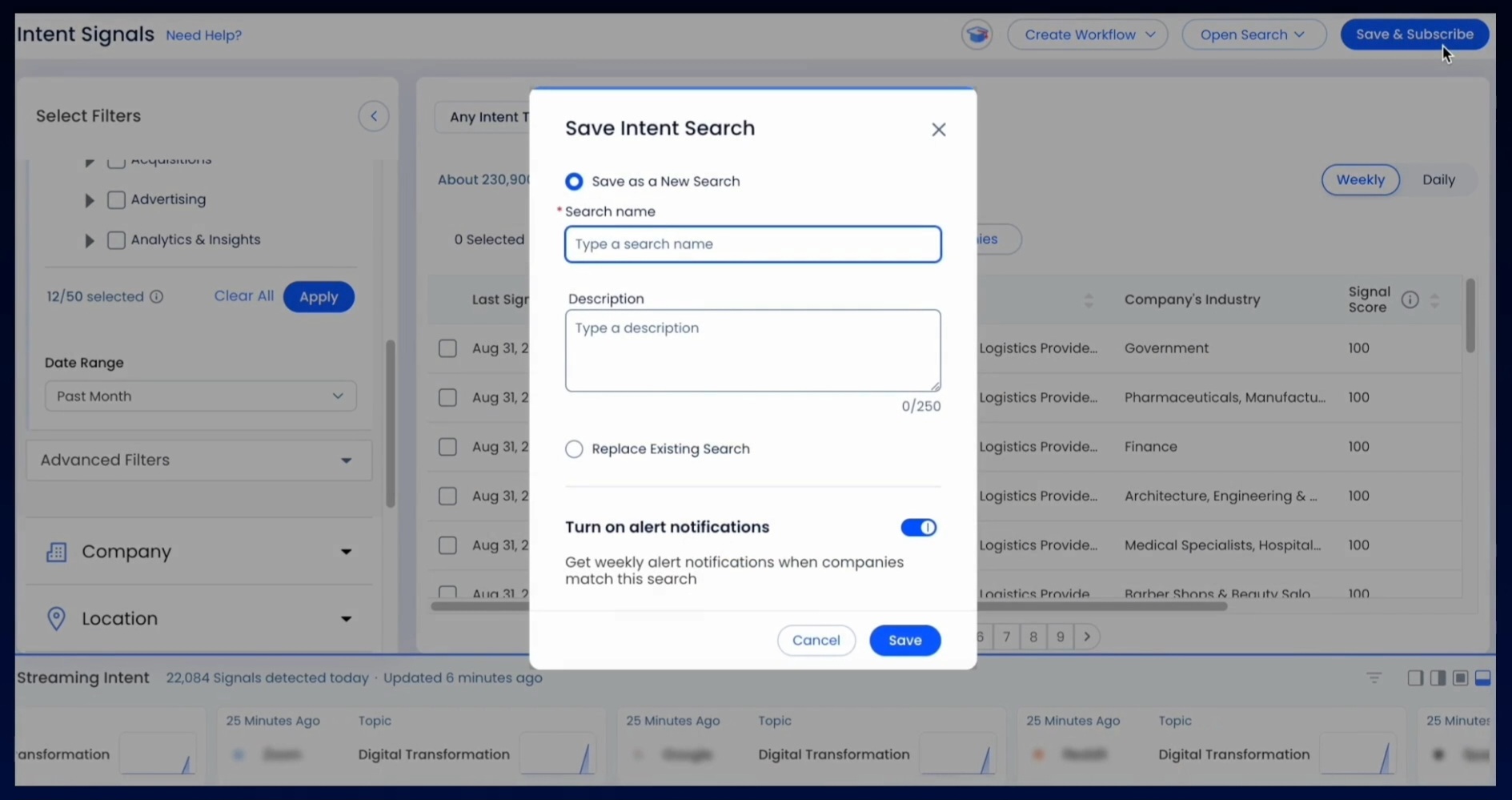
Source: ZoomInfo
This means Ambition's scorecards can weight outreach to high-intent accounts more heavily, coaching reps to prioritize opportunities most likely to convert.
In a Fortune 500 competitive RFP analyzing 25 million contacts across vendors, the independent consultant concluded that "no other competitor came even close." ZoomInfo has been named a Gartner Magic Quadrant Leader for ABM Platforms for two consecutive years and a Forrester Wave Leader for Intent Data Providers (Q1 2025).
Sago Health accelerated pipeline generation by using ZoomInfo for visibility into target buyers. "We've seen a higher percentage of conversion of outreach to opportunity created, and opportunity created to opportunity won," said Ashley Wade, CRO. (Sago Health Case Study)
GTM Context Graph: ZoomInfo fuses CRM data with external signals to reveal why deals move or stall.
The GTM Context Graph processes 1.5B+ data points daily, unifying a customer's CRM records, conversation transcripts, and email threads with ZoomInfo's third-party intelligence.
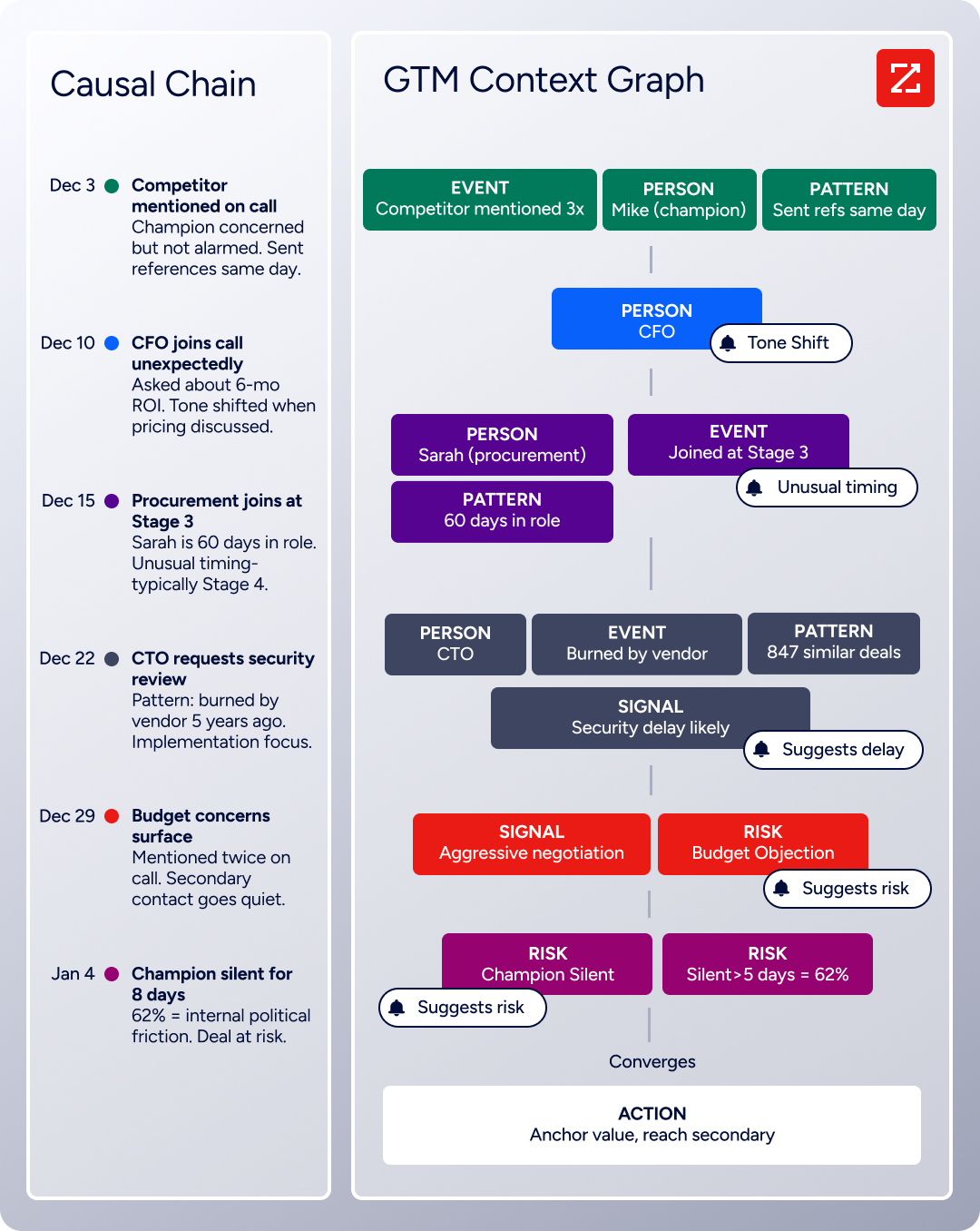
A CRM records that a deal moved to Stage 3. The GTM Context Graph captures why it moved: perhaps the CFO joined the last call and asked about ROI, or the champion went quiet because of an internal budget battle.
This intelligence transforms what managers can do inside Ambition's coaching workflows. Instead of coaching on surface metrics ("Your pipeline dropped, what happened?"), a manager with ZoomInfo's context can be specific ("Your champion at Acme went quiet after their CFO joined the call last week; here's what signals suggest about the next step").
ZoomInfo provides the intelligence. Ambition provides the coaching framework to act on it.
The GTM Context Graph reflects two decades of investment: building a large B2B data platform, acquiring Chorus for conversation intelligence (which extracts why deals accelerate or stall from calls and emails), and unifying first-party and third-party data into a single layer.
As ZoomInfo's Chief Product Officer Dominik Facher wrote: "If you rebuilt the GTM stack for AI, you'd end up with ZoomInfo for first-party data."
Seismic attributed 39% of active pipeline to ZoomInfo-influenced opportunities. "That combination of our internal CRM data, external signals, and AI has helped us craft very specific account-based messages, and people have responded right away," said Toby Carrington, Chief Business Officer. (Seismic Case Study)
Universal Access: ZoomInfo delivers intelligence through seller workspaces, marketing tools, and open APIs.
ZoomInfo's intelligence reaches teams through three channels, fitting into existing workflows rather than forcing teams to change how they work:
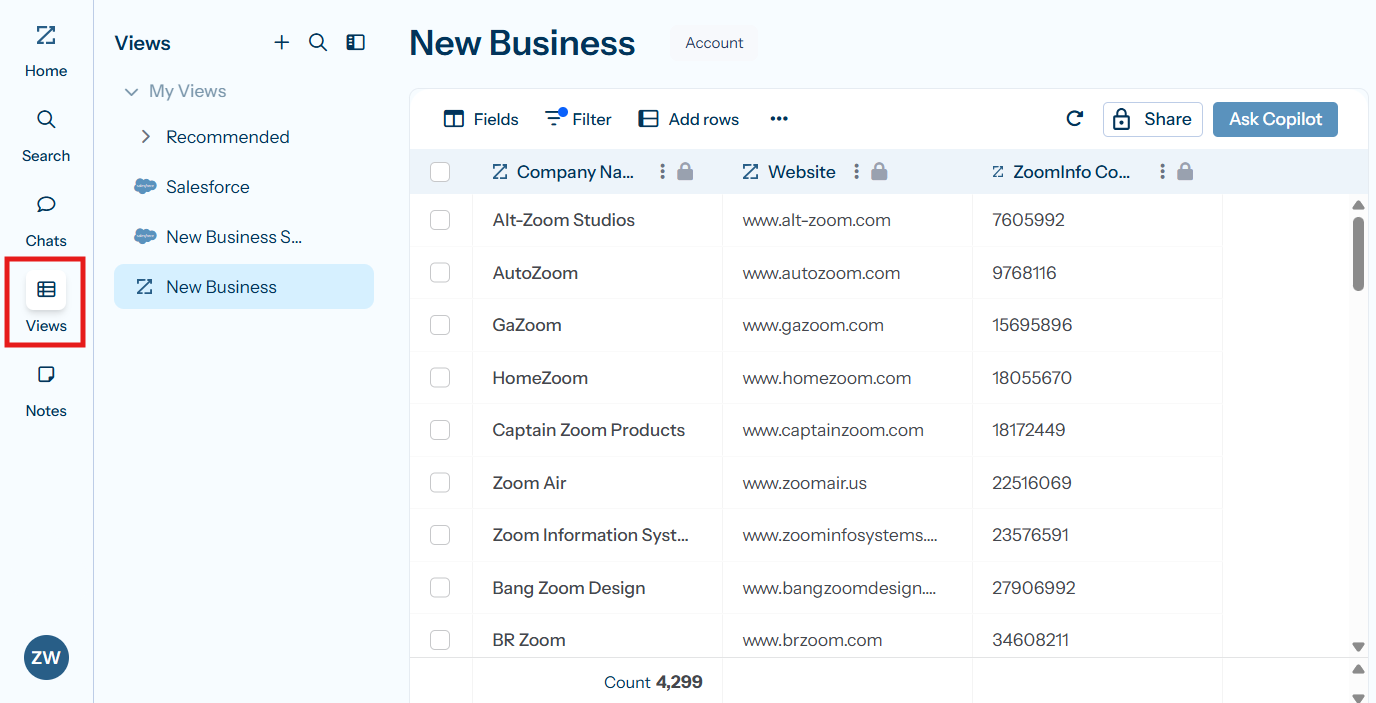
GTM Workspace is the seller's front-end to the GTM Context Graph. AEs, SDRs, and account managers get a single workspace combining their full book of business, AI-drafted outreach, buying group intelligence, and real-time signals. AI agents (built on Anthropic's Claude) handle account research, outreach generation, CRM updates, and next-best-action recommendations.
Source: ZoomInfo
GTM Studio gives marketers, RevOps, and GTM engineers an AI-powered canvas to define audiences in natural language, launch multi-channel plays, and monitor pipeline impact. Expansion plays that used to take 3 weeks now launch in 30 minutes, without engineering tickets.
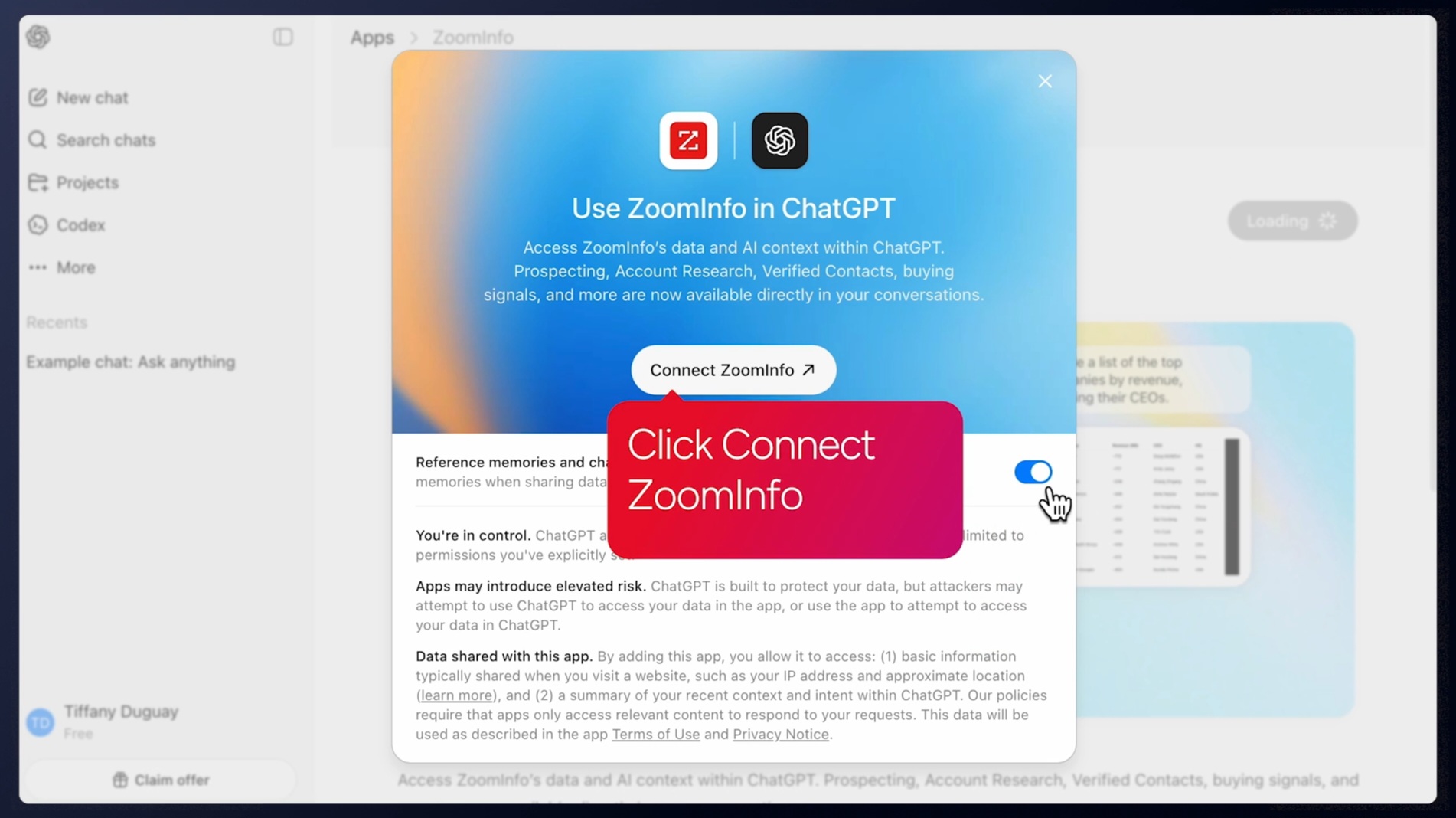
APIs and MCP deliver the same intelligence into any custom tool, AI agent, or third-party platform. ZoomInfo MCP is listed in the Claude directory and connects AI models to ZoomInfo data through natural language. API access is included in all relevant plans.
Source: ZoomInfo
The connection to Ambition works through the shared CRM. Both ZoomInfo and Ambition integrate natively with Salesforce, HubSpot, and Dynamics. ZoomInfo enriches the CRM with verified contact data, intent signals, and account intelligence. Ambition reads that enriched data to power its scorecards, coaching pre-reads, and performance analytics.
A signal detected in ZoomInfo's GTM Context Graph flows into the CRM, where Ambition's coaching system can surface it in a manager's next 1:1.
"ZoomInfo is our one source of truth for account data, and even more so for contact data. There's no other provider in the market that provides you with that level of detail," said Thor Sanderson, Senior Manager of Sales Technology Enablement at Smartsheet. (Smartsheet Case Study)
Ambition and ZoomInfo: How They Work Together
Aspect | Ambition | ZoomInfo |
|---|---|---|
Primary Purpose | Sales coaching, gamification, and performance management | B2B data, account intelligence, and GTM execution |
Core Question | "Are reps executing consistently?" | "Who should reps target, and when?" |
Data Provided | None (reads activity and pipeline data from CRM) | 500M contacts, 100M companies, intent signals, technographics |
AI Focus | Coaching pre-reads, performance Q&A, competition insights | Account research, outreach generation, deal intelligence |
Manager Value | Structured 1:1s, coaching analytics, program attribution | Account briefs, signal alerts, buying group mapping |
Rep Value | Scorecard visibility, competitions, recognition | Verified contacts, direct dials, AI-drafted outreach |
CRM Relationship | Reads CRM data for scoring and coaching | Enriches CRM with verified data and signals |
Analyst Recognition | Forrester Notable Vendor (Revenue Enablement, Q1 2026) | Gartner MQ Leader (ABM, 2024 & 2025); Forrester Leader (Intent Data, Q1 2025) |
Free Access | No free trial or free plan publicly available | ZoomInfo Lite (permanent free tier) + 7-day free trial |
Pricing Model | $45-$84/user/month, annual billing, 2-year standard | Consumption-based pricing |
Final Verdict
Ambition and ZoomInfo are not competing products. They solve two different problems, and using both creates a compounding effect that neither achieves alone.
Ambition is the coaching and activation layer. It ensures every manager runs structured 1:1s from the same playbook, that reps see where they stand against their targets, and that leadership can prove whether coaching programs move performance metrics.
For mid-market and enterprise sales organizations with 20+ reps, where inconsistent coaching costs quota attainment and drives turnover, Ambition provides the system to fix it. The platform works best for high-volume inside sales, SDR-led outbound, and any environment where daily activity visibility and competitive energy drive results.
ZoomInfo is the data and intelligence layer. It ensures that the activities Ambition tracks reach verified buyers at in-market accounts, that managers have account context before every coaching conversation, and that the CRM data powering Ambition's scorecards is accurate and complete.
With 500M contacts and 100M companies and the GTM Context Graph capturing why deals move or stall, ZoomInfo provides the intelligence that makes coached execution productive. Sellers access it through GTM Workspace, marketers through GTM Studio, and any tool through APIs and MCP.
Get started with ZoomInfo here.
The strongest revenue teams don't choose between coaching and data. They use both: ZoomInfo to identify the right opportunities and arm reps with context, Ambition to ensure those opportunities are pursued with consistency and accountability. Better data makes coaching more relevant. Better coaching makes data-driven outreach more consistent. The two reinforce each other.
Ambition FAQ
What is Ambition used for?
Ambition is a sales performance management platform used to structure coaching programs, gamify sales activities, and measure whether coaching efforts improve rep performance.
The three core modules are Coaching Orchestration (structured 1:1s and onboarding cadences), Sales Activation (leaderboards, competitions, and scorecards), and Performance Intelligence (pipeline analytics and coaching attribution). It is designed for frontline sales managers, enablement leaders, and revenue operations teams managing quota-carrying reps.
How much does Ambition cost?
Ambition offers three tiers: Starter at $45/user/month for gamification and scorecards, PRO at $65/user/month adding coaching orchestration, and Enterprise at $75/user/month adding performance intelligence, forecasting, and a dedicated customer success manager. AI capabilities are separate add-ons at $5/user/month (AI Insights) and $4/user/month (AI Actions).
All plans require annual billing with a 2-year standard contract. Volume discounts are available for large teams, though thresholds are not published.
Does Ambition offer a free trial?
No free trial or free plan is publicly advertised. The only entry-level access is pilot programs for qualified customers, evaluated case by case. Prospective buyers typically engage the sales team for a demo and pilot negotiation.
By comparison, ZoomInfo offers a permanent free tier (ZoomInfo Lite with 10 monthly export credits and access to the B2B database) and a 7-day free trial with no credit card required.
What CRM integrations does Ambition support?
Ambition's deepest integration is with Salesforce, supporting both a Managed Package (via the Salesforce AppExchange, with approximately 60-second data refresh) and an API-Only connection (10-minute minimum refresh). Native connectors also exist for HubSpot and Microsoft Dynamics 365.
Beyond CRMs, Ambition integrates with Gong, Seismic, Slack, Microsoft Teams, Webex, Zoom, Outreach, SalesLoft, and Domo. The platform supports SAML 2.0 SSO with Okta, Azure AD, Google SSO, and Salesforce SSO.
Is Ambition a good fit for small sales teams?
Ambition is built for teams of 20 or more quota-carrying reps. The per-user pricing ($45-$84/user/month), 2-year contract, and admin effort for initial scorecard and cadence configuration make it hard to justify for teams under 10. Solo sellers and small teams would find simpler gamification tools more appropriate.
Ambition's value scales with team size; coaching consistency and performance standardization matter more with larger, distributed organizations.
Does Ambition provide sales data or prospect intelligence?
No. Ambition is a coaching and performance management layer, not a data platform. It reads activity and pipeline data from your CRM (Salesforce, HubSpot, or Dynamics) but does not provide contact data, company intelligence, buyer intent signals, or prospecting capabilities.
For verified B2B data and account intelligence, teams pair Ambition with a data platform like ZoomInfo, which provides 500M contacts, 100M companies, and buying intent signals that enrich the CRM data Ambition depends on.
How does Ambition's AI work?
Ambition's AI capabilities are paid add-ons on top of any base tier.
Key features include Coaching Pre-Reads (automated session prep with metric analysis, sentiment review, and suggested questions), an AI Assistant (conversational chat for natural-language queries about performance, pacing, and pipeline), AI Challenge Insights (competition analysis and projections), and Pipeline Intelligence summaries.
AI usage is credit-based, with additional credits available for purchase beyond the base allocation. The credit allocation per tier is not publicly disclosed.
What analyst recognition does Ambition have?
Ambition was named a Forrester Notable Vendor in the Revenue Enablement Platforms Landscape for Q1 2026, where Forrester cited clients' top use cases as seller engagement, sales manager enablement, and AI tool navigation. The company has been a G2 High Performer in Sales Performance Management for at least 8 consecutive quarters in both Small Business and Enterprise segments.
Additional recognition includes a Sales Coaching Gold Medal from SoftwareReviews and inclusion on the Inc. 5000 list. Ambition holds SOC 2 Type 2 certification and is hosted on AWS. The Forrester designation is a "Notable Vendor" placement, a different tier from a Leader position.
Researching Ambition? These comparisons and alternatives help you decide:
