
Choosing between Apty and Whatfix for digital adoption comes down to five questions:
Do you need to guide employees through one application, or are you managing adoption across a multi-application tech stack?
Is proving software ROI to your CFO more important than having the broadest content authoring features?
Does your digital adoption platform need to work on desktop apps, mobile, and VDI environments, or are you primarily covering web applications?
How much are you willing to invest upfront, and how quickly do you need the platform deployed?
Beyond software guidance, do you also need to understand whether your go-to-market teams are actually using the intelligence tools you've licensed?
In short, here's what we recommend:
Apty is the right choice for enterprises that need fast deployment and measurable ROI on their software investments. Its dual-module architecture pairs in-app guidance with Apty PULSE, a workflow monitoring layer that tracks how employees actually use applications across the tech stack.
Apty can be deployed in 1–2 days without heavy IT involvement. However, Apty's pricing starts at $9,500 per app annually, its documentation portal sits behind a customer login, and it cannot cover desktop or VDI applications.
Whatfix is the platform for large enterprises that need the widest environmental coverage and the most content authoring capabilities. It's one of the few DAPs that natively supports web, desktop, mobile, and VDI/Citrix environments, making it viable for organizations running legacy desktop software alongside modern web apps.
Its ScreenSense AI engine reads application context to trigger guidance at the right moment, and the Mirror simulation product lets employees practice workflows before go-live. That breadth comes with complexity: setup requires planning, all pricing is quote-based, and analytics is a separate paid add-on.
Both platforms solve the same core problem: getting employees to actually use the software your organization has already paid for. But neither addresses whether your go-to-market teams have accurate data and intelligence before they even open those applications. That's a different adoption gap.
ZoomInfo is an AI GTM platform that ensures the data flowing into your CRM, marketing automation, and sales tools is accurate, complete, and actionable.
Built on a B2B data foundation of 500M contacts, 100M companies, 135M+ verified phone numbers, and 200M+ verified business email addresses, ZoomInfo's GTM Context Graph (an intelligence layer processing 1.5B+ data points daily) fuses this data with your CRM records, conversation transcripts, and behavioral signals to reveal not just what happened in a deal, but why.
Sales teams access this intelligence through GTM Workspace, marketers and RevOps through GTM Studio, and any custom tool or AI agent through APIs and MCP.
For organizations where Apty or Whatfix drives adoption of CRM and sales tools, ZoomInfo makes the data inside those tools worth adopting.
If accurate, complete B2B intelligence sounds like the missing piece of your software ROI strategy, see how ZoomInfo works.
Apty vs. Whatfix vs. ZoomInfo at a glance
Apty | Whatfix | ZoomInfo | |
|---|---|---|---|
Primary function | Digital Adoption Platform (guidance + workflow analytics) | Digital Adoption Platform (guidance + simulation + analytics) | AI GTM platform (B2B data + intelligence + execution) |
Core strength | ROI measurement and process compliance | Environmental breadth and content authoring | B2B data and GTM intelligence |
Deployment speed | Weeks to months | ||
AI capabilities | Prescriptive AI for intervention recommendations | ScreenSense context engine + 3 AI Agents | GTM Context Graph processing 1.5B+ data points daily |
Environment coverage | Web applications | Web platform, Chrome extension, mobile app, API/MCP | |
Pricing transparency | Quote-based only | Custom-quoted; | |
Best for | Fortune 1000 enterprises focused on software utilization ROI | Large enterprises with mixed application environments | B2B organizations needing accurate data and intelligence across their GTM stack |
Apty and Whatfix solve the same problem differently
Both Apty and Whatfix exist because enterprises keep buying software that employees don't fully use. The pattern is familiar: organizations invest heavily in Salesforce, Workday, or ServiceNow, then watch adoption plateau because employees revert to old habits, skip steps, or never discover features that would save them hours.
Where these platforms diverge is in what they prioritize.
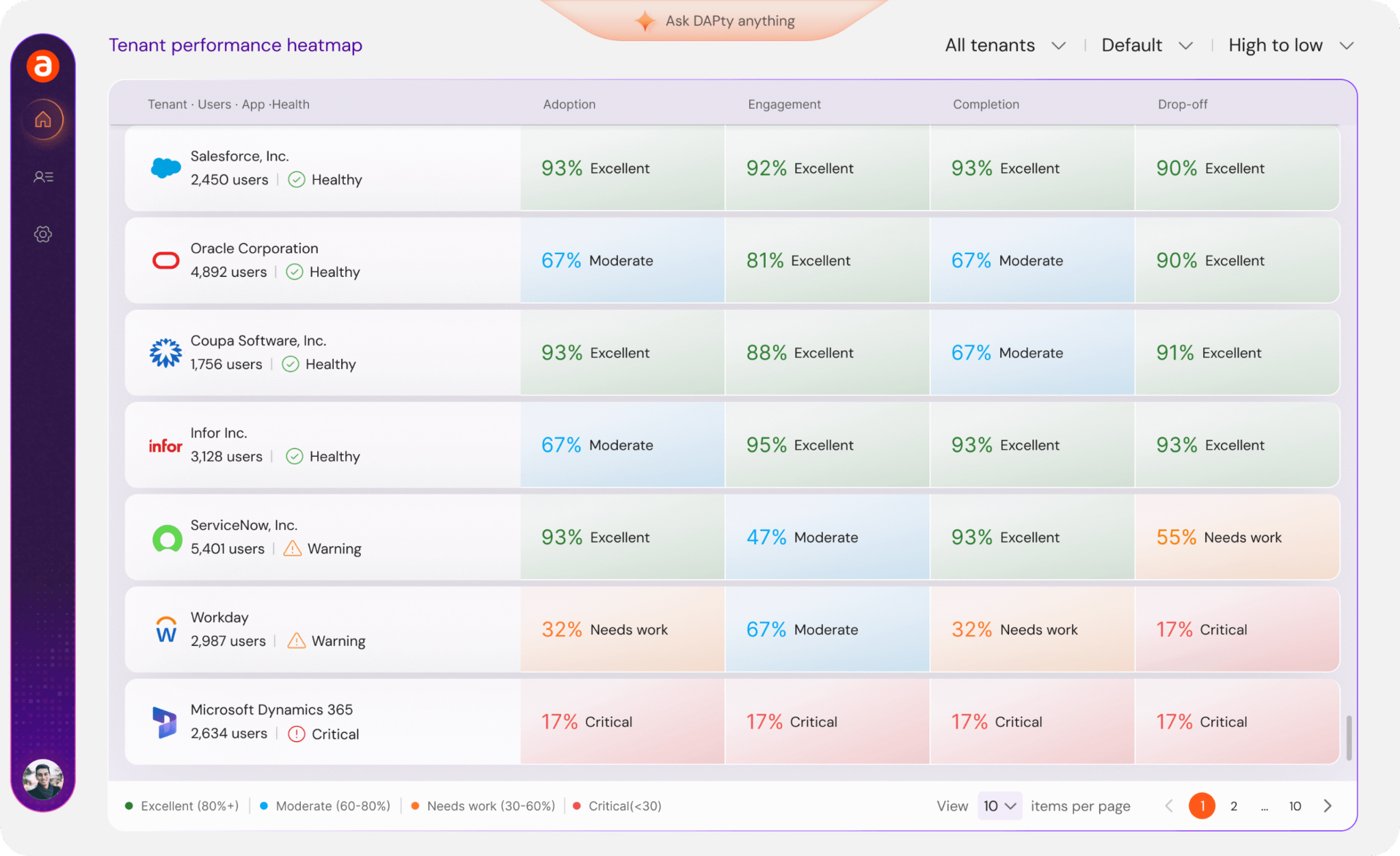
Apty starts with measurement. Its Apty PULSE module installs silently and begins tracking how employees interact with applications within two days.
Source: Apty
Within 30 days, it produces an adoption diagnosis, identifying which workflows are broken, which features go unused, and where process deviations occur. Only then does the guidance layer (walkthroughs, validations, tooltips) target those friction points. The philosophy: diagnose first, then prescribe.
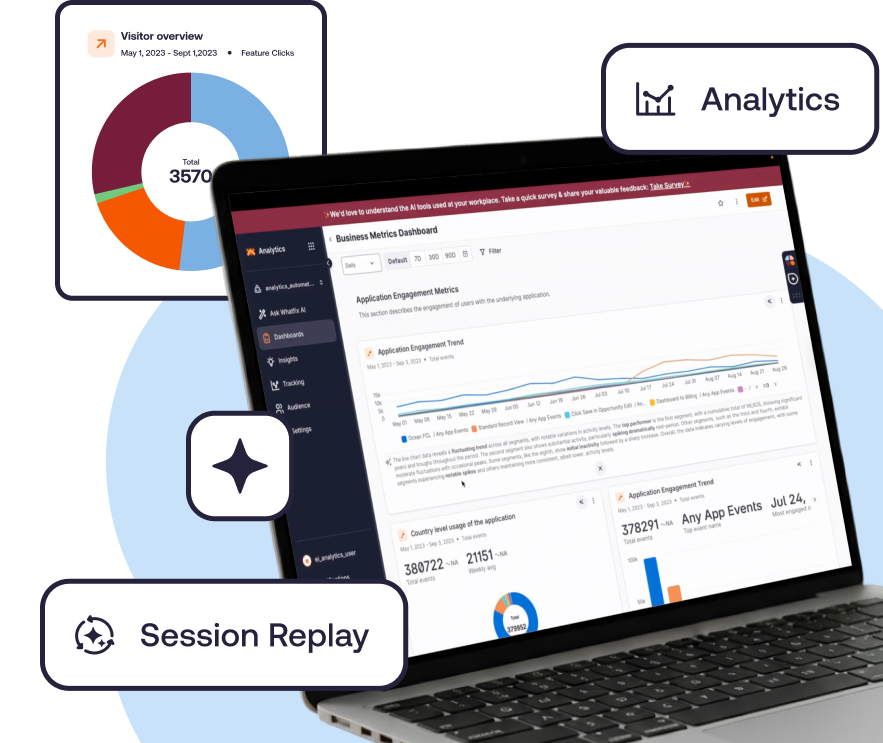
Whatfix starts with content. Its no-code Studio editor lets L&D teams record walkthroughs by clicking through an application's actual UI, then publish that content as interactive guides, videos, PDFs, and slide decks simultaneously through Adoption Everywhere.
The platform assumes you know where employees struggle and gives you the tools to create guidance at scale. Analytics come through a separate Product Analytics module.
Source: Whatfix
This difference shapes the buyer experience. Apty customers tend to deploy PULSE across their tech stack first, let the data reveal where interventions are needed, then build targeted guidance. Whatfix customers tend to build guidance content for a major application rollout, then use analytics to refine it over time.
Neither approach is wrong. But the distinction matters when you're deciding which platform fits your organization's adoption maturity.
Where ZoomInfo fits: the data quality layer beneath adoption
Apty and Whatfix both help employees use enterprise software correctly. But there's a prerequisite neither addresses: whether the data inside those applications is worth working with.
Consider a sales team using Salesforce. Apty or Whatfix can guide reps through opportunity creation, enforce field validations, and track whether reps follow the prescribed workflow.
But if the contact records are stale, the phone numbers don't connect, and the email addresses bounce, perfect process compliance still produces poor outcomes. The workflow is right, but the fuel is wrong.
This is the problem ZoomInfo solves. Its GTM Context Graph doesn't just populate CRM fields; it connects 500M contacts and 100M companies with your CRM records, conversation transcripts, and behavioral signals to reveal why deals move or stall.

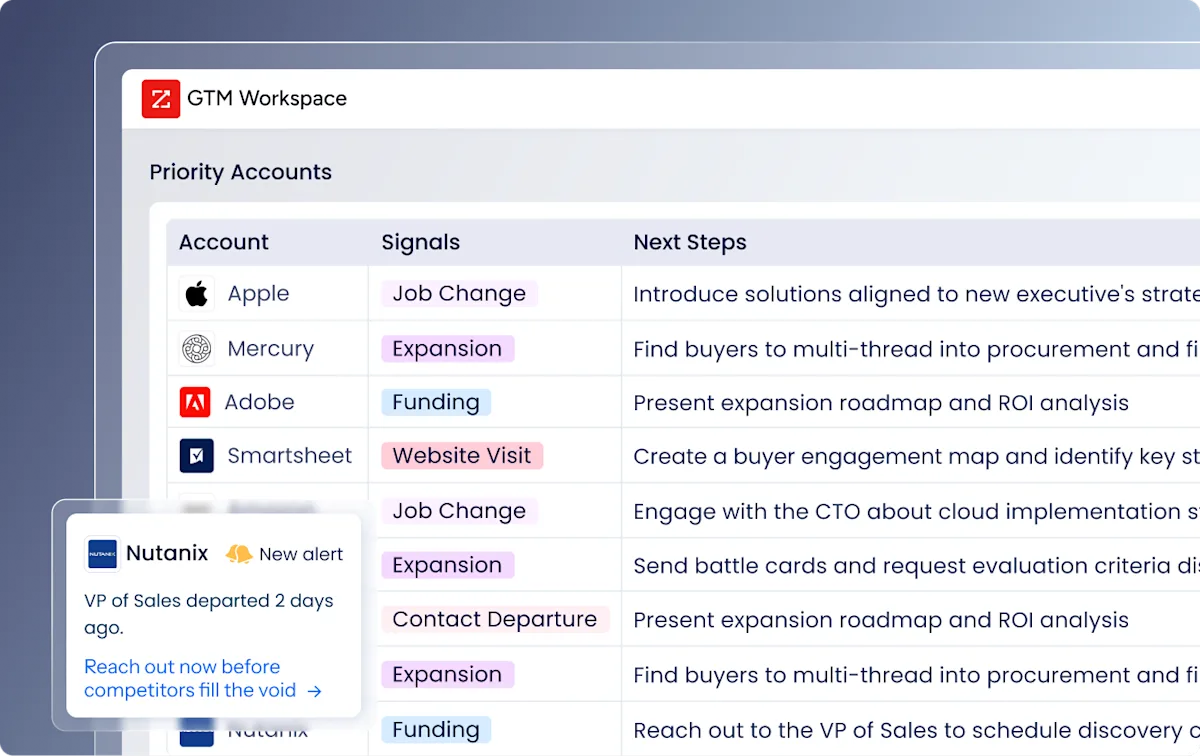
For go-to-market teams, ZoomInfo addresses a different kind of adoption gap. Sellers in GTM Workspace see prioritized accounts, AI-drafted outreach that addresses specific buyer concerns, and buying group intelligence, all without toggling between tools.
Source: ZoomInfo
Marketers in GTM Studio describe audiences in plain language and launch multi-channel plays in minutes. And for organizations building custom workflows, APIs and MCP deliver the same intelligence into any tool or AI agent.
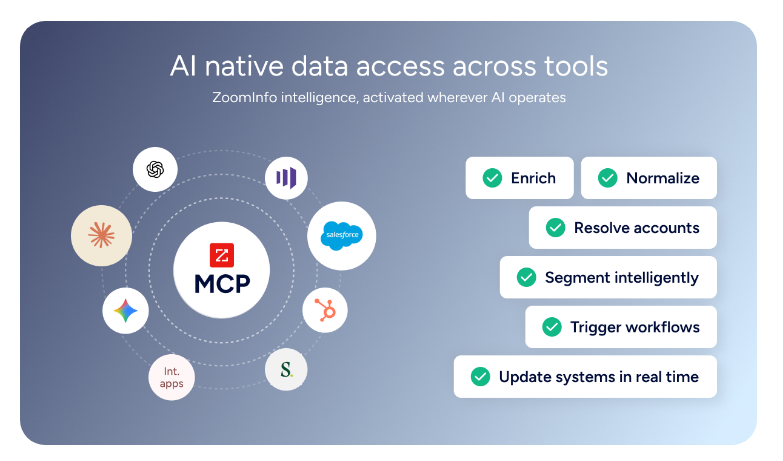
Source: ZoomInfo
"That combination of our internal CRM data, external signals, and AI that's given all that context has helped us craft very specific account- and persona-based messages. And people have responded to them right away." (Toby Carrington, Chief Business Officer, Seismic)
Deployment speed and implementation complexity
Apty's deployment speed is its most concrete differentiator. The platform can be launched in 1–2 days with lightweight activity trackers that run silently in the background. No jQuery dependency, no dev team required.
G2 has recognized this with a Fastest Implementation badge alongside eight consecutive quarters of Leader status.
Whatfix's implementation timeline is longer and more variable. G2 reviewers and SoftwareReviews (InfoTech) both note that initial setup is non-trivial, with InfoTech scoring ease of setup at 8.2 versus category leaders at 9.0. Creating customized flows across different applications requires planning.
That said, Whatfix's broader environmental coverage (desktop apps, VDI, mobile) naturally adds implementation complexity that Apty doesn't face.
For organizations where time-to-value is the primary buying criterion, Apty has a clear advantage. For organizations that need to cover desktop or VDI environments, Whatfix's longer setup is the cost of capabilities Apty doesn't offer.
Environmental coverage determines which platform you can even consider
This is the most straightforward differentiator between the two, and it may make the decision for you.
Whatfix covers web, Windows/Mac desktop apps, mobile, and VDI/Citrix environments under a single platform.

Source: Whatfix
If your organization runs SAP on desktop alongside Salesforce on the web and a custom mobile app, Whatfix can overlay guidance across all three. VDI/Citrix support is Enterprise-tier only, but few DAPs offer it at all.
Apty operates as a web application overlay and supports 1,000+ applications across 12 enterprise software categories, with integrations for Salesforce, Workday, ServiceNow, Microsoft Dynamics, Coupa, and Infor.
But its coverage is web-focused. Organizations running legacy desktop applications or Citrix environments will find a gap.
If your enterprise runs entirely on modern web applications, both platforms compete directly. If your tech stack includes desktop or VDI applications, Whatfix is your only option between the two.
AI capabilities take different architectural approaches
Both platforms are investing in AI, but their architectures reflect different priorities.
Apty's AI operates on a three-phase loop: see (monitor user behavior across applications), change (draft and target interventions), and prove (track whether those interventions changed outcomes).
The GenAI engine prescribes targeted solutions based on data gathered by PULSE, recommending specific interventions rather than leaving diagnosis to the adoption team.
Apty frames this as "DAP 2.0", positioning AI-driven behavioral monitoring as the next generation's defining capability.
Whatfix's AI is built on ScreenSense, a patented context engine trained on GUI interactions that understands what screen a user is on, interprets whether they're stuck or exploring, and triggers appropriate guidance.
Three AI Agents layer on top: the Authoring Agent generates content from natural-language prompts, the Guidance Agent delivers contextual answers in the flow of work, and the Insights Agent lets stakeholders query behavioral data conversationally.
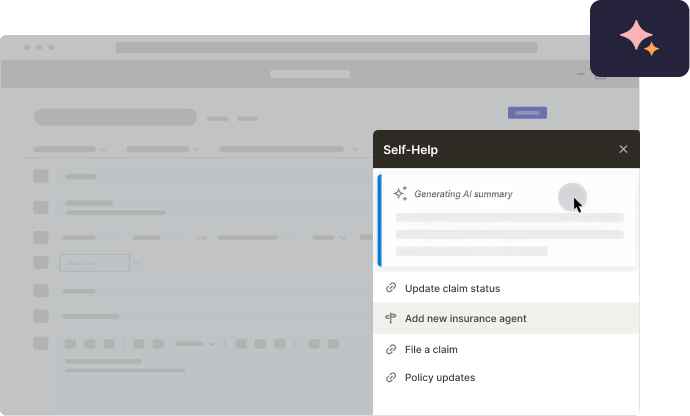
Source: Whatfix
Whatfix has also taken a first step toward agentic task automation, where AI completes actions on users' behalf rather than just guiding them.
Apty's AI advantage is prescriptive diagnostics: it tells you what's broken and what to do about it. Whatfix's AI advantage is contextual awareness: it knows where a user is and adapts in real time. Both are moving toward closed-loop automation (where AI identifies a problem and fixes it without human intervention), but neither is fully there yet.
Analytics and ROI measurement
This is where Apty makes its strongest competitive claim.
Apty PULSE functions as the sensing half of a closed-loop system. It monitors user and process engagement across multi-application business processes, tracking application frequency, time spent within software, and adoption rates at individual, departmental, and application levels.
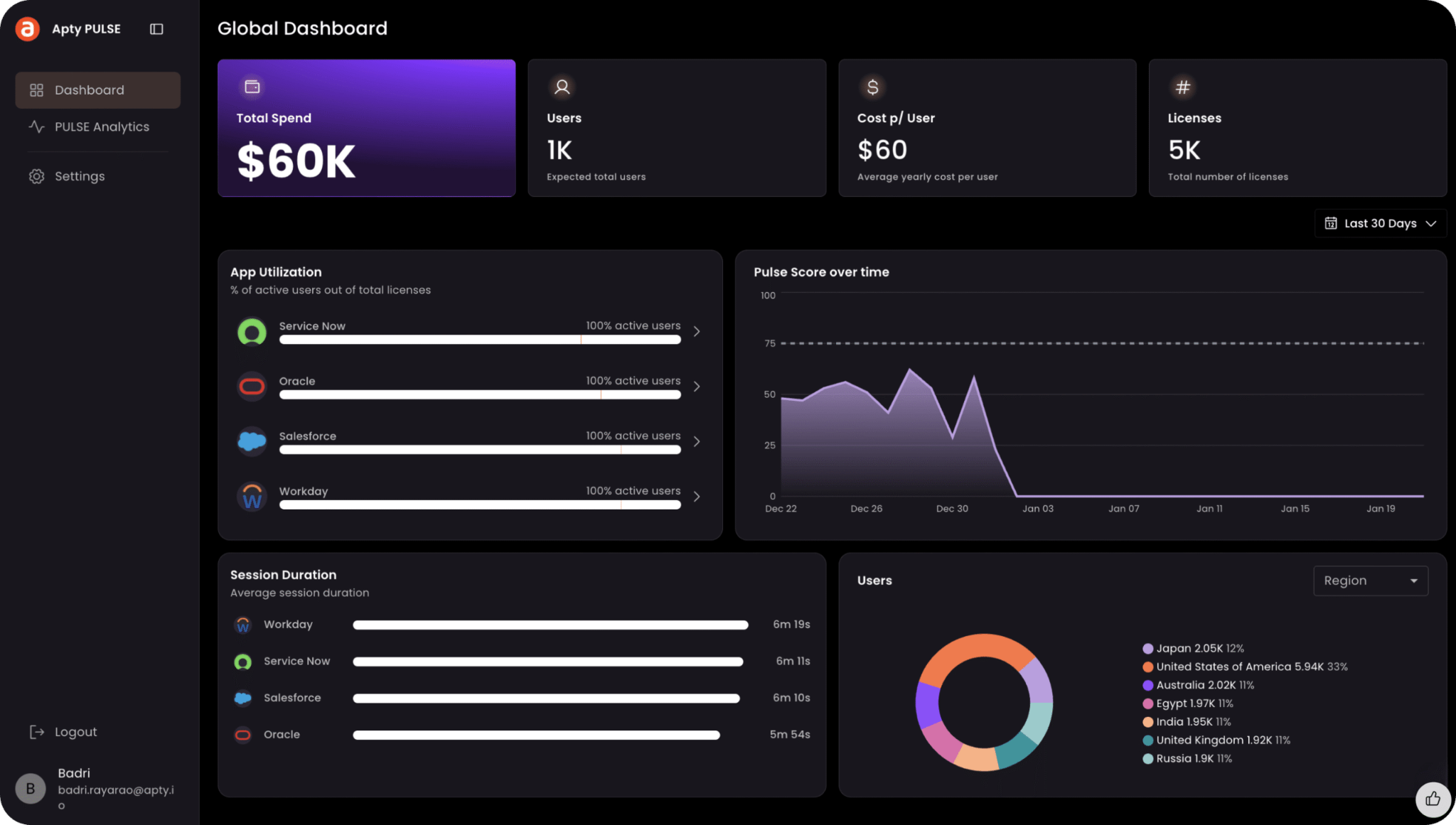
Source: Apty
The prescriptive layer then uses AI to identify areas for improvement and provides data-backed recommendations.
The platform is framed around software ROI, not just adoption, backed by a 2x ROI guarantee that no other DAP publicly offers.
Whatfix Product Analytics offers behavioral analytics with AutoCapture (automatic logging of user interactions without engineering instrumentation), funnels, user journey maps, cohorts, and session replay.
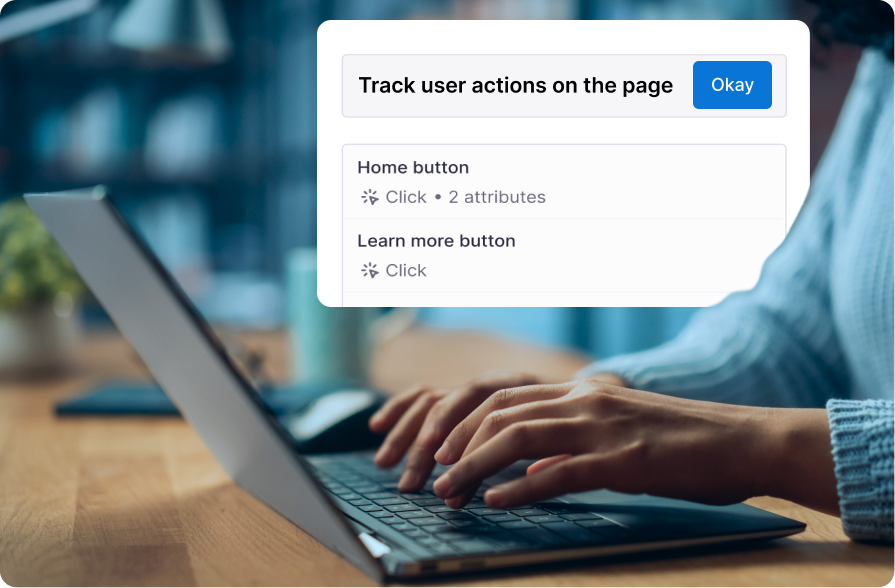
Source: Whatfix
The closed-loop integration with Whatfix's DAP means identified friction can trigger in-app guidance creation within the same platform.
However, SoftwareReviews reviewers have noted that analytics depth doesn't always meet enterprise expectations, and Product Analytics is a separate paid add-on (the Standard version ships free with DAP, but Premium and Enterprise tiers cost extra).
For organizations where proving software ROI to executive stakeholders is a primary requirement, Apty's PULSE architecture and ROI guarantee address that directly. For organizations that need session-level behavioral replay and funnel analysis, Whatfix's Product Analytics goes deeper into individual user behavior.
Content authoring and multi-format output
Whatfix holds a clear advantage in content creation flexibility.
The platform generates guidance content in multiple output formats simultaneously from a single authoring session: interactive walkthroughs, videos, PDFs, slide decks, and how-to articles.
This matters for organizations that need to feed an LMS with training materials while also delivering in-app guidance. SCORM 1.2 and xAPI 1.0 compliance ensures exports work with any conformant LMS. Auto Translation on Premium plans enables global deployments without manual translation effort.
Whatfix's Mirror product adds another dimension: it creates interactive replicas of enterprise applications for hands-on training without touching live systems. Employees can practice complex workflows before go-live, with AI-powered roleplay for scenarios like sales calls or customer support interactions.

Source: Whatfix
Apty provides a no-code visual editor with templates for walkthroughs, task flows, and checklists, plus 30+ language support for global deployments. But it doesn't match Whatfix's multi-format export capability or offer a simulation training environment. Apty's content authoring is functional and fast, not broad.
If your organization's primary challenge is creating and maintaining large volumes of training content across formats and languages, Whatfix is the stronger platform. If content creation is secondary to measuring and improving software utilization, Apty's leaner approach may be enough.
Process compliance and data quality enforcement
Apty's real-time field validations stand out for regulated industries. The platform doesn't just guide users through workflows; it blocks form submissions until input data meets predefined criteria.
This matters in environments where incorrect data entry creates compliance risk, audit exposure, or downstream data quality problems.
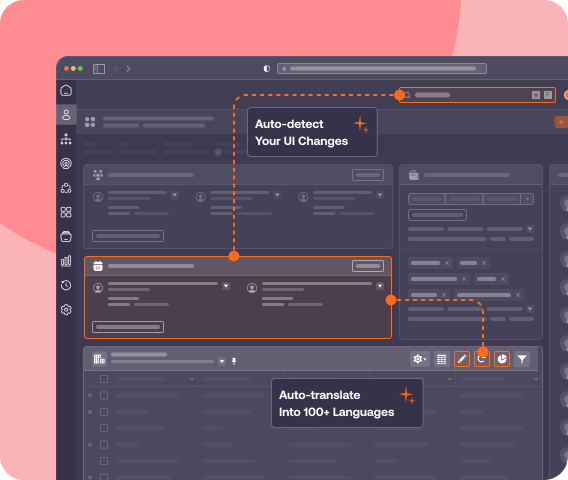
Whatfix addresses compliance through guided flows, pop-ups, and in-app alerts that direct users toward compliant processes. Its content lifecycle management includes multi-level approval workflows, staging environments, and automated UI-change testing.
Source: Whatfix
For governance-heavy enterprises, these content controls matter as much as the end-user guidance itself.
Both platforms enforce process standards, but through different mechanisms. Apty prevents bad data from entering systems at the point of entry. Whatfix guides users toward correct processes and governs the guidance content itself.
Pricing models reflect different market positions
Apty publishes a starting price of $9,500 per app, billed annually, with every customer getting the full feature set from day one: no-code content creation, validations, multi-language support, usage analytics, role-based access, and enterprise integrations.
Final pricing depends on employee count, implementation complexity, industry compliance needs, and integration requirements. Optional paid add-ons include on-premise authoring, white-labeling, and professional services.
Because pricing is per-application, organizations covering Salesforce, Workday, and ServiceNow would pay the base fee for each.
Whatfix publishes no pricing figures. Every plan is quote-based, structured as a flat fee plus per-user license fees that vary by deployment type (employee-based for internal apps, MAU-based for customer-facing apps).
Three product lines (DAP, Product Analytics, Mirror) each have their own tier structures, and platform variants (Web, Mobile, OS) add further complexity.

Source: Whatfix
The Standard plan limits integrations to two and content aggregation to 2,000 articles. Named CSM support requires Premium or Enterprise plans.
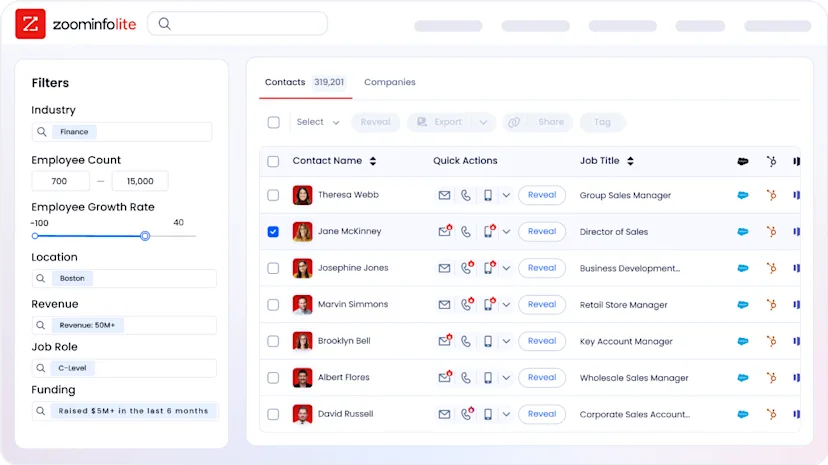
ZoomInfo uses custom-quoted, consumption-based pricing with no published prices for paid tiers. However, it offers two free entry points that neither Apty nor Whatfix provides: ZoomInfo Lite (a permanent free tier with 10 monthly export credits, no credit card required) and a 7-day free trial with access to core platform features.
Source: ZoomInfo
For budget-conscious buyers doing early evaluation, Apty's published starting price provides at least a pricing floor. Whatfix requires a sales conversation before you have any sense of cost.
Enterprise security and compliance
All three platforms maintain enterprise-grade security postures, with different emphasis areas.
Apty holds SOC 2 Type II, SOC 1 Type 2, ISO 27001, ISO 9001:2015, GDPR, FIPS 140-2, PCI DSS Level 1, FISMA, and ITAR certifications.
The ITAR and FISMA compliance alongside FIPS 140-2 validation signals readiness for US federal government and defense contractors, consistent with named customer Lockheed Martin.
Whatfix holds SOC 2 and ISO 27001:2013 certifications, plus a VPAT/Section 508 certification renewed annually for US federal procurement accessibility compliance.
Whatfix supports cloud and self-hosted deployment with data residency options.
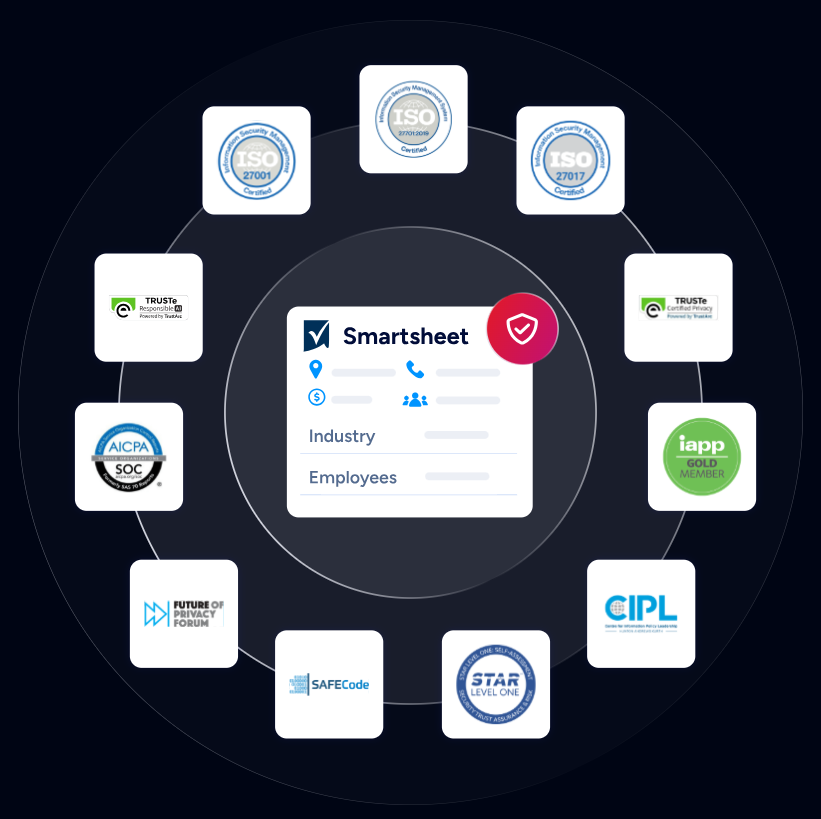
ZoomInfo maintains ISO 27001, ISO 27701, SOC 2 Type II, TRUSTe GDPR, and TRUSTe CCPA certifications, all renewed annually.
Source: ZoomInfo
As a registered data broker in California and Vermont, ZoomInfo's privacy compliance extends into data sourcing and handling, which matters for regulated industries.
Each platform's certification profile matches its target market. Apty's defense-adjacent certifications serve aerospace and government buyers. Whatfix's accessibility compliance and federal deployment experience serve public sector buyers. ZoomInfo's privacy management certifications serve organizations handling B2B contact data at scale.
Apty vs. Whatfix vs. ZoomInfo: Which should you choose?
The right choice depends on the problem you're solving and the environment you're working in.
Choose Apty if:
Proving software ROI to executive stakeholders is your primary objective
You need a DAP deployed in days, not weeks or months
Process compliance and data quality enforcement at the point of entry matter for your industry
Your tech stack is web-based and you need cross-application workflow monitoring
You want the confidence of a 2x ROI guarantee
Choose Whatfix if:
You need to cover desktop applications, mobile, or VDI/Citrix environments alongside web apps
Creating multi-format training content (walkthroughs, videos, PDFs, slide decks) from a single authoring session is important
You want a simulation training environment for pre-go-live practice
Your organization needs broad content authoring and lifecycle management capabilities
You're managing adoption across a complex, mixed-environment enterprise stack
Choose ZoomInfo if:
Your go-to-market teams need accurate, verified B2B data inside the CRM and sales tools they already use
You want AI that understands not just what happened in your deals, but why
You need intelligence accessible through any tool, from seller and marketer workspaces to custom AI agents via API and MCP
Data quality at the source, not just process compliance, drives your revenue outcomes
You want to start for free and scale as your needs grow
See how ZoomInfo powers go-to-market intelligence with a free trial.
Digital adoption platforms and GTM intelligence platforms address different layers of the same challenge: making enterprise software investments pay off. Apty and Whatfix ensure employees follow the right processes inside applications. ZoomInfo ensures the data and intelligence flowing through those applications are worth acting on. For organizations serious about both, these aren't competing investments. They're complementary layers of a software ROI strategy.
Apty vs. Whatfix vs. ZoomInfo FAQ
What is the core difference between Apty, Whatfix, and ZoomInfo?
Apty and Whatfix are both Digital Adoption Platforms that sit on top of enterprise software to guide employees through workflows and track adoption.
Apty emphasizes measurable software ROI through its dual-module architecture (guidance plus workflow monitoring), while Whatfix emphasizes environmental breadth and content authoring across web, desktop, mobile, and VDI applications.
ZoomInfo is a different product: an AI GTM platform that provides the B2B data, intelligence, and execution tools that go-to-market teams need inside their CRM and sales tools.
Which platform deploys faster?
Apty is the fastest, with deployment possible in 1–2 days using lightweight activity trackers that require no IT projects. Whatfix's implementation timeline is longer and more variable, particularly when covering desktop or VDI environments alongside web apps.
ZoomInfo deploys in weeks, with a 30-to-90 day onboarding program covering planning, technical implementation, and education phases.
Which platform is best for regulated industries?
Apty holds the broadest set of compliance certifications (including FIPS 140-2, FISMA, ITAR, and PCI DSS Level 1), making it the strongest fit for defense, aerospace, and financial services organizations. Whatfix has demonstrated federal-grade capability through its US Army deployment covering 1.1 million personnel.
ZoomInfo maintains ISO 27701, SOC 2 Type II, and TRUSTe GDPR/CCPA certifications focused on data privacy compliance.
Does either DAP offer a free plan or trial?
Apty offers a proof-of-concept period negotiated with sales rather than a conventional free trial. Whatfix offers a free trial initiated via a request form, though duration and feature scope are not publicly disclosed.
ZoomInfo provides both a permanent free tier (ZoomInfo Lite, with 10 monthly export credits and no time limit) and a 7-day free trial with access to core platform features.
Can Apty or Whatfix work on desktop applications?
Only Whatfix natively supports desktop applications, mobile apps, and VDI/Citrix environments alongside web apps. Apty operates as a web application overlay.
For organizations running legacy desktop software like SAP GUI or Citrix-hosted applications, Whatfix is the only option between the two.
How does each platform handle analytics?
Apty's PULSE module monitors user behavior across the tech stack from installation, delivering initial insights within two days and a full adoption diagnosis within 30 days, included in the base platform. Whatfix's Product Analytics module offers deeper behavioral analytics including session replay and funnel analysis, but the Standard version (bundled free with DAP) has limitations, and Premium or Enterprise tiers are separate paid add-ons.
Why would I consider ZoomInfo alongside a Digital Adoption Platform?
DAPs solve the problem of employees not following correct processes inside enterprise software. ZoomInfo solves the problem of the data inside that software being incomplete, stale, or inaccurate.
A sales team can follow a perfectly guided Salesforce workflow and still produce poor results if contact records are outdated and phone numbers don't connect.
ZoomInfo provides the accurate B2B intelligence that makes CRM and sales tool adoption worthwhile, while Apty or Whatfix ensures employees use those tools correctly.
Which platform offers a published ROI guarantee?
Only Apty offers a published ROI guarantee: 2x ROI in year one, or the investment is returned. Whatfix does not publish an ROI guarantee, though it reports customer outcomes such as a 72% productivity increase at Experian and an 87% reduction in support queries at Windward Risk Managers. ZoomInfo documents customer outcomes including 54% productivity gains at Seismic and 200% higher conversion rates at Snowflake.
More on Apty and Whatfix:
