
Choosing between Bitrix24 and Salesforce for your CRM comes down to five questions:
Do you need a dedicated CRM, or a platform that also handles project management, communication, and HR?
Is your team willing to invest months in implementation and training, or do you need something usable within weeks?
Are you building a sales operation that needs customization and enterprise AI, or one that needs broad functionality at a predictable cost?
Can you afford per-user pricing that scales with headcount, or do you need a flat fee regardless of team size?
Does your CRM need to generate its own sales intelligence, or are you pairing it with a dedicated data platform?
In short, here's what we recommend:
Bitrix24 is the all-in-one workspace for small and mid-sized businesses that want CRM, project management, team communication, a website builder, and HR tools under a single flat-fee subscription.
With no per-user pricing and a free plan that includes unlimited CRM users, Bitrix24 lets growing teams avoid the tool sprawl that comes with assembling separate apps for every function. The tradeoff is real: the interface feels cluttered, the learning curve is steep, and the CRM lacks the depth and ecosystem that larger sales organizations need.
Salesforce is the world's #1 CRM by market share, built for organizations that need sales automation, AI agents, and an ecosystem of 9,000+ partner apps. Its Agentforce platform can autonomously handle customer interactions, score leads, and coach reps.
But Salesforce's power comes with enterprise pricing, implementation complexity, and a learning curve that assumes you have a dedicated administrator.
Both platforms manage your sales pipeline. Neither generates the B2B intelligence your pipeline needs to stay full. Your CRM records what happened with a deal. It doesn't tell you who to call next, which accounts are researching solutions like yours, or whether the contact data in your records is still accurate. That gap between CRM data and sales intelligence is where deals stall and pipelines dry up.
ZoomInfo is a B2B data and GTM platform that fills that gap. Built on 500M contacts, 100M companies, 135M+ verified phone numbers, and 200M+ verified business email addresses, ZoomInfo's GTM Context Graph fuses this data with your CRM records, conversation transcripts, and behavioral signals to reveal not just what happened in a deal, but why.
ZoomInfo integrates with both Salesforce and other CRMs, feeding verified contacts, buyer intent signals, and AI-generated account insights into whichever platform your team uses through GTM Workspace for sellers, GTM Studio for marketers and RevOps, or APIs and MCP in any front-end.
If building a pipeline on verified data and real buying signals sounds like the missing layer in your CRM, see how ZoomInfo works.
Bitrix24 vs. Salesforce at a glance
Bitrix24 | Salesforce | ZoomInfo | |
|---|---|---|---|
Primary function | All-in-one workspace (CRM + PM + collaboration + sites + HR) | Enterprise CRM and AI platform | B2B data intelligence and GTM execution |
Pricing model | Flat team-based, no per-user fees | Per-user, per-cloud, annual contracts | Consumption-based, custom-quoted |
Free plan | Free forever (2 users, basic CRM) | Free Suite (2 users, basic CRM) | ZoomInfo Lite (permanent free tier) |
Paid starting price | $49/month (5 users) | $25/user/month (Starter Suite) | Custom-quoted |
AI capabilities | CoPilot across modules | Agentforce autonomous agents | GTM Context Graph + AI agents |
Ecosystem | 700+ marketplace apps | 9,000+ AppExchange apps | 120+ integrations + API/MCP |
Best for | SMBs wanting everything in one place | Mid-market to enterprise sales orgs | Teams that need verified B2B data and buying signals |
On-premise option | Yes (self-hosted edition) | No (cloud only, with Hyperforce for data residency) | No |
Implementation time | Days to weeks (self-serve or partner) | Weeks to months (partner-led typical) | Weeks |
Two different philosophies: breadth vs. depth
Bitrix24 and Salesforce both call themselves CRM platforms, but they rest on different assumptions about what a business needs.
Bitrix24 assumes you want one platform for everything.
Its six core modules (CRM, Tasks & Projects, Collaboration, Sites & Stores, HR & Automation, and CoPilot AI) let a 30-person company run its entire operation from a single login. The CRM sits alongside a Kanban board for project management, a messenger for team chat, a website builder for lead capture, and an HR module for employee management.
Source: Bitrix24
The pitch is consolidation: replace your CRM, project tracker, chat app, website builder, and HR system with one subscription.
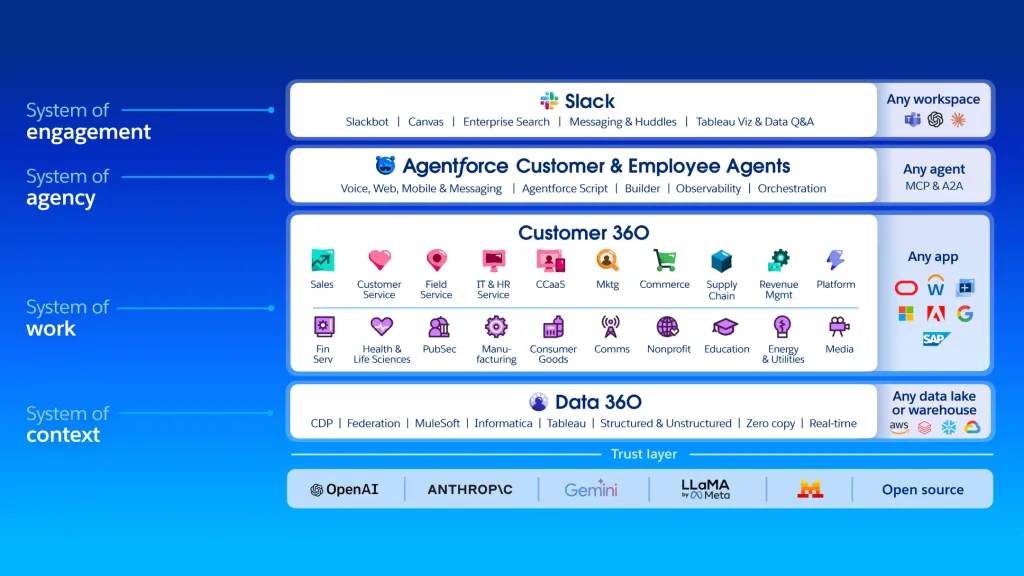
Salesforce assumes you want the best CRM available and will build your stack around it.
Source: Salesforce
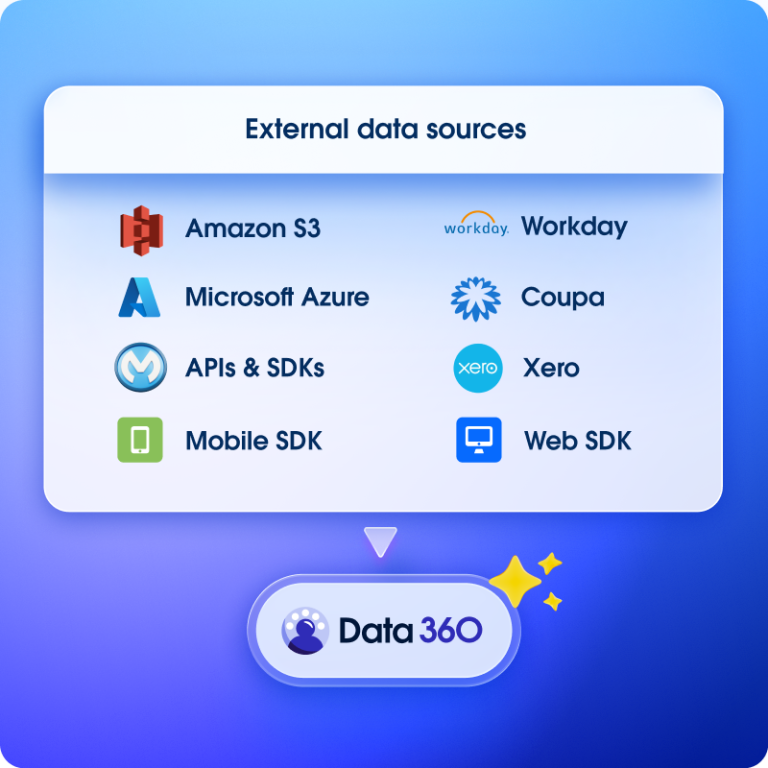
Sales Cloud, Service Cloud, Marketing Cloud, Commerce Cloud, and Data Cloud are each deep enough to stand alone. The pitch is specialization: get the strongest sales automation, then connect it to everything else through AppExchange and MuleSoft integrations.
Neither assumption is wrong. They serve different buyers at different stages.
Pricing structures reveal who each platform is built for
The cost difference between Bitrix24 and Salesforce becomes stark as your team grows.
Bitrix24's Professional plan at $199/month covers up to 100 users with full CRM, AI features, workflow automation, e-signature, and HR tools.
That's $1.99 per user per month. The Standard plan at $99/month supports 50 users with sales automation, invoicing, and unlimited projects.
Salesforce's Enterprise edition at $175/user/month costs $8,750 per month for a 50-person team.
The Unlimited edition at $350/user/month runs $17,500 monthly for that same team. And that's before add-ons: Digital Engagement ($75/user/month), the Contact Center ($150/user/month), Agentforce ($125/user/month), and the Premier Success Plan (30% of net license fees) all add up. A 6% price increase took effect in August 2025 on Enterprise and Unlimited tiers.
Source: Salesforce
Bitrix24's flat-fee model pays off most for teams of 10 or more, where per-user SaaS costs start to hurt.
For a solo founder or two-person team, both platforms offer free plans with basic CRM functionality, though Salesforce's Starter Suite at $25/user/month is affordable enough for small teams that want more depth.
The hidden costs differ too. Bitrix24 charges separately for telephony minutes, paid marketplace apps, and implementation partner fees. Salesforce's hidden costs are more structural: Data Cloud credits, Agentforce Flex Credits ($500 per 100,000), partner-led implementation (over 70% of deployments), and the reality that most organizations need Enterprise edition or above to unlock meaningful automation.
CRM depth: Salesforce operates at a different level
As a pure CRM, Salesforce is in a category Bitrix24 isn't trying to match.
Salesforce has held the Gartner Magic Quadrant Leader position for Sales Force Automation for 19 consecutive years.
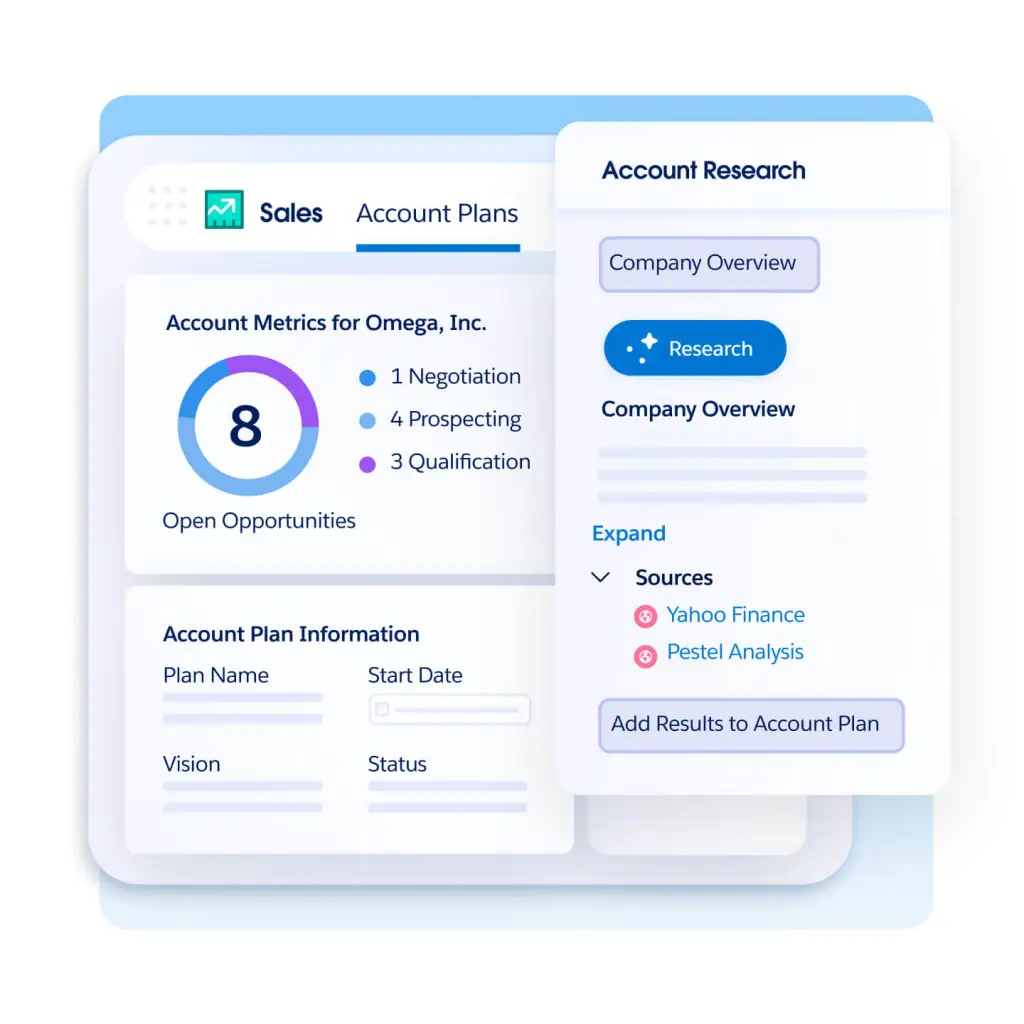
Its Sales Cloud includes Einstein Lead Scoring, AI-generated account plans with SWOT analysis, pipeline health signals, Revenue Lifecycle Management (CPQ, contract lifecycle, subscription management), and Agentforce sales agents that can autonomously prospect, engage inbound leads, and draft quotes 75% faster.
Source: Salesforce
Bitrix24's CRM handles the fundamentals well.
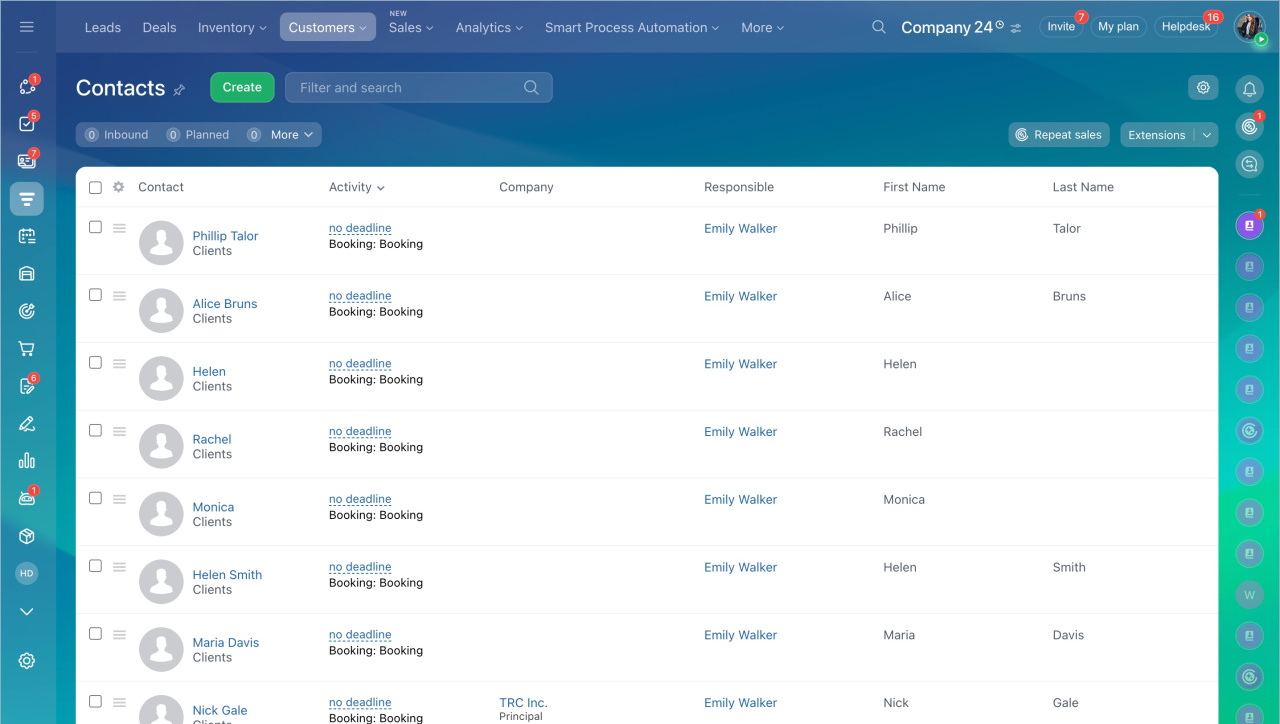
It supports configurable CRM modes (Classic with leads or Simple without), customizable pipelines, an omnichannel Contact Center aggregating WhatsApp, Instagram, telephony, email, and live chat into one inbox, and CoPilot in CRM for call transcription and automatic field completion.
Source: Bitrix24
But Bitrix24's CRM is built for small to mid-sized sales teams running straightforward pipelines. It lacks Salesforce's depth in forecasting, territory management, conversation intelligence, partner relationship management, and industry-specific data models. G2 review data confirms that Bitrix24's CRM is not suitable for large companies without significant customization.
For teams whose sales process is a five-stage pipeline with a handful of reps, Bitrix24's CRM is more than adequate. For organizations with complex deal structures, multiple business units, and a need for AI-powered coaching and autonomous agents, Salesforce is built for that complexity.
Bitrix24 wins on everything else under one roof
Where Bitrix24 pulls ahead is everywhere outside the CRM.
Salesforce is a CRM platform that expanded into adjacent areas through acquisitions.
Slack handles collaboration. Tableau handles analytics. MuleSoft handles integrations. Each is capable but separately priced and administered.
Bitrix24 bundles it all natively.
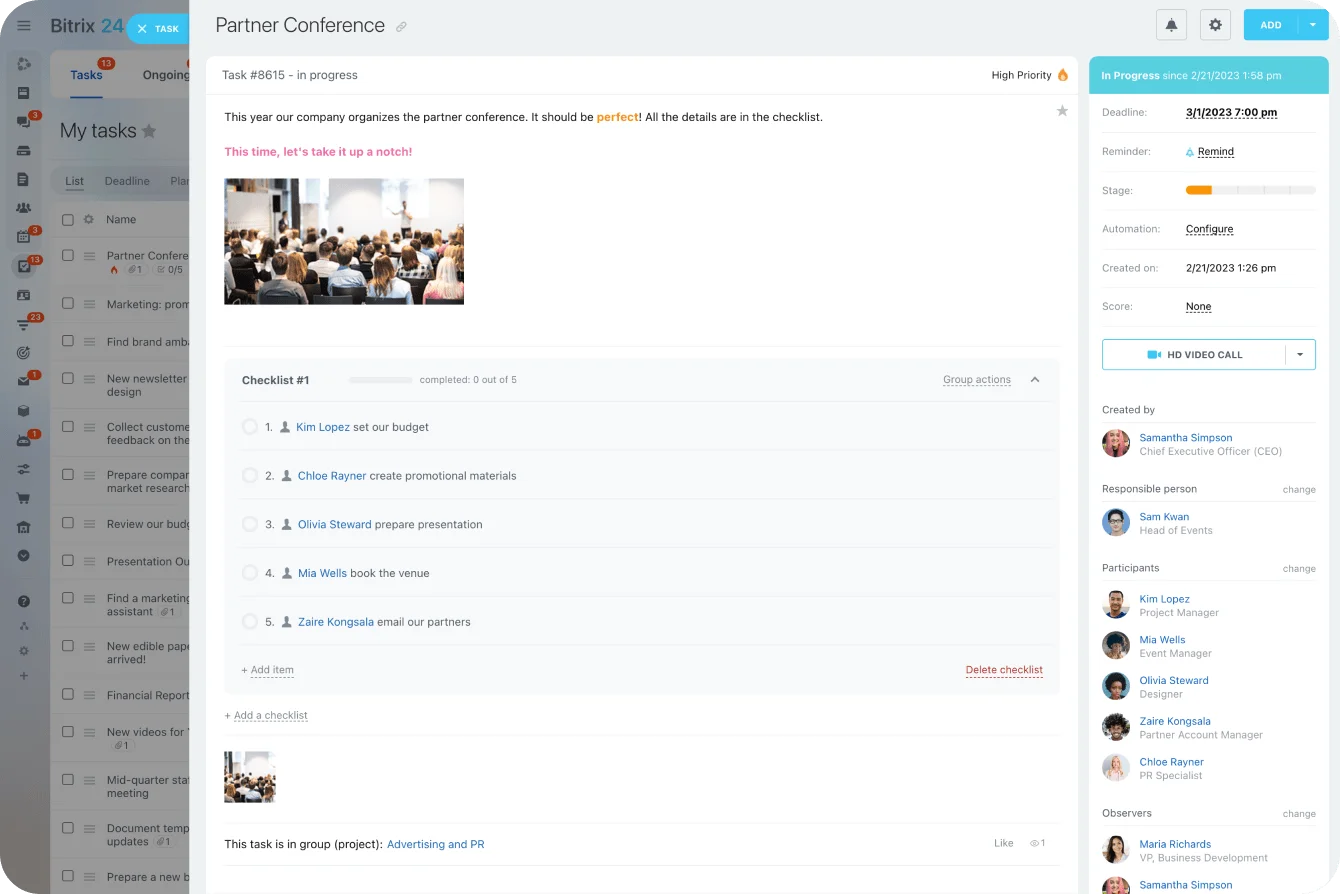
The Tasks & Projects module includes Kanban, Gantt charts with all four dependency types, Scrum boards, time tracking, and KPI scoring. The Collaboration suite provides chat, video calls for 100+ participants, document co-editing, shared calendars, and external collaboration spaces called Collabs.
Source: Bitrix24
The Sites & Stores module includes a website builder, an online store with inventory management, and landing pages that feed leads into the CRM automatically. The HR & Automation module handles org charts, work schedules, no-code RPA workflows, and e-signatures.
For a 25-person marketing agency that needs a CRM for client relationships, a project tracker for deliverables, team chat, a client-facing website, and basic HR workflows, Bitrix24 replaces what could be five or six separate subscriptions. Salesforce would cover the CRM portion, but the agency would still need separate tools (and budgets) for everything else.
Neither CRM generates the data your pipeline needs
Both Bitrix24 and Salesforce manage customer relationships. Neither builds your prospect list, verifies contact data, or detects when target accounts start researching your category.
This is the structural gap in every CRM. Your pipeline depends on the quality of data flowing into it: who to contact, whether their email and phone number are current, and whether they're in a buying cycle. CRMs record interactions after they happen. They don't generate the intelligence that starts those interactions.
ZoomInfo exists to fill this gap.
Its data platform covers 500M contacts and 100M companies, verified through a multi-source pipeline backed by 300+ human researchers with up to 95% accuracy on first-party data. In a Fortune 500 competitive RFP analyzing 25 million contacts across vendors, the independent consultant concluded that "no other competitor came even close."
That data becomes actionable through the GTM Context Graph, which processes 1.5B+ data points daily and fuses ZoomInfo's third-party intelligence with your CRM records, conversation transcripts, and behavioral signals.
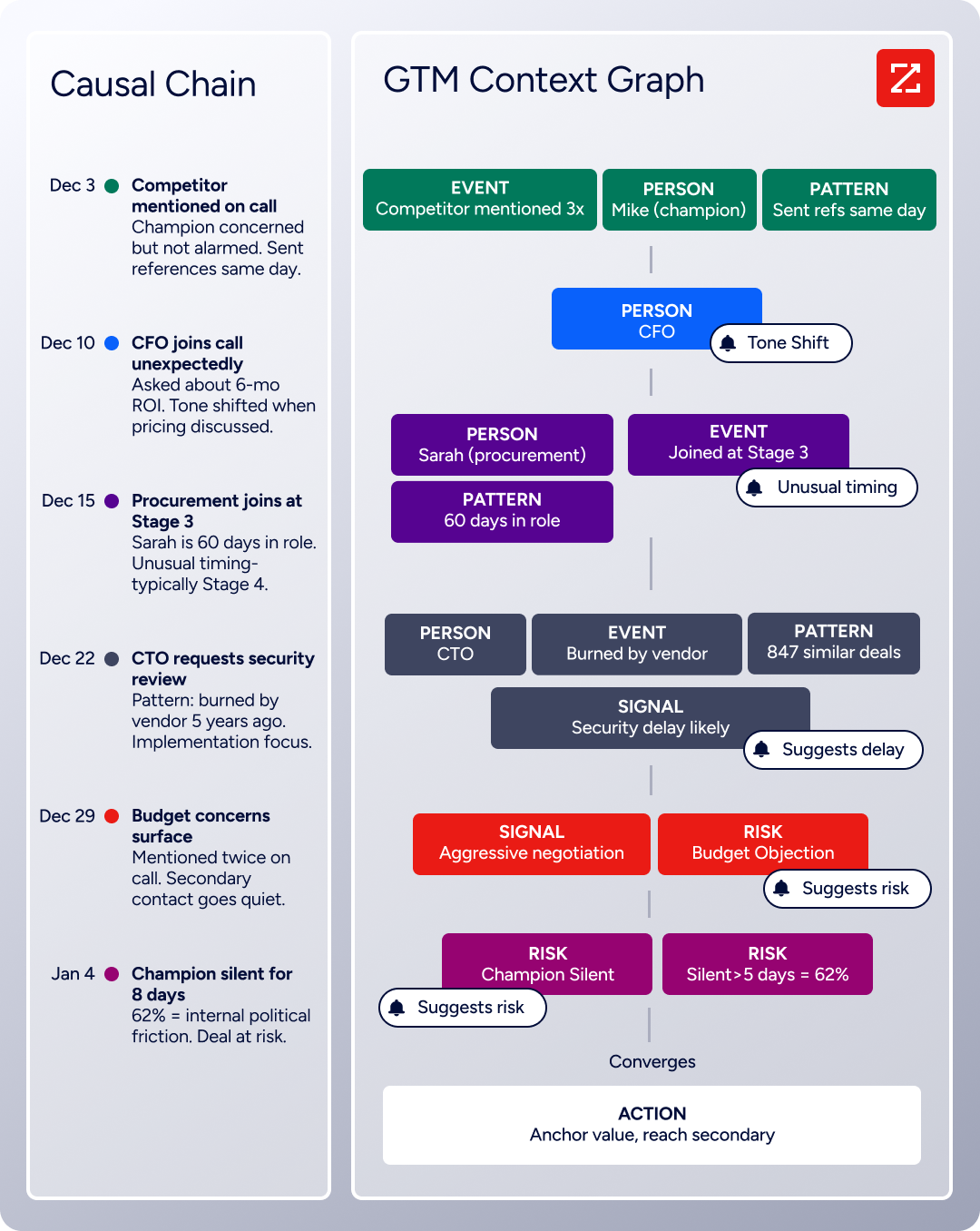
The result: AI that understands not just that a deal moved to Stage 3, but why it moved, which stakeholders are driving it, and what patterns from thousands of similar deals suggest happens next.
For Salesforce users, ZoomInfo integrates through its native Salesforce connector, feeding verified contacts, buyer intent signals, and account intelligence into Sales Cloud. For teams using any CRM, ZoomInfo's APIs and MCP deliver the same intelligence into any front-end.
Seismic's sales team attributed 39% of active pipeline to opportunities identified or influenced by ZoomInfo signals, boosted productivity by 54%, and saved 11.5 hours per week. As Chief Business Officer Toby Carrington put it: "That combination of our internal CRM data, external signals, and AI that's given all that context has helped us craft very specific account- and persona-based messages. And people have responded to them right away." (Seismic case study)
For a direct look at how Salesforce and ZoomInfo compare as part of your sales stack, see our Salesforce vs. ZoomInfo comparison.
AI capabilities: three different approaches
All three platforms have invested in AI, but each applies it differently.
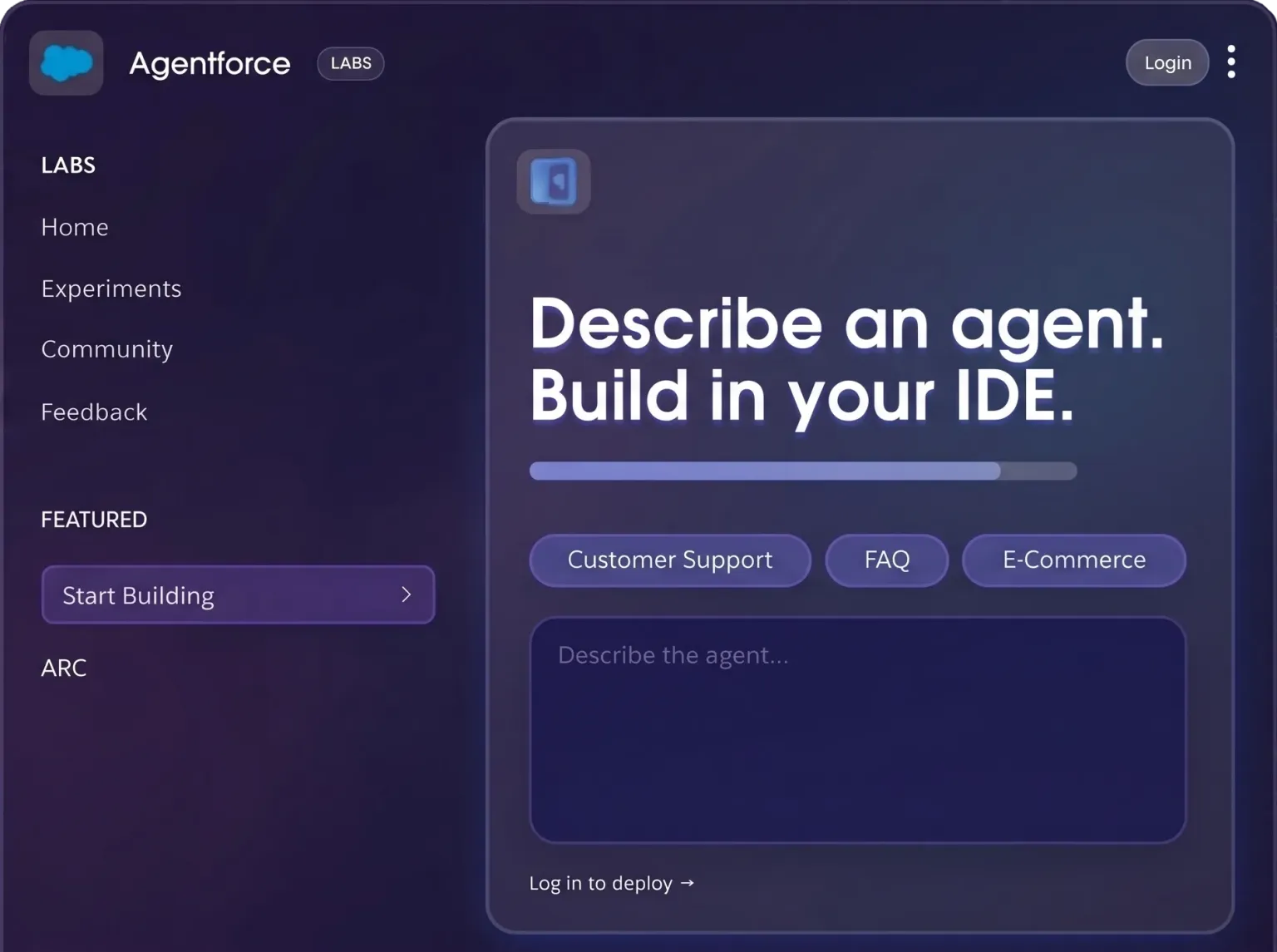
Salesforce's Agentforce is the most ambitious.
Source: Salesforce
Powered by the proprietary Atlas Reasoning Engine, Agentforce agents can autonomously handle customer service inquiries, engage inbound leads, coach sales reps, and create marketing campaigns.
The Einstein Trust Layer provides zero data retention with LLM partners, PII masking, and audit trails. Agentforce is the centerpiece of Salesforce's strategy, but it requires Enterprise edition or above and consumes Flex Credits at $500 per 100,000 for metered usage.
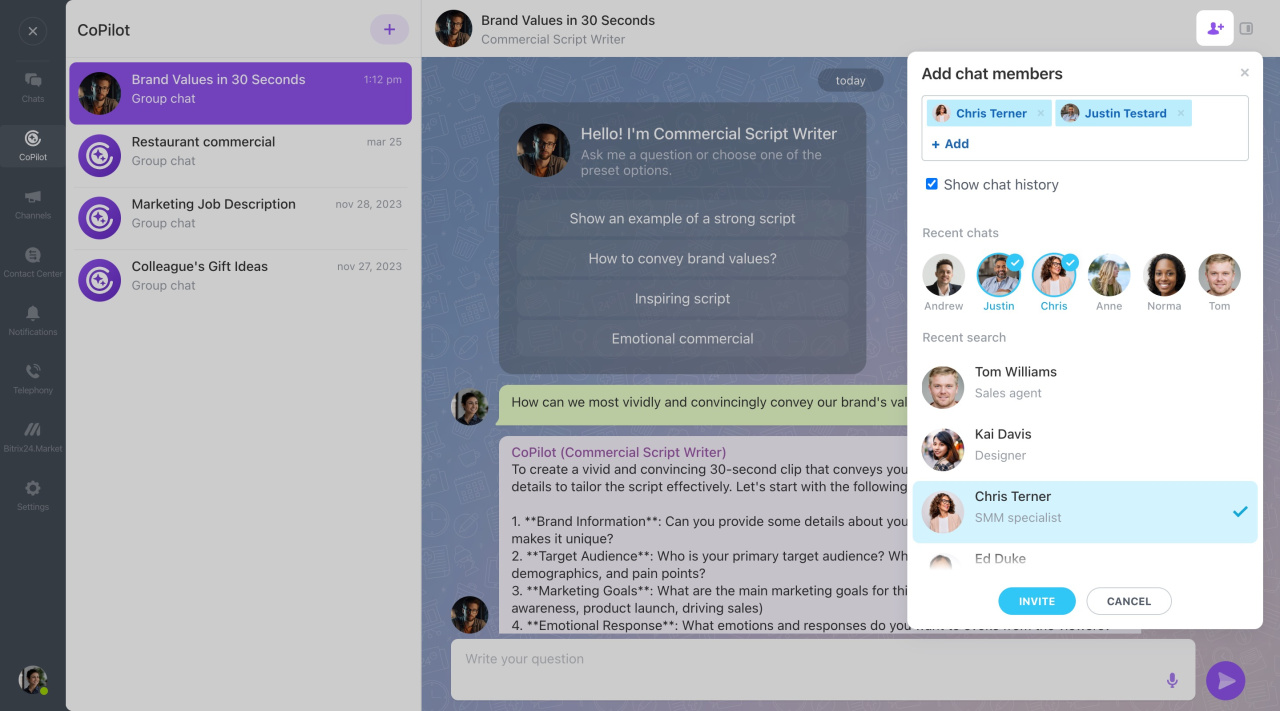
Bitrix24's CoPilot takes a more practical approach for smaller teams.
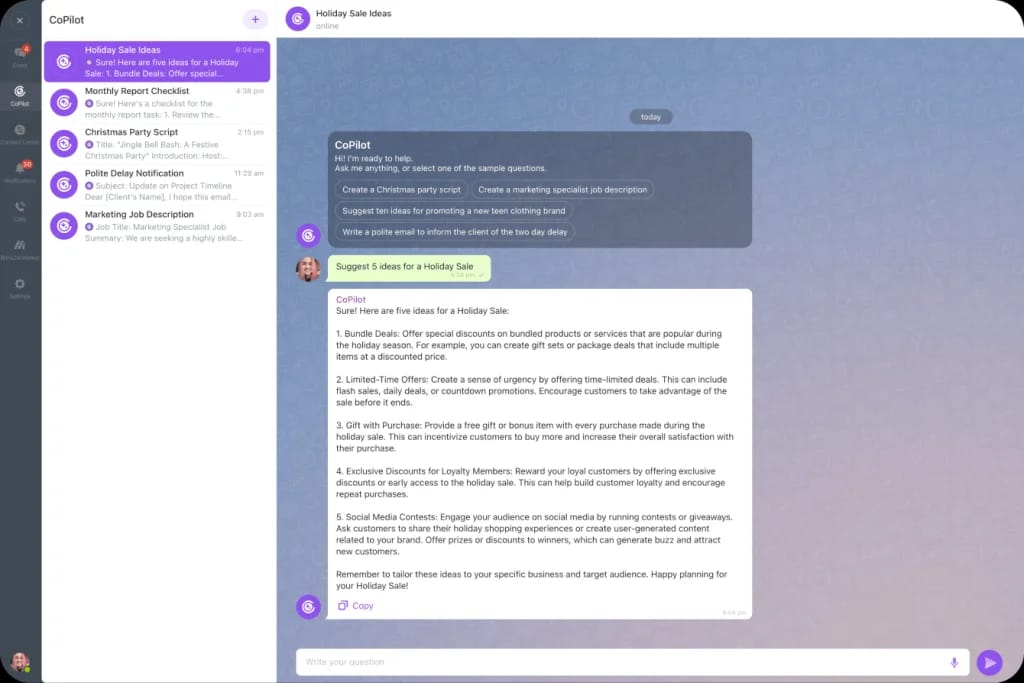
It's embedded across eight areas of the platform: CRM (call transcription, automatic field completion, sales script analysis), Tasks (AI-generated descriptions and checklists), Chat (30+ specialist roles for brainstorming), Feed (thread summaries, text creation), Video Calls (post-call transcription with one-click task creation), and Sites (website generation from a prompt).
Source: Bitrix24
CoPilot provides preset prompts so users don't need prompt-engineering experience and is available starting at the Professional plan. The algorithm does not save user data on third-party servers or use it for training.
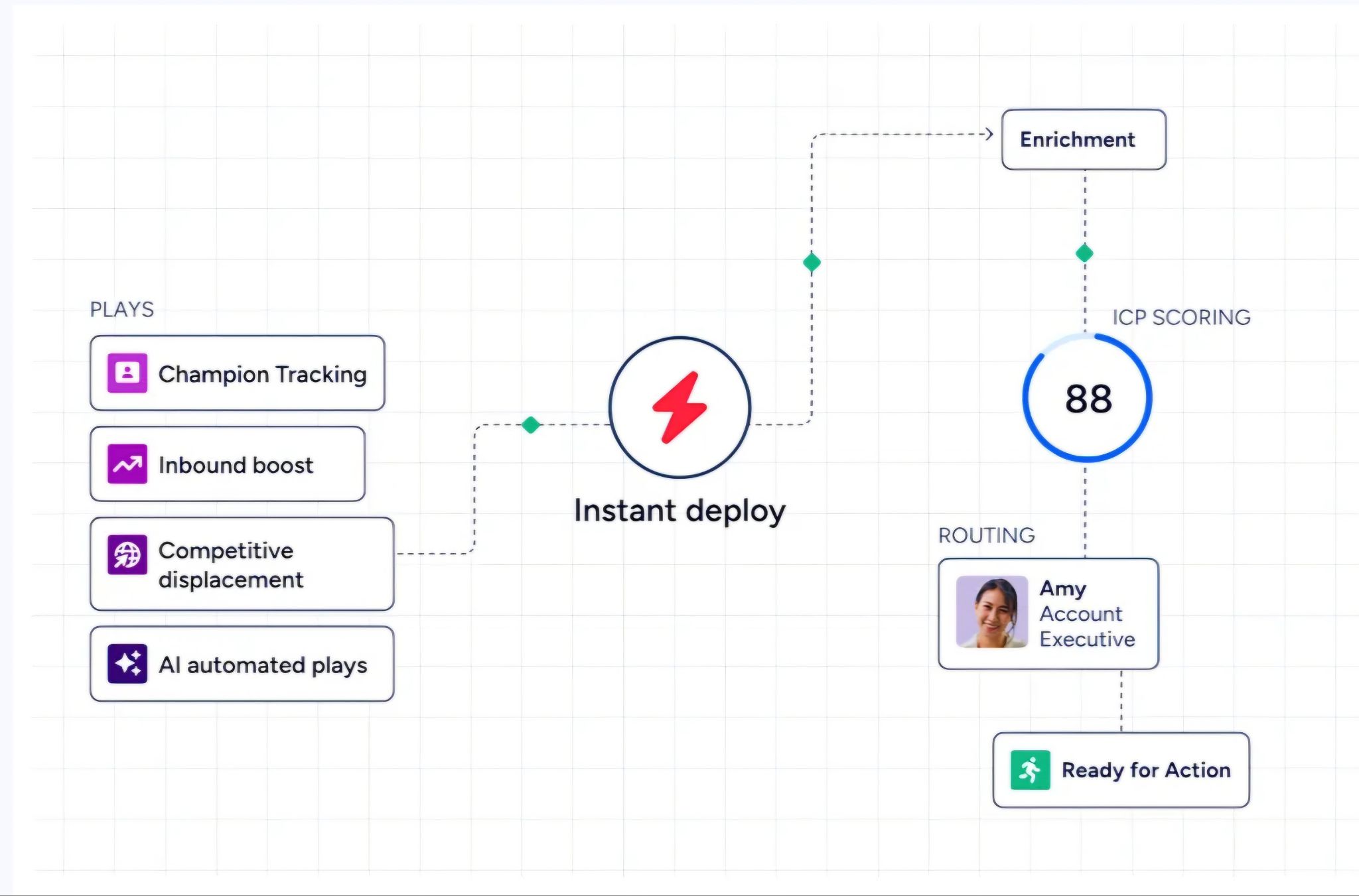
ZoomInfo's AI is built for go-to-market.
The GTM Context Graph powers AI agents in GTM Workspace that handle account research, draft personalized outreach based on full deal context, monitor buying signals, and surface next best actions. In GTM Studio, AI lets marketers and RevOps teams describe audiences in natural language and launch multi-channel plays targeting accounts that match proven win patterns.
Source: ZoomInfo
The AI draws on both ZoomInfo's proprietary B2B data and your first-party CRM and conversation data, giving it reasoning context that standalone CRM AI or general-purpose AI tools lack.
Levanta's CEO Ian Brodie described the shift: "ZoomInfo's not just a contact data company anymore. They've built a full system of execution. GTM Intelligence actually works the list, writes the outreach, triggers the play, and helps drive predictable growth." (Levanta case study)
Ecosystem and integrations
Salesforce's ecosystem is unmatched.
AppExchange hosts 9,000+ partner apps with 14+ million installs, and 91% of Salesforce customers use at least one AppExchange app. MuleSoft provides hundreds of pre-built connectors for enterprise integrations. Salesforce's APIs (REST, SOAP, Bulk, Metadata, Pub/Sub) are mature and well-documented. The partner ecosystem is roughly five times larger than Salesforce itself.
Bitrix24's Marketplace contains 700+ apps across CRM, marketing, automation, telephony, and more, with 900K+ total downloads.
The platform provides a free REST API covering all major product areas. While smaller than Salesforce's ecosystem, Bitrix24 compensates by building more functionality natively: the website builder, telephony, video conferencing, and HR tools that Salesforce users would source from AppExchange or third parties come included in the base platform.
ZoomInfo's App Marketplace lists 120+ partner integrations, including native connectors for Salesforce, HubSpot, and Microsoft Dynamics 365.
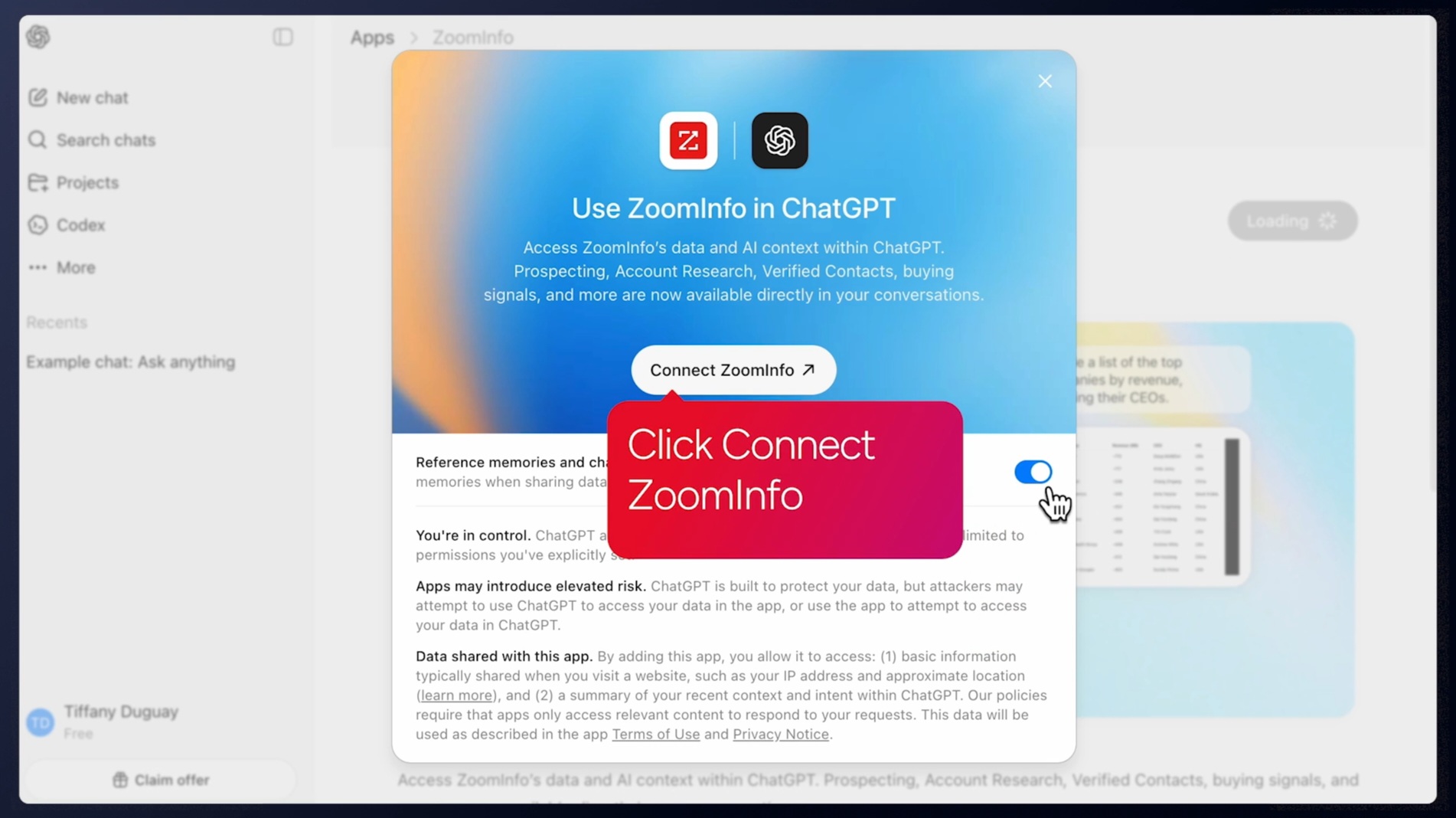
The Enterprise API and MCP server deliver ZoomInfo's data and GTM Context Graph into any tool, including AI assistants like Claude and ChatGPT. API access is included in all relevant plans, making ZoomInfo's intelligence available in any front-end without lock-in.
Source: ZoomInfo
User experience and learning curve
Salesforce is one of the most feature-rich enterprise platforms available.
That richness brings a steep learning curve. Lightning Experience is the modern interface, but meaningful configuration requires trained administrators. Trailhead provides 1,500+ badges and 6+ million learners to help teams get up to speed. Implementation timelines range from weeks for basic
Sales Cloud to 3-12 months for enterprise multi-cloud deployments, and over 70% of implementations are partner-led.
Bitrix24 faces a different version of the same problem.
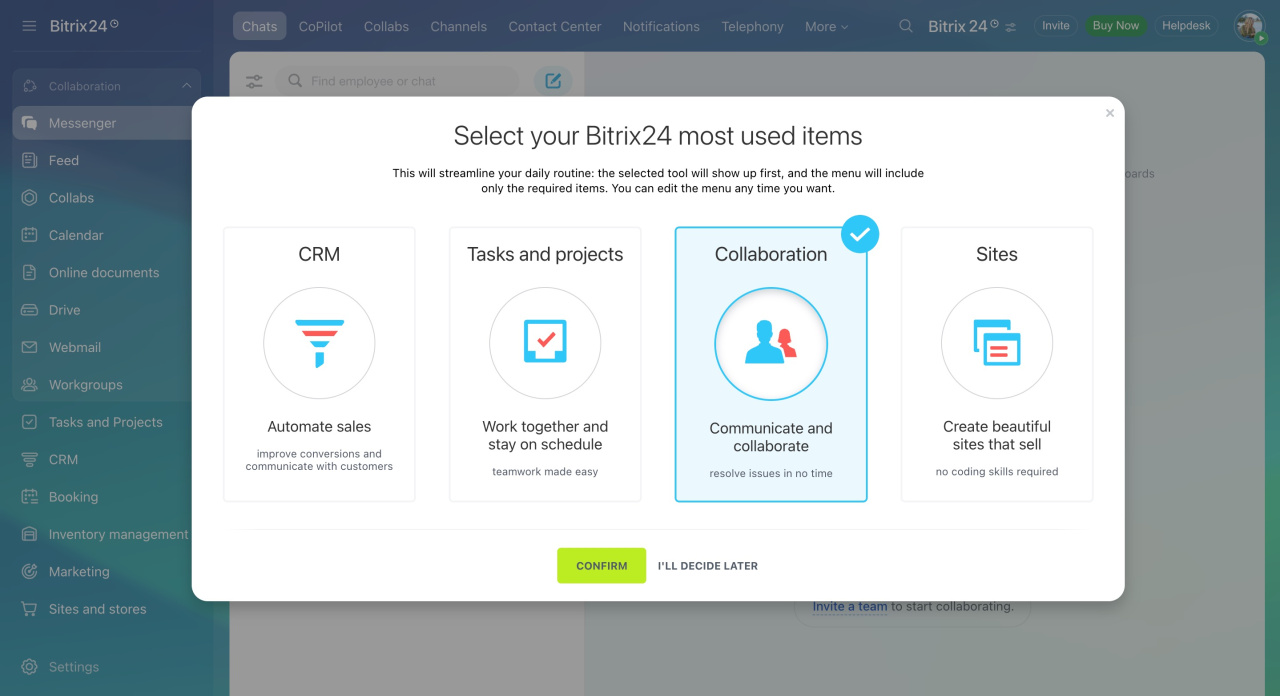
Its breadth (CRM + PM + collaboration + sites + HR + automation) means new users face a cluttered interface with many modules competing for attention. G2 reviewers consistently describe the interface as "overwhelming," and Capterra reviewers note that "some tools are hidden in unexpected locations inside other tools, making the navigation process quite frustrating." G2 rates ease of use at 7.9/10.
The platform offers a customizable main menu to reduce clutter, and Bitrix24's fall 2025 "Intelligence" release bets that an AI-driven natural language command layer can solve the navigation problem without a full redesign.
Source: Bitrix24
ZoomInfo redesigned its onboarding from 30 to 90 days, producing a 25% improvement in customer satisfaction scores.
GTM Workspace "deploys in weeks, not months", and ZoomInfo University provides role-specific learning paths for sales, marketing, and administration.

Support comparison
Salesforce's support is tiered by how much you pay.
The Standard plan (free) gives you Trailhead, documentation, and the Trailblazer Community. Premier (30% of net license fees) adds 1:1 expert coaching and 1-hour response time for business-impacting issues.
Signature (custom pricing) provides a dedicated Customer Success Manager and 24/7 support with 15-minute response for critical issues. The Trailblazer Community of 20 million members across 1,300+ local groups is a genuine asset.
Bitrix24's support is more limited.
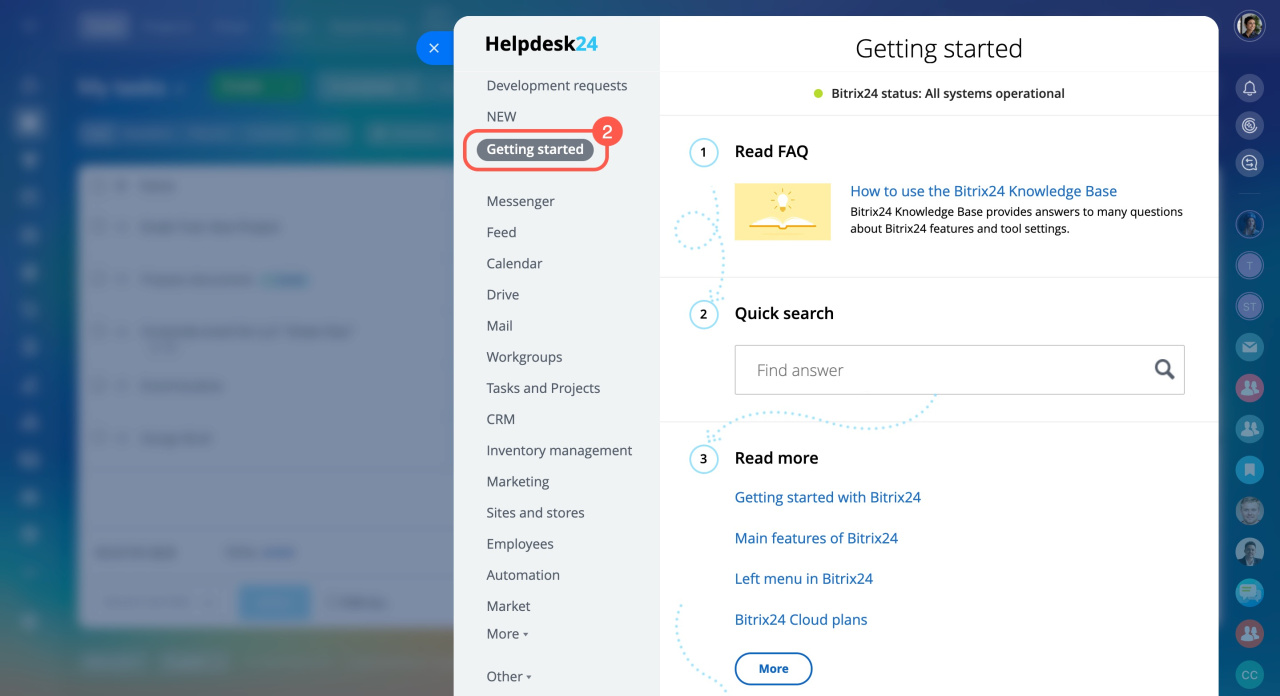
An AI support agent is available 24/7 on all plans, but live human support is restricted to paid plans. Only account administrators and Bitrix24 partners can open support tickets; regular users are directed to their admins. G2 rates support quality at 7.7/10, and Capterra reviewers flag that "customer support is not that great and it can take days to solve issues."
Source: Bitrix24
The 960+ certified partner network can fill this gap for implementation and customization, but partner engagement is separately priced.
ZoomInfo provides support through its Help Center, ZoomInfo University, and direct contact.
Enterprise customers receive dedicated customer service managers for onboarding and ongoing support. Professional services are available through ZoomInfo Labs for complex data and integration needs.
Security, compliance, and deployment
Salesforce holds ISO 27001/27017/27018, SOC 1/2/3, FedRAMP, and HITRUST certifications.
Source: Salesforce
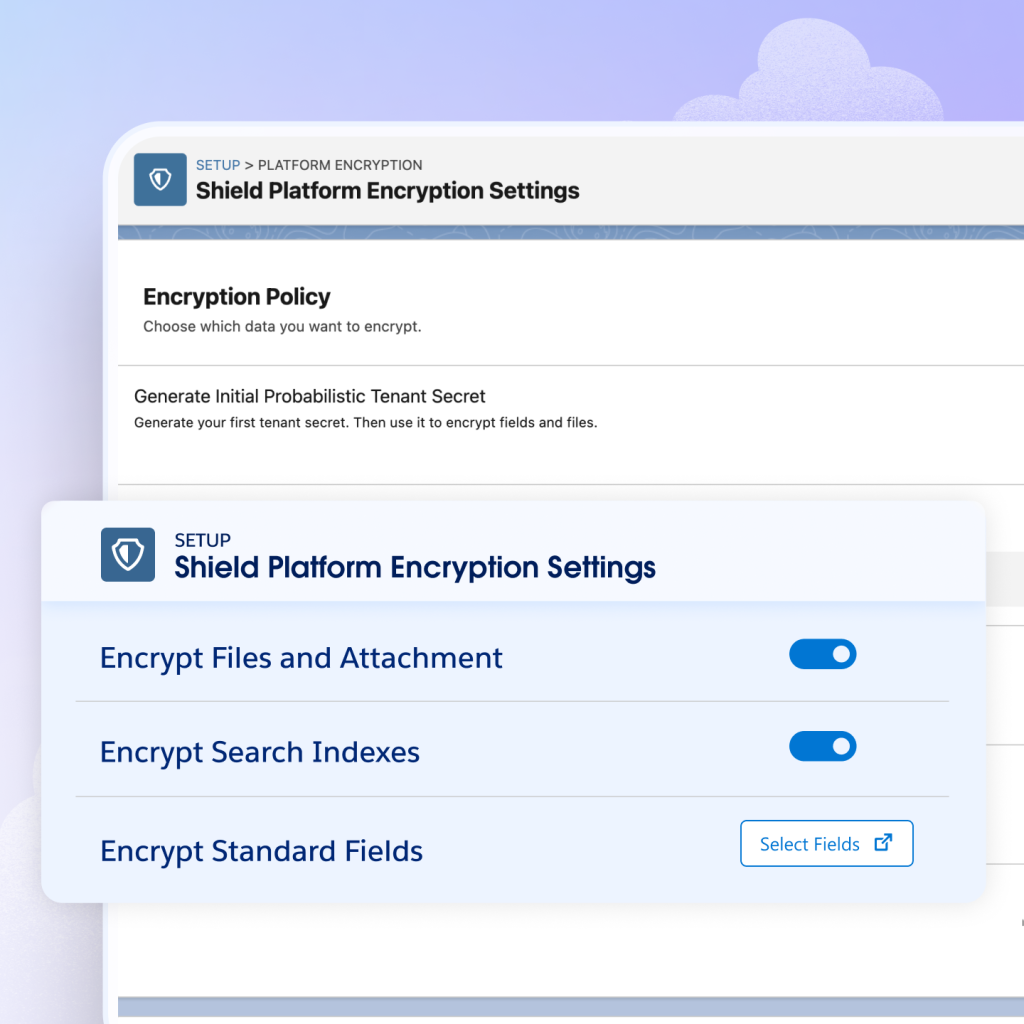
Salesforce Shield adds event monitoring, platform encryption with BYOK, and field audit trail as a premium add-on. Hyperforce enables regional data residency across multiple countries. The Einstein Trust Layer provides zero data retention with LLM partners. Salesforce is cloud-only.
Bitrix24 hosts on Amazon Web Services in the US (Virginia) or EU (Frankfurt), inheriting AWS's HIPAA, GDPR, ISO 27001, SOC 1/2/3, and PCI DSS certifications.
All data transfer uses TLS encryption with 256-bit keys. Bitrix24 also offers an on-premise (self-hosted) edition with full source code access, starting at $3,590 for up to 50 users. For organizations with strict data sovereignty requirements, this is a differentiator that cloud-only platforms cannot match.
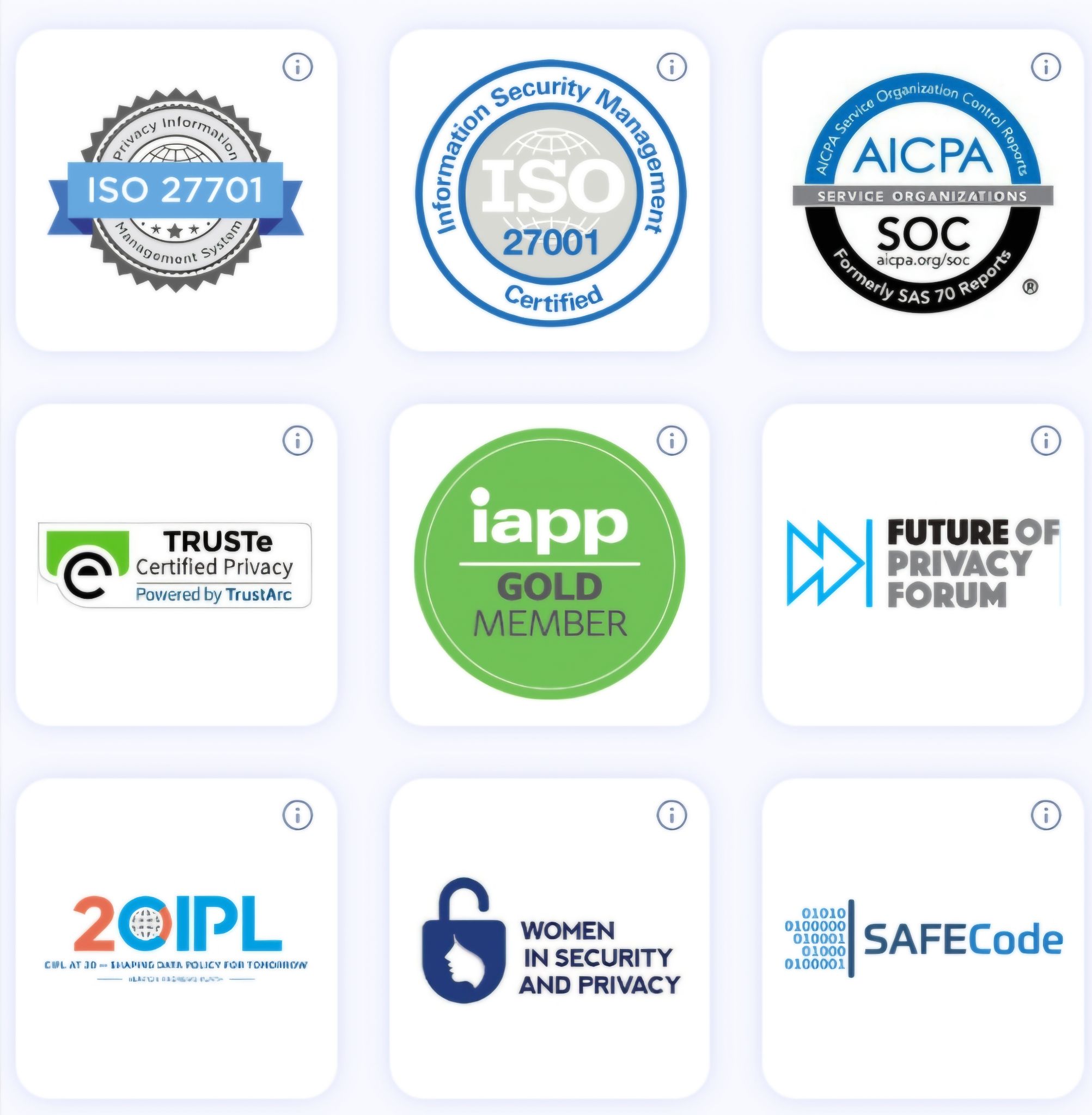
ZoomInfo maintains ISO 27001, ISO 27701, SOC 2 Type II, TRUSTe GDPR, and TRUSTe CCPA certifications, all renewed annually.
Source: ZoomInfo
The company is a registered data broker in California and Vermont, with a dedicated Trust Center.
Bitrix24 vs. Salesforce vs. ZoomInfo: Which should you choose?
The right choice depends on what your business needs and where you are in your growth.
Choose Bitrix24 if:
You need CRM, project management, team chat, and a website builder in one platform
Your team is 10-100 people and per-user pricing would strain your budget
You want a free plan with real CRM functionality to start with
Your sales process is straightforward without complex deal structures
Data sovereignty requires an on-premise deployment option
Choose Salesforce if:
You need sales automation, AI agents, and advanced forecasting
Your organization can invest in implementation, training, and administration
You want the largest ecosystem of third-party integrations and partner apps
You operate across multiple clouds (sales, service, marketing, commerce)
Enterprise compliance and industry-specific data models are requirements
Add ZoomInfo to either CRM if:
Your pipeline depends on finding new accounts and contacts, not just managing existing ones
You need verified direct-dial phone numbers and business emails that actually work
You want to know which accounts are researching solutions in your category
Your reps spend too much time on manual research instead of selling
You want AI that understands the full context behind your deals, not just what's in your CRM fields
See how ZoomInfo powers your CRM with verified B2B intelligence.
Bitrix24 and Salesforce both manage customer relationships. They do it at different price points, with different levels of depth, for different types of organizations. But the quality of the data flowing into either CRM determines the quality of every sales interaction that follows. ZoomInfo provides the verified contacts, buying signals, and account intelligence that make whichever CRM you choose productive.
Smartsheet's Senior Manager of Sales Technology Enablement Thor Sanderson put it directly: "ZoomInfo is our one source of truth for account data, and even more so for contact data. There's no other provider in the market that provides you with that level of detail." (Smartsheet case study)
Bitrix24 vs. Salesforce vs. ZoomInfo FAQ
What is the core difference between Bitrix24 and Salesforce?
Bitrix24 is an all-in-one business workspace that bundles CRM with project management, team communication, website building, and HR tools under flat-fee pricing with no per-user charges. Salesforce is a specialized enterprise CRM platform with sales automation, AI agents, and the largest third-party app ecosystem in the industry.
Bitrix24 prioritizes breadth and affordability; Salesforce prioritizes CRM depth and enterprise scale.
How does ZoomInfo fit with Bitrix24 or Salesforce?
ZoomInfo is not a CRM. It is a B2B data intelligence platform that integrates with CRMs to provide the verified contact data, buyer intent signals, and account insights that CRMs do not generate on their own.
ZoomInfo connects with Salesforce through a native integration and can feed data into any CRM through its APIs and MCP server. It fills the gap between managing relationships (what CRMs do) and finding and understanding buyers (what ZoomInfo does).
Which platform is cheapest for a growing team?
Bitrix24 is cheaper at scale. Its Professional plan at $199/month covers up to 100 users with full CRM, AI, and automation features.
Salesforce Enterprise at $175/user/month would cost $17,500/month for the same 100-person team, before add-ons. For small teams (under 5 users), Salesforce's Starter Suite at $25/user/month is competitive.
ZoomInfo is separately priced as a data intelligence layer and uses consumption-based pricing.
Which CRM has better AI features?
Salesforce's Agentforce is more advanced, with autonomous AI agents that handle customer service, prospect engagement, and sales coaching using the proprietary Atlas Reasoning Engine.
Bitrix24's CoPilot is more practical for small teams, embedded across CRM, tasks, chat, video calls, and websites with preset prompts that lower the adoption barrier.
ZoomInfo's AI focuses on go-to-market intelligence, using the GTM Context Graph to generate insights about deal context, account prioritization, and buying signals that CRM AI cannot produce on its own.
Can Bitrix24 replace Salesforce for enterprise organizations?
For most enterprise use cases, no. Bitrix24 lacks Salesforce's depth in sales forecasting, territory management, industry-specific clouds, partner relationship management, and ecosystem scale (9,000+ apps vs. 700+). Bitrix24's CRM is built for small and mid-market sales teams with straightforward pipelines.
However, for mid-sized businesses that need a CRM alongside project management, internal communication, and HR in one platform, Bitrix24 delivers functionality that would require multiple Salesforce add-ons and third-party tools.
Does Bitrix24 offer an on-premise deployment?
Yes. Bitrix24 offers a self-hosted edition with full source code access, starting at $3,590 for up to 50 users (with annual renewals at 50% of the initial price). This includes the full platform: CRM, tasks, collaboration, HR, and automation.
Salesforce is cloud-only, though Hyperforce allows regional data residency on public cloud infrastructure. This makes Bitrix24 one of the few platforms in its category with an on-premise option.
What buyer intent and prospecting data does each platform provide?
Bitrix24 and Salesforce do not provide third-party B2B prospecting data or buyer intent signals. Both CRMs work with the data you put into them.
ZoomInfo provides 500M contacts, 100M companies, 135M+ verified phone numbers, and 200M+ verified business email addresses, along with buyer intent data tracking signals from 210 million IP-to-Organization pairings. ZoomInfo's Guided Intent identifies topics historically correlated with deal success rather than requiring manual topic selection.
How long does implementation take for each platform?
Bitrix24 can be self-configured in days to weeks for teams willing to manage setup independently, though complex implementations benefit from a certified partner.
Salesforce implementations range from weeks for basic Sales Cloud to 3-12 months for enterprise multi-cloud deployments, with over 70% led by implementation partners.
ZoomInfo's GTM Workspace deploys in weeks, and the platform offers structured onboarding with role-specific learning paths through ZoomInfo University.
