
Bluecore is a retail marketing platform that combines shopper identity, behavioral signals, and product catalog data to personalize email, SMS, on-site, and paid media at the individual level. For enterprise retailers with large catalogs and dedicated marketing teams, its CDP and ESP architecture has produced a 59% customer retention rate over two years, compared to the 22% industry average.
But as your brand evolves, Bluecore's enterprise-only contracts, steep learning curve, or channel gaps may no longer fit. Its SMS capabilities have lagged behind email, reporting hasn't matched the depth of its underlying data, and the absence of public pricing or a free trial means you must go through a full enterprise sales process before you can test the platform.
That's where this guide comes in. Whether you're looking to:
Launch email and SMS automation on transparent, self-serve pricing without an enterprise contract
Build a B2B go-to-market intelligence layer that powers prospecting and pipeline generation
Orchestrate cross-channel customer journeys spanning mobile apps, push notifications, and in-app messaging
Get retail-depth automation paired with hands-on strategic partnership at a mid-market price point
Build an SMS-first retention program with the deepest mobile messaging infrastructure
Access full ecommerce automation from a genuine free plan without a sales process
Consolidate loyalty, RCS, WhatsApp, and managed execution in a single subscription
We'll cover Bluecore alternatives that lead in each of these areas.
Some brands use these tools alongside Bluecore to fill specific gaps, while others replace Bluecore entirely with a platform better suited to their current scale and channel priorities. This isn't about finding a "better" platform; it's about finding the right fit as your business grows.
The Best Bluecore Alternatives
Best Alternative for B2B Go-To-Market Intelligence and Pipeline Generation We chose ZoomInfo because it operates the largest B2B data platform (500M contacts) with AI-driven prospecting tools that help retail technology vendors and B2B commerce brands identify, engage, and convert their ideal buyers. |
|---|
Best Alternative for Self-Serve Access, Transparent Pricing, and Immediate Deployment We chose Klaviyo because it gives retail and DTC brands the same behavioral email and SMS automation as enterprise platforms, with a permanent free plan, public pricing, and same-day Shopify deployment that Bluecore's enterprise-only model cannot match. |
Best Alternative for Enterprise Cross-Channel Mobile Engagement We chose Braze because its mobile-native architecture, AI journey optimization, and warehouse-connected data model make it the strongest upgrade path for brands whose customer journeys extend beyond email into mobile apps, push notifications, and real-time in-session experiences. |
Best Alternative for Mid-Market Retail Brands Wanting Strategic Partnership We chose Listrak because it delivers retail-depth automation paired with U.S.-based strategic support as a core delivery model, filling the gap between basic ESPs and enterprise platforms like Bluecore. |
Best Alternative for SMS-Led Retail Marketing We chose Attentive because its patented Two-Tap opt-in, four-channel mobile architecture (SMS, email, RCS, push), and AI trained on 90 billion retail messages make it the deepest mobile messaging platform for brands whose primary revenue channel is SMS. |
Best Alternative for Ecommerce Automation Without Enterprise Pricing We chose Omnisend because its permanent free plan, 40+ pre-built ecommerce workflows, and revenue attribution reporting give growing DTC brands behavioral automation comparable to enterprise tools, with zero financial commitment. |
Best Alternative for Loyalty, RCS, WhatsApp, and Managed Execution We chose Maestra because it consolidates CDP, email, SMS, RCS, WhatsApp, loyalty, product recommendations, and on-site personalization into a single subscription with a dedicated CSM included at no additional cost. |
What is Bluecore?
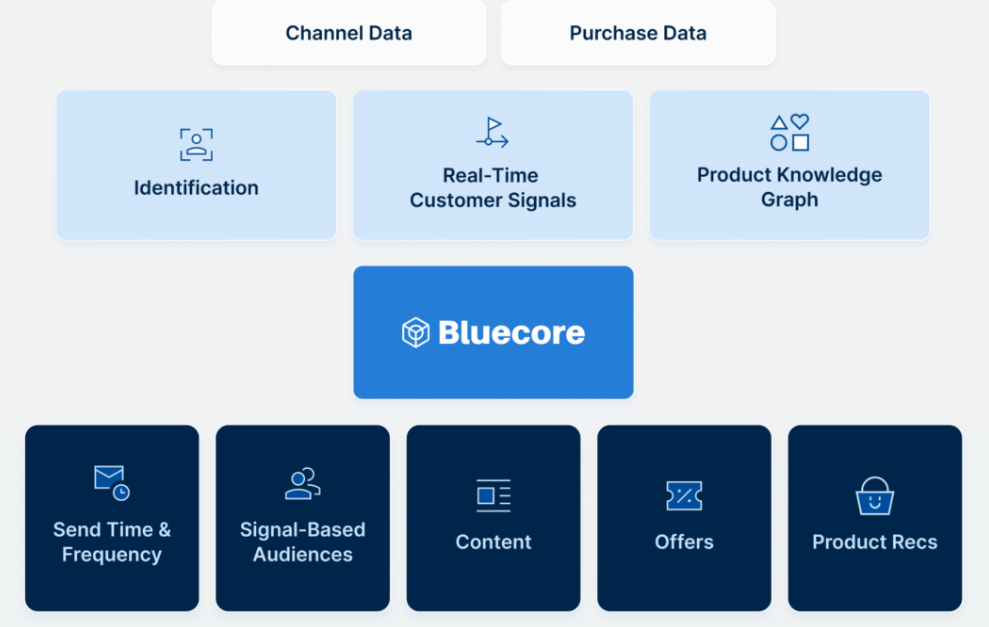
Source: Bluecore
Bluecore is a retail marketing platform that combines CDP and ESP capabilities into a single system designed for enterprise and mid-to-large DTC retail brands. Its architecture rests on a key insight: behavioral data alone cannot create a compelling shopper experience. Product catalog data matters just as much. This three-way fusion of shopper identity, real-time behavioral signals, and live product catalog attributes sets Bluecore apart from general-purpose marketing platforms.
Its key features include:
Customer Data & Identity: Real-time identity resolution across devices with 20+ predictive AI models trained on data from 400+ retail brands and 300 billion behaviors
Trigger-based campaigns: Always-on behavioral triggers (abandoned cart, browse abandonment, post-purchase) plus merchandising triggers (price drop, back-in-stock, new arrivals) that fire based on product catalog events
Cross-channel activation: Email, SMS, on-site personalization, and paid media audience sync from a single customer view
Transparent ID Network: Over 900 million deterministic IDs from 5,000+ brands and publishers, raising customer identification rates by an average of 42%
AI Shopping Agents: Marketing Agent for automated performance diagnostics and alby for conversational AI shopping assistance
Patented technology: Including Shopper and Product Match, Automatic Frequency Capping, and Smart Campaign with Autopilot
When a shopper visits a retailer's site, Bluecore tracks behavior from the first anonymous visit, links all historical data to a profile the moment it captures an identifier, and fires personalized campaigns based on the intersection of what the shopper did and what changed in the catalog.
This architecture has produced measurable results in retail email personalization and shopper identification, driven by its proprietary identity network and catalog-aware trigger engine.
However, Bluecore's enterprise-only model (no public pricing, no free trial, non-cancellable annual contracts), its historically underdeveloped SMS capabilities, and a steep learning curve for advanced features mean that growing brands, mobile-first businesses, or teams that need accessible entry points may benefit from alternatives that specialize in their specific needs.
Looking for a B2B data and intelligence platform to power your go-to-market strategy? ZoomInfo combines B2B data with AI-driven insights to help you find, win, and grow customers.
How We Curated Our List of Bluecore Alternatives
After researching Bluecore and the broader retail marketing platform market, we focused on tools that address specific gaps or serve specific audiences better. Bluecore excels at unifying shopper identity, behavioral signals, and product catalog data for enterprise retailers, but some businesses need platforms that offer:
B2B go-to-market intelligence for prospecting, pipeline generation, and account-based marketing
Self-serve access with transparent pricing and same-day deployment
Cross-channel mobile engagement spanning apps, push notifications, and in-session experiences
Mid-market retail automation paired with hands-on strategic partnership
SMS-first marketing with deep mobile messaging infrastructure
Full ecommerce automation accessible from a genuine free plan
Consolidated loyalty, messaging (RCS, WhatsApp), and managed execution in one platform
Each tool on this list leads in one of these areas. You might use them alongside Bluecore or switch entirely; it depends on what your growing business needs most.
DISCLAIMER: We aren't covering every single tool in the market! Our focus is on the best alternatives that address some of Bluecore's limitations for various use cases. The goal is to highlight tools that serve specific business needs. |
|---|
1. ZoomInfo — Best Alternative for B2B Go-To-Market Intelligence and Pipeline Generation
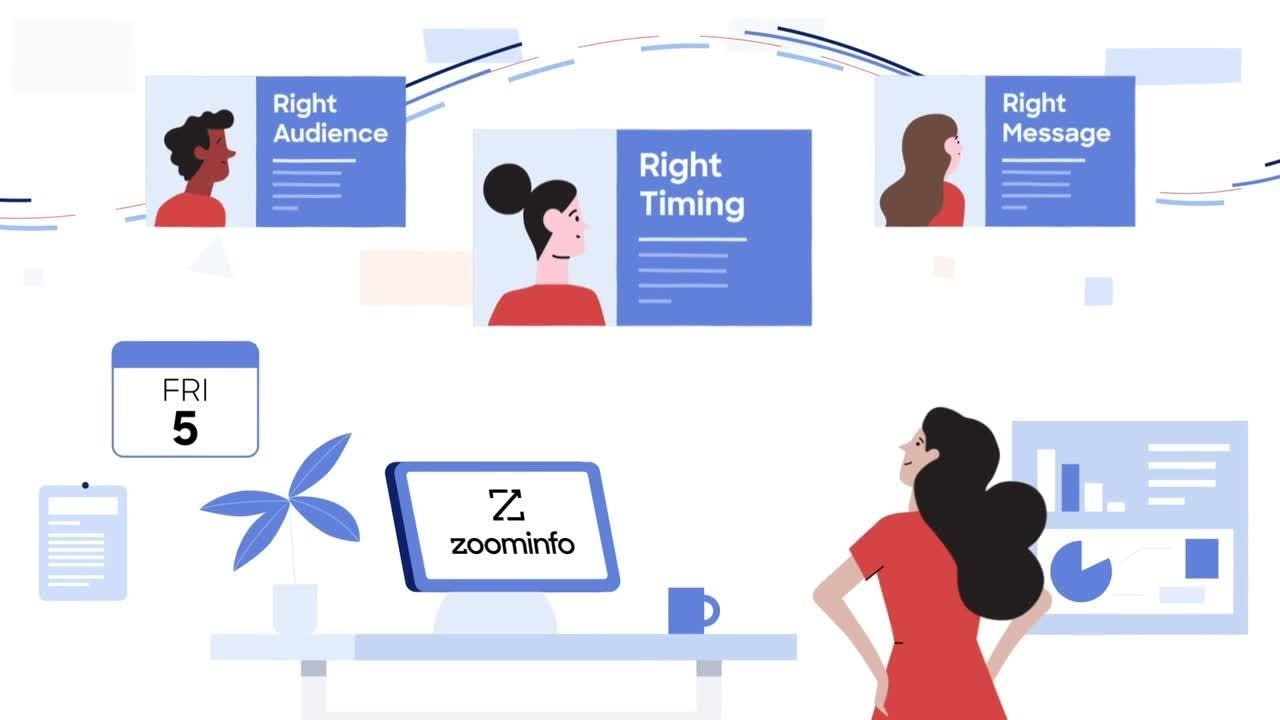
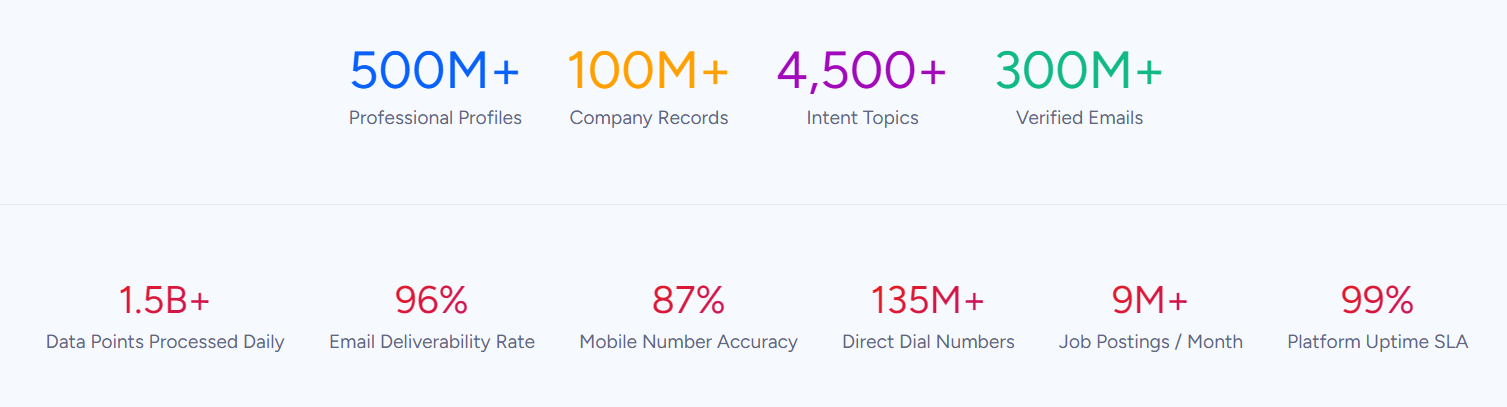
ZoomInfo is an all-in-one AI GTM platform built on the largest B2B data foundation in the industry: 500M contacts, 100M companies, 135M+ verified phone numbers, 120M direct-dial phone numbers, and 200M+ verified business email addresses.
While Bluecore focuses on B2C retail personalization, ZoomInfo addresses a different challenge: helping B2B go-to-market teams find, engage, and convert their ideal buyers with data-driven intelligence.
Its key features include:
B2B data: 500M contacts, 100M companies, 135M+ verified phone numbers, 120M direct-dial phone numbers, and 200M+ verified business email addresses, verified through a multi-source pipeline backed by 300+ human researchers with up to 95% accuracy on first-party data
GTM Context Graph: An intelligence layer that processes 1.5B+ data points daily, fusing ZoomInfo's B2B data with customer CRM records, conversation intelligence, and behavioral signals to capture not just what happened in a deal, but why it happened
Buyer Intent Data: Tracks signals from 210 million IP-to-Organization pairings and 6 trillion+ new keyword-to-device pairings sourced monthly, with Guided Intent that identifies topics correlated with deal success
Universal access: GTM Workspace for sellers, GTM Studio for marketers and RevOps, plus APIs and MCP for any custom tool or AI agent
For retail technology companies, B2B commerce platforms, and brands that sell to other businesses, ZoomInfo fills a gap that Bluecore was never designed to address: identifying and reaching the right buyers in enterprise accounts before they start evaluating solutions.
Why Choose ZoomInfo Over Bluecore for B2B Intelligence
ZoomInfo and Bluecore serve different markets.
Bluecore is a B2C retail platform built to personalize shopper experiences from behavioral and catalog data. ZoomInfo is a B2B intelligence platform built to identify, prioritize, and engage business buyers. The comparison matters most for organizations that operate in both B2B and B2C contexts, or for retail technology vendors that need to prospect into enterprise accounts.
The Largest B2B Data Platform
ZoomInfo's B2B data platform spans three dimensions: identity data (who buyers are, where they work, how to reach them), company context (firmographics, org charts, technographics across 30,000+ technologies at 30M+ companies), and dynamic signals that reveal when accounts are actively in-market.
This data isn't self-reported: in a Fortune 500 competitive RFP analyzing 25 million contacts across vendors, the independent consultant concluded that "no other competitor came even close."
Source: ZoomInfo
Where Bluecore excels at resolving anonymous retail shoppers into known buyer profiles using behavioral and catalog data, ZoomInfo excels at mapping the business landscape: charting org charts, identifying decision-makers with verified direct dials, and surfacing buying intent signals that show which companies are actively researching solutions relevant to your business.
ZoomInfo in Action: A retail SaaS company selling to ecommerce brands can use ZoomInfo to identify every VP of Marketing and Head of Ecommerce at companies using specific technologies (like Shopify Plus or Magento), filter for those showing active intent signals around "marketing automation" or "customer data platform," and trigger personalized outreach through GTM Workspace with AI-drafted messaging tailored to each prospect's context.
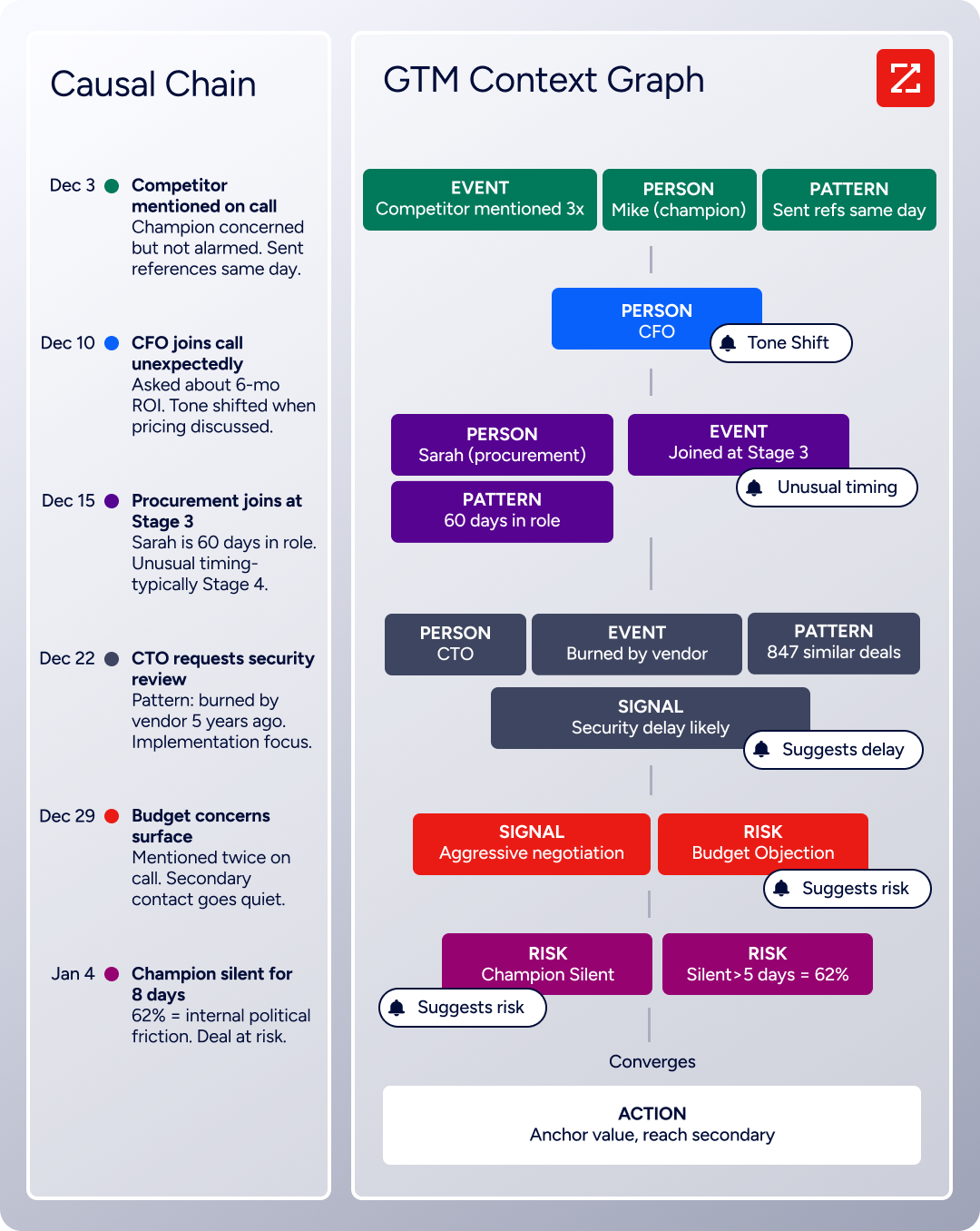
The GTM Context Graph: Understand Why Deals Move, Not Just That They Moved
The GTM Context Graph transforms ZoomInfo's data from a database into an intelligence layer.
By fusing CRM records, conversation transcripts, email interactions, and behavioral signals with ZoomInfo's third-party data, it captures the connections between signals and outcomes across every deal. A CRM records that a deal moved to Stage 3; conversation intelligence transcribes what the VP said on the call; intent data logs a research spike. The GTM Context Graph reasons across all three to capture why the deal moved.
As ZoomInfo's CPO Dominik Facher explains: "The CRM recorded the state change. It has no record of why it happened."
This intelligence layer exists because of two decades of infrastructure investment that no single point solution can replicate: the data unification platform, the conversation intelligence engine (from the Chorus acquisition), and the first-party/third-party unification layer that connects what's happening inside accounts with what's happening outside them.
Source: ZoomInfo
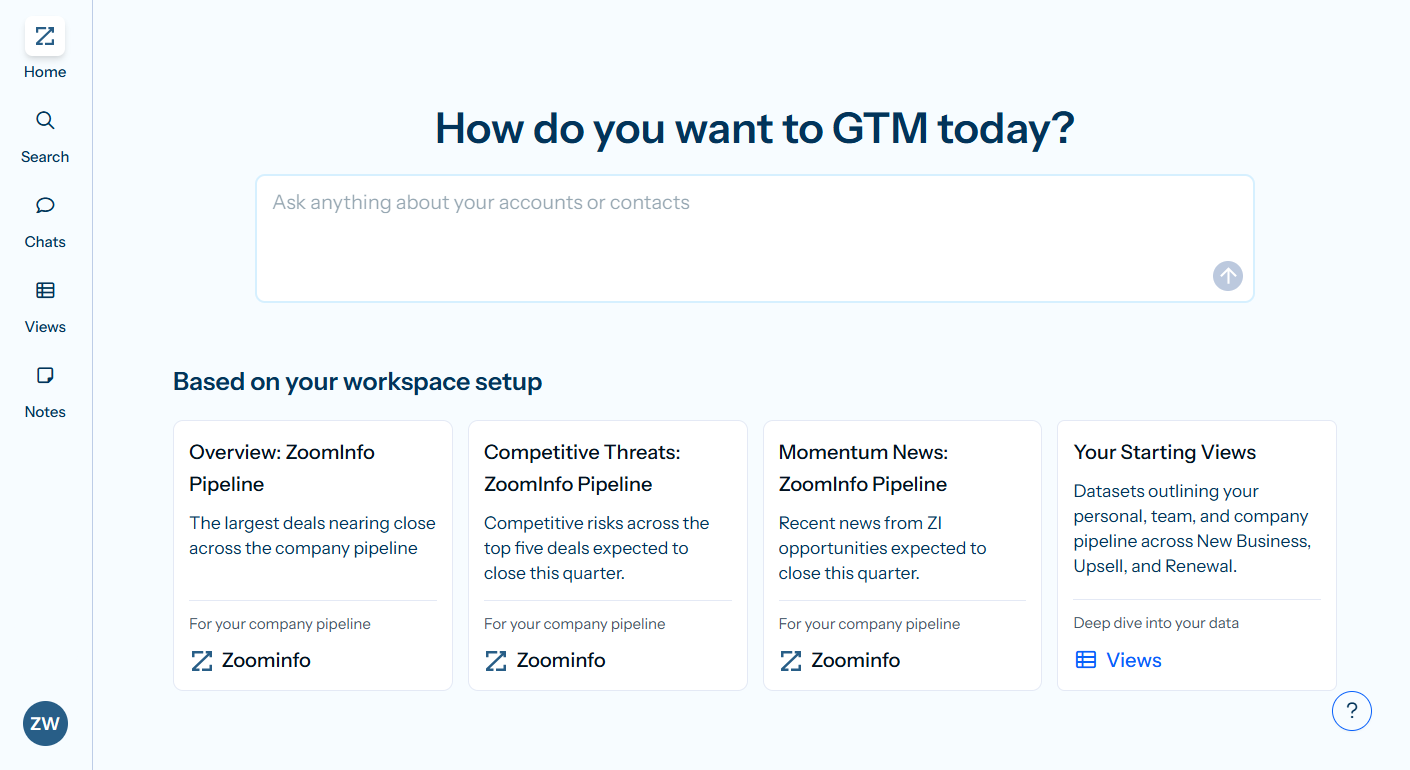
ZoomInfo in Action: When your sales team opens GTM Workspace, they see a prioritized account feed where AI-drafted outreach already addresses concerns identified from the last call. A marketer in GTM Studio describes an audience in plain language and launches a multi-channel play targeting accounts that match proven win patterns. An engineer connects the same intelligence to any custom tool via API or MCP. Every surface draws from one intelligence layer, so a buying signal one team detects is immediately actionable by every other team.
Universal Access: Intelligence That Works in Any Tool, Any Workflow
ZoomInfo delivers its intelligence through three products: GTM Workspace for sellers (AI-powered execution with account briefs, action feeds, and AI-generated outreach), GTM Studio for marketers and RevOps (natural-language audience building, multi-channel orchestration, and waterfall enrichment from 25+ alternative data sources), and APIs plus MCP for any custom application or AI agent.
The MCP server is available through partners including Anthropic Claude and Google, so the same data that powers ZoomInfo's own products flows into any third-party tool.
Seismic's sales team attributed 39% of active pipeline to opportunities identified or influenced by ZoomInfo signals, boosted productivity by 54%, and saved 11.5 hours per week per seller. (Seismic Case Study)
NOTE: We considered other B2B data and intelligence platforms, including Apollo.io and Cognism. Apollo.io offers an accessible entry point for startups with its sales engagement and prospecting tools, but its data scale and verification depth don't match ZoomInfo's 500M contacts and multi-source verification pipeline. Cognism specializes in European mobile numbers and GDPR compliance but has a narrower global dataset. ZoomInfo's combination of data scale, the GTM Context Graph, and universal access through APIs, MCP, Workspace, and Studio makes it the most complete platform for B2B go-to-market teams.
ZoomInfo Pricing
ZoomInfo uses a consumption-based pricing model structured around enterprise license agreements, data access, API consumption, and AI activity. No single published price applies to all customers; costs scale based on usage patterns, number of users/seats, credit volume, features, and contract length.
Sales Plans (Accelerate your sales process):
Professional: Contact and company data with profiles, advanced search, mobile numbers, CRM integrations, Chrome extension, and AI-powered email generation.
Advanced: Adds AI-driven account prioritization, buyer intent signals, website visitor identification, Champion Tracking, and automated outreach workflows.
Enterprise: Real-time buyer intent, advanced workflows, custom integrations, dedicated customer service manager, and AI-generated account summaries.
Marketing Plans (Achieve more ROI):
Marketing Demand: 75K credits, intent topics, dynamic audiences, CRM and MAP integrations, and AI-powered audience creation.
ABM Lite: 100 intent topics, ZoomInfo Display Network, Facebook/LinkedIn/Google advertising, and AI-driven buying-group identification.
ABM Enterprise: 150K credits, unlimited intent topics, unlimited display campaigns, and AI-generated account summaries.
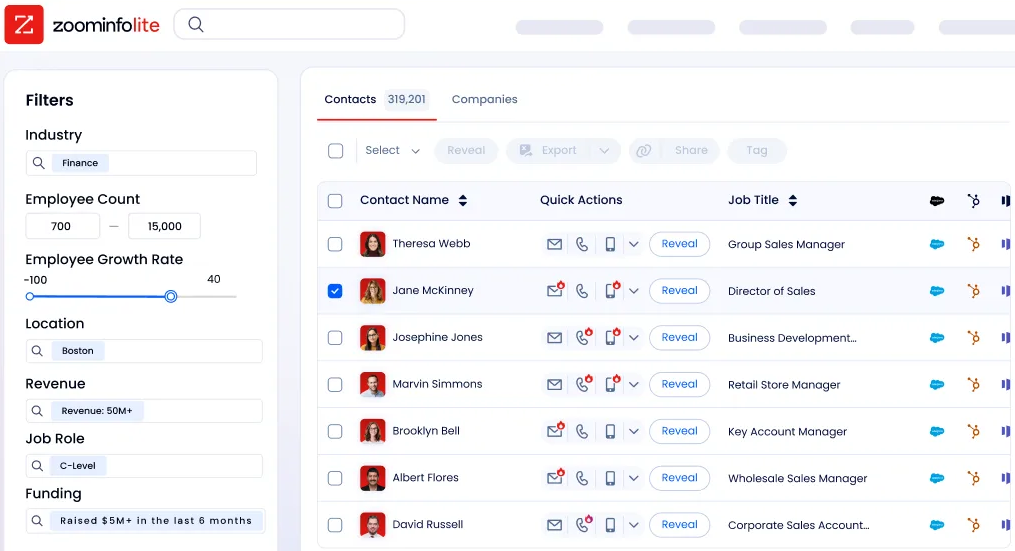
ZoomInfo Lite is a permanent free tier with access to the B2B database, 10 monthly export credits, individual and company searches, WebSights Lite, and HubSpot integration. A 7-day free trial is also available separately, no credit card required.
Source: ZoomInfo
Who Should Use ZoomInfo?
Choose ZoomInfo if:
You're a retail technology company, B2B commerce platform, or SaaS brand that sells to other businesses and needs to identify decision-makers, track buying intent, and generate pipeline at scale.
Your go-to-market strategy requires more than behavioral shopper data: you need verified contact information, org charts, technographic profiles, and real-time intent signals for enterprise accounts.
You want intelligence that works everywhere your team works, whether that's a native AI workspace, a marketing orchestration canvas, your CRM, or a custom-built AI agent powered by APIs and MCP.
Want to know which accounts are in-market for your solution right now? Start your free ZoomInfo trial and see the full context behind every deal.
2. Klaviyo — Best Alternative for Self-Serve Access, Transparent Pricing, and Immediate Deployment
Source: Klaviyo
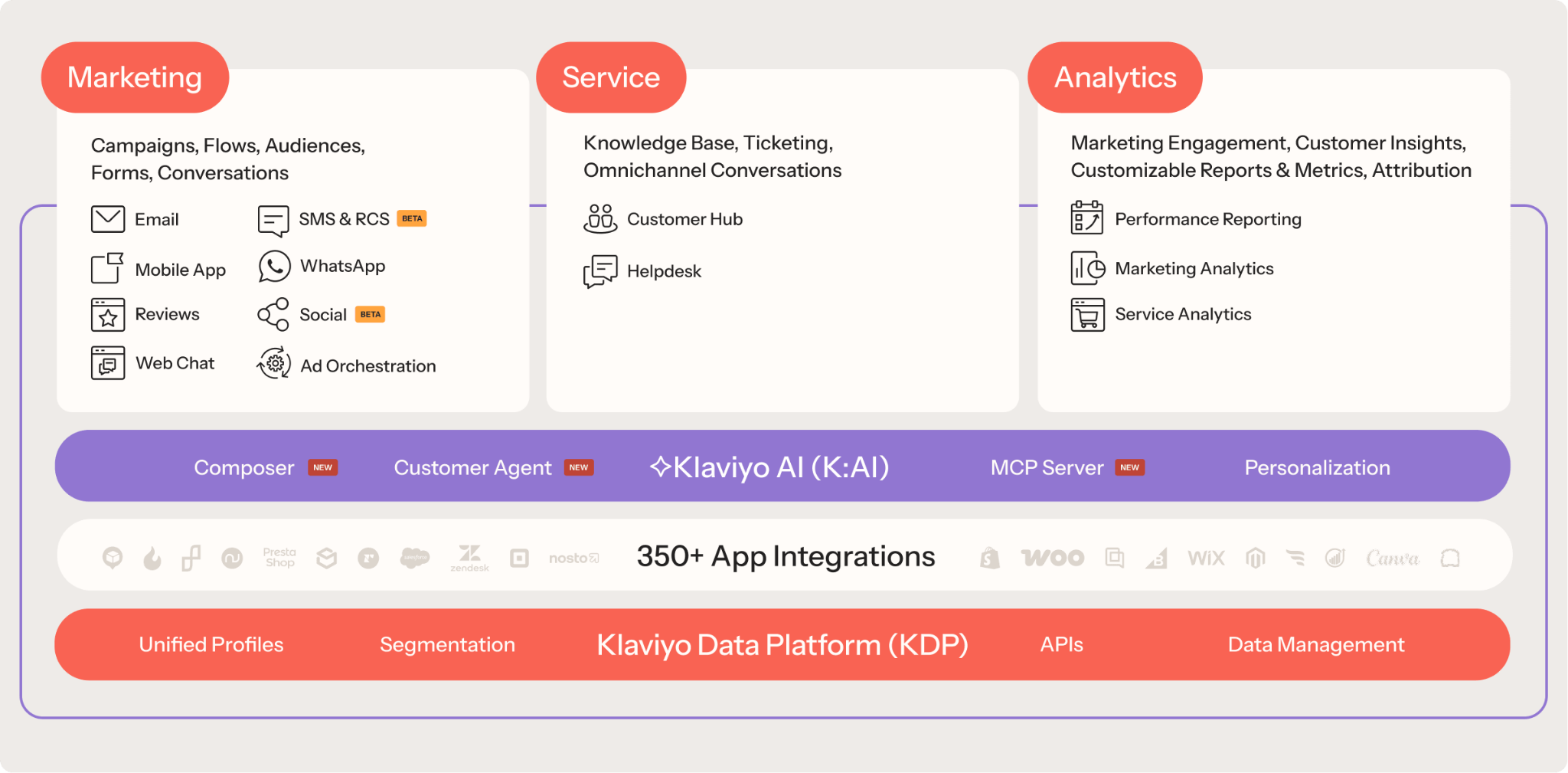
Klaviyo is a B2C CRM and marketing automation platform that serves as the operating system for consumer brands managing email, SMS, and customer data from a single interface.
Its key features include:
Transparent pricing: A permanent free plan (250 active profiles, 500 email sends/month) with no credit card required, scaling predictably by active profile count through a public interactive calculator
Pre-built ecommerce flows: Welcome series, abandoned cart, browse abandonment, post-purchase, and back-in-stock notifications deployable in minutes via 60+ pre-built flow templates
Unified email and SMS: Both channels managed from a single audience builder, shared flow builder, and unified subscriber profiles
Predictive analytics: Predicted CLV, churn risk, and next order date built natively into segmentation
350+ integrations: Including native Shopify sync, WooCommerce, BigCommerce, and Magento via the Klaviyo Data Platform
For Shopify-native DTC brands and SMBs that need to move fast, Klaviyo offers a path from sign-up to first triggered campaign on the same day, without an enterprise procurement cycle.
Why Choose Klaviyo Over Bluecore for Self-Serve Retail Marketing
Klaviyo stands out in the following areas:
Transparent Self-Serve Pricing vs. Enterprise-Only Contracts
The most immediate structural difference is access. Bluecore has no public pricing page, no free trial, and all commercial arrangements run through enterprise contracts billed annually in advance. Contracts are explicitly non-cancellable.
Klaviyo's permanent free plan includes all 350+ integrations, automated flow capability, and Marketing Agent for campaign creation. Paid plans scale by active profile count with monthly billing and 5 days' cancellation notice. For brands that need to assess ROI before committing, Klaviyo removes an entire category of procurement friction.
Same-Day Deployment vs. Multi-Week Implementation
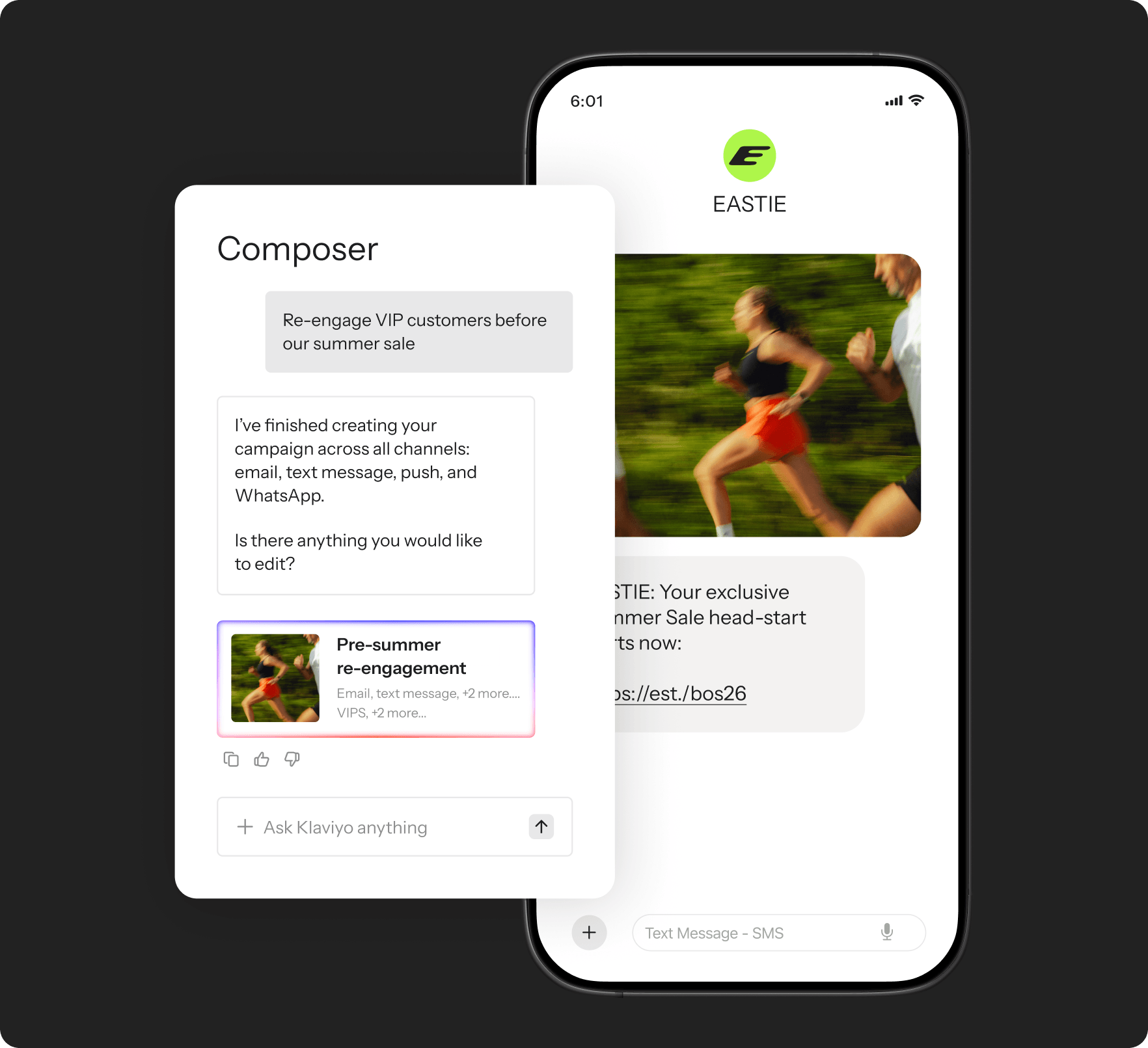
Bluecore's onboarding involves a dedicated Project Manager, Forward Deployed Engineer, and Deliverability Team. Klaviyo's Marketing Agent scans a brand's website, analyzes the product catalog and tone, then generates campaigns, activates flows, and launches a signup form "in just 3 clicks."
The Shopify native sync, deepened through a March 2026 partnership expansion, makes ecommerce event data available immediately. An IDC study found brands using Klaviyo and Shopify together achieved 73% revenue growth over three years.
Source: Klaviyo
Accessible Predictive Analytics Without a Data Science Layer
Bluecore's 20+ predictive models are strong at enterprise scale, but accessing that intelligence requires navigating the audience builder and CS support structure.
Klaviyo surfaces predicted CLV, churn risk, and next predicted order date directly inside its segmentation interface, available on every paid plan with no data science configuration required. The platform processes 3.4 billion daily interactions across 8 billion+ profiles from its 193,000+ brand customer base.
NOTE: We also evaluated Drip and Sendlane. Drip offers solid ecommerce email automation for SMBs but has a narrower integration ecosystem. Sendlane is a newer entrant with combined email and SMS but has a less established track record. Klaviyo offers the clearest path from Bluecore for brands needing transparent pricing, a dominant Shopify integration, and a proven self-serve model.
Klaviyo Pricing
Klaviyo offers transparent, self-serve pricing that scales by active profile count:
Free Plan: $0/month for up to 250 active profiles, 500 email sends/month, 150 mobile message credits/month, all 350+ integrations, Marketing Agent, and basic flow builder. No credit card required.
Paid Marketing Plans: Starting at approximately $45/month for small lists, scaling by active profile count via the interactive pricing calculator. Send limits are set as a multiple of active profile count. Monthly billing available with 5 days' cancellation notice.
Data + Analytics Add-On: Separately priced; includes advanced CDP features, data warehouse sync (Redshift, S3, BigQuery, Snowflake), and customizable RFM scoring.
Enterprise: Custom pricing with 24/7 live chat, dedicated Deliverability Strategist, Solutions Architect, and multi-account Portfolio management.
Who Should Use Klaviyo?
Choose Klaviyo if:
You're a Shopify-native DTC or retail brand that needs triggered email and SMS flows live within days, not months, and can't justify an enterprise implementation timeline or minimum spend commitment.
You want predictable, self-serve pricing with a public rate card (including a permanent free plan) rather than a closed-quote negotiation with annual minimum commitments.
Your team is small or solo and needs predictive analytics (CLV, churn risk, next order date) accessible directly inside your segmentation and flow builder without a dedicated data science function.
3. Braze — Best Alternative for Enterprise Cross-Channel Mobile Engagement
Source: Braze
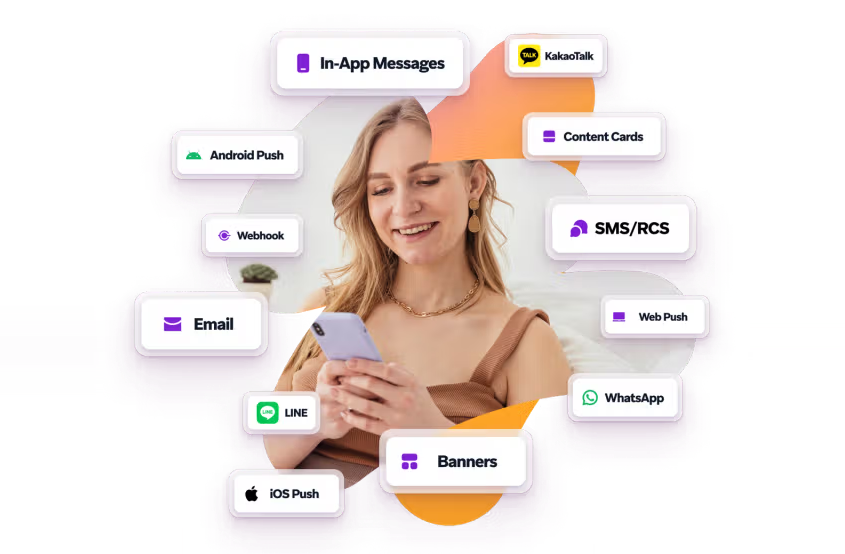
Braze is a customer engagement platform built for real-time, AI-driven consumer lifecycle engagement across every digital touchpoint. It orchestrates email, mobile push, in-app messages, SMS/RCS, WhatsApp, Content Cards, and paid media audience sync from a single campaign canvas.
Its key features include:
Cross-channel orchestration: 10+ owned and addressable channels governed by a single visual Canvas Flow journey builder with drag-and-drop components and Experiment Paths at any node
BrazeAI suite: Intelligent Timing, Intelligent Channel, Predictive Churn, Personalized Paths for 1:1 journey routing, and BrazeAI Decisioning Studio (powered by the $325M OfferFit acquisition) for reinforcement-learning next-best-action optimization
Cloud Data Ingestion: Direct connections to Snowflake, BigQuery, Redshift, and Databricks for zero-copy warehouse-native segmentation
Scale: Processed 8.5 billion monthly active users and 4.5 trillion Canvas actions in 2025
For enterprise brands with mobile apps as a primary customer touchpoint, Braze is the strongest upgrade path from Bluecore's retail-email-and-site model.
Why Choose Braze Over Bluecore for Cross-Channel Customer Engagement
Braze stands out in the following areas:
Full Cross-Channel Mobile Architecture
Bluecore was built around email and on-site personalization, with SMS capabilities that TrustRadius reviewers called out as a weak spot. Braze launched as Appboy in 2011 with a mobile-first thesis. Every channel (email, push, in-app messages, Content Cards, WhatsApp) was built on the same data model and journey orchestration layer.
When a push notification click triggers a follow-up in-app message in the same Canvas and simultaneously suppresses the user from paid media retargeting, the coordination happens in real time.
AI-Powered Journey Optimization With Embedded Experimentation
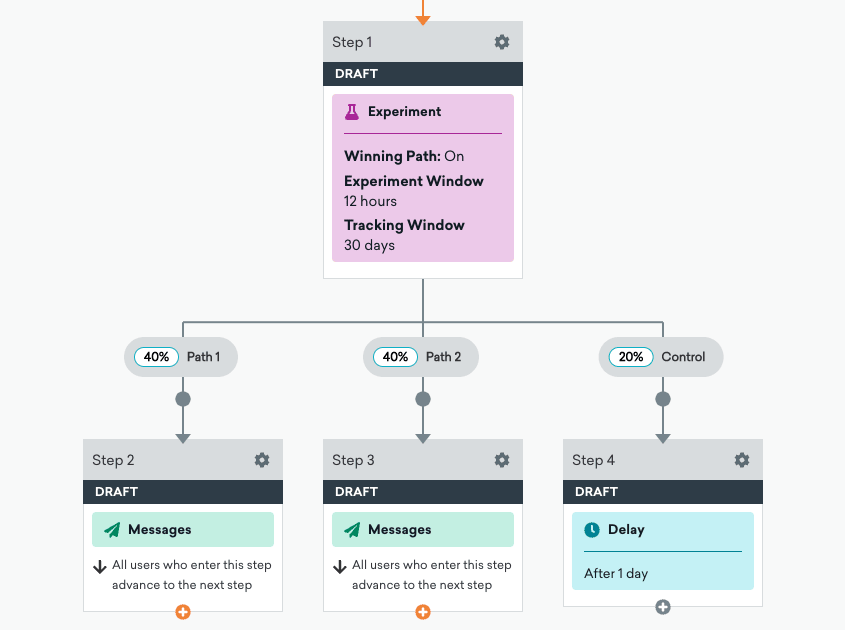
Bluecore's campaign model uses pre-configured triggers (Abandoned Cart fires 1-2 hours after abandonment; Price Decrease fires on a 10%+ drop). Braze's Canvas architecture treats experimentation as a core primitive: Experiment Paths at any node, Winning Path auto-routing, and Personalized Paths that predict the best branch per individual user.
BrazeAI Decisioning Studio continuously optimizes channel, creative, timing, and frequency for each individual through reinforcement-learning next-best-action optimization.
Source: Braze
Warehouse-Native Data Architecture
Enterprise brands with existing data infrastructure (Snowflake, BigQuery, Redshift) often find Bluecore's model requires routing data through its proprietary identity layer. Braze's Cloud Data Ingestion and Connected Sources let marketers build segments against live warehouse data without copying it, keeping the warehouse as the authoritative source of truth.
NOTE: We also evaluated Salesforce Marketing Cloud and Iterable. Salesforce Marketing Cloud has a strong enterprise footprint with deep CRM integration, but its legacy architecture often requires 6-12 months for full deployment. Iterable has a modern API-first architecture but a smaller global support footprint and less mature mobile SDK compared to Braze. Braze offers the strongest combination of mobile-native depth, AI optimization, and warehouse-connected architecture.
Braze Pricing
Braze does not publish pricing publicly. All terms are negotiated via direct sales and formalized in a signed Order Form.
Pricing scales across three dimensions: Platform Edition (capability tier), Monthly Active Users (only engaged users are billed), and Flexible Credits (shared across channels like SMS, WhatsApp, and Content Cards).
Braze Go: Core platform, BrazeAI Operator, Agent Console, email, and push. Custom pricing.
Braze Select: Everything in Go plus increased orchestration and enhanced security. Custom pricing.
Braze Pro: Everything in Select plus Predictive AI, personalized recommendations. Custom pricing.
Braze Enterprise: Everything in Pro plus enterprise-grade governance and advanced experimentation. Custom pricing.
A 30-day free trial is available. VC-backed startups can access Braze for Startups for 4 months of free access.
Who Should Use Braze?
Choose Braze if:
Your brand has a mobile app as a primary consumer touchpoint and needs push notifications, in-app messages, and Content Cards managed within the same system as your email and SMS programs.
You need cross-channel journeys where a push notification click triggers an in-app message, a non-response escalates to SMS, and a conversion suppresses the user from paid retargeting, all within a single Canvas.
Your engineering team has already invested in a cloud data warehouse and wants to power personalization directly from that infrastructure without duplicating data through a proprietary identity layer.
4. Listrak — Best Alternative for Mid-Market Retail Brands Wanting Strategic Partnership
Source: Listrak
Listrak is a cross-channel personalization platform built for retail and ecommerce, serving brands in the $20M-$500M revenue range. Its key features include:
Retail-native automation: Drag-and-drop email builder with the full retail trigger library (abandoned cart, browse abandonment, post-purchase, winback, replenishment)
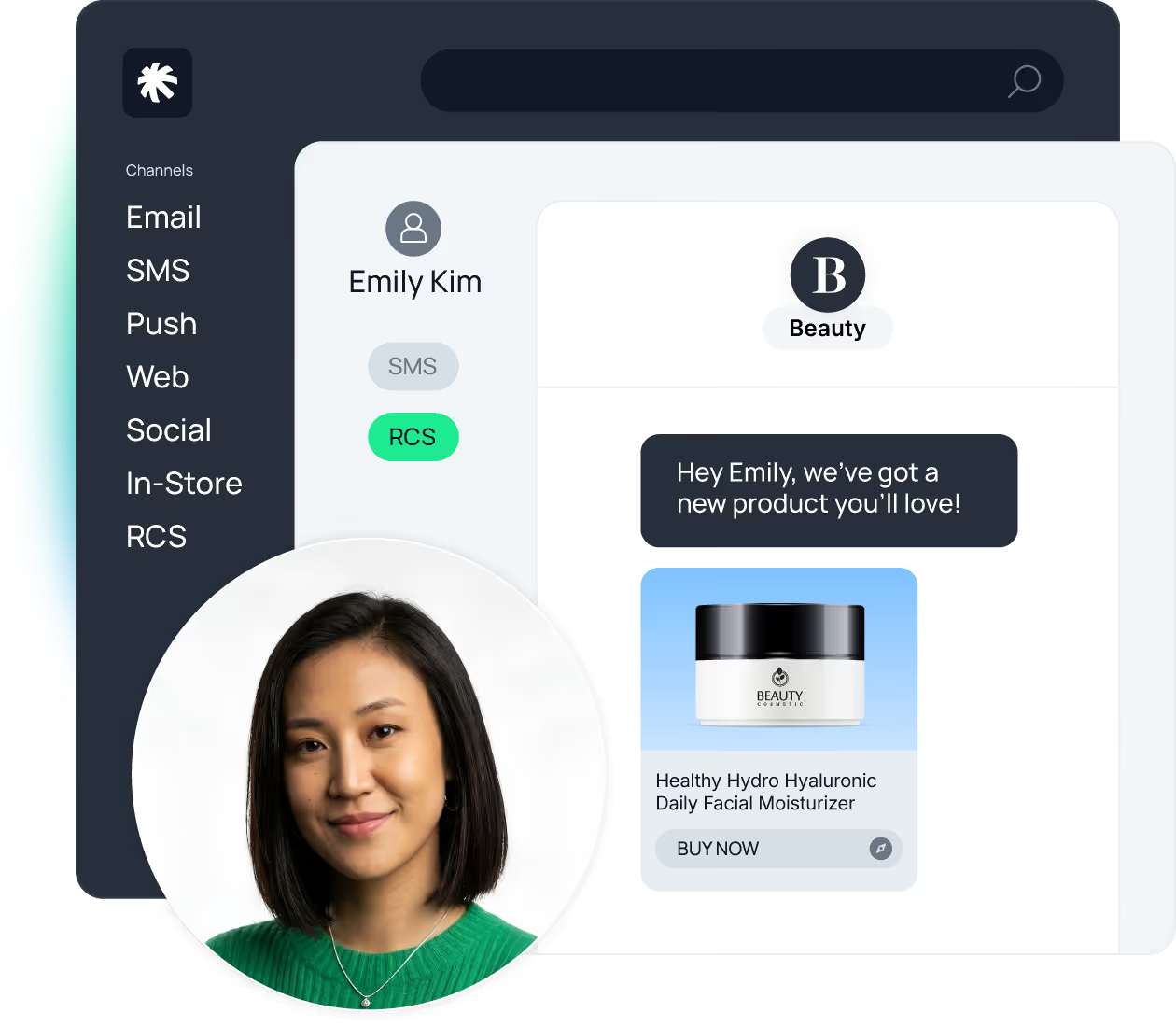
Unified mobile marketing: SMS, MMS, and RCS Messaging managed alongside email in a single Journey Hub orchestration canvas
AI-powered tools: AI Channel Affinity routing predicts the best channel for each contact; AI Text Message Assistant generates on-brand copy from linked landing page URLs
Dedicated U.S.-based strategists: Assigned to each account with industry-specific benchmark reporting from Listrak's 2026 Cross-Channel Benchmark Report covering 12 retail verticals
For brands that have outgrown general-purpose ESPs but aren't yet operating at Bluecore's enterprise scale, Listrak fills the gap between basic email tools and enterprise platforms.
Why Choose Listrak Over Bluecore for Mid-Market Retail Automation
Listrak stands out in the following areas:
Mid-Market Accessibility Without Sacrificing Retail Depth
Bluecore's customer roster (Wayfair, Gap, Neiman Marcus, Sephora) reflects a platform designed for brands with enterprise-scale data infrastructure and contract budgets.
Vendr transaction data places Listrak's annual contracts at $37K-$146K (average ~$83K), structured for mid-market retail teams. Listrak's client roster confirms this positioning: the platform serves retail brands across fashion, home goods, and specialty categories, delivering retail-depth automation at a mid-market price point.
Strategic Partnership as the Default, Not an Add-On
Listrak's most distinctive feature is its delivery model. Every enterprise account receives a Dedicated Client Success Manager, a Digital Strategist, deliverability experts, weekly program reviews, managed campaign execution, quarterly growth roadmaps, and annual onsite planning sessions. This is the baseline, not a premium tier.
Bluecore's CS team is strong, but managed campaign execution is structured as a separately purchasable "Professional Services Optional Add-On."
Unified Channel Parity Including RCS
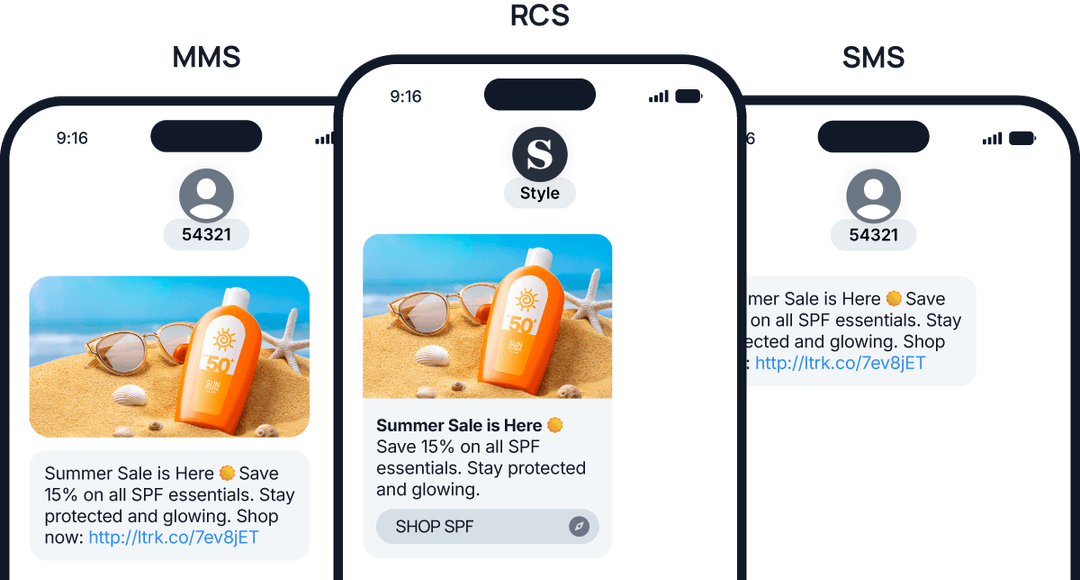
Listrak's mobile marketing suite covers SMS, MMS, RCS, mobile app push, and web browser push, all from the same Journey Hub. RCS gives brands verified sender branding, product imagery, and tappable action buttons, with 58% higher click-through rates versus traditional SMS. RCS falls back automatically to SMS/MMS when unsupported.
Source: Listrak
NOTE: We also evaluated SAP Emarsys and Dotdigital. SAP Emarsys offers strong pre-built retail playbooks but is priced at enterprise scale. Dotdigital provides solid cross-channel automation, but its primarily UK-based support model can create friction for North American brands. Listrak offers the strongest combination of retail specialization, U.S.-based hands-on support, and mid-market pricing accessibility.
Listrak Pricing
Listrak does not publish pricing publicly. The primary call-to-action is "Get a Demo," consistent with a sales-led model.
Typical annual contract values range from $37K-$146K (average ~$83K) based on third-party transaction data, with pre-negotiated volume allowances for email sends and SMS messages billed monthly in arrears. No free trial or free plan is available.
Who Should Use Listrak?
Choose Listrak if:
You're a U.S.-based retail brand in the $20M-$500M revenue range that has outgrown basic email marketing but isn't yet at the scale where Bluecore's enterprise contract structure is cost-justified.
Your team wants an embedded strategic partner, not just a software license: dedicated strategists, weekly reviews, managed execution, and annual onsite planning are included by default.
You're building a mobile-first retention program and need SMS, MMS, and RCS operating from the same platform and customer profile as your email automation.
5. Attentive — Best Alternative for SMS-Led Retail Marketing
Source: Attentive
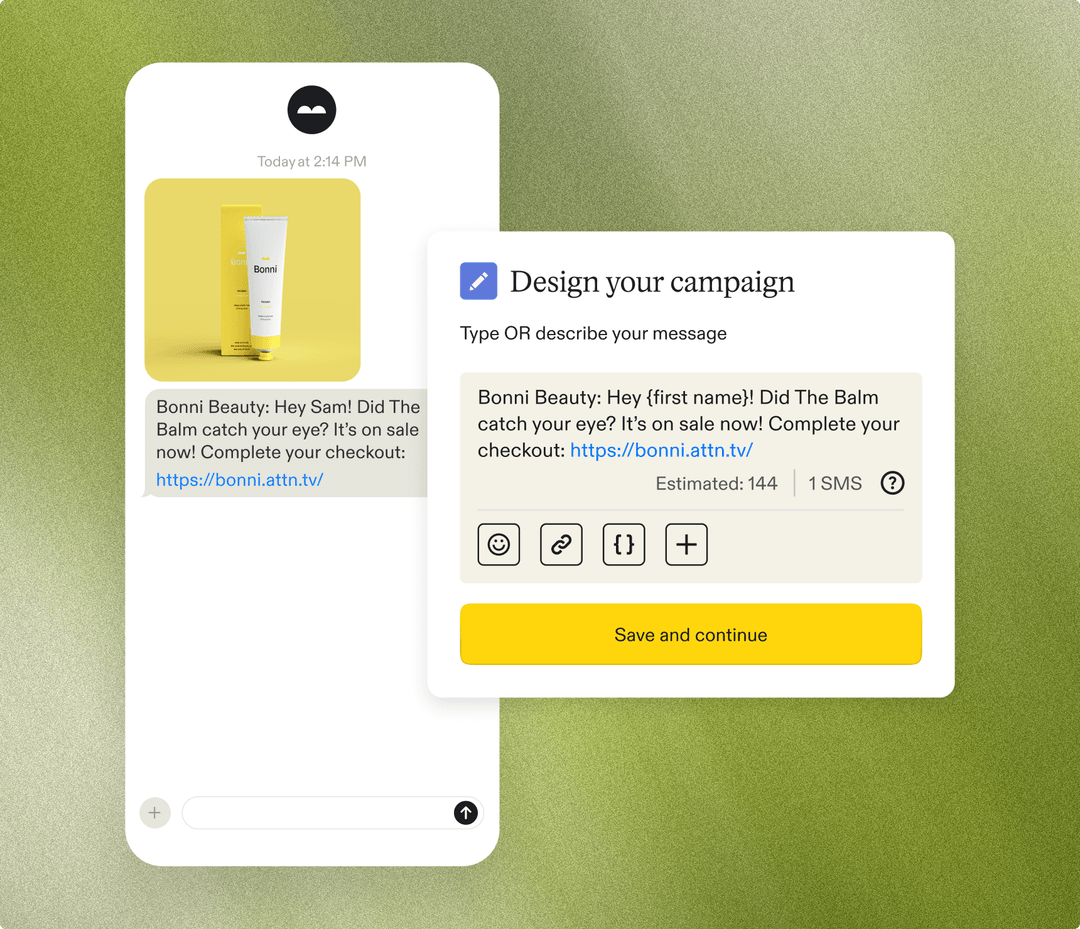
Attentive is an SMS and email marketing platform built for brands whose primary revenue channel is mobile messaging. Its key features include:
Patented Two-Tap opt-in: 30+ sign-up unit formats (pop-ups, QR codes, keyword campaigns) that reduce acquisition friction and establish Known Sender status
Four-channel mobile platform: SMS, email, RCS for Business, and push notifications from a single Consumer Passport subscriber profile
Deliverability at scale: 98.7% SMS deliverability across 2 billion+ daily sends with zero downtime during BFCM 2025
AI suite trained on retail: AI Journeys, AI Pro, AI Grow, and Attentive AI trained on 90 billion messages from retail and DTC contexts
Compliance infrastructure: Automatic suppression of 55,000+ known litigators and state-level quiet hours for TCPA compliance
For brands where SMS is the primary retention and revenue channel, Attentive's acquisition toolset and compliance infrastructure are more developed than what Bluecore has historically provided.
Why Choose Attentive Over Bluecore for SMS-Led Retail Marketing
Attentive stands out in the following areas:
SMS Subscriber Acquisition as a First-Class Product
Bluecore's SMS capabilities have historically been a documented weakness, with TrustRadius reviewers noting it "would not be particularly appropriate for building something in SMS."
Attentive was built on SMS from day one. The patented Two-Tap mechanism produces 25%+ more sign-ups than standard form entry and 30-40% higher engagement. Across the platform, this has driven 875M+ SMS opt-ins and 590M+ email opt-ins.
A Four-Channel Mobile Platform
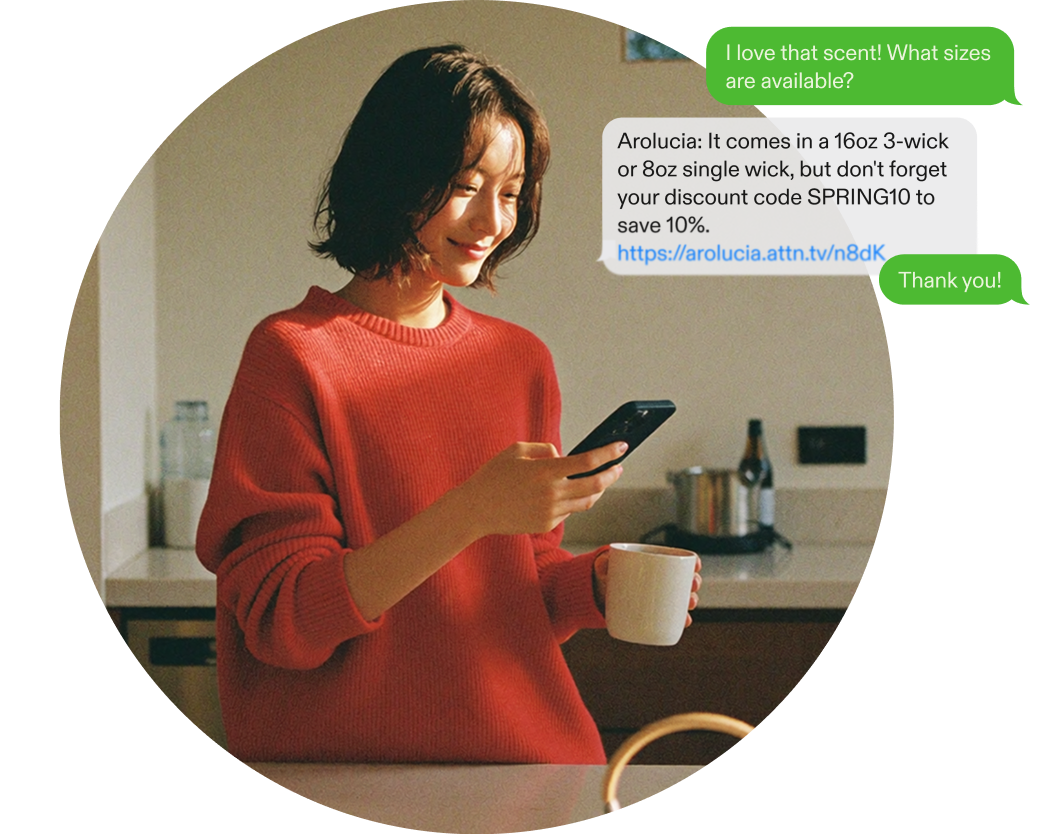
Attentive's SMS, email, RCS for Business, and push notifications all run from the same subscriber profile built on 1.8 billion+ phone numbers and email addresses. The platform reports 2.4x higher conversion when SMS and email work together within coordinated journeys. Early RCS metrics show 45% higher click-through rates, 47% revenue growth per message, and 20% higher conversion than traditional SMS.
AI Trained on SMS Revenue Outcomes at Scale
Attentive's AI is trained on 90 billion messages from retail and DTC contexts. AI Journeys has produced 200% revenue lift and 5X+ incremental ROI across the platform's brand base. Bluecore's AI is comparably deep in email-and-catalog personalization, but its SMS-specific training data is less established.
Source: Attentive
NOTE: We also evaluated PostScript and Recart. PostScript excels as a Shopify-native SMS platform but lacks Attentive's expansion into email, push, and RCS. Recart takes a Messenger-plus-SMS approach but operates within a narrower brand ecosystem. Attentive offers the most complete mobile messaging infrastructure for brands needing both deep SMS acquisition tools and a credible path to omnichannel mobile marketing.
Attentive Pricing
Attentive uses a usage-based pricing model calculated on message volume and subscriber list size. No fixed per-seat fee or credit system. All plans require a demo/quote to access pricing.
SMS, Email, RCS & Push: Full omnichannel bundle with built-in savings; AI Essentials included with all plans.
SMS & Email: Mid-tier bundle for brands consolidating mobile messaging.
SMS/MMS/RCS Only: Single-channel option for SMS-first brands.
Enterprise: Custom volume-based pricing with the complete AI suite (AI Pro, AI Grow, AI Journeys) and dedicated customer success manager.
AI tools (AI Pro, AI Grow, AI Journeys) are available as paid add-ons for non-Enterprise tiers. A free trial is available through a sales-initiated engagement; no self-serve free plan exists.
Who Should Use Attentive?
Choose Attentive if:
Your SMS subscriber list is your most valuable owned audience and you need list growth rates beyond what your current platform provides.
You're running email and SMS on separate vendors and want a single subscriber profile, shared journey logic, and unified analytics without losing channel depth.
You operate in a high-TCPA-risk environment and need compliance infrastructure managed at the platform level rather than by your internal legal team.
6. Omnisend — Best Alternative for Ecommerce Automation Without Enterprise Pricing
Source: Omnisend
Omnisend is an ecommerce marketing automation platform that combines email, SMS, and web push notifications in a single workflow engine, with its full feature set available starting at $0. Its key features include:
Permanent free plan: 250 contacts, 500 emails/month, 500 web push notifications, and access to all core features including automation workflows, segmentation, forms, and reporting
40+ pre-built workflows: Organized around the full customer lifecycle (welcome, abandoned cart, checkout abandonment, browse abandonment, post-purchase, reactivation)
Ecommerce-native builder: Live product picker pulling catalog items directly into emails, plus interactive elements like scratch cards and a gamified Wheel of Fortune opt-in widget
Revenue attribution: Per-campaign and per-automation revenue reporting connecting sends directly to store orders, with an Ordered Product Report mapping specific SKUs to campaign clicks
Native integrations: One-click setup with Shopify, WooCommerce, BigCommerce, Wix, and Shoplazza
For DTC brands evaluating alternatives to Bluecore's enterprise model, Omnisend makes behavioral automation comparable to enterprise tools accessible from a genuine free plan.
Why Choose Omnisend Over Bluecore for Accessible Ecommerce Automation
Omnisend stands out in the following areas:
Transparent Pricing With a Genuine Free Plan
Bluecore's pricing page returns a 404 error, and all terms are negotiated through non-cancellable enterprise contracts. Omnisend's pricing is publicly listed at all tiers. The free plan gives access to every core feature with volume caps as the only constraint, including automation workflows, segmentation, and reporting.
A brand can build and activate a full automation sequence, measure revenue attribution, and validate the platform before spending a dollar.
Pre-Built Automation That Cuts Time-to-Value From Weeks to Hours
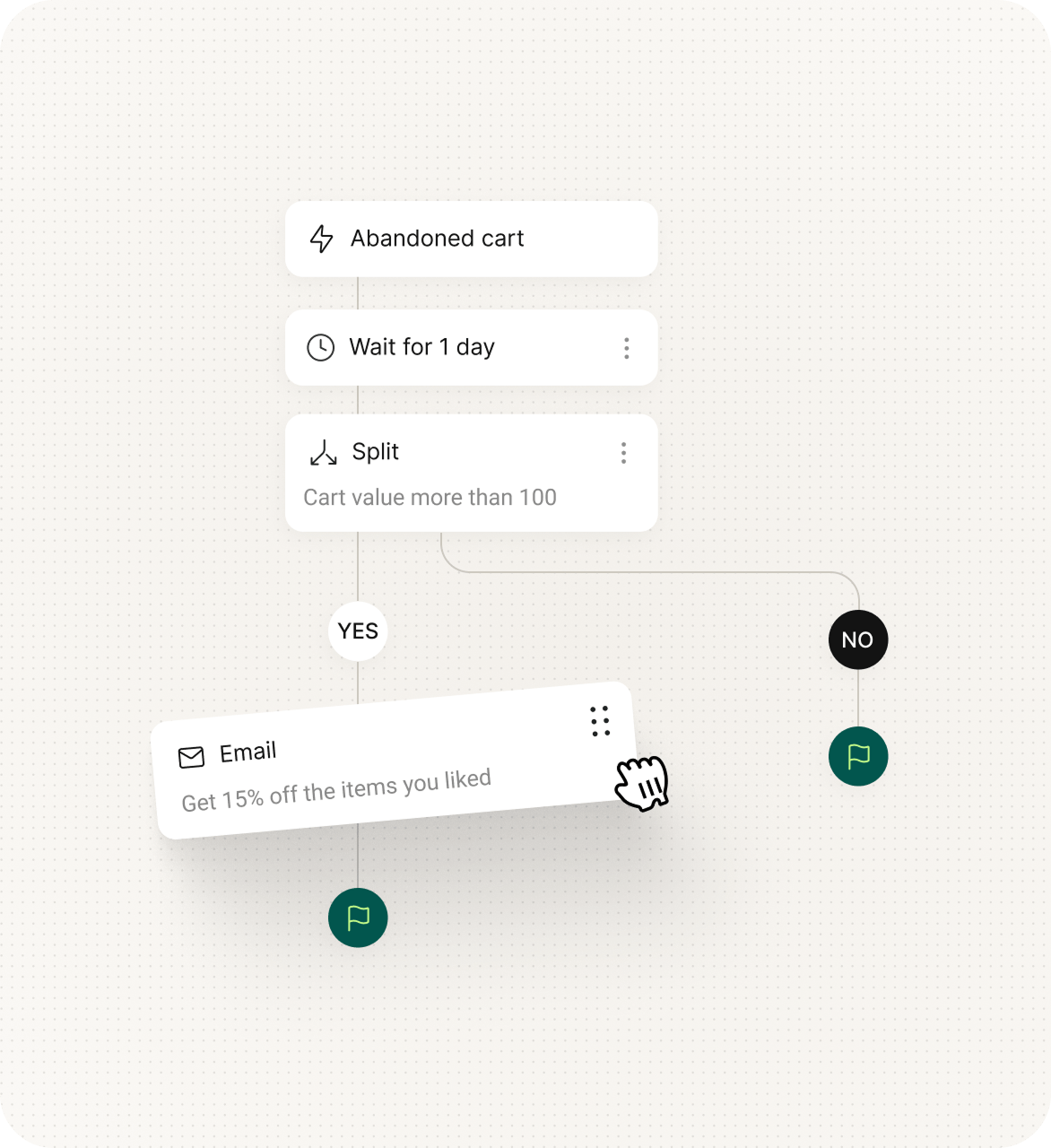
Bluecore's G2 reviewers flag a steep learning curve for complex segmentation and workflow configuration. Omnisend ships 40+ pre-built automation workflows that activate with minimal configuration.
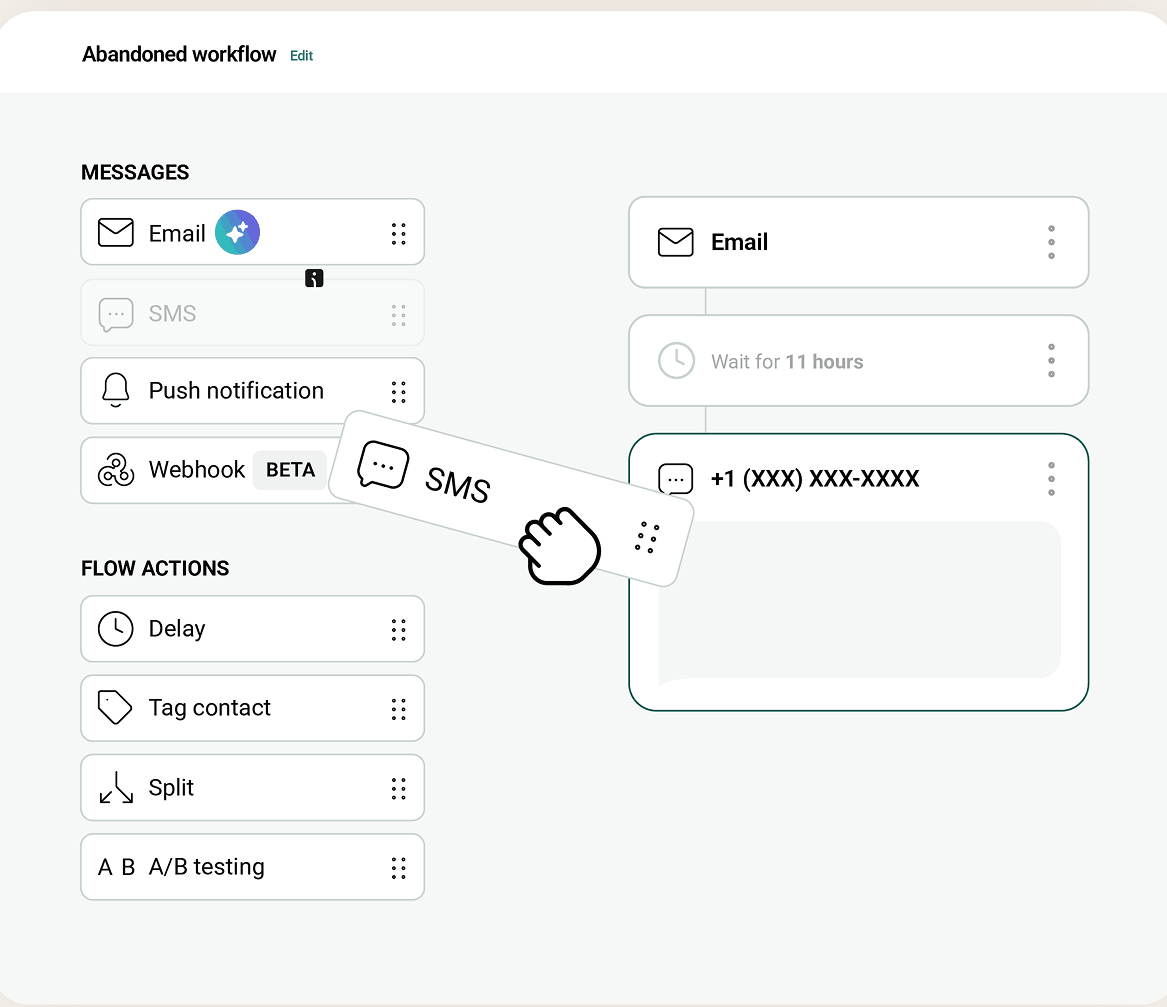
Omnisend's data shows that automated emails drove 37% of email-generated revenue while representing just 2% of total volume. The multi-channel workflow canvas supports email, SMS, and web push in a single automation with intelligent channel fallback.
Source: Omnisend
Revenue Attribution That Answers the Question Bluecore Users Report Goes Unanswered
G2 reviewers consistently flag Bluecore's reporting as insufficient relative to the data the platform holds. Omnisend's reporting layer is built around revenue attribution as its primary output: a Sales tab splits total store revenue between "From Omnisend" and "Not from Omnisend," broken down by channel, campaign type, and specific workflow. Attribution windows are configurable and retroactively recalculate all historical data.
NOTE: We also evaluated Mailchimp and compared it against Klaviyo's free tier. Mailchimp has a free plan, but its ecommerce-specific automation requires more manual configuration. Klaviyo has strong ecommerce depth, but SMS is not available on the free plan and pricing escalates at scale (approximately 40-60% more expensive than Omnisend at equivalent contact tiers). Omnisend offers the most accessible no-contract entry point for brands evaluating alternatives to Bluecore.
Omnisend Pricing
Omnisend uses contact-based subscription pricing with three tiers:
Free Plan: $0/month for 250 billable contacts, 500 emails/month, 500 web push notifications. All core features included. No credit card, no expiration.
Standard Plan: From $16/month. Email credits = billable contacts x 12 per cycle. Unlimited web push. 24/7 live chat support. 30% discount for first three months.
Pro Plan: From $59/month. Unlimited emails (fair use). Advanced AI features, conditional content, personalized recommendations. SMS available as a paid add-on.
24/7 live chat support is available on all plans, including the free tier.
Who Should Use Omnisend?
Choose Omnisend if:
Your brand runs on Shopify, WooCommerce, or BigCommerce and you want marketing automation with native catalog integration and revenue attribution without enterprise pricing.
You're evaluating Bluecore alternatives but can't commit to an enterprise contract before proving a platform's value; Omnisend's free plan gives access to full automation features with zero financial commitment.
You need email, SMS, and web push managed in a single workflow builder with shared reporting, and your team lacks the data science or marketing technology resources that Bluecore's platform demands.
7. Maestra — Best Alternative for Loyalty, RCS, WhatsApp, and Managed Execution
Source: Maestra
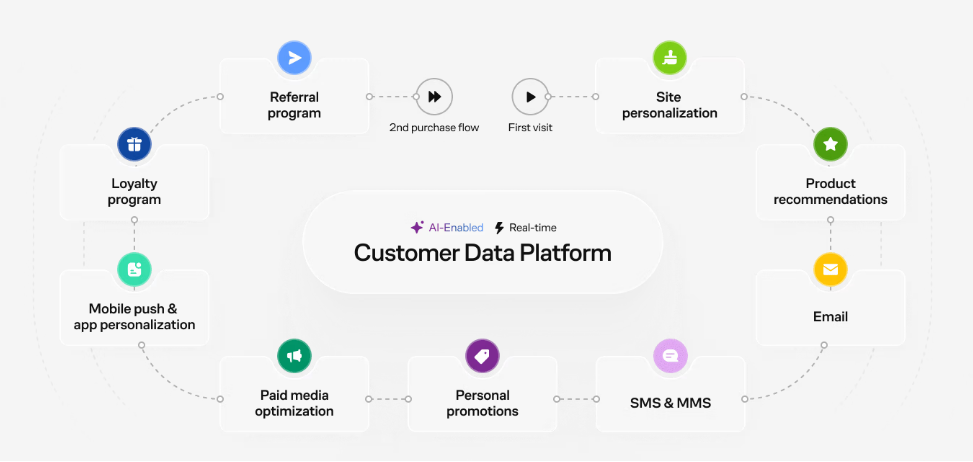
Maestra is an all-in-one marketing personalization platform built for mid-market and enterprise DTC ecommerce brands that need to consolidate their marketing stack.
Its key features include:
Real-time CDP: Identity resolution, RFM segmentation, and computed fields with up to 2M requests per minute at sub-300ms processing speed
8+ messaging channels: Email, SMS, MMS, RCS, WhatsApp, Viber, mobile push, web push, and chatbot integrations from a single campaign manager
Native loyalty and promotions: Points, tiers, challenges, gift cards, referrals, and a promo code pool engine built into the platform
On-site personalization: Pop-ups, product quizzes, gamified lead capture, NPS/CSAT surveys, and exit-intent modals
Dedicated CSM included: An embedded marketer with a CSM-to-client ratio capped at 1:15 versus 1:60+ at competing platforms, with a 5-minute response SLA via Slack
For brands running Bluecore alongside separate tools for loyalty, recommendations, and on-site personalization, Maestra replaces the entire stack with a single subscription.
Why Choose Maestra Over Bluecore for Stack Consolidation
Maestra stands out in the following areas:
Native Loyalty, Referrals, and In-App Personalization
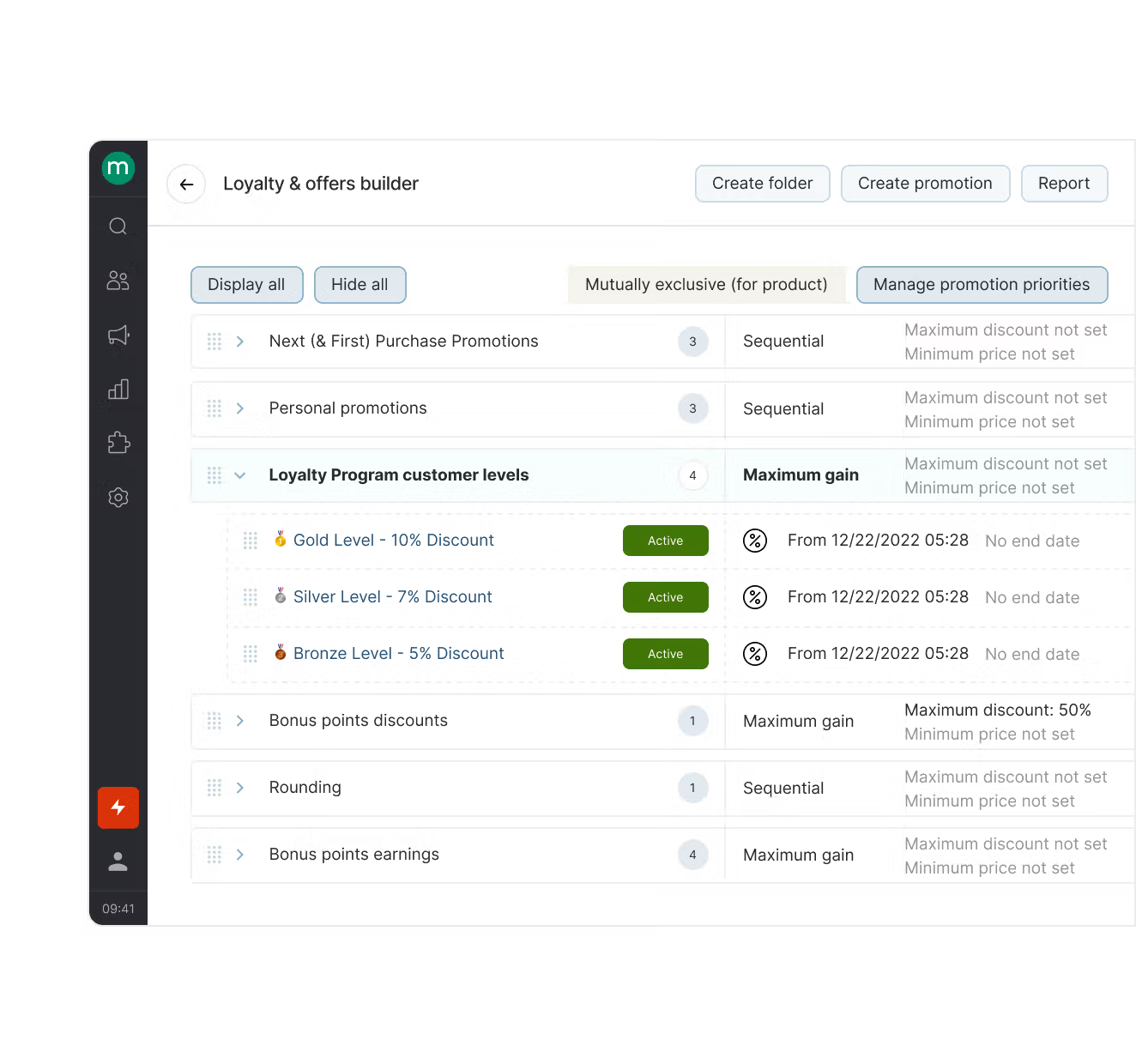
Bluecore does not include a native loyalty program, referral engine, or in-app personalization module. Brands on Bluecore typically supplement with Yotpo, LoyaltyLion, or Smile.io for loyalty.
Maestra includes all of these in a single subscription. A loyalty tier upgrade triggers an email and a site-level upsell bar in real time from the same platform and customer profile. Maestra's RCS and WhatsApp support gives brands richer messaging formats without adding a separate vendor, covering channels that Bluecore's published roadmap does not yet include.
Source: Maestra
Embedded Execution vs. Advisory Customer Success
Every Maestra subscription includes an "embedded marketer" who handles migration, flow setup, email and site design, A/B test execution, and ongoing campaign management. This contrasts with Bluecore's model, where campaign setup and creative production are billable Professional Services Optional Add-Ons purchased separately.
Month-to-Month Pricing Without Enterprise Lock-In
Bluecore's MSA states payment obligations are "non-cancellable and non-refundable" with no early termination for convenience. Maestra bills month-to-month with no long-term commitment required, and billing doesn't begin until the account is fully live. Migration, integration, flow setup, and email design are included in the subscription at no additional cost.
NOTE: We also evaluated Sendlane and Simon Data. Sendlane offers a clean email and SMS interface with competitive pricing but lacks native loyalty, on-site personalization, and product recommendations. Simon Data brings enterprise CDP credentials but requires in-house data engineering. Maestra offers the broadest channel and feature coverage with an embedded execution model for mid-market DTC brands.
Maestra Pricing
Maestra uses an all-in pricing model: a single monthly subscription that includes every module (CDP, email, all messaging channels, site and app personalization, product recommendations, loyalty, promotions, analytics, and dedicated CSM). No per-module add-on fees.
All-inclusive subscription: Scales from 10,000 to 65 million active profiles via the pricing slider. One disclosed data point: approximately $4,979/month (profile count at that price not specified). Third-party estimates suggest entry pricing around ~$2,990/month for up to 150,000 contacts.
Includes: CDP, all messaging channels, site and app personalization, product recommendations, loyalty, referrals, promo code engine, analytics, and dedicated CSM.
Up to 3 brands included; additional brands at $650/month each.
Month-to-month billing; no long-term commitment; billing starts only after the account is fully live.
SMS, MMS, RCS, and WhatsApp carry per-message fees (SMS 10DLC: $0.0045 + carrier fees).
Who Should Use Maestra?
Choose Maestra if:
Your current stack combines Bluecore with separate tools for loyalty, product recommendations, and on-site personalization, and the integration overhead and total vendor cost have become unsustainable.
You need RCS, WhatsApp, or in-app mobile personalization alongside email and SMS without adding separate messaging vendors.
Your DTC brand is in the $10M-$100M revenue range with a small-to-midsize marketing team and you need managed execution support included in the subscription rather than as a paid add-on.
Month-to-month pricing flexibility and the ability to exit without a multi-year commitment matter to your evaluation process.
The Final Verdict
Bluecore excels as a retail marketing platform for enterprise brands, but growing businesses often need tools that match their current scale, channel priorities, or commercial requirements. Based on our research, here are the best alternatives:
ZoomInfo for B2B go-to-market intelligence, pipeline generation, and account-based marketing
Klaviyo for self-serve access, transparent pricing, and same-day Shopify deployment
Braze for enterprise cross-channel mobile engagement spanning apps, push, and in-session experiences
Listrak for mid-market retail automation with U.S.-based hands-on strategic partnership
Attentive for SMS-first retention programs with deep mobile messaging infrastructure
Omnisend for full ecommerce automation accessible from a genuine free plan
Maestra for consolidating loyalty, RCS, WhatsApp, and managed execution in a single subscription
You don't have to choose between Bluecore and these alternatives exclusively. Many brands use Bluecore for its retail-native predictive AI alongside specialized tools for specific channels or use cases. Consider your specific needs, current scale, and growth trajectory when deciding which solution fits best.
Want to know which accounts are in-market for your solution right now? ZoomInfo combines B2B data with AI-driven intelligence to help you find, win, and grow customers. Start your free trial and see the full context behind every deal.
Bluecore Alternatives FAQ
Why do businesses look for Bluecore alternatives?
Bluecore is a strong retail marketing platform, but its enterprise-only contract model (no public pricing, no free trial, non-cancellable annual contracts), historically underdeveloped SMS capabilities, steep learning curve for advanced features, and limited reporting depth relative to its data lead many growing brands to evaluate alternatives that better fit their current scale and channel priorities.
What is the best overall Bluecore alternative?
There is no single best alternative because Bluecore covers several distinct functions.
Klaviyo is the top choice for self-serve retail email and SMS with transparent pricing. Attentive leads for SMS-first retention programs. Braze is the strongest option for enterprise brands with mobile apps as a primary touchpoint. ZoomInfo is the best choice for B2B go-to-market intelligence and pipeline generation.
Is there a free alternative to Bluecore?
Omnisend offers a permanent free plan with 250 contacts, 500 emails per month, and access to all core features including automation workflows, segmentation, and reporting. Klaviyo also offers a permanent free plan with 250 active profiles and 500 email sends. ZoomInfo provides a permanent free tier (ZoomInfo Lite) for B2B data access with 10 monthly export credits, plus a 7-day free trial of the full platform.
Which Bluecore alternative is best for Shopify brands?
Klaviyo is built for the Shopify ecosystem, with a native integration deepened through a March 2026 partnership. An IDC study found Shopify brands using Klaviyo achieved 73% revenue growth over three years. Omnisend is also strong for Shopify with a one-click integration and a free plan that includes full ecommerce automation.
How does Bluecore compare to Klaviyo for email marketing?
Bluecore is stronger for enterprise retailers with large catalogs, offering patented product-catalog-aware triggers (price drop, new arrival, back-in-stock) and 20+ predictive AI models trained across 400+ brands. Klaviyo is stronger for mid-market DTC brands that need transparent pricing, same-day deployment, and predictive analytics accessible without a data science team.
Bluecore requires an enterprise contract; Klaviyo starts free.
Which alternative is best for SMS marketing?
Attentive is the clear leader for SMS-led marketing, with patented Two-Tap subscriber acquisition, 98.7% SMS deliverability across 2 billion+ daily sends, and AI trained on 90 billion retail messages. Its four-channel mobile platform (SMS, email, RCS, push) from a single subscriber profile makes it the deepest mobile messaging infrastructure for retail brands.
Can I use ZoomInfo alongside Bluecore?
Yes. ZoomInfo and Bluecore serve different markets. Bluecore handles B2C retail personalization (email, SMS, on-site, paid media), while ZoomInfo provides B2B go-to-market intelligence (prospecting, intent data, account insights). Retail technology companies and B2B commerce platforms commonly use both: Bluecore for customer engagement and ZoomInfo for pipeline generation and buyer identification.
Which Bluecore alternative offers the best customer support?
Listrak and Maestra both stand out. Listrak includes dedicated U.S.-based strategists, weekly program reviews, and managed execution as the default delivery model. Maestra assigns an embedded CSM to every account at a 1:15 ratio with a 5-minute response SLA via Slack. Omnisend provides 24/7 live chat support on all plans, including its free tier.
