
Choosing between CaptivateIQ and Spiff for incentive compensation management comes down to five questions:
Do you need a standalone compensation platform or one embedded in your CRM?
Are you managing simple commission plans or complex multi-tier structures that change often?
How important is it that your compensation team can build and modify plans without IT or consultants?
Do you need territory planning, quota setting, and commission payout connected in one system?
Is your sales team on Salesforce, and does native CRM integration outweigh independent platform flexibility?
Here's what we recommend:
CaptivateIQ is the platform for compensation and RevOps teams that need to model anything. Its no-code SmartGrid engine handles the full range of commission logic (multi-tier accelerators, split credits, draws, clawbacks) without engineering support. CaptivateIQ also connects incentive compensation with sales planning (territory management, quota setting, capacity planning) in one workspace, so changes in one area flow to the other automatically. Named a Forrester Wave Leader for Sales Performance Management (Q1 2025), CaptivateIQ serves 800+ companies including Gong, Expedia, and Boston Scientific. The tradeoff: a steep initial setup curve, and quote-based pricing that requires a sales conversation.
Salesforce Spiff is built for organizations already on Salesforce Sales Cloud that want commission visibility inside the CRM. Reps see projected earnings on the same opportunity page where they build quotes, through the Commission Estimator. Its spreadsheet-familiar Spiff Designer and transparent pricing ($75/user/month) make it straightforward for mid-market Salesforce shops. But since the February 2024 Salesforce acquisition, reviewers on G2 and Capterra have flagged declining support quality and slower feature development, and teams not on Salesforce face $250/connector/month charges for every external integration.
Both platforms solve commission calculation and payout. But neither addresses the upstream question that determines whether those commissions drive the right outcomes: are your reps targeting the right accounts with the right data? That's where ZoomInfo fits in.
ZoomInfo is an AI-powered go-to-market platform that feeds intelligence into your compensation strategy. With 500M contacts, 100M companies, 135M+ verified phone numbers, and 200M+ verified business emails, ZoomInfo gives revenue teams the targeting accuracy and account intelligence that make quota attainment realistic. Its GTM Context Graph combines this data with your CRM records, conversation transcripts, and behavioral signals to show not just what happened in a deal, but why. Sellers reach this intelligence through GTM Workspace, marketers and RevOps through GTM Studio, and any custom tool through APIs and MCP. For organizations running CaptivateIQ or Spiff, ZoomInfo is the complementary data and intelligence platform that makes the targets behind your comp plans achievable.
To see how ZoomInfo's intelligence can sharpen your go-to-market execution, start a free trial.
CaptivateIQ vs. Spiff vs. ZoomInfo at a glance
CaptivateIQ | Salesforce Spiff | ZoomInfo | |
|---|---|---|---|
Primary function | Incentive compensation + sales planning | Incentive compensation (CRM-native) | B2B data, intelligence, and GTM execution |
Planning capabilities | Territory, quota, and capacity planning included | Requires separate Salesforce Sales Planning add-on | Territory design and TAM analysis via data intelligence |
CRM integration | Salesforce, HubSpot, Dynamics | Native Salesforce; others at $250/connector/month | Salesforce, HubSpot, Dynamics + 120+ marketplace integrations |
AI capabilities | AI agents for plan building, payee explanations, territory config | Spiff Assistant for formula help and plan explanations | GTM Context Graph, AI-powered outreach, intent signals |
Analyst recognition | Forrester Wave Leader (Q1 2025); Gartner Customers' Choice (2024) | Part of Salesforce (Gartner #1 SFA) | Forrester Leader (Intent Data); Gartner Leader (ABM); 133 G2 #1 rankings |
Relationship to your stack | Manages commissions and planning | Manages commissions inside Salesforce | Feeds the data and intelligence that make comp targets achievable |
Pricing model | Quote-based per-seat + setup fee | $75/user/month (annual) | Consumption-based, custom-quoted |
Free trial | No (product tours only) | No | Yes (7-day trial + permanent free Lite tier) |
Best for | Mid-market and enterprise comp teams with complex plans | Salesforce shops wanting CRM-embedded commissions | Revenue teams needing account intelligence and targeting |
CaptivateIQ handles complexity that Spiff can't match
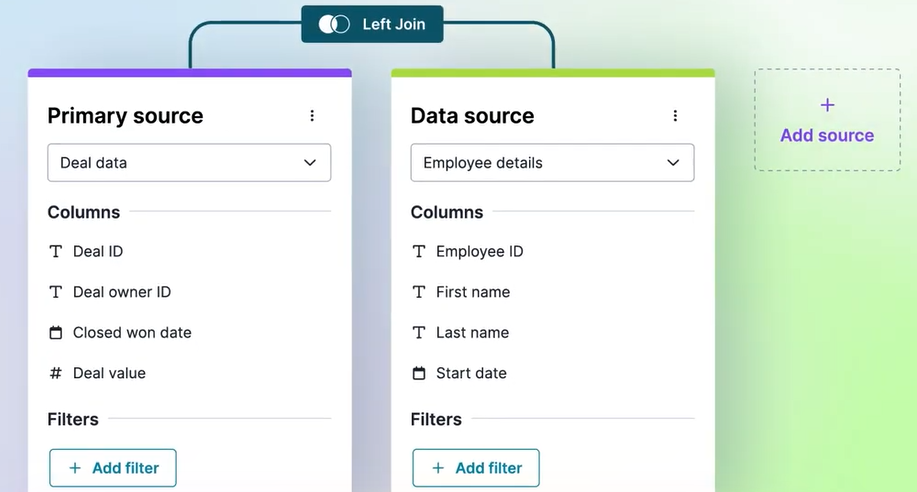
CaptivateIQ was built for the compensation team that has outgrown every other tool. Its SmartGrid engine processes 10M+ source transactions in 12 seconds and runs over 6.25 trillion calculations per month across its customer base. That scale matters when your commission structures stack multi-tier accelerators on territory-based splits with draw schedules and clawbacks that change quarterly.
Source: CaptivateIQ
The no-code interface is where CaptivateIQ earns its reputation. Compensation teams build and modify plans through a spreadsheet-like canvas that supports up to 7,000 simultaneous plans. G2 reviewers consistently praise the ability to "build anything" without filing IT tickets or hiring consultants.
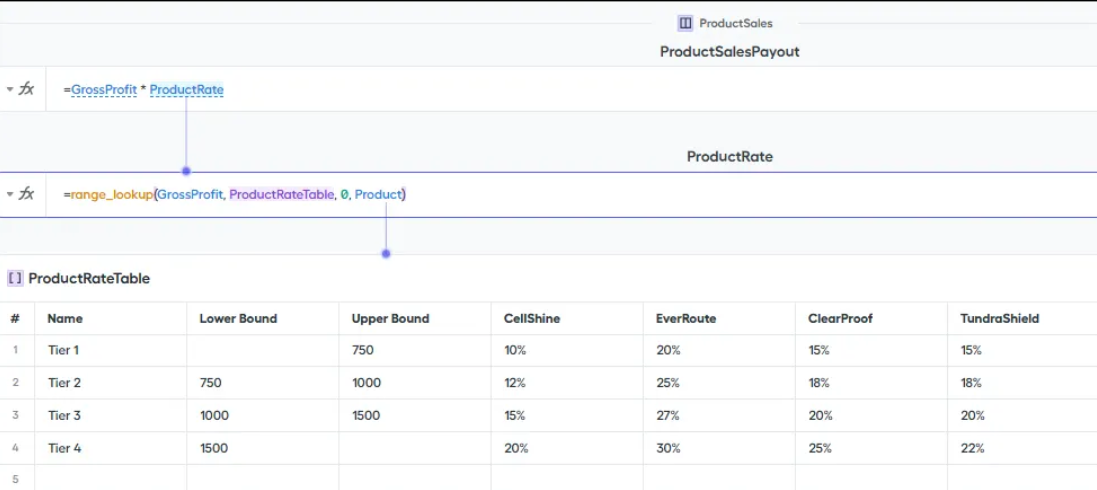
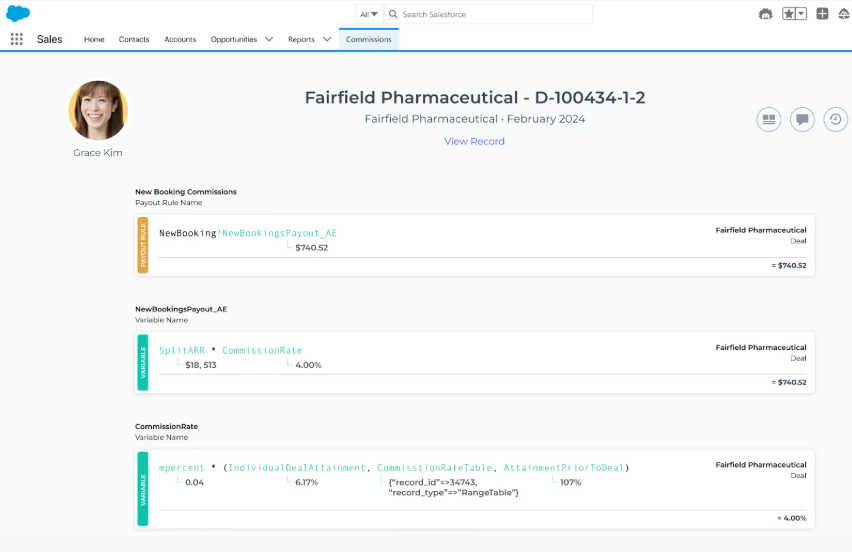
Spiff handles standard commission structures well. Its Spiff Designer uses a familiar spreadsheet interface with hundreds of pre-built models, and its four native accelerator functions (tier_payout, mamount, mpercent, and range_lookup) cover common tiered and progressive rate structures. For a 200-rep SaaS company with three or four plan variants, Spiff handles the math fine.
Source: Spiff
But when plans grow nested (50+ plan variations across global business units with different fiscal calendars) the two platforms diverge. CaptivateIQ's SmartGrid processes data transformation and commission calculation in one engine. Spiff relies on periodic data syncs from connected systems, and Capterra reviewers have noted a ~30-minute refresh lag during high-volume deal flow that undercuts the "real-time" promise.
Spiff wins when your world is Salesforce
If your CRM is Salesforce and you want commission data to feel native to the sales workflow, Spiff has a structural advantage CaptivateIQ can't replicate.
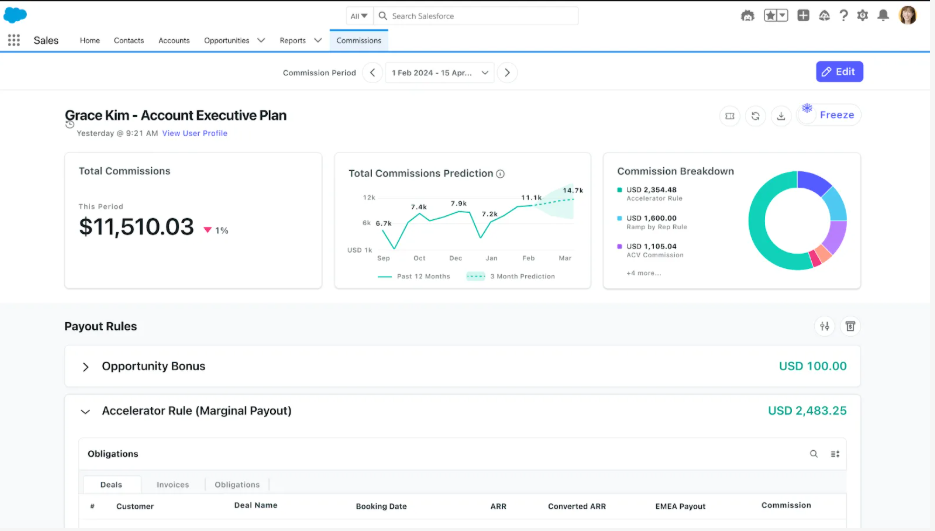
The Commission Estimator sits on the opportunity record page. A rep adjusting a deal's discount or contract length sees the earnings impact instantly, without opening another application. That pre-deal visibility changes behavior. Instead of reps asking "what will I make if I close this?" after the fact, they see the answer while shaping the deal. Salesforce positions this as aligning pricing decisions to compensation incentives at the moment they matter most.
Source: Spiff
Statement Tracing lets reps audit their own calculations line by line, seeing payout rules, rate tables, and data filters without raising a support ticket. The Spiff Assistant adds conversational AI that explains commission logic in plain English.
Source: Spiff
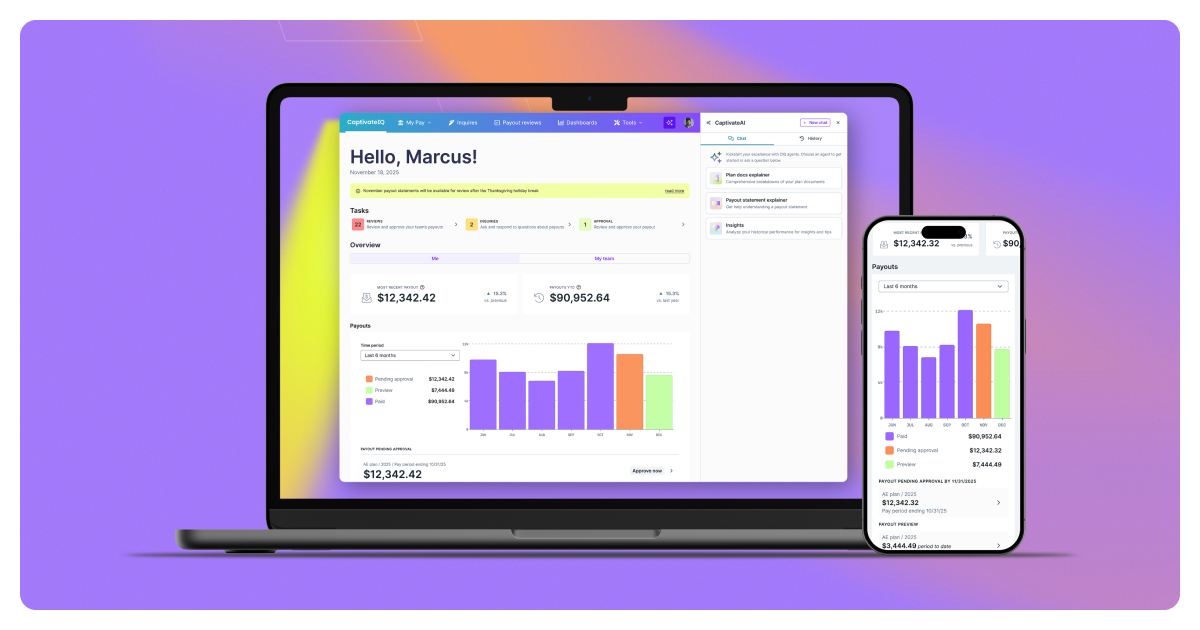
CaptivateIQ offers similar rep-facing visibility through its AI-powered payee experience, with explainable statements that trace every payout to plan clauses and source transactions. But the experience lives inside CaptivateIQ's own platform, not inside the CRM. Reps must open a separate application to check their earnings.
Source: CaptivateIQ
For Salesforce-native organizations, that difference matters daily. For teams on HubSpot, Dynamics, or another CRM, the math inverts: Spiff's $250/connector/month per external integration adds up fast, while CaptivateIQ connects to Salesforce, HubSpot, and Dynamics via native connectors without per-connector surcharges.
CaptivateIQ connects planning to payout; Spiff stops at commission calculation
This is where CaptivateIQ pulls ahead for organizations that want sales planning and compensation in one system.
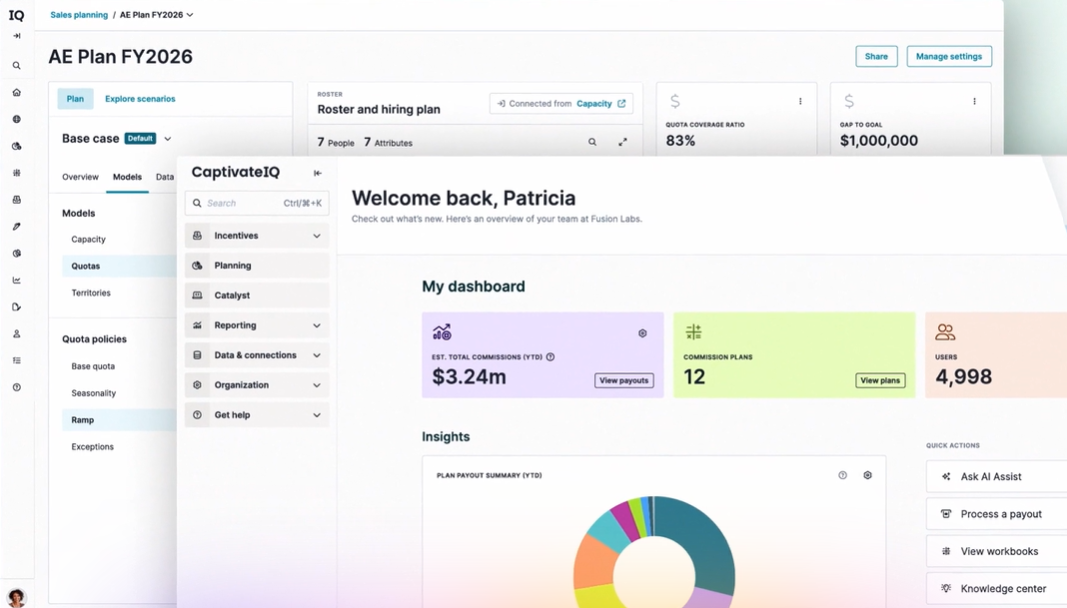
CaptivateIQ Planning puts territory management, quota setting, and capacity planning on the same data layer as incentive compensation. When a territory changes, quota targets adjust automatically. When quotas adjust, commission structures recalculate. No reconciliation spreadsheets, no manual updates across disconnected systems.
Source: CaptivateIQ
The practical value: a RevOps team can model a territory realignment, see how it changes quota distribution, and preview the compensation impact, all in one platform.
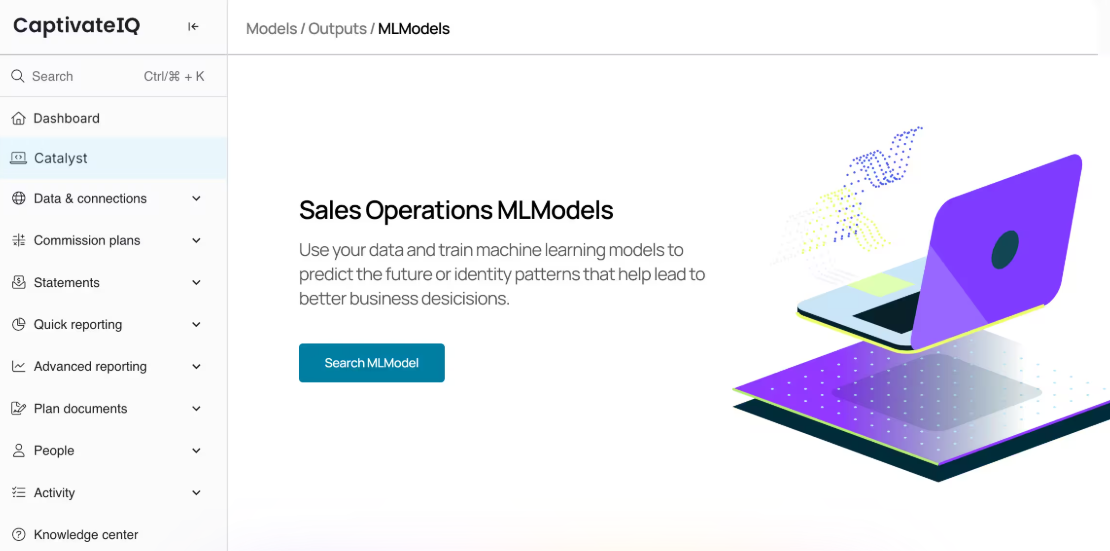
CaptivateIQ Catalyst adds predictive ML modeling on top, generating attainment forecasts, payout projections, and anomaly detection trained on each customer's historical data.
Source: CaptivateIQ
Spiff handles commissions well but doesn't cover planning natively. Territory management, quota setting, and capacity planning require Salesforce's separate Sales Planning product, which Salesforce is retiring in its v1 form in Summer 2026 and migrating to an updated platform. Organizations can assemble the full SPM picture through Salesforce's broader suite (Spiff + Sales Planning + Maps + Revenue Intelligence), but they're buying and integrating multiple products rather than working from a single data model.
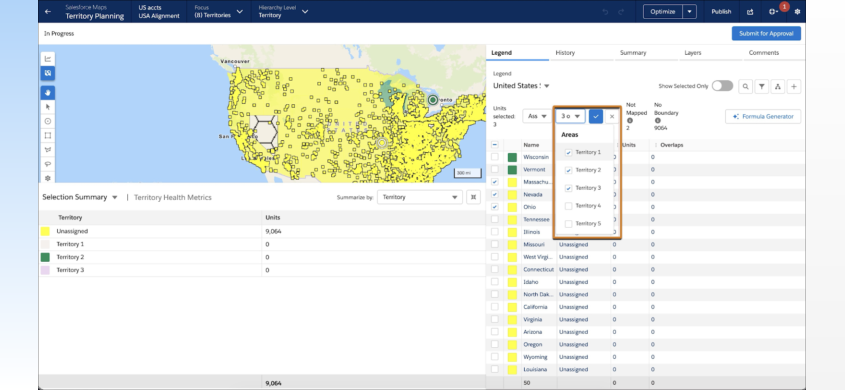
Source: Spiff
The intelligence gap: compensation plans are only as good as the data behind them
Both CaptivateIQ and Spiff automate what happens after a deal closes: calculating commissions accurately and paying reps on time. That's important work. But neither platform answers the question that determines whether those comp plans drive results: are your reps working the right accounts?
A comp plan with aggressive accelerators above 120% quota attainment means nothing if reps are calling outdated phone numbers, targeting accounts outside their ICP, or missing buying signals that would tell them when to engage. The commission plan motivates behavior. The data and intelligence layer tells reps where to direct it.
This is where ZoomInfo complements either ICM platform.
ZoomInfo's GTM Context Graph processes 1.5B+ data points daily, combining B2B data with a customer's CRM records, conversation transcripts, and behavioral signals. The result: an intelligence layer that reveals not just what happened in a deal, but why, and which patterns predict what happens next.
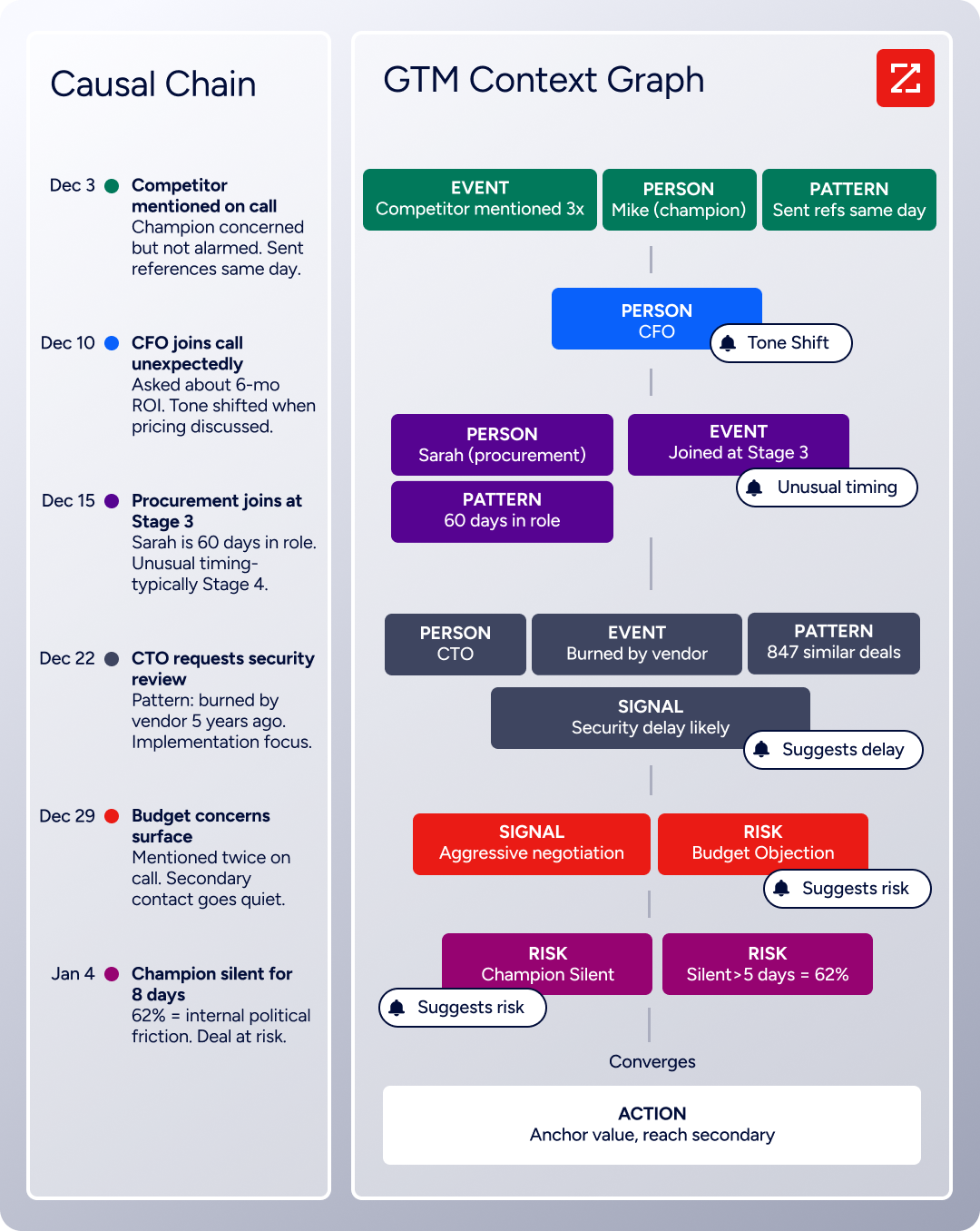
Source: ZoomInfo
For a RevOps team designing comp plans in CaptivateIQ or Spiff, ZoomInfo provides the upstream intelligence that makes those plans effective:
Territory design grounded in real market data. ZoomInfo's 300+ company attributes let you build territories around actual market opportunity rather than zip codes and guesswork.
Quota targets tied to achievable pipeline. Buyer Intent data tracking 210 million IP-to-Organization pairings shows which accounts are actively researching solutions, giving quota-setters real demand signals instead of last year's number plus 15%.
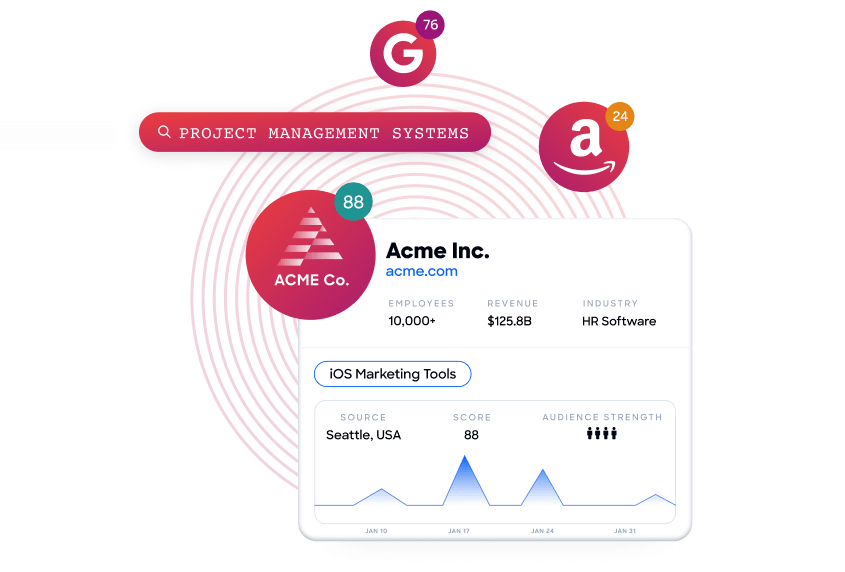
Source: ZoomInfo
Rep productivity that compounds commission ROI. GTM Workspace users report booking nearly 60% more meetings per week and growing pipelines by 23%. When reps hit quota more consistently, your commission spend becomes an investment with measurable returns rather than a cost center.
"That combination of our internal CRM data, external signals, and AI that's given all that context has helped us craft very specific account- and persona-based messages. And people have responded to them right away." (Toby Carrington, Chief Business Officer, Seismic)
Pricing models reflect different philosophies
CaptivateIQ does not publish prices. The pricing page describes "simple, per-seat pricing that doesn't skyrocket over time plus a one-time setup fee," but all quotes are custom. Pricing depends on three factors: number of payees, plan complexity, and integrations required.
CaptivateIQ Incentives, Planning, and Catalyst are three distinct products, each priced separately. ASC-606 reporting is an add-on. Premier and Elite support tiers cost extra. No free trial exists, though interactive product tours are available.
Salesforce Spiff publishes a single tier at $75/user/month, billed annually. That base includes plan management, rep statements, the Commission Estimator, mobile app, dispute resolution, audit logs, document management, and ASC 606 expense reporting. But costs climb from there:
Third-party connectors: $250/connector/month per integration beyond native Salesforce
Premium support: 30% of net contract price per year
Implementation and professional services: quoted separately
No free trial: Salesforce explicitly states trial licenses are not available
A 50-rep team on Spiff pays $45,000/year in license fees alone. Add two non-Salesforce connectors ($6,000/year) and premium support (~$13,500/year), and the annual cost reaches roughly $64,500 before implementation.
ZoomInfo uses consumption-based pricing custom-quoted by usage, seats, and features. Unlike either ICM platform, ZoomInfo offers a permanent free tier (ZoomInfo Lite) with access to the B2B database and 10 monthly export credits, plus a 7-day free trial of paid features, both with no credit card required.
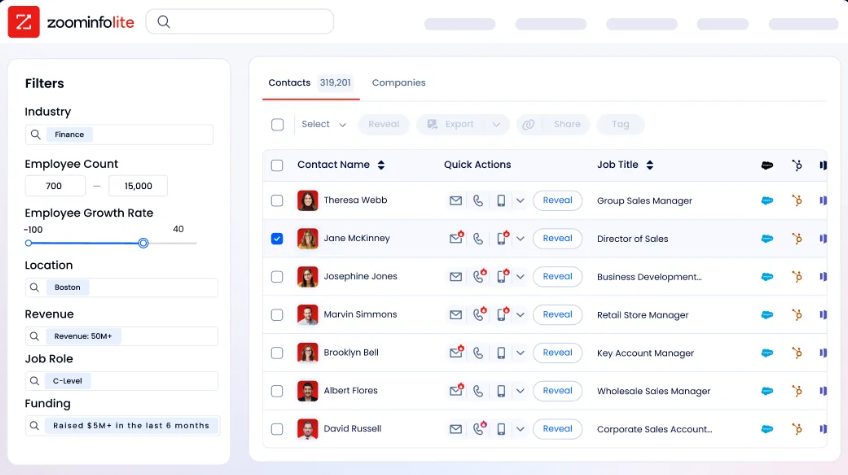
Source: ZoomInfo
Support and implementation: where the acquisition shows
CaptivateIQ's support reputation is strong. G2 reviewers and Capterra users call out CSM responsiveness, even for complex implementations. Forrester cited "time-to-value" as one of the criteria where CaptivateIQ scored highest. The company offers instructor-led and self-paced training with certifications and maintains a partner network of system integrators.
The tradeoff: CaptivateIQ's initial setup is substantial. The platform starts as a blank canvas, and G2 reviewers note that getting productive requires understanding how your plans are structured before the system delivers value. Implementation can take 4-6 months for complex deployments, though the pricing page claims "up and running in a matter of weeks" for simpler configurations.
Salesforce Spiff's support story has changed since the February 2024 acquisition, and not for the better. This is the most consistent complaint across review platforms. Capterra reviewers note "Terrible customer support which they admitted was a symptom of the acquisition." G2 reviews describe Salesforce deflecting support questions to seminars rather than resolving them directly. Feature development has also slowed: G2 reviewers report feature requests sitting on the roadmap for extended periods.
Spiff does benefit from Salesforce's broader training infrastructure. Trailhead modules are free, live Trailhead Academy workshops cover onboarding, and a sandbox environment lets you test before going live. But when something goes wrong, the quality of direct support matters more than the volume of documentation.
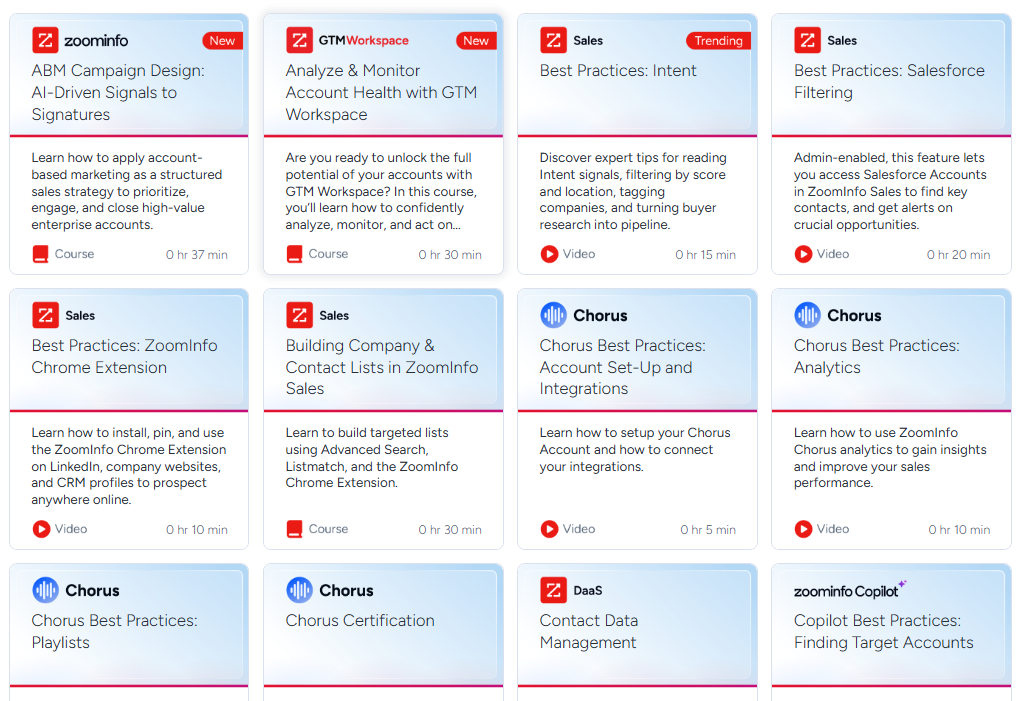
ZoomInfo redesigned its onboarding from 30 to 90 days, producing a 25% improvement in customer satisfaction scores and winning Rocketlane's Golden Comet award for Best Customer Onboarding Team of 2024. ZoomInfo University offers role-specific learning paths and certifications across sales, marketing, and administration.
Source: ZoomInfo
AI capabilities take different paths
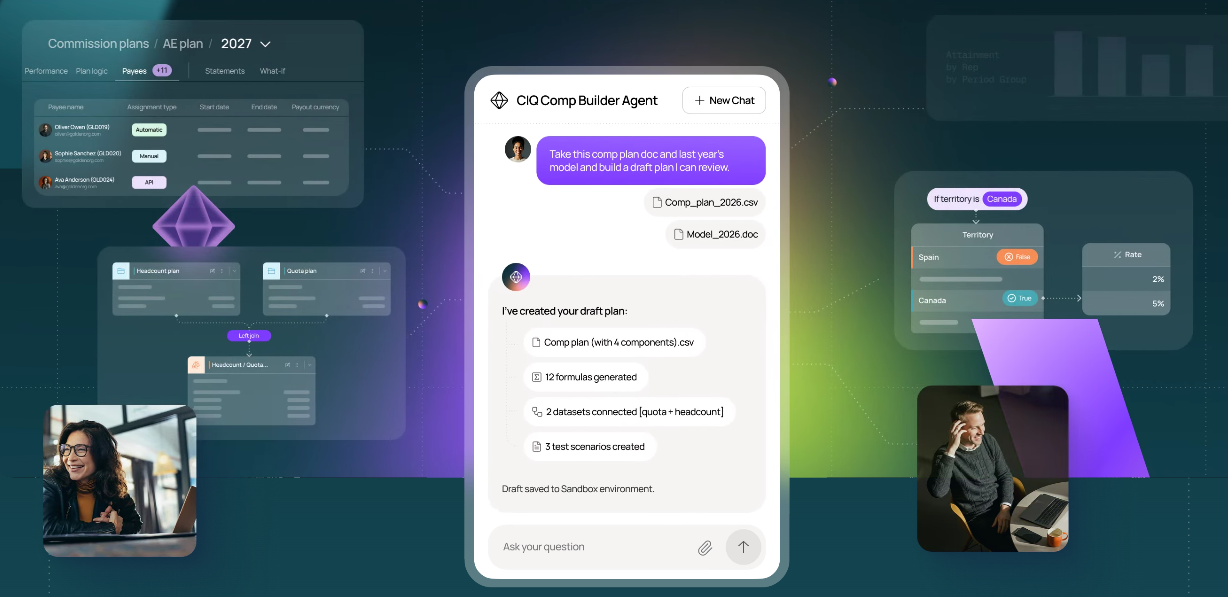
CaptivateIQ has gone furthest with AI in the ICM space. Its AI Agents, launched in May 2026, include three task-specific agents: a Comp Builder that creates plans from natural language descriptions, a Comp Ops agent that explains payouts in plain English and catches anomalies, and a Rev Planning agent that configures territories from goal descriptions. Forrester gave CaptivateIQ a perfect score on "advanced AI capabilities" in the Q1 2025 Wave. The agents operate on live platform data with the same permissions and approval workflows as manual actions.
Source: CaptivateIQ
Salesforce Spiff's Spiff Assistant offers conversational AI that explains commission formulas, optimizes plan logic, and answers questions in natural language. It helps both admins debugging formulas and reps understanding their pay.
Salesforce announced AI-powered commission plan design at Dreamforce 2025, with dynamic modeling and instant impact analysis, though specific ship dates haven't been confirmed. As Spiff moves into Salesforce's Agentforce narrative, deeper AI integration is likely coming.
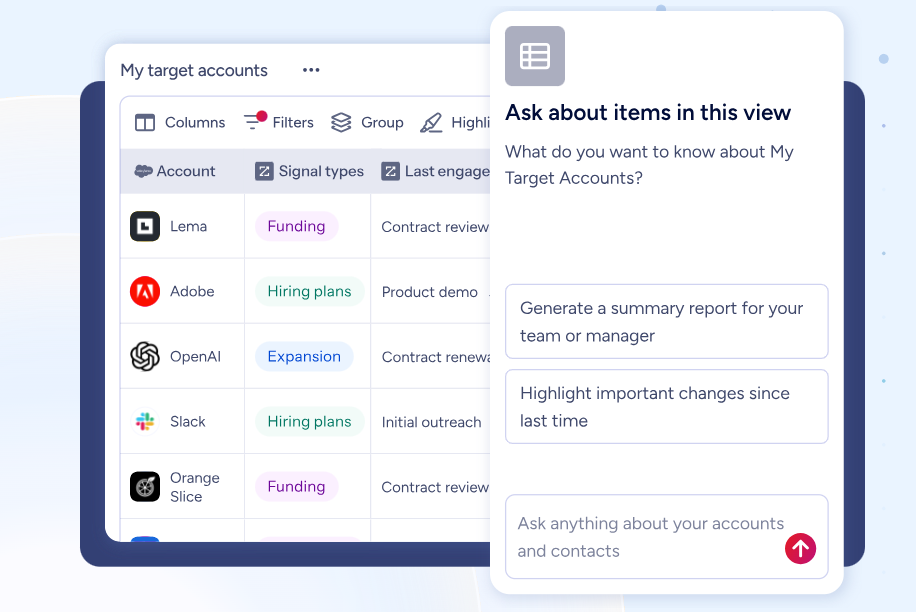
ZoomInfo's AI operates at a different level of the revenue stack. The GTM Context Graph connects CRM records, conversation transcripts, intent signals, and deal outcomes to identify patterns that predict what works. GTM Workspace agents handle account research, outreach drafting, signal monitoring, and CRM updates. Seismic attributed 39% of active pipeline to opportunities identified or influenced by ZoomInfo signals, with the sales team becoming 54% more productive.
Source: ZoomInfo
"ZoomInfo's not just a contact data company anymore. They've built a full system of execution. GTM Intelligence actually works the list, writes the outreach, triggers the play, and helps drive predictable growth." (Ian Brodie, CEO & Co-Founder, Levanta)
Compliance and audit readiness
Both ICM platforms take compliance seriously, as they should for systems that calculate and authorize financial payouts.
CaptivateIQ maintains SOC 1 and SOC 2 certifications (Security, Availability, Confidentiality), with a dedicated SOX compliance page covering segregation of duties, change control, audit logging, granular access controls, and ASC 606 reporting. Data is encrypted with AES-256 at rest and TLS 1.2+ in transit. Statement locking prevents unauthorized post-approval changes. The platform is AWS-hosted with WAF, DDoS mitigation, and geographically separated disaster recovery.
Salesforce Spiff inherits Salesforce's enterprise compliance program, which includes SOC 1 Type II, SOC 2 Type II, and ISO certifications (27001, 27017, 27018, 27701) explicitly covering "Salesforce Spiff on Hyperforce." ASC 606 and IFRS 15 compliance reporting is included in the base plan, not an add-on. ML-powered record matching, effective dating, and statement freezing create a layered audit trail. Platform-wide MFA is required.
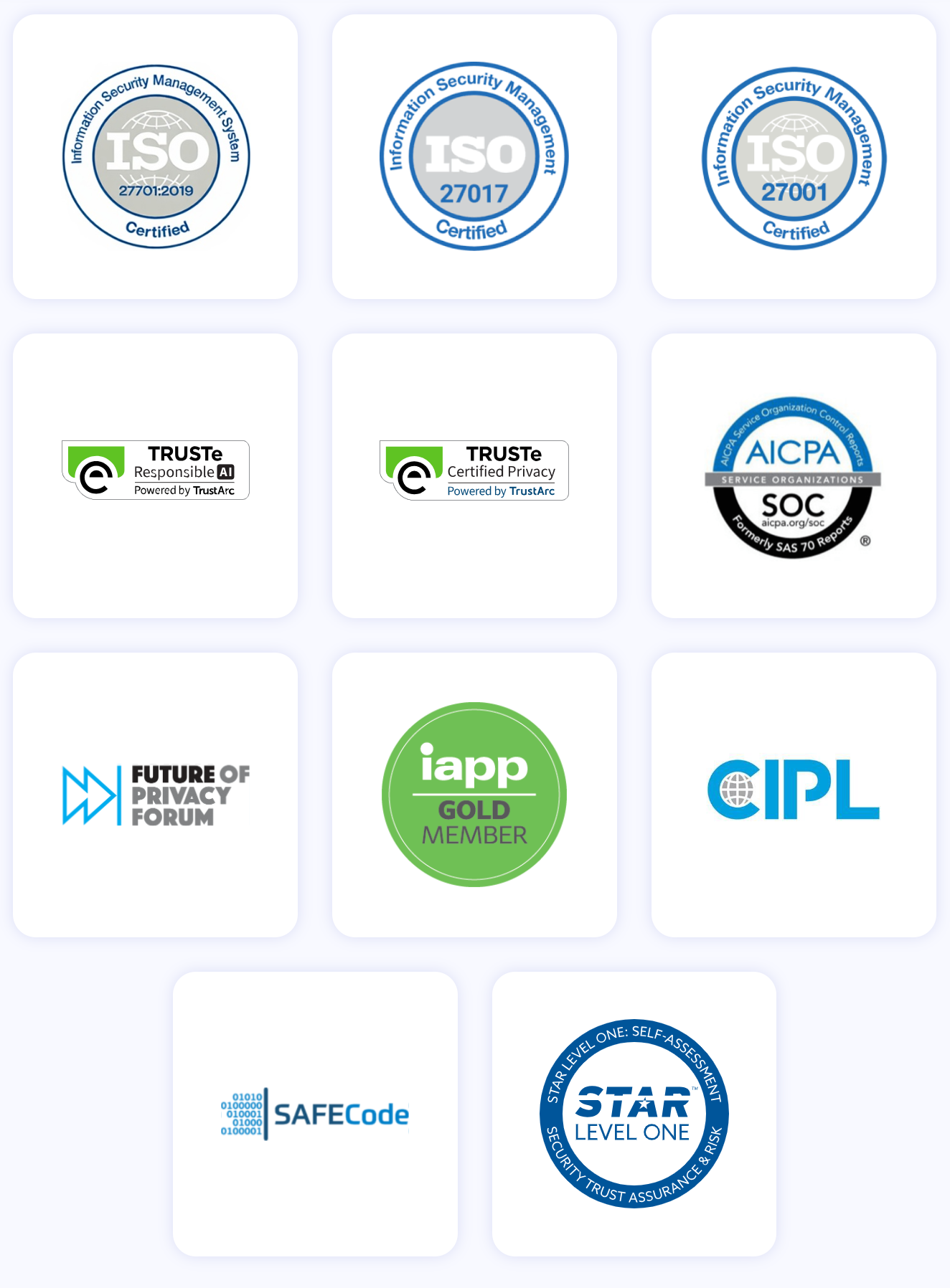
ZoomInfo maintains ISO 27001, ISO 27701, SOC 2 Type II, and TRUSTe GDPR/CCPA certifications, all renewed annually. As a registered data broker in California and Vermont, ZoomInfo maintains compliance infrastructure at the data layer itself. Its dedicated Trust Center at trust.zoominfo.com provides real-time transparency.
For regulated industries, both CaptivateIQ and Spiff pass the compliance bar. CaptivateIQ charges extra for ASC-606 reporting; Spiff includes it. Spiff benefits from Salesforce's broader certification portfolio (including FedRAMP and PCI DSS coverage at the platform level), though buyers should verify which certifications explicitly extend to the Spiff service.
CaptivateIQ vs. Spiff vs. ZoomInfo: Which should you choose?
These three platforms occupy different positions in the revenue stack, and the right combination depends on your team's structure, CRM, and maturity.
Choose CaptivateIQ if:
Your commission structures are complex, multi-layered, and change frequently
You want territory planning, quota setting, and compensation connected in one platform
Your compensation team needs to build and modify plans without engineering support
You're running a CRM other than Salesforce, or you want CRM-agnostic flexibility
You're willing to invest in a 4-6 month implementation for long-term capability
Choose Salesforce Spiff if:
Your organization runs on Salesforce Sales Cloud and wants commissions inside the CRM
Your commission plans are standard enough that a spreadsheet-familiar designer can handle them
You value transparent per-seat pricing over quote-based negotiations
Pre-deal commission visibility embedded on opportunity pages is a priority
You're prepared to supplement with Salesforce's Sales Planning product for territory and quota management
Add ZoomInfo to either if:
You want the account intelligence and targeting data that make quota attainment achievable
Your reps need verified contact data, direct dials, and buying signals to execute effectively
You're building territories and quotas and need real market data instead of recycled spreadsheets
You want AI-powered account prioritization, outreach, and pipeline generation alongside your comp platform
Start a free ZoomInfo trial and see the data behind your next territory plan.
Commission accuracy matters. But commissions only drive results when the targets behind them rest on real market intelligence, when reps have the data to reach the right buyers, and when the entire revenue operation shares one source of truth about accounts, intent, and opportunity. CaptivateIQ or Spiff handles the payout. ZoomInfo provides the intelligence that makes the payout worth designing.
CaptivateIQ vs. Spiff vs. ZoomInfo FAQ
What is the core difference between CaptivateIQ, Spiff, and ZoomInfo?
CaptivateIQ is a standalone incentive compensation and sales planning platform built for complex commission structures, with no-code plan building, territory management, and quota setting in one workspace. Salesforce Spiff is a CRM-native incentive compensation tool embedded in Salesforce Sales Cloud, giving reps real-time earnings visibility within their deal workflow. ZoomInfo is a B2B data and intelligence platform that provides account targeting, buyer intent signals, and contact data that make compensation targets achievable. CaptivateIQ and Spiff calculate commissions; ZoomInfo powers the upstream intelligence that drives the pipeline those commissions are paid on.
Which ICM platform is better for complex commission structures?
CaptivateIQ handles more complexity. Its SmartGrid engine supports up to 7,000 simultaneous plans and processes 10M+ source transactions in 12 seconds. Spiff's Designer covers standard tiered and progressive structures well, but CaptivateIQ's no-code flexibility, dependency-aware calculations, and unified planning-to-payout data model give it a clear advantage for organizations with nested, frequently changing comp plans.
How does pricing compare between CaptivateIQ and Spiff?
Spiff publishes a single tier at $75/user/month billed annually, with add-ons for third-party connectors ($250/connector/month) and premium support (30% of net price). CaptivateIQ does not publish prices; all quotes are custom based on payee count, plan complexity, and integration requirements, with a one-time setup fee. CaptivateIQ's three products (Incentives, Planning, Catalyst) are priced separately, and ASC-606 reporting is an add-on. Neither offers a free trial.
Do I need to be on Salesforce to use Spiff?
No, but the experience is significantly better if you are. Over 70% of Spiff's customer base was already on Salesforce at the time of acquisition. The native Salesforce connector is included in the base price, but every additional integration to a non-Salesforce system costs $250/connector/month. CaptivateIQ connects to Salesforce, HubSpot, and Dynamics via native connectors without per-connector charges.
How has the Salesforce acquisition affected Spiff?
Reviewers on G2 and Capterra have noted two consistent changes since the February 2024 acquisition: declining support quality (with Salesforce reportedly deflecting questions to seminars) and slower feature development. On the positive side, Spiff now benefits from Salesforce's enterprise security infrastructure, Trailhead training resources, and a broader SPM product suite. Salesforce has also announced AI-powered commission plan design coming through its Agentforce initiative.
Why would I add ZoomInfo alongside a commission platform?
Commission plans motivate behavior, but they don't tell reps where to direct it. ZoomInfo provides B2B data (500M contacts, 100M companies, 135M+ verified phone numbers), buyer intent signals, and account intelligence that make quota targets realistic. Revenue teams using ZoomInfo report booking nearly 60% more meetings per week and growing pipelines by 23%. If your comp plans reward quota attainment, ZoomInfo helps reps actually attain it.
Which platform has the strongest AI capabilities?
Each uses AI differently. CaptivateIQ leads in ICM-specific AI with three agents built for plan building, compensation operations, and territory configuration, earning a perfect AI score from Forrester. Spiff offers conversational AI for formula explanation and plan comprehension. ZoomInfo's AI operates at the intelligence layer, with a GTM Context Graph that connects deal outcomes, conversation transcripts, and buying signals to power account prioritization, outreach generation, and pipeline prediction.
Can CaptivateIQ and Spiff integrate with ZoomInfo?
Both can connect to ZoomInfo's data through API integrations and standard CRM sync workflows. ZoomInfo enriches the CRM data that both platforms ingest for commission calculations, ensuring rep records, territory assignments, and account attributes are accurate and current. ZoomInfo's API and MCP access mean the same intelligence is available in any downstream tool, including custom-built compensation workflows.
More CaptivateIQ comparisons and alternatives:
