
Choosing between Certinia and Salesforce for your services business starts with five questions:
Do you need a platform designed for professional services delivery, or a general-purpose CRM you can customize?
Is your priority managing the pipeline-to-billing lifecycle in one system, or covering sales, marketing, service, and commerce under one roof?reven
Are you already committed to the Salesforce ecosystem, or evaluating platforms from scratch?
How important is it that go-to-market intelligence, contact data, and buyer signals feed into your day-to-day workflows?
Do you want AI trained on services delivery, or AI that covers every customer-facing function?
In short, here's what we recommend:
Certinia is the right choice for professional services organizations that already run Salesforce CRM and need a single system for resource planning, project delivery, billing, and revenue recognition. Built natively on Salesforce, Certinia closes the gap between sales and delivery by keeping everything on one platform. Its Veda AI agents automate staffing decisions, project summaries, and estimation using data from 90 million real projects. The trade-off: Certinia requires a Salesforce license underneath it, implementation takes months, and the total cost rises fast when you add Salesforce fees, Certinia subscriptions, and implementation costs.
Salesforce is the platform for organizations that need a customizable foundation across sales, service, marketing, commerce, and analytics. With $41.5 billion in annual revenue and 150,000+ customers, it is the CRM market leader. Agentforce, its AI platform, handles everything from autonomous case resolution to AI-drafted sales outreach. But Salesforce was designed as a front-office CRM, not a services delivery engine. Professional services organizations that try to manage project delivery, resource planning, and complex billing natively in Salesforce will find themselves building custom configurations or buying add-ons like Certinia to fill the gaps.
Here's what both platforms miss: neither Certinia nor Salesforce was built to solve the data quality and go-to-market intelligence problem that determines whether your pipeline is healthy. Certinia manages what happens after the deal closes. Salesforce manages the customer relationship. But where do the prospects, the verified contacts, the buying signals, and the account intelligence come from?
ZoomInfo is a B2B data and go-to-market intelligence platform that feeds both Certinia and Salesforce with the data they need. ZoomInfo's database covers 500M contacts, 100M companies, 135M+ verified phone numbers, and 200M+ verified business emails. Its GTM Context Graph combines this data with your CRM records, conversation transcripts, and behavioral signals to reveal not just what happened in your pipeline, but why. ZoomInfo integrates with Salesforce through a native integration, enriching your CRM data with verified contacts, intent signals, and account intelligence. Whether your team works through the GTM Workspace for sellers, GTM Studio for marketers and RevOps, or the API and MCP in any tool, that intelligence reaches every tool where your team works.
If feeding your Salesforce and Certinia stack with verified B2B intelligence sounds like the missing piece, see how ZoomInfo works with your platform.
Certinia vs. Salesforce vs. ZoomInfo at a glance
Certinia | Salesforce | ZoomInfo | |
|---|---|---|---|
Core purpose | Professional services automation and financial management | CRM, sales, service, marketing, commerce | B2B data, go-to-market intelligence, and pipeline generation |
Built for | Services-led businesses (consulting, IT services, software) | Any industry with customer-facing operations | Any B2B organization with a sales or marketing motion |
Platform dependency | Requires Salesforce | Standalone | Integrates with Salesforce, HubSpot, Dynamics, and 120+ tools |
AI focus | Veda AI: staffing, estimation, delivery, customer success | Agentforce: sales, service, marketing, commerce, ITSM | GTM Context Graph: prospecting, signals, account intelligence |
Data strength | Project delivery data (90M+ projects, 2B+ timecards) | Customer relationship data (150,000+ orgs) | B2B contact and company data (500M contacts, 100M companies) |
Pricing transparency | Not published; custom quotes | Published tiers starting at $25/user/month | Custom quotes; free tier available (ZoomInfo Lite) |
Implementation time | 3–9 months | Weeks to 12 months depending on complexity | Deploys in weeks |
Best for | PSA, resource management, services billing, revenue recognition | CRM, pipeline management, customer service, marketing automation | Prospecting, data enrichment, intent signals, account intelligence |
They solve different problems
The comparison between Certinia and Salesforce is unusual because Certinia runs on top of Salesforce. They are not direct competitors. They are layers in a stack, each handling a different part of the business.
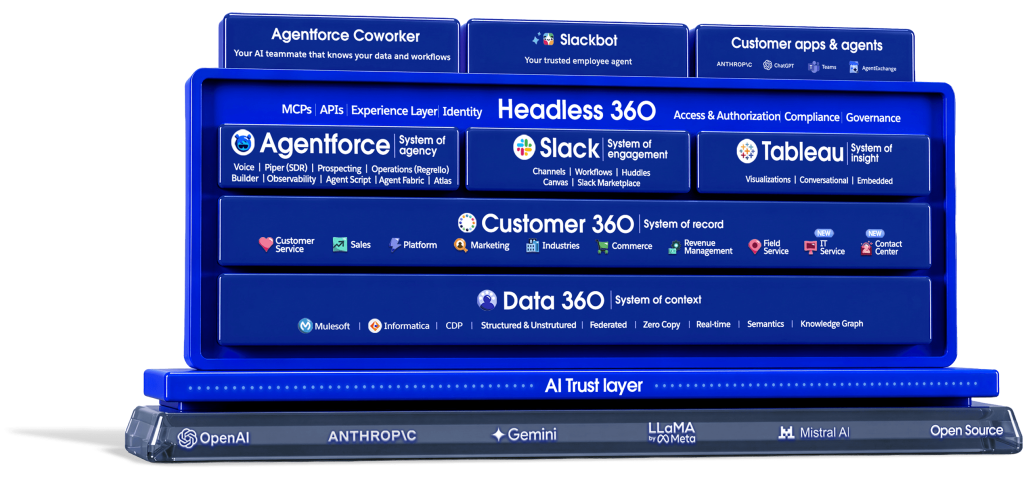
Salesforce manages the front office.
It tracks leads, contacts, opportunities, accounts, and cases. It powers marketing campaigns, service interactions, and commerce transactions. For most companies, Salesforce is the system of record for customer relationships.
Source: Salesforce
Certinia manages what happens after the sale closes.
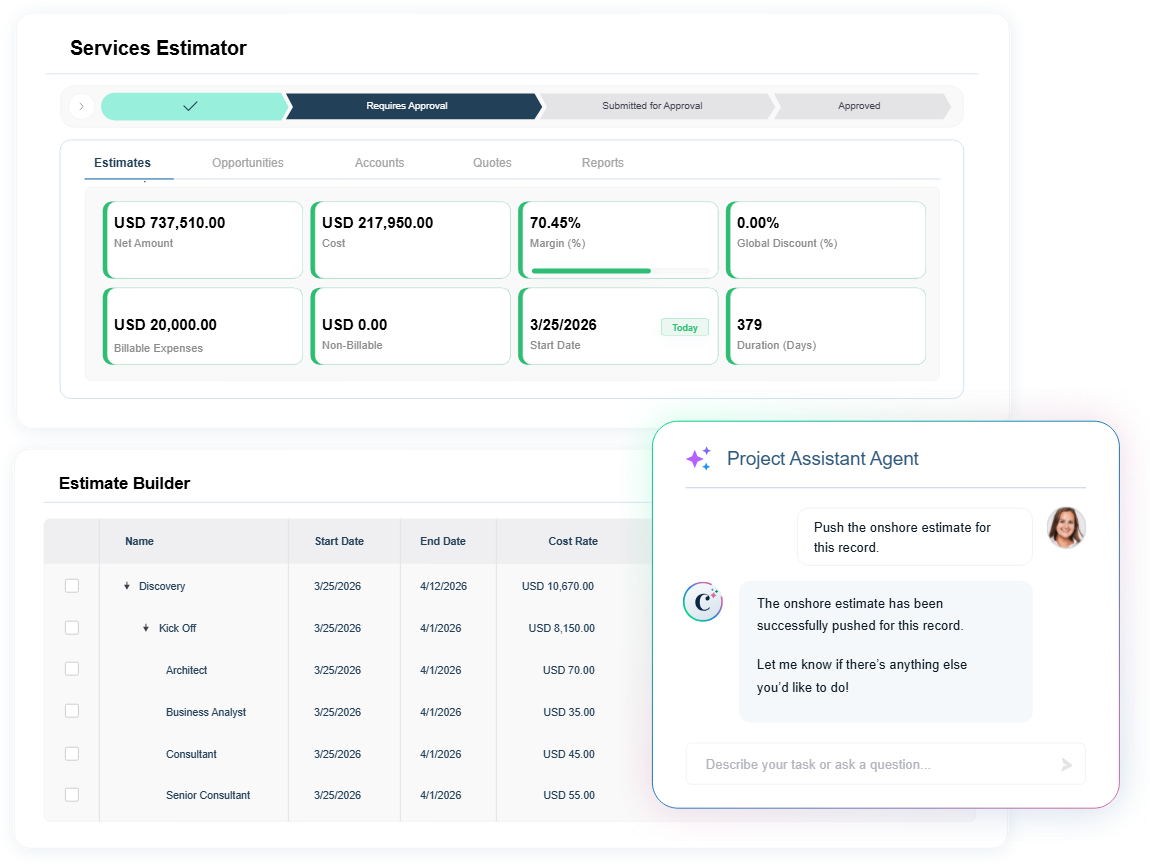
When an opportunity converts to a project, Certinia takes over: staffing the engagement, tracking time and expenses, managing milestones, generating invoices, recognizing revenue, and monitoring project profitability. Certinia calls this the "connected services journey": sell, staff, deliver, bill, renew, all on a single Salesforce-native data model.
Source: Certinia
The question is not which one to use. For a professional services firm on Salesforce, the question is whether you need Certinia's specialized capabilities or can get by with Salesforce's native tools plus customization.
ZoomInfo operates upstream of both.
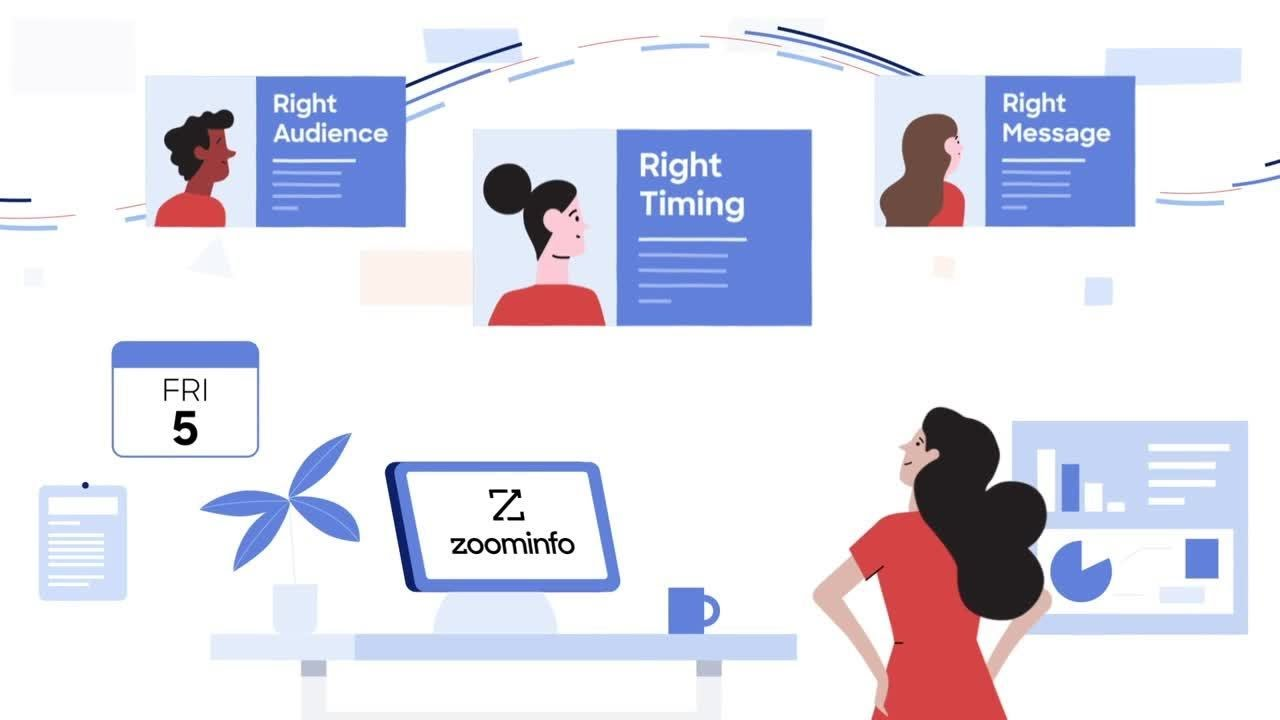
Before Salesforce can track a deal or Certinia can staff a project, someone needs to find the prospect, verify the contact data, identify the buying committee, and detect when the account is in-market. That is ZoomInfo's job. Its GTM Context Graph processes 1.5B+ data points daily to deliver intelligence that makes every downstream action, in Salesforce or Certinia, more effective.
Certinia wins on services delivery depth
Professional services firms face a specific challenge: the handoff between sales and delivery is where revenue leaks. A deal closes in the CRM. Then someone opens a spreadsheet, emails the resource manager, and manually creates a project. By the time the project is staffed and billing begins, the team has lost context, deadlines have shifted, and margins have eroded.
Certinia solves this.
When a Salesforce opportunity closes, the system creates a project from the winning bid without re-entering data. The full account context (what was sold, who the stakeholders are, the budget and timeline) carries through from sales to delivery.
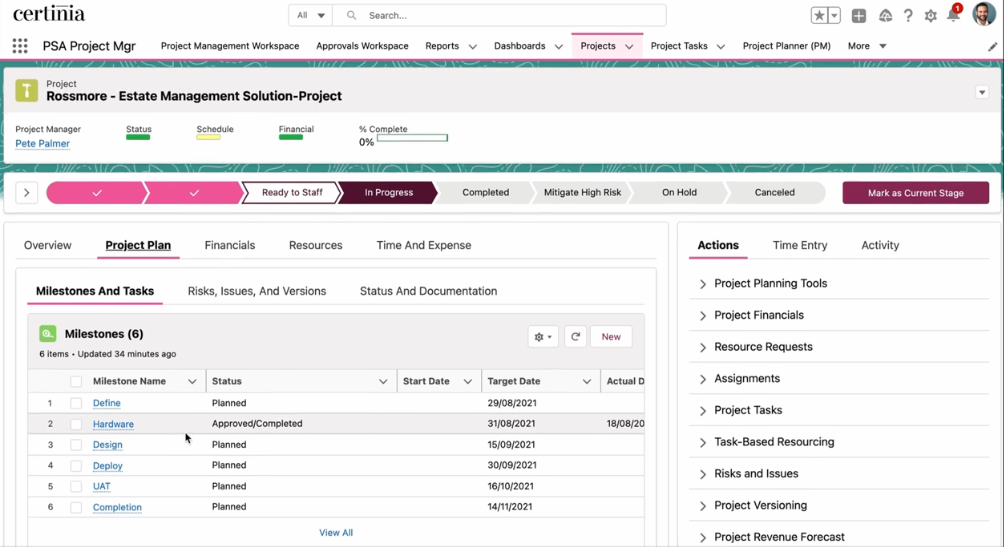
Source: Certinia
The resource management module matches skills, availability, and seniority to project demand. The billing engine handles time-and-materials, fixed-price, subscription, usage-based, and hybrid models in one system. Revenue recognition is automated for ASC 606 and IFRS 15 compliance. Deeproot boosted data accuracy by 95% and cut month-end close from 30 days to 5.
None of this exists natively in Salesforce. You could build some of it using Salesforce's low-code tools, but you would be reinventing what Certinia has spent 15 years refining.
Salesforce wins on breadth and ecosystem
What Salesforce lacks in service delivery, it makes up for in breadth. No other platform covers as many business functions from a single foundation.
Sales Cloud manages pipeline and forecasting. Service Cloud handles case management, self-service, and field service. Marketing Cloud orchestrates campaigns across channels. Commerce Cloud powers storefronts. Data Cloud unifies customer data. Slack connects teams. Tableau visualizes it all. And Agentforce ties AI agents into every product.
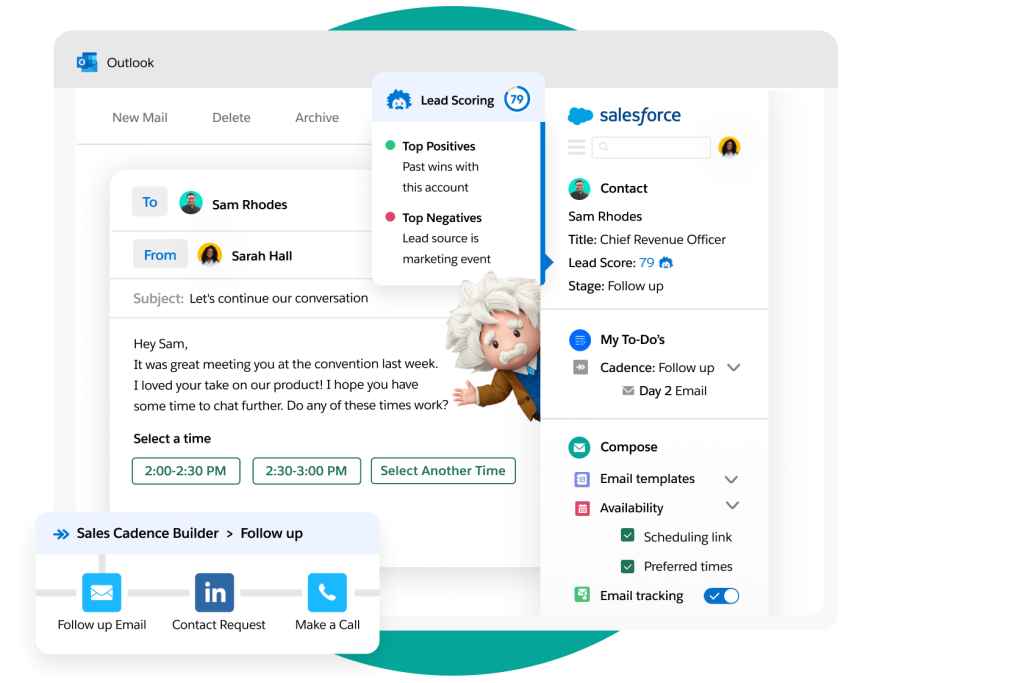
Source: Salesforce
The ecosystem amplifies this. The AppExchange hosts 9,000+ partner apps with 14+ million installs, and 91% of customers use at least one AppExchange app. Certinia itself is part of this ecosystem.
For professional services firms, Salesforce's strength is the front office. Pipeline management, forecasting, account-based engagement, customer service, and marketing all benefit from 19 consecutive years as a Gartner MQ Leader for Sales Force Automation. The platform handles everything up to the point of sale with a depth that specialized PSA tools cannot match.
The trade-off: Salesforce covers everything broadly. Certinia specializes in service delivery. Most professional services firms need both.
ZoomInfo fills the intelligence gap both platforms leave open
Certinia tracks project delivery. Salesforce tracks customer relationships. Neither tells you which accounts to pursue next, who the decision-makers are, or when a prospect is researching solutions.
This is the gap ZoomInfo fills.
Its data platform covers three dimensions: identity data (who buyers are and how to reach them), company context (org charts, technographics, and industry data for 100M companies), and signals that reveal when accounts are in-market. ZoomInfo verifies the data through multiple sources and 300+ human researchers, reaching up to 95% accuracy on first-party data.
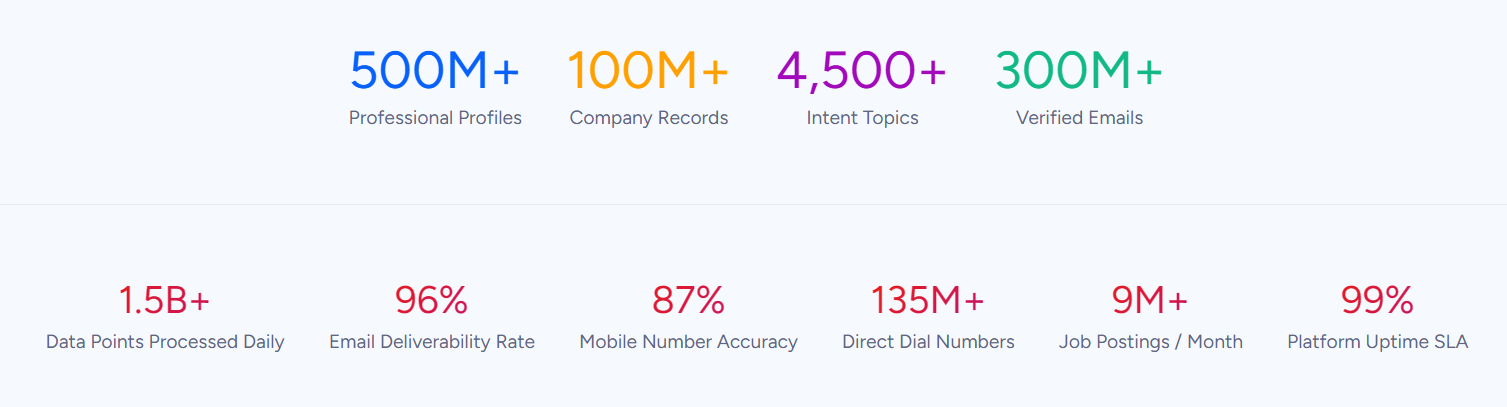
Source: ZoomInfo
For Salesforce users, ZoomInfo's native integration enriches CRM records with verified contact data, company intelligence, and intent signals inside the platform. No manual research, no stale data, no guesswork about who to call.
The real advantage is the GTM Context Graph.
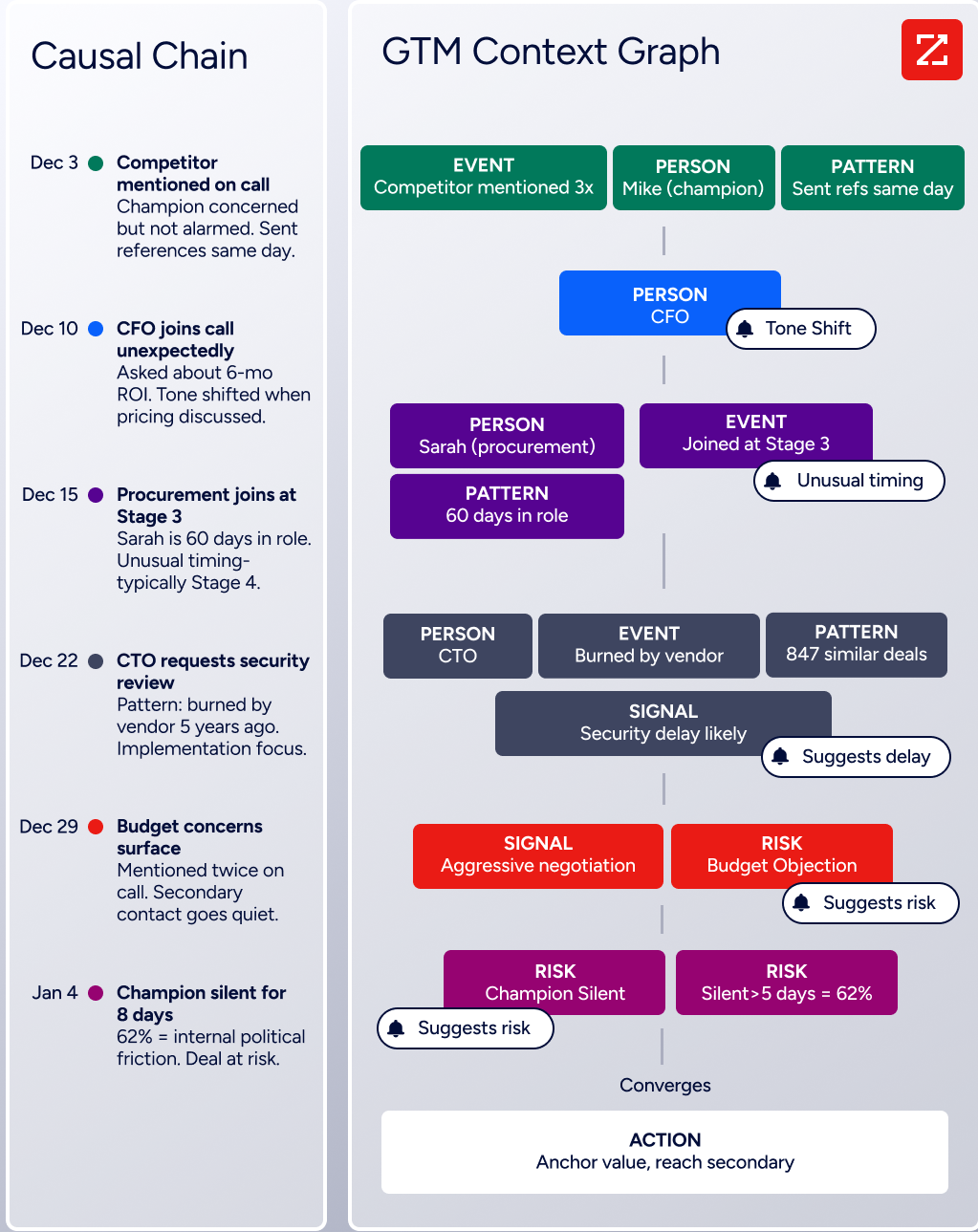
It combines ZoomInfo's B2B data with a customer's CRM records, conversation transcripts, email interactions, and behavioral signals into one system. A CRM records that a deal moved to Stage 3. The GTM Context Graph analyzes all that data to explain why it moved, what executive sponsorship looks like at this stage, and which signals predict what happens next.
Seismic's sales team attributed 39% of active pipeline to opportunities identified or influenced by ZoomInfo signals, boosted productivity by 54%, and saved 11.5 hours per week. (Seismic Case Study)
For a deeper look at how Salesforce and ZoomInfo stack up head-to-head, see our full Salesforce vs. ZoomInfo comparison.
AI strategies reflect each platform's DNA
All three platforms have invested in AI. The difference is what each platform's AI understands.
Certinia's Veda AI is trained on professional services data: 90M+ projects and 2B+ timecards.
Its agents handle staffing analysis, project estimation, delivery summaries, and customer success planning. Early adopter results include 50%+ faster staffing decisions, 75% faster time-to-invoice, and up to 20 hours per month saved per project manager. Veda is deterministic by design: every action follows business rules and compliance requirements, making its outputs auditable and predictable.
The limitation is scope. Veda handles services delivery but does not extend to sales prospecting, marketing, or general CRM intelligence.
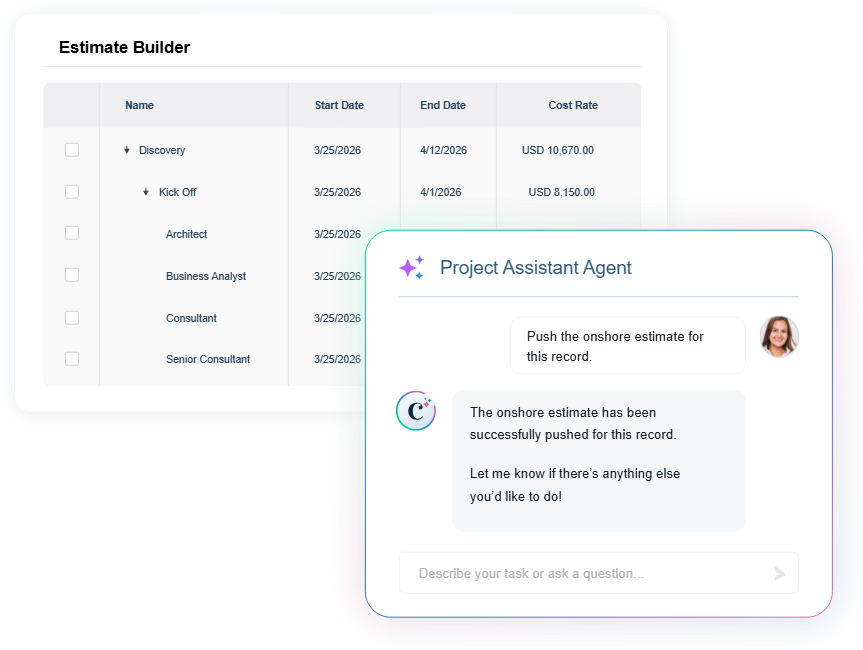
Source: Certinia
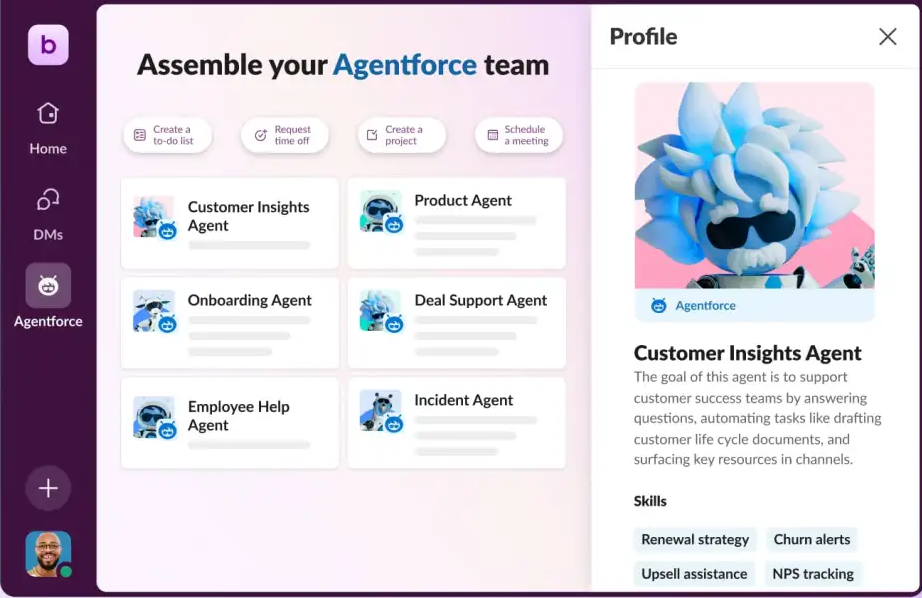
Salesforce's Agentforce covers more ground.
Pre-built agents handle sales coaching, service case deflection, marketing campaign creation, commerce recommendations, and IT service management. The Atlas Reasoning Engine uses a ReAct loop to reason, act, observe, and adapt. Salesforce reports 85% of support requests resolved without human escalation. The Einstein Trust Layer provides zero data retention with LLM partners, PII masking, and audit trails.
Agentforce's breadth is its strength, but it lacks the domain-specific training data that gives Veda its services delivery precision.
Source: Salesforce
ZoomInfo's AI is built on the GTM Context Graph, which combines ZoomInfo's B2B data with customer CRM data, conversation intelligence, and behavioral signals.
The AI drafting your next email follow-up understands the specific concern behind the last conversation. The play targeting your next set of accounts matches patterns from your actual closed-won deals, not generic scoring. The forecast reflects buying evidence, not stage labels.
Source: ZoomInfo
These three AI strategies are complementary, not competing. Veda optimizes delivery. Agentforce optimizes customer-facing operations. ZoomInfo's GTM Context Graph optimizes the intelligence feeding both.
Pricing and total cost of ownership
Pricing is where the comparison gets uncomfortable for buyers evaluating the full stack.
Salesforce publishes its tier structure.
Sales Cloud starts at $25/user/month (Starter Suite) and scales to $550/user/month (Agentforce 1). Most enterprises land on the $175/user/month Enterprise tier or the $350/user/month Unlimited tier. Add-ons for Agentforce AI, Data Cloud credits, Digital Engagement, and Premier Support (30% of net license fees) raise costs further. Over 70% of implementations are partner-led, adding cost.
Certinia does not publish pricing.
All terms are custom-quoted through individually negotiated order forms. The total cost includes the Certinia subscription plus the underlying Salesforce license plus implementation costs (typically 3 to 9 months with a certified partner). Veda AI adds $30/user/month plus Salesforce Agentforce credits.
G2 reviewers flag cost as a recurring concern: the platform delivers value for large services organizations, but the layered cost structure means smaller firms struggle to justify the investment.
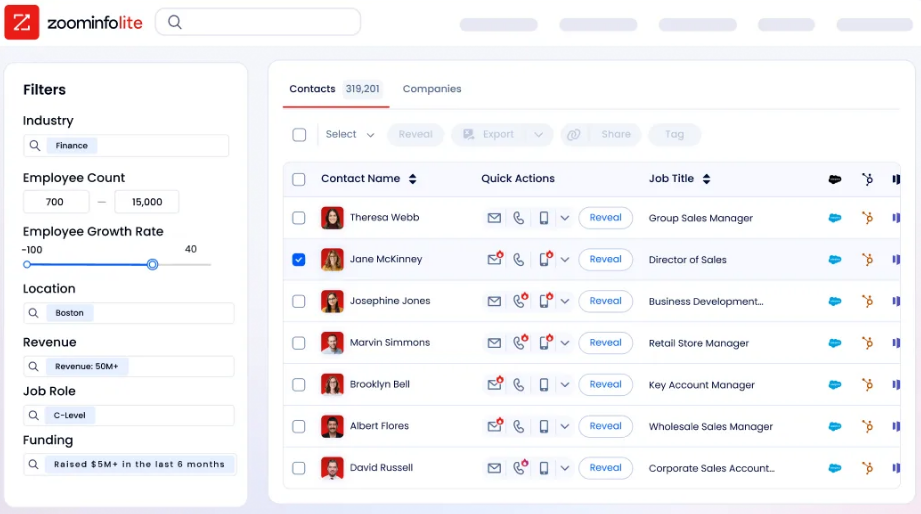
ZoomInfo uses a consumption-based pricing model. No prices are published publicly.
The platform offers ZoomInfo Lite as a permanent free tier with access to ZoomInfo's B2B database, 10 monthly export credits, and WebSights Lite. Paid plans (Professional, Advanced, Enterprise) scale based on seats, credit volume, and features. A 7-day free trial provides full feature access.
Source: ZoomInfo
For a professional services firm running all three, the costs compound. But the alternative, stitching together separate tools for CRM, PSA, data enrichment, and intent signals, typically costs more in integration overhead and data quality problems than it saves in license fees.
Integration and data flow between the three
How these platforms connect matters for daily operations.
Certinia and Salesforce share a single data model.
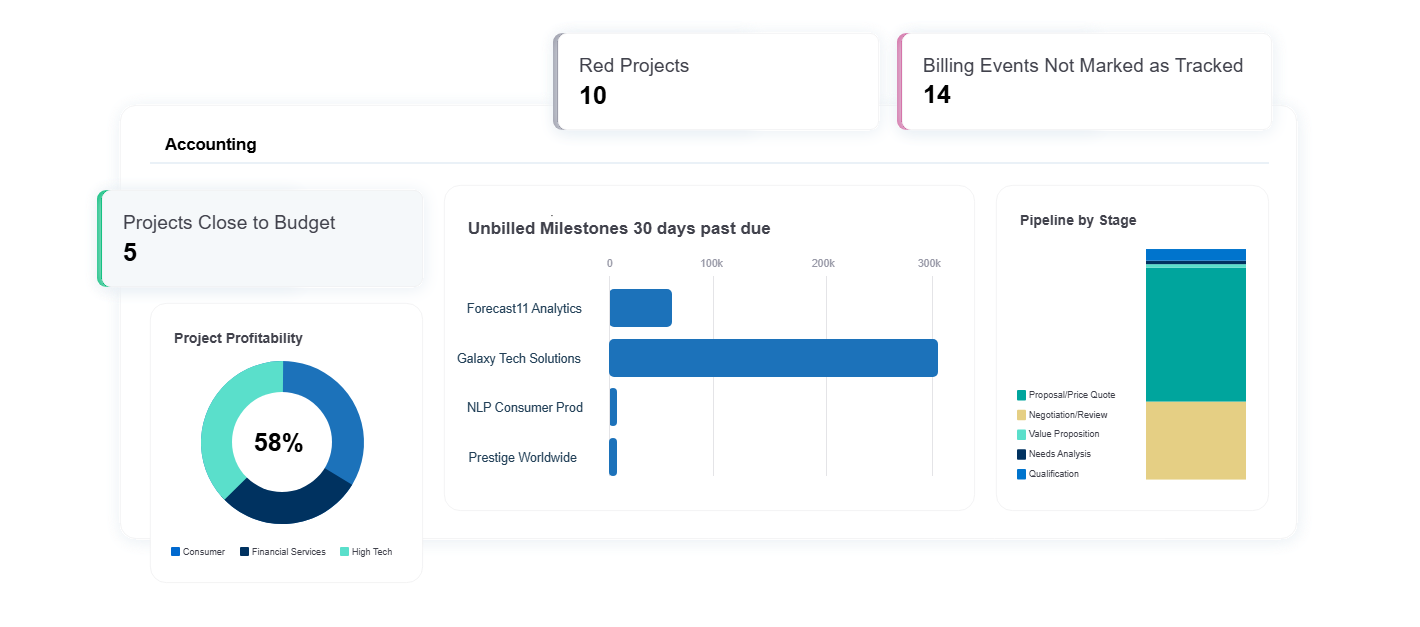
There is no integration because Certinia is built natively on the Salesforce platform. They share the same customer records, user interface, security model, and analytics infrastructure. When a deal closes in Salesforce, Certinia can create a project from it without data transfer. When Certinia generates a billing event, the financial data is already in the same system as the account record.
This native architecture is Certinia's main selling point, and it eliminates the usual integration problems.
Source: Certinia
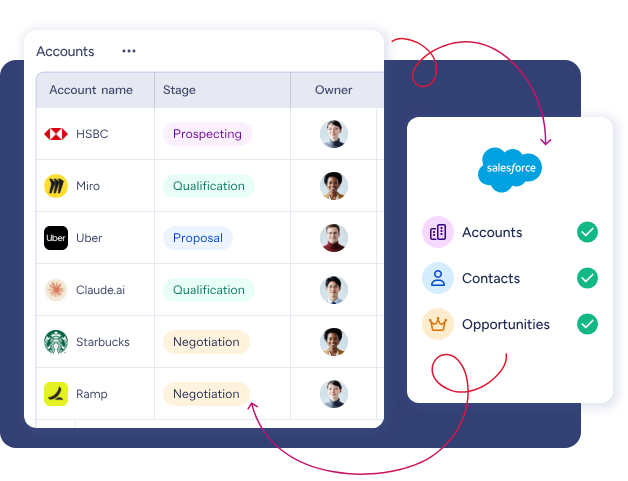
ZoomInfo and Salesforce connect through a native integration. ZoomInfo enriches Salesforce records with verified contact data, company intelligence, and buying signals. Lead routing, CRM data hygiene, and automated workflows run through ZoomInfo Operations and the broader GTM Studio canvas. The Enterprise API and MCP server extend this access to any custom application or AI agent.
Source: ZoomInfo
ZoomInfo and Certinia do not integrate directly, but they connect through Salesforce as the shared platform.
ZoomInfo enriches the Salesforce data that Certinia operates on. When ZoomInfo identifies a prospect, enriches the contact record, and surfaces intent signals, that data flows into Salesforce, where Certinia picks it up as part of the opportunity-to-project lifecycle. The result is a continuous data flow from prospect identification through deal close through project delivery, with each platform handling its part.
Smartsheet described ZoomInfo as "our one source of truth for account data, and even more so for contact data. There's no other provider in the market that provides you with that level of detail." (Smartsheet Case Study)
Implementation complexity and learning curve
Salesforce varies depending on scope. A simple Sales Cloud deployment can go live in weeks. A multi-cloud enterprise deployment with Data Cloud, Agentforce, and industry-specific configurations can take 3 to 12 months.
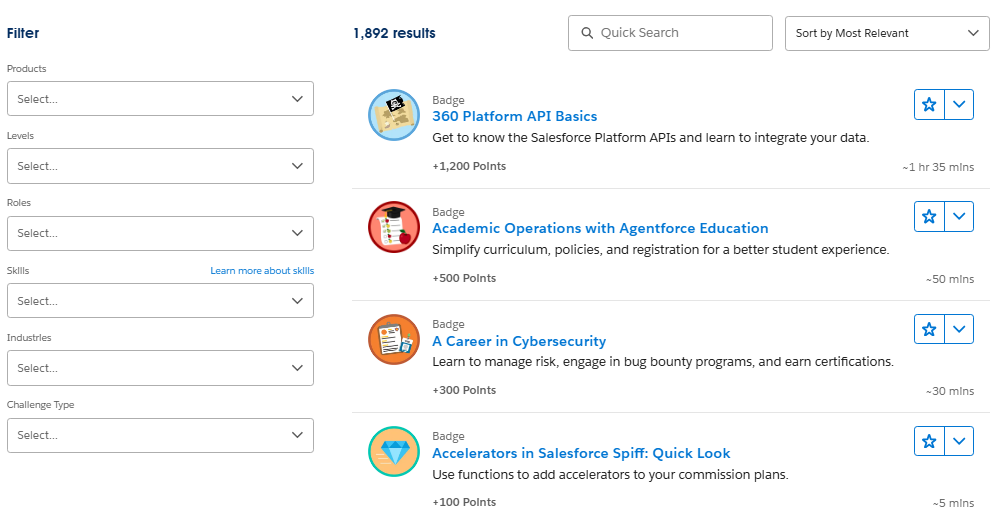
The platform requires dedicated administrators for customization, and Trailhead provides 1,500+ badges and 6+ million learners for upskilling. The learning curve is steep for advanced features, but the basics are accessible.
Source: Salesforce
Certinia adds implementation complexity on top of Salesforce.
Capterra reviewers note that "implementation is very complicated and would almost be impossible without professional services". Implementations typically require 3 to 9 months and substantial Salesforce admin capacity.
Teams already on Salesforce benefit from shared navigation patterns, but the depth of configuration needed for resource management, billing models, and revenue recognition means a real onboarding investment. The platform also faces recurring performance complaints from users about slow loading times.
ZoomInfo deploys faster.
CEO Henry Schuck has stated that GTM Workspace "deploys in weeks". The platform's redesigned onboarding program runs 30 to 90 days and produced a 25% improvement in customer satisfaction scores. ZoomInfo University offers role-specific learning paths across Sales, Marketing, Administration, and Customer Success.

Who should use what
The right combination depends on your business model, your existing infrastructure, and where your biggest pain is.
Choose Certinia if:
You run a professional services organization (consulting, IT services, software implementation, tax and audit)
You are already on Salesforce CRM or committed to adopting it
You need unified resource management, project delivery, billing, and revenue recognition
Manual handoffs between sales and delivery are causing revenue leakage
You have the budget and admin capacity for a 3 to 9 month implementation
Choose Salesforce if:
You need a broad CRM platform covering sales, service, marketing, and commerce
Your organization is not primarily a professional services firm
You want access to the largest enterprise app ecosystem (9,000+ AppExchange apps)
AI-powered customer engagement across every channel is a priority
You need industry-specific solutions across financial services, healthcare, manufacturing, or retail
Use ZoomInfo with either or both if:
Your pipeline depends on finding the right prospects with verified contact data
You need intent signals that reveal when accounts are in-market
CRM data quality problems are undermining your sales and marketing execution
You want AI that understands why deals move, not just that they moved
You need intelligence that works in Salesforce, in custom tools, or in any AI agent via API and MCP
Get a free trial and see how ZoomInfo powers your go-to-market stack.
Certinia and Salesforce are operational platforms: they manage what happens once you know who your customers are. ZoomInfo is the intelligence platform that tells you who those customers should be, when they are ready to buy, and what matters to them.
The most effective services organizations use all three: ZoomInfo to fill the pipeline with the right accounts, Salesforce to manage the customer relationship, and Certinia to deliver the work profitably.
"ZoomInfo's not just a contact data company anymore. They've built a full system of execution. GTM Intelligence actually works the list, writes the outreach, triggers the play, and helps drive predictable growth." — Ian Brodie, CEO & Co-Founder, Levanta
Certinia vs. Salesforce vs. ZoomInfo FAQ
What is the core difference between Certinia, Salesforce, and ZoomInfo?
Certinia is a professional services automation and financial management platform built natively on Salesforce, designed for services-led businesses that need to manage resource planning, project delivery, billing, and revenue recognition.
Salesforce is the world's largest CRM platform, covering sales, service, marketing, commerce, and analytics for any industry.
ZoomInfo is a B2B go-to-market intelligence platform that provides verified contact data, company intelligence, and buying signals that feed into both Certinia and Salesforce.
Can you use Certinia without Salesforce?
No. Certinia is built entirely on the Salesforce platform and requires an active Salesforce license to operate. It shares Salesforce's data model, user interface, and security infrastructure. Organizations considering Certinia must factor in both the Salesforce license cost and the Certinia subscription cost.
Does Salesforce have built-in professional services automation?
Salesforce does not include native PSA capabilities like resource management, project delivery tracking, services billing, or automated revenue recognition. These require either a Salesforce-native PSA tool like Certinia, a third-party AppExchange solution, or custom development on the Salesforce platform.
How does ZoomInfo integrate with Salesforce?
ZoomInfo has a native integration with Salesforce that enriches CRM records with verified contact data, company intelligence, and buying signals. ZoomInfo Operations automates data hygiene, lead routing, and workflow triggers. The Enterprise API and MCP server extend access to any custom application or AI agent connected to Salesforce.
Which platform has the best AI capabilities?
Each platform's AI excels in its domain.
Certinia's Veda AI is trained on 90M+ real projects and specializes in staffing, estimation, and delivery automation. Salesforce's Agentforce covers the broadest range of functions, from autonomous case resolution to marketing campaign creation. ZoomInfo's GTM Context Graph combines B2B data with CRM records and conversation intelligence to power prospecting, intent detection, and account intelligence.
What does the total cost look like for a professional services firm using all three?
The total cost depends on organization size, user count, and feature requirements.
Salesforce Enterprise edition starts at $175/user/month. Certinia pricing is custom-quoted and layered on top of the Salesforce license. ZoomInfo offers a permanent free tier (ZoomInfo Lite) and custom-quoted paid plans. Implementation costs add further: Salesforce and Certinia implementations are typically partner-led. ZoomInfo deploys in weeks with a structured onboarding program.
Who is Certinia best suited for?
Certinia is built for mid-market to enterprise professional services firms already on Salesforce CRM. This includes consulting and advisory firms, IT services organizations, software companies with professional services teams, IT hardware firms selling services alongside products, and tax and audit practices. Organizations with fewer than 100 employees or those not on Salesforce will find the investment hard to justify.
Why would a services firm need ZoomInfo if they already have Salesforce and Certinia?
Salesforce manages customer relationships and Certinia manages project delivery, but neither provides prospecting data, verified contact information, or buying intent signals.
ZoomInfo fills the top of the funnel with intelligence both platforms need. Its data enrichment keeps CRM records accurate, its intent signals reveal when target accounts are researching solutions, and its GTM Context Graph helps sales teams understand why deals move or stall.
See how Salesforce compares against other CRMs and platforms:
