
Choosing between Chameleon and Whatfix comes down to five questions:
Are you guiding external users through your own SaaS product, or training internal employees on enterprise software like Salesforce or SAP?
Do you need a platform your product team can run on its own, or one that supports L&D and IT-led change management at scale?
Is your application web-only, or do you also need coverage for desktop apps, mobile, and VDI environments?
Do you want built-in product analytics and simulation training, or a focused tool that plugs into your existing analytics stack?
How important is it that adoption signals feed directly into your sales and marketing work?
In short, here's what we recommend:
Chameleon is built for B2B SaaS product teams who want to own the in-app experience without writing engineering tickets. Its no-code visual builder, AI Copilot, and integrations with tools like Mixpanel, Amplitude, and HubSpot let teams launch tours, tooltips, surveys, checklists, and interactive demos in hours. The limits: it's web-only, lacks built-in product analytics, and pricing jumps sharply between tiers.
Whatfix serves large enterprises managing software adoption across multi-application environments. With support for web, desktop, mobile, and VDI/Citrix, plus a simulation product (Mirror) and separate Product Analytics module, Whatfix covers the adoption lifecycle from pre-production training through in-app guidance to behavioral measurement. The trade-offs: opaque pricing, a steeper implementation curve, and analytics that require a separate purchase.
Both platforms guide users through software well. But what happens after users adopt your product? When a prospect finishes an onboarding tour or a customer hits an activation milestone, that signal matters to your go-to-market team. Neither Chameleon nor Whatfix connects adoption data to sales intelligence, buyer intent, or pipeline execution. That's a different problem.
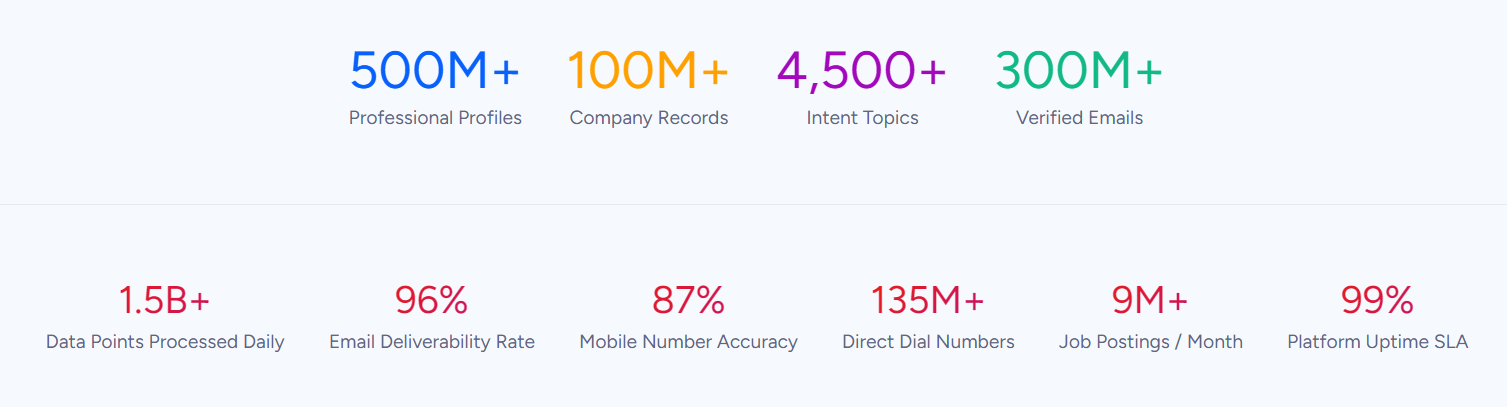
ZoomInfo is an AI-powered GTM platform that turns adoption signals into revenue. Built on a B2B data platform of 500M contacts, 100M companies, 135M+ verified phone numbers, and 200M+ verified business emails, ZoomInfo's GTM Context Graph combines your CRM records, conversation transcripts, and behavioral signals into a single layer that captures not just what happened in a deal, but why. For SaaS companies already using a DAP, ZoomInfo fills the gap: identify which accounts are evaluating competitors, surface buying committees before they reach out, and trigger outreach when intent signals spike. Access it through GTM Workspace for sellers, GTM Studio for marketers and RevOps, or API and MCP in any tool your team already uses.
If connecting product adoption to pipeline generation sounds like the missing piece, see how ZoomInfo works.
Chameleon vs. Whatfix vs. ZoomInfo at a glance
Chameleon | Whatfix | ZoomInfo | |
|---|---|---|---|
Primary focus | In-app experiences for SaaS product teams | Enterprise software adoption and change management | AI-powered go-to-market intelligence and execution |
Target buyer | Product managers, product marketers | L&D, HR, IT, digital transformation leaders | Sales, marketing, RevOps |
Environment support | Web only | Web, desktop, mobile, VDI/Citrix | Web platform with 120+ integrations |
AI capabilities | Copilot (campaign builder) + Ranger (governance agent) | ScreenSense (context engine) + 3 AI Agents | GTM Context Graph + AI agents for sellers and marketers |
Analytics | Basic; relies on integrations (Mixpanel, Amplitude) | Separate Product Analytics product (paid add-on) | Intent data, buyer signals, and pipeline analytics |
Starting price | $279/month (Startup) | Quote-based, not published | Custom-quoted; free tier (ZoomInfo Lite) available |
Best for | Mid-market SaaS companies guiding external users | Large enterprises training internal employees | B2B teams turning adoption data into pipeline |
Two different problems, two different platforms
Chameleon and Whatfix both call themselves digital adoption platforms, but they solve different problems for different buyers.
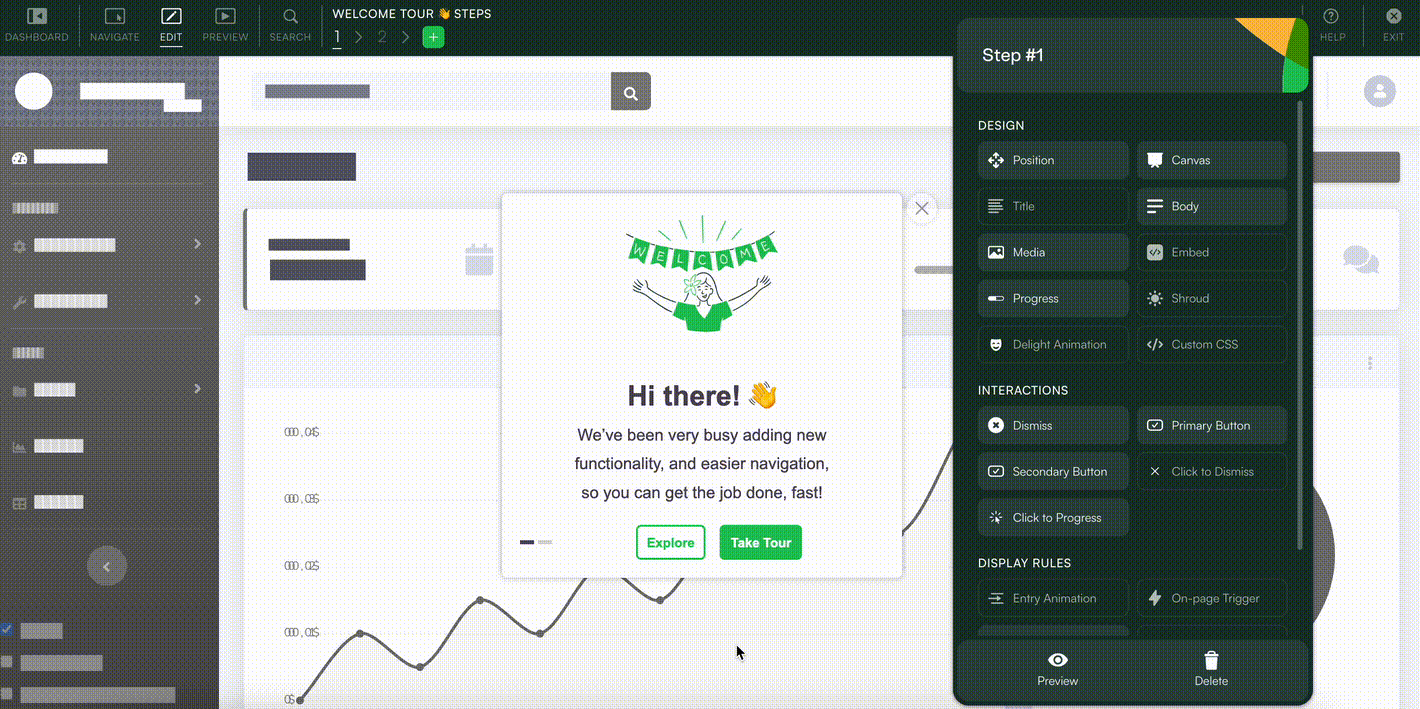
Chameleon is built for the product manager at a B2B SaaS company who needs to ship an onboarding tour by Friday.
The product team owns the in-app experience. Users are external customers navigating the company's own software. The goal is activation, feature adoption, and retention. Speed matters more than governance, and the product team wants to move without filing engineering tickets.
Source: Chameleon
Whatfix is built for the L&D director at a 5,000-person company rolling out a new Salesforce instance.
Users are internal employees who need to learn enterprise software they didn't choose. The goal is reducing support tickets, compressing time-to-proficiency, and proving ROI on a multi-million-dollar technology investment. Compliance, audit trails, and multi-application coverage matter more than shipping speed.
Source: Whatfix
This distinction shapes every design decision each platform makes, from how content is authored to how analytics are structured to how pricing works. Choosing the wrong one isn't just suboptimal. It means using a tool designed for someone else's problem.
Chameleon wins on speed and product team autonomy
Chameleon's Chrome Extension builder lets a product manager open their live app, point at elements, and build a tour without leaving the browser. The no-code interface covers tours, tooltips, surveys, checklists, banners, embeddables, and interactive demos from a single platform.
The AI layer adds speed.
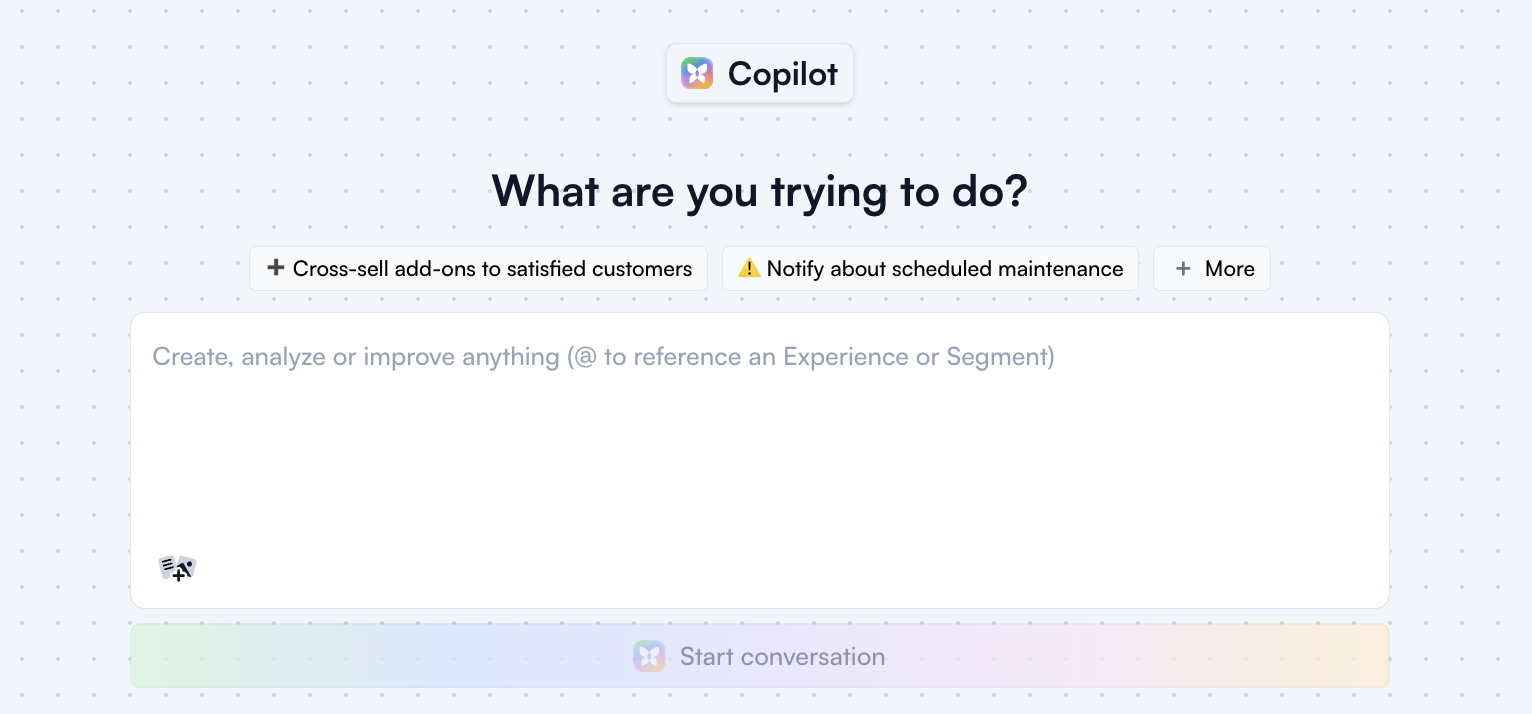
Copilot is a conversational agent that can strategize, build, A/B test, translate, and audit in-app campaigns from a single conversation. Describe what you want ("announce the new reporting feature to power users who haven't tried it"), and Copilot generates the tour, sets the audience segment, writes the copy, and configures success metrics. Ranger scans the account weekly for stale experiences, broken selectors, and naming inconsistencies, then suggests fixes.
Source: Chameleon
The technical foundation works well for modern SaaS. Chameleon supports SPAs (React, Vue, Angular), Shadow DOMs, iframes, and Electron apps. Smart Delay fires guidance only when a user is idle, not on an arbitrary timer. A/B testing is native on Growth and Enterprise plans.
But Chameleon's scope is deliberately narrow.
It's web-only, with no support for desktop applications, mobile apps, or VDI environments. Its analytics track tour completion and engagement, but teams needing funnel analysis, session replay, or behavioral data must bring their own tools.
Whatfix wins on enterprise breadth and environmental coverage
Whatfix operates at a different scale.
Where Chameleon covers one web application for one product team, Whatfix covers web, desktop, mobile, and VDI/Citrix environments under a single platform. For an enterprise running SAP on desktop, Salesforce on web, and a custom mobile app, Whatfix is one of the few DAPs that provides consistent guidance across all three.
The content authoring model reflects enterprise needs. Whatfix generates guidance in multiple output formats at once: interactive walkthroughs, videos, PDFs, slide decks, and articles from a single authoring session. This matters when L&D teams need to feed both an LMS and an in-app guidance layer from the same source.
Mirror, Whatfix's simulation product, creates interactive replicas of enterprise applications for risk-free training. Employees practice real workflows without touching production data. Combined with AI-powered roleplay scenarios, Mirror solves a problem Chameleon doesn't attempt: pre-production training for complex enterprise software.

Source: Whatfix
The AI layer does real work.
ScreenSense, Whatfix's context engine, reads application screens and user intent to trigger guidance at the right moment. Three AI Agents handle content creation (Authoring Agent), contextual answers (Guidance Agent), and behavioral analysis (Insights Agent). Auto Testing+ validates existing flows against UI changes, reducing maintenance after application updates.
The trade-offs are real.
Whatfix's initial setup requires more planning and technical effort than lighter tools. Pricing is entirely quote-based with no published figures, and Product Analytics is a separate paid product, not bundled with the core DAP. For a mid-market SaaS company with a single web application, Whatfix delivers more platform than needed.
The adoption data gap neither platform fills
Both Chameleon and Whatfix do their respective jobs well. But neither connects in-app adoption signals to your go-to-market engine.
When a trial user completes your onboarding tour and activates three features in one session, that's a buying signal. When an enterprise customer's usage drops 40% over two weeks, that's a churn risk. When a prospect watches your interactive demo and then visits your pricing page, that's a pipeline in motion.
Chameleon and Whatfix capture these behavioral signals inside their own platforms. But they don't match them against buyer intent data, buying committee intelligence, or CRM deal context. The product team sees the adoption metric. The sales team never knows it happened.
ZoomInfo closes that gap.
As an AI-powered GTM platform, ZoomInfo works at the intersection of data, intelligence, and execution. Its GTM Context Graph processes 1.5B+ data points daily, combining third-party B2B intelligence with your CRM records, conversation transcripts, and behavioral signals into a layer that captures why deals move or stall.
For SaaS companies already running a DAP, ZoomInfo adds three capabilities no adoption platform provides:
Buyer intent before the trial starts.
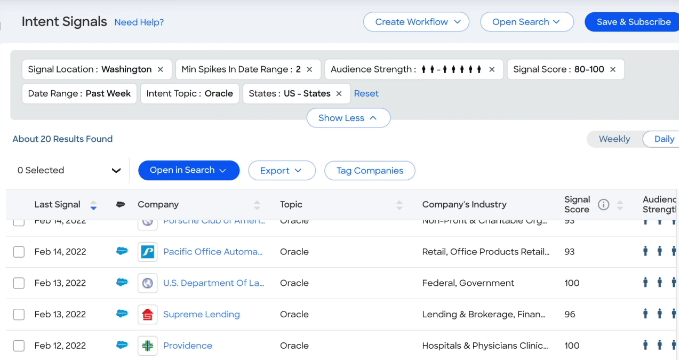
ZoomInfo Intent tracks signals from 210 million IP-to-Organization pairings, identifying which companies are researching your category. Guided Intent goes further, surfacing topics correlated with deal success rather than requiring manual topic selection.
Source: ZoomInfo
Buying committee intelligence behind the account.
A DAP tells you that "user #4821" completed onboarding. ZoomInfo tells you that the user works at a company with 2,000 employees, the VP of Operations just joined from a competitor, and three other stakeholders at the account are researching your category.
With 500M contacts and 120M direct-dial phone numbers, your sales team can reach the full buying committee, not just the individual who signed up.
Source: ZoomInfo
Automated execution on signals.
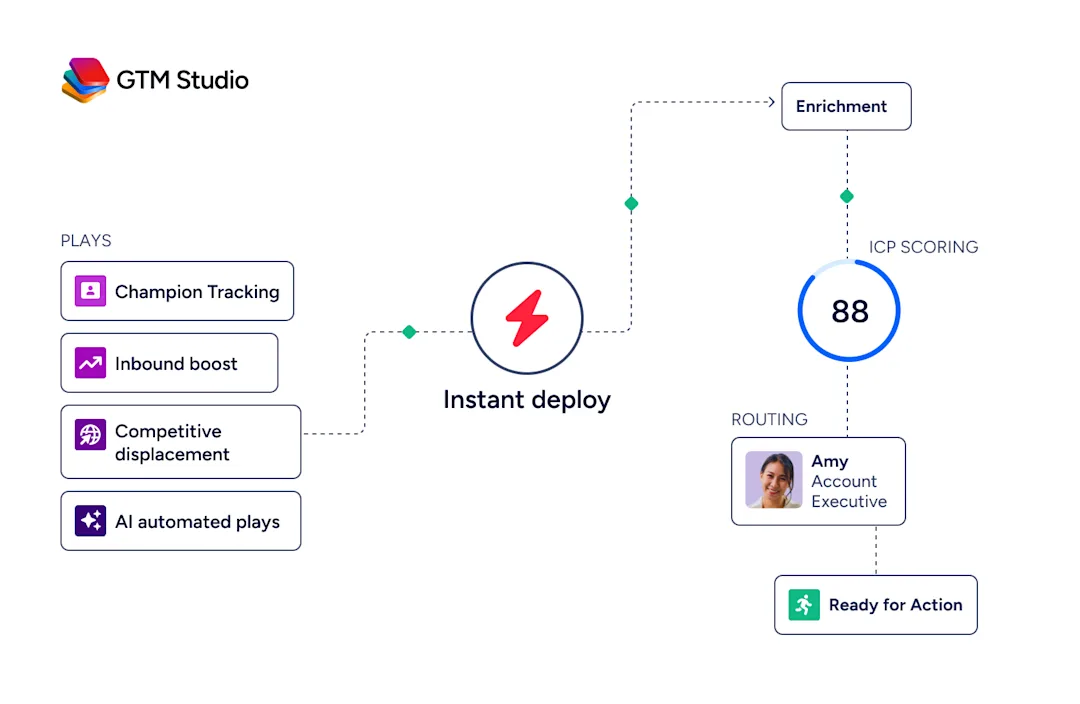
GTM Workspace gives sellers a prioritized account feed with AI-drafted outreach that addresses the context behind each signal. GTM Studio lets marketers build plays in plain language, targeting accounts that match proven win patterns and launching multi-channel campaigns without engineering tickets.
Source: ZoomInfo
Seismic's sales team attributed 39% of active pipeline to opportunities identified or influenced by ZoomInfo signals, while boosting productivity by 54%. (Seismic Case Study)
Content creation and AI compared
All three platforms use AI, but for different purposes.
Chameleon's AI focuses on in-app campaign execution.
Copilot reads your help documentation and product pages, then builds campaigns (tours, tooltips, surveys, checklists) from a single conversation. It validates links, checks accuracy, and ensures no placeholders ship. The AI draws on 10 years of data from thousands of product teams, so its default recommendations for timing, sequencing, and targeting start from tested patterns.
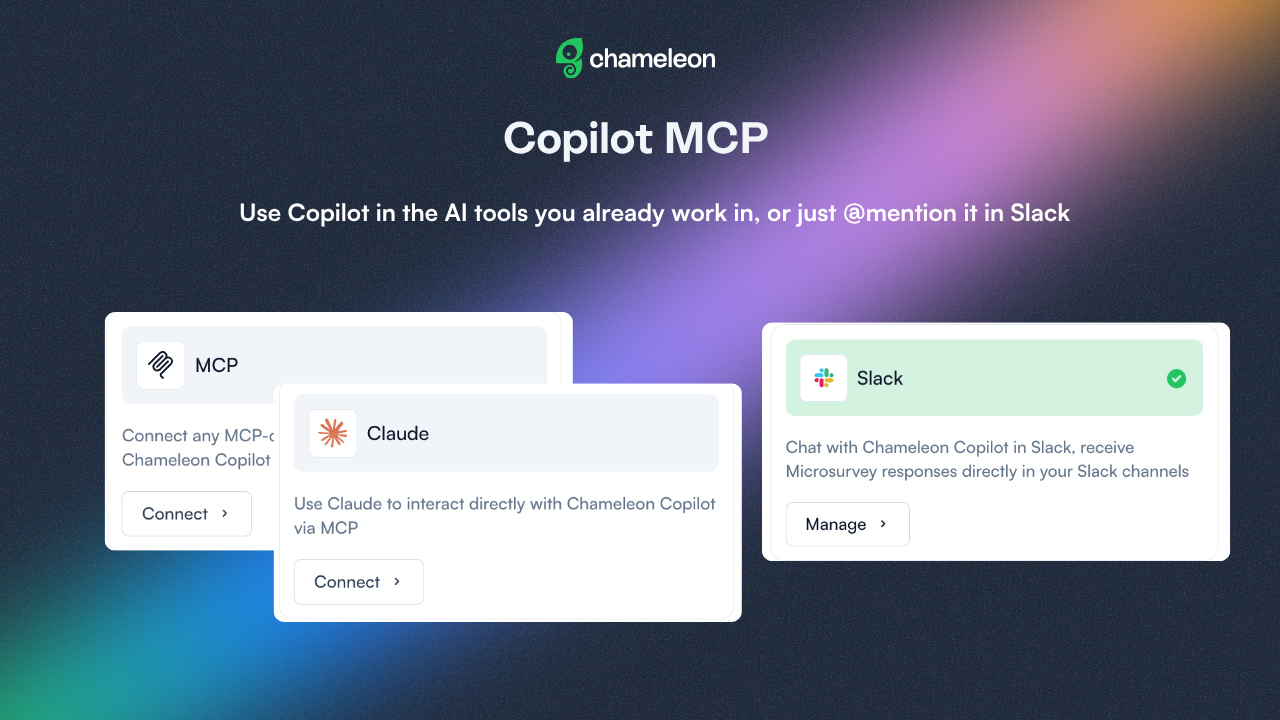
Copilot is also available as an MCP server, so teams can use it from Slack or external AI tools without opening the Chameleon dashboard.
Source: Chameleon
Whatfix's AI focuses on enterprise context.
ScreenSense uses a Computer Use model trained on GUI interactions to detect what screen a user is on, read whether they're stuck or exploring, and trigger guidance at the right moment. The Authoring Agent generates flows from natural-language prompts, while Visibility Rules AI converts plain-language targeting descriptions (like "show a pop-up every Monday at 5 PM to all users") into structured logic.
ScreenSense also adapts to UI changes, reducing maintenance when enterprise applications update.
ZoomInfo's AI focuses on go-to-market execution.
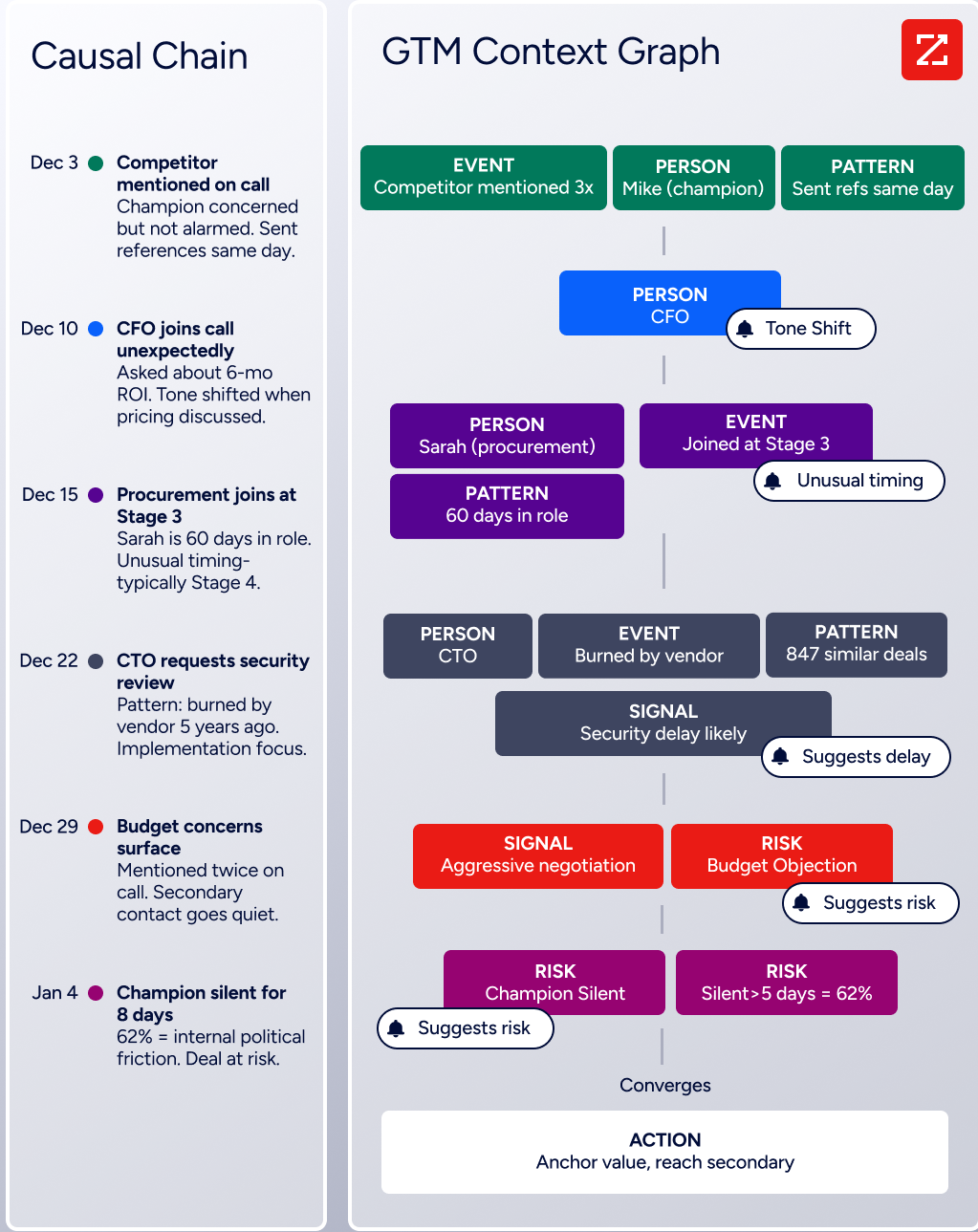
The GTM Context Graph captures the decision context behind deals: why a champion went quiet, what a competitive mention predicts about deal risk, which signal combinations match your actual win patterns. AI agents inside GTM Workspace handle account research, outreach drafting, CRM updates, and signal monitoring. AI in GTM Studio powers audience creation, campaign orchestration, and pipeline measurement from natural language.
Source: ZoomInfo
The distinction matters: Chameleon's AI builds the in-app experience. Whatfix's AI understands enterprise application context. ZoomInfo's AI turns those signals into revenue.
Integration depth comparison
Chameleon integrates with the SaaS product team's stack.
Two-way integrations with Mixpanel, Heap, and Amplitude let teams import behavioral cohorts and export engagement events back. CRM connections with HubSpot (bidirectional) and Salesforce let teams target in-app experiences by deal stage or account attributes. CDPs like Twilio Segment and Freshpaint serve as both installation vehicles and live data pipes. Reverse ETL tools like Hightouch and Census sync enriched warehouse data into Chameleon for precise segmentation.
The HelpBar integrates with Zendesk, Intercom, Help Scout, and other support tools to surface help content inside the product via CMD+K search. Chameleon also has a JavaScript API, REST API, and webhooks for custom implementations.
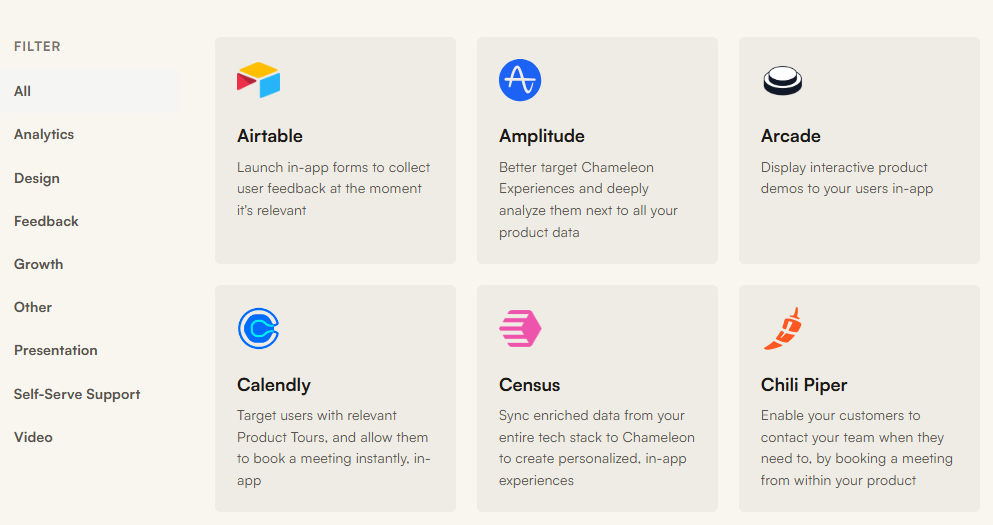
Source: Chameleon
Whatfix integrates with the enterprise IT stack.
Native connections span Salesforce, SAP SuccessFactors, Oracle, Workday, ServiceNow, and SharePoint. Analytics integrations cover Amplitude, Google Analytics, Heap, Quantum Metric, and FullStory. Whatfix supports SCORM 1.2 and xAPI 1.0 for LMS export to SAP Litmos, Docebo, and LearnUpon.
A REST API provides programmatic access to content, user attributes, and analytics reports. The Standard plan limits integrations to two; Premium and Enterprise offer unlimited.
ZoomInfo integrates with the go-to-market stack.
The App Marketplace lists 172+ partners across CRM (Salesforce, HubSpot, Dynamics 365), sales engagement (Salesloft, Outreach), cloud data platforms (Snowflake, Databricks, AWS, Google Cloud), and AI tools (Claude, ChatGPT).
The Enterprise API provides search, enrichment, intent, and account intelligence endpoints. The MCP server connects AI models directly to ZoomInfo's data as a native tool. API access is included in all plans, and the same data feeds every access point: GTM Workspace, GTM Studio, API, and MCP.
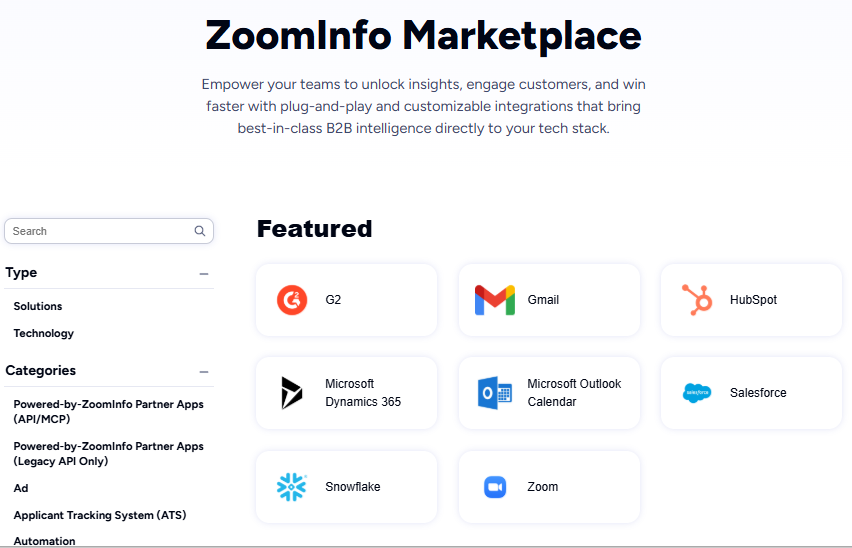
Source: ZoomInfo
Pricing model comparison
The three platforms price differently.
Chameleon is the most transparent.
The Startup plan begins at $279/month for 1,000 Monthly Tracked Users (MTUs), billed monthly. The Growth plan starts at $15,000/year, roughly a 4-5x jump that unlocks unlimited experiences, A/B testing, the Ranger governance agent, and dedicated Customer Success.
Enterprise is custom-priced. MTU-based billing means costs scale with your user base, and overages are billed automatically on the next invoice. SAML SSO is an add-on at $333/month on Startup or $4,000/year on Growth. A 14-day free trial provides full platform access with no credit card required.
Whatfix publishes no pricing.
All plans (Standard, Premium, Enterprise) are quote-based, with pricing built from a flat fee plus per-user license fees. Employee-facing deployments are licensed by headcount; customer-facing deployments by MAU. Product Analytics and Mirror are separate products with their own pricing.
The Standard plan caps integrations at two and content aggregation at 2,000 articles. A free trial is available via request, but duration and feature scope are not published.
ZoomInfo uses custom-quoted, consumption-based pricing with three product lines (Sales, Marketing, Chorus) each at multiple tiers. Credits are consumed when exporting data; searching and viewing are free. ZoomInfo Lite is a permanent free tier with access to 100M+ verified profiles, 10 monthly export credits, and WebSights Lite. A 7-day free trial of the full platform is also available.
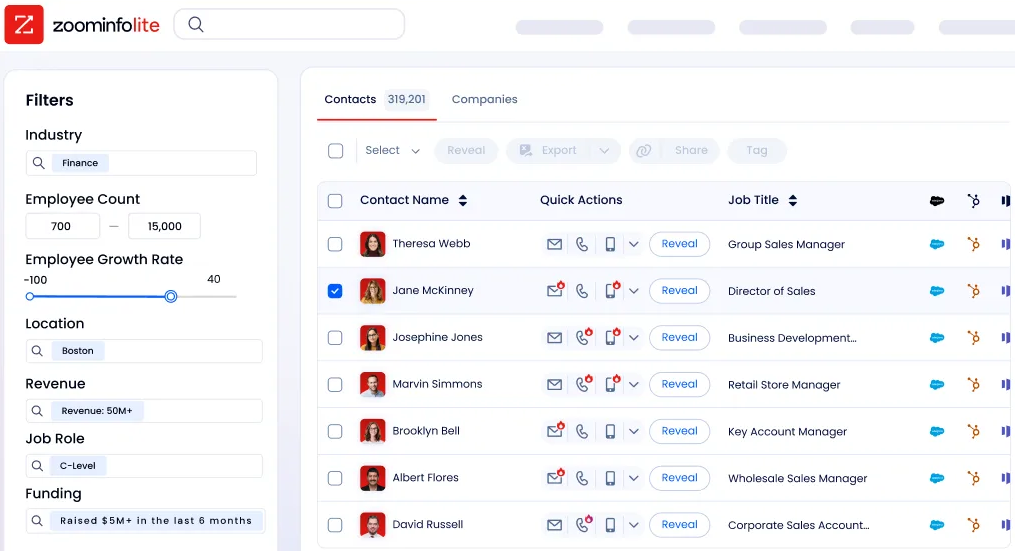
Source: ZoomInfo
Security and compliance
All three platforms maintain strong security postures, but the depth varies by target market.
Chameleon holds SOC 2 Type II certification (clean attestation, January 2026), GDPR compliance, and CCPA compliance. Data is stored in USA-based databases encrypted at rest with AES-256. All web communications use 256-bit TLS. Identity verification (UID encoding) prevents user ID spoofing. Enterprise customers can serve Chameleon assets from their own domain.
Whatfix holds SOC 2 certification and ISO 27001:2013, plus a VPAT/Section 508 certification for US federal procurement. SSO and IP whitelisting are available on all plans. Data residency is configurable, with an EU API endpoint available. Whatfix supports both cloud and self-hosted deployment. WCAG 2.1 AA accessibility compliance is documented.
ZoomInfo maintains the broadest compliance stack: ISO 27001, ISO 27701, SOC 2 Type II, TRUSTe GDPR, and TRUSTe CCPA certifications, all renewed annually. ZoomInfo is a registered data broker in California and Vermont, with a dedicated Trust Center.
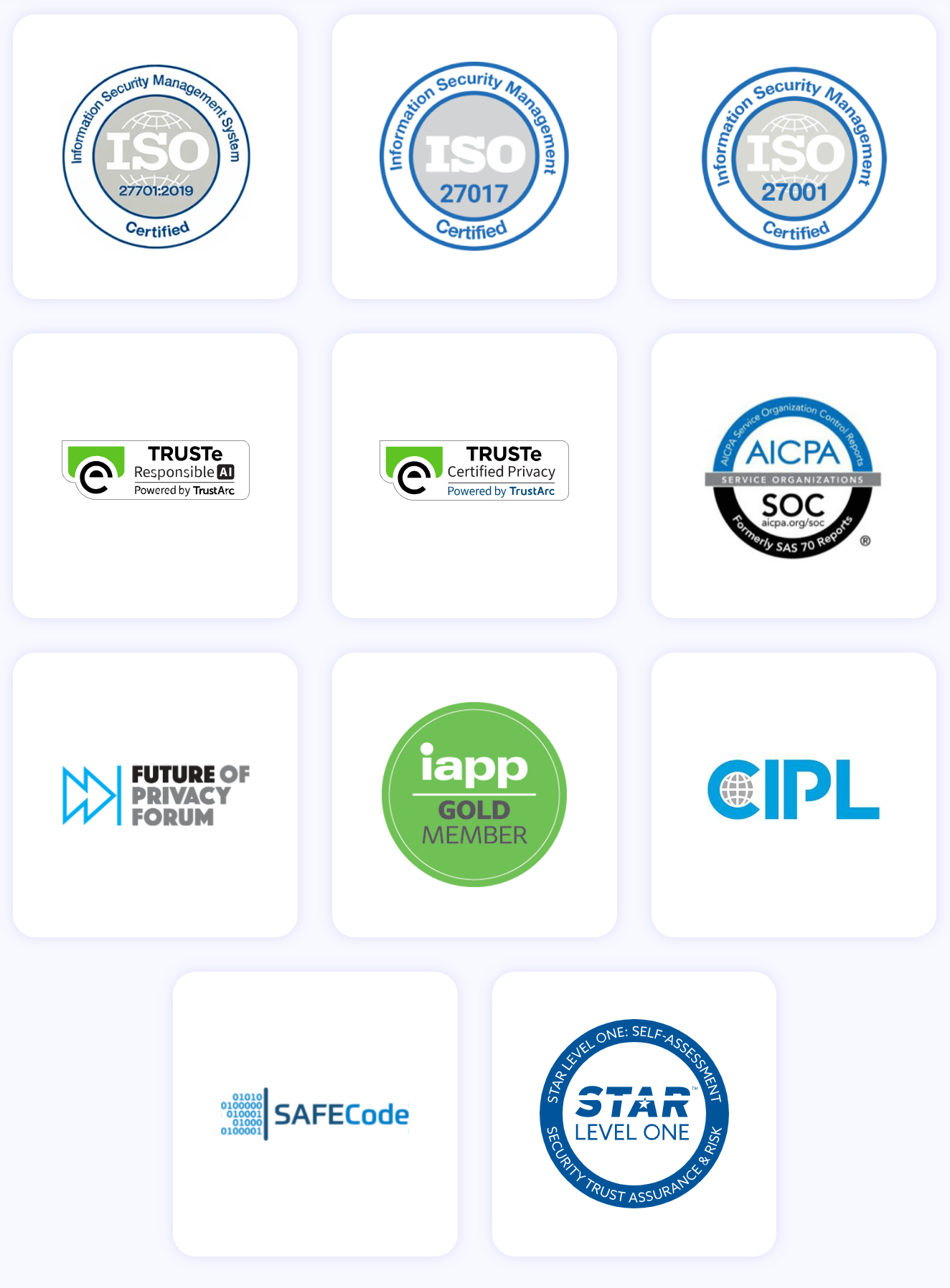
Chameleon vs. Whatfix vs. ZoomInfo: Which should you choose?
The right choice depends on what problem you're solving and who's solving it.
Choose Chameleon if:
You're a B2B SaaS company guiding external users through your own product
Your product team wants to build and iterate on in-app experiences without engineering
You need fast time-to-value with a no-code builder
Your application is web-based and you already use analytics tools like Mixpanel or Amplitude
You want built-in A/B testing and AI-powered campaign creation
Choose Whatfix if:
You're a large enterprise managing adoption across multi-application environments
You need coverage for desktop apps, mobile, and VDI/Citrix alongside web
L&D or IT teams are driving adoption as part of a digital transformation project
You need simulation training (Mirror) and multi-format content export for LMS delivery
Regulatory compliance and enterprise governance are non-negotiable requirements
Add ZoomInfo if:
You want adoption signals to feed directly into your sales and marketing execution
You need buyer intent data to identify accounts researching your category before they raise their hand
Your sales team needs buying committee intelligence, not just individual user behavior
You're ready to connect your product data to an AI-powered go-to-market engine
You want a platform that works in any tool via API and MCP, not just inside its own UI
Try ZoomInfo for free and see what your go-to-market team has been missing.
Chameleon and Whatfix both guide users through software well. The real question is what you do with the signals those users generate.
For B2B companies where every adoption milestone is a potential revenue event, ZoomInfo turns that data into action: identifying who's ready to buy, surfacing the right contacts, and powering outreach that reflects the full context of each account. The companies that connect adoption to pipeline don't just onboard users. They close deals.
Chameleon vs. Whatfix vs. ZoomInfo FAQ
What is the fundamental difference between Chameleon, Whatfix, and ZoomInfo?
Chameleon is a digital adoption platform built for B2B SaaS product teams to create in-app experiences (tours, tooltips, surveys, checklists) for their product's external users.
Whatfix is an enterprise DAP built for L&D and IT teams to guide internal employees through third-party enterprise software across web, desktop, mobile, and VDI environments.
ZoomInfo is an AI-powered GTM platform that provides B2B data, buyer intent signals, and execution tools for sales, marketing, and RevOps teams.
Which platform is best for a B2B SaaS company's product team?
Chameleon is the strongest fit for SaaS product teams. Its no-code Chrome Extension builder, AI Copilot, and integrations with product analytics tools like Mixpanel, Amplitude, and Heap are designed for product managers who need to ship in-app experiences quickly without engineering involvement. It supports SPAs, Shadow DOMs, and modern frontend architectures that SaaS products commonly use.
Which platform works for desktop and mobile applications?
Whatfix is the only one of the three that supports desktop applications (Windows/Mac), mobile apps, and VDI/Citrix environments natively. Chameleon is web-only. ZoomInfo is a data and intelligence platform accessed through web interfaces, APIs, and MCP rather than an overlay on other applications.
How do the pricing models compare?
Chameleon starts at $279/month with published pricing tied to Monthly Tracked Users. Whatfix publishes no pricing and requires a sales conversation for all plans, with separate pricing for its DAP, Product Analytics, and Mirror products. ZoomInfo uses consumption-based pricing with no published figures, but offers a permanent free tier (ZoomInfo Lite) with 10 monthly export credits and access to 100M+ profiles.
Can Chameleon and ZoomInfo work together?
Yes. Chameleon integrates with CRM and analytics platforms that ZoomInfo also connects to, including HubSpot and Salesforce.
A SaaS company could use Chameleon to drive product adoption for external users while using ZoomInfo to identify which accounts with adoption signals have buying intent, surface the buying committee behind those accounts, and trigger sales outreach through GTM Workspace or GTM Studio.
Which platform has the strongest AI capabilities?
Each platform's AI serves a different purpose. Chameleon's Copilot builds in-app campaigns from conversation and draws on 10 years of adoption data. Whatfix's ScreenSense engine uses a Computer Use model to understand enterprise application context and trigger guidance adaptively.
ZoomInfo's GTM Context Graph processes 1.5B+ data points daily and powers AI agents that handle account research, outreach generation, and signal-to-action execution across the go-to-market workflow.
Which platform is easiest to implement?
Chameleon has the fastest time-to-value, with a Chrome Extension builder and installation that can be completed in minutes via Twilio Segment or Freshpaint. Whatfix requires more planning and technical effort upfront, particularly for multi-application enterprise deployments.
ZoomInfo's GTM Workspace deploys in weeks for sellers, with deeper integrations scaling based on the complexity of the customer's data infrastructure.
Do any of these platforms offer free access?
Chameleon offers a 14-day free trial with full platform access and no credit card required. Whatfix offers a free trial via request form, but duration and feature scope are not published. ZoomInfo offers both a permanent free tier (ZoomInfo Lite with 10 monthly export credits) and a 7-day free trial of the full platform.
More Chameleon and Whatfix comparisons:
