

Clearbit built its reputation as the developer-first B2B enrichment API: clean REST endpoints, sub-second cached responses, and code samples in four languages. Then HubSpot acquired it in December 2023, rebranded its capabilities as Breeze Intelligence, and began pulling the standalone product inward.
The question a developer asks today is not whether the Clearbit API was good. It was. The question is whether you can still build on it as an independent surface, and what happens to that build as the product moves deeper into HubSpot.
The Clearbit API is likely the right choice if:
You are an existing Clearbit customer with an active subscription and API keys already in production.
You need person and company enrichment from a single email address or domain, with streaming responses in under a second for cached lookups.
You want enrichment data that includes simultaneous NAICS, GICS, and SIC industry codes, corporate hierarchy fields, and normalized role/seniority classifications in one response.
You need IP-to-company identification via the Reveal API for website visitor deanonymization.
You are building within a HubSpot-centric stack and can fall back to Breeze Intelligence as the standalone API surface narrows.
However, it might not be the right fit if:
You are a new customer: standalone Clearbit API subscriptions are no longer sold to new buyers, and the developer documentation is login-gated.
You need official, maintained SDKs: all three (Ruby, Node.js, Python) are unmaintained, and Clearbit now recommends direct HTTP requests.
You need OAuth 2.0, scoped access, or credential rotation: Clearbit uses static API keys via HTTP Basic Auth with no delegated access model.
You need a contact search or prospecting database, intent signals, org charts, or technographics beyond what enrichment returns.
You need a long-term API investment with a public roadmap: the product direction is Breeze Intelligence inside HubSpot, not the standalone REST API.
You need to evaluate the API before purchasing: the full reference docs require an active Clearbit login.
In this case, consider the API from ZoomInfo, an AI GTM platform built on 500M contacts and 100M companies. Its REST suite covers search, enrichment, AI intelligence, and audience management, with OAuth 2.0 authentication, tiered rate limits up to 35 req/sec, and an MCP server for AI-agent workflows.
This article reviews both: the Clearbit API in full technical depth first, then ZoomInfo's API as the alternative for developers whose builds need broader data, active documentation, and a surface that is expanding rather than contracting.
Clearbit API at a Glance
Attribute | Detail |
|---|---|
API type | REST over SSL, JSON responses |
Authentication | HTTP Basic Auth (API key as username) or Bearer token |
Base URL | Multiple subdomains: person.clearbit.com, company.clearbit.com, reveal.clearbit.com |
Rate limits | 600 req/min per endpoint (soft limit: excess requests queued, not rejected) |
SDKs | Ruby, Node.js, Python (all three no longer actively maintained) |
Webhooks | Yes, for asynchronous enrichment delivery with signature verification |
Documentation | clearbit.com/docs (login-gated since HubSpot acquisition) |
Pricing / access | Credit-based, paid subscribers only; no public free tier; new customers directed to HubSpot |
Clearbit API: What Works Well & What to Plan Around
What works well | What to plan around |
|---|---|
Person + Company enrichment from a single email or domain, with ~300ms cached responses | Standalone API is in active sunset: docs are login-gated, new subscriptions route through HubSpot |
Simultaneous NAICS, GICS, and SIC industry codes in one enrichment record | No OAuth 2.0, no token rotation, no scoped delegated access: static API key only |
IP-to-company identification via the Reveal API | All three official SDKs (Ruby, Node.js, Python) are unmaintained |
Webhook delivery with signature verification and exponential-backoff retries (up to 5) | Enrichment-only scope: no search, prospecting, intent signals, or org charts |
Streaming endpoints hold the connection open for up to 60 seconds, avoiding webhook setup | No public developer documentation without an active Clearbit login |
600 req/min soft limit queues excess requests rather than rejecting them | Breeze Intelligence (HubSpot) has no standalone API: the CRM-agnostic path is the legacy API only |
Clearbit API: Authentication & Getting Started
Source: Clearbit
API access requires a paid Clearbit subscription. Since the HubSpot acquisition in December 2023, HubSpot directs new customers to its Breeze Intelligence product rather than standalone Clearbit plans. Existing subscribers keep API access through their current accounts.
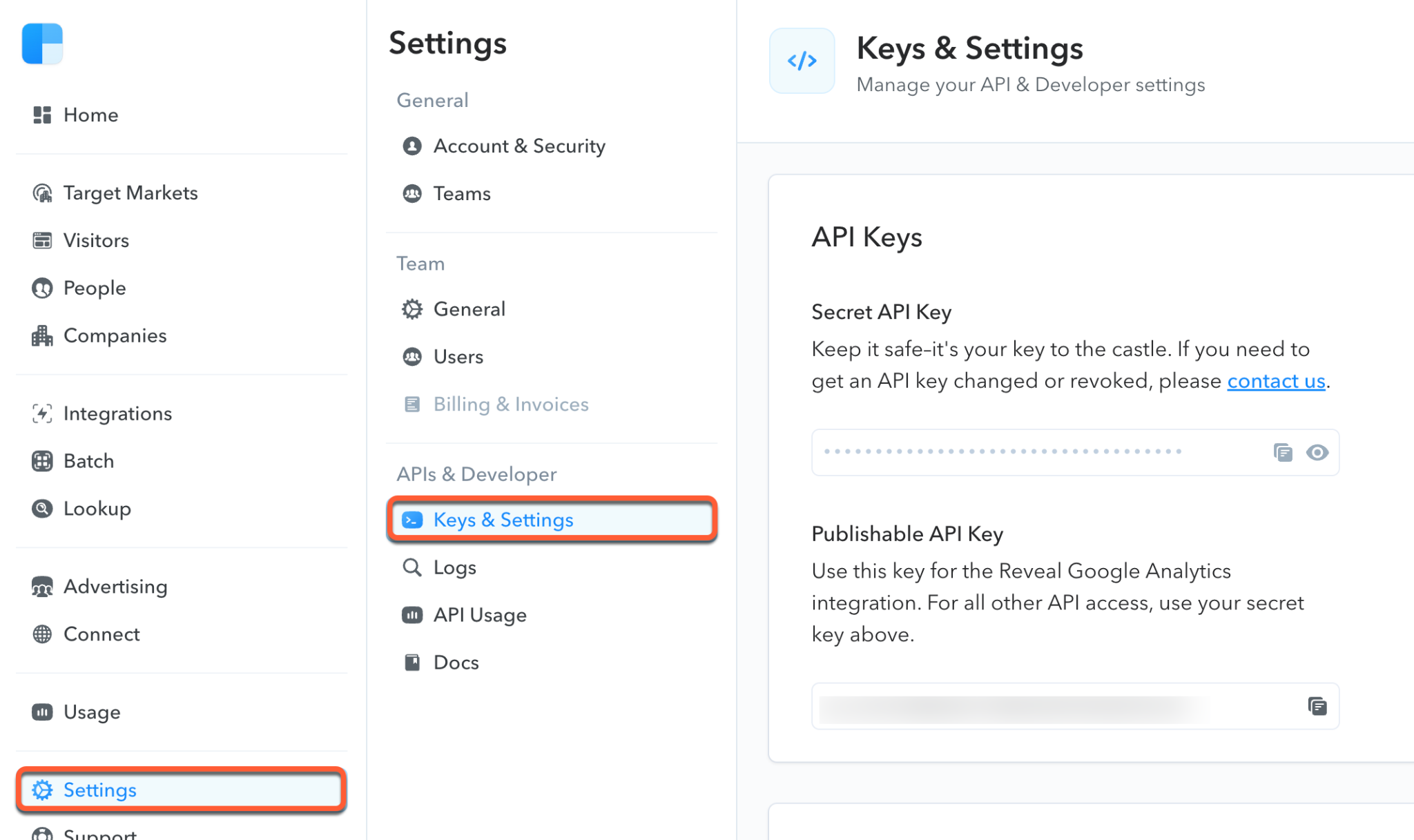
You generate API keys in the Clearbit dashboard at dashboard.clearbit.com. Authentication uses HTTP Basic Auth with the API key as the username and no password. You can also pass the key as a Bearer token in an Authorization header. Both methods grant the same access level.
A basic authenticated request looks like this:
curl "https://person.clearbit.com/v2/people/find?email=test@example.com" \
-u YOUR_API_KEY:
The trailing colon after the API key signals an empty password field in Basic Auth.
For teams embedding Clearbit into their own products, the Powered by Clearbit program supports child key provisioning, letting parent accounts issue scoped keys to end customers. Outside this program, there is no OAuth 2.0 flow, no token exchange, and no rotating credentials.
The simplicity is a tradeoff: key-based auth is easy to implement and easy to leak. There is no delegated access model for multi-tenant integrations where each customer authenticates independently.
One thing to know before you start: the free tools that once provided a low-barrier entry point (100 free lookups/month via the Connect Chrome extension, a free platform tier) were all sunset on April 30, 2025. There is no free tier for the API.
Clearbit API: Core Endpoints & Capabilities
The API is organized across separate subdomains rather than a single base URL. Each resource area maps to its own host, with shared authentication and response conventions.
Person Enrichment
Endpoint: GET https://person.clearbit.com/v2/people/find?email=:email
The Person API takes a work email address and returns 100+ person attributes: name, location, employment details (company, title, normalized role such as "leadership" or "engineering", sub-role such as "ceo" or "frontend", and seniority such as "executive" or "manager"), and social handles (LinkedIn, Twitter, GitHub, Gravatar).
Three response patterns are supported:
Synchronous (cached): Returns 200 with the full profile immediately. Cached lookups return in roughly 300 milliseconds.
Asynchronous (webhook): Returns 202 when data is still being assembled. Clearbit posts the enriched payload to your configured webhook URL once the lookup completes.
Streaming: A variant at person-stream.clearbit.com holds the HTTP connection open for up to 60 seconds while the lookup runs, avoiding the need for webhook infrastructure.
What you would build with this: a signup flow that takes only an email address, enriches the record in real time, and populates your CRM with title, company, seniority, and social profiles before the user finishes onboarding.
Company Enrichment
Source: Clearbit
Endpoint: GET https://company.clearbit.com/v2/companies/find?domain=:domain
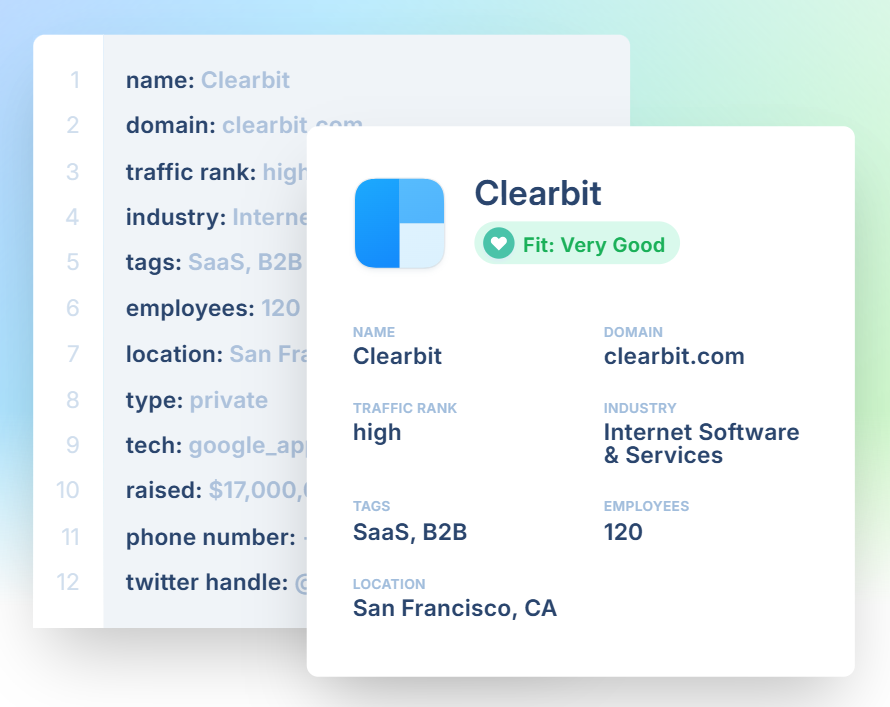
The Company API takes a domain and returns 100+ company attributes: industry classification across three systems simultaneously (6-digit NAICS, 8-digit GICS, and 4-digit SIC), employee count, estimated annual revenue, founded year, location, tech stack detection, corporate hierarchy fields (parent domain, ultimate parent domain), and social handles.
The triple industry classification is worth highlighting: most enrichment APIs provide one industry taxonomy. Clearbit returns NAICS, GICS, and SIC codes in a single response, which helps teams whose lead routing, compliance, or segmentation rules require a specific standard.
The same sync/async/streaming response pattern applies as with the Person API.
Combined Enrichment
A combined endpoint merges person and company data in a single call. Rather than making two requests (one to person.clearbit.com and one to company.clearbit.com), the combined API returns both the person profile and their associated company profile from a single email lookup.
Reveal API (IP-to-Company)
Source: Clearbit
Endpoint: GET https://reveal.clearbit.com/v1/companies/find
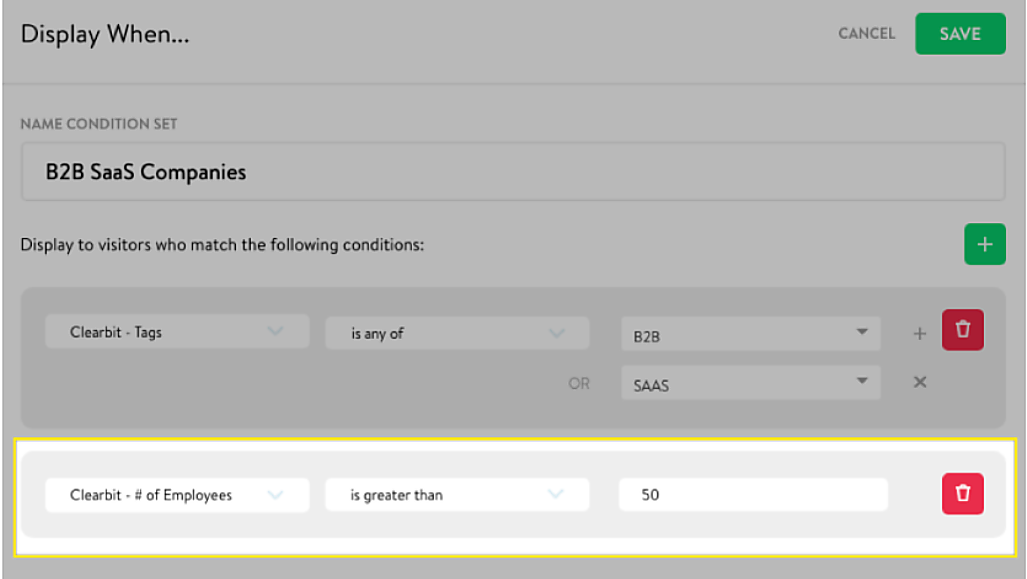
This endpoint converts anonymous website visitor IP addresses into company records. It is the programmatic layer behind Clearbit's visitor identification capabilities. A developer building a website personalization engine or visitor tracking dashboard would use it to resolve IP addresses to company profiles in real time.
Auxiliary Endpoints
Three lighter endpoints round out the surface:
Autocomplete API: Suggests company records from partial name strings, useful for type-ahead search in forms or internal tools. (Note: as of September 2025, the logo field in autocomplete responses returns null following the Logo API sunset.)
Name to Domain API: Converts a company name to its primary domain.
Risk API: Scores an email or domain for deliverability and fraud signals.
Batch Enrichment
Source: Clearbit
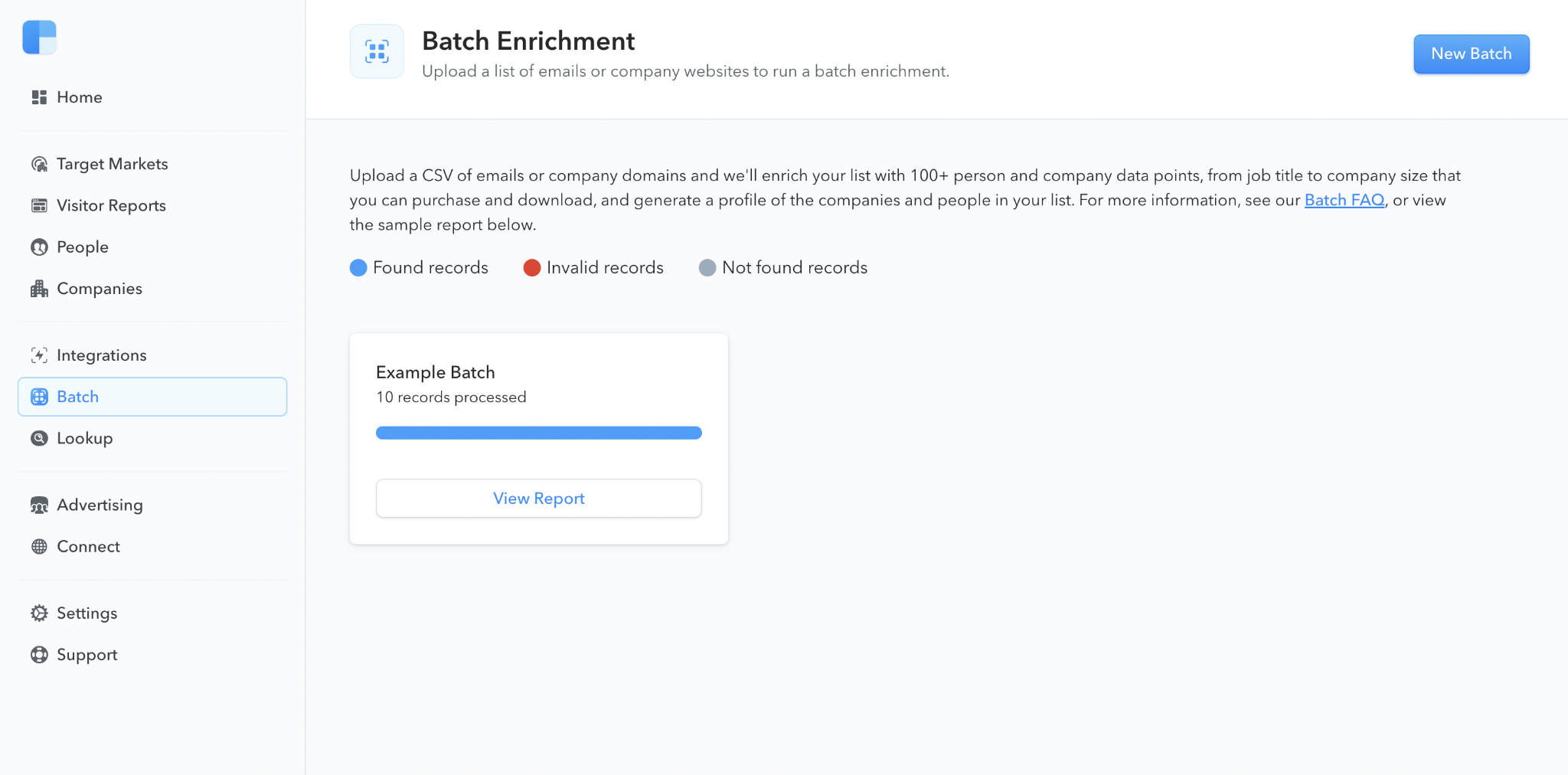
A bulk CSV enrichment path handles lists of emails or domains at scale rather than per-record real-time API calls. This serves teams migrating databases, cleaning CRM exports, or running periodic enrichment jobs against large contact lists.
Clearbit API: Webhooks & Events
Clearbit uses webhooks to deliver asynchronous enrichment responses. When a real-time enrichment request returns a 202 status (data not yet ready), Clearbit posts the enriched payload to the webhook URL configured in the account dashboard once the lookup completes.
The webhook system includes several reliability features:
Signature verification: An X-Request-Signature header lets recipients confirm the payload came from Clearbit.
Correlation: A webhook_id parameter can be attached to the original request to match the async response back to the triggering call.
Retries: Failed deliveries are retried up to five times with exponential backoff.
Webhook URLs are configured at the account level in the Clearbit dashboard, not per-request. The streaming endpoints (*-stream.clearbit.com) offer an alternative for developers who want synchronous-style responses without setting up a webhook receiver.
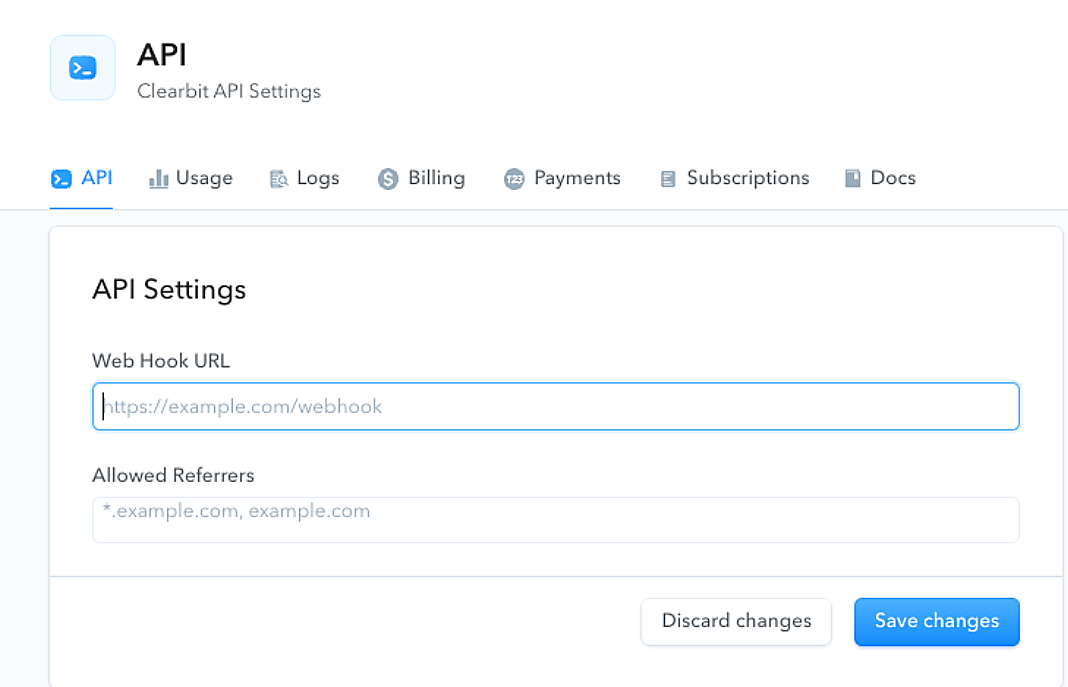
Source: Clearbit
One scope limitation: the webhook system covers enrichment responses only. There is no general event subscription system (no entity change notifications, no signal alerts, no credit usage events). If your pipeline depends on push notifications beyond "your enrichment result is ready," you will need to build that layer yourself.
Clearbit API: SDKs, Docs & Rate Limits
SDKs & Libraries
Clearbit published three official client libraries under the Clearbit GitHub organization:
Ruby: clearbit/clearbit-ruby (52 stars, 9 forks)
Node.js: clearbit/clearbit-node
Python: clearbit/clearbit-python
All three are unmaintained.
Clearbit's documentation now recommends direct HTTP requests. No new SDKs have been released since the HubSpot acquisition, and community-maintained wrappers exist on GitHub but carry no official endorsement.
A Postman collection is referenced in Clearbit's developer materials as a testing resource, though its current maintenance status is unclear.
Unmaintained SDKs are a real signal for a developer evaluating this API in 2026. It means you own the auth layer, request handling, error management, and rate-limit backoff logic. For a simple enrichment call, that is manageable.
For a production pipeline with webhook receivers, batch jobs, and streaming connections, the absence of maintained client libraries adds engineering overhead.
Documentation & Developer Experience
Clearbit's developer documentation was historically available at clearbit.com/docs and dashboard.clearbit.com/docs, with code snippets in Shell, Ruby, Node, and Python. The original docs were well organized with practical examples.
Post-acquisition, the picture has changed:
Both documentation URLs now redirect to a Clearbit login wall, making the full API reference inaccessible without an active subscription.
No publicly browsable interactive explorer (Swagger/OpenAPI) was found.
No OpenAPI spec download link is publicly available.
No llms.txt index for AI development tools.
What remains publicly accessible:
A changelog/release notes page covering product changes since 2024.
A status page providing API uptime and incident history.
The Clearbit Help Center at help.clearbit.com (Zendesk-powered), organized across APIs, Integrations, and FAQ categories.
Developer support via the Clearbit support portal (ticket submission) and the HubSpot Community Clearbit board.
For a developer evaluating the API without an existing subscription, the login-gated documentation is a barrier. You cannot confirm response shapes, review endpoint parameters, or test request formats without becoming a paying customer first.
Rate Limits & Constraints
The published rate limit is 600 req/min per endpoint. This is a soft limit: requests exceeding 600/minute are not rejected with a 429 response but queued at lower priority. Current rate-limit status is returned in HTTP response headers on every call.
This differs from most APIs, which hard-reject excess requests. The soft-queue approach means your integration will not break under brief traffic spikes, but sustained overuse will produce increasing response latency as your requests are deprioritized.
Two additional constraints to plan around:
Streaming endpoints hold connections open for up to 60 seconds. If you run many concurrent streaming requests, plan for the connection count on your infrastructure.
Batch enrichment has separate limits, though specific figures for bulk operations are not confirmed in publicly accessible documentation.
Clearbit API Pricing & Access Costs
Clearbit uses a credit-based model with credits refreshed monthly. Credits do not roll over. The full pricing structure is not publicly published; the pricing page and most help center pricing articles sit behind authentication.
What is available from accessible sources:
Credit-based billing: Sales alerts, CSV exports, and form shortens each consume credits separately. The specific credit cost per enrichment call is not documented in publicly accessible material.
Batch enrichment: A per-row price of roughly $0.30 has been cited in help center summaries for CSV batch enrichment, rounded to $5 increments. Verify this figure against a current quote before committing.
Powered by Clearbit: The program for teams embedding Clearbit into their own products supports "On Demand" additional credit purchases beyond the base allocation.
No free tier: Following the sunset of free tools on April 30, 2025, there is no free tier for the API.
Post-acquisition pricing direction: New API access is sold primarily as part of HubSpot's Breeze Intelligence product, where basic company and contact enrichment is included in all Starter+ Core Seats at no additional credit cost. Advanced features (Buyer Intent, Smart Properties) consume HubSpot Credits at $10 per 1,000 credits.
However, Breeze Intelligence has no standalone API: it operates entirely within HubSpot's CRM interface. Standalone Clearbit API subscriptions are handled through existing account relationships; HubSpot directs new purchasers to Breeze Intelligence.
For a developer sizing costs: the lack of published pricing means you cannot estimate API costs without contacting Clearbit or HubSpot directly. This is a real barrier, especially when comparing against APIs with transparent credit models.
Where the Clearbit API Falls Short
These are the practical limits a developer should plan around when evaluating this API in 2026. Several stem from the HubSpot acquisition rather than original design decisions.
The standalone API is in active sunset. The developer documentation is login-gated. Free tools have been discontinued. HubSpot directs new customers to Breeze Intelligence. The Logo API was sunset on December 8, 2025. The product roadmap points to Breeze Intelligence inside HubSpot's CRM, not the standalone REST API.
For a developer evaluating a long-term API dependency, this trajectory is the single biggest factor to weigh.
No public developer documentation. You cannot review endpoint specifications, confirm response formats, or test request shapes without an active Clearbit subscription. Compare this to APIs where the docs are public, interactive, and include try-it explorers. The gated documentation makes pre-purchase technical evaluation difficult.
No OAuth 2.0, no delegated access. Authentication is a static API key via HTTP Basic Auth. There is no token rotation, no scoped access beyond the Powered by Clearbit child key program, and no delegated OAuth flow for multi-tenant integrations.
For teams with credential-rotation policies or SaaS products connecting to many customer accounts, this is limiting.
All official SDKs are unmaintained. The Ruby, Node.js, and Python libraries are no longer maintained, and Clearbit recommends direct HTTP requests. No new SDKs have been released since the acquisition.
Enrichment is the entire scope. The API enriches records by email or domain. There is no contact search or prospecting database, no buyer intent signals, no org chart traversal, no technographic querying beyond what the enrichment response includes, and no AI-powered account research.
If your pipeline needs to find contacts (not just enrich known ones), you need a second API.
Webhooks cover enrichment delivery only. There are no push notifications for entity changes, signal events, credit usage, or any event beyond "your enrichment result is ready." Event-driven architectures beyond enrichment must build their own notification layer.
No published accuracy or coverage metrics. HubSpot documents dynamic scoring and human QA but publishes no specific match rates, accuracy percentages, or coverage by geography or industry. You cannot benchmark enrichment quality before committing.
ZoomInfo API: The Alternative with a Broader Data Surface
Where Clearbit's API focuses on enrichment (person and company data from an email or domain), ZoomInfo is an AI GTM platform whose API covers search, enrichment, AI intelligence, audience management, and compliance across 500M contacts and 100M companies.
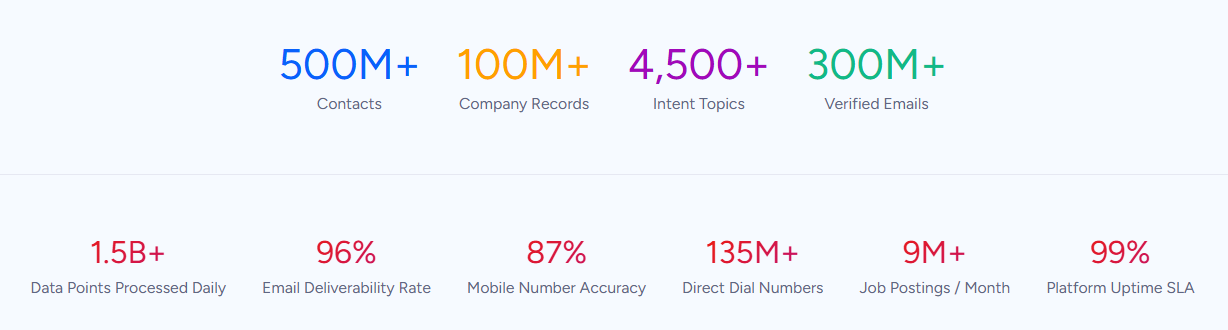
Its GTM Context Graph processes 1.5B+ data points daily, combining this dataset with your first-party data to power the AI endpoints below.
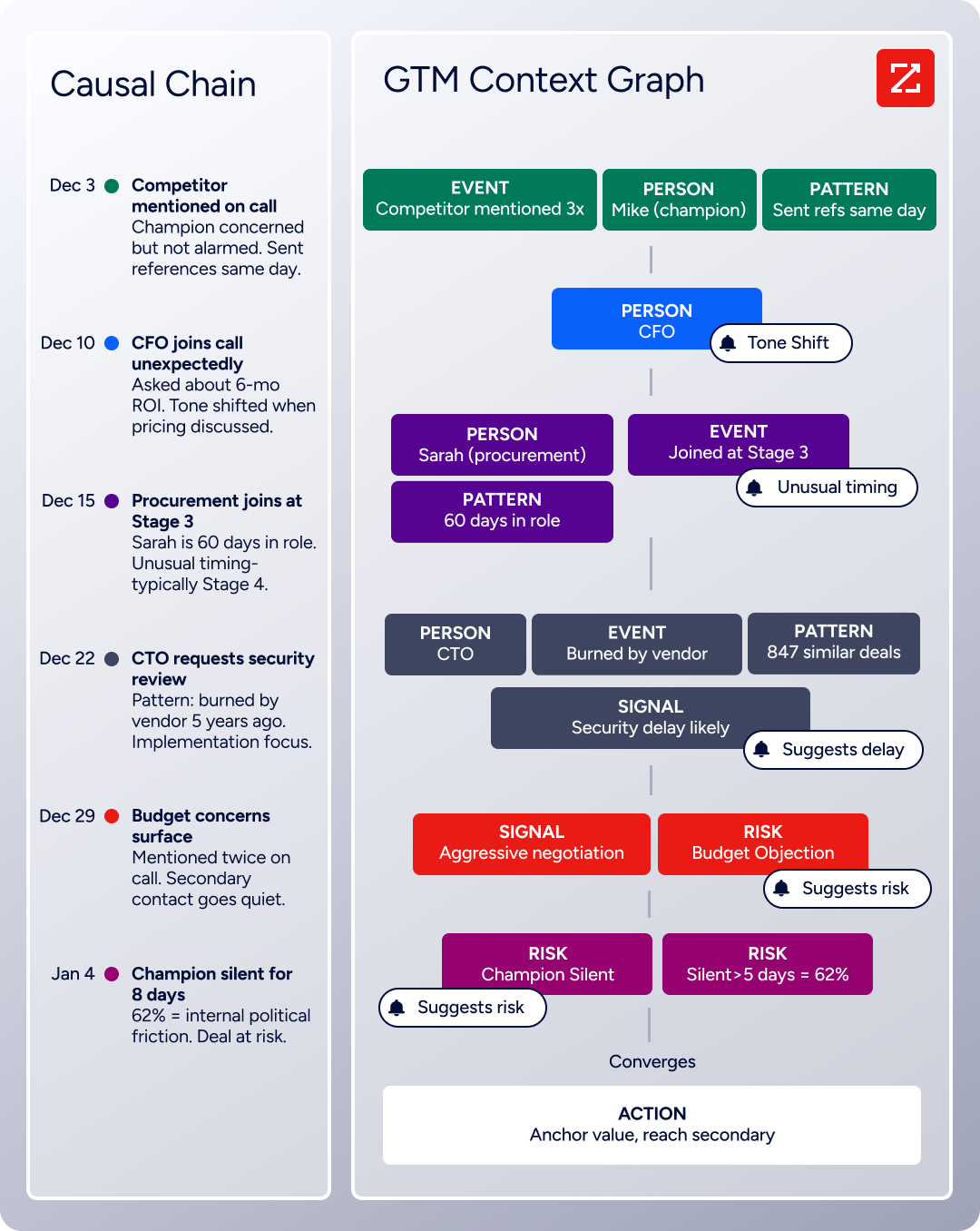
For a developer whose build needs to find contacts (not just enrich known ones), layer in intent signals, traverse org charts, or power AI agents with B2B data, ZoomInfo's API addresses the scope gaps directly.
What the API Covers
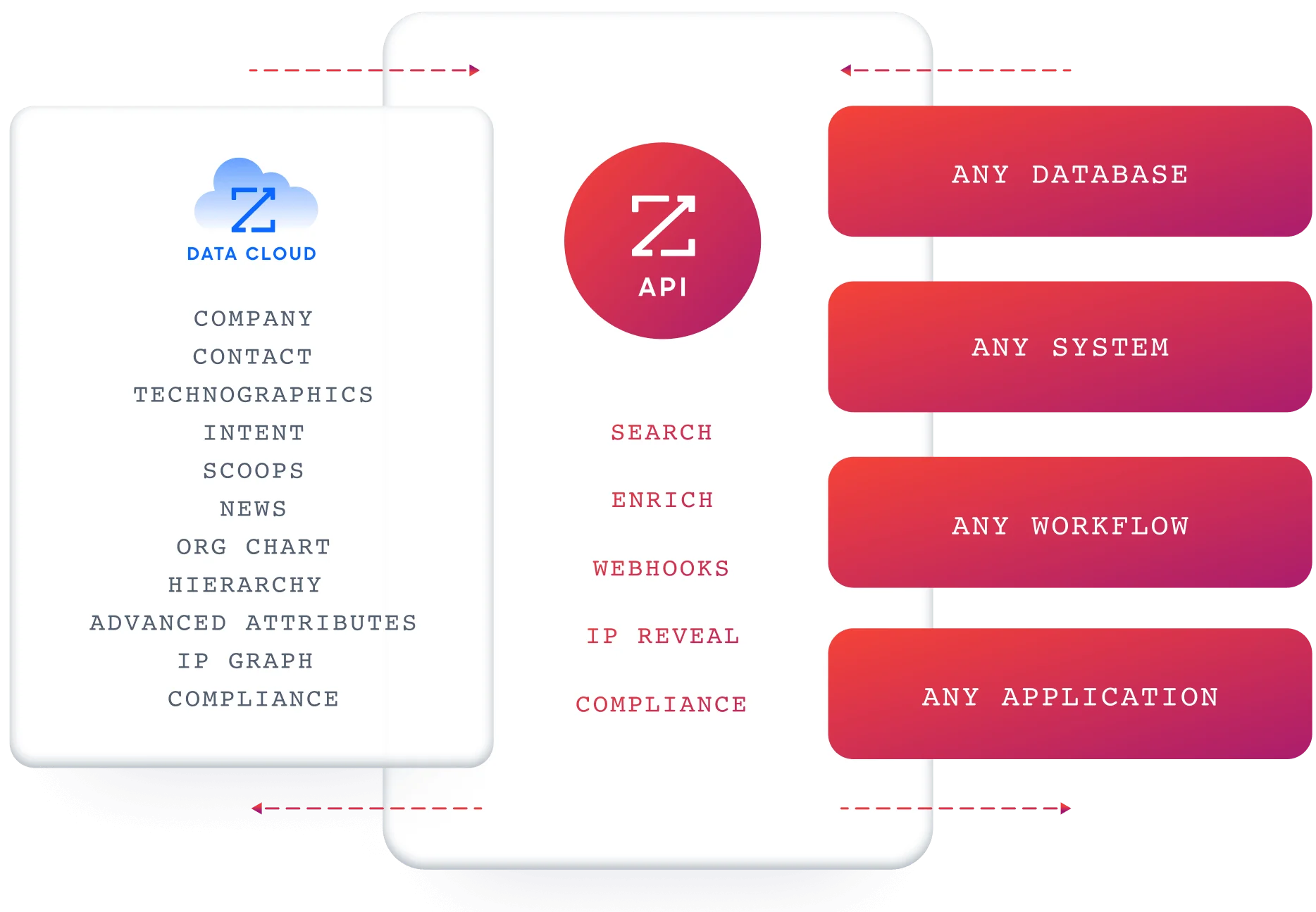
ZoomInfo's Enterprise API is a REST suite served from https://api.zoominfo.com/gtm, organized into four areas documented in the interactive API reference:
Data API (Search & Enrich): Search endpoints cover Contacts, Companies, Intent, News, and Scoops, returning matched records without consuming credits. Enrich endpoints unlock the full payload: business emails, direct dials, employment history, corporate hierarchy, org charts, technographics, and hashtag signals, up to 25 records per call. The search-then-enrich pattern lets you filter freely, then pay only for the records you commit to.
AI Intelligence API (Copilot, part of GTM Workspace): Account Summary returns structured account intelligence with a free-form Q&A endpoint. Find Similar Companies performs lookalike expansion. Contact Recommendations returns AI-ranked buying-committee suggestions by motion (prospecting, deal acceleration, renewals).
Marketing API: CRUD endpoints for programmatic audience management.
Platform API (Engagements, Beta): Bidirectional engagement data for feeding first-party signals back into the GTM Context Graph.
What you would build with this: a prospecting pipeline that searches for contacts matching your ICP (free, no credits consumed), enriches the matches with verified emails and direct dials, checks intent signals to prioritize accounts researching your category, then pushes qualified records into your CRM or outbound sequence.
Authentication & Access
ZoomInfo uses OAuth 2.0 with PKCE via Okta, supporting three flows: Authorization Code with PKCE (web applications), Client Credentials (server-to-server), and Refresh Token. Access tokens are 24-hour Bearer tokens with rotating refresh tokens.
Teams register applications through the ZoomInfo Developer Portal, where they generate credentials, define scopes, and test endpoints.
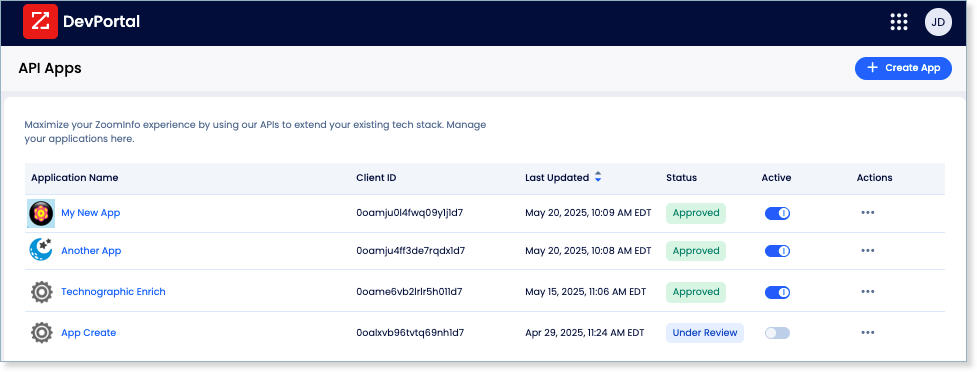
This is a fundamentally different authentication model from Clearbit's static API key. OAuth 2.0 supports delegated access, credential rotation, and scoped permissions, which fits multi-tenant integrations and enterprise security requirements.
Rate Limits, Credits & Webhooks
Rate limits are published by tier: Builder (5 req/sec), Standard (25 req/sec), and Scaling (35 req/sec), with per-hour and per-day sliding-window limits enforced simultaneously. Every response includes quota headers with remaining capacity, and 429 responses include a Retry-After header with exact backoff timing.

Credits follow a rolling 12-month window: enriching a record for the first time consumes one credit; re-enriching the same record within the year is free. Search and lookup operations are free and do not consume credits.
Webhooks are available via the Agents API, tied to ZoomInfo's Agent Teams system. Event types cover bulk enrichment jobs completing, records changing, credit usage crossing thresholds, and new GTM signals (scoops, funding events, intent spikes) becoming available, with retry behavior and throttling configurable per event type.
Developer Experience & MCP
Documentation lives at docs.zoominfo.com with an interactive API reference, OAuth recipes in five languages (Shell, Node, Ruby, PHP, Python), and an llms.txt index for AI development tools. The documentation is public and browsable without a subscription.
For developers building AI agents, ZoomInfo's MCP server at https://mcp.zoominfo.com/mcp exposes search, enrich, and account research as native tools for MCP-compatible assistants, currently supporting Claude and ChatGPT.
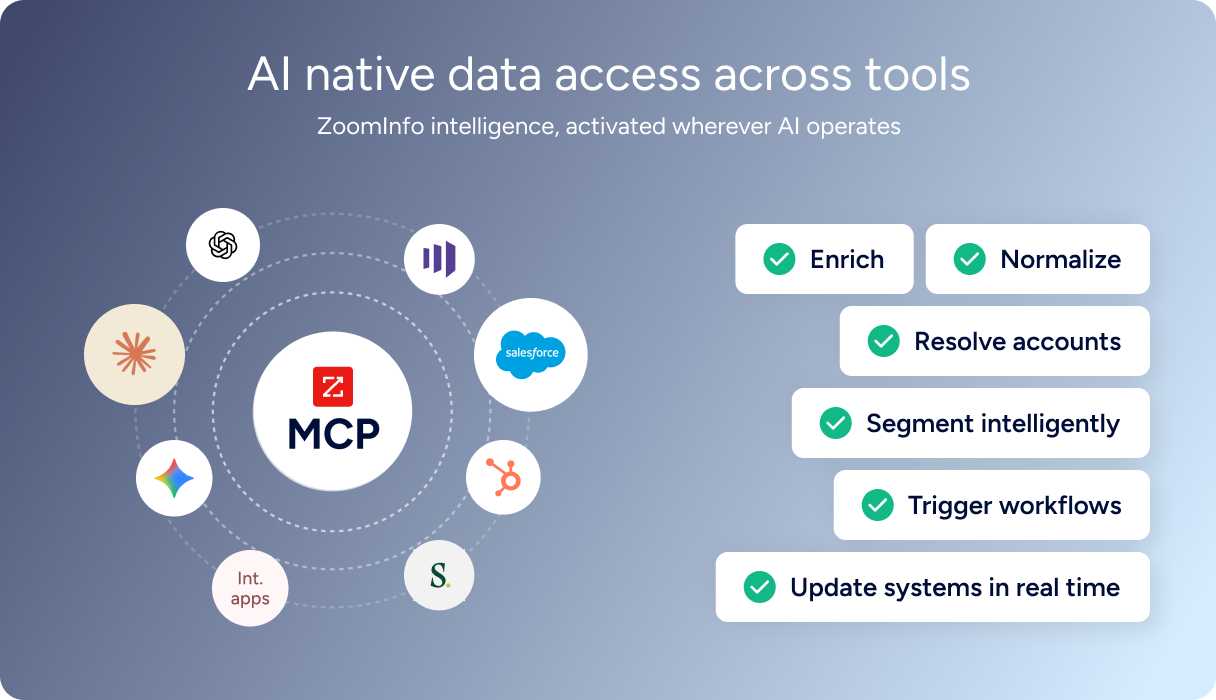
A separate Docs MCP server enables AI-assisted code generation against the API spec.
ZoomInfo does not publish official SDKs either, so both platforms require direct HTTP integration. ZoomInfo has added API access to all relevant plans; pricing follows a consumption-based model.
BDO Canada reported an 87% reduction in time spent updating internal data dashboards using the ZoomInfo API, with one analyst describing the integration as plug-and-play across any process. (ZoomInfo)
Clearbit API vs. ZoomInfo API
Dimension | Clearbit API | ZoomInfo API |
|---|---|---|
API type | REST, JSON (multiple subdomains) | REST, JSON:API format (single base URL) |
Authentication | HTTP Basic Auth / Bearer token (static API key) | OAuth 2.0 with PKCE (24-hour tokens, rotating refresh) |
Primary scope | Person and company enrichment from email/domain, IP-to-company identification | Contact/company search, enrichment, intent signals, org charts, technographics, AI research |
Data scale | 20M+ companies, 500M+ decision-makers (pre-acquisition figures) | 500M contacts, 100M companies, 135M+ verified phones, 200M+ verified business emails |
Search / prospecting | No search or prospecting endpoints | Free search across contacts, companies, intent, scoops, and news |
Webhooks | Enrichment delivery only (signature-verified, 5 retries) | Agent Teams-based webhooks (enrichment jobs, signal alerts, credit thresholds) |
SDKs | Ruby, Node.js, Python (all unmaintained) | None (recipes in Shell, Node, Ruby, PHP, Python) |
Rate limits | 600 req/min per endpoint (soft limit, excess queued) | 5-35 req/sec by tier, with per-hour and per-day sliding windows |
AI endpoints | Not available | Account Summary, Find Similar Companies, Contact Recommendations |
MCP server | Not available | Available at mcp.zoominfo.com (Claude, ChatGPT) |
Documentation | Login-gated (requires active subscription) | Public, interactive, with llms.txt index |
Pricing model | Credit-based (not publicly published) | Consumption-based (search free, enrich consumes credits) |
Best for | Existing subscribers needing focused person/company enrichment within a HubSpot-centric stack | Developers building pipelines that need search, enrichment, intent, and AI intelligence on a single API surface |
Final Verdict
Clearbit's API was a developer favorite for good reason: clean REST endpoints, sub-second cached responses, and rich enrichment attributes (including triple industry classification and corporate hierarchy fields), and straightforward authentication.
For existing subscribers with keys already in production, it remains a capable enrichment surface for person and company lookups.
Choose the Clearbit API if you are an existing subscriber whose build is scoped to person and company enrichment from emails and domains, and the HubSpot-centric product direction aligns with your stack. The enrichment data (100+ attributes, simultaneous NAICS/GICS/SIC codes, normalized roles and seniority) is strong for what the API does.
Choose the ZoomInfo API if your build needs to go beyond enrichment into search, prospecting, intent signals, org chart traversal, AI-powered account research, or audience management.
The public documentation, OAuth 2.0 authentication, search-then-enrich credit model (search is free, enrich consumes credits), and expanding MCP surface make it the stronger long-term API investment for developers building data-intensive pipelines.
Explore the ZoomInfo Enterprise API or start with the developer docs to see the endpoint surface directly.
A developer evaluating Clearbit's API for a new project in 2026 should weigh the login-gated documentation, unmaintained SDKs, and HubSpot-centric product direction before committing. The API still works for those who have access, but the investment trajectory points inward, not outward.
FAQ
Is the Clearbit API free?
No. Following the sunset of all free tools on April 30, 2025, there is no free tier for the Clearbit API. Access requires a paid Clearbit subscription, and HubSpot directs new customers to its Breeze Intelligence product. Within HubSpot, basic company and contact enrichment is included in Starter+ Core Seats at no additional credit cost, but Breeze Intelligence operates within HubSpot's CRM interface and does not provide a standalone REST API.
Does Clearbit have a GraphQL API?
No. Clearbit exposes a REST API with JSON responses across multiple subdomains (person.clearbit.com, company.clearbit.com, reveal.clearbit.com). There is no GraphQL endpoint. If you need a GraphQL interface for enrichment, you would need to build a wrapper layer on top of the REST API.
What is the Clearbit API rate limit?
The published limit is 600 requests per minute per API endpoint. Unlike most APIs, this is a soft limit: excess requests are queued at lower priority rather than rejected with a 429 error. Current rate-limit status is returned in HTTP response headers on every API call.
Separate limits may apply to the Reveal and Batch Enrichment endpoints, though specific figures for those paths are not confirmed in publicly accessible documentation.
Are there official Clearbit SDKs?
Clearbit published official client libraries for Ruby, Node.js, and Python under the Clearbit GitHub organization. All three are no longer maintained, and Clearbit now recommends direct HTTP requests. No new SDKs have been released since the HubSpot acquisition. Community-maintained wrappers exist but carry no official endorsement.
Can the Clearbit API be used outside of HubSpot?
The legacy Clearbit REST API can still be used outside of HubSpot by existing subscribers with active accounts. It is CRM-agnostic and works with any tech stack via standard HTTP requests. However, Breeze Intelligence (the post-acquisition evolution of Clearbit's capabilities) is available only within HubSpot and has no standalone API.
New customers seeking Clearbit's enrichment capabilities outside of HubSpot will need to explore alternatives, since standalone Clearbit subscriptions are no longer sold to new buyers.
What does ZoomInfo's API add beyond Clearbit's?
ZoomInfo's API covers the dimensions the Clearbit API does not: search and prospecting across 500M contacts and 100M companies (search is free, no credits consumed), buyer intent signals, org chart traversal, technographic enrichment across 30,000+ technologies, AI-powered account research and contact recommendations, and an MCP server for AI-agent workflows.
Where Clearbit enriches a known email or domain, ZoomInfo lets you find the right contacts first, then enrich them. The two APIs use different authentication models (static API key vs. OAuth 2.0) and different credit structures, and ZoomInfo's documentation is public and interactive while Clearbit's is now login-gated.
