
Choosing between Docebo and Lessonly (now Seismic Learning) for your team's training comes down to five questions most comparisons skip:
Are you training only sales reps, or does your program extend to customers, channel partners, and employees across the business?
Do you need a standalone LMS you control, or training embedded inside a sales enablement platform?
Is AI-powered content creation or AI-powered sales coaching more critical for your team right now?
How directly does training need to connect to your CRM, pipeline data, and deal performance?
Do your reps already have the buyer intelligence they need to act on what they've learned?
In short, here's what we recommend:
Docebo is the LMS built for organizations that train multiple audiences from a single platform. Its AI-powered content creation cuts course development time by up to 99%, a multi-audience architecture supports employees, customers, and partners in separate branded portals, and a Skills Intelligence layer drives workforce planning and internal mobility.
Docebo serves L&D leaders who need to prove training ROI across the business.
The trade-off: quote-only pricing with an average contract value of $55,229, configuration complexity that often requires technical resources, and analytics that need an add-on module to reach full depth.
Lessonly, now Seismic Learning, is the training and coaching module inside the Seismic Enablement Cloud, a platform that also includes content management, meeting intelligence, and digital sales rooms.
Its Aura Role-Play Agent lets reps practice buyer conversations grounded in your company's actual sales content, while AI coaching surfaces skill gaps and builds personalized development plans.
However, Seismic Learning targets revenue teams rather than general-purpose corporate training, and carries enterprise-level pricing with implementation timelines that can stretch beyond four months.
Both platforms train your revenue teams well. But training in isolation has a ceiling. Reps can master objection handling and product demos, yet still waste hours pursuing the wrong accounts or reaching out at the wrong time. The missing ingredient isn't more training. It's intelligence about who to target, when to engage, and what context to bring to each conversation.
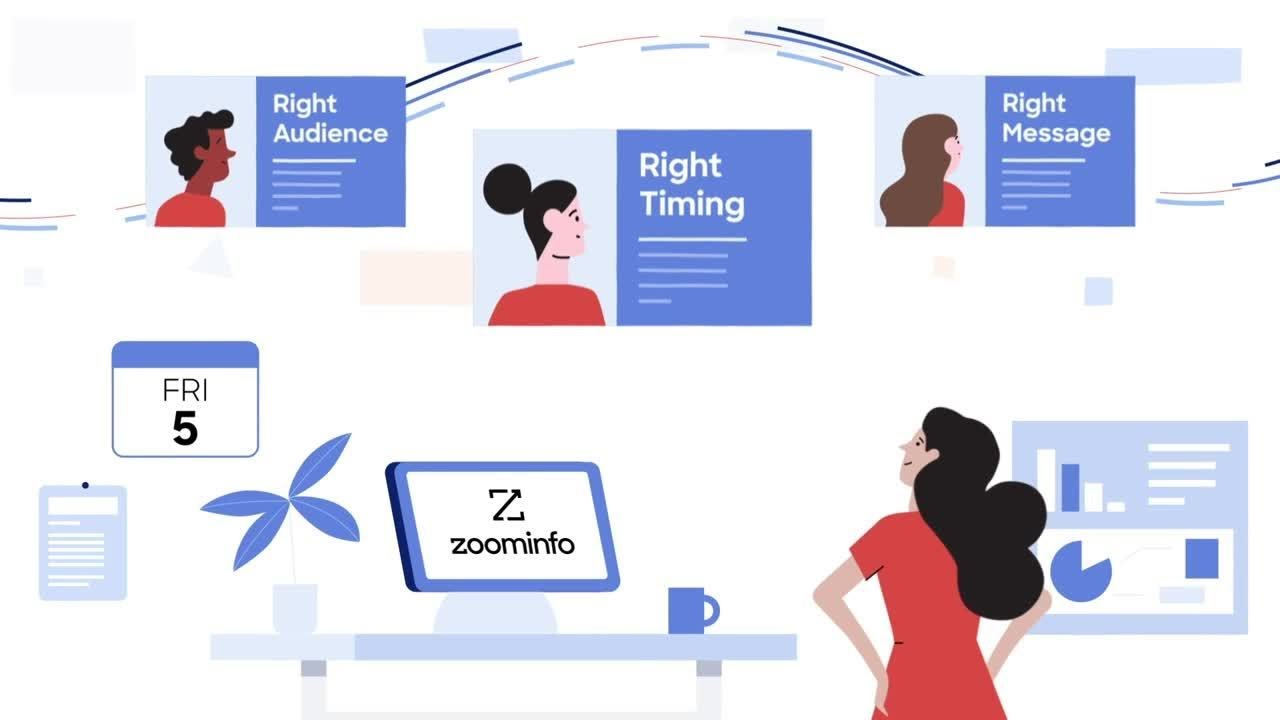
ZoomInfo is a B2B intelligence and GTM platform that complements either training solution with the buyer intelligence that training platforms don't provide.
It gives reps direct dials, verified emails, and intent signals that reveal which accounts are actively researching your category, drawn from 500M contacts, 100M companies, 135M+ verified phone numbers, and 200M+ verified business emails.
The GTM Context Graph processes 1.5B+ data points daily, fusing this data with your CRM records and conversation transcripts to reveal not just what's happening in a deal, but why.
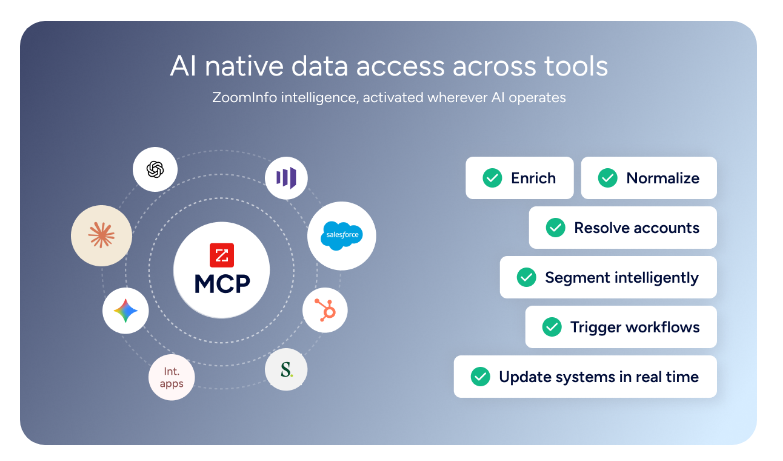
Your team reaches this intelligence through GTM Workspace for sellers, GTM Studio for marketers and RevOps, or APIs and MCP in any other tool. For revenue teams serious about performance, ZoomInfo turns good training into closed deals.
If buyer intelligence sounds like the missing piece in your training stack, see how ZoomInfo works with a free trial.
Docebo vs. Seismic Learning vs. ZoomInfo at a glance
Docebo | Seismic Learning (Lessonly) | ZoomInfo | |
|---|---|---|---|
Primary function | Enterprise LMS for multi-audience training | Sales training and coaching | B2B buyer intelligence and GTM execution |
Target buyer | L&D leaders, CLOs, CHROs | Sales enablement leaders | Sales, marketing, and RevOps leaders |
Audience scope | Employees, customers, partners | Revenue-facing teams | Go-to-market teams |
AI focus | Content creation, admin automation, search | Sales coaching, role-play, skill assessment | Buyer intelligence, deal context, outreach |
CRM integration | Available (Salesforce as paid add-on) | Native (Salesforce, HubSpot embedded) | Native (Salesforce, HubSpot, Dynamics) |
Content authoring | Full LMS authoring with SCORM support | Lightweight lesson builder for quick content | N/A (intelligence platform) |
Skills tracking | AI-inferred workforce skills intelligence | Manager-led sales competency assessment | N/A |
Extended enterprise | Up to 10 branded portals | Not available | N/A |
Pricing model | Quote-only (Elevate / Enterprise tiers) | Quote-only (enterprise sales motion) | Consumption-based with free Lite tier |
Free trial | Demo/product tour only | Demo/product tour only | 7-day free trial + permanent Lite plan |
Enterprise LMS vs. revenue enablement module
The core difference between Docebo and Seismic Learning is scope.
Docebo is a standalone learning management system that an organization owns and operates independently.
Founded in 2005 as a dedicated learning platform, it now serves 3,978 customers, reports $216.9M in annual revenue, and is publicly traded on both the TSX and NASDAQ.
When you buy Docebo, you're buying a dedicated LMS that sits at the center of your learning strategy.
Seismic Learning began as Lessonly, a team training tool founded in 2012 in Indianapolis with a focus on simplicity.
Seismic acquired Lessonly in August 2021 as part of a $170M funding round and folded it into the Seismic Enablement Cloud. Today, Learning & Coaching is one of five capabilities in Seismic's platform, alongside content management, program strategy, meeting intelligence, and digital sales rooms.
When you buy Seismic Learning, you're buying into a sales enablement ecosystem where training is one component of a larger revenue operation.
This distinction matters more than any individual feature comparison. Docebo serves the L&D leader who manages training as a business function. Seismic Learning serves the sales enablement leader who views training as one lever in a revenue engine.
If your primary job is corporate learning, Docebo speaks your language. If your primary job is sales performance, Seismic Learning was built for your workflow.
Multi-audience training is Docebo's structural advantage
Most LMS platforms handle one audience: employees. Docebo was built to manage multiple audiences from a single instance.
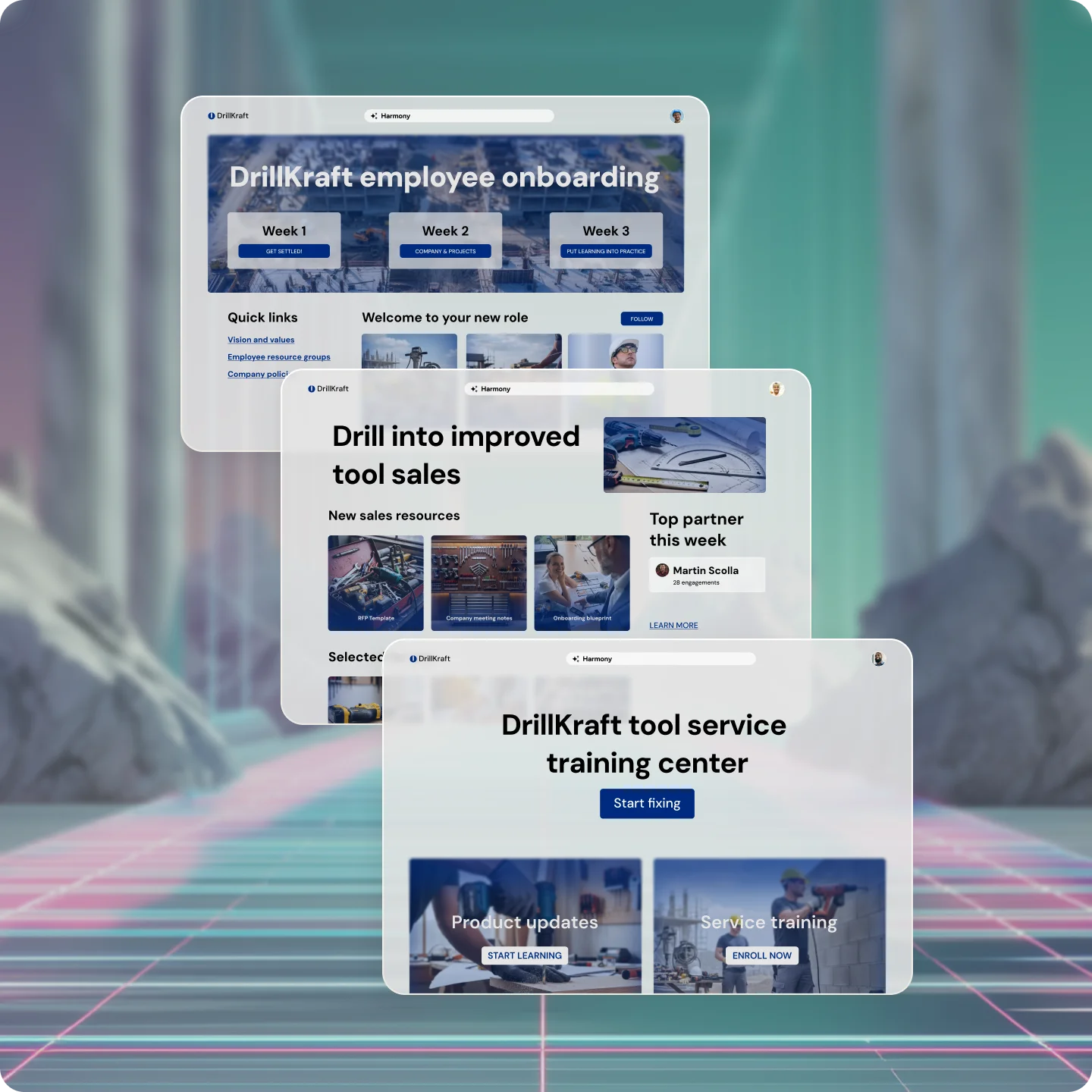
The Extended Enterprise capability lets organizations run up to 10 branded portals for separate audiences, each with independent branding, content catalogs, SSO configurations, and administrative controls.
Source: Docebo
An employee logging in sees internal compliance training. A customer logging into a white-labeled academy sees product onboarding. A channel partner sees certification courses. All from one platform.
Seismic Learning doesn't compete here. It focuses on internal revenue teams: sales reps, account managers, and customer success. If you need to train partners or sell courses to customers, Docebo is the clear choice. If those requirements don't apply, this advantage is irrelevant to your decision.
Seismic Learning is strongest when training connects to selling
Seismic Learning's advantage is context. Because it lives inside the Seismic Enablement Cloud, training isn't isolated from the content reps use in the field or the deals they're working.
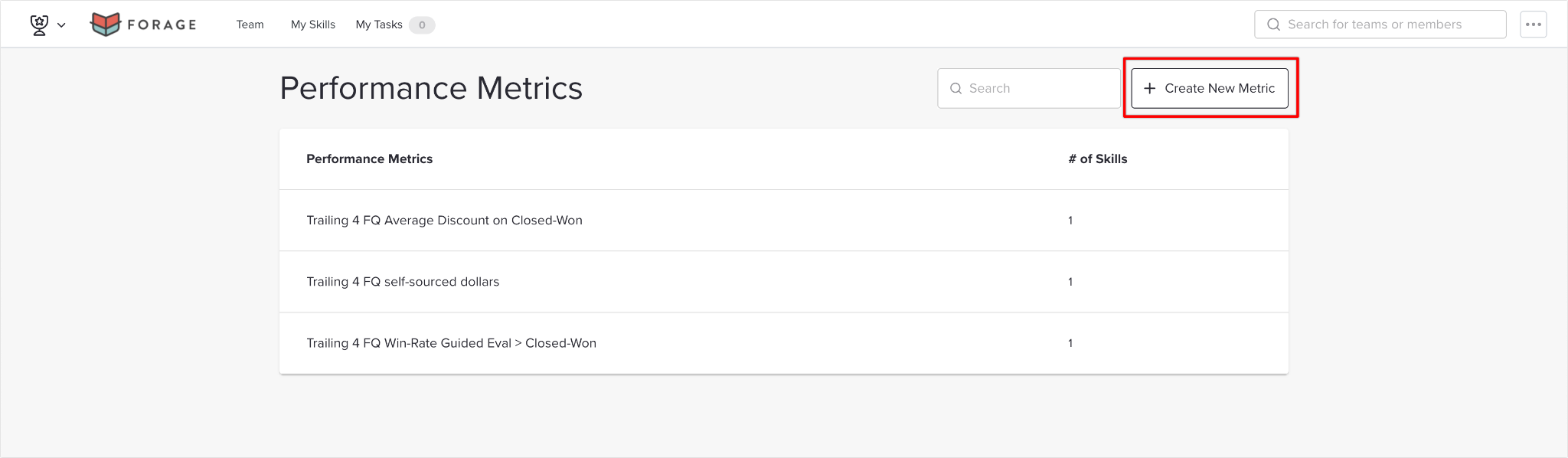
When a content team updates a product sheet in Seismic's content library, that update can automatically appear in embedded training lessons. When a rep completes a certification, that data connects to their CRM activity and deal performance.
When a manager needs to coach a struggling rep, the platform surfaces which skills need work based on four types of assessment data: manager reviews, live observations, performance metrics, and self-reflections.
Source: Seismic Learning
Docebo integrates with Salesforce and other CRM tools, but the Salesforce integration is a paid add-on beyond standard pricing. The connection works, but it bridges two separate systems rather than unifying them.
AI capabilities take different paths
Both platforms invest heavily in AI, but they solve different problems.
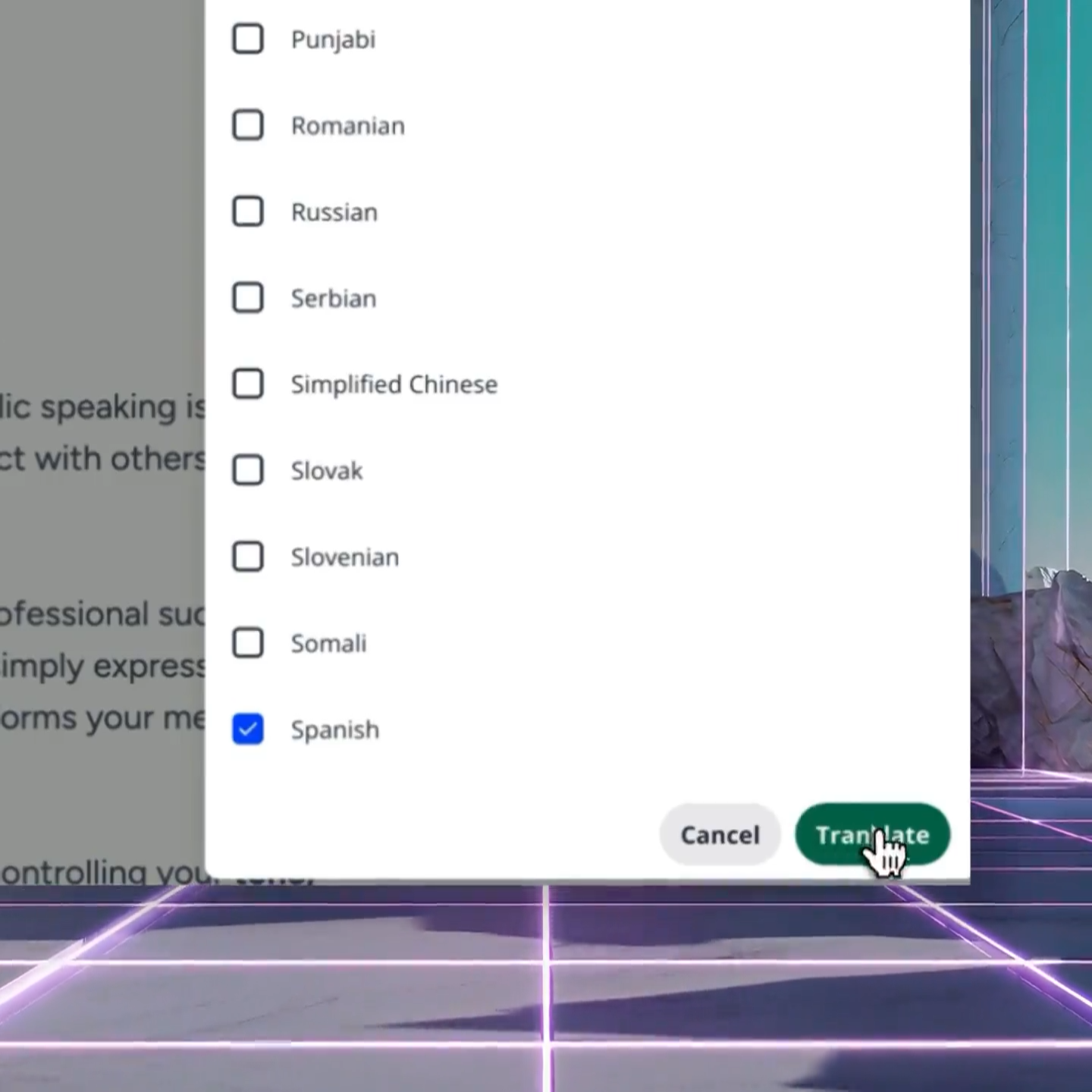
Docebo's AI covers breadth. The Content Creator generates interactive courses, AI avatar videos, and assessments from documents or text prompts, with one-click translation into 50+ languages.
Source: Docebo
Harmony AI powers intent-based search across the content library and serves as an admin copilot for platform configuration.
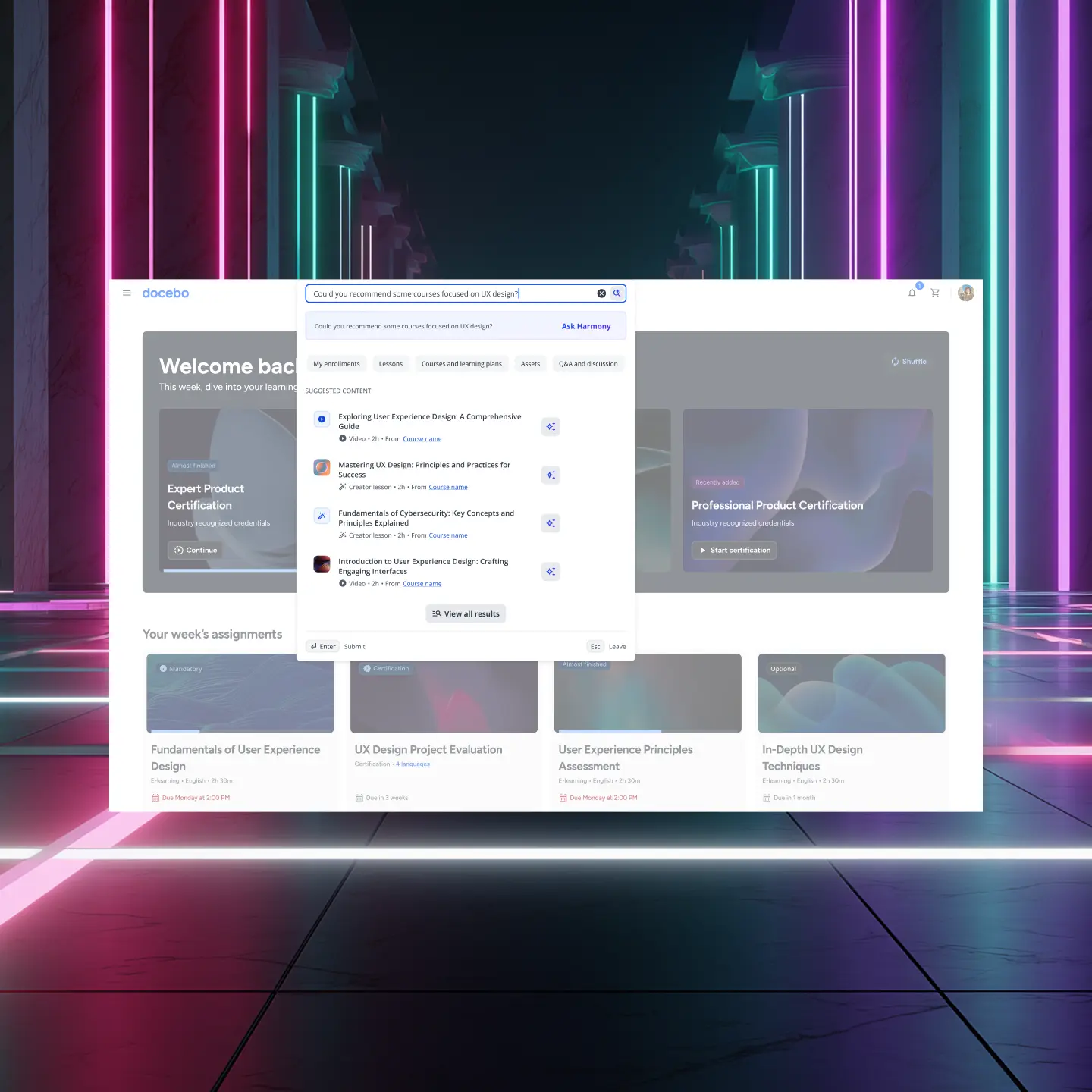
Source: Docebo
AI Roleplay lets learners practice conversations with configurable personas across voice, chat, and video. And AgentHub, launching summer 2026, introduces AI agents that execute multi-step administrative workflows without developer involvement.
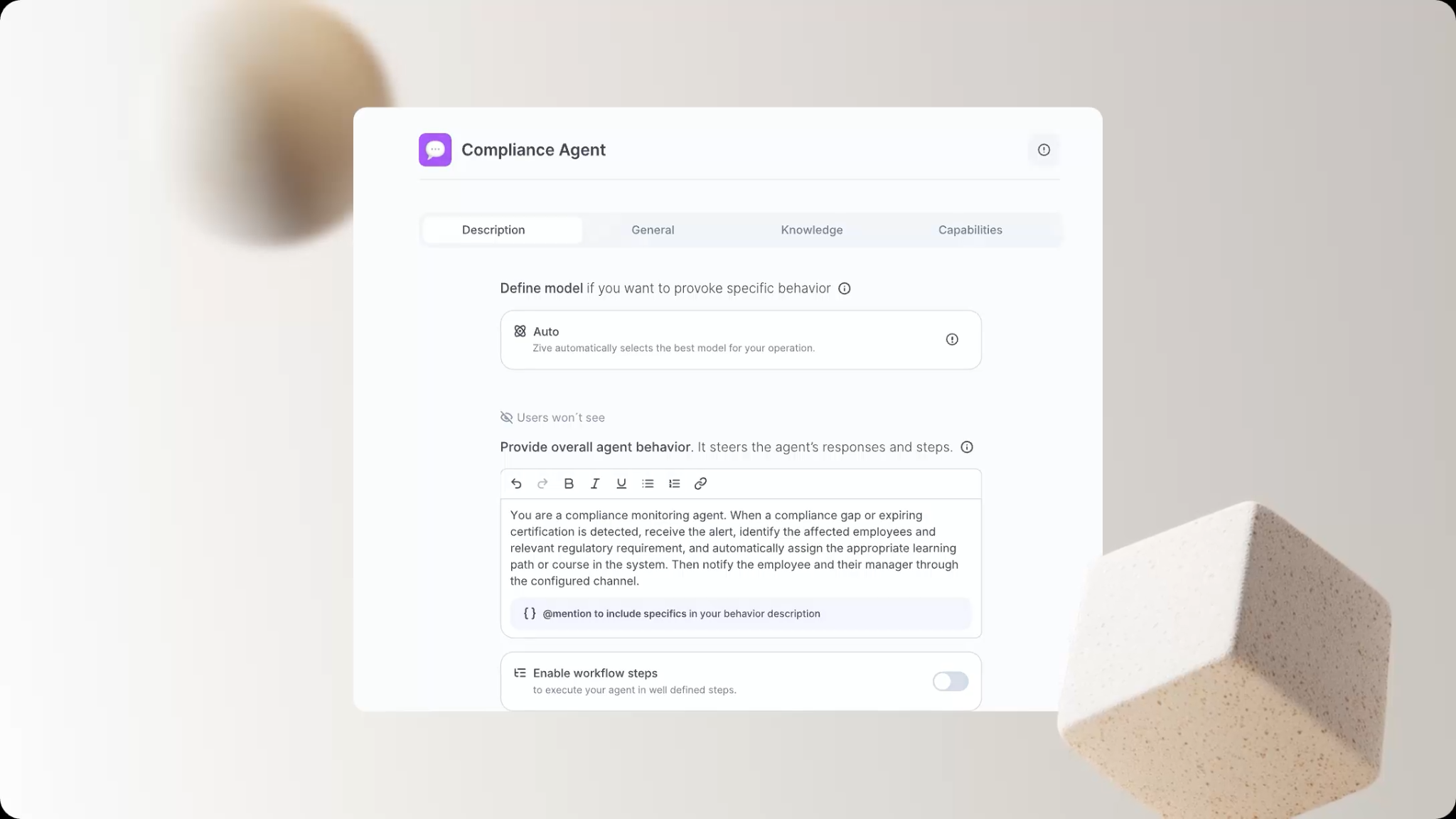
Source: Docebo
Seismic's AI goes deep on sales. The Aura Role-Play Agent simulates customer conversations grounded in the organization's own approved messaging and CRM-connected product knowledge.
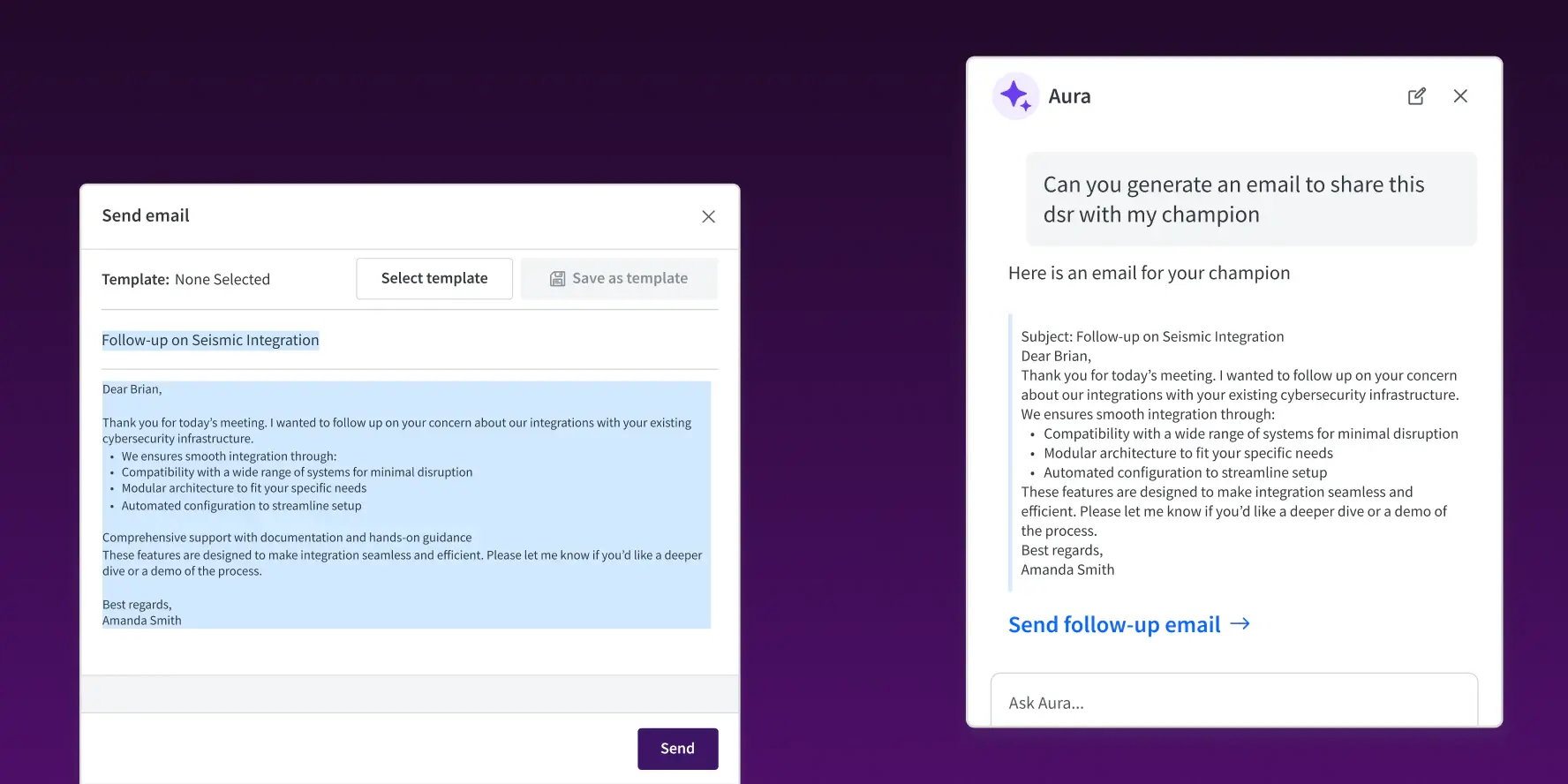
Source: Seismic Learning
Unlike generic role-play tools, the AI buyer persona draws on your company's actual GTM content, making practice scenarios relevant to real deals.
Managers receive aggregated scoring and gap analysis to identify patterns across the team. The Aura Analytics Agent lets users query enablement data in plain language.
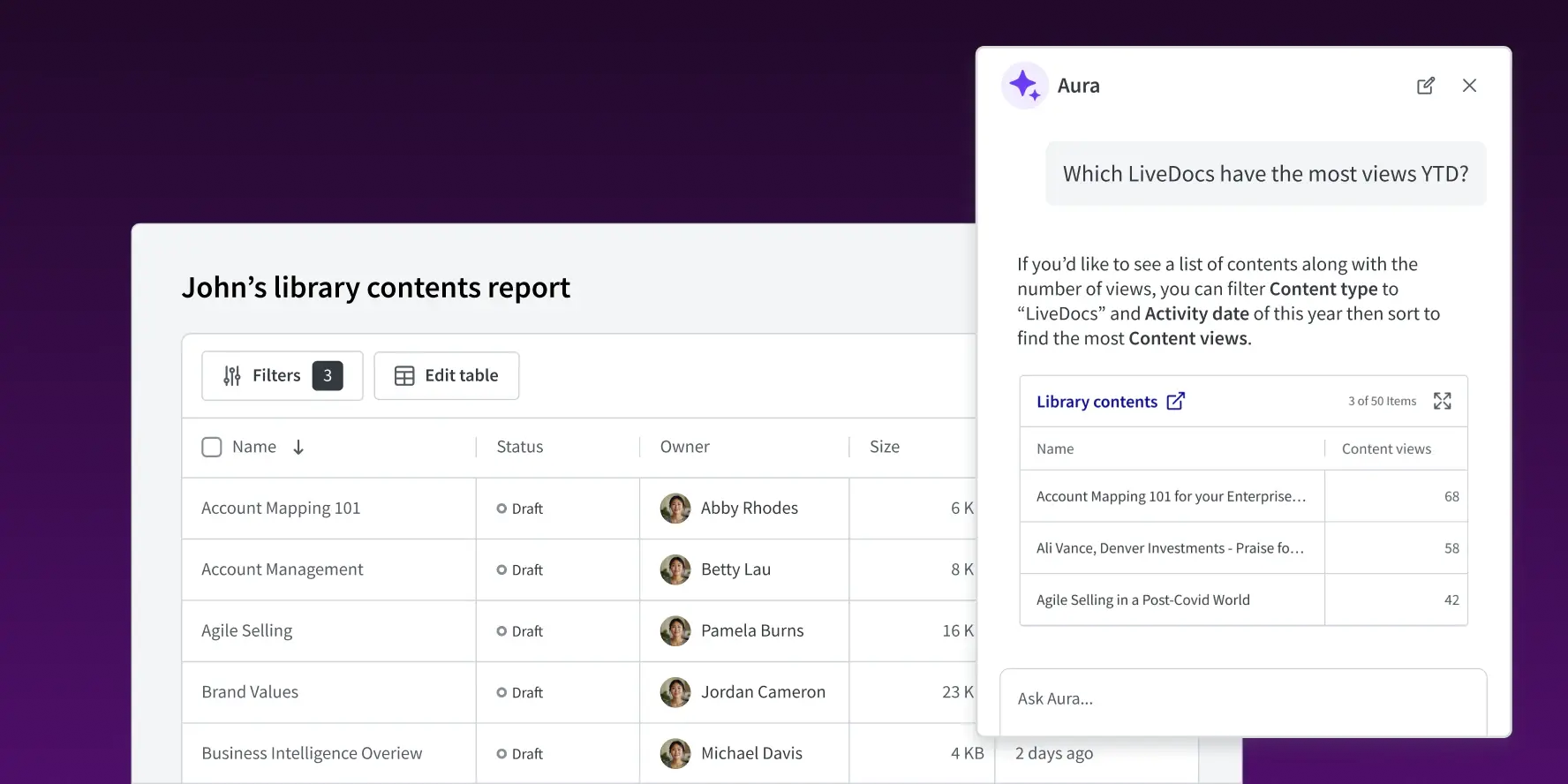
Source: Seismic Learning
The choice depends on your problem. If you need to create training content faster across multiple formats and languages, Docebo's content creation AI is more capable.
If you need reps to practice realistic sales conversations and managers to spot skill gaps through AI coaching, Seismic Learning is more focused on that outcome.
The intelligence layer neither training platform provides
Training platforms answer one question: does the rep know how to sell? Neither Docebo nor Seismic Learning answers the follow-up: does the rep know who to sell to, when to reach out, and what to say?
This is the gap ZoomInfo fills.
ZoomInfo runs the largest B2B data platform in the market: 500M contacts, 100M companies, 135M+ verified phone numbers, 120M direct-dial phone numbers, and 200M+ verified business email addresses.
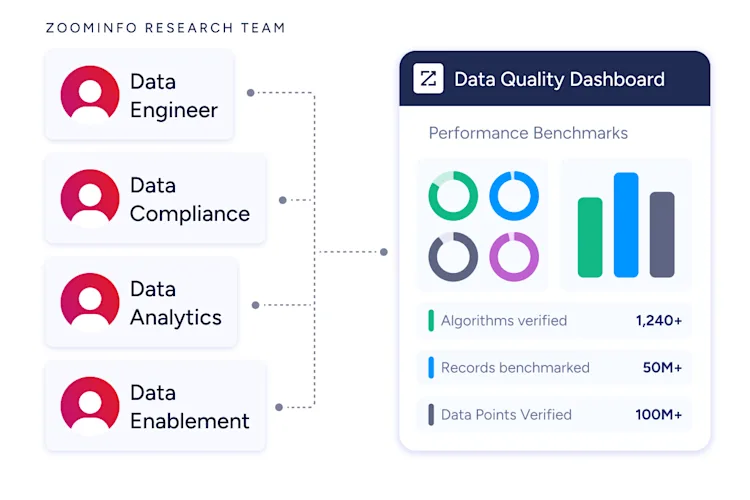
A multi-source pipeline backed by 300+ human researchers verifies that data, reaching up to 95% accuracy on first-party records.
Source: ZoomInfo
In a Fortune 500 competitive RFP analyzing 25 million contacts across vendors, the independent consultant concluded that "no other competitor came even close."
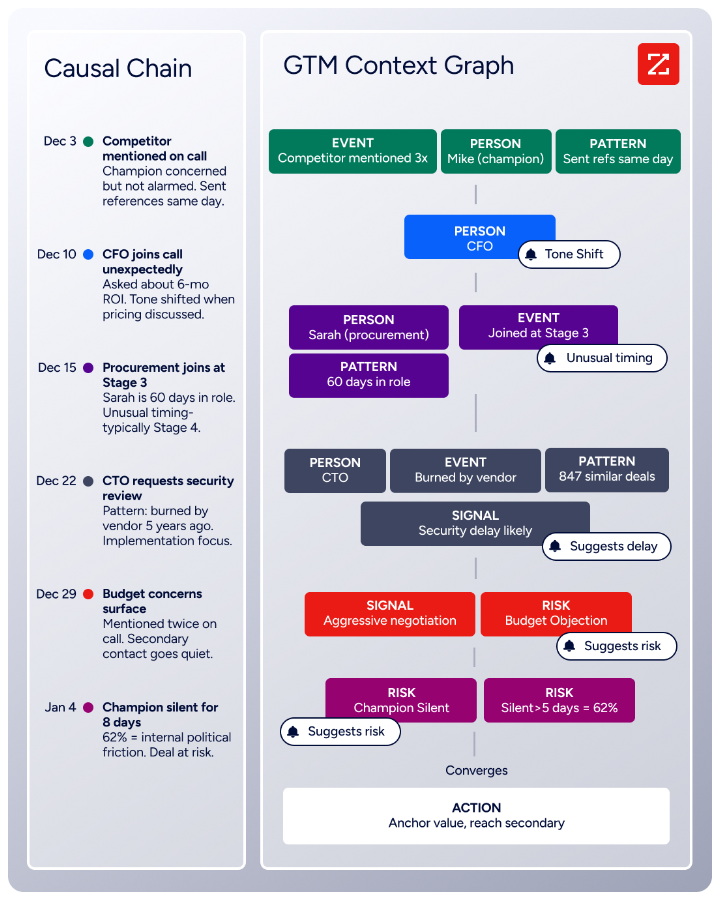
But data alone isn't what makes ZoomInfo complementary to training platforms. The GTM Context Graph processes 1.5B+ data points daily, unifying ZoomInfo's B2B data with your CRM records, conversation transcripts, and behavioral signals into a single intelligence layer.
Source: ZoomInfo
It captures not just what happened in a deal, but why. A CRM records that a deal moved to stage 4. The GTM Context Graph knows the CFO joined the last call and asked about six-month ROI, and that executive sponsorship entering at this stage matches the pattern behind closed-won deals in your segment.
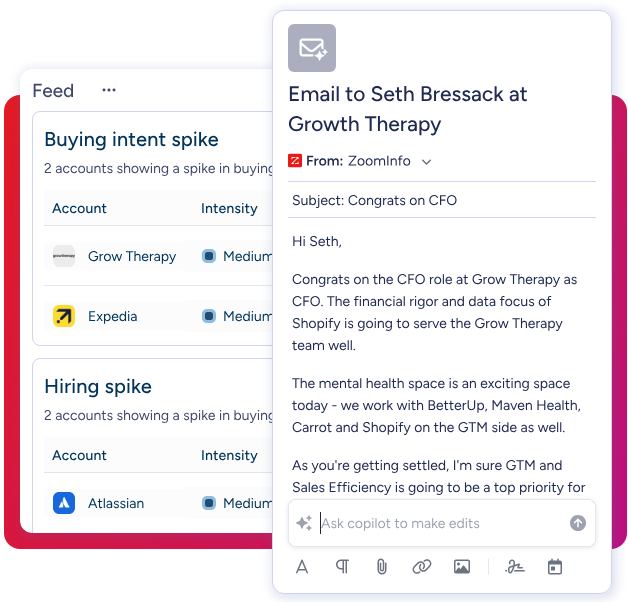
Through GTM Workspace, sellers get AI-drafted outreach that reflects this context, prioritized account feeds, and deal intelligence.
Source: ZoomInfo
Through GTM Studio, marketers and RevOps build and launch GTM plays in natural language. Through APIs and MCP, the same intelligence powers any custom tool or AI agent.
Source: ZoomInfo
The connection to sales training is direct. A rep who completed Seismic Learning's certification on value-based selling still needs to know which accounts show buying intent, which contacts to engage, and what those contacts care about right now.
A rep who aced Docebo's product training still needs verified direct dials and emails that actually reach the decision-maker. ZoomInfo provides both.
Seismic's sales team boosted productivity by 54%, saved 11.5 hours per week, and attributed 39% of active pipeline to opportunities identified or influenced by ZoomInfo signals. (Seismic Case Study)
Skills tracking reflects each platform's DNA
Both Docebo and Seismic Learning track skills, but their approaches reveal their priorities.
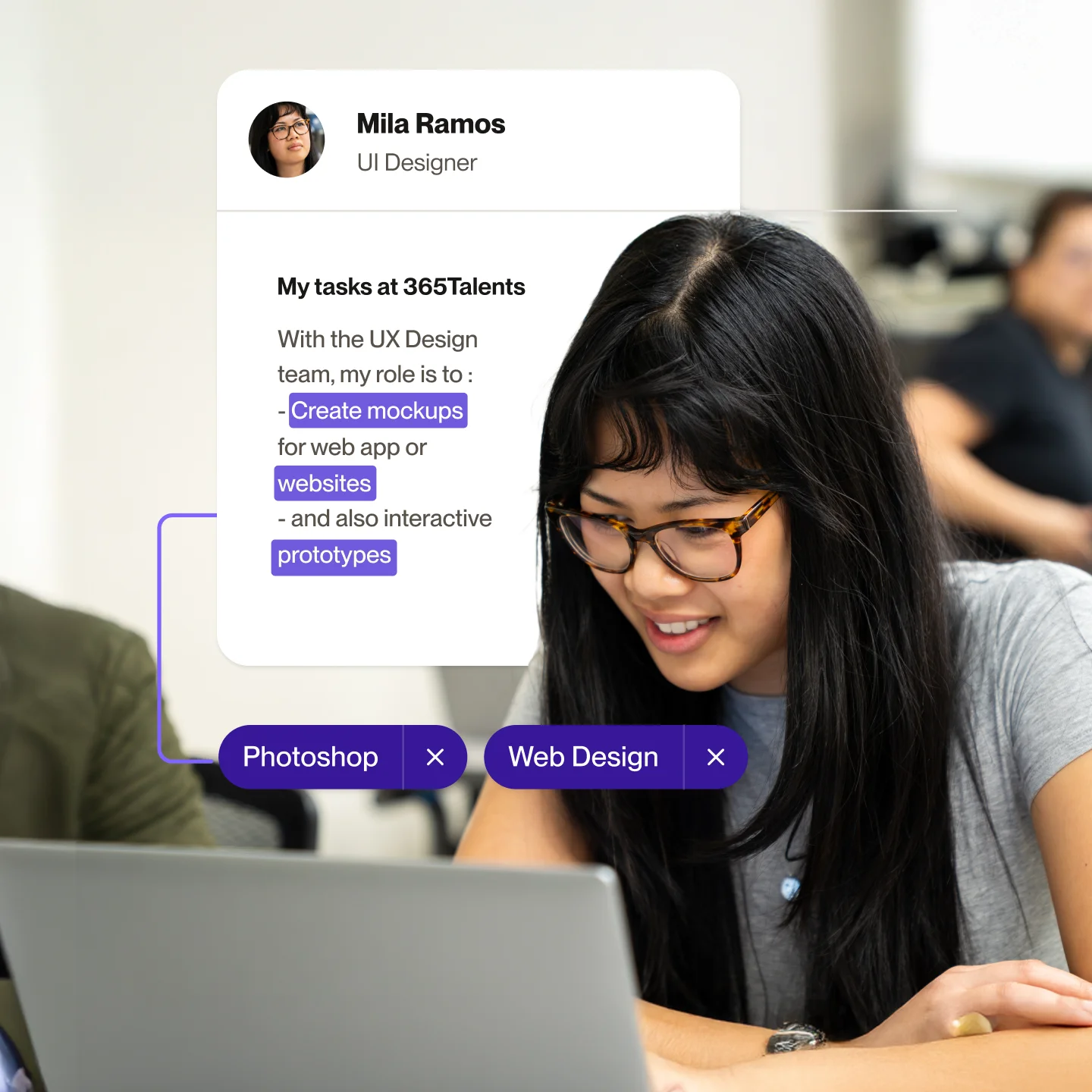
Docebo's Skills Intelligence, built on the 365Talents acquisition completed in January 2026, infers skills from roles, projects, experience, and learning activity using AI.
Source: Docebo
Rather than relying on self-reported assessments, the system creates skill profiles that update as employees' work changes.
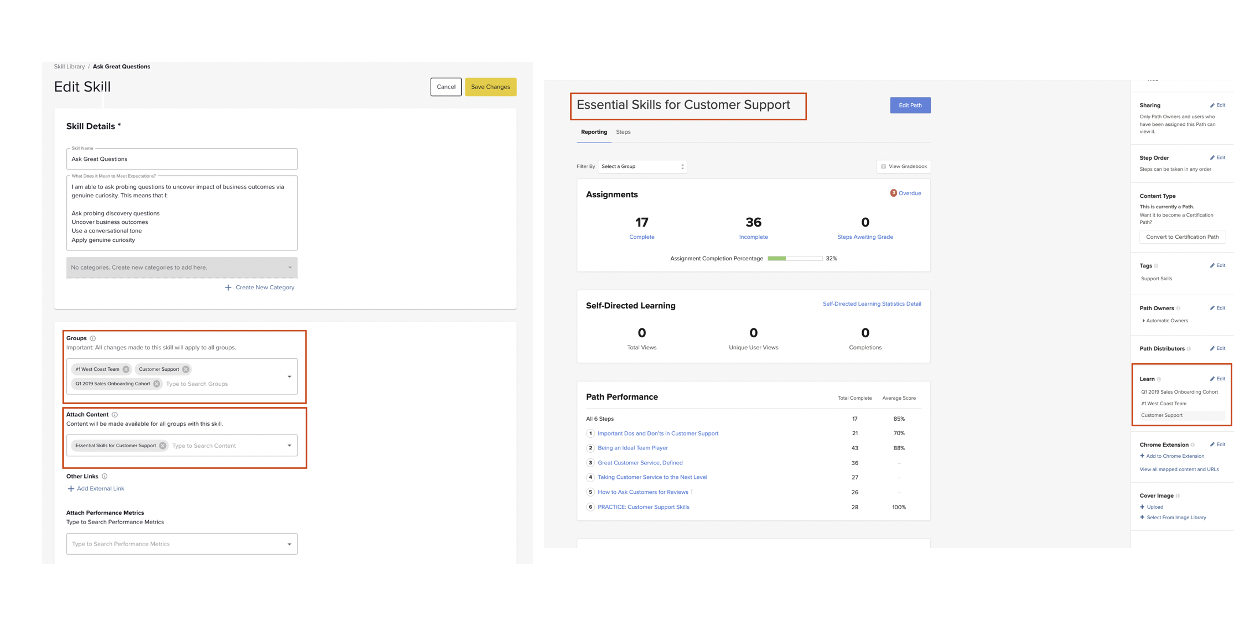
Seismic Learning's Skills App takes a different approach. Enablement leaders define skills, organize them by role, and measure them through four assessment types: structured manager reviews, live observations, performance metrics mapped to specific skills, and self-reflections.
Source: Seismic Learning
Scores combine these inputs through a weighted averaging formula.
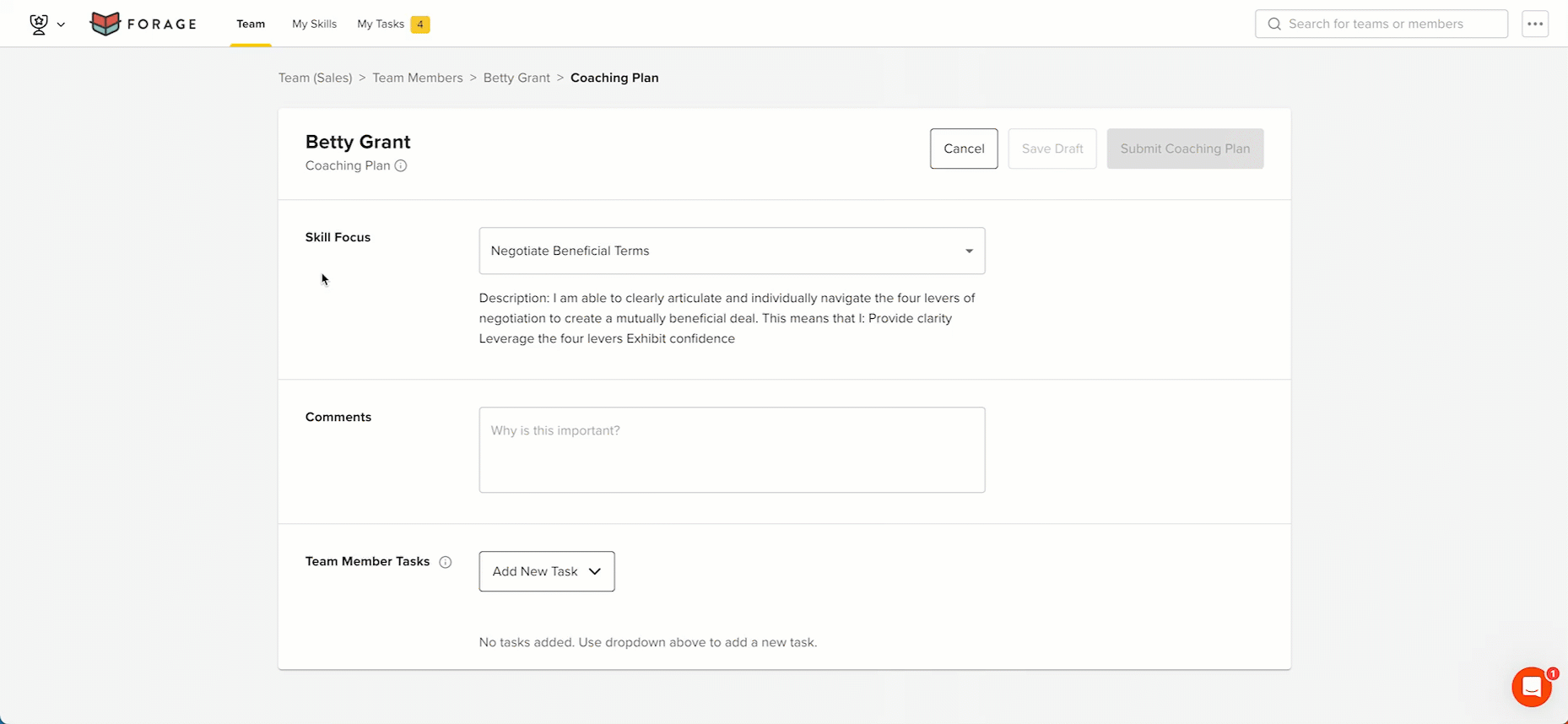
When gaps appear, managers create coaching plans with linked learning content, tying skill development directly to training assignments.
Source: Seismic Learning
Docebo's approach is broader and more automated, suited for organizations managing skills across thousands of employees for HR-level workforce decisions.
Seismic's approach is more hands-on and manager-driven, suited for sales leaders who want to know exactly which reps can handle a competitive displacement call and which need more practice.
Pricing and cost of ownership
Neither Docebo nor Seismic Learning publishes pricing. Both require contacting sales for a quote.
Docebo offers two tiers, Elevate and Enterprise, with a separate Skills Intelligence add-on. The average contract value of $55,229 gives a rough benchmark.
Key cost drivers beyond the base subscription: the Salesforce integration is a paid add-on, Advanced Analytics (Learn Data) requires the Enterprise tier, premium support tiers are separately priced, and implementation services are scoped as professional services engagements.
AI credits for content creation are usage-based, not unlimited.
Seismic Learning is sold as part of the broader Seismic Enablement Cloud. No tier names or pricing figures are published. All fees are non-refundable, order commitments are non-cancellable, and seat quantities cannot be reduced mid-term.
Professional services are separately scoped and priced. Gartner flagged premium pricing and less predictable long-term costs as caution areas.
Buyers should also note that Seismic announced a merger with Highspot in February 2026, introducing short-term roadmap uncertainty while the combined entity finalizes which capabilities it retains.
ZoomInfo uses a consumption-based pricing model with published tier names (Professional, Advanced, Enterprise for Sales; multiple tiers for Marketing).
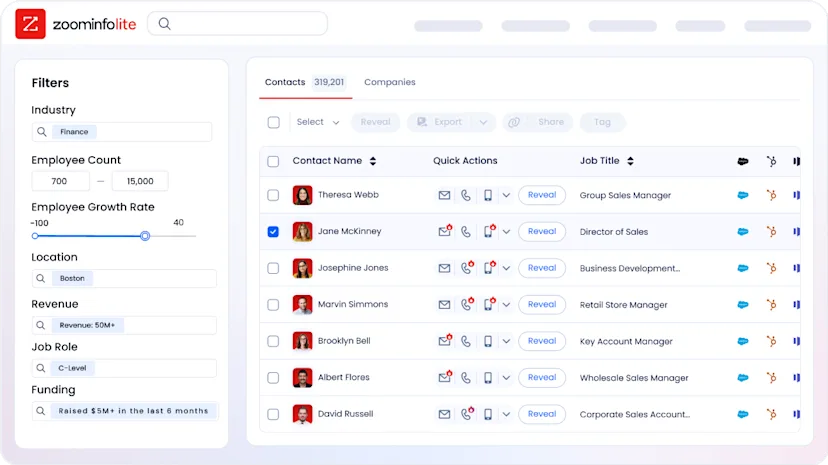
Unlike either training platform, ZoomInfo offers a permanent free tier: ZoomInfo Lite includes access to the B2B database, 10 monthly export credits, and basic features at no cost. A 7-day free trial of the full platform is also available.
Source: ZoomInfo
When budgeting for a complete sales performance stack, consider both investments together. The training platform teaches reps how to sell. The intelligence platform gives them the data to sell effectively. Spending on one while neglecting the other limits the return on both.
Docebo vs. Seismic Learning vs. ZoomInfo: Which should you choose?
The right combination depends on who you're training and what gaps you're filling.
Choose Docebo if:
You train multiple audiences: employees, customers, and channel partners
You need a standalone LMS with full content authoring and SCORM support
Customer education or monetized training is part of your business model
AI-powered content creation across formats and languages is a priority
Workforce planning and internal mobility matter as much as sales enablement
Choose Seismic Learning if:
Your primary goal is accelerating sales rep ramp time and performance
You want training embedded alongside content management, coaching, and deal execution
AI-powered role-play grounded in your company's actual sales content matters
Tight CRM integration and deal-level performance correlation are requirements
You're willing to commit to the broader Seismic Enablement Cloud ecosystem
Add ZoomInfo if:
Your reps need accurate buyer data and verified direct dials to act on their training
You want intelligence that shows reps who to target, when to engage, and what to say
Intent signals and deal context would make your training outcomes measurable at the pipeline level
You need a platform that connects to any tool in your stack via APIs and MCP
You're building a complete revenue performance stack, not just adding another training tool
Start with ZoomInfo Lite for free, or try the full platform for 7 days.
The most effective revenue teams don't choose between training and intelligence. They invest in both. Docebo or Seismic Learning teaches your team how to sell. ZoomInfo gives them the intelligence to know who to sell to and why that deal is moving. Together, they produce results that neither category of tool delivers alone.
Docebo vs. Lessonly vs. ZoomInfo FAQ
What is the key difference between Docebo and Lessonly (Seismic Learning)?
Docebo is a standalone enterprise LMS designed to train employees, customers, and partners from a single platform, with AI-powered content creation and skills intelligence for workforce planning.
Lessonly (now Seismic Learning) is the training and coaching module within the Seismic Enablement Cloud, focused on revenue-facing teams. Docebo serves L&D leaders managing training as a business function. Seismic Learning serves sales enablement leaders using training to drive pipeline and revenue.
Is Lessonly still available as a standalone product?
No. Seismic acquired Lessonly in August 2021 and integrated it into the Seismic Enablement Cloud as the Learning & Coaching capability. The Lessonly brand redirects to Seismic's product pages. Buyers evaluating the former Lessonly are now evaluating Seismic Learning within the broader Seismic platform, which also includes content management, meeting intelligence, digital sales rooms, and program strategy.
Which platform is better for training customers and channel partners?
Docebo. Its Extended Enterprise architecture supports up to 10 branded portals from a single instance, with independent branding, content catalogs, and SSO per audience. Zoom runs over 2 million external learners on a single Docebo instance. Docebo also includes built-in eCommerce with zero platform transaction fees for monetized training. Seismic Learning targets internal revenue teams and does not offer multi-audience or customer-facing training capabilities.
Which platform has stronger AI capabilities?
Both invest heavily in AI, but in different areas. Docebo's AI focuses on content creation (generating courses from documents with one-click translation into 50+ languages), admin automation through AgentHub, and search via Harmony AI. Seismic Learning's AI focuses on sales coaching: the Aura Role-Play Agent simulates buyer conversations grounded in the company's own approved messaging, with scoring and team-level gap analysis. Choose based on your priority: faster content creation or more effective sales practice.
How does ZoomInfo relate to Docebo and Seismic Learning?
ZoomInfo is not a training platform. It's a B2B intelligence platform that complements either Docebo or Seismic Learning by providing the buyer data, intent signals, and deal context that training platforms don't offer. Training platforms teach reps how to sell. ZoomInfo provides verified contact data, buying intent signals, and deal intelligence that tell reps who to sell to and when to engage. Seismic's own sales team uses ZoomInfo alongside their platform and attributed 39% of active pipeline to opportunities identified or influenced by ZoomInfo signals.
Which platform is easier and faster to implement?
Seismic Learning was originally built as Lessonly with a focus on simplicity, featuring a lesson builder designed for non-technical managers. However, as part of the broader Seismic Enablement Cloud, full platform implementation can extend beyond four months. Docebo's implementation timeline depends on complexity and tier, with the company offering tiered onboarding packages from Quick Start to Elite. Both platforms benefit from dedicated professional services for enterprise deployments.
How do the pricing models compare?
Neither Docebo nor Seismic Learning publishes pricing, and both require enterprise sales conversations. Docebo's average contract value is approximately $55,229 with two tiers (Elevate and Enterprise). Seismic's contracts are non-cancellable with no mid-term seat reductions. ZoomInfo is the only platform of the three offering a permanent free tier (ZoomInfo Lite with 10 monthly export credits) and a 7-day free trial, making it the easiest to evaluate before committing budget.
Can I use ZoomInfo with both Docebo and Seismic Learning?
Yes. ZoomInfo integrates with the CRM systems both platforms connect to, including Salesforce, HubSpot, and Microsoft Dynamics. Its APIs and MCP server make its intelligence accessible in any tool. The buyer intelligence ZoomInfo provides (verified contact data, intent signals, deal context) informs what reps train on and ensures training translates into pipeline, regardless of which training platform delivers the lessons.
More Lessonly comparisons and alternatives:
