
Choosing between EasyComp and CaptivateIQ for sales compensation management comes down to five questions:
Are you replacing spreadsheets for the first time, or migrating off a legacy ICM platform that has become too slow and admin-heavy?
Do you need a focused commission engine, or a full sales performance management suite that also covers territory planning, quota setting, and predictive modeling?
How complex are your commission plans, and how often do they change mid-cycle?
Can your team wait months for implementation, or do you need to be live in weeks?
Is your deal data accurate enough for your commissions to be trusted, or are CRM gaps creating errors before the first calculation runs?
In short, here's what we recommend:
EasyComp is the challenger built for mid-market B2B companies that need to move fast. Founded in 2024, EasyComp focuses on getting compensation operations right without the overhead of legacy platforms. Its event-driven architecture recalculates commissions the moment a CRM field changes, and its line-by-line explainability lets reps trace every dollar back to the exact deal and rule that generated it. With published pricing starting at $30/user/month and implementation measured in weeks, EasyComp is built for teams that have outgrown spreadsheets but don't want enterprise ICM cost and complexity. The trade-off is maturity: as a 2024 startup, some features are still being built, and the platform lacks the analyst recognition of established competitors.
CaptivateIQ is the enterprise platform for organizations that need a full sales performance management suite. Named a Leader in The Forrester Wave for Sales Performance Management Solutions (Q1 2025), CaptivateIQ has evolved from a commission automation tool into a platform that connects incentive compensation with territory management, quota setting, and capacity planning. Its SmartGrid engine processes 10M+ source transactions in 12 seconds, and its no-code plan builder supports up to 7,000 simultaneous plans. The trade-off is complexity and cost: implementation can take 4-6 months for complex deployments, pricing is quote-only, and the blank-canvas flexibility demands significant upfront setup work.
Both platforms solve the commission calculation problem well. But accurate commissions depend on accurate deal data, and that's where most compensation operations break down. A commission engine can only be as good as the CRM data feeding it. That's where ZoomInfo comes in.
ZoomInfo is a B2B data and GTM platform that keeps the data powering your commissions accurate and complete. With 500M contacts, 100M companies, 135M+ verified phone numbers, and 200M+ verified business email addresses, ZoomInfo keeps your CRM records current so the deal data flowing into EasyComp or CaptivateIQ reflects reality. ZoomInfo's GTM Context Graph processes 1.5B+ data points daily, connecting intent signals, conversation intelligence, and CRM data to help sellers find and close more deals. For RevOps leaders managing both sales performance and compensation operations, ZoomInfo addresses the root cause of most commission disputes: bad data entering the system before calculations begin.
If clean CRM data and stronger pipeline sound like the missing pieces of your compensation strategy, see how ZoomInfo works.
EasyComp vs. CaptivateIQ at a glance
EasyComp | CaptivateIQ | ZoomInfo | |
|---|---|---|---|
Primary function | Commission calculation and rep visibility | Full SPM: commissions + planning + predictive modeling | B2B data, GTM intelligence, CRM enrichment |
Founded | 2024 | 2017 | 2007 |
Customers | Early-stage (Alkira, Roboflow, Fieldguide) | 800+ (Gong, Expedia, Boston Scientific) | 35,000+ (Adobe, Snowflake, Seismic) |
Published pricing | Quote-only | Consumption-based (free tier available) | |
Implementation time | Weeks | Weeks to months | |
Plan complexity | Splits, accelerators, tiers, clawbacks, overlays | All of EasyComp's plus 7,000 simultaneous plans | N/A (feeds deal data into comp tools) |
Sales planning | Not available | Territory, quota, capacity planning | Territory and TAM analysis via data |
AI capabilities | Claude Cowork integration, AI plan language | AI Agents (Comp Builder, Comp Ops, Rev Planning) | GTM Context Graph, AI-drafted outreach |
Analyst recognition | None yet | Forrester Wave Leader, Gartner Customers' Choice | Gartner MQ Leader (ABM), Forrester Leader (Intent) |
CRM integrations | Salesforce, HubSpot, Microsoft Dynamics | Salesforce, HubSpot, Microsoft Dynamics CRM | Salesforce, HubSpot, Microsoft Dynamics + 120+ more |
Security | SOC 2 Type II | SOC 1, SOC 2 Type II | ISO 27001, ISO 27701, SOC 2 Type II |
The maturity gap shapes every other comparison
EasyComp and CaptivateIQ are at different stages.
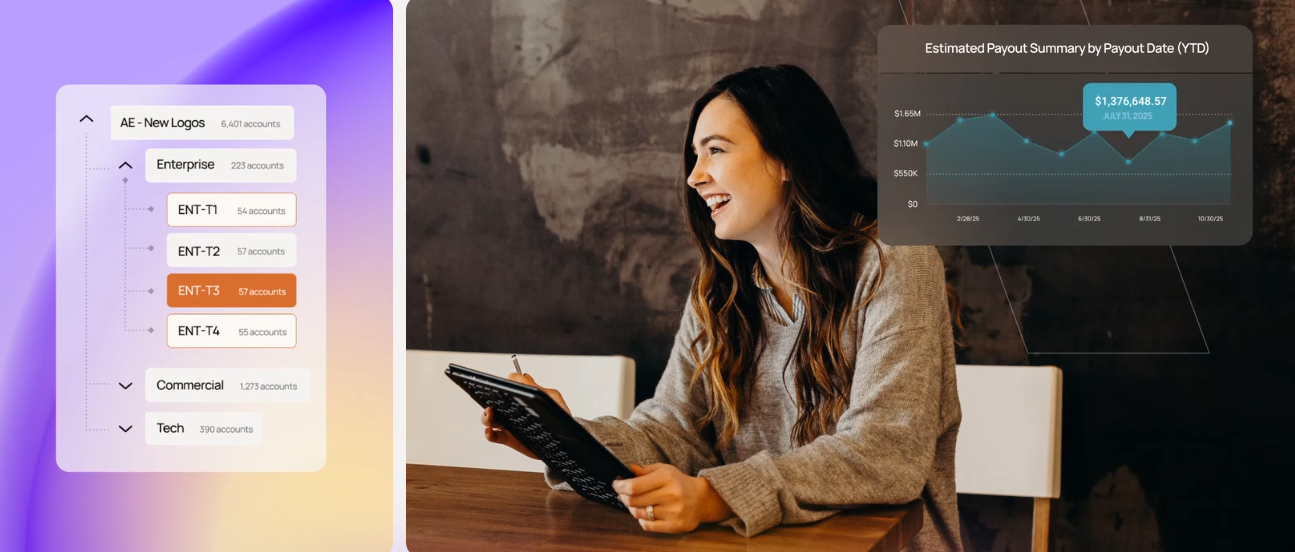
CaptivateIQ has been building since 2017, raised $164.6 million from Sequoia, Accel, and ICONIQ Growth, and reached a $1.25 billion valuation. That funding bought time to build the SmartGrid calculation engine, a planning module covering territory management, quota setting, and capacity planning, a predictive ML layer called Catalyst, and workflow automation for post-calculation processes.
Source: CaptivateIQ
The platform earned a Forrester Wave Leader designation with the highest possible scores in 12 of 26 criteria, including AI capabilities and time-to-value.
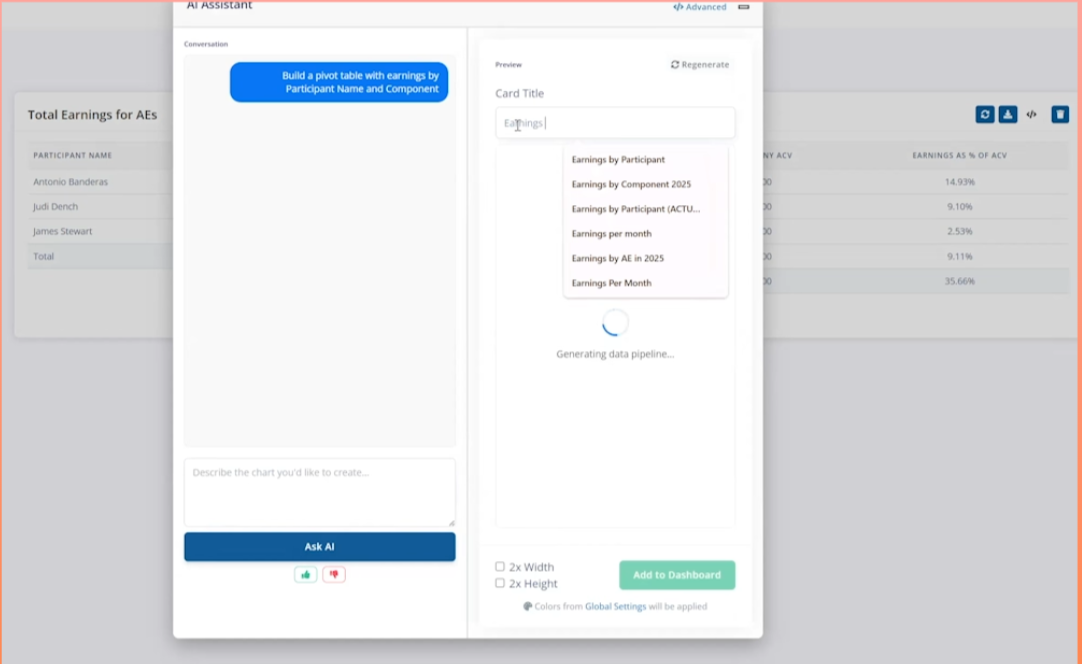
EasyComp was founded in 2024 by two practitioners who spent years running compensation operations at Google, MongoDB, and Segment. The team is about 8 people, and the company appears bootstrapped. There are no analyst placements, no billion-dollar valuation, and some features are still being built.
Source: EasyComp
But maturity cuts both ways. CaptivateIQ's depth gives enterprise buyers a complete platform. It also means G2 reviewers flag slow page loads when working with large models, initial setup takes significant time because of the blank-canvas design, and implementation for complex deployments can stretch to 4-6 months.
EasyComp's smaller scope means faster deployment, simpler administration, and a team that, according to customers, understands variable compensation well.
Calculation speed and architecture tell different stories
Both platforms process commissions automatically, but the underlying architecture differs.
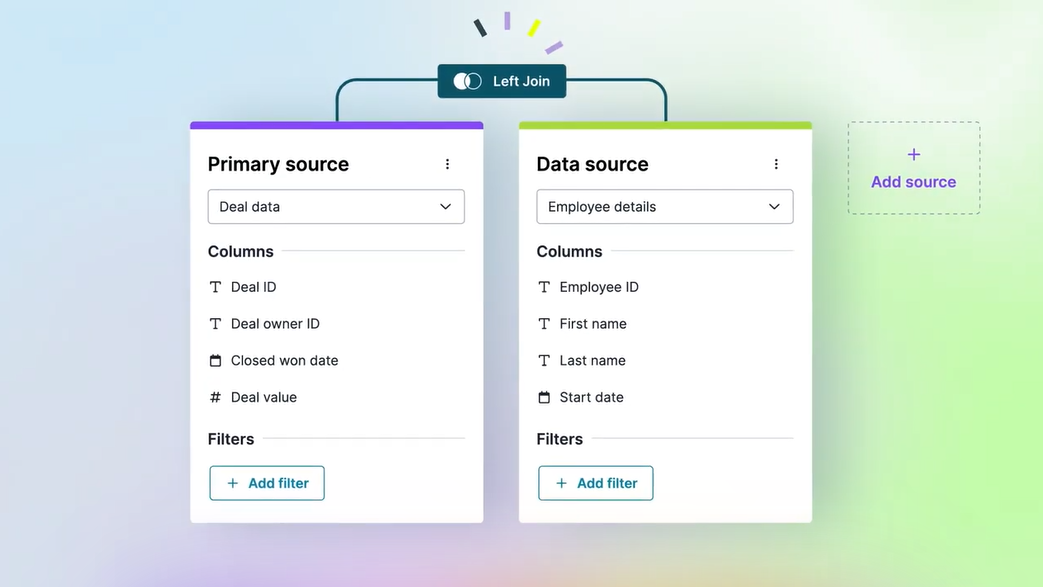
CaptivateIQ's SmartGrid engine is a proprietary ELT and calculation layer that handles data ingestion, transformation, and calculation in one platform.
Source: CaptivateIQ
The scale numbers: 50 million records per data sync, 10M+ source transactions processed in 12 seconds, and 6.25 trillion calculations per month across the platform. For enterprises running thousands of plans across thousands of payees, this infrastructure matters.
EasyComp built its engine from scratch on cloud infrastructure, NoSQL data models, and event-driven architecture. The philosophy is different: instead of processing large batches faster, EasyComp recalculates instantly whenever source data changes in a connected CRM. A deal closes in Salesforce, and the rep's commission updates immediately.

Source: EasyComp
A CRM field gets edited retroactively, and EasyComp flags the change before it ripples into payroll.
The practical difference: CaptivateIQ is built for enterprise-scale batch processing with real-time capabilities layered on top. EasyComp is built for real-time processing from the ground up, though it hasn't been tested at CaptivateIQ's scale.
Plan complexity is where CaptivateIQ pulls ahead
Both platforms handle the core plan mechanics: tiered commissions, accelerators, split crediting, bonuses, SPIFs, territory rules, ramps, draws, clawbacks, and overlays.
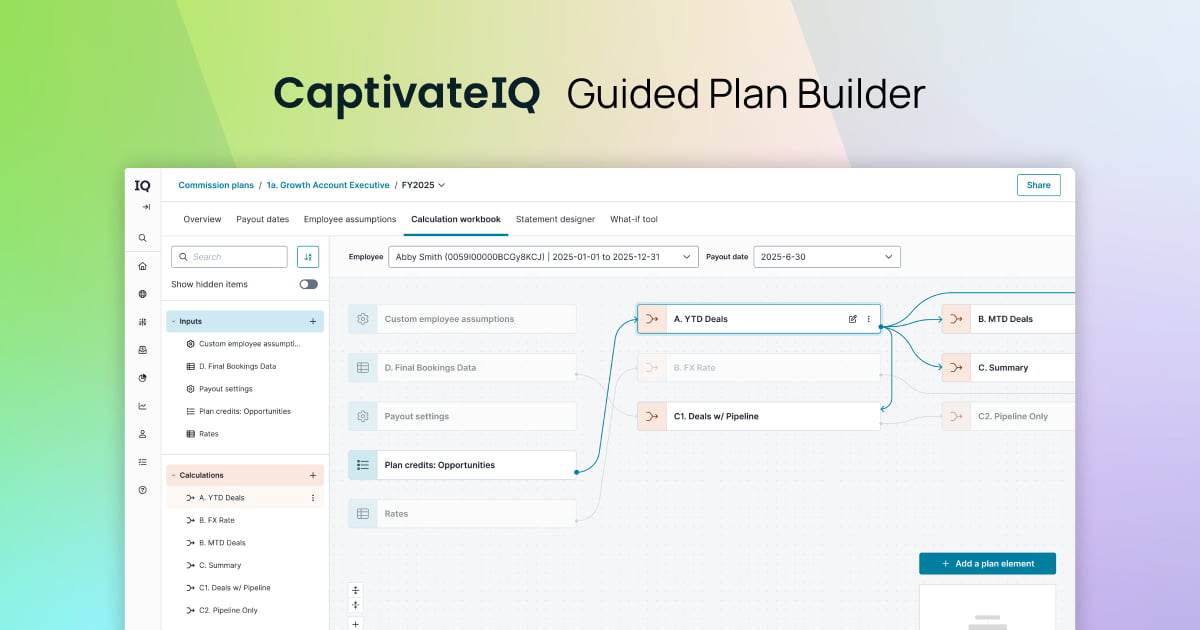
CaptivateIQ separates itself in scale. The Guided Plan Builder supports up to 7,000 simultaneous plans through a spreadsheet-like no-code interface. Forrester gave CaptivateIQ the highest possible scores in plan creation and maintenance, plan modeling and scenario planning, and end-user modeling.
Source: CaptivateIQ
For a Fortune 500 company running different plans across dozens of business units, geographies, and product lines, this ceiling matters.
EasyComp takes a different approach. Rather than offering a blank canvas, it provides pre-built commission plan templates on the Starter tier and custom plan design on Growth and Enterprise.
The emphasis is speed: CEO Jose Fernandez describes organizations where plans take months to implement even when built in Excel, leaving reps without a comp plan at the start of a fiscal year. EasyComp targets plan changes live in days, not weeks or months.
The trade-off is clear. CaptivateIQ handles any plan you can conceive, but the blank canvas means significant setup time and ongoing administration. EasyComp gets you live faster but may not yet have the ceiling for the most complex enterprise configurations.
Rep visibility takes different philosophies
Commission disputes waste everyone's time. Both platforms address this, but differently.
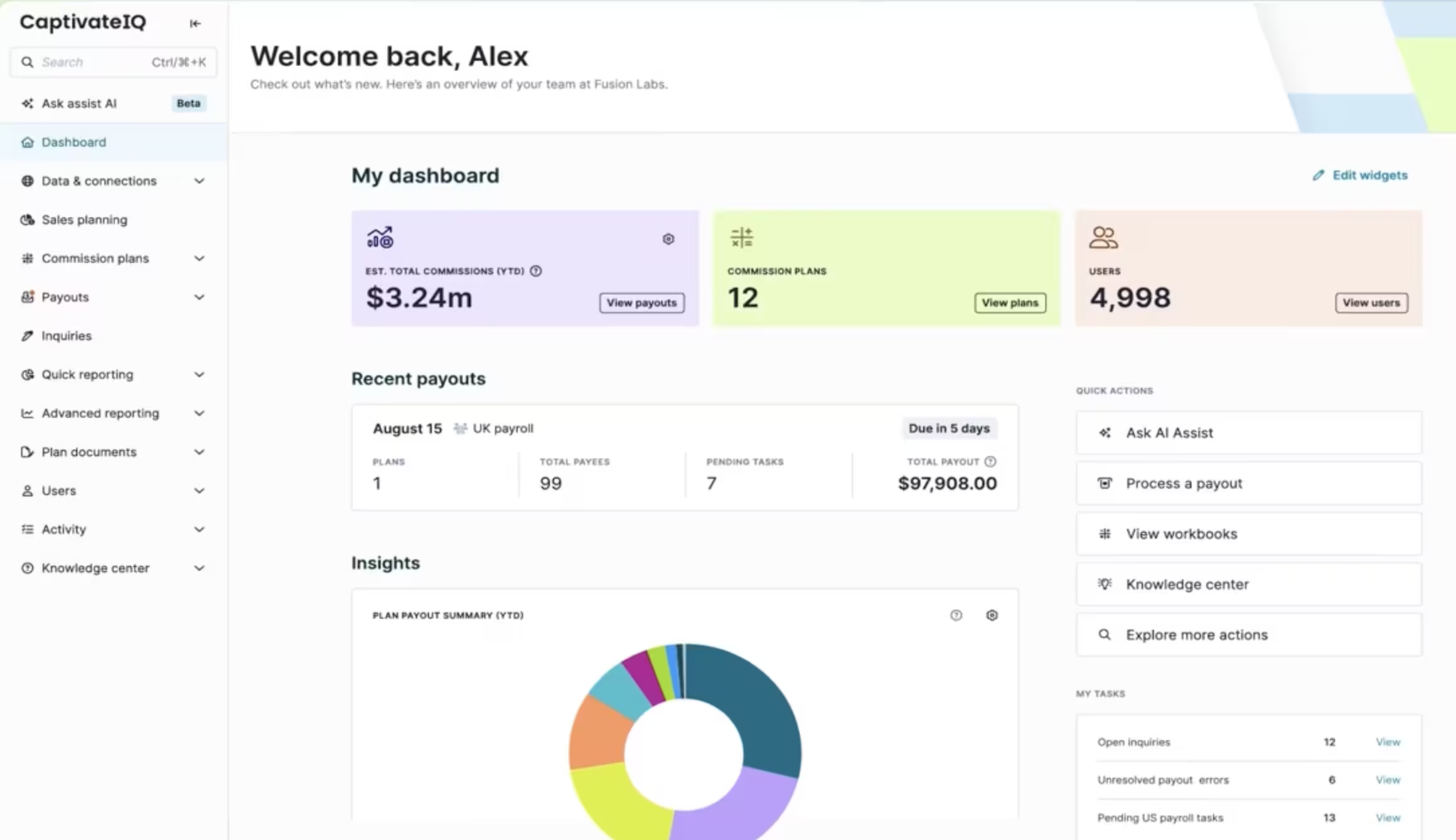
CaptivateIQ deploys AI agents that generate plain-English narratives explaining every line item, citing exact plan clauses and underlying transactions. Reps can run natural-language what-if analysis and receive predictive payout forecasts.
Source: CaptivateIQ
The Plan Doc Explainer Agent answers questions about quotas, targets, accelerator timing, and eligibility rules, while the Statement Explainer Agent validates calculations and highlights primary earnings drivers.
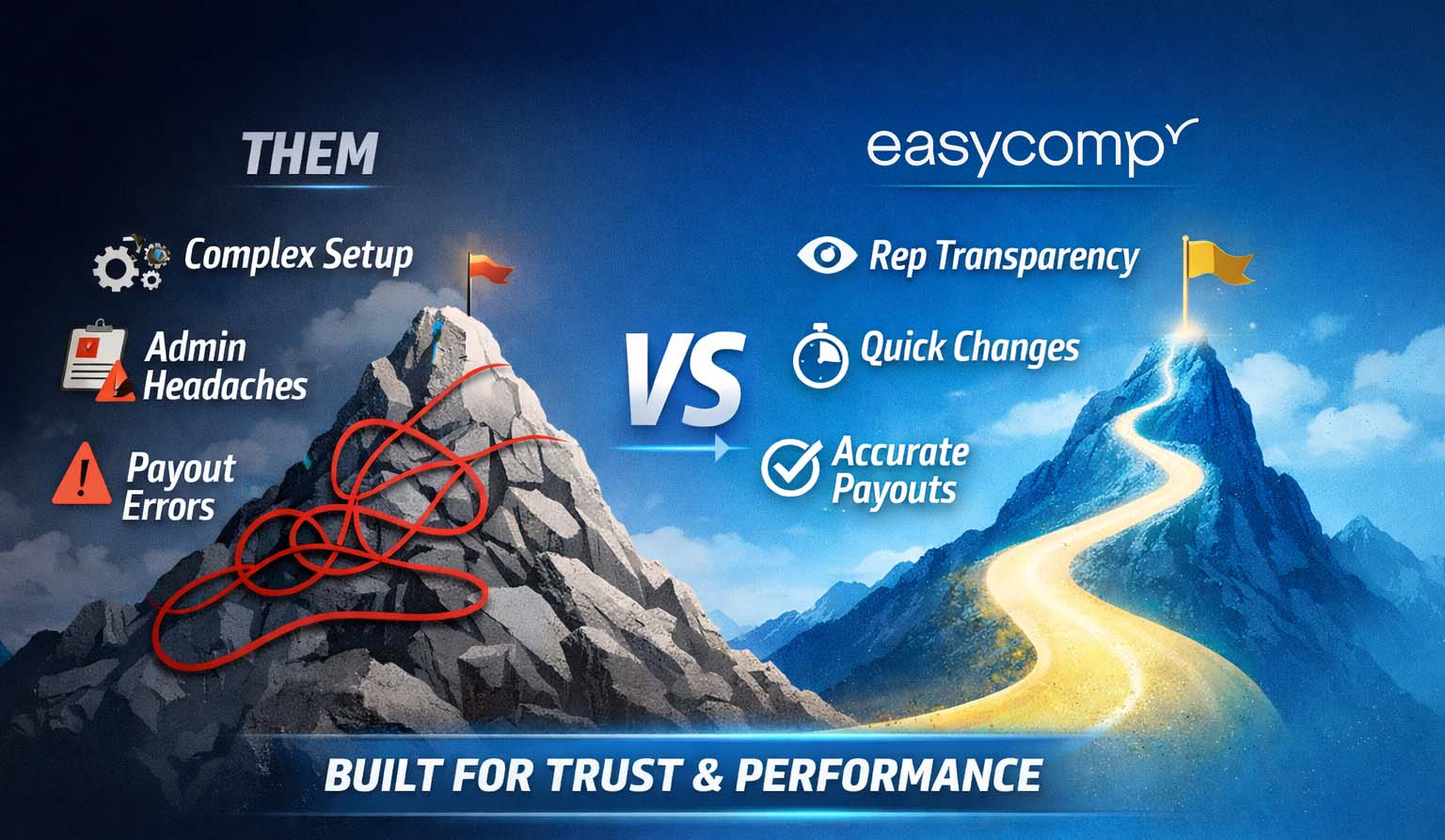
EasyComp calls its approach "calculation lineage". Every payout includes a deal-level, rule-level, and math-level breakdown showing how the number was derived. Reps can search for a specific deal and see how much they earned, which plan components applied, what calculation ran, and which paycheck included the payout.
Source: EasyComp
The philosophy favors transparent math over AI conversation: if every step of the calculation is visible, disputes resolve themselves.
Both approaches reduce disputes. CaptivateIQ's AI agents add natural language Q&A, predictive modeling, and proactive explanations. EasyComp's calculation lineage adds simplicity: every number traces to a source record, visible without asking a question.
CaptivateIQ offers planning that EasyComp doesn't
This is the widest gap between the two platforms.
CaptivateIQ Planning puts territory management, quota setting, and sales capacity planning in the same platform as incentive compensation. Territory changes automatically sync to commission structures. Quota adjustments flow through to payout calculations. Headcount planning ties directly to coverage gaps and revenue targets.

Source: CaptivateIQ
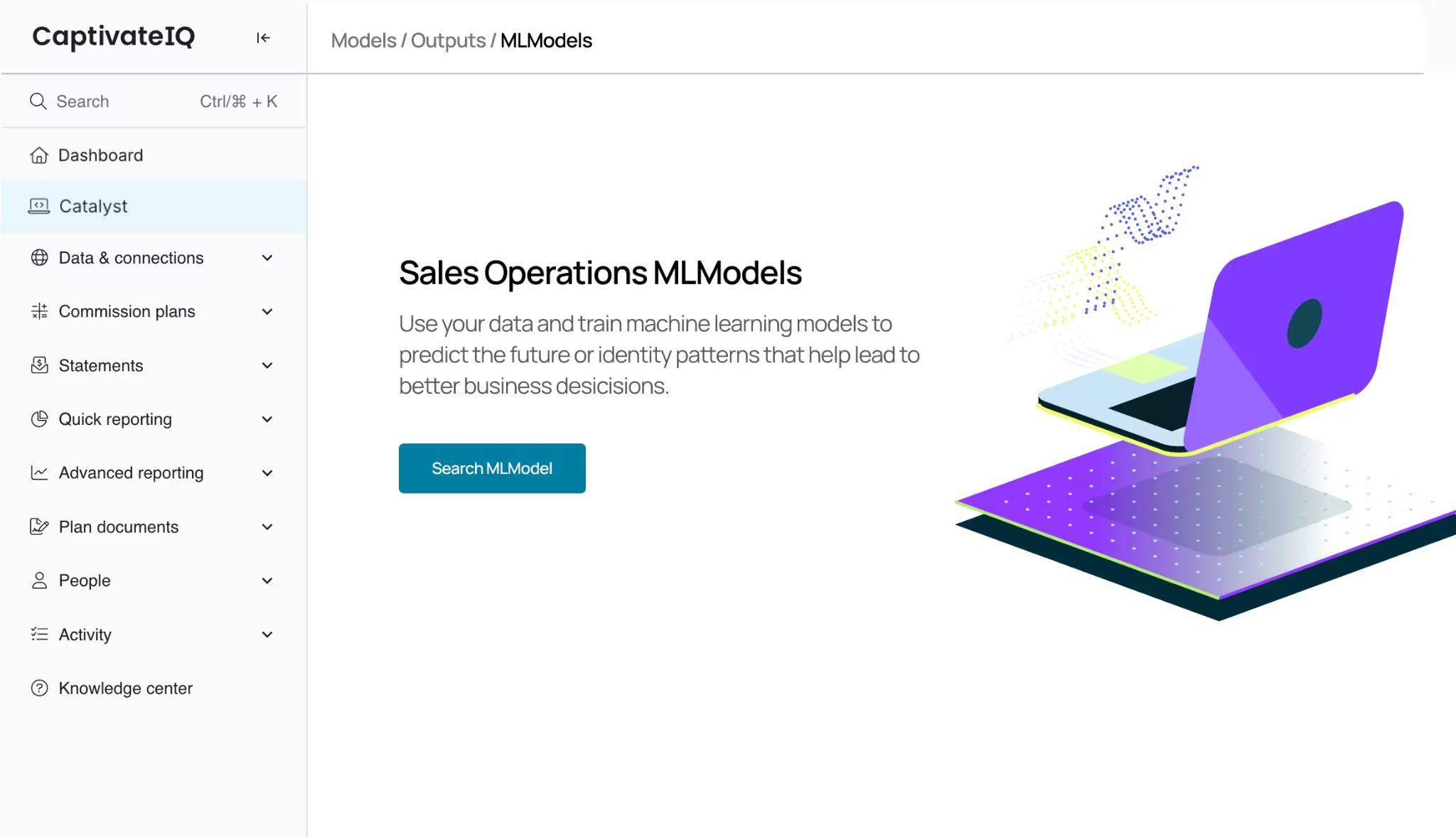
On top of that, CaptivateIQ Catalyst adds predictive ML modeling: attainment forecasting, payout forecasting, anomaly detection, account scoring, and usage-based and ARR-based sales forecasting. Models train on each customer's historical data, not generic benchmarks.
Source: CaptivateIQ
EasyComp does not offer territory planning, quota management, or predictive modeling. If your organization needs planning and compensation in one system, CaptivateIQ is the only option here.
But for organizations that handle planning in separate tools (or in spreadsheets that work well enough), the planning gap may not be a dealbreaker. The question is whether you need planning and incentives together, or whether you need commissions done well and fast.
Accurate commissions start with accurate CRM data
Both EasyComp and CaptivateIQ pull deal data from your CRM to calculate commissions. If that CRM data is incomplete, stale, or wrong, no commission engine can fix it.
ZoomInfo solves this problem before it reaches your compensation platform. ZoomInfo's data covers 500M contacts and 100M companies, verified through a pipeline backed by 300+ human researchers and reaching up to 95% accuracy on first-party data. That data flows into your CRM through native integrations with Salesforce, HubSpot, and Microsoft Dynamics, keeping contact records, company attributes, and deal data current.
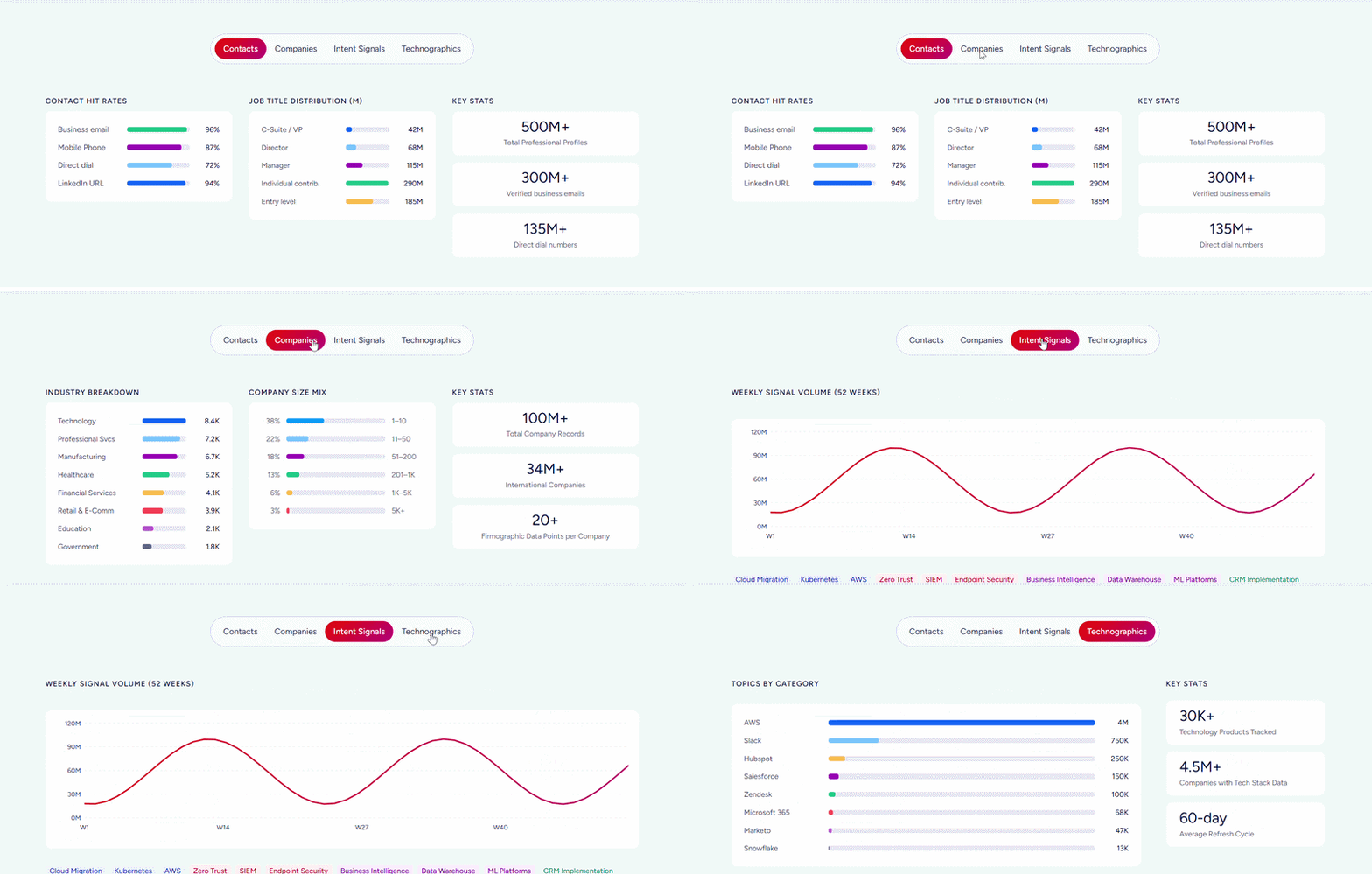
For compensation operations, the impact is direct. Territory assignments depend on accurate company attributes and hierarchies. Split crediting depends on correct deal attribution. Quota attainment depends on properly tracked pipeline.
When a contact changes companies or a deal gets misattributed to the wrong territory, the commission error isn't a calculation problem. It's a data problem that happened upstream.
EasyComp addresses this partially with CRM change monitoring that flags unexpected field edits and backdated bookings. CaptivateIQ's SmartGrid handles data cleanup and combination within the platform. But both react to data problems after they enter the system. ZoomInfo prevents them from entering in the first place.
Snowflake uses ZoomInfo for at least one-third of the most critical data features in their Account Propensity Scoring model. Accounts monitored using ZoomInfo-powered scores showed 90% higher opportunity open rates and 2x higher customer conversion rates. (Snowflake Case Study)
Pricing transparency favors EasyComp
EasyComp publishes its pricing. CaptivateIQ does not.
EasyComp offers three tiers on its pricing page:
Starter ($30/user/month): Pre-built plan library, Salesforce/HubSpot/Google Sheets integrations, activation support, zero implementation fees
Growth ($45/user/month): Custom plan design, complex structures and data transformations, advanced integrations, live within 2 weeks for most customers (additional setup fees may apply)
Enterprise (custom pricing): Dedicated data engineers, multi-source integrations including Microsoft Dynamics and ERP/payroll providers, optional fully managed compensation operations
CaptivateIQ uses quote-based, per-seat pricing. Three factors determine the quote: number of payees, plan complexity, and integrations required.
CaptivateIQ Incentives, Planning, and Catalyst are priced as separate products. ASC-606 reporting is an add-on. Premier and Elite support tiers cost extra. Integration connector fees may apply.
For budget planning, EasyComp's transparency helps. A 100-rep organization can estimate $3,000-$4,500/month before talking to sales. With CaptivateIQ, the same organization must go through a sales cycle and custom quote to understand total cost, and should budget for a one-time setup fee plus potential add-ons for ASC-606 reporting, premium support, and integration connectors.
Neither platform offers a self-serve free trial. EasyComp uses a demo request flow. CaptivateIQ offers interactive product tours but also directs prospects to a custom quote via sales.
Implementation speed matters more than most buyers expect
Getting live with a compensation platform is not trivial. The implementation timeline shapes when you start seeing value.
EasyComp positions speed as a core differentiator. The Starter plan ships with zero implementation fees, and Growth plan customers target going live within two weeks. When Carrum Health evaluated the platform, the EasyComp team produced a working demo using Carrum Health's own commission model in under a week.
CaptivateIQ's pricing page says customers get "up and running in a matter of weeks instead of months," positioning against legacy platforms with 12-18 month deployments. But G2 reviewers note that implementation can take 4-6 months for complex deployments.
The blank-canvas flexibility means administrators need to understand how their plans are structured before the system becomes productive, and TrustRadius users describe month-to-month cycling after initial setup as "a significant lift."
The difference reflects the platforms' design philosophies. EasyComp constrains choices (pre-built templates on Starter, guided customization on Growth) to speed up time-to-value. CaptivateIQ provides flexibility, which requires more investment upfront but accommodates virtually any plan structure.
Integration ecosystems reflect different stages
CaptivateIQ publishes a full integrations directory with 19 pre-built connectors spanning CRM (Salesforce, HubSpot, Microsoft Dynamics), data warehouses (Snowflake, Amazon Redshift, BigQuery), databases (MySQL, PostgreSQL, Oracle), ERP (NetSuite), accounting (QuickBooks, Xero, Sage Intacct, Stripe, Zuora), and HR platforms (Workday, ADP, BambooHR).
An Open API with documented endpoints, recipes, and a changelog supports custom integrations.
EasyComp's integration footprint is narrower. Native CRM integrations cover Salesforce, HubSpot, and Microsoft Dynamics, with ERP, payroll, and billing integrations at the Growth and Enterprise tiers. A Google Sheets connector is available through the Google Workspace Marketplace, and a Claude Cowork integration enables natural-language compensation workflows.
No public API documentation, webhook specs, or developer portal is available.
Neither platform offers Zapier, Workato, or Make connectors, a recurring complaint for CaptivateIQ on G2 and TrustRadius and an undisclosed gap for EasyComp. Teams needing workflow automation outside either platform must use CaptivateIQ's API directly or work through EasyComp's implementation team.
ZoomInfo's integration ecosystem is the broadest of the three, with an App Marketplace listing 120+ partner integrations and an Enterprise API with documented endpoints, OAuth 2.0 authentication, and tiered rate limits.
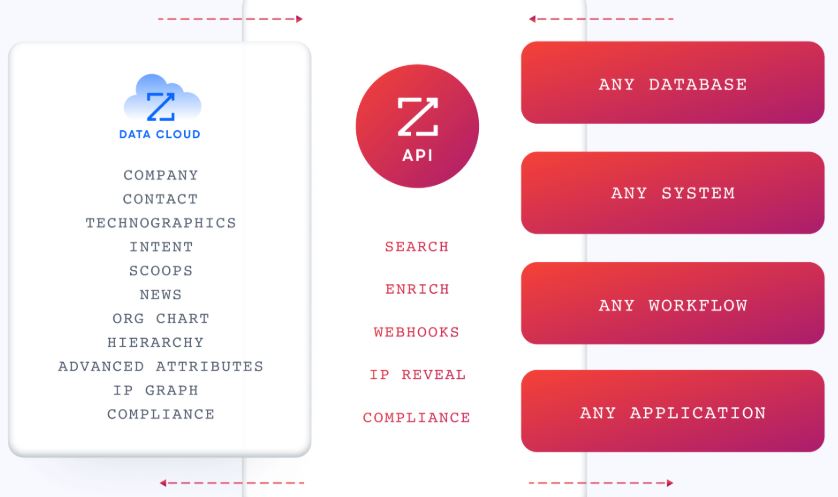
For compensation operations, ZoomInfo's CRM integrations keep the deal and contact data feeding into either EasyComp or CaptivateIQ clean and current.
AI capabilities are evolving quickly
CaptivateIQ is further along in AI deployment. The CaptivateIQ Agents portfolio launched in May 2026 with three agents: Comp Builder (build comp plans from natural language), Comp Ops (explain payouts, manage approvals, catch anomalies), and Rev Planning (configure territories from natural-language goals).
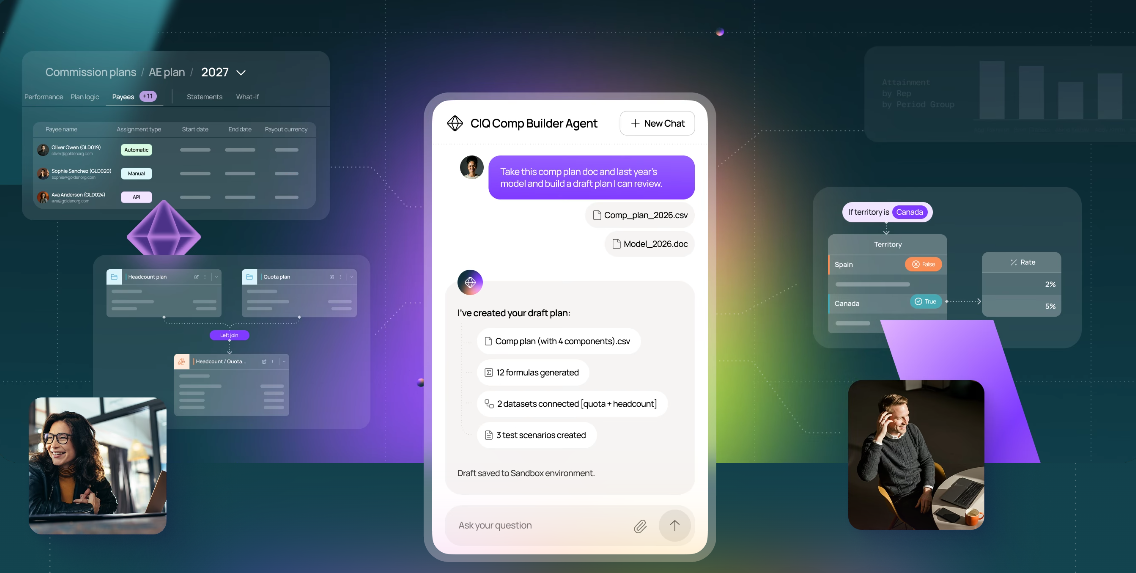
Source: CaptivateIQ
These agents operate on live platform data with built-in governance: every action falls under the same permissions and approval framework as manual operations. CaptivateIQ received a perfect score on "advanced AI capabilities" in The Forrester Wave Q1 2025. A CaptivateIQ MCP Server is announced for connecting compensation data to third-party AI tools.
EasyComp's AI approach is more targeted. The platform uses AI to draft consistent plan language, detect inconsistencies between plan logic and plan documents, and standardize terminology across plan letters.
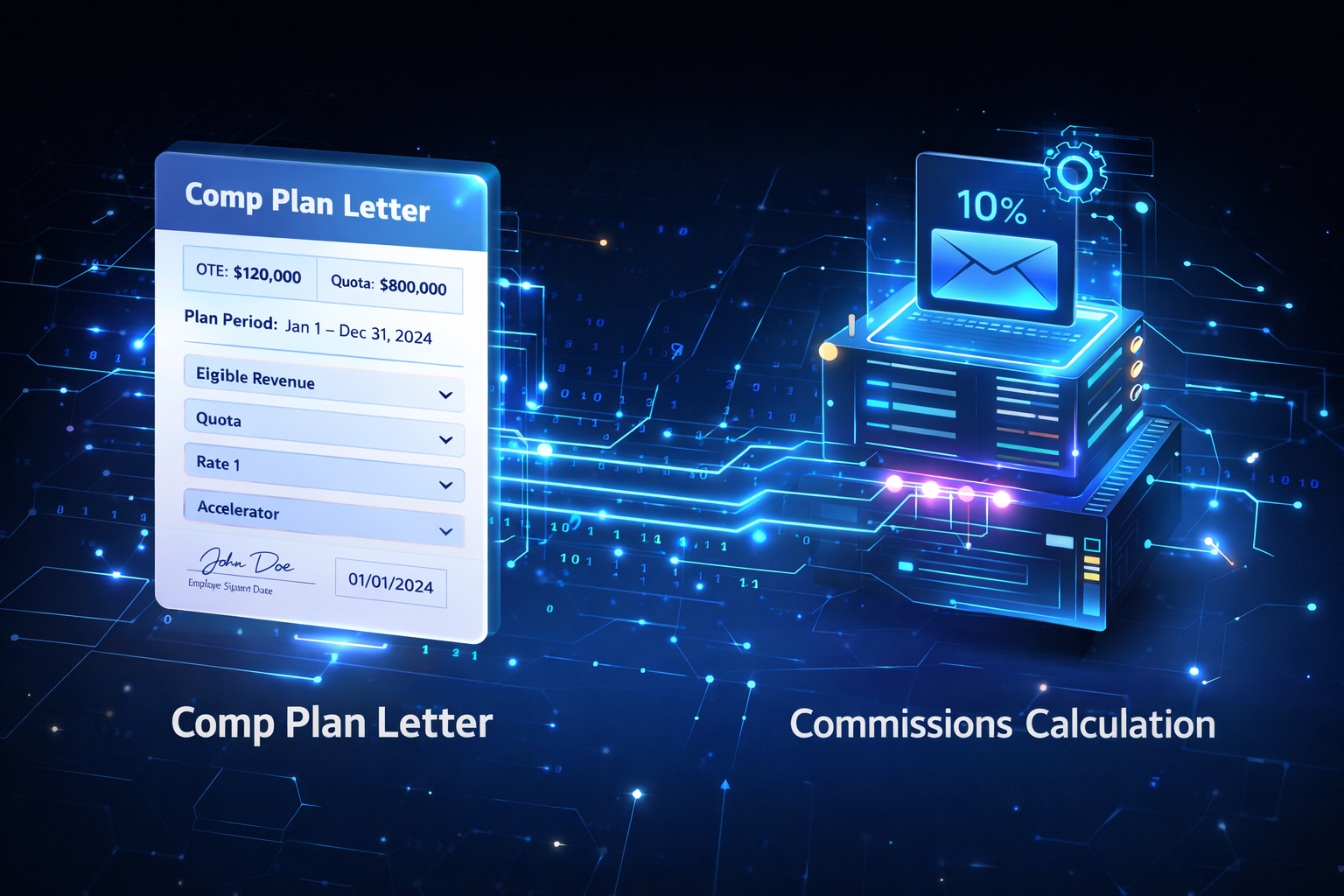
Source: EasyComp
The Claude Cowork integration connects EasyComp's structured compensation data with Claude for natural-language workflows: onboarding data loading, commission cost breakdowns, audit report generation, and plan letter drafting.
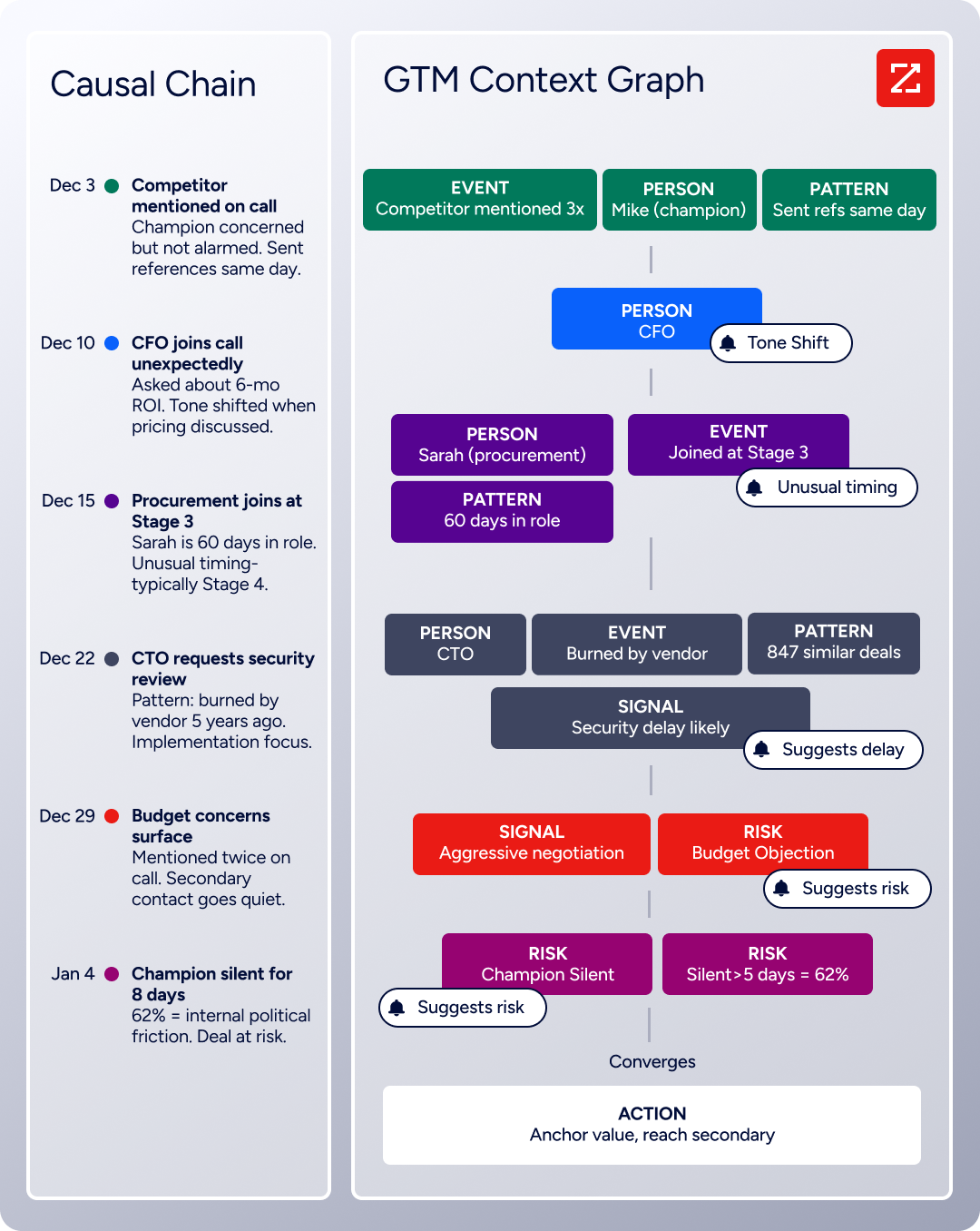
ZoomInfo's AI operates upstream of both platforms. The GTM Context Graph processes 1.5B+ data points daily, connecting intent signals, conversation intelligence, and CRM data to reveal not just what happened in a deal, but why.
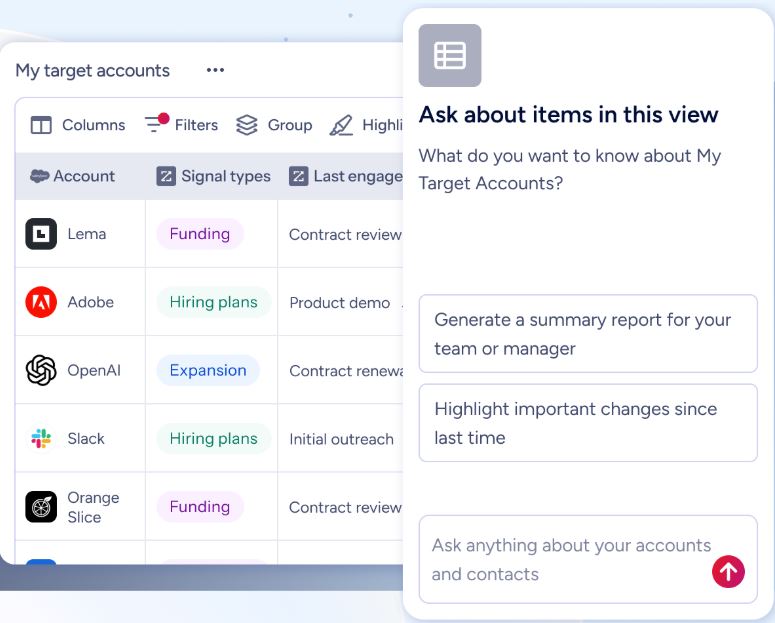
GTM Workspace uses AI agents to help sellers prioritize accounts, draft outreach, and update CRM, generating the deal activity that eventually flows into commission calculations.
Seismic's sales team attributed 39% of active pipeline to opportunities identified or influenced by ZoomInfo signals and boosted productivity by 54%. (Seismic Case Study)
Security and compliance comparison
All three platforms meet enterprise security baselines, but coverage varies.
EasyComp has completed an independent SOC 2 Type II audit and maintains a Trust Center. Customer data is stored on US-based servers, and the privacy policy confirms AI subprocessors will not use customer data to train models. No additional certifications (ISO 27001, HIPAA) are publicly confirmed.
CaptivateIQ undergoes annual independent audits for both SOC 1 and SOC 2, covering security, availability, and confidentiality. The platform includes a dedicated SOX compliance page with six controls: segregation of duties, change control, audit logging, access control, reporting, and data protection. Infrastructure runs on AWS with AES-256 encryption at rest and TLS 1.2 in transit.
ZoomInfo holds the broadest certification stack: ISO 27001, ISO 27701, SOC 2 Type II, TRUSTe GDPR, and TRUSTe CCPA, all renewed annually. ZoomInfo is a registered data broker in California and Vermont.
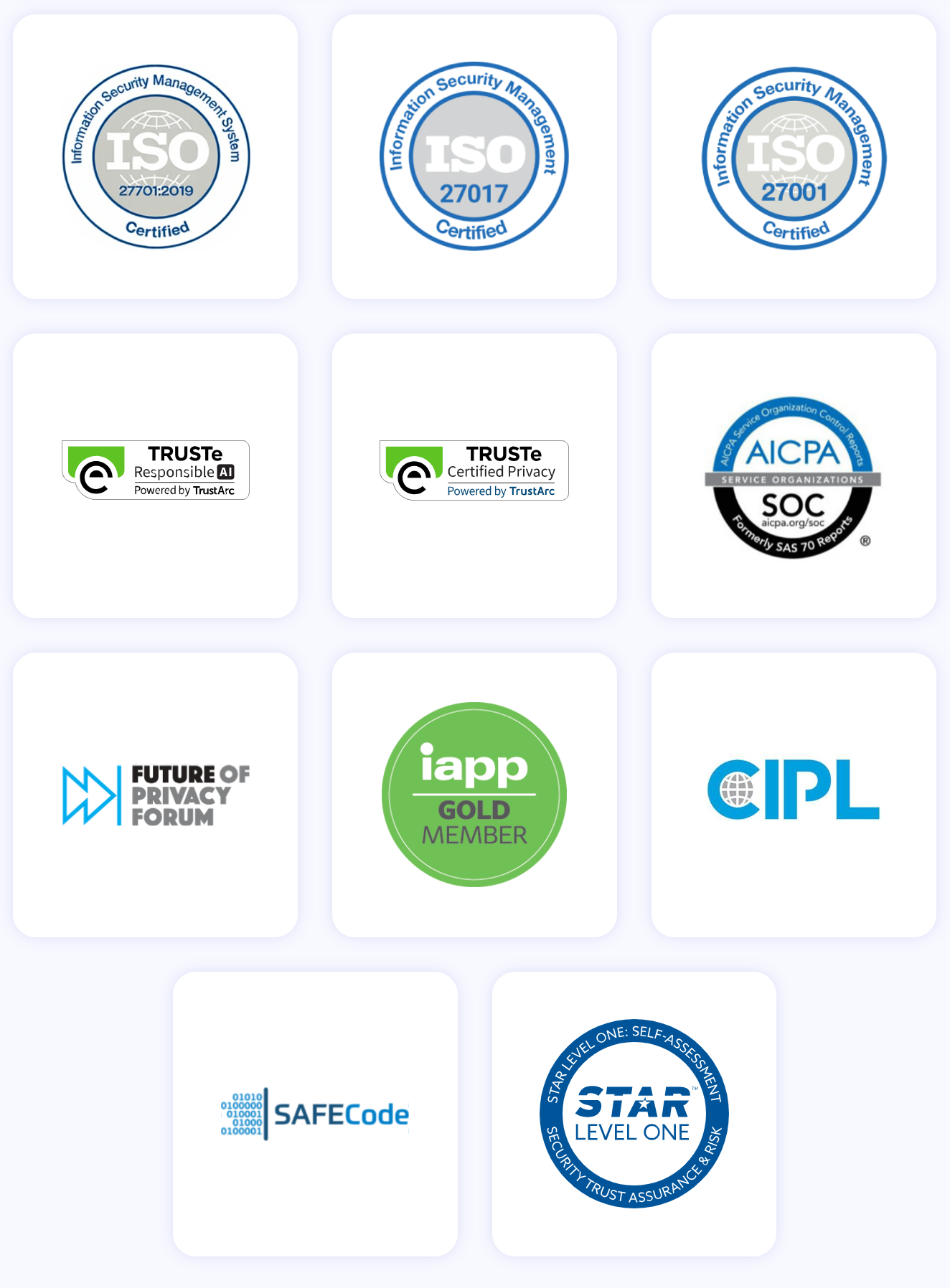
For public companies needing SOX compliance on commission accruals, CaptivateIQ's SOX controls and SOC 1 audit provide the deepest coverage. EasyComp's SOC 2 Type II meets the baseline for most mid-market buyers. ZoomInfo's ISO certifications matter for enterprises requiring data privacy compliance across their vendor stack.
EasyComp vs. CaptivateIQ vs. ZoomInfo: Which should you choose?
The choice depends on where you are in your compensation operations journey and what your deal data looks like upstream.
Choose EasyComp if:
You're replacing spreadsheets or a legacy ICM platform that has become too heavy
Your team needs to be live in weeks, not months
You want transparent pricing you can evaluate before talking to sales
Your commission plans are complex but don't require 7,000 simultaneous plan configurations
You're a Series B through mid-enterprise B2B company on Salesforce or HubSpot
You value a vendor team with domain expertise in variable compensation
Choose CaptivateIQ if:
You need a full sales performance management suite: commissions plus territory, quota, and capacity planning
Your organization runs thousands of unique commission plans across multiple business units
Analyst validation (Forrester Leader, Gartner Customers' Choice) matters to your procurement process
You want AI agents that can build plans, explain payouts, and configure territories from natural language
Predictive modeling for attainment and payout forecasting is a priority
You can invest 4-6 months in implementation for a long-term platform
Add ZoomInfo to either if:
Commission disputes frequently trace back to incorrect deal data in your CRM
Your territory assignments depend on company data that goes stale
Your sales team needs better pipeline to generate the revenue your comp plans reward
You want one platform keeping contact records, company hierarchies, and deal attribution accurate across your CRM
You need intent signals and account intelligence to help sellers close deals
See how ZoomInfo keeps your CRM data accurate so your commissions are calculated on reality, not guesswork.
The strongest compensation operations don't start at the commission engine. They start with accurate deal data flowing into the CRM, accurate CRM data flowing into the comp platform, and accurate payouts flowing to the reps who earned them. EasyComp or CaptivateIQ handles the last two steps. ZoomInfo handles the first.
EasyComp vs. CaptivateIQ vs. ZoomInfo FAQ
What is the core difference between EasyComp and CaptivateIQ?
EasyComp is a focused commission calculation and rep visibility platform built for speed: transparent pricing starting at $30/user/month, implementation in weeks, and real-time calculations on an event-driven architecture.
CaptivateIQ is a full sales performance management suite covering commissions, territory planning, quota setting, and predictive modeling, with Forrester Wave Leader recognition and 800+ enterprise customers but quote-only pricing and longer implementation timelines.
How does ZoomInfo relate to EasyComp and CaptivateIQ?
ZoomInfo is not a commission calculation tool. It solves the upstream data problem: keeping your CRM records accurate so the deal data flowing into EasyComp or CaptivateIQ reflects reality. ZoomInfo's B2B database covers 500M contacts and 100M companies with up to 95% accuracy on first-party data, preventing the data errors that cause commission disputes before calculations run.
Which platform is cheaper for a mid-market company?
EasyComp is the most affordable option with published pricing at $30-$45/user/month and zero implementation fees on the Starter plan. CaptivateIQ does not publish prices and requires a custom quote based on payee count, plan complexity, and integrations. CaptivateIQ also charges a one-time setup fee and may charge separately for ASC-606 reporting, premium support, and integration connectors.
Which platform handles the most complex commission structures?
CaptivateIQ supports up to 7,000 simultaneous plans through its no-code SmartGrid interface and received the highest possible Forrester scores in plan creation, plan modeling, and end-user modeling. EasyComp handles the same core plan mechanics (splits, accelerators, tiers, clawbacks, overlays) but is built for faster deployment rather than maximum scale. Organizations with thousands of unique plan configurations across multiple business units will find CaptivateIQ better suited.
Which platform is faster to implement?
EasyComp targets implementation in weeks, with Growth plan customers typically live within two weeks. One customer reported receiving a working demo with their own commission model in under a week. CaptivateIQ says implementation takes "weeks instead of months," but G2 reviewers note that complex deployments can take 4-6 months due to the blank-canvas setup model.
Does either platform offer sales planning capabilities?
Only CaptivateIQ. CaptivateIQ Planning covers territory management, quota setting, and sales capacity planning in the same platform as incentive compensation, with changes automatically syncing to commission structures. EasyComp focuses on commission calculation and does not offer planning.
How do the platforms handle rep commission disputes?
Both platforms reduce disputes through transparency, but differently. CaptivateIQ uses AI agents that generate plain-English payout explanations and let reps ask natural-language questions about their commissions. EasyComp uses "calculation lineage," line-by-line breakdowns showing the exact deal, rule, and math behind every payout. Intercom reduced commission inquiry tickets by 30% using CaptivateIQ.
EasyComp customers report reps recovering 5-10 hours per quarter from eliminating manual commission reconciliation.
Can ZoomInfo's data feed directly into EasyComp or CaptivateIQ?
Not directly. ZoomInfo feeds data into your CRM (Salesforce, HubSpot, Microsoft Dynamics) through native integrations. EasyComp and CaptivateIQ then pull deal and revenue data from that CRM.
The connection is indirect but critical: ZoomInfo keeps CRM records accurate and complete, which ensures the data EasyComp or CaptivateIQ uses for commission calculations is reliable. Clean upstream data means fewer errors, fewer disputes, and less time on manual reconciliation.
More EasyComp and CaptivateIQ comparisons:
