
What is first mover advantage?
First mover advantage (FMA) is the competitive edge a company gains by entering a market or reaching a customer before its rivals do. Lieberman and Montgomery's foundational 1988 research identified three mechanisms that make this edge durable: technology leadership that competitors cannot easily replicate, preemption of scarce resources like distribution channels or supplier relationships, and buyer switching costs that make it painful for customers to change once they've committed to a vendor.
The counterintuitive reality is that being first does not guarantee winning. Golder and Tellis research across hundreds of brands and product categories found that first movers fail 47% of the time and capture only 10% average market share, while early followers achieve 28% market share with just an 8% failure rate. The difference between a first mover that wins and one that fails often comes down to the quality and speed of the intelligence driving the decision.
Catch companies at the moment of incorporation
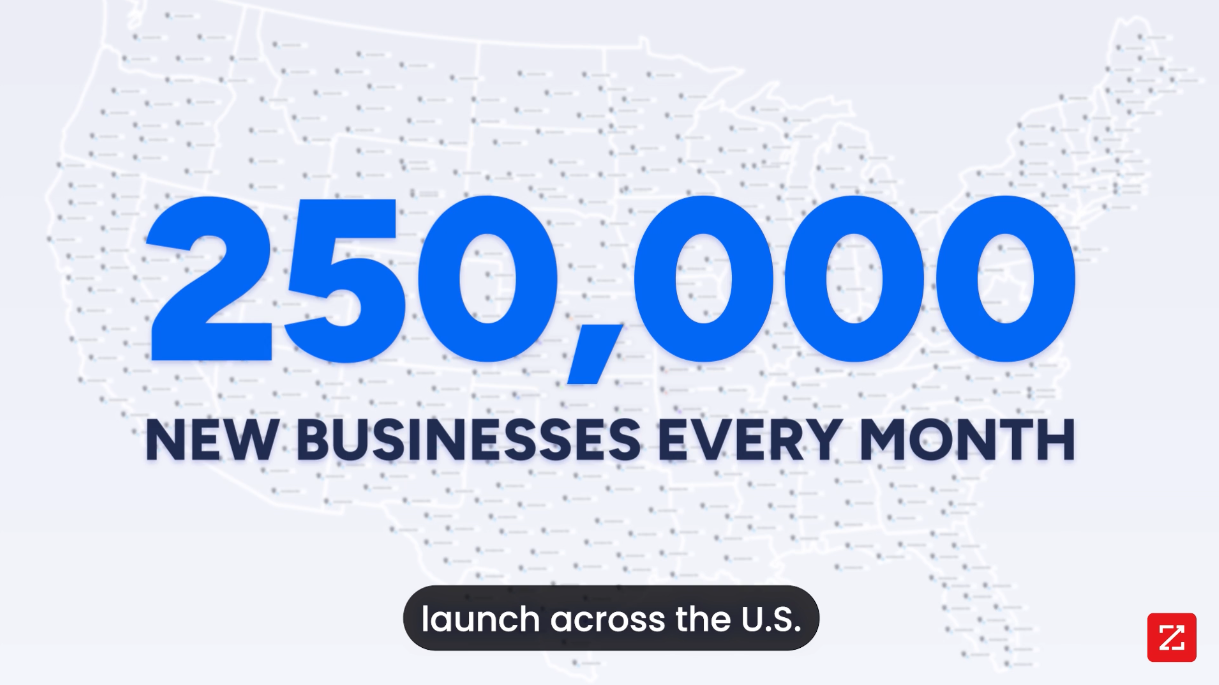
With ZoomInfo, an all-in-one AI GTM Platform, First-Mover Advantage data gives sales and marketing teams unprecedented visibility into brand-new businesses, about 250,000 every month, based on ZoomInfo's tracking of state business formation filings across the US.
That's because ZoomInfo tracks and compiles data whenever new companies file business formation paperwork with regulators all across the US, and delivers it directly to your go-to-market systems.
First-Mover Advantage data gives you access to:
Business Addresses
State of Business Formation
Date of Incorporation
Industry
Key Officers
Why speed wins: the data advantage behind first movers
Getting the fastest, most comprehensive data on new-business formation gives sales and marketing teams a crucial edge in outreach and customer profiling. New business filings occur weeks or even months before most businesses have set up their website, listed themselves on third-party platforms, or begun to advertise or open storefronts.
First-Mover Advantage data also helps companies expand into new markets, capitalizing on the earliest signals that ideal customers are appearing in new territories and geographies.
By analyzing new businesses at scale, GTM teams can be the first to spot emerging markets and critical shifts in industry trends. And when paired with ZoomInfo's deep Go-to-Market Intelligence on mature companies, you get full lifecycle coverage, from inception to IPO. Teams building agentic workflows can access that same lifecycle intelligence through ZoomInfo's APIs and MCP, with the GTM Context Graph surfacing formation signals alongside intent, CRM context, and behavioral data so agents act on the right signal at the right moment.
ZoomInfo's first-mover data advantage rests on three interconnected capabilities. The platform's verified B2B data covers 500M contacts and 100M companies, updated continuously through 300+ human researchers and multi-source verification. The GTM Context Graph processes 1.5B+ data points daily, fusing company formation signals with CRM data, intent signals, and behavioral context to surface not just what is happening but why. And through GTM Workspace for sellers, GTM Studio for marketing and RevOps teams, or directly via APIs and MCP, that intelligence reaches every workflow without lock-in.
The scale of what this makes possible is concrete. MarketSpark used ZoomInfo data to identify 30,000 prospect companies and generate 5x revenue opportunities, a direct illustration of what first-mover data access produces at scale.
First mover advantage vs. second mover: what the data actually shows
The business world celebrates Tesla, Amazon, and Google as first-mover wins. But this is survivorship bias at work. MySpace pioneered social networking and lost to Facebook. Netscape introduced the web browser and ceded the market first to Internet Explorer, then to Chrome. The celebrated examples survived; the failures are forgotten.
The Golder and Tellis research makes the tradeoff concrete:
Dimension | First Mover | Early Follower |
|---|---|---|
Failure Rate | 47% | 8% |
Average Market Share | 10% | 28% |
Key Risk | Market education cost, technology leapfrogging | Ceding brand recognition |
Key Advantage | Brand recognition, switching costs, resource control | Lower R&D cost, validated demand |
Source: Golder & Tellis research across hundreds of brands and product categories.
FMA is not a myth, it is conditional. It works when switching costs are high, technology is defensible, and resources can be locked up before competitors arrive. It fails when market demand is unproven or technology evolves faster than the first mover can adapt.
For B2B sales, the first-mover advantage is not about being the first company in a market. It is about being the first sales team to reach a newly formed business before competitors even know it exists. That is a timing advantage that data makes possible, and it is a first mover advantage strategy any team can execute with the right intelligence.
Real-world first mover advantage examples (and what made them stick)
Amazon: Not the first company to sell books online, but the first to achieve significant scale in online retail. Amazon built switching costs through Prime membership, logistics infrastructure, and marketplace network effects that followers could not replicate cheaply or quickly.
Coca-Cola: First to scale a carbonated soft drink brand globally, creating switching costs through taste familiarity and distribution lock-in that gave the brand a century-long head start on shelf space and consumer habit.
Netflix: First to scale streaming video on demand, building switching costs through an original content library and a recommendation engine that made the platform progressively harder to leave.
MySpace: Pioneered social networking but lost to Facebook's superior product and network effects. Being first in the category was not enough when a fast follower delivered a meaningfully better experience.
Netscape: Introduced the commercial web browser but ceded the market to Internet Explorer and then Chrome. Technology leadership evaporated once Microsoft bundled a competitor into every Windows installation.
In each success case, the first mover combined early entry with a defensible advantage rooted in scale, switching costs, or resource control, not timing alone. The failures show what happens when the underlying advantage is absent or eroded by a better-resourced follower.
For sales teams, the equivalent of Amazon's early-scale advantage is reaching a newly incorporated business before it has established vendor relationships. When switching costs are zero and the first conversation sets the frame, timing becomes the entire advantage. That is the first mover advantage strategy that ZoomInfo's First-Mover Advantage data makes executable at scale.
How ZoomInfo's First-Mover Advantage data works in practice
Here is how that works in practice.
ZoomInfo surfaces approximately 250,000 new business filings per month, weeks before those companies have a website, a third-party listing, or an advertising presence. Your team reaches them before any competitor knows they exist.
The data flows directly into your go-to-market systems. SDRs can build prospecting lists of newly incorporated businesses filtered by industry, geography, and officer title. AEs can set alerts for new formations in their territory. RevOps teams can route new-company signals automatically into CRM workflows, so no new business slips through unworked.
For teams building agentic workflows, this same new-business formation intelligence is accessible through ZoomInfo's APIs and MCP, so it can be wired into custom prospecting agents without adopting a new interface.
See how ZoomInfo's First-Mover Advantage data puts your team on Day One. Request a demo.
Frequently asked questions
What is first mover advantage in business?
First mover advantage in business is the competitive edge a company gains by entering a market, reaching a customer segment, or establishing a category before rivals do. The advantage is most durable when the first mover can build switching costs, lock up scarce resources, or establish technology leadership that followers cannot easily replicate. In B2B sales, this translates directly to reaching newly formed businesses before competitors know they exist.
What are the advantages and disadvantages of being a first mover?
Advantages include brand recognition, buyer switching costs, resource preemption, and technology leadership. Disadvantages include high market education costs, the risk of technological leapfrogging by followers, and the complacency trap where incumbents stop innovating. Golder and Tellis research shows first movers fail 47% of the time and capture only 10% average market share, while early followers achieve 28% market share with just an 8% failure rate. The implication: being first matters less than being first with a defensible advantage.
What is an example of a first mover advantage?
Amazon is the canonical example: not the first company to sell books online, but the first to achieve significant scale in online retail, building switching costs through Prime membership, logistics infrastructure, and marketplace network effects. In B2B sales, ZoomInfo's First-Mover Advantage data gives sales teams the equivalent edge by surfacing newly incorporated businesses before they appear on any third-party platform. MarketSpark used that data to identify 30,000 prospect companies and generate 5x revenue opportunities, reaching prospects before any competitor knew they existed.
How does data give companies a first mover advantage?
Data creates first mover advantage by surfacing signals before competitors act on them. In B2B sales, ZoomInfo's First-Mover Advantage data tracks business formation filings across all US states, delivering information on approximately 250,000 new businesses per month, weeks before those businesses have websites, third-party listings, or existing vendor relationships. Teams that reach these companies first set the frame for every subsequent vendor conversation. The GTM Context Graph is the intelligence layer that processes and surfaces these formation signals so your team acts on them before a competitor does.
What is the difference between first mover advantage and second mover advantage?
First mover advantage comes from entering a market early and building switching costs, brand recognition, or resource control before competitors arrive. Second mover advantage (also called fast-follower advantage) comes from letting the first mover educate the market, absorb R&D costs, and validate demand, then entering with a superior product. Research shows early followers achieve 28% average market share versus 10% for first movers, with a much lower failure rate (8% vs. 47%). The optimal first mover advantage strategy depends on whether the market has high switching costs and defensible technology.
How does ZoomInfo's First-Mover Advantage data integrate with my CRM?
ZoomInfo delivers First-Mover Advantage data directly to your go-to-market systems, including CRM platforms. New business formation records flow into your CRM automatically, enabling SDRs to build prospecting lists filtered by industry, geography, and officer title, and allowing RevOps teams to configure routing rules for new-company signals. Teams building custom workflows can access the same data through ZoomInfo's APIs and MCP.