
Choosing between folk and HubSpot for your CRM often comes down to these five questions:
Do you need a simple, relationship-focused CRM, or a full customer platform spanning marketing, sales, service, and commerce?
Is your team under 50 people and looking to start in minutes, or are you scaling toward enterprise and need advanced automation?
Do you want unlimited contacts at a flat per-seat price, or are you willing to navigate tiered pricing for deeper capabilities?
How important are built-in data intelligence and buyer intent signals versus a clean interface for managing existing relationships?
Are you choosing a CRM to organize what you already know, or a platform that also tells you who to target and when?
In short, here's what we recommend:
folk is built for small teams that want a CRM they can enjoy using. With a spreadsheet-like interface, AI Assistants for follow-ups and research, and the folkX Chrome extension for capturing contacts from LinkedIn and Gmail, folk gets you from zero to organized in about 20 minutes. It offers unlimited contacts on all plans, built-in enrichment, and email sequences, all starting at $24/seat/month. But folk is designed for teams that value simplicity over scale. If you need enterprise reporting, marketing automation, or analytics, you'll outgrow it.
HubSpot is the full-stack customer platform for companies that want marketing, sales, service, and content tools sharing a single database. With 288,706 customers and over 2,000 app integrations, HubSpot gives scaling companies the infrastructure to run their entire go-to-market operation from one login. Its Breeze AI layer automates prospecting, customer support, and content creation. The tradeoff is complexity and cost: pricing involves per-seat fees, per-hub charges, mandatory onboarding fees at Professional tiers, and a contact-based billing model for marketing that can escalate quickly.
Both folk and HubSpot help you manage the relationships you already have. But neither tells you which accounts are researching solutions like yours right now, who the decision-makers are, or what signals indicate a deal is ready to move. That intelligence gap is where deals get lost, and where ZoomInfo changes the equation.
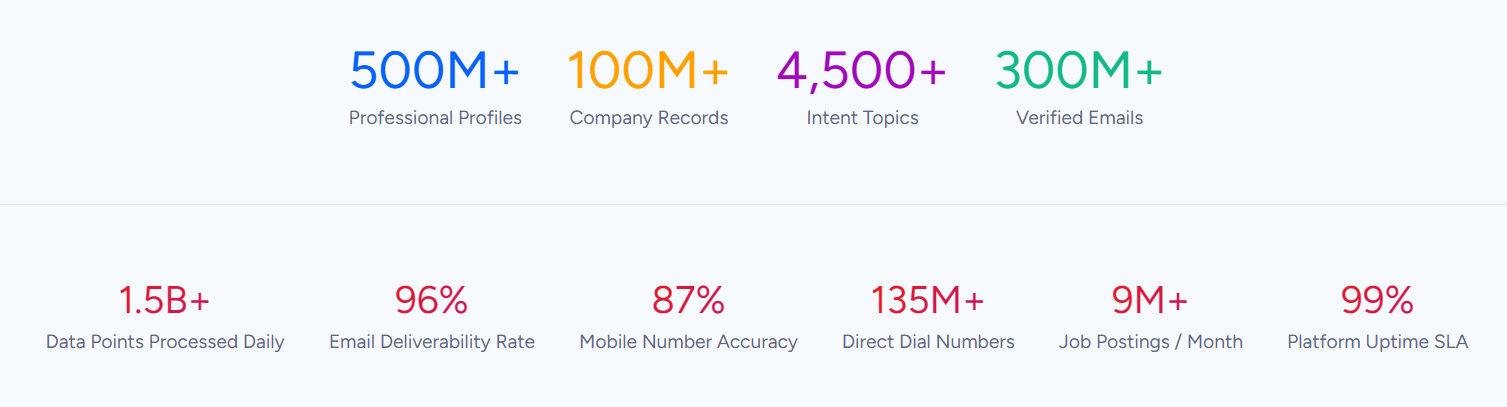
ZoomInfo is a B2B intelligence platform built on 500M contacts, 100M companies, 135M+ verified phone numbers, and 200M+ verified business email addresses. Its GTM Context Graph (an intelligence layer processing 1.5B+ data points daily) fuses this data with your CRM records, conversation transcripts, and behavioral signals to reveal not just what's happening in your pipeline, but why deals move or stall. ZoomInfo integrates with both folk and HubSpot, and its intelligence is accessible through the GTM Workspace for sellers, GTM Studio for marketers and RevOps, or API and MCP in any tool you already use.
If you want to see how ZoomInfo's intelligence layer can power your CRM, start with a free trial.
folk vs. HubSpot at a glance
folk | HubSpot | ZoomInfo | |
|---|---|---|---|
Primary function | Relationship-focused CRM | All-in-one customer platform | B2B intelligence platform |
Contact limits | Unlimited on all plans | Up to 15M (expandable to 50M) | 500M contact database |
AI capabilities | Follow-up, Recap, Research, Workflow Assistants | Breeze AI (Customer, Prospecting, Data Agents) | GTM Context Graph with AI-powered execution |
Buyer intent data | Not available | Limited (via third-party integrations) | Native intent from 210M IP-to-Org pairings |
Contact enrichment | Built-in waterfall enrichment (6 providers) | AI auto-enrichment from conversations and web | Multi-source verified data, up to 95% accuracy |
Email sequences | Up to 10 steps (Premium plan) | Sequences with automated + manual tasks | AI-drafted outreach via GTM Workspace |
Starting price | $24/seat/month (annual) | Free CRM; paid from $15/seat/month | Custom-quoted; free Lite tier available |
Setup time | ~20 minutes | Hours to weeks depending on tier | Deploys in weeks |
Integrations | 5,000+ via Zapier/Make; native Gmail, Outlook, LinkedIn | 2,000+ native marketplace integrations | 120+ native; API/MCP for any tool |
Best for | Small teams (under 50 seats) | Scaling companies (20 to 2,000+) | Revenue teams needing B2B data and signals |
Simple CRM vs. full platform vs. intelligence layer
These three tools solve different problems.
folk starts with a question most CRMs ignore: what if managing relationships didn't require fighting your software?
The platform gives you a clean, spreadsheet-like interface where contacts, pipelines, and outreach live in one place. It grew out of eFounders (now Hexa) when the startup studio's team realized they had a large network of contacts but no good way to use it. The result is a CRM that feels more like Notion than Salesforce.
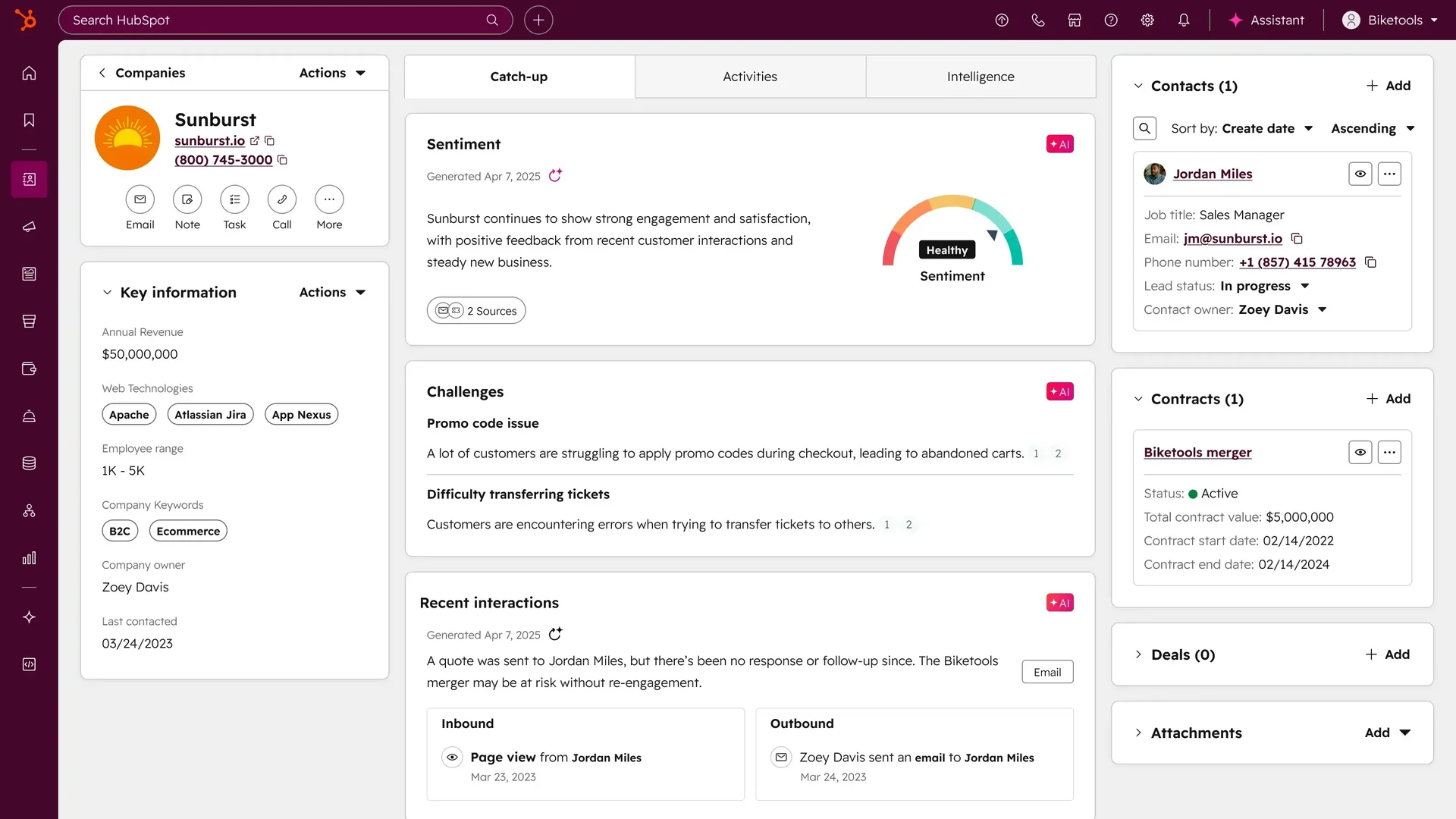
HubSpot starts with a different premise: everything your go-to-market team needs should share one database.
Marketing automation, sales pipelines, customer service ticketing, content management, and commerce tools all feed the same Smart CRM. For companies with multiple departments touching the customer journey, this eliminates the fragmentation of running separate tools for each function.
Source: HubSpot
ZoomInfo starts with the question neither folk nor HubSpot was built to answer: who should you be talking to right now, and why? While CRMs organize existing relationships, ZoomInfo identifies new opportunities by combining a large B2B dataset with buyer intent signals, website visitor identification, and conversation intelligence. It then delivers that intelligence into your CRM of choice.
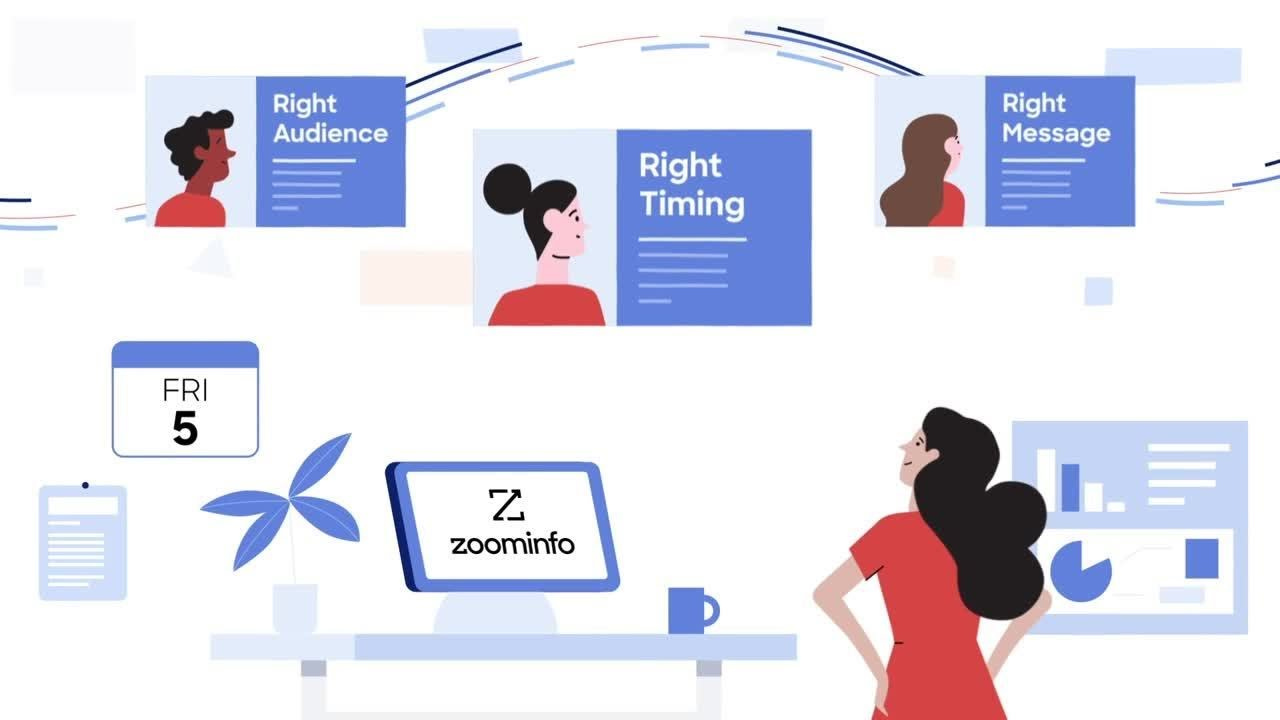
The distinction matters because most teams don't need to choose just one. folk or HubSpot handles relationship management and execution. ZoomInfo provides the intelligence that sharpens that execution.
folk wins on speed and simplicity
folk's appeal is that it removes every barrier between signing up and doing work.
Users report being productive within 20 minutes of setup, without watching tutorials or reading documentation. The interface is intuitive enough that teams can start immediately, organizing contacts, building pipelines, and sending outreach from day one.
The folkX Chrome extension captures contacts from LinkedIn, Gmail, Google Meet, WhatsApp, and other platforms with a single click, pulling in names, titles, emails, and company details without copy-paste.
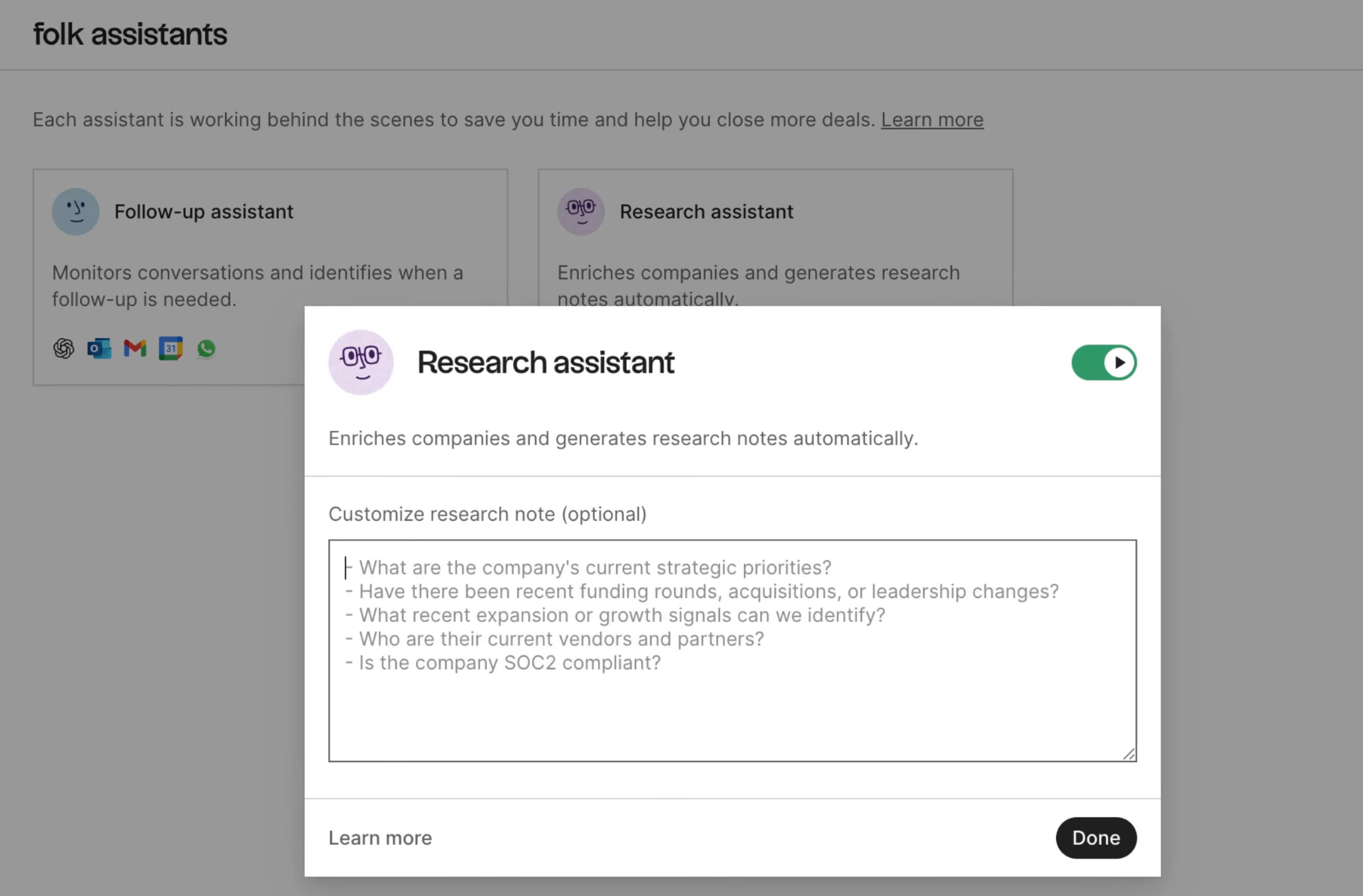
folk's AI Assistants handle the tasks that slow small teams down. The Follow-up Assistant analyzes email and WhatsApp conversations to identify needed replies, then drafts a response in your tone. The Recap Assistant summarizes recent interactions so you walk into every conversation informed. The Research Assistant enriches company profiles automatically using People Data Labs and Perplexity.
Source: folk
This simplicity has limits.
folk doesn't offer marketing automation, customer service tools, or advanced reporting. Its dashboards require the Premium plan, and the analytics it provides focus on pipeline metrics rather than full-funnel attribution. For a 15-person agency tracking clients and partnerships, that's enough. For a 200-person company running multi-channel campaigns, it's not.
HubSpot wins on breadth and scale
HubSpot's advantage is that it keeps expanding to cover whatever your next need is.
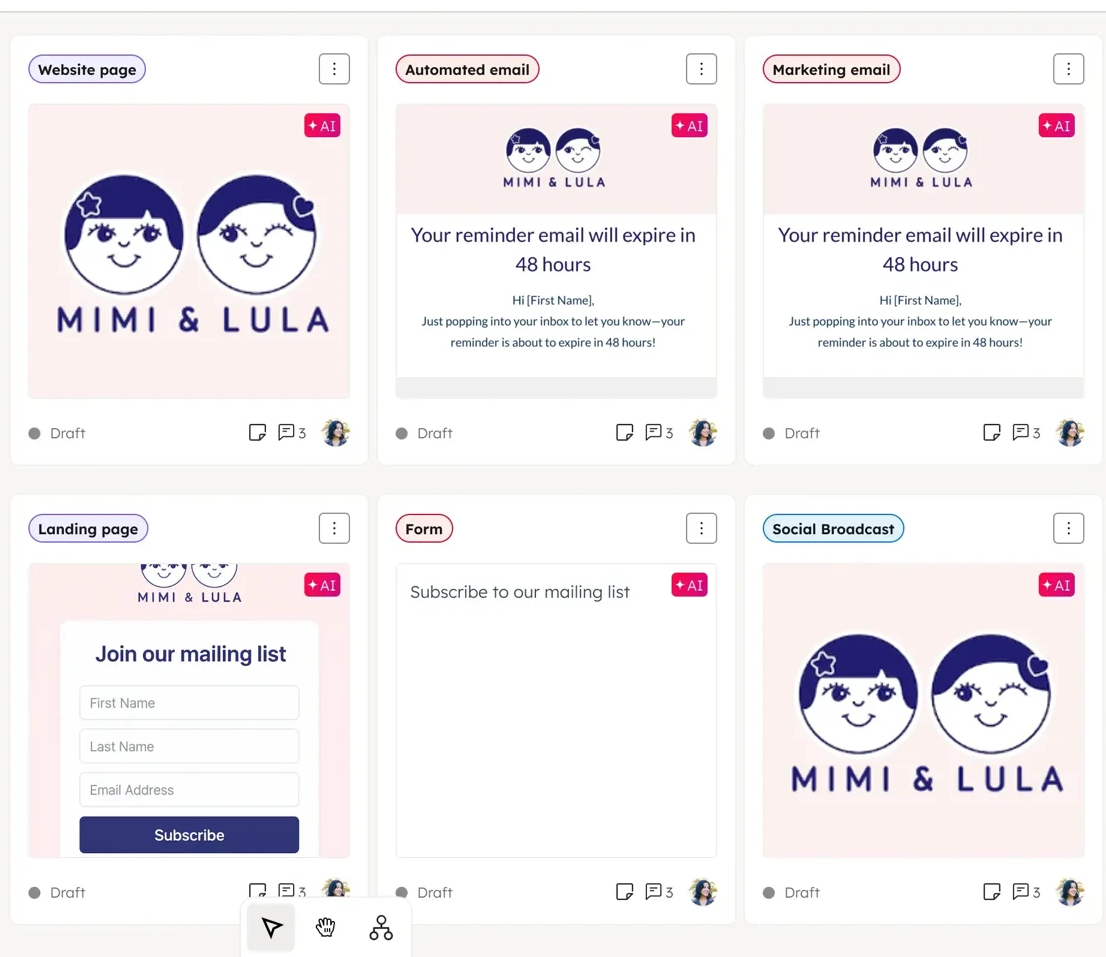
Need marketing automation? Marketing Hub handles email campaigns, landing pages, social scheduling, and multi-touch attribution. Need sales tools? Sales Hub includes sequences, a power dialer, CPQ, and AI-guided selling. Customer support? Service Hub provides ticketing, a knowledge base, and an AI Customer Agent that reportedly resolves over 50% of conversations autonomously. Content? Commerce? Data operations? Each has its own Hub, all sharing one database.
Source: HubSpot
The Breeze AI layer ties it together.
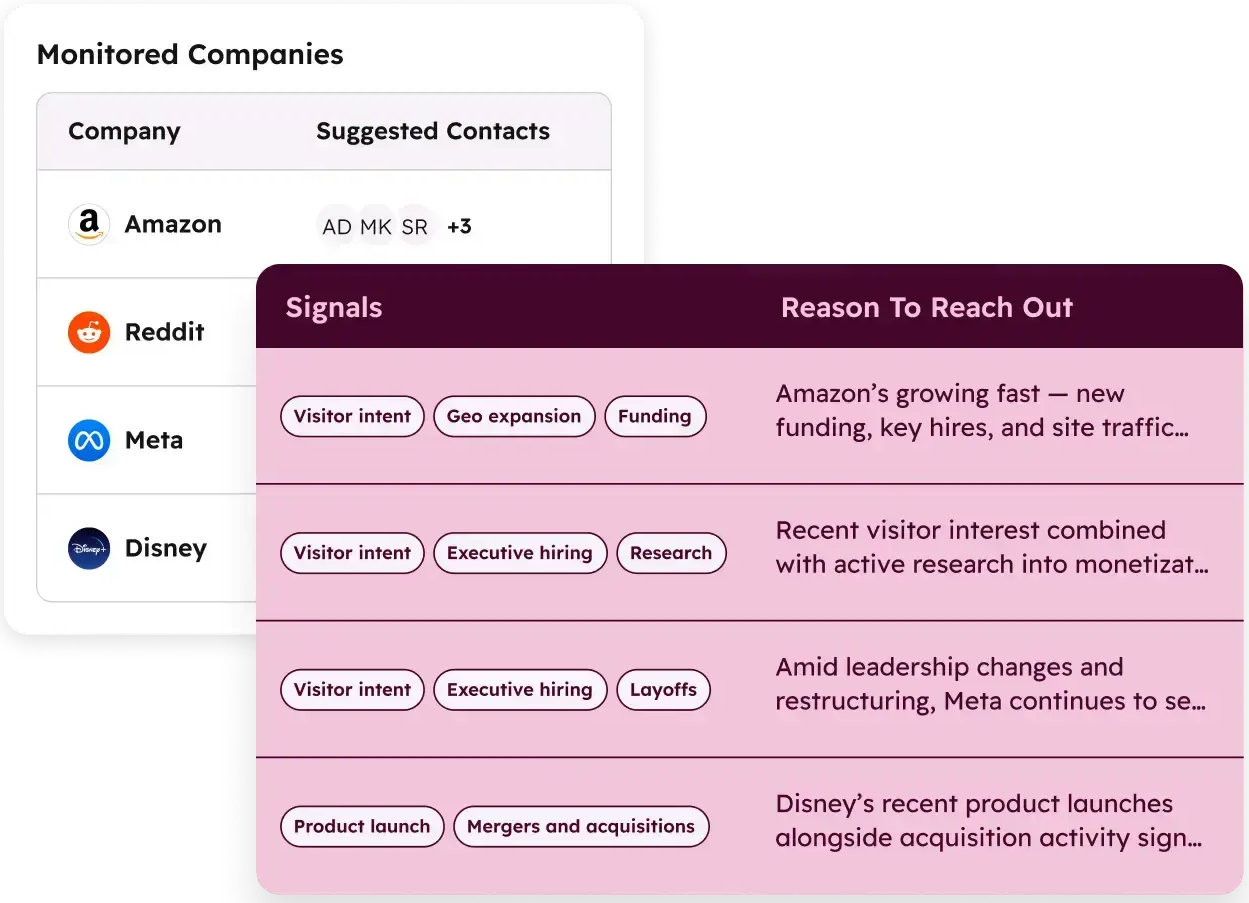
The Prospecting Agent monitors buying signals and drafts personalized outreach using your complete customer history. The Data Agent answers natural-language questions about your CRM data. The Customer Agent handles support inquiries around the clock. These agents draw context from every Hub, so a sales rep's outreach can reference a prospect's marketing engagement and support interactions.
Source: HubSpot
But breadth has a cost.
HubSpot's interface is more complex than folk's. The pricing model requires navigating per-seat charges, per-hub subscriptions, contact tiers for marketing, mandatory onboarding fees ($3,000 for Marketing Hub Professional, $1,500 for Sales Hub Professional), and a rule where all Core Seats are billed at the highest tier's rate if you mix tiers across hubs. A team that starts on HubSpot's free plan can face thousands per month once they need Professional features across departments.
ZoomInfo fills the intelligence gap both CRMs leave open
Neither folk nor HubSpot was built to answer the most expensive question in sales: which accounts should you pursue right now?
folk enriches contacts you've already found using a waterfall of six data providers, with success rates around 50-60%. HubSpot enriches CRM records from conversations and web data, and offers some predictive lead scoring. But neither provides the scale of verified B2B intelligence that ZoomInfo delivers.
For a detailed look at how HubSpot and ZoomInfo compare as standalone platforms, see our HubSpot vs. ZoomInfo comparison.
ZoomInfo's data covers 500M contacts and 100M companies, verified through a multi-source pipeline backed by 300+ human researchers achieving up to 95% accuracy on first-party data. In a Fortune 500 competitive RFP analyzing 25 million contacts across vendors, the independent consultant concluded that "no other competitor came even close."
Source: ZoomInfo
Beyond static contact data, ZoomInfo's Buyer Intent tracks signals from 210 million IP-to-Organization pairings and 6 trillion+ new keyword-to-device pairings sourced monthly. Guided Intent, exclusive to ZoomInfo, identifies the topics historically correlated with your closed-won deals rather than relying on manual keyword selection. Your team learns which accounts are researching problems your product solves before those accounts ever fill out a form.
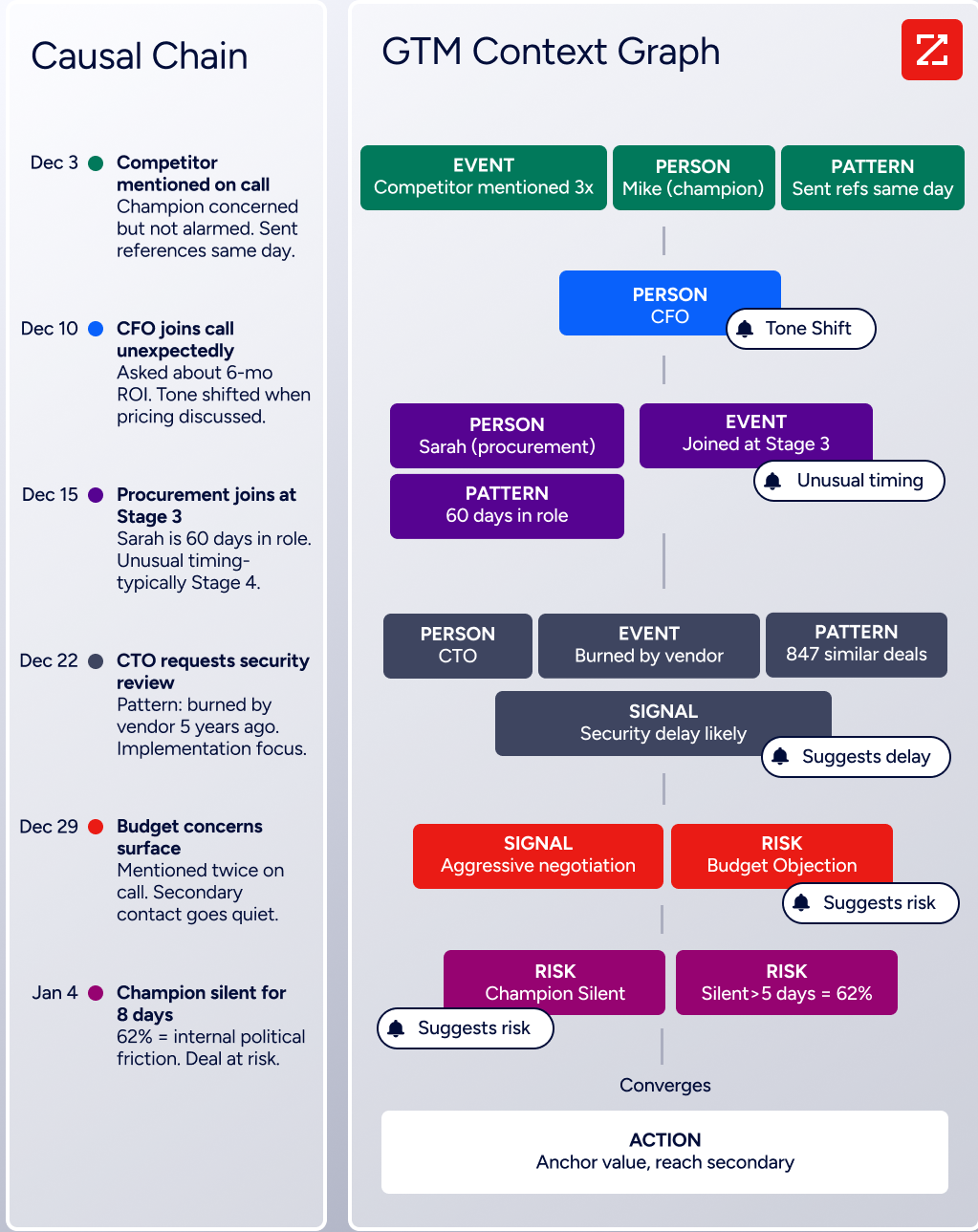
The GTM Context Graph is the intelligence layer that turns this data into action.
It fuses ZoomInfo's third-party data with your CRM records, conversation transcripts from Chorus, and behavioral signals to capture not just what happened in a deal, but why. A CRM records that a deal moved to Stage 4. The GTM Context Graph reveals that the CFO joined the last call, asked about six-month ROI, and that executive sponsorship entering at this stage matches the pattern behind your closed-won deals in this segment.
Source: ZoomInfo
Seismic's sales team attributed 39% of active pipeline to opportunities identified or influenced by ZoomInfo signals, reported 54% productivity gains, and saved 11.5 hours per week per seller. (Seismic case study)
Contact enrichment runs on different engines
All three platforms enrich contact data, but depth and accuracy vary.
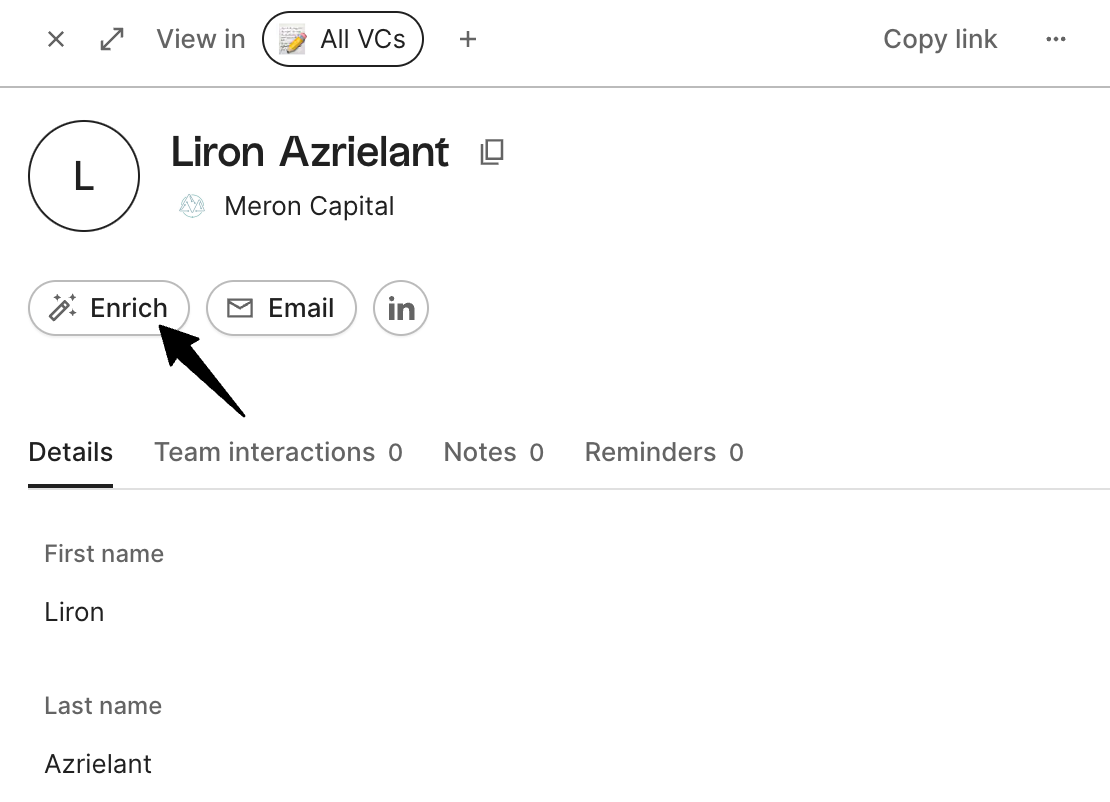
folk uses 1-click waterfall enrichment powered by six providers including Apollo.io, People Data Labs, Clearbit, Datagma, Prospeo, and DropContact.
It finds emails, phone numbers, company names, job titles, and contact URLs. Success rates run 50-60% depending on publicly available data. Standard plan users get 500 enrichment credits per month; Premium users get 1,000. Credits are only consumed when data is found.
Source: folk
HubSpot enriches records through its Smart CRM, pulling information from email threads, recorded calls, company websites, and its own dataset.
Company records re-enrich automatically when properties like employee count or revenue change. It also includes automatic duplicate detection and merging. The enrichment works well for existing contacts but doesn't extend to discovering new prospects outside your database.
ZoomInfo operates on a different scale.
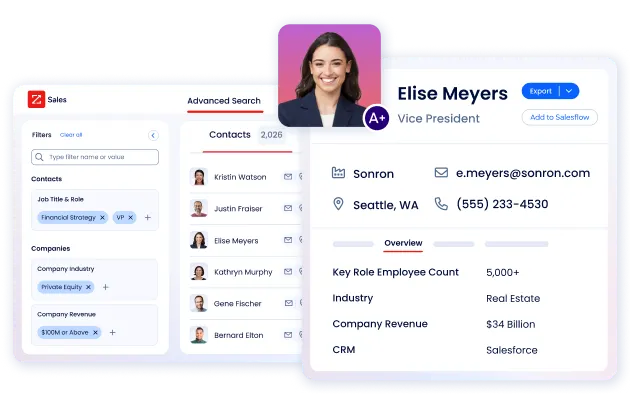
Its enrichment draws from a B2B dataset with 300+ company attributes per record. The platform verifies data through automated ML scanning of 28 million site domains daily, a community of 200,000+ ZoomInfo Lite users who share data back, and 300+ human researchers.
The difference shows most in direct dials: ZoomInfo provides 120M direct-dial phone numbers and 135M+ verified phone numbers, while folk and HubSpot's phone enrichment is limited to what their respective data sources can surface.
Source: ZoomInfo
Vensure's VP of Revenue Operations described the impact: "ZoomInfo gives us the information we need to execute. We don't have to go through and spend our time digging. It's already there, so we can be three steps ahead." (Vensure case study)
Pricing reflects what each platform is built to do
The pricing models reveal three different philosophies.
folk keeps pricing straightforward.
Standard costs $24/seat/month (annual), including unlimited contacts, pipeline management, 2,000 email messages per member per month, 500 enrichment credits, and AI Assistants. Premium costs $48/seat/month and adds email sequences, dashboards, API access, and advanced permissions. A Custom tier starts at $80/seat/month for larger teams needing tailored limits.
There are no onboarding fees, no contact-based billing tiers, and no overage charges, just monthly caps. A 10-person team on Premium pays $480/month. That's it.
HubSpot is harder to predict.
The free CRM includes unlimited contacts and real utility: contact management, deal tracking, email templates, and a meeting scheduler. The Starter Customer Platform bundles all Hubs at $15/seat/month (annual). But Professional and Enterprise tiers, where most scaling companies land, change the math.
Sales Hub Professional costs $90/seat/month (annual) with a $1,500 onboarding fee. Marketing Hub Professional runs $800/month (annual) with a $3,000 onboarding fee and charges for marketing contacts beyond the included 2,000. Adding both Hubs at Professional tier for a 10-person team reaches well over $1,500/month before contact overages. And if you mix tiers across Hubs, all Core Seats get billed at the highest tier's rate.
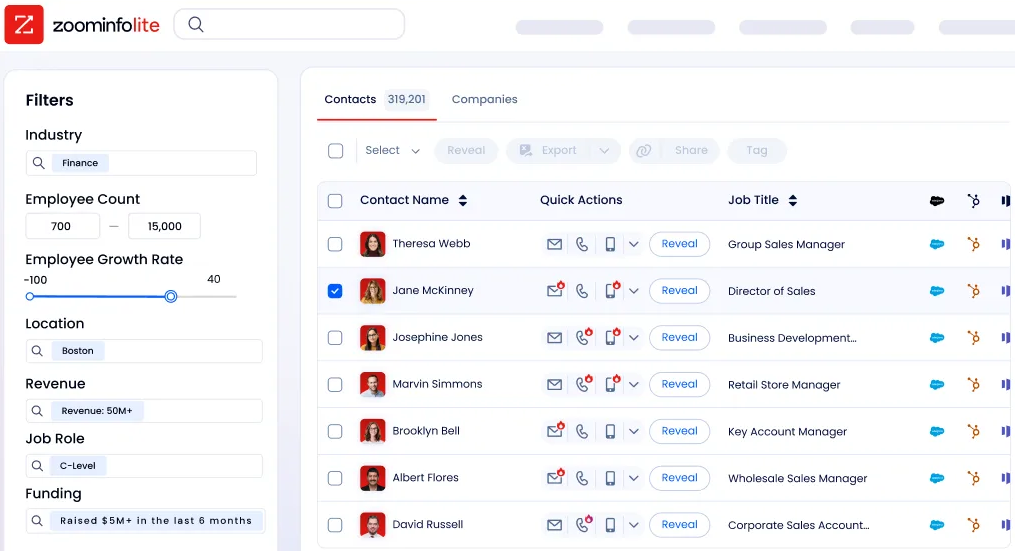
ZoomInfo uses custom-quoted, consumption-based pricing with no published dollar amounts. Pricing scales around seats, data credits (1 credit = 1 export), and feature access.
ZoomInfo is priced for enterprise teams, but offers two free entry points: ZoomInfo Lite (permanent free access with 10 monthly export credits) and a 7-day free trial of core features. The credit system means cost-per-contact depends on your usage volume, and searching or viewing data within the platform doesn't consume credits.
Source: ZoomInfo
For budget-conscious small teams, folk's transparent pricing is the easiest to plan around. For companies that need a full customer platform with a free starting point, HubSpot's Starter tier is accessible. For teams where data quality and buyer intelligence drive revenue, ZoomInfo's investment is measured against pipeline outcomes rather than per-seat costs.
AI capabilities target different workflows
All three platforms lean on AI, but each applies it to different problems.
folk's AI Assistants focus on eliminating CRM busywork.
The Follow-up Assistant uses GPT-5 to analyze conversations and draft contextual follow-ups. The Workflow Assistant creates trigger-based email automations with AI personalization that adapts messages using real interaction history. These assistants operate within folk's CRM data, so their context is limited to what you've already captured.
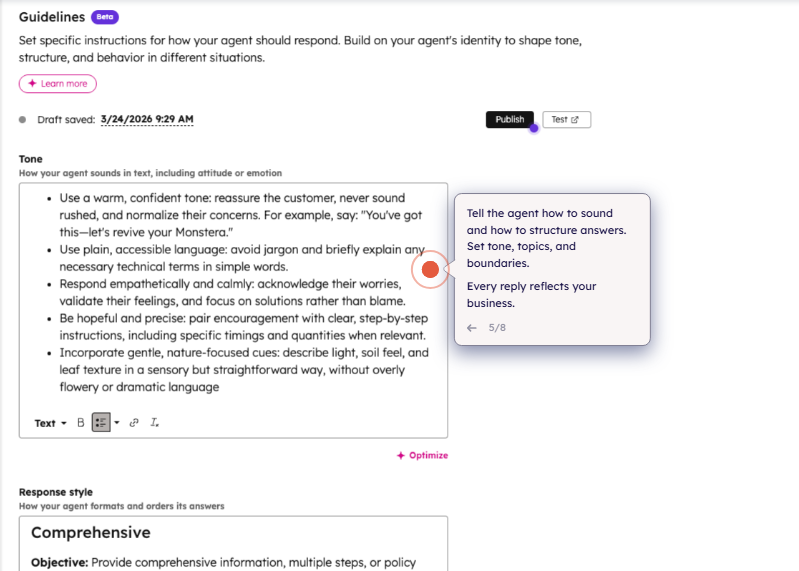
HubSpot's Breeze operates across a wider range.
The Prospecting Agent researches prospects, monitors buying signals like funding rounds and executive hires, and drafts personalized outreach using your complete customer history. The Customer Agent handles support conversations across chat, email, WhatsApp, and phone. The Data Agent answers natural-language questions about your CRM.
Because Breeze draws from all HubSpot Hubs, it has more context than folk's assistants. Some features, including AI-Powered Segmentation and Personalization, remain in Beta.
Source: HubSpot
ZoomInfo's AI is powered by the GTM Context Graph, an intelligence layer that gives it a different foundation.
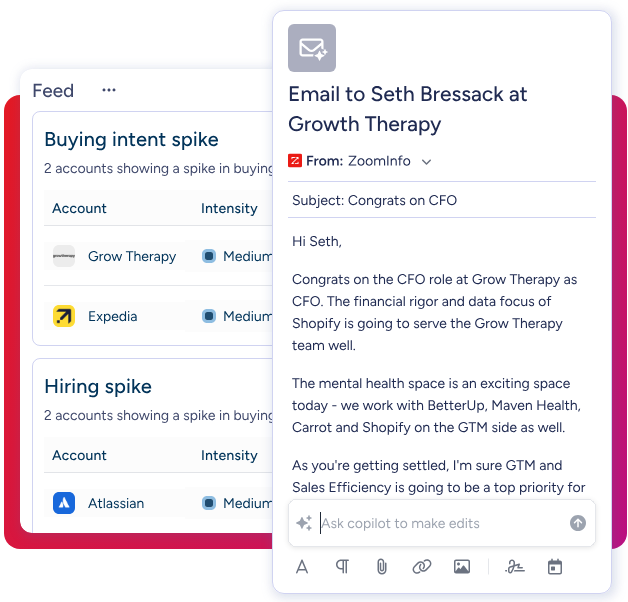
While folk's AI knows your email history and HubSpot's AI knows your platform activity, ZoomInfo's AI works across your internal data and the external B2B landscape at once. In GTM Workspace, AI agents handle account research, outreach drafting, and CRM updates based on signals from across the graph. In GTM Studio, marketers describe audiences in natural language and launch multi-channel plays targeting accounts that match proven win patterns.
GTM Workspace users have reported boosting pipelines by 23% and booking nearly 60% more meetings per week.
Source: ZoomInfo
Redwood Logistics saw a 99% reduction in cost-per-click and 310% increase in clickthrough rate using ZoomInfo's data-driven targeting. Their Senior Director of Digital Strategy noted: "It's not just the data itself. It's more about the right data at the right time to help us reach out with the right message across that full buyer journey." (Redwood Logistics case study)
Integration approaches show different design priorities
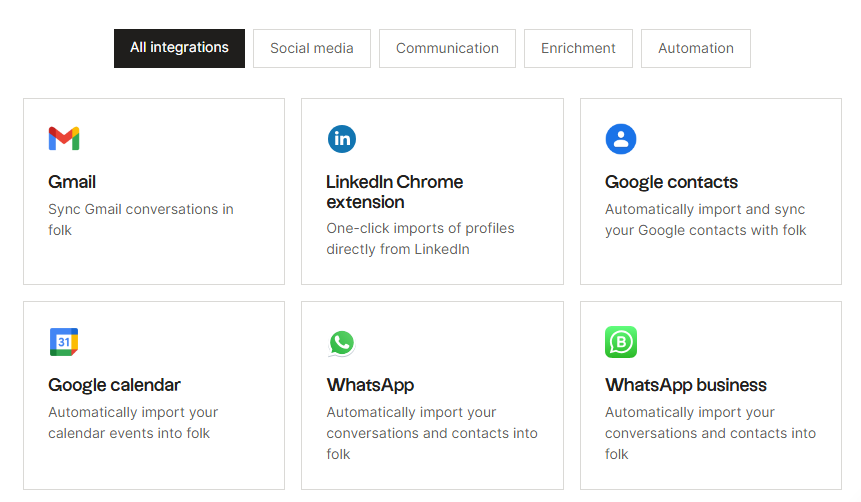
folk connects to 5,000+ tools via Zapier and Make.com, with native integrations for Gmail, Outlook, LinkedIn, and WhatsApp. The folk REST API is available on Premium and Custom plans.
For a small team using common tools, this covers most needs. But native integrations beyond email and LinkedIn are limited. Users who need Salesforce sync, for example, cannot push contacts to Salesforce natively and must rely on manual export/import or third-party connectors.
Source: folk
HubSpot has the broadest integration ecosystem of the three, with over 2,000 apps and 2.5 million active installs in its marketplace. The developer ecosystem includes UI Extensions, custom objects, and a mature REST API.
For teams running Shopify, Salesforce, Slack, or dozens of other common tools, HubSpot likely has a native connector. The Data Hub adds bidirectional sync with 100+ business apps and programmable automation supporting custom JavaScript and Python inside workflows.
ZoomInfo takes a different approach: rather than trying to replace your existing tools, it powers them.
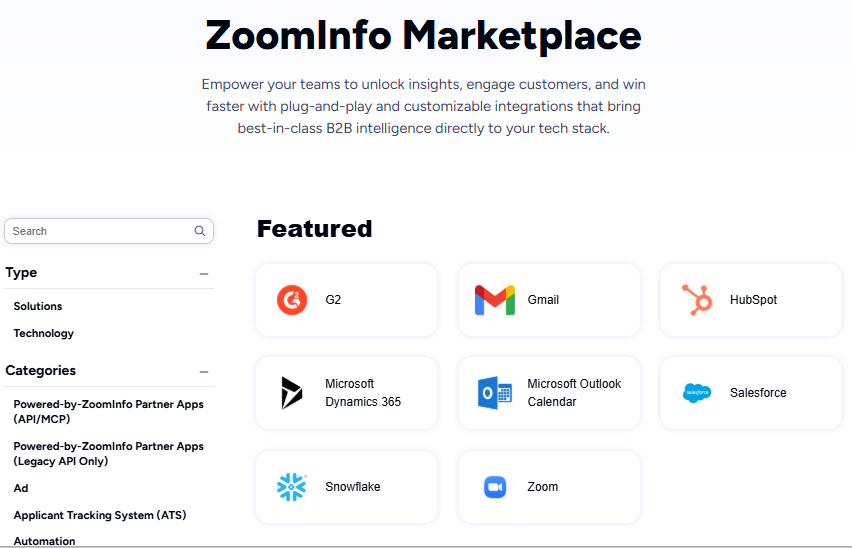
The Enterprise API covers search, enrichment, AI intelligence, marketing audience management, and engagement data across documented endpoints. The ZoomInfo MCP server connects AI models to ZoomInfo's data with no custom coding. API access is included in all relevant plans. The App Marketplace includes native integrations with Salesforce, HubSpot, Microsoft Dynamics 365, Snowflake, and 120+ more.
The design philosophy: ZoomInfo's intelligence should be available wherever work happens, not locked behind a single interface.
Source: ZoomInfo
BDO Canada's Senior Marketing Intelligence Analyst described ZoomInfo's API integration: "The plug-and-play aspect of the API means I can integrate it very easily into any process and get information at a moment's notice." BDO achieved an 87% reduction in time spent on data dashboard updates. (BDO Canada case study)
Security and compliance at different maturity levels
folk holds SOC 2 Type I certification for 2025-2026, is GDPR compliant, and has Google Security certification. Data is hosted on AWS in North Virginia with encrypted storage and MFA enforcement for all team members. For a CRM serving small to mid-size teams, this is solid. folk reports no history of data breaches.
HubSpot offers enterprise-level security: SOC 2 Type II, SOC 3, HIPAA attestation, GDPR, CCPA, and EU Cloud Code of Conduct compliance. Encryption uses AES-256 at rest and TLS 1.2/1.3 in transit.
The platform supports SSO, 2FA, passkeys, IP allowlisting, and an EU Data Center for data residency requirements. Regular third-party penetration testing and a bug bounty program on Bugcrowd round out the security posture.
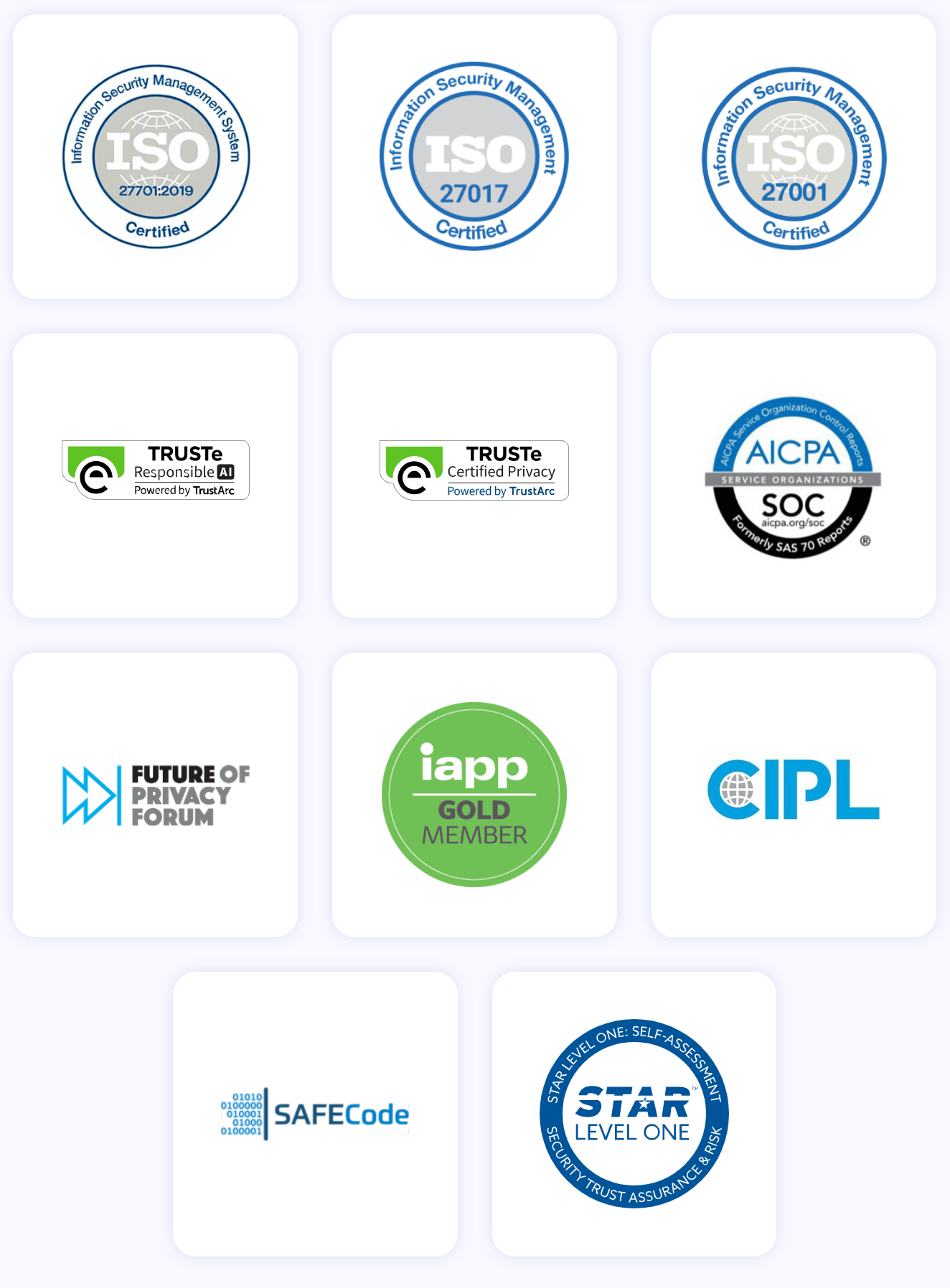
ZoomInfo maintains the broadest compliance stack, all renewed annually: ISO 27001, ISO 27701, SOC 2 Type II, TRUSTe GDPR and CCPA certifications. ZoomInfo is a registered data broker in California and Vermont and maintains a dedicated Trust Center.
For organizations in regulated industries where data provenance and privacy compliance are non-negotiable, ZoomInfo's certification depth matters.
folk vs. HubSpot vs. ZoomInfo: Which should you choose?
The choice depends on what your team needs to grow revenue.
Choose folk if:
Your team is under 50 people and values simplicity above all
You need a CRM for managing relationships across sales, partnerships, recruiting, or community
Getting started in minutes matters more than having every feature
You want unlimited contacts at a predictable per-seat price
LinkedIn is a primary channel for finding and engaging prospects
Choose HubSpot if:
You need marketing automation, sales tools, and customer service in one connected platform
Your company is scaling from startup to mid-market and wants to consolidate tools
You want a free CRM to start with and the ability to add capabilities over time
Multiple departments need to share customer data without integration overhead
You value a large app ecosystem and extensive educational resources
Add ZoomInfo if:
You need verified B2B contact data and direct dials to reach decision-makers
Buyer intent signals and account prioritization would change how your team prospects
You want AI that works across both your internal CRM data and the external market
Data accuracy directly impacts your pipeline, sender reputation, and conversion rates
You want intelligence that works inside your existing CRM, not a replacement for it
Try ZoomInfo free and see how intelligence-driven prospecting changes your pipeline.
The most productive go-to-market teams don't treat CRM and intelligence as either/or. folk or HubSpot handles relationship management and execution. ZoomInfo provides the verified data, intent signals, and contextual AI that tell your team where to focus. Together, they create a system where every outreach is informed by real buying evidence, not guesswork.
folk vs. HubSpot vs. ZoomInfo FAQ
What is the core difference between folk, HubSpot, and ZoomInfo?
folk is a lightweight, relationship-focused CRM designed for small teams that prioritize simplicity and quick setup.
HubSpot is a customer platform combining marketing, sales, service, content, and commerce tools on a shared database.
ZoomInfo is a B2B intelligence platform providing verified contact data, buyer intent signals, and AI-powered prospecting that integrates with both folk and HubSpot to strengthen their effectiveness.
Which platform is cheapest for a small team?
folk offers the most predictable pricing for small teams, starting at $24/seat/month with unlimited contacts and no hidden fees. HubSpot's free CRM provides real utility at no cost, though most growing teams need paid plans that start at $15/seat/month for Starter and escalate to $90+/seat/month for Professional features, plus mandatory onboarding fees.
ZoomInfo uses custom-quoted pricing but offers a permanent free Lite tier with 10 monthly export credits.
Can I use ZoomInfo with folk or HubSpot?
Yes. ZoomInfo is designed to work with your existing CRM rather than replace it. It integrates natively with HubSpot and connects to other tools through its API, MCP server, and Zapier. ZoomInfo's intelligence (verified contacts, intent signals, and deal context) flows into whichever CRM you use, so your team can act on buying signals without leaving their workflow.
Which platform has the best contact data?
ZoomInfo has the largest B2B contact database with 500M contacts, 135M+ verified phone numbers, and 200M+ verified business email addresses, verified by 300+ human researchers with up to 95% accuracy.
HubSpot enriches existing CRM records from conversations and web data but doesn't provide a standalone prospecting database. folk offers built-in enrichment from six providers with 50-60% success rates and up to 1,000 credits per month on its Premium plan.
Which platform is best for marketing automation?
HubSpot is the strongest choice for marketing automation, with Marketing Hub offering email campaigns, landing pages, social scheduling, multi-touch attribution, and AI-powered content creation. ZoomInfo complements this with account-based marketing tools, a native DSP for display advertising, and intent-driven audience targeting. folk does not offer marketing automation.
How do the AI features compare across the three platforms?
folk's AI Assistants handle follow-ups, relationship recaps, company research, and trigger-based email workflows using CRM data. HubSpot's Breeze AI spans the full platform with agents for prospecting, customer support, data queries, and content creation.
ZoomInfo's AI draws on the GTM Context Graph, which combines your CRM data with 500M+ external contacts and buyer intent signals, enabling it to understand why deals move or stall and identify patterns across thousands of similar deals.
Do I need both a CRM and ZoomInfo?
A CRM manages your existing relationships and pipeline. ZoomInfo identifies which new accounts and contacts you should pursue and provides the intelligence to engage them effectively. Most revenue teams benefit from both: the CRM for daily relationship management, and ZoomInfo for the data, signals, and AI that fill the top of the funnel and inform every interaction downstream.
Which platform has stronger security and compliance certifications?
ZoomInfo holds the broadest certification stack: ISO 27001, ISO 27701, SOC 2 Type II, and TRUSTe GDPR and CCPA validations, all renewed annually. HubSpot offers SOC 2 Type II, SOC 3, HIPAA attestation, GDPR, and CCPA compliance with an EU data center option. folk holds SOC 2 Type I certification for 2025-2026 and is GDPR compliant with Google Security certification.
