
If you're searching for "Gong vs ConversationIQ," here's what you should know upfront: these two products serve different markets.
In short, here's what we recommend:
Gong is the leader in conversation intelligence, built for mid-market and enterprise sales teams that want call recording, deal execution, forecasting, and coaching in one platform.
Its Revenue Graph captures customer interactions across calls, emails, and meetings, then uses AI trained on more than three billion customer interactions to surface deal risks, coaching moments, and pipeline predictions.
But Gong's pricing is opaque, its newer modules (Enable, Gong Assistant) are still maturing, and the platform focuses on what happens inside conversations without the B2B data needed for prospecting, intent detection, and account targeting.
ConversationIQ (conversationiq.io) is a consumer AI tool that analyzes digital conversations to help users understand what's being communicated in personal relationships.
It offers emotion detection, communication pattern analysis, and relationship advice from pasted text. The free tier allows 3,000 characters and one analysis per day with no credit card required.
This is not a B2B sales tool. It has no call recording, no CRM integration, no pipeline analytics, and no team features. If you're evaluating tools for a revenue team, ConversationIQ is not in this category.
For revenue teams that want conversation intelligence as part of a go-to-market platform (with B2B data, buyer intent signals, and AI that understands not just what was said on a call but why deals move), there's a broader option.
ZoomInfo is an all-in-one AI GTM platform that includes conversation intelligence through Chorus, alongside B2B data covering 500M contacts, 100M companies, 135M+ verified phone numbers, and 200M+ verified business email addresses.
ZoomInfo's GTM Context Graph fuses conversation transcripts with CRM records, intent signals, and behavioral data to capture not just what happened on a call, but why deals move or stall.
That intelligence is accessible through GTM Workspace for sellers, GTM Studio for marketers and RevOps, or APIs and MCP in any third-party tool. For teams that don't want to stitch together separate conversation intelligence, prospecting data, and engagement platforms, ZoomInfo provides all three in one place.
If you want to see how conversation intelligence fits within a GTM platform, explore ZoomInfo's capabilities with a free trial.
Gong vs. ConversationIQ vs. ZoomInfo at a glance
Gong | ConversationIQ | ZoomInfo | |
|---|---|---|---|
Category | Revenue AI platform | Consumer conversation analysis | All-in-one AI GTM platform |
Target user | Revenue teams (50+ seats) | Individuals (personal relationships) | GTM teams (sales, marketing, RevOps) |
Conversation intelligence | Core product; call recording + AI analysis | Text paste analysis only; no call recording | Chorus: full call recording + AI analysis |
B2B contact data | None native; relies on integrations | None | 500M contacts, 135M+ verified phone numbers |
Buyer intent signals | None native | None | Built-in intent tracking (210M IP-to-Org pairings) |
CRM integration | Salesforce, HubSpot, Dynamics 365 | None | Salesforce, HubSpot, Dynamics 365, and 120+ more |
AI capabilities | Revenue-specific AI (deal prediction, coaching, forecasting) | Emotion detection and relationship advice | GTM Context Graph + AI agents across GTM functions |
Pricing | Custom quotes; per-user + platform fee | Free tier (3,000 chars/day); paid tiers undisclosed | Custom quotes; consumption-based; free Lite tier available |
Security/compliance | SOC 2, ISO 27001, ISO 42001, HIPAA, PCI DSS | No privacy policy published | ISO 27001, ISO 27701, SOC 2 Type II, GDPR, CCPA |
Analyst recognition | Gartner MQ Leader (RAO), Forrester Leader | None | Gartner MQ Leader (ABM), Forrester Leader (Intent Data) |
ConversationIQ is not what you think it is
The name "ConversationIQ" suggests enterprise conversation intelligence. The product is something else.
ConversationIQ is a web application where users paste snippets of personal text conversations (up to 3,000 characters) and receive AI analysis in three areas: communication patterns, hidden emotions, and relationship advice.
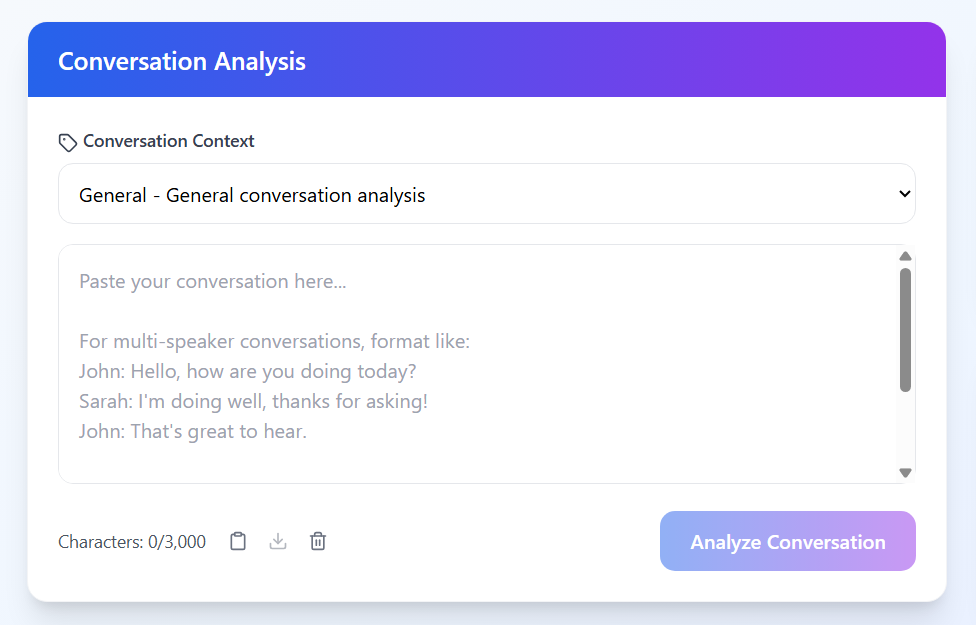
The homepage describes helping users "spot emotions that words alone don't reveal" and "improve your relationships."
The domain was registered in August 2025. The public-facing product is a single-page site with no pricing page, no team page, no blog, no documentation, and no privacy policy. No reviews exist on G2, Capterra, or TrustRadius. There is no CRM integration, no call recording, no team features, and no API.
If you're a revenue leader evaluating conversation intelligence for your sales organization, ConversationIQ is not relevant. It's built for individuals analyzing personal text messages, not for teams analyzing sales calls and pipeline activity.
The rest of this article focuses on the comparison that matters for B2B revenue teams: Gong's conversation-first approach versus ZoomInfo's GTM intelligence approach.
Gong leads in conversation-native revenue intelligence
Gong built its reputation by solving a specific problem: revenue leaders had no data explaining why deals won or lost. Reps reported what they chose to report. Managers coached from memory. Forecasts relied on gut feeling.
Gong's answer was to record every customer interaction and apply AI to extract what actually happened.
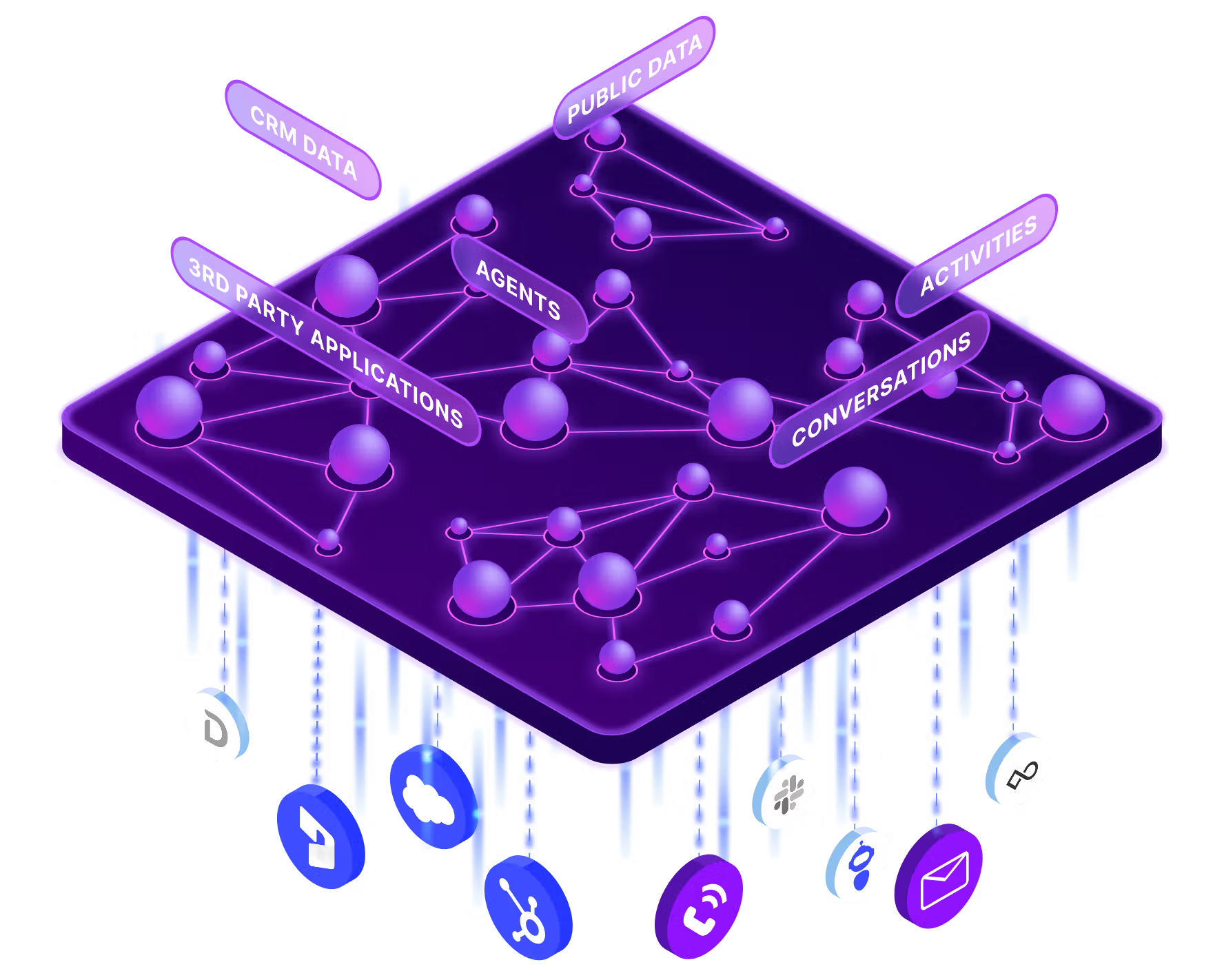
That foundation (the Gong Revenue Graph) now captures every customer interaction, including voice calls, web conferences, emails, and SMS, then maps each to the correct accounts, contacts, and deals without manual data entry.
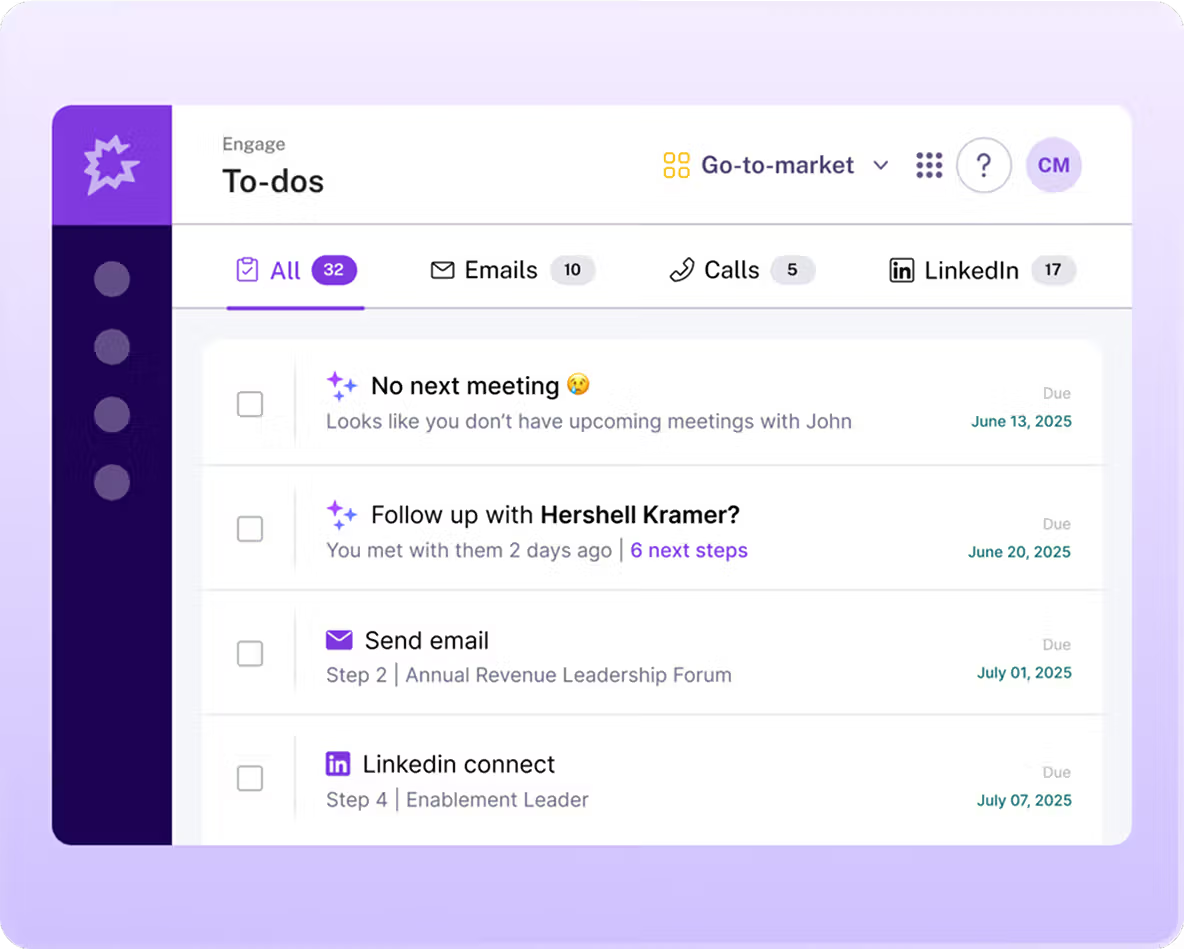
The platform has expanded well beyond call recording. Gong Engage handles multi-channel outreach with AI-drafted emails that draw on actual conversation context.
Source: Gong
Gong Forecast uses 300+ signals from customer conversations to predict outcomes 20% more precisely than CRM-only algorithms.
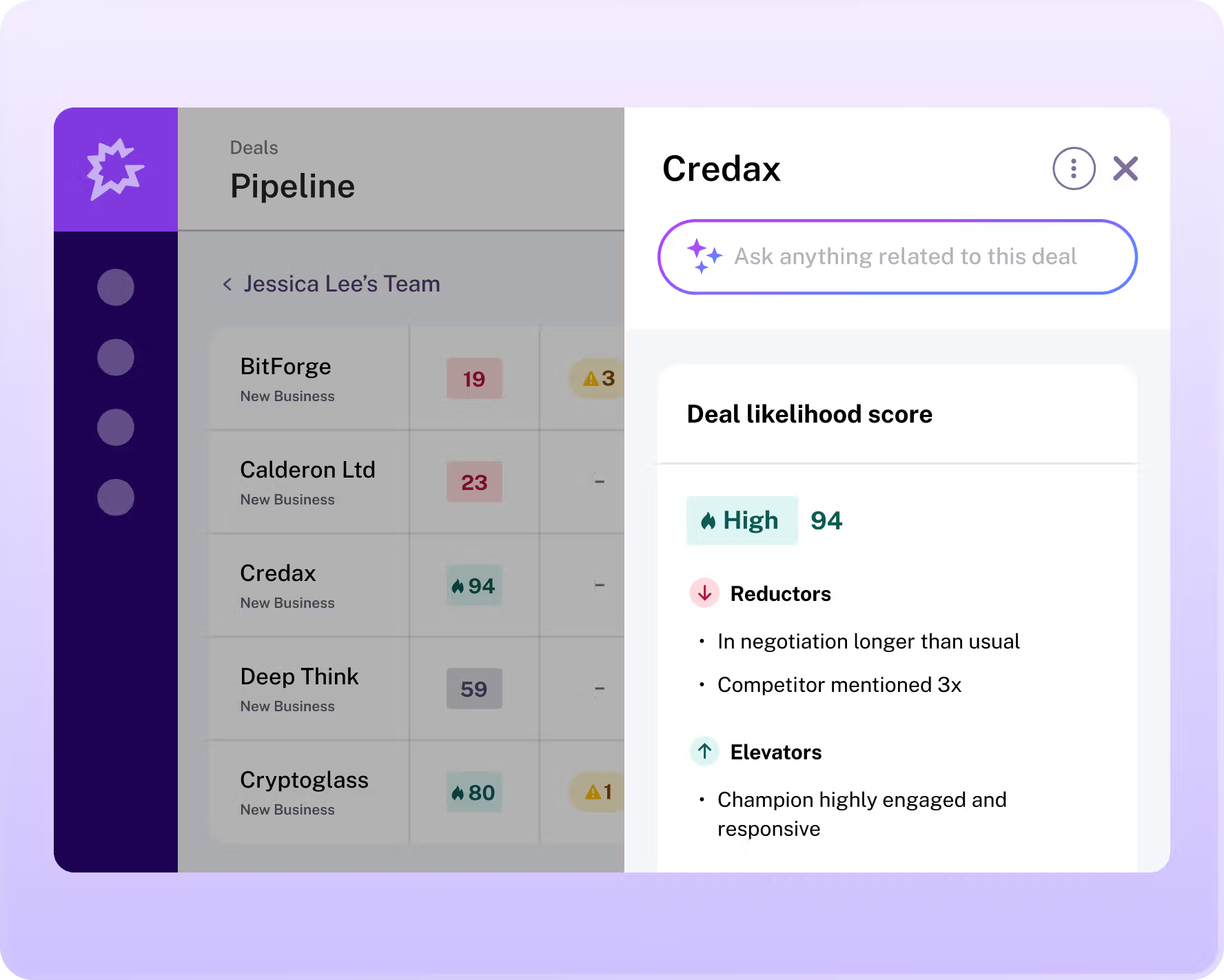
Source: Gong
Gong Enable uses real call data to build coaching scorecards and AI training simulations.
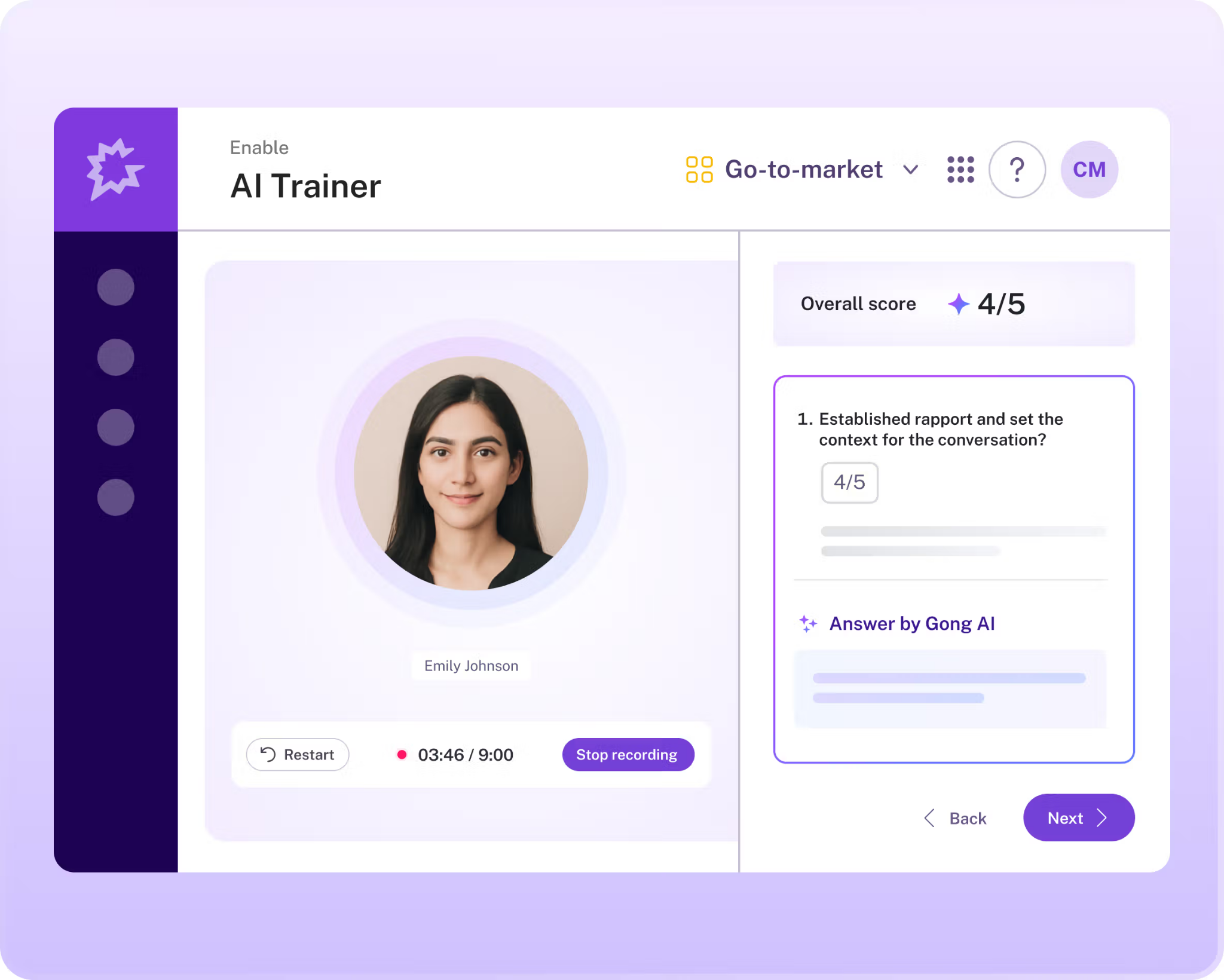
Source: Gong
A suite of 15+ AI agents, included with Gong licenses at no extra cost, automates tasks from deal scoring to CRM field extraction.
This is where Gong excels: taking the raw reality of customer conversations and turning it into intelligence that improves execution. For organizations with 50+ revenue team members who need visibility into what's happening on calls, Gong delivers.
Gong's blind spot: it starts after the conversation happens
Gong works well once a conversation exists. But getting to that conversation (knowing who to call, when to engage, and why a particular account matters right now) requires data Gong doesn't have.
Gong has no native B2B contact database. No verified phone numbers. No buyer intent signals. No technographic data. No company attributes beyond what reps enter into the CRM.
The platform depends on other tools (CRM, sales engagement platforms, data providers) to generate the pipeline that Gong then analyzes.
This creates a structural gap. Gong can tell you a deal is at risk because the champion went silent. It can't tell you that three new VPs were hired at the account last month, that the company is researching your competitor's product category, or that the CFO who joined the last call sits on the board of another target account. That intelligence requires a different data foundation.
Gong addresses this partially through its 300+ integration partners and its MCP support for external AI agents. But integrations add complexity, cost, and data lag. The intelligence lives in separate systems, and stitching it together takes engineering effort.
ZoomInfo provides the full context behind every conversation
ZoomInfo approaches the problem from the opposite direction. Instead of starting with conversations and working outward, ZoomInfo starts with its B2B dataset and works inward toward every touchpoint.
The foundation: 500M contacts, 100M companies, 135M+ verified phone numbers, 120M direct-dial phone numbers, and 200M+ verified business email addresses, maintained by 300+ human researchers and reaching up to 95% accuracy on first-party data.
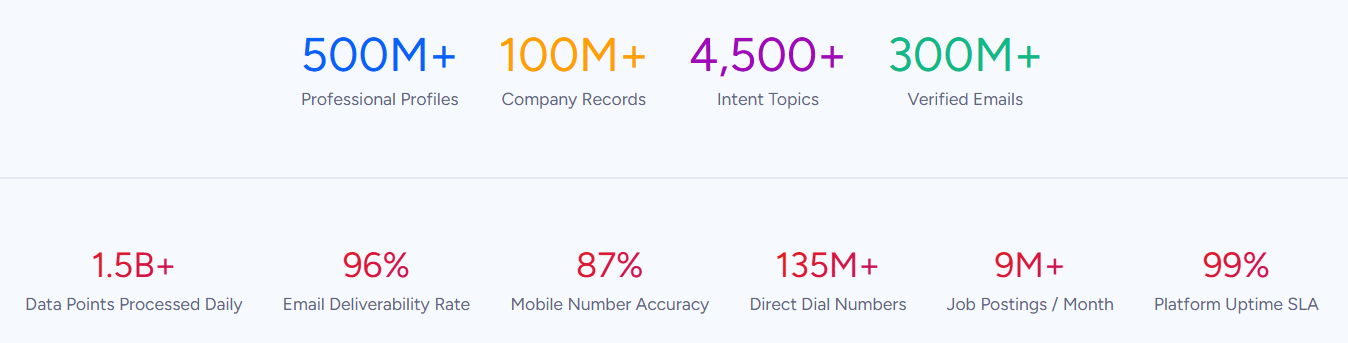
Source: ZoomInfo
In a Fortune 500 competitive RFP analyzing 25 million contacts across vendors, the independent consultant concluded that "no other competitor came even close."
On top of that data, ZoomInfo built the GTM Context Graph, which processes 1.5B+ data points daily. It fuses ZoomInfo's B2B intelligence with a customer's CRM records, conversation transcripts (via Chorus), email threads, and behavioral signals into one layer that captures why outcomes happened, not just that they happened.
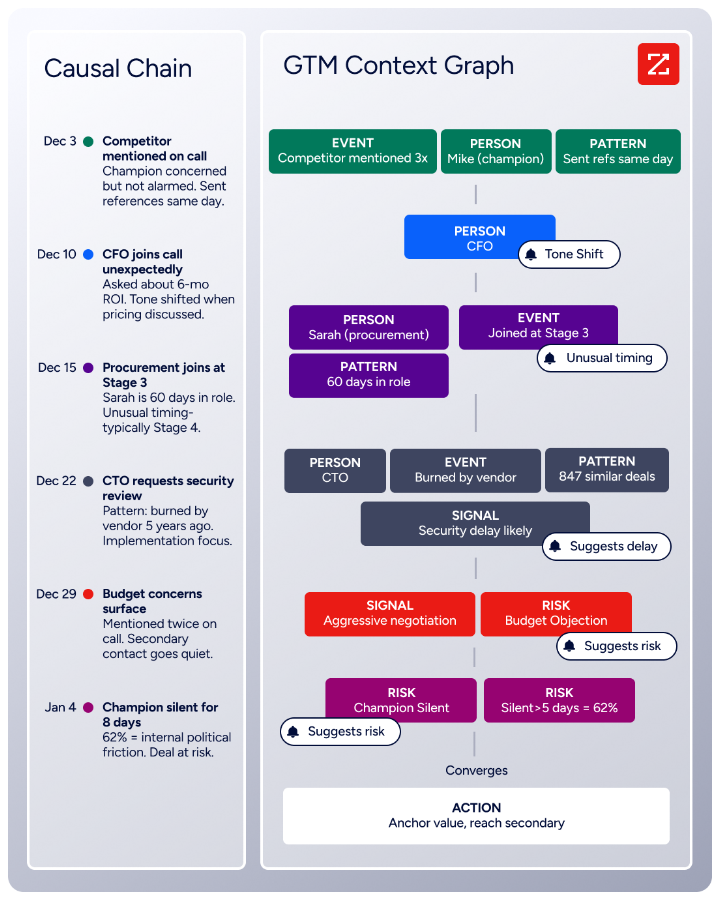
Source: ZoomInfo
As ZoomInfo CPO Dominik Facher writes: "The CRM recorded the state change. It has no record of why it happened."
The GTM Context Graph connects the CFO's ROI question on the last call to the executive sponsorship pattern behind closed-won deals in your segment, then links that to third-party signals showing the company is hiring and researching your competitor. That reasoning flows into follow-up emails, play targeting, and forecast weighting.
Seismic's sales team attributed 39% of active pipeline to opportunities identified or influenced by ZoomInfo signals, reported 54% productivity gains, and saved 11.5 hours per week per seller. (Seismic case study)
Conversation intelligence: Gong's depth vs. ZoomInfo's breadth
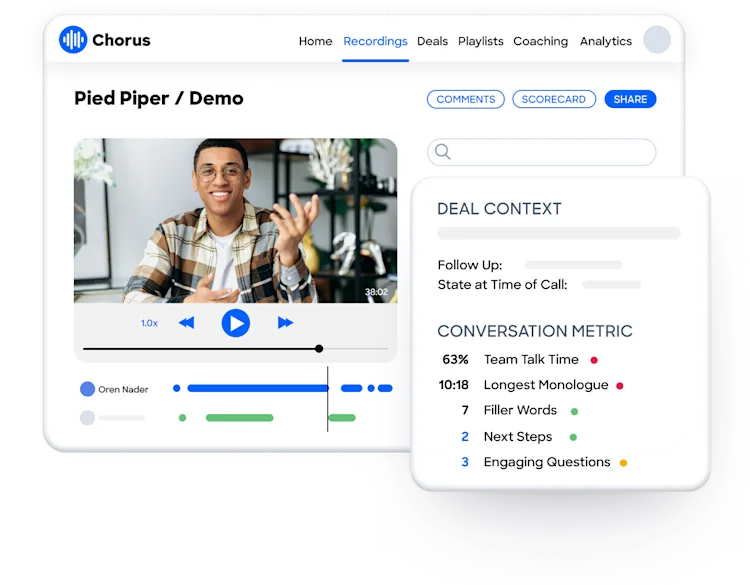
Both Gong and ZoomInfo (via Chorus) record, transcribe, and analyze sales calls. The difference is what each platform does with that intelligence.
Gong's approach: Conversation data feeds AI trained on more than three billion customer interactions. The AI detects deal risks, coaching opportunities, competitive mentions, and forecasting signals. Everything starts and ends with the conversation. Gong has the most specialization in this domain.
ZoomInfo's approach: Chorus, backed by 14 technology patents, provides conversation intelligence (recording, transcription, AI analysis, coaching scorecards, deal intelligence) as one layer within the GTM Context Graph.
Source: ZoomInfo
The same call transcript that reveals a champion's objection automatically connects to ZoomInfo's data showing that company's intent signals spiked last week, three new decision-makers joined the buying committee, and similar accounts in your pipeline closed 40% faster when executive sponsorship appeared at this stage.
The practical difference: Gong tells you what happened on the call. ZoomInfo tells you what happened on the call, why it matters given everything else happening at that account, and what to do next based on patterns across thousands of similar deals.
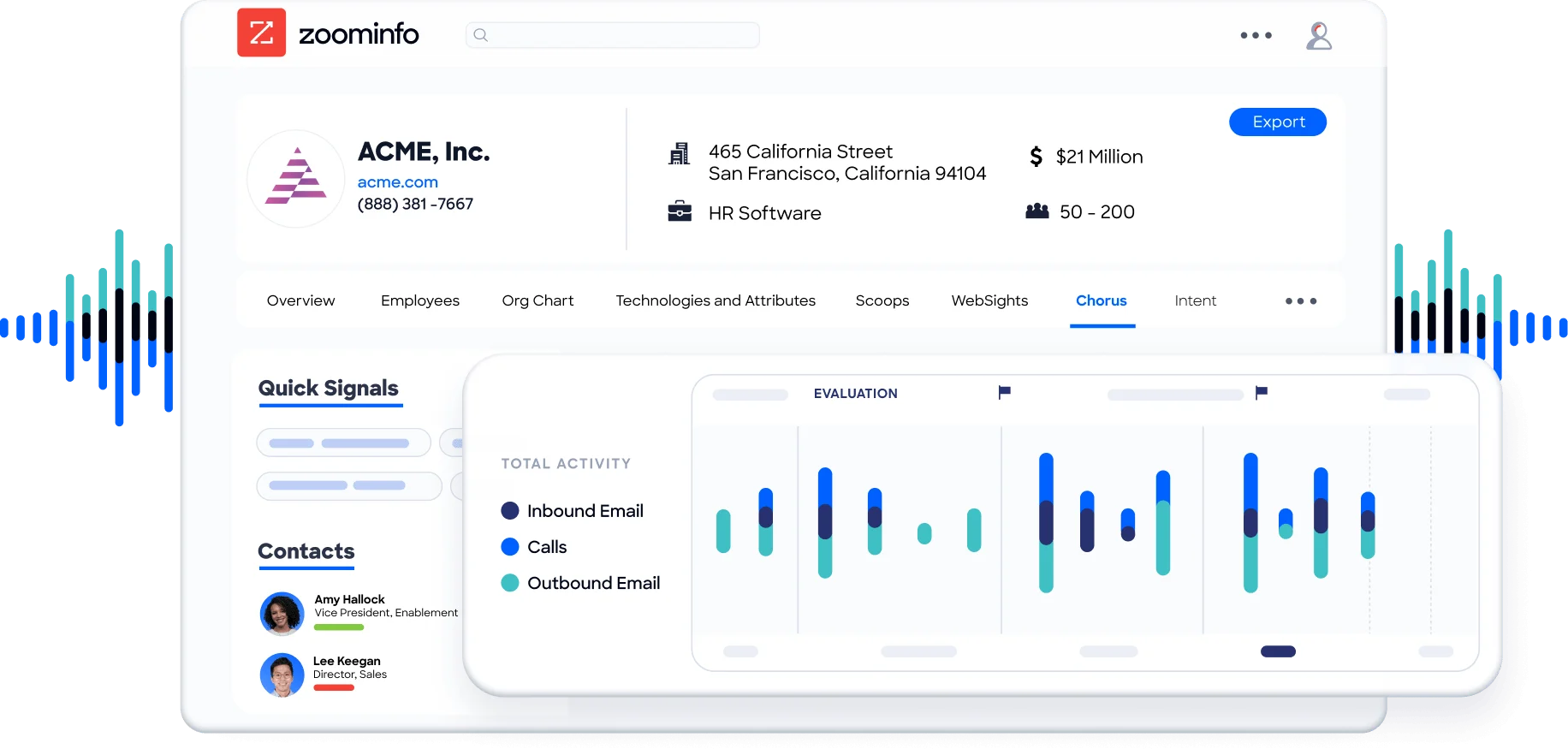
Chorus's Connected Intelligence surfaces ZoomInfo's company profile and relationship history for every call participant. A manager reviewing a call sees not just the transcript, but verified contact details, company insights, org chart context, and relevant signals for everyone on the line.
Source: ZoomInfo
For a side-by-side look at how Gong and ZoomInfo stack up as platforms, see our Gong vs. ZoomInfo comparison.
Where each platform delivers the most value
Gong for revenue process optimization. If your primary challenge is understanding and improving what happens during sales conversations, Gong is built for this.
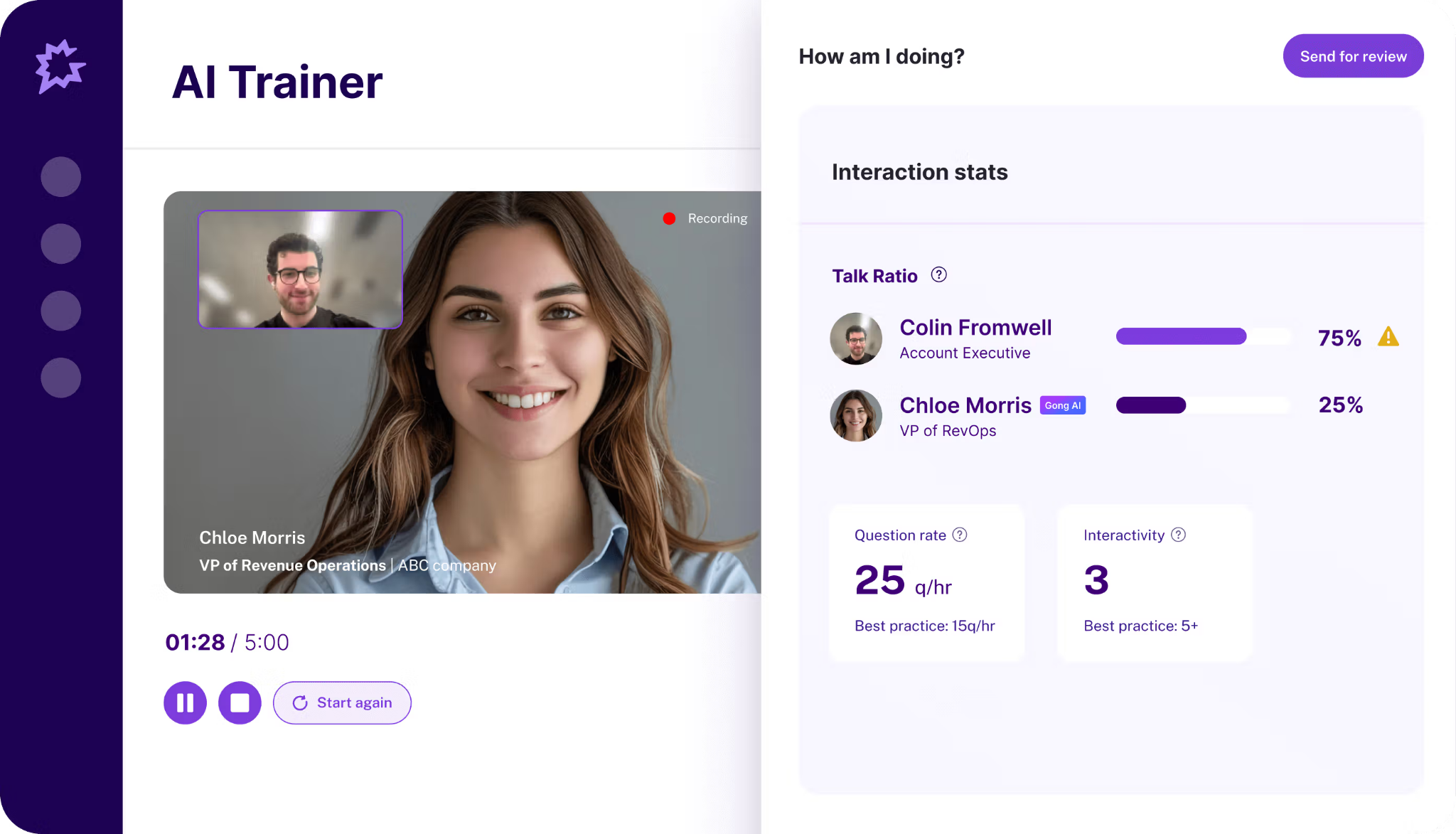
The AI Call Reviewer evaluates rep performance using configurable scorecards. The AI Trainer creates realistic role-play scenarios from real conversations.
Source: Gong
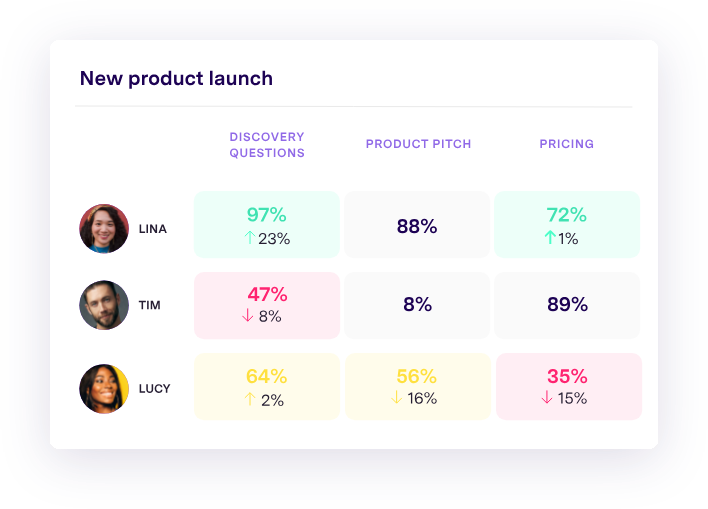
Smart Trackers detect whether reps are adopting new messaging or methodology.
Source: Gong
ZoomInfo for combined go-to-market execution. If your challenge extends beyond conversation analysis into prospecting, account targeting, intent monitoring, and multi-channel orchestration, ZoomInfo provides the infrastructure.
GTM Workspace gives sellers one place where prioritized accounts, AI-drafted outreach, and deal execution converge.
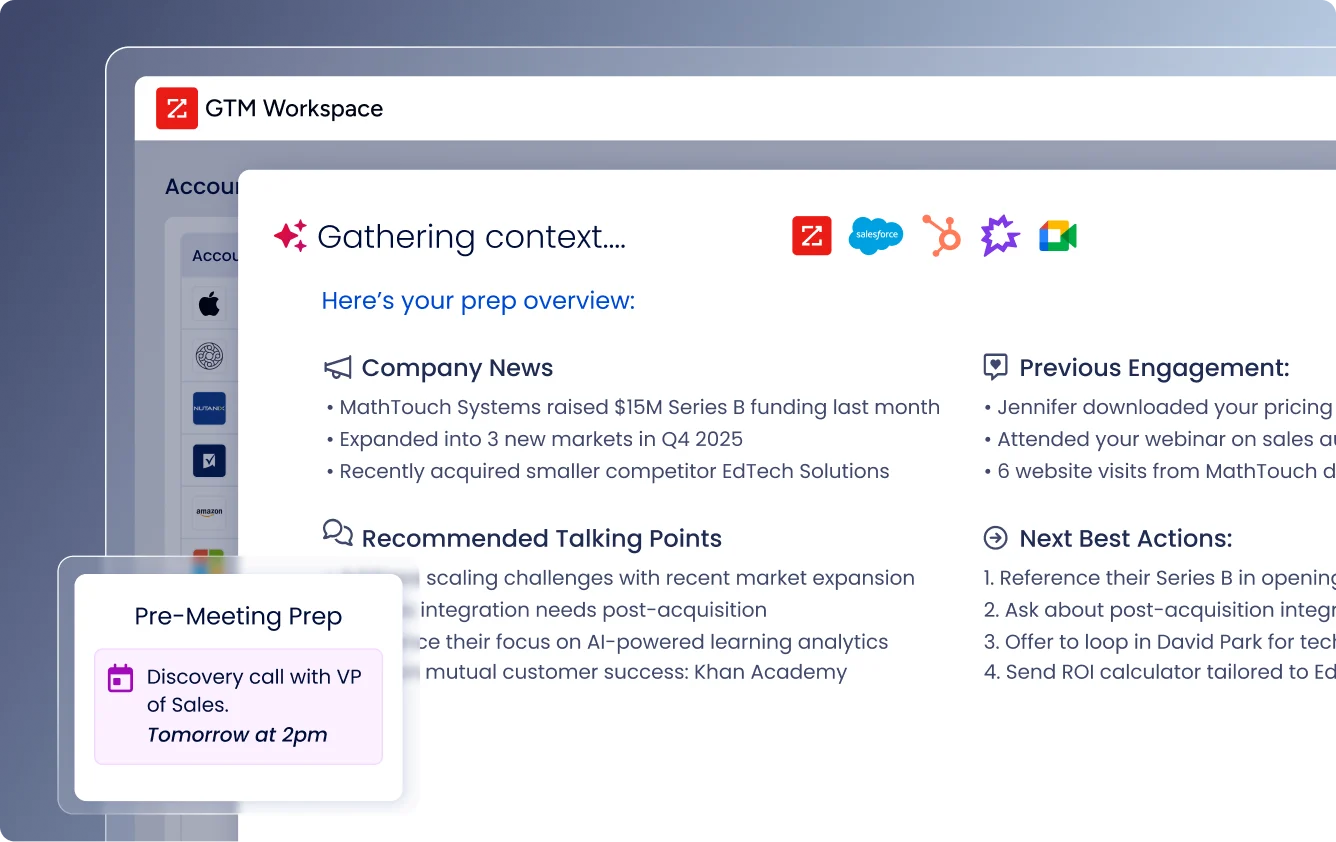
Source: ZoomInfo
GTM Studio lets marketers and RevOps build audiences in natural language and launch multi-channel plays.
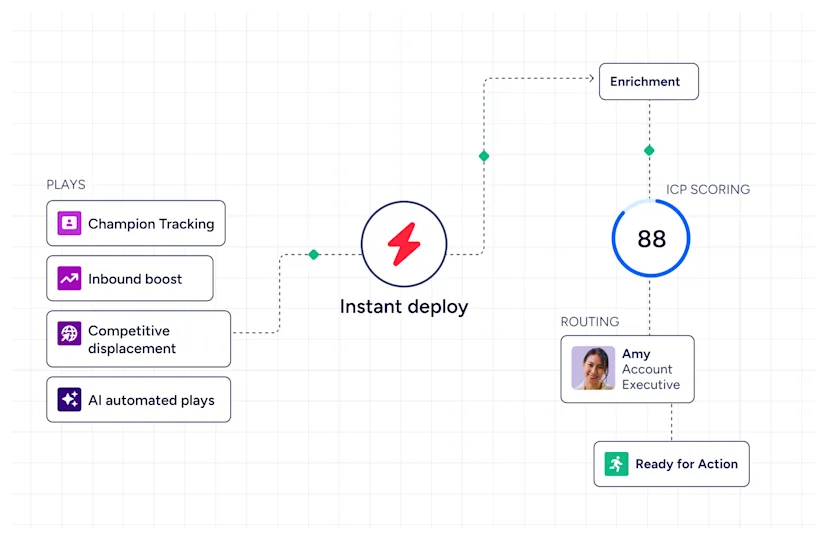
Source: ZoomInfo
The Enterprise API and MCP deliver the same intelligence into any third-party tool or AI agent.
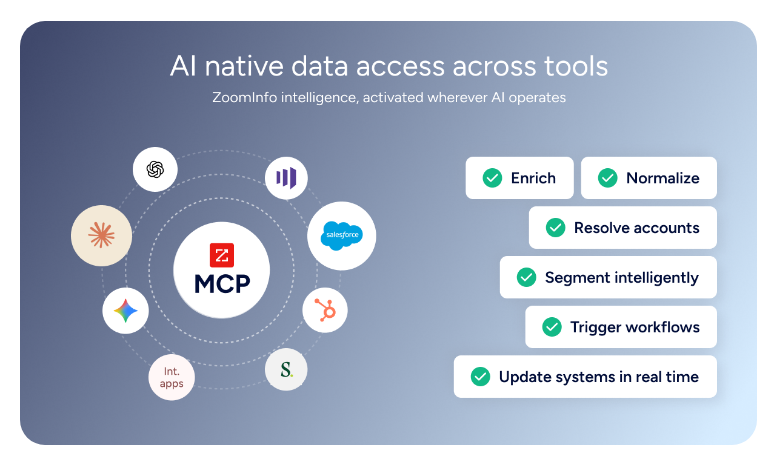
Source: ZoomInfo
"Anything that minimizes our team's need to switch contexts is beneficial. ZoomInfo offers a unified view, eliminating the need to navigate between systems," said Ben Perceval, RevOps Manager at Spekit. (Spekit case study)
Pricing comparison
Gong uses custom-quoted pricing with no published prices. Three factors determine cost: per-user licenses, a platform fee based on user count, and tech stack integrations (included free).
Customers buy a Gong Foundation license and add applications (Engage, Forecast, Enable) separately. All fees are non-cancelable and non-refundable. Subscriptions auto-renew annually with 60 days' notice required to cancel. Gong offers no self-serve free plan; access begins with a demo request.
For a detailed breakdown of what Gong's plans cost and how they're structured, see our Gong Pricing guide.
ConversationIQ offers a free tier with 3,000 characters and one analysis per day. No paid tier pricing is publicly available.
ZoomInfo uses consumption-based pricing with custom quotes. Unlike Gong, ZoomInfo provides two free entry points: ZoomInfo Lite (a permanent free tier with 10 monthly export credits, access to the B2B database, Chrome extension, and website visitor identification) and a 7-day free trial with broader feature access.
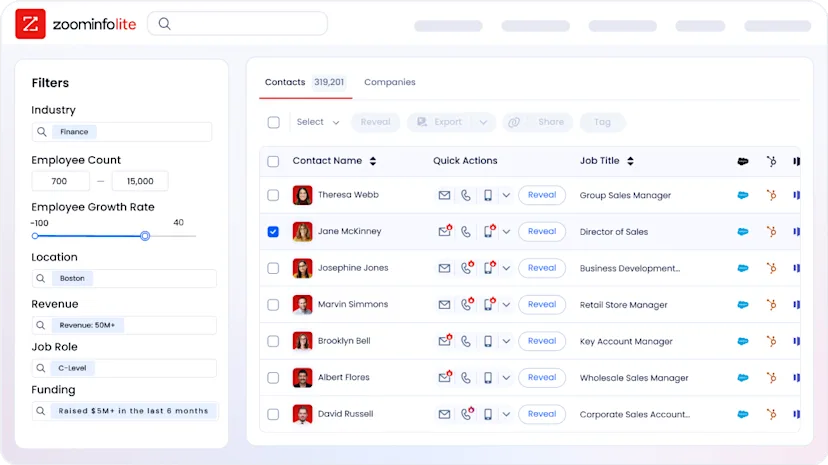
Source: ZoomInfo
Paid plans split into Sales (Professional, Advanced, Enterprise) and Marketing (Marketing Demand, ABM Lite, ABM Enterprise) tiers with distinct capabilities at each level.
Both Gong and ZoomInfo require sales engagement for pricing. The key economic difference: Gong charges for conversation intelligence and related applications. ZoomInfo charges for a platform that includes conversation intelligence, B2B data, intent signals, marketing automation, and AI execution. Teams that would otherwise buy Gong plus a data provider, an intent platform, and a sales engagement tool may find the consolidated cost more favorable.
Security and enterprise readiness
Both Gong and ZoomInfo meet enterprise security requirements. The contrast with ConversationIQ is stark.
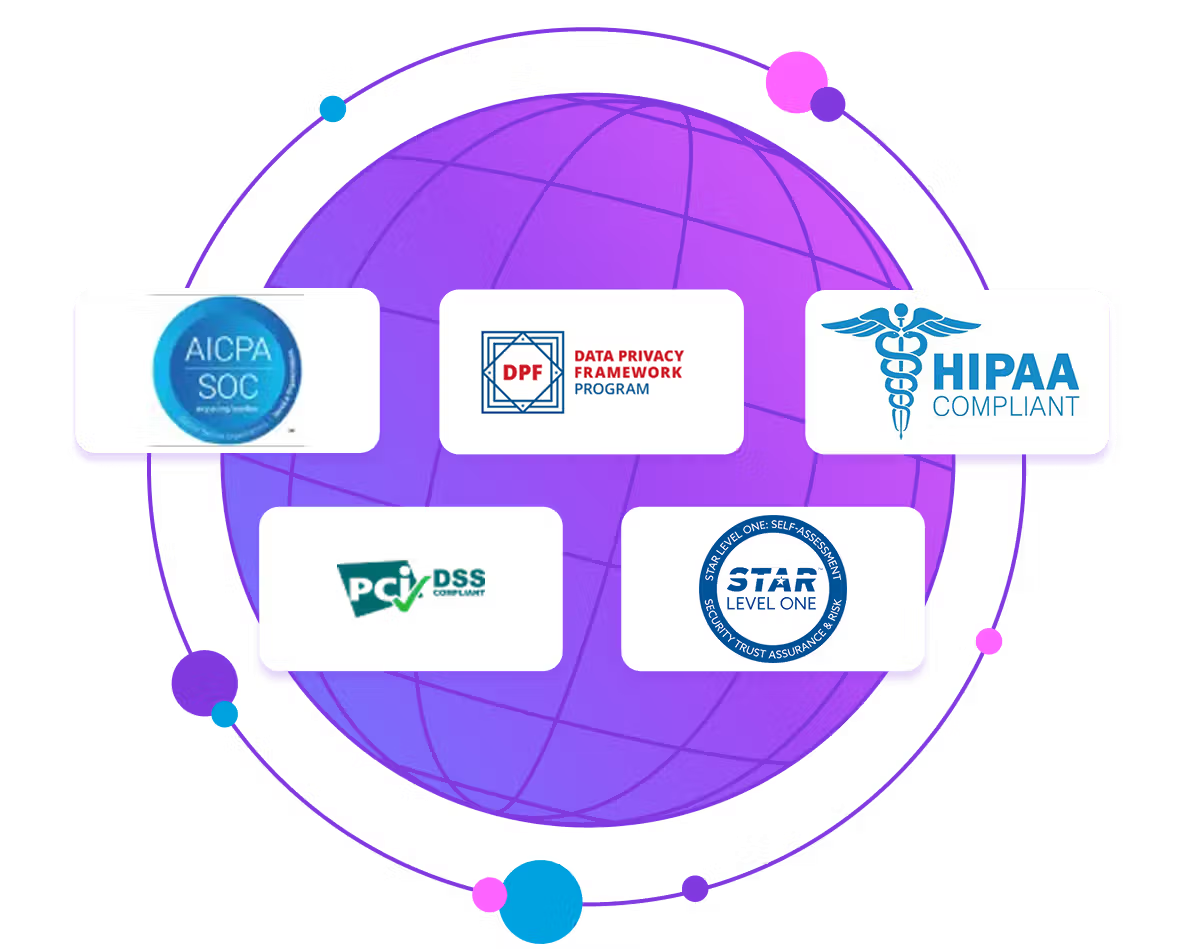
Gong holds SOC 2 Type II, ISO/IEC 42001:2023 (AI Management), ISO/IEC 27001:2022, ISO/IEC 27017, ISO/IEC 27018, ISO/IEC 27701, PCI DSS SAQ-D, HIPAA support, CSA STAR, and EU-U.S. Data Privacy Framework certification.
Source: Gong
Gong commits that customer data is never used to train generative models and delivers over 99.5% uptime. Infrastructure runs on AWS with BYOK encryption available.
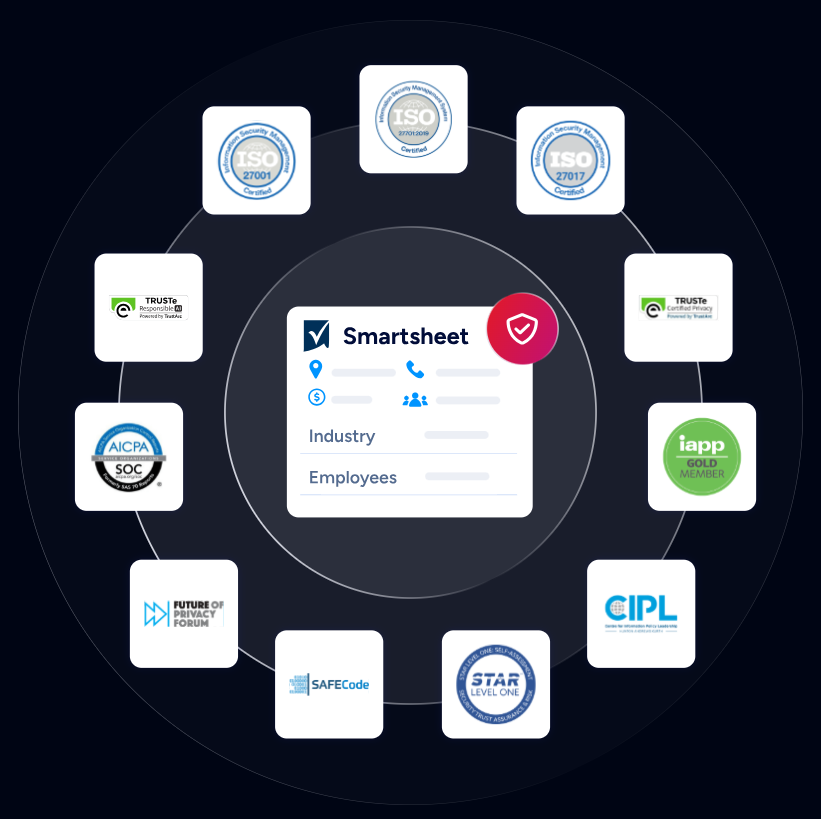
ZoomInfo maintains ISO 27001, ISO 27701, SOC 2 Type II, TRUSTe GDPR, and TRUSTe CCPA certifications, all renewed annually. ZoomInfo is a registered data broker in California and Vermont. A dedicated Trust Center provides certification details.
Source: ZoomInfo
ConversationIQ publishes no privacy policy, terms of service, or security documentation. For a tool that processes personal conversation data, this is a significant gap. Users considering pasting sensitive communications have no basis to evaluate how their data is handled, stored, or retained.
Integration ecosystems
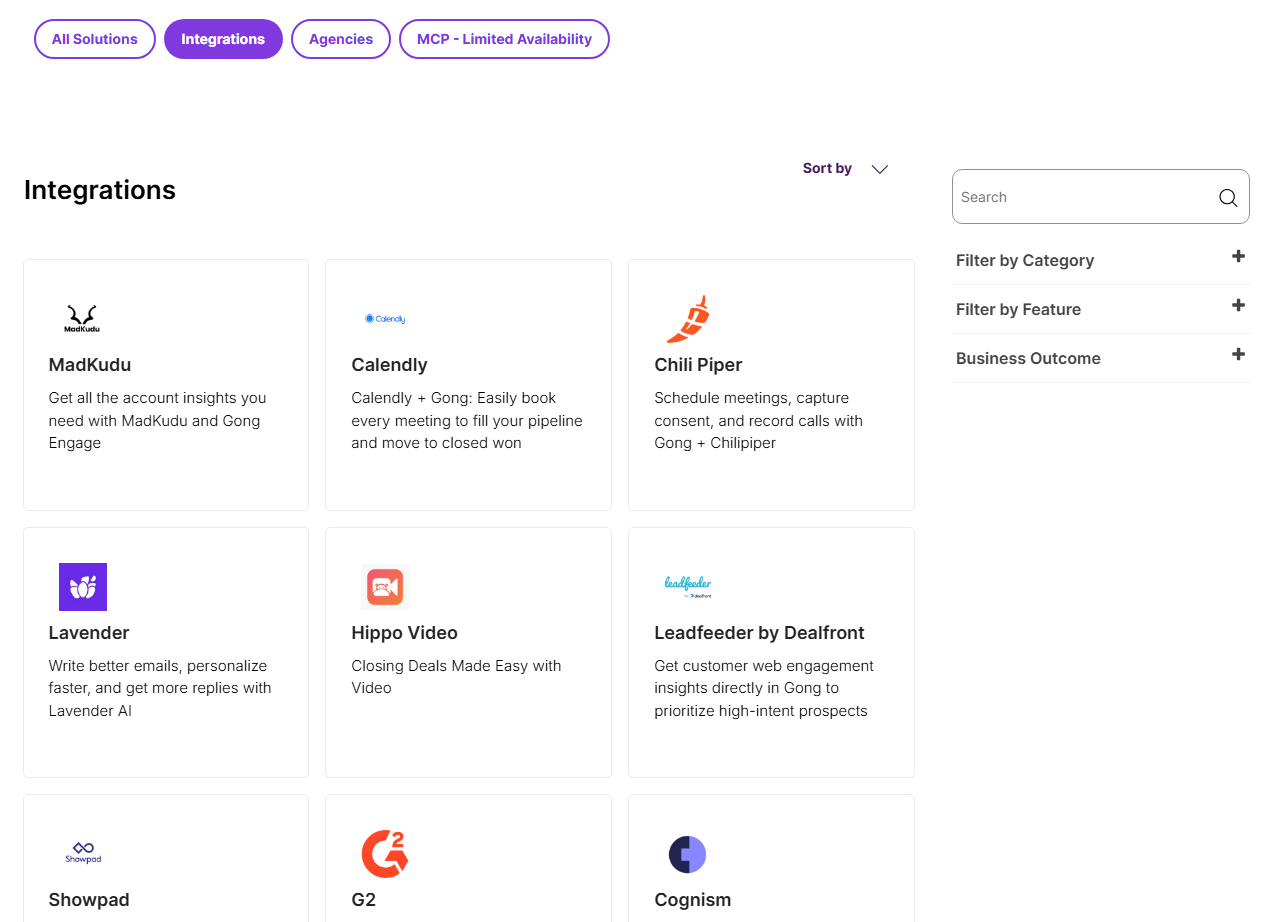
Gong operates the Gong Collective marketplace with over 300 integration partners. Integrations span CRM (Salesforce, HubSpot, Dynamics), email/calendar, web conferencing, telephony, buyer intent, contact enrichment, and BI tools.
Source: Gong
Gong supports the Model Context Protocol (MCP) as both client and server, enabling intelligence exchange with Microsoft 365 Copilot, Salesforce Agentforce, and others. The Gong API supports uploading recordings, retrieving call data, and building custom reporting.
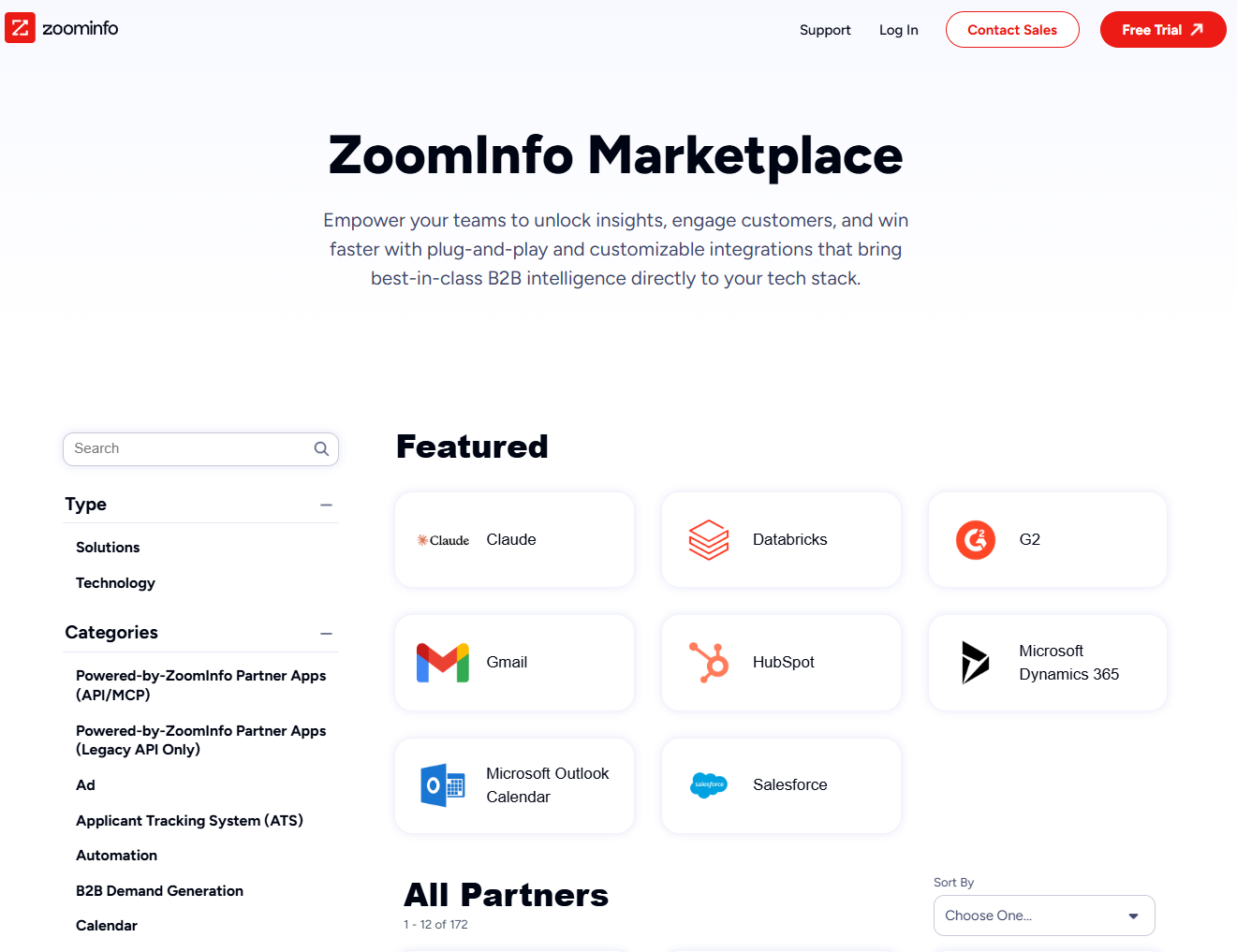
ZoomInfo provides the App Marketplace with 120+ partner integrations across CRM, marketing automation, sales engagement, data warehouse, and communications categories.
Source: ZoomInfo
The Enterprise API offers programmatic access to the full data and intelligence layer, with API access included in all plans.
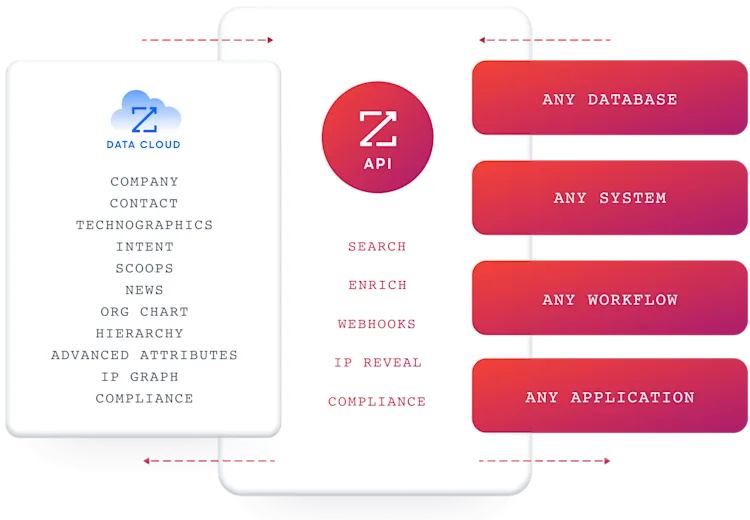
Source: ZoomInfo
The ZoomInfo MCP server connects AI models directly to ZoomInfo's data and is listed in the Claude directory.
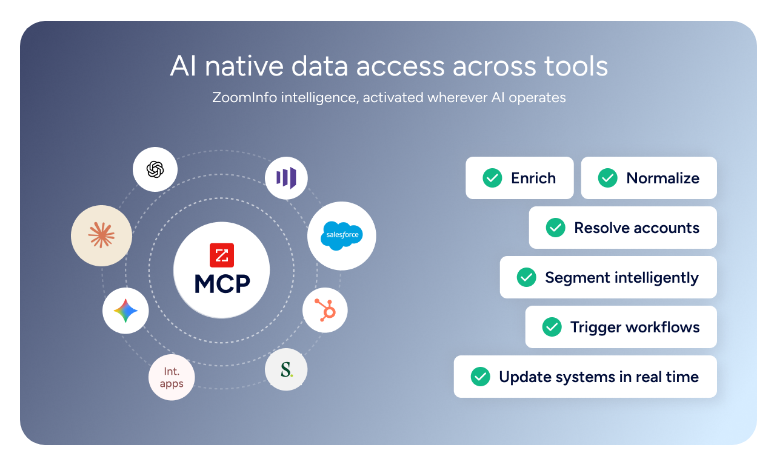
Source: ZoomInfo
Cloud partnerships with AWS, Google Cloud, Snowflake, and Databricks enable direct data ingestion into enterprise data infrastructure.
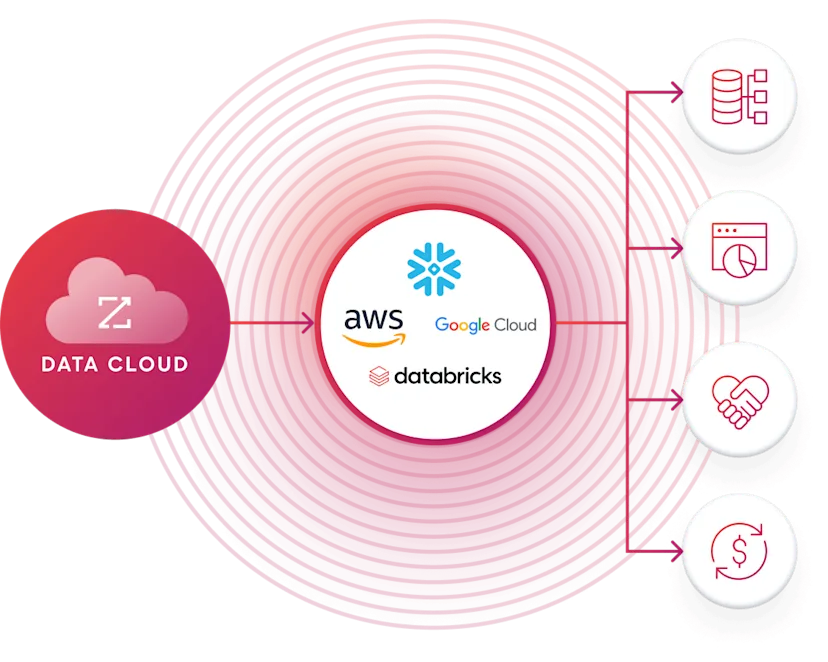
Source: ZoomInfo
ConversationIQ has no integrations, no API, and no connections to external platforms. It operates as a standalone paste-and-analyze web tool.
BDO Canada reported an 87% reduction in time spent on internal data dashboard updates using ZoomInfo's API. "The plug-and-play aspect of the API means I can integrate it very easily into any process and get information at a moment's notice," said Jerry Wilson, Senior Marketing Intelligence Analyst. (BDO Canada case study)
Gong vs. ConversationIQ vs. ZoomInfo: Which should you choose?
The choice depends on your role, your existing tech stack, and whether you need conversation intelligence alone or as part of a broader GTM platform.
Choose Gong if:
Your primary need is conversation intelligence and revenue process optimization
You already have a separate data provider for B2B contacts and intent signals
You want the most specialized AI for call coaching, deal prediction, and forecast accuracy
Your team has 50+ revenue professionals who justify the platform fee
You're willing to integrate multiple tools for prospecting, data, and engagement
ConversationIQ is not for revenue teams. It's a consumer tool for analyzing text messages in personal relationships. If you're evaluating conversation intelligence for B2B sales, it is not relevant.
Choose ZoomInfo if:
You want conversation intelligence within a GTM platform that also provides B2B data, intent signals, and multi-channel execution
You need contact data (verified direct dials, emails, org charts) alongside call analysis
You want AI that connects conversation signals with broader account intelligence to explain why deals move
You're looking to consolidate point solutions into one platform
You need the flexibility to access data through native products, APIs, or MCP in any third-party tool
Start with ZoomInfo Lite for free access to the B2B database, or request a full platform trial.
For revenue teams already using Gong, ZoomInfo's data and GTM Context Graph complement what Gong provides.
ZoomInfo's Chorus integrates natively with the platform's data layer, but ZoomInfo's APIs and MCP access also work alongside other conversation intelligence tools. The platform doesn't force an either/or decision.
For teams building a revenue stack from scratch, ZoomInfo offers the consolidated approach: one platform with the data foundation, conversation intelligence, engagement tools, and AI layer that would otherwise require three or four separate vendors.
Levanta CEO Ian Brodie put it directly: "ZoomInfo's not just a contact data company anymore. They've built a full system of execution. GTM Intelligence actually works the list, writes the outreach, triggers the play, and helps drive predictable growth." (Levanta case study)
Gong vs. ConversationIQ vs. ZoomInfo FAQ
What is the difference between Gong and ConversationIQ?
Gong is an enterprise revenue AI platform that records, transcribes, and analyzes B2B sales calls, emails, and meetings to provide deal intelligence, forecasting, coaching, and sales engagement for revenue teams. It serves 5,000+ companies and was valued at $7.25 billion.
ConversationIQ (conversationiq.io) is an early-stage consumer web tool where individuals paste personal text messages (up to 3,000 characters) to receive AI analysis of communication patterns and emotions in personal relationships. They serve different markets with no functional overlap.
Does ZoomInfo have conversation intelligence like Gong?
Yes. ZoomInfo acquired Chorus, a conversation intelligence platform backed by 14 technology patents, which records and analyzes sales calls, meetings, and emails.
The difference is that Chorus operates within ZoomInfo's GTM Context Graph, connecting conversation insights with B2B contact data, intent signals, and behavioral data across the go-to-market motion rather than functioning as a standalone tool.
Which platform is better for sales coaching and call analysis?
Gong has the most specialization in conversation-based coaching. Its AI Call Reviewer uses configurable scorecards, AI Trainer creates role-play simulations from real calls, and Smart Trackers detect methodology adoption.
ZoomInfo's Chorus provides similar call analysis and coaching, with the added benefit of surfacing ZoomInfo's company and contact profiles alongside every interaction. Both are strong; Gong has more years of iteration on the coaching workflow.
Can I use Gong and ZoomInfo together?
Yes. ZoomInfo is an integration partner in the Gong Collective ecosystem. Many organizations use ZoomInfo for B2B data, intent signals, and prospecting while using Gong for conversation intelligence and deal execution. ZoomInfo's APIs and MCP server also allow its data to flow into any tool in a revenue stack.
For teams that want one vendor, ZoomInfo's Chorus provides conversation intelligence within the same platform as the data and engagement layers.
How does pricing compare between Gong and ZoomInfo?
Both use custom-quoted pricing with no published dollar amounts. Gong charges per-user licenses plus a platform fee, with add-on applications (Engage, Forecast, Enable) priced separately. ZoomInfo uses consumption-based pricing across its platform.
The comparison depends on what you're replacing: if ZoomInfo consolidates a data provider, intent platform, and conversation intelligence tool into one contract, the total cost may be lower than buying Gong plus separate vendors for data and signals.
Is ConversationIQ suitable for any business use case?
ConversationIQ is designed for individuals analyzing personal conversations. It has no business features: no call recording, no CRM integration, no team collaboration, no pipeline analytics, and no enterprise security certifications. Its free tier limits analysis to 3,000 characters of pasted text once per day. There is no published privacy policy. It is not suitable for handling business or customer communication data.
Which platform has stronger AI capabilities for revenue teams?
Gong's AI is trained on over three billion customer interactions and focuses on revenue outcomes: deal prediction, coaching, forecasting, and engagement.
ZoomInfo's GTM Context Graph processes 1.5 billion data points daily, fusing conversation intelligence with B2B data, intent signals, and CRM records to provide contextual reasoning about why deals move.
Gong has deeper conversation-specific AI; ZoomInfo has broader contextual AI that connects conversations to the full account picture.
What are the security differences between these platforms?
Gong holds SOC 2 Type II, ISO 27001, ISO 42001 (AI Management), HIPAA support, and PCI DSS certifications, with a commitment that customer data is never used to train generative models.
ZoomInfo maintains ISO 27001, ISO 27701, SOC 2 Type II, plus TRUSTe GDPR and CCPA validations.
Both meet enterprise security requirements. ConversationIQ publishes no security documentation, privacy policy, or compliance certifications.
