
A targeted account list (TAL) is the set of companies your sales and marketing teams agree are worth real, coordinated effort. It is the highest-leverage decision in outbound. The list decides which accounts get your team's time, and no amount of clever messaging rescues weeks spent on companies that were never going to buy.
What makes a list work is its quality, and length has little to do with it. The accounts have to fit the customers you already win, show signs of buying now, and come with data accurate enough to act on. Even then, the list only pays off once it reaches the reps who work it. This guide covers how to build a list that holds up on each count, how to segment and prioritize it, and how to keep it useful once it is live.
What Makes a Targeted Account List Work
A targeted account list is the defined set of companies your sales and marketing teams commit to pursuing with account-based effort, chosen because they resemble the customers you already win. It is deliberately narrow: fewer accounts, deeper research, and a plan for each one. That focus is what separates it from a broad target market, and it is why account-based selling can outperform spray-and-pray volume. A list works only when every account clears three bars: fit, timing, and data you can trust.
Kade Hinkle, one of the top SDRs featured in Florin Tatulea's Prospecting from the Trenches newsletter, puts the stakes plainly:
"This is where everything starts. If your targeting sucks, the rest of this doesn't really matter."
Everything downstream, the messaging, the sequences, the personalization, only works when the account is a real fit. So the list is worth building deliberately and keeping current, which is what the rest of this guide walks through.
Why a Targeted Account List Is Worth Building
A focused list changes where your team spends its time and what that time returns. Instead of chasing volume, you concentrate prospecting effort on accounts with real revenue potential, and the gains show up across the funnel:
You reach the right people more often. ZoomInfo customers report 40% more effective prospect targeting, with 60% of outreach connecting with the right person, up from 43% before.
Sales and marketing work one list. When both teams pursue the same accounts, campaigns and outreach reinforce each other instead of pulling in different directions, which is the foundation of any ABM program.
Deals get bigger and close faster. Targeting the right accounts lifted win rates from 32% to 46% and grew average deal size by 40% for ZoomInfo customers.
More pipeline from a smaller pool. ZoomInfo customers grew their total addressable market by 40% and their total pipeline by 32%, and three in four surfaced opportunities they would have missed.
Track those gains with clear ABM success metrics so you can tell which accounts and segments are paying off.
Build the List Step by Step
Building a targeted account list runs from a clear picture of who you serve to a ranked list your team can act on. Six moves get you there, and each one sharpens the accounts that carry forward to the next.
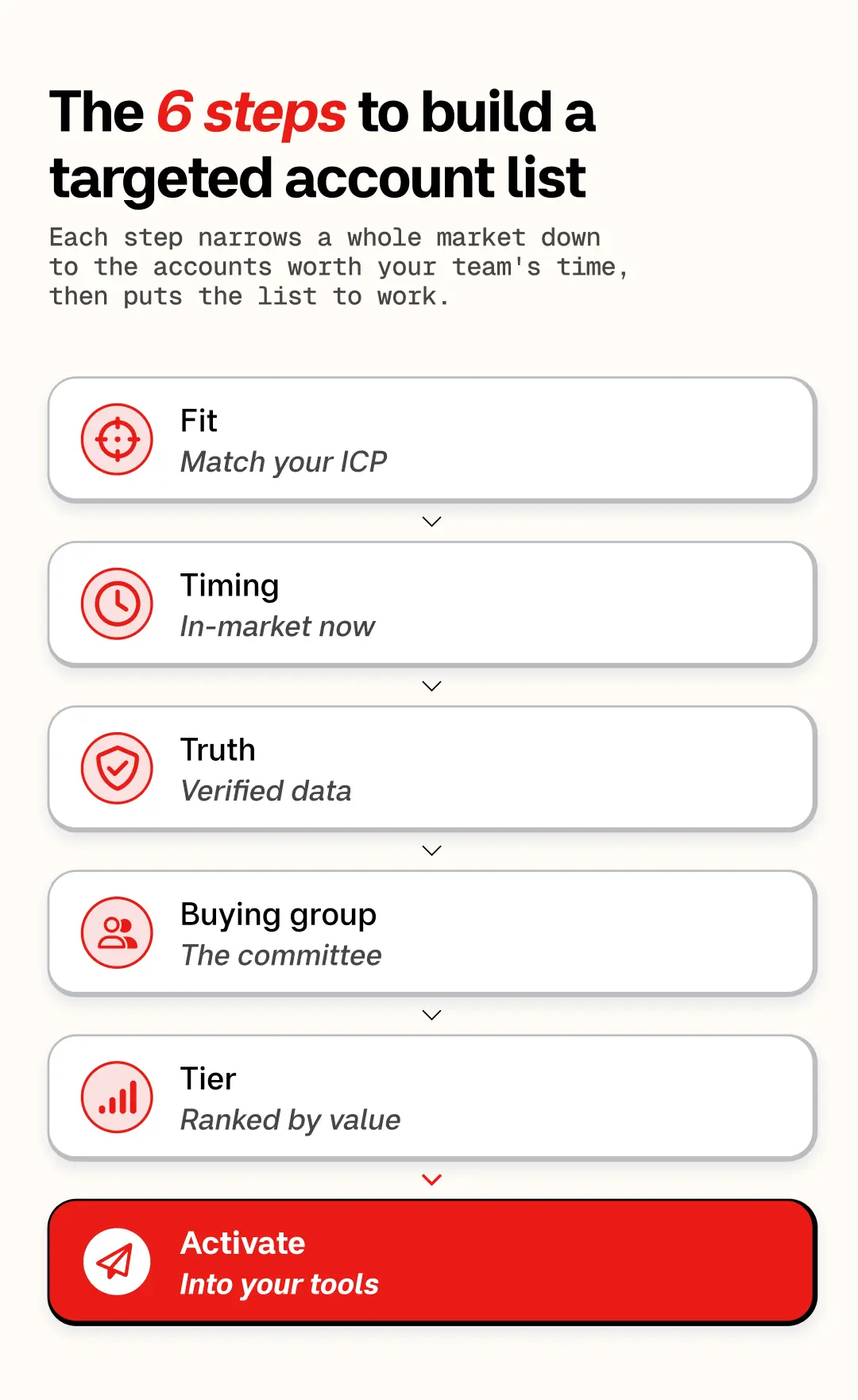
Start with fit
Fit starts with your ideal customer profile. Study the customers you already win and look for the traits that repeat:
Firmographics: size, industry, revenue, and location.
Technographics: the tools and platforms they run.
Growth signals: funding stage, headcount trend, and expansion.
Deal patterns: budget cycles, sales-cycle length, and what made them stick.
Add the buyer persona so you know which roles to reach once the accounts are set, and an ICP builder can turn the pattern into filters fast. Then turn the profile into companies: filter a complete data foundation by your criteria, check the result against your total addressable market to gauge coverage, and round it out with lookalike companies that share your best accounts' traits.
The ceiling on this step is the data underneath it. ZoomInfo, the all-in-one AI GTM Platform, builds it on a foundation of 500M contacts and 100M companies verified by 300+ researchers across 30,000+ tracked technologies, which is what lets you filter precisely and size the whole market instead of a slice of it. MarketSpark used that foundation to identify 30,000 prospect companies and open five times more revenue opportunities.
Add timing
Fit tells you which accounts could buy. Timing tells you which are moving now, and it is what turns a flat list into a ranked one. Watch for the buying signals that mean an account is entering a buying window:
Funding rounds: fresh budget to spend.
Leadership changes: new executives rebuild their stack.
Hiring sprees: a team scaling around your category.
Technology migrations: a stack already in flux.
Intent spikes: active research in your category.
The hard part is reading a signal in context rather than in isolation. A funding round means one thing at an account that already runs a competitor and another at an account with an open role for your champion. This is the job of ZoomInfo's GTM Context Graph, the intelligence layer that processes 1.5B+ data points a day and fuses ZoomInfo's B2B data with your CRM history, conversation intelligence, and behavioral signals into one reasoning layer. It surfaces not just that an account moved but why, so accounts with real buying readiness rise to the top of the list this week and the quiet ones wait.
Verify the data
A list built on bad data fails quietly: bounced emails, dead numbers, and messages that reach people who moved on. Before you act on the list, enrich every record so it carries:
A verified business email and direct dial for each priority contact.
A current title and role, so you are not reaching who someone used to be.
Accurate firmographics, so your segments and tiers hold up.
The reporting structure, so you can see the whole account.
Skipping this is expensive, because poor data quality wastes the effort that went into finding the accounts. ZoomInfo verifies its data through multiple sources for up to 95% accuracy on first-party data, with 120M+ direct dials and 200M+ verified business emails behind the list. Accuracy is also perishable: TDWI's 2026 State of Data Quality report warns that a clean but outdated record is more dangerous than a messy but current one, because AI-driven outreach acts on it at scale before anyone catches the error.
Map the buying group
A company is not a buyer. A buying committee is. For each priority account, map the buying group so you know who to reach:
The decision-maker who owns budget and signs.
The champion who sells you internally.
Influencers who shape the decision.
Technical evaluators who judge whether it works.
End users who live with the product.
Working several of them at once with a multi-threaded approach builds consensus and protects the deal if one contact goes quiet. A structured pass at stakeholder mapping turns a list of companies into a list of people, and ZoomInfo's buying-group data surfaces the full committee and the org chart around it, so each account arrives with the names attached instead of a research project.
Rank and tier the list
Not every account earns equal effort. Score each on fit, intent, and revenue potential, then sort the list into tiers so effort matches potential:
Tier 1: perfect-fit accounts with active signals, worth one-to-one effort.
Tier 2: good fits worth a lighter, one-to-few touch.
Tier 3: plausible fits for scaled programs and nurture.
Clear tiers keep your best reps on your best accounts, where lead qualification effort pays off most. Inside ZoomInfo, GTM Studio, the workspace for marketers, RevOps, and GTM engineers, scores and prioritizes accounts on live intelligence, so the ranking reflects signals as they change rather than a spreadsheet frozen in time.
Spekit saw the difference this focus makes:

"ZoomInfo's data plays a big part in telling our reps where to spend their time."
Activate the list
A list that lives in a spreadsheet generates nothing. Activation is the step that turns it into pipeline by getting the list, and the intelligence behind it, into the tools your team already works in:
Sync it to the CRM so reps see accounts in context.
Route accounts to the right rep automatically with account-based routing.
Push it into the AI tools reps prompt through the ZoomInfo MCP.
Deliver a daily digest so mornings start on the right accounts.
Because ZoomInfo is consumed on one set of data in more than one place, the list travels without re-exporting. Sellers work it in GTM Workspace, and reps or developers can pull it into their own tools through GTM.AI, letting AI handle the prospecting legwork on top of verified data. Building the list and acting on it stop being separate jobs.
How to Segment Your Target Account List
Segmentation lets you run different plays on different groups without losing efficiency, and it works hand in hand with your tiers. Where tiers decide how much effort an account gets, segments decide what you say. The common cuts:
By industry: companies in the same sector share challenges, so industry-specific campaigns and case studies land harder.
By company size: enterprise, mid-market, and SMB accounts have different buying processes, cycles, and budgets.
By region: local regulations, language, and time zones change how and when you engage.
By use case: group accounts by the primary problem you solve for them, since that shapes the whole pitch.
Layer segmentation on top of tiers so each play matches both how valuable an account is and what will resonate with it. Good customer segmentation is also what lets marketing and sales run coordinated plays against the same groups instead of one-size-fits-all outreach.
Turn a Static List Into a Living One
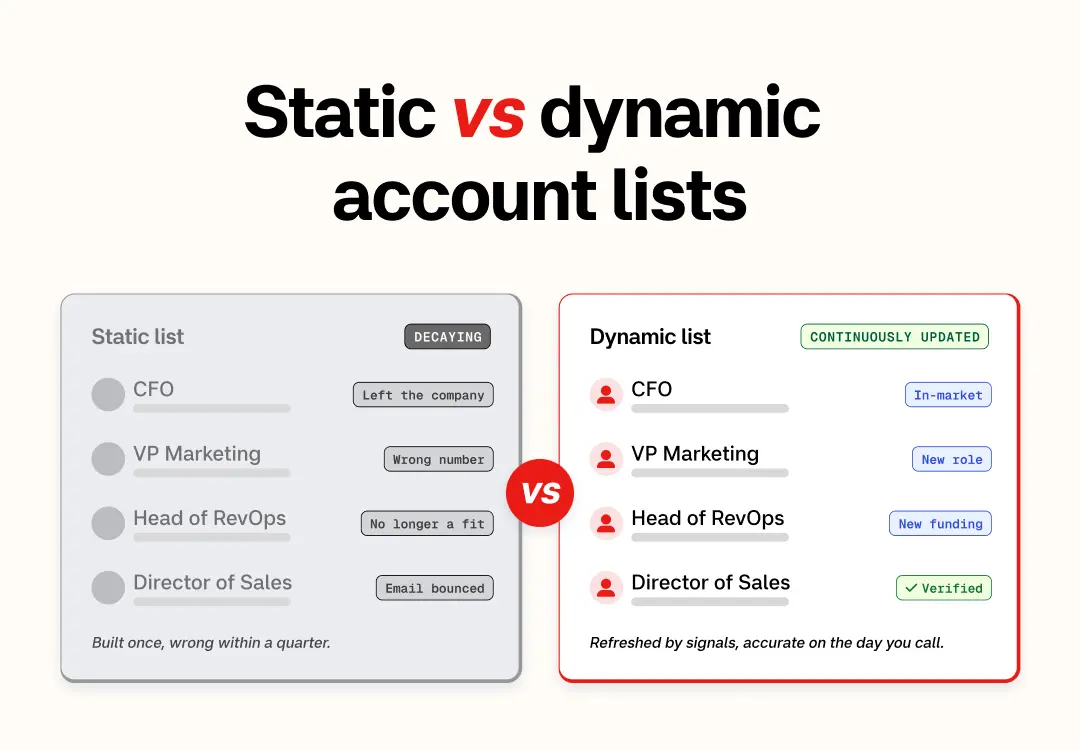
A targeted account list is a snapshot, and snapshots age. B2B data decays as people change jobs and companies reorganize, so a list that was right last quarter is quietly wrong today. Keep it current with a simple rhythm:
Review on a cadence: a full pass each quarter.
Cap the churn: swap no more than around 20% at a time so reps can work each account.
Let signals drive movement: in-market accounts rise, quiet ones fall.
Reverify continuously: so contacts stay reachable through ongoing CRM hygiene.
What to Look for in a Target Account List Tool
The platform you build on decides whether the list stays accurate and reaches your team. When you evaluate options, look for:
A deep, verified data foundation, broad enough to cover your market and accurate enough to act on.
Built-in intent and signals, so you can rank accounts by timing instead of fit alone.
Enrichment that keeps records current rather than a one-time export that decays.
Native activation, with CRM sync, routing, and access from the AI tools your team already uses.
ZoomInfo brings these together on one platform, which is why it holds up as more than a list builder. Buyers weighing options often compare ZoomInfo and Cognism or ZoomInfo and Apollo on data coverage and accuracy, and it is worth testing any tool against your own ICP before you commit, whether you are weighing full platforms or standalone data enrichment tools. For a wider view, compare the leading sales prospecting tools on how well they build and maintain a list rather than how much data they hold.
Where Account Lists Break Down
Even experienced teams undercut their own list in a few repeatable ways. Watch for these:
Building it too broad. A list of 500 "maybe" accounts spreads your team thin and buries the ones that count. A focused set of high-fit accounts will outperform a long list of marginal ones, so resist padding it.
Targeting on fit alone. Firmographics tell you who could buy, but they miss who is buying now. Layer in intent and signals so timing shapes priority alongside fit.
Trusting stale data. Roles change and companies shift, so a list left untouched slowly points at people who left. Verify before outreach and refresh on a cadence.
Skipping sales input. Marketing can build a list on paper that sales knows is unwinnable. Build and review it together so it reflects real account access and capacity.
Never activating it. A list that sits in a spreadsheet generates nothing. Get it into the CRM and the tools reps use, or the work of building it goes to waste.
Build a List Your Team Will Use
A targeted account list earns its place when it is built for fit, timing, and truth, then segmented, tiered, and kept in motion. Define the accounts against a real data foundation, rank them by who is buying now, verify the contacts so reps can reach them, and refresh the list as the market moves. Do that and the list stops being a static spreadsheet and becomes the plan your whole team runs on.
That is the gap ZoomInfo closes end to end: the data to build the list, the GTM Context Graph to rank it, the verification to keep it accurate, and the access to put it to work wherever your team sells. ZoomInfo is "Free to start with consumption credits based on usage," so you can build your first list and prove the motion before you commit. Book a demo to see it work from ICP to pipeline.
Frequently Asked Questions
How many accounts should be on a targeted account list?
Size it to your team's capacity. A common starting point is 50 to 100 accounts per rep, enough that each account gets real, personalized attention without overwhelming anyone. Enterprise teams running one-to-one plays often work fewer, higher-value accounts, while teams running scaled programs can carry more. The right number is the one your team can genuinely engage rather than the largest list you can generate.
How often should you refresh your targeted account list?
Review the full list quarterly and replace no more than around 20% at a time, so your team has runway to work each account before it cycles out. Between reviews, let live intent and buying signals move accounts in and out continuously, since an account that spikes in-market this week should not wait a quarter for attention.
What is the difference between a target account list and a target market?
A target market is the broad universe of companies that could theoretically buy from you, used for wide-net awareness. A targeted account list is a curated subset of that market, the specific high-fit companies your team commits to pursuing with personalized effort. The market defines the opportunity, and the account list defines where you spend your time.
What data do you need to build a targeted account list?
You need firmographic data to filter by size, industry, and revenue, technographic data to target by the tools accounts use, and intent and signal data to see who is in-market now. You also need verified contact data, direct dials and business emails for the buying committee, so the list is something reps can act on rather than a set of names with no way to reach them.
What is the best tool to build a targeted account list?
The best fit combines a large, accurate data foundation with intent signals, enrichment, and a way to push the list into your CRM and outreach tools. ZoomInfo does this on one platform: build the list from your ICP, rank it with intelligence, keep it verified, and activate it where your team works. Test any option against your own ICP and the accounts you already win before you decide.
