

Hunter.io has built its reputation on a simple premise: every professional email address on the public web can be found, verified, and used for outreach.
With 150 million professional email addresses sourced from 650 million public web pages and 6 million user accounts, the platform has grown from a single-purpose email lookup tool into what it now calls an "all-in-one email outreach platform". But that growth also reveals where Hunter's boundaries lie.
To write this Hunter.io review, we analyzed it closely. We believe it's the right choice if:
You primarily need verified email addresses for cold outreach
You value transparent, publicly sourced data with GDPR compliance built in
You want a tool with a free tier and simple pricing
Your outreach is email-only and doesn't require phone numbers or multichannel sequences
You need a lightweight platform your team can adopt in minutes
However, Hunter.io might not be sufficient if:
You need phone numbers, direct dials, or mobile numbers for your outreach
You require multichannel sequences across email, phone, LinkedIn, and ads
You need buyer intent signals and account-level intelligence
Your team requires AI-driven deal execution and CRM-integrated workflows
You're targeting contacts who don't have publicly indexed email addresses
In this case, you should consider ZoomInfo: an AI-powered go-to-market platform built on a large B2B dataset, with the GTM Context Graph (a layer that captures not just contact data but the context behind your deals).
With 500M contacts, 100M companies, 135M+ verified phone numbers, and 200M+ verified business emails, ZoomInfo covers what Hunter does and reaches contacts Hunter's public-web approach cannot, through its own seller and marketing tools or any third-party tool via APIs and MCP.
We've included a detailed look at ZoomInfo later in this Hunter.io review as the next step for teams that have outgrown email-only outreach. If you're ready to explore a broader go-to-market platform, you can start with ZoomInfo's free trial here.
What is Hunter.io?
Hunter.io was created in April 2015 by Antoine Finkelstein and François Grante.
Both founders had just graduated and saw the potential of cold emails as a prospecting channel. Their core decision (one that still defines the product) was to use only emails found on the public web rather than compiling private or opaque third-party databases.
The product launched as "Email Hunter" and was one of the first email-finding tools to use the public web as a data source. Over time, it expanded from a single Domain Search feature into email verification, lead storage, and cold email sequences.
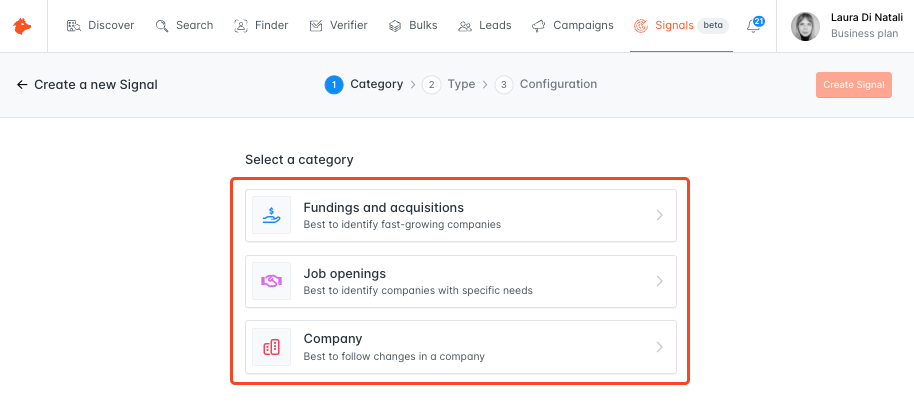
More recently, Hunter added Discover (a B2B company database), Signals (intent data), TechLookup (technographic targeting), and an AI Writing Assistant.
Source: Hunter.io
Today, Hunter operates as Hunter Web Services, Inc., registered in Delaware with servers in Belgium on Google Cloud Platform.
The company remains bootstrapped with roughly 25 people across 16 countries, remote from the start. It serves sales teams, marketing departments, recruiters, SEO link-builders, and solopreneurs, and aims to make cold emailing accessible to everyone, not just large enterprises. Key customers include Canva, Semrush, Cursor, Customer.io, Gartner, Vimeo, Cisco, Xero, and Autodesk.
Hunter.io Pros & Cons
Pros | Cons |
|---|---|
- Transparent, publicly sourced data with clickable source URLs | - No phone number data of any kind |
- Permanent free plan (50 credits/month, no time limit) | - Database limited to publicly indexed contacts only |
- Email verification with <1% bounce rate on verified addresses | - Sequences limited to email (no phone, LinkedIn, or SMS steps) |
- Full workflow from finding to outreach in one tool | - No native A/B testing in Sequences |
- Chrome extension with 600,000+ users and 4.7 rating | - Small team (~25 people) relative to product scope |
- Unlimited team members on all plans at no extra cost | - No formal security certifications (SOC 2, ISO 27001) |
- Credit-based pricing with unused credits rolling over | - Signals and intent data still maturing |
Hunter.io Review: How it Works & Key Features
Email Finding & Discovery: Hunter provides multiple tools to locate professional email addresses from publicly indexed web sources.
Hunter's data product is built around three linked tools that form a prospecting pipeline.
All three draw from the same dataset: 150 million professional email addresses sourced from 650 million public web pages, with Hunter crawling 30 million web pages every day to keep the data current.
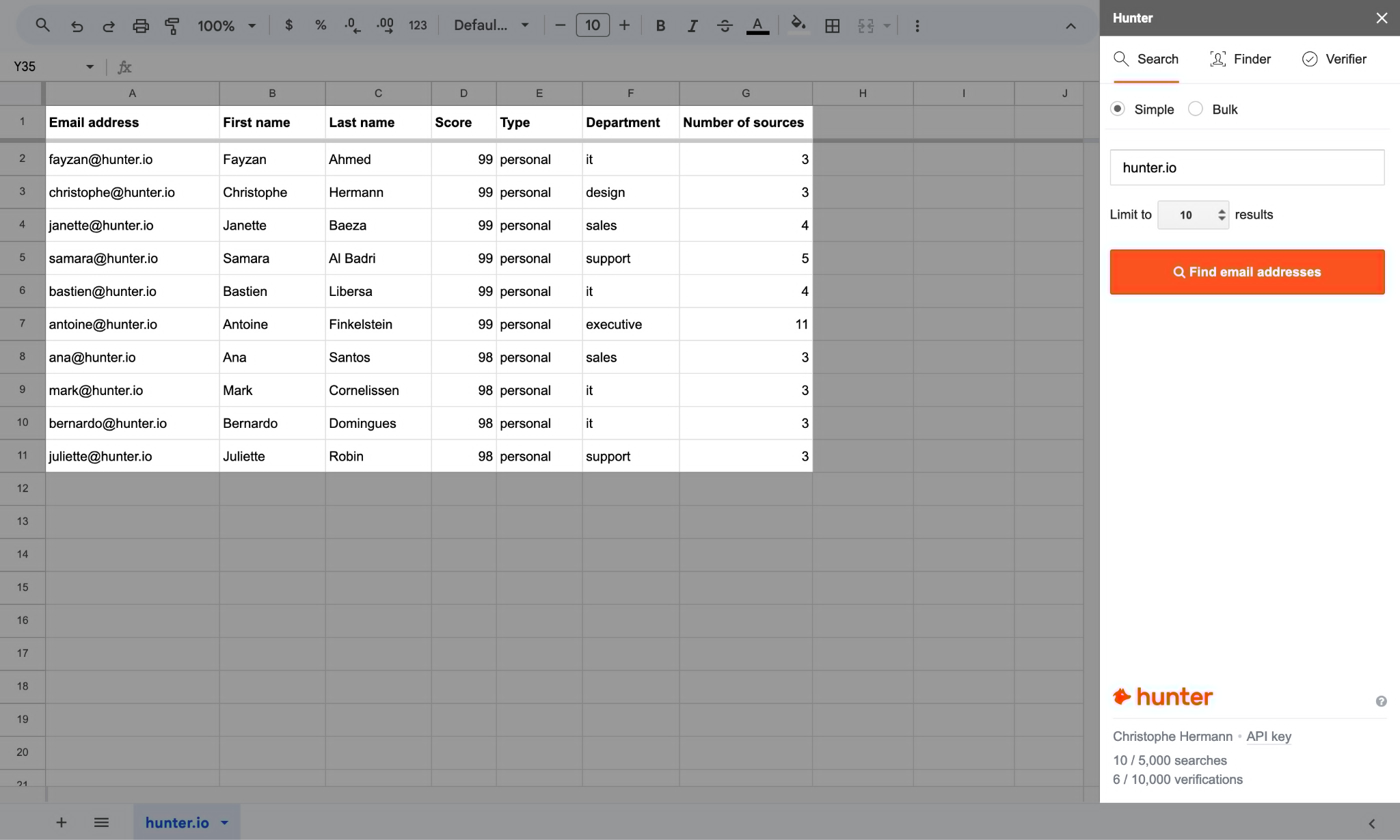
Domain Search answers "Who works at this company?" Given a domain name, it returns all publicly sourced professional email addresses with confidence scores and source URLs showing when and where each address was found. Results can be filtered by 14 departments, job title, and verification status.
Source: Hunter.io
The tool also detects email patterns (e.g., {first}.{last}@company.com) for each domain. One search credit covers up to 10 emails.
Email Finder locates a specific person's email given their name and company domain. It searches Hunter's database first, then generates the most likely email using the company's known format pattern if no public match exists. Every result goes through an automated deliverability check, and no credit is consumed when no result is found.
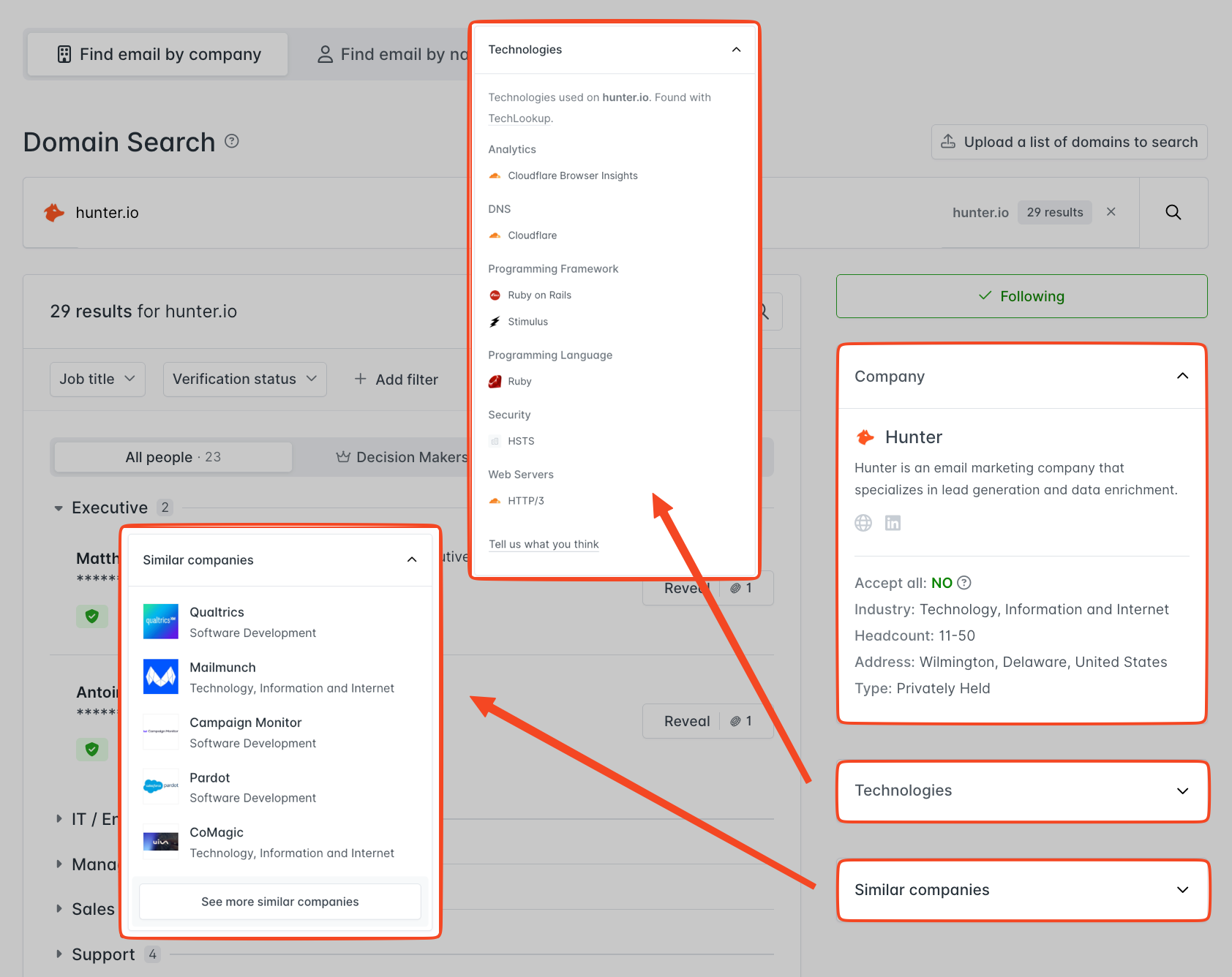
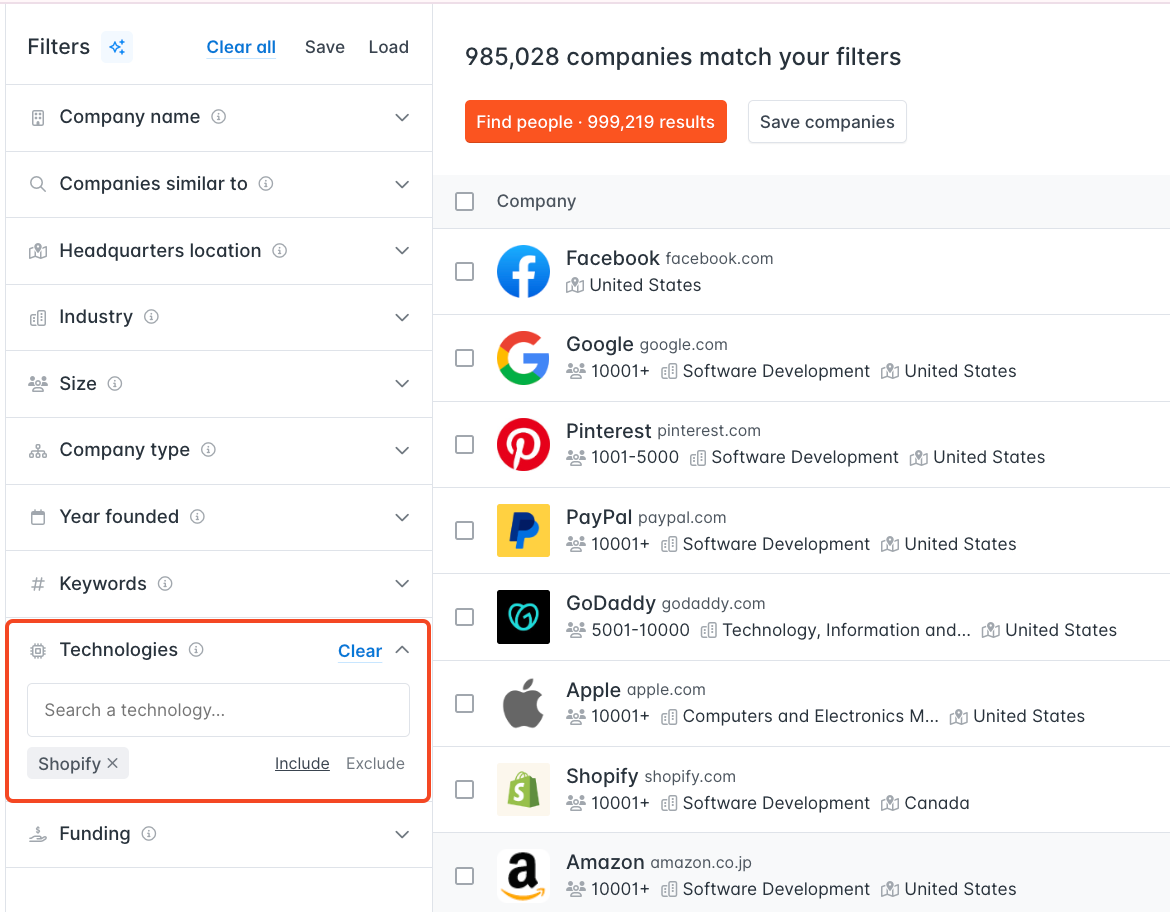
Discover is Hunter's B2B company database for top-of-funnel prospecting. Users define ICP attributes (headquarters, industry, company size, technologies, and more) and Discover surfaces matching companies with their contacts.
An AI Assistant accepts natural-language queries to auto-configure filters. Credits are consumed only when emails are revealed, not when browsing companies. Paid users can retrieve emails in bulk for up to 25,000 companies at once.
The Chrome extension (600,000+ users, 4.7 rating) shows email addresses for any website with one click, while the Google Sheets add-on (47,000+ installations) runs Domain Search, Email Finder, and Email Verifier directly in spreadsheets.
Source: Hunter.io
All data follows four published data principles: contacts include disclosed public sources, data without live sources is removed after six months, anyone can remove themselves via hunter.io/claim, and Hunter's crawler follows robots.txt. This lets users tell recipients exactly how their contact information was found, a concrete advantage for GDPR and CCPA compliance.
Email Verification: Hunter validates addresses through an eight-step process without sending actual messages.
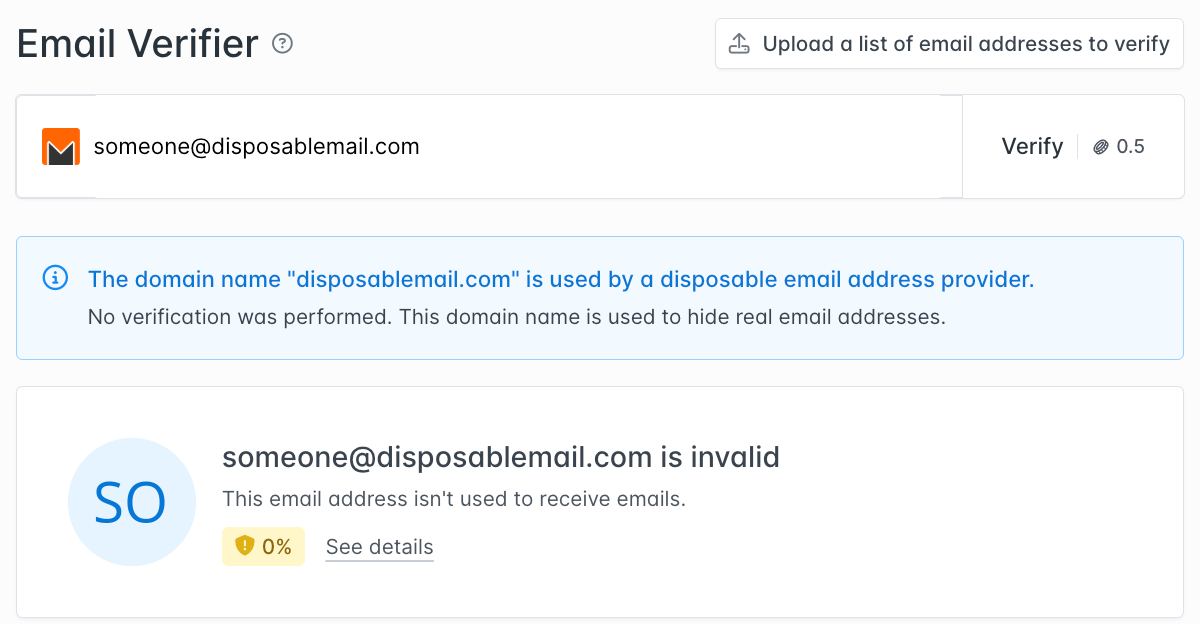
The Email Verifier runs eight sequential checks on every address: syntax validation, gibberish detection, disposable email detection, webmail flagging, MX record lookup, SMTP server check, SMTP verification (asking the server if it will accept email without sending one), and accept-all detection.
Source: Hunter.io
Hunter claims more than 95% of addresses marked "valid" will not bounce, with bounce rates typically below 1% for verified addresses. Results come in five statuses: Valid, Accept-All, Invalid, Disposable, and Unknown, with a confidence score for borderline cases.
Hunter's proprietary accept-all resolution verifies catch-all domain addresses with major providers rather than flagging them as ambiguous. Paid subscribers also get automatic monthly re-verification of all saved leads at no additional credit cost, and Hunter excludes invalid addresses from outreach sequences automatically.
Verification costs 0.5 credits per check on All-in-One plans, with Unknown and Disposable results consuming no credits. Anyone can check a single address free without signup.
Cold Email Sequences: Hunter sends automated outreach and follow-ups from your own connected mailbox.
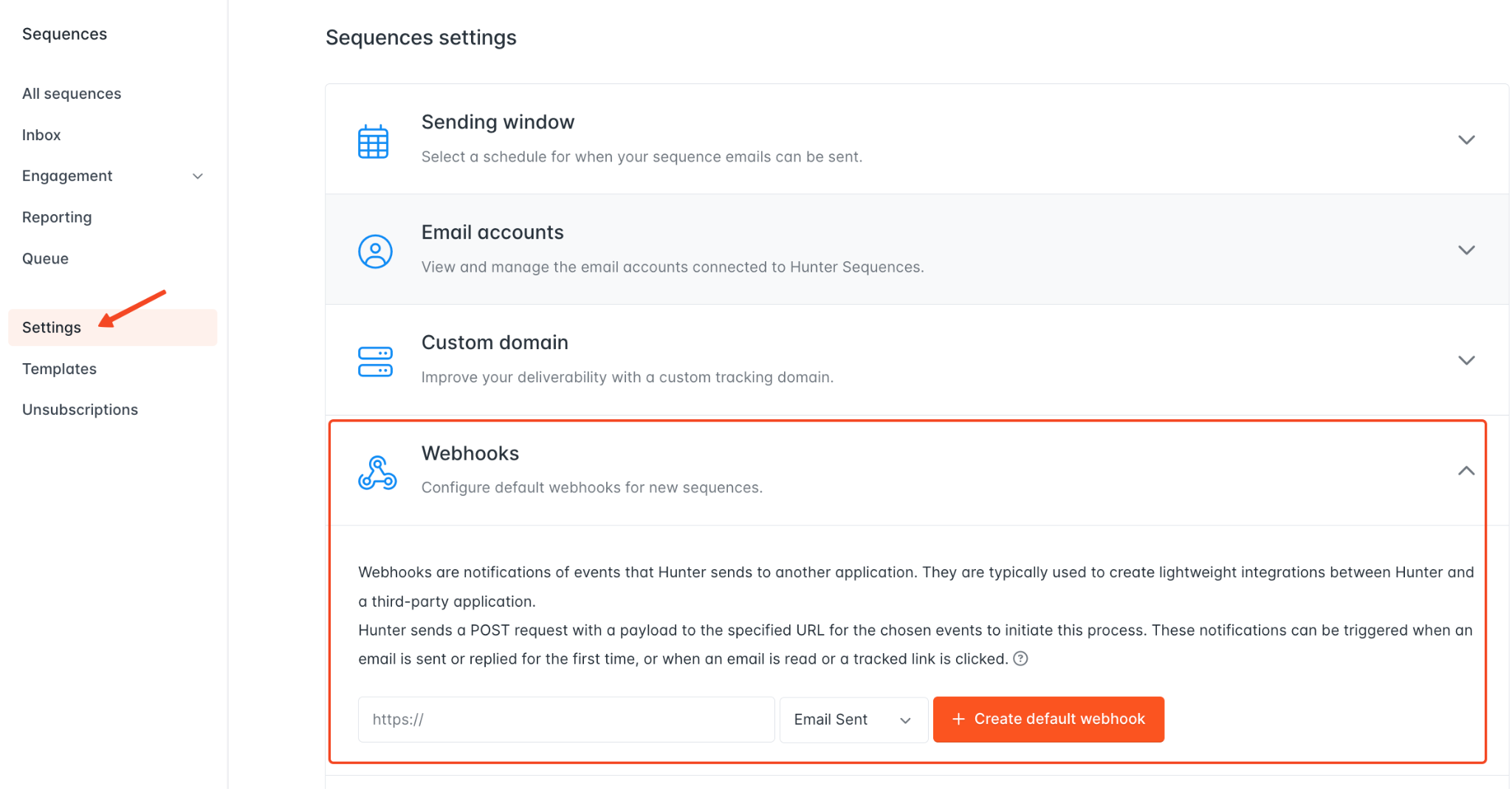
Hunter Sequences handles cold email campaigns by sending personalized outreach and automated follow-ups from the user's own email account until a recipient replies, unsubscribes, or the address hard-bounces.
Source: Hunter.io
The setup: connect a Gmail, Google Workspace, or Outlook account (or any provider via SMTP/IMAP on paid plans), build your audience from Hunter Leads or CSV import, compose an initial email plus up to 5 follow-ups with 1–30 day delays, and launch.
Key capabilities include custom attributes for personalization, email account rotation across multiple sender accounts, custom tracking domains for open and click tracking, a unified inbox that consolidates replies from all connected mailboxes, and warm lead identification that surfaces engaged recipients who haven't replied yet. The system auto-detects out-of-office replies and unsubscribe requests.
The AI Writing Assistant (paid plans only) generates a unique message per lead based on company, job title, industry, and custom attributes, with support for copywriting frameworks like AIDA and PAS and four languages. Users choose between GPT-4.0 mini, GPT-4.1 mini, or GPT-4.1 nano as the underlying model.
Daily sending limits depend on the provider: 400 for Gmail/Google Workspace, 250 for Outlook/Microsoft 365, and 250 for SMTP/IMAP. Connected accounts range from 1 on the Free plan to 20 on Scale, with up to 50 available through add-ons.
The main Sequences limitation: no native A/B testing. The workaround is creating duplicate sequences with manually split lists.
Signals & TechLookup: Hunter surfaces buying intent through funding events, job postings, and technology tracking.
Signals moves Hunter past static list building by surfacing companies showing buying intent.
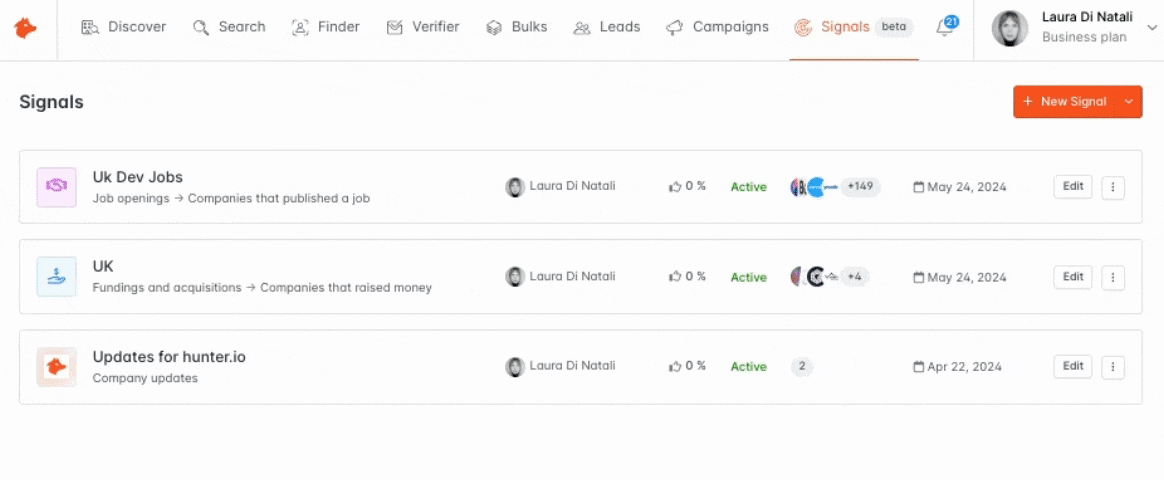
It tracks three signal categories: Fundings and Acquisitions (companies that recently raised money, filterable by round, amount, location, and industry), Job Openings (companies actively hiring in specific roles, filterable by title, seniority, and department), and Company Signals (alerts on new emails discovered, funding, or technology changes for followed companies).
Each user can create up to 50 Signals, with daily updates and email notifications every 48 hours. Users can run Bulk Domain Search on flagged companies to find contact emails immediately. Signals is free for all users (credits consumed only when finding emails), though the Free plan is limited to 10 Signals and several signal types remain listed as "coming soon".
TechLookup identifies websites using specific technologies, useful for sellers targeting companies with particular tech stacks. Browse the technology directory, select a technology (e.g., 1,889,588 websites using WordPress), and the results open in Discover with the Technology filter pre-applied. Available on paid plans only.
Source: Hunter.io
Pricing: Hunter uses credit-based pricing with a permanent free tier and plans starting at $34/month.
Hunter's unified credit system pools credits across all tools. Finding an email costs 1 credit, verifying costs 0.5 credits, and failed searches consume nothing. Deduplication applies: the same search or verification counts only once per billing period.
Free | Starter | Growth | Scale | |
|---|---|---|---|---|
Monthly price | $0 | |||
Annual price | $0 | |||
Credits/month | 50 | 2,000 | 10,000 | 25,000 |
Email accounts | 1 | 3 | 10 | 20 |
Recipients/sequence | 500 | 2,500 | 5,000 | 15,000 |
AI Writing | No | Yes | Yes | Yes |
Team members | Unlimited | Unlimited | Unlimited | Unlimited |
The free plan is permanent with no time limit and no credit card required. Monthly plans let you cancel or pause anytime, with unused credits rolling over as extra packs valid for 3 months. Annual plans offer a 30% discount with all credits available upfront for 12 months. Additional email accounts cost $10/month each. A 30% discount is available for registered nonprofits.
Hunter also offers a separate Data Platform tier for high-volume API and bulk access, with search and verification credits purchased independently and valid for 12 months.
Where Hunter.io Falls Short
Hunter.io does email outreach well.
But several limitations appear as teams grow and their go-to-market needs expand beyond email. These constraints show a platform built for one channel rather than the full prospecting workflow.
No Phone Number Data. Hunter offers no phone numbers. This follows from its public-web sourcing approach: professional email addresses appear on websites, phone numbers generally don't. Teams that include cold calling in their outreach must add a separate tool.
Data Limited to Publicly Indexed Contacts. Because Hunter sources exclusively from the public web, it cannot surface contacts who don't appear anywhere online. Decision-makers at companies with strict web presence policies, executives who keep their email addresses off public pages, and contacts at smaller firms with limited online footprints won't appear.
Providers that supplement with contributed, crowd-sourced, or purchased data offer broader coverage on these harder-to-find contacts.
Email-Only Sequences. Hunter Sequences handles cold email but offers no multichannel capabilities: no LinkedIn steps, call tasks, SMS messages, or ad retargeting. For teams whose prospects respond better to phone calls or social touches, this means managing separate tools for each channel with no single view of engagement across them.
No Native A/B Testing. Sequences does not support built-in A/B testing. The workaround is creating duplicate sequences with manually split lists, which adds friction and makes it harder to draw statistically valid conclusions from campaign variations.
No Formal Security Certifications. Hunter does not publicly claim SOC 2, ISO 27001, or other third-party security certifications. Enterprise buyers with strict vendor compliance requirements may find this a gap during procurement reviews.
Intent Data Still Maturing. Signals tracks funding events, job postings, and technology changes, but the feature set is narrower than dedicated intent data platforms. Several signal types remain listed as "coming soon", and the free plan is limited to 10 Signals. Companies that treat buying intent as a primary prospecting trigger will likely need a more developed solution.
Source: Hunter.io
These limitations aren't failures. They're the natural result of a small, focused team building an email outreach tool. But they create a ceiling for go-to-market teams that need broad data, multichannel engagement, and AI-driven intelligence in one platform.
Top Hunter.io Alternative for Full Go-to-Market Teams: ZoomInfo
ZoomInfo addresses Hunter's scope limitations with an AI-powered go-to-market platform backed by a broad data foundation: 500M contacts, 100M companies, 135M+ verified phone numbers, and 200M+ verified business emails.
Founded in 2007 by Henry Schuck, ZoomInfo has grown into a publicly traded company (NASDAQ: GTM) serving 35,000+ companies worldwide, including Adobe, Snowflake, Seismic, and Thomson Reuters.
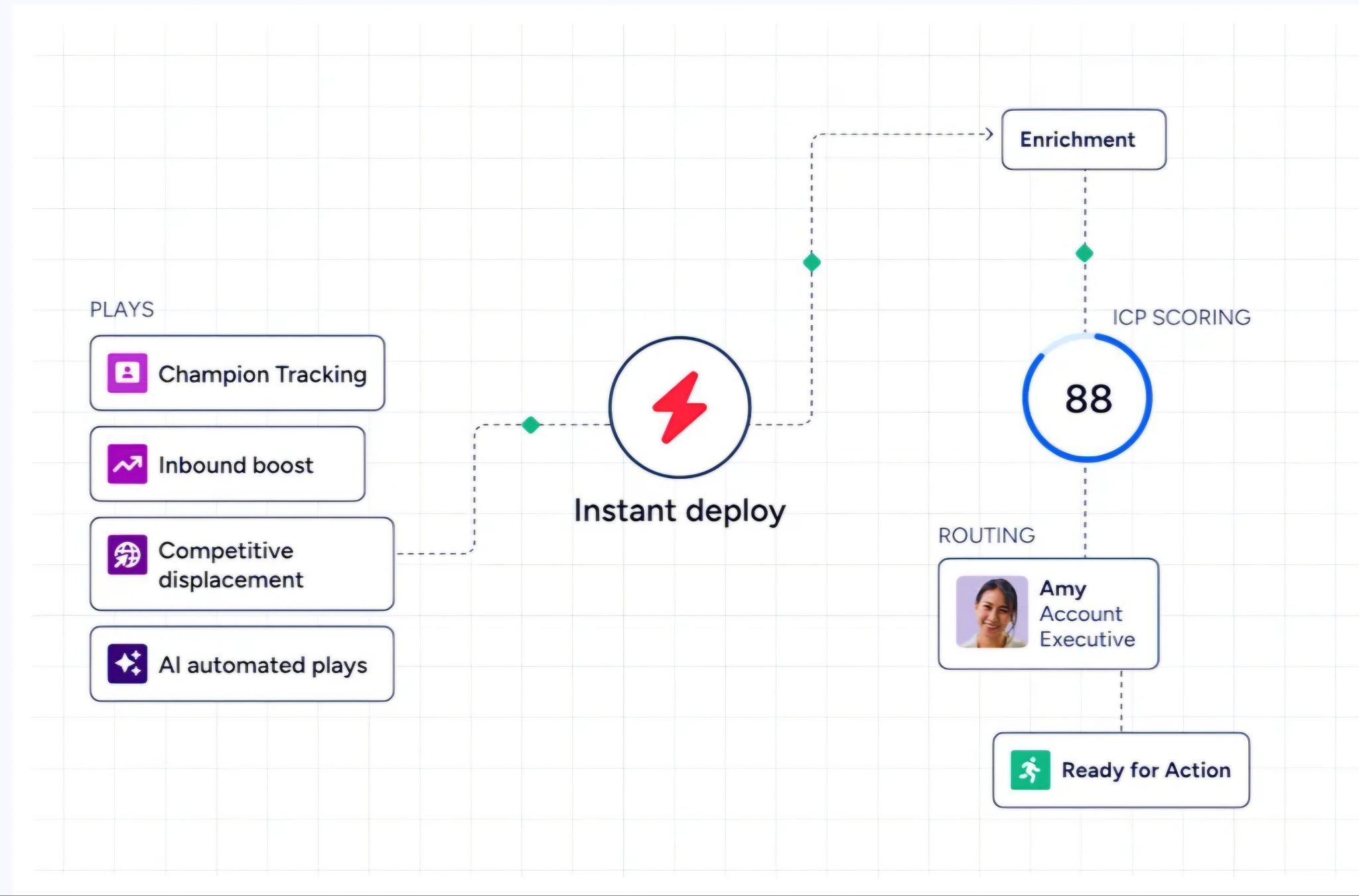
Its GTM Context Graph processes 1.5B+ data points daily, combining ZoomInfo's data with your CRM records, conversation transcripts, and behavioral signals to capture not just what happened in a deal, but why. Your team acts on that intelligence through the GTM Workspace for sellers, GTM Studio for marketers and RevOps, or APIs and MCP in any third-party tool.
Source: ZoomInfo
Comprehensive B2B Data: ZoomInfo provides data spanning contacts, companies, phone numbers, and buying signals at a scale Hunter's public-web approach cannot match.
Hunter's database covers 150 million professional email addresses.
ZoomInfo's covers 500M contacts, 100M companies, 135M+ verified phone numbers, 120M direct-dial phone numbers, and 200M+ verified business email addresses. The difference isn't just volume. It's the range of data types.
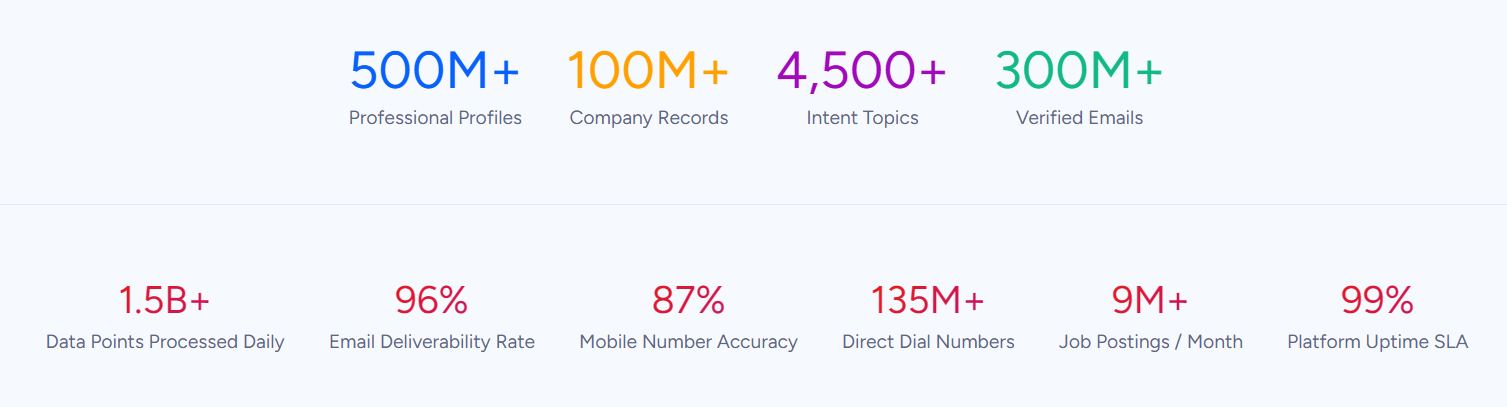
ZoomInfo's data spans three layers: identity data (who buyers are and how to reach them, including direct dials and mobile numbers), company context (firmographics, org charts, technographics across 30,000+ technologies, and parent-child hierarchies), and live signals (buyer intent, website visitor identification, job changes, and funding events).
Data flows through a verification process drawing from multiple sources and backed by 300+ human researchers, reaching up to 95% accuracy on first-party data.
This breadth matters in practice. A sales rep gets direct dials that ring. A RevOps team doesn't need to stitch together three vendors for a complete account picture. A marketing team models TAM from a continuously updated dataset rather than a static snapshot.
In a Fortune 500 competitive RFP analyzing 25 million contacts across vendors, the independent consultant concluded that "no other competitor came even close."
ZoomInfo gives teams the information they need without digging through multiple sources, getting them "three steps ahead" according to the Vice President of Revenue Operations. (Vensure)
GTM Context Graph: ZoomInfo's intelligence layer combines its B2B data with your CRM records, conversation transcripts, and behavioral signals to capture why deals move or stall.
Hunter provides contact data. ZoomInfo provides contact data plus the context behind every deal.
The GTM Context Graph is ZoomInfo's intelligence layer, processing 1.5B+ data points daily and combining ZoomInfo's third-party data with a customer's own CRM records, conversation transcripts, email threads, and product usage data.
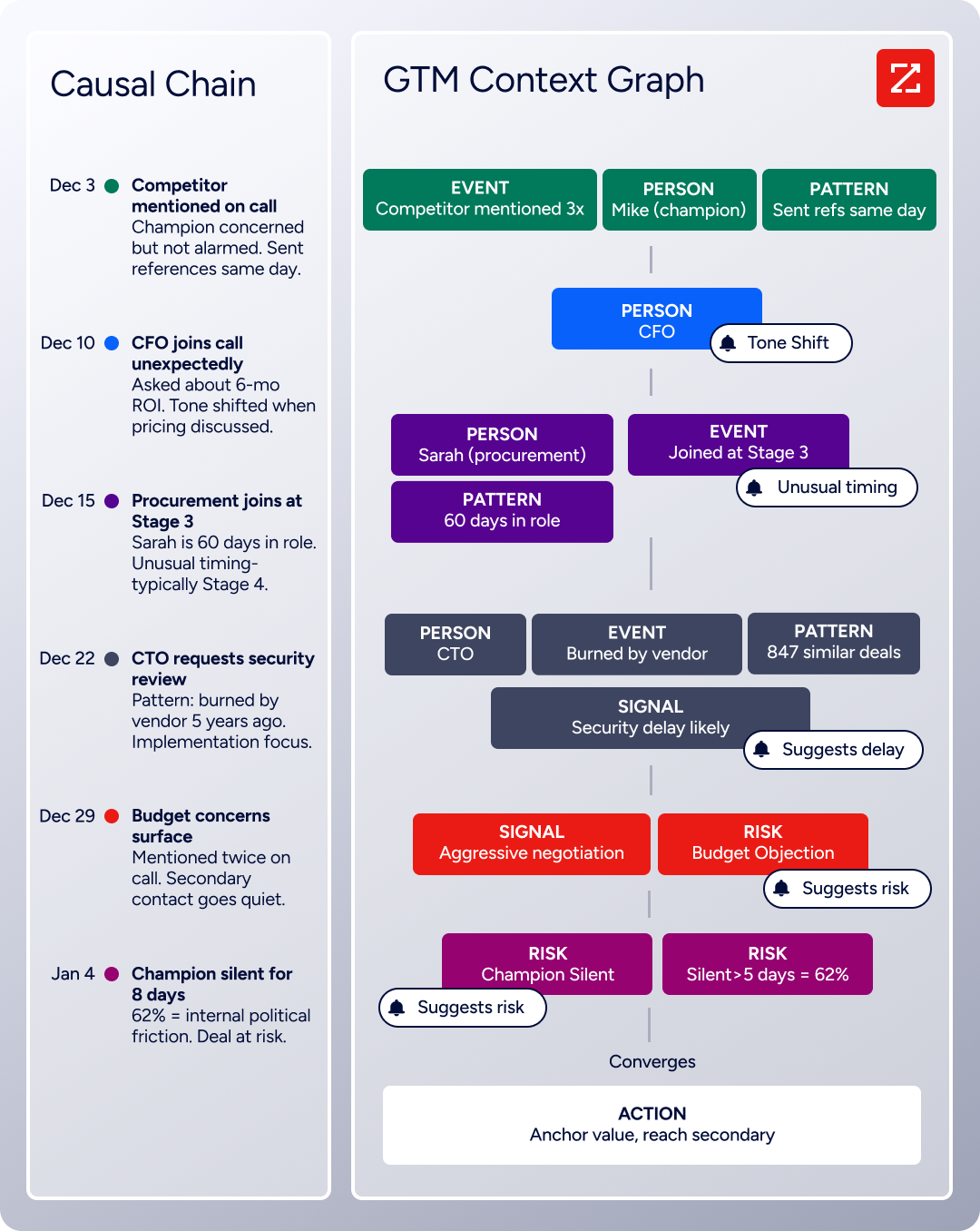
The result: AI that understands not just what happened in a deal, but why it happened. A CRM records that a deal moved to Stage 4. The GTM Context Graph identifies that executive sponsorship entering at this stage, combined with ROI-focused questions on the last call, matches the pattern behind closed-won deals in your segment.
That insight flows into every action that follows: the follow-up email addresses the specific concern the CFO raised, the next play targets accounts whose signal patterns match your wins, and the forecast reflects buying evidence rather than stage labels.
This layer is built on two decades of data infrastructure. ZoomInfo has been named a Leader in the Forrester Wave for Intent Data Providers (Q1 2025) and a Leader in the Gartner Magic Quadrant for ABM Platforms for two consecutive years.
Seismic attributed 39% of active pipeline to opportunities identified or influenced by ZoomInfo signals, crediting the combination of internal CRM data with external signals for "very specific account-based messages" that prospects "responded to right away." (Seismic)
GTM Workspace & Sales Automation: ZoomInfo gives sellers an AI-powered workspace that replaces context-switching across tools.
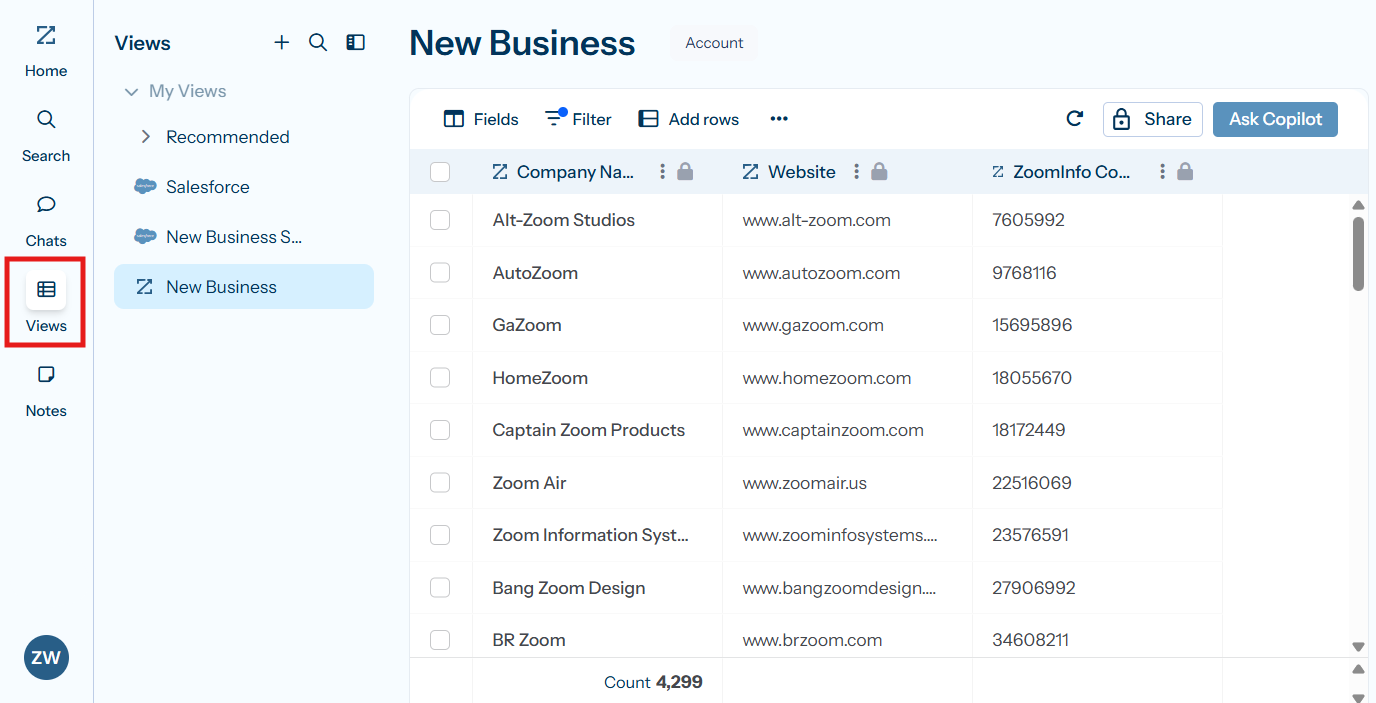
Hunter Sequences sends cold emails. ZoomInfo’s GTM Workspace handles the full seller workflow: prioritized account feeds, AI-drafted outreach addressing specific deal context, buying group intelligence, signal monitoring, and CRM updates, all in one place.
Source: ZoomInfo
The AI agents inside GTM Workspace (built on Anthropic's Claude) answer three questions for every rep: who to contact, when to engage, and what to say.
An Action Feed streams in-market buyers matched to target criteria with pre-drafted actions on every signal. Views combine CRM data with real-time buying signals, letting reps filter for intent spikes, technology changes, funding events, or executive hires. One-click account briefs pull CRM history, company news, and stakeholder context into a summary in seconds.
For multichannel execution, ZoomInfo's partnership with Salesloft connects intelligence to action, with ZoomInfo Buying Signals syncing to Salesloft Rhythm for AI-prioritized phone and email engagement.
Customer results include Databricks reaching prospects 50% faster and Thomson Reuters increasing closed-won deals by 40%.
Spekit found that opportunities at higher-scoring accounts were 43% more likely to become qualified pipeline and moved 58% faster, with their RevOps Manager noting that ZoomInfo "offers a unified view, eliminating the need to navigate between systems." (Spekit)
Universal Access: ZoomInfo delivers its intelligence through APIs, MCP, and GTM Studio so teams can work wherever they choose.
Hunter integrates with HubSpot, Salesforce, Pipedrive, Zoho CRM, Zapier, and a REST API. ZoomInfo goes further with three access methods that put its data into every tool a team uses.
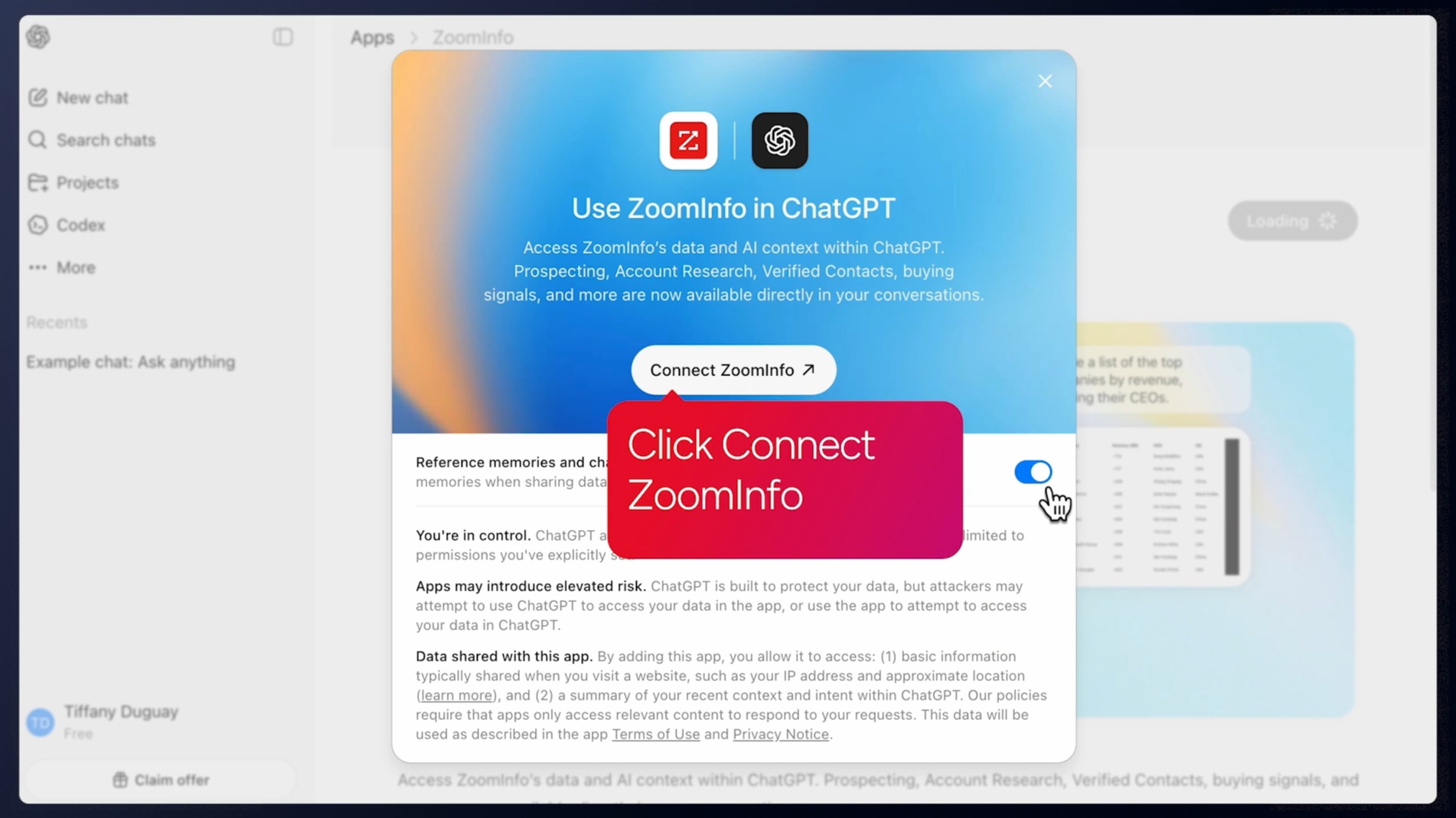
Enterprise APIs provide programmatic access to search, enrich, and intelligence endpoints, with API access included in all relevant plans. The MCP server connects AI models directly to ZoomInfo's data as a native tool, supporting Claude and ChatGPT with no custom coding required.
Source: ZoomInfo
GTM Studio gives marketers, RevOps, and GTM engineers a workspace where they define audiences, run campaigns, and measure pipeline using natural language instead of engineering tickets. Expansion campaigns that used to take 3 weeks now launch in 30 minutes.
The ZoomInfo App Marketplace lists 120 partner integrations across CRM, marketing automation, sales engagement, and data warehouse categories. Cloud Partners deliver data directly into AWS, Google Cloud, Snowflake, and Databricks. Whether a team works inside ZoomInfo's products or outside them, the same data and intelligence are available.
BDO Canada reported an 87% reduction in time spent on data dashboard updates thanks to ZoomInfo's API, with their Senior Marketing Intelligence Analyst noting "the plug-and-play aspect means I can integrate it very easily into any process." (BDO Canada)
Hunter.io or ZoomInfo: Comparison Summary
Hunter.io | ZoomInfo | |
|---|---|---|
Primary focus | Email finding and cold email outreach | AI-powered go-to-market platform |
Database size | 150M email addresses, 81M websites | 500M contacts, 100M companies, 200M+ emails |
Phone numbers | Not available | 135M+ verified, 120M direct dials |
Data sourcing | Public web only (transparent source URLs) | Multi-source: ML scanning, partners, contributors, 300+ researchers |
Intent data | Funding events, job postings, tech changes | Buyer intent from 210M IP pairings, 6T+ keyword signals, Guided Intent |
Outreach capabilities | Email sequences only | Multichannel via Salesloft partnership (email, phone, LinkedIn) |
AI capabilities | AI email writing assistant | GTM Context Graph, AI agents, account summaries, AI-drafted outreach |
CRM integrations | HubSpot, Salesforce, Pipedrive, Zoho | Salesforce, HubSpot, Dynamics 365, 120+ marketplace integrations |
API/MCP access | REST API, Zapier, MCP server | Enterprise API, MCP server, Cloud Partners (AWS, Snowflake, Databricks) |
Security certifications | None disclosed | ISO 27001, ISO 27701, SOC 2 Type II, TRUSTe GDPR/CCPA |
Free tier | 50 credits/month, permanent | ZoomInfo Lite (10 exports/month, permanent) |
Paid pricing | $34–$299/month (published) | Consumption-based pricing, custom-quoted |
Analyst recognition | G2 Leader badge | Gartner MQ Leader (ABM), Forrester Wave Leader (Intent), 133 G2 No. 1 rankings |
Best for | Email-focused outreach at accessible pricing | Full go-to-market execution across channels and teams |
Final Verdict
The choice between Hunter.io and ZoomInfo depends on the scope of your go-to-market needs and how far your team has grown.
Choose Hunter.io if your outreach is email-first and you want a focused tool that does it well. Hunter is the right choice for solopreneurs, small sales teams, SEO link-builders, and agencies whose primary job is finding verified email addresses and running cold email sequences.
The transparent data sourcing makes GDPR compliance straightforward, the pricing is clear, and the free plan is generous enough to get real work done. If you don't need phone numbers, multichannel sequences, or enterprise intelligence, Hunter gives you a direct workflow from finding to sending without added complexity.
Choose ZoomInfo if your team has outgrown email-only outreach and needs the full picture: direct dials for cold calling, buyer intent signals to prioritize accounts, deal intelligence, and multichannel execution across email, phone, and ads.
ZoomInfo is built for go-to-market teams that need broad data, deal context, and the ability to act on it from any tool in their stack. The investment is larger, but the platform covers what Hunter does and extends into territory Hunter's architecture wasn't designed to reach.
Get started with ZoomInfo here.
Hunter.io proves that a small, focused team can build an email outreach tool that millions of people use and trust. ZoomInfo proves that when go-to-market teams need data, intelligence, and execution in one platform, the scale of the underlying data determines how far they can go.
Hunter.io FAQ
Is Hunter.io free to use?
Yes, Hunter offers a permanent free plan with 50 credits per month, no credit card required, and no time limit. It includes access to Domain Search, Email Finder, Email Verifier, Sequences (1 connected account, 500 recipients), Discover with basic filters, 10 Signals, and the Chrome extension. It excludes AI Writing, link tracking, Sequences Reporting, and auto-verification.
ZoomInfo also offers a permanent free tier called ZoomInfo Lite, which provides access to its B2B database with 10 monthly export credits, the Chrome extension, and website visitor identification.
Does Hunter.io provide phone numbers?
No, Hunter does not offer phone number data. This follows from sourcing exclusively from the public web, where professional email addresses appear but phone numbers generally do not. Teams that need direct dials or mobile numbers for cold calling must use a separate tool.
ZoomInfo's database includes 135 million verified phone numbers and 120 million direct-dial phone numbers alongside its email data.
How accurate is Hunter.io's email data?
Hunter claims more than 95% of addresses marked "valid" will not bounce, with bounce rates typically below 1% for verified emails. The Email Verifier runs eight sequential checks including SMTP verification and a proprietary accept-all resolution for major providers.
Multiple customer stories corroborate accuracy as a primary reason for choosing Hunter. Darwinbox reported a 15-20% improvement in determining whether addresses were valid or invalid after switching to Hunter, with SQL reply rates going from 6% to 12%.
Does Hunter.io support multichannel outreach?
No, Hunter Sequences is email-only. There are no LinkedIn steps, phone call tasks, SMS messages, or ad retargeting capabilities within a sequence. Teams needing multichannel engagement must use separate tools.
ZoomInfo provides multichannel execution through its Salesloft partnership and GTM Workspace, combining email, phone, and social engagement in workflows informed by buyer intent signals.
How does Hunter.io's pricing compare to ZoomInfo?
Hunter publishes transparent pricing starting at $34/month (annual) for the Starter plan with 2,000 credits, scaling to $299/month for Scale with 25,000 credits. All plans include unlimited team members at no extra cost.
ZoomInfo uses consumption-based pricing with no publicly listed prices, reflecting its broader feature set and enterprise positioning. ZoomInfo also offers ZoomInfo Lite as a permanent free tier with 10 monthly export credits.
What integrations does Hunter.io support?
Hunter integrates natively with HubSpot, Salesforce, Pipedrive, and Zoho CRM, plus automation platforms like Zapier and Make. It also offers a REST API, browser extensions for Chrome, Firefox, and Edge, a Google Sheets add-on with 47,000+ installations, and a remote MCP server for AI agent integration.
ZoomInfo provides a broader integration ecosystem with 120 marketplace integrations, an Enterprise API with search, enrich, and intelligence endpoints, an MCP server supporting Claude and ChatGPT, and direct data delivery into cloud platforms like AWS, Snowflake, and Databricks.
Does Hunter.io offer intent data?
Yes, Hunter's Signals feature tracks three categories of buying intent: funding and acquisitions, job openings, and company-level changes like technology adoption. Users can create up to 50 Signals with daily updates. The feature is still maturing, with several signal types listed as "coming soon."
ZoomInfo's intent data tracks signals from 210 million IP-to-Organization pairings and over 6 trillion keyword-to-device pairings sourced monthly, with Guided Intent that identifies topics historically correlated with deal success rather than requiring manual topic selection.
Is Hunter.io GDPR compliant?
Yes, Hunter built its data model around GDPR compliance. All contacts include clickable source URLs and discovery dates showing exactly where and when the information was found on the public web.
Contacts without live public sources are removed after six months, anyone can remove their data via the claim page, and Hunter's crawler follows robots.txt. The company has an EU GDPR Representative in Dublin and a UK representative in Brighton.
ZoomInfo also maintains compliance with ISO 27701, TRUSTe GDPR and CCPA validations, and registered data broker status in California and Vermont.
More relevant alternatives and breakdowns:
