

Only about 5% of your addressable market is in-market at any given time.
We’ve all heard that statistic. It gets quoted in boardrooms, SKOs, and marketing offsites. But most teams stop there. They accept it as a constraint instead of seeing it as an opportunity.
When buyers are in-market, they don’t move quietly. They leave signals everywhere. They hire. They research. They read reviews. They visit your website. They evaluate your competitors.
Most go-to-market teams don’t have a unified way to capture those signals, score them, and turn them into motion in real time. This is a problem of activation failure.
Let’s walk through exactly how ZoomInfo solves that inside GTM Studio and GTM Workspace.
Start With the Territory
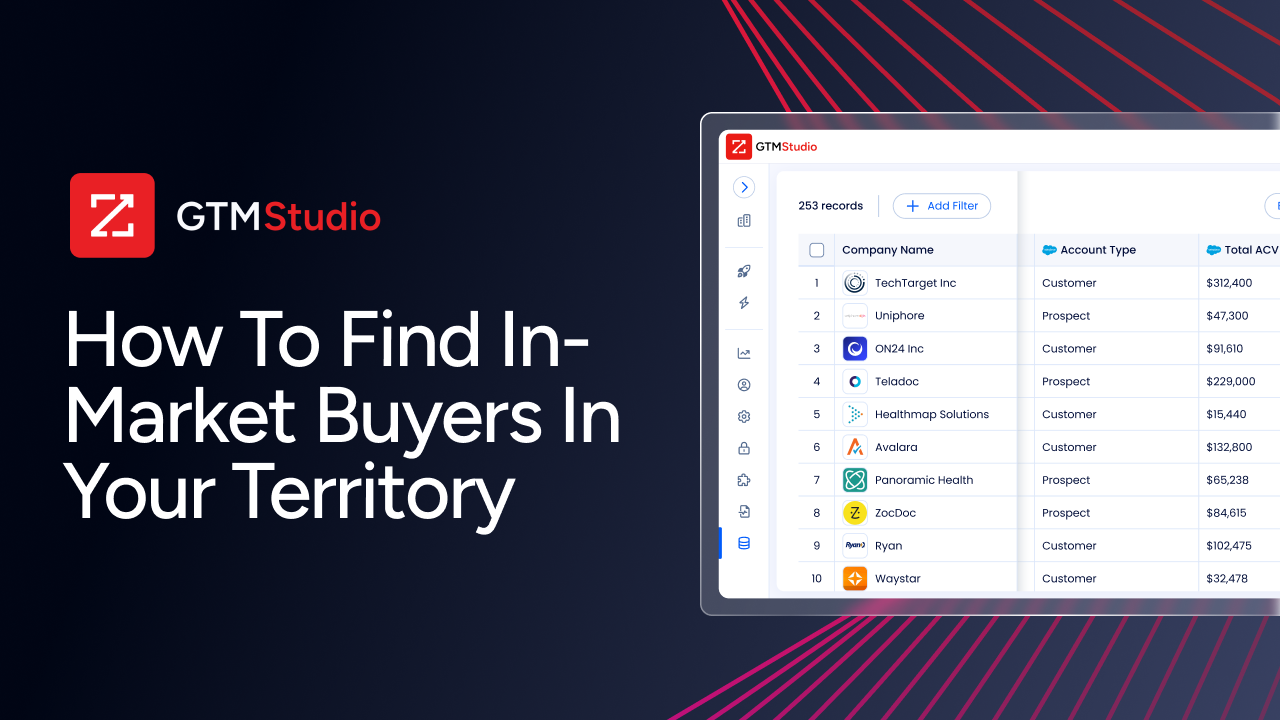
In this example, we begin with a list of 500 accounts. You can think of that as a rep’s territory or book of business. It includes companies across industries and size segments, pulled in from ZoomInfo and the CRM, and centralized into one working environment.
The starting point isn’t a net-new list of accounts. It’s the accounts you already own. The question becomes simple: which of these companies are actually in-market right now?
That’s where signal layering begins.
Hiring Data as a Growth Indicator
The first signal we bring in is job posting data. If a company is actively hiring sales reps, that’s not random activity. That’s an investment in growth. And growth usually correlates with increased need for tools, systems, and data.
Inside GTM Studio, you can see how many sales roles a company is currently hiring for and how many salespeople they’ve hired in the last 90 days. That gives you a directional view into whether the company is expanding, stagnating, or contracting.
Hiring is one piece of intent. It’s not definitive on its own, but it’s a strong leading indicator.
Intent Signals: Who’s Researching Right Now?
If you’re in the market for a product, the first thing you’re likely to do is research. That behavior leaves a trail.
The next layer we bring in is intent data. This shows which companies are actively researching the products, services, or categories that we sell. You can see when a company is spiking on relevant topics, consuming content around a category, or exploring specific competitors.
Now we’re combining growth signals with active research behavior. That’s far more powerful than either one alone.
Review Site Activity: Evaluation in Motion
After research comes evaluation. Buyers don’t just read content; they go to review sites.
That’s why we layer in activity from platforms like G2 and TrustRadius. Company by company, you can see what categories they’re viewing and which competitors they’re evaluating.
At this point, the picture sharpens. If a company is hiring sales reps, researching my category, and reviewing competitors on G2, that’s not theoretical interest. That’s commercial intent.
Website Engagement and the Silent Evaluator
Next, we look at website activity. Did the company visit our site? Did they view high-value pages? Did they submit a form?
There’s nuance here. We’re especially interested in the companies that did everything else — research, competitor reviews, category exploration, came to our website — and then did not submit a form. Those are high-signal accounts. They’re clearly evaluating, but they haven’t raised their hand. That’s where proactive outbound wins.
Instead of waiting for an inbound conversion, we can act on the signals they’ve already given us.
AI Scoring: From Data to Prioritization
Once those layers are in place — hiring, intent, review sites, website activity — we ask AI to score the account.
The system evaluates the totality of signals and assigns a low, medium, or high score based on the intensity and combination of behaviors. Did they visit the site? Did they review competitors? Did they spike on relevant topics? Are multiple signals happening simultaneously?
This eliminates guesswork. Reps no longer have to manually triangulate five systems to determine who to call. The prioritization is done for them.
Generating a Talk Track for Reps
Signal without narrative is wasted, so the next step is to generate a contextual talk track for each account.
If the data shows that a company is experiencing significant growth and operates an AI-powered lending platform, the outreach reflects that. If signals indicate expansion into new partner ecosystems, the messaging connects to that strategy.
Now the rep doesn’t just know who to call. They know why, and they have a relevant starting point grounded in real behavior.
This is where data becomes execution.
Activation in GTM Workspace
From GTM Studio, you can assign accounts to sellers, export to CRM, push into a sales engagement platform, or activate digital campaigns. But the real power shows up when you push this directly into GTM Workspace.
Workspace is where the rep lives.
Instead of raw spreadsheets and disconnected dashboards, the rep sees a clean, prioritized view of accounts. For each one, they see the live buying signals, the AI-generated talking points, and recommended next actions.
It becomes a command center, not a research project.
The system effectively says: these are the accounts you should engage today. Here’s the evidence. Here’s what to say. Here’s what to do next.
From Insight to Motion
Zooming out, here’s what actually happened.
We started with an existing territory. We layered in job postings, intent data, review site research, and website activity. We used AI to score accounts based on combined signals. We generated specific, contextual talk tracks. And then we pushed all of it into a workflow environment designed for activation.
This is what a modern go-to-market motion should look like.
Today, sellers are expected to personally triangulate hiring trends, funding announcements, website visits, competitive research, executive hires, and CRM history. That’s too much cognitive load. It’s inefficient, and it doesn’t scale.
The future is unified signal aggregation, AI prioritization, and seamless execution.
Reps shouldn’t spend their mornings deciding who to call. The system should deliver the right accounts, ranked and justified, ready for engagement.
When you combine a strong data foundation with AI on top of it and activation built into the workflow, you remove the bottleneck between strategy and execution. And that’s how you engage the right buyers at the right time — and actually win.
