
Choosing between Insightly vs. Salesforce for your CRM often comes down to five questions:
Do you need a CRM your team can set up in days, or are you prepared for a multi-month implementation with dedicated administrators?
Is your priority managing the full customer lifecycle (sales through project delivery) in one tool, or building an enterprise platform that scales across every department?
Are you comparing total cost of ownership, or just license fees?
How important is it that your CRM data is accurate, complete, and enriched with real-time buying signals?
Do you need a platform your team will actually adopt, or one with configurability that requires a dedicated admin team?
In short, here's what we recommend:
Insightly is built for mid-market teams that want CRM, marketing automation, customer service, and project management under one roof without enterprise complexity. Its platform claims 2x faster go-live versus competitors, and the ability to convert won deals directly into projects makes it a natural fit for professional services, agencies, and consultancies. Starting at $29/user/month, Insightly delivers Salesforce-level governance features (approval processes, role hierarchies, custom objects) at mid-market prices.
The trade-off: a dated interface, limited automation, and a scalability ceiling that growing organizations may hit sooner than expected.
Salesforce is the #1 CRM by IDC market share, serving over 150,000 companies with the broadest feature set in the industry. Sales Cloud, Service Cloud, Marketing Cloud, Commerce Cloud, Data Cloud, and the Agentforce AI platform form an ecosystem that covers virtually any business process. With 19 consecutive years as a Gartner Magic Quadrant Leader for Sales Force Automation, Salesforce is the safe enterprise choice.
But that depth costs: pricing starts at $25/user/month and climbs past $175/user/month for meaningful functionality, 70%+ of implementations require partner involvement, and the learning curve demands dedicated administrators.
Both platforms focus on organizing customer records and managing pipelines. But a CRM is only as good as the data inside it, and neither Insightly nor Salesforce solves the problem of where that data comes from, how accurate it is, or how to identify which accounts are ready to buy.
ZoomInfo is an AI-powered go-to-market platform that lets your sales reps walk into every call knowing why the deal is moving, who's championing it, and what's likely to happen next. Your marketers can describe audiences in plain language and launch plays against accounts that match your proven win patterns. Your leaders can see deal risk before it shows up in CRM stage fields.
That depth comes from the GTM Context Graph, an intelligence layer built on the largest B2B dataset in the industry (500M contacts, 100M companies, 135M+ verified phone numbers, and 200M+ verified business emails), unified with your CRM records, conversation transcripts, and behavioral signals. Your team accesses it through GTM Workspace for sellers, GTM Studio for marketers and RevOps, or APIs and MCP in any front-end.
If enriching your CRM with verified data and real-time buying signals sounds like the missing piece, see how ZoomInfo works.
Insightly vs. Salesforce at a glance
Insightly | Salesforce | ZoomInfo | |
|---|---|---|---|
Best for | Mid-market teams needing CRM + project management | Enterprises needing a full platform across departments | Teams needing verified B2B data and go-to-market intelligence |
Starting price | $29/user/month | $25/user/month (Free Suite available for up to 2 users) | Custom-quoted; free tier available (ZoomInfo Lite) |
Implementation time | Days to weeks | Weeks to months (complex deployments: 3-12 months) | Weeks |
AI capabilities | Copilot (Beta) on Professional/Enterprise plans | Agentforce with Atlas Reasoning Engine | GTM Context Graph with AI agents via GTM Workspace, GTM Studio, API, and MCP |
Marketing automation | Native module (separate pricing) | Marketing Cloud (separate pricing, from $1,500/org/month) | GTM Studio with audience building and multi-channel orchestration |
Data enrichment | Not included; relies on manual entry or third-party tools | Not included natively; requires Data Cloud add-on or third-party | 500M contacts, 100M companies, verified and continuously updated |
Integration breadth | 2,000+ via AppConnect | 9,000+ via AppExchange | 120+ native integrations, plus API and MCP for any tool |
Post-sale capability | Native project management from won deals | Requires additional configuration or tools | Conversation intelligence (Chorus) for ongoing deal and account context |
The CRM you choose is only as good as the data you put in it
This is the problem neither Insightly nor Salesforce addresses. Both platforms store and organize customer data, but they depend on your team to create, maintain, and update that data manually, or to purchase separate enrichment tools.
Insightly's own 2025 CRM Research Report found that only 27% of non-executives say their CRM is used effectively.
Salesforce CEO Marc Benioff acknowledged at Dreamforce 2025: "You have got to get your data right." These aren't competing platforms pointing fingers. They're identifying the same reality: CRM adoption fails when the data inside is incomplete or stale.
ZoomInfo solves this problem at the source. With 500M contacts and 100M companies verified through a multi-source pipeline backed by 300+ human researchers and achieving up to 95% accuracy on first-party data, ZoomInfo provides the raw material that makes any CRM useful.
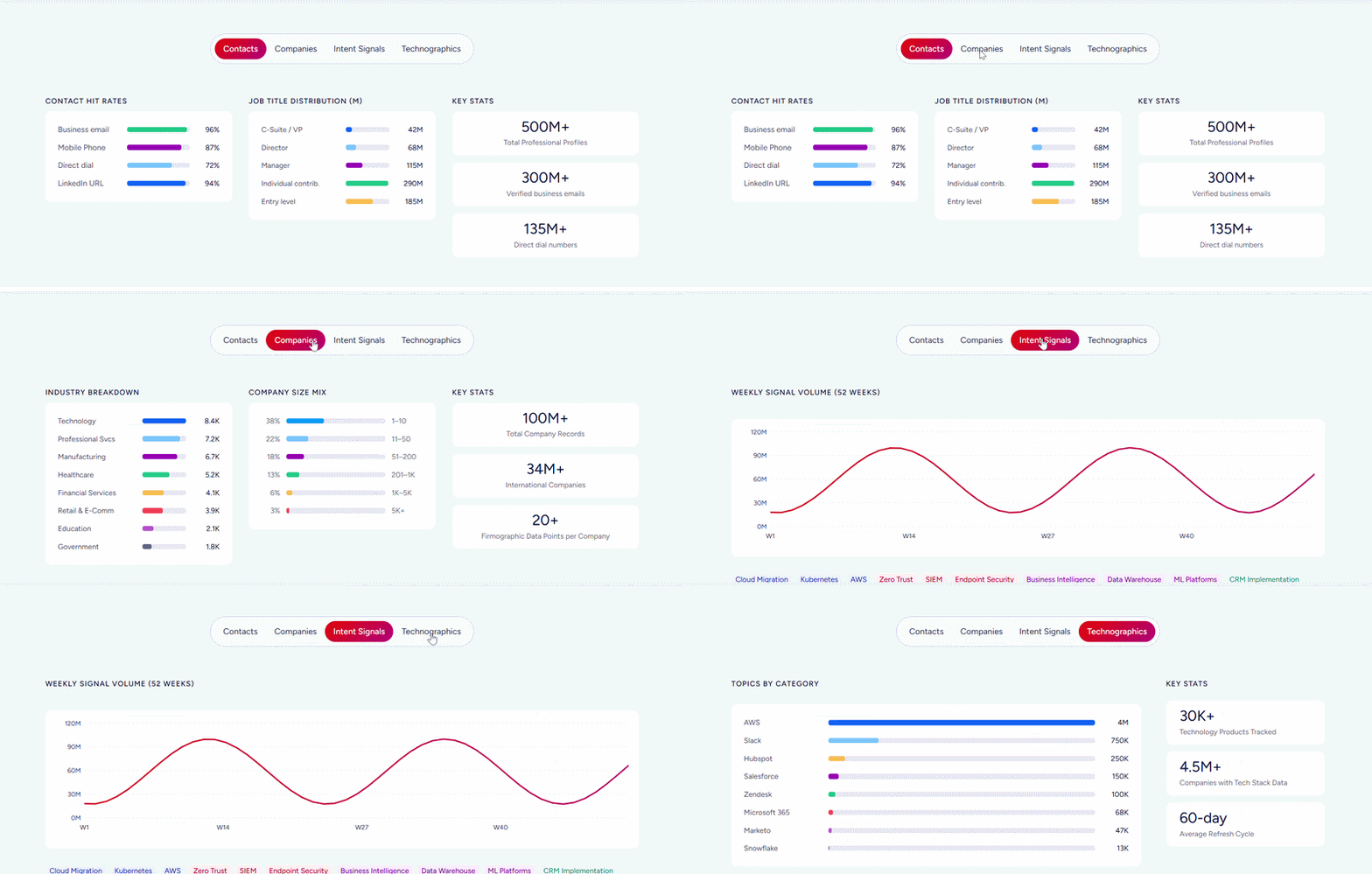
A Fortune 500 competitive RFP analyzing 25 million contacts across vendors concluded that "no other competitor came even close."
The data flows into Salesforce, HubSpot, or other CRMs through native integrations and APIs. The enrichment happens automatically rather than requiring manual research by your sales team.
Snowflake uses ZoomInfo data for at least one-third of the most critical features in their Account Propensity Scoring model. Accounts monitored using ZoomInfo-powered scores showed 90% higher opportunity open rates and 2x higher customer conversion rates. (Snowflake case study)
Insightly wins on simplicity and speed-to-value
Insightly's core advantage over Salesforce is straightforward: you can get it running without hiring a consultant.
The platform's guided onboarding checklist walks administrators through setup in a structured sequence (navigation, objects, customization, data import), and the Admin's Beginner Guide breaks the process into four phases that a non-technical person can follow. Insightly claims this produces 2x faster go-live compared to competitors.
On G2, Insightly holds a 4.2/5 rating from 920+ reviews, with users consistently praising ease of use and support responsiveness. A 2024 Software Reviews report scored Insightly at 90% for Service Experience versus Salesforce's 87%.
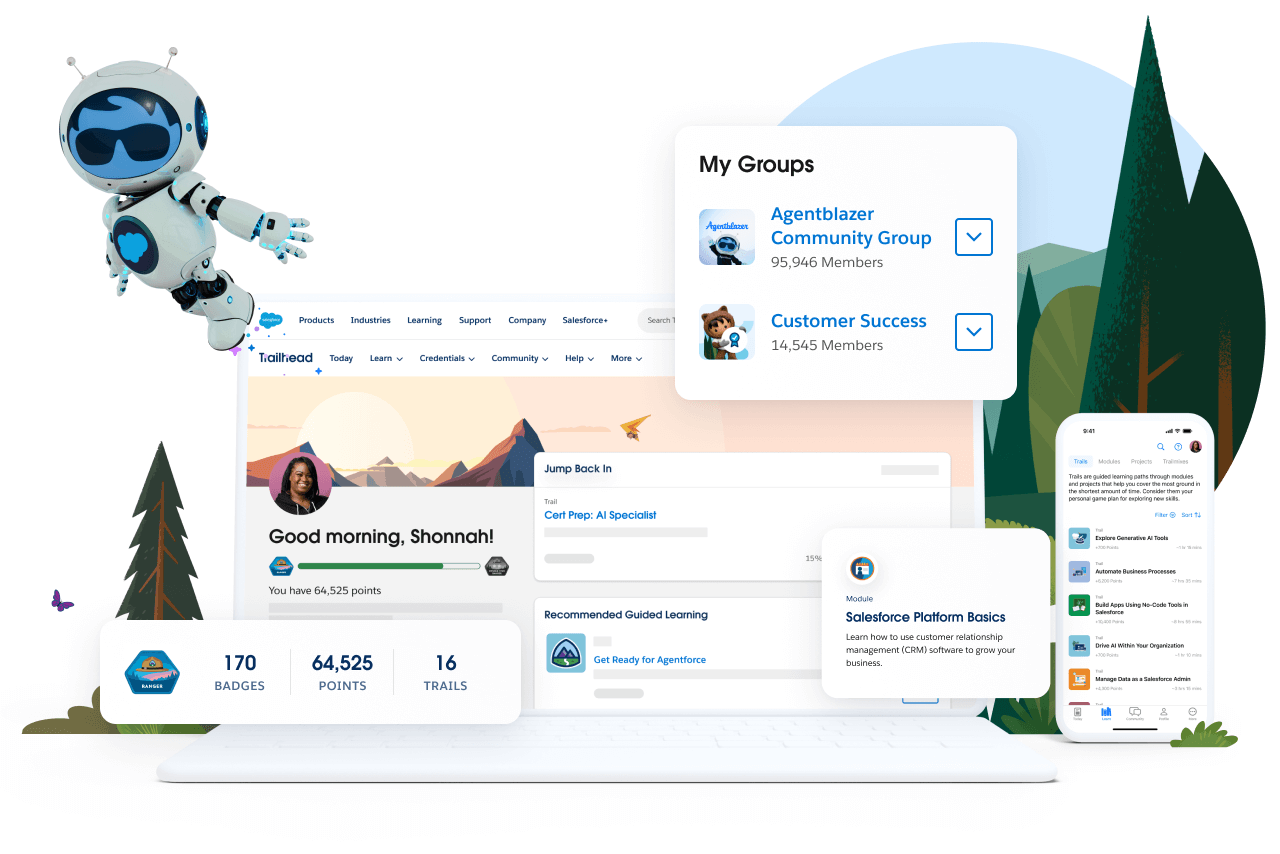
Salesforce, by contrast, requires real investment before it delivers value. The Lightning Experience interface is capable but dense. Configuring it beyond out-of-the-box capabilities requires trained administrators, and Trailhead (Salesforce's learning platform with 1,500+ badges) exists precisely because learning the platform is a significant undertaking.
Source: Salesforce
Implementation timelines range from weeks for simple Sales Cloud setups to 3-12 months for enterprise multi-cloud deployments.
For a 15-person sales team at a consulting firm, the difference between "productive in a week" and "productive in three months" is real revenue.
Salesforce dominates in depth, scale, and ecosystem
Where Insightly offers enough, Salesforce offers everything.
Sales Cloud alone covers lead management with Einstein Lead Scoring, pipeline management with AI deal insights, forecast management with real-time rollups, conversation intelligence with Call Explorer, revenue lifecycle management (CPQ, contracts, billing), and territory planning with commission management via Salesforce Spiff. That's one cloud out of a dozen.
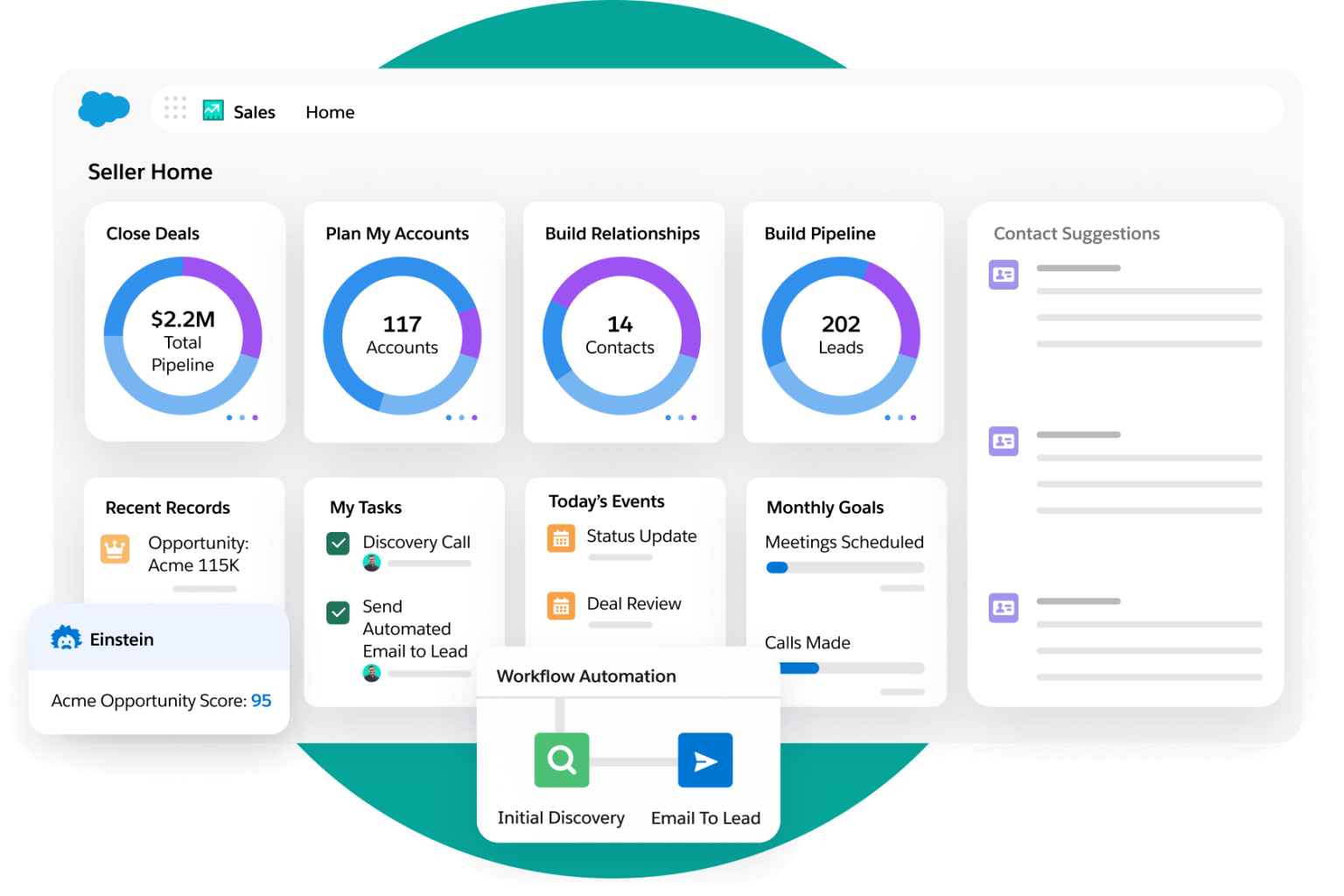
The breadth compounds. Service Cloud gives you omnichannel case management across chat, SMS, WhatsApp, and voice. Marketing Cloud handles B2C journey orchestration and B2B lead nurturing. Commerce Cloud powers storefronts for over two billion shoppers. Data Cloud ingested 112 trillion records in FY26. And the AppExchange marketplace offers 9,000+ partner apps with 14+ million installs.
Insightly cannot match this breadth. Its marketing automation, service module, and AppConnect integrations cover the basics, but organizations with complex multi-department needs will eventually hit walls. Capterra reviewers note that organizations often outgrow Insightly as they scale, with performance slowdowns under larger datasets or high-concurrency usage.
The question is whether you need all of it. Many mid-market teams pay for Salesforce's depth and use 20% of it.
Post-sale project delivery separates Insightly from every other CRM
This is Insightly's most distinctive feature, and it's unique at its price point.
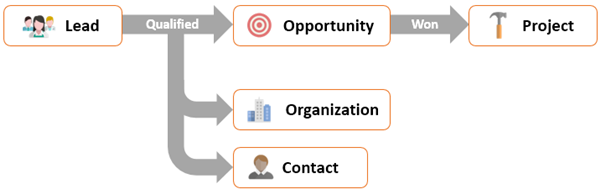
When a sales rep marks an opportunity as won in Insightly, they can convert it into a project from the Actions menu. The project inherits all linked contacts, organizations, tasks, and files. From there, the delivery team manages the work using the same pipeline and milestone model the sales team used for the deal.
Source: Insightly
For professional services firms, agencies, consultancies, and any business where "closing the deal" is the beginning of the work rather than the end, this eliminates the handoff friction that plagues teams using separate CRM and project management tools.
Salesforce can accomplish this through configuration, custom objects, or AppExchange tools, but it's not a native one-click workflow. The gap between "built-in" and "possible with configuration" matters when you're a 50-person firm without a Salesforce admin on staff.
AI capabilities reflect different maturity levels
All three platforms have AI strategies, but they're at different stages.
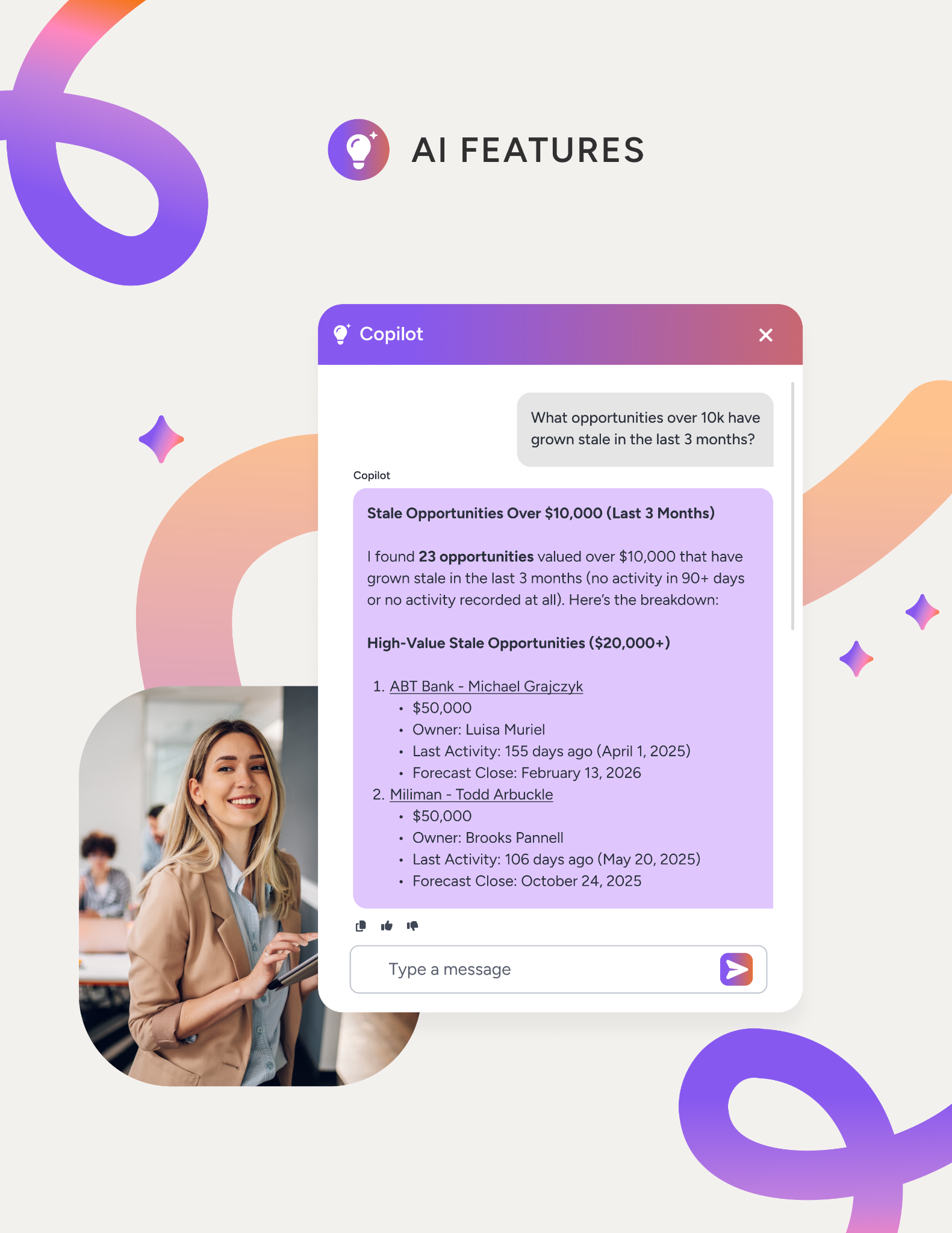
Insightly's Copilot (in Beta on Professional and Enterprise plans) handles natural-language CRM queries, email generation, record summarization, and data hygiene prompts. Usage is capped at 75 queries/month on Professional and 100 on Enterprise, with overage available at $19 per 100 additional queries.
Source: Insightly
It reduces routine CRM friction but is limited to the data already in your CRM. The underlying model is not disclosed, and the feature is not HIPAA-compliant.
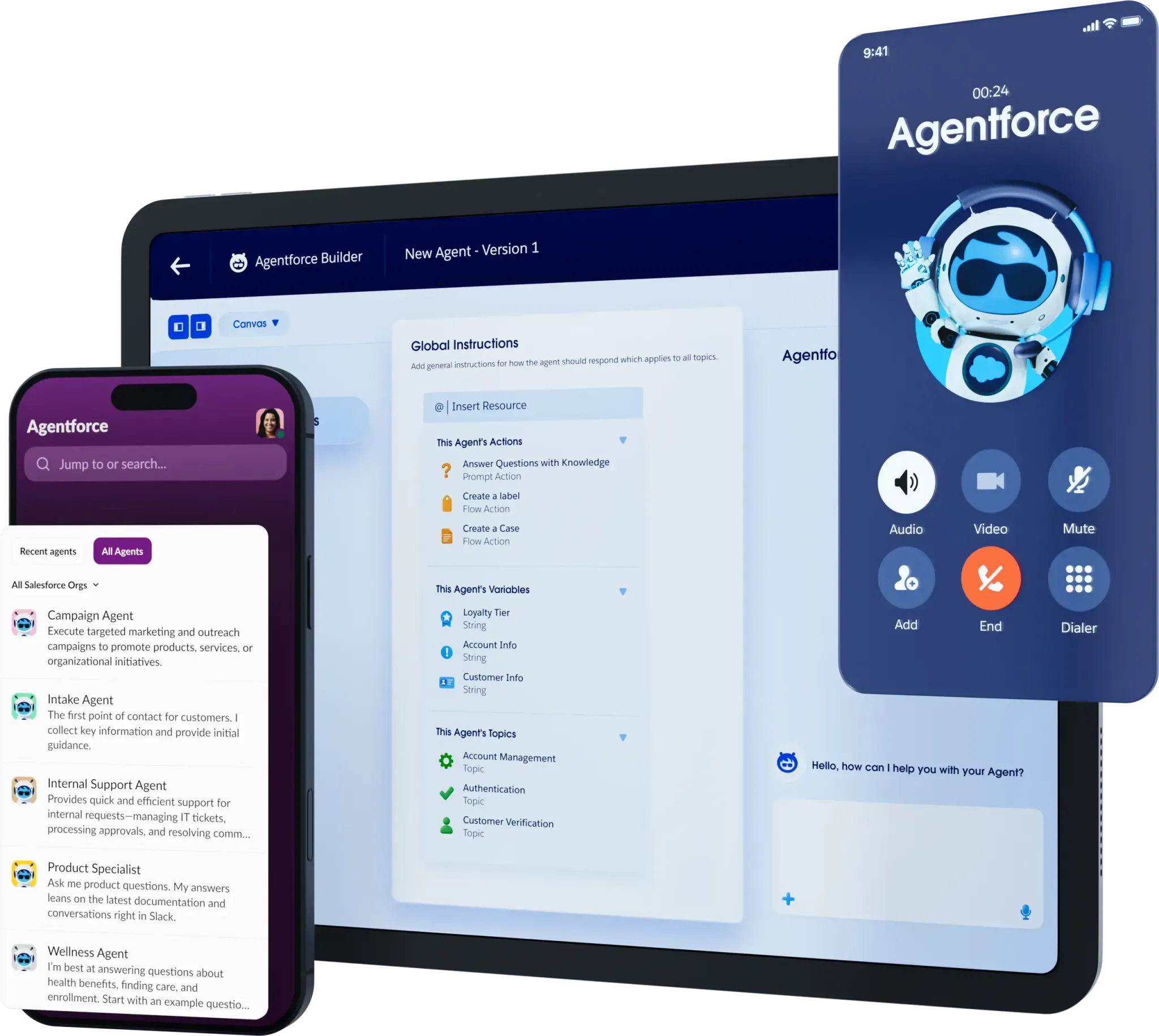
Salesforce's Agentforce is the most ambitious AI effort in the CRM market. Powered by the proprietary Atlas Reasoning Engine, it moves beyond copilot-style assistance to autonomous agents that can perceive, plan, and execute across any channel.
Source: Salesforce
The Einstein Trust Layer provides zero data retention with LLM partners, PII masking, and full audit trails. But Agentforce runs on your CRM data, and if that data is incomplete, the agents inherit the blind spots.
ZoomInfo's GTM Context Graph approaches AI from the data layer up. Instead of building agents on top of whatever data happens to be in your CRM, ZoomInfo fuses its 500M-contact B2B database with your CRM records, conversation intelligence from Chorus, and behavioral signals to create an intelligence layer that captures why deals move or stall.
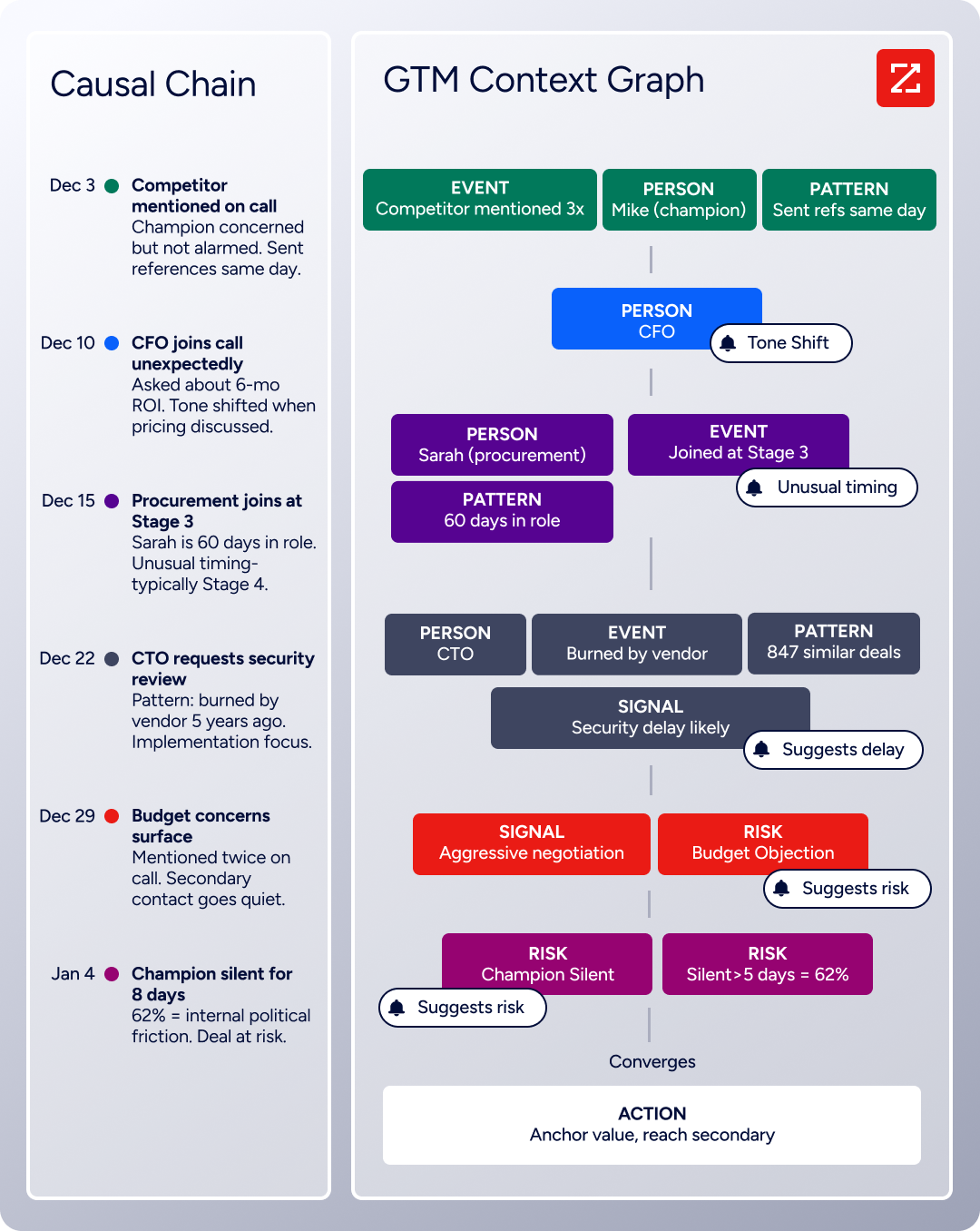
The AI agents in GTM Workspace don't just summarize your CRM fields. They reason across patterns from thousands of deals to tell sellers who to contact, when to engage, and what to say, grounded in verified external data that no CRM generates on its own.
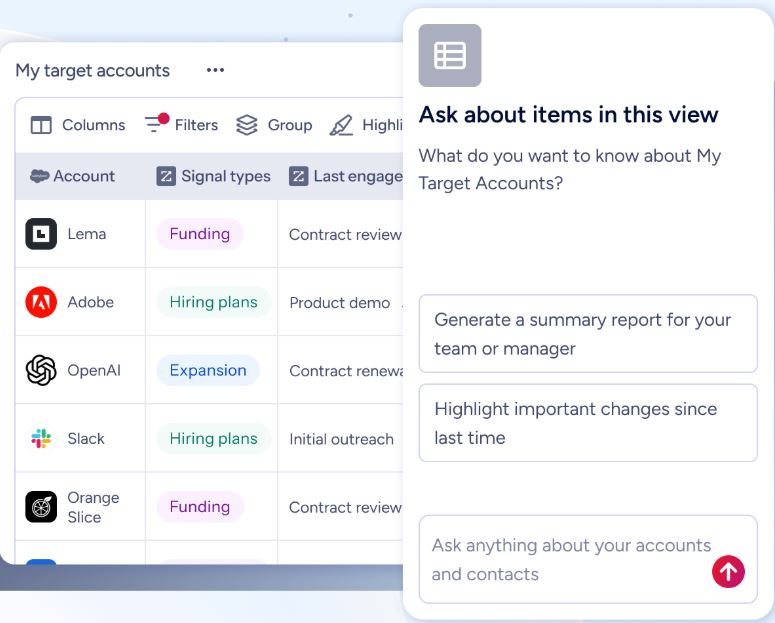
Seismic's sales team attributed 39% of active pipeline to opportunities identified or influenced by ZoomInfo signals, reported 54% productivity gains, and saved 11.5 hours per week per seller. (Seismic case study)
For a deeper look at how Salesforce and ZoomInfo compare across data, AI, and go-to-market capabilities, see our Salesforce vs. ZoomInfo comparison.
Pricing tells you who each platform is designed for
Insightly uses per-user, per-month pricing billed annually:
Plan | Price | Key limits |
|---|---|---|
$29/user/month | 100K records, 10 GB storage, no workflow automation | |
$49/user/month | 250K records, 100 GB, 50 automation rules, AI Copilot (75 queries/month) | |
$99/user/month | 500K records, 250 GB, products/quotes, SSO, sandbox |
Marketing Automation starts at $99/month (Plus) and scales to $999/month (Enterprise). AppConnect starts at $249/month plus a $3,000 setup fee. The All-in-One bundle (CRM + Marketing + Service + AppConnect) ranges from $349/month to $2,599/month.
Notable gaps on the Plus plan: no workflow automation, no custom objects, no SSO, no shared dashboards. Teams needing the full feature set will land on Professional or Enterprise.
Salesforce pricing starts lower but escalates:
Edition | Price |
|---|---|
$0 (max 2 users) | |
$25/user/month | |
$100/user/month | |
$175/user/month | |
$350/user/month |
But that's just Sales Cloud. Marketing Cloud starts at $1,500/org/month. Service Cloud Digital Engagement adds $75/user/month. Agentforce AI capabilities add $125/user/month or $500 per 100,000 Flex Credits. Premier Support costs 30% of net license fees. And most implementations require consulting partners.
ZoomInfo uses consumption-based pricing with no publicly listed prices. ZoomInfo Lite offers a permanent free tier with access to the B2B database, 10 monthly export credits, and basic features.
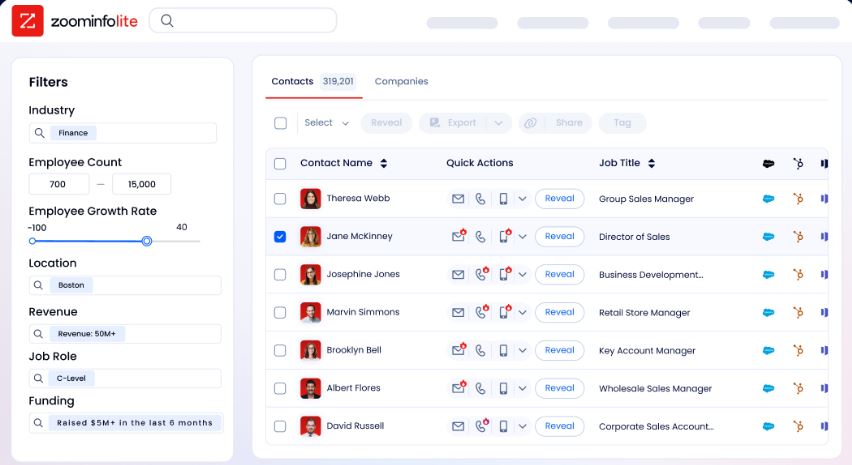
Paid plans scale based on seats, credit volume, and features. The pricing model reflects ZoomInfo's position as data infrastructure: you pay for the data and intelligence you consume, not for empty user licenses.
The critical comparison isn't license price per user. It's total cost to get your team productive with accurate data in front of them. Insightly's $49/user Professional plan with clean, manually maintained data may cost less in license fees than Salesforce Enterprise at $175/user, but if your team spends hours per week researching contacts and companies manually, the productivity gap dwarfs the license savings.
Integration approaches reveal different philosophies
Insightly connects to external tools through two paths: Zapier (available on all plans) and AppConnect (the native integration platform with 2,000+ connectors, starting at $249/month plus $3,000 setup). AppConnect supports polling triggers, real-time webhooks, scheduled bulk transfers, and conditional logic with error handling.
It runs on serverless AWS infrastructure and has guaranteed delivery even during downtime. For a mid-market platform, this is solid integration capability.
Salesforce operates the largest enterprise app ecosystem in the industry. AppExchange has 9,000+ apps and 14+ million installs. MuleSoft provides enterprise API management with hundreds of pre-built connectors.
The REST, SOAP, Bulk, and Pub/Sub APIs give developers programmatic access. AgentExchange, launched in 2025, adds a marketplace for AI agent components. The ecosystem is unmatched, though complexity scales with it.
ZoomInfo takes a different approach. Rather than building an app marketplace, ZoomInfo makes its data and intelligence accessible everywhere through APIs and the Model Context Protocol (MCP). The ZoomInfo App Marketplace lists 120+ native integrations with tools like Salesforce, HubSpot, and Snowflake. API access is included in all relevant plans, and the MCP server connects to AI assistants like Claude and ChatGPT.
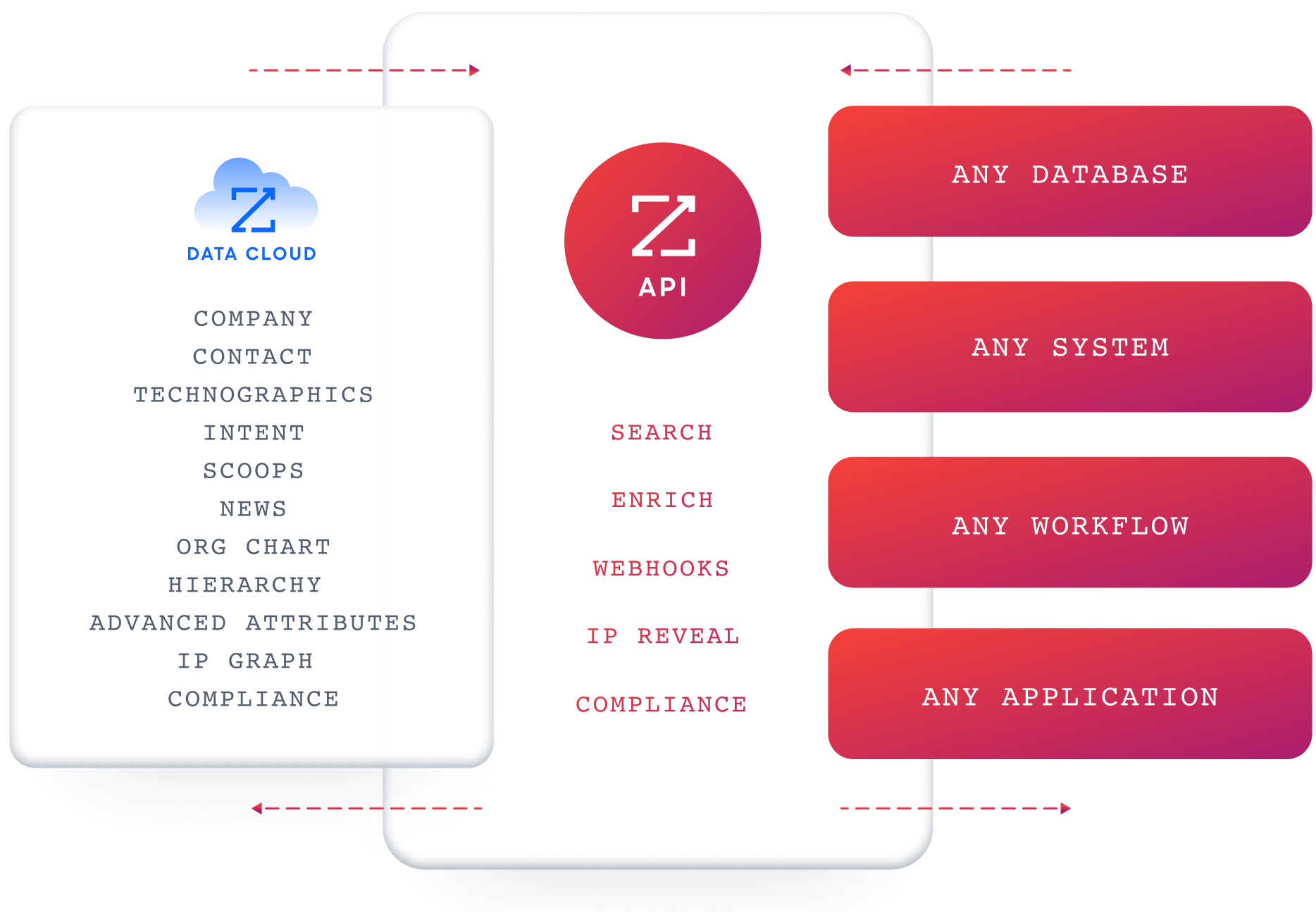
This means ZoomInfo's intelligence works inside whatever CRM or tool your team already uses, not as a replacement but as the data layer underneath.
BDO Canada activated ZoomInfo data within their internal systems via the API, achieving an 87% reduction in time spent on data dashboard updates. (BDO Canada case study)
Security and compliance comparison
All three platforms take security seriously, but their certifications and compliance postures serve different audiences.
Insightly holds SOC 2 Type II and HIPAA compliance (platform-level, excluding AI Copilot), with GDPR and CCPA addressed through its MSA and DPA. SAML/SCIM SSO is Enterprise-only. Insightly explicitly states it is not designed for SOX or GLBA compliance. Databases are backed up daily with encryption, and the platform discloses a 99.95% uptime track record.
Salesforce offers the broadest compliance coverage: ISO 27001/27017/27018, SOC 1/2/3, FedRAMP (Government Cloud), and HITRUST. Salesforce Shield adds event monitoring, platform encryption with BYOK, and field audit trail as a premium add-on. Hyperforce enables regional data residency across multiple countries.
For regulated industries (financial services, healthcare, government), Salesforce's compliance stack is the most extensive of the three.
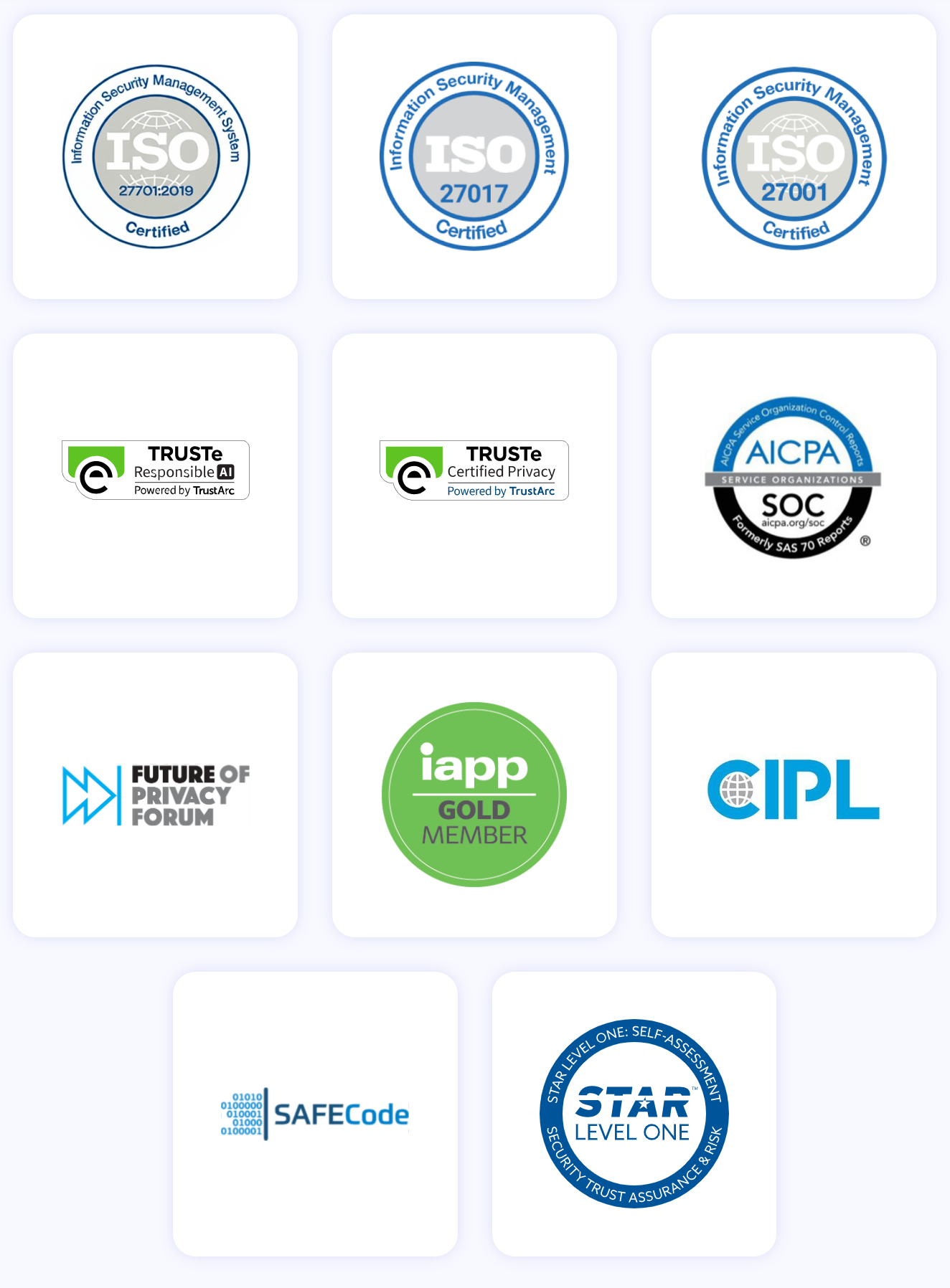
ZoomInfo holds ISO 27001, ISO 27701, SOC 2 Type II, TRUSTe GDPR, and TRUSTe CCPA certifications, all renewed annually. It's a registered data broker in California and Vermont. The compliance emphasis matters because ZoomInfo handles third-party contact data at scale, where privacy regulations apply directly to the data collection and verification process itself.
Insightly vs. Salesforce vs. ZoomInfo: Which should you choose?
The right choice depends on where your biggest gap is: CRM functionality, enterprise scale, or data and intelligence.
Choose Insightly if:
You're a mid-market team (50-500 employees) that needs CRM, marketing, and service in one platform
Fast implementation without consultants matters more than configurability
Your business delivers projects after closing deals (professional services, consulting, agencies)
You want Salesforce-level governance features (approval processes, custom objects, role hierarchies) at mid-market prices
Your team will actually adopt a simpler tool over a more capable one they ignore
Choose Salesforce if:
You need the broadest feature set across sales, service, marketing, commerce, and analytics
Your organization has (or will hire) dedicated Salesforce administrators
Enterprise compliance requirements (FedRAMP, HITRUST, SOX-adjacent controls) are non-negotiable
You're building on a platform ecosystem with 9,000+ apps and a 20-million-member community
Budget and implementation timeline are secondary to capability breadth
Choose ZoomInfo if:
Your CRM's biggest problem is the data inside it, not the CRM itself
Your sales team spends hours researching accounts and contacts manually before outreach
You need verified B2B contact data, buyer intent signals, and real-time buying intelligence
You want an intelligence layer that works inside your existing CRM (Salesforce, HubSpot, or others) through native integrations, APIs, and MCP
You're moving from reactive pipeline management to proactive, signal-driven selling
See how ZoomInfo works and how the GTM Context Graph can improve your go-to-market execution.
The best go-to-market teams don't treat CRM selection and data strategy as separate decisions. Insightly and Salesforce organize your customer relationships. ZoomInfo ensures those relationships are built on accurate, complete, and timely intelligence. For teams serious about pipeline growth, the CRM is the container. The data is the fuel.
"ZoomInfo has always been the most accurate source for decision-maker data," said Kevin Neely, VP of Brand Partnerships at Levanta. (Levanta case study)
Insightly vs. Salesforce vs. ZoomInfo FAQ
What is the main difference between Insightly and Salesforce?
Insightly is a CRM platform designed for mid-market teams, combining sales CRM, marketing automation, customer service, and project management in one system with fast implementation and lower total cost of ownership.
Salesforce is the industry's largest CRM platform, offering the broadest feature set across sales, service, marketing, commerce, analytics, and AI, but requiring dedicated administrators, longer implementation timelines, and higher investment.
Which CRM is easier to implement?
Insightly is easier to implement. It offers a guided onboarding checklist and claims 2x faster go-live than competitors. Most teams can be productive in days to weeks without outside consultants. Salesforce implementations range from weeks (simple Sales Cloud) to 3-12 months for multi-cloud enterprise deployments, and over 70% of implementations are partner-led.
How does pricing compare between Insightly and Salesforce?
Insightly CRM ranges from $29 to $99 per user per month. Salesforce Sales Cloud ranges from free (2 users) to $550 per user per month. However, Salesforce's total cost includes add-ons for marketing ($1,500+/org/month), AI capabilities ($125/user/month or consumption-based), Premier Support (30% of license fees), and typically partner-led implementation.
Insightly's AppConnect integration platform adds $249/month plus a $3,000 setup fee, and Marketing Automation starts at $99/month.
Can Insightly replace Salesforce for a growing company?
Insightly can replace Salesforce for mid-market companies that prioritize ease of use, faster implementation, and lower total cost of ownership, particularly in professional services, consulting, and agencies where post-sale project management is a core workflow.
However, organizations needing enterprise features like FedRAMP compliance, industry-specific clouds across 17 verticals, or an app marketplace with 9,000+ solutions will find Salesforce's depth necessary.
Where does ZoomInfo fit if I already have a CRM?
ZoomInfo is not a CRM replacement. It is a B2B data and intelligence platform that integrates with your existing CRM to solve the data quality problem. ZoomInfo enriches your Salesforce, HubSpot, or other CRM with verified contact and company data, layers on buyer intent signals and buying group intelligence, and provides AI-powered prospecting and engagement tools.
The integration works through native connectors, APIs, and MCP so the intelligence is available wherever your team works.
Which platform has the best AI capabilities?
Salesforce's Agentforce is the most mature CRM AI, with autonomous agents that can resolve support cases, draft outreach, and manage deals across any channel. Insightly's Copilot is in Beta and handles natural-language CRM queries and email generation with capped monthly usage.
ZoomInfo's GTM Context Graph takes a different approach, applying AI to the data layer itself to identify which accounts are in-market, why deals are moving or stalling, and what actions will drive the next outcome, grounded in verified third-party data rather than CRM fields alone.
How do the platforms handle marketing automation?
Insightly Marketing is a native module with journey building, prospect scoring and grading, landing pages, and A/B testing, starting at $99/month. Salesforce Marketing Cloud is a full enterprise marketing platform covering B2C cross-channel engagement, B2B automation (formerly Pardot), personalization, and analytics, starting at $1,500/org/month.
ZoomInfo's GTM Studio enables marketers to build audiences using natural language, launch multi-channel plays (email, ads, direct mail), and measure pipeline impact, powered by the GTM Context Graph rather than CRM data alone.
Which platform is best for a professional services firm?
Insightly has a structural advantage for professional services firms because it natively converts won opportunities into managed projects within the same platform. This eliminates handoff friction between sales and delivery teams and keeps the full client lifecycle (prospect to deal to project to relationship) in one system. Salesforce can achieve similar workflows through configuration but lacks this as a built-in feature.
ZoomInfo complements either CRM by providing verified contact data and buying signals that help professional services firms identify and reach the right prospects.
