

Koala was one of the best intent signal tools for product-led growth companies. It deanonymized website visitors, surfaced product usage signals, and triggered rep outreach at the right moment, earning loyal customers among B2B SaaS teams like Vercel, Retool, and Deepgram. Then, in July 2025, Cursor (Anysphere) acquired Koala and shut the product down on September 30, 2025.
If you're here searching for a Koala review, you're in one of two situations: you used Koala and need to know what replaces it, or you heard about it and want to know whether something similar exists. This review covers what Koala did well, where it fell short, and what to consider now that it's gone.
Koala was the ideal choice if:
You ran a product-led growth motion and needed to convert free users into paying customers
You wanted first-party intent signals from website visits and product usage in a single view
You needed fast setup (a single JavaScript pixel) without weeks of implementation
You prioritized signal quality for a small, targeted sales team
Your go-to-market centered on B2B SaaS with a developer or technical buyer audience
However, Koala had clear limitations:
It was a signal layer only, not a complete execution platform (you still needed separate tools for sequencing, dialing, and CRM management)
Its value depended on having website traffic and a self-serve product, limiting usefulness for outbound-heavy or early-stage companies
Third-party enrichment data had gaps, particularly for visitor-level identification and firmographic completeness
Pricing scaled quickly: the Growth plan at $1,000/month covered only 3 seats
And most critically, the product no longer exists
For teams that relied on Koala's intent signals and visitor identification, the next step is a platform that covers those capabilities while providing the data, execution tools, and stability that Koala lacked.
ZoomInfo is a GTM platform built on a B2B data foundation of 500M contacts and 100M companies, 135M+ verified phone numbers, and 200M+ verified business emails. Its GTM Context Graph combines ZoomInfo's data with your CRM records and behavioral signals to show what happened and why. That intelligence powers GTM Workspace for sellers, GTM Studio for marketers and RevOps, and APIs and MCP for any front-end, covering everything Koala did while adding the data, execution tools, and stability that 35,000+ companies rely on.
We cover ZoomInfo in detail later in this review as the recommended alternative for former Koala users. If you want to explore it now, you can start with ZoomInfo's free trial here.
What Was Koala?
Koala was a sales intelligence platform founded in January 2022 by Tido Carriero, Netto Farah, and Matthew Shwery, three engineers who had worked together at Segment. The founding thesis was simple: sellers lost deals not because they lacked effort but because they lacked context. Behavioral data, product usage signals, and intent indicators were locked inside product analytics infrastructure and never reached the sales floor.
The company was incorporated as Konfetti, Inc. and headquartered in San Francisco. It raised approximately $20 million across two rounds, including a $15 million Series A led by CRV with participation from HubSpot Ventures, Recall Capital, and Afore Capital, closed in February 2025.
Koala's product had three core modules: Koala Data (a B2B customer data platform for revenue teams), Intent Signals (first-party and behavioral signals scored by AI), and Automations (trigger-based plays that converted signals into outreach). A single JavaScript pixel captured website activity, product usage, and email click-throughs. Koala then surfaced active accounts, scored them by intent, and triggered the right rep action.
The platform's customers page claimed over $400M in pipeline accelerated, $169K in pipeline accelerated per hour, and more than 1 billion intent signals processed annually. Notable customers included Vercel, Retool, Hightouch, Sanity, Dolby, Deepgram, and DX.
Five months after closing its Series A, Cursor (Anysphere) acquired Koala in July 2025. The deal was an acqui-hire to build Cursor's enterprise readiness team. All three founders joined Cursor, and the Koala product shut down on September 30, 2025.
Koala Pros & Cons
Pros | Cons |
|---|---|
First-party intent data with high PLG identification rates (75%+) | Product shut down; no longer available |
Fast self-serve setup via a single JavaScript pixel | Signal layer only; still needed separate tools for sequencing and CRM |
AI-powered intent scoring across 30+ signal sources | Third-party enrichment data had gaps in visitor clarity |
Clean interface praised by SDRs and AEs | Limited value without meaningful website traffic or a product |
Strong product usage signal integration for PLG companies | Growth plan ($1,000/month) covered only 3 seats |
Direct integrations with HubSpot, Salesforce, Apollo, Outreach | Reporting customization was limited |
SOC 2 Type II certified | Thin G2 review volume (approximately 30 reviews) |
Koala Review: How It Worked & Key Features
Koala Data: A B2B CDP built for revenue teams, not generic analytics.
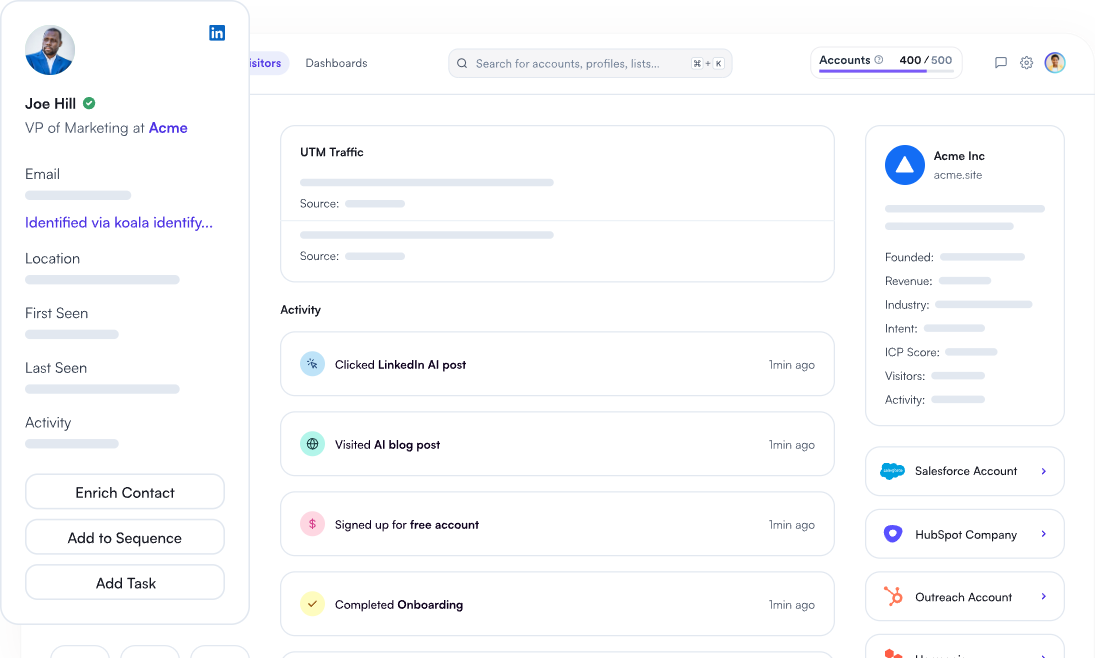
Koala Data was the platform's foundation. It combined three functions into a single prospect record: identity resolution, enrichment unification, and ICP scoring.
Source: Koala
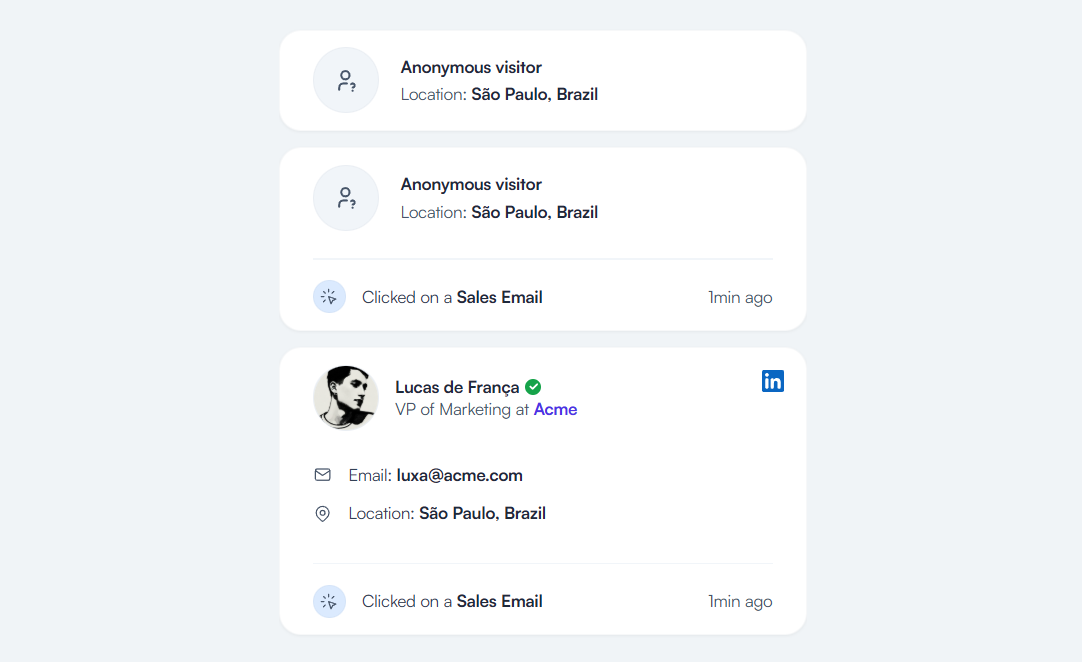
The identity resolution system used a lightweight tracking pixel that tracked page views and active session time. When a visitor was anonymous, the system still captured their behavior. The moment that visitor identified themselves (through an email click, product sign-up, or form submission), all previously anonymous activity attached to their known profile. This identity resolution worked across multiple devices and across logged-out to logged-in transitions, built on first-party signals without relying on third-party cookies.
For PLG companies, this produced strong results: Koala claimed to deanonymize more than 75% of traffic for PLG customers, compared to roughly 30% for non-PLG deployments. The difference came from the density of identity anchors that product sign-ups and in-app events generate.
Source: Koala
Enrichment pulled data from the customer's existing tools (CRM, contact enrichment databases) into one record. Waterfall enrichment across multiple data sources found and verified contact details. ICP scoring analyzed the customer's Closed Won population to derive a composite score based on firmographics and technographics, grounding the model in actual win patterns rather than assumptions.
Intent Signals: Aggregating behavioral data from 30+ sources into scored, actionable alerts.
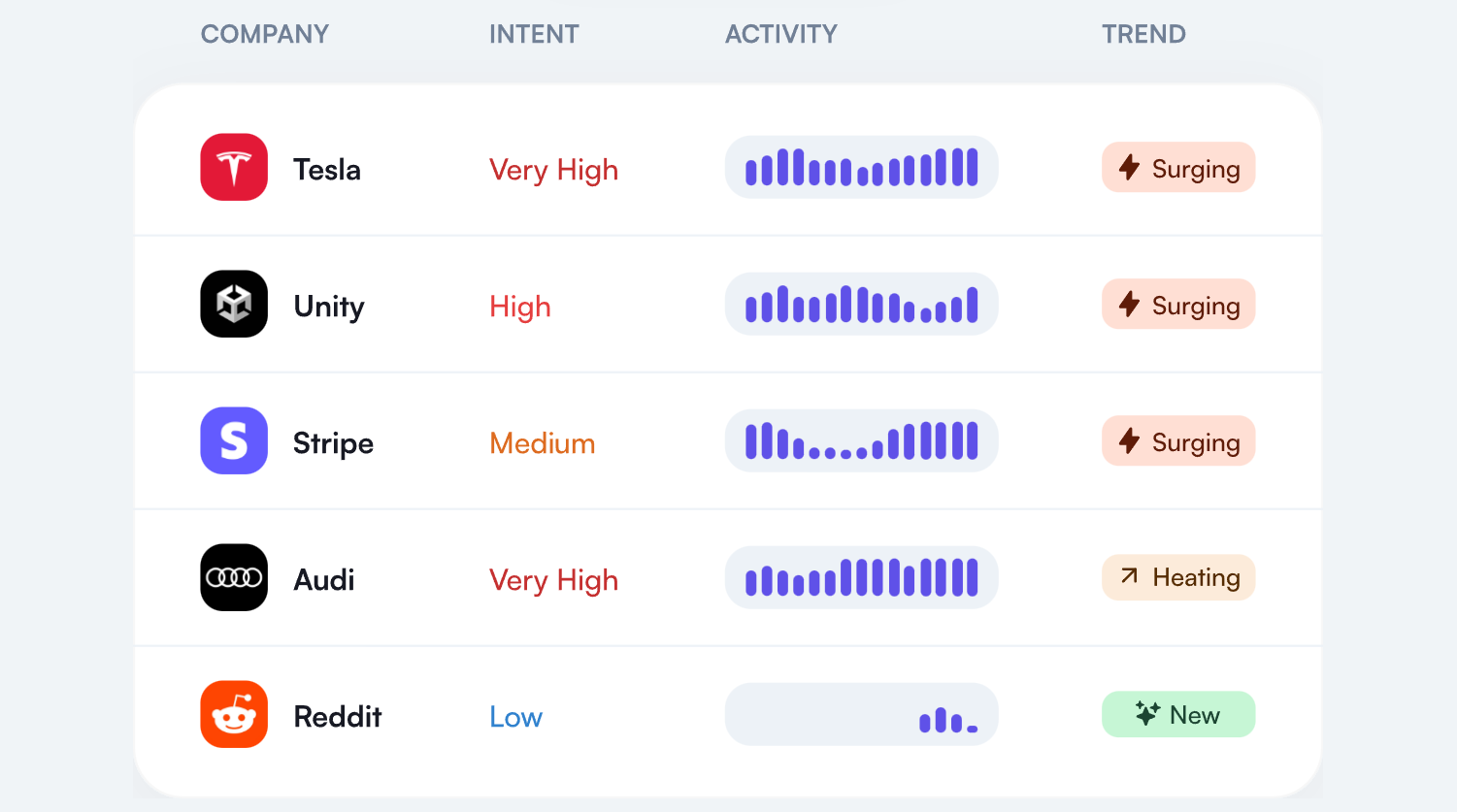
Intent Signals made raw data useful. It captured behavioral events across 30+ signal sources and ran them through an AI scoring model to estimate conversion likelihood.
Source: Koala
The signal sources spanned multiple categories. Website signals included page views, active session time, and form submissions. Email click-through tracking from sales outreach and marketing campaigns alerted reps when a prospect went live on site. Product signals surfaced onboarding status, milestone completions, feature adoption, invited users, plan type, and custom product events. Additional sources included data warehouses (Snowflake, BigQuery), community platforms (GitHub, LinkedIn, Slack, Discord), review sites (G2), and documentation tools (Mintlify, Readme).
Each signal was scored based on how often it preceded a conversion, then rolled up into an account-level intent score from 0 to 100. The system flagged accounts as "heating" or "surging" when score momentum increased, so reps could focus on accounts showing buying behavior rather than scanning dashboards.
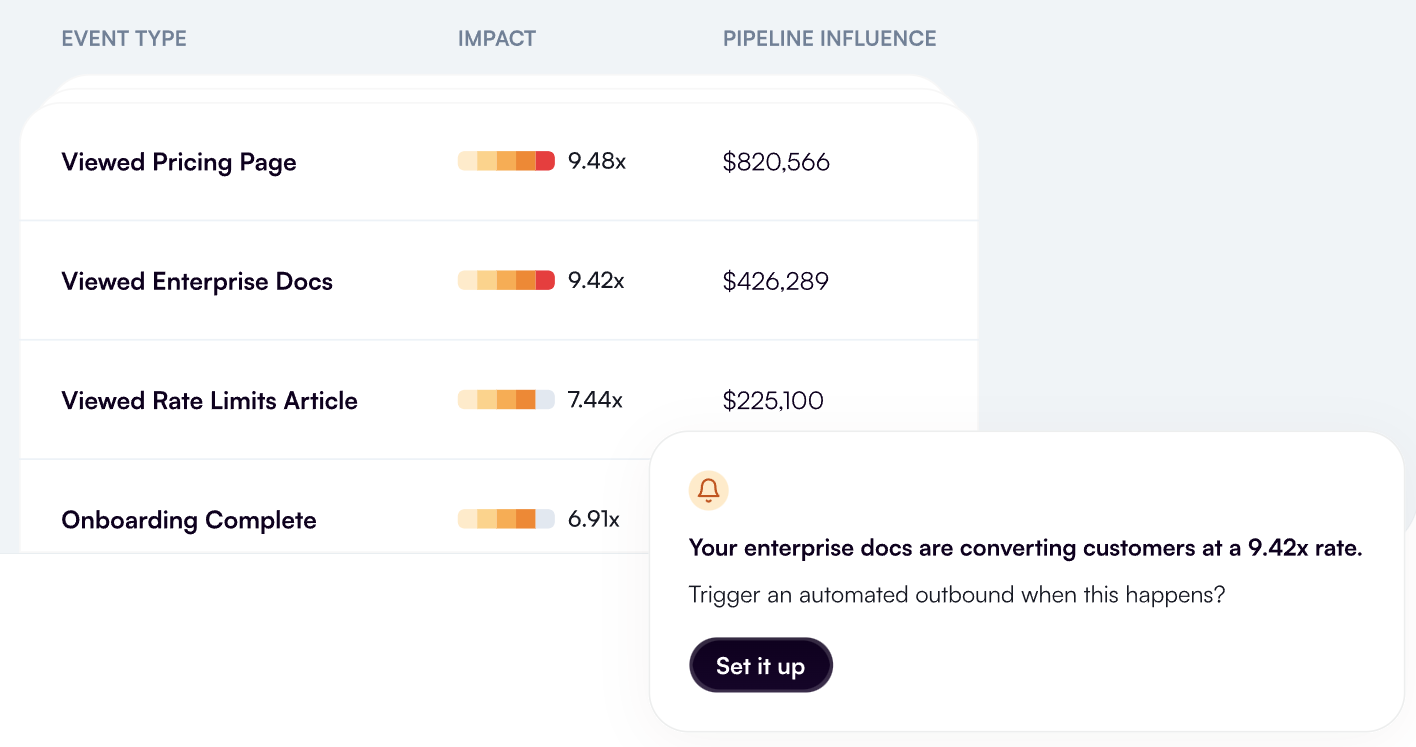
One notable feature was AI-powered Content Reports, which identified which page views and events correlated with conversion and suggested new signals the team hadn't yet configured. This made the signal library self-improving over time.
Source: Koala
Automations: Converting intent signals into outreach without manual intervention.
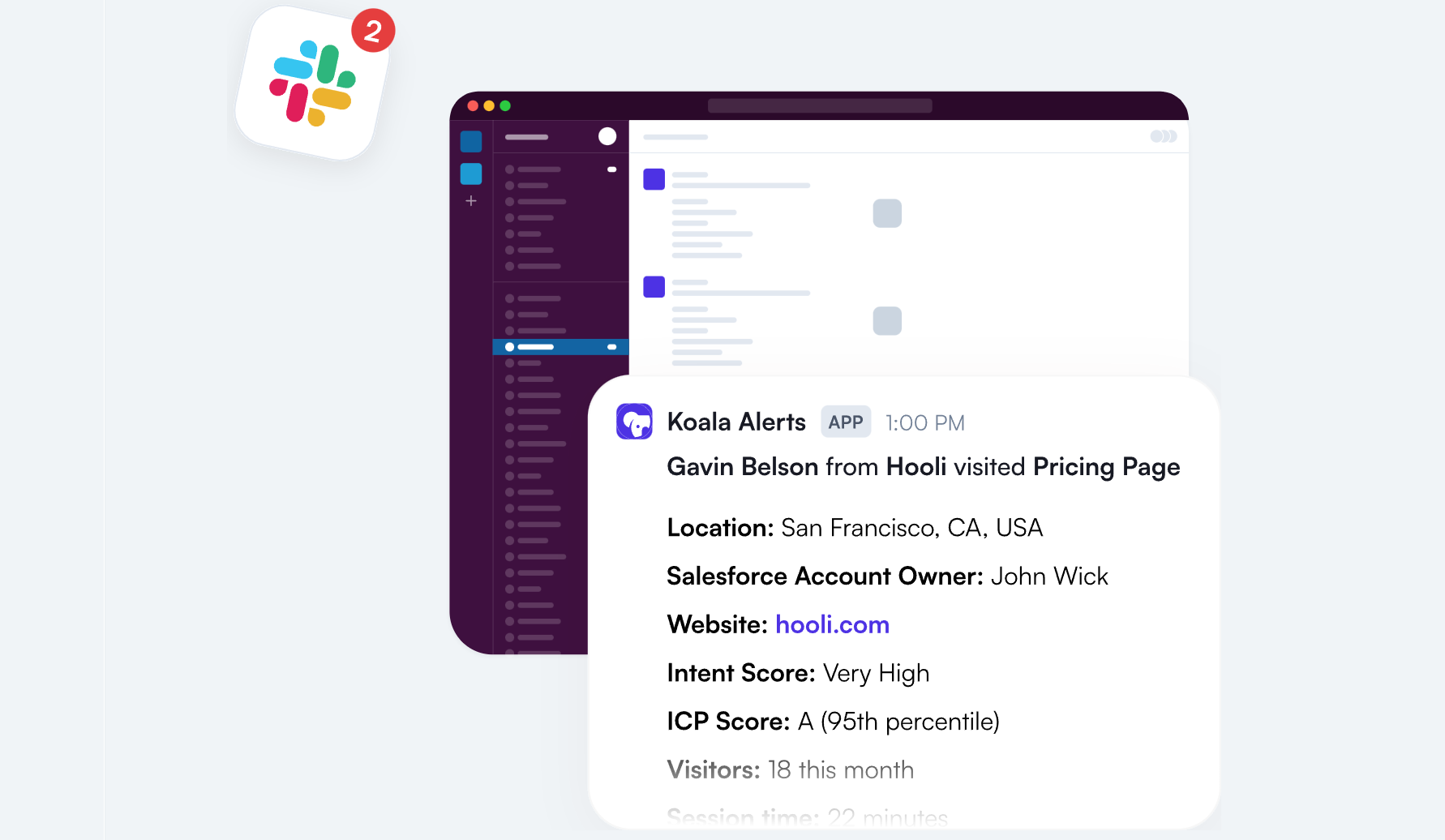
Koala Automations closed the gap between detecting a high-intent signal and acting on it. The system offered four activation channels: Slack Alerts (routed to the relevant rep when a signal fired), Actions (CRM and workflow updates), Auto Outbound (automatic sequence enrollment in connected sales engagement platforms), and Auto Prospecting (surfacing the right contacts at active accounts).
Source: Koala
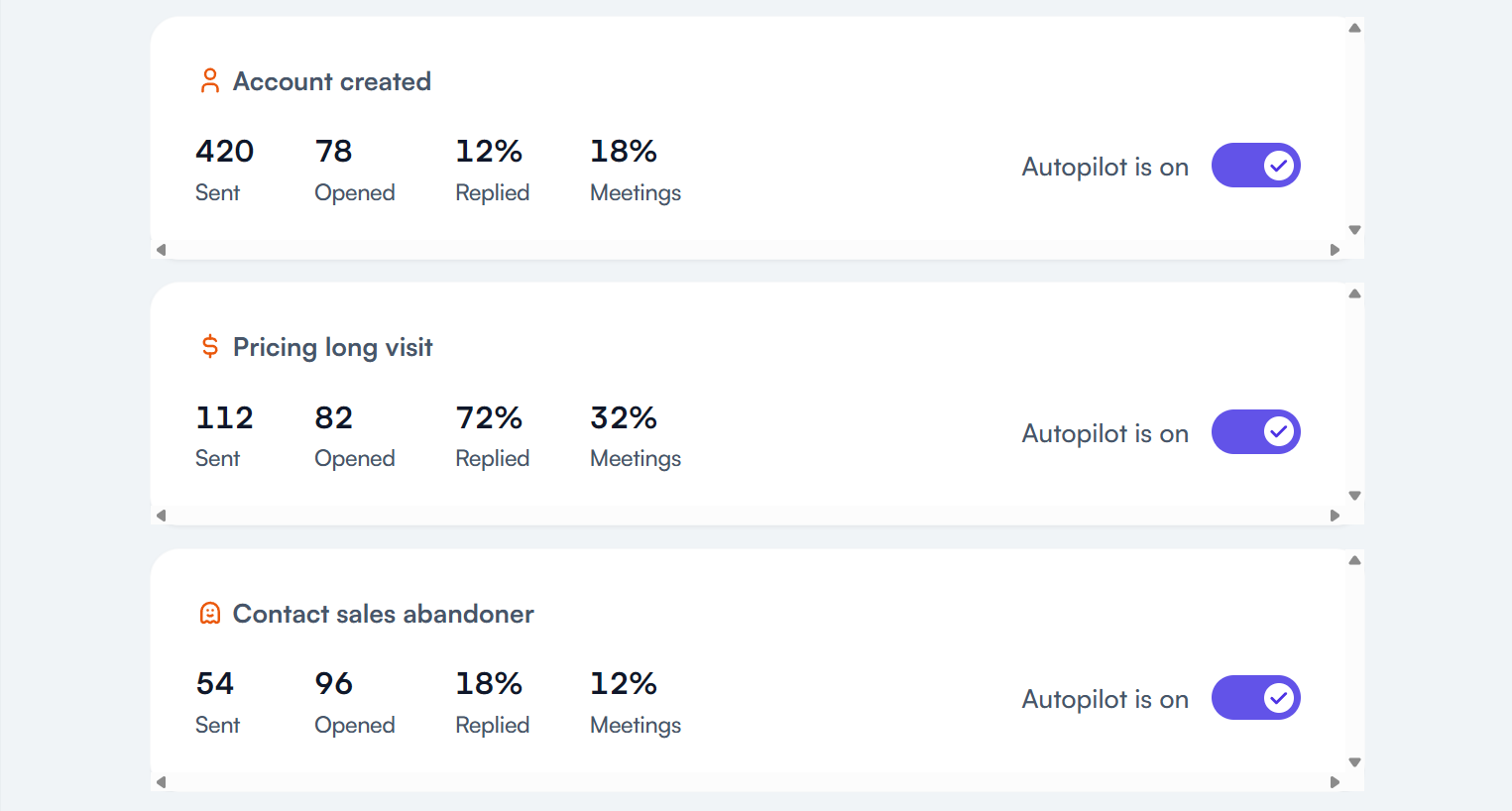
The automation layer mapped individual intent signals to individual sequences. A pricing page visit could trigger one sequence; a product re-engagement signal triggered another. This 1:1 signal-to-sequence mapping kept outreach relevant to what the prospect was doing, rather than applying a generic follow-up to all visitors. The Automations product page cited signal-based selling sequences achieving open rates of 75% and reply rates of 10-15%.
Source: Koala
Enrollment guardrails prevented existing customers, active deals, or prospects already in a conversation from being enrolled. Integration with HubSpot, Salesforce, Apollo, Outreach, Clay, and webhooks meant automations ran inside existing stacks.
On top of this trigger-action foundation, Koala added AI Qualification Agents and Research Agents through its Plays framework. These agents pre-enriched each enrolled prospect with account intelligence so that outreach (automated or rep-driven) could be personalized rather than generic.
Pricing: A credit-based model that scaled quickly for larger teams.
Koala used a hybrid seat-plus-credits model. Each plan bundled seats with a monthly credit allotment for enrichment and AI actions.
Tier | Price | Seats | Credits/Month |
|---|---|---|---|
Free | $0 | 2 | 100 |
Starter | $200/month | 2 | 1,000 |
Growth | $1,000/month | 3 | 5,000 |
Business | Custom | Custom | Custom |
The Free plan provided basic intent scoring, custom signals, trending accounts, and Slack alerts (capped at 250/month), but excluded CRM integration, email enrichment, AI agents, and most automation features. The Starter plan added CSV imports, email enrichment, and the Chrome Extension. The Growth plan unlocked everything: CRM integration, waterfall enrichment, AI Research Agents, automated outbound (100 sends/month), and content reports. The Business plan added multiple CRM connections, data warehouse integrations, and custom automation limits.
A 14-day free trial on the Growth tier was also available. Additional seats could be purchased, though per-seat pricing was not publicly disclosed.
Where Koala Fell Short
Koala earned praise from its users, but several structural limitations constrained it beyond a specific niche. Understanding these gaps matters for teams now evaluating replacements.
Signal layer without execution. Koala surfaced intent signals and scored accounts, but it did not handle outreach. Reps still needed Apollo, Outreach, or a similar sequencing tool alongside it. For teams already managing four or five sales tools, Koala added cost and complexity without replacing anything. The platform told you who to contact and when, but the actual engagement happened elsewhere.
Dependent on first-party traffic. Koala's value came from first-party intent signals on your website and product. Companies at early stages, with minimal web traffic and no free trial or freemium motion, had little raw material for the platform to work with. Signal quality dropped in outbound-only or offline-heavy models. This made Koala effective for a specific company profile (B2B SaaS with PLG motions) but limited outside it.
Enrichment gaps. G2 reviews cited missing firmographic and contact enrichment data, particularly for identifying the specific person behind an anonymous visit. The identity graph could not resolve every session to a known company or individual, and companies without a strong first-party data foundation saw lower identification rates and less useful output.
Reporting limitations. Customers wanted more granular, customizable reporting, particularly filtering pipeline impact by persona, segment, or campaign type. The analytics layer worked for identifying intent but did not match the depth of dedicated BI or RevOps reporting tools.
Cost scaling for teams. The Growth plan at $1,000/month covered only 3 seats. Larger SDR or AE teams hit custom pricing discussions at relatively low headcount, a cost step that was hard to justify since Koala didn't replace any existing tool.
And then it disappeared. Koala was shut down on September 30, 2025. Every customer had to migrate off the platform. The acquisition came just five months after the Series A closed, catching users off guard. For teams that had built workflows around Koala's signals and automations, the shutdown created an immediate operational gap.
These were not failures of ambition. Koala solved a real problem for a specific audience. But the narrow focus, combined with the sudden shutdown, left former users looking for a platform that covers the same ground while offering the stability and breadth that Koala could not.
The Recommended Alternative for Former Koala Users: ZoomInfo
ZoomInfo addresses every limitation that constrained Koala while covering the same intent signal and visitor identification capabilities that made Koala valuable. Where Koala was a signal layer that required surrounding tools, ZoomInfo is a GTM platform that combines B2B data, an intelligence layer called the GTM Context Graph (which processes 1.5B+ data points daily), and execution tools for every GTM team, all in one place.
Founded in 2007 by Henry Schuck and publicly traded on NASDAQ under the ticker GTM, ZoomInfo serves 35,000+ companies including Adobe, Snowflake, Seismic, and Thomson Reuters. With $1.25 billion in annual revenue, this is not a startup that might get acqui-hired.
Comprehensive B2B Data: The foundation Koala never had.
Koala's data layer drew from first-party signals (your website, your product, your CRM). That worked for PLG companies with heavy site traffic, but it meant the platform was only as good as the data flowing through the customer's own properties. If your traffic was thin or your enrichment sources had gaps, Koala's output suffered.
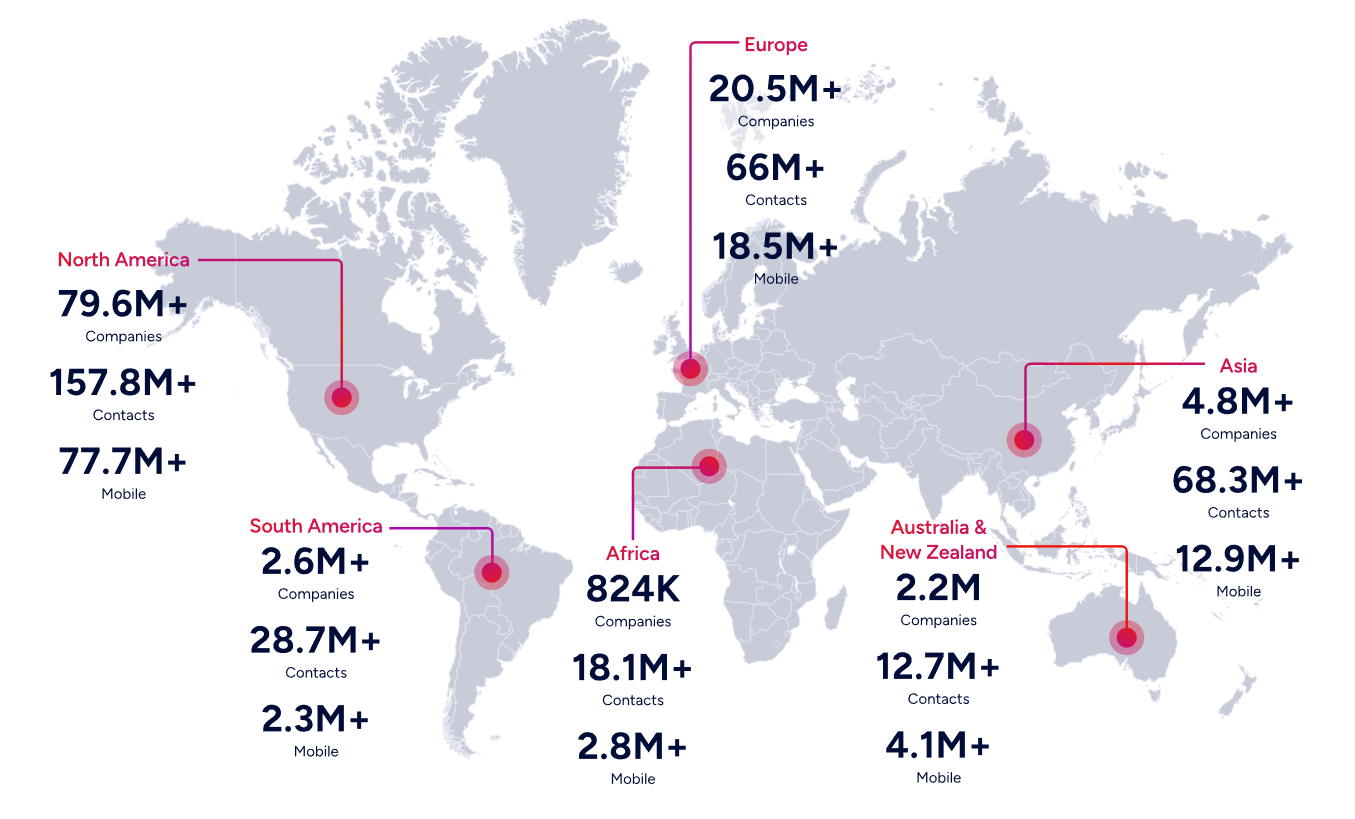
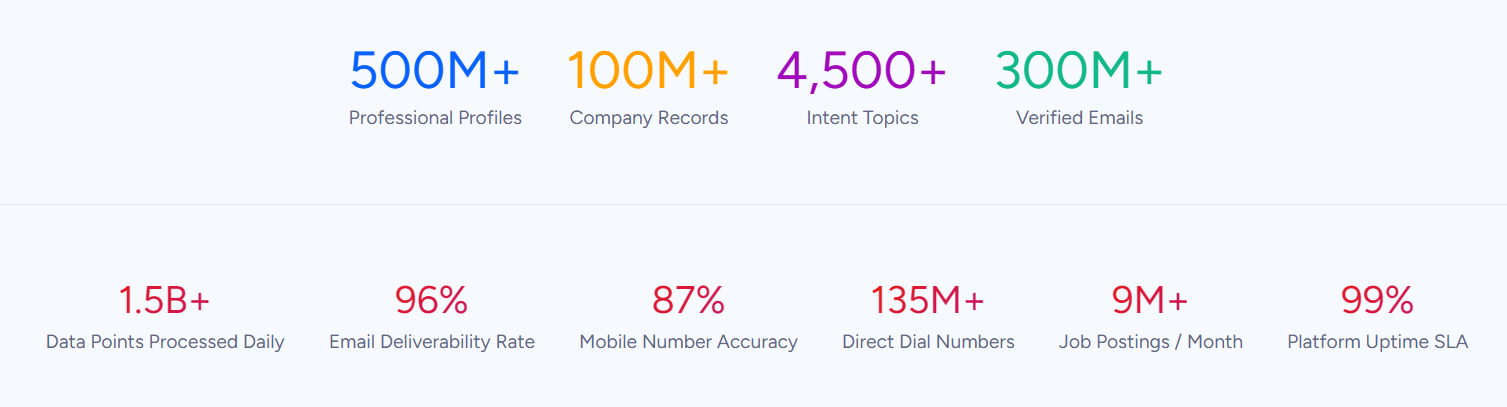
ZoomInfo operates a B2B data platform of 500M contacts, 100M companies, 135M+ verified phone numbers, 120M direct-dial phone numbers, and 200M+ verified business email addresses. 300+ human researchers and automated ML systems maintain this data, scanning 28 million site domains daily and reaching up to 95% accuracy on first-party data.
For teams that used Koala, this means the enrichment gaps disappear. When ZoomInfo identifies a company visiting your website through WebSights, it doesn't just resolve the company name. It surfaces the buying team with verified direct dials and email addresses, backed by company attributes and technographic data. No separate enrichment vendor needed.
The data advantage holds up to outside scrutiny. In a Fortune 500 competitive RFP analyzing 25 million contacts across vendors, the independent consultant concluded that "no other competitor came even close." ZoomInfo holds 133 No. 1 rankings on G2 across Sales Intelligence, Buyer Intent, Data Quality, and related categories.
"ZoomInfo gives us the information we need to execute. It's already there, so we can be three steps ahead." (Vensure)
Intent Signals and Website Visitor Tracking: Covering Koala's core use case with broader reach.
Koala's strongest feature was its intent signal aggregation, pulling behavioral data from 30+ sources and scoring accounts. ZoomInfo covers this through ZoomInfo Intent and WebSights, with broader signal coverage.
ZoomInfo Intent tracks signals from 210 million IP-to-Organization pairings and 6 trillion+ new keyword-to-device pairings sourced monthly. This combines third-party intent data (what companies research across the web) with first-party signals (what happens on your site). Guided Intent, exclusive to ZoomInfo, identifies topics correlated with deal success rather than requiring manual topic selection, similar in philosophy to Koala's AI-powered Content Reports but applied to a far larger dataset.
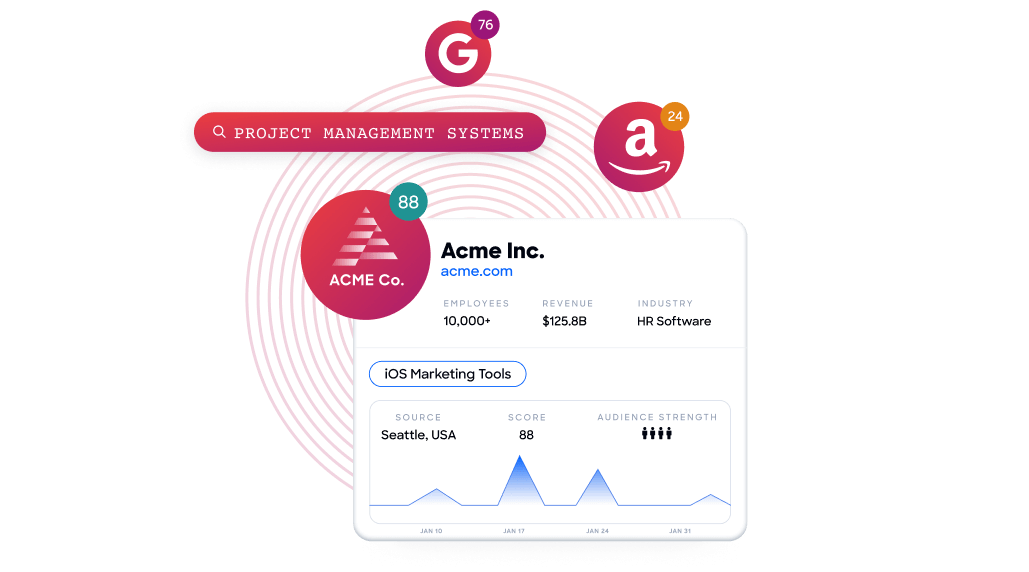
WebSights resolves anonymous traffic to companies, including buying team identification and direct contact information. It includes automatic traffic filtering to distinguish real company traffic from bots, preventing false signals from polluting your data.
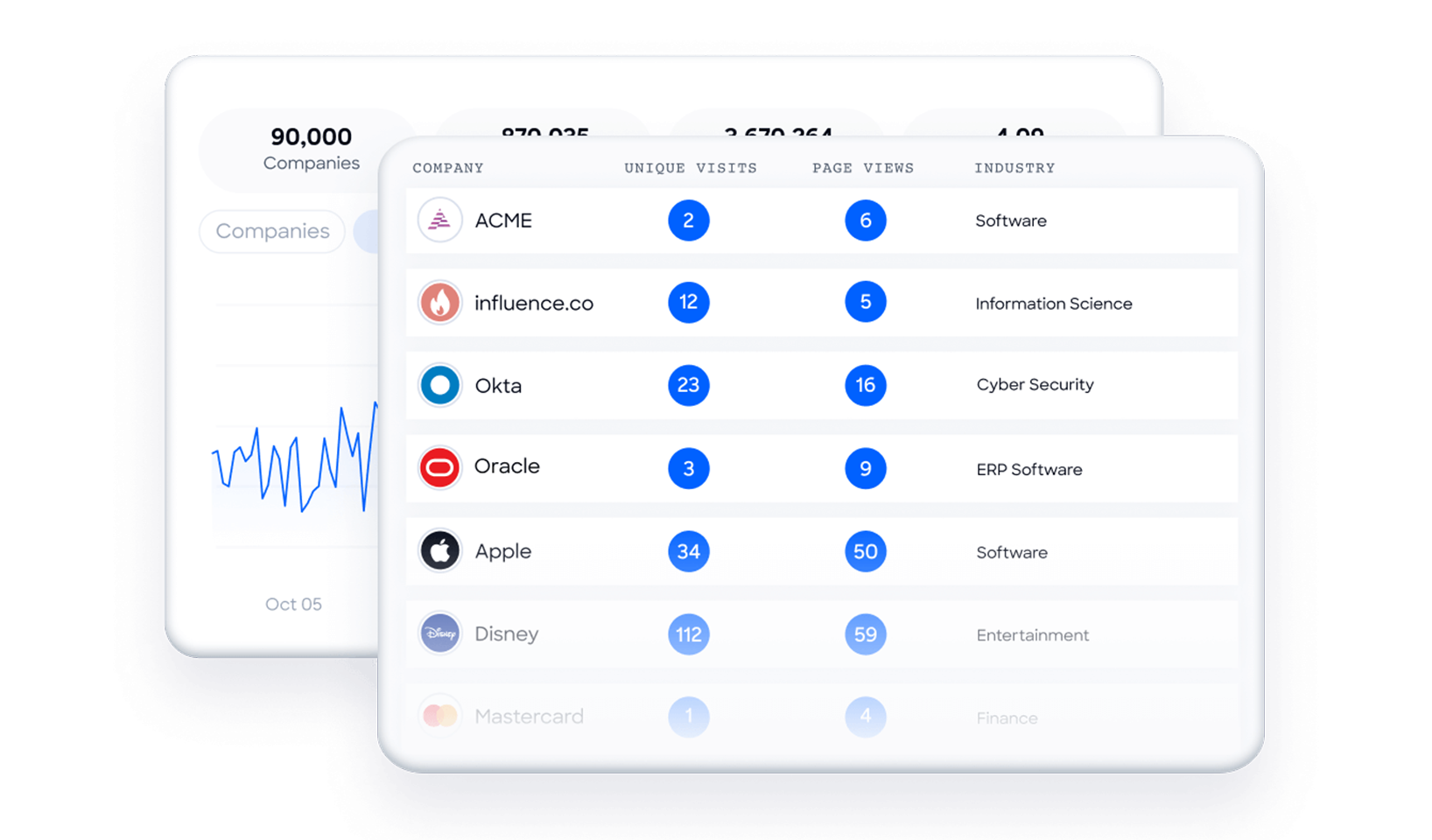
Where Koala had an advantage for PLG companies was in product usage signal ingestion: it natively surfaced onboarding milestones, feature adoption, and usage limits. ZoomInfo approaches this differently. Its GTM Context Graph fuses CRM records, conversation intelligence, and behavioral signals with ZoomInfo's B2B data. The result is a broader intelligence layer that captures what happened and why, drawing from a wider set of data sources than Koala's first-party-only approach.
Seismic attributed 39% of active pipeline to opportunities identified or influenced by ZoomInfo signals, with the sales team becoming 54% more productive. (Seismic)
Execution Tools: From signals to action without leaving the platform.
Koala's biggest structural gap was that it surfaced signals but couldn't act on them. You needed Apollo or Outreach to run sequences, Salesforce or HubSpot for CRM management, and often additional tools for enrichment and routing. ZoomInfo closes this loop.
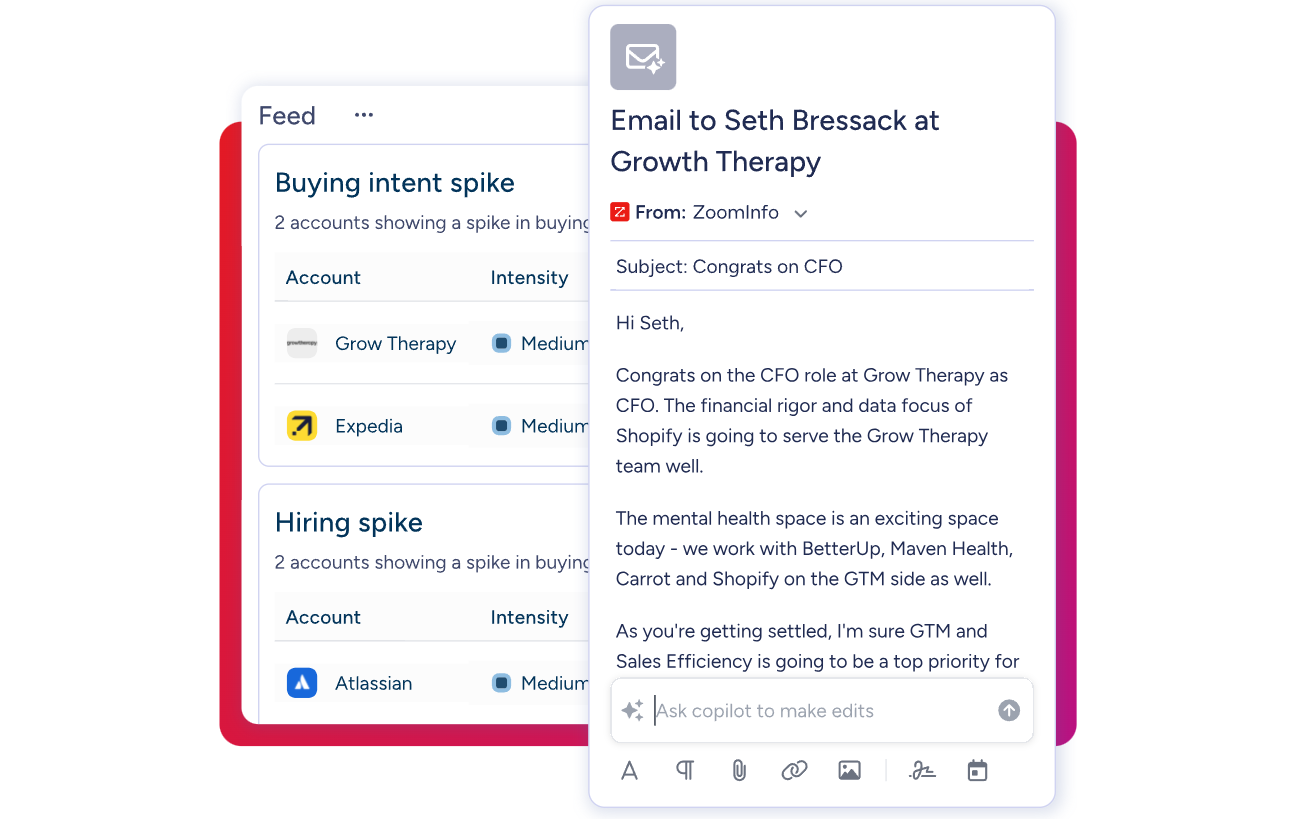
GTM Workspace is ZoomInfo's workspace for sellers. It shows a complete Book of Business view across CRM, ZoomInfo data, conversation history, and market intelligence, with AI agents that handle account research, outreach drafting, CRM updates, and signal monitoring. Reps see prioritized accounts, AI-drafted outreach addressing specific deal context, and next best actions without switching tools.
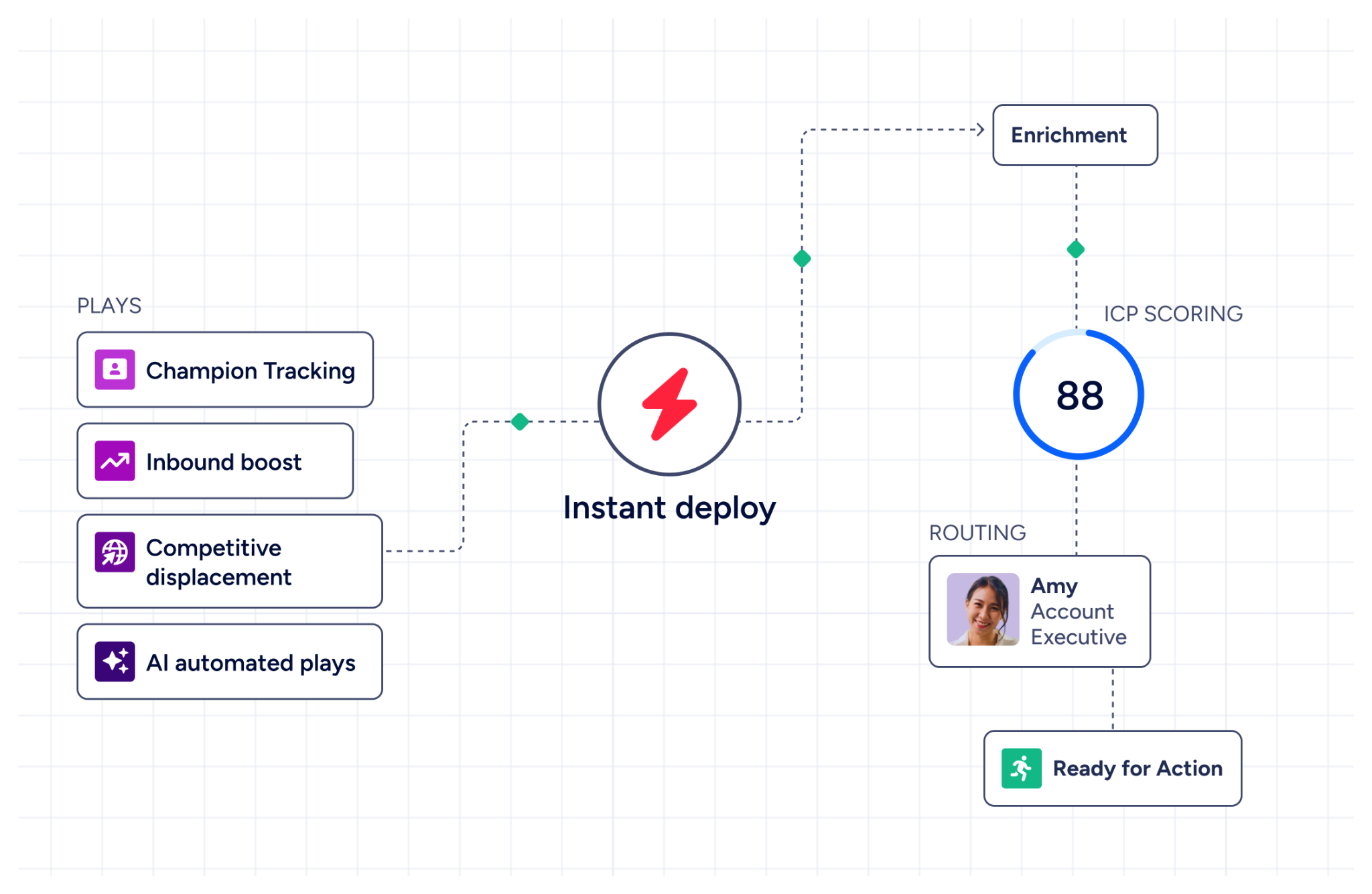
GTM Studio serves marketers, RevOps, and GTM engineers with a canvas for building audiences, launching multi-channel plays, and measuring pipeline impact. Expansion plays that used to take 3 weeks now launch in 30 minutes.
For teams that prefer their own tools, ZoomInfo's APIs and MCP server expose the same intelligence to any custom agent, internal tool, or partner platform. API access is included in all relevant plans, and MCP is available through partners including Anthropic Claude and Google.
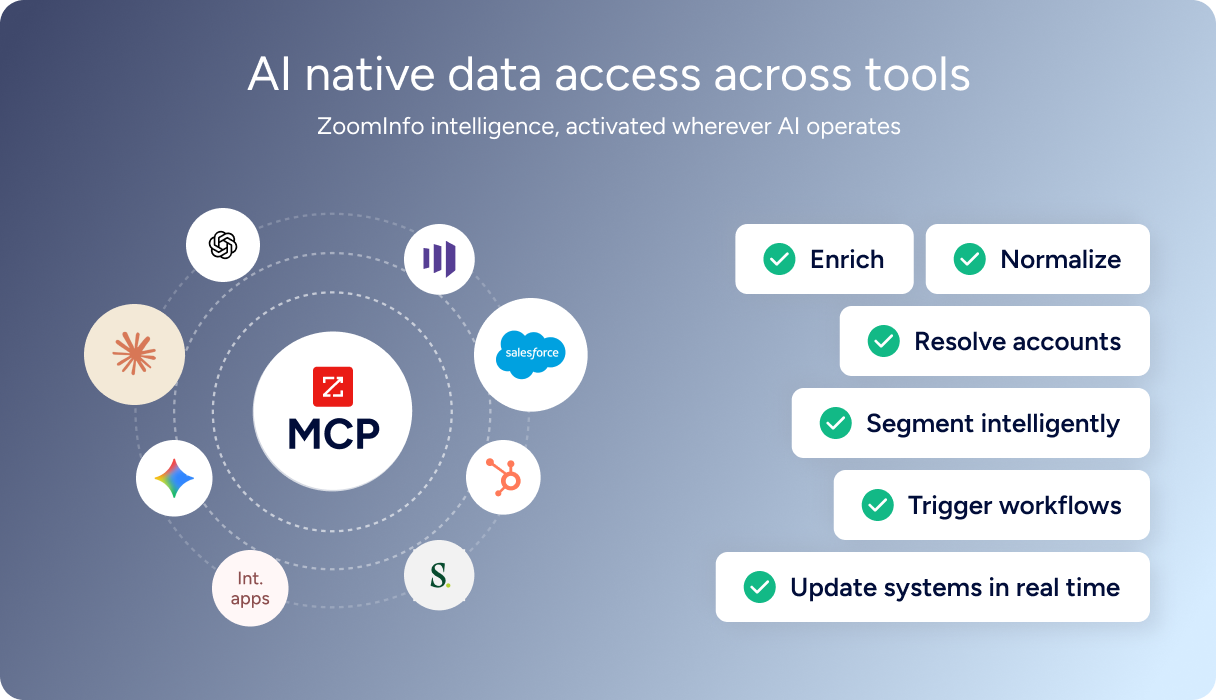
Former Koala users don't just get their signal layer back. They get the signals, the data to act on them, and the execution tools to follow through, all connected.
"Anything that minimizes our team's need to switch contexts is beneficial. ZoomInfo offers a unified view, eliminating the need to navigate between systems." (Spekit)
Stability and Scale: A public company with $1.25 billion in revenue.
Koala's shutdown caught users off guard. The Series A had closed just five months earlier. For teams that built workflows around Koala's signals and automations, the migration was disruptive and unplanned.
ZoomInfo offers a different risk profile. As a publicly traded company with $1.25 billion in annual revenue and $455 million in free cash flow, ZoomInfo has the financial stability to invest continuously in its platform. The company maintains ISO 27001, ISO 27701, SOC 2 Type II, and TRUSTe GDPR certifications (renewed annually) and is recognized as a Leader in Gartner's Magic Quadrant for ABM Platforms and a Leader in Forrester's Wave for Intent Data Providers.
For organizations evaluating vendors, the vendor's ability to exist next year matters as much as today's features. ZoomInfo has been building its data platform since 2007. That longevity shows in both data depth and platform maturity that a three-year-old startup could not match.
Koala vs. ZoomInfo: Comparison Summary
Koala | ZoomInfo | |
|---|---|---|
Status | Shut down September 30, 2025 | Active; public company (NASDAQ: GTM) |
Primary focus | First-party intent signals for PLG sales teams | GTM platform for full revenue teams |
B2B data | First-party only; enrichment via third-party integrations | 500M contacts, 100M companies, 135M+ verified phone numbers, 200M+ verified emails |
Website visitor identification | JavaScript pixel; 75%+ for PLG, ~30% for non-PLG | WebSights with buying team identification and contact data |
Intent signals | 30+ first-party signal sources | 210M IP-to-Org pairings, 6T+ keyword-device pairings monthly, plus first-party signals |
Product usage signals | Native integration with product analytics | Behavioral signals via GTM Context Graph |
Execution tools | Signal layer only; required separate sequencing and CRM tools | GTM Workspace (sellers), GTM Studio (marketers/RevOps), API/MCP (any tool) |
Conversation intelligence | Not included | Chorus (recording, transcription, AI analysis) |
AI capabilities | AI scoring, Research Agents, Qualification Agents | GTM Context Graph, AI agents in Workspace, natural language plays in Studio |
CRM integration | HubSpot, Salesforce (1 CRM on Growth) | Salesforce, HubSpot, Microsoft Dynamics, 120+ marketplace integrations |
Free option | Free plan (2 seats, 100 credits) | ZoomInfo Lite (permanent free) + 7-day free trial |
Pricing | $0 to $1,000/month (self-serve); Custom for Business | Consumption-based pricing |
Security | SOC 2 Type II | ISO 27001, ISO 27701, SOC 2 Type II, TRUSTe GDPR/CCPA |
Analyst recognition | None published | Gartner Leader (ABM), Forrester Leader (Intent Data), G2 133 No. 1 rankings |
Best for | PLG B2B SaaS with strong site traffic (no longer available) | B2B companies of any size needing data, signals, and execution in one platform |
Final Verdict
Koala was a well-designed product that solved a real problem for a specific audience. It unified first-party intent signals, product usage data, and website behavior into a single scored view, giving PLG sales teams an advantage. The founding team's background at Segment showed in the data infrastructure quality, and customers like Retool and Vercel validated the approach with real pipeline results.
But Koala's story ended in September 2025. The product is gone, the team is at Cursor, and former users need to rebuild their intent signal infrastructure elsewhere.
For teams that valued what Koala provided, ZoomInfo is the natural next step and a significant upgrade. It covers Koala's core capabilities (website visitor identification, intent scoring, automated signal-based workflows) while eliminating Koala's biggest limitations: the dependency on first-party data only, the gap between signal detection and execution, and the enrichment blind spots. ZoomInfo's data foundation, the GTM Context Graph, and execution tools like GTM Workspace and GTM Studio give your team signals, context, verified contacts, and the ability to act on them, all from one platform.
Get started with ZoomInfo here.
The market that Koala proved (that PLG companies need a dedicated layer to convert product usage signals into sales pipeline) remains valid. ZoomInfo has absorbed that thesis into a broader platform that serves not just PLG teams, but every go-to-market motion.
Koala FAQ
What happened to Koala?
Cursor (Anysphere) acquired Koala in July 2025 and shut it down on September 30, 2025. The deal was an acqui-hire to build Cursor's enterprise readiness team as it competed against GitHub Copilot. All three co-founders (Tido Carriero, Netto Farah, and Matthew Shwery) joined Cursor. The product was not folded into a new offering; it was discontinued.
Who founded Koala and what was their background?
Tido Carriero, Netto Farah, and Matthew Shwery founded Koala in January 2022. All three had worked at Segment. Carriero previously held engineering leadership roles at Facebook and Dropbox before serving as Chief Product Development Officer at Segment through its $3.2 billion acquisition by Twilio. The founding thesis: behavioral and product usage data was locked in analytics infrastructure and never reached the sales teams who needed it.
How much funding did Koala raise?
Approximately $20 million across two rounds: an undisclosed seed round circa 2022-2023 and a $15 million Series A led by CRV in February 2025, with participation from HubSpot Ventures, Recall Capital, and Afore Capital. The Series A closed just five months before the Cursor acquisition.
What types of companies used Koala?
Koala's ideal customers were B2B SaaS companies with product-led growth motions: a free trial, freemium tier, or developer self-serve experience combined with a sales team. Notable customers included Vercel, Retool, Hightouch, Sanity, Deepgram, Dolby, and DX. The platform worked best for companies with strong website traffic and a product generating usage events. Companies without these characteristics saw less value.
What is the best alternative to Koala now that it's shut down?
ZoomInfo is the recommended alternative. It covers Koala's core capabilities (website visitor identification, intent signals, automated workflows) while adding verified B2B contact data for 500 million contacts, conversation intelligence through Chorus, execution tools in GTM Workspace and GTM Studio, and API/MCP access for custom integrations. ZoomInfo offers a permanent free tier (ZoomInfo Lite) and a 7-day free trial for evaluating the full platform.
How did Koala's intent signals work?
Koala captured behavioral data from 30+ signal sources including website activity, product usage, email click-throughs, data warehouses, community platforms, and review sites. Each signal was scored based on how often it preceded a conversion, then rolled up into an account-level intent score from 0 to 100. Accounts were flagged as "heating" or "surging" when their score momentum increased, and automations could trigger outreach sequences, Slack alerts, or CRM updates in response.
Did Koala have a free plan?
Yes. Koala offered a permanent free plan with 2 seats and 100 credits per month. It included basic intent scoring, custom signals, trending accounts, and Slack alerts (capped at 250/month), but excluded CRM integration, email enrichment, AI agents, and most automation features. A 14-day free trial of the Growth plan was also available.
Could Koala replace a full sales engagement platform?
No. Koala was a signal layer, not a complete execution platform. It surfaced which accounts showed intent and could trigger enrollment in sequences, but the actual outreach, dialing, and email execution happened in separate tools like Apollo, Outreach, or HubSpot. This was a design choice, but it meant Koala added to the tool stack rather than consolidating it.
Researching Koala? These comparisons and alternatives help you decide:
