
Bad data has a ripple effect across every go-to-market function. Reps chase contacts who left their company months ago. Campaigns reach the wrong personas. Deals stall because the buying committee was never fully mapped. For B2B teams, incomplete records translate directly into wasted motion and lost revenue.
Here is the reality most revenue leaders underestimate: your CRM is almost certainly a snapshot of a market that no longer exists. People change jobs constantly. Companies merge, pivot, or shut down. If your outbound emails are bouncing or your calls aren't going through, your database is actively hurting your pipeline.
Lead enrichment fixes this by appending verified contact details, firmographics, technographics, and buyer-intent signals to incomplete records and keeping that data current as your market shifts. This guide covers what enrichment actually does at an operational level, which platforms deliver on that promise, and how to evaluate them against your specific GTM motion.
Lead Enrichment Tools Comparison
Here is how the top lead enrichment platforms compare across key dimensions:
Platform | Database Coverage | Key Strength | Best For | Pricing Model |
|---|---|---|---|---|
ZoomInfo | 500M+ contacts, 100M+ companies, 1.5B+ daily signals | cross-signal reasoning across CRM, intent, conversation, and behavioral data reasoning with waterfall match logic enrichment and intent signals | GTM teams running outbound at scale | Free to start with consumption credits based on usage |
Clearbit | Real-time firmographic and technographic data | Instant inbound enrichment at form fill | HubSpot-native teams focused on inbound | HubSpot Credits (post-acquisition) |
Apollo | 230M+ contacts with prospecting tools | Enrichment plus outbound execution in one platform | SMB to mid-market outbound teams | Free tier; public tiered pricing |
Cognism | Global B2B database with EMEA focus | GDPR compliance and verified mobile numbers | Global teams selling into Europe | Quote-based (Standard/Pro tiers) |
Lusha | Browser-based contact enrichment | Chrome extension for instant lookups | Individual SDRs and BDRs | Free tier; public tiered pricing |
Clay | Aggregates 150+ data providers | Waterfall enrichment with AI research agents | RevOps teams building custom workflows | Free tier; public tiered pricing ($0-$495/mo+) |
6sense | Intent-first account identification | Predictive buying stage analytics | Enterprise ABM programs | Free tier (50 credits/mo); quote-based paid tiers |
Datanyze | Technographic data on 35M+ domains | Tech stack visibility for targeted prospecting | SaaS sales teams targeting specific stacks | Free tier; public tiered pricing |
UpLead | 180M+ real-time verified contacts | 95% accuracy guarantee with credit refunds | Budget-conscious teams needing accuracy | Public tiered pricing (from $99/mo) |
Snov | 500M+ B2B email database with outreach tools | All-in-one enrichment and engagement | SMBs needing combined enrichment and outreach | Free tier; public tiered pricing |
1. ZoomInfo
Reps lose hours every week chasing contacts who changed jobs, calling numbers that go nowhere, and researching accounts that should already be in the CRM. ZoomInfo, the all-in-one AI GTM Platform, fixes that at the data layer so reps spend time selling, not searching.
It starts with scale: 500M+ contacts, 100M+ companies, 135M+ verified phone numbers, and 200M+ verified business emails, refreshed continuously by AI, 300+ human researchers, and multi-source verification. Coverage gaps that plague smaller databases are gone before a rep ever opens the record.
Data alone isn't the differentiator. ZoomInfo's GTM Context Graph processes 1.5B+ data points daily, fusing B2B data with CRM records, Chorus conversation intelligence, and behavioral signals to show not just what's happening in an account, but why. That's what turns enriched contacts into actionable intelligence.
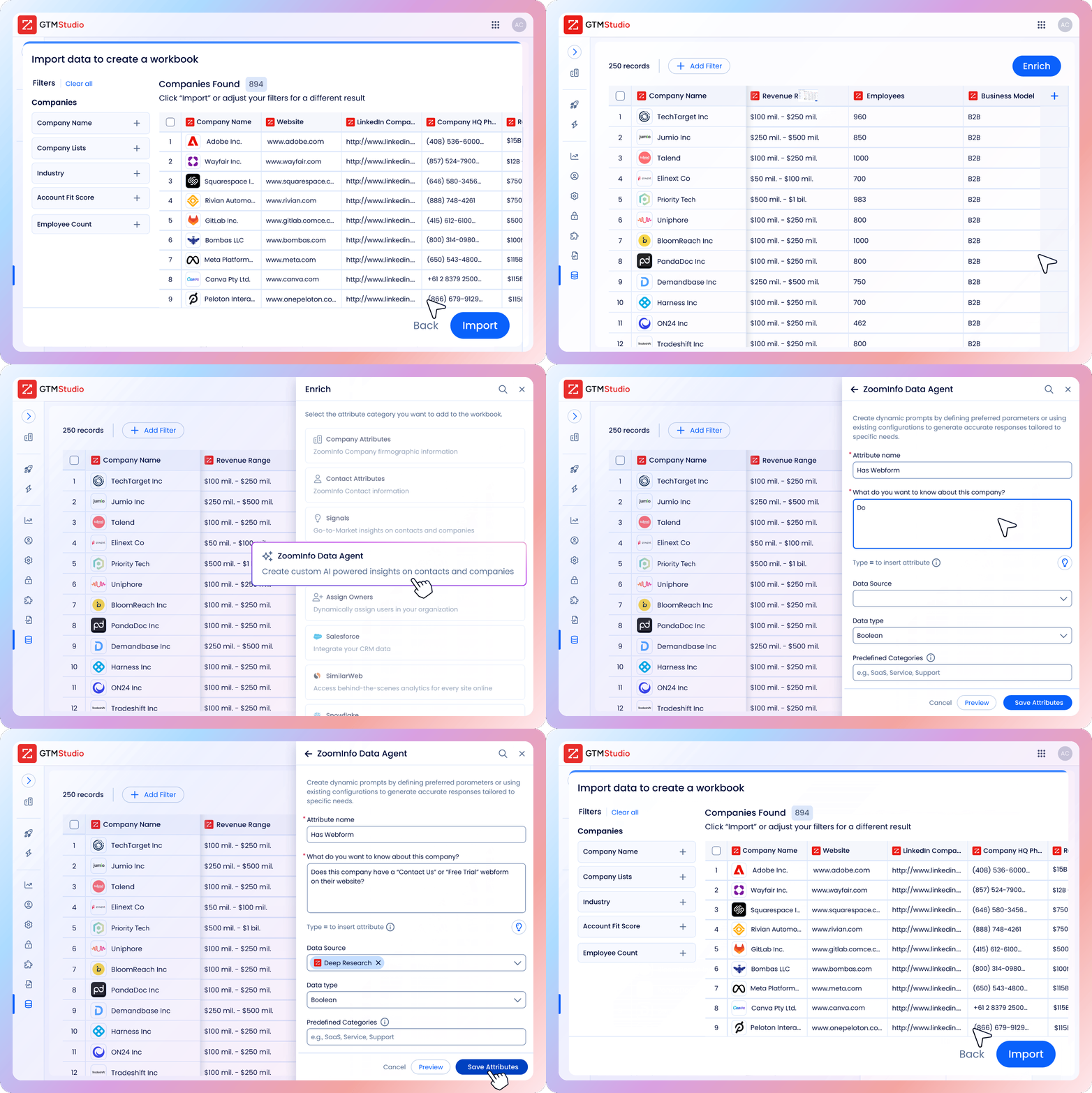
That intelligence reaches every workflow. GTM Studio runs waterfall enrichment across 25+ providers and returns the highest-confidence result automatically, no manual vendor management. GTM Workspace puts it in front of sellers through Pulse Feed, surfacing buying intent and job changes in real time. APIs and MCP give RevOps and engineering teams the same access for custom builds.
The results speak for themselves. Momentive replaced several point-solution vendors with ZoomInfo's Operations suite and cut lead enrichment and validation from 20 minutes to under 60 seconds. Capital One's Commercial Bank team, where reps once burned 30-40% of their time on manual prospecting, now pulls 150+ company attributes straight into Salesforce. No more cross-site research.
Key Features:
Continuously updated B2B contact and company data across broader contact coverage and 100M+ companies
ZoomInfo Enrich with the parallel match approach enrichment across 25+ providers and automated prioritization
GTM Context Graph intelligence processing 1.5B+ daily signals to surface account context and buying signals
GTM Workspace AI agents for real-time targeting and outreach recommendations
Built-in buyer intent data plus tools for conversation intelligence and account alerts
Native integrations with Salesforce, HubSpot, Marketo, and other core GTM platforms
Org charts and reporting structures that map buying committees across accounts
Technographic data showing tech stack composition and replacement signals
Data cleansing and deduplication to maintain CRM hygiene continuously
Data sourcing transparency with documented lawful basis for GDPR and CCPA compliance
Best For: GTM teams running outbound at scale who need continuously verified data, AI-powered account intelligence, and enrichment that flows automatically into existing CRM and MAP workflows.
Limitations: Consumption-credit pricing model requires planning for teams with variable enrichment volume. Full platform value is realized at enterprise scale, and smaller teams may find the breadth exceeds their immediate needs.
Pricing: Free to start with consumption credits based on usage.
Request a demo to see how ZoomInfo enrichment fits your GTM stack.
2. Clearbit
Clearbit was acquired by HubSpot in November 2023 and is actively transitioning to Breeze Intelligence, HubSpot's native AI enrichment layer. Standalone Clearbit free tools are being phased out in two stages (April 30, 2025 and December 1, 2025), so teams evaluating Clearbit today are effectively evaluating Breeze Intelligence as the forward-looking product.
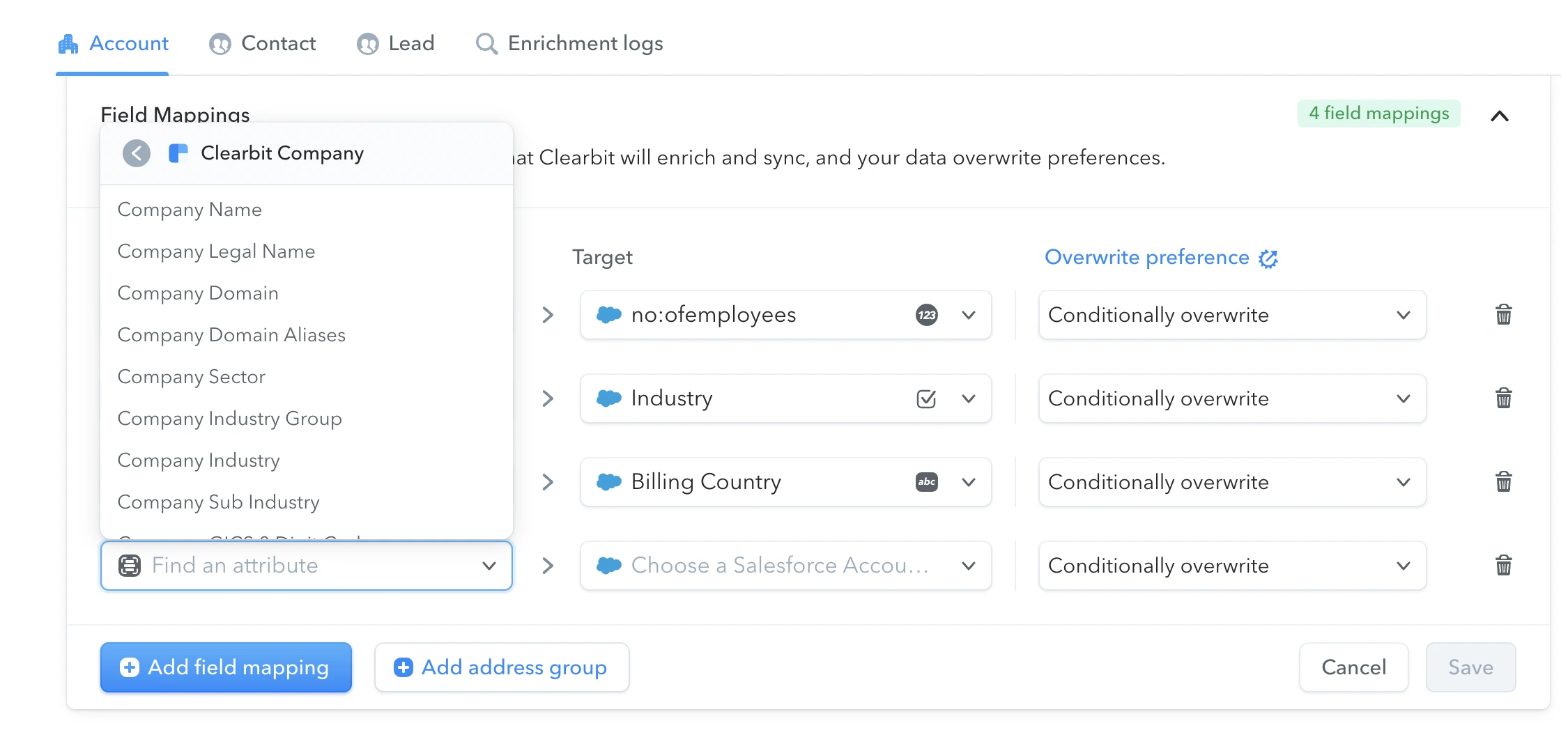
Breeze Intelligence provides real-time enrichment via API and webhooks, appending 40+ firmographic, demographic, and technographic attributes at the point of form fill or contact creation. Form shortening reduces friction for inbound leads by pre-filling known fields, while intent-based outreach triggers and lead scoring and routing help marketing and RevOps teams prioritize follow-up. Native HubSpot integration is the core differentiator, with Salesforce and Marketo supported as well.
See the Clearbit vs. ZoomInfo comparison for the full head-to-head.
Key Features:
Real-time enrichment via API and webhooks
40+ firmographic, demographic, and technographic attributes
Form shortening and lead scoring and routing
Intent-based outreach triggers
Native HubSpot integration with Salesforce and Marketo support
Best For: HubSpot-native teams focused on inbound enrichment at the point of form fill or site visit.
Limitations: Pricing is in transition. Standalone Clearbit plans are being phased out in favor of HubSpot Credits for AI features, which creates uncertainty for non-HubSpot users. Teams not already in the HubSpot ecosystem may find integration depth more limited than enterprise-grade alternatives.
Pricing: HubSpot Credits (post-acquisition).
3. Apollo
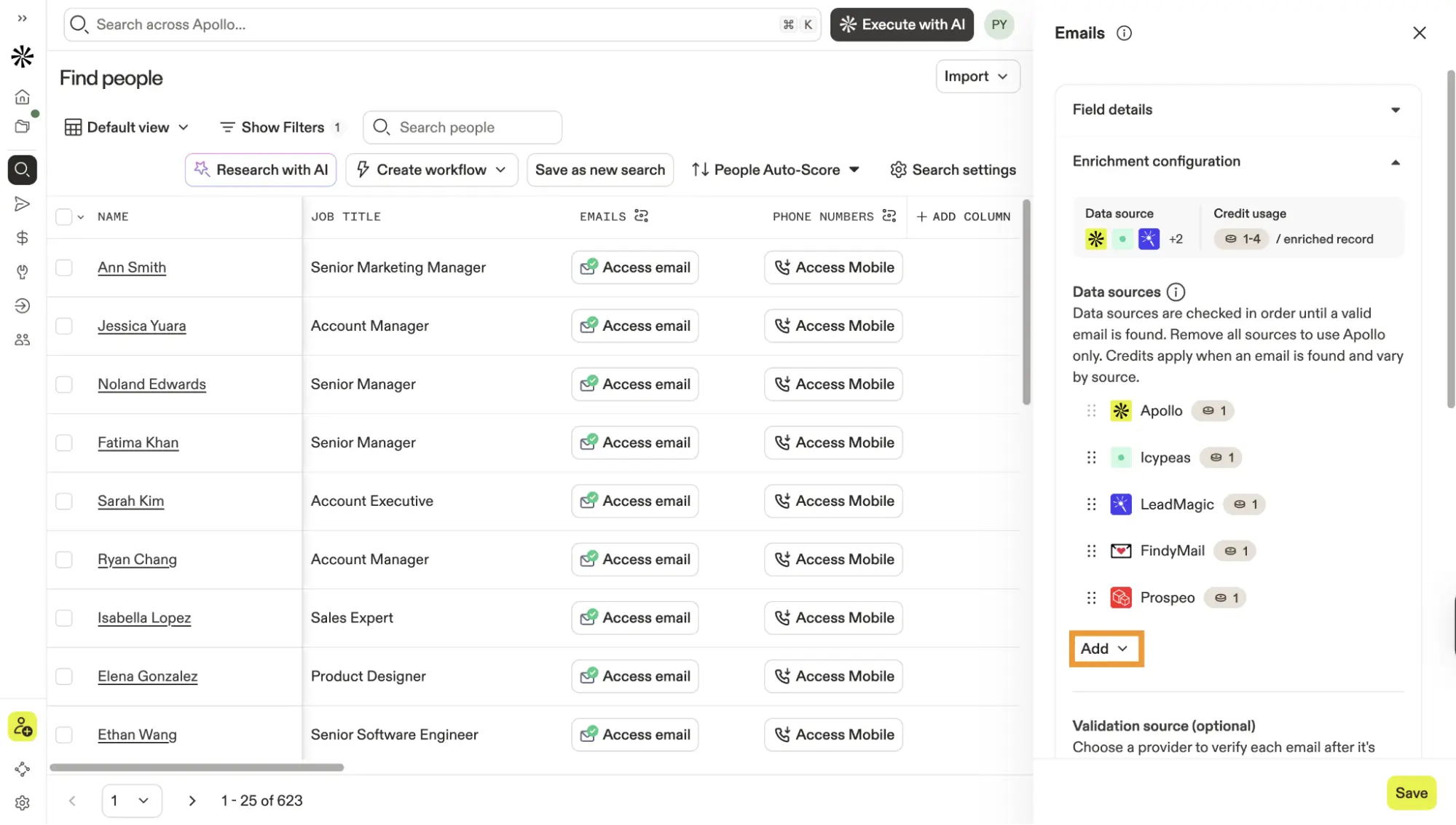
Apollo is an all-in-one AI sales platform combining a 230M+ contact database with enrichment and outbound execution. The Apollo AI Sales Platform includes AI agents for prospecting, AI-drafted personalized emails, and conversation summaries from synced calls, making it a stack-consolidation option for SMB and mid-market teams that want enrichment and engagement in one subscription.
Apollo's pitch, "Why buy five tools when one does it better?", reflects its positioning as a single platform covering data, enrichment, sequencing, and call recording. Workflow automation across CRM and sequencing reduces the overhead of managing separate point solutions, and AI account research helps reps prioritize before they reach out.
Key Features:
AI agents for prospecting and outreach
AI-drafted personalized emails
Conversation summaries from synced calls
AI account research for account prioritization
Workflow automation across CRM and sequencing
Best For: SMB to mid-market outbound teams that want enrichment and engagement in one subscription with public per-seat pricing.
Limitations: Apollo's contact database (230M+ contacts, 30M+ companies) is roughly half the scale of ZoomInfo's the larger contact database and 100M+ companies. The platform lacks a the GTM Workspace context that surfaces signals directly in the seller workflow equivalent for cross-signal reasoning across CRM, conversation intelligence, and behavioral data, so enrichment is data-centric rather than intelligence-driven. Enterprise proof points are thinner than ZoomInfo's.
Pricing: Free tier; public tiered pricing.
How Apollo compares against ZoomInfo
Apollo's all-in-one positioning with a free-forever tier and fully public per-seat pricing lands hardest with SMB and individual sellers who want a single subscription covering data, enrichment, sequencing, and call recording.
ZoomInfo's edge is enterprise-grade verified data scale (enterprise-scale coverage vs. Apollo's 230M+ contacts and 100M+ companies vs. Apollo's 30M+), the reasoning layer that connects enrichment, intent, and conversation intelligence reasoning layer that Apollo AI agents lack for cross-signal reasoning across CRM, Chorus conversation intelligence, and behavioral data, and deeper conversation intelligence via Chorus, which is a dedicated conversation intelligence product feeding the ZoomInfo's cross-signal reasoning layer rather than a feature-level recording capability.
See the Apollo vs. ZoomInfo all-in-one platform comparison for the full head-to-head.
4. Cognism
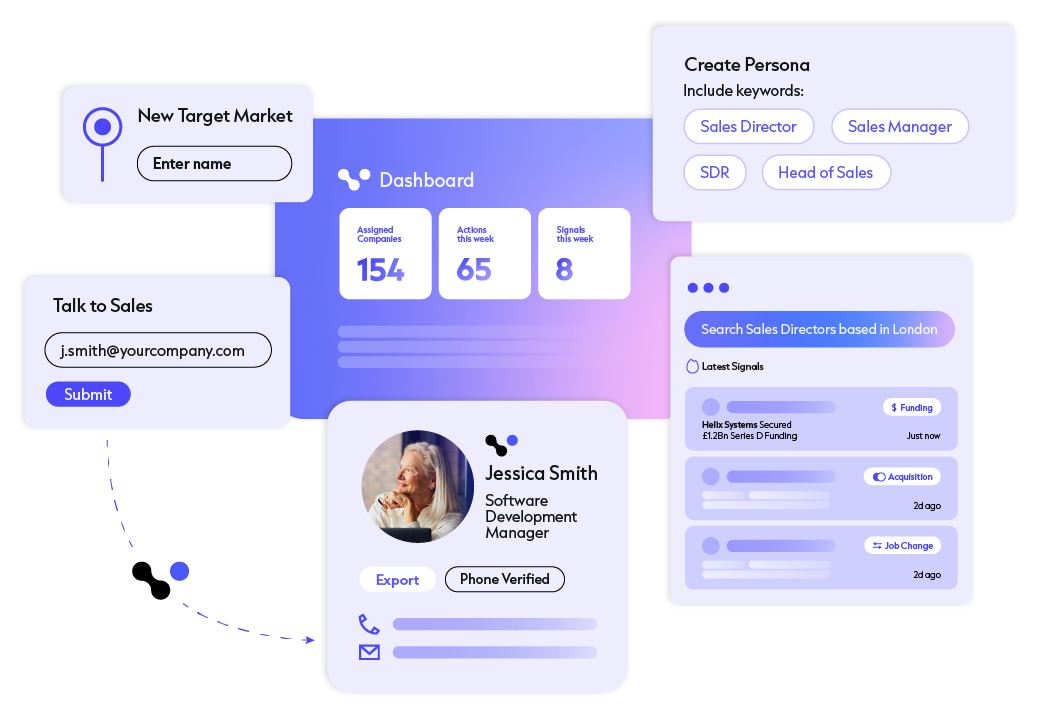
Cognism is a premium B2B sales-intelligence platform whose central pitch is European data quality and compliance. Cognism provides phone-verified mobile numbers, a meaningful differentiator for outbound teams where connect rates directly impact quota attainment.
Cognism's GDPR-by-design architecture includes lawful basis documentation, making it a practical option for companies selling into Europe or operating across multiple regulatory jurisdictions. Standard and Pro tiers offer transparent pricing structure, and global coverage is strongest in EMEA.
Key Features:
Phone-verified Diamond Data mobile numbers
GDPR-by-design architecture with lawful basis documentation
Standard and Pro transparent two-tier pricing
Human verification processes for phone numbers before database entry
Global coverage with strongest depth in EMEA
Best For: Global teams selling into Europe where GDPR compliance and verified mobile connect rates are non-negotiable.
Limitations: Cognism does not compete on GTM Workspace, Chorus conversation intelligence, or APIs and MCP. Its positioning is best-in-class data that strengthens existing systems rather than replacing them. Teams needing an all-in-one platform with AI agent workflows will find Cognism's scope narrower than ZoomInfo's.
Pricing: Quote-based (Standard/Pro tiers).
How Cognism compares against ZoomInfo
Cognism's GDPR-by-design architecture and phone-verified Diamond Data make it the strongest choice for outbound teams selling into Europe where compliance gaps carry real legal risk.
ZoomInfo's edge is broader global coverage with 500M+ contacts and 100M+ companies vs. Cognism's EMEA-focused database for teams selling across North America, EMEA, and APAC, ZoomInfo's GTM Workspace context layer intelligence layer that Cognism has no equivalent for in terms of cross-signal reasoning across CRM, conversation intelligence, and behavioral data, and Chorus conversation intelligence and APIs and MCP programmatic access that Cognism, competing on data only, does not offer.
See the Cognism vs. ZoomInfo comparison for the full head-to-head.
5. Lusha
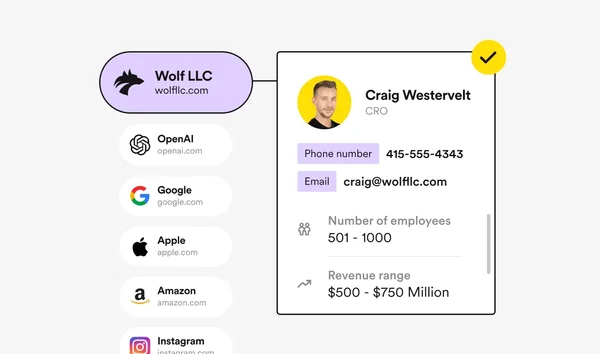
Lusha is designed for speed and minimal friction. The Lusha Workspace platform gives SDRs and BDRs verified contact access through a web app and Chrome extension, enriching leads on the fly while browsing LinkedIn, company websites, or CRM records.
One strategically notable development: Lusha ships a Model Context Protocol server (Lusha MCP), placing it in the same emerging MCP-for-sales lane as ZoomInfo. Lusha's five public pricing tiers (Free through Scale) and fast setup with minimal onboarding mean reps can start enriching leads within minutes without IT involvement. Bulk enrichment for list building and outbound prep, combined with integrations with Salesforce, HubSpot, and Pipedrive, rounds out the core workflow.
Key Features:
Verified contact access through web app and Chrome extension
Bulk enrichment for list building and outbound prep
Five public pricing tiers (Free, Starter $37.45, Pro $52.45, Premium $299.95, Scale custom)
Lusha MCP server for programmatic access
Integrations with Salesforce, HubSpot, and Pipedrive
Best For: Individual SDRs and BDRs who need fast, frictionless contact enrichment on LinkedIn and company websites with minimal onboarding.
Limitations: Lusha's contact database and enrichment depth are more limited than enterprise-grade platforms. It is optimized for individual SDR and BDR workflows rather than team-wide GTM orchestration. The platform lacks conversation intelligence, ABM advertising, and predictive scoring capabilities.
Pricing: Free tier; public tiered pricing.
How Lusha compares against ZoomInfo
Lusha's fully public pricing (starting free, with tiers up to $299.95/mo) and fast Chrome extension setup make it the lowest-friction entry point for individual SDRs and BDRs who need contact data without IT involvement.
ZoomInfo's edge is significantly broader coverage with the larger data foundation and 135M+ verified phone numbers vs. Lusha's more limited database for enterprise prospecting, the unified signal layer (data + intent + conversation) intelligence layer that Lusha has no equivalent for since it is a data-access tool rather than an intelligence platform, and GTM Studio ZoomInfo's waterfall enrichment enrichment across 25+ providers vs. Lusha's single-source lookup model.
Talk to our team for a head-to-head Lusha vs. ZoomInfo walkthrough.
6. Clay
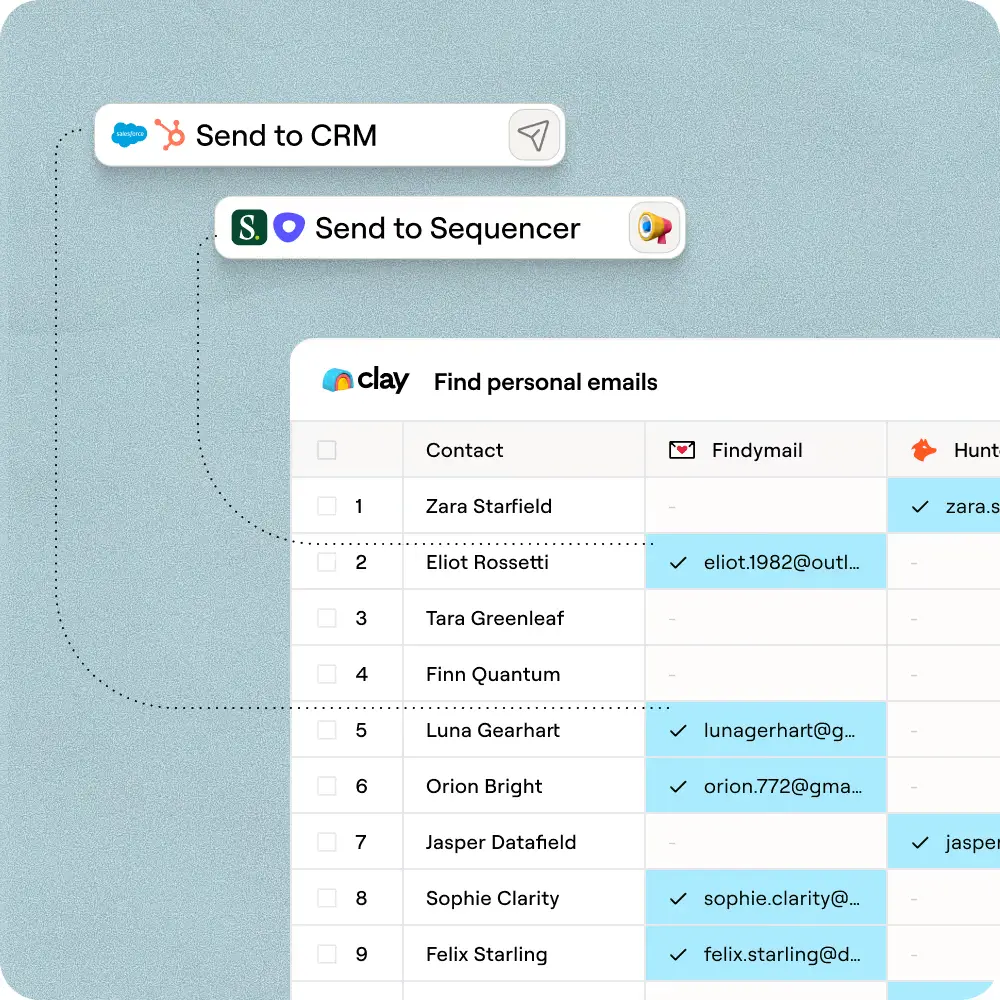
Clay is a GTM data orchestration platform that aggregates 150+ data sources via its Clay Waterfall Enrichment engine, letting RevOps teams build custom enrichment workflows that pull from multiple sources in sequence. Clay also ships a Clay MCP server, placing it in the same emerging MCP-for-sales lane as ZoomInfo.
The Claygent AI research agents can scrape websites, summarize content, and extract structured data from unstructured sources, making it possible to enrich leads with information that does not exist in traditional B2B databases, like recent funding announcements, hiring patterns, or product launches. Clay's no-code workflow automation lets RevOps teams build custom enrichment logic without engineering support, and fully public tiered pricing ($0 to $495/mo+) makes it accessible for teams evaluating cost-per-record economics.
One important distinction: Clay's waterfall is sequential, stopping at the first available match. ZoomInfo's GTM Studio runs the parallel match logic, evaluating all 25+ providers simultaneously for the highest-confidence result. At scale, that difference shows up in accuracy. Clay's own FAQ states: "We often double or triple data coverage rates at a 1/5th or less of the cost of ZoomInfo." Teams frequently use Clay to build custom enrichment workflows that combine data from ZoomInfo and dozens of other sources, making it a strong complement to existing data investments rather than a standalone replacement.
Key Features:
Sequential waterfall enrichment across 150+ data providers
Claygent AI research agents for custom data extraction from unstructured sources
Clay MCP server for programmatic access
No-code workflow automation for enrichment logic
Fully public tiered pricing ($0 to $495/mo+)
Best For: RevOps teams and GTM engineers who want maximum flexibility to build custom enrichment workflows combining multiple data sources.
Limitations: Clay's sequential waterfall stops at the first available match rather than evaluating all sources for the highest-confidence result, which can reduce accuracy at scale compared to ZoomInfo's waterfall logic across providers approach. Clay requires manual workflow configuration and RevOps expertise to set up; it is a complement to existing data investments rather than a standalone replacement.
Pricing: Free tier; public tiered pricing ($0-$495/mo+).
How Clay compares against ZoomInfo
Clay's orchestration-layer approach with 150+ data providers and fully public pricing gives RevOps teams maximum flexibility to build custom enrichment workflows at a fraction of enterprise platform costs.
ZoomInfo's edge is GTM Studio's multi-provider waterfall validation across 25+ providers simultaneously for highest-confidence results vs. Clay's sequential waterfall that stops at first available match, ZoomInfo's broader B2B coverage as a first-party verified database vs. Clay's aggregation of third-party sources with no proprietary data, and the reasoning layer behind ZoomInfo's GTM Workspace intelligence layer that Clay has no equivalent for since it is a data orchestration tool rather than an intelligence platform.
Talk to our team for a head-to-head Clay vs. ZoomInfo walkthrough.
7. 6sense
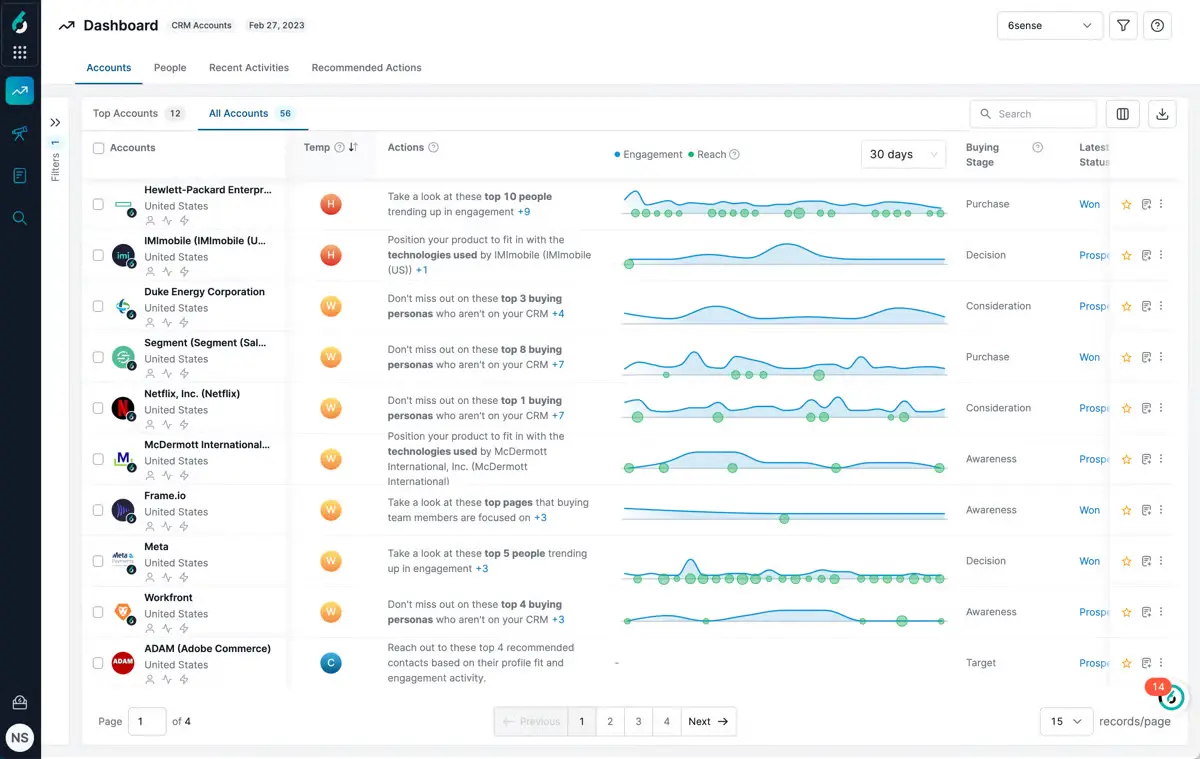
6sense is an AI-driven ABM and revenue-intelligence platform built around the 6sense ABM Platform. Its pitch is "AI that knows what matters," with predictive scoring, intent signals, and account orchestration across sales, marketing, and advertising. Analyst recognition includes Forrester Wave Leader for Revenue Marketing Platforms B2B Q1 2026 and Gartner Magic Quadrant for ABM Platforms.
The 6sense ABM Platform identifies in-market accounts via predictive AI, surfaces anonymous buyer-journey data before prospects fill out a form, and orchestrates multi-channel campaigns across display, LinkedIn, and email. Real-time buying signals and native Salesforce, HubSpot, and Marketo integrations connect the ABM motion to existing revenue systems. As the platform states: "Connect, sync, and activate every channel from one canvas."
Key Features:
In-market account identification via predictive AI
Multi-channel campaign orchestration (display, LinkedIn, email)
Anonymous buyer-journey identification
Real-time buying signals
Native Salesforce, HubSpot, and Marketo integrations
Best For: Enterprise ABM programs that need predictive buying-stage analytics and multi-channel campaign orchestration.
Limitations: 6sense does not offer conversation intelligence (no Chorus equivalent), a self-service developer or MCP story, or a first-party verified contact database at ZoomInfo's scale. Pricing is fully quote-based on paid tiers, with no public dollar amounts beyond the free tier's 50 data credits per month.
Pricing: Free tier (50 credits/mo); quote-based paid tiers.
How 6sense compares against ZoomInfo
6sense's native ABM advertising as a first-class channel (display and retargeting orchestration) and Forrester Wave Q1 2026 Leader recognition give it strong credibility for enterprise marketing teams running multi-channel ABM programs.
ZoomInfo's edge is the larger contact universe and 100M+ companies as a first-party verified database vs. 6sense's free tier limited to 50 data credits per month, Chorus conversation intelligence that 6sense has no equivalent for since ZoomInfo captures deal context from calls and feeds it into the ZoomInfo's signal-layer foundation, and APIs and MCP programmatic access lane that 6sense has no documented MCP server or developer ecosystem at parity with.
See the 6sense vs. ZoomInfo comparison for the full head-to-head.
8. Datanyze
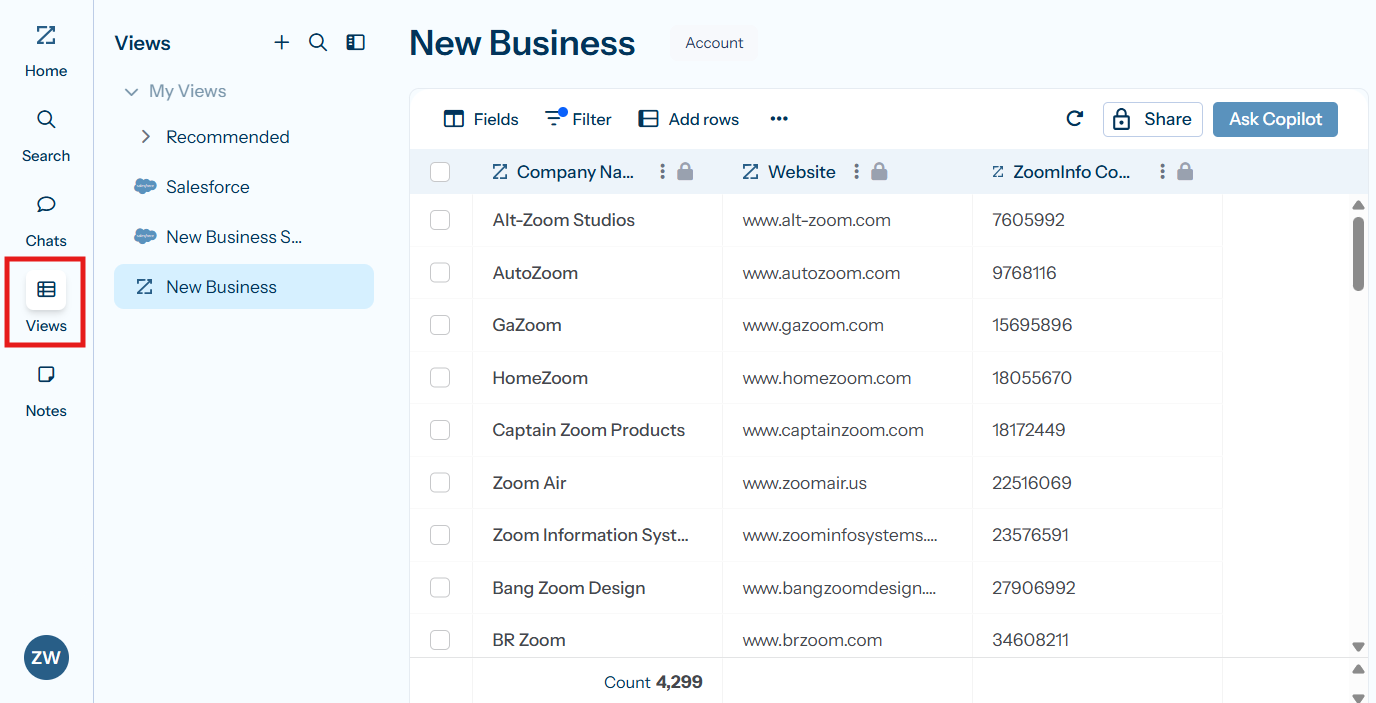
Datanyze, a ZoomInfo company since the September 2018 acquisition, is a budget-tier B2B contact data and technographics tool focused on helping GTM teams identify what software a company uses. The Datanyze Chrome Extension is the primary product surface, running in the browser on LinkedIn, company websites, and inside CRM records.
The platform tracks over 35 million domains and identifies the technologies deployed across them, from CRM systems to marketing automation platforms to infrastructure tools. Install base reports support competitive intelligence workflows. Affordable pricing with a free tier makes it accessible for small or resource-light teams that need technographic visibility without enterprise-level complexity.
Key Features:
Technographic enrichment for identifying software usage across 35M+ domains
Chrome extension for lead lookup on LinkedIn and company websites
Affordable public pricing with free tier
Install base reports for competitive intelligence
Basic contact access for individual SDR workflows
Best For: Individual SDRs and small sales teams that need technographic visibility for targeted prospecting without enterprise-level complexity.
Limitations: Datanyze is a point tool focused on technographic data. It does not extend into GTM Workspace, GTM Studio, the GTM AI reasoning layer, or APIs and MCP. Contact data and segmentation features are more limited than full-suite platforms.
Pricing: Free tier; public tiered pricing.
9. UpLead
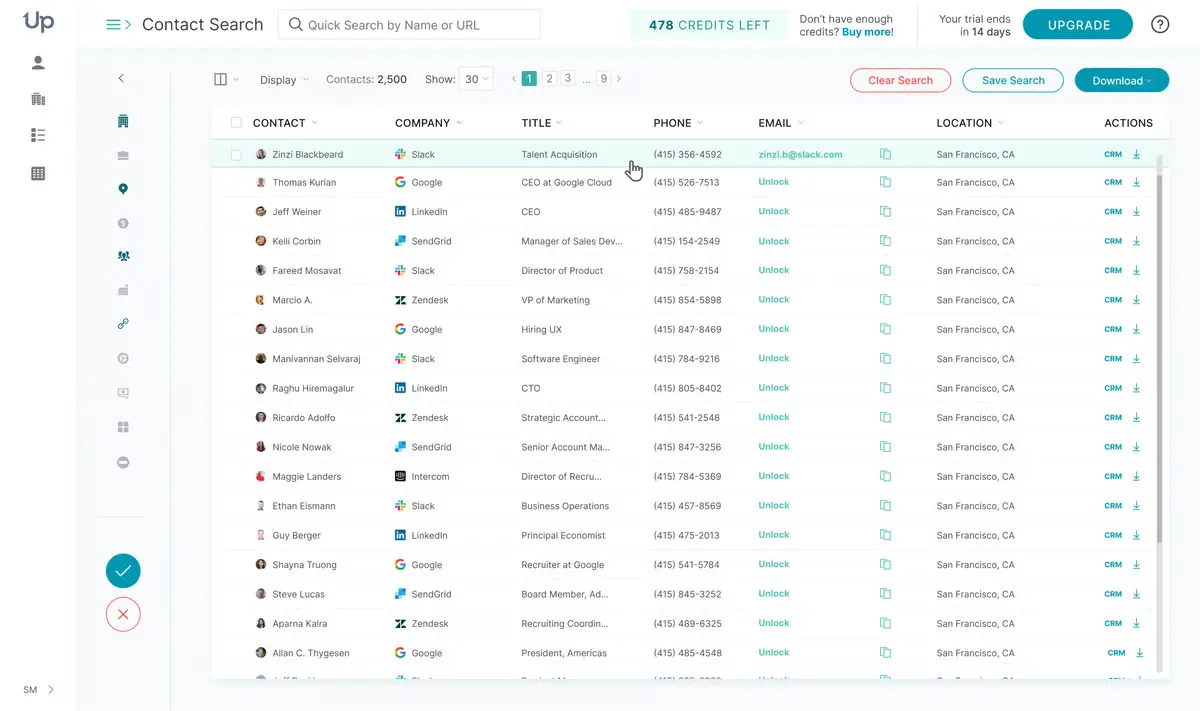
UpLead is a B2B contact data and lead-generation platform built around the UpLead Prospector, aimed at SMB and mid-market sales teams that want a verified prospect database without an enterprise contract. Its 95% accuracy guarantee with credit refunds for inaccurate data is a concrete differentiator for budget-conscious buyers.
The platform delivers 180M+ verified contacts with real-time email verification at the point of lookup, rather than relying on pre-cached database records. Bombora intent data is included on premium plans, adding behavioral signals to traditional contact and company data so reps can prioritize accounts showing active research behavior. CRM integrations with Salesforce and HubSpot and flexible public pricing starting at $99/month round out the offering.
Key Features:
180M+ verified contacts with real-time email verification at point of lookup
95% accuracy guarantee with credit refunds for inaccurate data
Bombora intent data on premium plans
CRM integrations with Salesforce and HubSpot
Flexible public pricing starting at $99/month
Best For: Budget-conscious SMB and mid-market teams that prioritize data accuracy with a concrete guarantee and flexible pricing over platform breadth.
Limitations: UpLead has no analog to ZoomInfo's the unified GTM AI signal layer, GTM Workspace, GTM Studio, Chorus, MCP server, or website visitor tracking. Its 180M+ contact database is smaller than ZoomInfo's 500M+ and its enrichment depth is more limited for enterprise use cases.
Pricing: Public tiered pricing (from $99/mo).
How UpLead compares against ZoomInfo
UpLead's 95% accuracy guarantee with credit refunds and public pricing starting at $99/month make it the most accessible entry point for SMB teams that need verified contact data without an enterprise contract.
ZoomInfo's edge is nearly 3x the contact coverage with the broader 500M+ data base vs. UpLead's 180M+ for enterprise prospecting, the cross-signal reasoning layer behind GTM AI intelligence layer that UpLead has no equivalent for since it is a data-access tool without cross-signal reasoning, and GTM Workspace, GTM Studio, Chorus, and APIs and MCP that UpLead has no equivalent for across any of these platform surfaces.
Talk to our team for a head-to-head UpLead vs. ZoomInfo walkthrough.
10. Snov
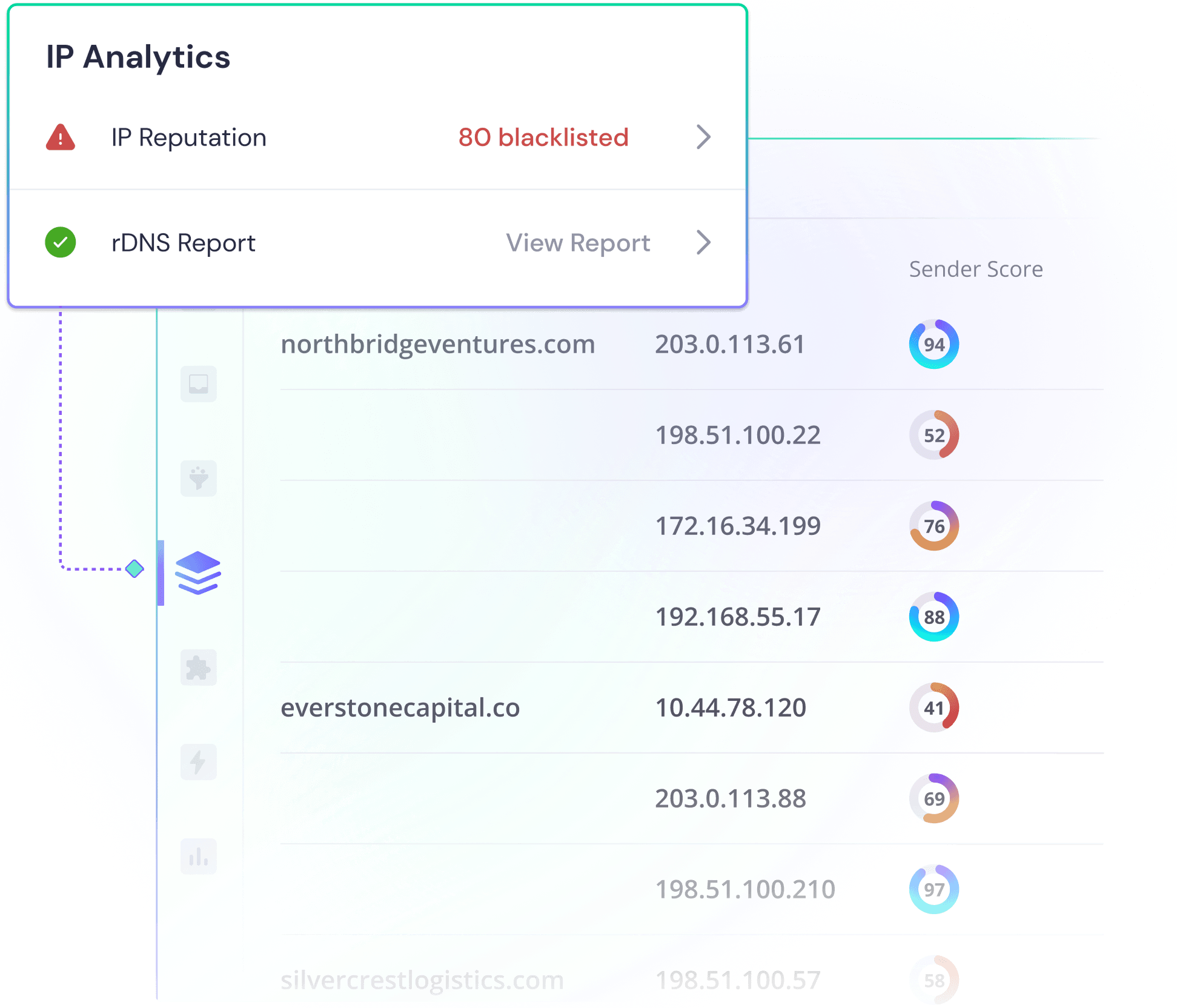
Snov is an SMB-focused email finder and cold outreach automation platform built around the Snov Email Finder. It bundles a 500M+ B2B email database, a 7-tier email verifier, and multichannel drip campaigns into one credit-based subscription, positioning itself as a cheaper, simpler alternative for solopreneurs, startups, and small sales teams.
Mailbox warm-up infrastructure improves deliverability for cold outreach campaigns, and a free built-in sales CRM handles basic pipeline management without requiring a separate tool. Multichannel email and LinkedIn drip campaigns let reps launch multi-touch sequences after enriching leads, though LinkedIn automation is premium-only and not available on free or entry tiers.
Key Features:
500M+ B2B email database with 7-tier email verifier
Mailbox warm-up infrastructure for deliverability
Multichannel email and LinkedIn drip campaigns
Free built-in sales CRM
Credit-based subscription with free tier
Best For: Solopreneurs, startups, and SMB sales teams running cold email outreach who need enrichment and engagement in one affordable subscription.
Limitations: Snov has no comparable the data + intent + conversation reasoning layer, intent data, ABM, or RevOps orchestration story. LinkedIn automation is premium-only. The platform is optimized for cold email volume rather than enterprise GTM intelligence.
Pricing: Free tier; public tiered pricing.
How Snov compares against ZoomInfo
Snov's all-in-one email finder, verifier, drip campaigns, and free CRM in a single credit-based subscription with a free tier makes it the most cost-effective option for solopreneurs and startups running cold email outreach.
ZoomInfo's edge is 135M+ verified phone numbers and 120M direct-dial numbers vs. Snov's email-only enrichment focus, enabling multi-channel outreach beyond email, the cross-signal reasoning layer that connects CRM, intent, and conversation data intelligence layer that Snov has no equivalent for in terms of cross-signal reasoning, intent data, or ABM orchestration, and GTM Studio the simultaneous-provider waterfall enrichment and RevOps orchestration that Snov has no equivalent for in team-wide enrichment automation.
Talk to our team for a head-to-head Snov vs. ZoomInfo walkthrough.
The ten platforms above are the tools most teams compare head-to-head when shopping for lead enrichment. But enrichment rarely runs in isolation. Several adjacent platforms, including ABM tools, native-CRM enrichment, visitor identification, prospecting layers, and sales engagement systems, sit in the same evaluation conversation because they either feed enriched data into the seller workflow or consume it on the way out.
What Are Lead Enrichment Tools?
Lead enrichment tools automatically append missing contact and company data to incomplete CRM records. They add verified emails, phone numbers, job titles, firmographics, technographics, and buyer intent signals to give sales and marketing teams the context needed to prioritize and personalize outreach.
Enrichment works by matching your existing CRM records against third-party databases using identifiers like email addresses, company domains, or LinkedIn profiles. Once a high-confidence match is confirmed, missing fields are filled in automatically. The best platforms use rule-based waterfall logic to validate data on a per-field basis, evaluating firmographics like industry first, then subsequent fields like phone number, email, and primary website domain, rather than treating a record as either fully matched or not.
Waterfall enrichment is the method that separates basic data appending from enterprise-grade contact data enrichment. Sequential waterfall stops at the first available match across providers. Parallel waterfall, the approach used by ZoomInfo's GTM Studio, evaluates all sources simultaneously and returns the highest-confidence result. At scale, that distinction shows up directly in match rates and data accuracy.
Critically, lead enrichment is an ongoing CRM hygiene workflow, not a one-time append process. Markets move too fast for static data. The platforms that deliver the most value continuously update records as job changes, funding rounds, leadership shifts, and hiring trends occur, so reps always have current intelligence without manual research.
Core capabilities include:
Contact data enrichment: Verified emails, direct dials, mobile numbers, and social profiles that connect reps to decision-makers
Firmographic enrichment: Company size, revenue, industry, location, and org structure that define your ICP
Technographic data: Tech stack visibility showing what software prospects use and what they might replace
Intent signals: Buyer behavior data that flags accounts actively researching solutions like yours
Why B2B Lead Enrichment Matters
B2B lead enrichment is the foundation for faster pipeline velocity and higher conversion rates. Every minute your team spends chasing incomplete records is a minute lost to a competitor who has better data.
Most B2B buyers are well into their evaluation before they engage a seller, which means when a prospect does reach out, your team needs to capitalize immediately with the right context, the right contacts, and the right message. Stale data makes that impossible.
There is also a structural problem most teams overlook: most B2B purchases involve multiple stakeholders across finance, IT, and the business unit. If your CRM only shows one contact per account, you are not just missing context, you are flying blind on the buying committee. Enrichment surfaces the full org chart, identifies decision-makers and influencers, and gives reps the complete picture needed to run a multi-threaded deal.
The operational benefits are measurable. Sendoso, a fast-growing B2B company managing records flowing in from web forms, Marketo, and list imports, implemented ZoomInfo's data enrichment to address a CRM filled with incomplete records and outdated contacts. The results: 70% reduction in inaccurate data and 1,100+ hours saved in manual enrichment efforts, a 10% increase in access to ICP contacts, and $4.9 million in new pipeline generated in just two quarters. Their reps stopped doing data entry and started having conversations.
Enterprise teams running enrichment at scale see similar operational gains. ConnectWise enriched 40,000+ records with automated segmentation and routing, eliminating manual list management across their GTM stack.
Key benefits of lead enrichment:
Reduced bounce rates: Email enrichment keeps your addresses accurate so messages reach real people. When hard bounce rates exceed 3 to 5%, the database is actively degrading pipeline performance.
Improved connect rates: Phone number enrichment with verified direct dials and mobile numbers means more meaningful conversations and less time chasing dead ends.
Faster time to action: Better lead scoring and routing mean reps can act on opportunities immediately. Speed matters, the first seller to engage often wins the deal.
Buying committee visibility: Enrichment maps the full org chart so reps can engage the economic buyer, technical buyer, and end user with role-appropriate messaging.
Smarter segmentation: Accurate fields enable targeting by role, intent, industry, and tech stack, making campaigns sharper and conversion rates higher.
Sales and marketing alignment: When both teams work from the same enriched data, handoff friction disappears and leads stop falling through the cracks.
How We Evaluated These Lead Enrichment Tools
The tools listed here were assessed across several dimensions: data accuracy and match rates against real ICP segments, CRM integration depth and sync behavior, enrichment latency for real-time use cases, regional coverage for North American, EMEA, and APAC markets, compliance posture for GDPR and CCPA, and the breadth of enrichment types supported beyond basic contact data. Vendor documentation, G2 category reviews, and TrustRadius ratings were used to supplement direct product evaluation for third-party tools.
How to Choose a Lead Enrichment Tool
Selecting lead enrichment software requires matching capabilities to your specific GTM motion. The right platform fits how your team actually works, integrates with your existing stack, and delivers data quality that drives measurable outcomes. Feature breadth matters less than fit.
Data Accuracy and Coverage
Poor enrichment is worse than no enrichment. If your tool appends wrong titles, outdated emails, or disconnected phone numbers, reps waste time chasing dead ends, and your hard bounce rate climbs past the 3 to 5% threshold where database quality starts actively degrading pipeline performance. Match rates matter, but accuracy and freshness matter more.
Real-world deployments illustrate why accuracy matters at scale. ConnectWise enriched 40,000+ records across its CRM and routing pipeline, and Capital One increased data quality and productivity by treating enrichment as a system rather than a one-time data project.
Platforms that evaluate multiple sources in parallel rather than sequentially are more likely to return accurate, up-to-date data instead of simply the first available match.
Look for platforms that verify contact data continuously, not just at the point of collection. Enrichment that runs once and goes stale creates the same problem you started with, just more slowly.
What is the platform's match rate for your ICP? Test with a sample list before committing.
How often does the vendor refresh data? Monthly updates are insufficient in fast-moving markets.
Does the platform validate emails and phone numbers in real time, or are you receiving stale records?
What is the coverage depth for your target regions? Some vendors are strong in North America but weak in EMEA or APAC.
CRM and Sales Tool Integrations
CRM enrichment only delivers value if it flows into the systems your team uses every day. Native integrations with Salesforce, HubSpot, Marketo, and sales engagement platforms like Outreach or Salesloft eliminate manual uploads and keep data synced in real time. API access matters for teams building custom workflows or using less common tools.
Does the platform offer native integrations with your CRM and MAP, or are you relying on Zapier workarounds?
Can you enrich records automatically when they enter your system, or does enrichment require manual triggering?
Does the integration support bi-directional sync, so updates in your CRM flow back to the enrichment platform?
What field mapping options are available? Can you control which fields get updated and which stay locked?
Real-Time vs. Batch Enrichment
Real-time enrichment suits inbound workflows where you need instant context on form fills or website visitors. Batch enrichment makes sense for list cleanup, database hygiene, or outbound campaigns where you're enriching thousands of records at once. Most teams need both, but the balance depends on your motion.
Are you running high-velocity inbound where real-time enrichment at form fill drives routing and scoring?
Do you need to enrich large lists for outbound campaigns, or are you enriching records one at a time?
Can the platform handle both use cases, or are you forced to choose one mode?
What's the latency for real-time enrichment? Milliseconds matter when routing high-intent leads.
Compliance and Data Privacy
For teams selling globally, GDPR and CCPA compliance is a non-negotiable requirement. Look for platforms that provide transparency into data sourcing, offer opt-out mechanisms, and maintain certifications like SOC 2. Compliance gaps can create legal exposure and kill deals, particularly in regulated industries or when selling into European markets.
Operational examples reinforce the compliance angle. Momentive built an ongoing data hygiene workflow into its CRM rather than treating compliance as a one-time audit. Beyond certifications, data sourcing transparency is what separates compliant vendors from those that look compliant on paper.
Key considerations:
Does the vendor provide GDPR-compliant data for European contacts, including lawful basis documentation?
Are CCPA opt-out requests handled automatically, or do you need to manage them manually?
What certifications does the platform maintain? SOC 2, ISO 27001, and GDPR compliance should be baseline expectations.
Can you audit data sources and understand where contact information originated?
Enrichment Depth and Intelligence Layer
There is a meaningful difference between data enrichment and intelligence enrichment. Data enrichment fills fields: job title, phone number, company size. Intelligence enrichment surfaces why an account is moving: buying signals, intent spikes, org changes, and conversation context that indicate readiness to engage.
The richest platforms layer behavioral context onto static records. Buyer intent flags which accounts are actively researching solutions like yours, turning enrichment from a data-completeness exercise into a prioritization signal.
The most advanced lead enrichment platforms layer AI agent workflows on top of enriched signals, automating prioritization and outreach recommendations based on account behavior rather than requiring reps to interpret raw data manually. Buying signals as a layer above contact data, whether through intent data feeds, website visitor identification, or conversation intelligence, are what separate a data vendor from a GTM intelligence platform.
When evaluating this dimension, ask whether the platform can tell you not just who is in an account but what is happening there right now. For teams using ZoomInfo MCP or similar programmatic access layers, this intelligence can flow directly into AI agents and custom workflows without manual intervention.
Choosing the Right Lead Enrichment Tool
Lead enrichment is no longer a "buy a data list once a year" exercise. The platforms that deliver the most value run enrichment continuously, layer intent and conversation signals onto basic firmographics, and surface enriched context directly where reps work.
The right tool for your team depends on where you sit in the stack. If enrichment is the foundation for an enterprise outbound motion, an all-in-one AI GTM Platform that combines verified data, signal intelligence, and seller activation in one surface is the simplest path to measurable pipeline impact. If you run lighter inbound or SMB workflows, the right move may be a focused enrichment provider paired with the sales-engagement layer your team already uses.
Whatever shape your evaluation takes, weigh the criteria above against your specific motion: data accuracy and coverage for your ICP, integration depth with your CRM and engagement stack, real-time vs. batch enrichment latency, compliance posture for the markets you sell into, and how much intelligence the platform adds beyond static contact data.
Talk to sales to see how ZoomInfo enrichment fits your GTM stack.
Frequently Asked Questions
What Is Lead Enrichment?
Lead enrichment is the process of appending missing or outdated data to contact and company records in your CRM, filling gaps like job titles, phone numbers, company size, tech stack, and buyer intent signals. The goal is to give revenue teams the context needed to prioritize outreach and personalize messaging at scale. Unlike a one-time data append, effective CRM enrichment runs continuously so records stay current as contacts change jobs and companies evolve. ZoomInfo Enrich automates this process across 25+ providers with no manual configuration required.
How Does Lead Enrichment Work?
Lead enrichment tools match incomplete CRM records against third-party B2B databases using identifiers like email addresses, company domains, or LinkedIn profiles. Once a high-confidence match is confirmed, the tool appends missing fields automatically. The most effective platforms use rule-based waterfall logic to validate data on a per-field basis, and continuously refresh records as market conditions change rather than enriching once and letting data go stale.
What is Waterfall Enrichment and Why Does It Matter?
Waterfall enrichment is a method of querying multiple data providers in sequence or in parallel to fill in missing contact and company fields, rather than relying on a single source. Sequential waterfall stops at the first available match. Parallel waterfall, used by ZoomInfo Enrich inside GTM Studio, evaluates all providers simultaneously and returns the highest-confidence result. Parallel waterfall improves both match rates and data accuracy, especially at scale, because it does not stop at the first available answer.
What Types of Data Can Be Enriched?
Lead enrichment tools can append contact data (verified emails, phone numbers, direct dials), firmographic data (company size, revenue, industry, location), technographic data (software stack, tools in use), buyer intent signals (active research behavior), and org chart data (buying committee structure, reporting relationships). The specific data types available depend on the platform and subscription tier.
How Much Does Lead Enrichment Software Cost?
Lead enrichment software pricing varies widely by platform and use case. SMB-focused tools like UpLead start at $99/month with public tiered pricing. Mid-market platforms like Apollo and Clay offer free tiers with paid plans from $49 to $495/month. Enterprise platforms like ZoomInfo use a consumption-credit model, free to start with consumption credits based on usage, that scales with enrichment volume rather than fixed seat tiers. Teams should evaluate total cost of ownership including match rates, refresh frequency, and integration overhead, not just per-credit price.
Is Lead Enrichment GDPR Compliant?
Lead enrichment can be GDPR compliant when the vendor sources data lawfully and provides mechanisms for opt-outs and data subject requests. Look for platforms that document their legal basis for processing, offer transparency into data sourcing, and maintain relevant certifications (SOC 2, ISO 27001). Teams selling into European markets should verify that a vendor's GDPR compliance applies specifically to their contact database, not just their internal data handling practices. ZoomInfo maintains GDPR, CCPA, and SOC 2 compliance.
What's the Difference Between Lead Enrichment and Data Appending?
Lead enrichment and data appending are often used interchangeably, but enrichment typically implies adding intelligence beyond basic contact fields, including intent signals, technographics, and buying committee context. Data appending generally refers to filling in missing contact details like email addresses or phone numbers. Both involve matching records against external sources, but enrichment is the broader, more strategic practice that includes continuous refresh and signal-based prioritization.
What Is the Best Lead Data Enrichment Tool for HubSpot?
For HubSpot-native teams focused on inbound enrichment, Clearbit (now transitioning to HubSpot Breeze Intelligence) offers the deepest native integration with automatic enrichment at form fill and site visit. For teams using HubSpot as their CRM but running enterprise outbound, ZoomInfo's native HubSpot integration enriches records automatically as they enter the system, with GTM Studio's the waterfall match strategy ensuring the highest-confidence data across 25+ providers. Sendoso's 70% reduction in inaccurate data illustrates what that outcome looks like for a team managing records from Marketo and web forms, an analogous workflow to HubSpot-based inbound operations.
How Do Lead Enrichment Tools Integrate with CRMs?
Lead enrichment tools integrate with CRMs through native connectors or APIs. Native integrations with Salesforce, HubSpot, and Marketo allow automatic enrichment when records are created or updated, with no manual intervention required. API integrations give teams more control over when and how enrichment happens, which is useful for custom workflows or less common tech stacks. Bi-directional sync, where updates in your CRM flow back to the enrichment platform, is a feature worth verifying before committing to a vendor. GTM Workspace brings enriched data directly into the seller's daily workflow so context is available at the moment of outreach, not after a manual sync.