
Loxo calls itself the creator of the Talent Intelligence Platform category. The idea: collapse the fragmented recruiting tech stack (ATS, CRM, sourcing database, outreach automation, and AI agents) into a single system of record, powered by proprietary AI and an 800-million-person talent graph built in-house.
For recruiting firms tired of stitching together ten disconnected tools to make one placement, that pitch carries weight.
To write this Loxo review, we analyzed it extensively. We believe it's the right choice if:
You want to consolidate ATS, CRM, sourcing, and outreach into one recruiting platform
You need a proprietary talent database with natural language search instead of Boolean strings
You're a small-to-mid-size recruiting firm that values workflow unification
You want AI built for recruiting, not a generic chatbot layer
You need a free tier generous enough to evaluate the platform with real work
Loxo excels at the candidate side of recruiting (sourcing, tracking, and placing talent) but doesn't address the other half: finding and winning the clients who need your recruiting services. Business development at recruiting firms depends on B2B company intelligence, verified decision-maker contact data, and intent signals that reveal which companies are actively growing or hiring.
This is where ZoomInfo enters the picture: an AI GTM platform built on 500M contacts, 100M companies, 135M+ verified phone numbers, and 200M+ verified business emails. It gives recruiting firms the intelligence to identify companies with hiring demand, reach the people who authorize recruiting spend, and run business development at scale.
We've included a detailed look at ZoomInfo later in this Loxo review because it represents the missing piece in a recruiting firm's growth strategy. If you're ready to explore how B2B intelligence can power your client acquisition, learn more about ZoomInfo here.
What is Loxo?
Loxo is an AI-powered recruiting platform founded in 2012 by Matt Chambers, a software engineer who spent two years studying more than fifty industries before landing on recruiting as the domain where software intelligence could make the greatest difference.
The core insight: recruiters were cobbling together Gmail, Word, Excel, and half a dozen disconnected tools to do work that should flow through a single system.
In 2013, Chambers assembled his first team (including co-founder and CTO Ilia Cheishvili) and began building from first principles. Rather than improving the existing ATS category, Loxo set out to replace it with what it calls a Talent Intelligence Platform, a suite combining ATS, Recruiting CRM, sourcing search engine, outbound recruiting, verified people data, and AI throughout.
Today, Loxo serves 13,200+ clients across direct hire firms, executive search agencies, staffing agencies, and RPO firms, with depth in Technology, Healthcare, Insurance, Life Sciences, and Construction.
Loxo Pros & Cons
Pros | Cons |
|---|---|
All-in-one platform replacing 5-10 recruiting tools | Pricing has increased and is no longer competitive at scale |
Proprietary 1.2B-person talent graph with verified contact data | Sourced contact data can be outdated in certain verticals |
Natural Language Search eliminates Boolean string complexity | Duplicate candidate records across jobs pollute the CRM |
AI agents automate CRM hygiene, note-taking, and candidate submittals | Email delivery reliability issues reported by some users |
Free tier with full ATS and CRM functionality | Annual contract required; no month-to-month billing |
Hiring Manager Portal for real-time client collaboration | Business development pipeline tools are underdeveloped |
Omnichannel outreach (email, SMS, phone) from one platform | Human support requires escalation; live help is a paid add-on |
Loxo Review: How it Works & Key Features
Loxo Source & Natural Language Search: A proprietary talent database that lets recruiters search 1.2 billion profiles in plain English.
Loxo Source is the platform's built-in candidate sourcing engine. It searches the recruiter's internal database and Loxo's global talent graph simultaneously, eliminating the need to check for existing candidates before sourcing externally.
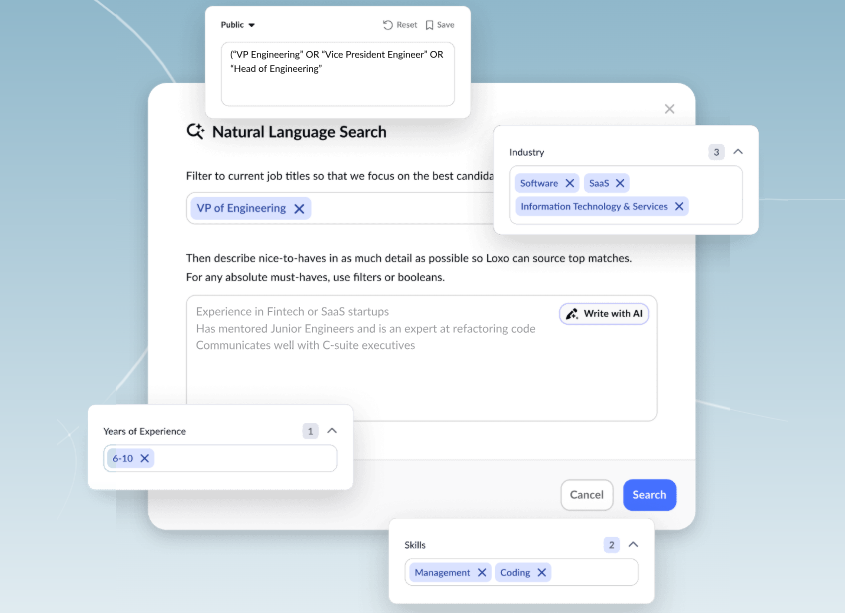
The database draws from 1.2 billion candidate profiles that Loxo owns rather than licenses. Recruiters can search three ways: Natural Language Search (describe the ideal candidate in plain English and let the AI interpret intent), Boolean strings (for experienced sourcers who want precision), or structured filters (title, location, industry, experience, tenure, university).
Source: Loxo
Natural Language Search is the standout. Instead of building complex Boolean queries, a recruiter types something like "senior backend engineer in Austin with fintech experience" and the AI translates that into a search across the full talent graph.
Results are ranked by semantic match, with a "Context" feature explaining why each candidate ranks where it does. The AI also learns from rejection feedback: when a recruiter passes on a candidate, those signals improve future recommendations.
Loxo Source also includes industry-specific datasets for healthcare, legal, technology, and insurance, surfacing candidates not indexed on general professional networks. Searches can be saved and shared with the team, so successful sourcing strategies can be standardized across the firm.
ATS & Recruiting CRM: A unified pipeline and relationship database that keeps every candidate interaction in one place.
Loxo's ATS and Recruiting CRM work as a single system. The ATS provides a visual Kanban board for tracking candidates through customizable pipeline stages. Recruiters drag and drop candidates between stages, and the system updates in real time across every job, recruiter, and client view.
What makes this more than a standard ATS is the automation layer. Each pipeline stage can trigger Stage Automations when a candidate moves into it: enrolling candidates in outreach campaigns, fetching contact information, or firing email sequences. These automations run without manual intervention, turning the pipeline from a passive tracker into an active workflow engine.
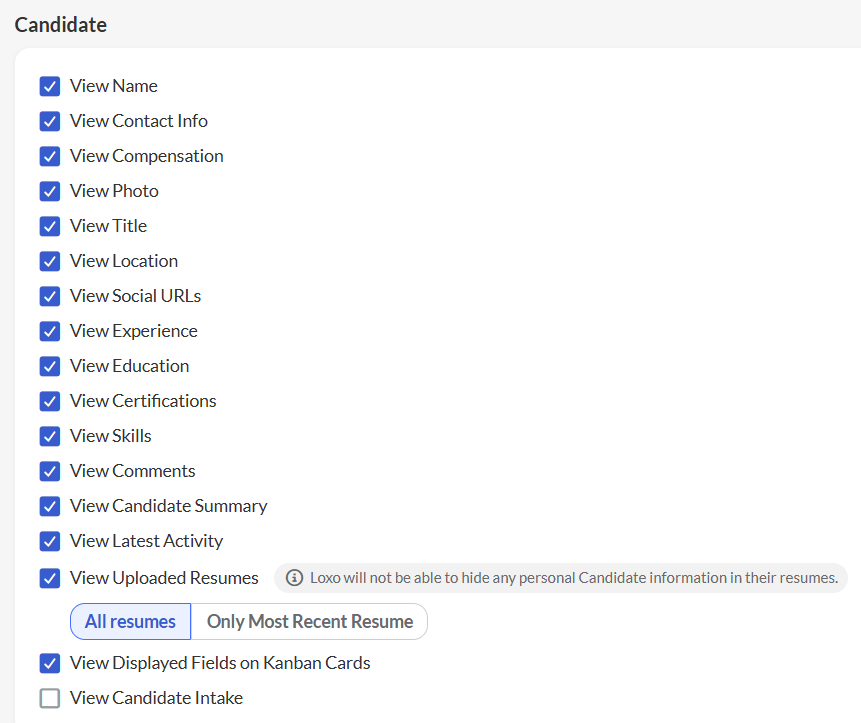
Client collaboration happens through the Hiring Manager Portal, a live space shared via a single link. Hiring managers can view candidate pipelines, comment on candidates, access scorecards, and upload resumes, replacing email chains and PDF status reports with real-time visibility.
Source: Loxo
The Candidate Submittal Agent generates AI-written candidate summaries in one click, pulling from the full candidate profile and aligning strengths against job requirements.
The CRM side centralizes every candidate and contact profile, conversation history, note, and activity log in one searchable, team-accessible database. It's available on Loxo's Free plan, with Boolean search, advanced filtering, tags, custom fields, and bulk actions.
The Self-Updating CRM Agent (Professional plan) runs in the background, refreshing candidate records by cross-checking multiple data sources before applying changes.
Outreach & Campaign Automation: Omnichannel sequences that run from the same platform as sourcing and pipeline management.
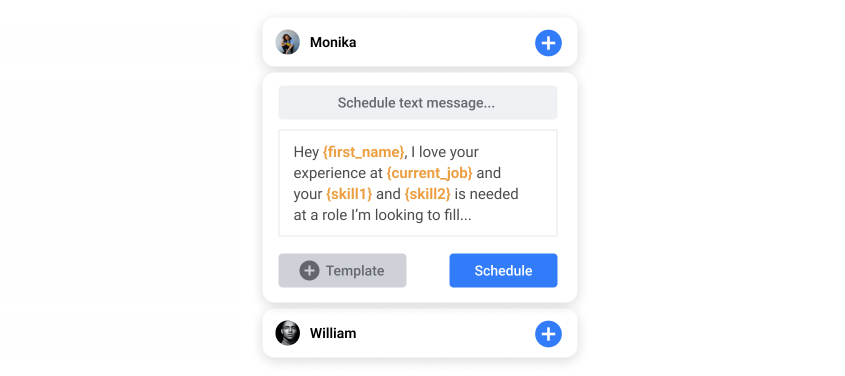
Loxo Outreach replaces the separate email, SMS, and calling tools most recruiting teams use. Recruiters build multi-stage campaigns with email, SMS, phone, and meeting steps, all from the same platform where they source and track candidates.
The most useful automation is Auto-Add to Campaign. Attach a campaign to a job pipeline stage, and any candidate moved into that stage enrolls in the linked outreach sequence automatically. The platform also auto-fetches contact information for candidates entering a linked stage, removing the manual step of finding email addresses before outreach begins.
Outreach GPT generates complete multi-stage campaigns based on job details, with the ability to regenerate individual stages or add A/B variants before launch. Campaigns support unlimited A/B testing variants per stage, custom personalization per recipient without breaking analytics, and configurable operating hours and schedule-send options.
Source: Loxo
All interactions (calls, messages, responses, meetings) are automatically logged on every profile, creating a complete relationship history regardless of which recruiter sent the last message. The same outreach infrastructure supports business development campaigns aimed at prospective clients, not just candidates.
AI Agents: Four autonomous agents that eliminate manual work across CRM hygiene, contact finding, note-taking, and candidate presentation.
Loxo's AI layer is built on over 50 machine learning models trained on recruiter behavior, now in its sixth generation since 2012. The company draws a clear line between its approach and competitors: this is proprietary AI built from scratch, not a commercial LLM with a recruiting skin.
Four AI agents run autonomously:
Self-Updating CRM Agent monitors candidate profiles and cross-checks multiple datasets to validate changes before applying them. It updates location, titles, companies, education, certifications, and skills without recruiter input. Every update is logged in the candidate's activity feed.
Contact Info Finding Agent surfaces personal email addresses and direct phone numbers from aggregated public and proprietary sources. Each retrieval consumes a Loxo Credit; no credit is charged if nothing is found.
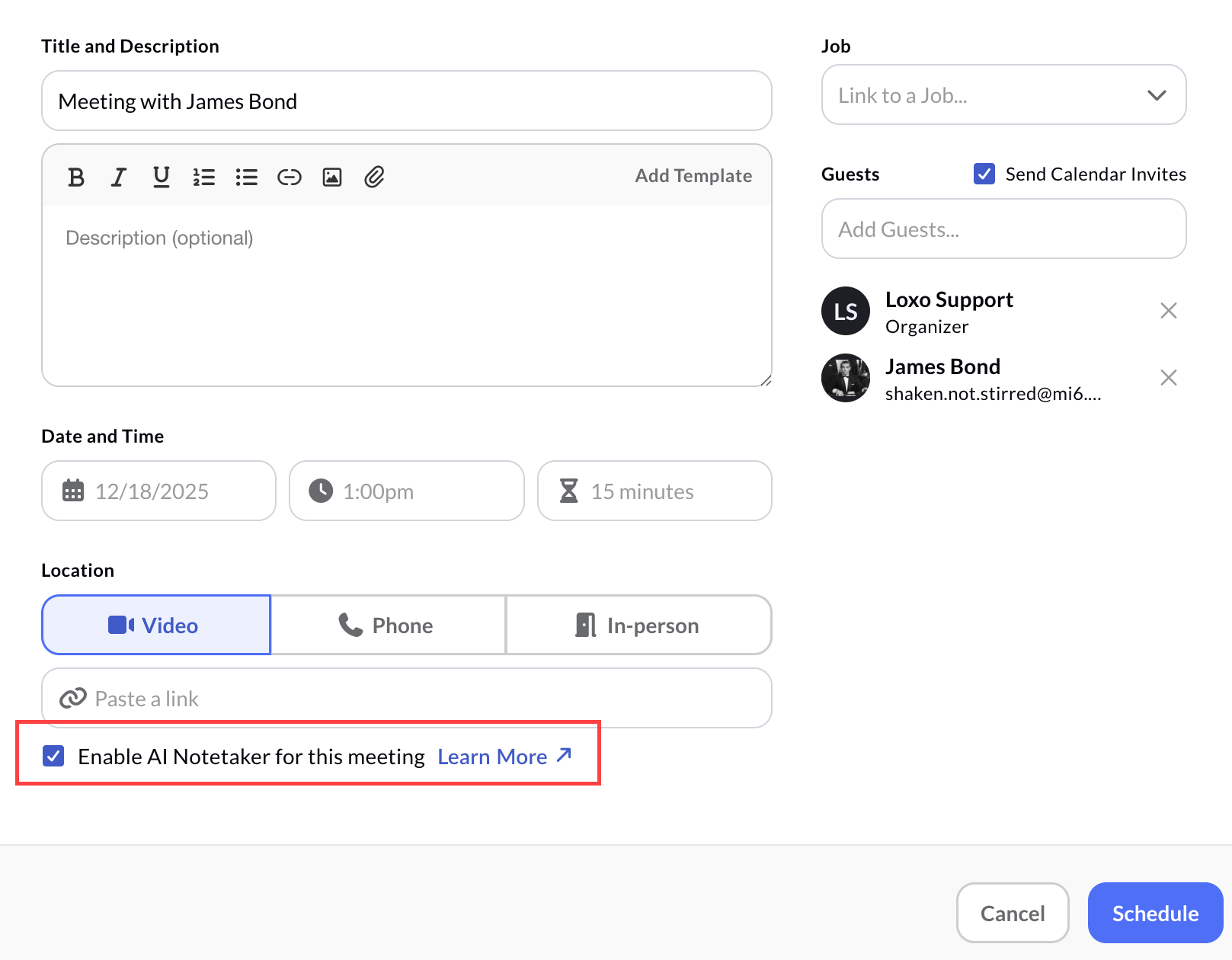
AI Notetaker connects to Zoom, Microsoft Teams, or Google Meet and automatically joins meetings tied to a matching Loxo profile. After processing, it writes a transcript and summary directly into the candidate's record. Recruiters can create shareable "Snippets" (trimmed clips from recordings with optional expiration).
Source: Loxo
Candidate Submittal Agent generates an AI-written candidate summary by reading the candidate's full profile and cross-referencing job requirements. The output appears in the submission flow, the Client Portal, and Executive Presentations.
Beyond the agents, AI Job Matching works in reverse: given a candidate profile, it identifies which open roles in the pipeline fit best. This enables talent redeployment workflows where existing database candidates are matched to new openings automatically.
Where Loxo Falls Short
Loxo consolidates the recruiting workflow well, but several limitations appear with regular use. These reflect a platform built for the candidate side of recruiting rather than the full business lifecycle of a recruiting firm.
Contact Data Quality Is Inconsistent. Capterra users report that sourced contact data can be outdated, particularly in certain verticals, and does not always replace LinkedIn Recruiter. G2 reviewers flag that sourced contacts sometimes lack accurate email or phone information.
For a platform whose value depends on a proprietary talent graph with verified contact data, inconsistency in that data undermines trust in the outreach automation built on top of it.
Business Development Tools Are Underdeveloped. Recruiting firms need to win clients, not just find candidates. Loxo's Sales CRM and Account-Based Prospecting features exist, but Capterra reviews note the deal board setup makes BD pipeline management difficult for firms with complex client sales cycles.
The company intelligence available through Loxo's ABP is limited compared to dedicated B2B intelligence platforms: no intent signals showing which companies are actively growing, no technographic data, and no organizational hierarchy mapping beyond basic employee search.
Pricing Complexity at Scale. Capterra reviewers flag that pricing has increased over time and is no longer competitive for organization-wide rollouts. The publicly listed Basic plan is $169/user/month on annual billing, but this is promotional first-year pricing for new customers only, and renewal rates may differ.
Professional and Enterprise tiers (which unlock Loxo Source, Natural Language Search, AI agents, and outreach automation) are custom-priced behind a sales conversation. The Loxo Credits system adds another consumption layer on top of the subscription, and credits expire at the end of the subscription period without rollover.
Duplicate Records and Data Hygiene. Capterra feedback calls out that Loxo creates multiple profiles for the same person when they appear as candidates across multiple jobs. Over time, this pollutes the CRM and creates confusion about which profile contains the most current information, a problem for a platform whose central promise is being the firm's single source of truth.
Email Delivery Reliability. G2 users report outreach emails silently failing, with candidates never receiving them. For a platform built on automated omnichannel outreach, unreliable email delivery is a real concern.
Support Defaults to Self-Serve. Capterra reviewers report that live human support requires escalation steps, with some users finding response times slow. A dedicated account manager, priority support, and custom training are available as a paid Strategic Customer Success add-on, not included in standard plans.
These limitations are the natural result of a platform built for the candidate side of recruiting. But they highlight a gap that matters for growing firms: the business development and client intelligence that determine whether you have clients to recruit for in the first place.
The Perfect Complement to Loxo: ZoomInfo
ZoomInfo addresses the gap Loxo leaves open. While Loxo manages the talent workflow (sourcing, tracking, and placing candidates) ZoomInfo is an AI GTM platform built on the B2B data recruiting firms need.
That means intelligence to find companies that need your services, verified contact data to reach the people who authorize recruiting spend, and signals to know when a company is in-market for talent, before they post a job listing.
B2B Company & Contact Intelligence: ZoomInfo identifies the decision-makers at companies that need to hire.
Recruiting firms live or die on their ability to find clients. Loxo's Account-Based Prospecting offers basic company and employee search, but the data is thin compared to what ZoomInfo provides.
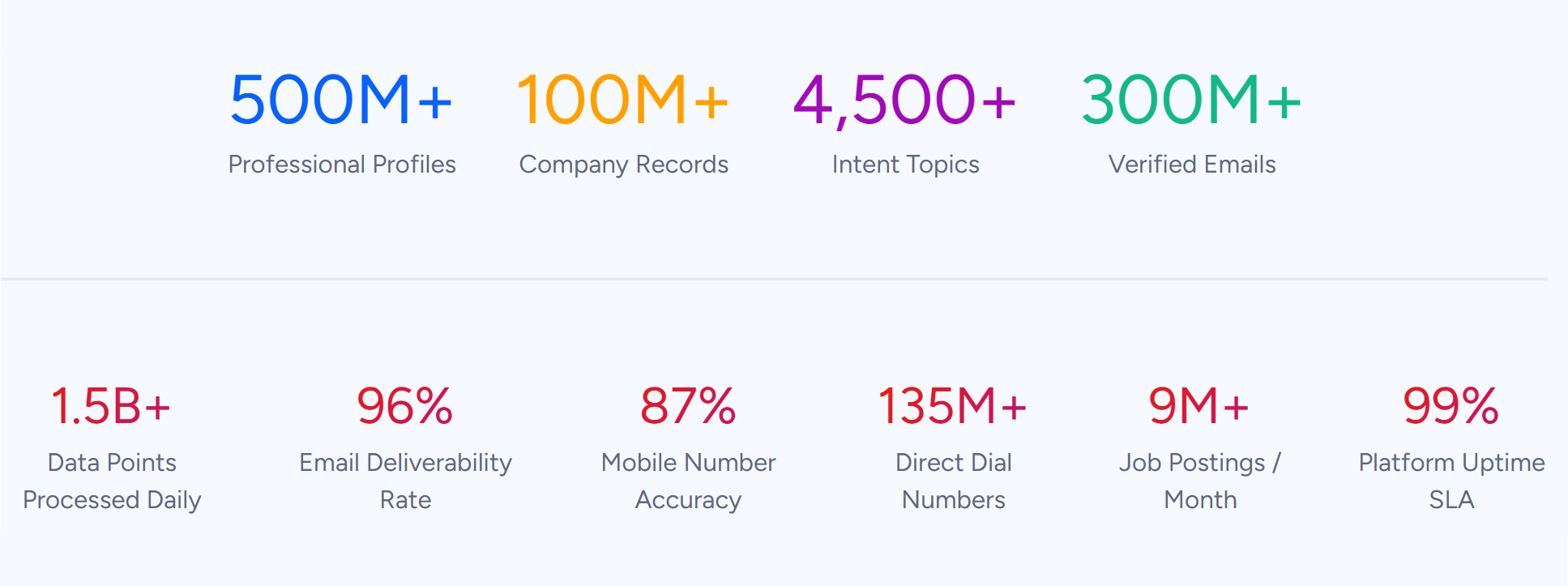
ZoomInfo's data platform covers 500M contacts, 100M companies, 135M+ verified phone numbers, 120M direct-dial phone numbers, and 200M+ verified business email addresses, processed through a multi-source verification pipeline backed by 300+ human researchers and reaching up to 95% accuracy on first-party data.
Source: ZoomInfo
For a recruiting firm, this means finding VPs of Talent Acquisition, Heads of HR, and C-suite executives at target companies, with direct phone numbers and verified emails, not generic info@ addresses.
ZoomInfo's 300+ company attributes let you filter by industry, headcount, revenue, technology stack, funding status, and department structure, building targeted prospect lists of companies that match your placement focus.
The data quality difference is externally validated. In a Fortune 500 competitive RFP analyzing 25 million contacts across vendors, an independent consultant concluded that "no other competitor came even close." ZoomInfo is Ranked #1 in 142 G2 Reports.
"ZoomInfo gives us the information we need to execute. We don't have to spend our time digging. It's already there, so we can be three steps ahead." (Vensure)
Intent & Signal Intelligence: ZoomInfo reveals which companies are actively in-market before they reach out to you.
Knowing which companies to target is half the equation. Knowing when they're ready to buy is the other half. Loxo's platform has no intent signal capability, no way to detect when a company is researching recruiting services, planning expansion, or showing hiring activity that predicts demand.
ZoomInfo's Intent Data tracks signals from 210 million IP-to-Organization pairings and 6 trillion+ keyword-to-device pairings sourced monthly. Guided Intent, exclusive to ZoomInfo, identifies topics historically correlated with deal success rather than requiring manual topic selection.
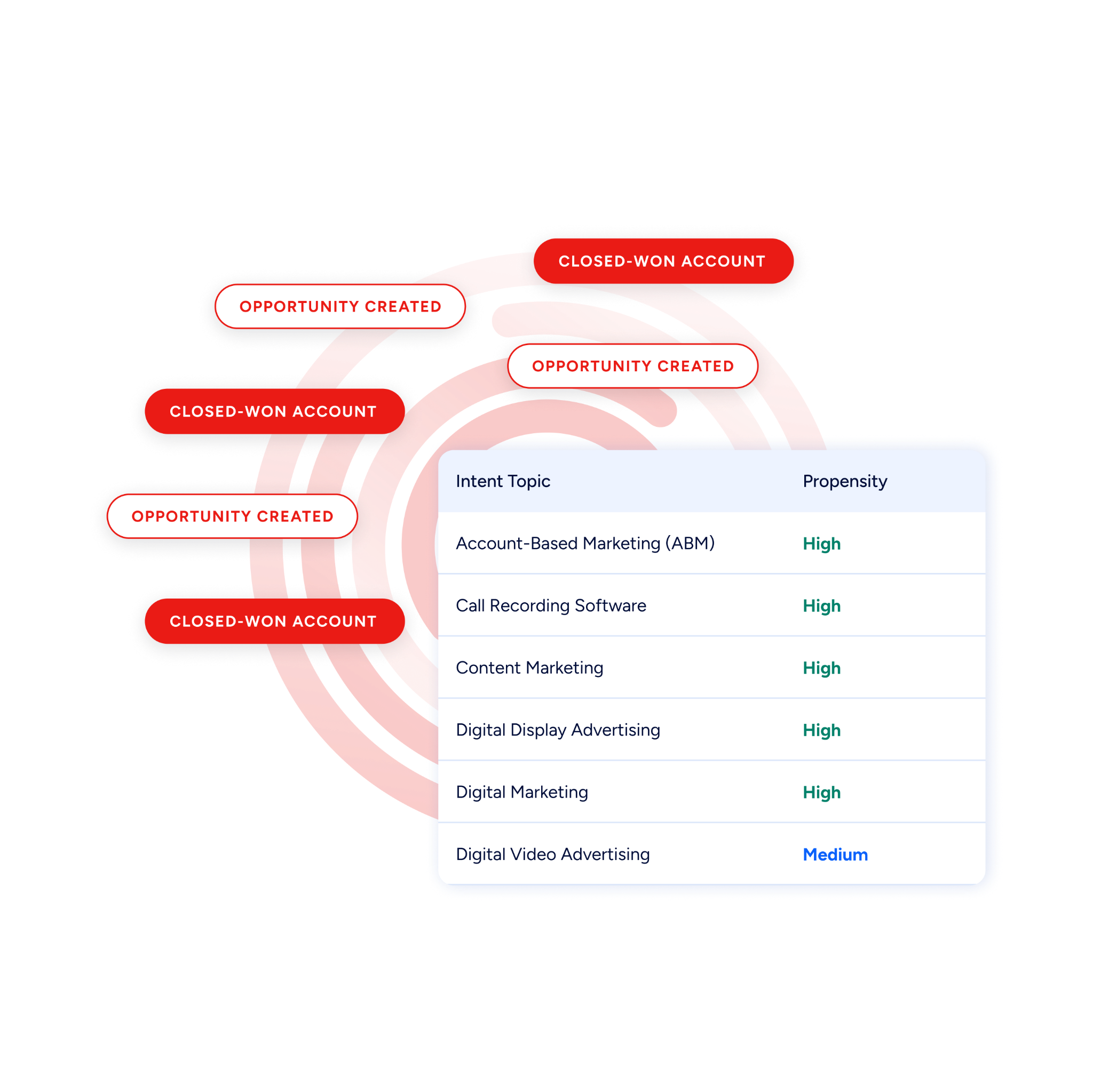
For recruiting firms, this surfaces companies researching hiring solutions, talent acquisition platforms, or workforce expansion, buying signals that tell you where to focus outreach today.
Beyond intent, ZoomInfo tracks scoops and signals like funding rounds, leadership changes, new initiatives, and hiring patterns. A company that just raised a Series C, hired a new VP of Engineering, and is researching recruiting services is a far warmer prospect than one you're cold-calling from a static list. ZoomInfo surfaces these patterns automatically.
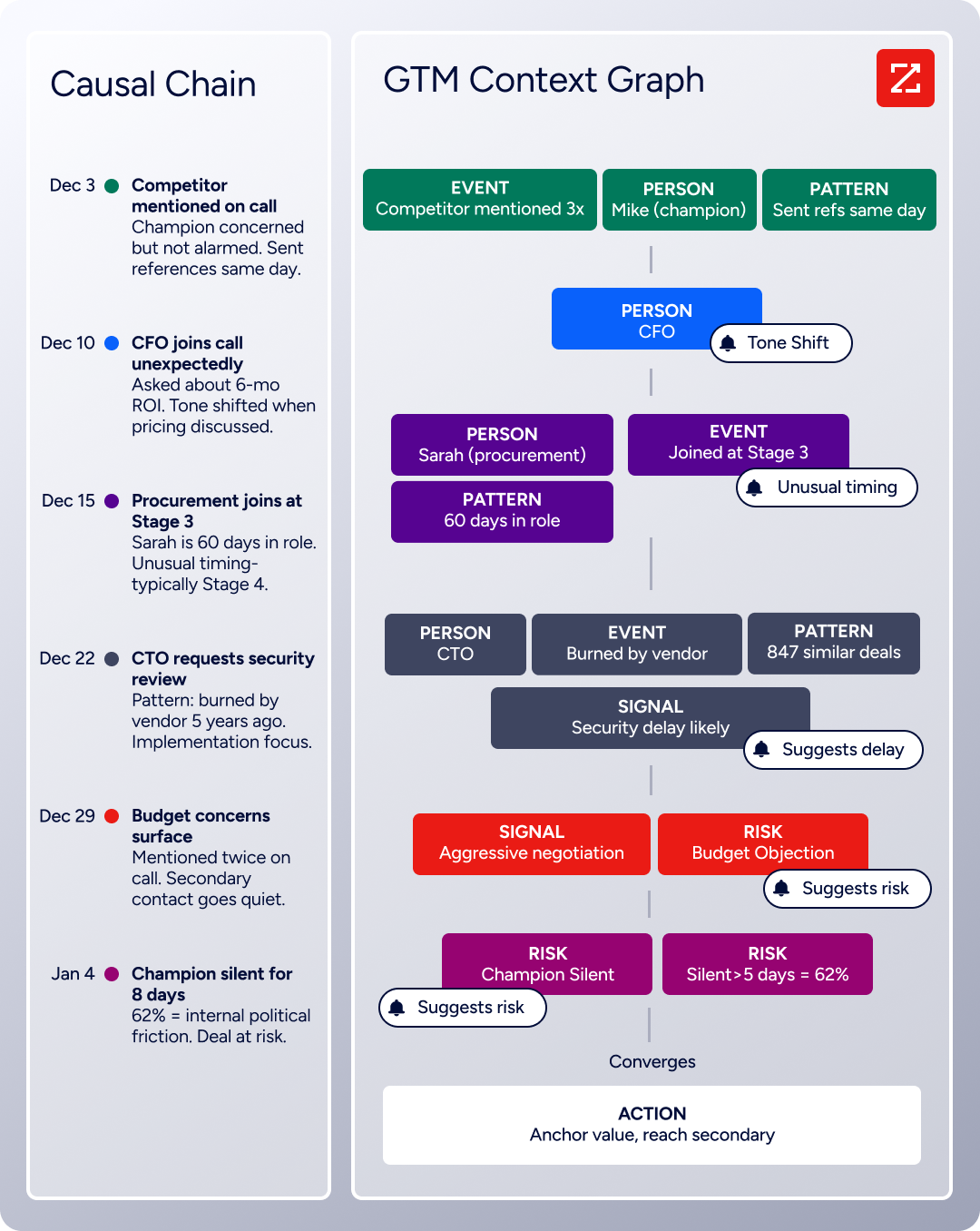
The GTM Context Graph, which processes 1.5B+ data points daily, goes further by fusing ZoomInfo's third-party intelligence with your CRM records, conversation transcripts, and behavioral signals. It captures not just what happened in a deal, but why it happened, enabling AI that understands your actual win patterns rather than relying on generic scoring.
Source: ZoomInfo
"ZoomInfo's not just a contact data company anymore. They've built a full system of execution. GTM Intelligence works the list, writes the outreach, triggers the play, and helps drive predictable growth." (Levanta)
GTM Workspace: An AI-powered execution engine for recruiting firm business development.
Identifying target companies and detecting intent signals is only useful if you can act on that intelligence efficiently. GTM Workspace is ZoomInfo's native workspace for sellers, and for recruiting firms, it changes how business development gets done.
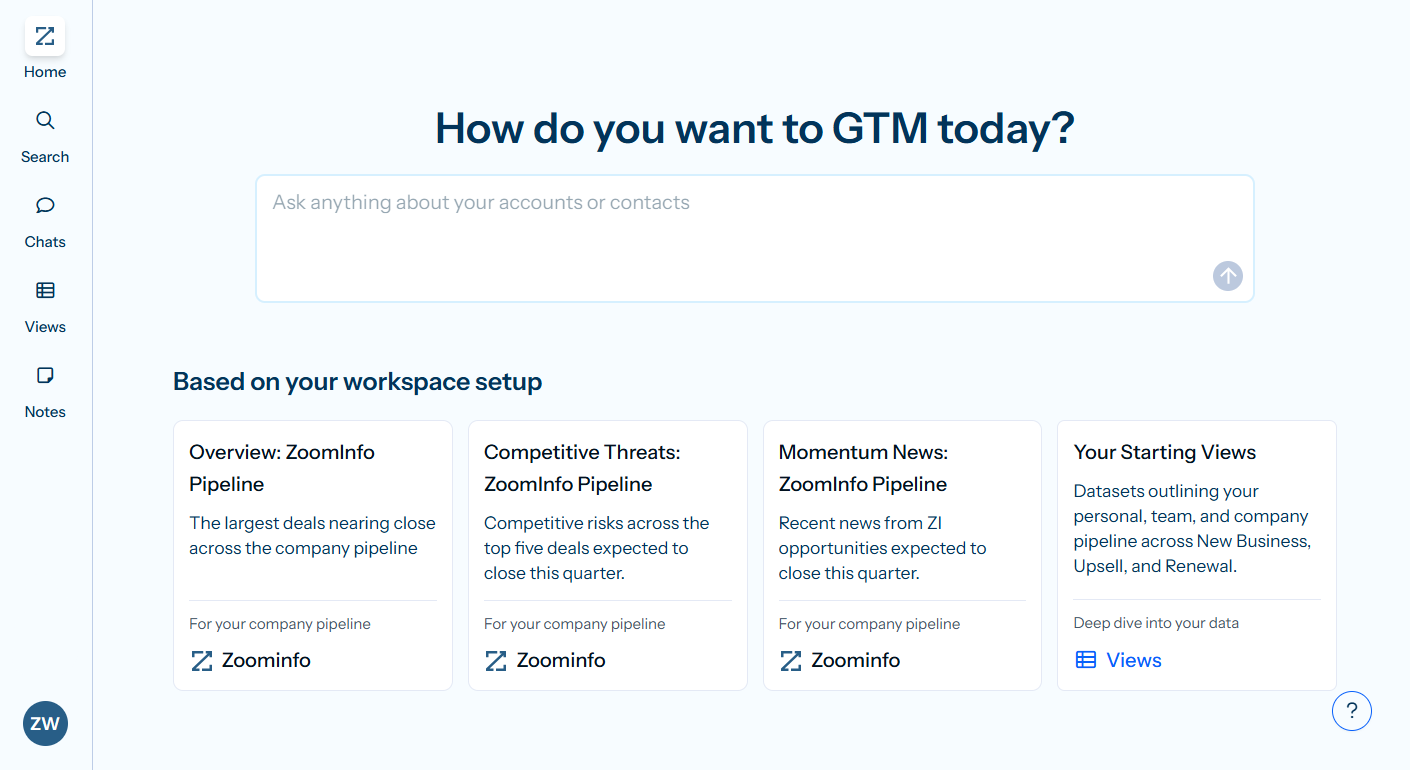
GTM Workspace provides a complete book-of-business view across CRM data, ZoomInfo intelligence, conversation history, and market signals. An Action Feed streams in-market buyers matched to your target criteria, with pre-drafted actions on every signal.
When a target company raises funding, hires a new executive, or spikes on intent topics, the system surfaces it with a recommended next step. AI-generated outreach drafts personalized emails from full account context in seconds.
For recruiting firms whose BD teams are small (often the same people doing recruiting), GTM Workspace's AI agents handle the administrative work that typically falls through the cracks: researching accounts, monitoring signals, drafting follow-ups, and updating CRM fields. Business development runs continuously even when recruiters are focused on active searches.
"That combination of our internal CRM data, external signals, and AI that's given all that context has helped us craft very specific account- and persona-based messages. And people have responded to them right away." (Seismic)
API & MCP Access: ZoomInfo's intelligence in any tool your firm already uses.
ZoomInfo is not locked inside a single application. APIs and MCP (Model Context Protocol) expose the same data and intelligence to any custom agent, internal tool, or partner platform. The MCP server is listed in the Claude directory and currently supports Claude and ChatGPT, with additional MCP-compatible tools noted as coming soon.
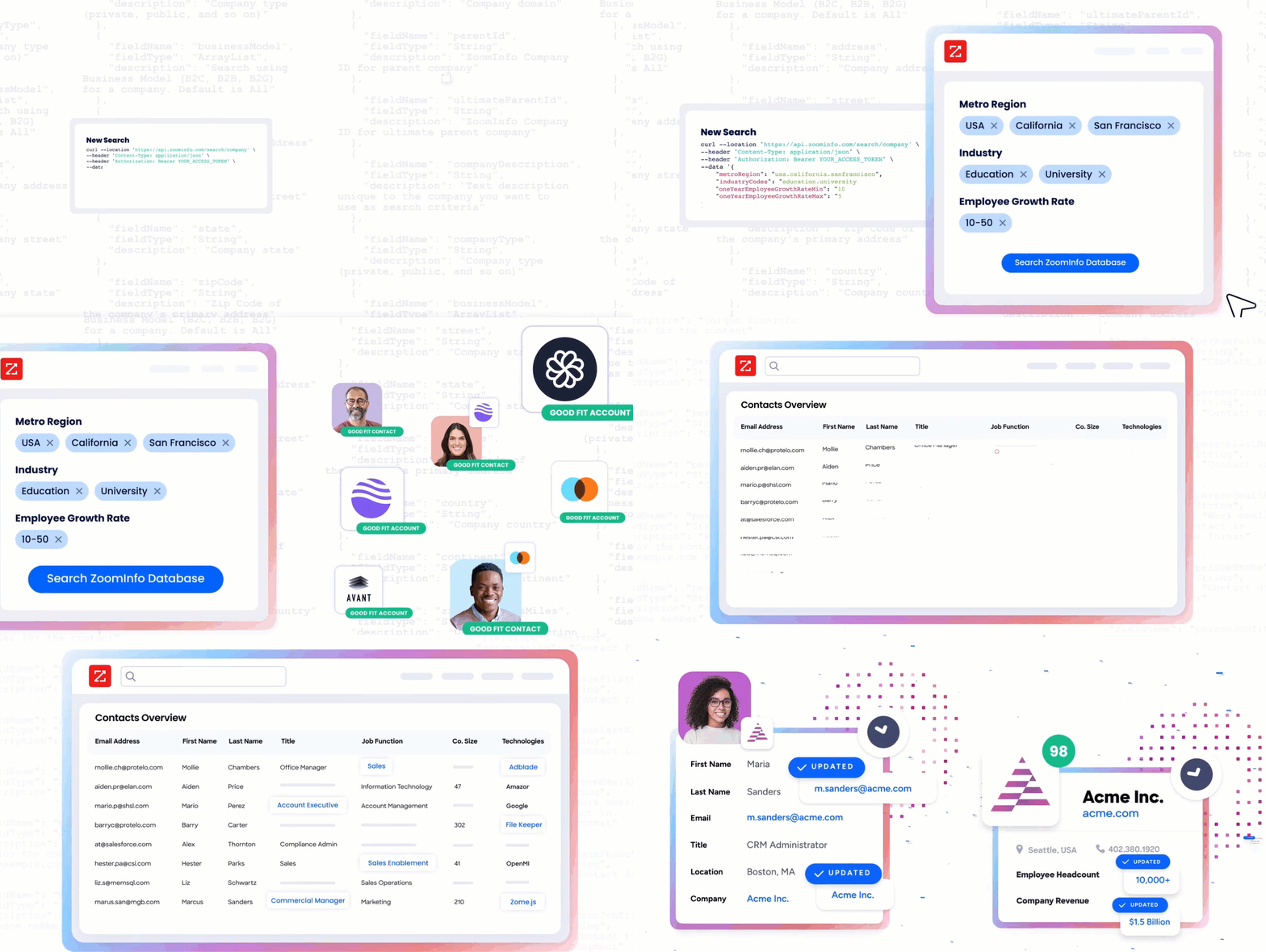
Source: ZoomInfo
For recruiting firms, this means feeding ZoomInfo's company and contact intelligence into existing workflows, whether that's enriching client records in your CRM, powering custom business development dashboards, or integrating B2B data into proprietary tools.
The Enterprise API covers search, enrichment, intent, company hierarchy, org charts, and AI-powered account research. API access is included in all relevant plans.
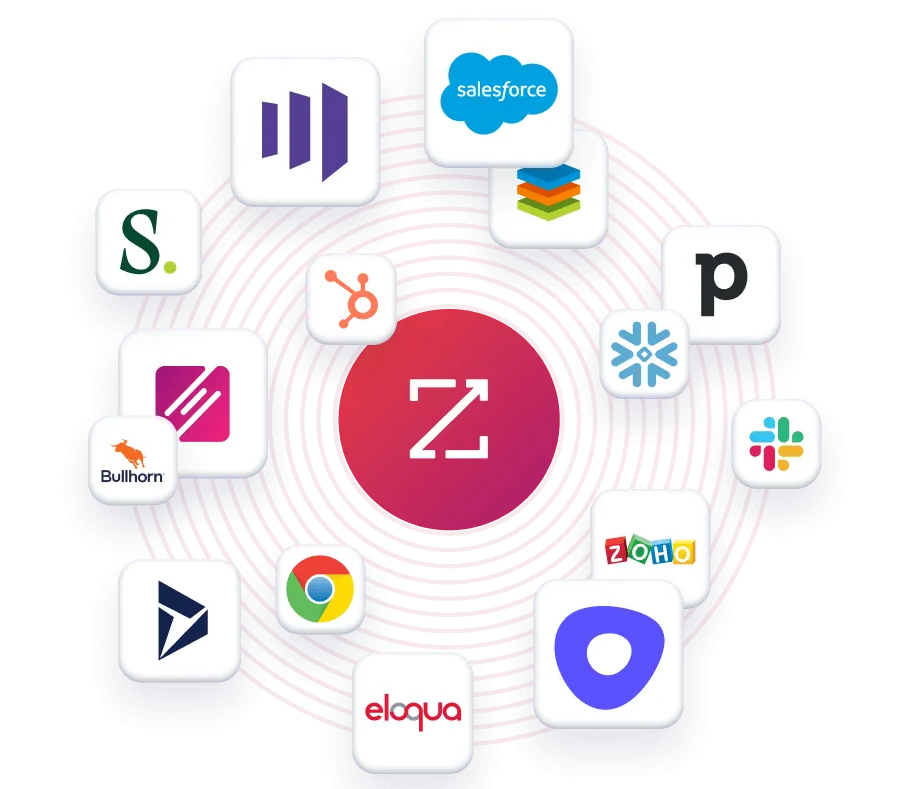
ZoomInfo also integrates with the tools recruiting firms commonly use alongside their ATS. The App Marketplace lists 172+ integration partners, including Salesforce, HubSpot, Microsoft Dynamics 365, and Bullhorn (one of recruiting's most widely used ATS platforms).
Source: ZoomInfo
For firms running Loxo for candidate management and ZoomInfo for BD intelligence, data can flow between systems through API connections or integration platforms.
"The plug-and-play aspect of the API means I can integrate it very easily into any process and get information at a moment's notice." (BDO Canada)
Loxo and ZoomInfo: How They Work Together
Aspect | Loxo | ZoomInfo |
|---|---|---|
Primary Focus | Recruiting workflow (sourcing, tracking, placing candidates) | B2B intelligence (finding companies, reaching decision-makers) |
Core Strength | Unified ATS + CRM + sourcing + outreach for recruiters | Contact, company, and intent data for business development |
Data Asset | 1.2B candidate profiles (talent graph) | 500M contacts, 100M companies, 135M+ verified phone numbers |
AI Focus | Recruiting-specific: candidate matching, CRM hygiene, note-taking | GTM-specific: account prioritization, signal detection, outreach drafting |
Intent Signals | Not available | 210M IP-to-Organization pairings, 6T+ keyword-to-device pairings monthly |
BD Capabilities | Basic Sales CRM and Account-Based Prospecting | GTM Workspace with AI agents, signal-driven action feed, and automated outreach |
Ideal User | Recruiters managing candidate pipelines | BD teams finding and winning recruiting clients |
Free Tier | Free plan (1 user, ATS + CRM) | ZoomInfo Lite (permanent, 10 monthly exports) |
Pricing | $169/user/month (Basic, annual) + custom for higher tiers | Custom-quoted, consumption-based |
Final Verdict
Loxo and ZoomInfo address two distinct sides of the recruiting business. Loxo handles the talent side: finding, managing, and placing candidates. ZoomInfo powers the business side: identifying companies that need your services, reaching the people who make hiring decisions, and detecting the signals that predict demand.
Choose Loxo if your primary challenge is the recruiting workflow itself. It's the right platform when your firm needs to consolidate a fragmented tech stack into one system, source candidates from a proprietary talent database, and automate the repetitive work that slows down placements.
Sourcing, pipeline management, outreach, and client collaboration happen in a single interface, with no data re-entry and no context switching. For small-to-mid-size recruiting firms where every recruiter handles the full cycle, Loxo delivers real efficiency gains.
Pair it with ZoomInfo if your firm needs to grow its client base, not just manage existing relationships. ZoomInfo's B2B intelligence gives recruiting firms the same data and signal advantages that enterprise sales teams use to find, prioritize, and win accounts.
Direct dial numbers that actually ring. Intent signals that reveal hiring demand before a job posting goes live. AI-powered business development that runs even when your recruiters are focused on active searches. For firms where client acquisition is the bottleneck (not candidate sourcing) ZoomInfo fills a gap that no recruiting-specific platform addresses.
Get started with ZoomInfo here.
Together, these platforms create a complete system for the two sides of every recruiting firm's revenue: ZoomInfo brings in the clients, and Loxo manages the talent. The firms that treat business development and recruiting as separate workflows, solved by separate tools, will outperform those trying to force one platform to do both.
Loxo FAQ
Is there a free version of Loxo?
Yes, Loxo offers a permanent free plan for a single user that includes full ATS and CRM functionality, job management, the Chrome extension, and data importing. It does not include AI automations, Loxo Credits, outreach tools, or customer support.
New sign-ups automatically receive access to all Professional features for 7 days. The free plan is available only to new customers and cannot be used as a downgrade path from a paid subscription.
How much does Loxo cost?
The Basic plan is $169 per user per month on annual billing, though this is promotional first-year pricing for new customers, and renewal rates may differ. Professional and Enterprise tiers (which unlock Loxo Source, Natural Language Search, AI agents, and full outreach automation) are custom-priced.
Loxo Credits for AI-powered actions like contact finding and the AI Notetaker add a consumption layer on top of the subscription, and unused credits expire at the end of the billing period.
What is Loxo's talent database?
Loxo Source contains 1.2 billion candidate profiles with verified contact data, including mobile numbers and personal and work emails. The database is proprietary: Loxo owns the data rather than licensing it from third parties.
It includes specialized datasets for healthcare, legal, technology, and insurance verticals. Recruiters can search it using Natural Language Search, Boolean strings, or structured filters, and results are ranked by AI-driven semantic matching.
Does Loxo offer month-to-month billing?
Loxo offers both annual and month-to-month billing options, though the publicly listed $169/user/month price reflects annual billing. Month-to-month pricing is not publicly disclosed. Both annual and month-to-month plans auto-renew and require a written 30-day notice to cancel. Annual plans cannot be modified (including seat count changes) until the renewal date.
What AI features does Loxo include?
Loxo has four AI agents: the Self-Updating CRM Agent (automatically refreshes candidate profiles), Contact Info Finding Agent (surfaces verified emails and phone numbers), AI Notetaker (records and summarizes interview calls), and Candidate Submittal Agent (generates candidate summaries).
Additional AI features include Natural Language Search for plain-English sourcing, AI Job Matching that identifies best-fit open roles for existing candidates, and Outreach GPT for generating multi-stage outreach campaigns. Most AI features require a Professional plan or higher and consume Loxo Credits.
Does Loxo have business development tools?
Yes, Loxo includes a Sales CRM with customizable deal pipelines and an Account-Based Prospecting feature for finding target companies and their decision-makers. User reviews note that BD pipeline management is underdeveloped compared to dedicated CRM tools, and the company intelligence available is limited.
For recruiting firms that need deeper B2B company data, intent signals, and sales execution capabilities, a platform like ZoomInfo complements Loxo's recruiting-focused BD tools.
What integrations does Loxo support?
Loxo's Marketplace includes integrations across several categories: VOIP (Ringover, RingCentral, Twilio), scheduling (Arrange, Zoom, Hireflix), job boards (Indeed, Monster, Broadbean), email (HubSpot, Mailchimp, Mailgun), assessments (HireQuotient, Testlify), HCM and payroll (Workday, Xero, Astute Payroll), and eSignature (RSign).
The platform also offers an Open API and supports Zapier for custom workflow automation, though some users have noted the integration ecosystem is limited compared to larger platforms.
How does Loxo compare to other ATS platforms?
Loxo differentiates itself by being more than an ATS: it integrates sourcing, CRM, outreach, and AI agents into one platform instead of treating applicant tracking as a standalone function.
Independent research commissioned by Tritium Partners found that recruiters in the US and UK gave Loxo the highest net promoter score among major ATS platforms and ranked it first in AI-driven features, user experience, and ease of implementation.
Firms needing enterprise HRIS integrations, high-volume contingent workforce management, or deep business development intelligence may find that Loxo's strengths sit on the candidate management side rather than the full business operations side.
