
Lytics built its reputation on a specific conviction: behavioral data matters more than demographic data for personalizing customer experiences.
The platform, now branded as an "Experience CDP" (xCDP), unifies first-party data from website visits, email engagement, and app interactions into real-time user profiles, then uses machine learning to score each visitor's interests and predict behavior.
For consumer-facing brands with content-heavy websites, that means more relevant experiences and better ad targeting.
To write this Lytics review, we analyzed the platform in detail. We believe it's a good choice if:
You're a consumer-facing brand (retail, CPG, media) that needs real-time website personalization driven by behavioral data
You want machine learning models (content affinity scoring, lookalike audiences) without hiring a data science team
You need a CDP that works natively with Google Cloud infrastructure
Your priority is activating first-party data for ad targeting in a post-cookie environment
You want a composable architecture that layers on top of your existing data warehouse
However, Lytics is not a good choice if:
You're a B2B company that needs verified contact data, direct-dial phone numbers, and company intelligence to power sales and marketing
You need buyer intent signals tied to identified business accounts, not anonymous behavioral scoring
You require a platform that unifies prospecting, outreach, conversation intelligence, and deal execution in one system
You need contact-level identity resolution for B2B accounts (Lytics resolves at the account level only)
You want a go-to-market platform with broad adoption across sales and marketing teams
In this case, you should consider ZoomInfo: a B2B go-to-market platform that combines verified data (500M contacts, 100M companies, 135M+ verified phone numbers, and 200M+ verified business email addresses) with the GTM Context Graph, an intelligence layer that captures not just what happened but why.
ZoomInfo delivers that intelligence through APIs, MCP, GTM Workspace for sellers, and GTM Studio for marketers and RevOps.
We've included a detailed look at ZoomInfo later in this review as the stronger choice for B2B teams that need intelligence and execution in one platform. If you're ready to explore, you can try ZoomInfo free.
What is Lytics?
Lytics is a customer data platform co-founded in 2013 by James McDermott and Aaron Raddon in Portland, Oregon.
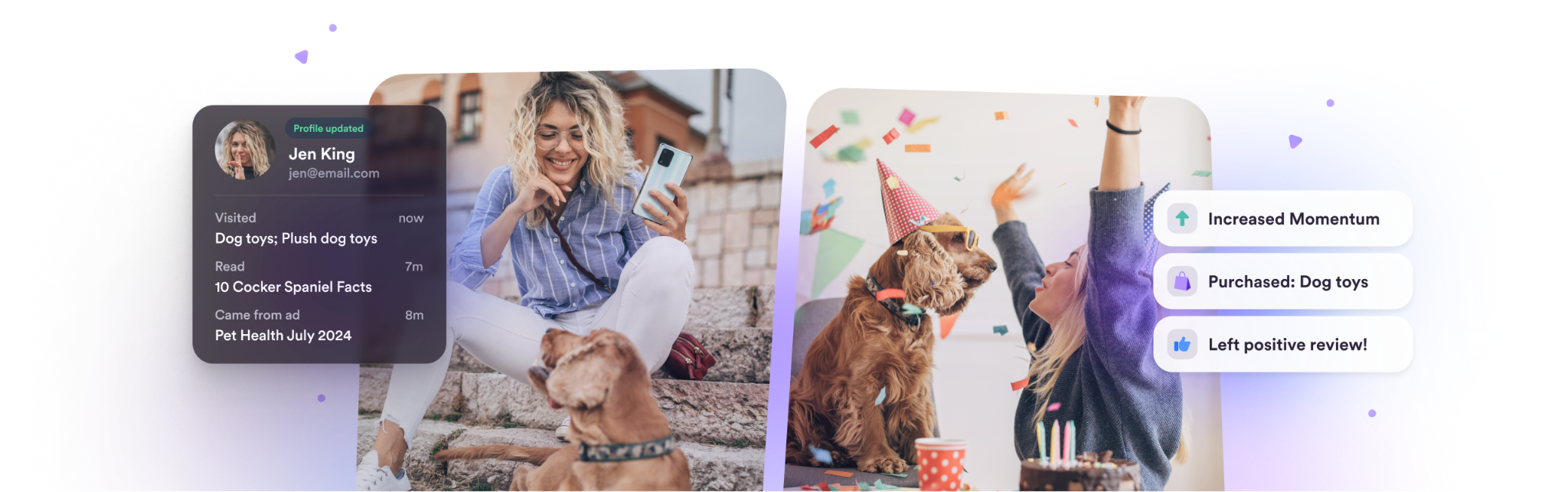
McDermott, previously CEO of Storycode and VP of Business Development at Webtrends, saw that consumer brands needed a better way to unify behavioral data and compete with the personalization capabilities of companies like Amazon and Netflix.
The platform collects first-party data from website visits, email interactions, mobile apps, and data warehouses, then stitches those signals into unified user profiles using an identity graph.
Its machine learning engine generates behavioral scores and content affinity maps for every visitor (including anonymous ones), letting marketers build segments and trigger personalized experiences without writing code.
Lytics raised approximately $58.3 million, with its largest round being a $35 million Series C in February 2019 led by JMI Equity. In December 2024, Contentstack acquired Lytics to become what they describe as "the world's first fully integrated composable DXP." James McDermott now serves as Contentstack's Global Head of Data Products.
Lytics targets enterprise marketers at mid-market to large consumer-facing brands in Retail/CPG, Media & Entertainment, B2B Technology, and Financial Services. Named customers include Kraft Heinz, Mondelez, Universal Music Group, LiveNation, Clorox, Ancestry, and Land O'Lakes.
Lytics Pros & Cons
Pros | Cons |
|---|---|
Content Affinity Engine builds per-user interest maps automatically using NLP | Dashboard and reporting frequently described as unintuitive by reviewers |
Nine behavioral scores computed on every profile, including anonymous visitors | Approximately 3.9 stars on G2 from ~69 reviews, well below category leaders |
Free Developer plan with 2M credits/month (no time limit) | Identity resolution limited to account level for B2B (no contact-level unification) |
Google Cloud-native with firewall deployment option for regulated industries | On-demand audience counts can be slow at scale |
Composable Cloud Connect integrates with existing data warehouses | Acquired by Contentstack, creating uncertainty about standalone future |
AI copilots for schema mapping, audience creation, and integration setup | Enterprise pricing requires annual contracts with 90-day cancellation notice |
Real-time audience membership updates after every behavioral event | Content affinity strength is niche (most relevant for content-heavy sites) |
Lytics Review: How it Works & Key Features
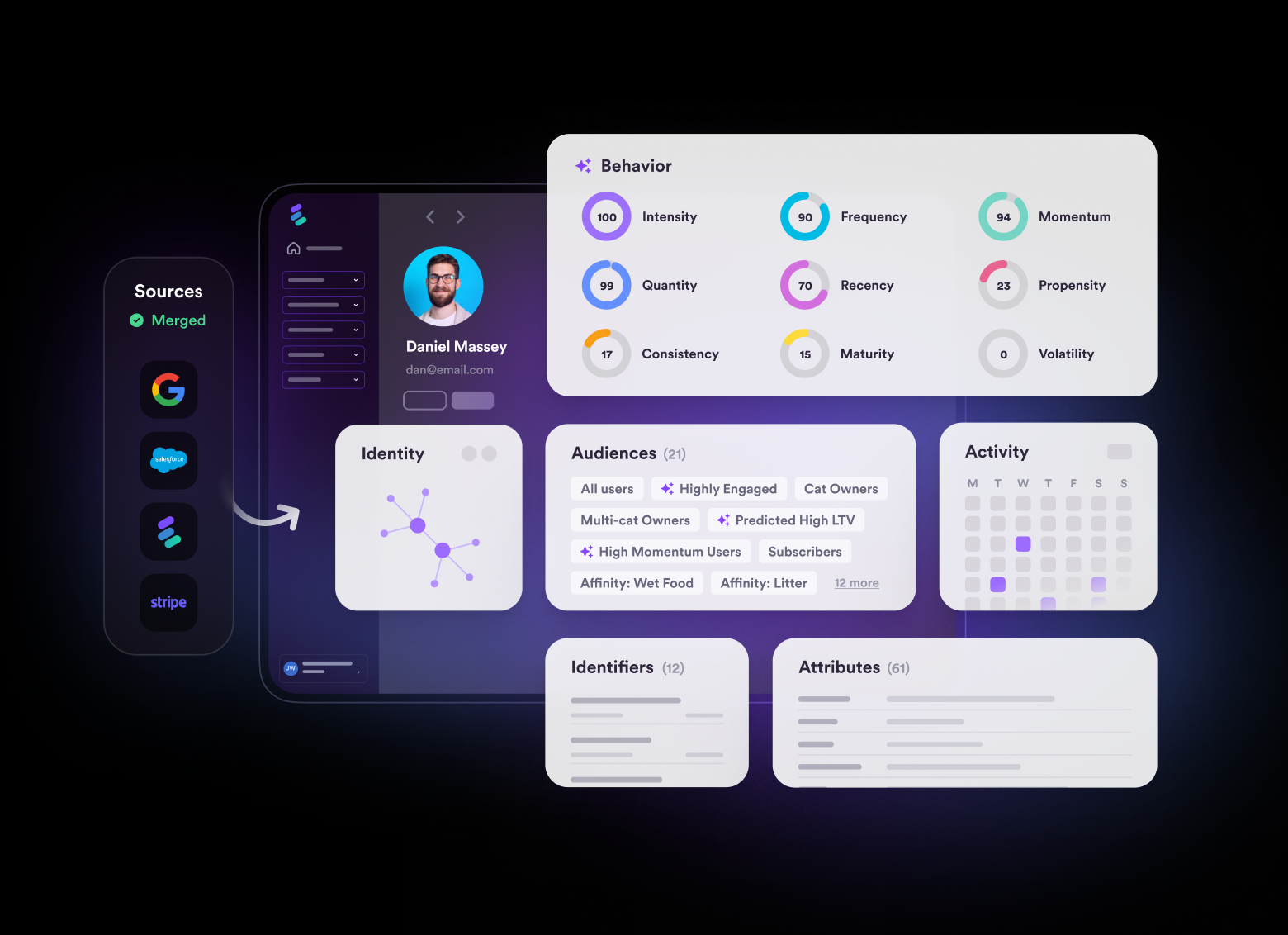
Building Profiles: Lytics unifies fragmented customer data into behavioral profiles enriched with machine learning scores.
Building Profiles is the foundation of Lytics. It ingests data from hundreds of pre-built integrations, API calls, and reverse ETL connections, then maps that data into a standardized schema using Lytics Query Language (LQL).
Source: Lytics
The identity resolution system constructs an identity graph from fragments tied to individual identifiers (email, cookie, customer ID).
When an event contains two or more identity keys at once (for example, a newsletter signup capturing both an email address and a browser cookie), Lytics stitches those fragments into a single profile.
A ranked key system resolves conflicts: higher-ranked keys (typically email) take precedence over lower-ranked ones (typically cookies) to prevent over-merged profiles.
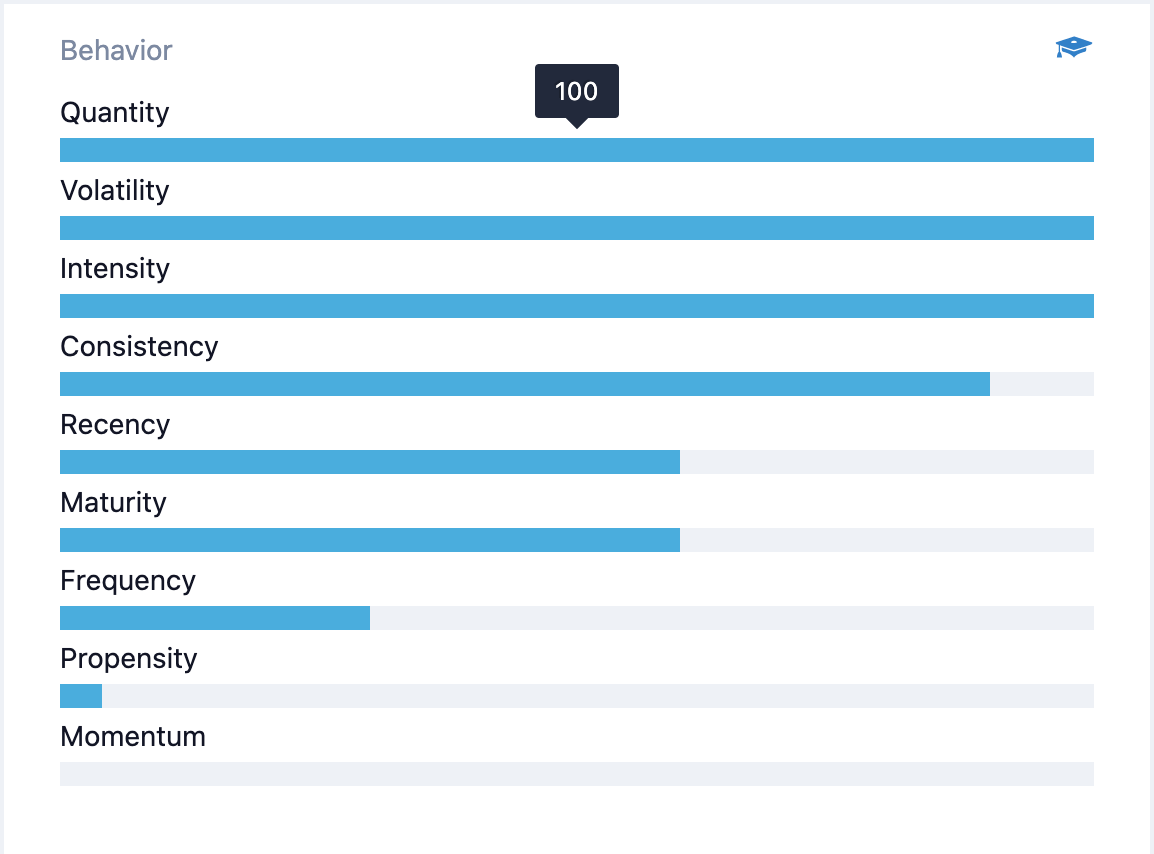
What sets this layer apart is the universal schema applied to every profile. Lytics generates nine behavioral scores (consistency, frequency, intensity, maturity, momentum, propensity, quantity, recency, and volatility) on a normalized 0-100 scale.
Source: Lytics
These scores update continuously after every user event, including for anonymous visitors.
The Content Affinity Engine adds another layer. When events arrive with a URL, Lytics sends it to an NLP pipeline (Google NLP by default, with Diffbot, TextRazor, and Google Vision available) to extract topics.
Those topics map to each user's profile, building a per-visitor interest graph that tracks what content each person cares about, not just what pages they visited.
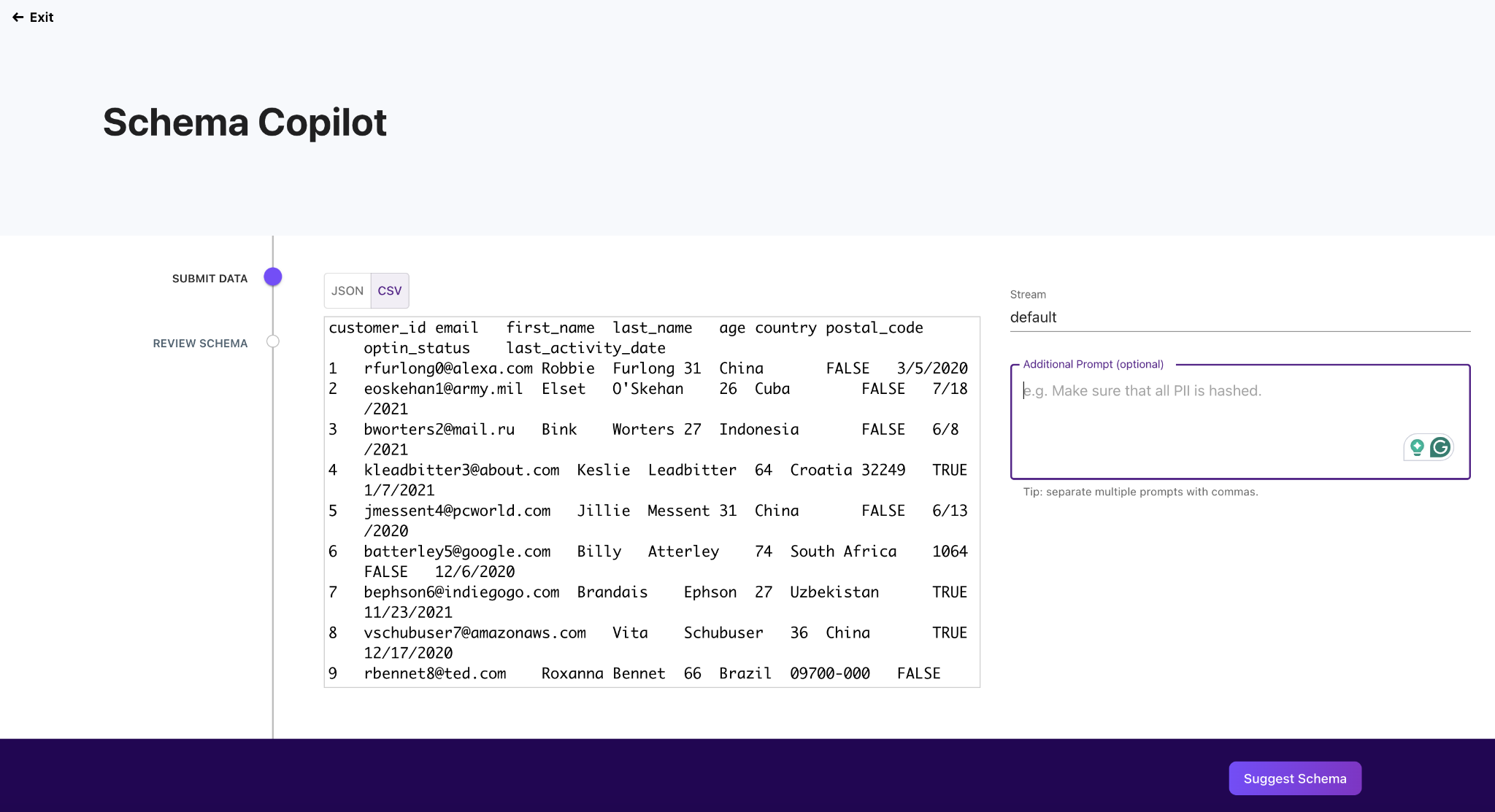
The Visual Schema Editor manages schema changes through a staged patch model closer to version control than typical CDP schema management. AI-assisted tooling (Schema Copilot, AI Schema Suggestions) helps non-technical users configure field mappings and identity keys.
Source: Lytics
Audience Segmentation & Activation: Real-time audience building with a Bayesian Decision Engine that optimizes experience delivery.
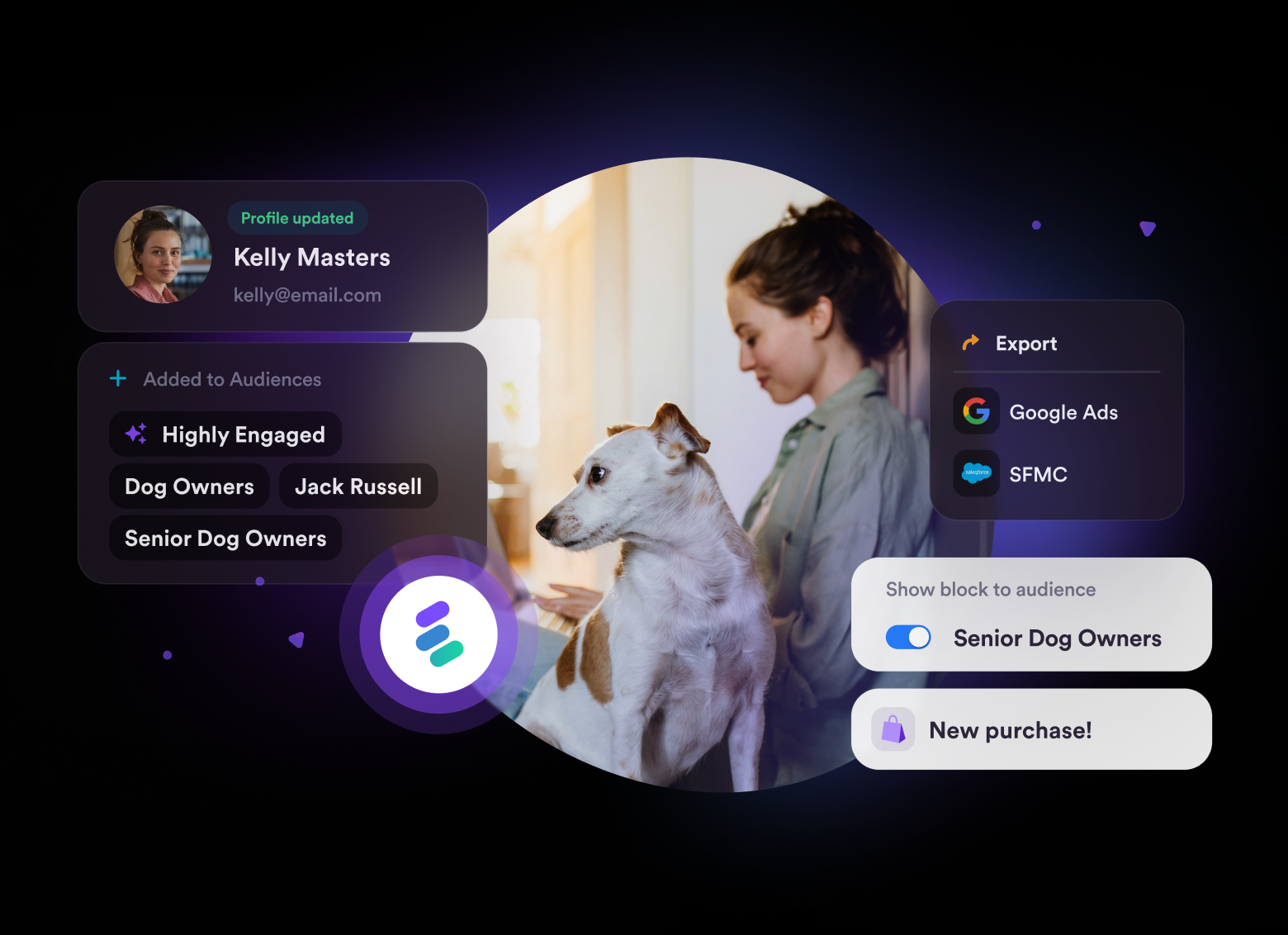
Audience Segmentation & Activation turns unified profiles into actionable audiences. The visual rule builder supports two rule types: Attribute Rules (conditions on any profile field) and Audience Rules (referencing existing audiences as building blocks), combined with AND/OR logic.
Source: Lytics
Behavioral scores and content affinities work as first-class conditions, so a segment like "high engagement momentum but declining frequency in the outdoor products category" is a native query.
Audience membership updates dynamically as behavioral scores change after every user event. There are no scheduled list refreshes. When someone abandons a cart or reads three pricing articles in a row, their segment membership changes immediately.
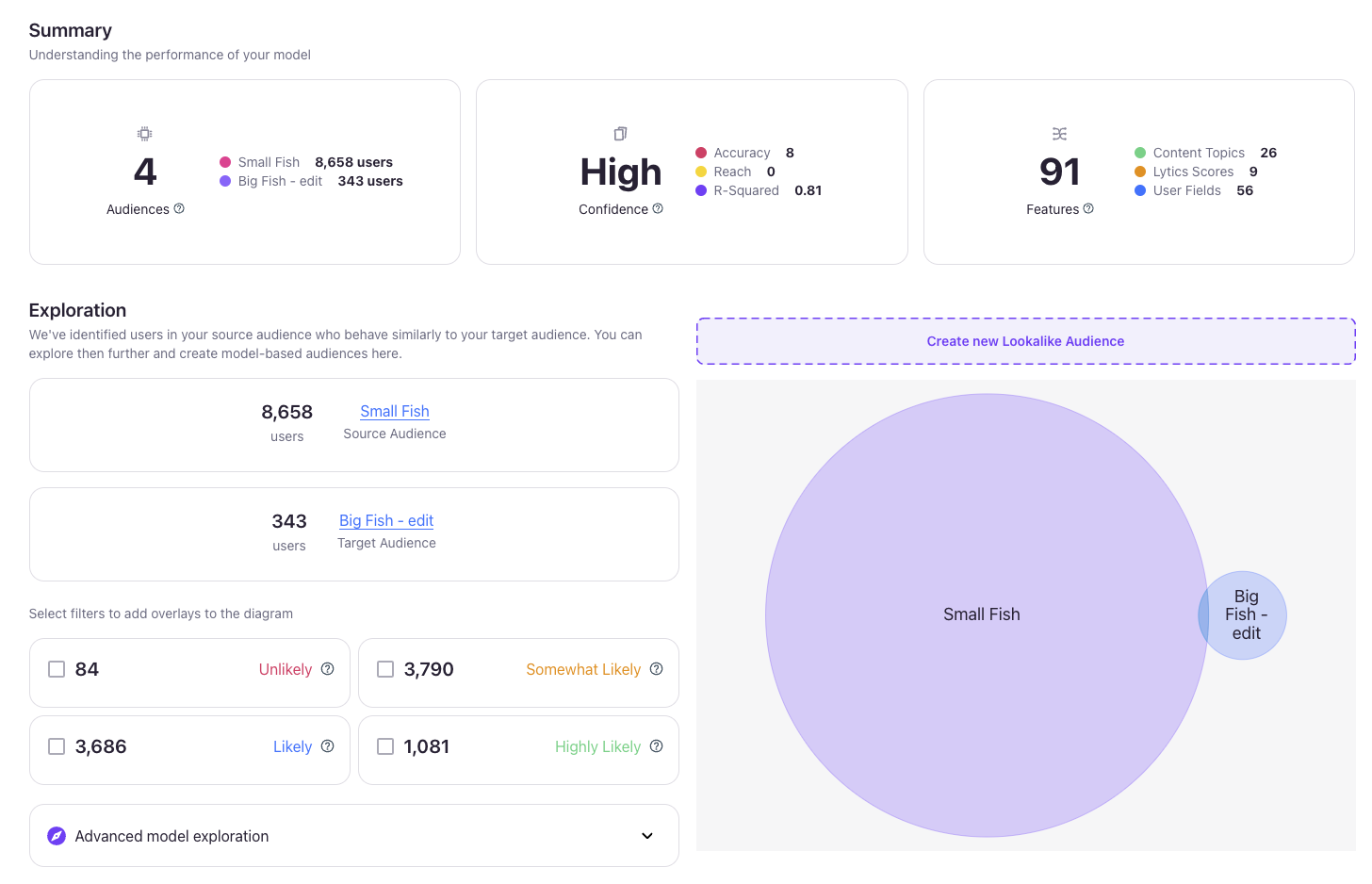
For expanding reach, Lytics offers Lookalike Models built using Random Forests and Logistic Regression. Marketers select a target audience (for example, repeat purchasers) and a source audience, and the model scores every user in the source pool by propensity. Unlike static uploads, these scores update after every user event.
Source: Lytics
The Decision Engine uses a Bayesian Bandit algorithm to decide which experience each user should see. Each experience starts with a probability distribution; as impressions and conversions accumulate, the engine learns which experiences perform best for which users, balancing exploration and exploitation automatically.
Pathfora, Lytics' web personalization SDK, delivers four experience formats (slideouts, modals, inline content blocks, and sticky bars) targeted to specific audiences.
Lytics exports activated audiences to 50+ destinations including Google Ads, Facebook, LinkedIn, TikTok, The Trade Desk, Braze, Iterable, Salesforce Marketing Cloud, and Klaviyo.
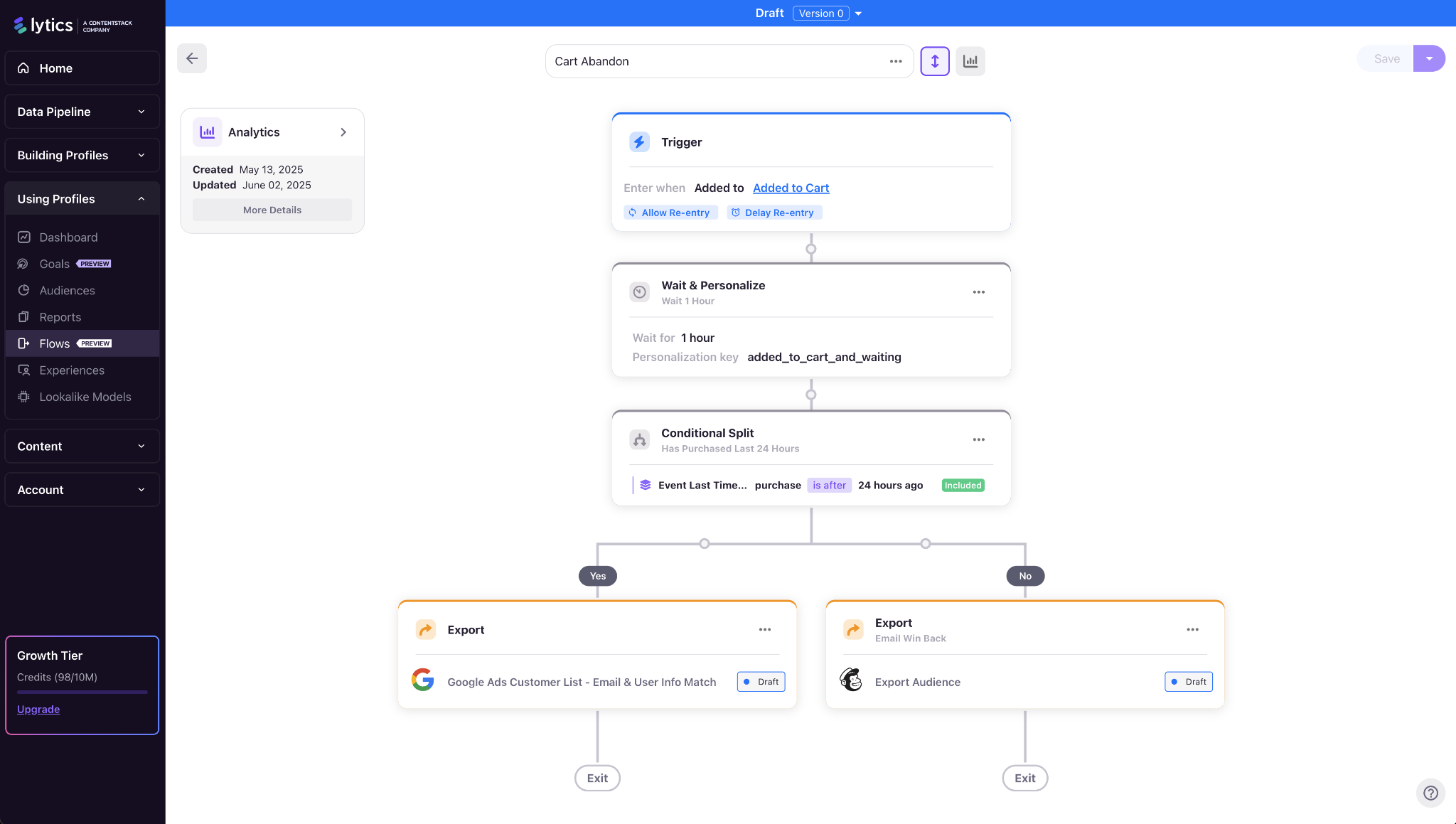
Flows, a visual workflow canvas, orchestrates multi-step user journeys with trigger steps, wait conditions, export steps, and conditional splits.
Source: Lytics
Flows expose their state on user profiles, so web personalization, email, and ad suppression all read from the same source of truth about where a user stands in a sequence.
Cloud Connect: Zero-copy warehouse integration for building audiences directly from existing data infrastructure.
Cloud Connect is Lytics' reverse ETL solution. It lets marketers run SQL queries against their existing data warehouse and use the results to build audience segments without copying data into Lytics.
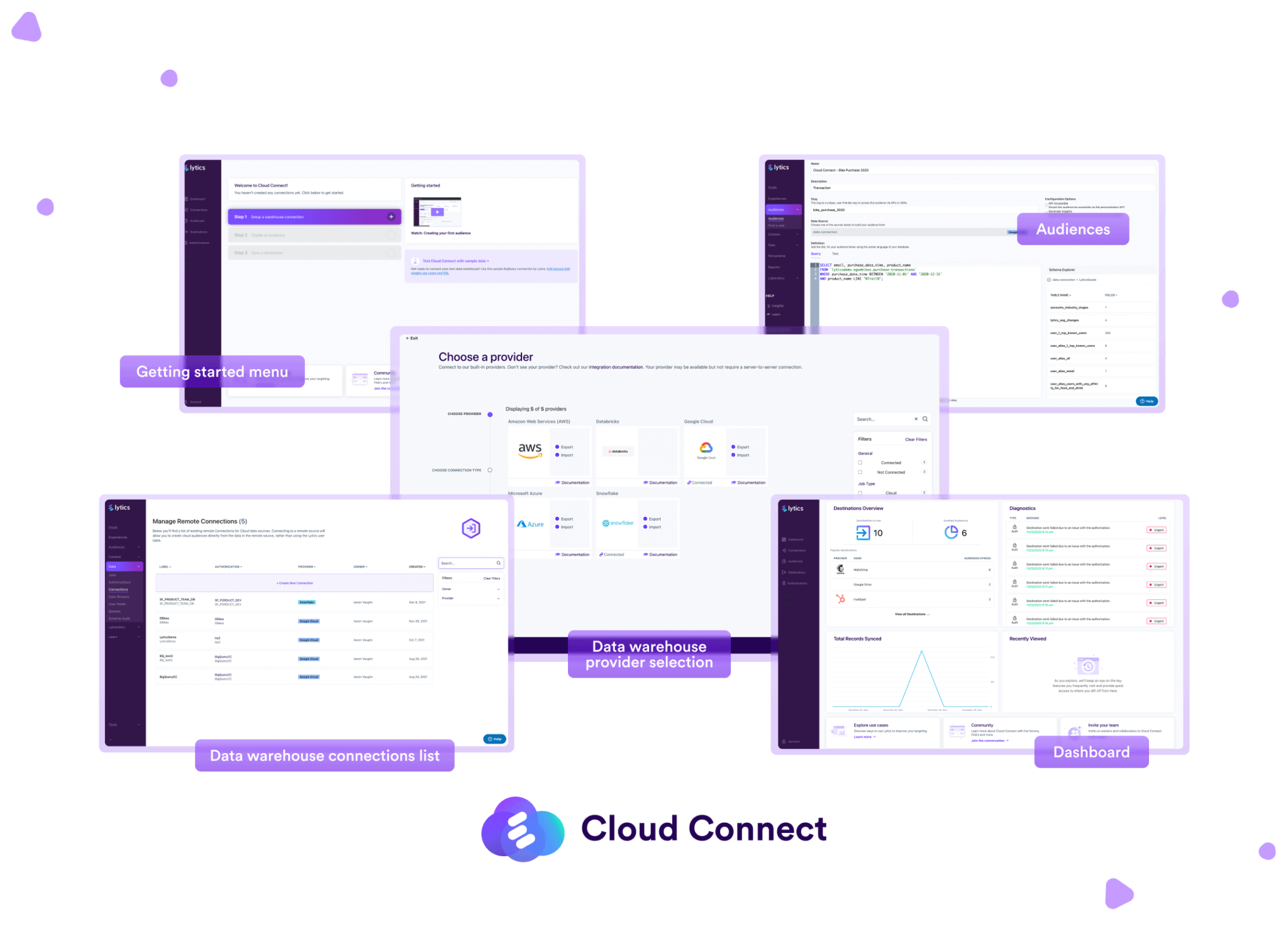
Source: Lytics
The workflow has three steps: authorize a connection to your warehouse, create a Data Model (a SQL query that defines a set of records, with field mappings to Lytics profile attributes), and activate the model on a configurable schedule (hourly, daily, weekly, or monthly).
A GenAI SQL Translator generates SQL from plain-language descriptions for non-technical users.
Cloud Connect supports five warehouse platforms: Google BigQuery, Snowflake, Amazon Redshift, Microsoft Azure SQL Database, and Databricks.
The zero-copy architecture means Lytics does not store warehouse data long-term. If a Data Model is deleted, the associated profile data disappears. The warehouse remains the authoritative source.
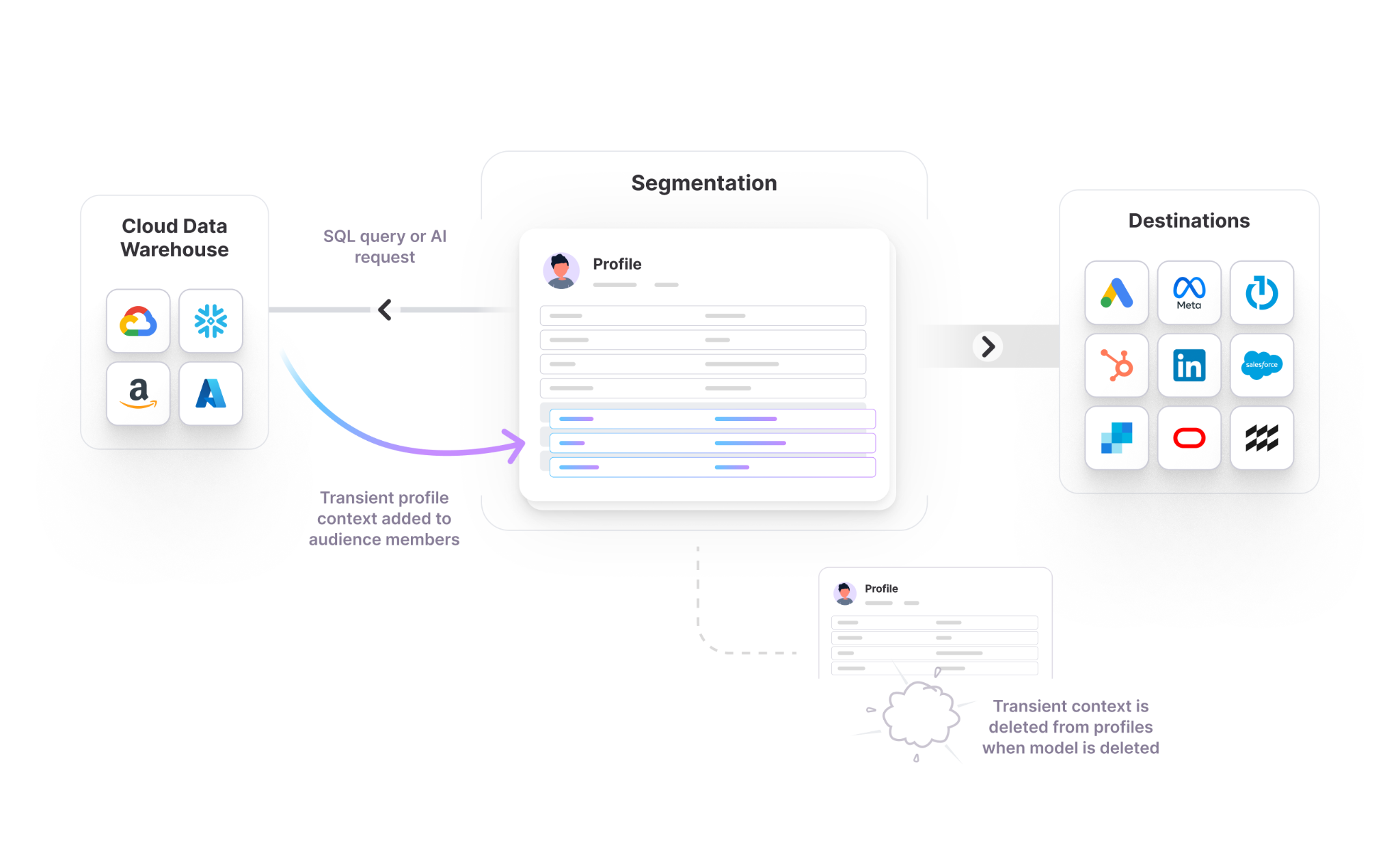
Source: Lytics
Cloud Connect audiences can still be enriched with Lytics' behavioral scores, content affinities, and predictive models, even though the underlying data never leaves the warehouse. This makes Lytics a CDP intelligence layer on top of existing infrastructure rather than a replacement for it.
Generative AI & Machine Learning: AI copilots and native ML models that reduce dependence on data engineering teams.
Lytics embeds generative AI and machine learning across its platform so marketers can act without waiting for engineering.
Three AI copilots handle different stages of the workflow. The Audience Copilot (AI Segment Translation) accepts natural language prompts and translates them into executable audience queries, powered by OpenAI and Google's Vertex AI.
It also works in reverse, converting existing query expressions into readable descriptions.
The Schema Copilot analyzes incoming event streams and suggests field types, identity keys, PII classifications, and merge operations.
The Integration Copilot generates destination configuration mappings from desired output structures.
On the ML side, Lookalike Models use a multi-stage pipeline with feature reduction, Random Forests, Logistic Regression, cross-validation, and hyperparameter tuning.
An Auto Tune option automates feature selection for non-technical users, while advanced users can control it manually. Models retrain weekly and update predictions in real time after each user event. Minimum seed size is 25 users; maximum is 20 million.
Context Layers (Interest Engines) analyze user interactions with content using NLP and image analysis to generate per-user interest fields. The default Context Layer processes web content to produce topic taxonomies without configuration. Collaborative Filters layer on top to recommend items based on similar-user behavior.
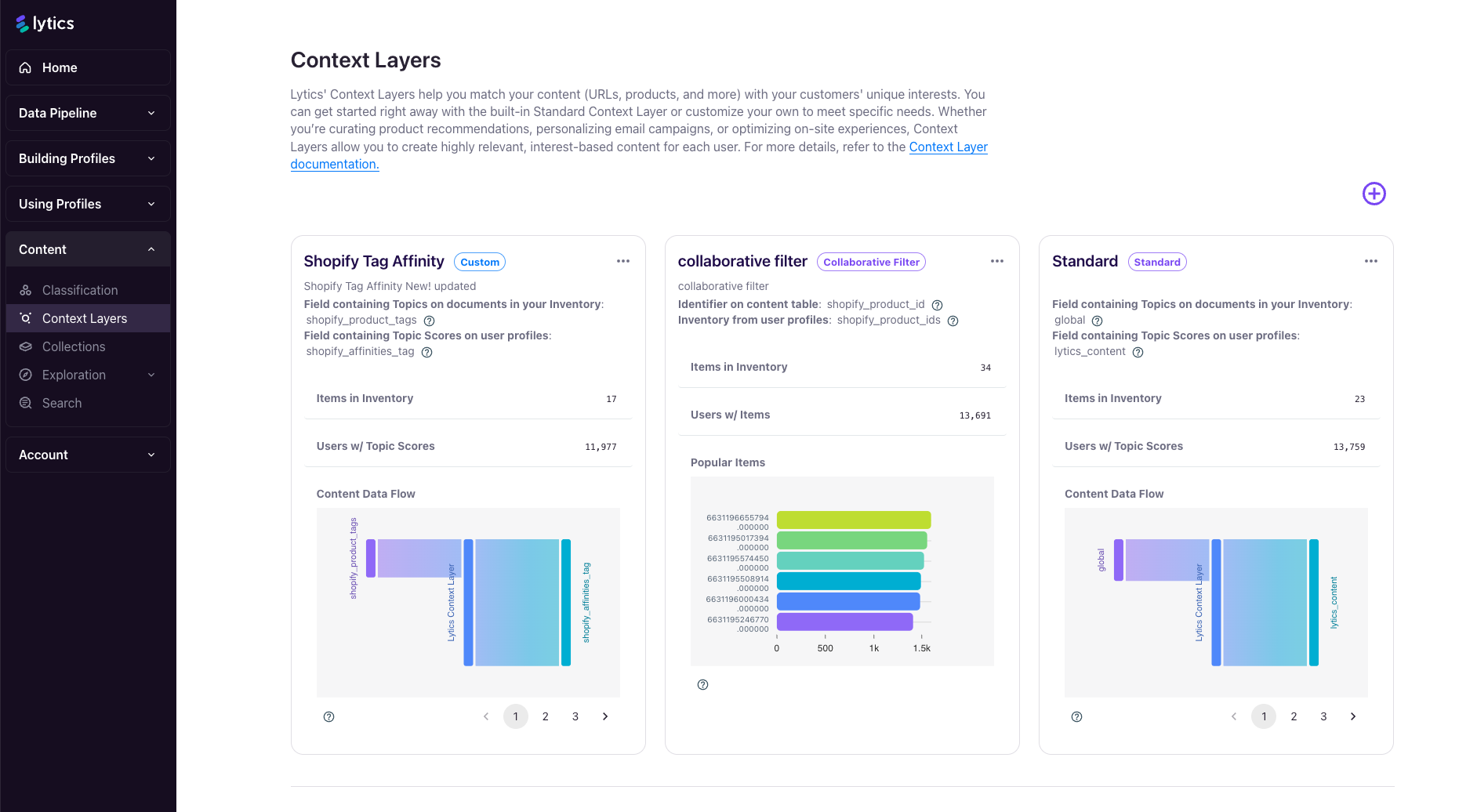
Source: Lytics
Where Lytics Falls Short
Lytics works well for consumer-facing brands that need behavioral personalization, but several limitations stand out during evaluation. These reflect a platform designed for a specific niche rather than broad go-to-market needs.
Acquisition Uncertainty: Contentstack acquired Lytics in December 2024. Contentstack says it will maintain existing integrations with competing CMS platforms, but the long-term direction points toward absorption into Contentstack's composable DXP. Buyers evaluating Lytics as a standalone CDP face a transitional period.
The acquisition came after a stretch in which the company had not raised funding since 2019 and reportedly shrank in headcount.
Dashboard and Reporting Weakness: G2 and TrustRadius reviewers consistently describe the dashboard as unintuitive, with documented complaints about "lack of effective tools for organizing segments, forcing users to perform data visualization and analytics outside the system."
Contentstack's June 2025 Audience Insights App is a first response to this gap, but it embeds analytics inside the CMS rather than improving Lytics' native interface.
B2B Identity Resolution Gap: Lytics' identity unification works at the account level but not at the contact level. For B2B companies where the same individual interacts across multiple accounts or devices, this leaves gaps.
Companies running account-based marketing that need contact-level precision face a structural limitation.
Moderate Market Presence: Lytics holds approximately a 3.9-star rating on G2 from roughly 69 reviews, well below Twilio Segment (4.6 stars, 563 reviews) and Tealium (4.2 stars, 425 reviews).
The lower volume and scores suggest limited adoption compared to the broader CDP category. Comparative data also shows Lytics' ease-of-admin score at 7.5 vs. Salesforce CDP at 9.1.
No B2B Sales Intelligence: Lytics activates data into other tools; it does not provide verified contact data, direct-dial phone numbers, company intelligence, or buyer intent signals tied to identified business accounts.
For B2B companies, this means Lytics handles one piece of the puzzle (behavioral audience building) but leaves sales prospecting, pipeline generation, and deal intelligence to separate platforms.
These limitations follow naturally from Lytics' focus on first-party behavioral data for consumer-facing brands. But for B2B organizations that need intelligence, audience building, and execution in one system, the gaps are substantial.
Top Lytics Alternative for B2B Go-to-Market: ZoomInfo
ZoomInfo, a B2B go-to-market platform, addresses the intelligence gap that Lytics leaves open. Where Lytics builds profiles from first-party behavioral data on your website, ZoomInfo is built on verified B2B data with an intelligence layer that captures why deals move or stall.
For B2B companies evaluating CDPs, ZoomInfo replaces the need to stitch together a behavioral data tool, a contact data provider, an intent data vendor, and a sales execution platform.
Comprehensive B2B Data: ZoomInfo's foundation is a verified data layer that no single CDP can replicate.
ZoomInfo's data spans three dimensions: identity data (500M contacts, 135M+ verified phone numbers, 120M direct-dial phone numbers, 200M+ verified business email addresses), company context (100M companies with firmographics, org charts, and technographics covering 30,000+ technologies across 200+ categories), and dynamic signals that reveal when accounts are actively in-market.
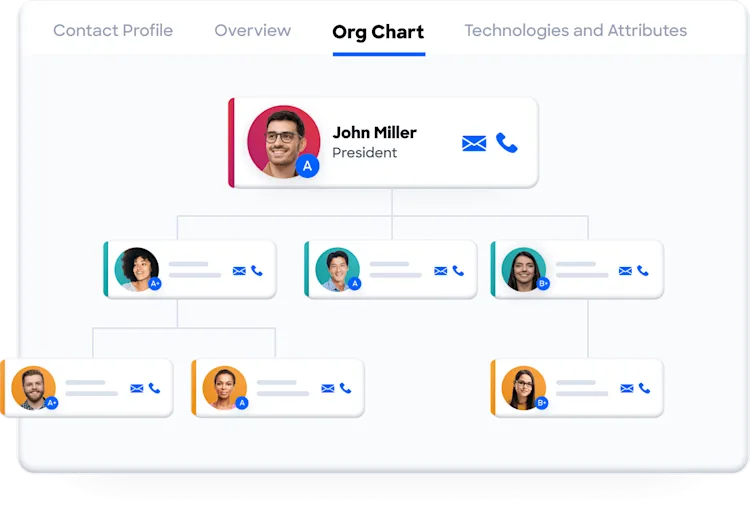
Source: ZoomInfo
A multi-source pipeline backed by 300+ human researchers verifies this data, reaching up to 95% accuracy on first-party data.
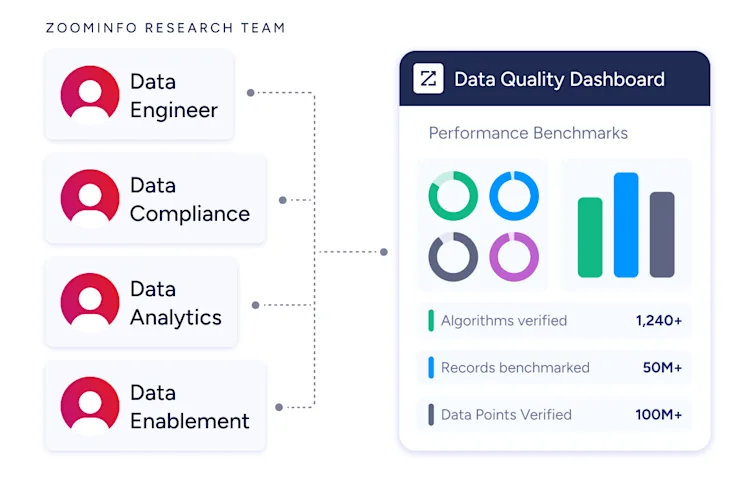
Source: ZoomInfo
In a Fortune 500 competitive RFP analyzing 25 million contacts across vendors, the independent consultant concluded that "no other competitor came even close." Buyer Intent Data tracks signals from 210M IP-to-Org pairings and 6 trillion+ new keyword-to-device pairings sourced monthly.
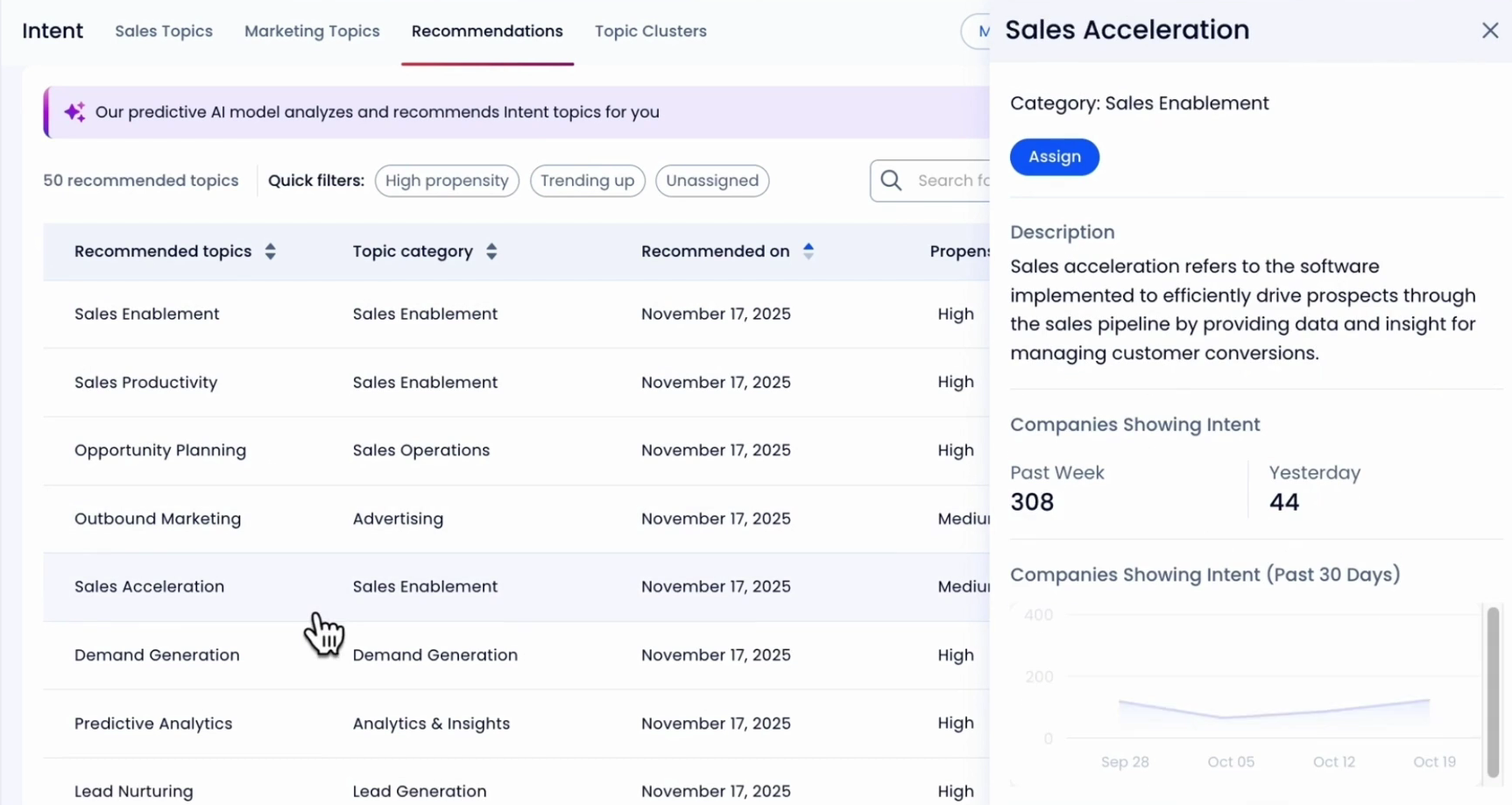
Guided Intent, exclusive to ZoomInfo, identifies topics historically correlated with deal success rather than requiring manual topic selection.
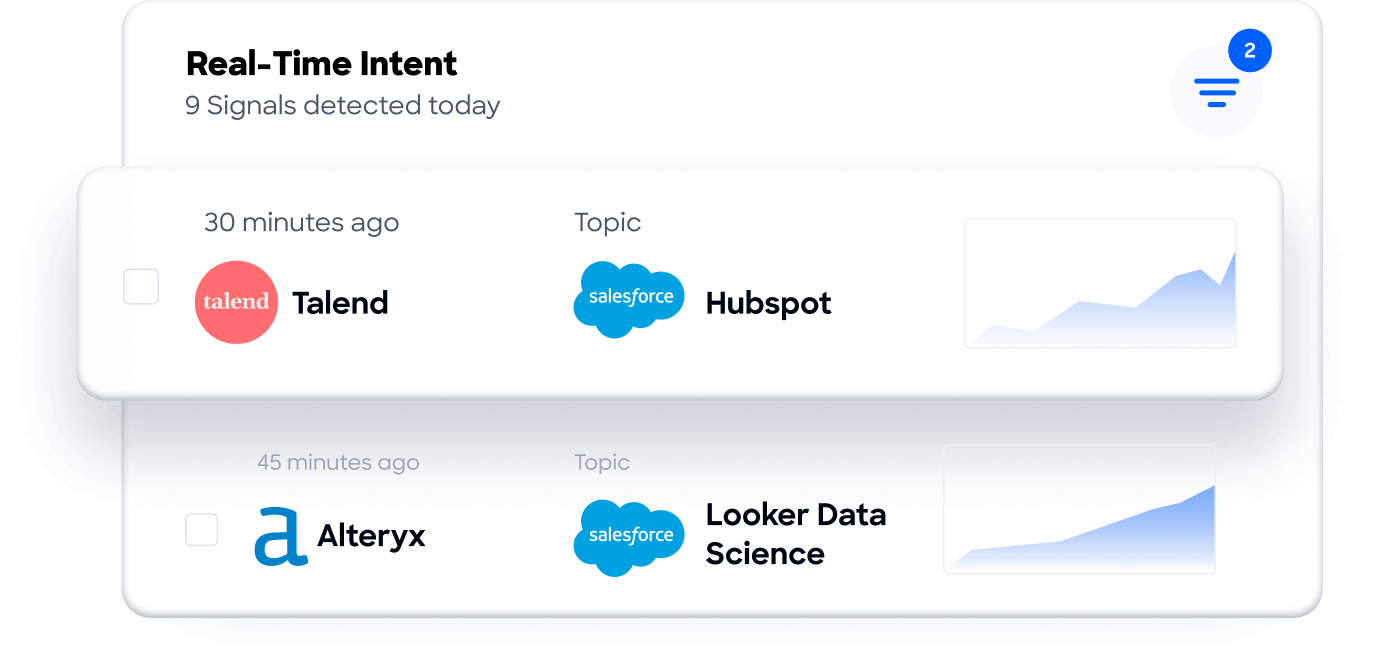
Source: ZoomInfo
This differs from Lytics' behavioral scoring, which tracks what visitors do on your site. ZoomInfo's intent data tracks what companies research across the open web, revealing demand before a prospect ever visits your page.
The data advantage is externally validated: Leader in the Forrester Wave for Intent Data Providers (Q1 2025), Leader in the Gartner Magic Quadrant for ABM Platforms (2024 & 2025), the only vendor in the Gartner Customers' Choice quadrant (2025) with a 4.7/5.0 average rating, and 133 No. 1 rankings on G2.
"ZoomInfo gives us the information we need to execute. We don't have to go through and spend our time digging. It's already there, so we can be three steps ahead." — William Kenimer, VP of Revenue Operations (Vensure)
GTM Context Graph: An intelligence layer that captures why deals move, not just what happened.
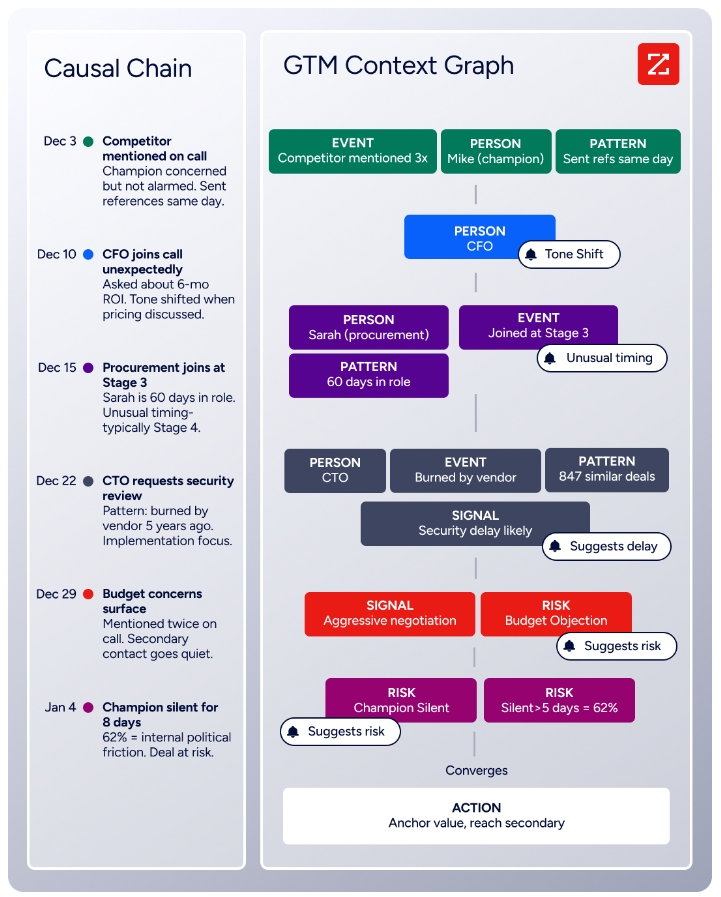
The GTM Context Graph processes 1.5B+ data points daily, combining ZoomInfo's B2B data with a customer's CRM records, conversation transcripts, email interactions, and behavioral signals into a unified graph that connects signals to outcomes.
Where Lytics' Content Affinity Engine reasons about what topics a visitor is interested in, ZoomInfo's GTM Context Graph reasons about what's driving an entire deal.
Source: ZoomInfo
A CRM records that a deal moved stages. Conversation intelligence transcribes what the VP of Finance said on the last call. Intent signals log a spike in research activity. The GTM Context Graph connects all three to capture why the deal advanced, and what that pattern predicts for similar accounts.
This intelligence exists because of two decades of infrastructure investment. The same data unification platform that resolves and verifies hundreds of millions of contacts and companies now applies to a customer's calls, emails, CRM, and product usage.
The acquisitions of Chorus and Workbounce gave ZoomInfo the tools to extract not just raw data from calls and meetings, but the signals underneath (why a champion went quiet, what a competitive mention predicts about deal risk).
For B2B teams, the practical difference is between a platform that knows a prospect visited your pricing page (what Lytics provides) and a platform that knows why the deal is accelerating, who's championing it, which competing product they're evaluating, and what pattern this matches from your historical wins.
Seismic attributed 39% of active pipeline to ZoomInfo-influenced opportunities and reported 54% productivity gains. "That combination of our internal CRM data, external signals, and AI has helped us craft very specific account- and persona-based messages." (Seismic)
GTM Studio & GTM Workspace: Interfaces for marketers and sellers, powered by the same intelligence.
ZoomInfo delivers its intelligence through interfaces designed for different roles.
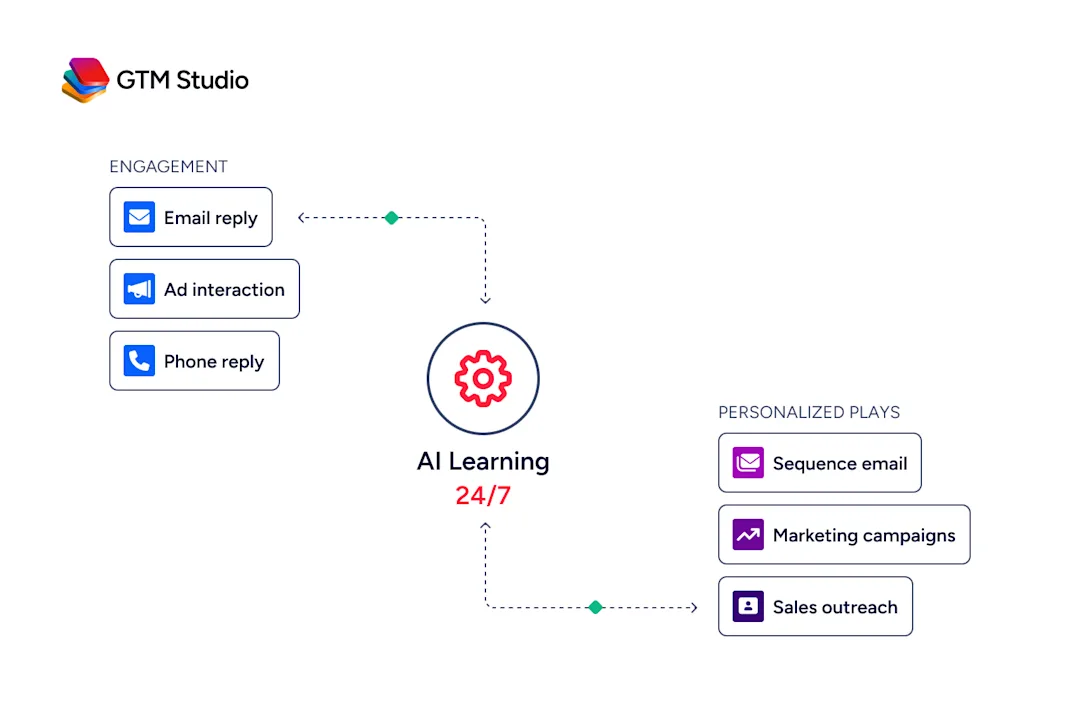
GTM Studio is the front end for marketers, RevOps, and GTM engineers. It provides an AI-powered canvas where teams describe audiences in natural language, enrich data from first- and third-party sources, define triggers, and activate plays across email, calls, ads, and direct mail.
Source: ZoomInfo
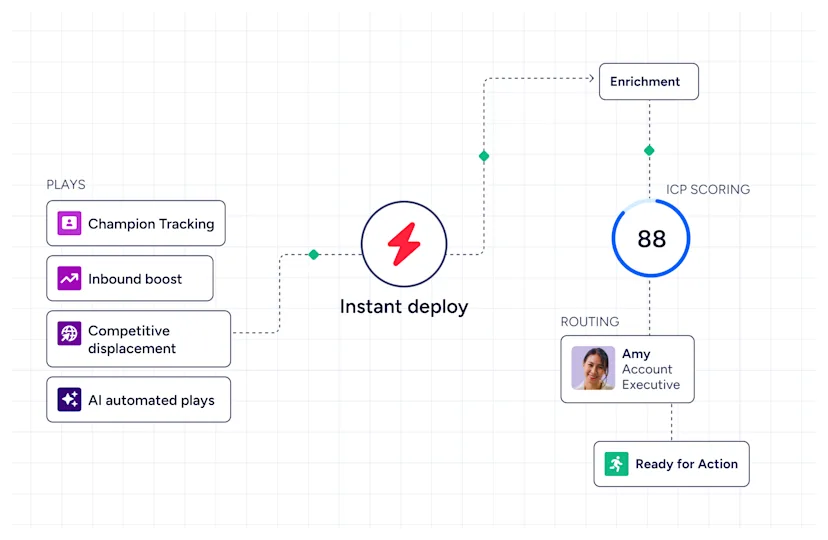
Pre-built GTM plays (inbound acceleration, champion tracking, competitive displacement, ICP targeting) launch in one click. Waterfall enrichment evaluates 25+ data sources and returns the highest-confidence result at no additional cost.
Source: ZoomInfo
Where Lytics requires separate tools for email, ads, and sales routing, GTM Studio handles orchestration across all channels from one canvas.
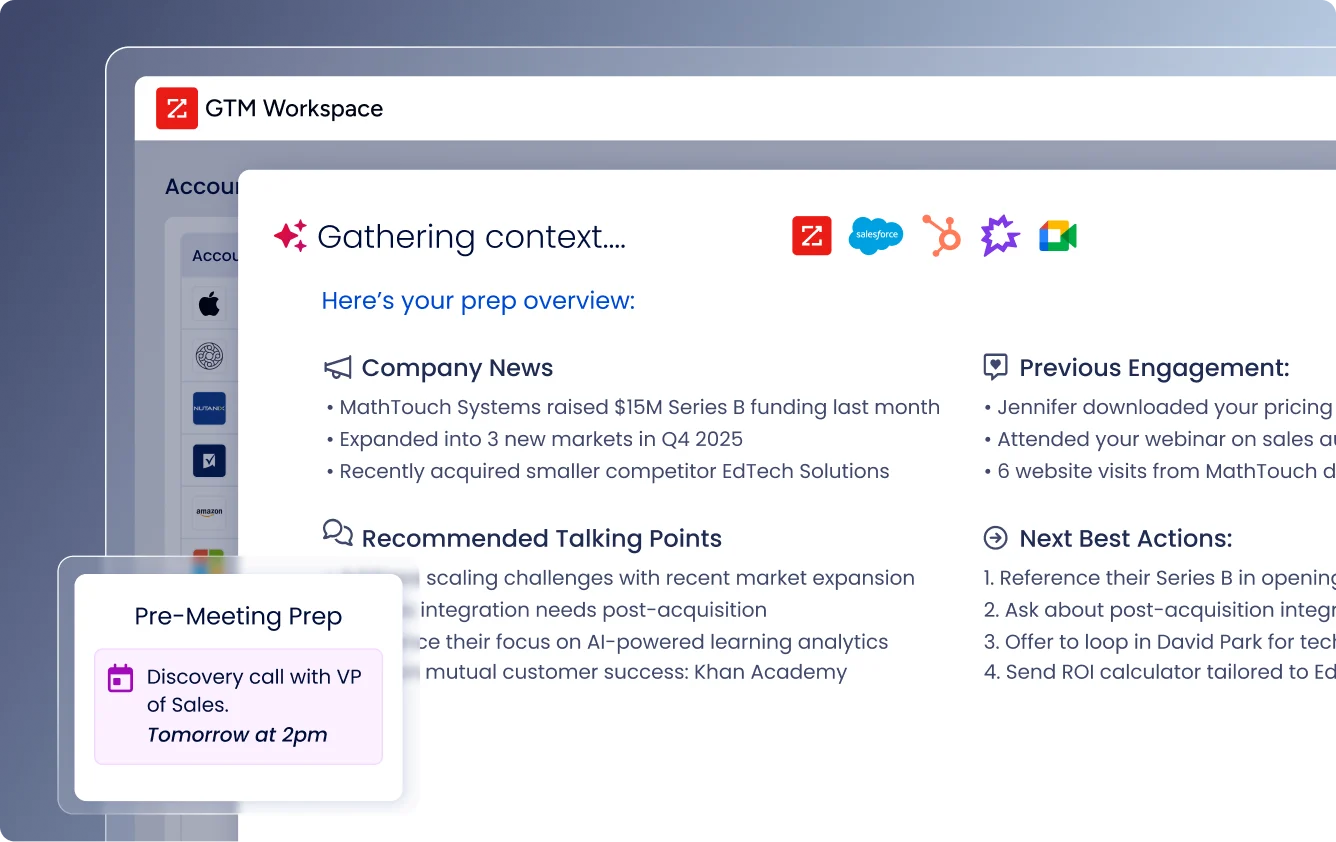
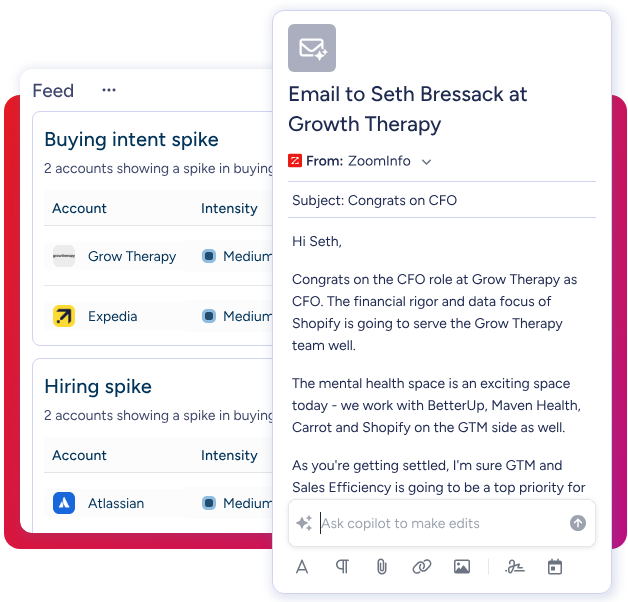
GTM Workspace is the front end for sellers. It provides a book-of-business view across CRM data, ZoomInfo intelligence, conversation history, and market signals. AI agents automate account research, outreach drafting, CRM updates, and signal monitoring.
Source: ZoomInfo
The Action Feed streams in-market buyers matched to target criteria with pre-drafted actions on every signal.
Source: ZoomInfo
The two tools share one intelligence layer. When GTM Studio identifies a hot account through intent signals, that account appears in the seller's GTM Workspace with full context and a recommended next action. No handoff required.
"Anything that minimizes our team's need to switch contexts is beneficial. ZoomInfo offers a unified view, eliminating the need to navigate between systems." — Ben Perceval, RevOps Manager (Spekit)
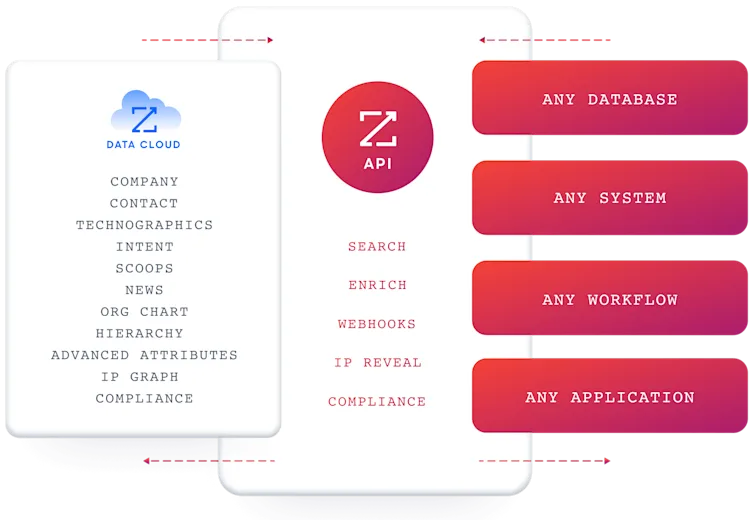
Universal Access: Use ZoomInfo's intelligence in any tool through APIs and MCP.
For teams that build beyond ZoomInfo's own products, APIs and MCP expose the same intelligence to any custom agent, internal tool, or partner platform.
The Enterprise API covers four areas: Data API (search and enrich), Copilot API (AI intelligence including account summaries, lookalikes, and contact recommendations), Marketing API (audience management), and Platform API (engagement data).
Source: ZoomInfo
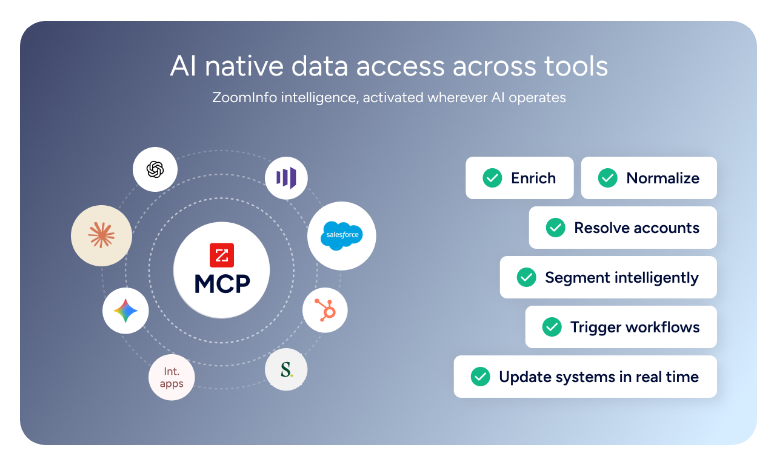
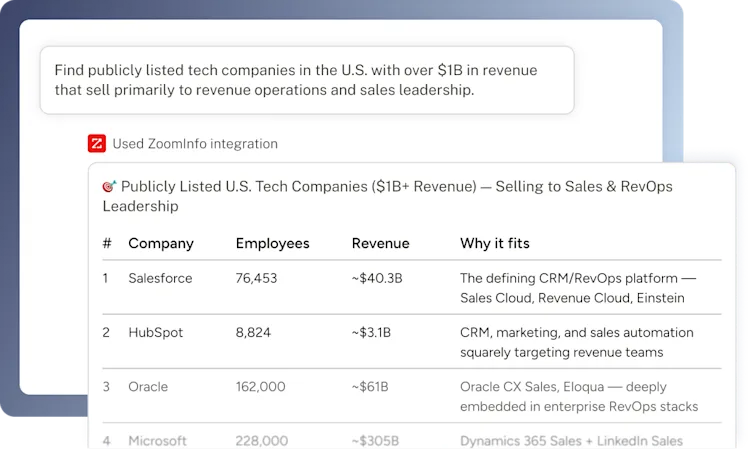
The ZoomInfo MCP server connects AI models to ZoomInfo's B2B data as a native tool. Currently supporting Claude and ChatGPT, it lets users interact with ZoomInfo data through natural language.
Source: ZoomInfo
The MCP tool set covers finding, profiling, and research operations, all drawing from the same GTM Context Graph.
Source: ZoomInfo
API access is included in all relevant plans. ZoomInfo functions as infrastructure, not just an application. The same data and reasoning powering GTM Workspace and GTM Studio is available inside any CRM, data warehouse, or AI agent a team builds with.
BDO Canada achieved an 87% reduction in time spent on updates to their internal data dashboards using the ZoomInfo API. "The plug-and-play aspect of the API means I can integrate it very easily into any process and get information at a moment's notice." (BDO Canada)
Lytics or ZoomInfo: Comparison Summary
Lytics | ZoomInfo | |
|---|---|---|
Primary focus | First-party behavioral data unification and personalization | B2B go-to-market intelligence and execution |
Target audience | Consumer-facing marketers (CPG, media, retail) | B2B sales, marketing, and RevOps teams |
Data source | First-party behavioral data from your own properties | 500M contacts, 100M companies, plus first-party CRM and conversation data |
Contact data | No verified B2B contact database | 200M+ verified business emails, 135M+ verified phone numbers |
Intent signals | Behavioral scoring from your website visitors | Buyer intent across the open web (210M IP-to-Org pairings, 6T+ keyword signals/month) |
Identity resolution | Account-level only for B2B contexts | Contact-level with org charts and buying committee intelligence |
AI capabilities | Three AI copilots, lookalike models, behavioral scoring | GTM Context Graph, AI agents for sales and marketing, natural-language audience building |
Sales execution | Not included (activates data into other tools) | GTM Workspace with AI-drafted outreach, deal intelligence, CRM sync |
Marketing orchestration | Audience activation to 50+ destinations | GTM Studio with multi-channel plays, native DSP, waterfall enrichment |
Web personalization | Pathfora SDK (modals, slideouts, inline, sticky bars) | Website Chat with company identification, FormComplete |
Warehouse connectivity | Cloud Connect with zero-copy architecture (5 warehouses) | Cloud Partners (AWS, GCP, Snowflake, Databricks), Enterprise API |
Free tier | Developer plan: 2M credits/month (permanent) | ZoomInfo Lite: permanent free access with 10 monthly export credits |
Paid pricing | Credit-based: $500/month (Growth), custom (Enterprise) | Consumption-based: custom-quoted based on usage |
Analyst recognition | Not included in Gartner CDP Magic Quadrant as standalone | Leader in Gartner MQ for ABM Platforms, Leader in Forrester Wave for Intent Data |
G2 presence | ~3.9 stars from ~69 reviews | 4.7/5.0 (Gartner VOC), 133 No. 1 G2 rankings |
Final Verdict
The choice between Lytics and ZoomInfo depends on who your customers are and what your go-to-market motion requires.
Choose Lytics if you're a consumer-facing brand that needs to personalize website experiences, email content, and ad targeting using first-party behavioral data.
Its Content Affinity Engine, real-time behavioral scoring, and composable warehouse architecture make it a strong fit for retailers, publishers, and CPG companies building a first-party data strategy in a post-cookie world.
The free Developer plan and $500/month Growth tier provide accessible entry points, and the Google Cloud-native architecture serves regulated industries that need firewall deployment.
Keep in mind that the Contentstack acquisition means Lytics is transitioning from a standalone CDP to a data layer inside a broader DXP.
Choose ZoomInfo if you're a B2B company that needs verified contact data, buyer intent signals, and AI-powered execution for sales and marketing in one platform.
ZoomInfo's data foundation, the GTM Context Graph, and its three entry points (GTM Workspace for sellers, GTM Studio for marketers and RevOps, APIs and MCP for any tool) deliver a go-to-market system that Lytics was never designed to provide.
Where Lytics tells you what anonymous visitors are interested in on your site, ZoomInfo tells you which companies are actively researching your category across the web, who the decision-makers are, how to reach them, and what to say, then executes the outreach from the same platform.
Get started with ZoomInfo here.
The distinction is not about which platform is better in the abstract. Lytics and ZoomInfo serve fundamentally different go-to-market models. Lytics personalizes experiences for consumers visiting your properties. ZoomInfo identifies, reaches, and engages business buyers across the B2B go-to-market lifecycle. If your revenue depends on B2B pipeline, ZoomInfo is the platform built for that problem.
Lytics FAQ
What is Lytics used for?
Lytics is a customer data platform that unifies first-party behavioral data from websites, email, mobile apps, and data warehouses into real-time user profiles.
Marketers use it to build audience segments based on behavioral signals (not just demographics), personalize website experiences for anonymous and known visitors, activate first-party audiences across ad platforms and email tools, and run lookalike models to expand reach. Its core strength is content personalization for consumer-facing brands in retail, CPG, media, and entertainment.
Is Lytics free?
Lytics offers a permanent free Developer plan with 2M credits per month. This tier includes CSV import, reverse ETL, the Personalization SDK, and ad network sync for Google and Meta.
However, it restricts identity stitching to web-only, limits data retention to 6 months, and excludes server-side connectors, custom segmentation, lookalike modeling, SOC2, SSO, and RBAC. Paid plans start at $500 per month for the Growth tier with 5M credits.
ZoomInfo also offers a permanent free tier called ZoomInfo Lite, which provides access to its B2B database with 10 monthly export credits.
Who acquired Lytics?
Contentstack acquired Lytics in December 2024. The acquisition was announced publicly on January 8, 2025. Contentstack, a headless CMS provider, stated that "data was the missing link" for delivering personalized digital experiences. Lytics co-founder James McDermott became Contentstack's Global Head of Data Products.
The combined entity reportedly has over 500 customers and 500 employees. Lytics' existing integrations with non-Contentstack CMS platforms (WordPress, Drupal, Contentful) are reportedly being maintained.
How does Lytics pricing work?
Lytics uses a credit-based pricing model where credits correspond to inbound events (data collected) and outbound events (data exported).
Three tiers are available: Developer (free, 2M credits/month), Growth ($500/month, 5M credits/month), and Enterprise (custom pricing, 10M+ credits/month). Additional credits for the Growth plan cost $500 per 10M. Enterprise contracts default to 12-month terms with automatic renewal, and cancellation requires 90 days' notice before the term ends. Overage rates for Enterprise are negotiated per contract.
What are Lytics' main limitations?
Reviewers frequently cite an unintuitive dashboard, slow on-demand audience counts with large segment libraries, and identity resolution that works at the account level but not at the contact level for B2B use cases.
Lytics holds approximately a 3.9-star rating on G2 from roughly 69 reviews, well below category leaders like Twilio Segment (4.6 stars).
The platform is most differentiated for content-heavy consumer-facing sites; for industries where content personalization is not central, or for B2B companies needing verified contact data and sales intelligence, Lytics is less suited.
Does Lytics integrate with data warehouses?
Yes. Lytics' Cloud Connect feature supports five warehouse platforms: Google BigQuery, Snowflake, Amazon Redshift, Microsoft Azure SQL Database, and Databricks. It uses a zero-copy architecture that queries warehouse data directly without replicating it into Lytics.
SQL queries can be written manually or generated from natural language using a GenAI SQL Translator. Sync schedules are configurable (hourly, daily, weekly, or monthly).
For teams without their own warehouse, Lytics provides a managed BigQuery instance.
How does Lytics compare to ZoomInfo for B2B companies?
Lytics and ZoomInfo serve different go-to-market models. Lytics is a first-party behavioral data platform that personalizes experiences for visitors on your own properties. It does not provide verified B2B contact data, direct-dial phone numbers, company intelligence, or buyer intent signals from the open web.
ZoomInfo provides 500M contacts, 100M companies, and 135M+ verified phone numbers, combined with buyer intent data, conversation intelligence, and AI-powered sales and marketing execution tools. For B2B companies that need to identify, reach, and engage business buyers, ZoomInfo provides one platform where Lytics would require assembling separate tools.
What is Lytics' Content Affinity Engine?
The Content Affinity Engine is Lytics' core differentiator. It classifies website content into topic taxonomies using NLP and image analysis, then tracks each user's consumption patterns to build a per-visitor interest graph.
This data powers personalized content recommendations, targeted audience segments based on topic interest, and lookalike models that predict which visitors are most likely to convert. Industry Dive reported a 40% increase in click-throughs using this capability, and Land O'Lakes achieved 28% click-throughs and 38% conversions with Lytics web personalization.
The engine requires meaningful site content to classify, making it most relevant for publishers, media companies, and content-heavy retail or CPG brands.
