
Mutiny has repositioned itself from a website personalization tool into something more ambitious: an AI agent that creates customer-facing content for go-to-market teams. The pitch is that one person with Mutiny can produce landing pages, business cases, deal rooms, and pitch decks in an afternoon instead of waiting weeks for design and copywriting queues. For sales and marketing teams stuck in those queues, that matters.
To write this Mutiny review, we've analyzed the platform. We believe it's the right fit if:
You need to produce personalized, on-brand sales and marketing assets quickly
Your sales reps wait on marketing or design teams for deal-specific content
You run account-based marketing programs and need 1:1 landing pages at scale
You want an AI agent that learns your brand from your website automatically
Your primary challenge is content creation speed, not data or intelligence gaps
However, Mutiny might not be the best choice if:
You need B2B data and buyer intelligence alongside content creation
Your GTM challenges extend beyond content into prospecting, intent signals, and pipeline orchestration
You require CRM integrations, conversation intelligence, or multi-channel campaign execution
You want a single platform covering data, intelligence, and execution rather than a content-focused tool
You need analytics and attribution beyond basic engagement tracking
In this case, you should consider ZoomInfo: an AI GTM platform that covers the full go-to-market workflow, from B2B data (500M contacts, 100M companies, 135M+ verified phone numbers, and 200M+ verified business emails) to intelligence that captures why deals move or stall, to execution tools for sellers, marketers, and RevOps teams. Where Mutiny focuses on creating content assets, ZoomInfo provides the data, buyer signals, and orchestration behind every stage of the go-to-market cycle.
We've included a detailed look at ZoomInfo later in this review for teams whose GTM challenges go beyond content creation. If you're ready to explore, you can start with ZoomInfo's free trial here.
What is Mutiny?
Mutiny was co-founded in May 2018 by Jaleh Rezaei (CEO) and Nikhil Mathew (CTO), both former Gusto employees. The idea came from Rezaei's experience running marketing at Gusto, where personalizing the buyer experience required nearly 20 engineers (resources most companies don't have). The two met at Original Joe's in San Francisco, spent four hours discussing the problem, and committed to building a solution. They entered Y Combinator's Summer 2018 batch and have since raised $72M from investors including Sequoia Capital, Tiger Global, and Insight Partners.
The company went through a major transformation in 2024-2025. The original product was a no-code website personalization platform that let marketers swap headlines, CTAs, and images for different visitor segments. Rezaei wrote publicly about the decision to rebuild: "Mutiny 1.0 started as a big success: $72M from tier 1 investors like Sequoia/YC, 8-figures in ARR, and beloved by the best GTM teams in the world. But it was built on a SaaS foundation, which puts the execution onus on humans. So we killed the SaaS product and rebuilt the whole thing from scratch, this time agent-first."
Today, Mutiny positions itself as "your AI agent for creating anything customer-facing", targeting sales teams and ABM marketers at B2B SaaS companies. The rebuilt platform has seen 30,000+ assets published by companies including Rippling, Snowflake, Figma, and Uber. Named enterprise customers also include BMC, Airwallex, and Vanta.
Mutiny Pros & Cons
Pros | Cons |
|---|---|
Agent-first architecture rebuilt from scratch, not bolted-on AI | Credit limits constrain high-volume users (30-50 credits/month on lower tiers) |
Automatic brand extraction from a website URL | Account Studio enrichment locked to Enterprise ($30,000+/year) |
17+ Blueprint templates covering the full deal cycle | Analytics work but lack depth for attribution |
CRM and call transcript ingestion for deal-level personalization | Limited A/B testing and CRO capabilities |
Buyer engagement tracking with session replays | Small integration surface compared to established platforms |
Permanent free plan with no credit card required | CRM integrations (Salesforce, HubSpot) require Enterprise plan |
MCP server enables use inside Claude and ChatGPT | Limited public review volume (23 G2 reviews) |
Mutiny Review: How it Works & Key Features
AI Creative Agent: Mutiny's core engine handles the full lifecycle of GTM content creation through a conversational interface.
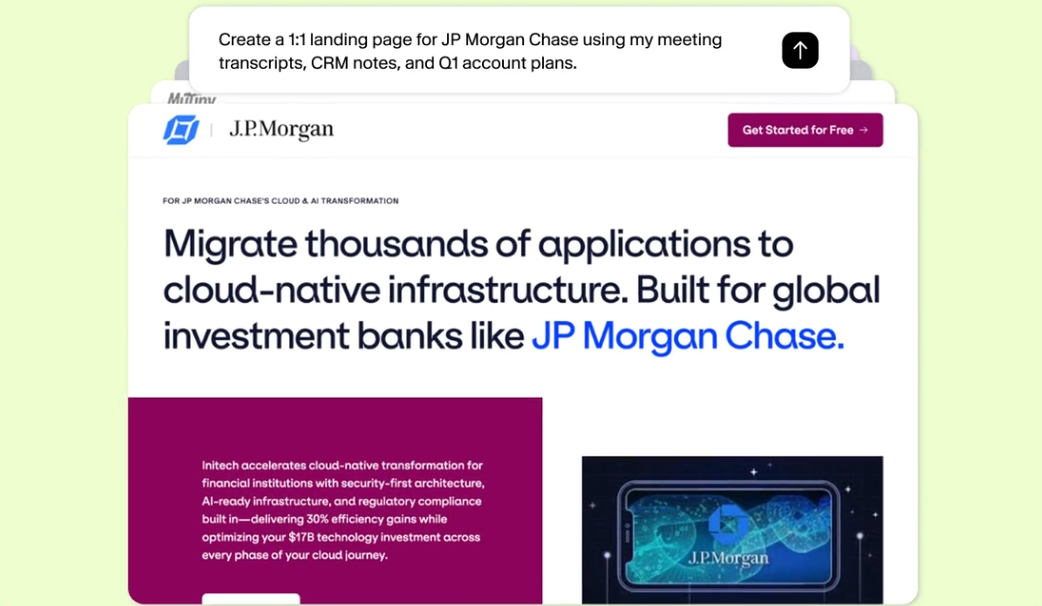
The AI Creative Agent is what makes Mutiny work. It's a conversational AI assistant inside Mutiny's asset editor that generates first drafts, refines copy, personalizes sections for specific accounts, conducts live web research, and writes supporting email sequences.
Source: Mutiny
Asset creation starts from the Home tab, where users describe what they want to build. Three starting paths are available: a plain-language prompt from scratch, a pre-built Blueprint for a specific content type, or a saved team Template. Users can attach files (design screenshots, messaging documents, call transcripts) or dictate prompts by voice.
Once submitted, the agent builds the asset in real time, populating sections, writing copy, and applying brand styles. It draws on three sources: the user's Company Context (auto-extracted from the company website, covering products, ICP, brand voice, and pricing), the team's Library of approved case studies and brand assets, and any context attached to the prompt.
After generation, the agent stays live in a Chat tab inside the editor. Users issue follow-up instructions in plain language, scoped to one section or applied across the whole page. The agent retains full conversational context, so research from earlier in the session informs later editing requests without re-pasting.
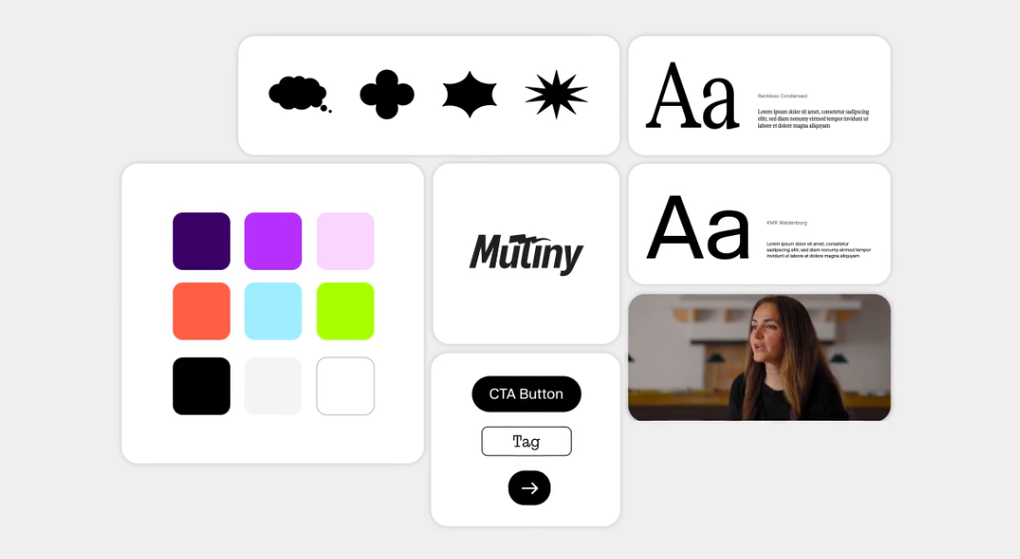
What sets this apart from general-purpose AI tools is the brand awareness. Entering a website URL causes Mutiny to extract colors, fonts, logos, and visual style automatically, so the first generated asset matches brand guidelines without manual setup. The agent can also conduct live web research on target accounts inside the editor, pulling company details, funding rounds, and tech stacks from public sources and applying them to the asset immediately.
Source: Mutiny
The agent extends beyond the asset itself. Once a page is finalized, it can write a supporting outreach email grounded in the asset's content, or generate a multi-touch email sequence with varied angles tied to the page. Mutiny automatically versions the asset as work progresses, and users can restore any prior version or undo only the agent's changes while keeping manual edits.
Blueprints & Templates: Pre-built frameworks covering the full deal cycle, from prospecting to expansion.
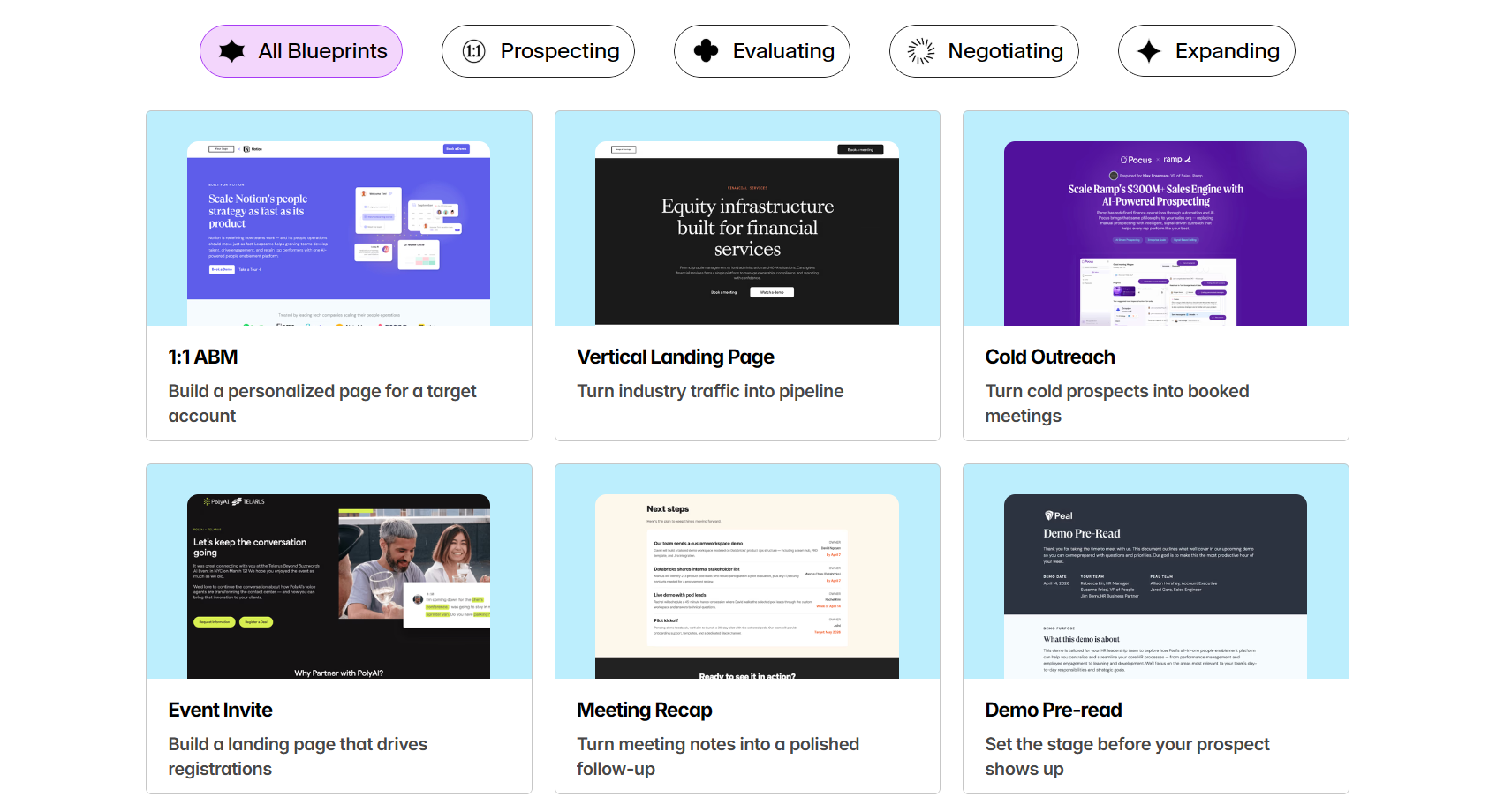
Mutiny's Blueprint library is the structured layer that keeps output consistent across a team. 17+ Blueprints are organized by buyer journey stage (Prospecting, Evaluating, Negotiating, Expanding), each defining the sections, tone, and intent for a specific content type.
Source: Mutiny
The library covers: 1:1 ABM Landing Page, Vertical Landing Page, Cold Outreach, Event Invite, Meeting Recap, Demo Pre-Read, Case Study, Case Study Round Up, Competitive Comparison, Group Demo Follow Up, Pitch Deck, Pricing Proposal, Executive Business Case, Deal Room, Forward Looking Strategy, Impact Report, and Expansion ABM Page.
These aren't just visual templates. Each Blueprint encodes the strategic intent behind the asset. The 1:1 ABM Blueprint includes a co-branded header, industry-specific logo bar, feature spotlight, relevant resources, a "how we'd work together" section, and a single CTA. When a user selects it and provides account context, the agent builds content mapped to that account's initiative, pulls relevant case studies from the Library, and frames the value proposition around the stated priority.
Templates are the team-internal counterpart. Teams build them by starting from scratch, converting existing assets, or saving customized Blueprint-generated assets. On Enterprise plans, admins can attach Template Prompts: custom instructions that run behind the scenes whenever a template is used, so every rep follows the same playbook without learning how to prompt the AI.
Unlimited templates are available at every plan level, including Free. Template Prompts are Enterprise-only.
Account Studio: A centralized account data hub for enrichment and personalization at scale (Enterprise only).
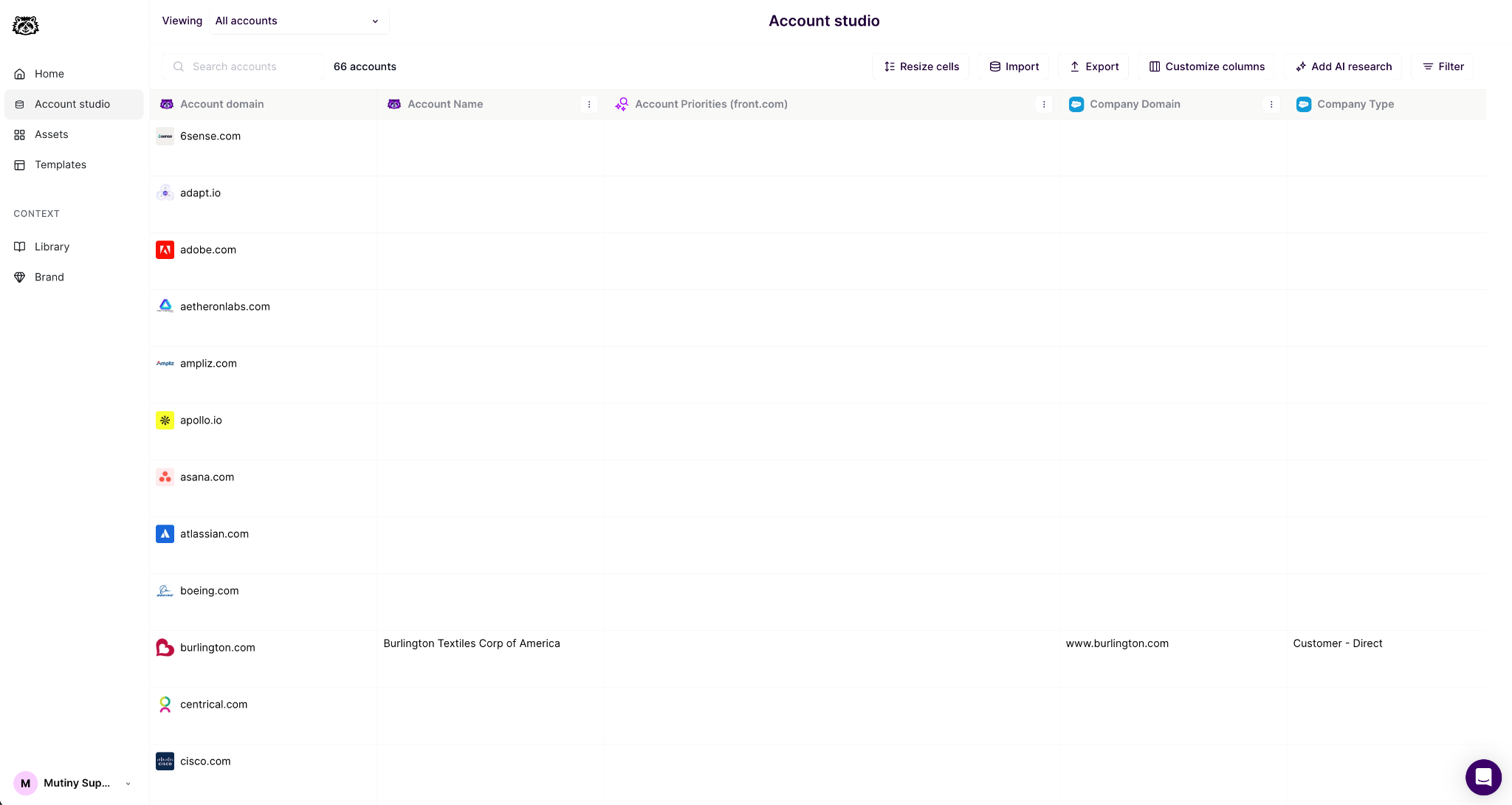
Account Studio is Mutiny's data management layer, designed to close the gap between the account data teams have and what they need for personalized content. It's available only on Enterprise plans (starting at $30,000/year).
Source: Mutiny
The hub uses company domain as the universal matching key, merging data from Salesforce, HubSpot, CSV uploads, and AI-generated research into a single record per account. Users can apply AND/OR filters and nested condition groups to define target audiences, with real-time account counts updating as filters change.
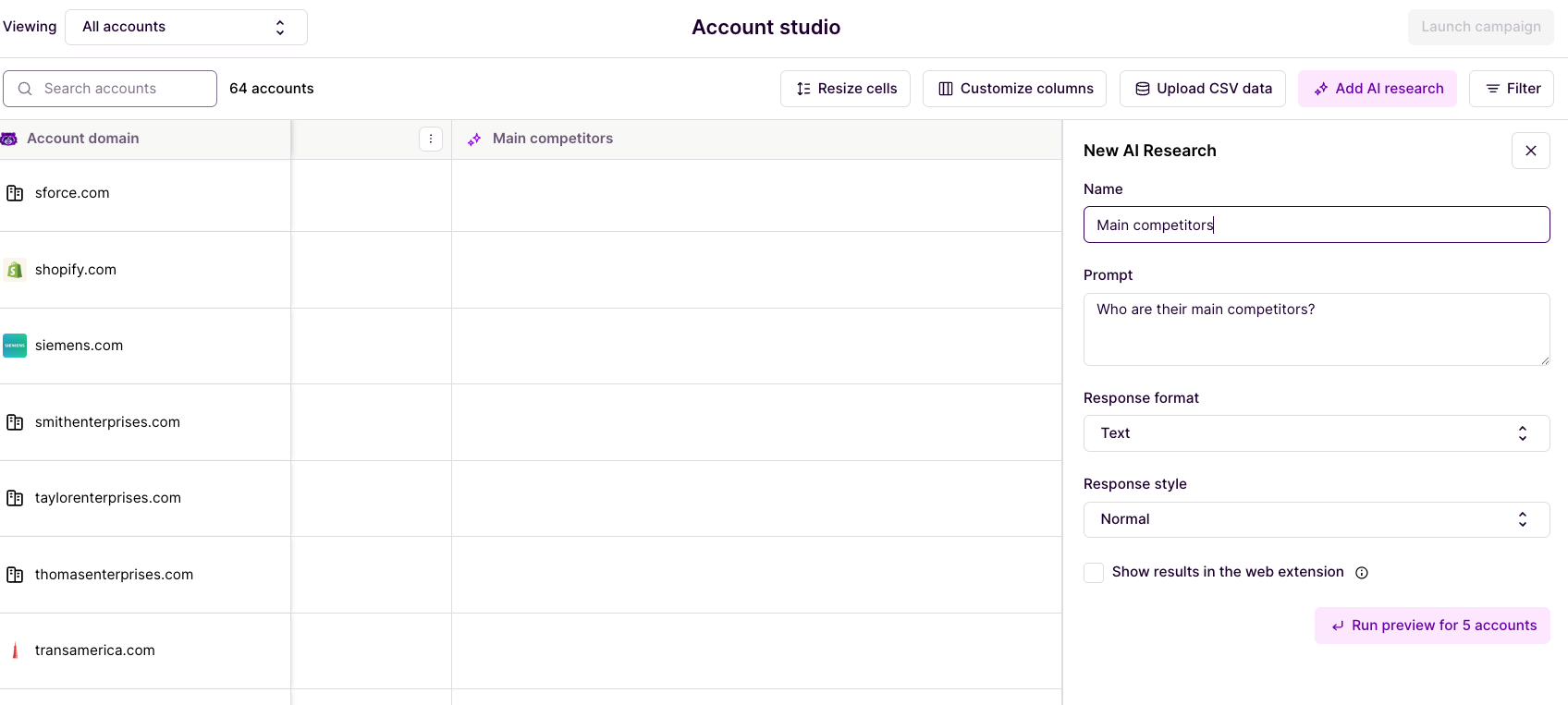
The standout feature is prompt-driven AI enrichment. Users write a natural language prompt (for example, "Have they raised funding in the last 6 months?"), and the system generates a new data column with answers. Output formats include text, true/false, number, or date. The system previews results for the first 5 accounts before running across the full list, so teams can refine prompts without wasting credits. Each result includes the answer, a rationale, and cited sources.
Source: Mutiny
Credits are consumed at 1 credit per 50 enrichments, pooled across the team. Lists can be reused across multiple assets and exported as CSVs.
Analytics & Distribution: Engagement tracking and multi-channel distribution for personalized assets.
Mutiny includes built-in analytics and distribution tools to get personalized assets in front of buying committees and track what happens next.
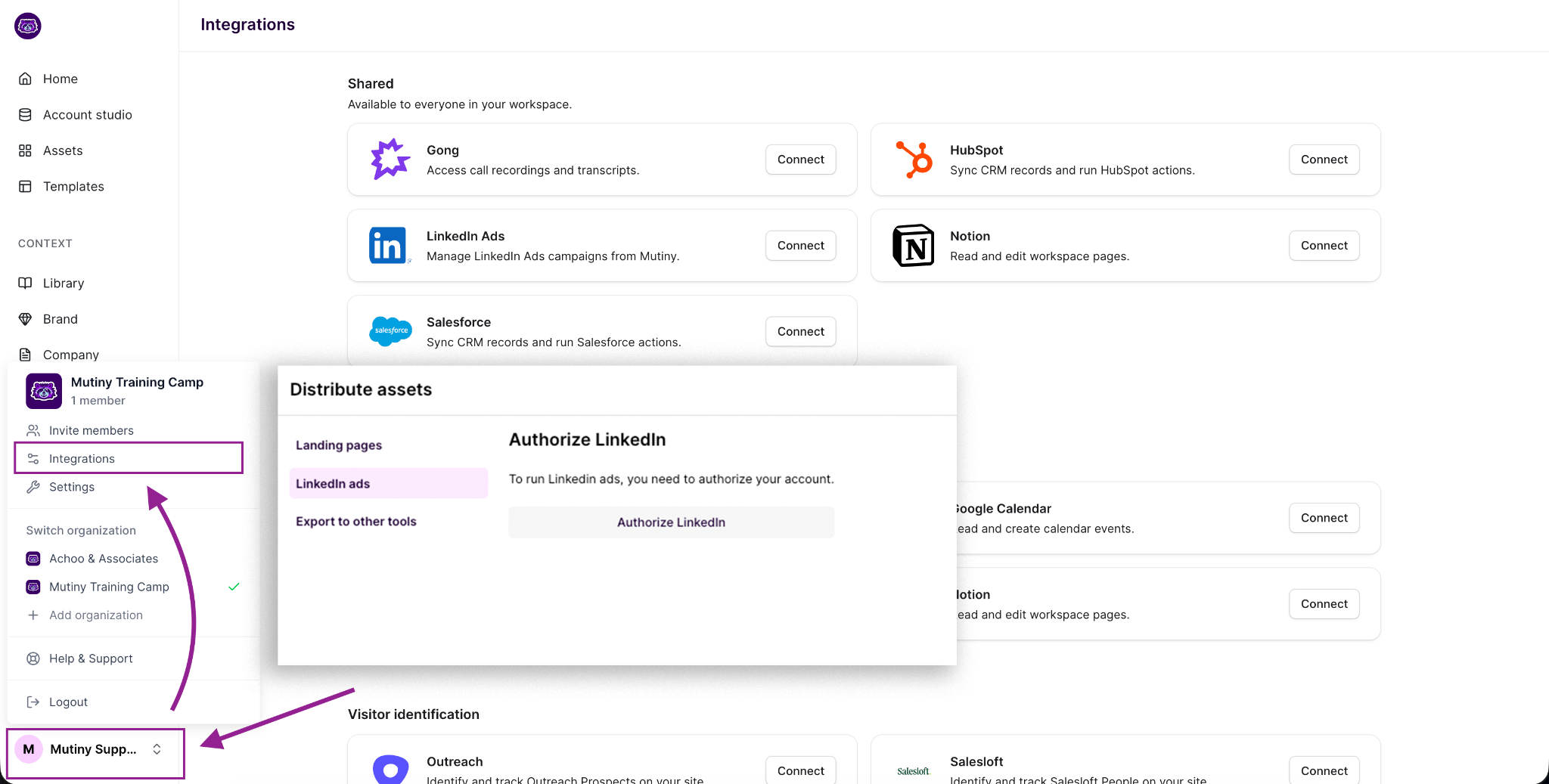
Distribution works across five channels: rep outbound (via Sales Extension, CSV export, or Salesforce Account field), LinkedIn Ads (Mutiny builds personalized ad creative and pushes drafts into LinkedIn), marketing emails and nurtures, event follow-ups, and QR codes on physical direct mail.
Source: Mutiny
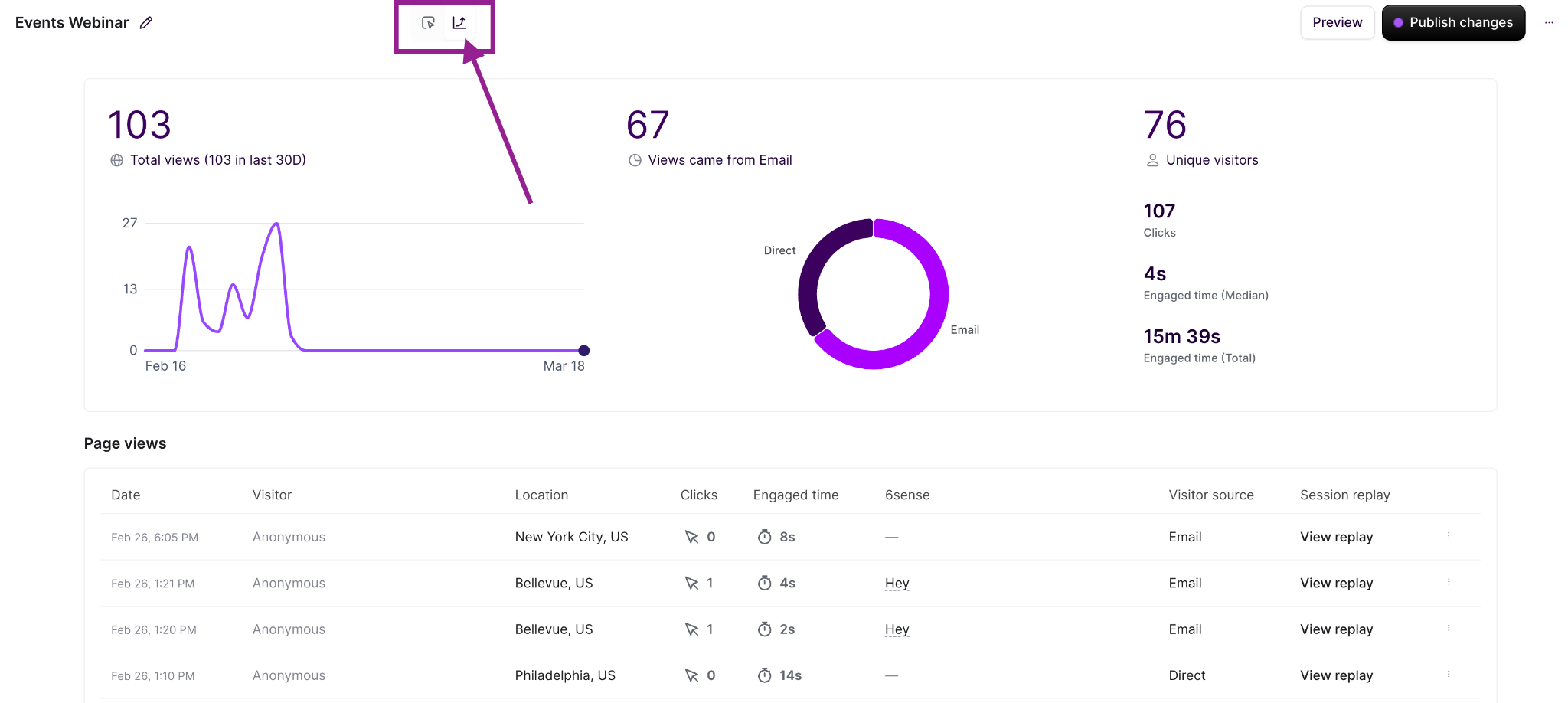
The analytics layer logs every visit with timestamp, visitor identity (resolved via Outreach or Salesloft integrations), geographic location, click count, and time on page. Session replays are available from the visits table. UTM-based channel attribution follows Google's default groupings.
Source: Mutiny
For teams using external analytics tools, tracking scripts can be installed account-wide to support GA4, Adobe Analytics, Google Tag Manager, LinkedIn Insight Tag, Meta Pixel, and behavioral tools like Hotjar and Amplitude.
Mutiny also launched an MCP server that lets sellers generate on-brand assets inside Claude or ChatGPT conversations, pulling deal context from Salesforce and call transcripts from Gong, and publishing shareable URLs without leaving the chat.
Pricing Structure: Freemium model with credit-based usage and a steep jump to Enterprise.
Mutiny uses a hybrid per-seat plus usage-credit model:
Free ($0/month):
Up to 5 team members
5 daily credits, up to 30 credits per month per seat (pooled)
Unlimited templates and content library
Hosted on mutiny.app domain
Access to training videos
Business ($50/seat/month):
Everything in Free
50 credits per month per seat (pooled)
Custom subdomain
Outreach and Salesloft integrations
Password protection on published pages
Enterprise (starting at $30,000/year):
Everything in Business
Custom credit limits
SSO, custom DPA, and dedicated CSM
Onboarding support (2-6 week typical rollout)
Salesforce and HubSpot CRM integrations
Template Prompts and Account Studio AI enrichments
Additional credits can be purchased at 100 credits for $100 on Business and Enterprise plans. Unused credits roll over for one month. All plans are SOC 2 certified.
The pricing creates a clear gap: teams that need CRM integrations, SSO, or Account Studio enrichment must commit to the $30,000/year Enterprise floor. There is no middle tier between $50/seat/month and a five-figure annual contract.
Where Mutiny Falls Short
Mutiny produces personalized GTM content quickly. But several limitations surface as teams scale beyond content creation.
Content Creation Without Underlying Intelligence: Mutiny generates assets but doesn't provide B2B data, buyer intent signals, or account intelligence to inform which accounts to target and when to engage. The AI Creative Agent can run basic web research on individual accounts, but it lacks verified contact data, intent signals, and technographic intelligence that enterprise GTM teams need to prioritize. Teams still need a separate data platform to decide where to focus before using Mutiny to create content.
Credit Limits That Constrain Scale: Free users receive 30 credits per month and Business users receive 50 per seat. For account executives managing large pipelines or ABM teams running campaigns across dozens of named accounts, these limits force either an Enterprise upgrade or frequent add-on purchases at $100 per 100 credits. The credit model works for occasional use but creates friction at the volume where personalization pays off most.
CRM Integrations Gated to Enterprise: Salesforce and HubSpot integrations are Enterprise-only, starting at $30,000/year. Business plan teams can't pull CRM data into asset personalization, which is core to the value proposition. This forces a choice: upgrade to Enterprise or manually provide deal context for every asset.
Analytics That Don't Go Deep Enough: Multiple reviewers on G2 call analytics the platform's weakest area. The engagement tracking shows who visited and for how long, but teams needing attribution, conversion funnel analysis, or multi-touch reporting will need additional tools. For a platform built around personalized sales content, the inability to tie specific assets to deal progression is a gap.
Limited A/B Testing for Optimization: Mutiny is built for content generation, not experimentation. It lacks click tracking on individual page elements and multivariate testing. Teams running conversion rate optimization programs will need a dedicated tool (VWO, Optimizely) alongside Mutiny.
Narrow Integration Surface: Native integrations cover Outreach and Salesloft (Business tier) and Salesforce and HubSpot (Enterprise), plus tools like Gong, Google Drive, and Gmail. Compared to GTM platforms with hundreds of integrations, Mutiny's ecosystem is small. All integrations route through Pipedream, a middleware layer, rather than direct native connectors.
These limitations reflect Mutiny's focus on content creation speed and quality. But for teams whose GTM challenges extend into data, intelligence, prospecting, and orchestration, a broader platform may be the better investment.
Top Mutiny Alternative for Full GTM Coverage: ZoomInfo
ZoomInfo addresses the gaps that surface when content creation is only one piece of a larger go-to-market challenge. As an AI GTM platform, ZoomInfo covers the full workflow: B2B data, the GTM Context Graph that captures not just what happened in your pipeline but why, and access through GTM Workspace, GTM Studio, and APIs/MCP, giving teams the data, intelligence, and execution tools that a content-focused tool can't provide.
B2B Data: ZoomInfo operates on a data foundation spanning 500M contacts, 100M companies, and 200M+ verified business emails.
Where Mutiny's Creative Agent conducts ad hoc web research on individual accounts, ZoomInfo provides a verified, continuously updated data platform. The platform covers three data dimensions: identity data (500M contacts, 135M+ verified phone numbers, 120M direct-dial phone numbers, and 200M+ verified business emails), company context (100M companies with firmographics, org charts, and technographics), and signals that show when accounts are in-market.
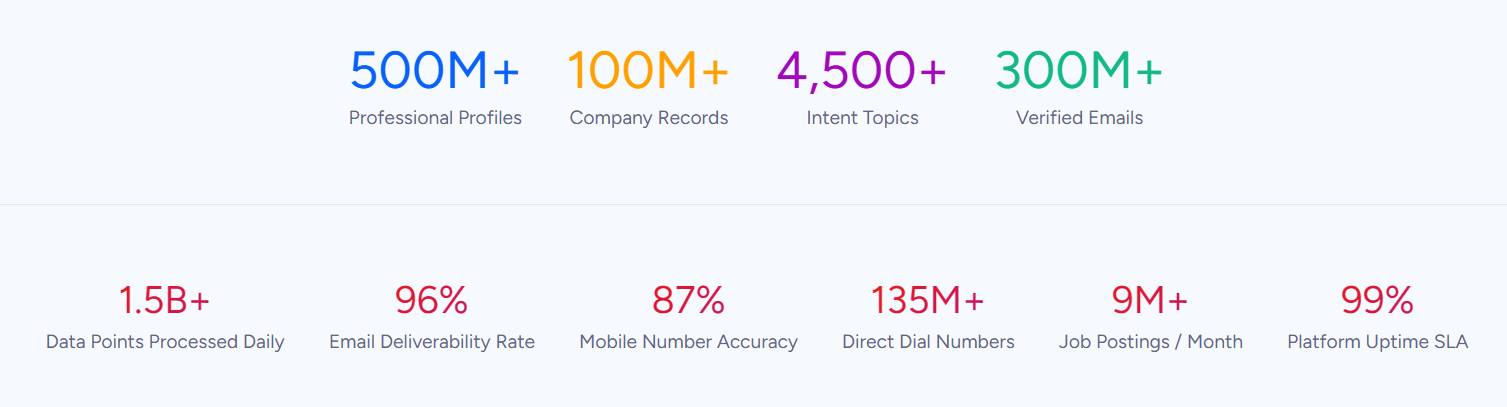
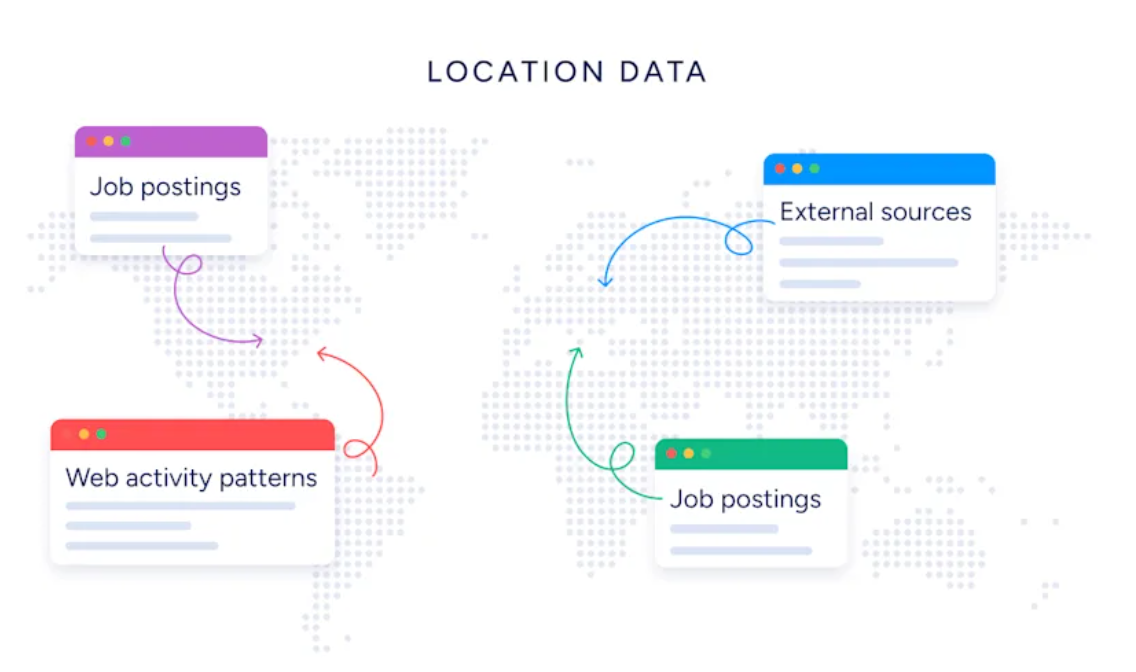
This data flows through a collection and verification system that includes automated ML scanning of 28 million site domains daily, third-party partner data covering 95 million businesses, and an in-house Data Training Lab of 300+ human researchers. First-party data reaches up to 95% accuracy.
Third-party evaluations back this up. In a Fortune 500 competitive RFP analyzing 25 million contacts across vendors, the independent consultant concluded that "no other competitor came even close." ZoomInfo holds analyst Leader positions in both the Gartner MQ for ABM Platforms and the Forrester Wave for Intent Data Providers, and earned 133 No. 1 rankings on G2.
For GTM teams, prospecting, account prioritization, and content personalization all draw from one verified source instead of stitching together ad hoc web research, stale CRM records, and third-party enrichment tools.
Vensure scaled prospecting with ZoomInfo's data: "ZoomInfo gives us the information we need to execute. We don't have to go through and spend our time digging. It's already there, so we can be three steps ahead." (Vensure)
GTM Context Graph: An intelligence layer that captures not just what happened in a deal, but why.
Mutiny tracks whether accounts visit shared assets and how long they stay. ZoomInfo's GTM Context Graph operates at a different level, fusing B2B data with CRM records, conversation intelligence from calls and meetings, email interactions, and behavioral signals into a single intelligence layer that processes 1.5B+ data points daily.
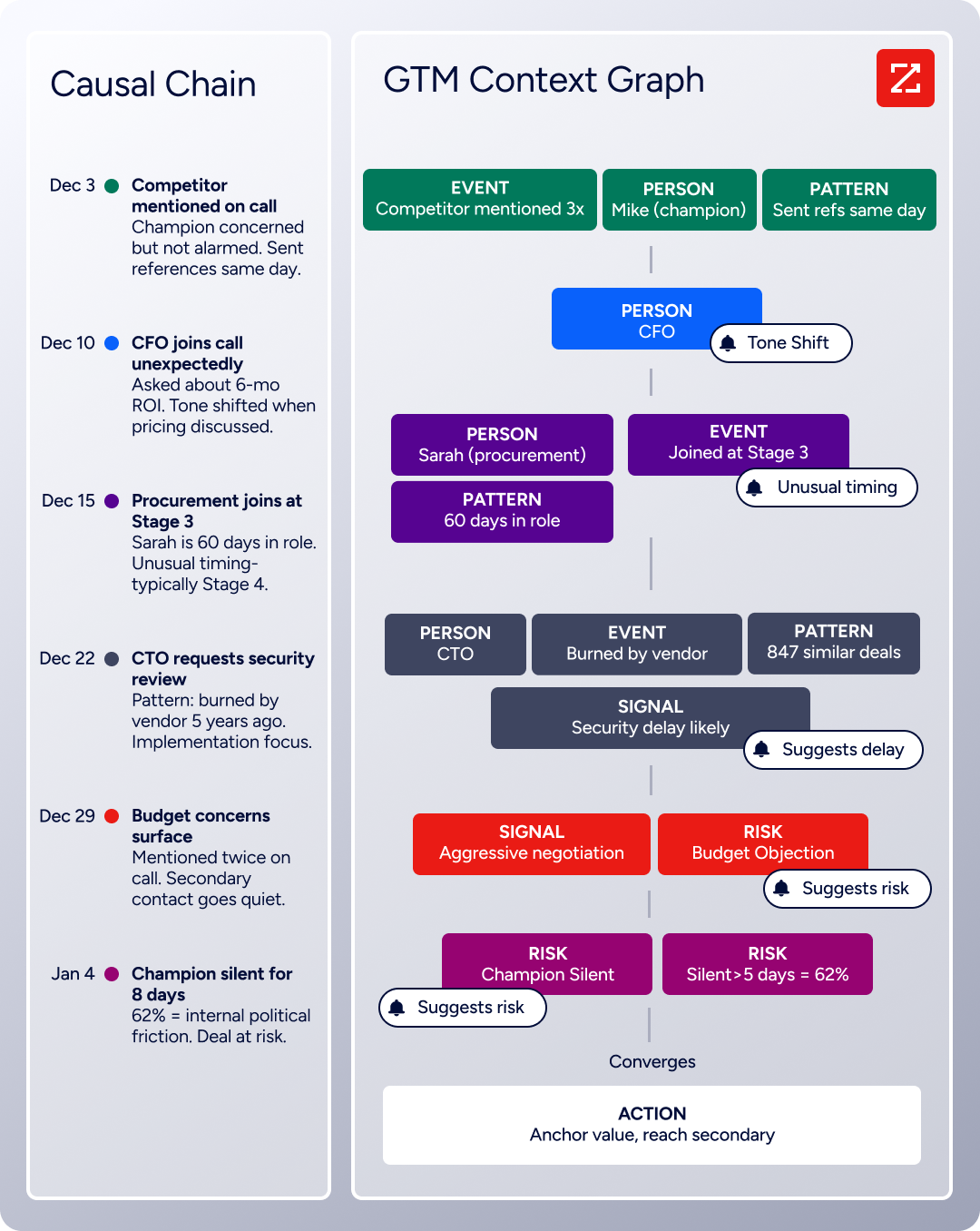
The distinction matters because CRMs record that a deal's stage changed, but not why. As ZoomInfo's CPO Dominik Facher writes: "The CRM recorded the state change. It has no record of why it happened." The GTM Context Graph makes this decision context machine-readable, capturing who influences whom, what actions produced which outcomes, what thousands of similar deals suggest happens next, and why things slipped.
This intelligence layer exists because of two decades of investment. ZoomInfo built a B2B data unification platform, then acquired Chorus and Workbounce for context capture and reasoning. The result is a graph where AI can reason about go-to-market decisions, not just generate content.
For teams evaluating Mutiny's engagement analytics alongside ZoomInfo's intelligence, the difference is between knowing a prospect viewed a landing page and understanding why that prospect's buying committee is likely to close based on signals from thousands of similar deals.
Seismic attributed 39% of active pipeline to opportunities identified or influenced by ZoomInfo signals, with sales teams seeing 54% productivity gains. (Seismic)
Universal Access: Use ZoomInfo's intelligence in any tool through GTM Workspace, GTM Studio, or APIs and MCP.
Mutiny delivers its value through its own editor and a recent MCP server for Claude and ChatGPT. ZoomInfo takes a broader approach: the same data and intelligence are accessible through three paths designed for different teams and workflows.
GTM Workspace gives sellers a single place where prioritized accounts, AI-drafted outreach, and deal execution come together. AI agents research accounts, generate follow-ups, monitor signals, and update CRM fields. Customer results include Databricks reaching prospects 50% faster and Thomson Reuters increasing closed-won deals by 40%.
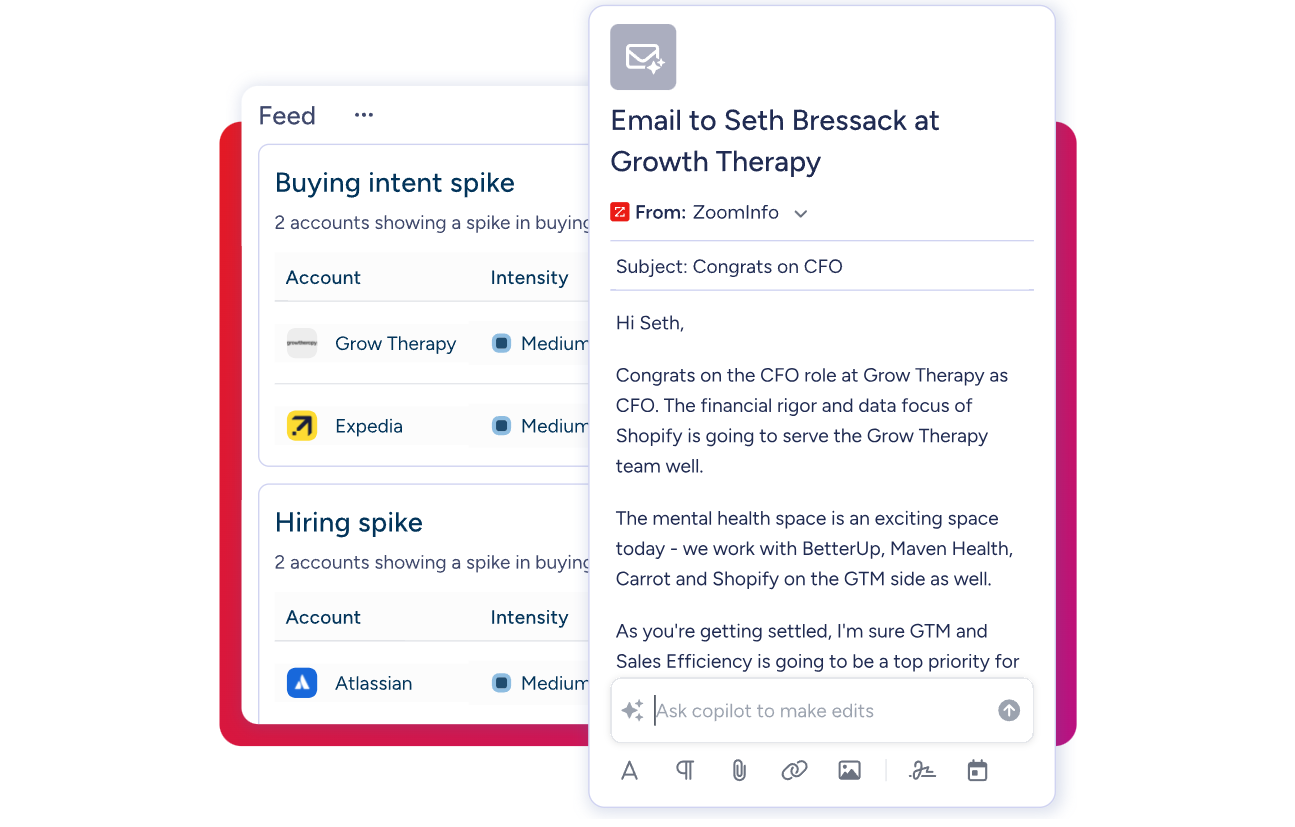
GTM Studio gives marketers, RevOps, and GTM engineers a canvas where teams define audiences, orchestrate campaigns, and measure pipeline in natural language. Teams can launch expansion plays in 30 minutes that previously took three weeks, without engineering support. Plays run continuously and improve as prospects respond.
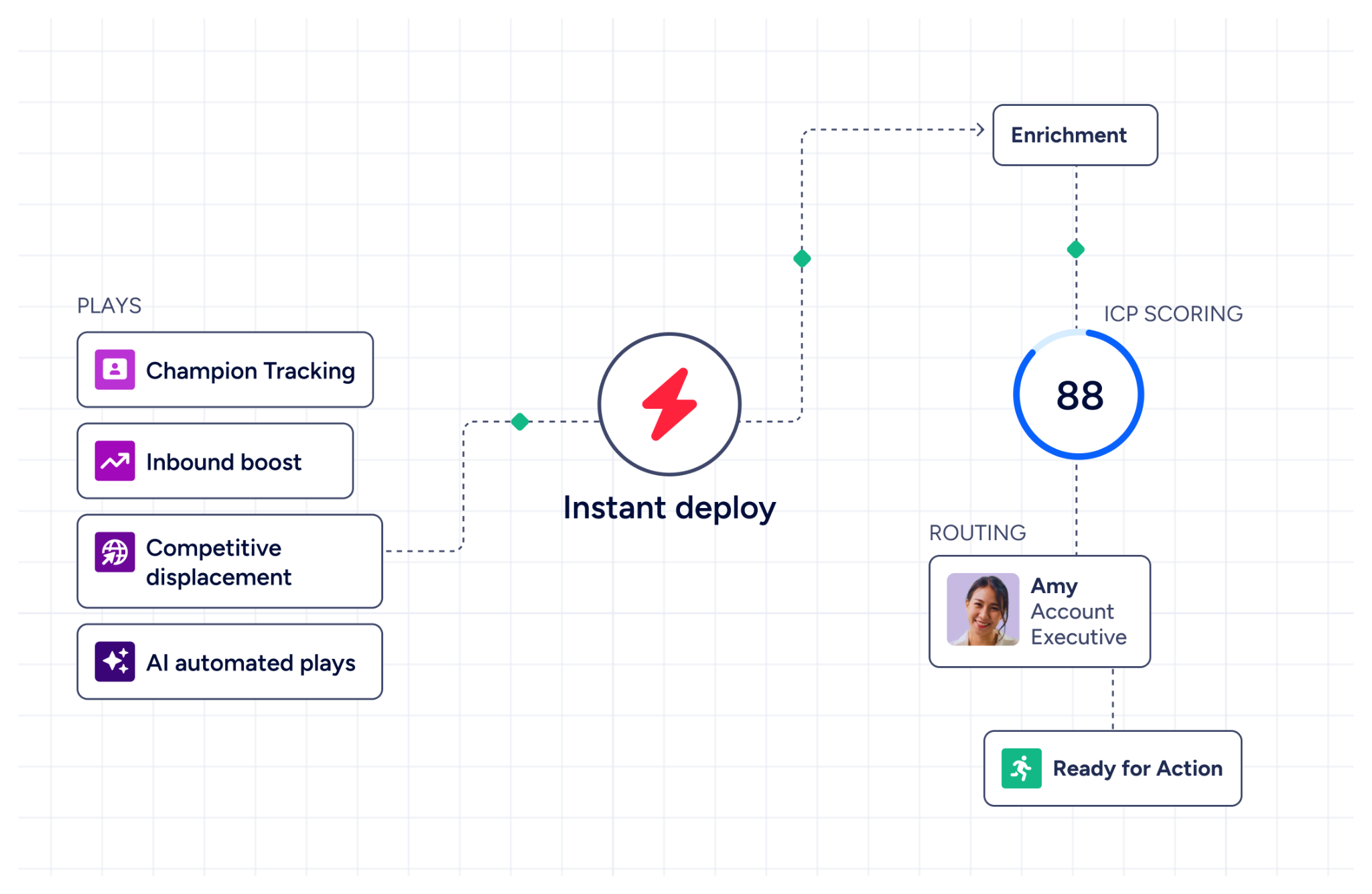
For teams building beyond ZoomInfo's own products, APIs and MCP expose the same intelligence to any custom agent, internal tool, or partner platform. The ZoomInfo MCP server connects to Claude and ChatGPT, and API access is included in all relevant plans.
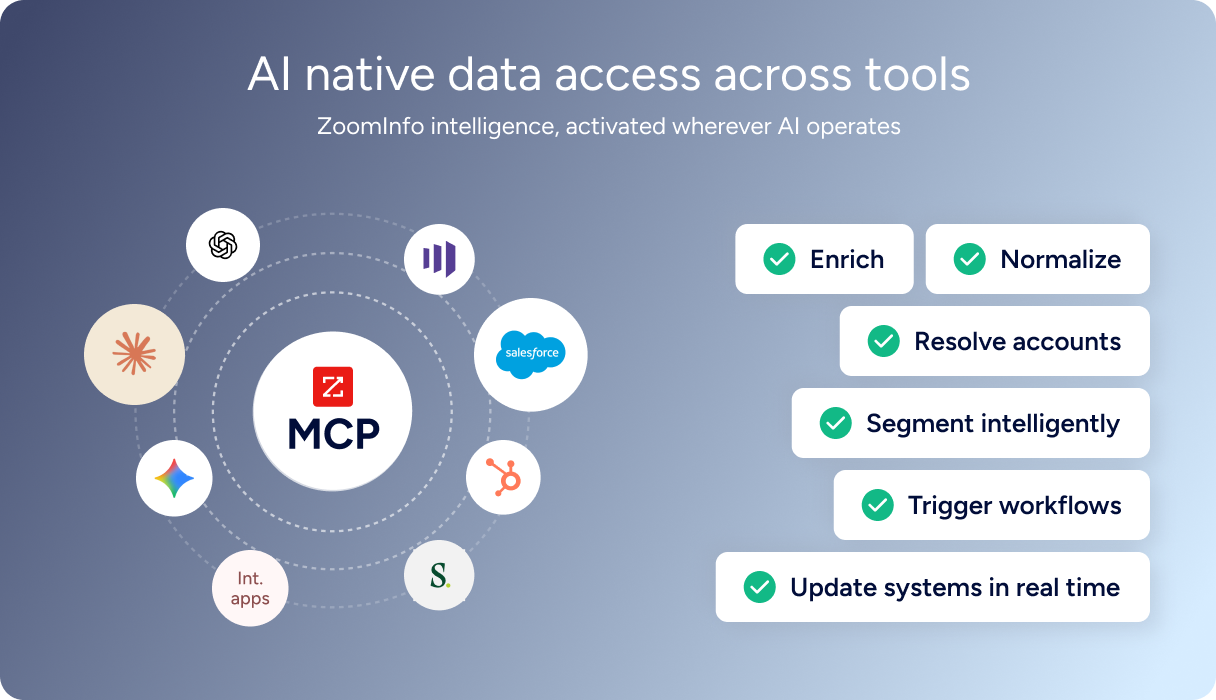
All three draw from one GTM Context Graph: the same data, the same reasoning, the same continuously learning model. Where you work never limits the intelligence available.
Spekit delivered insights within rep workflows: "Anything that minimizes our team's need to switch contexts is beneficial. ZoomInfo offers a unified view, eliminating the need to navigate between systems." (Spekit)
Pricing: Custom-quoted consumption-based pricing with a permanent free tier.
ZoomInfo uses a consumption-based pricing model with no publicly listed prices. Pricing scales around data access, API consumption, AI activity, and credit volume, so customers pay for what they use.
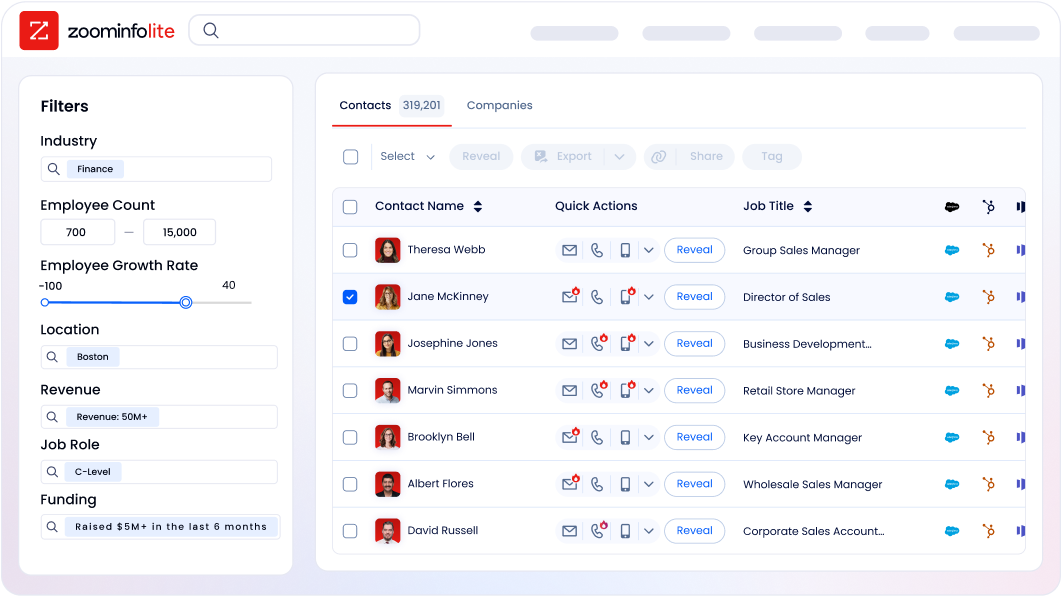
Two free entry points exist. ZoomInfo Lite is a permanent free tier (not a trial) offering access to ZoomInfo's B2B database, 10 monthly export credits, individual and company searches, the ReachOut Chrome Extension, WebSights Lite, built-in email sending, and HubSpot integration. A separate 7-day free trial gives broader access to core platform features including intent signals and sales intelligence tools.
Paid plans are organized into Sales tiers (Professional, Advanced, Enterprise) and Marketing tiers (Marketing Demand, ABM Lite, ABM Enterprise), each adding capabilities progressively. Chorus and Chat are priced separately. Annual contracts are standard, with multi-year commitments offering pricing advantages.
Mutiny or ZoomInfo: Comparison Summary
Mutiny | ZoomInfo | |
|---|---|---|
Primary focus | AI content creation for GTM teams | AI GTM platform (data, intelligence, execution) |
Target users | AEs needing deal content, ABM marketers | Sales, marketing, RevOps, GTM engineers |
B2B data | Ad hoc web research per account | 500M contacts, 100M companies, 200M+ verified emails |
Buyer intent signals | Basic engagement tracking on shared assets | Intent data from 210M IP-to-Org pairings, 6T+ keyword signals monthly |
Content creation | AI Creative Agent with 17+ Blueprints | AI-drafted outreach in GTM Workspace |
CRM integrations | Salesforce, HubSpot (Enterprise only, $30K+/year) | Salesforce, HubSpot, Microsoft Dynamics (included in relevant plans) |
Analytics depth | Per-visit engagement tracking, session replays | AI-powered dashboards, multi-touch attribution, deal intelligence |
Conversation intelligence | Call transcript ingestion for personalization | Chorus (recording, transcription, AI analysis, coaching) |
Campaign orchestration | Asset distribution across 5 channels | GTM Studio with multi-channel orchestration (email, ads, calls, direct mail) |
Integrations | ~15 via Pipedream middleware | 120+ in App Marketplace, Enterprise API, MCP |
Free tier | Free plan (30 credits/month, 5 team members) | ZoomInfo Lite (permanent, 10 exports/month) + 7-day trial |
Paid pricing | $50/seat/month (Business), $30K+/year (Enterprise) | Custom-quoted, consumption-based |
Security | SOC 2 Type II | ISO 27001, ISO 27701, SOC 2 Type II, TRUSTe GDPR/CCPA |
Best for | Teams whose primary bottleneck is content creation speed | Teams needing data, intelligence, and execution in one platform |
Final Verdict
The choice between Mutiny and ZoomInfo depends on where your go-to-market bottleneck sits.
Choose Mutiny if your primary challenge is producing personalized, on-brand sales and marketing assets at speed. It's built for teams where account executives wait weeks for deal-specific content, ABM marketers need 1:1 landing pages without a designer, and the limiting factor is content creation, not data or intelligence. Mutiny's agent-first architecture, automatic brand extraction, and Blueprint library solve a real problem for teams that already know who to target and when to engage but struggle to produce the materials that move deals forward.
Choose ZoomInfo if your GTM challenges extend beyond content into knowing which accounts to prioritize, understanding why deals move or stall, and executing across the full revenue cycle. With B2B data (500M contacts, 100M companies, 200M+ verified emails), the GTM Context Graph that captures context behind deal outcomes, and access through GTM Workspace, GTM Studio, and APIs/MCP, ZoomInfo provides the foundation behind every GTM decision, from identifying your next best account to closing and expanding the deal. For teams that need data, intelligence, and execution in one platform, ZoomInfo covers the full go-to-market cycle.
Get started with ZoomInfo here.
Mutiny solves a specific and valuable problem: it turns content creation from a weeks-long dependency chain into an afternoon's work. ZoomInfo solves the broader system: giving go-to-market teams the data, intelligence, and execution tools to find, win, and grow customers at scale. Teams with mature data stacks may find Mutiny fills a genuine content gap. Teams building or consolidating their GTM platform will find ZoomInfo covers far more ground.
Mutiny FAQ
What is Mutiny used for?
Mutiny is an AI platform that creates personalized customer-facing content for go-to-market teams. Sales reps use it to produce deal-specific materials (business cases, pitch decks, deal rooms) without waiting on marketing or design. ABM marketers use it to build personalized landing pages for named accounts at scale. The platform covers the full deal cycle through 17+ Blueprint templates, from prospecting to expansion.
How much does Mutiny cost?
Mutiny offers a permanent free plan with up to 5 team members and 30 credits per month. The Business plan costs $50 per seat per month with 50 credits per seat. Enterprise plans start at $30,000 per year with custom credit limits and include CRM integrations, SSO, Account Studio, and a dedicated customer success manager. Additional credits can be purchased at $100 for 100 credits.
Does Mutiny integrate with Salesforce and HubSpot?
Yes, but only on the Enterprise plan (starting at $30,000 per year). Business plan users ($50/seat/month) cannot access CRM integrations. Teams on the lower tier can't pull CRM data into asset personalization and must provide deal context manually. ZoomInfo includes CRM integrations with Salesforce, HubSpot, and Microsoft Dynamics across its relevant plans.
What are Mutiny's credit limits?
Free users receive 5 credits per day, capped at 30 per month per seat. Business users receive 50 credits per month per seat. Enterprise plans have custom credit limits negotiated per contract. Credits are pooled across the team, and unused credits roll over for one month. For teams managing large pipelines, these limits may require frequent add-on purchases or an Enterprise upgrade.
Does Mutiny provide B2B contact data or intent signals?
No. Mutiny's AI Creative Agent can run basic web research on individual target accounts, but it does not maintain a B2B contact database, provide verified phone numbers or emails, or track buyer intent signals. Teams need a separate data and intelligence platform for prospecting and account prioritization. ZoomInfo provides 500M contacts, 135M+ verified phone numbers, 200M+ verified business emails, and buyer intent data from 210M IP-to-Organization pairings.
How does Mutiny's analytics compare to dedicated analytics platforms?
Mutiny includes per-visit engagement tracking with timestamps, visitor identity (resolved through Outreach or Salesloft integrations), session replays, and UTM-based channel attribution. However, multiple G2 reviewers note that analytics are the platform's weakest area. Teams needing attribution, conversion funnel analysis, or multi-touch reporting will need additional tools. ZoomInfo offers AI-powered analytics dashboards, deal intelligence, and pipeline attribution through its GTM Context Graph.
Is Mutiny a competitor to ZoomInfo?
No. Mutiny focuses on creating personalized customer-facing content (landing pages, business cases, deal rooms, pitch decks). ZoomInfo is a broader AI GTM platform covering B2B data, buyer intelligence, prospecting, campaign orchestration, conversation intelligence, and execution. ZoomInfo provides the data and intelligence layer that informs which accounts to target and why, while Mutiny produces the content assets used within deals. Teams with GTM needs beyond content creation will find ZoomInfo covers more of their workflow.
What happened to Mutiny's website personalization product?
Mutiny originally launched as a no-code website personalization platform for swapping headlines, CTAs, and images for different visitor segments. In 2024-2025, the company rebuilt from scratch, moving from a SaaS foundation to an agent-first architecture. The original personalization product was deprecated. The current platform focuses on AI content creation across the full deal cycle rather than website CRO.
