
Choosing between Nimble vs. Zoho CRM for your sales process often comes down to five questions:
Are you a solopreneur managing personal relationships, or a growing team that needs structured sales processes?
Do you need a simple, flat-rate tool, or do you want customization even if it takes time to set up?
Is your biggest challenge managing contacts you already have, or finding the right prospects to pursue?
How important is it that your CRM works inside your existing email and calendar tools without switching tabs?
Do you need B2B data intelligence and buying signals, or is a basic contact database enough?
In short, here's what we recommend:
Nimble is built for solopreneurs and small teams (typically under 25 people) who run on personal relationships. At $24.90/seat/month, it includes all core features in a single plan with no tier-gating. The Nimble Prospector browser extension lets you capture and enrich contacts from LinkedIn, Gmail, or any website without leaving your workflow. Forbes named it the 2025 Best CRM for Solopreneurs and Small Teams. However, Nimble's automation is limited to linear sequences, reporting lacks attribution and A/B testing, and the mobile app consistently draws complaints for being slow and buggy.
Zoho CRM serves growing businesses that need a full-featured, customizable CRM at a fraction of enterprise pricing. With a permanent free plan for up to 3 users and paid tiers starting at $14/user/month, it delivers sales force automation, AI-powered lead scoring via Zia, process enforcement through Blueprint, and omnichannel engagement across email, phone, WhatsApp, and social. The trade-off is complexity: G2 reviewers consistently flag that advanced configuration demands significant time, and support quality can be inconsistent.
Both platforms focus on managing contacts and deals after you've identified them. But for teams whose real bottleneck is finding the right accounts, knowing when they're ready to buy, and knowing what to say when they engage, the challenge lives upstream of any CRM.
ZoomInfo is a GTM platform that gives your sales reps the context to walk into every call knowing why the deal is moving, who's championing it, and what's likely to happen next. Your marketers can describe audiences in plain language and launch plays against accounts that match your proven win patterns. Your leaders can see deal risk before it shows up in CRM stage fields.
That context comes from the GTM Context Graph, an intelligence layer built on a B2B dataset of 500M contacts, 100M companies, 135M+ verified phone numbers, and 200M+ verified business emails, unified with your CRM records, conversation transcripts, and behavioral signals.
Your team accesses this intelligence through GTM Workspace for sellers, GTM Studio for marketers and RevOps, or APIs and MCP in any front-end. For teams that have outgrown basic CRM and need intelligence-driven pipeline generation, ZoomInfo solves the problem that neither Nimble nor Zoho CRM was designed to address.
If finding and engaging the right buyers is your biggest challenge, see how ZoomInfo works.
Nimble vs. Zoho CRM vs. ZoomInfo at a glance
Nimble | Zoho CRM | ZoomInfo | |
|---|---|---|---|
Best for | Solopreneurs and small teams (1–25) | Growing SMBs needing full CRM | Teams needing B2B intelligence and GTM execution |
Pricing | $24.90/seat/month (annual) | Free (3 users); paid from ~$14/user/month | Consumption-based; custom-quoted; free Lite tier available |
Core strength | Relationship management and ease of use | Customizable SFA with automation | B2B data and AI-powered prospecting |
Contact database | 25,000 contacts (base) | Scales with plan | 500M contacts, 100M companies |
AI capabilities | AI email drafting, AI chat helper | Zia: predictive scoring, agents, generative AI | GTM Context Graph, AI agents, conversation intelligence |
Automation depth | Linear email sequences, basic workflow triggers | Blueprint process enforcement, journey orchestration, cadences | Signal-triggered workflows, AI-drafted outreach, automated plays |
Integrations | Microsoft 365, Google Workspace, Zapier | 1,100+ integrations, 60+ Zoho apps | 120+ integrations, APIs, MCP for any AI agent |
Free option | 14-day trial | Free plan (3 users, forever) | ZoomInfo Lite (permanent free tier) |
The core split: relationship CRM vs. full-stack CRM vs. GTM intelligence
Nimble, Zoho CRM, and ZoomInfo solve three different problems. Understanding which problem is yours determines the right choice.
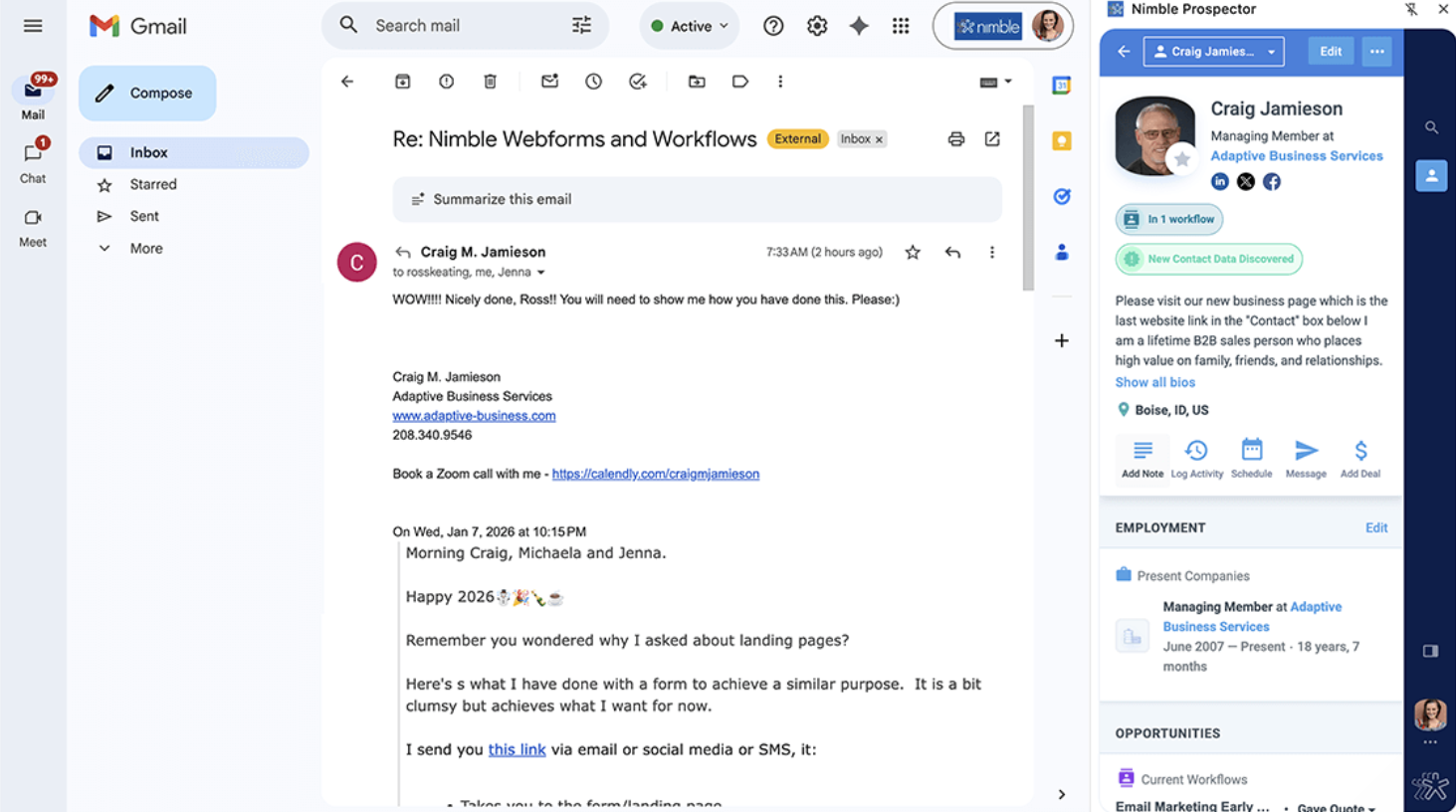
Nimble was built by Jon Ferrara, who co-founded GoldMine Software in 1989 and spent decades watching CRMs become bloated tools that salespeople avoided. His thesis: relationships, not pipelines, drive revenue for small businesses.
Source: Nimble
The product reflects this. It lives inside your inbox and browser rather than demanding a separate tab, tracks when you last contacted someone, nudges you when relationships go cold, and enriches contacts with social and business data automatically. It's a CRM for people who hate CRMs.
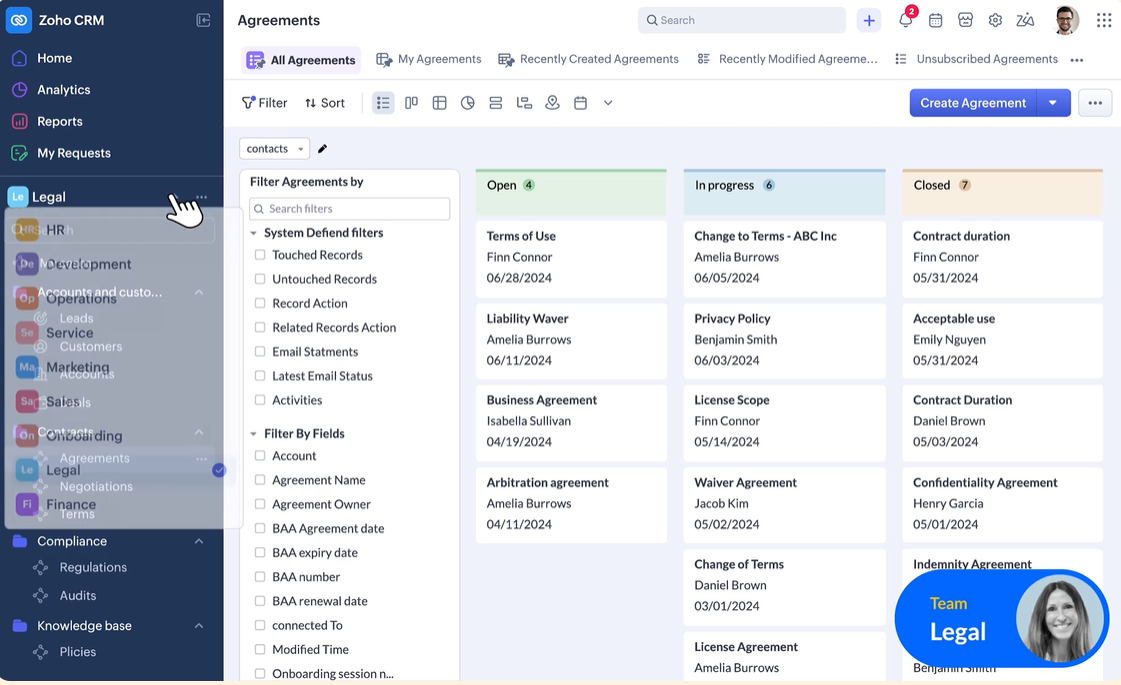
Zoho CRM takes the opposite bet. It assumes your business has outgrown a contact manager and needs structured processes: deals progressing through defined pipeline stages, reps who can't skip qualification steps, forecasts built on real pipeline data, and reporting that shows where prospects drop off.
Source: Zoho CRM
Zoho serves 300,000+ businesses and has held the Visionary position in the Gartner Magic Quadrant for Sales Force Automation for 15 consecutive years. The depth is real, but so is the setup investment.
ZoomInfo operates at a layer above both. Where Nimble and Zoho manage contacts and deals you already know about, ZoomInfo answers the question that comes first: which companies should you target, who are the decision-makers, and are they in-market right now?
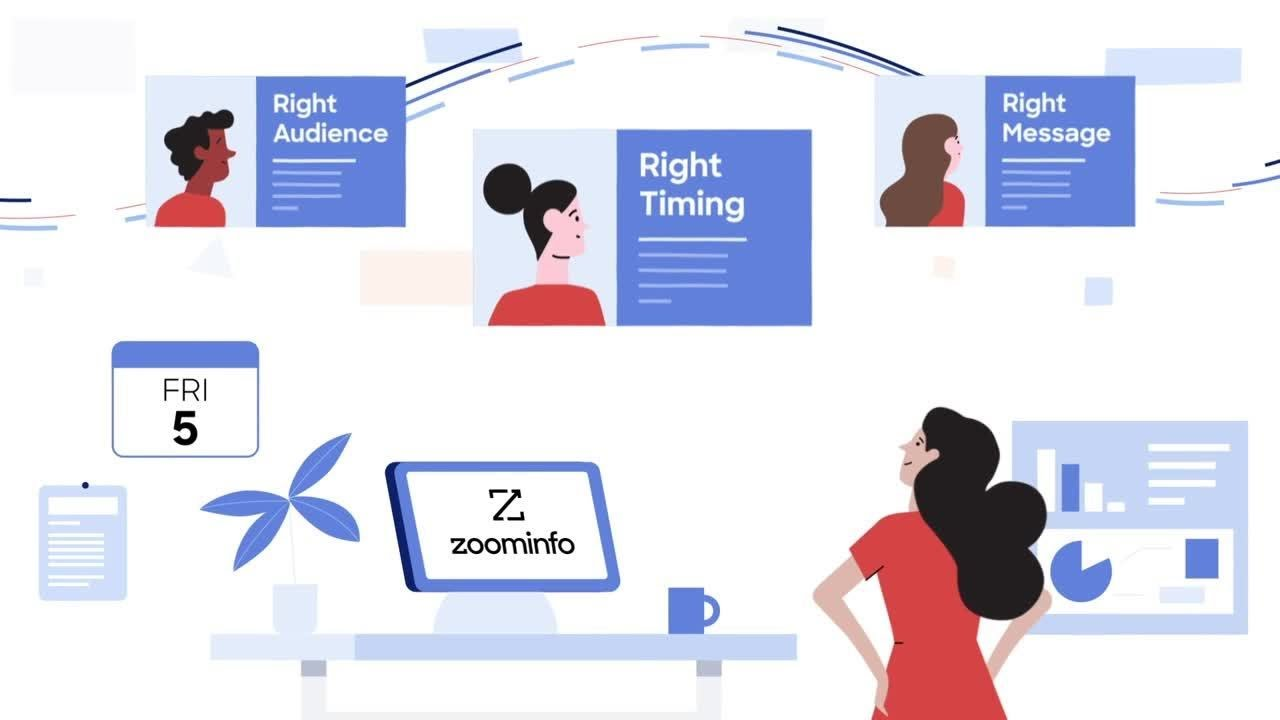
GTM Context Graph processes 1.5B+ data points daily and maps the connections between signals and outcomes across your pipeline. It integrates with CRMs (including Zoho), so teams that need both intelligence and relationship management can have both.
Contact data and prospecting capabilities
This is where the three platforms diverge most sharply.
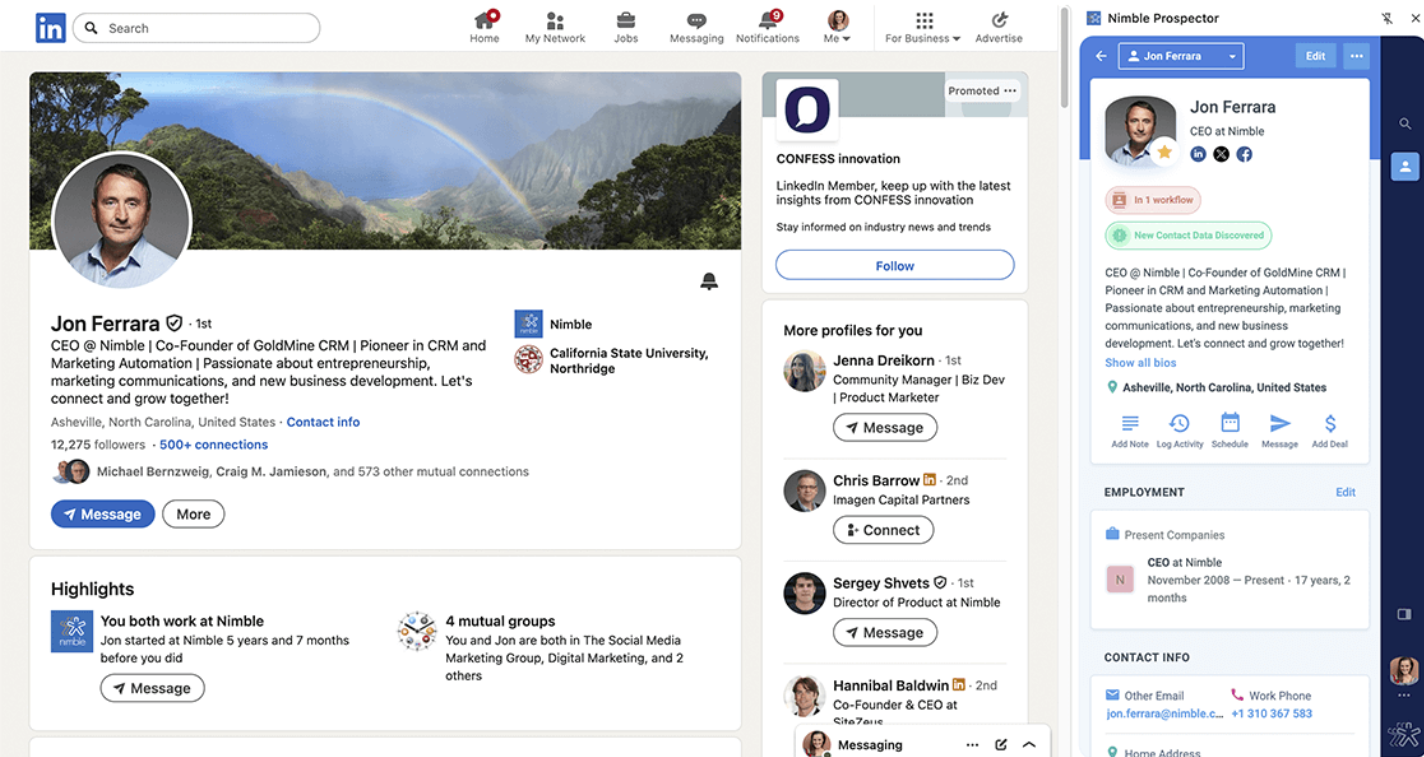
Nimble includes a solid prospecting tool in the Nimble Prospector browser extension, available for Chrome, Firefox, Safari, and Edge. Hover over a name on LinkedIn or any website, and Nimble builds a contact record with verified email, phone number, company data, and social profiles.
Source: Nimble
Each email lookup costs 4 enrichment credits, with 100 credits included per user per month. Emails pass through an eight-step verification pipeline covering format validation, MX records, SMTP checks, and disposable email screening. For a solo consultant researching prospects one at a time, this workflow is efficient.
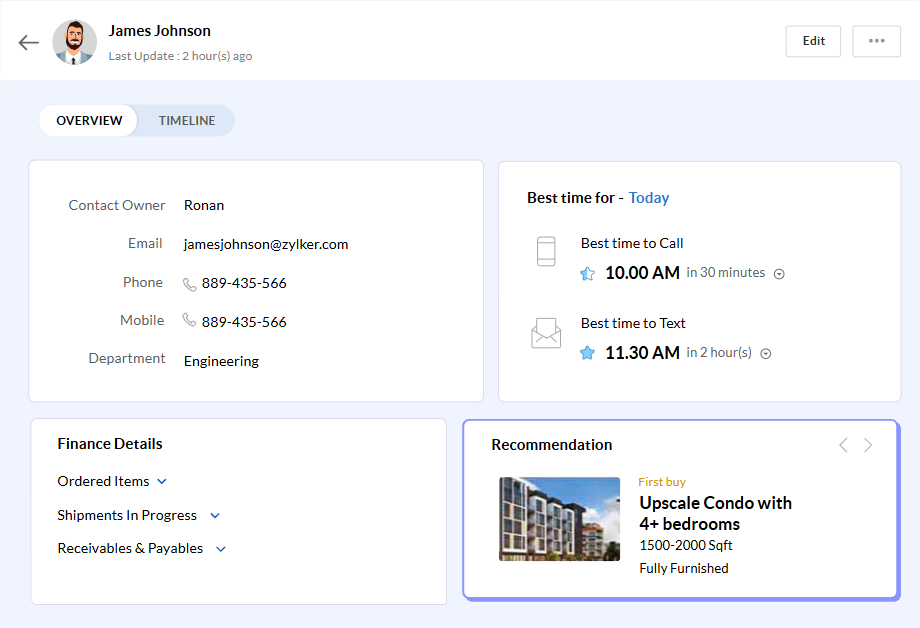
Zoho CRM approaches prospecting differently. It captures leads through web forms, spreadsheet imports, a business card scanner, live chat via Zoho SalesIQ, and social media. Zia can score leads by conversion likelihood and recommend the best time and channel to contact each prospect.
Source: Zoho CRM
But Zoho CRM doesn't include a proprietary contact database. You bring your own leads, and Zoho helps you manage and convert them.
ZoomInfo operates at a different scale. The platform maintains a B2B database of 500M contacts, 100M companies, 135M+ verified phone numbers, 120M direct-dial phone numbers, and 200M+ verified business email addresses, all verified through a process backed by 300+ human researchers and achieving up to 95% accuracy on first-party data.
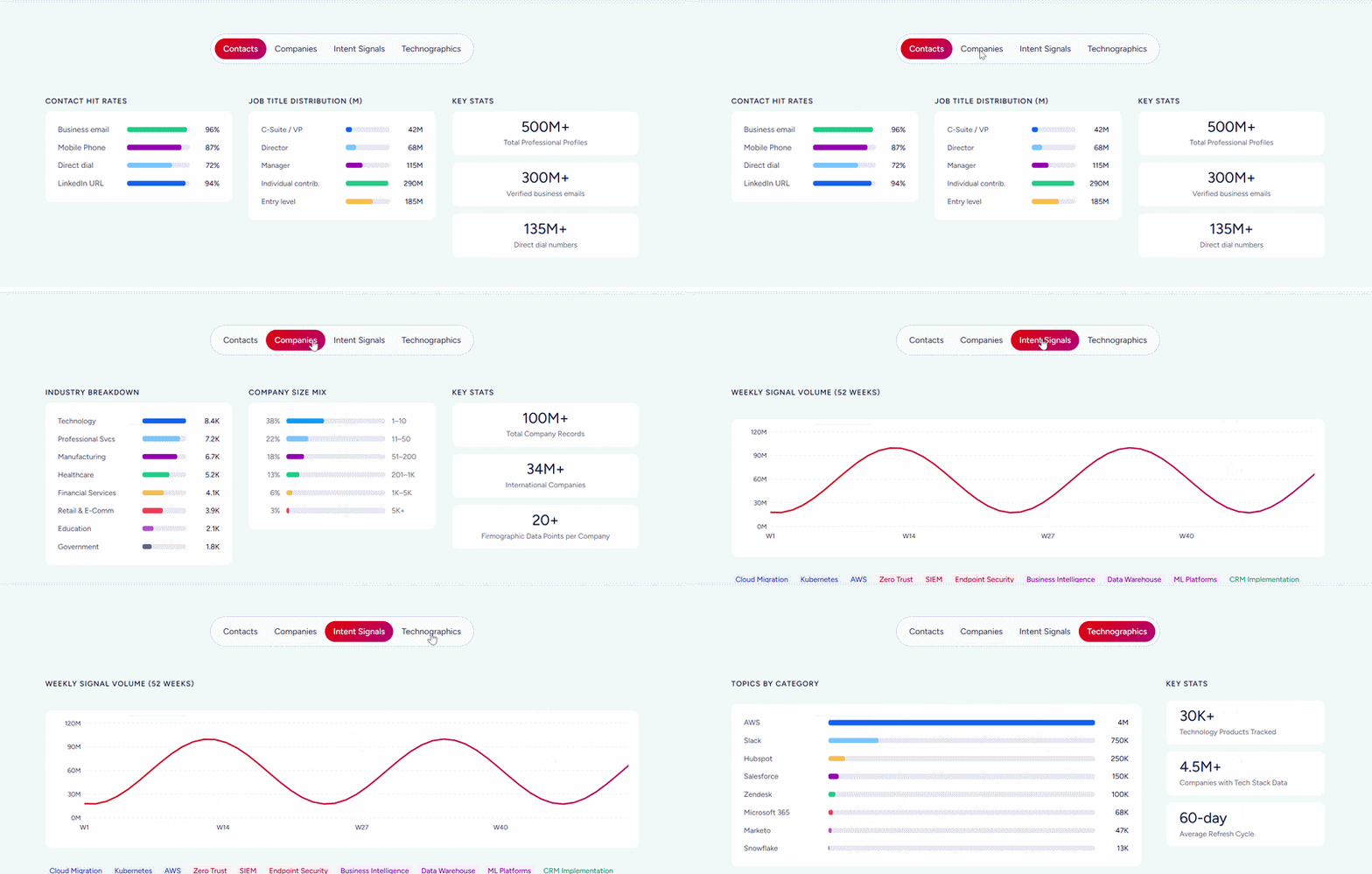
Beyond contact data, ZoomInfo tracks buyer intent signals from 210 million IP-to-Organization pairings, monitors the tech stacks of 30+ million companies, and identifies anonymous website visitors at the company level through WebSights.
In a Fortune 500 competitive RFP analyzing 25 million contacts across vendors, the independent consultant concluded that "no other competitor came even close." For sales reps, the difference is practical: the direct dial actually rings and the email actually lands.
SpringDB achieved 2x–3x increases in campaign conversions and a 300% increase in database usability using ZoomInfo's enriched data. (SpringDB case study)
Automation: from simple sequences to process enforcement to AI-driven plays
Each platform automates sales work at a different level.
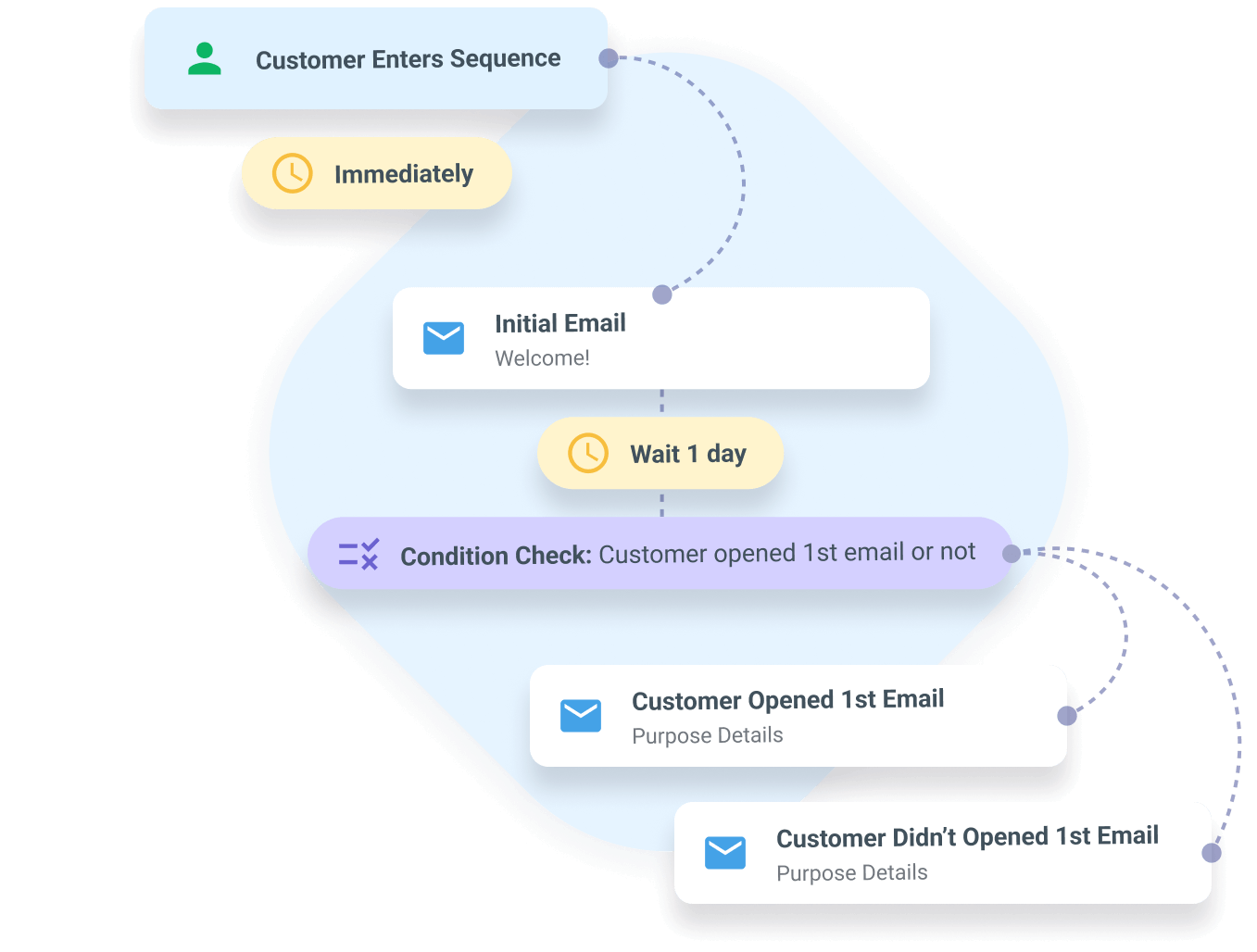
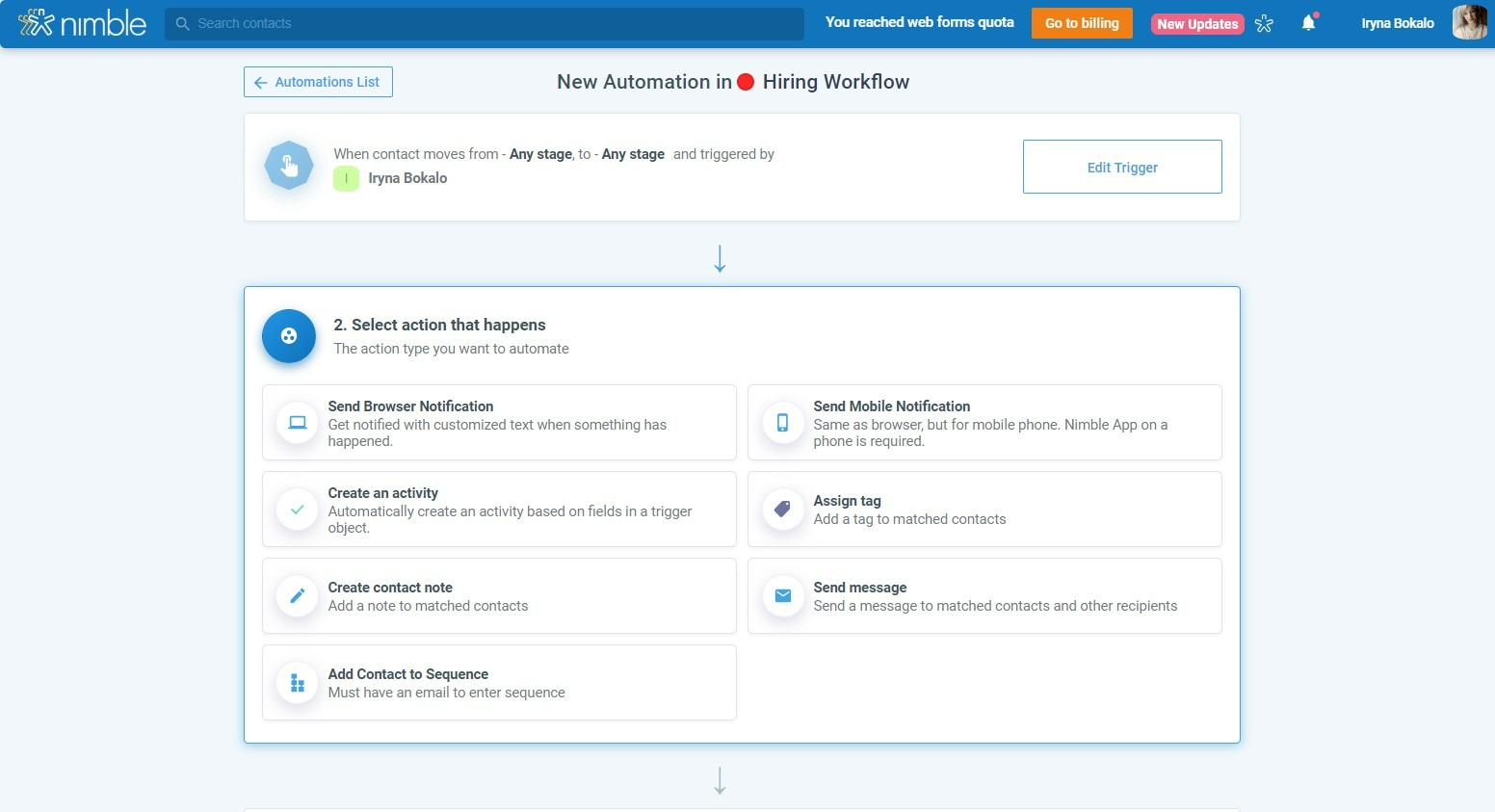
Nimble offers email sequences that fire based on time delays or recipient behavior (opens, clicks, replies), with if-then and if-else branching on conditions. The recently launched Sequence Activities feature adds human-executed actions (calls, tasks, calendar events) alongside automated emails.
Source: Nimble
Workflow automations trigger when contacts move between stages, firing actions like sending messages, creating tasks, or enrolling contacts in sequences. All sequences send from the user's own email address via Google Workspace or Microsoft 365, which Nimble claims boosts opens by 27% compared to marketing platforms.
Source: Nimble
For a small team running straightforward outreach, this covers the basics. But Nimble itself acknowledges that tools like Outreach are "genuinely better" for teams needing multi-step branching, conversation intelligence, and SDR coaching dashboards.
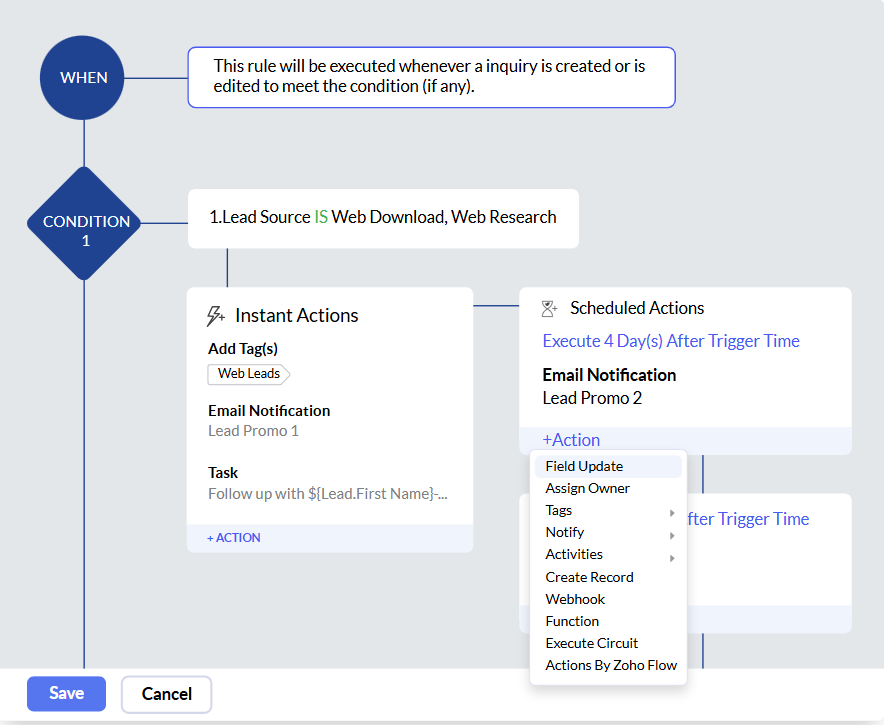
Zoho CRM goes deeper with a layered automation stack. Workflow rules handle routine trigger-action automation (up to 2,500 rules per organization).
Source: Zoho CRM
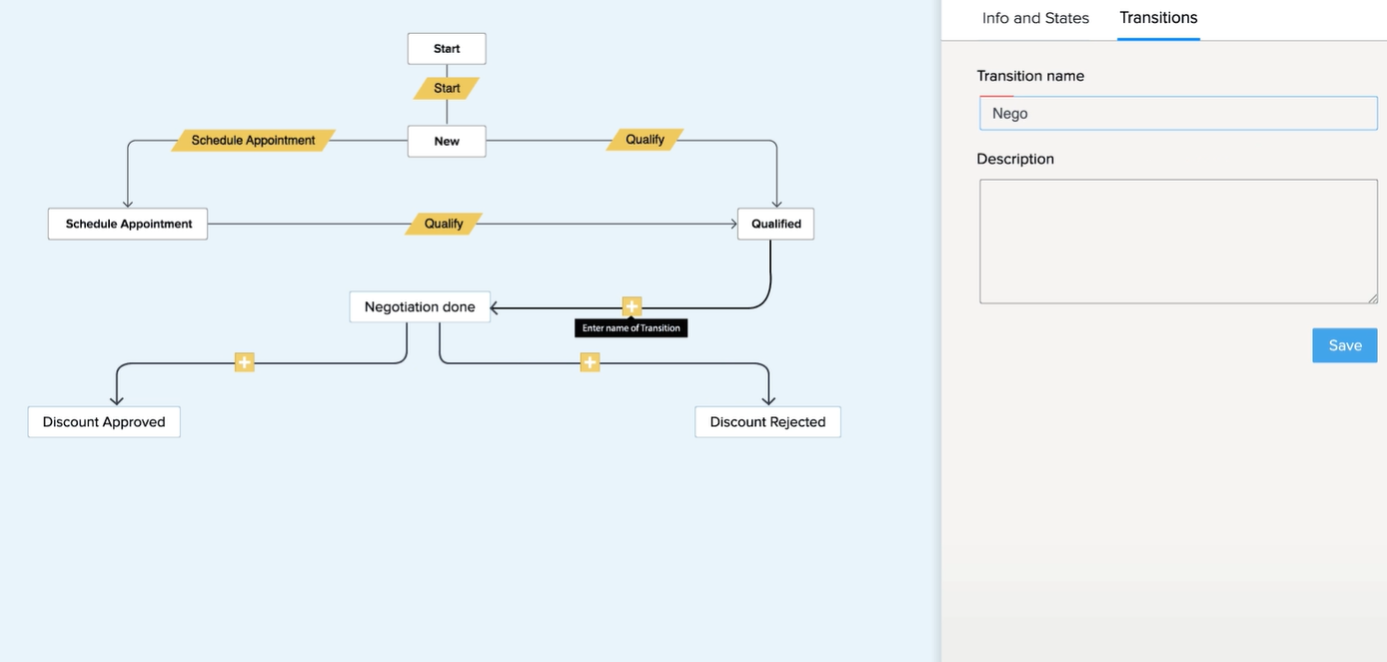
Blueprint enforces sales processes step-by-step: reps cannot advance a deal without completing required fields, finishing tasks, or getting approvals.
Source: Zoho CRM
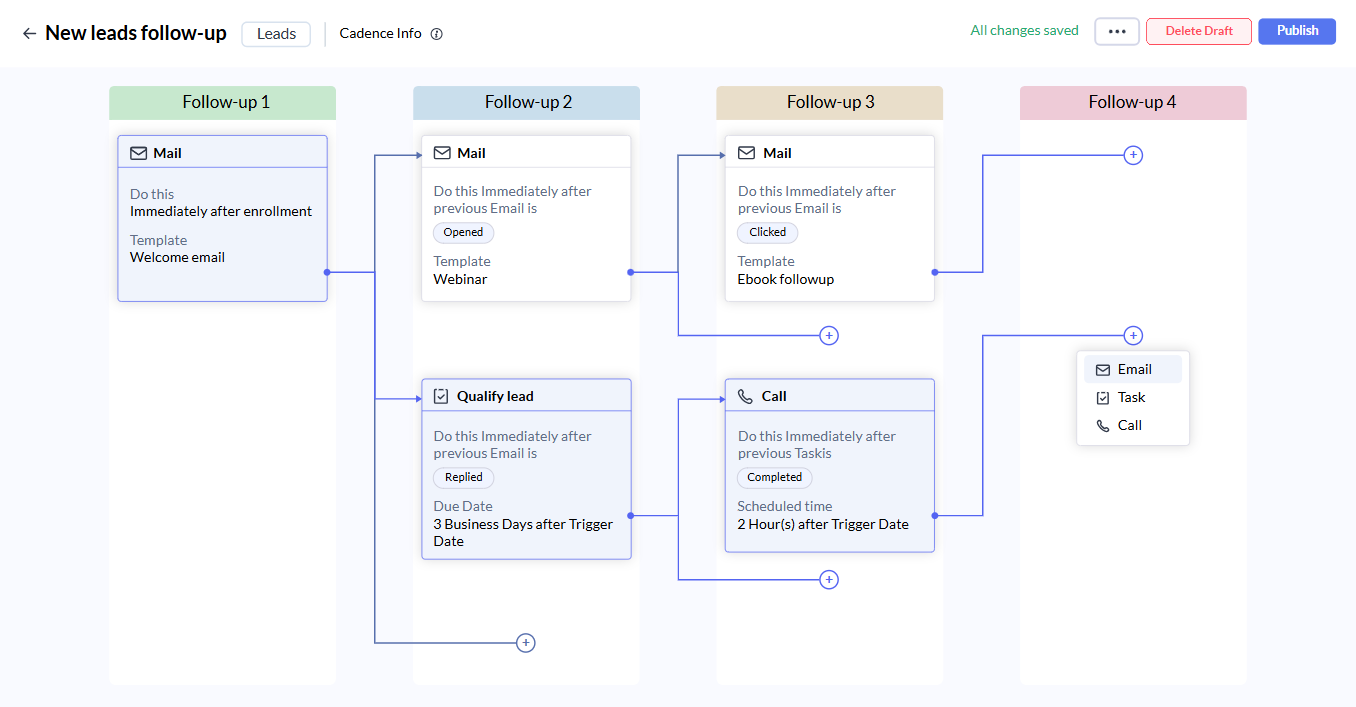
Cadences coordinate multichannel follow-up sequences across email, phone, tasks, and WhatsApp with behavior-based branching.
Source: Zoho CRM
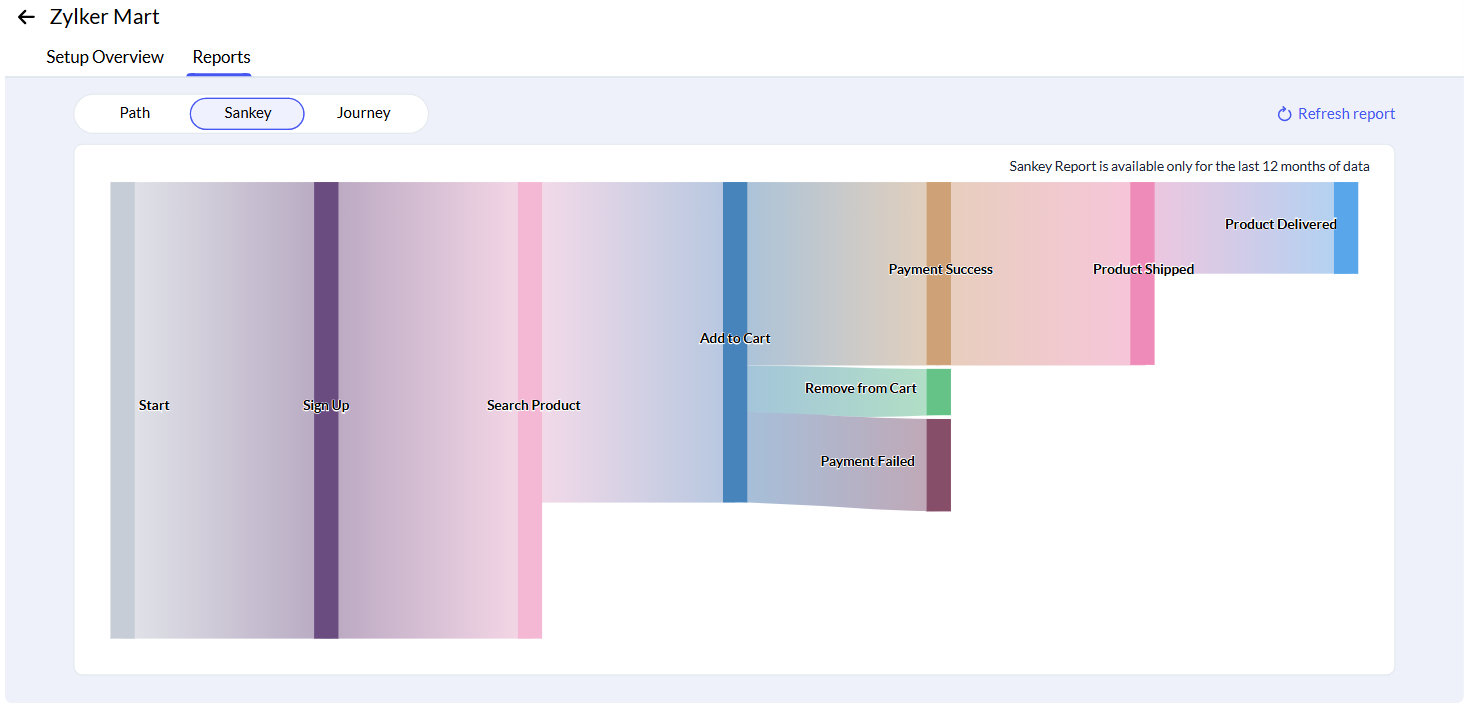
CommandCenter provides full customer journey orchestration with a visual drag-and-drop editor. Zia monitors audit logs for repeated manual actions and suggests new workflow rules automatically.
Source: Zoho CRM
For organizations with complex, multi-stage sales processes, Zoho CRM's automation runs deep.
ZoomInfo automates at the intelligence layer. Rather than automating steps after a rep decides to pursue a prospect, ZoomInfo automates the decision of who to pursue and when. GTM Workspace delivers an Action Feed: a live stream of in-market buyers matched to your criteria, complete with pre-drafted actions on every signal.
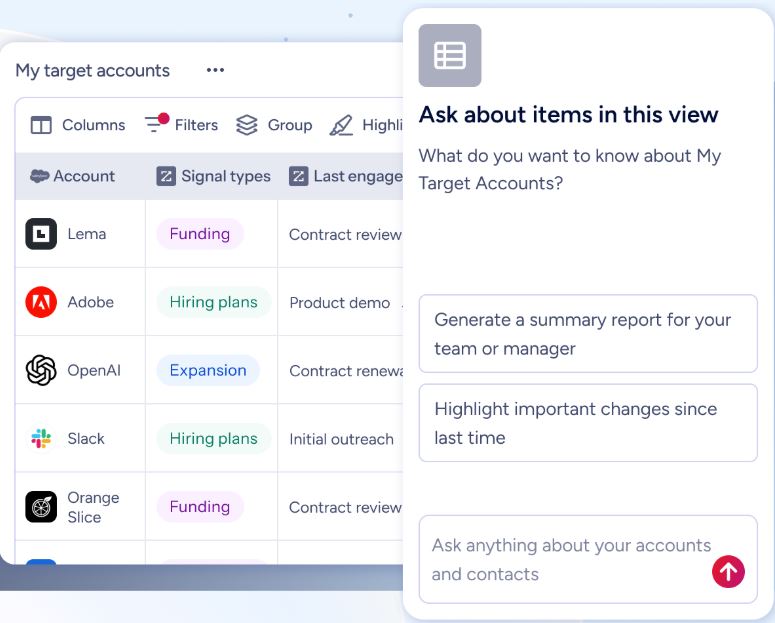
GTM Studio lets marketers and RevOps teams build and launch GTM plays (inbound acceleration, champion tracking, competitive displacement) that run continuously and improve as prospects respond. Expansion plays that used to take 3 weeks now launch in 30 minutes.
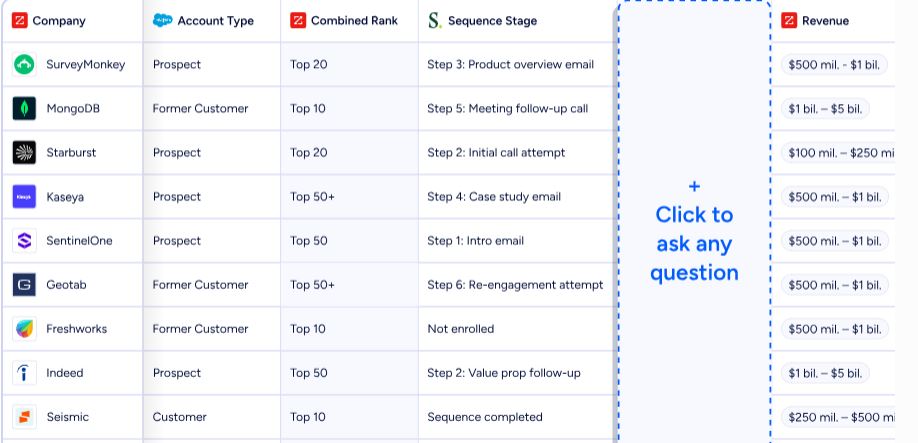
Levanta's CEO Ian Brodie noted: "ZoomInfo's not just a contact data company anymore. They've built a full system of execution. GTM Intelligence actually works the list, writes the outreach, triggers the play, and helps drive predictable growth." (Levanta case study)
AI capabilities compared
AI has become a baseline claim in CRM marketing. What matters is what the AI actually does.
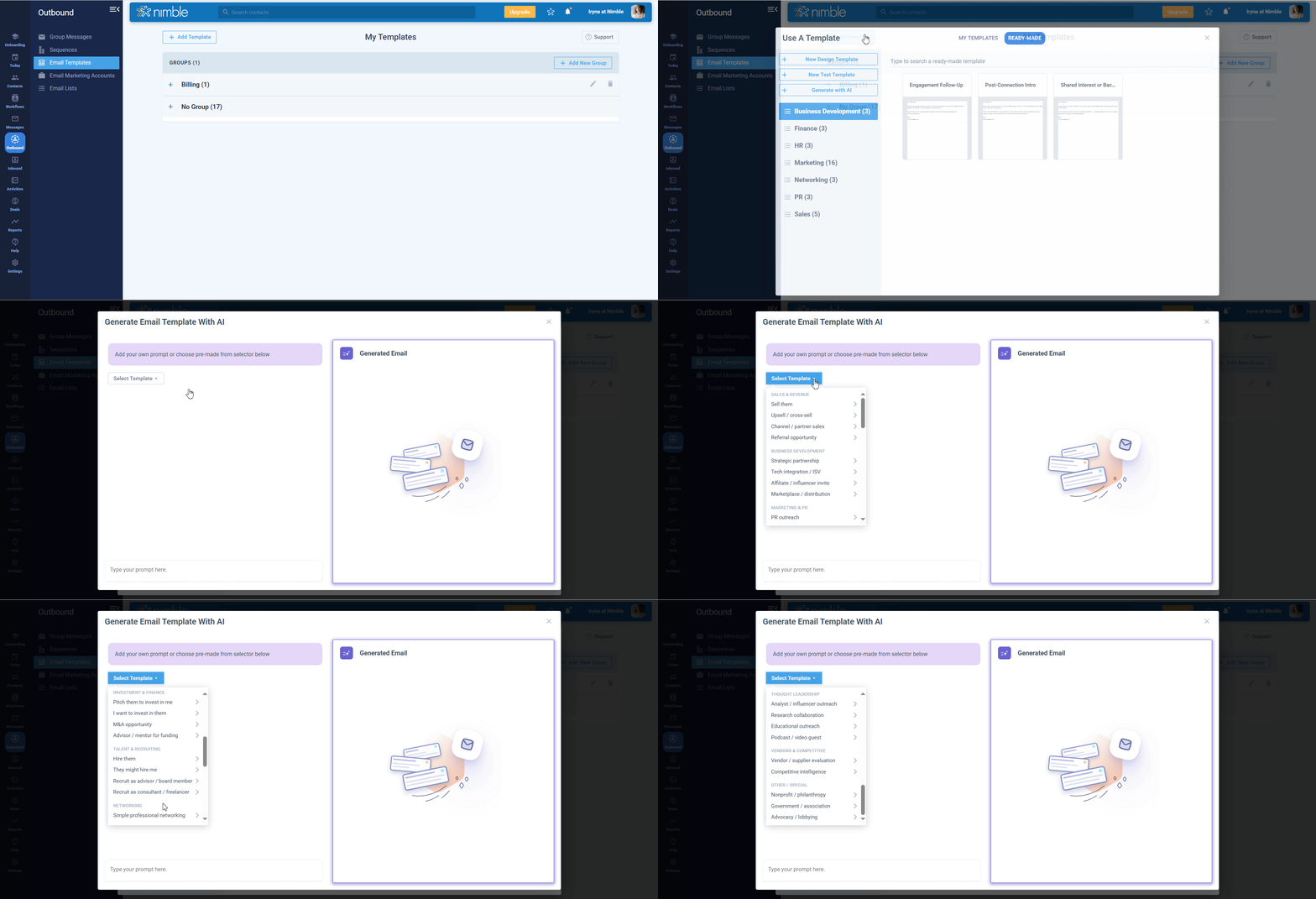
Nimble's AI focuses on content creation. The AI email generator drafts messages from natural language prompts across text templates, visual design templates, and ad-hoc messages.
Source: Nimble
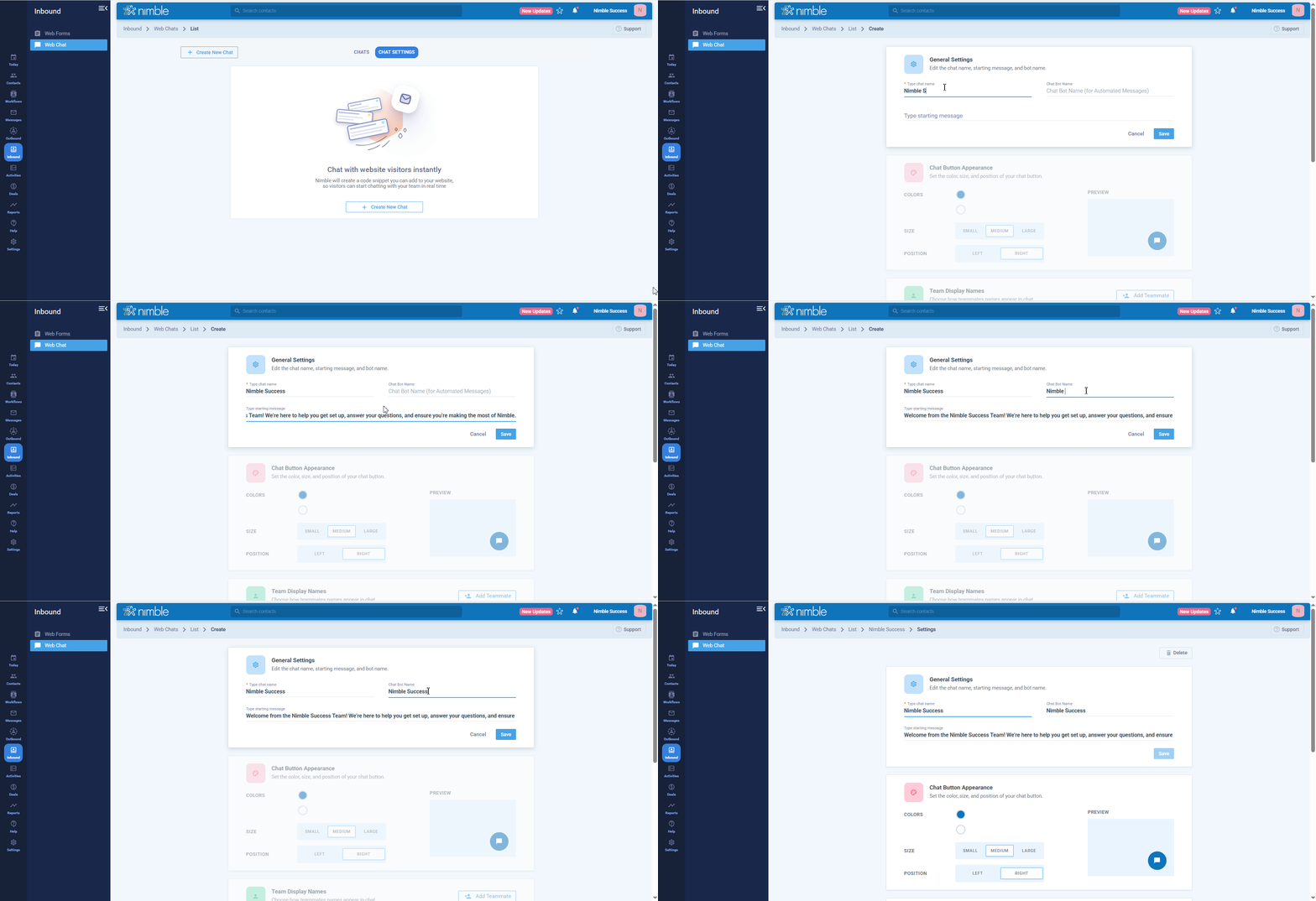
The AI Chat Helper engages website visitors with predefined questions and generates conversation summaries.
Source: Nimble
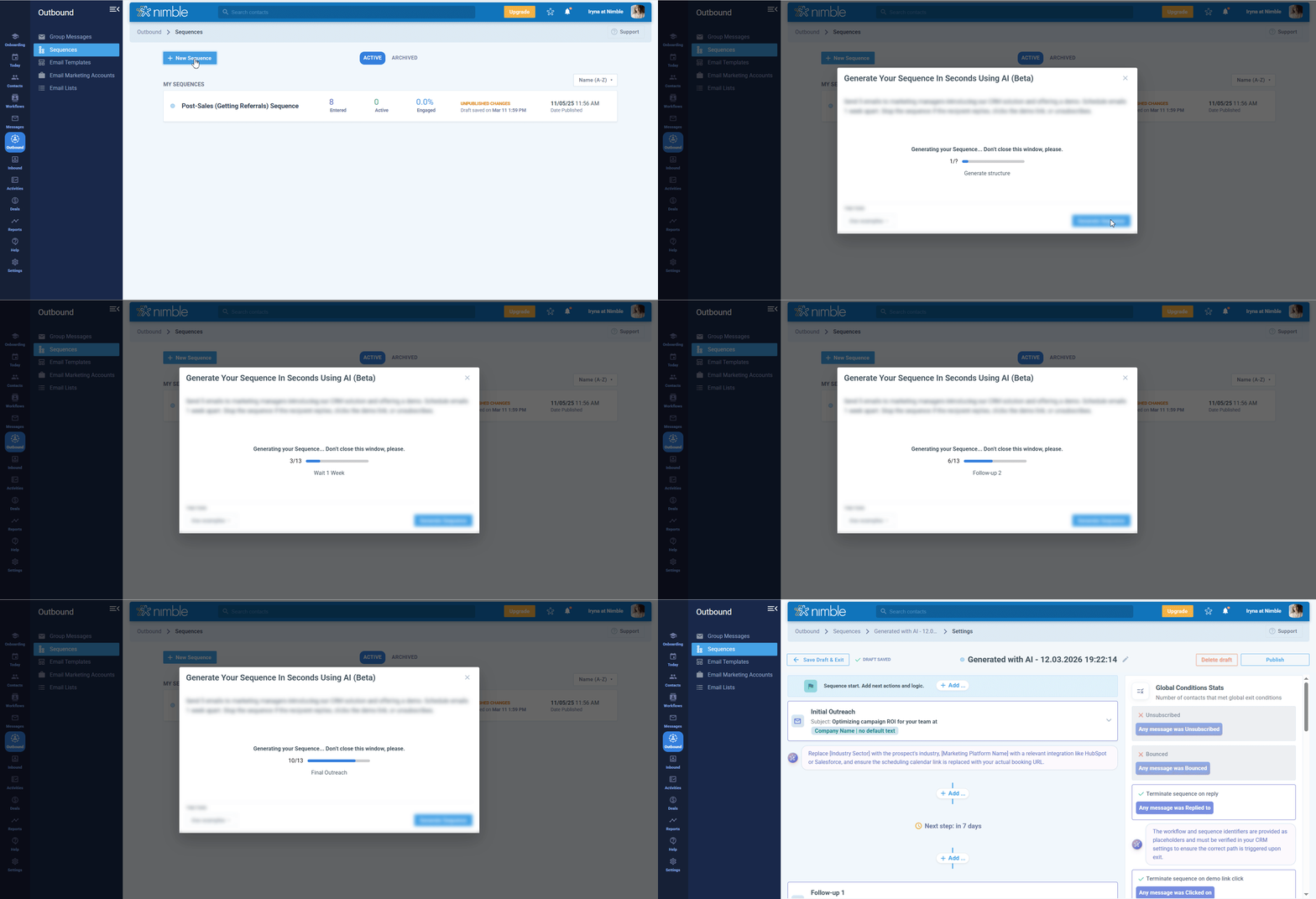
An AI Sequence Generator creates entire outreach sequences from scratch. Upcoming features include AI Sequences that draft from actual relationship history and a Relationship Graph that prioritizes contacts by engagement signals.
Source: Nimble
Nimble's AI is practical for small teams but limited in scope: it helps you write and organize, but it doesn't predict, score, or reason about your pipeline.
Zoho CRM's Zia covers a broader surface. On the predictive side, Zia provides lead scoring, churn prediction, deal win probability, field predictions, best time and channel to contact, and anomaly detection in forecasts.
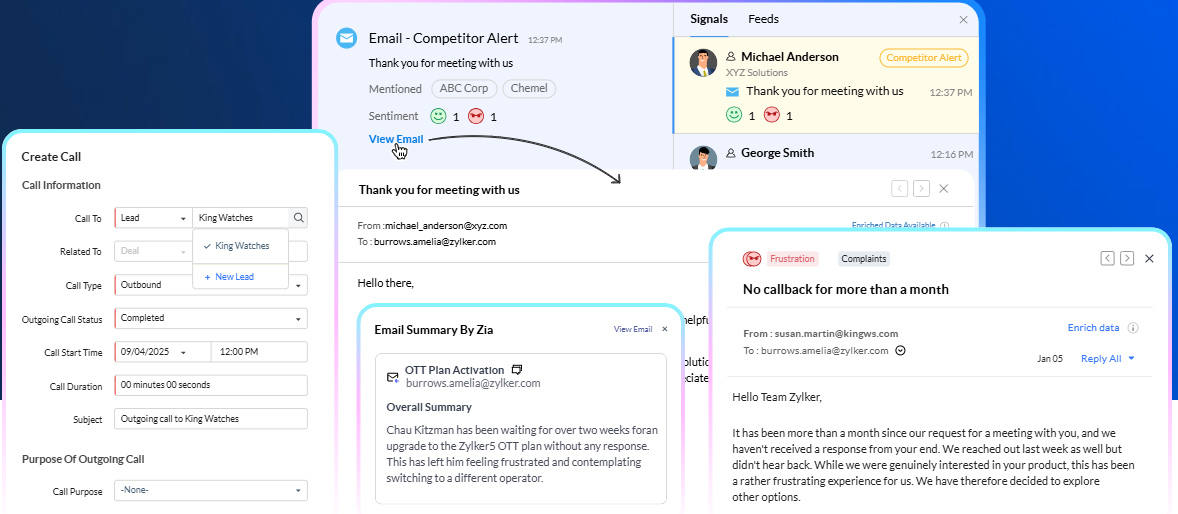
On the generative side, Zia can create CRM modules from natural language descriptions, build workflow rules from plain-language instructions, and generate reports conversationally. For email, Zia delivers sentiment analysis, intent classification, competitor mention alerts, and multilingual translation.
Source: Zoho CRM
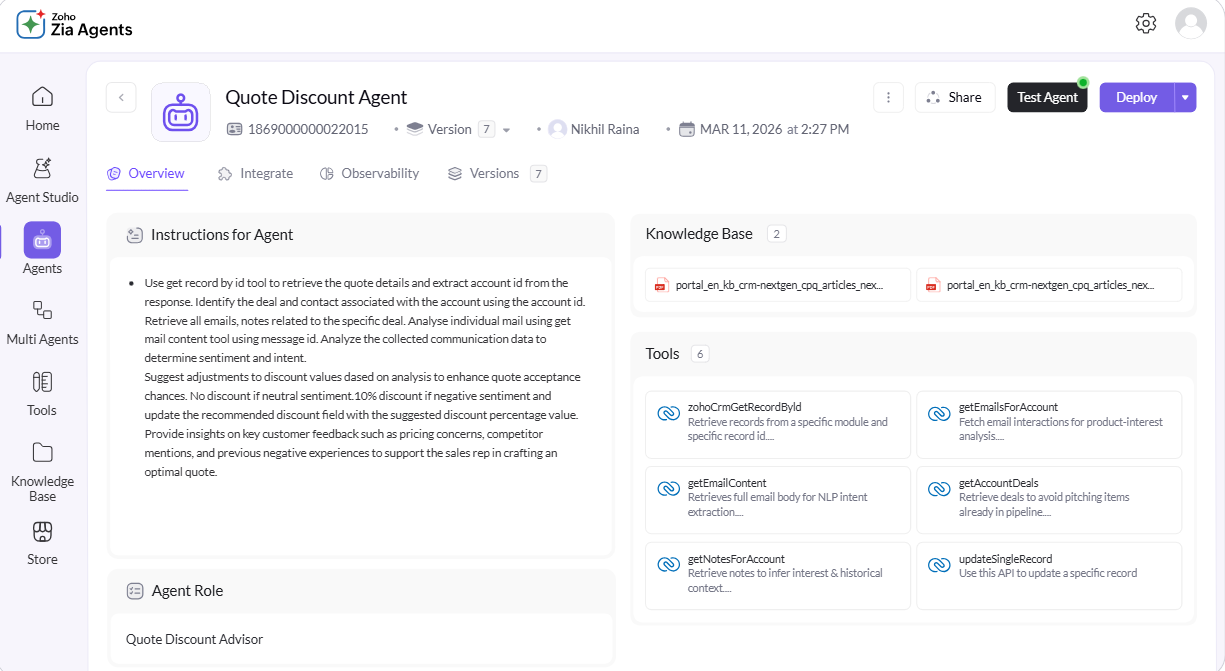
The Zia Agents Store provides seven pre-built autonomous agents (SDR agent, sales coach, deal analyzer, quote generator, follow-up scheduler, revenue growth specialist, and deal closure reminder) that operate as digital employees with their own CRM identities.
Source: Zoho CRM
The breadth is real, though the most advanced AI features require Enterprise or Ultimate plans.
ZoomInfo's AI is built on a different foundation. Where Nimble and Zoho CRM apply AI to data you've already collected, ZoomInfo's GTM Context Graph reasons across your first-party CRM data, conversation intelligence from Chorus, and ZoomInfo's own third-party data to understand why deals move or stall.
As ZoomInfo's CPO Dominik Facher explained: "The CRM recorded the state change. It has no record of why it happened." The AI agents in GTM Workspace, built on Anthropic's Claude, answer three questions for every rep: who to contact, when to engage, and what to say, drawing on the full context of the GTM Context Graph.
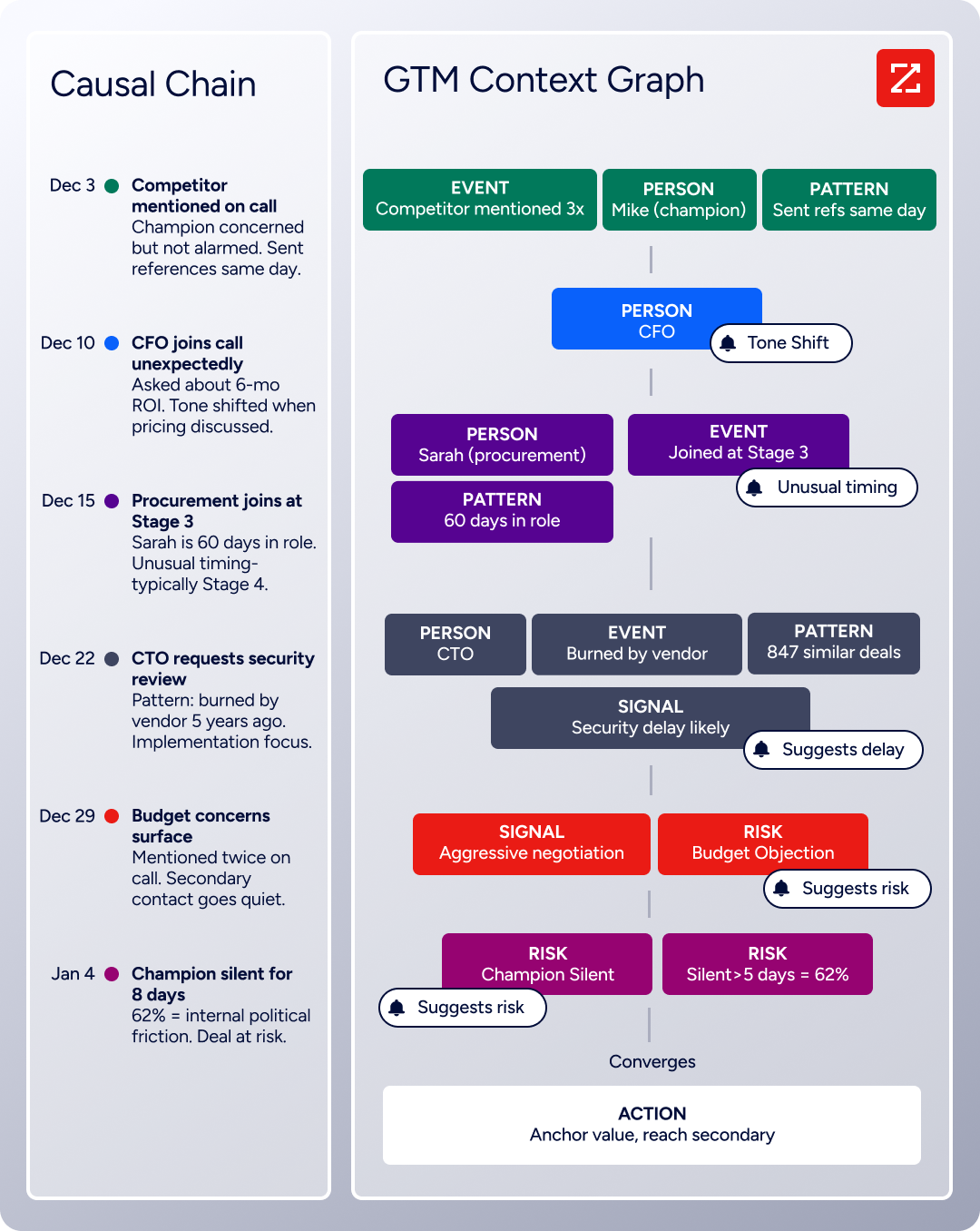
Seismic's Chief Business Officer Toby Carrington noted: "That combination of our internal CRM data, external signals, and AI that's given all that context has helped us craft very specific account- and persona-based messages. And people have responded to them right away." (Seismic case study)
Pricing models reflect different markets
The pricing structures tell you who each platform was built for.
Nimble keeps it simple: one plan at $24.90/seat/month (annual) or $29.90/month-to-month. All core features are included. Add-ons cost extra: AI Email Marketing is $15/month company-wide, Web Forms & Chat is $12/month per team, additional enrichment credits cost $10/month per 1,000 credits, and extra storage runs $10/month per 10GB beyond the base 2GB/seat.
The base price sits well below the $74/month average SMB CRM spend, according to Capterra reviewers. A 14-day free trial is available, but there is no permanent free plan. Worth noting: Nimble enforces a no-refunds policy regardless of usage.
Zoho CRM offers the widest pricing range. The free plan supports 3 users forever with basic lead, contact, and deal management. Paid plans scale from approximately $14/user/month (Standard) through Professional ($23/user/month), Enterprise ($40/user/month), and Ultimate ($52/user/month), all billed annually.
Critical features are tier-gated: Blueprint requires Professional, Zia's predictive scoring and journey orchestration require Enterprise, and custom ML models (QuickML) require Ultimate. Month-to-month contracts are available, and Zoho positions its flexible subscriptions against competitors that use multi-year lock-in.
ZoomInfo uses consumption-based pricing with no publicly listed prices. Costs scale around user seats, monthly credit volume (1 credit = 1 contact or company export), features, and contract length. The entry point is higher than either Nimble or Zoho CRM, reflecting ZoomInfo's enterprise focus. Two free options exist: ZoomInfo Lite is a permanent free tier with access to the B2B database, 10 monthly export credits, and WebSights Lite; and a 7-day free trial gives full access to paid features.
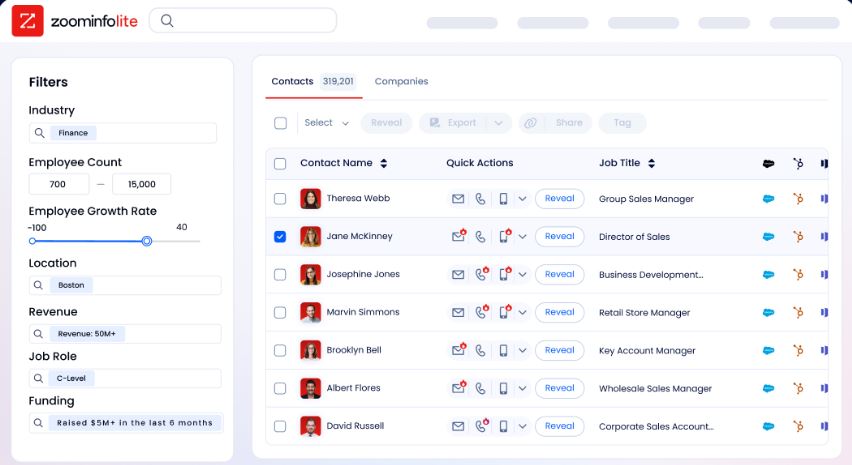
The pricing premium buys data, intelligence, and execution capabilities that neither Nimble nor Zoho CRM offer. Customers point to documented results: Snowflake achieved 200% higher conversion rates on accounts scored using ZoomInfo data, and Thomson Reuters increased closed-won deals by 40%.
Integrations and ecosystem breadth
Nimble integrates with two ecosystems: Microsoft 365 and Google Workspace. It syncs contacts, calendars, and emails bidirectionally with both and is available on Microsoft's Commercial Marketplace (AppSource). The Nimble Prospector extension works across LinkedIn, Gmail, Outlook, and any website. Beyond these native connections, Nimble links to other tools through Zapier, Make.com, and Pabbly. The Apps Marketplace lists integrations with Mailchimp, PandaDoc, Dropbox, PhoneBurner, and others.
For a small team centered on Microsoft 365 or Google Workspace, the coverage is sufficient. For businesses needing connections to specialized industry tools, the ecosystem is thin compared to larger platforms.
Zoho CRM benefits from the Zoho ecosystem. Signing up gives access to more than 40 integrated Zoho applications (including Zoho Books, Zoho Campaigns, Zoho Analytics, Zoho Desk, and Zoho Projects), all built to work natively together.
The Marketplace lists 1,100+ third-party integrations across marketing, sales, finance, telephony, and communications. Recent additions include Microsoft Teams Phone and Microsoft Teams Online Meeting integration. The REST API supports full CRUD operations, and the developer toolkit includes server-side SDKs, Mobile SDKs, a Web App SDK, and Client Scripts.
However, G2 users flag integration friction when connecting to non-Zoho systems, particularly in complex enterprise environments.
ZoomInfo treats integrations as infrastructure. The App Marketplace lists 120+ partner integrations spanning CRM, marketing automation, sales engagement, data warehouses, and communications. Featured connections include Salesforce, HubSpot, Microsoft Dynamics 365, Snowflake, Outreach, and Salesloft. Cloud Partners enable direct data ingestion into AWS, Google Cloud, Snowflake, and Databricks.
The Enterprise API provides programmatic access to ZoomInfo's data and intelligence.
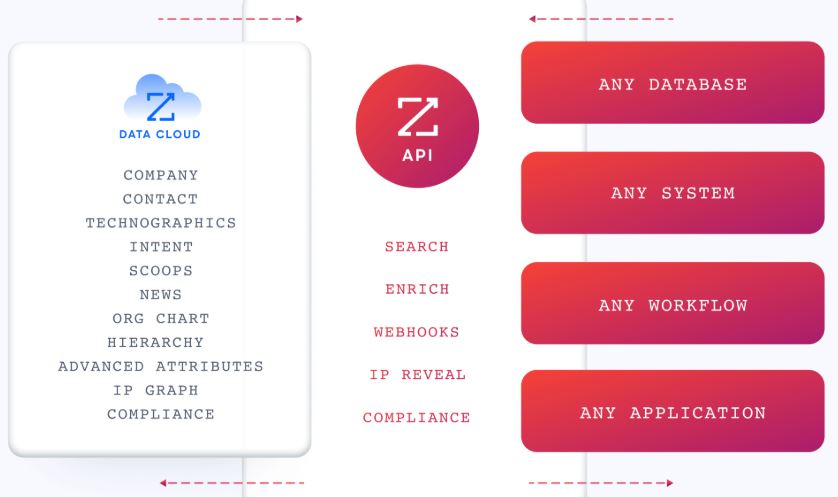
ZoomInfo MCP connects AI models directly to ZoomInfo's B2B data with no custom coding, currently supporting Claude and ChatGPT. API access is included in all relevant plans, so teams can consume ZoomInfo's intelligence inside any tool they already use.
BDO Canada's Senior Marketing Intelligence Analyst Jerry Wilson noted: "The plug-and-play aspect of the API means I can integrate it very easily into any process and get information at a moment's notice," reporting an 87% reduction in time spent on internal data dashboard updates. (BDO Canada case study)
Ease of use versus depth of capability
There's a direct trade-off between simplicity and power across these three platforms.
Nimble wins on daily usability. G2 reviewers rate ease of use at 8.9/10 and give it a 9.20 implementation score. Kennesaw State University's Director of Professional Selling uses it in the classroom to teach CRM concepts, which tells you something about the learning curve. Nimble offers daily "Introduction to Nimble" webinars (Monday through Friday, 9–9:30 AM PT) and free one-on-one onboarding calls.
The flip side: power users hit limits quickly. G2 reviewers note limited automation capabilities, basic reporting without attribution or A/B testing, and a mobile app described as "slow, buggy, and less responsive" than desktop.
Zoho CRM is more complex. The platform claims a "minimal learning curve", and customers report 50% faster implementation compared to prior alternatives. But basic use and full use are different things. G2 reviewers consistently flag that advanced configuration (workflows, Blueprint, journey orchestration) demands significant time and admin resources.
The interface supports two tiers: no-code tools (Canvas, Kiosk Studio, Zia Module Creation) for business users, and pro-code developer tools (Deluge functions, Client Scripts, REST APIs) for technical teams. The depth is there, but someone needs to build it.
ZoomInfo invested in reducing onboarding friction. The company redesigned its onboarding program from 30 to 90 days, structured across planning, technical implementation, education, and adoption, producing a 25% improvement in customer satisfaction scores. ZoomInfo University provides role-specific learning paths.

CEO Schuck has stated that GTM Workspace "deploys in weeks, not months". The platform earned Gartner's Customers' Choice designation in 2025 (the only vendor in that quadrant), with a 4.7/5.0 average rating.
Security and compliance
For regulated industries, compliance certifications matter.
Nimble is GDPR compliant, certified under the EU-U.S. Data Privacy Framework, and carries the TRUSTe Privacy Seal. Data is stored on Microsoft Azure servers. However, Nimble is explicitly not HIPAA compliant and does not publish SOC 2, ISO 27001, or any other enterprise security certifications.
Zoho CRM carries the broadest compliance portfolio of the three: ISO 27001, ISO 27701, ISO 27017, ISO 27018, ISO 9001, ISO 22301, SOC 2 Type 2, SOC 1 Type 2, and SOC 2 + HIPAA Type 2. Data residency options span the US, EU, India, Japan, China, Australia, Canada, Saudi Arabia, and South Africa.
The company runs its own data centers rather than relying on public cloud infrastructure and maintains a public vulnerability disclosure program. For organizations with strict regulatory requirements, Zoho's compliance stack is strong.
ZoomInfo maintains ISO 27001, ISO 27701, SOC 2 Type II, TRUSTe GDPR, and TRUSTe CCPA certifications, all renewed annually. The company is a registered data broker in California and Vermont and operates a dedicated Trust Center. Compliance is built into the data layer itself.
Nimble vs. Zoho CRM vs. ZoomInfo: Which should you choose?
The right platform depends on where your biggest bottleneck sits.
Choose Nimble if:
You're a solopreneur or small team (under 25 people) who runs on relationships
You want a CRM that lives inside Gmail, Outlook, or LinkedIn, not a separate tab
Flat-rate pricing with no feature tiers matters to your budget
You need basic prospecting from LinkedIn and the web
You value simplicity over advanced automation and reporting
Choose Zoho CRM if:
You need a full-featured CRM with structured sales processes and automation
Customization (custom modules, Canvas UI, Blueprint enforcement) is important
You're already using other Zoho tools or plan to use the ecosystem
You want enterprise-level capabilities at a fraction of Salesforce pricing
Compliance requirements (HIPAA, SOC 2, ISO) are non-negotiable
Choose ZoomInfo if:
Your biggest challenge is finding and prioritizing the right accounts, not just managing them
You need verified B2B contact data, direct dials, and business emails at scale
Buyer intent signals and real-time alerts on in-market accounts would change how you sell
You want AI that understands why deals move, not just what happened in the CRM
Your team needs intelligence they can access through any tool via APIs and MCP
See ZoomInfo in action with a free trial.
Both Nimble and Zoho CRM are strong choices for managing the contacts and deals already in your pipeline. But for teams whose growth depends on finding the right opportunities before competitors do, ZoomInfo provides the data and intelligence that CRMs were never designed to deliver. The most effective GTM teams don't choose between CRM and intelligence.
They use both, with ZoomInfo powering the prospecting and prioritization that feeds their CRM of choice.
Nimble vs. Zoho CRM vs. ZoomInfo FAQ
What is the core difference between Nimble, Zoho CRM, and ZoomInfo?
Nimble is a relationship-focused CRM for solopreneurs and small teams, designed to work inside your email and browser. Zoho CRM is a full-featured sales force automation platform with customization, process enforcement, and an ecosystem of 60+ integrated business applications.
ZoomInfo is a B2B intelligence and GTM execution platform built on 500M contacts and 100M companies, providing the data, signals, and AI that help teams find and engage the right buyers before they enter a CRM.
Which platform is most affordable for a small team?
Zoho CRM offers the lowest entry point with a permanent free plan for up to 3 users. Nimble's single plan costs $24.90/seat/month (billed annually) with all core features included, though add-ons for email marketing, web forms, and extra storage increase the total.
ZoomInfo uses consumption-based pricing custom-quoted for each buyer, but ZoomInfo Lite provides permanent free access to the B2B database with 10 monthly export credits.
Can ZoomInfo work alongside Nimble or Zoho CRM?
Yes. ZoomInfo integrates with Zoho CRM directly and can connect to Nimble through Zapier or API workflows. Many teams use ZoomInfo as their intelligence and prospecting layer, then push enriched contacts and accounts into their CRM for pipeline management. ZoomInfo's API access is included in all relevant plans, and the MCP server allows any AI-compatible tool to consume ZoomInfo data natively.
Which platform has the best AI capabilities?
Each excels in a different area. Nimble's AI focuses on email drafting and content creation. Zoho CRM's Zia covers the broadest range within the CRM itself, including predictive lead scoring, churn prediction, autonomous agents, and natural-language CRM configuration.
ZoomInfo's GTM Context Graph provides the deepest intelligence by fusing CRM data, conversation transcripts, and third-party signals to understand why deals move or stall, powering AI agents that tell reps who to contact, when to engage, and what to say.
Which platform is best for a team that needs both CRM and prospecting?
ZoomInfo paired with Zoho CRM covers both needs. Zoho CRM handles structured pipeline management, process enforcement, and customer engagement. ZoomInfo provides the prospecting data, buyer intent signals, and AI-powered account prioritization that fills that pipeline. Nimble combines light CRM and prospecting in one tool, which works for small teams but lacks the data scale and automation depth that growing organizations need.
How do the platforms handle data security and compliance?
Zoho CRM carries the broadest compliance portfolio among the three, including ISO 27001, SOC 2 Type 2, HIPAA, and data residency across 10+ regions.
ZoomInfo maintains ISO 27001, ISO 27701, SOC 2 Type II, and TRUSTe GDPR/CCPA certifications. Nimble is GDPR compliant with TRUSTe certification and Azure hosting, but is explicitly not HIPAA compliant and does not publish SOC 2 or ISO certifications.
Which platform has the largest integration ecosystem?
Zoho CRM leads with 1,100+ marketplace integrations plus 60+ native Zoho applications. ZoomInfo offers 120+ partner integrations plus APIs and MCP access that let any tool or AI agent consume its data programmatically. Nimble integrates with Microsoft 365 and Google Workspace but has a smaller third-party ecosystem, relying on Zapier and Make.com for most connections.
Is ZoomInfo only for large enterprises?
ZoomInfo serves 35,000+ companies, with its strongest adoption in enterprise and upper mid-market. However, ZoomInfo Lite provides a permanent free tier for individual users and small teams, and the 7-day free trial gives full platform access. The platform is most valuable for any B2B team where finding and engaging the right prospects is the primary growth constraint, regardless of company size.
