
If you're comparing Oracle CRM vs. Zoho CRM, you're choosing between two platforms built for different organizations. Oracle is an enterprise revenue management system designed for companies that already run Oracle across their back office. Zoho is a customizable, affordable CRM built for businesses that want capable sales tools without enterprise complexity or cost.
Before deciding, answer these questions:
Do you need a CRM that manages the full revenue lifecycle (quoting, billing, subscriptions, commissions), or one focused on pipeline management and sales automation?
Is your organization already running Oracle ERP, HCM, or supply chain software?
Do you have the IT resources and budget for a complex enterprise implementation, or does your team need to configure the CRM without consultants?
Is pricing transparency and contract flexibility a deciding factor?
How confident are you in the quality and completeness of the contact and company data feeding your CRM?
In short, here's what we recommend:
Oracle Sales (Oracle CRM) is the platform for large enterprises that need their entire revenue operation on a single architecture. It unifies sales force automation, CPQ, commerce, subscription management, and incentive compensation on Oracle's Fusion platform, sharing a native data layer with Oracle ERP, HCM, and supply chain.
However, Oracle doesn't publish pricing, doesn't offer a self-serve trial, requires substantial implementation resources, and its user interface is consistently cited as outdated compared to modern CRMs.
Zoho CRM is the platform for growth-oriented businesses that need strong functionality at a fraction of the enterprise cost.
Its AI assistant Zia covers predictive scoring, anomaly detection, email sentiment analysis, and seven pre-built sales agents that can operate autonomously. Canvas Design Studio lets admins redesign record views with pixel-level control, no code required. Blueprint enforces stage-by-stage sales processes so reps can't skip required steps.
Pricing starts with a permanent free plan for up to 3 users, and paid plans use month-to-month contracts with no multi-year lock-in. The trade-off: advanced configuration demands significant time, support quality is inconsistent, and integration friction increases outside the Zoho ecosystem.
Both platforms give you capable tools for managing deals and pipelines. But neither generates the intelligence that fills those pipelines in the first place. Your CRM records the deal. It doesn't tell you which companies are researching your category, who the decision-makers are, or when accounts match the patterns behind your closed-won deals.
That intelligence layer determines whether your CRM is a productive system or an expensive filing cabinet.
ZoomInfo is a GTM platform that provides the data and intelligence sitting upstream of any CRM. Built on 500M contacts, 100M companies, 135M+ verified phone numbers, and 200M+ verified business emails,
ZoomInfo's GTM Context Graph (an intelligence layer that processes 1.5B+ data points daily) fuses this third-party data with your CRM records, conversation transcripts, and behavioral signals to reveal not just what happened in a deal, but why.
ZoomInfo integrates with both Oracle and Zoho, delivering enriched data, buyer intent signals, and AI-driven account intelligence directly into the platform your team already uses. Sellers work through GTM Workspace, marketers and RevOps through GTM Studio, and any custom application through APIs and MCP.
If turning your CRM into a system that knows who to target, when to engage, and what to say sounds like the missing piece, see how ZoomInfo works with your existing tools.
Oracle CRM vs. Zoho CRM vs. ZoomInfo at a glance
Oracle Sales | Zoho CRM | ZoomInfo | |
|---|---|---|---|
Primary function | Enterprise revenue lifecycle (SFA + CPQ + billing + subscriptions) | CRM + sales automation + process management | B2B data intelligence + GTM execution |
Target market | Large enterprises | SMB to mid-market | Enterprise and upper mid-market B2B |
AI capabilities | Fusion AI agents included in subscription | Zia AI (predictive, generative, agentic) | GTM Context Graph + AI agents |
Gartner recognition | Leader, SFA MQ (9 consecutive years) | Visionary, SFA MQ (4th time, 2025) | Leader, ABM Platforms (2024 & 2025) |
User experience | Redwood design system (criticized as outdated) | Canvas customization (feature-dense) | GTM Workspace (structured onboarding) |
Ecosystem | Native Oracle ERP/HCM/SCM integration | 60+ Zoho apps; 1,100+ marketplace integrations | 120+ partner integrations; API/MCP access |
Starting price | Custom-quoted (no public pricing) | Free (3 users); paid from ~$14/user/month | Custom-quoted; ZoomInfo Lite (permanent free tier) |
Free trial | No self-serve trial | 15-day trial + permanent free plan | 7-day trial + ZoomInfo Lite |
Contract flexibility | Negotiated enterprise agreements | Month-to-month or annual | Annual contracts standard |
Best for | Organizations on Oracle ERP needing unified front-to-back office | Growth businesses needing affordable, customizable CRM | B2B teams needing accurate data and buying signals in their CRM |
Enterprise revenue platform vs. growth-stage CRM
Oracle Sales and Zoho CRM serve different markets with different philosophies.
Oracle Sales is built for organizations that need the full revenue lifecycle on a single platform.
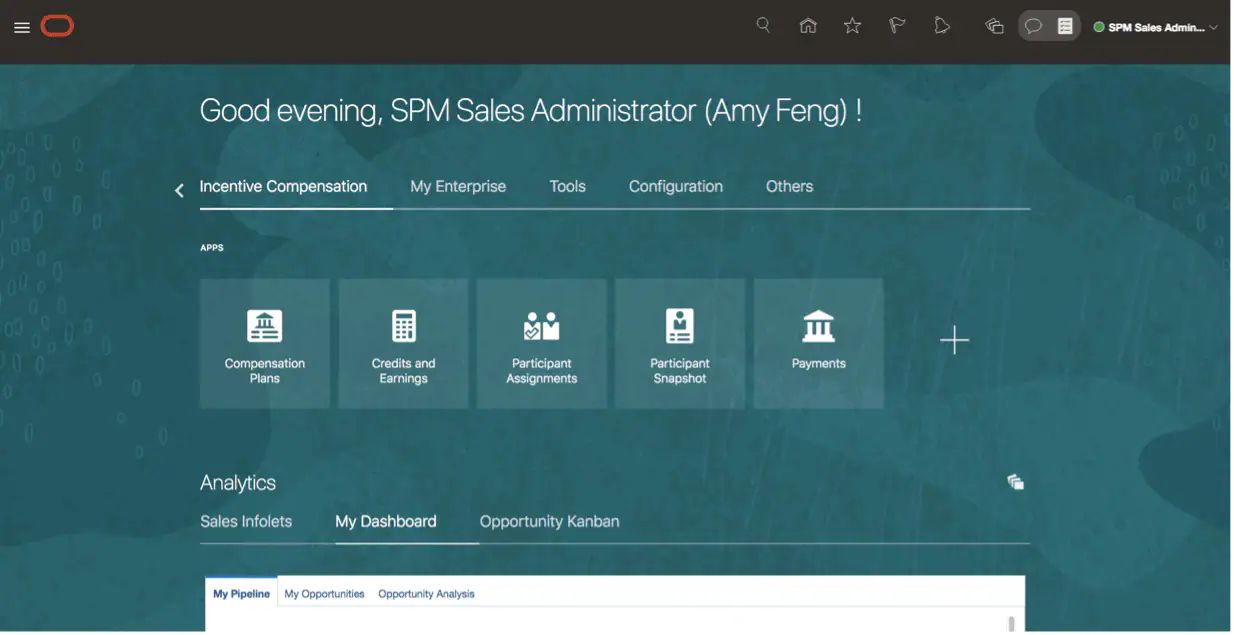
Sales Force Automation handles pipeline management, leads, accounts, and forecasting. CPQ automates product configuration, pricing rules, and quote generation. Subscription Management handles renewals, billing, and revenue recognition under ASC 606 and IFRS 15. Incentive Compensation calculates commissions and bonuses and integrates directly with Oracle Payroll.
Source: Oracle CRM
All of this runs on Oracle's Fusion platform, sharing a native data layer with ERP, HCM, and supply chain.
For an enterprise selling complex products with configurable pricing, subscription billing, and multi-tiered sales compensation, this consolidation eliminates the handoff friction between quoting, ordering, billing, and renewal that plagues multi-vendor stacks.
Zoho CRM addresses the other end of the market.
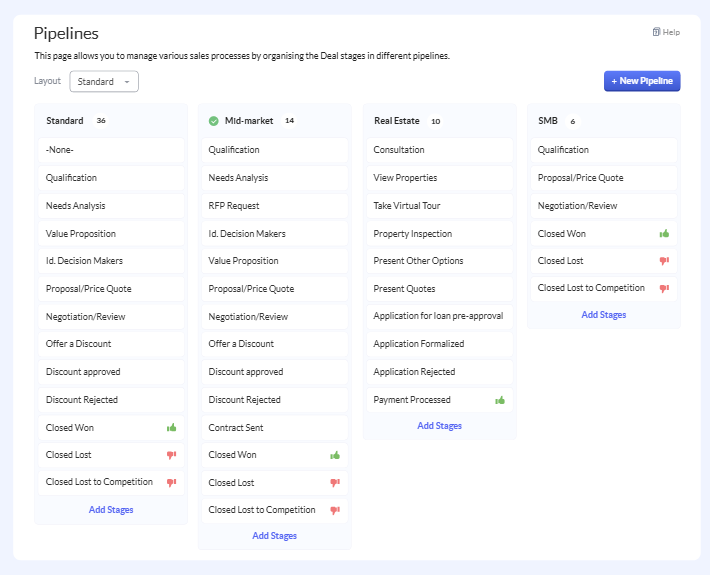
It provides sales force automation, pipeline management with multiple distinct pipelines, and process enforcement at a price point accessible to growing businesses.
Source: Zoho CRM
Rather than covering the entire order-to-cash cycle, Zoho focuses on doing the core CRM job well (lead capture, deal tracking, forecasting, omnichannel engagement) while connecting to the broader Zoho ecosystem for adjacent functions like accounting (Zoho Books), customer support (Zoho Desk), and marketing (Zoho Campaigns).
The choice depends less on features than on where your organization sits. Oracle demands dedicated IT staff, implementation partners, and significant budget, but delivers depth that no mid-market CRM matches for complex revenue operations. Zoho deploys faster, costs far less, and gives non-technical teams the ability to configure their own workflows without consultants.
AI approaches reflect different design priorities
Both platforms invest in AI, but their implementations reveal different assumptions about who uses the CRM and how.
Oracle's Fusion Agentic Applications include role-based AI agents embedded in the CRM at no additional license cost.
The Contact Insights Agent surfaces intelligence on contacts and their importance within an account. The My Territory Agent monitors territory-wide risk, expansion opportunities, and performance anomalies.
The Renewal Agent tracks contract health, margin risk, and generates renewal briefs with usage trends and upsell recommendations. The Sales Command Center coordinates multiple agents, continuously monitoring accounts and surfacing pipeline risks.
These agents draw on Oracle's back-office data (invoice status, contract compliance, supply chain availability) to provide context that standalone CRMs cannot match.
Zoho's Zia is more accessible but equally ambitious.
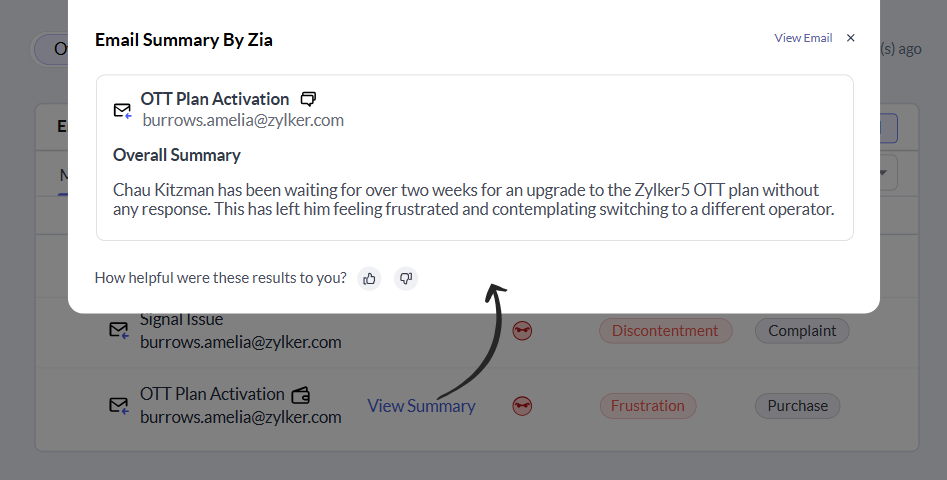
Zia spans predictive lead scoring, churn prediction, best time to contact, email sentiment and intent analysis, anomaly detection, and deal win probability.
Source: Zoho CRM
The Zia Agents Store offers seven pre-built agents (SDR, sales coach, deal analyzer, quote generator, follow-up scheduler, revenue growth specialist, and deal closure reminder), deployable as Connections (acting under a user's identity) or as Digital Employees with their own CRM identities.
Agent Studio allows no-code agent creation from natural language descriptions. Beyond sales assistance, Zia extends into CRM configuration: users can describe a module they need and Zia generates it with associated fields, and workflows can be created by describing the automation in plain language.
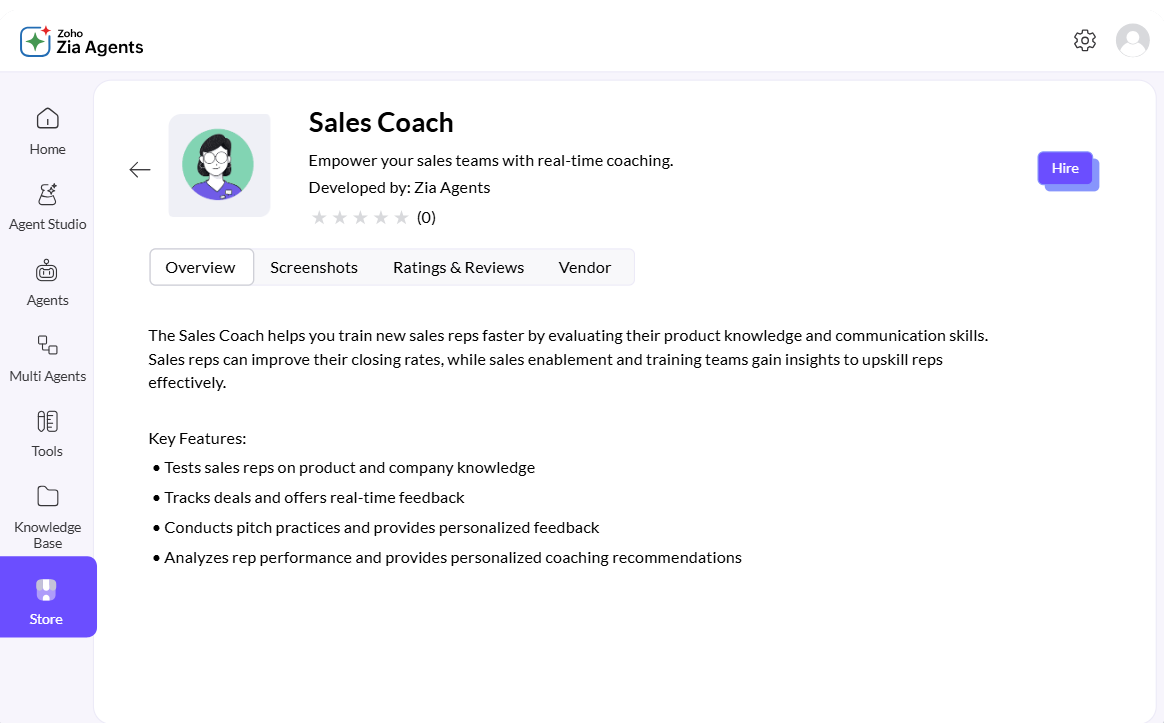
Source: Zoho CRM
The key difference: Oracle's AI agents operate across a connected back-office, pulling invoice, contract, and supply chain data into sales decisions. Zoho's AI is designed for business teams to configure and use without IT involvement.
But both platforms share a constraint. Their AI operates on whatever data lives inside the CRM. If contact records are incomplete, company data is stale, or buying signals are absent, AI recommendations rest on a weak foundation. The best agent can't recommend the right stakeholder to engage if that person doesn't exist in your system.
Pricing accessibility defines the buying experience
Oracle Sales does not publish pricing.
No pricing page, no listed tiers, no self-serve trial. The engagement path starts with a demo request and moves through enterprise sales negotiations. Modules (SFA, CPQ, Subscription Management, Commerce, Incentive Compensation) are each licensed separately. Oracle provides two environments per subscription (one production, one non-production), with additional environments at extra cost.
Zoho CRM puts pricing front and center.
A permanent free plan supports up to 3 users with core lead, contact, and deal management. Four paid tiers scale from Standard through Ultimate. The Enterprise plan (the most popular) adds territory management, Zia AI predictions and call intelligence, journey orchestration, and custom functions. A 15-day free trial of any paid edition requires no credit card.
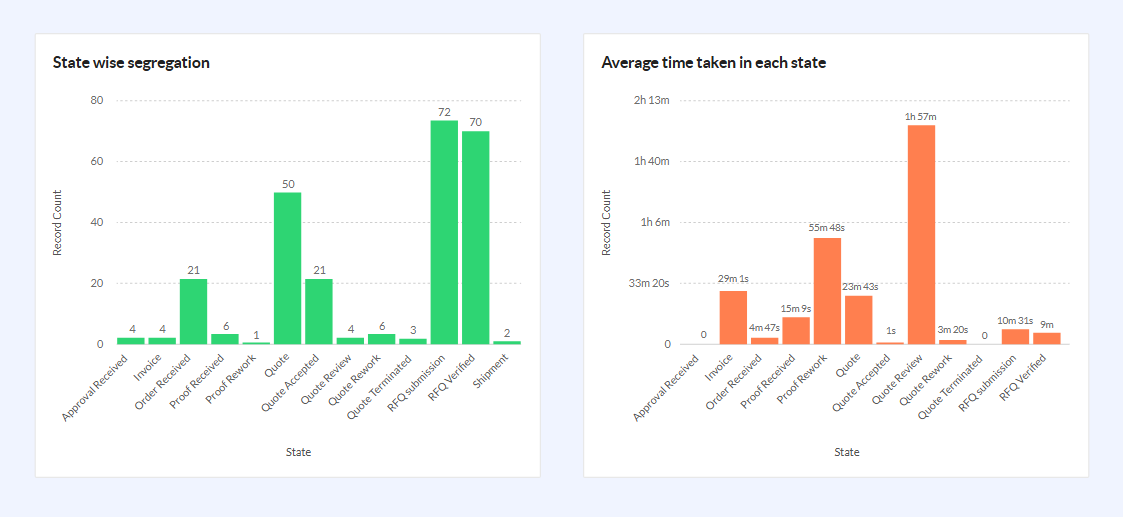
Source: Zoho CRM
Zoho advertises month-to-month contracts as a differentiator.
For organizations evaluating both, the pricing signals intent. Oracle is built for enterprises that negotiate seven-figure software contracts annually. Zoho is built for businesses that want to test before committing and scale incrementally.
Customization and user experience
Oracle Sales runs on the Redwood user experience, Oracle's design system for Fusion Applications.
Redwood introduces guided orchestrations (step-by-step workflows for different sales scenarios), AI-driven prescriptive insights, and a natural language "Ask Oracle" bar for navigation and task completion. The platform works conversationally across mobile, desktop, and collaboration tools including Microsoft Teams and Outlook.
But getting there takes work. Enabling Redwood requires contacting Oracle Support to request installation of internal microservices before any configuration can begin. Customization uses Oracle Visual Builder Studio, with an Express Mode for non-technical admins.
Despite these investments, the user interface remains Oracle's most persistent weakness. G2 reviewers note "the user interface feels outdated compared to modern CRM solutions, which can impact usability and adoption among less technical users." PeerSpot flags "user interface and performance" as a primary improvement area across its 43 reviews.
Zoho CRM's Canvas Design Studio gives administrators pixel-level control over record views (colors, typography, section groupings, image placement) through a drag-and-drop editor.
Canvas Rules (up to 100 per module) display different layouts to different users based on conditions. Image to Canvas generates designs from uploaded screenshots. The underlying Module 360 architecture processes over 1 billion events per day and supports 1.5 billion+ records in a single org.
Beyond UI customization, Zoho's Blueprint enforces stage-by-stage deal progression with mandatory field completion, task completion, and approval gates.
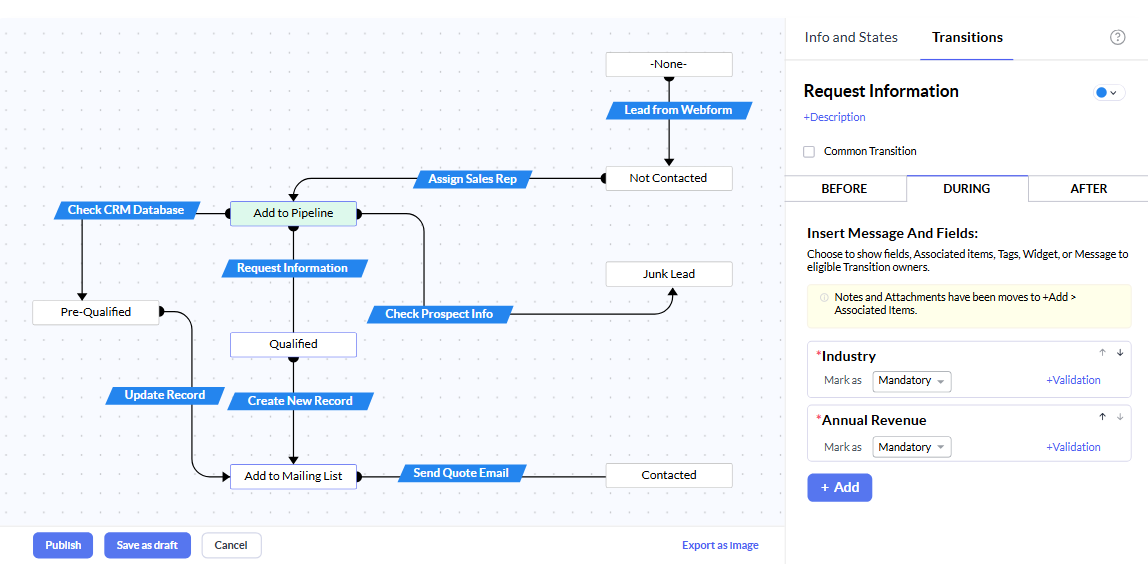
Source: Zoho CRM
Kiosk Studio builds interactive input flows without code. Wizards break long forms into sequential steps. CommandCenter orchestrates cross-channel customer journeys, with PathFinder showing how customers actually interact across channels before you design the journeys you want them to take.
Both platforms offer extensive customization, but through different models. Oracle's customization requires technical expertise and, frequently, implementation partners. Zoho's customization is accessible to business users and supported by AI-assisted configuration tools.
Integration ecosystems favor their own families
Oracle Sales integrates natively with Oracle's back-office suite (ERP, HCM, SCM, Order Management), sharing a single Fusion data model.
This native integration is Oracle's core differentiator: invoice status, contract compliance, entitlement data, and supply chain availability surface inside the sales workflow without middleware.
Third-party connectivity runs through Oracle Integration (OIC), which includes prebuilt adapters for Salesforce, SAP, Workday, and ServiceNow. Microsoft Outlook and Teams integrations are available natively within Redwood.
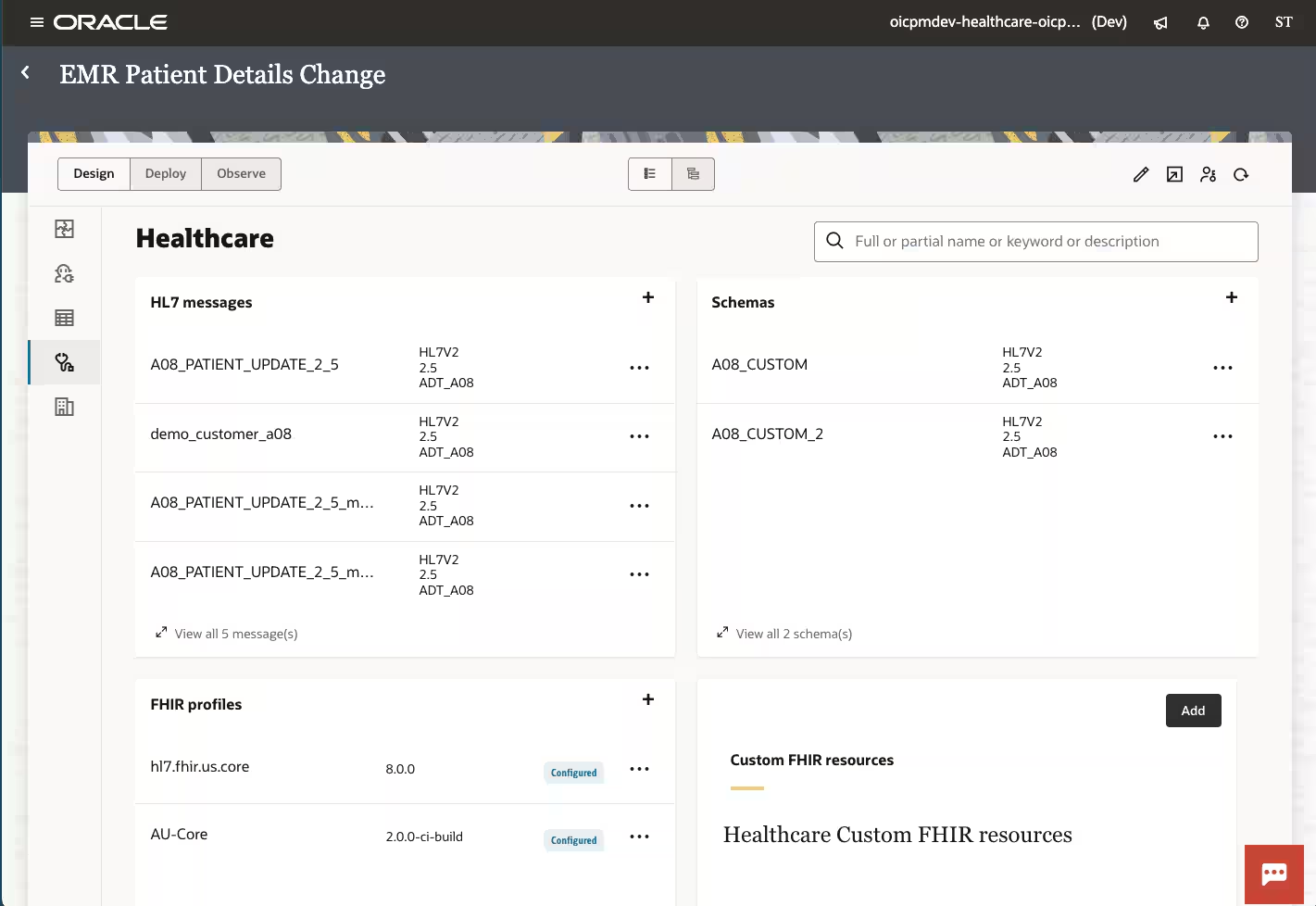
Source: Oracle CRM
But step outside the Oracle ecosystem, and integration becomes difficult. G2 reviewers note that Oracle Sales "works well within the Oracle ecosystem but presents integration challenges with external tools, requiring third-party providers to connect with accounting software, cloud storage, Google Workspace and marketing automation platforms."
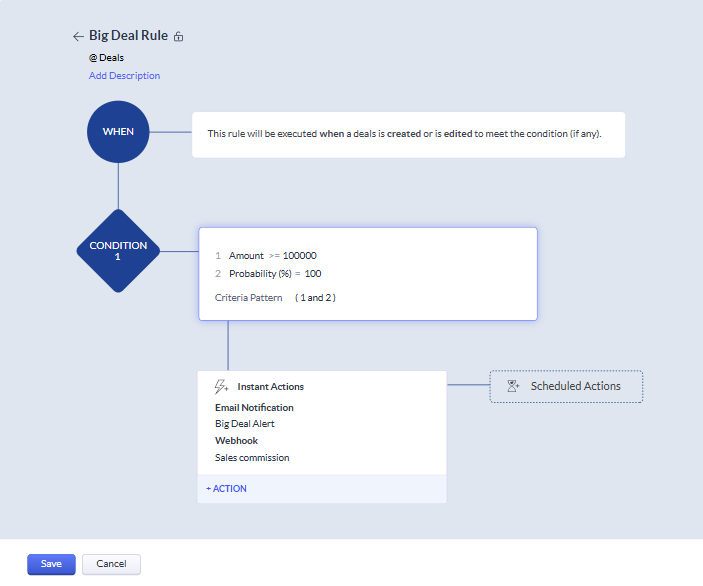
Zoho CRM connects natively to over 60 Zoho applications and offers 1,100+ pre-built third-party integrations through the Zoho Marketplace.
Source: Zoho CRM
REST APIs (V8), SDKs, custom functions via Deluge scripting, and Zoho Flow (cross-app automation) provide extensibility. G2 users report integration friction when connecting to non-Zoho enterprise systems, though the integration ecosystem is broader than Oracle's for mid-market tools.
Both platforms work best within their respective ecosystems. For organizations running mixed technology stacks, neither provides smooth connectivity to every tool.
The intelligence gap both CRMs share
Oracle and Zoho both provide good tools for managing deals once they're in the pipeline.
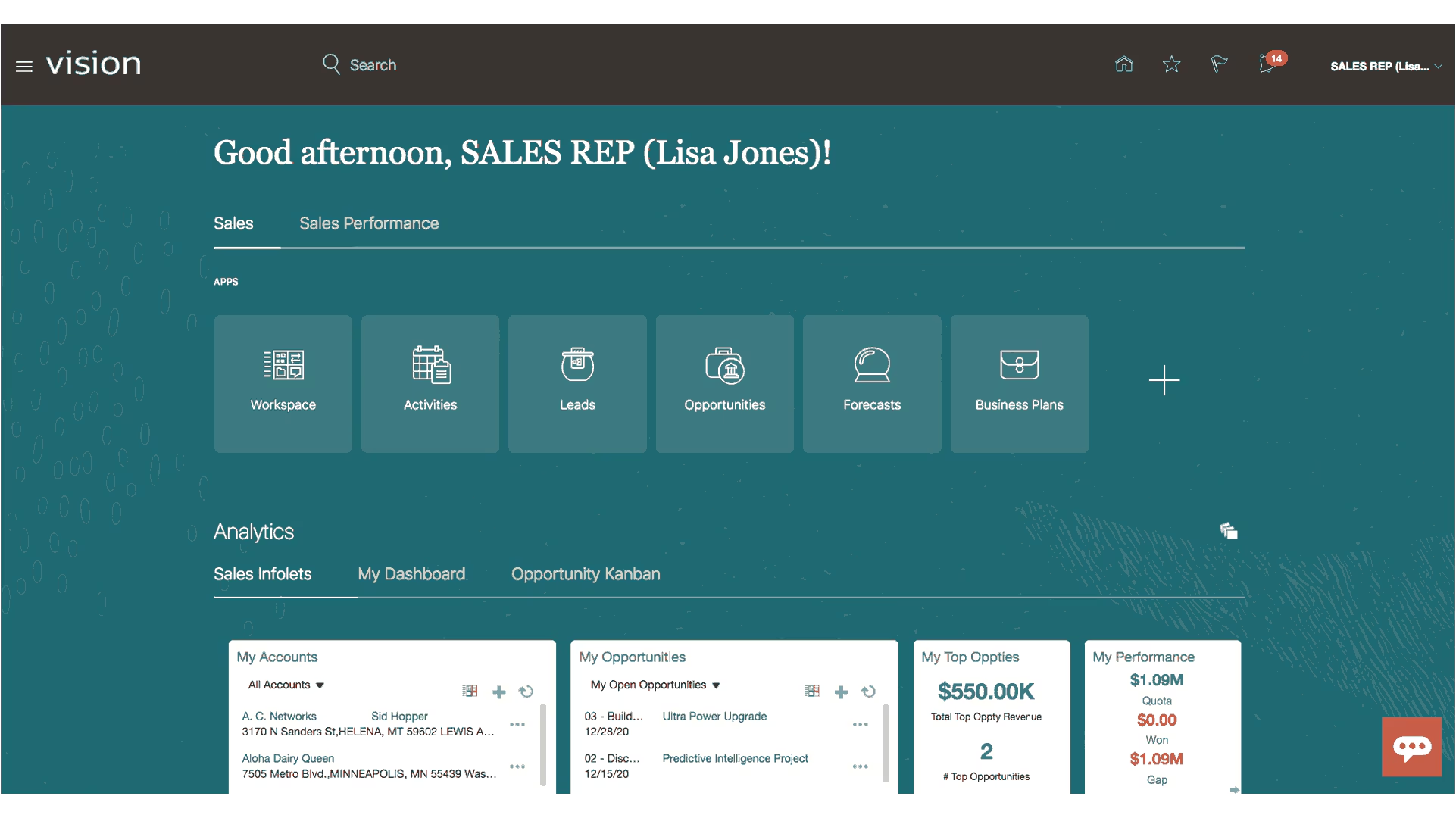
Oracle's predictive lead and opportunity scoring and Zoho's Zia scores analyze conversion probability based on CRM data. Oracle's Seller 360 dashboard and Zoho's SalesSignals aggregate customer interactions into consolidated views.
Source: Oracle CRM
But both platforms depend on the quality and completeness of the data inside them. Neither tells you which companies outside your pipeline are researching solutions in your category right now. Neither continuously verifies that the contact data in your pipeline is current (that phone numbers still work, email addresses still deliver, job titles haven't changed).
Neither maps buying committees inside target accounts with verified direct dials and business emails for stakeholders you haven't yet engaged.
This upstream intelligence (knowing who to contact, when they're ready to buy, and what matters to them) separates productive CRM usage from expensive record-keeping.
ZoomInfo fills this gap.
It provides the data foundation and intelligence layer that sits upstream of any CRM. The platform covers 500M contacts, 100M companies, 135M+ verified phone numbers, and 200M+ verified business emails, processed through a multi-source verification pipeline with 300+ human researchers and up to 95% accuracy on first-party data.
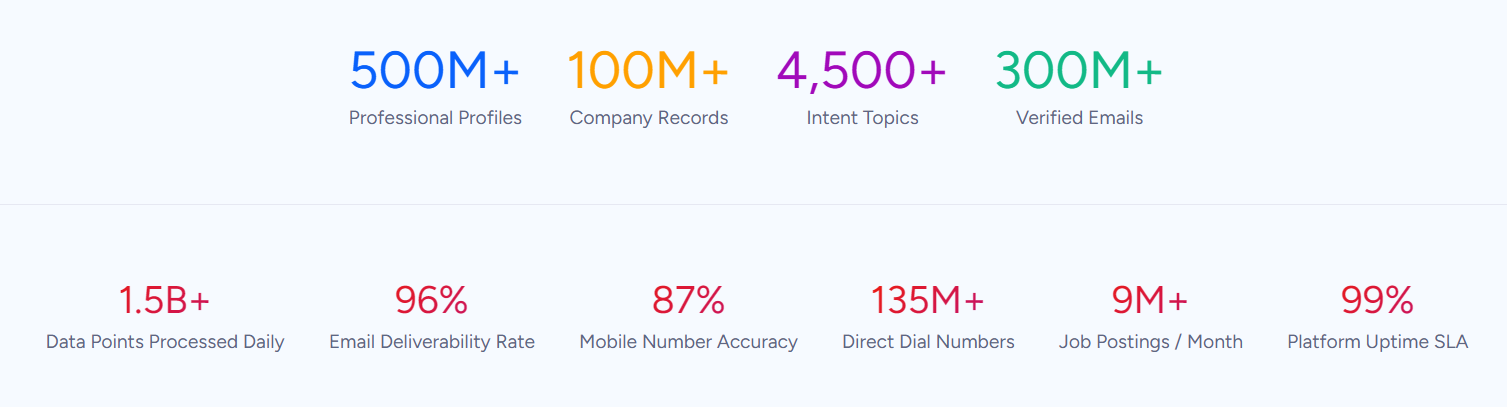
ZoomInfo's Buyer Intent data tracks signals from 210 million IP-to-Organization pairings and 6 trillion+ new keyword-to-device pairings sourced monthly, revealing which accounts are researching before they fill out a form.
WebSights resolves anonymous website traffic to companies, including buying team identification. Guided Intent, exclusive to ZoomInfo, identifies topics historically correlated with deal success rather than requiring manual topic selection.
The GTM Context Graph fuses this data with your CRM records, conversation transcripts, and behavioral signals into a single intelligence layer that captures not just what happened in a deal, but why. A CRM records that a deal moved to Stage 3.
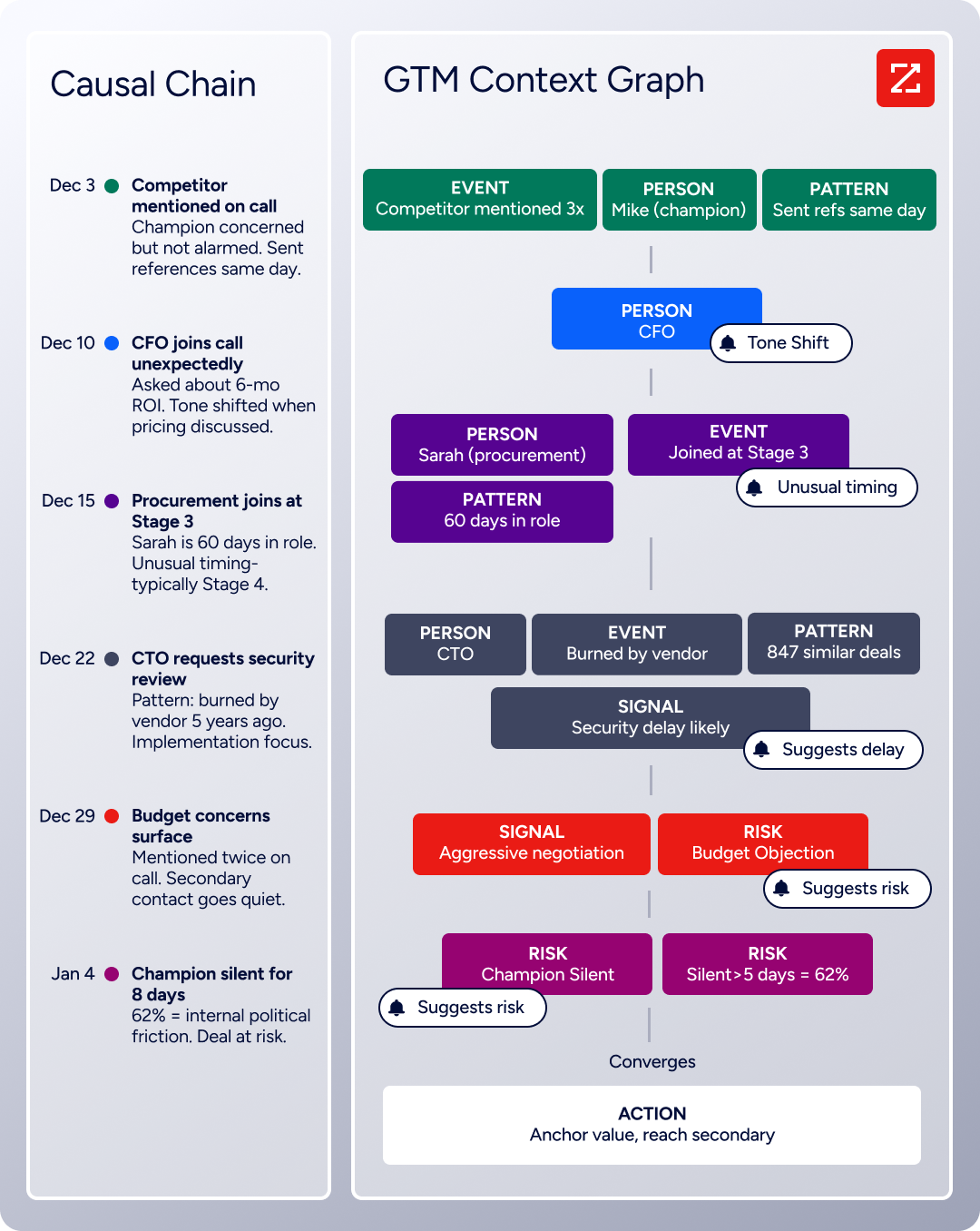
The GTM Context Graph reasons that executive sponsorship entering at this stage, combined with ROI-focused questions and third-party signals showing the company is hiring new VPs and researching your competitor, matches the pattern behind closed-won deals in your segment.
Seismic's sales team attributed 39% of active pipeline to opportunities identified or influenced by ZoomInfo signals, boosted productivity by 54%, and saved 11.5 hours per week per seller. (Seismic Case Study)
ZoomInfo works with both platforms
ZoomInfo integrates with both Oracle and Zoho CRM, so the choice between CRMs doesn't determine whether you can use ZoomInfo's intelligence.
ZoomInfo's App Marketplace includes CRM integrations for leading platforms, and the Enterprise API enables programmatic data enrichment in any system. API access is included in all relevant plans.
For sellers, GTM Workspace provides a single surface where prioritized accounts, AI-drafted outreach, and deal execution converge, pulling data from your CRM into a consolidated view alongside ZoomInfo's market intelligence. AI agents research accounts, generate follow-ups, monitor buying signals, and update CRM fields without context-switching.
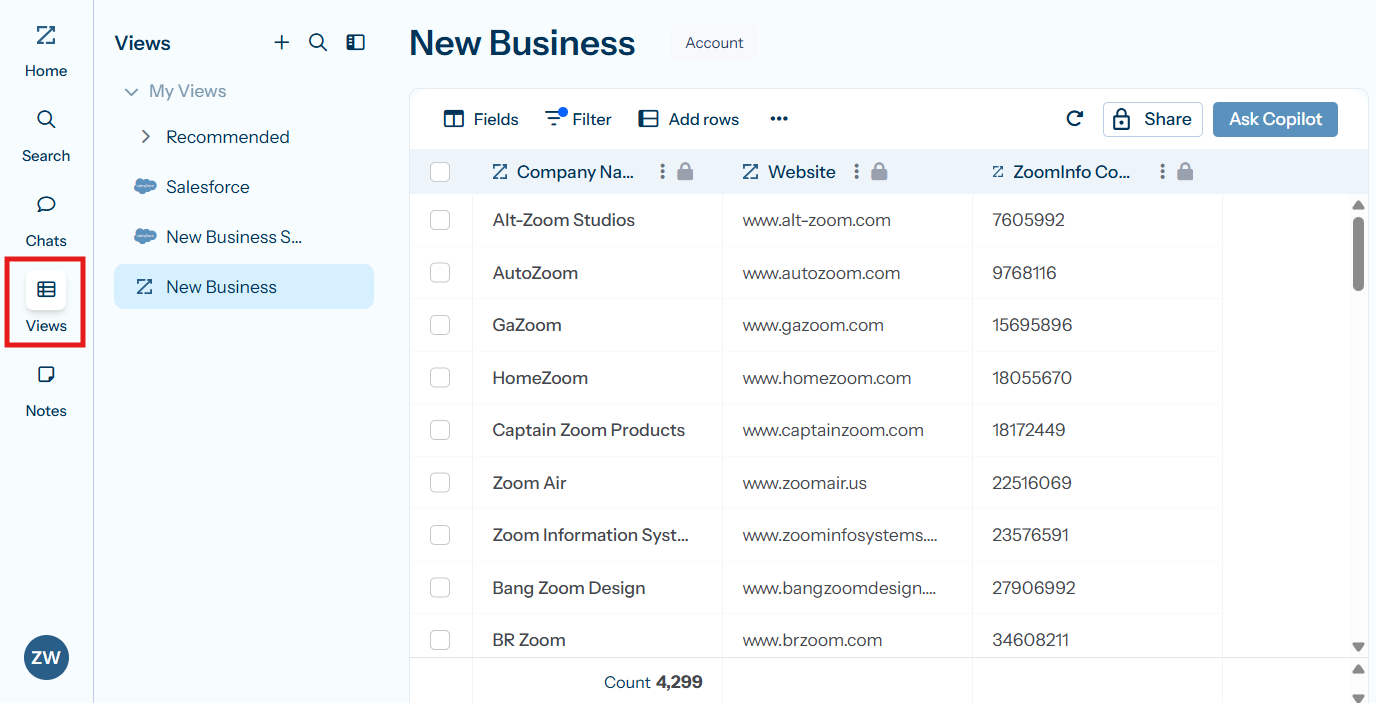
Source: ZoomInfo
For marketers and RevOps, GTM Studio provides an AI-powered canvas where audience definition, campaign orchestration, and pipeline measurement happen in natural language. Expansion plays that used to take 3 weeks launch in 30 minutes without engineering support.
For teams building custom workflows, APIs and MCP expose the same intelligence to any application or AI agent. The ZoomInfo MCP server connects AI models directly to ZoomInfo's B2B data as a native tool, requiring only one-time server configuration. It currently supports Claude and ChatGPT, with additional MCP-compatible tools noted as coming soon.
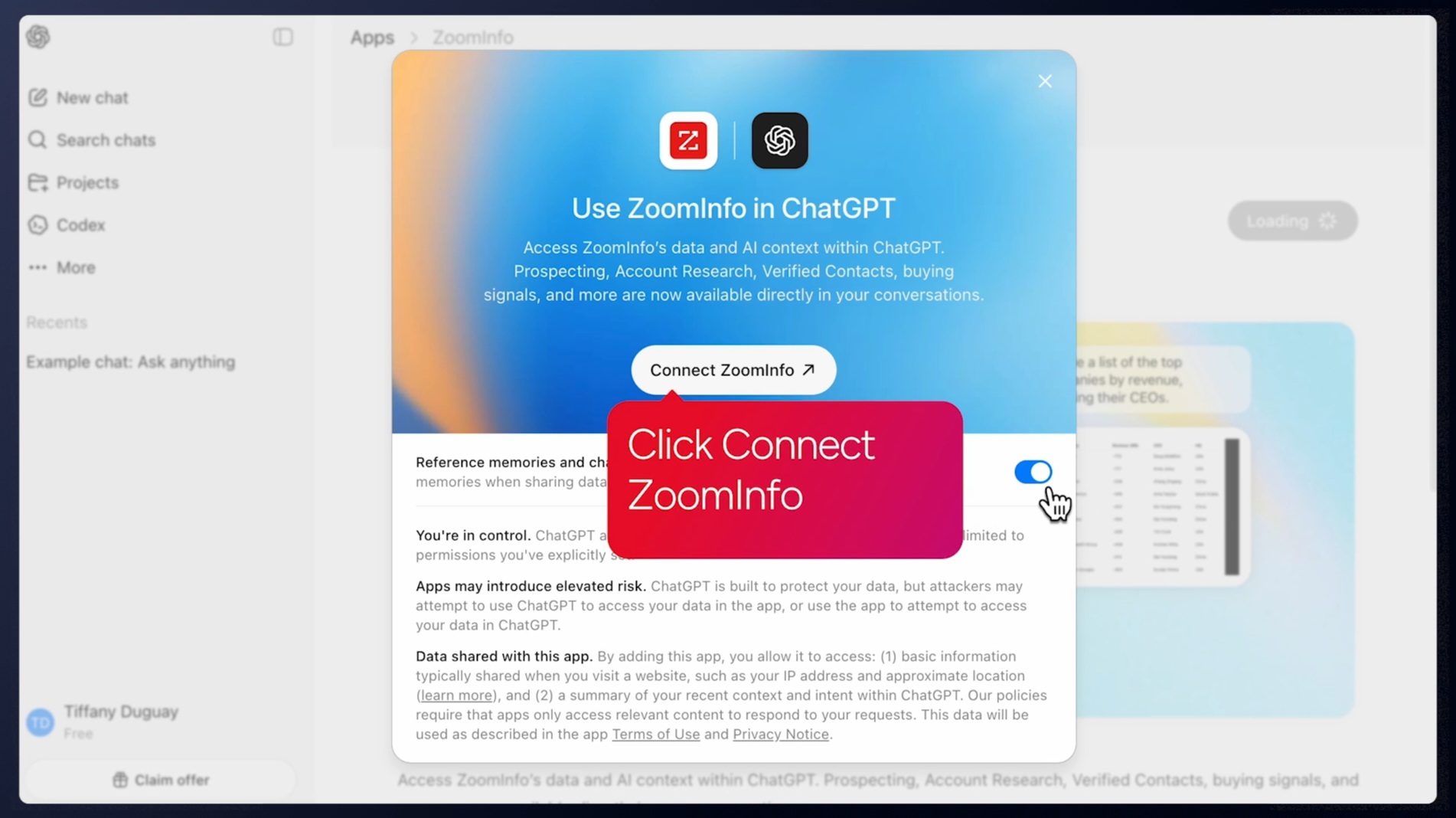
Source: ZoomInfo
Your CRM handles deal management and revenue operations. ZoomInfo handles the intelligence that makes those operations productive.
"ZoomInfo is our one source of truth for account data, and even more so for contact data. There's no other provider in the market that provides you with that level of detail." — Thor Sanderson, Senior Manager of Sales Technology Enablement, Smartsheet. (Smartsheet Case Study)
Oracle CRM vs. Zoho CRM vs. ZoomInfo: Which should you choose?
The right answer depends on your organization, your existing tech stack, and where your sales process breaks down.
Choose Oracle Sales if:
You're a large enterprise already running Oracle ERP, HCM, or supply chain
You need the full revenue lifecycle (quoting, billing, subscriptions, commissions) on a single platform
You have dedicated IT resources for implementation and ongoing administration
Integration with back-office financial and operational data is critical to your sales process
Budget for enterprise CRM is not a constraint
Choose Zoho CRM if:
You're a growing SMB or mid-market company looking for enterprise features at an accessible price
Your team needs to configure workflows, reports, and automations without developer involvement
Pricing transparency and contract flexibility matter to your buying decision
You value a broad ecosystem of integrated business applications (60+ Zoho apps)
You want to start with a free plan and scale as your needs grow
Use ZoomInfo with either if:
You need accurate, verified contact data and company intelligence feeding your CRM
Knowing which accounts are researching your category before they contact you would change your prospecting
Your sales team spends too much time on manual research instead of selling
You want AI-driven account intelligence that goes beyond what your CRM data alone can provide
You're building a B2B go-to-market operation where data quality is the difference between pipeline and noise
See how ZoomInfo's intelligence layer works with your CRM. Start with ZoomInfo Lite for free or request a demo.
Oracle and Zoho are both capable CRMs for their respective markets. Oracle delivers depth for complex revenue operations in enterprise environments. Zoho delivers value for businesses that need flexibility without the enterprise price tag.
But regardless of which CRM you choose, the intelligence feeding it determines the results you get. A pipeline filled with accurate data and timely buying signals will outperform a poorly informed pipeline on any platform.
That intelligence layer (complete data, contextual signals, and AI that understands why deals move) is what ZoomInfo provides.
Oracle CRM vs. Zoho CRM vs. ZoomInfo FAQ
What is the fundamental difference between Oracle CRM, Zoho CRM, and ZoomInfo?
Oracle Sales is an enterprise revenue lifecycle platform covering sales automation, quoting, billing, subscriptions, and commissions on a single Oracle Fusion architecture.
Zoho CRM is an affordable, customizable CRM focused on sales pipeline management and process automation for SMBs and mid-market companies.
ZoomInfo is not a CRM. It is a B2B data intelligence and GTM platform that provides the contact data, company intelligence, and buying signals that feed into CRMs like Oracle and Zoho to make them more productive.
Which platform is more affordable?
Zoho CRM is far more affordable, with a permanent free plan for 3 users and paid plans starting at approximately $14/user/month.
Oracle Sales does not publish pricing and requires enterprise sales negotiations, with modules licensed separately.
ZoomInfo offers a permanent free tier (ZoomInfo Lite) with access to its B2B database and 10 monthly export credits, with paid plans using consumption-based pricing.
Which CRM is better for a small or mid-sized business?
Zoho CRM is the clear choice for SMBs and mid-market organizations. It offers transparent pricing, month-to-month contracts, a free plan, a 15-day trial, and the ability for non-technical admins to configure workflows and automations.
Oracle Sales is designed for large enterprises and requires IT resources, implementation partners, and budget that smaller organizations typically cannot justify.
Do Oracle and Zoho CRM include AI features?
Both platforms include AI. Oracle's Fusion AI agents (Contact Insights, My Territory, Renewal, Quote Generation) are included in the standard subscription and draw on Oracle's back-office data for context.
Zoho's Zia AI covers predictive scoring, churn prediction, email and call intelligence, and seven pre-built agentic agents, with availability increasing at higher plan tiers. In both cases, AI effectiveness depends on the quality and completeness of data in the CRM.
Can ZoomInfo work with both Oracle and Zoho CRM?
Yes. ZoomInfo integrates with leading CRM platforms, including both Oracle and Zoho. The Enterprise API enables programmatic data enrichment in any system, and ZoomInfo's App Marketplace includes CRM connectors. ZoomInfo's MCP server also enables AI agents to access ZoomInfo data from any MCP-compatible application. The data and intelligence are platform-agnostic.
Which platform has the strongest Gartner recognition?
Oracle has been named a Leader in the Gartner Magic Quadrant for Sales Force Automation Platforms for nine consecutive years and holds a nine-year Leader streak in CPQ Applications.
Zoho has been recognized in the Gartner SFA Magic Quadrant for 15 consecutive years and was named a Visionary for the fourth time in 2025.
ZoomInfo has been named a Leader in the Gartner Magic Quadrant for ABM Platforms in both 2024 and 2025, and was the only vendor positioned in the Customers' Choice quadrant in the 2025 Gartner Voice of the Customer report.
What kind of data does ZoomInfo provide that CRMs do not?
ZoomInfo provides verified B2B contact data (500M contacts, 135M+ verified phone numbers, 200M+ verified business emails), company intelligence (100M companies with company attributes, technographics, and org charts), and dynamic buying signals (intent data from 210 million IP-to-Organization pairings, website visitor identification, and job change alerts).
CRMs store the data your team enters. ZoomInfo provides externally sourced, continuously verified intelligence that keeps that data current and complete.
Which platform offers the most flexible contract terms?
Zoho CRM offers the most flexibility with month-to-month subscriptions and no mandatory multi-year commitments. Zoho also provides a full refund within the first month on monthly plans or within 45 days on annual plans.
Oracle's contracts are negotiated through enterprise sales and typically involve longer-term agreements.
ZoomInfo uses annual contracts as standard, with multi-year commitments offering pricing advantages.
