
Most comparisons of Qualified vs. Intercom miss the fundamental difference between them. These are not two versions of the same tool. Qualified converts website visitors into sales pipeline. Intercom resolves customer support tickets with AI. The real decision starts with understanding which problem you're solving.
Before you choose, answer these five questions:
Are you trying to generate sales pipeline from inbound website traffic, or provide customer service to existing users?
Do you need an AI agent that books meetings and qualifies leads, or one that resolves support tickets and deflects help desk volume?
Is verified B2B contact data and buyer intent signals essential to your strategy?
Are you running Salesforce as your primary CRM?
Do you want a specialized tool for a single stage of the customer lifecycle, or a platform that covers your full go-to-market?
In short, here's what we recommend:
Qualified is built for B2B marketing and sales teams that need to convert inbound website visitors into pipeline. Its AI SDR Agent, Piper, engages prospects across text, voice, and video the moment they land on the site, qualifying them, routing them to the right rep, and booking meetings without human intervention. Salesforce integration, buyer intent signals, and real-time routing make it strong for enterprise B2B companies with demand generation teams. However, Qualified's enterprise-only pricing, inbound-only focus, and recent acquisition by Salesforce (completed April 2026) raise questions about its long-term roadmap as a standalone product.
Intercom is built for customer service teams that need to resolve support tickets faster. Its AI Agent, Fin, handles customer queries across chat, email, voice, WhatsApp, and SMS, resolving an average of 67% of conversations without human involvement. The platform combines a full helpdesk with an integrated AI agent, so handoffs between Fin and human agents carry complete context. Intercom reduces support costs and improves response times for B2B SaaS companies. But it is not a sales tool. It won't generate pipeline, identify buyer intent, or book sales meetings.
Both platforms do their jobs well. But each covers one side of the customer lifecycle. Qualified engages prospects before they buy. Intercom supports them after. Neither provides the data intelligence that tells you who your buyers are, when they're in-market, and what makes them convert. That foundation determines whether any engagement tool moves the needle.
ZoomInfo is an AI GTM platform built on a B2B data foundation of 500M contacts, 100M companies, 135M+ verified phone numbers, and 200M+ verified business email addresses. Its GTM Context Graph processes 1.5B+ data points daily, combining this data with your CRM records, conversation transcripts, and behavioral signals to show not just which accounts are on your website, but why they're there and what to do next. Sellers work from GTM Workspace, where AI agents draft outreach, prioritize accounts, and surface buying signals. Marketers build and launch plays in GTM Studio. For teams using other tools, APIs and MCP deliver the same intelligence into any front-end. For B2B companies that want a data-driven GTM platform rather than a single-purpose engagement tool, ZoomInfo covers pipeline generation and more.
If a data-driven approach to your go-to-market sounds right, see how ZoomInfo works with a free trial.
Qualified vs. Intercom vs. ZoomInfo at a glance
Qualified | Intercom | ZoomInfo | |
|---|---|---|---|
Primary function | AI SDR for inbound pipeline generation | AI-powered customer service helpdesk | AI GTM platform |
Core AI agent | Piper (sales conversations, meetings, email) | Fin (support ticket resolution) | GTM Workspace AI agents (account research, outreach, signals) |
Website engagement | Proactive sales chat with text, voice, and video | Customer support messenger with AI resolution | Data-powered chat identifying companies + buyer intent signals |
B2B data | Account segmentation with waterfall enrichment | Customer records within the platform | 500M contacts, 100M companies, 135M+ verified phone numbers |
Buyer intent signals | First-party + third-party (Bombora) via AI Signals | Not applicable | Guided Intent from 210M+ IP-to-org pairings + 6T keyword signals monthly |
CRM integration | Salesforce native; HubSpot supported | Salesforce, HubSpot via integrations | Salesforce, HubSpot, Microsoft Dynamics native |
Pricing model | Custom enterprise quotes only | $29–$132/seat/month + $0.99/AI resolution | Custom consumption-based; free tier available |
Free option | No free trial or free tier | 14-day free trial | ZoomInfo Lite (permanent free) + 7-day full trial |
Best for | Enterprise B2B marketing teams on Salesforce | B2B SaaS customer service teams | B2B sales, marketing, and RevOps teams across the GTM motion |
These tools solve fundamentally different problems
Qualified, Intercom, and ZoomInfo each address a different stage of the B2B customer lifecycle. Comparing them side-by-side only makes sense once you understand where each one fits.
Qualified sits at the top of the sales funnel.
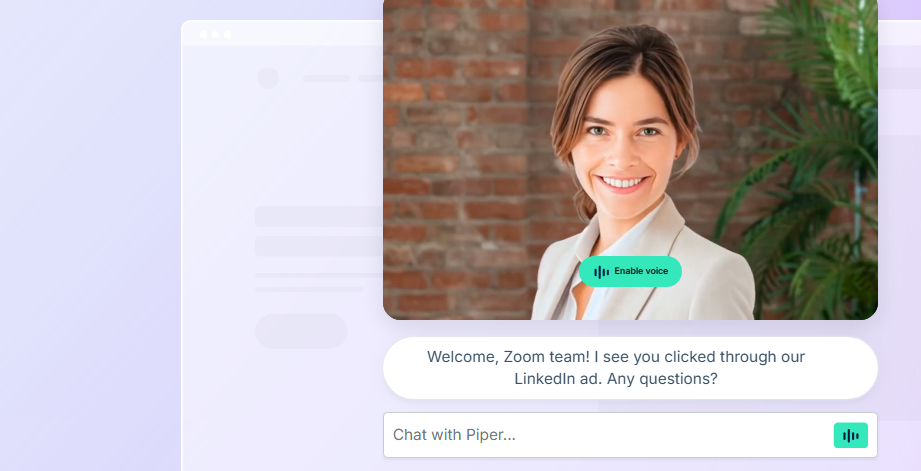
When a target account visits your website, Piper the AI SDR Agent greets them, qualifies them against your ICP, and books a meeting with the right rep. The purpose is converting anonymous website traffic into booked sales meetings and qualified pipeline.
Source: Qualified
Intercom sits at the post-sale support stage.
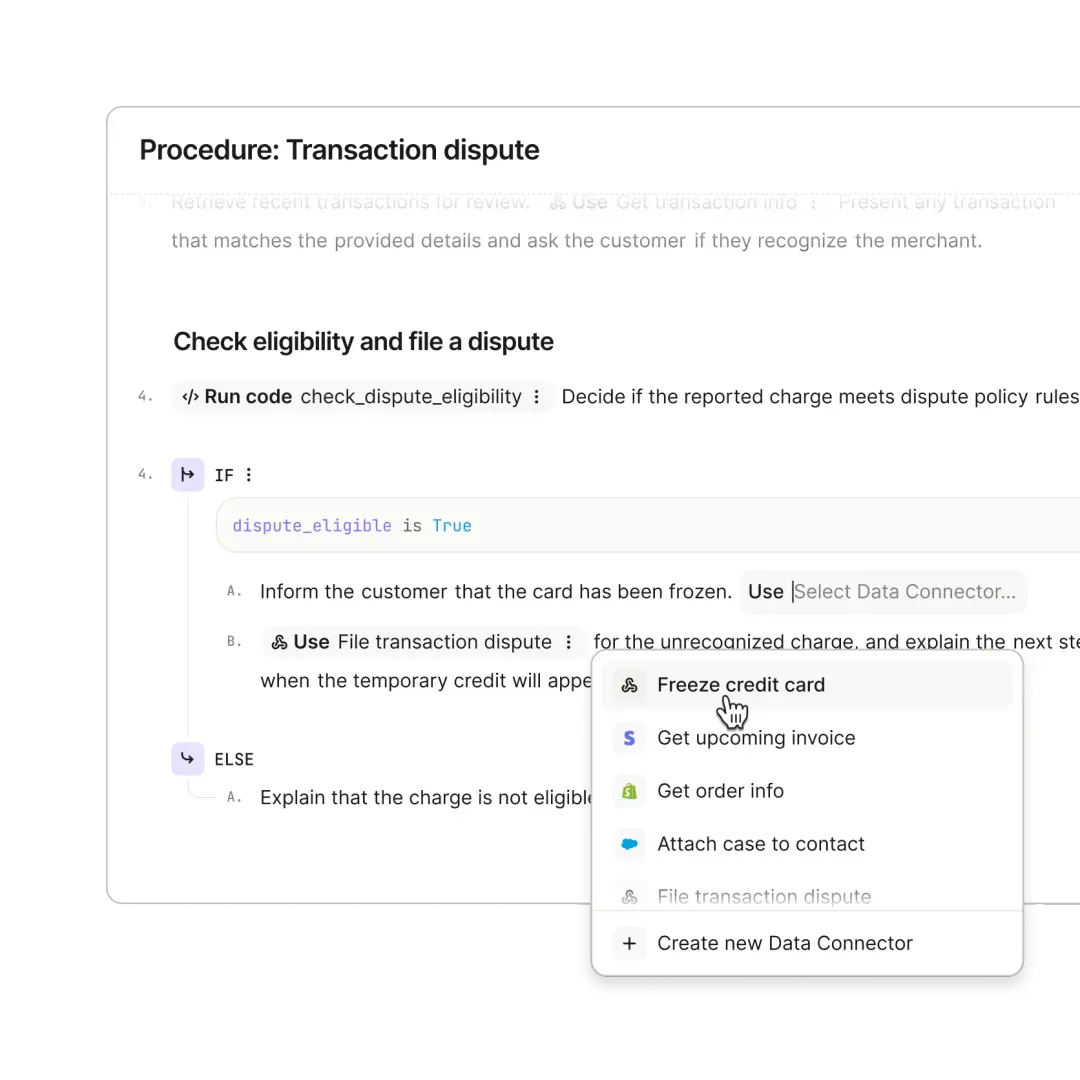
When an existing customer has a question, a billing issue, or a technical problem, Fin AI Agent resolves it by drawing from the knowledge base, applying Procedures for complex queries, and handing off to human agents when needed.
Source: Intercom
ZoomInfo spans the full go-to-market, from identifying your total addressable market to prioritizing in-market accounts to executing outreach to tracking deal progression.
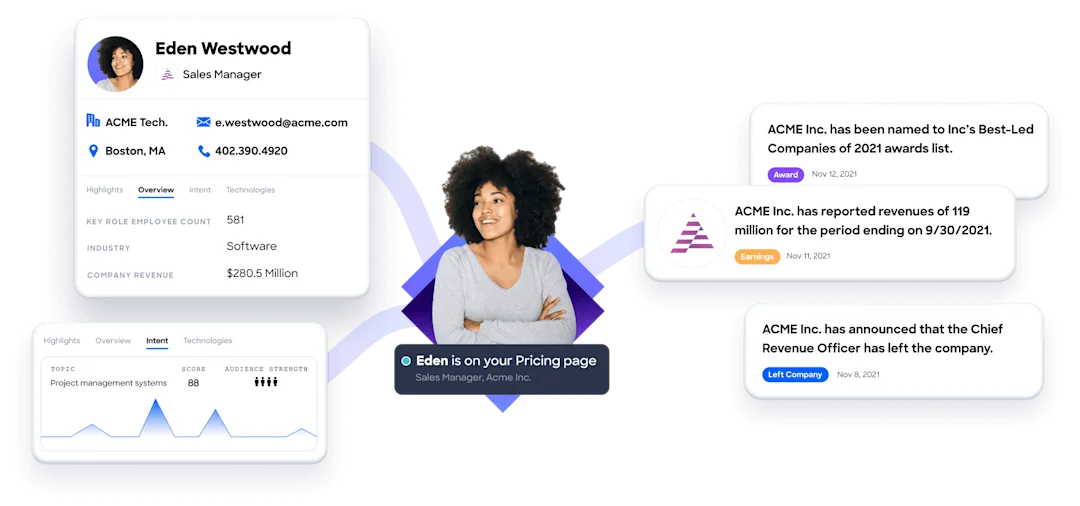
Its website chat identifies visitors using ZoomInfo's B2B database, but that's one feature among many. The platform's value is the data foundation: knowing who to engage, when they're ready, and what to say, then executing on that intelligence across every channel.
Source: ZoomInfo
The practical takeaway: if you need to convert more inbound website visitors into meetings, Qualified and ZoomInfo both address that (Qualified as a specialized tool, ZoomInfo as part of a broader platform). If you need AI-powered customer support, Intercom is the clear choice. If you need the data foundation that powers your sales and marketing operation, ZoomInfo stands alone.
Website engagement: three approaches to the same chat window
All three platforms put a chat widget on your website. What happens behind that widget is where they diverge.
Qualified's approach is sales-first.
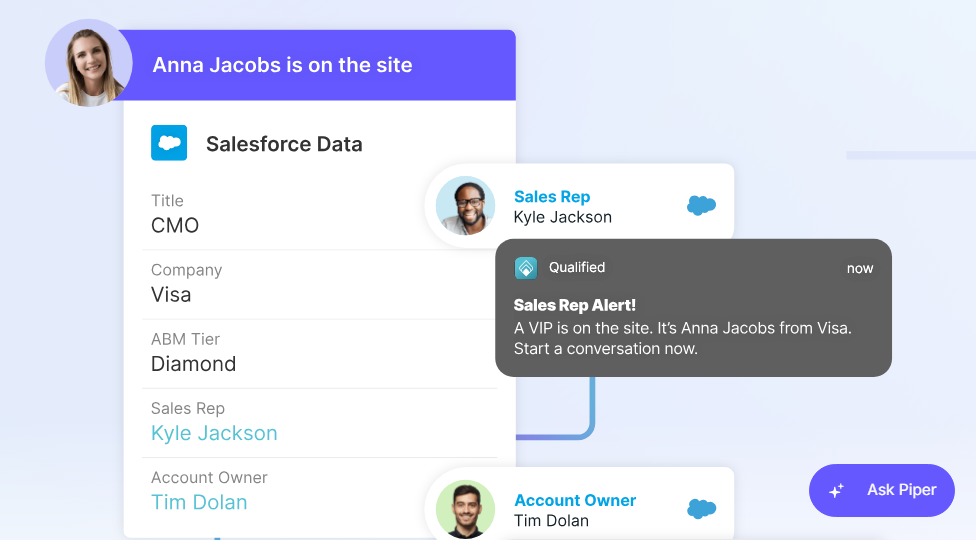
Piper identifies high-intent buyers or target accounts the moment they arrive and starts a conversation tailored to their context: the ad they clicked, the company they work for, and whether they have an open opportunity in Salesforce.
With PiperX, Piper can hold live video conversations and present sales slides directly in the messenger. Qualified reports that PiperX on their own website produced 2x more conversations and 6x more meetings booked.
The experience is designed for the B2B buying process. Routing rules draw from Salesforce ownership, geography, ABM tier, and outbound sequences, so a known contact from an open deal gets welcomed by name and routed to their assigned rep. Alerts fire in real time via Slack, Microsoft Teams, and the Qualified Mobile app.
Source: Qualified
Intercom's approach is support-first.
The Messenger is the entry point for customers seeking help, not prospects exploring a purchase. When someone opens the chat, Fin checks the knowledge base, applies Procedures for multi-step logic, and resolves the issue on its own if possible. If not, it hands off to a human agent with full conversation context.
What sets Intercom's chat apart is the infrastructure behind it.
The Fin AI Engine runs incoming messages through a six-phase pipeline: query refinement, semantic retrieval, reranking, response generation via the Apex 1.0 model, accuracy validation, and engine optimization. The result is a 67% average resolution rate across 7,000+ customers. That number matters for support teams. It does not apply to sales pipeline generation.
ZoomInfo's approach is data-first.
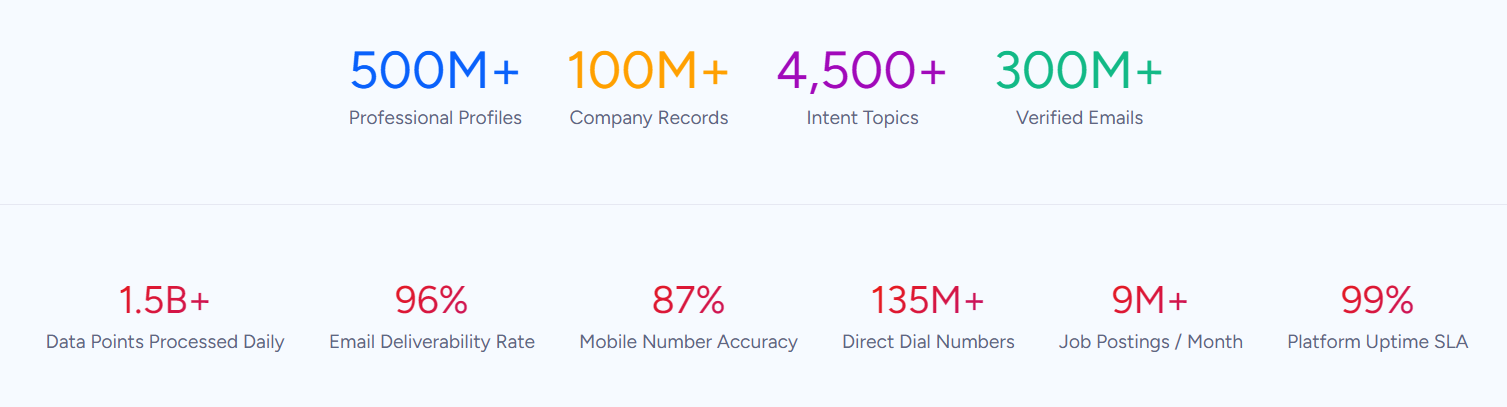
ZoomInfo Chat identifies the company behind an anonymous visitor before they type a single message, using ZoomInfo's database of 100M companies. It then triggers tailored experiences based on company profile, intent signals, and relationship status. When a rep gets an alert via Slack, they already know who they're talking to, what the company looks like, and whether the account shows in-market behavior.
Source: ZoomInfo
The difference comes down to what fuels the conversation. Qualified draws intelligence from Salesforce CRM data and first-party/third-party intent signals. Intercom draws from the customer's support history and knowledge base. ZoomInfo draws from its B2B dataset, combined with your CRM data, conversation transcripts, and behavioral signals through the GTM Context Graph.
Seismic's sales team attributed 39% of active pipeline to opportunities identified or influenced by ZoomInfo signals, while boosting productivity by 54%. (Seismic)
AI agents built for different jobs
Each platform has invested in AI, but each AI does a different job.
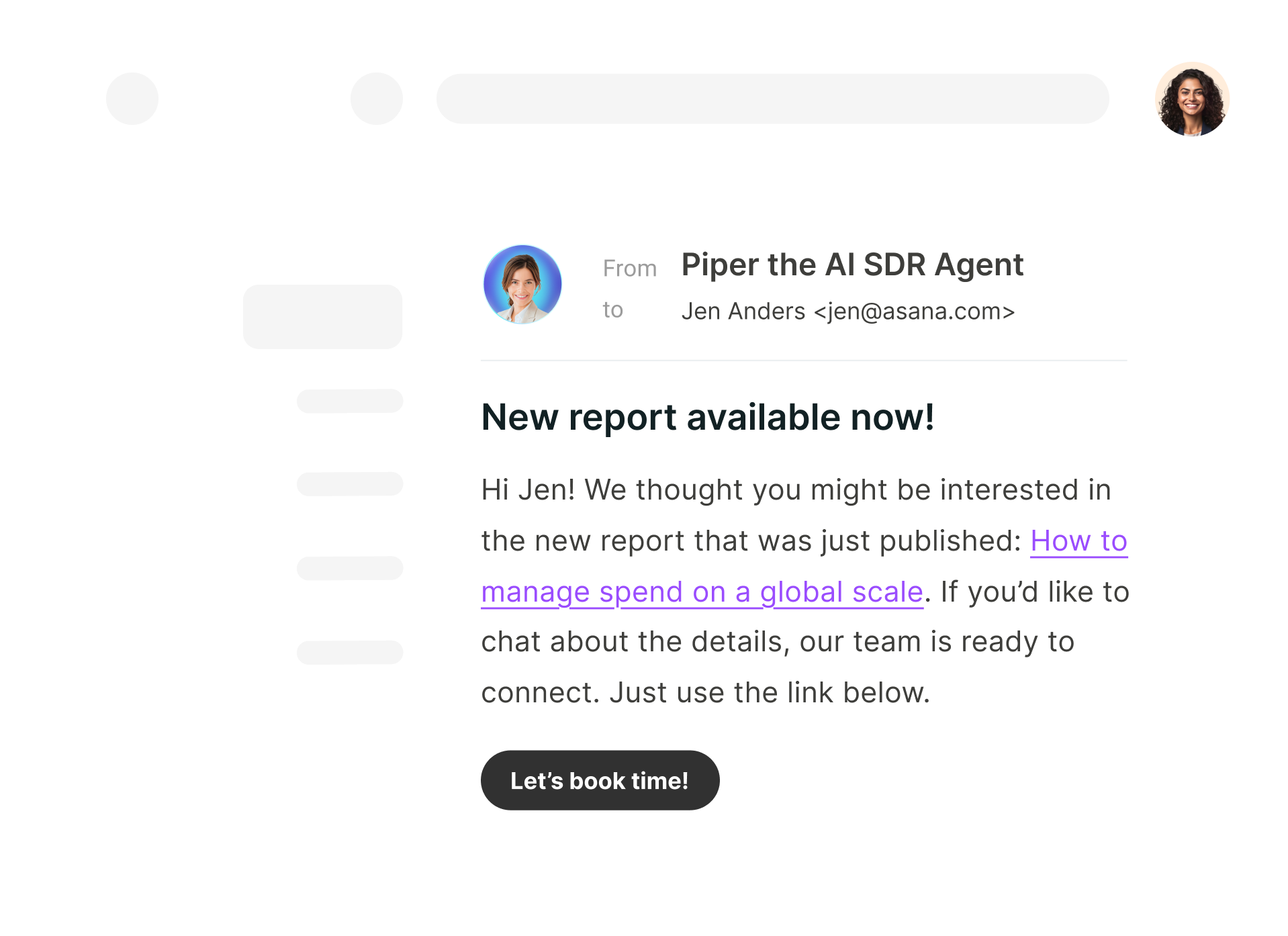
Piper is an autonomous sales agent. She engages website visitors, qualifies them, sends follow-up emails, books meetings, serves content offers, and nurtures leads over time.
Piper takes natural-language instructions and decides the best path forward rather than following rigid decision trees. Her capabilities span Conversations (website chat), Email (autonomous follow-up), Meetings (scheduling), and Offers (content delivery). For leads that aren't ready to buy, Agentic Nurture keeps them engaged with relevant content across channels.
Piper's scope is inbound pipeline generation. She does not handle customer support, outbound cold prospecting, or post-sale account management.
Source: Qualified
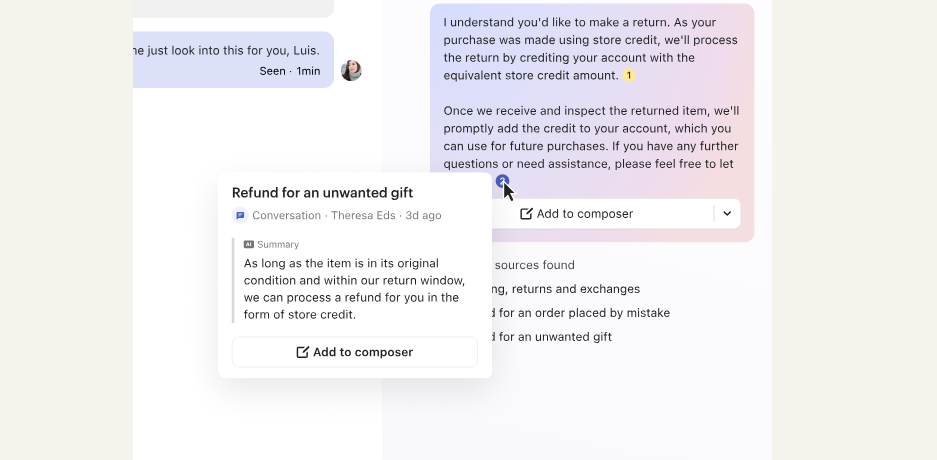
Fin is an autonomous support agent. It resolves customer queries across voice, email, live chat, WhatsApp, SMS, Slack, Discord, and social channels.
Fin runs on a proprietary suite of seven specialized models: Apex 1.0 (the generative core), a retrieval model, a reranker, an issue summarizer, a feedback parser, a language detector supporting 45 languages, and an escalation router with 98%+ accuracy.
Intercom also offers Copilot, an AI assistant that helps human agents work faster by querying conversation history, help center articles, and external knowledge sources.
Fin's scope is customer service resolution. It does not identify buyer intent, book sales meetings, or generate pipeline.
Source: Intercom
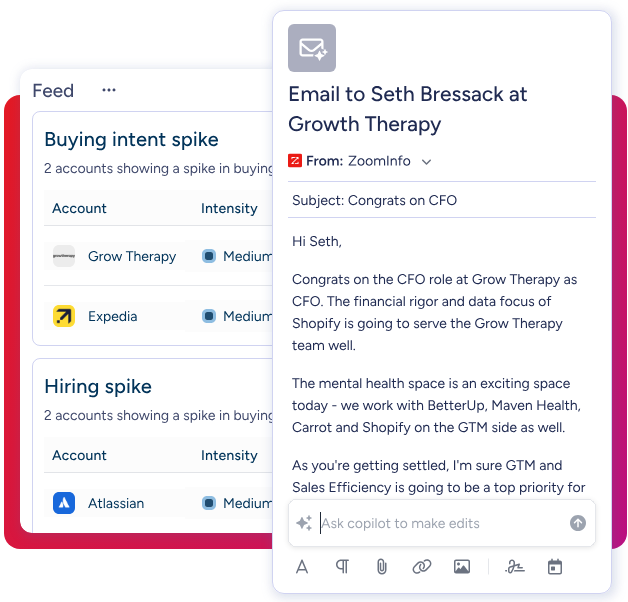
ZoomInfo's AI agents inside GTM Workspace serve a different function. They research accounts, generate follow-ups, monitor buying signals, draft outreach, update CRM fields, and surface next best actions. These agents run on the GTM Context Graph, so they don't just summarize CRM data. They reason about why a deal is moving, who's influencing the decision, and what action will advance it.
In GTM Studio, AI agents handle enrichment, scoring, routing, and campaign orchestration. Marketers describe audiences in natural language and launch multi-channel plays that get smarter as prospects respond. The scope covers the full go-to-market: prospecting, pipeline acceleration, account management, and expansion.
Source: ZoomInfo
Data determines how much your engagement tool can actually do
This is where the comparison becomes asymmetric.
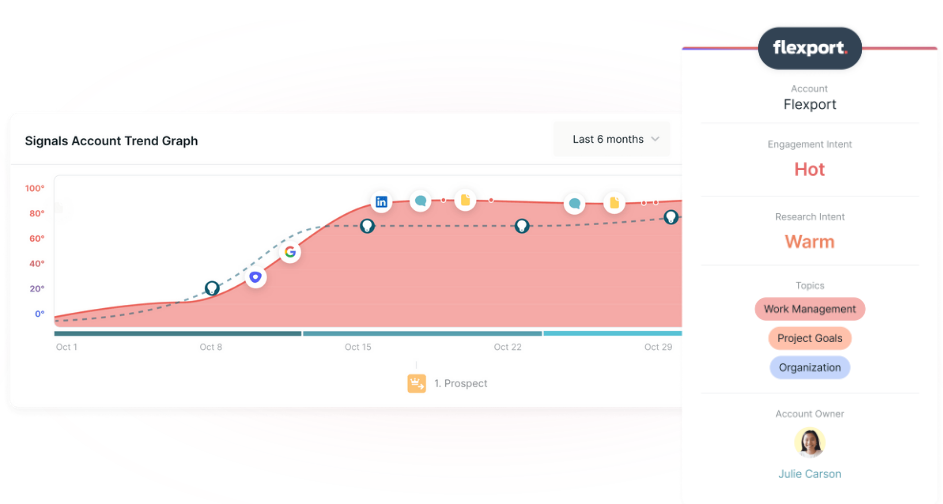
Qualified brings account segmentation with waterfall enrichment and its AI Signals layer, which combines first-party website engagement data, third-party research intent from Bombora (processing an average of 16 billion monthly content consumption events across 5,000+ sites), and Salesforce CRM data.
The result is an intent score per account that helps prioritize which visitors deserve attention. This works well for identifying high-intent website visitors.
Source: Qualified
Intercom maintains customer records within its platform (conversation history, behavioral data, custom attributes) and makes this context available to both Fin and human agents.
But Intercom does not provide B2B contact databases, company attributes, org charts, technographics, or buyer intent signals. It's not designed to. Its data model serves customer support, not sales prospecting.
ZoomInfo operates at a different scale.
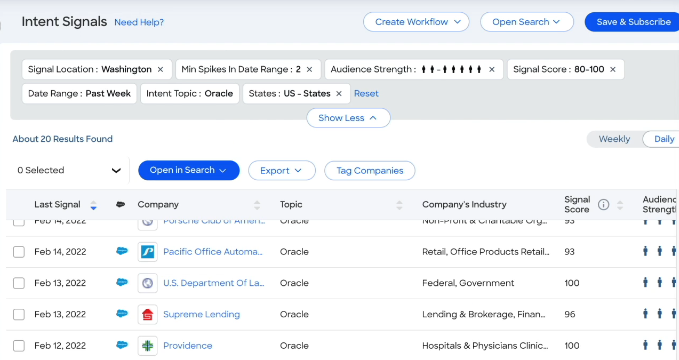
The platform holds 500M contacts, 100M companies, 135M+ verified phone numbers, 120M direct-dial phone numbers, and 200M+ verified business email addresses, verified through a multi-source pipeline backed by 300+ human researchers and reaching up to 95% accuracy on first-party data.
Buyer Intent tracks signals from 210 million IP-to-Organization pairings and 6 trillion+ new keyword-to-device pairings sourced monthly. Guided Intent, exclusive to ZoomInfo, identifies topics historically correlated with deal success rather than requiring manual topic selection. Technographics profile the tech stack of 30+ million companies across 30,000+ technologies.
Source: ZoomInfo
This matters because any engagement tool is constrained by the data behind it. A website chat widget can only personalize as well as its data allows. An AI SDR can only prioritize accounts as accurately as its intent signals. And a pipeline generation platform can only deliver ROI when the contacts it surfaces are real people at real companies with verified contact information.
In a Fortune 500 competitive RFP analyzing 25 million contacts across vendors, the independent consultant concluded that "no other competitor came even close" to ZoomInfo's data.
Spekit found that opportunities at higher-scoring accounts were 43% more likely to turn into qualified pipeline and moved 58% faster through qualification. (Spekit)
Pricing models reflect different markets
The pricing structures reveal who each platform is designed for.
Qualified publishes no prices.
All three tiers (Premier, Enterprise, Ultimate) require a demo and custom quote. There is no free trial or free tier. Qualified markets to companies with dedicated SDR teams, and the enterprise positioning suggests minimum contracts in the tens of thousands per year. Qualified gates features by tier: multi-language support requires Enterprise; multiple production instances require Ultimate; third-party intent signals unlock at Enterprise.
Intercom uses hybrid pricing: $29/seat/month (Essential), $85/seat/month (Advanced), or $132/seat/month (Expert), billed annually.
On top of seat costs, Fin AI Agent charges $0.99 per resolved outcome. Additional layers include Copilot unlimited usage at $29/agent/month, the Pro analytics suite at $99/month, and Proactive Support Plus at $99/month. A 14-day free trial is available with no credit card required. Workflows automation and round-robin assignment require the Advanced plan; SLAs are gated to Expert.
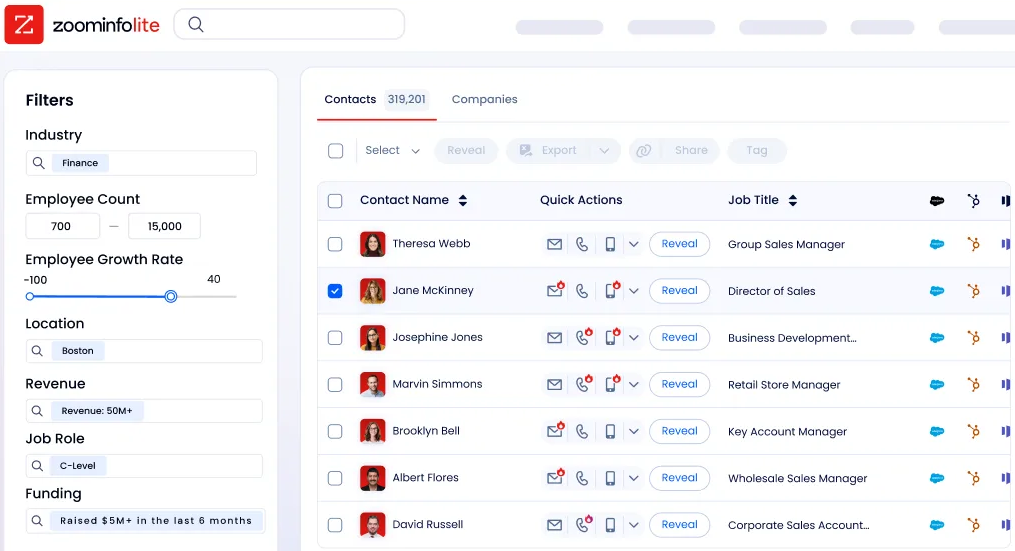
ZoomInfo uses custom consumption-based pricing scaled around seats, credits, and feature access. No list prices are published, but ZoomInfo offers two free entry points that neither Qualified nor Intercom match: ZoomInfo Lite, a permanent free tier with access to 100M+ verified profiles and 10 monthly export credits, and a 7-day full-feature trial. This lets teams evaluate the data quality before committing to an annual contract.
Source: ZoomInfo
The cost comparison only makes sense relative to what you're buying. Qualified's price buys AI-powered inbound website conversion. Intercom's price buys AI-powered customer support. ZoomInfo's price buys a B2B data platform, intent signals, AI-powered seller and marketer tools, conversation intelligence, and website engagement across the GTM stack.
The Salesforce acquisition changes Qualified's trajectory
Salesforce looms over this comparison. Qualified was acquired by Salesforce on April 1, 2026, and the deal changes the competitive landscape.
What does the acquisition mean for Qualified users?
Salesforce plans to integrate Qualified's capabilities into its Agentforce platform. For current Salesforce customers, this could mean deeper native integration over time. For non-Salesforce shops, it introduces uncertainty. The product roadmap may shift toward Agentforce priorities rather than standalone Qualified development.
This matters because Qualified was already Salesforce-centric before the acquisition. Founded by former Salesforce executives, backed by Salesforce Ventures across all funding rounds, and ranked #1 on the Salesforce AppExchange, Qualified's value has always been tied to the Salesforce ecosystem. Companies running HubSpot, Microsoft Dynamics, or other CRMs already faced a shallower integration. The acquisition may widen that gap.
Intercom integrates with Salesforce, HubSpot, Pipedrive, and other CRMs through its App Store, but Intercom's value isn't tied to any specific CRM. Its helpdesk and AI agent work regardless of which CRM you run.
ZoomInfo integrates natively with Salesforce, HubSpot, and Microsoft Dynamics, with 120+ partner integrations across the broader ecosystem. Unlike Qualified, ZoomInfo is CRM-agnostic. Its data and intelligence are accessible through APIs and MCP in any front-end, so the choice of CRM doesn't constrain access to ZoomInfo's capabilities.
For Salesforce-first companies evaluating Qualified, the acquisition raises a choice: wait for the Agentforce integration and benefit from deeper native capabilities, or choose a platform with broader applicability and less dependency on a single vendor's roadmap.
Levanta's CEO Ian Brodie noted: "ZoomInfo's not just a contact data company anymore. They've built a full system of execution. GTM Intelligence actually works the list, writes the outreach, triggers the play, and helps drive predictable growth." (Levanta)
Integration ecosystems and technical infrastructure
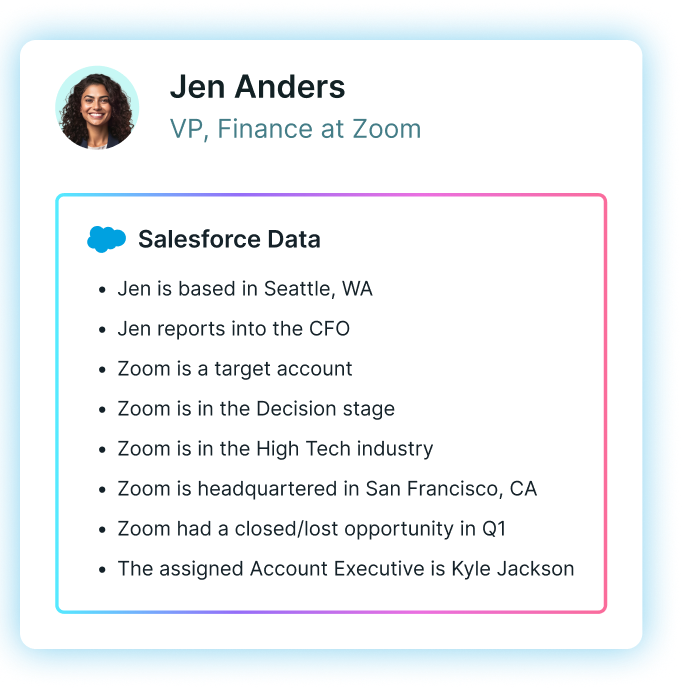
Qualified supports native integrations with Salesforce CRM, HubSpot, Marketo, Pardot, Eloqua, Outreach, Salesloft, 6sense, Demandbase, Gong, ZoomInfo, Slack, LinkedIn, Google Ads, and Microsoft Teams.
The Salesforce integration is the deepest, traversing custom objects and triggering personalization from real-time CRM data. APIs are available at the Enterprise tier. The ecosystem focuses on the B2B demand generation stack.
Source: Qualified
Intercom maintains an App Store with 350–450+ integrations across CRM, analytics, project management, e-commerce, and social channels.
Key integrations include Salesforce, HubSpot, Jira, Slack, Shopify, and Stripe. Intercom's REST API is mature (version 2.15) with official SDKs in PHP, Node.js, Ruby, Go, Java, and .NET. Rate limits allow 10,000 API calls per minute. The ecosystem is broad and platform-agnostic.
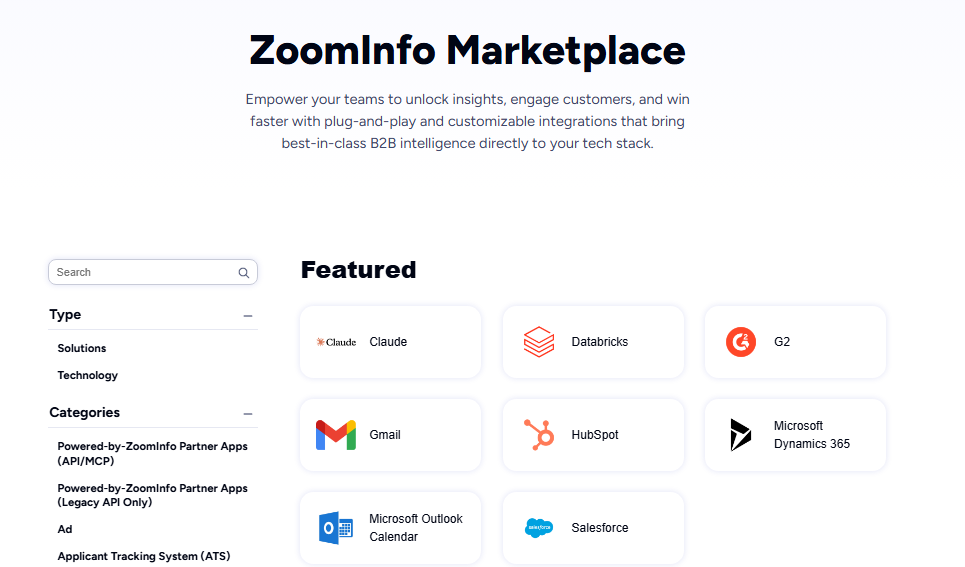
ZoomInfo operates the ZoomInfo App Marketplace with 120+ partner integrations across CRM, marketing automation, sales engagement, data warehouse, and communications platforms.
Beyond traditional integrations, ZoomInfo delivers data through Cloud Partners (AWS, Google Cloud, Snowflake, Databricks) and the MCP server, which connects AI models directly to ZoomInfo's B2B data. The Enterprise API exposes search, enrichment, AI intelligence, audience management, and engagement data endpoints. API access is included in all relevant plans.
Source: ZoomInfo
The integration story reinforces the platform distinction. Qualified connects to your sales stack. Intercom connects to your support stack. ZoomInfo connects to both and feeds intelligence into any tool through APIs and MCP.
BDO Canada's Jerry Wilson described ZoomInfo's API as "plug-and-play," achieving an 87% reduction in time spent on internal data dashboard updates. (BDO Canada)
Qualified vs. Intercom vs. ZoomInfo: Which should you choose?
The right platform depends on which problem you're solving.
Choose Qualified if:
Your primary goal is converting inbound website visitors into booked sales meetings
You run Salesforce as your CRM and want the deepest native integration
You have a demand generation or SDR function that can justify enterprise pricing
AI-powered text, voice, and video website engagement is a priority
You're comfortable with the implications of Salesforce's acquisition on the product roadmap
Choose Intercom if:
Your primary goal is resolving customer support tickets faster and at lower cost
You need an AI agent that handles email, chat, voice, WhatsApp, and social support from one inbox
Reducing time-to-resolution and improving CSAT across existing customers is the priority
You want measurable outcomes from AI support (Fin's $0.99/resolution pricing makes ROI transparent)
Your team needs a helpdesk, not a sales pipeline generation tool
Choose ZoomInfo if:
You need the data foundation that powers your go-to-market, not just one conversation channel
Verified B2B contact data, buyer intent signals, and account intelligence are central to your strategy
You want AI agents that research accounts, draft outreach, and surface buying signals across your full book of business
You need a platform that works across Salesforce, HubSpot, and Microsoft Dynamics equally
You want to start with a free tier or trial before committing to an annual contract
See ZoomInfo's data quality firsthand with ZoomInfo Lite (free) or a 7-day free trial.
Qualified and Intercom are both strong tools built for specific jobs. But they each cover one piece of the customer lifecycle. For B2B companies that want data, intelligence, and execution in one platform, ZoomInfo provides the foundation that specialized tools build on, and a growing set of native tools that handle many of those jobs itself.
Qualified vs. Intercom vs. ZoomInfo FAQ
What is the fundamental difference between Qualified, Intercom, and ZoomInfo?
Qualified is an AI SDR platform that converts inbound website visitors into a sales pipeline through autonomous text, voice, and video conversations.
Intercom is an AI-powered customer service helpdesk that resolves support tickets across chat, email, voice, and social channels.
ZoomInfo is an AI GTM platform built on a large B2B dataset, covering prospecting, intent signals, account intelligence, conversation intelligence, and multi-channel execution across the sales and marketing motion.
Can Qualified and Intercom replace each other?
No. Qualified is built for pre-sale pipeline generation. It engages website visitors, qualifies them, and books sales meetings. Intercom is built for post-sale customer service. It resolves support tickets and deflects help desk volume. They serve different teams (marketing and sales vs. customer support) at different stages of the customer lifecycle. A company may need both, but one cannot substitute for the other.
Which platform has the strongest AI capabilities?
Each platform's AI excels at its specific job.
Qualified's Piper uses agentic reasoning to conduct multi-modal sales conversations and book meetings autonomously. Intercom's Fin uses a proprietary seven-model suite (including Apex 1.0) to resolve 67% of support queries without human intervention. ZoomInfo's AI agents in GTM Workspace research accounts, draft outreach, and surface buying signals by reasoning across the GTM Context Graph, which processes 1.5 billion data points daily.
Which platform offers the best free entry point?
ZoomInfo offers the most accessible entry. ZoomInfo Lite is a permanent free tier with access to 100M+ verified profiles and 10 monthly export credits, plus a separate 7-day full-feature trial. Intercom offers a 14-day free trial with no credit card required. Qualified has no free trial or free tier. Access requires scheduling a demo and negotiating an enterprise contract.
How does the Salesforce acquisition of Qualified affect the comparison?
Salesforce completed its acquisition of Qualified on April 1, 2026, with plans to integrate Qualified's capabilities into its Agentforce platform. For Salesforce customers, this may eventually mean deeper native integration. For companies using other CRMs, the acquisition raises uncertainty about Qualified's standalone product roadmap and may deepen its Salesforce dependency. ZoomInfo and Intercom both operate independently of any single CRM vendor.
Which platform is best for B2B pipeline generation?
ZoomInfo is the broadest option, combining verified B2B contact data (500M contacts, 135M+ verified phone numbers), buyer intent signals, AI-powered seller tools, and multi-channel execution. Qualified is a strong specialized choice for converting inbound website traffic into meetings, particularly for Salesforce-centric organizations. Intercom is not designed for pipeline generation.
Does ZoomInfo have website chat capabilities like Qualified and Intercom?
Yes. ZoomInfo Chat identifies the company behind anonymous website visitors using ZoomInfo's database, then triggers tailored chat experiences based on company profile, intent signals, and relationship status.
Unlike Qualified (which focuses on AI-driven sales conversations) or Intercom (which focuses on support resolution), ZoomInfo Chat is backed by ZoomInfo's B2B dataset and integrates into the broader GTM platform for prospecting, enrichment, and outreach.
Which platform has the most transparent pricing?
Intercom is the most transparent, publishing per-seat pricing across three tiers ($29 to $132 per month) plus documented per-resolution AI pricing ($0.99) and add-on costs.
ZoomInfo publishes tier names and feature breakdowns but requires custom quotes for pricing, while offering a permanent free tier for evaluation. Qualified publishes neither pricing nor tier details. All access is gated behind a sales conversation.
More Qualified and Intercom comparisons:
