
Choosing between QuotaPath and CaptivateIQ for sales compensation management comes down to five questions:
Are you replacing spreadsheets for the first time, or migrating off a legacy platform that's too rigid?
Do you need your RevOps team to own plan changes independently, or are you comfortable relying on vendor support?
Is your commission logic straightforward (quotas, tiers, bonuses), or do you run multi-source, multi-currency structures across thousands of payees?
How important is it that your reps understand exactly how their paycheck was calculated?
Does your compensation strategy need to connect upstream to the data that drives quota setting, territory carving, and pipeline quality?
In short, here's what we recommend:
QuotaPath fits small-to-mid-market teams that want transparent pricing, fast implementation, and a self-service experience. Its AI-Powered Plan Builder lets RevOps create and modify plans without vendor involvement, and the rep-facing earnings dashboard gives sellers real-time visibility into every deal's commission breakdown. However, QuotaPath cannot merge multiple sources simultaneously, and companies with complex enterprise compensation structures will hit its ceiling.
CaptivateIQ serves mid-market and enterprise organizations whose commission logic demands a more capable calculation engine. Its SmartGrid ELT engine processes 10M+ source transactions in 12 seconds, and the platform handles multi-tier accelerators, split credit, and territory overlays through a no-code interface. CaptivateIQ also unifies incentive compensation with sales planning (territory management, quota setting, capacity planning) in one platform. The trade-off: initial setup is complex, implementation can take 4–6 months, and pricing is entirely quote-based with no public transparency.
Both platforms solve commission calculation and payouts well. But compensation accuracy depends on something neither provides: the quality of the data feeding your plans. Territory assignments, quota targets, and deal attribution are only as good as the account intelligence behind them. That's where the upstream data layer matters.
ZoomInfo is an AI GTM platform built on 500M contacts, 100M companies, 135M+ verified phone numbers, and 200M+ verified business emails. While QuotaPath and CaptivateIQ calculate what reps earn after deals close, ZoomInfo helps ensure the right deals reach the right reps in the first place. Its GTM Context Graph processes 1.5B+ data points daily, combining this data with your CRM records, conversation transcripts, and behavioral signals to reveal which accounts are in-market, who the decision-makers are, and how territories should be carved. Teams access this intelligence through GTM Workspace for sellers, GTM Studio for marketers and RevOps, or APIs and MCP in any front-end. For revenue leaders who want their compensation plans built on accurate data from the start, ZoomInfo is the foundation that makes either commission platform more effective.
If ensuring your comp plans are built on accurate accounts and contact data sounds like the missing piece, see how ZoomInfo works.
QuotaPath vs. CaptivateIQ vs. ZoomInfo at a glance
QuotaPath | CaptivateIQ | ZoomInfo | |
|---|---|---|---|
Best for | SMB to mid-market teams replacing spreadsheets | Mid-market to enterprise with complex commission logic | Upstream data quality powering accurate territory, quota, and pipeline decisions |
Pricing | Quote-based; no public pricing | Consumption-based pricing; free tier available | |
Implementation | |||
Free trial | No free trial; product tours only | 7-day free trial + permanent free tier | |
Plan complexity | Standard quotas, tiers, bonuses, SPIFs | Multi-tier accelerators, splits, overlays, draws, partner commissions across 7,000 simultaneous plans | N/A (data and intelligence layer) |
AI capabilities | Atlas AI Revenue Strategist for plan grading and modeling | CaptivateIQ Agents for plan building, rep Q&A, territory configuration | GTM Context Graph powering account insights, signals, and outreach |
Sales planning | No territory or capacity planning | Unified planning: territory, quota, and capacity | Territory intelligence via 300+ company attributes, org charts, technographics |
Data sources | 25+ native integrations; single-source per plan | 19 native connectors + SmartGrid in-app ELT | 500M contacts, 100M companies; 172+ Marketplace integrations |
Analyst recognition | G2 Leader (Small-Business) | Forrester Wave Leader Q1 2025; Gartner Customers' Choice 2024 | Gartner MQ Leader (ABM Platforms); Forrester Wave Leader (Intent Data) |
QuotaPath makes self-service the default
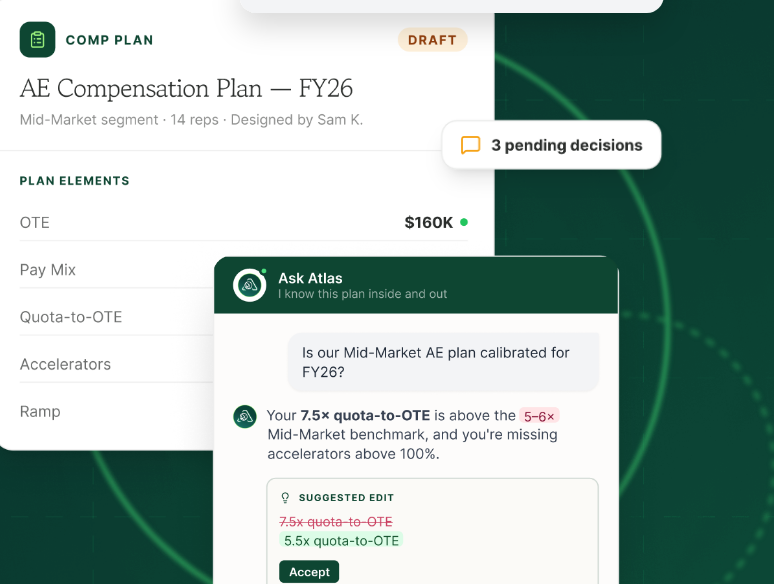
QuotaPath was built for RevOps teams who want to own their compensation operations without filing support tickets or hiring consultants. The platform's component-based plan builder treats quotas, accelerators, bonuses, and SPIFs as modular pieces that admins assemble, modify, and duplicate across roles on their own.
This matters because commission plans change. Mid-year accelerator adjustments, new product SPIFs, territory reshuffles all require plan updates.
Source: QuotaPath
The AI-Powered Plan Builder speeds up initial setup by reading uploaded compensation documents (PDFs or similar) and generating plan components automatically. Admins review the AI's output, adjust where needed, and publish. For teams creating plans from scratch, a text prompt mode accepts natural-language descriptions and builds the structure accordingly.
QuotaPath excels in speed to go-live. The average implementation timeline is 45–60 days, far faster than enterprise competitors.
But speed comes with constraints.
QuotaPath cannot merge multiple sources simultaneously, meaning companies whose commission calculations depend on data from a CRM, an ERP, and a data warehouse must choose a primary source or find workarounds. Enterprise structures involving territory overlays, matrix-based SPIFs, or multi-currency logic will push the platform past its design scope.
CaptivateIQ handles enterprise-grade complexity
CaptivateIQ targets a different problem: organizations whose commission logic is so complex that spreadsheets break and basic tools cannot express the rules. Multi-tier accelerators with split credit across overlapping territories, draw-against-commission structures, and partner channel payouts (CaptivateIQ's SmartGrid engine handles all of it).
The numbers back the scale claim.
SmartGrid processes worksheets with 10M+ source transactions in 12 seconds, loads up to 50M records per data sync, and runs over 6.25 trillion calculations per month across the platform. The system supports up to 7,000 simultaneous plans, accommodating large enterprises with hundreds of roles, regions, and plan variants.
Source: CaptivateIQ
Where CaptivateIQ differentiates from QuotaPath is in its unified planning and incentives architecture.
CaptivateIQ Planning covers territory management, quota setting, and sales capacity planning on the same data layer as commission calculations. When a quota changes in Planning, it automatically syncs to Incentives, with no manual reconciliation between disconnected tools.
The trade-off is setup time and cost.
G2 reviewers note that because CaptivateIQ is a "white canvas," initial configuration requires significant internal resources and a thorough understanding of plan structure. Implementation can take 4–6 months for complex deployments. And with no published pricing, buyers enter negotiations without a baseline, a friction point QuotaPath avoids entirely.
ZoomInfo strengthens the foundation both platforms depend on
QuotaPath and CaptivateIQ both assume that the data flowing into them (deal records, territory assignments, quota targets) is accurate. Neither platform creates that data.
This is where ZoomInfo fills a different role in the revenue stack.
ZoomInfo is an AI GTM platform whose GTM Context Graph processes 1.5B+ data points daily to unify B2B contact and company intelligence with a customer's own CRM records, conversation transcripts, and behavioral signals. The result is a continuously updated intelligence layer that reveals not just who your buyers are, but when they're in-market and why deals are moving.
For compensation leaders, this upstream data quality matters in three specific ways:
Territory design based on real market data.
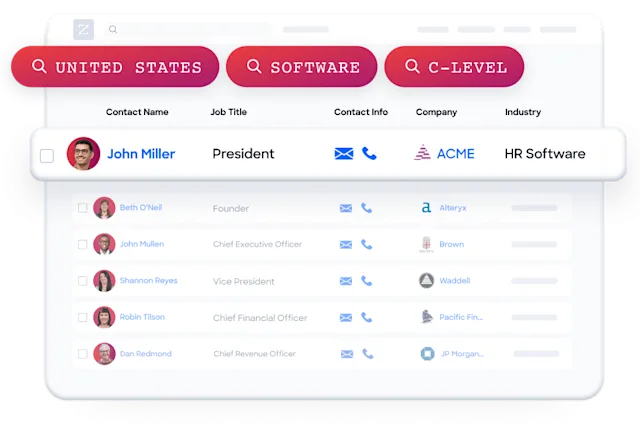
Quota fairness starts with territory fairness. ZoomInfo's 300+ company attributes, corporate hierarchies, and technographic data covering 30M+ companies provide the raw inputs for carving territories that reflect actual market opportunity. CaptivateIQ's Planning module can model territory scenarios, but the quality of those models depends on the data feeding them.
Source: ZoomInfo
Quota targets grounded in addressable markets.
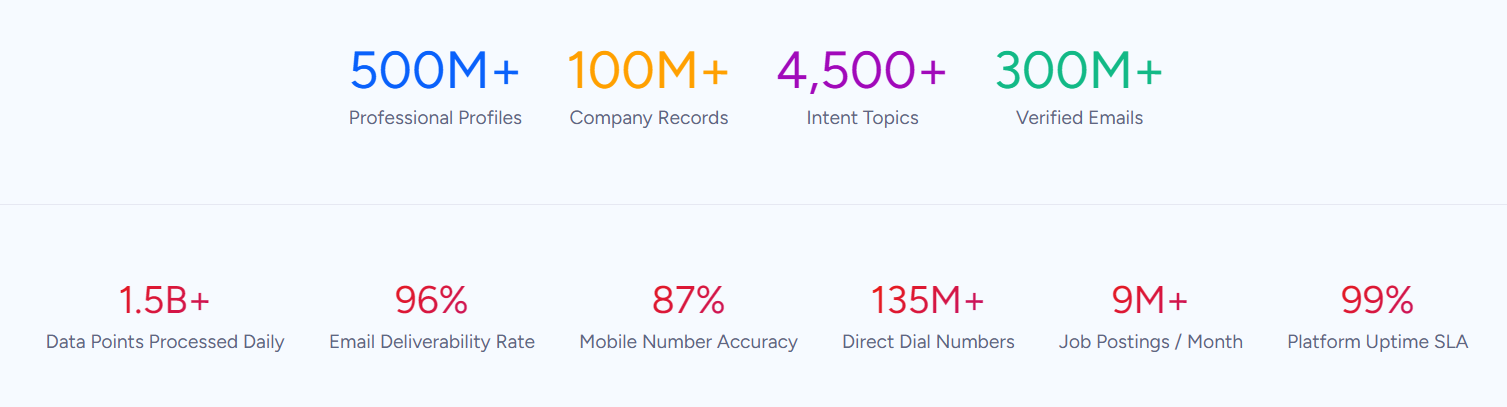
Quotas set from incomplete account data produce unattainable targets, missed payouts, and rep turnover. ZoomInfo's coverage of 500M contacts and 100M companies ensures the TAM analysis behind quota allocation reflects reality.
Source: ZoomInfo
Pipeline quality that makes commission plans work as designed.
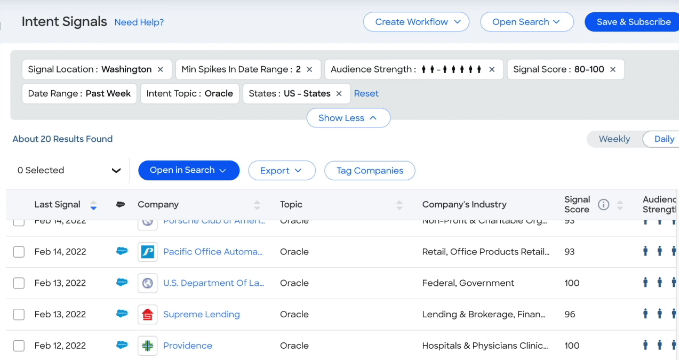
A comp plan optimized for a specific deal profile fails if reps chase the wrong accounts. ZoomInfo's Buyer Intent data identifies which accounts are actively researching solutions, and GTM Workspace surfaces AI-prioritized accounts with pre-drafted outreach. Seismic attributed 39% of active pipeline to opportunities identified or influenced by ZoomInfo signals and reported 54% productivity gains.
Source: ZoomInfo
"That combination of our internal CRM data, external signals, and AI that's given all that context has helped us craft very specific account- and persona-based messages. And people have responded to them right away." (Toby Carrington, CBO, Seismic)
ZoomInfo's intelligence is accessible through APIs and MCP, so it flows into whatever tools your team uses. The same data that helps a seller identify the right account in GTM Workspace can enrich a CRM record that feeds into QuotaPath or CaptivateIQ for commission calculation.
Rep-facing transparency takes different forms
Both platforms recognize that reps who distrust their commission statements waste time shadow-accounting in private spreadsheets. But they solve this differently.
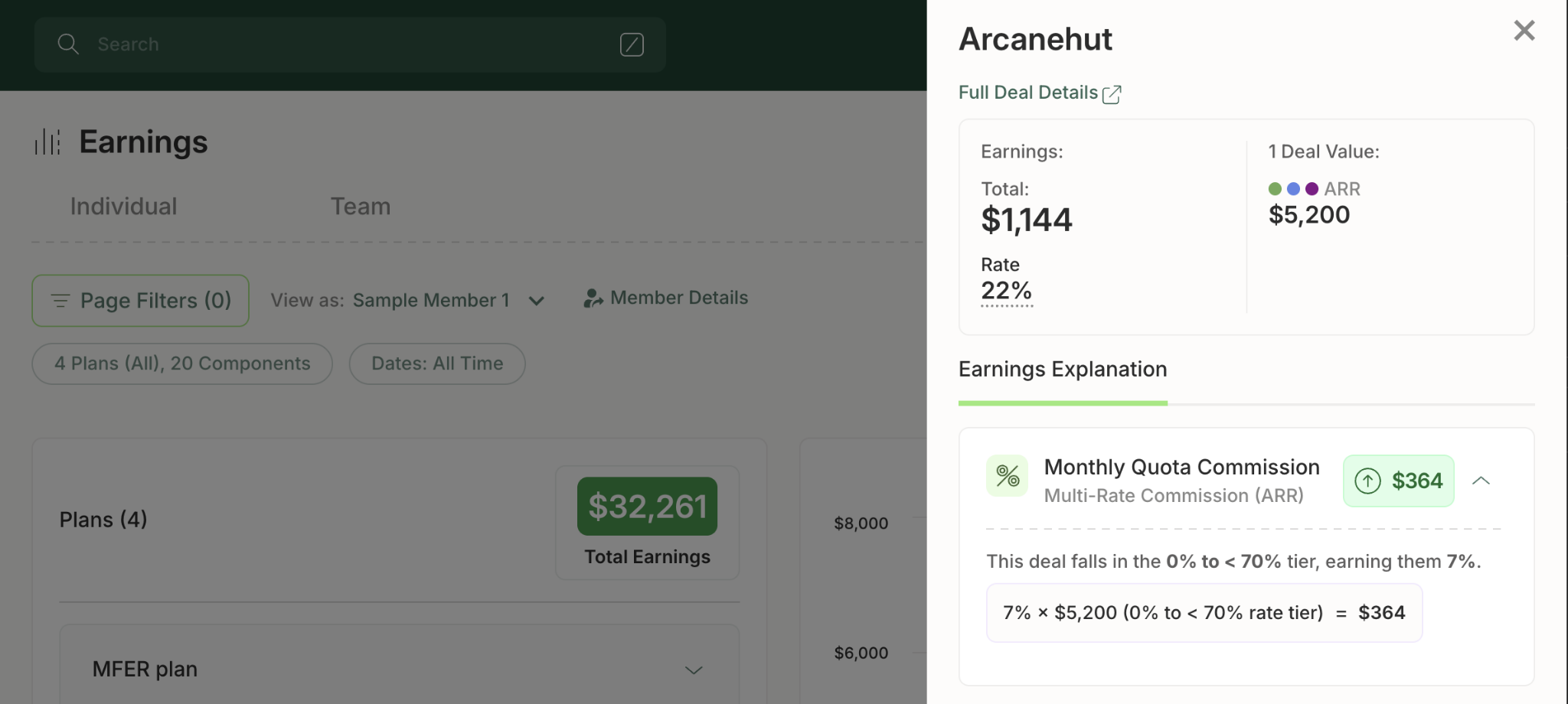
QuotaPath's rep experience centers on real-time earnings dashboards that show component-level cards, deal-level breakdowns grouped by stage, and time-series earnings graphs.
From any deal, reps can open an Earnings Explanation panel showing the step-by-step math behind each commission. This is plain-language transparency, built for reps who want to verify their own numbers without asking finance.
Source: QuotaPath
CaptivateIQ approaches transparency through AI.
Its Comp Ops Agent generates plain-English narratives explaining every line item on a statement, citing the exact plan clauses and underlying transactions. Reps can ask natural-language questions about their earnings and get answers grounded in their actual plan rules.
The difference: QuotaPath gives reps a dashboard to check themselves. CaptivateIQ gives reps an AI that explains the answer. Both reduce disputes, but QuotaPath's approach works without AI dependencies, while CaptivateIQ's scales better when plan complexity makes manual verification impractical.
Pricing reveals different market strategies
QuotaPath is the only platform in this comparison with publicly listed pricing. Two tiers are available:
Growth: $35/user/month + $525/month platform fee (includes first 5 users)
Premium: $50/user/month + $800/month platform fee (includes first 5 users)
This transparency is a deliberate competitive move. QuotaPath is the only platform offering a free trial in its competitive set, and the published rates let buyers model total cost before a sales conversation. However, a Capterra reviewer described the pricing as "misleading" because the mandatory platform fees and annual billing requirement push the actual cost well beyond the headline per-user rates.
CaptivateIQ does not publish price points. All pricing is quote-based, with costs determined by the number of payees, plan complexity, and the integrations required.
The pricing page describes "simple, per-seat pricing" that doesn't skyrocket over time plus a one-time setup fee, but two customers with the same headcount could receive different quotes. Additional costs include connector fees, ASC-606 reporting as an add-on, and Premier or Elite Support tiers for commission plan configuration guidance.
For a 50-person sales team, QuotaPath's costs are calculable in advance. CaptivateIQ's costs require a conversation. Neither approach is inherently better; it depends on whether your procurement process values predictability or negotiation flexibility.
Data integrations determine what's possible
Commission accuracy starts with data. Both platforms connect to CRMs and financial systems, but their integration architectures differ in important ways.
QuotaPath connects to 25+ native sources across CRMs (Salesforce, HubSpot, Close, Pipedrive, Zoho, Copper, and more), accounting/ERP (QuickBooks, NetSuite, Xero, Sage Intacct), payment processors (Stripe, Chargebee), data warehouses (BigQuery, Snowflake), and HRIS (Rippling).
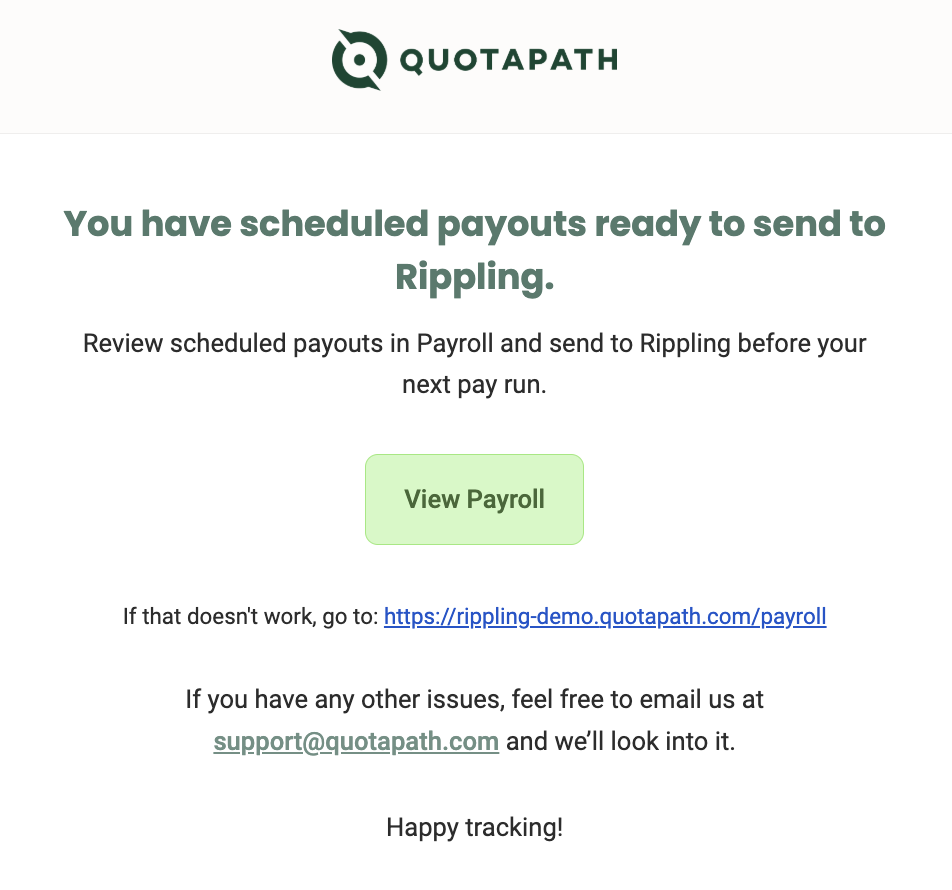
The Rippling integration stands out: resolved commissions push directly into a Rippling payroll run, closing the loop from deal close to paycheck without manual export.
Source: QuotaPath
QuotaPath also supports cross-source data joining via a shared unique ID (for example, pulling deal data from HubSpot and invoice data from QuickBooks to calculate cash-collected commissions). But this is limited to one-to-one or one-to-many relationships between two sources. Teams whose commission logic requires merging three or more data sources simultaneously will find this insufficient.
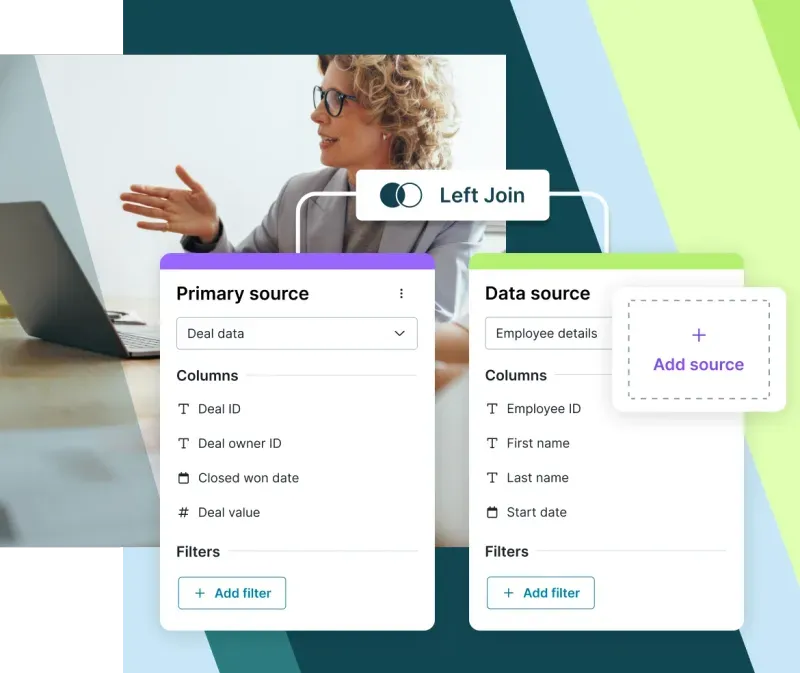
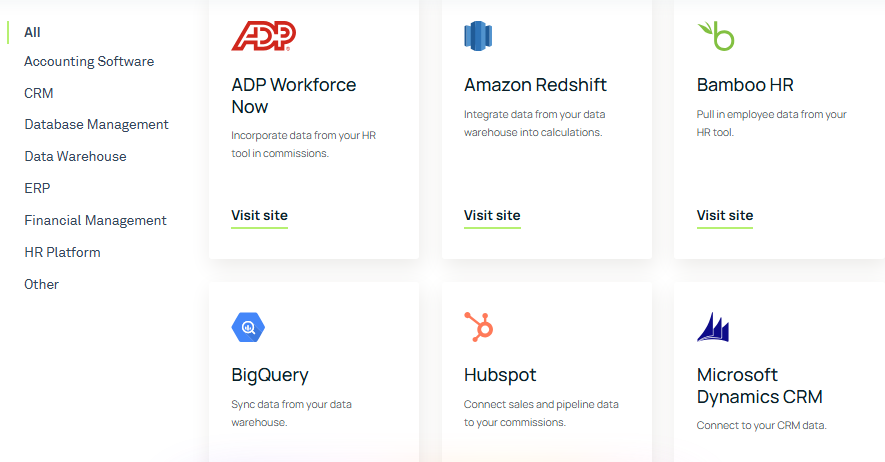
CaptivateIQ's SmartGrid handles data ingestion and transformation in-platform, functioning as a built-in ELT engine.
Compensation teams can pull raw data from CRMs, ERPs, HR platforms, and data warehouses, then shape and join it inside CaptivateIQ without building external data pipelines. The 19 native connectors cover Salesforce, HubSpot, Workday, ADP, NetSuite, Snowflake, BigQuery, and others.
Source: CaptivateIQ
The gap in CaptivateIQ's integration story is the absence of iPaaS connectors. G2 and TrustRadius users flag the lack of Zapier, Workato, and Make support, meaning teams needing workflow automation outside CaptivateIQ must use the raw API with engineering involvement.
AI capabilities serve different needs
All three platforms have invested in AI, but each targets a different part of the revenue workflow.
QuotaPath's Atlas is an AI Revenue Strategist focused on comp plan design and analysis.
Its Comp Plan Grader scores plans across five dimensions (Competitiveness, Motivation Alignment, Clarity, Attainability, Complexity) and generates ranked recommendations. The performance modeling engine runs Monte Carlo simulations to stress-test plans before rollout. Atlas exists in both a standalone mode (usable without a QuotaPath subscription) and a connected mode that pulls live workspace data, starting at $5,000 annually.
CaptivateIQ Agents target execution rather than strategy.
Three task-specific agents handle plan building from natural language (Comp Builder), payout explanation and anomaly detection (Comp Ops), and territory configuration (Rev Planning). These agents operate on live platform data, grounded in actual plan rules and calculations.
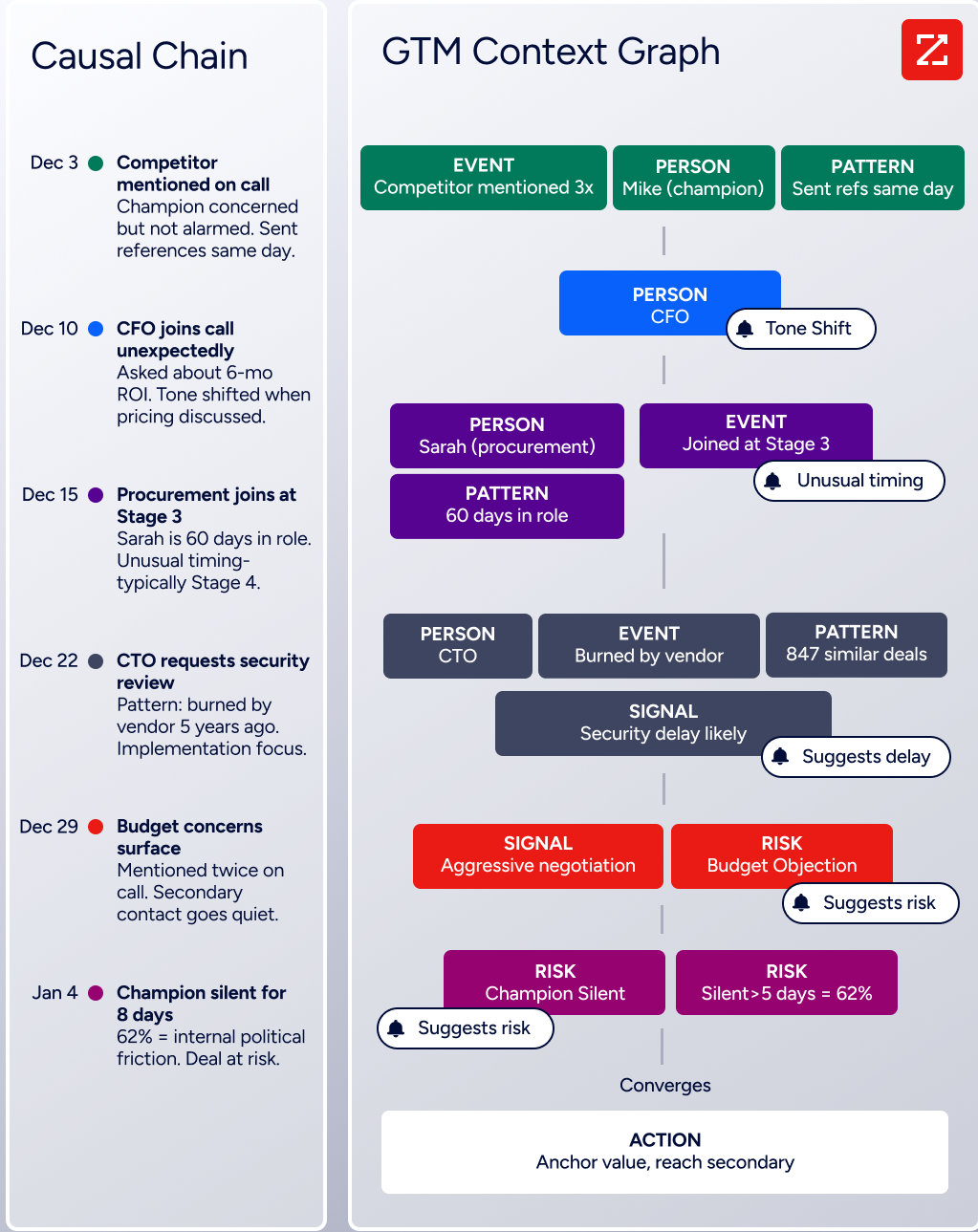
ZoomInfo's AI operates upstream, at the intelligence layer.
The GTM Context Graph doesn't just record what happened in a deal; it draws on conversation intelligence, intent signals, and behavioral data to surface why deals move or stall and predict what will happen next.
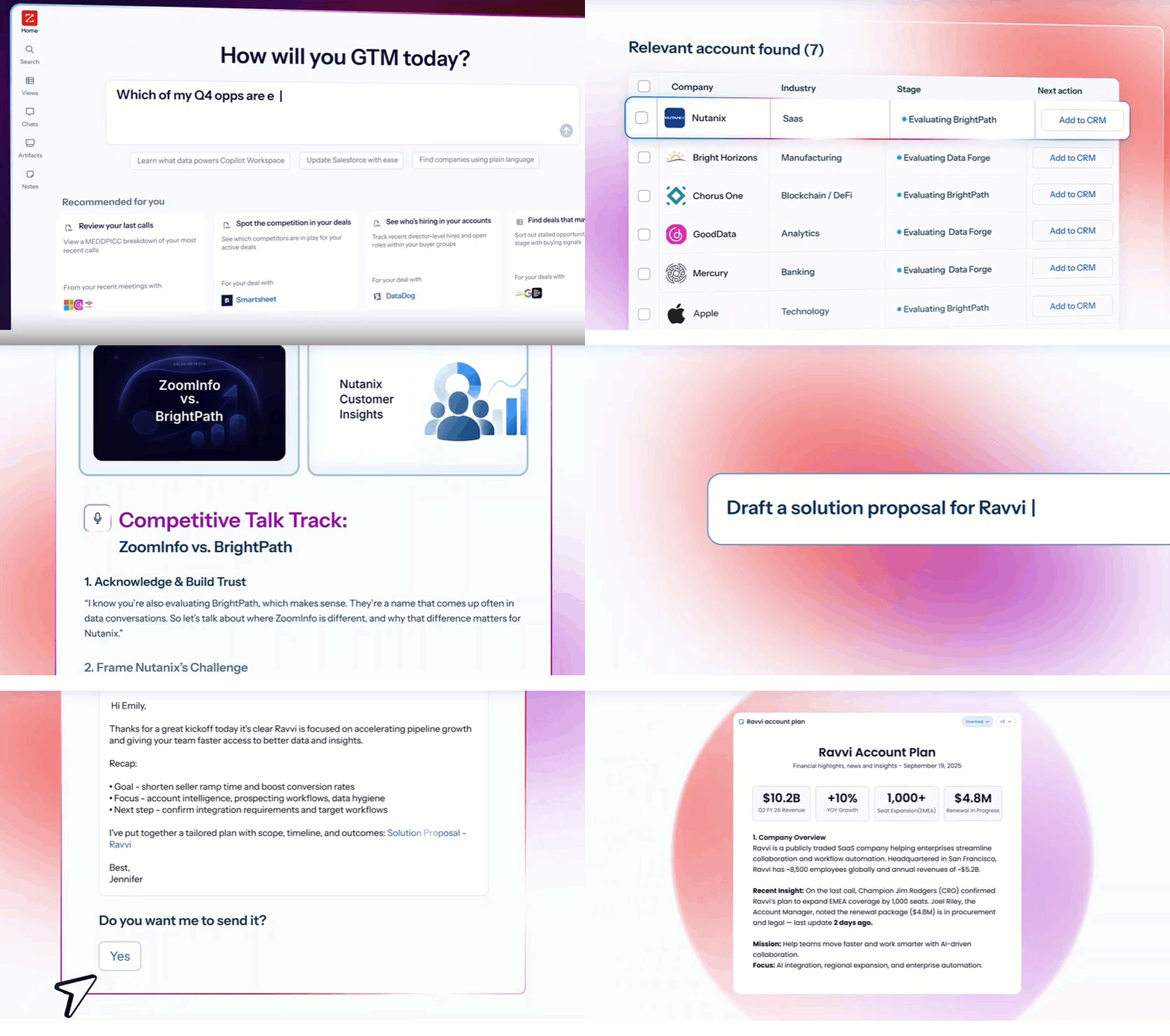
This intelligence powers AI-generated account briefs, buying group identification, and signal-driven outreach recommendations in GTM Workspace. For comp leaders, this means the deals entering your commission system are better qualified from the start.
Source: ZoomInfo
Support and implementation set the pace
QuotaPath's support is its most praised feature.
G2 gives QuotaPath a support score of 9.6, its highest-rated dimension. Every tier includes a dedicated CX manager and 1:1 implementation support. The Premium tier adds a dedicated data engineer and priority support. Multiple customer testimonials describe the onboarding experience as "all hands on deck."
CaptivateIQ's support earns high marks as well, with 94% CSAT from over 2,500 G2 reviews and a Gartner Customers' Choice distinction.
CSM responsiveness is frequently cited as a mitigating factor when implementation gets complex. However, commission plan configuration support requires a Premier or Elite Support upgrade, not included in the base subscription. Basic support covers bug resolution and general guidance but not plan-logic build assistance.
The implementation timelines tell a clear story: QuotaPath's 45–60 day average versus CaptivateIQ's 4–6 months for complex deployments. For organizations that need to be live before the next compensation cycle, this difference matters.
ZoomInfo approaches support differently, matching its platform-level role.
The company redesigned its onboarding program from 30 to 90 days, producing a 25% improvement in CSAT. ZoomInfo University provides role-specific learning paths and certifications, and the platform earned Gartner Customers' Choice status as the only vendor in that quadrant.
Compliance and security for finance teams
Commission data is financial data, and finance teams evaluating these platforms need audit controls, compliance reporting, and data protection.
QuotaPath provides SOC 2 Type 1 certification with continuous compliance monitoring via Drata. SSO is available through both Okta and Microsoft Entra ID on Growth and Premium tiers.
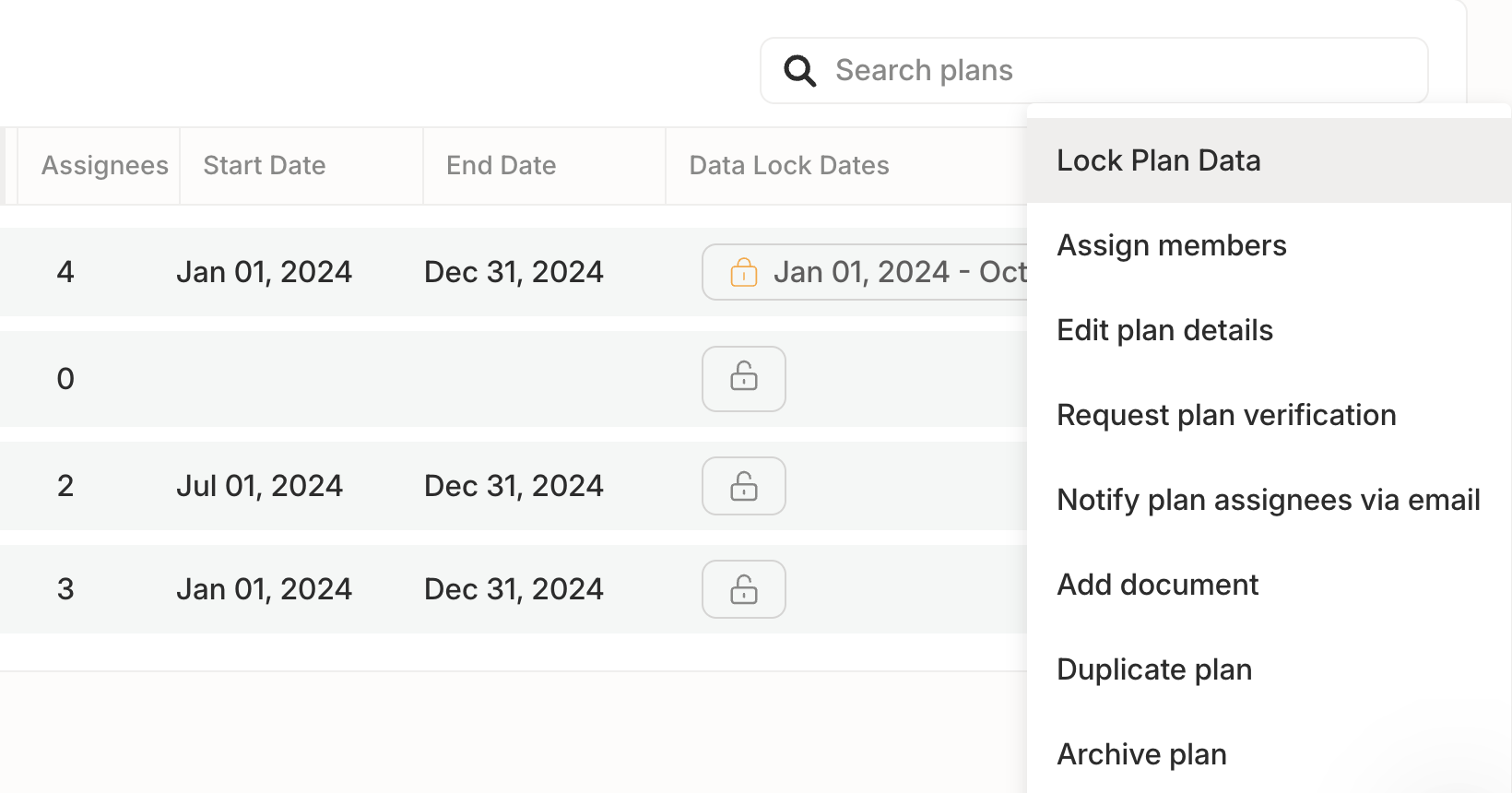
The ASC 606 Ledger handles commission expense recognition with straight-line amortization or immediate recognition, available on Growth tier and above. Plan data can be locked for specific date ranges to freeze figures after close-of-period.
Source: QuotaPath
CaptivateIQ holds annual SOC 1 and SOC 2 audits covering Security, Availability, and Confidentiality. A dedicated SOX compliance page details six controls: segregation of duties, change control with statement locking, audit logging, granular access control, compliance reporting, and data protection (AES-256 encryption at rest, TLS 1.2 in transit).
ASC 606 reporting is available as an add-on subscription. For public companies or those preparing for SOX compliance, CaptivateIQ's controls are more mature.
ZoomInfo maintains the broadest compliance stack: ISO 27001, ISO 27701, SOC 2 Type II, TRUSTe GDPR and CCPA certifications, all renewed annually. As a registered data broker in California and Vermont, ZoomInfo's compliance infrastructure reflects its role handling sensitive B2B contact data at scale.
QuotaPath vs. CaptivateIQ vs. ZoomInfo: Which should you choose?
The best choice depends on where your biggest compensation pain point lives: in the calculation, in the strategy, or in the data feeding both.
Choose QuotaPath if:
Your team has outgrown spreadsheets but doesn't need enterprise-grade plan complexity
Self-service plan management without vendor dependencies is a priority
You want transparent, published pricing you can model before talking to sales
Fast implementation (45–60 days) matters more than configurability
Your CRM is HubSpot or Salesforce and your commission structures are straightforward
Choose CaptivateIQ if:
Your commission logic involves multi-tier accelerators, split credit, territory overlays, or partner payouts
You need territory management, quota setting, and capacity planning unified with incentive compensation
SOX compliance and enterprise audit controls are requirements
You have the internal resources and timeline (4–6 months) for a thorough implementation
You're scaling beyond 500 payees with multiple plan variants
Add ZoomInfo if:
Your territory and quota decisions need to be grounded in accurate, comprehensive account data
You want AI-driven signals showing which accounts are in-market before reps start prospecting
Your comp plan effectiveness depends on pipeline quality and deal accuracy upstream
You need a data layer that feeds any downstream tool (including commission platforms) via API and MCP
You want your sellers walking into every conversation with full buying group intelligence
See how ZoomInfo's data and intelligence can strengthen your revenue stack with a free trial.
"ZoomInfo is our one source of truth for account data, and even more so for contact data. There's no other provider in the market that provides you with that level of detail." (Thor Sanderson, Senior Manager of Sales Technology Enablement, Smartsheet)
The strongest revenue operations teams don't choose between compensation management and data quality. They invest in both. QuotaPath or CaptivateIQ handles the calculation and payout layer. ZoomInfo ensures the data driving those calculations reflects reality. Together, they create a compensation system where territories are fair, quotas are achievable, and reps trust their paychecks.
QuotaPath vs. CaptivateIQ vs. ZoomInfo FAQ
What is the core difference between QuotaPath and CaptivateIQ?
QuotaPath is built for small-to-mid-market teams that want fast, self-service commission management with transparent pricing ($35–$50/user/month plus platform fees).
CaptivateIQ targets mid-market and enterprise organizations with complex commission logic, offering a SmartGrid calculation engine that handles multi-tier accelerators, split credit, and territory overlays across thousands of payees. CaptivateIQ also includes unified sales planning (territories, quotas, capacity) in one platform, which QuotaPath does not offer.
Which platform is faster to implement?
QuotaPath averages 45–60 days, with some customers like SeekOut going live in two weeks. CaptivateIQ implementations can take 4–6 months for complex deployments. The difference reflects platform scope: QuotaPath prioritizes speed and simplicity, while CaptivateIQ accommodates more intricate commission structures that require deeper configuration.
How does ZoomInfo relate to commission management platforms?
ZoomInfo is not a commission management tool. It is an AI GTM platform that provides the upstream data quality commission platforms depend on. Territory assignments, quota targets, and deal attribution are only as accurate as the account and contact data behind them. ZoomInfo's 500M contacts, 100M companies, and GTM Context Graph ensure the data feeding your commission calculations reflects actual market reality.
Which platform has better AI capabilities?
Each platform's AI targets a different problem.
QuotaPath's Atlas AI grades comp plans against benchmarks, runs Monte Carlo simulations, and models scenarios. CaptivateIQ's Agents build plans from natural language, explain payouts to reps, and configure territories. ZoomInfo's GTM Context Graph connects CRM data, conversation intelligence, and buying signals to identify which accounts are in-market and why deals are moving.
The best fit depends on whether your bottleneck is plan design, plan execution, or upstream pipeline quality.
Can I use both a commission platform and ZoomInfo together?
Yes. ZoomInfo's data flows into your CRM through native integrations and APIs, enriching the deal, contact, and account records that QuotaPath or CaptivateIQ then use for commission calculations. ZoomInfo strengthens territory carving, quota allocation, and pipeline quality upstream, while the commission platform handles calculation and payout downstream.
Which platform is better for a company with fewer than 100 reps?
QuotaPath is the stronger fit for smaller teams. Its transparent pricing, 30-day free trial, and 45–60 day implementation timeline suit organizations that need to move quickly without dedicated implementation resources. CaptivateIQ's strength becomes relevant when commission logic exceeds what QuotaPath's component library can express.
Does either platform offer SOX compliance controls?
CaptivateIQ has more mature SOX controls, with a dedicated SOX compliance page detailing segregation of duties, change control with statement locking, full audit logging, and ASC 606 reporting (available as an add-on).
QuotaPath offers ASC 606-compliant ledger and plan data locking on Growth tier and above, along with SOC 2 Type 1 certification, but does not publish SOX-specific control documentation at the same depth.
Which platform has better CRM integration?
QuotaPath has broader CRM coverage with 11 native CRM integrations including HubSpot support with lead and invoice object access. CaptivateIQ connects natively to Salesforce, HubSpot, and Microsoft Dynamics CRM but treats its in-platform SmartGrid ELT engine as the primary data transformation layer.
QuotaPath's HubSpot integration is a differentiator for HubSpot-native teams. CaptivateIQ's SmartGrid is a differentiator for teams that need to transform and join data from multiple sources before calculating commissions.
Comparing QuotaPath and CaptivateIQ? These related breakdowns go deeper:
