
The question behind every sales engagement API is the same: does it give you enough programmatic control to justify the dependency, or will you end up back in the dashboard for the operations that matter most?
Reply.io's API is a REST surface now on its third major version, with Bearer token authentication, a scope-based access control system, and endpoints spanning contacts, sequences, email and LinkedIn channels, inbox management, tasks, reporting, webhooks, and an AI SDR layer. The developer docs ship with OpenAPI specs, Postman collections, and an MCP server for AI-agent workflows.
For a platform that started as a lightweight email automation tool in 2014, that is a mature programmatic surface.
But coverage and depth are different questions.
The Reply.io API is likely the right choice if:
You need programmatic control over multichannel outreach sequences: creating email, LinkedIn, SMS, and call steps, enrolling contacts, and pulling analytics.
You are building a pipeline where contact management, sequence enrollment, reply handling, and campaign reporting happen through one API surface.
You want webhook-driven automation on email events (replies, opens, bounces, clicks) and LinkedIn engagement events.
You need to manage the AI SDR layer programmatically: knowledge bases, playbooks, offers, and intent signals via API.
You operate a multi-workspace agency and need Master or Organization API keys to impersonate users across teams.
However, it might not be the right fit if:
You need B2B data beyond what Reply's built-in database covers: org charts, corporate hierarchies, technographics, direct-dial phone numbers, or buyer intent signals at the API layer.
You need higher throughput than 100 requests per minute and 3,000 per hour, or your pipeline requires high-concurrency bulk operations.
You are building a multi-tenant integration that requires OAuth 2.0 with delegated access for each customer, rather than static API keys.
You need enrichment endpoints for contact and company intelligence: employment history, company financials, funding rounds, or technology stack detection.
Your pipeline requires AI-powered account research, lookalike expansion, or buying-committee recommendations at the API layer.
You need maintained official SDKs rather than raw HTTP calls against a REST surface.
In this case, consider the API from ZoomInfo, an AI GTM platform whose REST suite covers search, enrichment, AI intelligence, and audience management across 500M contacts and 100M companies, with OAuth 2.0 authentication, tiered rate limits up to 35 req/sec, and an MCP server for AI-agent workflows.
This article reviews both: the Reply.io API in full technical depth first, then ZoomInfo's API where your build needs the data and intelligence layer that outreach automation alone does not cover.
Reply.io API at a Glance
Attribute | Detail |
|---|---|
API type | REST over HTTPS, JSON request/response |
Authentication | Bearer token (API key in Authorization: Bearer YOUR_API_KEY header) |
Base URL | https://api.reply.io/v3 |
Current version | v3 (v1/v2 deprecated, still accessible at apidocs.reply.io) |
Rate limits | |
Pricing / access | Included on all paid plans ($49/user/month entry); no separate API tier |
SDKs | No official SDKs; OpenAPI specs, Postman collections, and MCP server provided |
Webhooks | Yes, outbound webhook system with configurable event types and scopes |
Documentation | docs.reply.io (v3 reference); apidocs.reply.io (legacy v1/v2) |
Reply.io API: What Works Well & What to Plan Around
What works well | What to plan around |
|---|---|
v3 API covers eight functional areas with consistent REST conventions | No official SDKs: you build and maintain the HTTP layer yourself |
Granular scope system (domain:verb format) for fine-grained access control | Rate limits are modest: 100 req/min, 3,000 req/hour per user |
Master API Key enables workspace-level impersonation across team members | Bearer token auth only: no OAuth 2.0 for delegated multi-tenant access |
OpenAPI specs in YAML, JSON, and OpenAPI 3.0 for client generation | Reporting endpoints carry stricter, undisclosed rate limits |
Webhook subscriptions support team-scope and payload enrichment flags | 50 active webhook subscription cap per account |
MCP server exposes the full API surface to AI agents (Claude, Cursor) | Contact enrichment endpoints marked "coming July 2026," not yet live |
Reply.io API: Authentication & Getting Started
API access starts with any paid Reply.io plan. The Email Volume plan at $49/user/month includes API access, as does the Multichannel plan at $89/user/month. A 14-day free trial covers all core features including the API and all native integrations, with no credit card required.
There is no separate developer signup or enterprise-only gate for basic API access, though enterprise plans (20+ seats) include "enhanced API" capabilities.
You create API keys in the Reply dashboard at Settings > API Key. Every request includes the key as a Bearer token:
curl -X GET "https://api.reply.io/v3/contacts" \
-H "Authorization: Bearer YOUR_API_KEY" \
-H "Content-Type: application/json"
You can verify credentials against the /v3/whoami endpoint, which returns the authenticated user's ID.
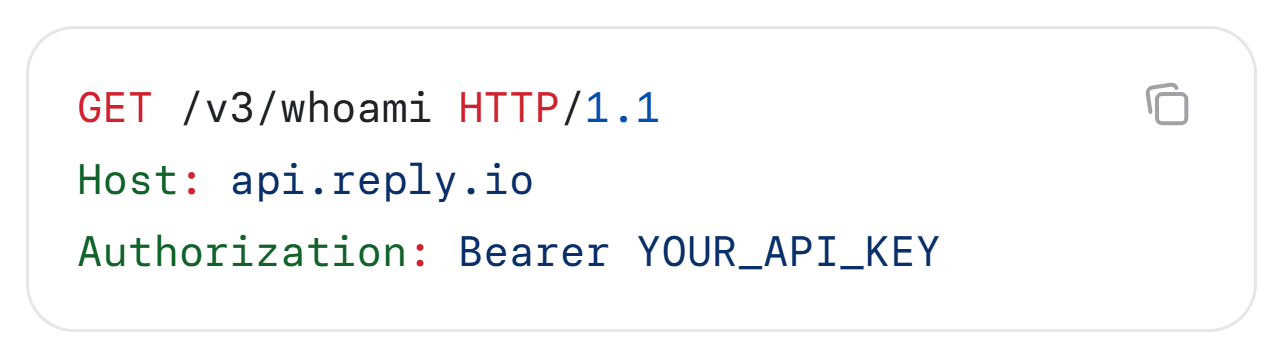
Source: Reply.io
Reply.io implements a granular scopes system using a domain:verb format:
Domains: settings, contacts, sequences, channels, inbox, tasks, reporting, webhooks, ai-sdr, other
Verbs: read (access data), write (create/update/delete), operate (trigger runtime actions)
Broader scopes satisfy narrower ones: write satisfies read, and contacts:* satisfies any contact verb
Two key types extend beyond the standard per-user API key:
Master API Key: Created by the workspace owner, this key provides workspace-level access and can impersonate any workspace user via X-User-Id or X-User-Email request headers.
Organization API Key: Provides org-wide access but requires impersonation headers (X-USER-ID or X-User-Email plus X-TEAM-ID) on every request. The API rejects requests without them.
Missing, invalid, or revoked keys return 401 Unauthorized with a WWW-Authenticate: Bearer header and no JSON body. There is no OAuth 2.0 flow documented for the v3 API.
Reply.io API: Core Endpoints & Capabilities
The v3 API organizes resources into eight functional areas with standard REST conventions: plural-noun resource paths, GET/POST/PATCH/DELETE verbs, JSON request and response bodies, and application/problem+json error responses with stable <resource>.<variant> error codes.
Long-running operations (email validation, bulk imports) return 202 Accepted with a Location header pointing to /v3/background-jobs/{id} for asynchronous status polling.
Contacts & Accounts
The contacts surface handles the full lifecycle of prospect data.
Operations: Contact CRUD, bulk actions, contact list management, and account list management with sharing. A blacklist system supports domain and email blocking rules. Contact enrichment (email/LinkedIn enrichment and phone finding) is marked as coming July 2026 and is not yet live.
Response pagination uses top and skip parameters. Custom field definitions extend the contact data model beyond the defaults. You can organize contacts into lists and share them across team members.
What you would build with this: a CRM sync that pushes qualified contacts into Reply.io for outreach based on deal stage changes, or a deduplication service that merges contacts across workspaces before campaigns begin.
Sequences & Outreach
Full programmatic control over multichannel sequence lifecycle and performance.
Operations: Sequence creation, management, templates, and folder organization. Sequence steps support variant testing and conditional branching logic. You can assign email and LinkedIn accounts to sequences programmatically. Contact filtering and per-contact status management within sequences give fine-grained control over enrollment and progression.
What you would build with this: an automation that creates sequences from templates, assigns sending accounts, enrolls contacts based on ICP criteria, and monitors step-level performance without touching the dashboard.
Communication Channels
Operations: Email account management supporting Gmail/Office 365 OAuth and SMTP/IMAP. LinkedIn account integration with connection-link generation for automation steps. Email templates with personalization variables and folder organization. Direct outreach actions include email send, LinkedIn messages, InMail, and voice messages.
AI SDR Layer
The v3 API exposes Reply.io's Jason AI SDR capabilities programmatically:
Knowledge base management: Upload and manage documents and links that Jason AI uses for context
Playbooks and style files: Configure AI persona, tone, and messaging approach
Offers management: Define and manage the product/service offers Jason AI pitches
Reply handlers and reengagement cards (beta): Automate response handling
Intent signals: Access industries and technologies typeahead for targeting
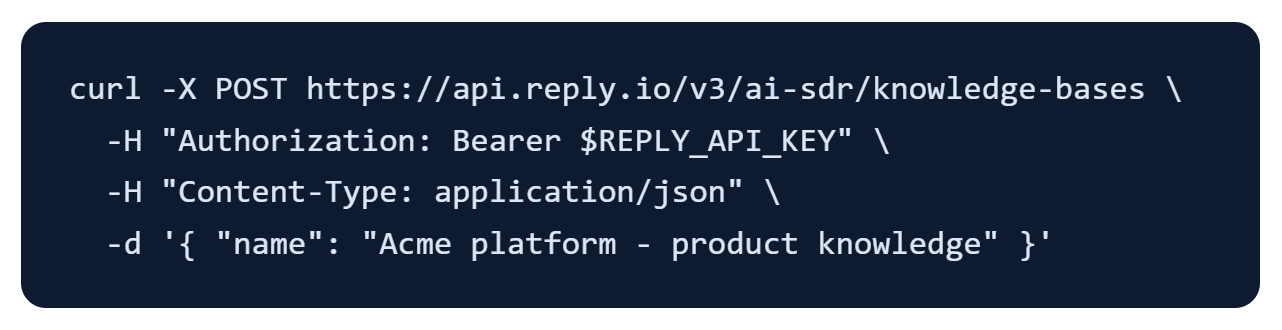
Source: Reply.io
This surface is useful for agencies managing multiple client campaigns: you can configure Jason AI's knowledge base, playbooks, and offers per client via the API rather than manually through the dashboard.
Inbox & Tasks
Operations: Thread management with categorization and read/unread toggling. AI-generated draft replies are in beta, with a full release targeted for July 2026. Task creation, assignment, completion, and batch reassignment cover the manual touchpoints in a sequence (calls, LinkedIn actions, follow-ups).
Reporting
Operations: Email, LinkedIn, call, and task activity metrics. Channel efficiency stats. Team performance overviews and meeting tracking. Reporting endpoints carry stricter rate limits than the standard 100 req/min ceiling, though the exact figures are not published.
Utility
Background job status tracking via /v3/background-jobs/{id} handles async operations. Attachment uploads support documents, voice messages, and template assets. Email validation estimation and scheduling are available for list hygiene.
Reply.io API: Webhooks & Events
Reply.io provides an outbound webhook system that pushes events to a developer-specified HTTPS endpoint in real time, eliminating the need to poll the API.
Creating subscriptions: POST /v3/webhooks (requires webhooks:write scope). Required fields are eventType (a value from GET /v3/webhooks/events) and url (max 1,024 characters).
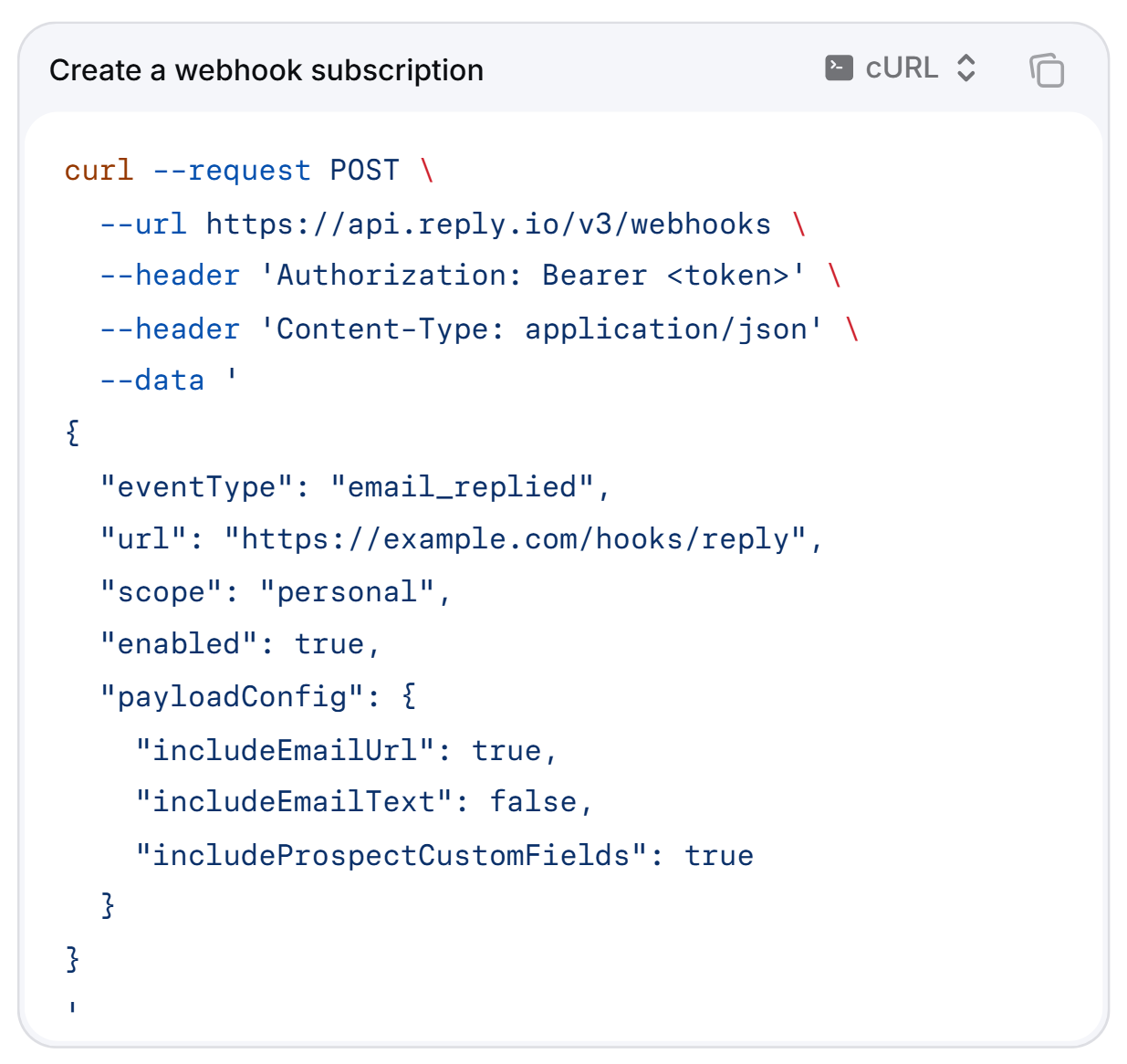
Source: Reply.io
Scope options:
personal: fires only for the subscription owner's own activity
team: fires for any team member's activity; creation is restricted to team owners for private teams, open for public teams
organization: reserved for future use; the API currently rejects this scope
Payload enrichment flags (optional per subscription):
includeEmailUrl: adds a link to the tracked email
includeEmailText: includes the plain-text email body
includeProspectCustomFields: attaches the contact's custom field values
Event categories cover email events (replies, opens, clicks, bounces) and LinkedIn events. The complete event list is served dynamically by GET /v3/webhooks/events.
Limits: A maximum of 50 active webhook subscriptions per account. Hitting this cap returns 409 Conflict with webHook.subscriptionLimitReached. The API returns 403 Forbidden for insufficient permissions on team-scoped webhooks.
Delivery and retry: Webhook delivery logs and test payload functionality are available in the v3 API. The documentation does not specify retry-on-failure policies or timeout windows.
What you would build with this: a real-time integration that pushes reply events to your CRM, triggers a Slack notification when a prospect clicks a link, and logs bounce events to a deliverability monitoring dashboard, all without polling.
Reply.io API: SDKs, Docs & Rate Limits
SDKs & Libraries
Reply.io does not publish official SDKs. The platform takes a REST-first approach: the v3 API works with any language, framework, or HTTP client without proprietary client libraries.
Instead of SDKs, Reply.io provides three developer-tooling options:
OpenAPI specs: Available in bundled YAML, JSON, and OpenAPI 3.0 formats for generating client stubs or exploring the schema in any OpenAPI-compatible tool
Postman collections: Official collections for interactive request testing
Reply MCP server: Connects Reply's full API surface to Claude, Cursor, and any other MCP-aware AI client, letting AI agents call Reply operations without writing HTTP requests
No official SDK is a real signal. It means you own the auth-and-retry layer, the request serialization, the error handling, and the rate-limit backoff logic. The OpenAPI spec helps (you can auto-generate a typed client in most languages), but an auto-generated client is not a maintained one.
Documentation & Developer Experience
The primary documentation hub at docs.reply.io serves the v3 API reference. The legacy apidocs.reply.io hosts v1/v2 documentation, which is deprecated but still accessible.
Developer resources available:
Getting started guide with authentication walkthrough
OpenAPI spec in YAML, JSON, and OpenAPI 3.0 formats for Swagger UI, Redoc, or client-generation tools
Postman collections for hands-on request testing
Reply MCP server for AI-client integration
docs.reply.io/llms.txt: A machine-readable API map for LLM consumption
The documentation marks upcoming endpoints as "Coming soon" with specific month/year availability windows (e.g., July-August 2026 for contact enrichment, AI draft replies, offer generation, and sequence autopilot). Beta features are clearly flagged. This roadmap transparency helps when planning an integration against a surface that is still expanding.
Developer support runs through a Slack community. No dedicated developer forum or ticketed API support tier is documented.
The documentation quality is strong for a sales engagement platform: stable JSON error codes, JSON Pointer validation paths for 400 Bad Request responses, async job patterns, and scope-based access control are all documented with examples. Webhook retry policies and per-plan rate limit details are the most notable gaps.
Rate Limits & Constraints
The v3 API enforces a tiered rate limit per user, regardless of how many applications share the same key:
Standard endpoints: 100 requests per minute; 3,000 requests per hour
Reporting and sequence stats endpoints: stricter limits that are not specified in the public docs
When any limit is exceeded, the API returns 429 Too Many Requests with a Retry-After header indicating the seconds until quota resets.
Three constraints worth planning around:
The 100 req/min ceiling is modest compared to platforms like Instantly.ai (100 req/sec). If your integration makes dozens of endpoint calls in a tight loop, you will hit the ceiling quickly.
Reporting endpoints can exhaust their budget before the general hourly quota, so a dashboard that polls analytics frequently may trigger 429s on reporting while other endpoints still have capacity.
The background jobs system (202 Accepted + poll /v3/background-jobs/{id}) is the recommended mechanism for bulk imports and email validation batches. The documentation advises processing bulk operations sequentially or with modest parallelism rather than high concurrency.
No per-plan rate limit variations are published. Whether enterprise plans carry elevated limits is not documented.
Reply.io API Pricing & Access Costs
Reply.io bundles API access into its paid plans rather than charging per call or per credit. There is no metered API pricing or API-specific add-on fee documented.
The entry points:
Email Volume plan: $49/user/month (annual billing) includes API access with email-only automation and 1,000 active contacts monthly.
Multichannel plan: $89/user/month (annual billing) includes API access with all channels, though LinkedIn automation adds $69/account and Calls/SMS adds $29/account as separate add-ons.
Enterprise (20+ seats): Includes "enhanced API," whitelabeling, and customized solutions. Pricing is quote-based.
The 14-day free trial includes full API access. After the trial, you need a paid plan.
The practical cost constraint is not the API itself but the platform limits it operates within. Active contacts are capped monthly by plan tier (1,000 on the Email Volume plan).
Channel add-ons increase the total cost: a solo rep on the $49/month Email Volume plan who needs LinkedIn and SMS capabilities would pay $147/month total ($49 + $69 + $29). A mandatory 3-month minimum commitment applies but is not prominently disclosed during signup.
The platform's AI credits (e.g., the 50 Live Data credits/month for Reply Data) are a separate consumption model specific to the built-in data product, not the API itself.
For a developer sizing costs: the API is effectively free if you already pay for Reply.io. The real cost is the plan tier that determines your channel access, contact limits, and add-on requirements, and those limits apply equally whether you use the dashboard or the API.
Where the Reply.io API Falls Short
These are the limits a developer should plan around when building on this API, not criticisms of the platform. Several are scope decisions that reflect what Reply.io is (a multichannel sales engagement platform) and what it is not.
Rate limits are modest for a production pipeline. At 100 requests per minute and 3,000 per hour, the v3 API is more restrictive than comparable outreach APIs. A pipeline that syncs contacts, manages sequences, and pulls analytics in the same loop can exhaust the hourly quota quickly.
Reporting endpoints carry even stricter undisclosed limits. Integrations that need high throughput require careful request budgeting and caching.
No OAuth 2.0 for third-party apps. The API uses static Bearer token authentication. There is no delegated OAuth flow for multi-tenant integrations where each customer authenticates with their own Reply.io workspace. If you are building a SaaS product that connects to many Reply.io workspaces, each customer must generate and share an API key manually.
No official SDKs. Every integration is raw HTTP. The OpenAPI spec lets you auto-generate a client, but you still own the maintenance, error handling, and retry logic. For a quick webhook listener, that is fine. For a production system making dozens of endpoint calls, it adds engineering overhead.
Contact enrichment is not yet live. The v3 API lists email/LinkedIn enrichment and phone finding endpoints as "coming July 2026." Until those endpoints ship, enrichment requires a separate API or manual workflow. This is a notable gap for builders who want to discover, enrich, and enroll contacts in one API surface.
Data depth stops at outreach. Reply.io's built-in B2B database (1 billion contacts) is accessible through the dashboard and the Jason AI SDR, but the API's contact endpoints do not expose the full prospecting database programmatically the way a dedicated data API would. There are no API endpoints for org charts, corporate hierarchies, technographics, buyer intent signals, or employment history.
Webhook retry policies are undocumented. The webhook system supports delivery logs and test payloads, but the public documentation does not specify retry-on-failure policies or timeout windows. Design your receiver to be idempotent and confirm the delivery contract if your pipeline depends on guaranteed delivery.
50-subscription webhook cap. The per-account limit of 50 active webhook subscriptions may constrain integrations that need to subscribe to many event types across multiple scopes (personal, team). For a platform with a dozen event types and team-scope needs, you can reach the cap quickly.
ZoomInfo API: The Data and Intelligence Layer Beyond Outreach
Reply.io's API gives you programmatic control over the outreach pipeline: sequences, contacts, sending accounts, inbox management, and AI SDR configuration.
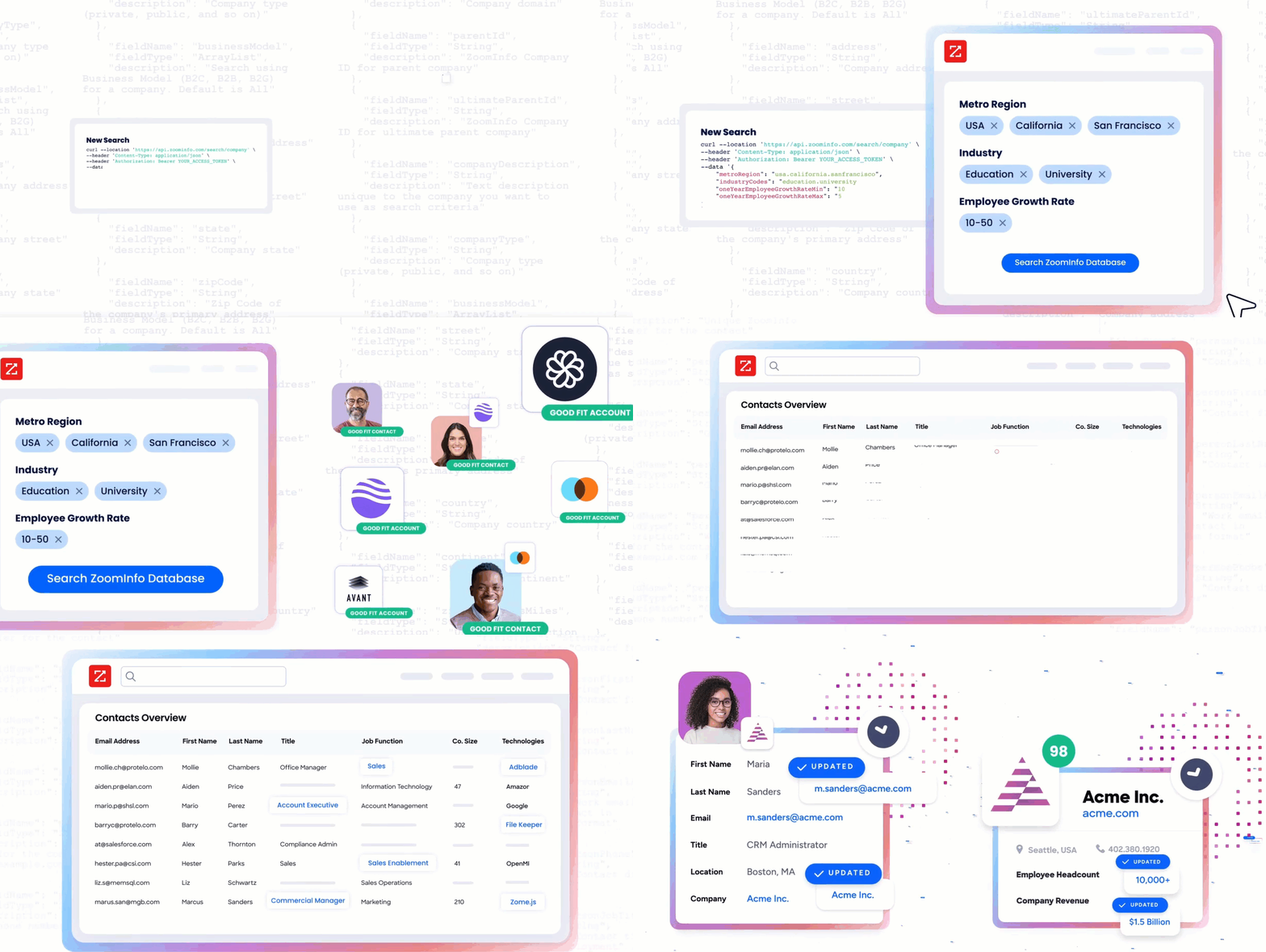
ZoomInfo, an AI GTM platform, gives you the data that feeds that pipeline and the intelligence that shapes it: who these contacts are, what companies they work for, what technology they use, whether they are researching your category, and where they sit in the org chart.
That intelligence comes from the GTM Context Graph, which processes 1.5B + data points daily by fusing ZoomInfo's B2B data with your first-party data. The API is one of ZoomInfo's three access surfaces, alongside GTM Workspace for sellers and GTM Studio for marketers and RevOps.
Source: ZoomInfo
The two APIs operate at different layers. A developer building a complete outbound pipeline would use Reply.io's API to run the sequences and ZoomInfo's API to decide who should be in them.
What the API Covers
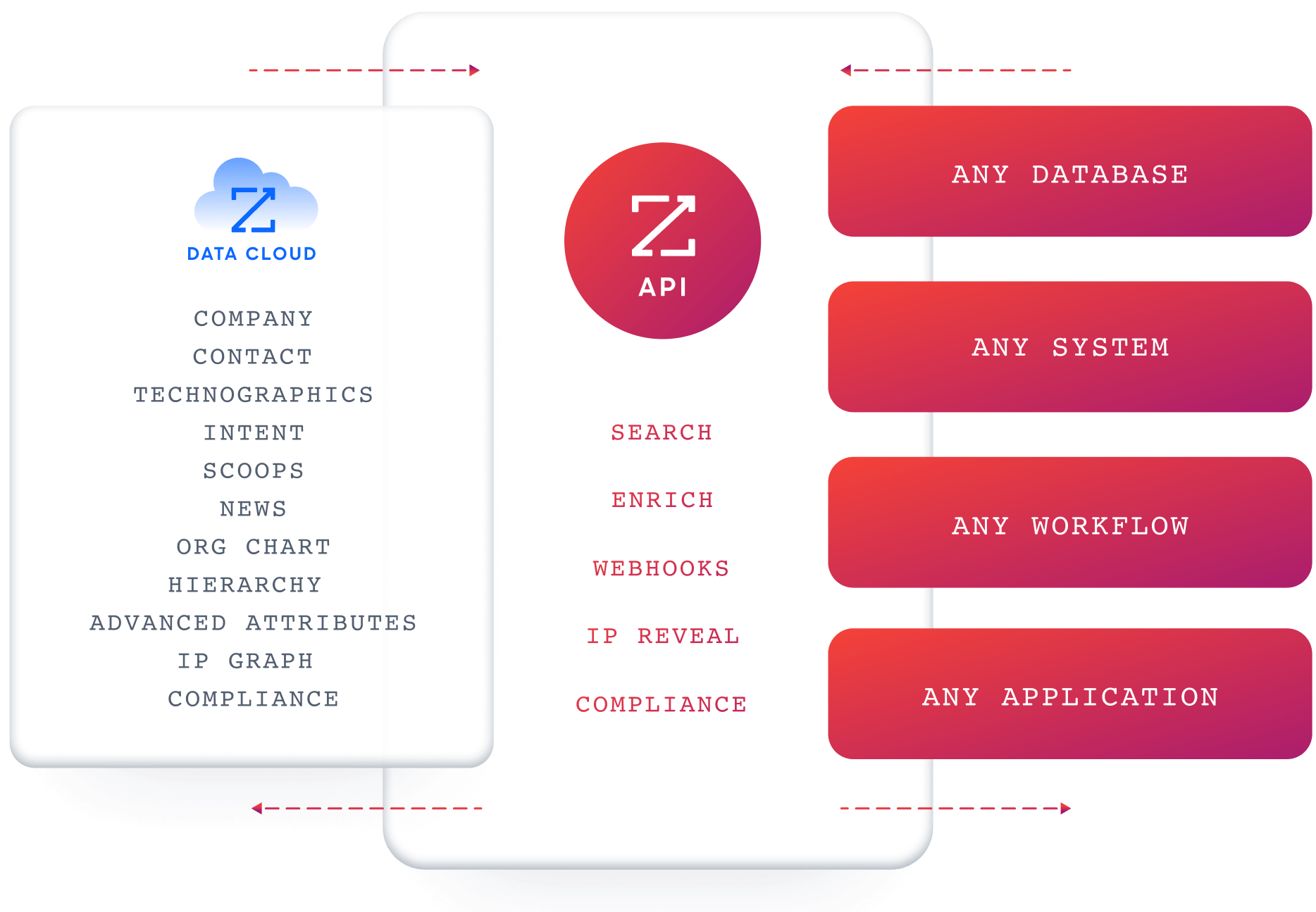
ZoomInfo's Enterprise API is a REST suite served from https://api.zoominfo.com/gtm, organized into four areas documented in the interactive API reference:
Data API (Search & Enrich): Search endpoints cover Contacts, Companies, Intent, News, and Scoops, returning matched records without consuming credits. Enrich endpoints unlock the full payload: business emails, direct dials, employment history, corporate hierarchy, org charts, technographics, and hashtag signals, up to 25 records per call. The underlying dataset spans 500M contacts and 100M companies, 135M+ verified phone numbers, and 200M+ verified business email addresses.
AI Intelligence API: Account Summary returns structured account intelligence with a free-form Q&A endpoint. Find Similar Companies performs lookalike expansion. Contact Recommendations returns AI-ranked buying-committee suggestions by motion (prospecting, deal acceleration, renewals).
Marketing API: CRUD endpoints for programmatic audience management.
Platform API (Engagements, Beta): Bidirectional engagement data via the Engagements API.
Source: ZoomInfo
The pairing with an outreach API is direct: use ZoomInfo's search endpoints to find contacts matching your ICP (free, no credits consumed), enrich the ones worth pursuing, then push them into Reply.io's sequence endpoints. The search-then-enrich pattern means you filter freely and pay only for the records you commit to.
Authentication & Access
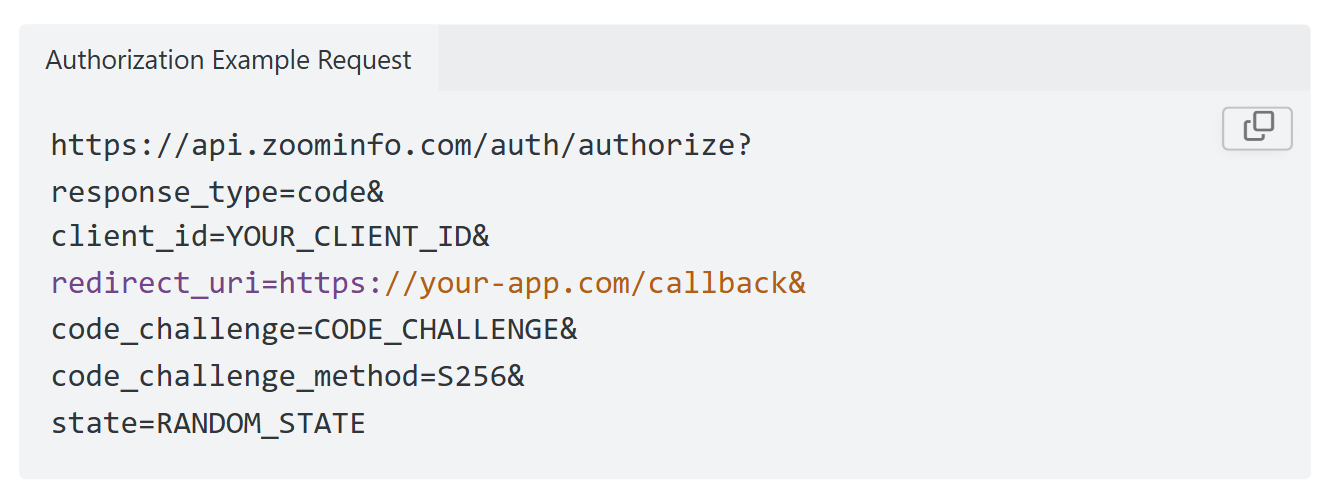
ZoomInfo uses OAuth 2.0 with PKCE via Okta, supporting three flows: Authorization Code with PKCE (web applications), Client Credentials (server-to-server), and Refresh Token. Access tokens are 24-hour Bearer tokens with rotating refresh tokens. Teams register applications through the ZoomInfo Developer Portal, where they generate credentials, define scopes, and test endpoints.
Source: ZoomInfo
This is a different authentication model from Reply.io's static API key. OAuth 2.0 supports delegated access, credential rotation, and scoped permissions out of the box, making it the right choice for multi-tenant integrations and enterprise security requirements.
Rate Limits, Credits & Developer Experience
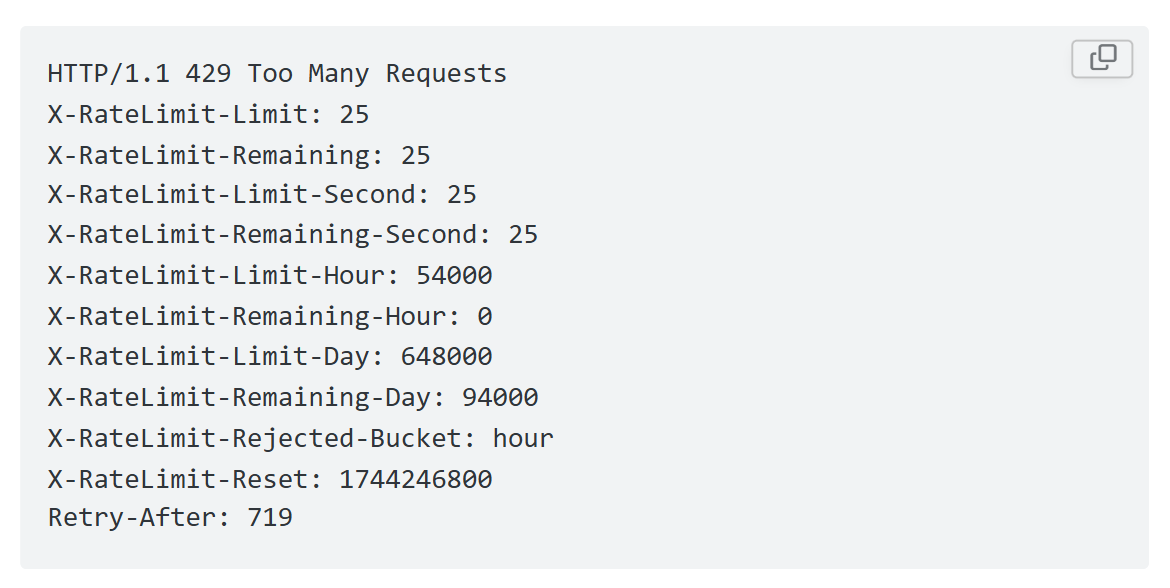
Rate limits are published by tier: Builder (5 req/sec), Standard (25 req/sec), and Scaling (35 req/sec), with per-hour and per-day sliding-window limits enforced simultaneously. Every response includes quota headers with remaining capacity, and 429 responses include a Retry-After header with exact backoff timing and a X-RateLimit-Rejected-Bucket header identifying which window was exhausted.
Source: ZoomInfo
Credits follow a rolling 12-month window: a record enriched for the first time consumes one credit; re-enriching the same record within the year is free. Search and lookup operations do not consume credits.
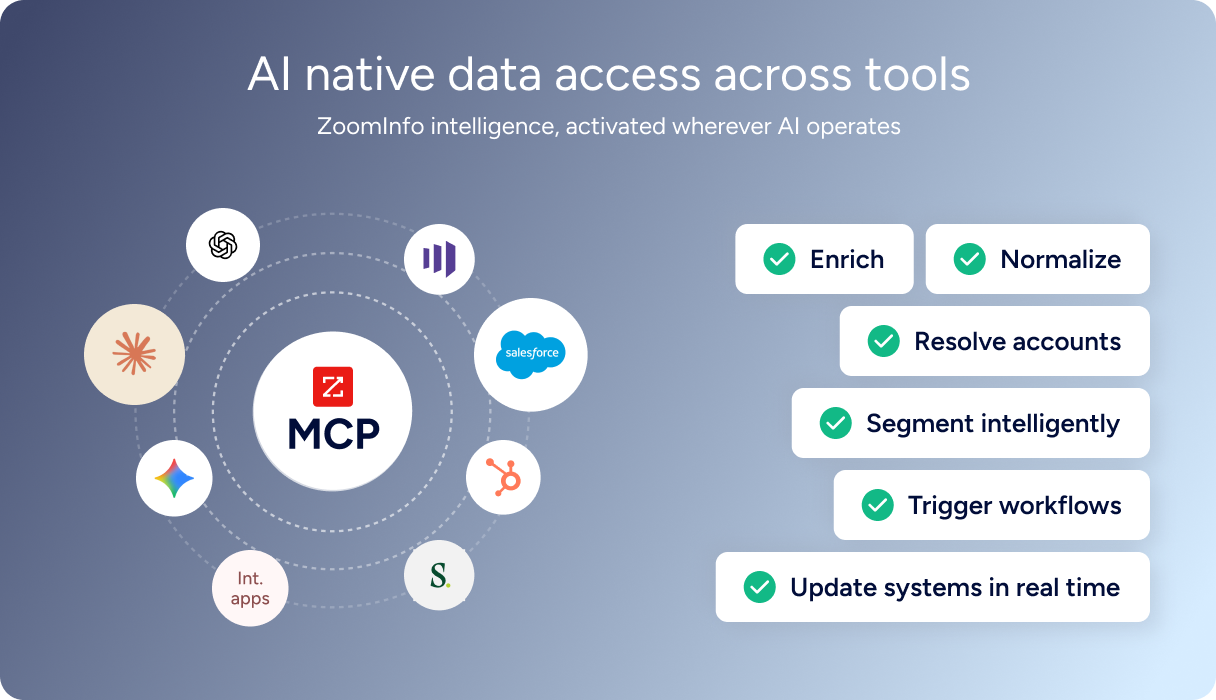
For developers building AI agents, ZoomInfo's MCP server at https://mcp.zoominfo.com/mcp exposes search, enrich, and account research as native tools for MCP-compatible assistants, currently supporting Claude and ChatGPT. Documentation lives at docs.zoominfo.com with an interactive API reference, OAuth recipes in five languages, and an llms.txt index for AI development tools.
Source: ZoomInfo
ZoomInfo does not publish official SDKs either, so both platforms require direct HTTP integration. Pricing is custom-quoted; API access requires an Enterprise API package, and ZoomInfo has extended API access to all relevant plans.
BDO Canada reported an 87% reduction in time spent updating internal data dashboards using the ZoomInfo API, with one analyst describing the integration as plug-and-play across any process. (ZoomInfo)
Reply.io API vs. ZoomInfo API
Dimension | Reply.io API | ZoomInfo API |
|---|---|---|
API type | REST, JSON | REST, JSON:API format |
Authentication | Bearer token (static API key, workspace-scoped) | OAuth 2.0 with PKCE (24-hour tokens, rotating refresh) |
Primary scope | Outreach automation: sequences, contacts, email/LinkedIn channels, inbox, AI SDR, tasks, reporting | B2B intelligence: contact/company search, enrichment, intent, org charts, technographics, AI research |
Contact database | 1B+ contacts (via dashboard/Jason AI; API enrichment endpoints not yet live) | 500M contacts, 100M companies, 135M+ verified phone numbers, 200M+ verified business emails |
Intent / signals | Intent signals via AI SDR layer (industries/technologies typeahead) | Buyer intent, scoops, news, job changes, funding signals, all searchable and enrichable via API |
Webhooks | Outbound event system (email, LinkedIn events); 50 subscription cap | Agent Teams-based webhooks (enrichment jobs, signal alerts, credit thresholds) |
SDKs | None (OpenAPI specs, Postman collections, MCP server) | None (recipes in Shell, Node, Ruby, PHP, Python; MCP server) |
Rate limits | 100 req/min, 3,000 req/hour (per user) | 5-35 req/sec by tier, with per-hour and per-day sliding windows |
Pricing model | Bundled with paid plans ($49/user/month entry) | Custom-quoted, consumption-based (search free, enrich consumes credits) |
AI endpoints | Knowledge bases, playbooks, offers, reply handlers, intent signals | Account Summary, Find Similar Companies, Contact Recommendations |
MCP server | Available (Claude, Cursor) | Available at mcp.zoominfo.com (Claude, ChatGPT) |
Key management | Standard, Master, and Organization API keys with scope control | OAuth 2.0 apps via Developer Portal with scope management |
Final Verdict
Reply.io's API is a capable outreach automation surface: well-scoped, documented with OpenAPI specs and Postman collections, and broad enough to cover contacts, sequences, multichannel outreach, webhooks, reporting, and the AI SDR layer from a single REST interface.
The scope-based access control system, Master API Key for workspace-level operations, and MCP server for AI agents are mature features for a sales engagement API. For a developer whose build starts and ends with outreach automation, the API delivers what the dashboard does, without the dashboard.
Choose the Reply.io API if your integration is outreach-first: automating sequence creation, contact enrollment, multichannel step management, reply handling, and campaign analytics. The $49/user/month entry point with API access included, combined with the granular scope system and async job pattern for bulk operations, makes it a practical surface for outbound pipeline automation.
Choose the ZoomInfo API if your build needs the intelligence layer upstream of outreach: deciding which accounts are worth pursuing, which contacts to reach, what their companies look like, and whether they are in-market. The search-then-enrich pattern (search is free, enrich consumes credits) and the AI intelligence endpoints cover the data and intelligence that outreach APIs do not.
Explore the ZoomInfo Enterprise API or start with the developer docs to see the endpoint surface directly.
A developer who needs neither API alone should consider that Reply.io's API does not cover data intelligence, and ZoomInfo's API does not run outreach sequences. If your pipeline requires both, the two are complementary layers: use ZoomInfo's search to find contacts matching your ICP, enrich the ones worth pursuing, then push them into Reply.io's sequence endpoints for multichannel outreach.
FAQ
Is the Reply.io API free?
Not beyond a trial. A 14-day free trial includes full API access with no credit card required. After the trial, API access comes bundled into all paid plans starting at $49/user/month for the Email Volume tier (annual billing). There are no published per-call charges or API-specific credit costs.
The real cost driver is the plan tier that determines your active contact limits, channel access, and add-on requirements (LinkedIn automation at $69/account, Calls/SMS at $29/account).
Does Reply.io have a GraphQL API?
No. Reply.io exposes a REST API (currently v3) that communicates over HTTPS with JSON request and response bodies. There is no GraphQL endpoint. If you need a GraphQL interface, you would need to build a wrapper on top of the REST API. The OpenAPI specs in YAML, JSON, and OpenAPI 3.0 formats are available for generating typed clients or exploring the schema in tools like Swagger UI.
What is the Reply.io API rate limit?
The v3 API enforces 100 requests per minute and 3,000 requests per hour, per user regardless of how many applications share the key. Hitting either limit triggers a 429 response with a Retry-After header. Reporting and sequence stats endpoints carry stricter limits that are not published. The background jobs system is the recommended path for bulk operations like imports and email validation.
Are there official Reply.io SDKs?
No. Reply.io does not publish official SDKs in any language. The developer documentation provides OpenAPI specifications (YAML, JSON, OpenAPI 3.0) for auto-generating client stubs, Postman collections for interactive testing, and an MCP server for AI-agent integration. Developers integrate directly over HTTP. A Slack community serves as the developer support channel.
Does the Reply.io API support webhooks?
Yes. Reply.io has an outbound webhook system managed through the API. You create, list, update, and delete webhooks via /v3/webhooks endpoints. Supported event types cover email events (replies, opens, clicks, bounces) and LinkedIn events, with the complete list served dynamically by GET /v3/webhooks/events.
Each subscription supports scope options (personal or team) and payload enrichment flags for including email content and custom fields. The account-wide cap is 50 active subscriptions. Retry-on-failure policies are not documented publicly.
What does ZoomInfo's API add to a Reply.io build?
ZoomInfo's API adds the data and intelligence layer that Reply.io's API does not cover.
Where Reply.io's API manages sequences and contacts, ZoomInfo's API provides the contact and company intelligence that determines who should be in those sequences: search across 500M contacts and 100M companies, enrich with direct dials, org charts, technographics, and employment history, detect buyer intent signals, and generate AI-powered account research and buying-committee recommendations.
The two APIs use different authentication models (Bearer token vs. OAuth 2.0) and different pricing structures (bundled vs. consumption-based), so plan the integration layer to handle both.
Both platforms offer MCP servers, meaning an AI agent can orchestrate across both APIs natively: use ZoomInfo's MCP tools to find and research accounts, then use Reply.io's MCP tools to create sequences and enroll contacts.
