
Choosing between SafeGraph and InfobelPRO comes down to five questions:
Do you need data about physical places, or structured records about the companies that operate them?
Are you powering a location-aware product, enriching a CRM, or running go-to-market campaigns?
How important is contact-level data (direct dials, verified emails, buying intent) versus company-level firmographic records?
Do you need data delivered as bulk files for your warehouse, or flowing into sales and marketing workflows?
Are you buying a data ingredient to build on, or a platform that acts on it for you?
Here's what we recommend:
SafeGraph is the right choice for data scientists and product builders who need accurate, production-ready point-of-interest data.
Its Places dataset delivers clean, NAICS-coded POI records with building footprint polygons, updated monthly and delivered through Snowflake, AWS, Databricks, and Esri. Companies like Plaid, Sysco, and Clear Channel Europe trust SafeGraph because it focuses on one thing: telling you what places exist, where they are, and when they change.
SafeGraph provides no B2B contact data, no firmographic enrichment beyond its POI schema, and no sales or marketing tools.
InfobelPRO is a global company data platform offering 371M+ company records across 220 countries, sourced from over 1,100 official registries.
Each record carries up to 460+ attributes: revenue, headcount, industry classifications (SIC and NACE), corporate linkage, and technographic signals. InfobelPRO targets data engineering teams that need bulk firmographic data for CRM enrichment, KYB compliance, or building their own products. Its 202M+ POI dataset also competes with SafeGraph on location intelligence.
But InfobelPRO is a data layer, not a sales tool. It has no CRM, no pipeline management, no intent signals, and limited email and phone coverage.
Both platforms deliver quality data in their specializations. But if your goal is to find buyers, reach them, and close deals, neither was built for that. That's where ZoomInfo comes in.
ZoomInfo is a GTM platform built on a large B2B dataset: 500M contacts, 100M companies, 135M+ verified phone numbers, and 200M+ verified business emails.
That data feeds the GTM Context Graph, which connects your CRM records, conversation transcripts, and behavioral signals with the 1.5B+ data points ZoomInfo processes daily. The result: the AI drafting your follow-up understands the concern behind the conversation, your next campaign targets accounts matching your actual win patterns, and your forecast reflects buying evidence rather than rep optimism.
Sellers work from GTM Workspace, marketers and RevOps teams build plays in GTM Studio, and engineering teams pipe the same data into any tool through APIs and MCP. For teams comparing SafeGraph and InfobelPRO because they need better data to drive revenue, ZoomInfo provides both the data and the tools to act on it.
If turning B2B data into pipeline is what you need, see ZoomInfo in action with a free trial.
SafeGraph vs. InfobelPRO vs. ZoomInfo at a glance
SafeGraph | InfobelPRO | ZoomInfo | |
|---|---|---|---|
Primary focus | POI / places data | Global firmographic data platform | AI-powered GTM platform |
Company records | POI-level only | ||
Contact data | None | Limited (5.4% email coverage) | 500M contacts, 200M+ verified emails, 135M+ verified phones |
POI data | Core product (Places) | Not a primary focus | |
Intent signals | None | None | Buyer Intent with 210M IP-to-Org pairings |
Sales execution tools | None | None | GTM Workspace, Chorus, Chat, Workflows |
Delivery model | Bulk files (Snowflake, S3, Databricks) | APIs, flat files, search app | APIs, MCP, native UI, CRM integrations |
Pricing | Custom annual fee | Custom / contact for quote | Custom / seat-and-credit based |
Best for | Data scientists building location products | Data engineers needing global firmographic data | GTM teams that need data and execution in one platform |
Data infrastructure vs. go-to-market platform: A fundamental split
SafeGraph and InfobelPRO share an identity: they are data suppliers. They source, clean, and deliver structured datasets for other teams to build on. Neither tells you who to call, what to say, or when to reach out. They provide raw material; you provide the analysis, the workflows, and the action.
SafeGraph is explicit about this.
Its about page describes the company as "narrowly focused on building the most accurate global places dataset available, empowering modern builders to create world-class location-based applications and analytics tools." SafeGraph doesn't build the applications. It feeds them.
InfobelPRO fills a similar role with a different dataset.
Its documentation positions the platform as a data layer that enterprises plug into their existing systems. User reviews note that InfobelPRO is not oriented toward sales pipeline management. If you need a prospecting UI, you need other tools on top.
ZoomInfo operates in a different category.
It has a large B2B data layer, but it also has the GTM Context Graph, which connects your CRM records, conversations, and behavioral signals to reveal not just what happened, but why deals moved or stalled. AI agents in GTM Workspace draft outreach, prioritize accounts, and update your CRM. GTM Studio lets marketers launch multi-channel campaigns in natural language.
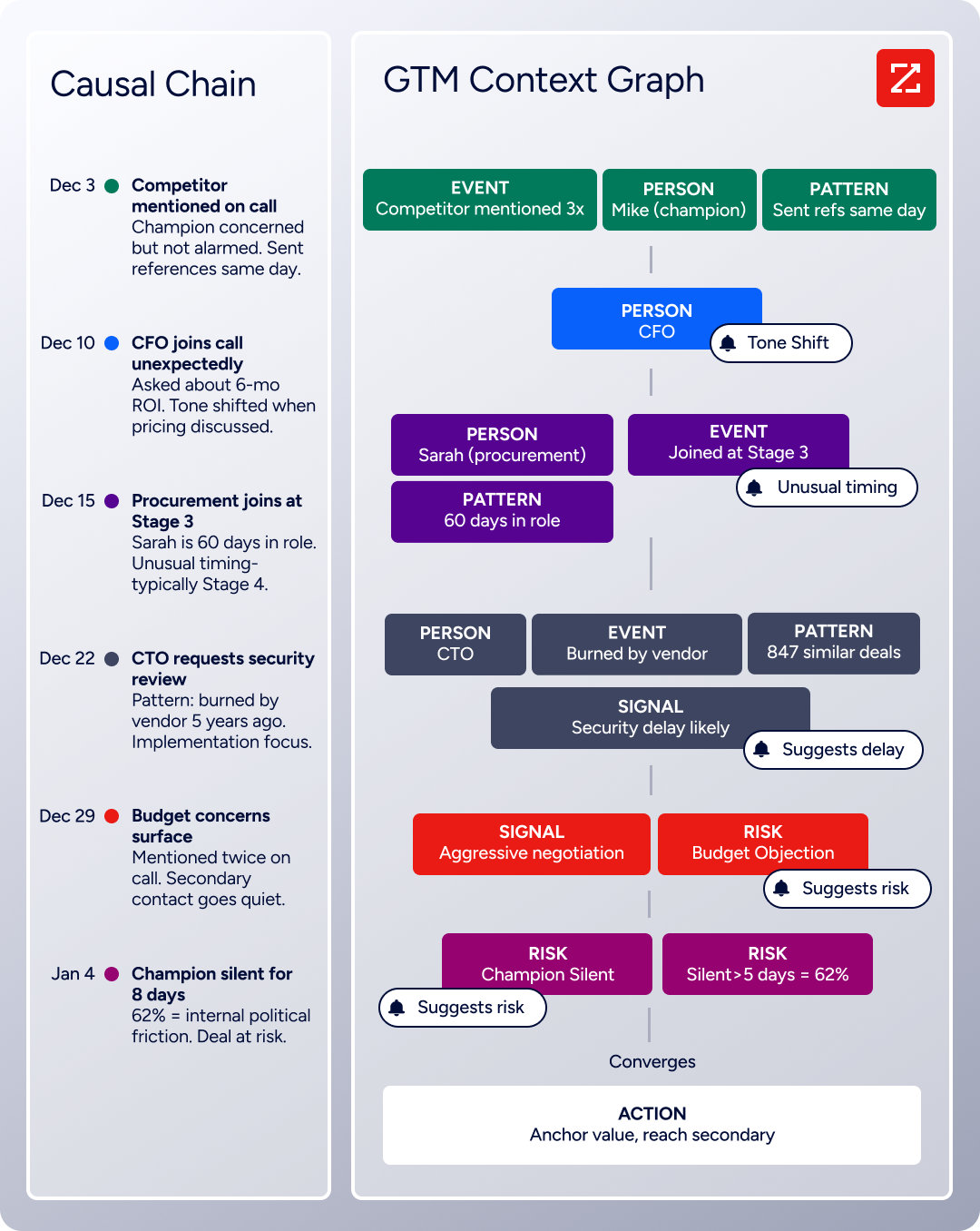
For teams whose end goal is revenue, the gap between "here's your data" and "here's your next action" is where deals are won or lost.
Seismic attributed 39% of active pipeline to opportunities identified or influenced by ZoomInfo signals, with sales teams reporting 54% higher productivity and 11.5 hours saved per week per seller. (Seismic Case Study)
SafeGraph leads in POI accuracy and schema quality
SafeGraph's core strength is the precision of its places data.
Every POI comes with a persistent Placekey identifier, NAICS categorization, and building footprint polygons in WKT format. The Geometry dataset distinguishes between owned and shared polygons, flags synthetic shapes, and encodes spatial hierarchy (a store inside a mall, a kiosk inside an airport) in the schema.
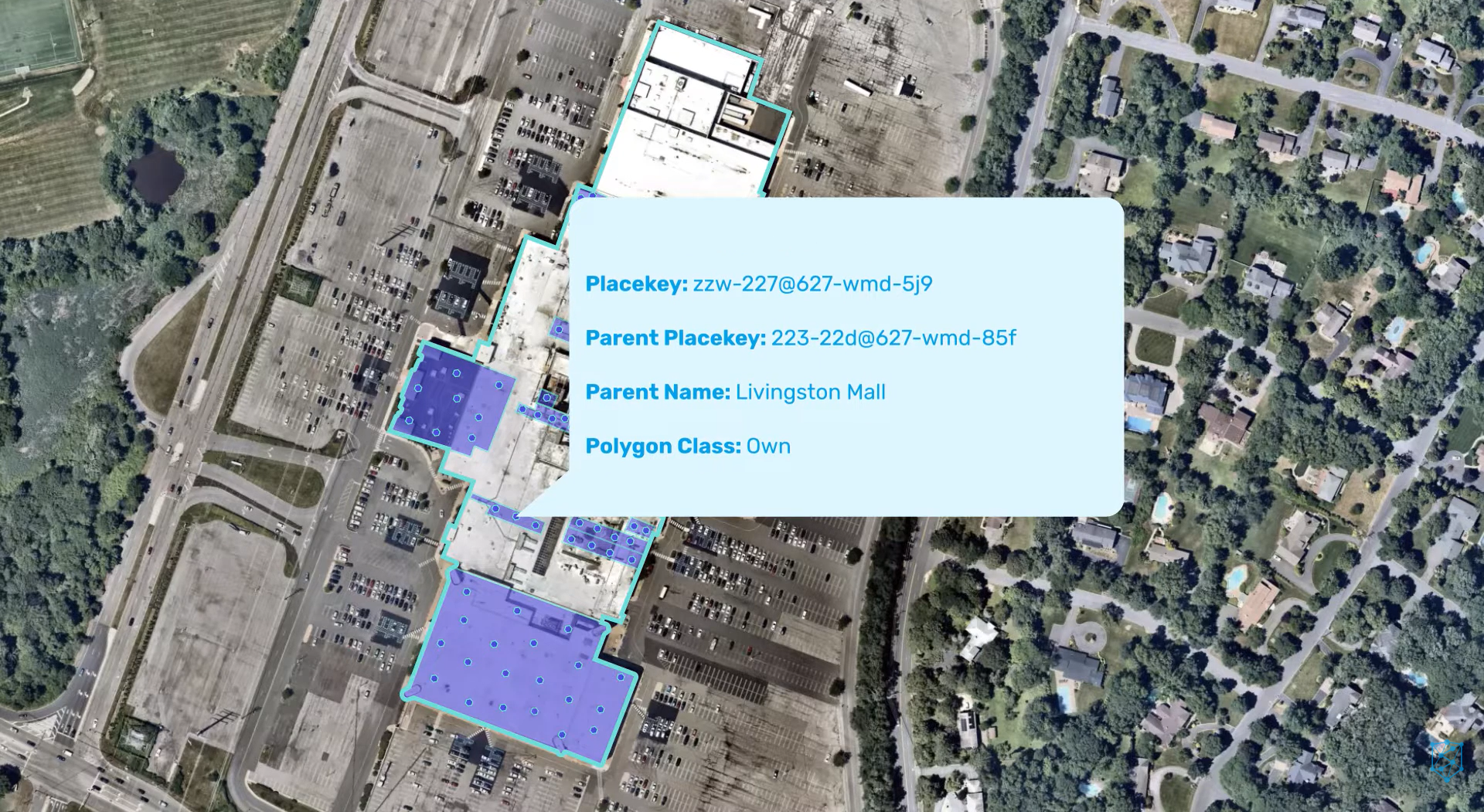
Source: SafeGraph
This matters for specific use cases. Olvin's VP of Product switched to SafeGraph after their previous provider placed stores "in the middle of a street" and showed them overlapping. Clear Channel Europe's Chief Data Officer praised SafeGraph's taxonomy for making sense, and cited the team's responsiveness as a reason they trusted the data across 17 European markets.
SafeGraph also publishes transparent accuracy metrics. Its documentation includes recall and precision frameworks, summary statistics, and monthly release notes with changelogs. The company claims its data can identify 95% of a brand's locations when compared to first-party brand data.
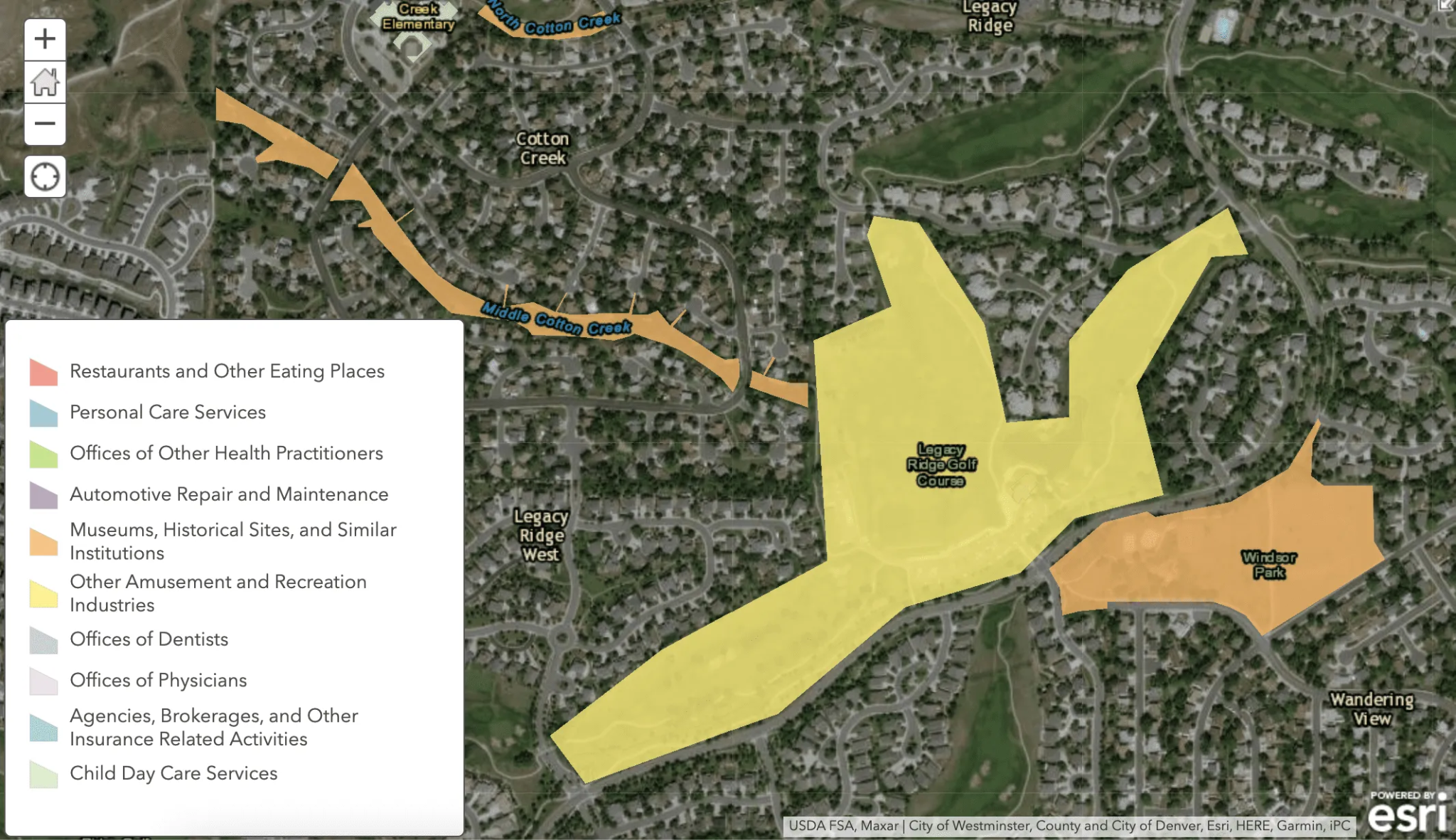
Source: SafeGraph
InfobelPRO competes on POI scale with 202M+ points of interest and 114M+ building footprint polygons across 220+ countries.
Its POI data includes 50+ attributes: opening hours, reviews, ratings, and social media profiles. As a listed Esri partner, InfobelPRO's location data integrates into ArcGIS workflows.
Where InfobelPRO gains an edge is attribute depth per record. Each POI carries the full firmographic profile of the business operating there (revenue, headcount, industry codes, corporate linkage, technographic signals) because InfobelPRO's POI data shares a schema with its company data.
SafeGraph's POI records are rich in location attributes but do not include company financials, corporate hierarchy, or firmographic context.
InfobelPRO wins on global firmographic coverage
For buyers whose primary need is company-level data at global scale, InfobelPRO holds a clear advantage over SafeGraph.
Its 371M+ company records span 220 countries and territories, each carrying up to 460+ data attributes: revenue, employee count, industry classification in three systems (SIC, NACE, and InfobelPRO proprietary), VAT and national IDs, executive names, and corporate linkage mapping parent-subsidiary relationships.
The registry-sourced approach is InfobelPRO's differentiator. Every record traces back to an official business registry, tax authority, or regulated filing from over 1,100 verified providers. For KYB verification and compliance, this provenance matters. InfobelPRO cites a KYB use case where client onboarding dropped from five working days to under four hours.
The depth in typically sparse markets is notable. InfobelPRO's country aggregation table shows substantial record counts where many providers offer only token coverage: China (90M+), India (32M+), Brazil (25M+), Kazakhstan (2.1M+), and Indonesia (1.5M+).
For organizations prospecting or running compliance checks outside North America and Western Europe, this breadth from a single source reduces the need to stitch together regional vendors.
SafeGraph was not designed to be a firmographic data provider.
Its schema captures what a place is and where it sits, not the financial profile or ownership structure of the business there. SafeGraph's international expansion has focused on POI coverage in Western Europe and Latin America and select other markets, but its core strength remains the United States, Canada, and the UK.
Neither platform solves the contact data problem
This is where both SafeGraph and InfobelPRO leave a critical gap for go-to-market teams.
SafeGraph provides no B2B contact data. No emails, no phone numbers, no executive names. It was never designed for that.
InfobelPRO includes executive names for 66-73% of records and some contact data, but the coverage is thin by sales intelligence standards.
Email coverage sits at about 5.4% of the database. Phone numbers cover about 24% of records, and mobile numbers about 12%. There are no verified direct dials at the scale sales teams need, and no buying intent signals.
For data engineering teams enriching a warehouse or compliance teams verifying business entities, this gap may not matter. For sales and marketing teams trying to reach decision-makers, it disqualifies both as standalone solutions.
ZoomInfo was built to solve this problem. Its dataset includes 500M contacts with 200M+ verified business emails, 135M+ verified phone numbers, and 120M direct-dial phone numbers.
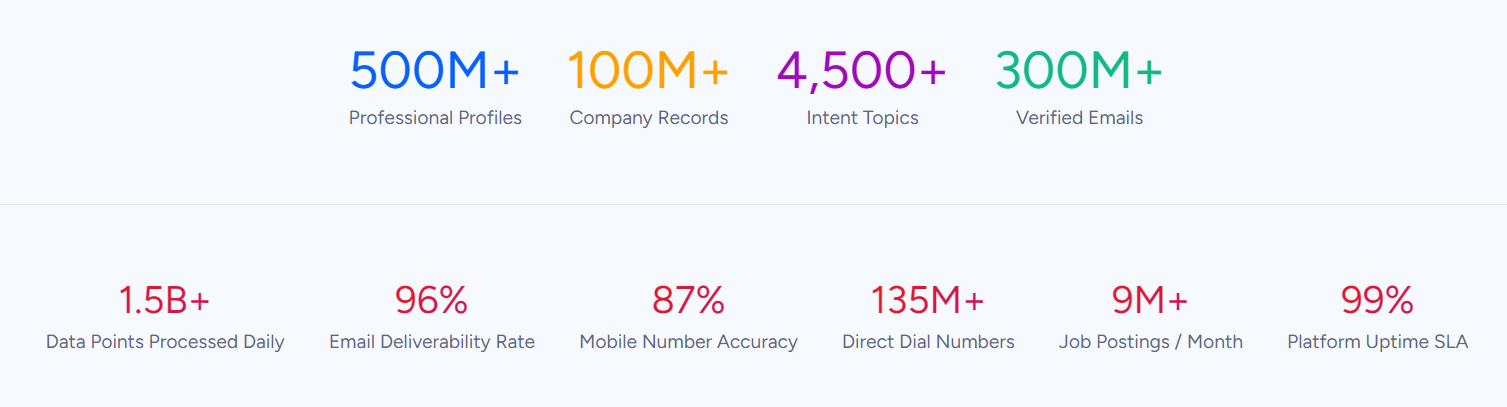
The verification pipeline combines automated ML scanning of 28 million site domains daily, a network of 200,000+ ZoomInfo Lite users who share data back, and a Data Training Lab of 300+ human researchers. In a Fortune 500 competitive RFP analyzing 25 million contacts across vendors, the independent consultant concluded that "no other competitor came even close."
Beyond contact data, ZoomInfo adds Buyer Intent signals tracking activity from 210 million IP-to-Organization pairings, WebSights for website visitor identification, and technographic profiles across 30,000+ technologies. These signals tell you not just who a buyer is, but when they're in-market.
Delivery models reflect different buyers
How you access data reveals who each platform was designed for.
SafeGraph delivers bulk datasets through five channels: Amazon S3, Snowflake Secure Data Sharing, AWS Data Exchange, CARTO, and Parquet files.
There is no real-time API for querying individual records. Data arrives as flat files (gzipped CSV or Parquet), updated monthly. This model fits data science teams and product builders who ingest datasets into their own pipelines. SafeGraph calls its data "production ready from day-1", and customers like Olvin confirm it arrives clean enough to use without months of preprocessing.
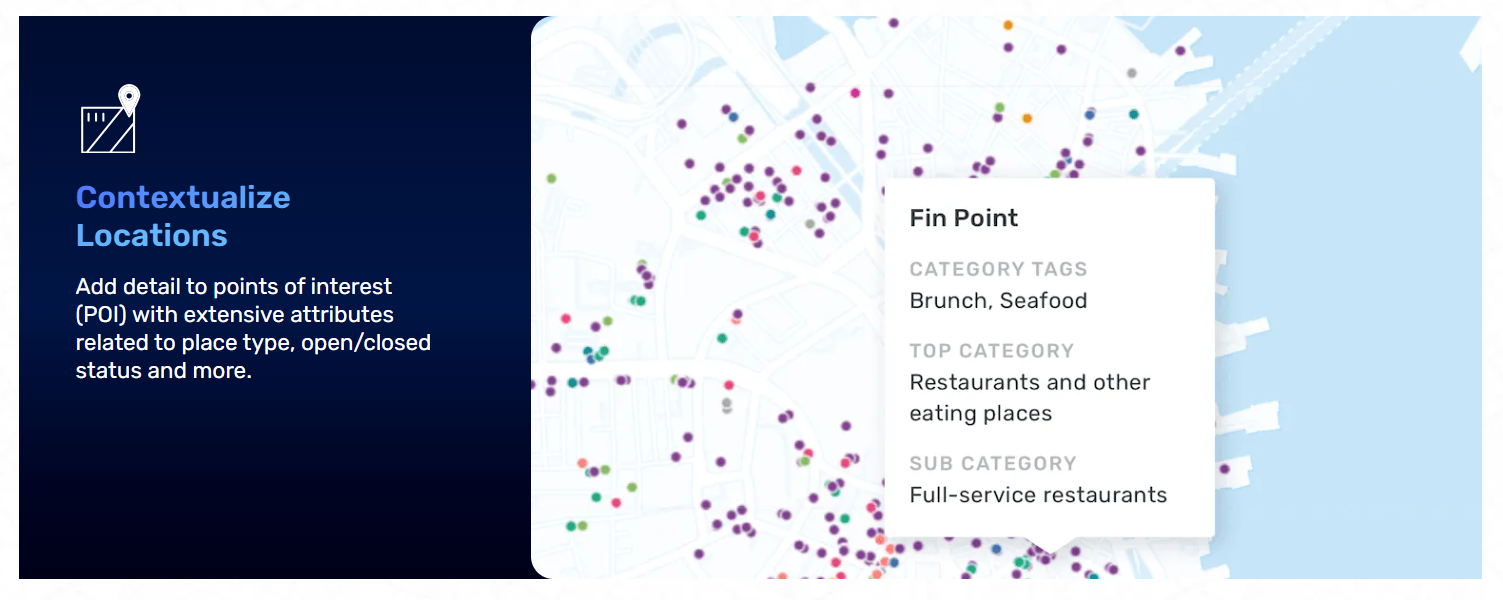
Source: SafeGraph
InfobelPRO offers more delivery flexibility: three REST APIs (BizSearch, GetData, and Company Search), bulk flat file exports, and a no-code search application where non-technical users can filter companies and export Excel-ready lists.
The APIs support real-time enrichment and lookup, making InfobelPRO usable for both batch processing and live integrations. Client libraries are available in Shell, Ruby, Node.js, PHP, and Python.
ZoomInfo operates at a different level of integration.
Beyond its Enterprise API (with search, enrich, copilot, and marketing endpoints) and MCP server for AI agents, ZoomInfo connects natively with over 120 integrations across CRMs (Salesforce, HubSpot, Microsoft Dynamics), marketing automation (Marketo, Eloqua), sales engagement tools (Salesloft, Outreach), and data warehouses (Snowflake, Databricks, AWS).
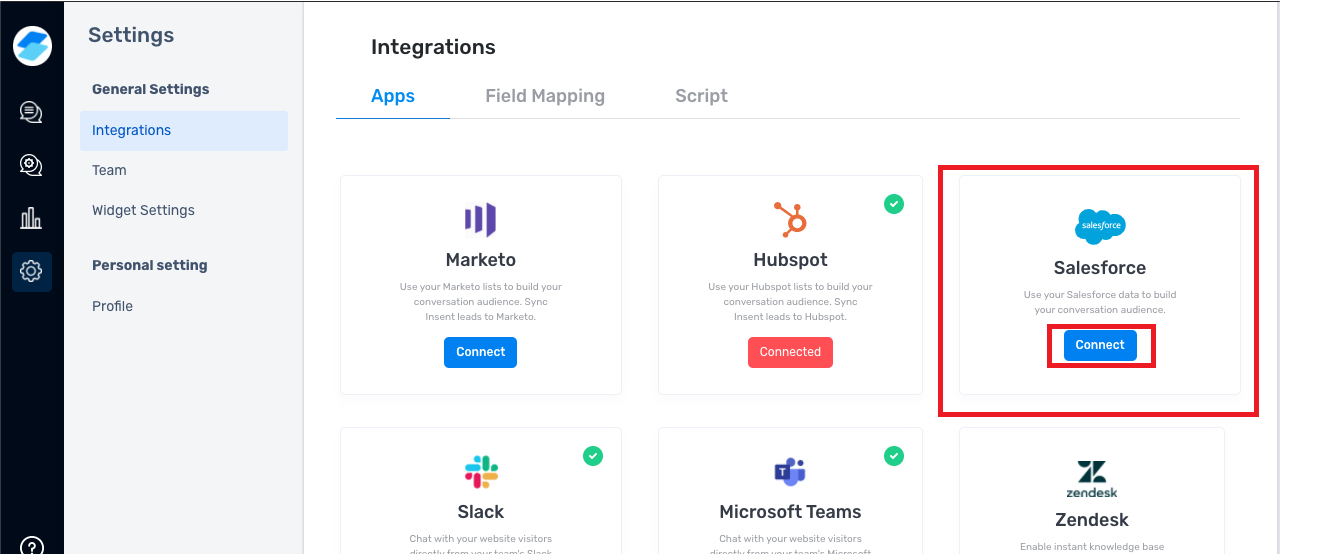
Source: ZoomInfo
The data flows into the systems where sales and marketing teams already work, enriching records, triggering workflows, and powering AI-drafted outreach without custom engineering.
BDO Canada's Senior Marketing Intelligence Analyst called ZoomInfo's API "plug-and-play," reducing time spent on internal data dashboard updates by 87%. (BDO Canada Case Study)
Data freshness operates on different timescales
SafeGraph updates its Places dataset monthly, by the 7th of each month.
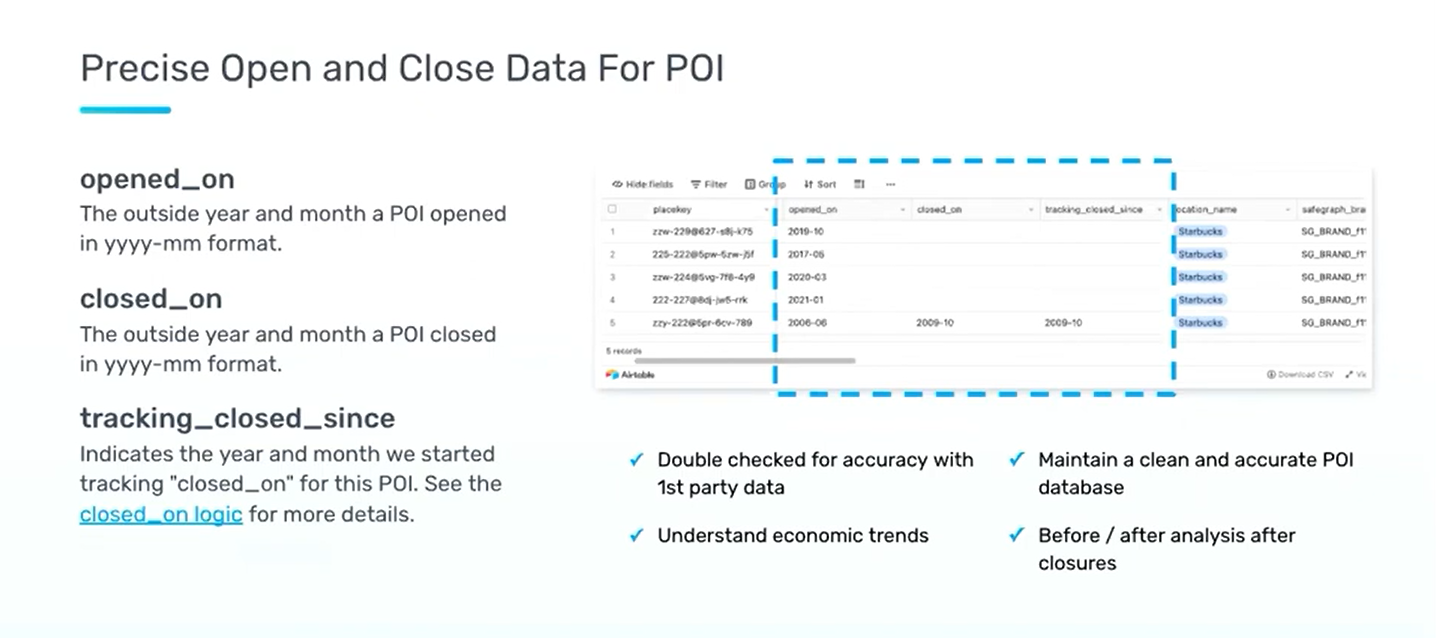
Source: SafeGraph
The company notes this is faster than "many other POI vendors, who may update once every 3-6 months." During COVID, SafeGraph switched to weekly updates for public health use. Monthly cadence works well for static POI data where store openings and closures are the primary changes.
InfobelPRO uses a tiered update schedule: high-turnover fields like opening hours and phone numbers refresh daily or weekly, while stable records cycle monthly.
The registry-sourced model means updates depend partly on when official registries publish new filings, which varies by country.
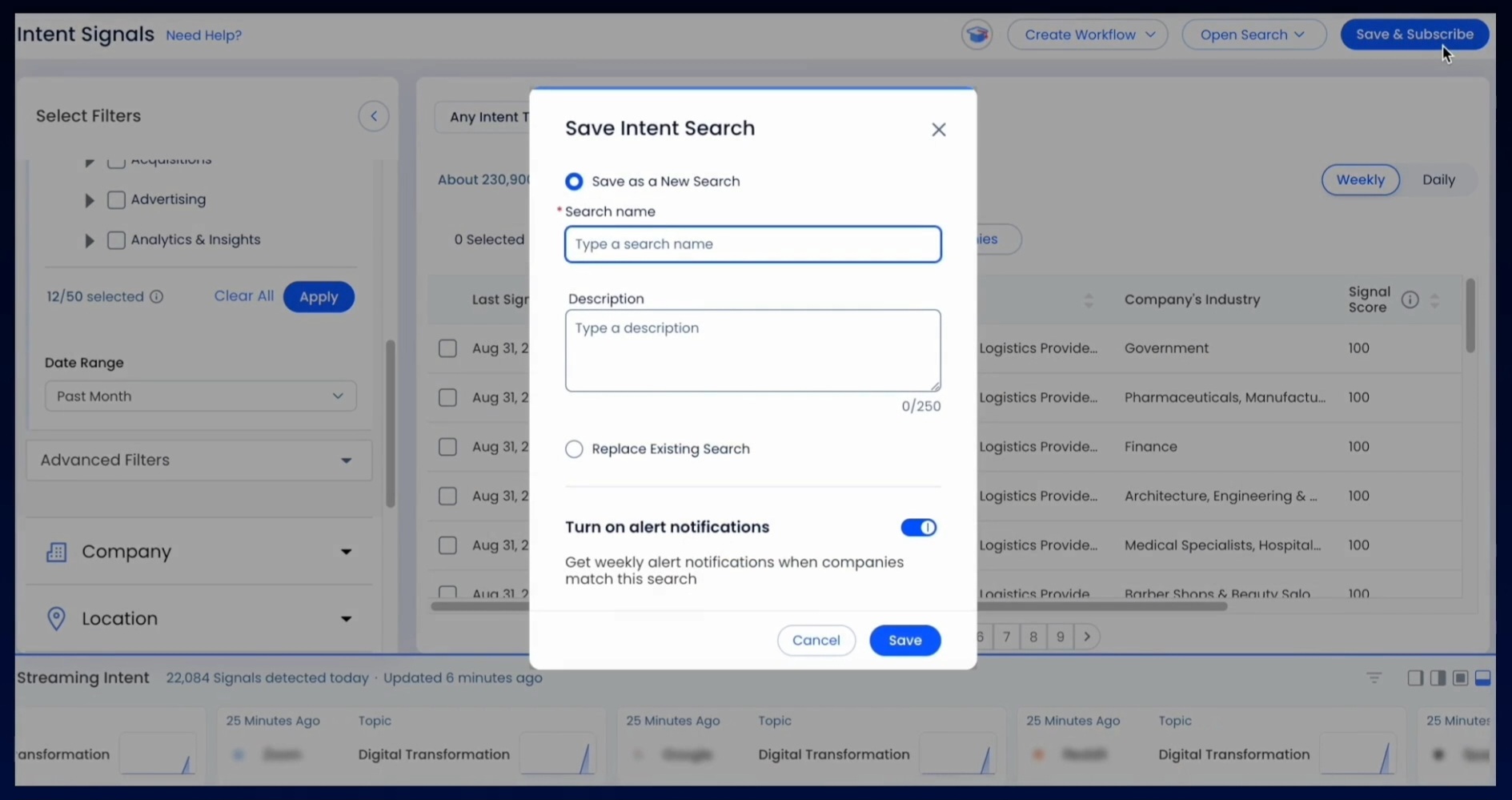
ZoomInfo runs on a faster cycle because its data types demand it.
Intent signals and website visitor data are real-time by nature. Contact data (job changes, new hires, departures) requires continuous monitoring. The GTM Context Graph processes 1.5B+ data points daily, backed by automated ML scanning of 28 million site domains and technographic pairings updated within three months for nearly 90% of active records.
Source: ZoomInfo
For POI and firmographic use cases, monthly or tiered updates work. For sales teams who need to know that a VP of Engineering changed jobs last week or that a target account just spiked on competitor research, monthly data is already stale.
Pricing accessibility varies widely
All three platforms use custom pricing, but ease of entry differs.
SafeGraph quotes a custom annual fee based on POI rows, attribute columns, usage rights, and delivery method.
No per-seat fees, no usage-based metering. Free data samples help buyers evaluate quality before committing. But there is no self-serve purchase path, no published prices, and no freemium tier.
InfobelPRO directs buyers to contact a data consultant for custom quotes.
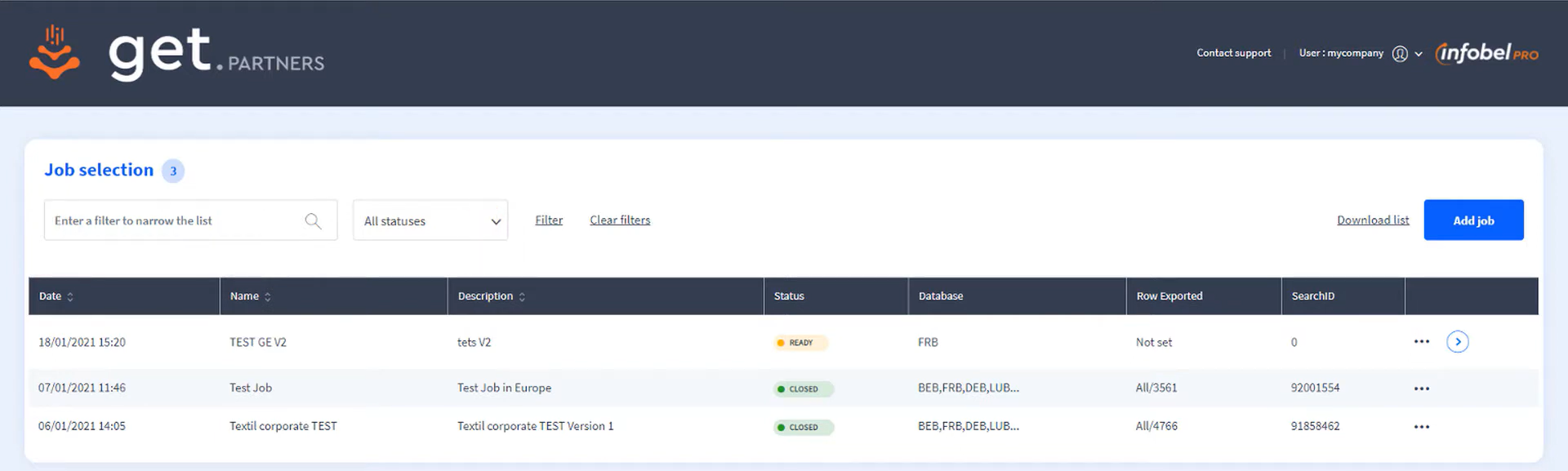
The Get.app tool provides an alternative: users build a filtered company list and buy the extract via Stripe. This gives smaller teams a way to purchase data without a sales negotiation, though per-record pricing is only revealed inside the tool. No permanent free plan exists, though a free API trial is available.
Source: InfobelPRO
ZoomInfo offers the broadest range of entry points.
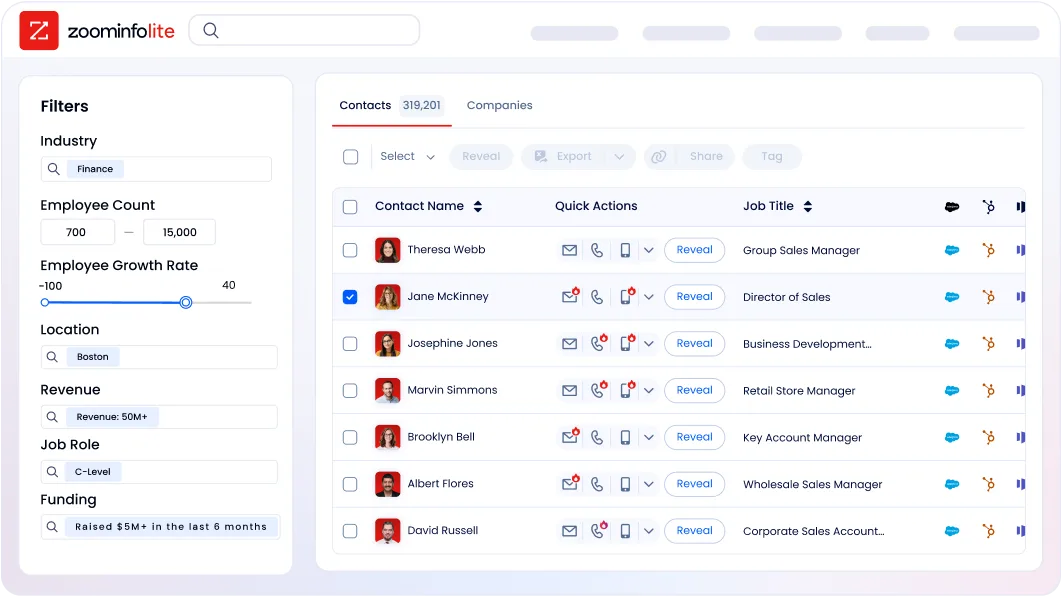
ZoomInfo Lite is a permanent free tier (no time limit, no credit card) with access to the B2B database, 10 monthly export credits, the Chrome extension, and WebSights Lite. A 7-day free trial unlocks paid features. Paid plans are custom-quoted and seat-and-credit based, with API access included in all relevant plans.
Compliance and security postures reflect different markets
SafeGraph's compliance approach centers on privacy by design.
The company does not collect information from natural persons (per its privacy policy) and does not sell location data that can identify individuals. A CCPA addendum is maintained, but SafeGraph considers GDPR not applicable because it does not collect personal data in the EEA or UK. No public security certifications (SOC 2, ISO 27001) appear on its website.
InfobelPRO foregrounds GDPR and CCPA compliance, with data sourced from 1,100+ official registries and attribute-level metadata enabling field-level traceability.
Do-Not-Contact-Mobile flags are built into the schema. No public documentation on ISO 27001, SOC 2, or other security certifications is available.
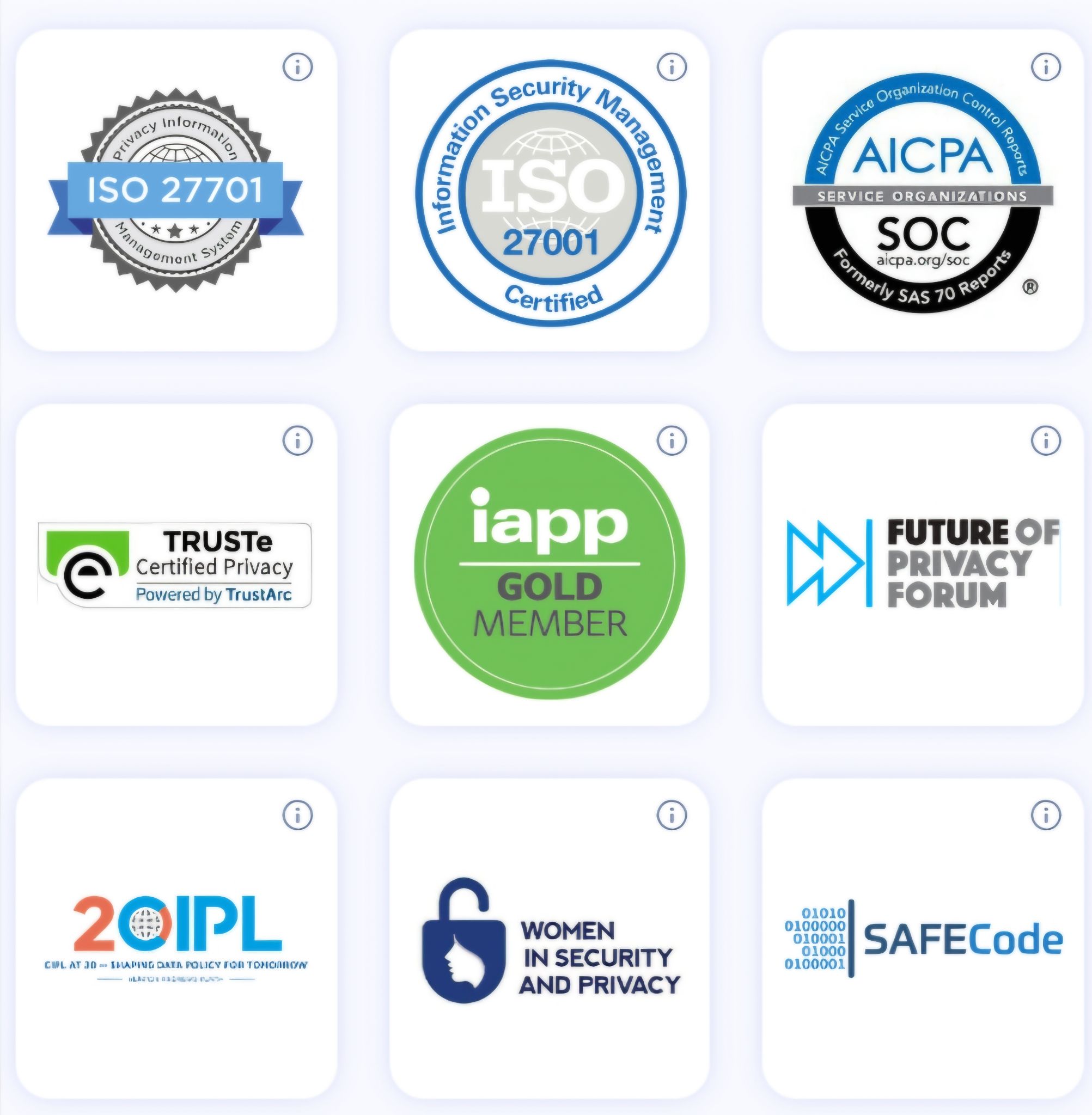
ZoomInfo holds the broadest set of compliance certifications among the three: ISO 27001, ISO 27701, SOC 2 Type II, and TRUSTe GDPR and CCPA validations, all renewed annually.
Source: ZoomInfo
It is a registered data broker in California and Vermont and maintains a Trust Center. For enterprise buyers in regulated industries (financial services, healthcare, government contracting), ZoomInfo's documented security posture addresses procurement requirements that the other two platforms may need to satisfy through custom attestations.
Where each platform fits in your stack
SafeGraph and InfobelPRO are data ingredients. ZoomInfo is a data platform with a built-in kitchen.
If you're building a location-aware SaaS product that needs to know where every Starbucks, hospital, and gas station sits (with polygon boundaries), SafeGraph was built for that job.
Plaid uses SafeGraph to connect 50% of card-present transactions to verified merchant locations. Spade uses it to bring transparency to financial services. These companies embed SafeGraph's data inside their own products.
If you're enriching a CRM with global firmographic data, verifying business entities for KYB compliance, or building an ABM platform that needs structured company records across 220 countries, InfobelPRO provides that data layer.
Its registry-sourced approach and coverage in non-Anglophone markets make it one of the few single-source options for global company data.
If your end goal is revenue (finding prospects, reaching decision-makers, closing deals, and expanding accounts), ZoomInfo turns data into action.
The GTM Context Graph connects your CRM records, conversation intelligence, and third-party signals to tell your team who to contact, when to engage, and what to say.
GTM Workspace puts that intelligence in front of sellers. GTM Studio lets marketers and RevOps teams build campaigns without engineering tickets. The API and MCP access means the same intelligence can power any custom tool or AI agent.
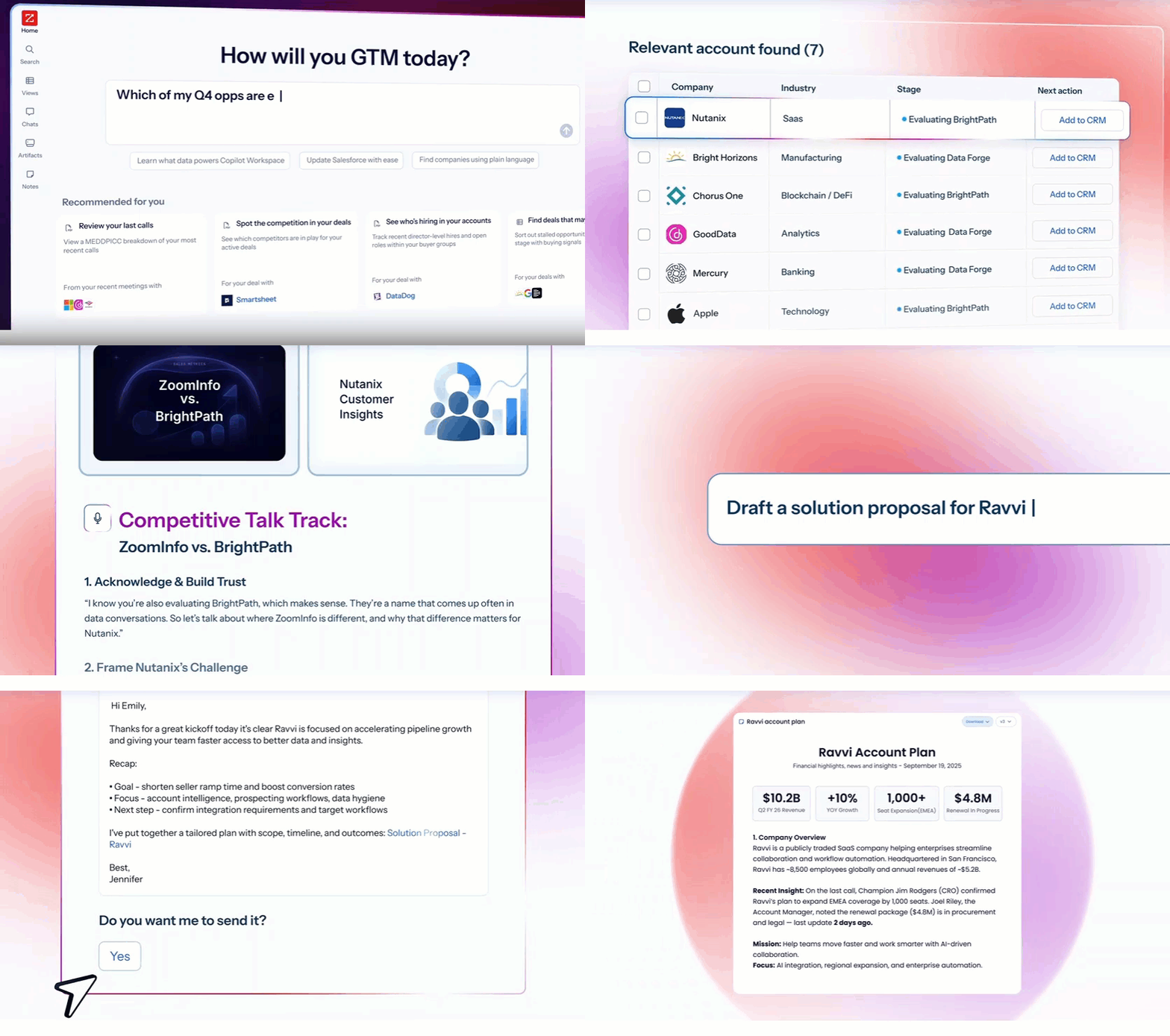
Levanta's CEO called ZoomInfo "a full system of execution" that "works the list, writes the outreach, triggers the play, and helps drive predictable growth." (Levanta Case Study)
SafeGraph vs. InfobelPRO vs. ZoomInfo: Which should you choose?
The right choice depends on what you're building and what problem you're solving.
Choose SafeGraph if:
You're building a location-aware product that needs accurate, production-ready POI data
Polygon accuracy and spatial hierarchy are critical to your analytics or attribution models
You work in adtech, fintech, retail analytics, or commercial real estate
Your team consists of data scientists and engineers comfortable with bulk file delivery
You need transparent documentation and monthly updates for your data pipeline
Choose InfobelPRO if:
You need global company data at scale, especially outside North America and Western Europe
Registry-sourced, compliance-ready data is a procurement requirement for KYB or AML workflows
You're building a product that needs a firmographic data layer via API
Corporate linkage and ownership hierarchy matter for your use case
You need POI data enriched with full firmographic context in a single schema
Choose ZoomInfo if:
Your goal is finding, reaching, and closing B2B buyers, not just storing data about them
You need verified contact data at scale (direct dials, business emails, mobile numbers)
Intent signals and buying behavior matter to your prospecting and account prioritization
You want AI-powered execution tools (GTM Workspace, GTM Studio) alongside your data
You need a platform that integrates natively with your CRM and sales engagement tools
You want the same intelligence accessible through APIs, MCP, or native UI
Start with ZoomInfo Lite for free or request a demo of the full platform.
SafeGraph and InfobelPRO earned their reputations by doing one thing well: delivering clean, structured data that other teams build on. But data is only valuable if it drives decisions.
For organizations that need both the data and the action layer (from prospecting to outreach to pipeline management to deal intelligence), ZoomInfo provides what neither data platform was designed to offer: a go-to-market engine built on a large, verified B2B dataset.
SpringDB's Founder and CEO saw 2-3x increases in campaign conversions, a 300% increase in database usability, and 30-50% uplift in average deal size after adopting ZoomInfo. (SpringDB Case Study)
SafeGraph vs. InfobelPRO vs. ZoomInfo FAQ
What is the core difference between SafeGraph, InfobelPRO, and ZoomInfo?
SafeGraph is a geospatial data provider focused on point-of-interest data, building footprint polygons, and geocoded addresses for product builders and data scientists.
InfobelPRO is a global firmographic data platform delivering 371M+ company records across 220 countries via APIs and flat files, targeting data engineering and compliance teams.
ZoomInfo is a GTM platform that combines 500M contacts, 100M companies, intent signals, and conversation intelligence with AI-powered sales and marketing execution tools.
Which platform has the best POI and location data?
SafeGraph and InfobelPRO both offer strong POI datasets.
SafeGraph provides building footprint polygons with transparent accuracy metrics and monthly updates, used by companies like Plaid and Clear Channel Europe. InfobelPRO offers 202M+ POIs with deeper firmographic context per record and is an official Esri partner.
SafeGraph is the stronger choice for geospatial analytics requiring polygon precision. InfobelPRO adds more business context to each location record.
Which platform provides the best B2B contact data?
ZoomInfo leads by a wide margin, with 500M contacts, 200M+ verified business emails, 135M+ verified phone numbers, and 120M direct dials.
SafeGraph provides no contact data.
InfobelPRO includes executive names for most records, but email coverage is about 5.4% of its database and phone coverage about 24%.
For teams that need to reach specific decision-makers, ZoomInfo is the only viable standalone option among the three.
Can SafeGraph or InfobelPRO replace ZoomInfo for sales prospecting?
No. Neither was designed for sales prospecting. SafeGraph is a places data provider with no contact information or sales features.
InfobelPRO is a data platform with limited contact coverage and no CRM, pipeline management, intent signals, or outreach tools.
ZoomInfo combines contact data, buying signals, AI-drafted outreach, and CRM integration into a single platform built for go-to-market execution.
How do pricing models compare across the three platforms?
All three use custom pricing. SafeGraph charges a custom annual fee based on rows, columns, and usage rights, with no published prices.
InfobelPRO directs most buyers to a data consultant, though its Get.app tool allows transactional purchases of company lists.
ZoomInfo offers a permanent free tier (ZoomInfo Lite) with 10 monthly export credits, a 7-day free trial, and custom-quoted paid plans based on seats and credits.
Which platform is best for compliance and KYB use cases?
InfobelPRO is the strongest choice for KYB and regulatory compliance, with data sourced from 1,100+ official business registries, attribute-level provenance metadata, and corporate linkage enabling ownership chain verification across 200+ countries.
ZoomInfo also supports compliance workflows with ISO 27001, ISO 27701, and SOC 2 Type II certifications.
SafeGraph focuses on places data and does not target compliance use cases.
Which platform has the broadest international coverage?
InfobelPRO leads on global firmographic coverage with 371M+ company records across 220 countries, including depth in markets like China (90M+), India (32M+), and Brazil (25M+).
ZoomInfo provides 34M+ company profiles and 200M+ professional profiles outside North America, with recent expansions adding 1.8 million mobile numbers across six European markets.
SafeGraph's core strength remains the United States, Canada, and the UK, with ongoing expansion into Western Europe and Latin America.
Can these platforms be used together?
Yes. SafeGraph and InfobelPRO serve as data layers that complement ZoomInfo.
A data team might use SafeGraph's polygons for store-visit attribution, InfobelPRO's registry data for compliance verification, and ZoomInfo for the contact-level intelligence and GTM execution that turn those insights into pipeline. ZoomInfo's API and MCP access make it straightforward to integrate alongside other data sources.
