
Choosing between Sage CRM vs. Salesforce for your business often comes down to these five questions:
Are you already running Sage accounting software and need a CRM that connects directly to your financial data?
Do you need a CRM that handles basic sales and service workflows, or one that spans marketing, commerce, analytics, and AI agents?
Is your team 20 people or 2,000, and will that number change in the next three years?
Can you invest in a dedicated administrator to configure and maintain your CRM, or do you need something your team can run without specialized staff?
Does your CRM help your reps find and reach the right buyers, or does it just record what happened after the fact?
In short, here's what we recommend:
Sage CRM is built for small and midsize businesses already using Sage accounting software. Its core value is a native integration with Sage 100, 200, 300, and 50 that lets sales reps see order history, invoice status, and inventory levels without leaving the CRM. For a 25-person company on Sage accounting, it's the path of least resistance to a functional CRM. But the interface feels dated compared to modern competitors, the integration ecosystem outside Sage is thin, and there's no AI to speak of.
Salesforce is the #1 CRM by IDC market share, serving over 150,000 companies worldwide with a platform that extends beyond sales into service, marketing, commerce, and AI agents. With Agentforce reaching $800M ARR and 9,000+ apps on AppExchange, it can handle nearly any business process you throw at it. That capability comes with complexity: configuration requires trained administrators, pricing layers compound fast, and over 70% of implementations are partner-led.
Both platforms manage customer relationships. Neither tells your reps who to call next, whether a target account is researching your category, or what the buying committee looks like before the first conversation. That intelligence gap is where most CRM investments underperform.
ZoomInfo is a B2B data and intelligence platform that provides what CRMs were never designed to deliver. With 500M contacts, 100M companies, and 135M+ verified phone numbers, plus 200M+ verified business emails, ZoomInfo gives sales teams the fuel their CRM needs: verified contacts with direct dials that connect, buyer intent signals showing which accounts are in-market now, and AI workflows that tell reps who to contact, when to engage, and what to say. ZoomInfo integrates with both Salesforce and other major CRMs, turning your CRM from a record-keeping system into a pipeline generator.
If making your CRM investment pay off sounds appealing, see how ZoomInfo works with your CRM.
Sage CRM vs. Salesforce at a glance
Sage CRM | Salesforce | ZoomInfo | |
|---|---|---|---|
Core strength | Sage ERP integration | Platform depth and ecosystem | B2B data, intent signals, and AI prospecting |
AI capabilities | None currently; natural language reporting planned | Agentforce autonomous agents, Einstein AI across platform | GTM Context Graph powering AI outreach and deal intelligence |
Integration ecosystem | Sage accounting products; limited third-party | 172+ marketplace integrations, native CRM connectors, API and MCP access | |
Contact database | Stores contacts you enter | Stores contacts you enter | 500M contacts with verified direct dials and emails |
Buyer intent data | None | Available via add-ons or third-party apps | Native intent data from 210M IP-to-Org pairings |
Deployment options | Cloud and on-premise | Cloud only (multi-tenant) | Cloud |
Starting price | ~$45-50/user/month | $25/user/month (Starter Suite) | Custom-quoted; free tier available |
Free plan | No (30-day trial) | Free Suite (2 users max) | ZoomInfo Lite (permanent free tier) |
Best for | SMBs on Sage accounting | Mid-market to enterprise across industries | Sales intelligence and GTM execution with any CRM |
Sage CRM serves a specific buyer; Salesforce serves everyone else
Sage CRM and Salesforce aren't competing for the same customer. They're designed for different situations.
Sage CRM exists for one reason: to give businesses already running Sage accounting a CRM that syncs customers, contacts, quotes, orders, and accounting details in real time with their financial system. A sales rep can see a customer's invoice status, credit limit, and order history without switching to the ERP. When a deal closes, the quote promotes directly into Sage's sales order module without re-entering data. For a manufacturing or distribution company on Sage 100 or Sage 300, this removes the most common friction point between sales and finance.
Outside the Sage ecosystem, the value weakens. The integration ecosystem is thin compared to Salesforce, there's no native Zapier connector, and the platform no longer appears in Gartner's SFA Magic Quadrant evaluations for sales force automation.
Salesforce plays in a different league. With $41.5 billion in FY26 revenue, it covers 17 industry verticals and spans everything from basic contact management on the free CRM tier to marketing automation, commerce, and autonomous AI agents. Salesforce has held the Gartner Magic Quadrant Leader position for Sales Force Automation for 19 consecutive years.
The difference is scope, not quality. Sage CRM is a functional CRM for a narrow audience. Salesforce is a platform you can configure to do almost anything, if you have the budget and expertise to set it up.
The data gap matters more than the feature gap
Both Sage CRM and Salesforce are record-keeping systems. They store the contacts, companies, and deals your team enters. Neither tells you who you should be selling to, whether those contacts are still at the company, or if a target account is researching solutions in your category.
This is the problem ZoomInfo solves.
Sage CRM captures what your reps input. The contact database requires manual management, and users find it tedious to group, segment, and update large contact lists. There's no enrichment engine, no intent data, and no way to identify anonymous website visitors.
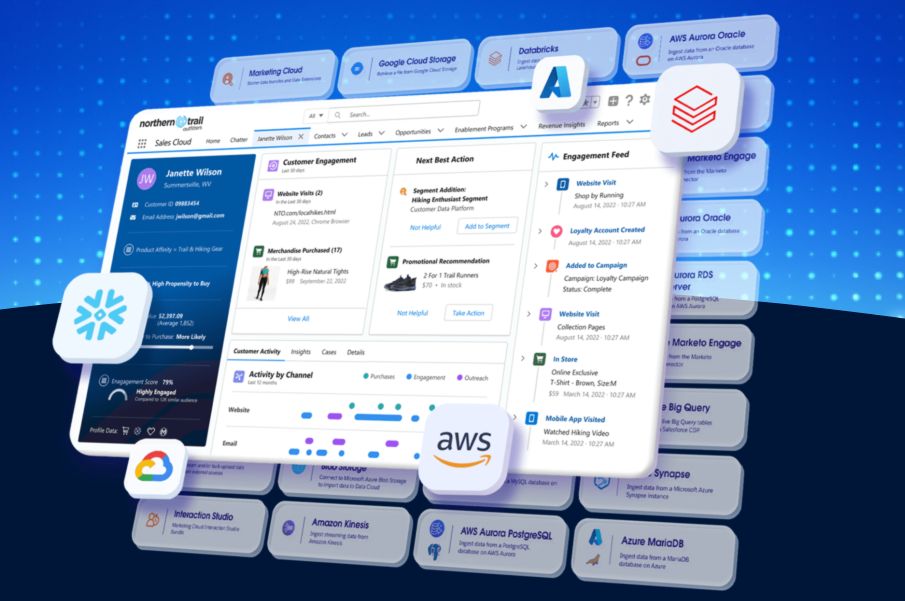
Salesforce offers more through its Data Cloud (which ingested 112 trillion records in FY26) and third-party AppExchange integrations. But Data Cloud is a unification and activation layer for data you already have or connect, not a source of new prospect intelligence.
Source: Salesforce
ZoomInfo starts with the data itself: 500M contacts, 100M companies, and 135M+ verified phone numbers, 120M direct-dial phone numbers, and 200M+ verified business emails, verified through a multi-source pipeline backed by 300+ human researchers with up to 95% accuracy on first-party data. In a Fortune 500 competitive RFP analyzing 25 million contacts across vendors, the independent consultant concluded that "no other competitor came even close."

Source: ZoomInfo
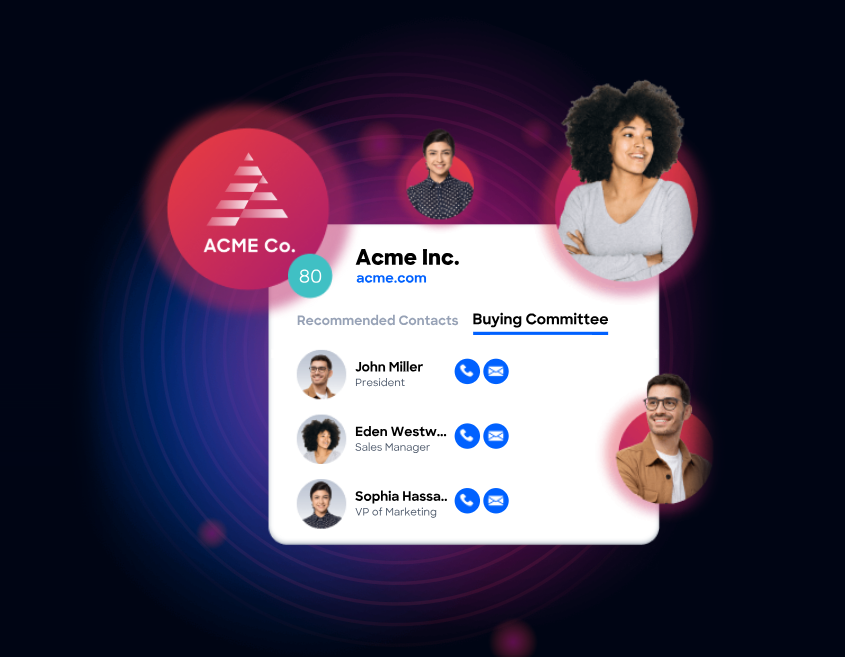
Beyond static profiles, ZoomInfo Intent tracks signals from 210 million IP-to-Organization pairings and 6 trillion+ new keyword-to-device pairings sourced monthly. Guided Intent (exclusive to ZoomInfo) identifies topics historically correlated with deal success rather than requiring manual topic selection. WebSights resolves anonymous website traffic to companies, including buying team identification and direct contact info.
Source: ZoomInfo
A sales rep using Sage CRM or Salesforce with ZoomInfo doesn't just manage existing relationships. They know which target accounts are in-market, who the decision-makers are, and how to reach them directly, before the first conversation.
Snowflake uses ZoomInfo data for at least one-third of the most critical features in their Account Propensity Scoring model, feeding over 70 company and technographic fields. Accounts monitored using ZoomInfo-powered scores showed 90% higher opportunity open rates and 2x higher customer conversion rates. (Snowflake Case Study)
The AI divide is wide and growing
This is where the comparison becomes less about preference and more about trajectory.
Sage CRM has no AI capabilities in its current release. The 2026 R1 update prioritized security and infrastructure over new features, and the roadmap's first planned AI feature is natural language reporting, where users type plain-English queries to generate reports.
That's useful, but it's table stakes in 2025. There's no AI lead scoring, no predictive pipeline analytics, and no conversation intelligence. Deal probability is assigned manually per opportunity stage rather than derived from machine learning.
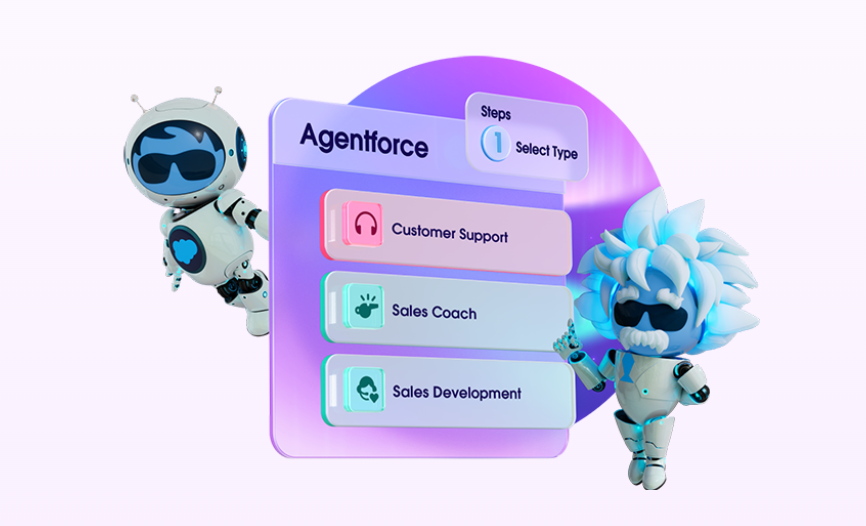
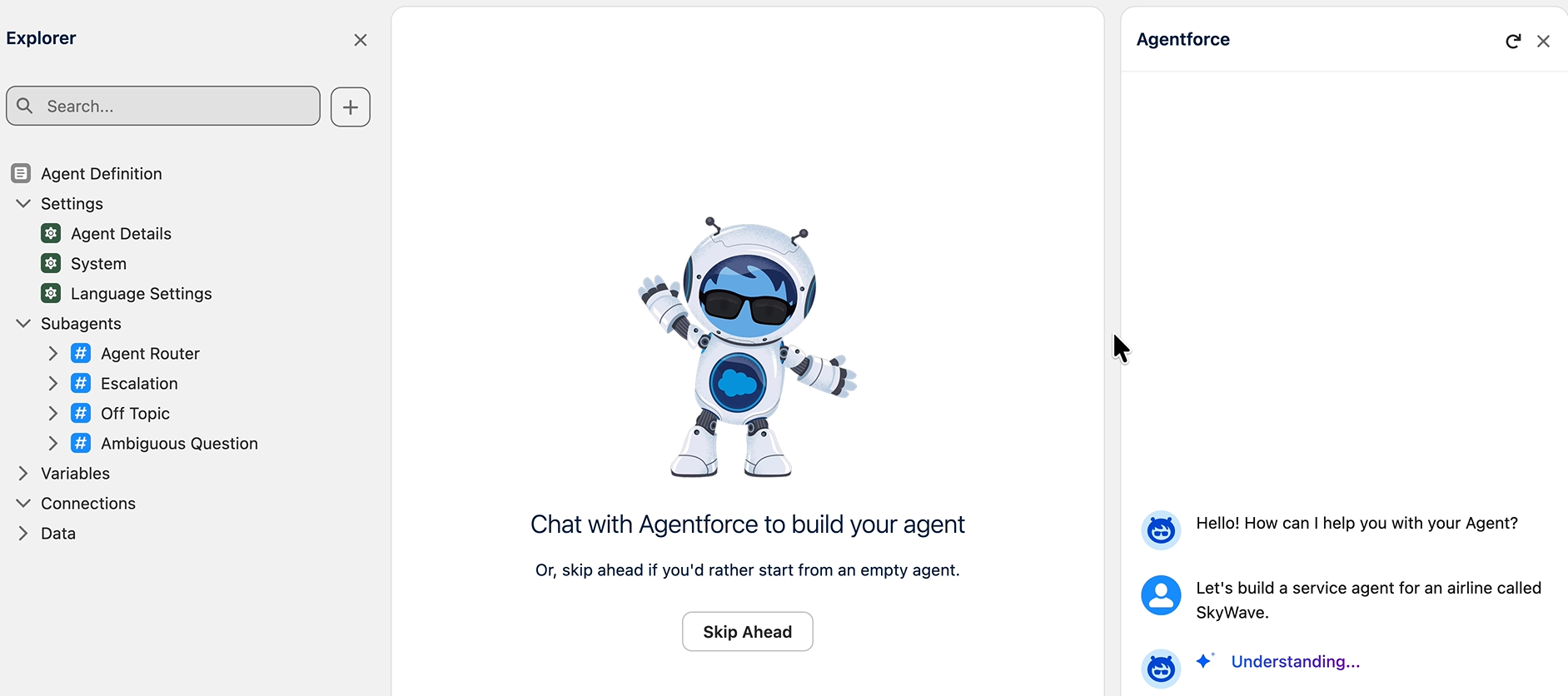
Salesforce has gone all-in on AI. Agentforce deploys autonomous agents that handle customer service inquiries, draft sales outreach, coach reps, and manage pipelines.
Source: Salesforce
The results are measurable: Salesforce resolves 85% of its own support requests without human escalation. The Atlas Reasoning Engine powers these agents with a loop of reasoning, acting, and adapting, not scripted responses. Einstein AI handles lead scoring, opportunity insights, activity capture, and forecast overlays across the platform.
Source: Salesforce
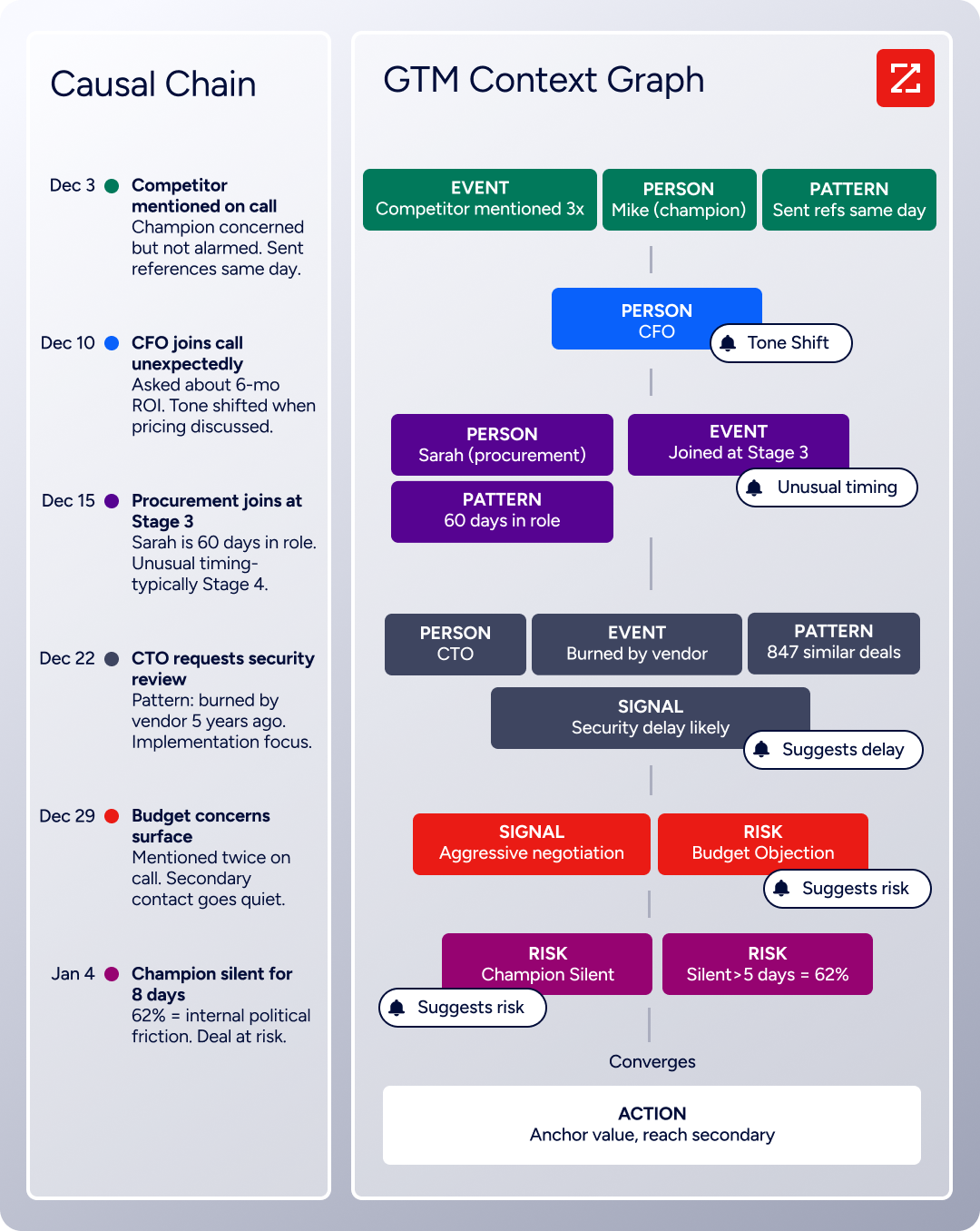
ZoomInfo approaches AI from the data side. Its GTM Context Graph combines ZoomInfo's B2B data with a customer's CRM records, conversation transcripts, and behavioral signals to capture not just what happened in a deal, but why it happened.
Source: ZoomInfo
As CPO Dominik Facher writes: "The CRM recorded the state change. It has no record of why it happened." The GTM Context Graph fills that gap. The AI built on it drafts outreach that addresses specific buyer concerns, targets accounts matching proven win patterns, and surfaces buying committee members that reps would otherwise miss.
Seismic's sales team attributed 39% of active pipeline to opportunities identified or influenced by ZoomInfo signals, boosted productivity by 54%, and saved 11.5 hours per week per seller. (Seismic Case Study)
For a closer look at how Salesforce's platform AI and ZoomInfo's data intelligence compare on their own terms, see our Salesforce vs. ZoomInfo breakdown.
Integration ecosystems show different philosophies
Sage CRM's integration story starts and ends with Sage. The connections to Sage 50, 100, 200, 300, X3, and Intacct are the product's reason for being. Outside that ecosystem, options narrow fast. There's no native Zapier integration, no confirmed Make or Workato connectors, and the REST API still supports only Basic Authentication rather than OAuth 2.0. Webhooks arrived in 2025 R2 as a Labs feature, and the official C# SDK was archived in May 2024. If you need Sage CRM to talk to tools outside the Sage family, expect third-party solutions or custom development.
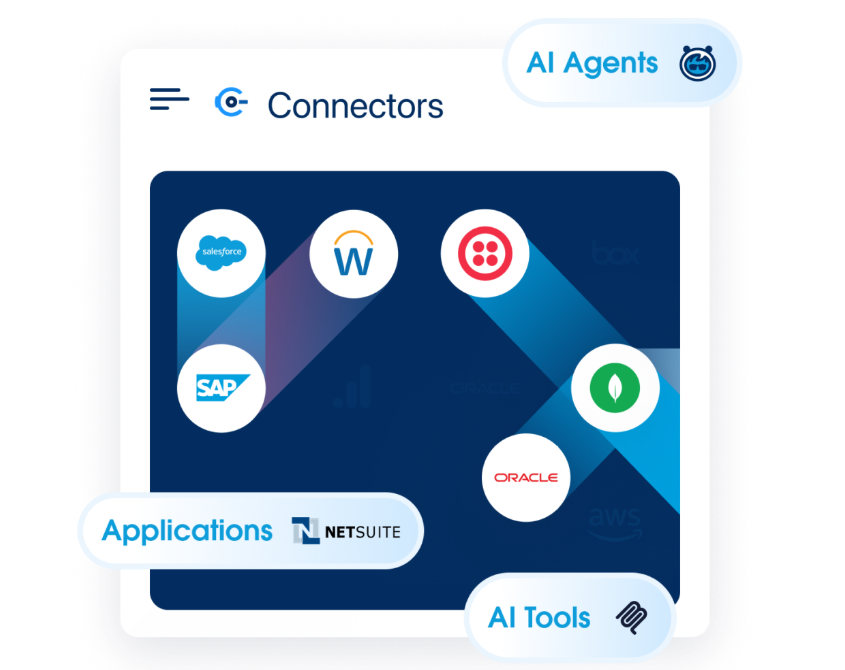
Salesforce has one of the largest integration ecosystems in enterprise software. AppExchange hosts 9,000+ partner apps with 14+ million installs, and 91% of customers use at least one AppExchange app. MuleSoft provides hundreds of pre-built connectors for enterprise systems. The API portfolio spans more than 30 distinct APIs across REST, SOAP, GraphQL, gRPC, and event-streaming protocols, all secured with OAuth 2.0. If a business tool exists, there's likely a Salesforce integration for it.
Source: Salesforce
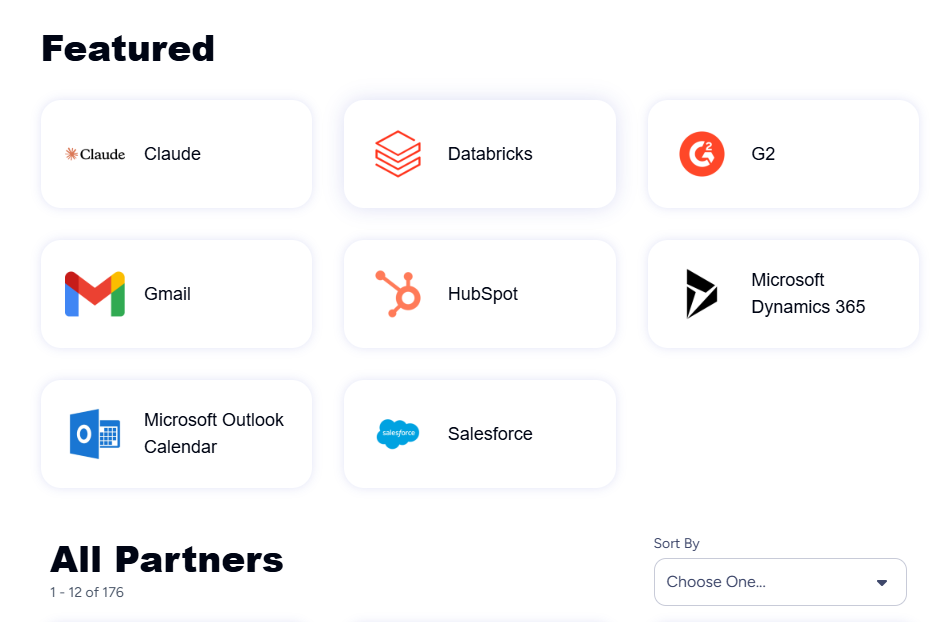
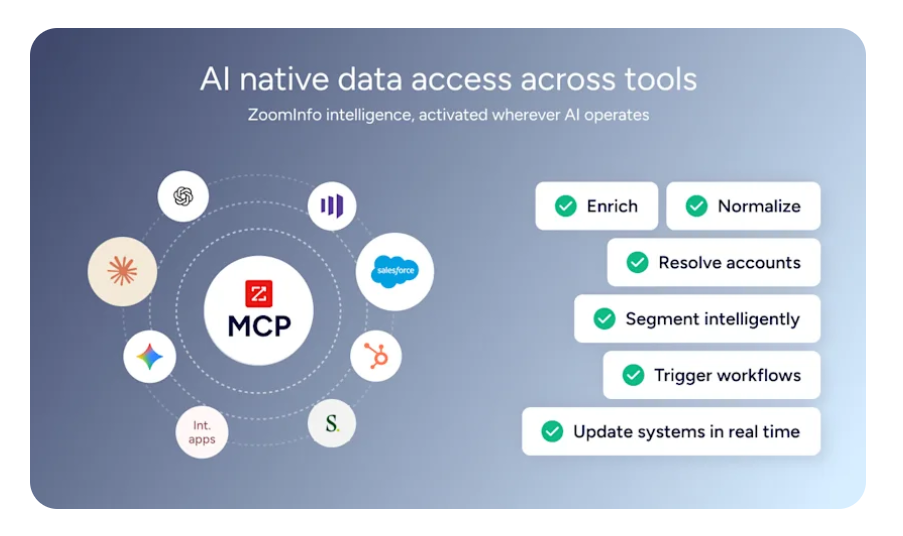
ZoomInfo connects to both ecosystems. Its Marketplace lists 172+ integration partners across CRM, marketing automation, sales engagement, data warehouses, and AI platforms.
Source: ZoomInfo
The native Salesforce integration enriches CRM records, routes leads, and surfaces buying signals directly in Salesforce. For teams building their own tools, the Enterprise API and MCP server expose ZoomInfo's intelligence to any AI agent or custom application, including Claude and ChatGPT.
Source: ZoomInfo
"The plug-and-play aspect of the API means I can integrate it very easily into any process and get information at a moment's notice." BDO Canada achieved an 87% reduction in time spent on internal data dashboard updates using ZoomInfo's API. (BDO Canada Case Study)
Pricing structures reflect different markets
Sage CRM doesn't publish US pricing on its website. The Irish storefront lists Cloud Professional at €50/user/month. US reseller estimates range from $45/user/month at baseline to $150/user/month for a partner-managed bundle with hosting, ERP integration, and support. The gap matters: the base license covers sales, marketing, and service modules, but add-ons like advanced Outlook connectivity (~$200/user/year), ERP integration (~$200/user/year), and mobile apps (~$150/user/year) are sold separately. On-premise deployments also require SQL Server licensing and a mandatory first-year support contract. A fully configured deployment can reach $75-$150+/user/month.
Salesforce pricing is transparent in theory and complex in practice. The free tier supports 2 users. Starter Suite runs $25/user/month, but real functionality starts at Pro Suite ($100/user/month) for customization and forecasting. Enterprise ($175/user/month) adds AI capabilities. Unlimited ($350/user/month) includes the full AI suite and Premier Success support. Then come the add-ons: Digital Engagement at $75/user/month, Contact Center at $150/user/month, Agentforce at $125/user/month or $2 per conversation, and Data Cloud credits priced separately. Premier Success Plans cost 30% of net license fees on top of everything else. A mid-sized company can reach $50,000-100,000 per month without careful management.
ZoomInfo uses custom-quoted, consumption-based pricing. Three product lines (Sales, Marketing, and Chorus) come in Professional, Advanced, and Enterprise tiers. ZoomInfo Lite is a permanent free tier with access to the B2B database, 10 monthly export credits, and basic search, with no time limit or credit card required. Paid plans are annual and scale based on seats, credit volume, and feature access.
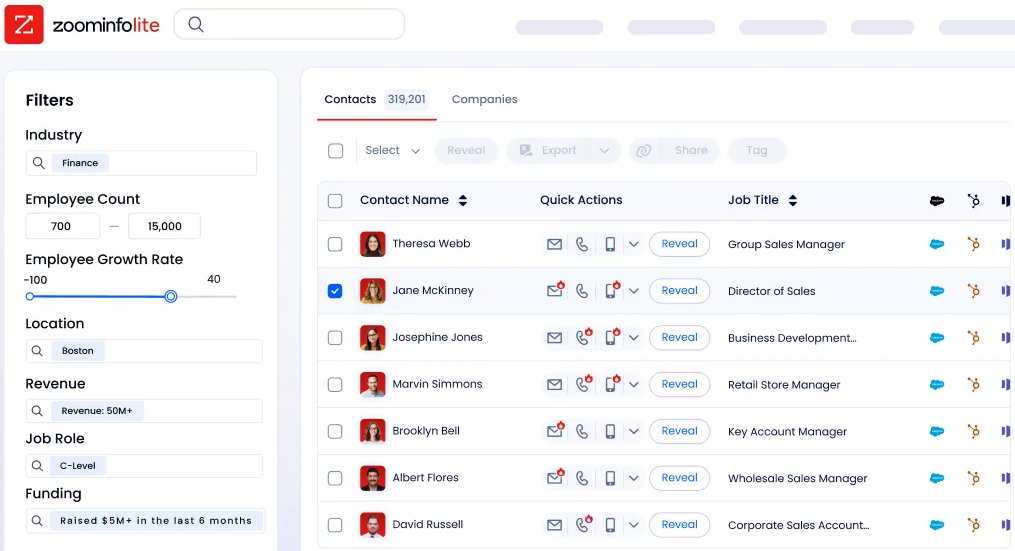
The pricing question for ZoomInfo differs from the CRM question. ZoomInfo isn't replacing your CRM; it's making your CRM investment productive. The question is whether ZoomInfo's cost is offset by the pipeline it generates. Customers like Seismic (54% productivity gain) and Snowflake (2x customer conversion) suggest the math works at scale.
User experience: modern expectations vs. legacy reality
Sage CRM's interface reflects its long product history. Users consistently describe it as visually dated compared to modern CRM platforms, with clunky navigation and workflows that take more clicks than expected. The 2026 R1 release deferred UX improvements in favor of security work, so this gap persists through at least H1 2026. There's no native mobile app; instead, the platform offers browser-based responsive themes. On the positive side, sales consultants report new users are generally ready within 1-2 days for basic functions.
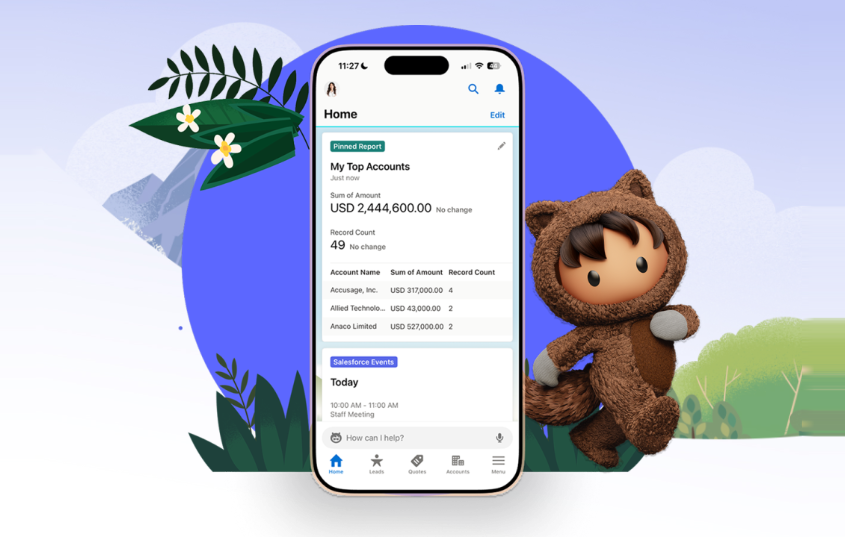
Salesforce's Lightning Experience is polished and component-based. The mobile app provides real-time CRM access on iOS and Android. But the platform's depth creates its own UX challenge: with 50+ tools across multiple clouds, the learning curve is steep. Configuration requires trained administrators, and Trailhead offers 1,500+ badges to help users get up to speed. Implementation timelines range from weeks for simple Sales Cloud setups to 3-12 months for enterprise multi-cloud deployments.
Source: Salesforce
ZoomInfo's GTM Workspace was designed to cut context-switching for sellers. Rather than toggling between a CRM, a prospecting tool, an intent dashboard, and an email sequencer, reps get a single view of their book of business with AI-generated account briefs, an action feed of in-market buyers, and AI-drafted outreach ready to send. ZoomInfo redesigned its onboarding from 30 to 90 days, producing a 25% improvement in customer satisfaction scores and winning Rocketlane's Golden Comet award for Best Customer Onboarding Team of 2024.

Source: ZoomInfo
Customer service and support capabilities
Sage CRM includes a full customer service module with structured case lifecycle management, SLA enforcement with priority tiers and business calendar awareness, and a self-service portal bundled with the license rather than sold as an add-on. For SMBs with a small service team, the case management, knowledgebase with case-suggestion matching, and workflow escalation rules cover the basics. Sage's own support quality draws mixed reviews: Capterra reviewers report receiving conflicting solutions from different support specialists, and G2 users cite slow wait times.
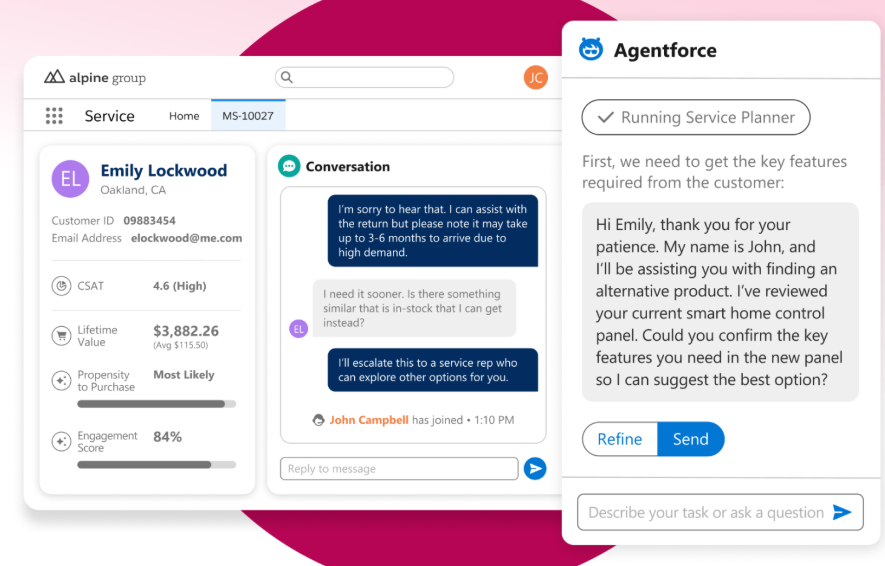
Salesforce has Service Cloud with case management, omnichannel engagement, AI knowledge management, and Agentforce for Service that can resolve cases autonomously. The capability is extensive, but so is the cost: Digital Engagement adds $75/user/month, Contact Center adds $150/user/month, and Agentforce for Service adds $125/user/month. Salesforce support itself is tiered: Standard is free but basic, Premier costs 30% of net license fees with 1-hour response time, and Signature provides 24/7 support with 15-minute response at custom pricing.
Source: Salesforce
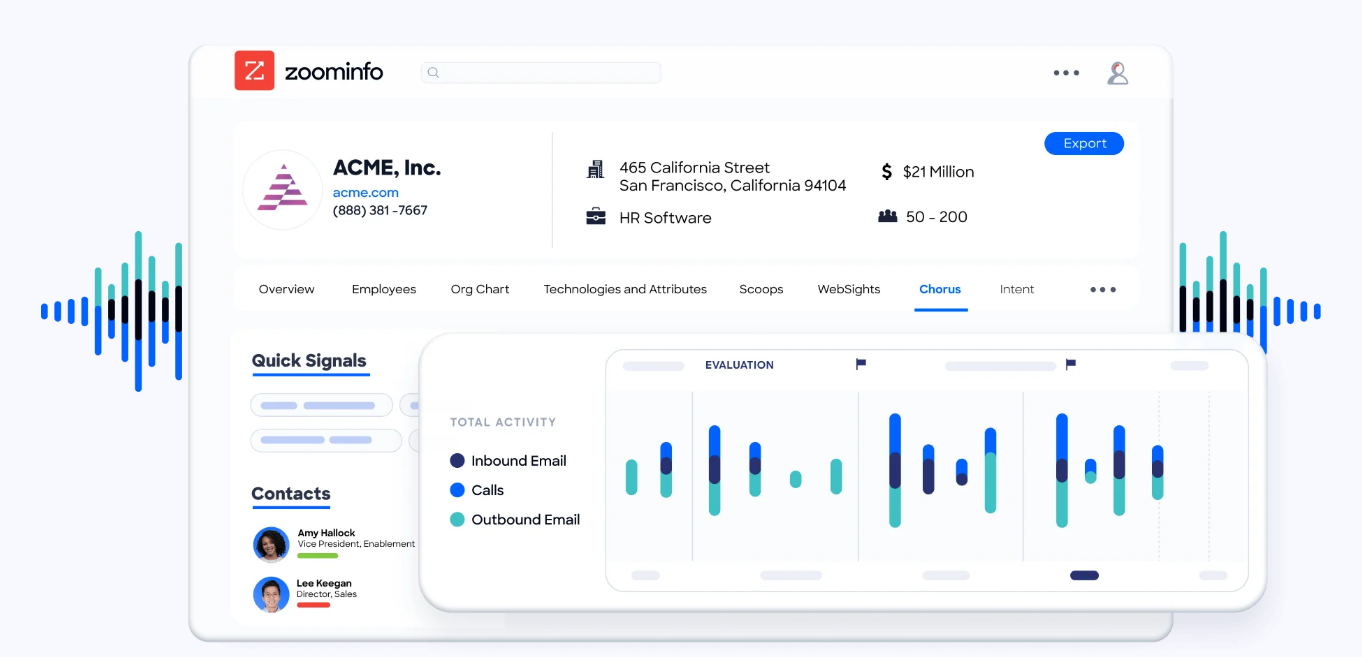
ZoomInfo doesn't replace a service desk. Its role in customer service is preventive: by giving account managers visibility into customer health signals, org chart changes, and competitive research activity, it helps teams spot at-risk accounts before they churn. Chorus captures and analyzes all customer calls and meetings, surfacing sentiment shifts and competitive mentions that a CRM case log would miss.
Source: ZoomInfo
Security and compliance comparison
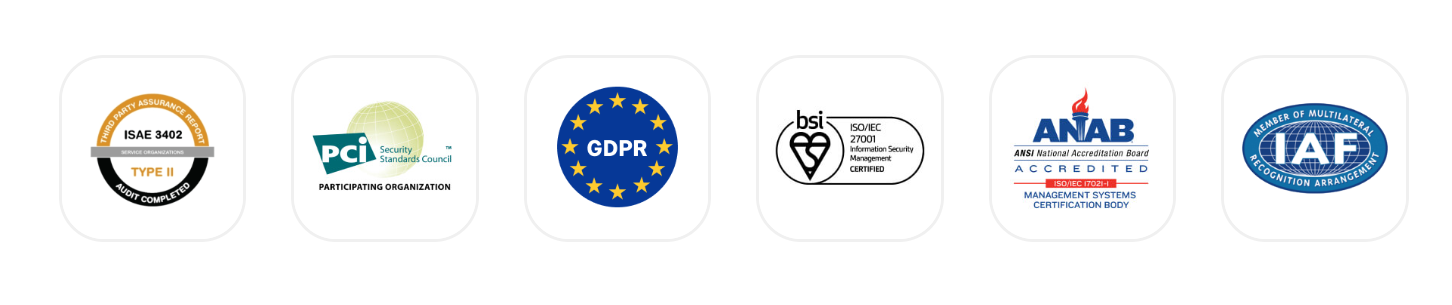
Sage CRM relies on the Sage Group ISO 27001 certification for cloud deployments and SQL Server TLS and TDE configurations for data protection. The 2026 R1 release addressed vulnerabilities found through penetration testing and updated third-party libraries. GDPR compliance is supported through consent tracking functionality. On-premise deployment gives organizations full control over their data infrastructure, which matters for regulated industries. However, certifications like PCI DSS or HIPAA BAA for the CRM product are not publicly documented.
Source: Sage
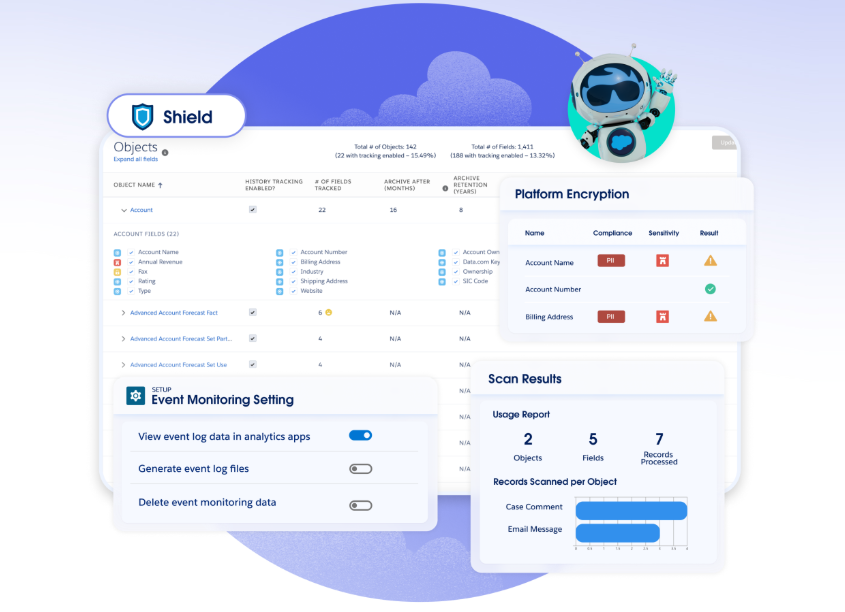
Salesforce holds ISO 27001/27017/27018, SOC 1/2/3, FedRAMP, and HITRUST certifications. Salesforce Shield adds event monitoring, platform encryption with BYOK, and field audit trail as a premium add-on. The Einstein Trust Layer provides zero data retention with LLM partners, PII masking, and toxicity detection for AI features. Hyperforce enables regional data residency across multiple countries. trust.salesforce.com provides real-time system status and compliance documentation.
Source: Salesforce
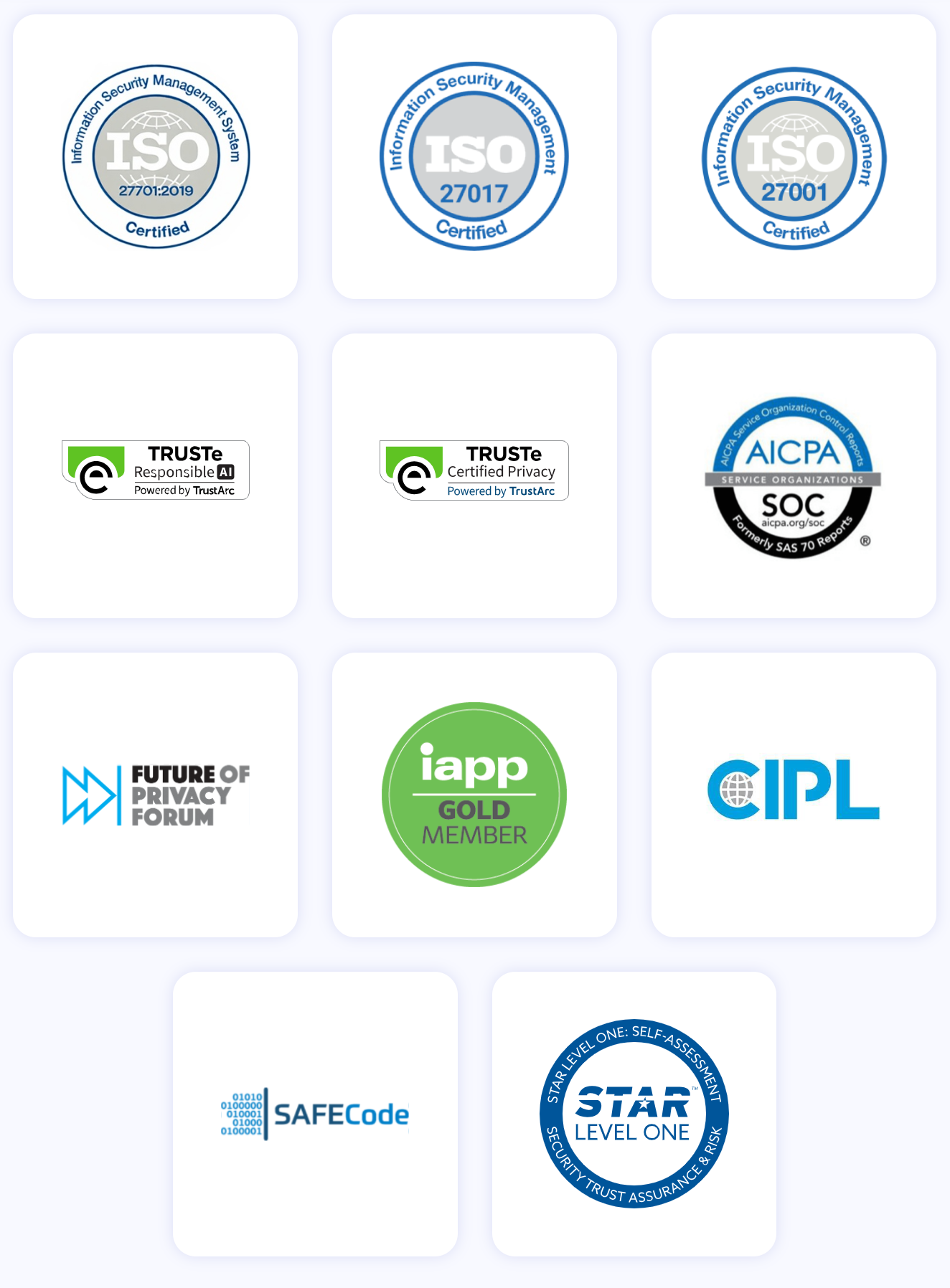
ZoomInfo maintains ISO 27001, ISO 27701, SOC 2 Type II, TRUSTe GDPR, and TRUSTe CCPA certifications, all renewed annually. The company is a registered data broker in California and Vermont. A dedicated Trust Center provides transparency into data handling practices. Given that ZoomInfo handles large volumes of contact data across its B2B database, this compliance infrastructure is essential for enterprise adoption.
Sage CRM vs. Salesforce vs. ZoomInfo: Which should you choose?
The three platforms serve different purposes, and for many teams the answer isn't one or the other; it's a combination.
Choose Sage CRM if:
You're already running Sage 100, 200, 300, or 50 for accounting
You need real-time, bi-directional sync between CRM and your financial system
Your sales team is under 100 users and your processes are straightforward
On-premise deployment matters for your compliance or IT requirements
You value simplicity and fast onboarding over advanced features
Choose Salesforce if:
You need a platform that spans sales, service, marketing, commerce, and analytics
You have or plan to hire dedicated Salesforce administrators
AI automation and autonomous agents are strategic priorities
You need industry-specific solutions across regulated verticals
Your integration requirements extend across dozens of business systems
Add ZoomInfo to either CRM if:
Your reps spend more time researching prospects than selling to them
You need verified contact data with direct dials and emails that work
Knowing which accounts are in-market before they contact you would change your pipeline
You want AI that understands your deals and drafts outreach based on real buyer context
You need your CRM data enriched and maintained automatically rather than manually
See how ZoomInfo's data and intelligence layer works with your CRM.
A CRM stores your customer relationships. ZoomInfo finds your next ones. Sage CRM does the first job well for Sage accounting users. Salesforce does it well for everyone else. But neither platform generates the intelligence that fills your pipeline. That's the layer ZoomInfo adds, and it works regardless of which CRM you choose.
"ZoomInfo is our one source of truth for account data, and even more so for contact data. There's no other provider in the market that provides you with that level of detail." Thor Sanderson, Senior Manager of Sales Technology Enablement at Smartsheet. (Smartsheet Case Study)
Sage CRM vs. Salesforce vs. ZoomInfo FAQ
What is the fundamental difference between Sage CRM, Salesforce, and ZoomInfo?
Sage CRM is a CRM built for small and midsize businesses that use Sage accounting software, with tight integration between sales activity and financial data. Salesforce is a full enterprise platform spanning sales, service, marketing, commerce, and AI agents, serving companies of every size across 17 industries. ZoomInfo is not a CRM. It is a B2B intelligence platform that provides the data, buyer intent signals, and AI workflows that feed into CRMs like Sage CRM and Salesforce, helping sales teams find and engage the right buyers.
Which CRM is better for a small business?
Sage CRM is the simpler choice for small businesses already using Sage accounting. New salespeople can learn the basics within 1-2 days, and the Sage ERP integration eliminates double data entry between sales and finance. Salesforce offers a free tier for up to 2 users and a Starter Suite at $25/user/month, but meaningful features require the Pro Suite at $100/user/month and a trained administrator to configure. For small businesses without Sage accounting, Salesforce's free or Starter tiers may still be more practical because of the broader integration ecosystem.
Does ZoomInfo replace a CRM?
No. ZoomInfo works alongside a CRM, not in place of it. It integrates natively with Salesforce, HubSpot, and Microsoft Dynamics 365, among others. ZoomInfo provides the B2B contact data, company intelligence, buyer intent signals, and AI prospecting that CRMs were never designed to generate. Your CRM records what happened with existing customers. ZoomInfo helps you find the next ones.
How do the pricing models compare?
Sage CRM starts around $45-50/user/month but can reach $75-150/user/month with necessary add-ons like ERP integration, advanced Outlook connectivity, and hosting. Salesforce starts free for 2 users, with paid plans from $25 to $550/user/month plus add-ons for AI, data, and support that compound fast. ZoomInfo uses custom-quoted consumption-based pricing with a permanent free tier (ZoomInfo Lite) that includes database access and 10 monthly exports.
Can Sage CRM match Salesforce's AI capabilities?
Not currently. Sage CRM has no AI features in its current release. Its first planned AI capability, natural language reporting, has no announced timeline. Salesforce has invested heavily in AI through Agentforce, which reached $800M ARR with 29,000 deals closed and can autonomously handle sales prospecting, customer service, and pipeline management. ZoomInfo's GTM Context Graph and AI agents provide intelligence capabilities that work alongside either CRM.
Which platform has better third-party integrations?
Salesforce has the largest integration ecosystem with 9,000+ AppExchange apps. Sage CRM integrates well with Sage accounting products but has limited third-party connectors and no native Zapier integration. ZoomInfo offers 172+ marketplace integrations plus API and MCP access that enables connection to any tool or AI agent.
Is Sage CRM available in the cloud?
Yes. Sage CRM supports both cloud/hosted and on-premise deployment. However, cloud deployment has a limitation: it offers only one-way synchronization with Sage ERP, compared to full bi-directional sync available on-premise. Salesforce is cloud-only. ZoomInfo is cloud-only.
What kind of buyer intent data does each platform offer?
Sage CRM has no buyer intent capabilities. Salesforce can access intent data through third-party AppExchange apps or Data Cloud integrations. ZoomInfo provides native intent data tracking signals from 210 million IP-to-Organization pairings and 6 trillion+ new keyword-to-device pairings sourced monthly, with Guided Intent that identifies topics historically correlated with deal success.
See how Sage CRM stacks up elsewhere:
