

Salesforce has held the #1 CRM market share position by IDC revenue data for over a decade, serving more than 150,000 companies worldwide across 17 industry verticals. With $41.5 billion in annual revenue and products spanning sales, service, marketing, commerce, and AI, it has grown from a cloud-based contact manager into something closer to an operating system for business.
For most buyers, the question isn't whether Salesforce has the features they need. It's whether the investment, complexity, and data requirements match their situation.
To create this Salesforce review, we've analyzed it extensively. We believe it's the ideal choice if:
You need a unified platform connecting sales, service, marketing, and commerce
You have the budget and administrative resources for proper implementation
You want deep customization through low-code tools and an extensive app marketplace
You're managing complex sales processes across multiple teams and territories
You require enterprise-grade security, compliance, and AI capabilities
However, Salesforce might not be the best choice if:
You're a small team that needs straightforward CRM without a dedicated administrator
Your budget can't absorb multi-cloud pricing, annual contracts, and partner-led implementation
You need a quick deployment measured in days, not weeks or months
Your data infrastructure isn't ready (fragmented sources, no enrichment strategy)
You prefer lightweight point solutions over a full enterprise platform
While Salesforce excels at managing customer relationships, the value you get from it depends on the quality and completeness of the data inside it.
This is where ZoomInfo becomes essential: an all-in-one AI GTM platform that integrates directly with Salesforce to provide the B2B intelligence your CRM needs. ZoomInfo enriches your Salesforce records with comprehensive B2B data, surfaces buyer intent signals, and powers AI-driven execution directly inside your CRM workflows.
Because of that, we've included a detailed look at ZoomInfo later in this Salesforce review, as the B2B intelligence layer that makes your Salesforce investment work harder. If you're ready to see what ZoomInfo does for Salesforce teams, you can start with a free trial here.
What is Salesforce?
Salesforce was founded on March 8, 1999 by Marc Benioff, Parker Harris, Frank Dominguez, and Dave Moellenhoff. They started in a rented apartment on San Francisco's Telegraph Hill, with a radical premise for its time: delivering CRM software entirely through the cloud as a subscription service rather than installed enterprise software.

Source: Salesforce Early Office Circa 2000
Their launch event in February 2000 was themed "The End of Software," and the provocation proved prescient. The company went public in June 2004, crossed $1 billion in revenue by FY08, and has since grown through a series of major acquisitions: MuleSoft ($6.5 billion, 2018) for integration, Tableau ($15.7 billion, 2019) for analytics, and Slack ($27.7 billion, 2021) for collaboration.
Today, Salesforce positions itself as the world's #1 AI CRM. The platform is organized around four pillars: Customer 360 (the CRM application suite covering Sales, Service, Marketing, and Commerce), Agentforce (autonomous AI agents), Data 360 (the data and analytics layer), and Slack (enterprise collaboration with 5.2 billion messages sent weekly).
The company serves organizations of every size and industry, from small businesses using the free CRM tier to global enterprises like PepsiCo, FedEx, and Volkswagen. With over 83,000 employees across 110 offices in 93 cities, it is one of the largest enterprise software companies in the world.
Salesforce Pros & Cons
Pros | Cons |
|---|---|
- Unmatched CRM market share and analyst recognition | - Pricing complexity across multiple clouds and tiers |
- Unified platform across sales, service, marketing, and commerce | - Steep learning curve requiring dedicated administrators |
- Agentforce AI agents with autonomous task execution | - Implementation often requires partner support (70%+ of deployments) |
- 9,000+ apps on AppExchange with 14M+ installs | - Annual contracts required on most plans |
- Deep customization via low-code and pro-code tools | - Full platform value demands significant investment |
- Gartner MQ Leader across 6+ product categories | - Data quality depends entirely on what you put in |
- Enterprise-grade security and compliance certifications | - Enterprise heritage limits simplicity for small teams |
Salesforce Review: How it Works & Key Features
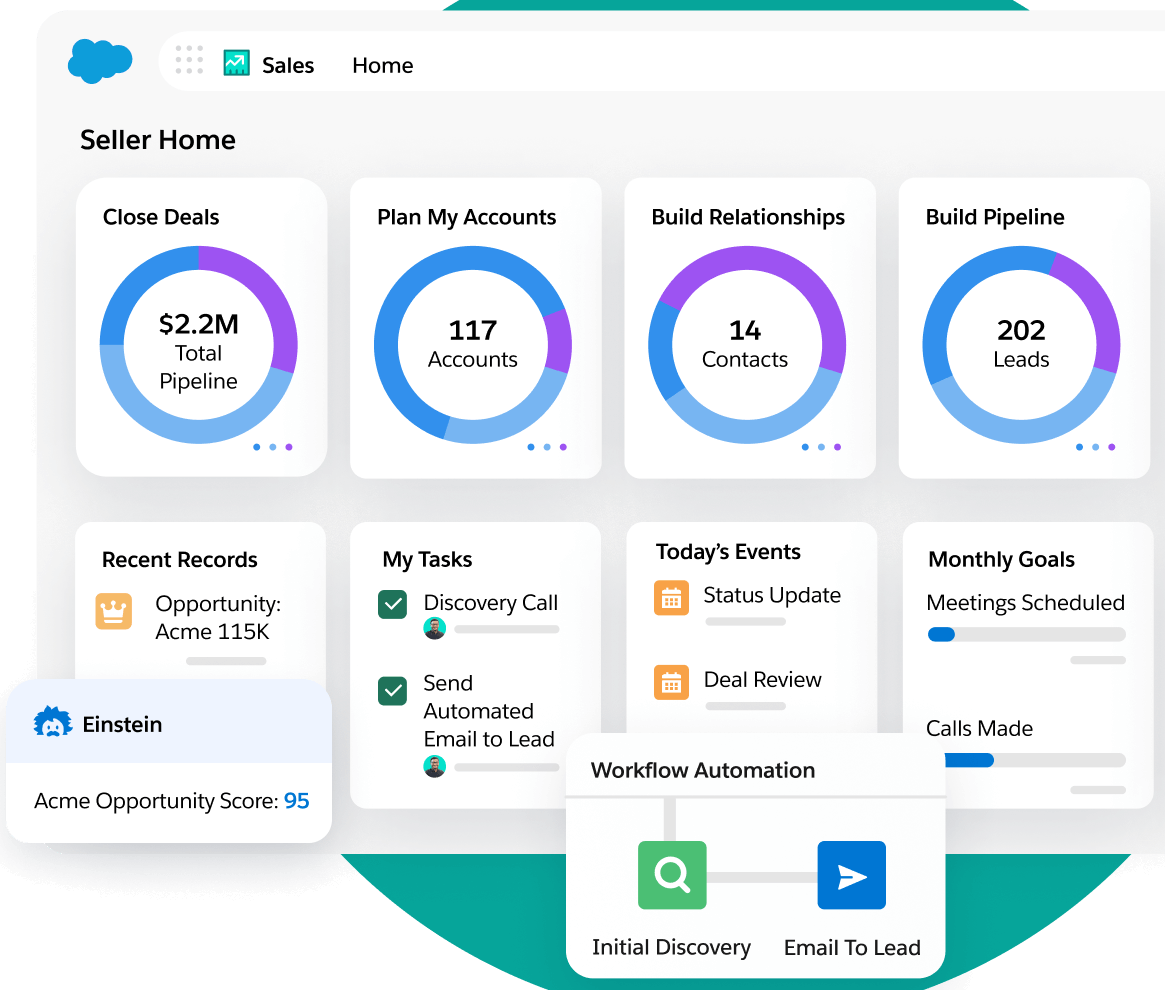
Sales Cloud: Salesforce's flagship CRM manages the full sales cycle from lead to close.
Sales Cloud (now also branded Agentforce Sales) is the product that made Salesforce dominant. It addresses a specific problem: 72% of sales reps' time goes to non-selling activities like data entry, research, and admin work.
Source: Salesforce Sales Cloud
The platform centralizes lead management, account and opportunity tracking, pipeline management, and forecasting into a single interface. Einstein Lead Scoring prioritizes prospects automatically. Einstein Activity Capture syncs emails and calendar events from Gmail and Outlook without manual logging.
Pipeline views surface AI deal insights and change signals, and forecast rollups with Einstein overlay give managers real-time revenue visibility.
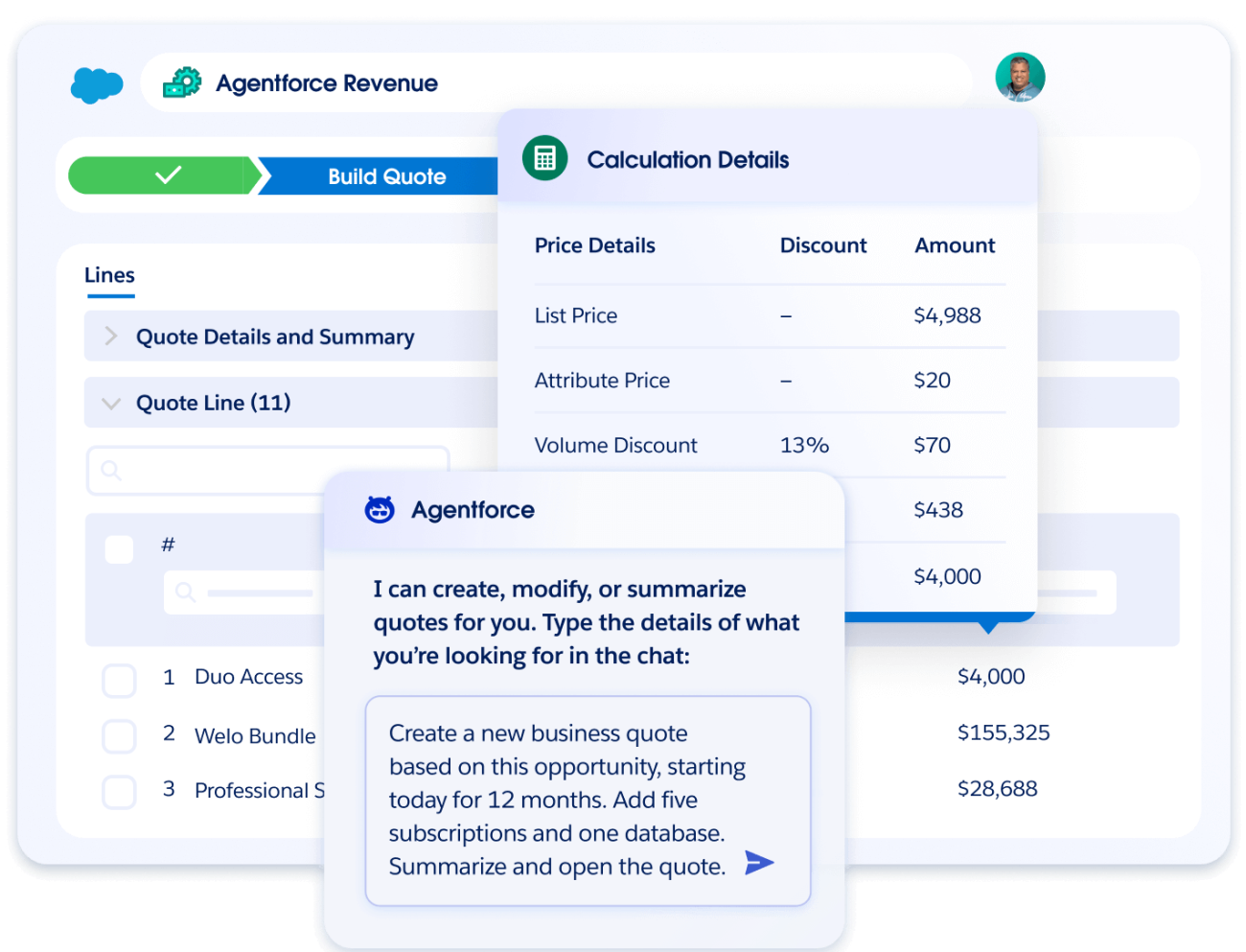
Beyond core CRM, Sales Cloud includes Revenue Lifecycle Management (CPQ, contracts, subscription management), Sales Performance Management (quotas, territories, and commissions via Salesforce Spiff), and Sales Engagement (cadences, a prospecting center, and a browser extension for CRM access from any webpage).
Source: Salesforce Revenue Management
The product has been a Gartner MQ Leader for Sales Force Automation for 19 consecutive years.
Service Cloud: Omnichannel customer support with AI-powered case resolution.
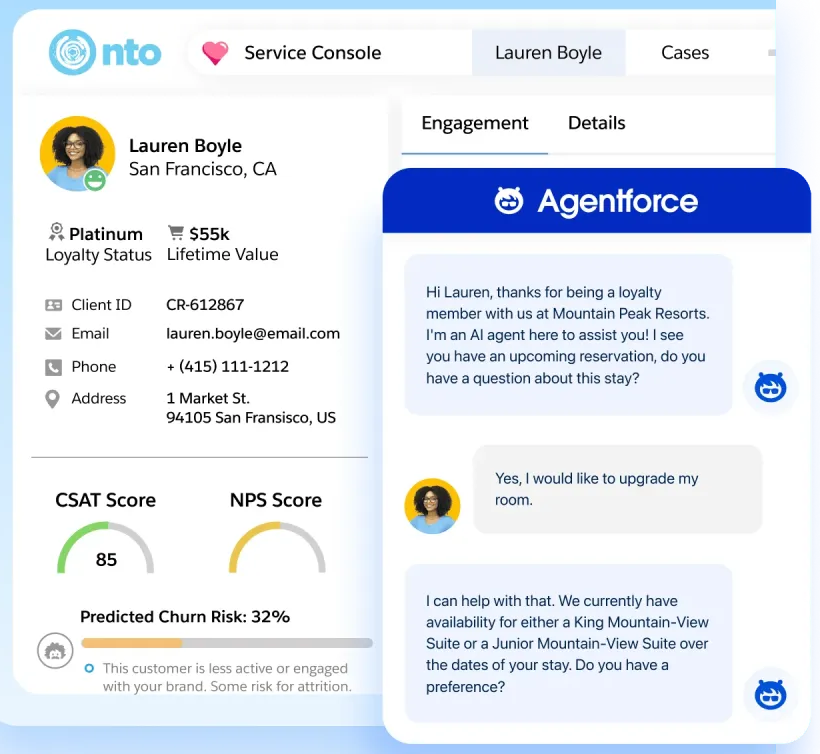
Agentforce Service (formerly Service Cloud) puts human agents and AI agents side by side across every support channel.
Source: Salesforce Agentforce for Service
The Service Console provides a unified workspace with AI action plans, AI-powered replies, conversation summaries, and team swarming via Slack. Case management includes auto-assignment, escalation rules, and SLA milestones. The knowledge base generates and maintains articles using AI.
For digital engagement, Service Cloud supports chat, SMS, WhatsApp, Facebook Messenger, Apple Messages, and LINE, with the option to bring custom channels.
Field Service adds AI-powered scheduling, an offline mobile app, and work order management.
Agentforce & AI: Autonomous agents that handle sales, service, and marketing tasks.
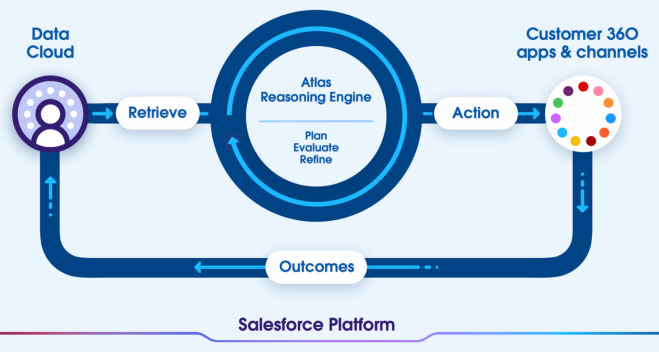
Agentforce is Salesforce's most significant strategic bet. Unlike copilots that require constant human prompting, Agentforce creates AI agents that can perceive, plan, and execute autonomously. Salesforce calls this "digital labor".
Pre-built agents cover common roles (Service Agent, SDR Agent, Sales Coach, Personal Shopper, Campaign Assistant), while Agentforce Builder lets teams create custom agents using natural language.
Agents are configured through Topics (intent scoping), Actions (connectors), and Guardrails (safety boundaries).
Under the hood, agents run on the Atlas Reasoning Engine, which uses a Reasoning and Acting loop (reason, act, observe, adapt) rather than fixed response chains. The Einstein Trust Layer provides zero data retention with LLM partners, PII masking, toxicity detection, and full audit trails.
Source: Agentforce Atlas Reasoning Engine
Platform, Ecosystem & Pricing: A customizable foundation with tiered pricing across multiple clouds.
The Salesforce Platform gives admins and developers the tools to customize and extend every part of the CRM. App Builder handles drag-and-drop app creation, Flow automates business processes, and Code Builder provides a full IDE for pro-code development.
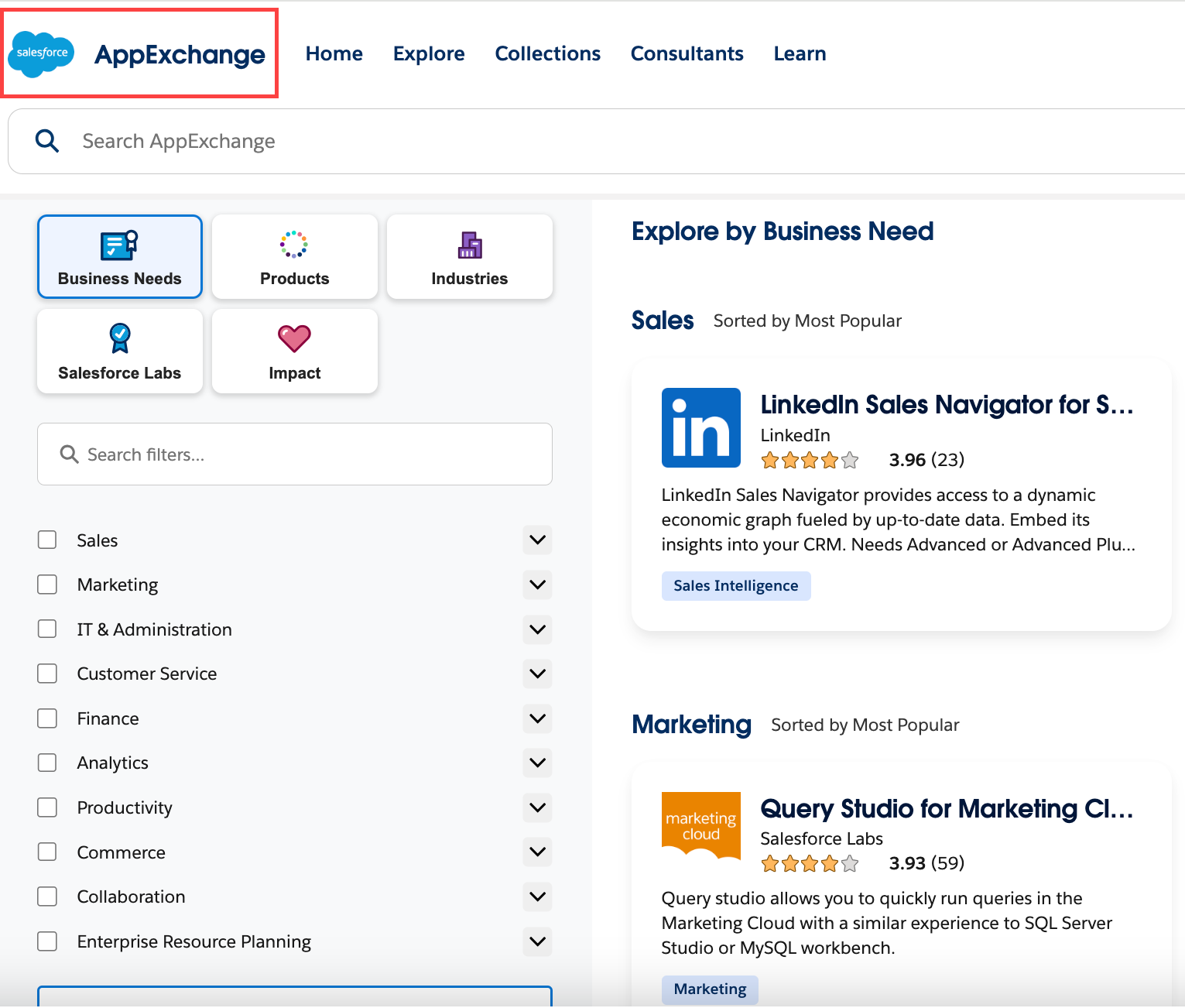
AppExchange, the enterprise cloud marketplace, offers 9,000+ partner apps with 14+ million installs, and 91% of customers use at least one AppExchange app.
Source: Salesforce AppExchange
Pricing follows a multi-cloud, multi-tier model. Sales Cloud and Service Cloud each offer tiers from Free ($0 for up to 2 users) through Starter Suite ($25/user/month), Pro Suite ($100/user/month), Enterprise ($175/user/month), and Unlimited ($350/user/month), up to Agentforce 1 ($550/user/month). Marketing Cloud starts at $1,500/org/month. Commerce Cloud pricing is entirely quote-based.
Agentforce usage carries separate consumption costs: $2 per conversation (24-hour session) or $500 per 100,000 Flex Credits. Data Cloud charges $500 per 100,000 credits on top of license fees. Premier Support costs 30% of net license fees. Annual contracts are required on most plans, and a June 2025 restructuring raised Enterprise/Unlimited list prices by an average of 6%.
Where Salesforce Falls Short
While Salesforce excels as an enterprise platform, several limitations become apparent depending on your team size, data maturity, and budget. These reflect deliberate design choices favoring breadth and enterprise capability over simplicity and accessibility.
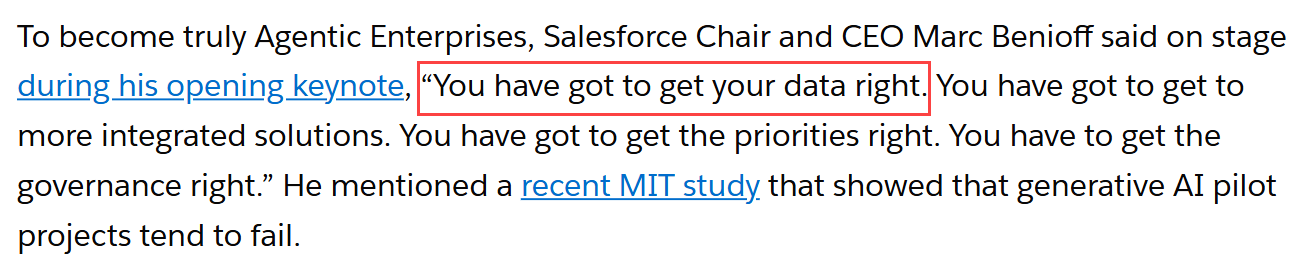
Your CRM is only as good as your data. Salesforce provides the infrastructure to manage customer relationships, but it does not provide the B2B intelligence data that powers those relationships. Marc Benioff acknowledged at Dreamforce 2025: "You have got to get your data right." Salesforce's own 2026 CIO research found trust in data is the #1 bottleneck for AI adoption.
Source: Salesforce CEO at Dreamforce 2025
Without accurate, current contact records, company data, and buying signals flowing into the CRM, even Agentforce's autonomous agents have little to work with. Salesforce provides the engine, but you need a source for the fuel.
Implementation demands real investment. Over 70% of implementations are partner-led, adding cost and complexity beyond the license fees. Implementation timelines range from weeks for simple Sales Cloud deployments to 3-12 months for enterprise multi-cloud projects.
Salesforce has acknowledged being "historically built for large enterprises", and the full value of the platform requires dedicated, trained administrators. The free Trailhead learning platform helps (6+ million learners, 1,500+ badges), but the time investment is real.
Pricing adds up quickly. Salesforce itself acknowledged its pricing model "needed to be easier to understand", more predictable, and more flexible. Between license fees, consumption-based AI credits, Data Cloud charges, Premier Support (30% of license cost), and partner implementation fees, the total cost of ownership can surprise buyers accustomed to simpler SaaS pricing.
A sales team needing Enterprise-tier Sales Cloud ($175/user/month), Agentforce access, and Data Cloud faces a combined monthly cost well above the listed per-seat price.
Enterprise-centric heritage. While the free CRM tier and Starter Suite exist, teams without dedicated administrators or data infrastructure strategies may find themselves underusing the platform. The depth that makes Salesforce powerful for complex organizations creates friction for smaller teams that want a CRM they can configure in a day and start using immediately.
These limitations are not flaws. They are the natural result of building the most feature-rich CRM platform on the market. But they create a clear need for a B2B intelligence layer that can feed Salesforce with the verified data, buyer signals, and account context it needs to deliver on its promise.
Best Salesforce Integration for B2B Intelligence: ZoomInfo
ZoomInfo addresses Salesforce's core data dependency by providing the B2B intelligence layer that the CRM itself does not include.
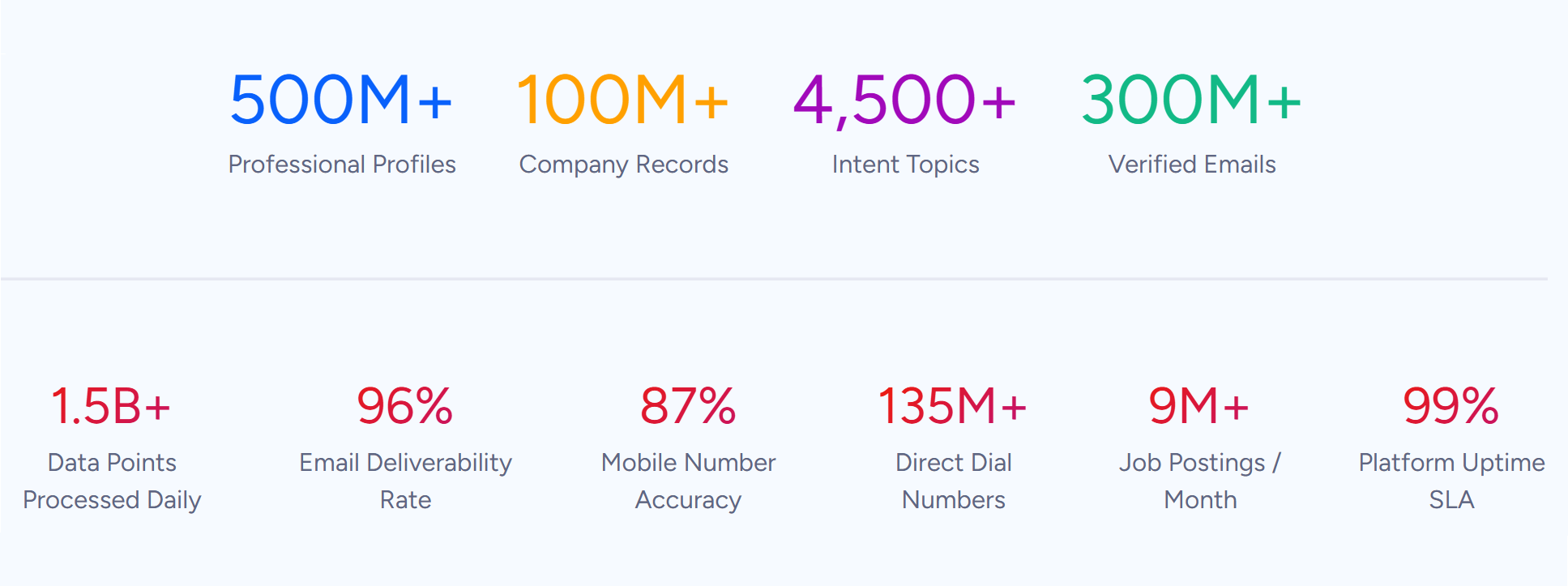
ZoomInfo is an all-in-one AI GTM platform built on the industry's most comprehensive B2B data: 500M contacts, 100M companies, 135M+ verified phone numbers, and 200M+ verified business emails. Fusing this data with your CRM records, conversation transcripts, and behavioral signals, ZoomInfo's GTM Context Graph (which processes 1.5B+ data points daily) reveals the full context of your accounts.
Source: ZoomInfo Data
That intelligence flows directly into Salesforce through a native integration, and is also accessible through the dedicated GTM Workspace for sellers, GTM Studio for marketers and RevOps, or APIs and MCP in any front-end.
Comprehensive B2B Data: 500M contacts and 100M companies with up to 95% accuracy.
Salesforce stores and organizes your customer data. ZoomInfo provides it.
The platform covers three data dimensions simultaneously: identity data (who buyers are and how to reach them, including 120M direct-dial phone numbers and 200M+ verified business email addresses), company context (org charts, technographics, and company attributes across 100M companies), and dynamic signals (buyer intent data from 210 million IP-to-Organization pairings indicating when a company is actively in-market).
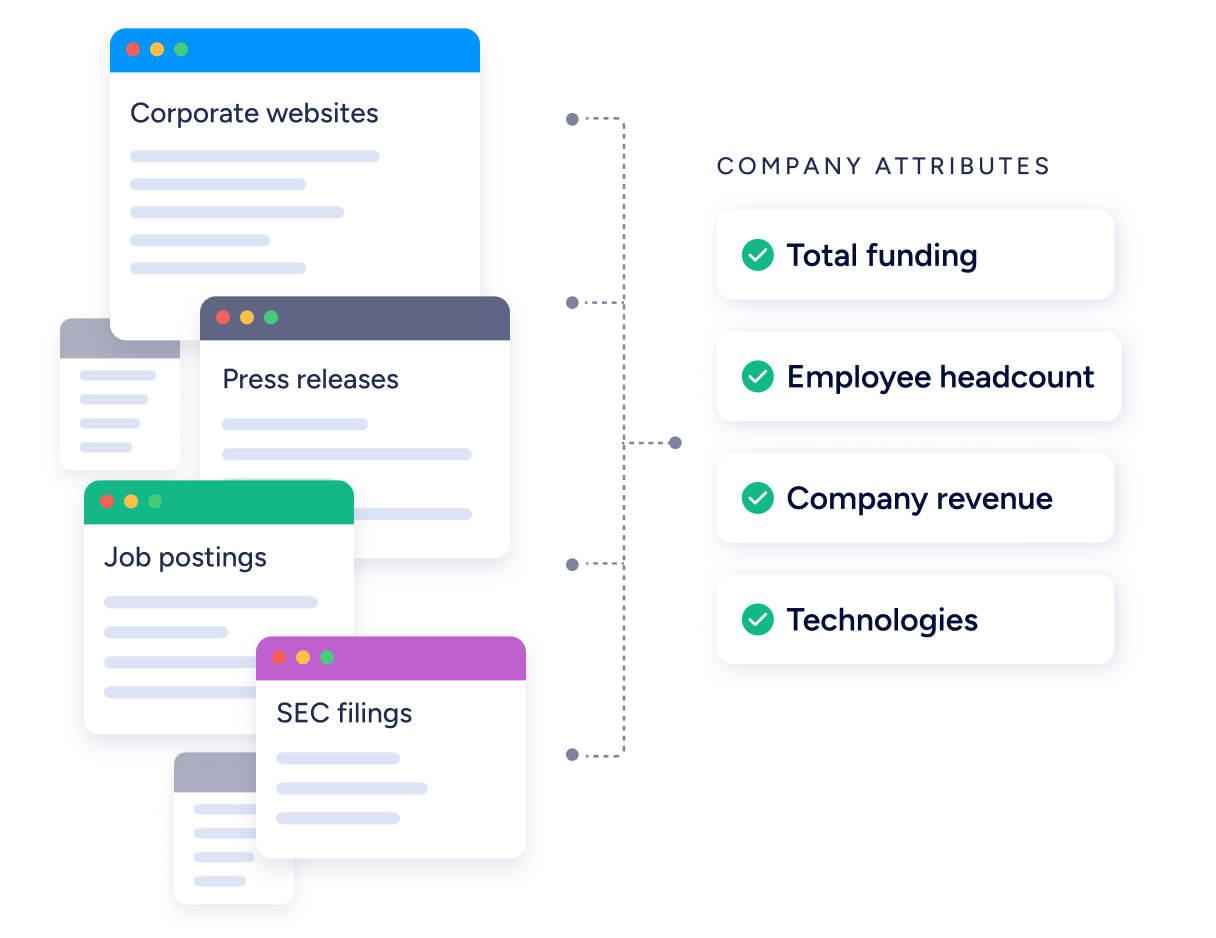
The data is built through a multi-source pipeline: automated ML scanning of 28 million site domains daily, third-party partner data covering 95 million businesses, a contributory community of 200,000+ ZoomInfo Lite users, and an in-house Data Training Lab of 300+ human researchers. First-party data reaches up to 95% accuracy.
Source: ZoomInfo Scanning
The advantage is externally validated. In a Fortune 500 competitive RFP analyzing 25 million contacts across vendors, the independent consultant concluded that "no other competitor came even close." ZoomInfo has been named a Leader in the Forrester Wave for Intent Data Providers, a Gartner MQ Leader for ABM Platforms for two consecutive years, and earned 133 No. 1 rankings on G2.
SpringDB achieved 2-3x increases in campaign conversions and 30-50% uplift in average deal size using ZoomInfo's enriched data for precise client targeting. (SpringDB)
The GTM Context Graph: Intelligence that captures why deals move, not just that they did.
Raw data tells you the facts. The GTM Context Graph tells you what they mean. It fuses ZoomInfo's B2B data with a customer's CRM records, conversation intelligence from calls and meetings, email interactions, and behavioral signals into a unified intelligence layer.
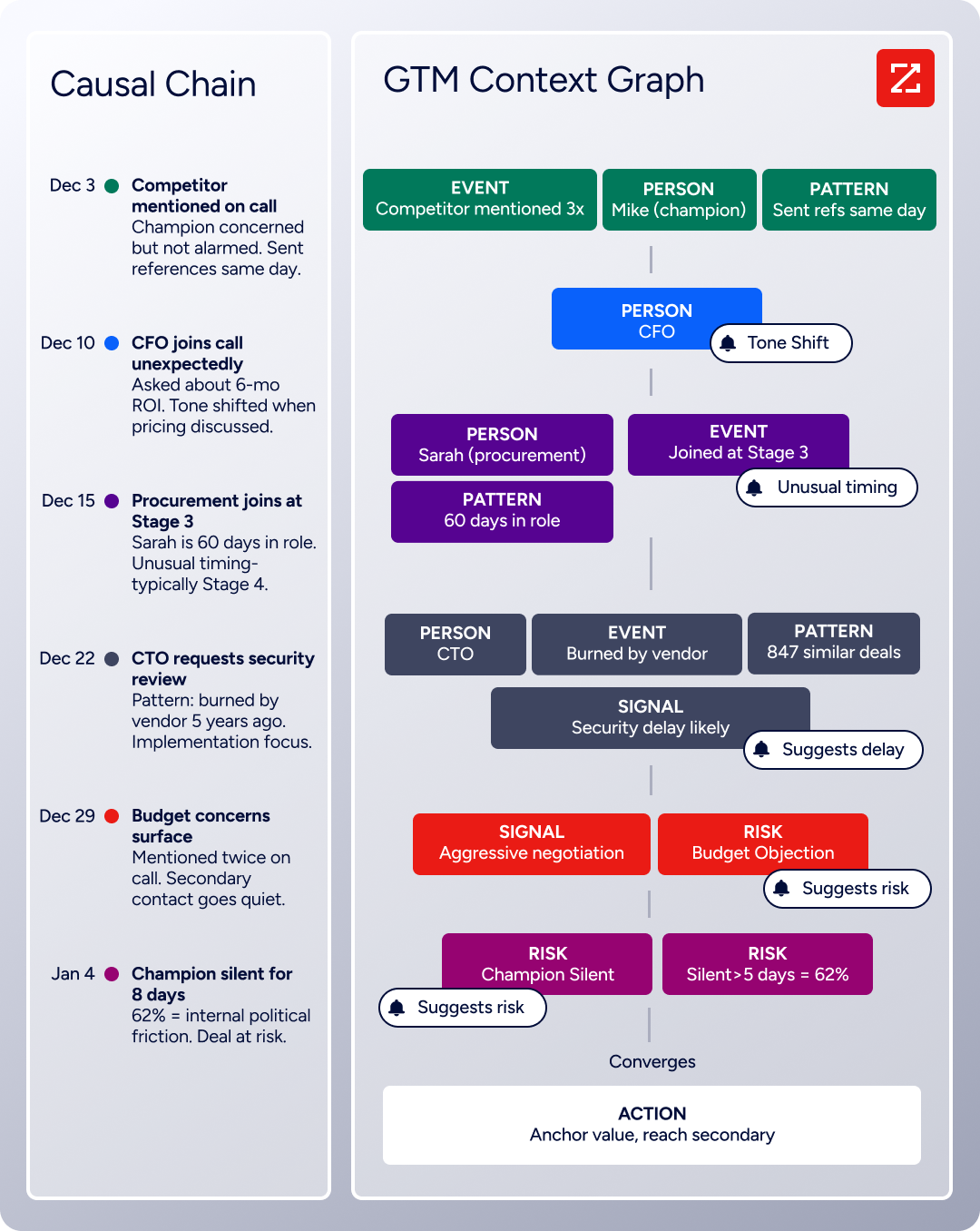
Source: ZoomInfo Context Graph
As ZoomInfo's Chief Product Officer Dominik Facher writes: "The CRM recorded the state change." It has no record of why it happened. A CRM shows that a deal moved from Stage 3 to Stage 4. The GTM Context Graph reveals that the CFO joined the last call and asked about six-month ROI (which is what actually accelerated the deal), while also detecting that the company is hiring three new VPs and researching a competitor.
This intelligence layer captures people and their relationships (who influences whom, who's blocking, who's championing), actions and their outcomes (what each action responded to and whether it worked), and patterns and predictions (what thousands of similar deals suggest happens next).
That reasoning flows into every downstream action: the follow-up email addresses the specific concern the prospect raised, the play targets accounts whose signal combinations match your actual win patterns, and the forecast reflects buying evidence rather than stage labels.
Seismic's sales team attributed 39% of active pipeline to opportunities identified or influenced by ZoomInfo signals, while saving 11.5 hours per week per seller and boosting productivity by 54%. (Seismic)
Direct Salesforce Integration & GTM Workspace: Verified data and AI-driven execution inside your CRM.
ZoomInfo's native Salesforce integration connects the intelligence layer directly to your CRM. Contact and company records are enriched with verified data, lead routing is automated based on buying signals, and CRM fields are kept current without manual entry.
Operations teams can run waterfall enrichment from 25+ data sources to ensure the highest-confidence result for every record, with perimeter protection that blocks bad data at entry.
For sellers, GTM Workspace provides the execution layer on top of this Salesforce integration. It consolidates the complete book of business (CRM data, ZoomInfo intelligence, conversation history, and market signals) into a single view. Specialized AI agents handle account research, outreach drafting, CRM updates, and signal monitoring.
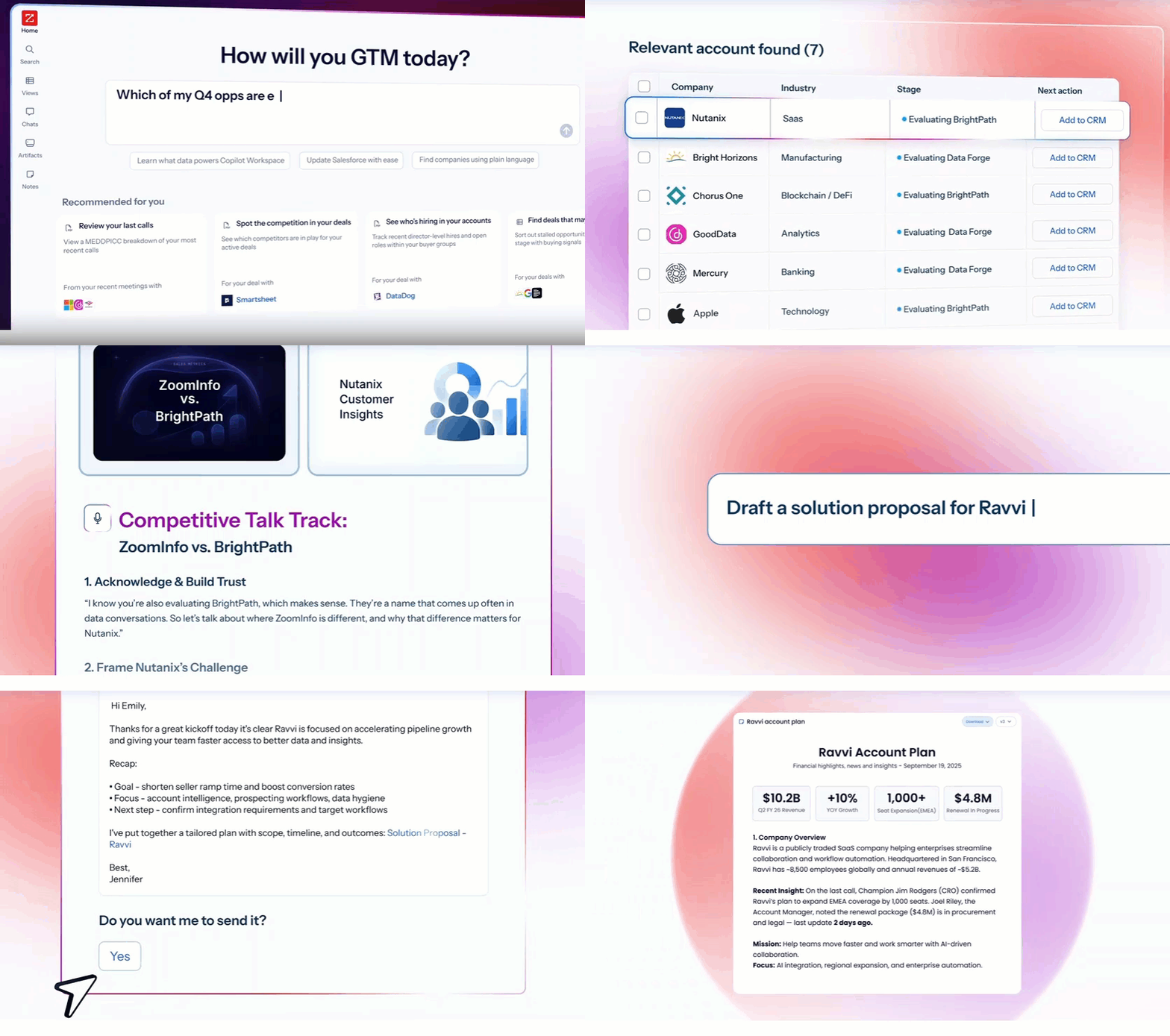
Source: ZoomInfo GTM Workspace
The Action Feed delivers a live stream of in-market buyers with pre-drafted actions on every signal, while the AI Assistant produces 1-click account briefs pulling CRM history, company news, and stakeholder context into a 10-second summary. GTM Workspace integrates natively with Salesforce, HubSpot, and Microsoft Dynamics and "deploys in weeks, not months."
Smartsheet uses ZoomInfo as its single source of truth for account and contact data, noting that without it, achieving their business objectives would be "extremely difficult, if not impossible." (Smartsheet)
GTM Studio & Universal Access: Orchestration for marketers, RevOps, and any AI agent.
GTM Studio gives marketers and RevOps teams a builder environment where audience definition, campaign orchestration, and pipeline measurement happen in natural language rather than engineering tickets.
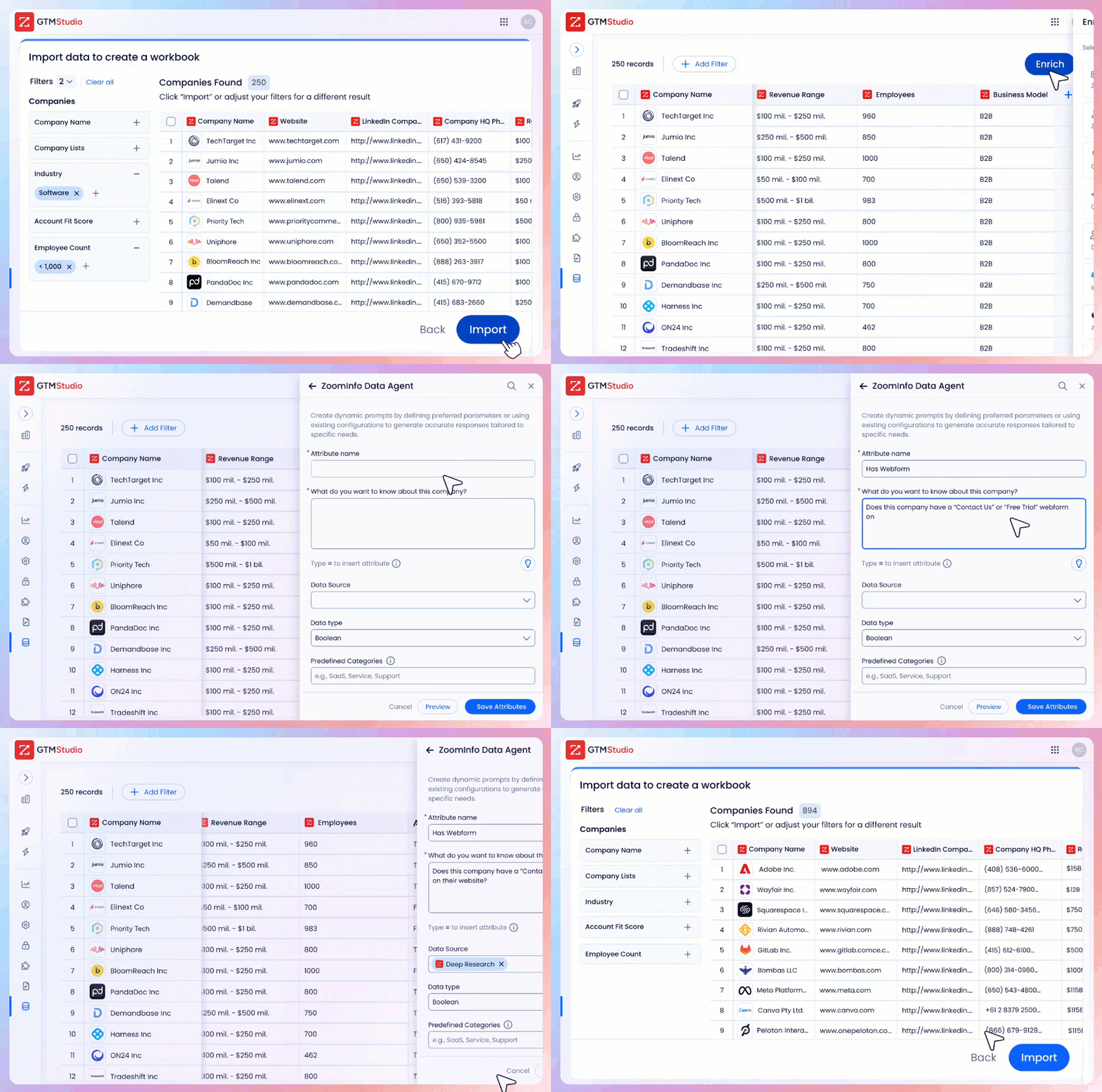
Source: ZoomInfo GTM Studio
Teams can describe an audience in plain language, launch a multi-channel play, and watch pipeline impact in real time. Pre-built GTM plays cover inbound acceleration, champion tracking, competitive displacement, and ICP targeting, all launchable in one click.
Expansion plays that used to take 3 weeks now launch in 30 minutes. Outputs (hot accounts, signals, recommended actions) are delivered into GTM Workspace for seller execution.
For teams that build beyond ZoomInfo's own products, APIs and MCP expose the same intelligence to any custom agent, internal tool, or third-party platform. The MCP server connects AI models directly to ZoomInfo's B2B data with no custom coding required, and currently supports Claude and ChatGPT. API access is included in all relevant plans.
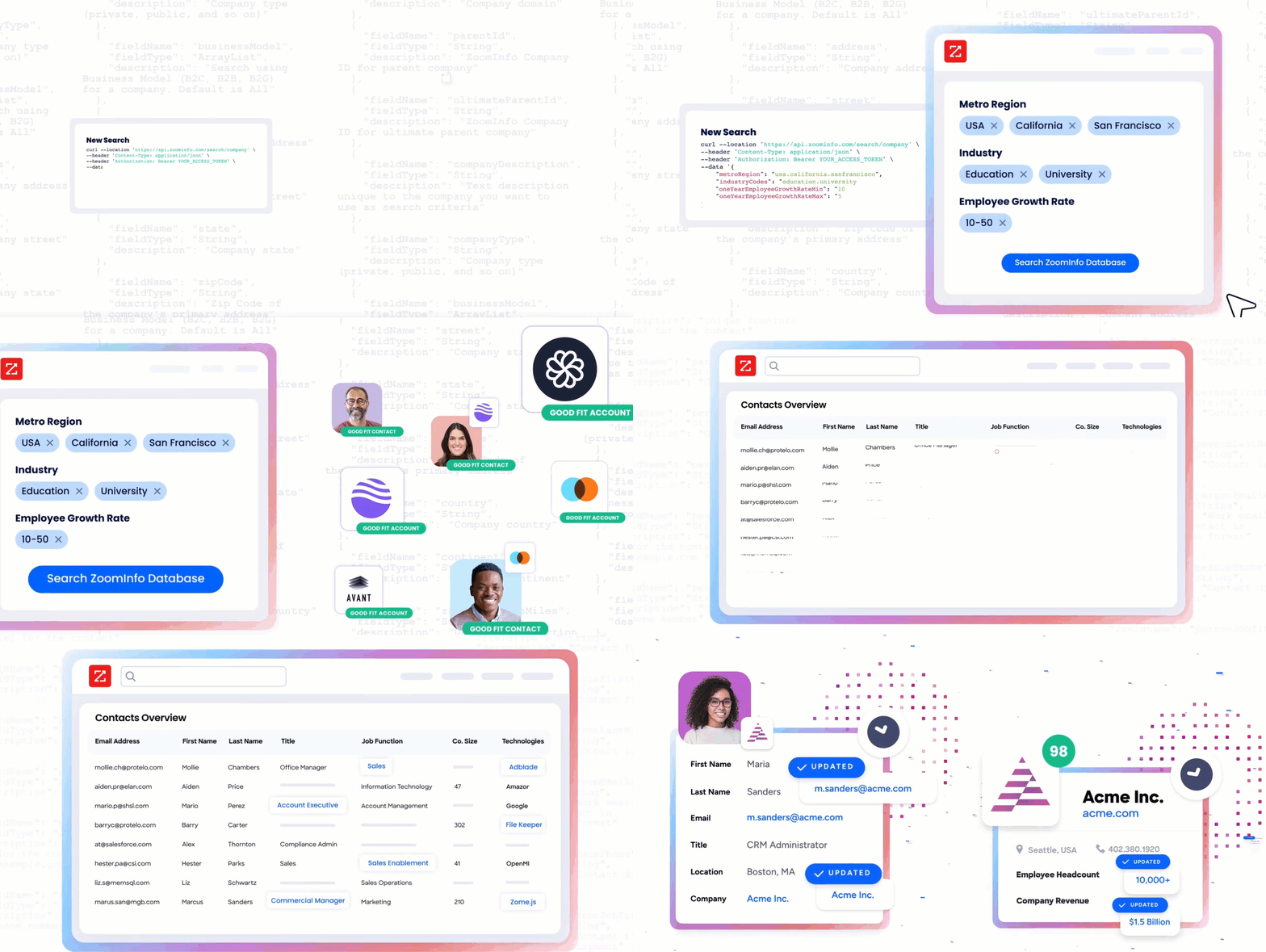
Source: ZoomInfo API
The same data, the same GTM Context Graph, the same intelligence, available in any tool your team uses.
BDO Canada achieved an 87% reduction in time spent on data dashboard updates by integrating ZoomInfo's API directly into their internal systems, calling the integration experience "plug-and-play." (BDO Canada)
Salesforce and ZoomInfo: Integration Summary
Aspect | Salesforce | ZoomInfo |
|---|---|---|
Primary Purpose | CRM and business process management | B2B intelligence and GTM execution |
Core Strength | Unified platform for sales, service, marketing, commerce | Comprehensive B2B data and AI-powered GTM context |
Data Approach | Stores and organizes customer data you provide | Provides and continuously verifies B2B intelligence data |
AI Focus | Autonomous agents for CRM tasks and customer interactions | AI-powered prospecting, outreach, and deal intelligence |
Contact Database | No native B2B contact database | 500M contacts, 200M+ verified emails, 135M+ verified phones |
Buyer Intent | No native intent signal capability | Intent data from 210M+ IP-to-Organization pairings |
Integration Ecosystem | 9,000+ AppExchange apps | Native Salesforce connector, 120+ marketplace integrations |
Access Model | Web, mobile, Slack | GTM Workspace, GTM Studio, APIs, MCP |
Pricing Model | Per-user tiers + consumption add-ons (public pricing) | Consumption-based pricing (no public pricing) |
Combined Value | Manages the relationship lifecycle | Feeds it with the intelligence to make every interaction count |
For a head-to-head breakdown of how the two platforms compare, see our Salesforce vs ZoomInfo comparison.
Final Verdict
Salesforce is the most complete CRM platform available. Its combination of Sales Cloud, Service Cloud, Marketing Cloud, Commerce Cloud, Agentforce AI, and a marketplace of 9,000+ apps gives organizations the infrastructure to manage virtually every customer-facing process on a single platform.
The company's sustained Gartner MQ leadership across 6+ categories, $41.5 billion in revenue, and 150,000+ customer base reflect a platform that has earned its market position.
For mid-market and enterprise organizations with the resources to implement and administer it properly, Salesforce is the standard for good reason.
ZoomInfo is the intelligence layer that makes Salesforce work harder. Salesforce manages relationships. ZoomInfo provides the verified contacts, company data, buyer intent signals, and contextual intelligence that those relationships depend on.
Through its native Salesforce integration, GTM Workspace for sellers, GTM Studio for marketers and RevOps, and APIs and MCP for any tool, ZoomInfo ensures your team always has the data and context to find, win, and grow customers.
For any organization running Salesforce, ZoomInfo is the integration that closes the gap between what your CRM can do and what it actually knows.
Get started with ZoomInfo here.
Salesforce FAQ
What does Salesforce cost?
Salesforce uses multi-tier, per-user pricing that varies by product. Sales Cloud and Service Cloud range from free (up to 2 users) through Starter Suite ($25/user/month) to Unlimited ($350/user/month) and Agentforce 1 ($550/user/month). Marketing Cloud starts at $1,500/org/month.
Agentforce AI usage costs $2 per conversation or $500 per 100,000 Flex Credits on top of license fees. Data Cloud charges separately at $500 per 100,000 credits. Premier Support adds 30% of net license fees. Annual contracts are required on most paid plans.
Is there a free version of Salesforce?
Yes, Salesforce offers a Free Suite with basic lead, account, and opportunity management for up to 2 users with no contract required. The Starter Suite at $25/user/month is the first paid tier, adding unlimited users, AI email sync, and lead routing. The free tier provides a starting point, though the full value of the platform requires paid plans with dedicated administration.
What is Agentforce?
Agentforce is Salesforce's autonomous AI agent platform. Unlike copilots that require constant human prompting, Agentforce agents can perceive, plan, and execute tasks independently using the Atlas Reasoning Engine. Pre-built agents handle roles like customer service, sales development, sales coaching, and campaign management.
Custom agents can be built using natural language in Agentforce Builder. The platform has reached $800M in annual recurring revenue with 29,000 deals closed and 2.4 billion Agentic Work Units delivered. AI usage is priced separately from CRM license fees.
Does Salesforce require a dedicated administrator?
For basic use at the Starter Suite level, a dedicated administrator is not strictly necessary. However, once you move beyond default configuration into custom objects, automations, integrations, and AI agents, a trained admin becomes essential.
Over 70% of Salesforce implementations are partner-led, and the free Trailhead learning platform offers 1,500+ badges and 60+ certifications to develop internal expertise. Organizations that invest in proper administration and data management get far more value from the platform.
Does Salesforce include B2B contact data or buyer intent signals?
No. Salesforce is a CRM platform that stores and organizes data, but it does not provide B2B contact databases, verified phone numbers, or buyer intent signals. These capabilities require external data providers.
ZoomInfo integrates directly with Salesforce to fill this gap, providing 500M contacts, 100M companies, 135M+ verified phone numbers, and 200M+ verified business emails, along with buyer intent data from 210M+ IP-to-Organization pairings that identify when target accounts are actively researching solutions.
What industries does Salesforce serve?
Salesforce offers dedicated industry cloud solutions across 17 verticals, including Financial Services, Healthcare, Manufacturing, Retail, Education, and Public Sector. These industry clouds provide specialized data models, workflows, AI agents, and compliance features.
The industry business collectively reached $6.6 billion in annual recurring revenue, growing nearly 20% year over year. Named customers span virtually every major industry.
How does Salesforce handle integrations?
Salesforce offers one of the largest integration ecosystems in enterprise software. AppExchange hosts 9,000+ partner apps with 14+ million installs. Native integrations cover Google Workspace, Microsoft Outlook and Teams, and Slack. MuleSoft (acquired for $6.5 billion) provides hundreds of pre-built connectors for complex enterprise integration scenarios.
APIs include REST, SOAP, Bulk, Metadata, and Pub/Sub options. ZoomInfo is one of the featured integrations on the Salesforce AppExchange, providing native CRM enrichment, lead routing, and B2B intelligence directly inside Salesforce records.
