
Twilio Segment is a customer data platform that does one thing well: it collects first-party behavioral data from websites, mobile apps, and servers through a single API, then routes it to the analytics, marketing, and warehouse tools that need it. With 25,000+ customers and 750+ integrations, Segment has become the default for companies tired of maintaining duplicate tracking code across their tech stack.
To create this Twilio Segment review, we analyzed the platform in detail. We believe it's the right choice if:
You need to collect first-party event data from web, mobile, and server sources through a single API
You want to route behavioral data to hundreds of downstream tools without maintaining separate integrations
You need identity resolution to unify customer profiles across devices and channels
You have engineering resources to design and maintain a proper event taxonomy
You're building on a modern data stack with Snowflake, BigQuery, or Databricks
Segment excels at collecting and routing your first-party data, but it doesn't provide the third-party B2B intelligence that go-to-market teams need to identify, prioritize, and reach buyers. Segment can tell you what a visitor did on your site. It cannot tell you who they are, what company they represent, whether they're researching your category, or how to reach the decision-makers on their buying committee.
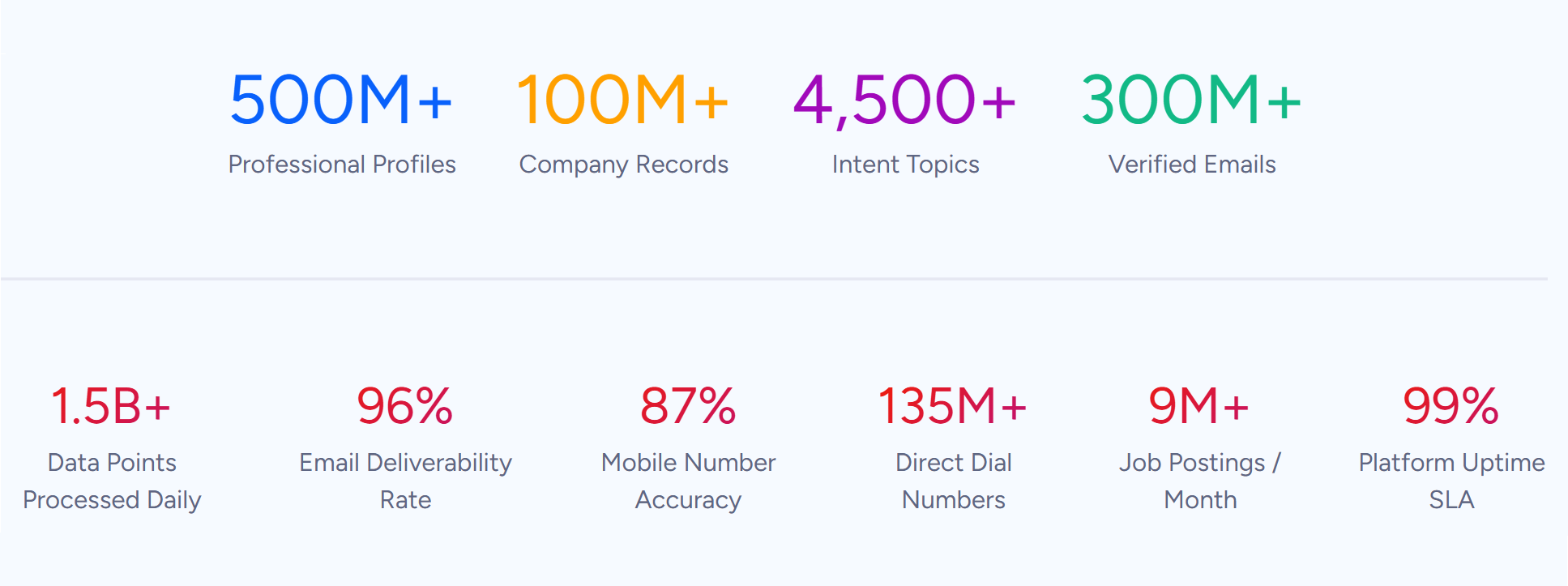
This is where ZoomInfo enters the picture: a B2B intelligence and GTM platform with 500M contacts, 100M companies, 135M+ verified phone numbers, and 200M+ verified business emails. Where Segment captures behavioral signals, ZoomInfo provides the identity, company, and intent data that turns those signals into pipeline.
Its GTM Context Graph fuses your CRM records, conversation transcripts, and behavioral data with ZoomInfo's third-party intelligence to show not just what happened in a deal, but why.
We've included a detailed look at ZoomInfo later in this review because it represents the natural complement for B2B companies that need both first-party data infrastructure and third-party intelligence. If you're ready to explore what ZoomInfo can add to your data stack, start with a free trial here.
What is Twilio Segment?
Twilio Segment is a customer data platform founded in 2011 by four MIT students (Peter Reinhardt, Calvin French-Owen, Ilya Volodarsky, and Ian Storm Taylor) as part of Y Combinator's Summer 2011 cohort. Based in San Francisco, the team first built a classroom lecture tool that failed.
Their breakthrough came from Analytics.js, an open-source JavaScript library that let developers pipe data to any analytics service through a single API. The library spread on GitHub, and they built a commercial data routing business on top of it.
After raising over $283 million in venture funding (including a $175M Series D that valued the company at $1.5 billion), Twilio acquired Segment for $3.2 billion in November 2020. The rationale: customer data would make Twilio's communications platform smarter. As of 2025, Segment's web presence has been consolidating under Twilio.com.
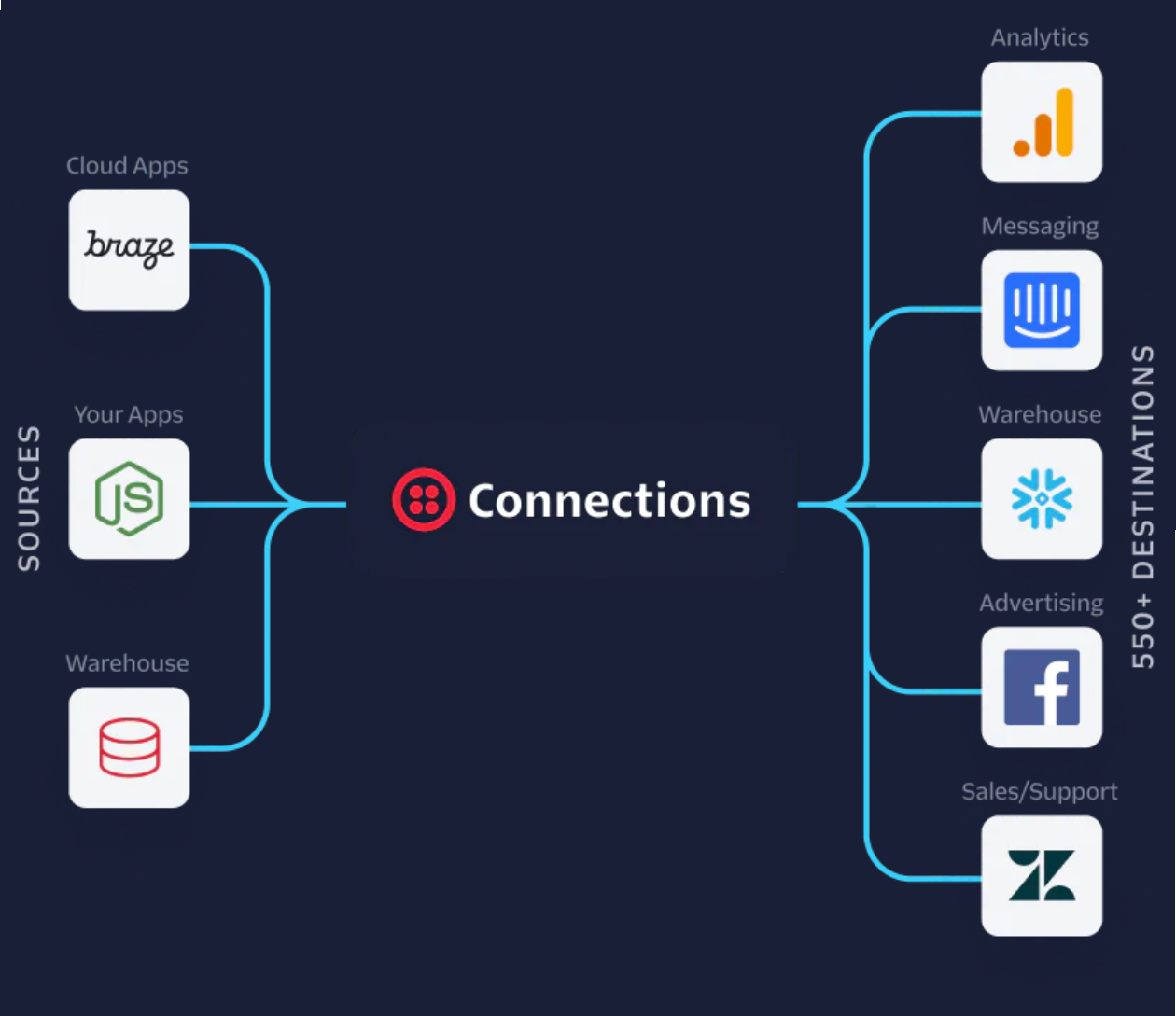
The platform has three product tiers. Connections is the core data pipeline, collecting first-party data from every touchpoint and routing it to 550+ destinations. Unify handles identity resolution, building profiles from all sources including the data warehouse. Engage enables audience building and journey orchestration for personalized campaigns.
Source: Segment
Supporting products include Protocols (data governance and schema enforcement), Reverse ETL (pushing warehouse data back to operational tools), and CustomerAI features like Predictions and Recommendations.
Segment serves 25,000+ customers and has processed 12.1 trillion API calls. IDC named it a MarketScape Leader for CDPs focused on B2C users in December 2024, though Gartner placed it in the Niche Players quadrant in the 2025 Magic Quadrant for CDPs.
Its ideal users are data engineers, marketing teams, and product teams at mid-market to enterprise companies who need to unify first-party customer data across their tool stack.
Twilio Segment Pros & Cons
Pros | Cons |
|---|---|
- 750+ pre-built integrations across analytics, CRM, advertising, and warehouses | - Pricing is expensive and opaque at enterprise scale |
- Single API eliminates duplicate tracking code across tools | - High implementation complexity requiring developer involvement |
- Real-time identity resolution across devices and channels | - No built-in analytics or reporting |
- Bi-directional data flow with Reverse ETL | - Customer support quality is a recurring concern |
- Data governance through Protocols and schema enforcement | - Connector functionality varies across integrations |
- Free tier with 1,000 MTUs, no credit card required | - Full CDP features require custom enterprise contracts |
- Warehouse-native capabilities via Linked Audiences | - Segment revenue grew only 1% YoY in FY2024 |
Twilio Segment Review: How It Works & Key Features
Data Pipeline: Connections collects first-party events from any source and routes them to 750+ tools through a single API.
Connections is Segment's foundation. It collects event data from websites (Analytics.js JavaScript SDK), mobile apps (iOS Swift, Android Kotlin SDKs), and servers (Node, Python, Ruby, Java, Go, HTTP API) through a single write key. That data flows into Segment's Tracking API, where schema controls validate events against a tracking plan before fanning them out to all enabled destinations.
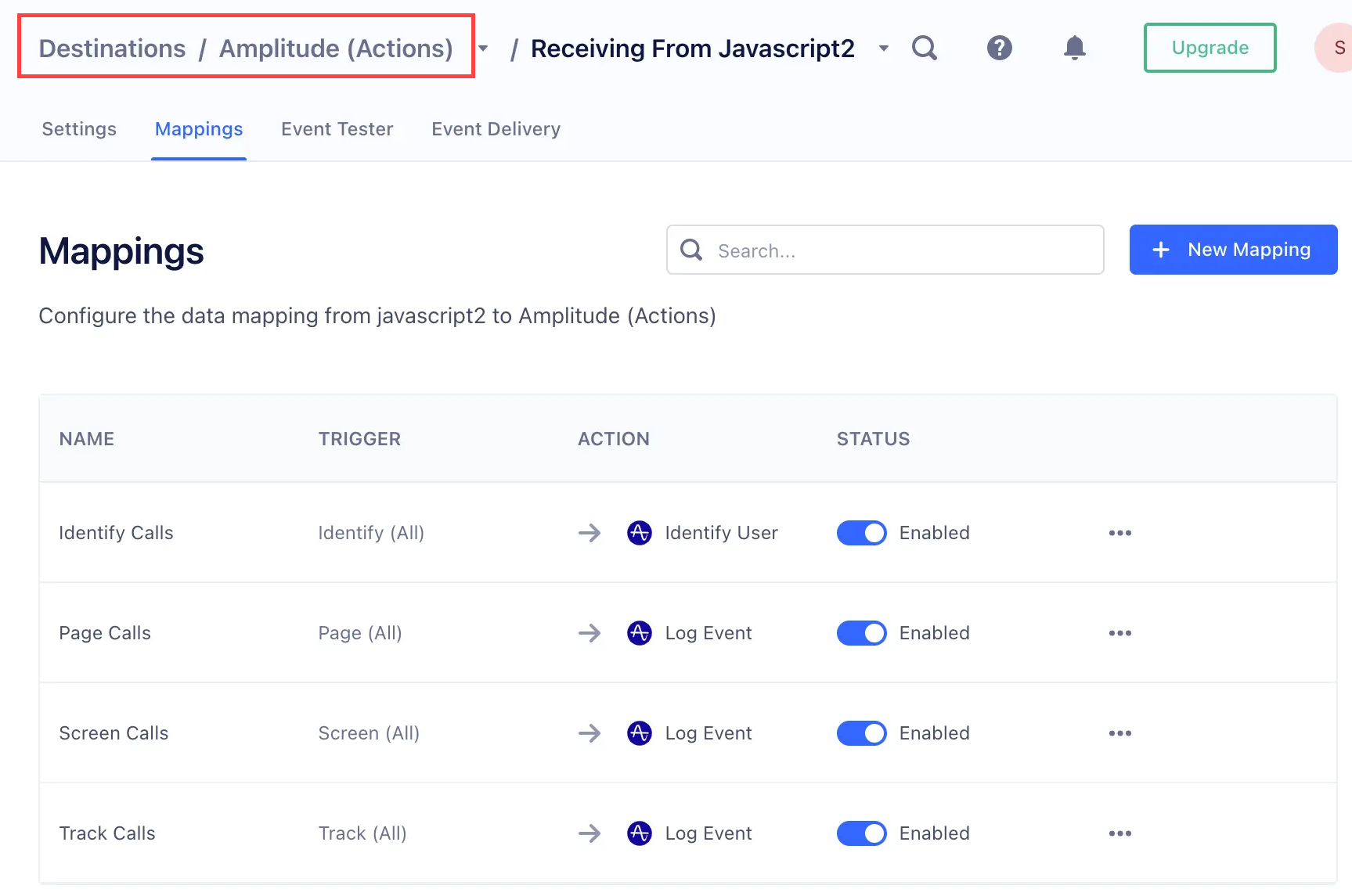
Destinations connect in two modes: cloud mode (Segment's servers forward data server-side) or device mode (the destination's SDK loads in the browser or app). The Destination Actions framework gives teams control over which events trigger which actions, with field-level mapping and transformations including coalesce, case, JSON, flatten, replace, and concatenate functions.
Source: Segment
For integrations not in the catalog, Functions let teams write custom JavaScript on managed AWS Lambda to ingest data from any webhook or send data to any endpoint. A Functions Copilot can generate function code using AI.
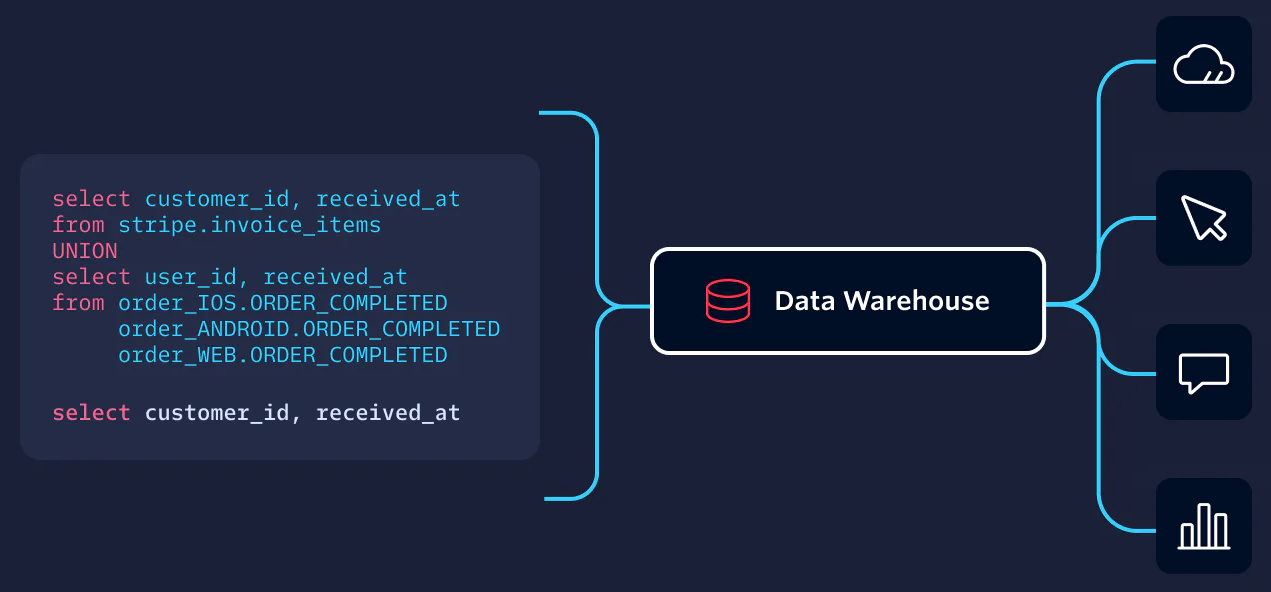
Reverse ETL completes the data loop. Companies extract data from warehouses (Snowflake, BigQuery, Redshift, Databricks, Postgres, Azure Synapse, Db2) using SQL queries or dbt models, then push it back to business tools on schedules as frequent as every 15 minutes. Only changed records sync, through an incremental record diffing mechanism that runs within the customer's warehouse.
Source: Segment
Segment's Protocols product adds data governance on top of the pipeline. Teams define a centralized Tracking Plan specifying every permitted event and property. Protocols validates incoming data in real time, blocks non-conforming events, and routes violations to a quarantine source for analysis.
Identity Resolution: Unify merges fragmented customer data into unified profiles across devices and channels.
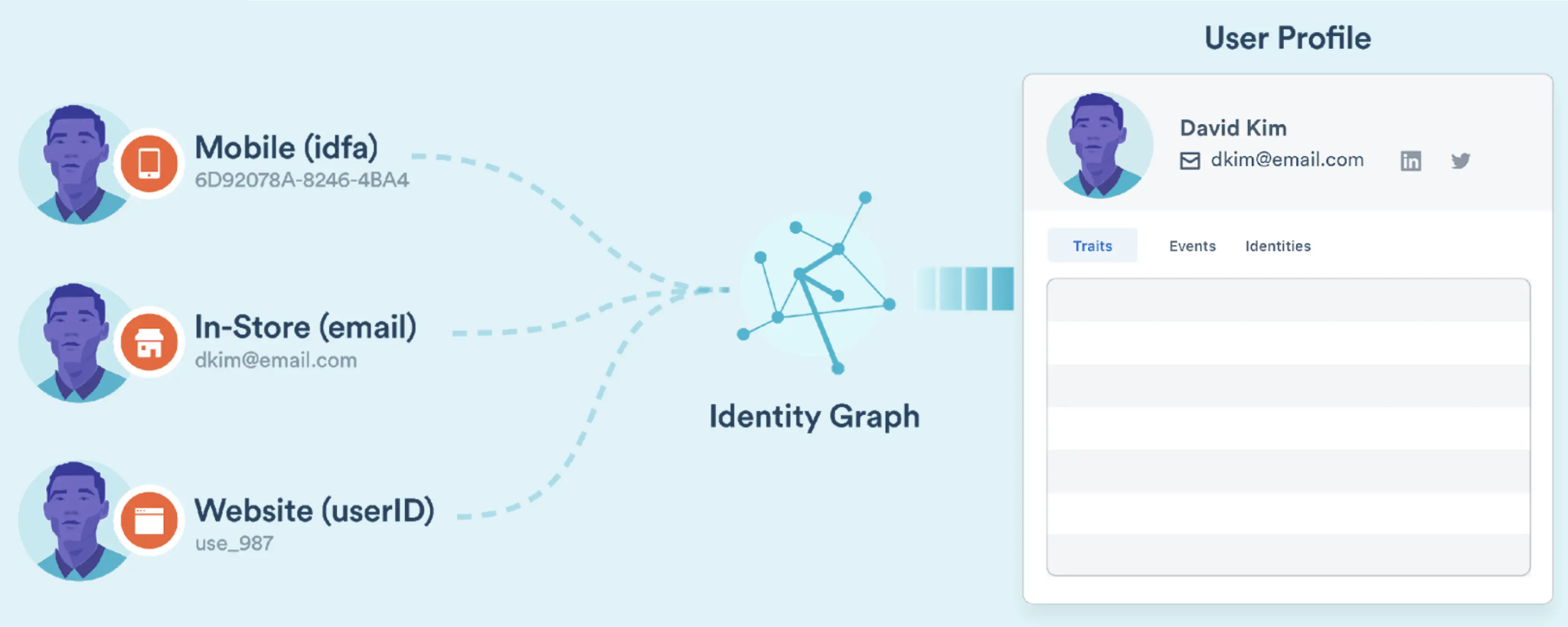
Unify is the identity resolution layer between data collection and activation. Its Identity Graph consolidates every interaction from the same individual (including anonymous pre-registration sessions) into a single persistent profile, resolving across cookie IDs, device IDs, email addresses, user IDs, and custom external IDs.
Source: Segment
When an anonymous user later identifies themselves, all prior anonymous activity folds into their profile without additional code. Administrators configure customizable ID rules to control how events associate with profiles, with a priority trust algorithm that protects against merge errors from shared devices in environments like libraries or kiosks.
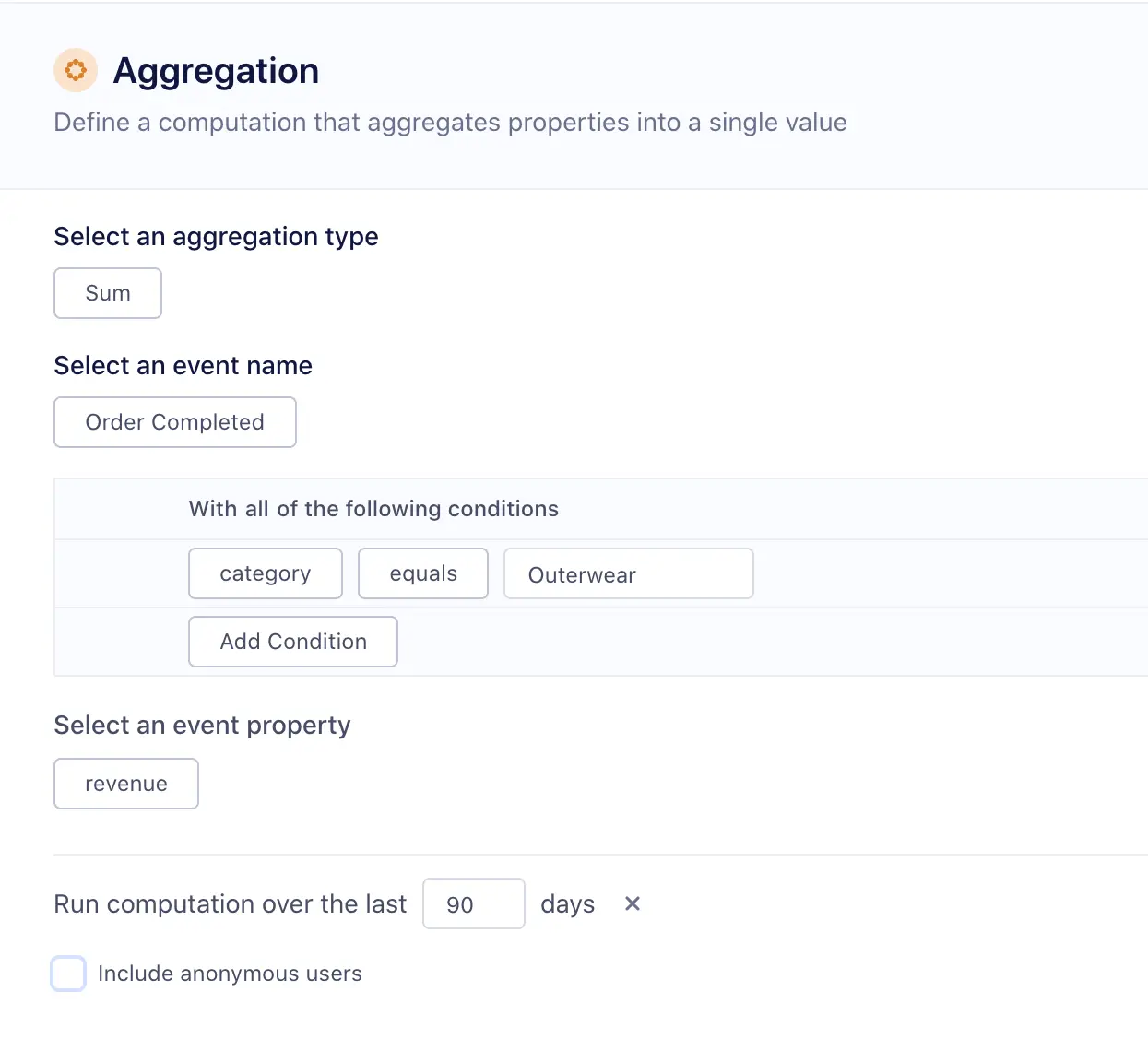
Profiles can be enriched in several ways. Computed Traits calculate metrics like total orders, lifetime revenue, or most viewed page. SQL Traits import computed attributes from a connected warehouse. Predictive Traits use machine learning to score customers for purchase likelihood, churn risk, and lifetime value.
Source: Segment
The Profile API exposes any unified profile programmatically with response times under 200ms, enabling real-time personalization at the application layer.
The Data Graph connects Segment to a warehouse, letting relational data stored there (product tables, Salesforce objects) link to Unify profiles and enrich downstream activations through Linked Events. Profiles Sync continuously exports resolved profiles to Snowflake, BigQuery, Redshift, or Databricks.
Audience Activation: Engage builds real-time audiences and triggers personalized journeys across channels.
Engage sits downstream of Connections and Unify. Teams build audiences using a no-code interface with combinations of behavioral events, custom traits, computed traits, and SQL traits. The builder supports Boolean AND/NOT logic, time-windowed conditions, funnel audiences that enforce strict event ordering, and account-level audiences for B2B use cases.
Generative Audiences (GA in 2025) lets marketers describe audience segments in natural language instead of configuring conditions manually. Linked Audiences connects segmentation logic to warehouse data in Snowflake, BigQuery, Redshift, or Databricks, blending real-time behavioral signals with historical warehouse data without a separate ETL pipeline.
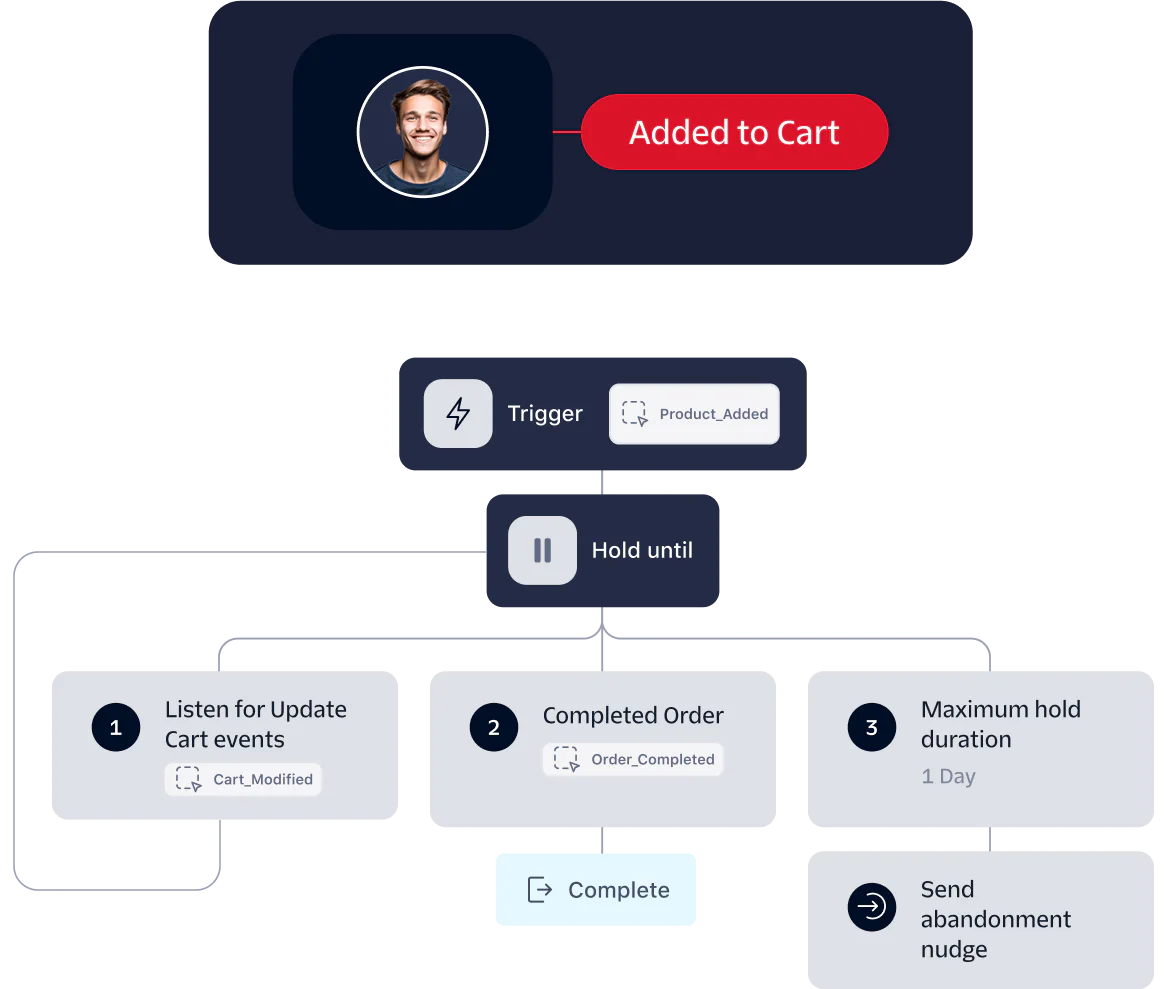
Event-Triggered Journeys (Journeys V2, GA summer 2025) fire the moment a user performs a specific event (cart abandonment, form submission) rather than waiting for batch audience evaluation. The journey builder uses a canvas interface with wait timers, condition branches, and send actions across email, SMS, WhatsApp, push notifications, and any destination in Segment's catalog.
Source: Segment
Pre-built templates cover common patterns including cart abandonment, onboarding, trial-to-paid conversion, and campaign suppression.
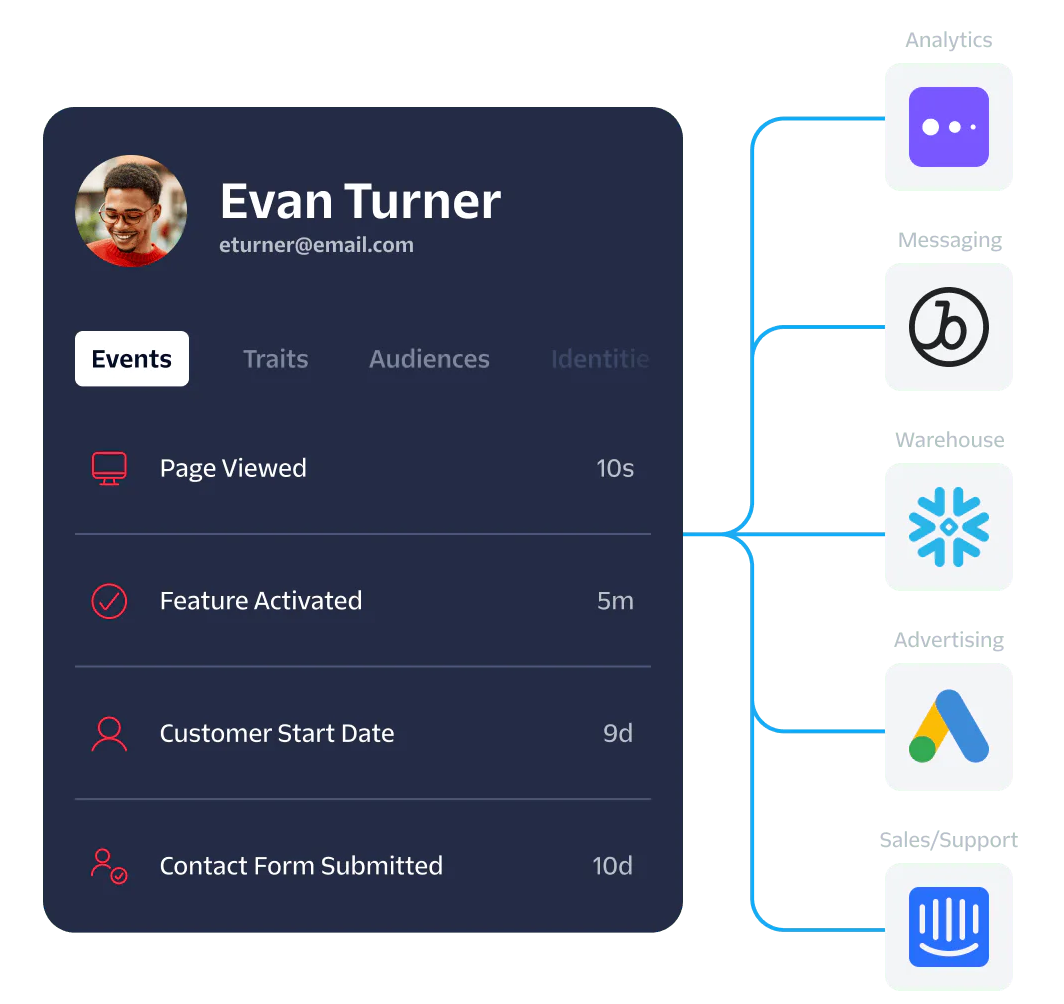
Pricing: Usage-based pricing tied to Monthly Tracked Users, with a free tier and custom enterprise contracts.
Segment charges based on Monthly Tracked Users (MTUs), not per seat. An MTU is any unique user who generates at least one event in a calendar month.
Source: Segment
The Free Plan offers 1,000 MTUs, 2 sources, 1 warehouse destination, and 500,000 Reverse ETL records per month. No credit card is required, and it includes access to 700+ integrations. This is a working production tier, not just a trial.
The Team Plan starts at $120/month with 10,000 MTUs, unlimited sources, and Public API access. Overage pricing scales from $12 per 1,000 additional MTUs (10K to 25K range) down to $10 per 1,000 at 100K+. Annual billing saves up to 20%. A 14-day free trial is available with no credit card required.
The Business Plan requires custom pricing from sales and adds unlimited warehouse destinations, Protocols, advanced roles, HIPAA eligibility, regional data residency, and a dedicated customer success manager.
The full CDP (Connections + Unify + Engage + AI features) also requires contacting sales, with no self-serve trial available. G2 reviewers flag pricing as a barrier at enterprise scale, with contracts reportedly reaching $400K. Support plans add cost: Production support starts at the greater of $250/month or 4% of monthly spend, and Business support starts at $1,500/month or 6%.
Where Twilio Segment Falls Short
Segment excels at first-party data infrastructure, but several limitations emerge depending on what you need from it. These reflect a platform built for data collection and routing, not intelligence or execution.
No Third-Party B2B Intelligence. Segment collects what happens on your own properties. For B2B companies, knowing that an anonymous session viewed your pricing page only matters if you can identify who that visitor is, what company they represent, and who else on their buying committee should hear from you.
Segment doesn't provide contact databases, company context, org charts, technographics, or buying intent signals. B2B teams that need this intelligence must integrate separate providers, creating the data silos that a CDP was supposed to eliminate.
No Built-In Analytics or Reporting. Segment routes data but doesn't analyze it. TrustRadius reviewers note "limited reporting and advanced analytics capabilities." To get insights from the data Segment collects, you need external tools like Amplitude, Mixpanel, or Looker. That adds another integration, another cost, and another dependency before anyone can act on the data.
Pricing Becomes Unpredictable at Scale. The MTU model works at lower traffic levels, but G2 reviewers flag pricing as a barrier at enterprise scale. High-traffic, low-conversion businesses get hit hardest: every unique visitor counts as an MTU whether they convert or not. Pricing reportedly jumped 40% in 2025, and the full CDP has no self-serve trial or published pricing.
Implementation Requires Significant Engineering. Getting basic tracking live is straightforward, but a production CDP implementation (identity resolution, Protocols governance, Reverse ETL, Engage audiences) demands expertise across data engineering, marketing operations, and IT.
G2 users note that "initial implementation and event taxonomy design are hard to get right, and mistakes are expensive long-term." Unlike platforms that offer auto-capture or codeless tracking, Segment requires manual event taxonomy design for most use cases.
Customer Support Quality Is Inconsistent. G2 reviewers describe "poor customer support leading to implementation issues and dissatisfaction." Free and Team customers get web-only support with an estimated three-business-day response time. Paid support plans add real cost, and Segment services reportedly have separate support terms from standard Twilio support.
These limitations reflect Segment's focus on being the infrastructure layer for first-party data. But for B2B companies that need both behavioral data infrastructure and third-party intelligence to run go-to-market, they leave a gap that a complementary platform can fill.
The Natural Complement to Segment: ZoomInfo
ZoomInfo addresses the intelligence gap in Segment's data infrastructure. As a B2B intelligence and GTM platform, ZoomInfo provides the third-party data that Segment's first-party pipeline cannot: verified contact data, company context, buying intent signals, and conversation intelligence.
Its GTM Context Graph fuses ZoomInfo's data with your first-party data to reveal not just what happened in a deal, but why. Where Segment captures what your users do, ZoomInfo reveals who they are, which accounts are in-market, and how to reach the people who make buying decisions.
B2B Data at Scale: ZoomInfo provides the identity and company intelligence that first-party data pipelines cannot.
Segment's event streams capture behavioral signals from your own properties. ZoomInfo provides the B2B identity layer that sits outside those properties: 500M contacts, 100M companies, 135M+ verified phone numbers, 120M direct-dial phone numbers, and 200M+ verified business email addresses.
Source: ZoomInfo
A multi-source verification pipeline backed by 300+ human researchers and automated ML scanning of 28 million site domains daily maintains this data, reaching up to 95% accuracy on first-party data.
For B2B companies using Segment, this fills a structural gap. Segment can track that someone visited your pricing page.
ZoomInfo can identify which company that visitor belongs to through WebSights (which resolves anonymous traffic using 210 million IP-to-Organization pairings), surface the org chart and contact data for decision-makers with direct dials and verified emails, and add technographic data covering 30,000+ technologies across 30M+ companies.

Source: ZoomInfo
Buyer Intent data flags when accounts are researching topics related to your product. Guided Intent, exclusive to ZoomInfo, identifies the topics historically correlated with your actual deal success rather than requiring manual topic selection.

Source: ZoomInfo
Independent validation backs the data quality. In a Fortune 500 competitive RFP analyzing 25 million contacts across vendors, the independent consultant concluded that "no other competitor came even close." ZoomInfo holds 133 No. 1 rankings on G2 across Sales Intelligence, Buyer Intent, and Data Quality categories, and Forrester named it a Wave Leader for Intent Data Providers.
SpringDB used ZoomInfo's enriched data to achieve 2-3x increases in campaign conversions, a 300% increase in database usability, and 30-50% uplift in average deal size. (SpringDB Case Study)
GTM Context Graph: ZoomInfo's intelligence layer captures not just what happened in a deal, but why.
Segment captures behavioral events and builds unified profiles well. But behavioral data alone doesn't explain deal outcomes. A "pricing page viewed" event in Segment is a data point.
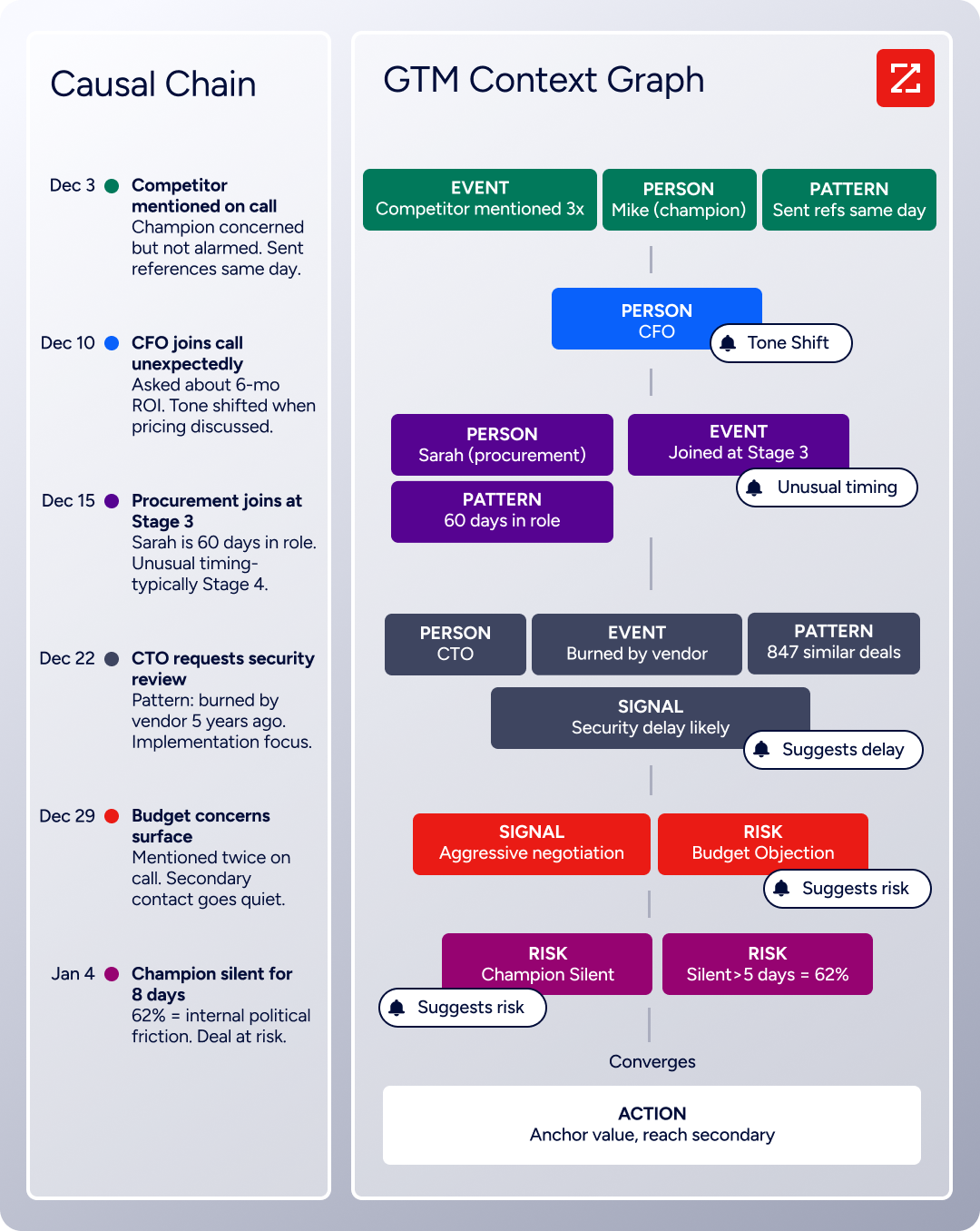
ZoomInfo's GTM Context Graph turns data points into decision context by fusing a customer's CRM records, conversation transcripts, and email interactions with ZoomInfo's third-party intelligence into a single layer that processes 1.5B + data points daily.
Source: ZoomInfo
The distinction matters because CDPs and CRMs record state changes, not the reasons behind them. A CRM records that a deal moved to stage 4. Conversation intelligence captures that the CFO joined the call and asked about ROI timelines. Intent data shows the account is researching competitors.
The GTM Context Graph connects these signals to reveal why the deal accelerated and what should happen next. This capability was built on twenty years of data unification work, strengthened by the acquisition of Chorus for conversation intelligence.
For teams using Segment as their first-party data backbone, the GTM Context Graph adds a layer that behavioral data alone cannot provide: the connection between customer actions and deal outcomes, plus the third-party signals (intent activity, hiring patterns, funding rounds, competitive mentions) that reveal what's happening outside your own properties.
Seismic attributed 39% of its active pipeline to opportunities identified or influenced by ZoomInfo signals, while the sales team reported 54% higher productivity. (Seismic Case Study)
Universal Access: ZoomInfo's intelligence reaches any tool in your stack through APIs, MCP, and native products.
For companies that already use Segment in their data infrastructure, the most relevant ZoomInfo capability is that its intelligence is available everywhere, not locked inside a single application.
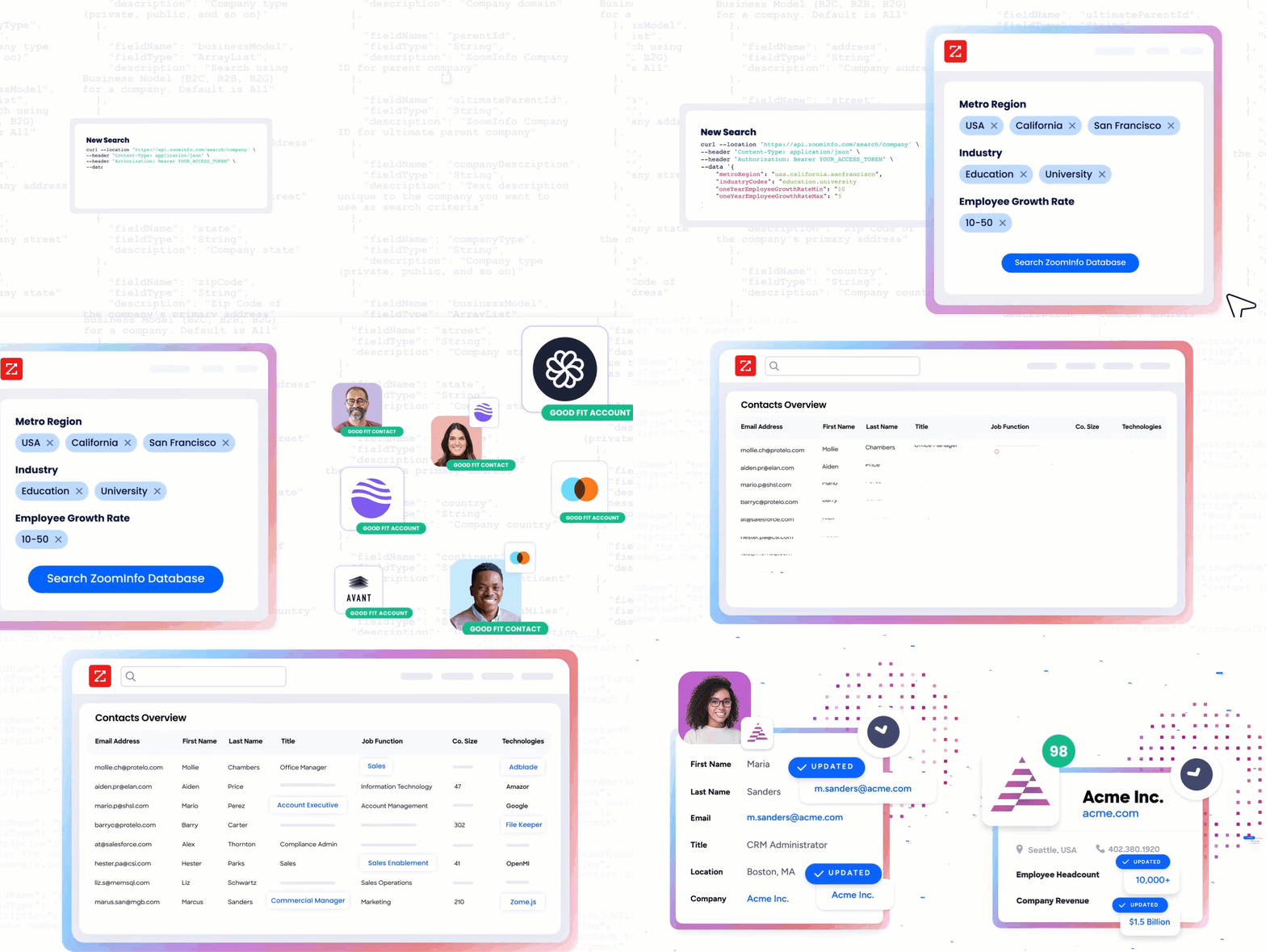
Enterprise APIs provide programmatic access through four areas: a Data API for search and enrichment, a Copilot API for AI-powered intelligence (account summaries, lookalike companies, buying committee recommendations), a Marketing API for audience management, and a Platform API for engagement data.
Source: ZoomInfo
API access is included in all plans, so teams can feed ZoomInfo data into existing workflows without a separate enterprise contract.
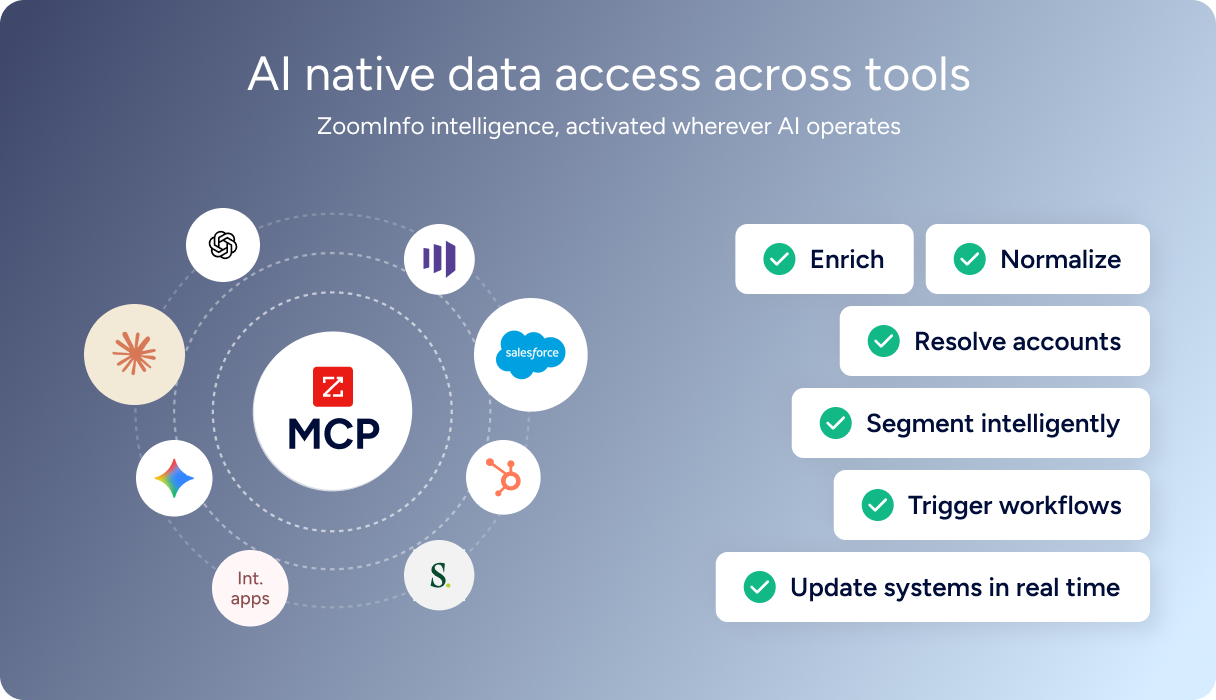
The ZoomInfo MCP server connects AI models to ZoomInfo's data with no custom coding beyond one-time configuration. It supports Claude and ChatGPT and lets users interact through natural language, with the AI selecting the right data call automatically.
Source: ZoomInfo
For teams that prefer a dedicated interface, GTM Workspace gives sellers an AI-powered workspace where account intelligence, AI-drafted outreach, and CRM updates converge without toggling between tools.
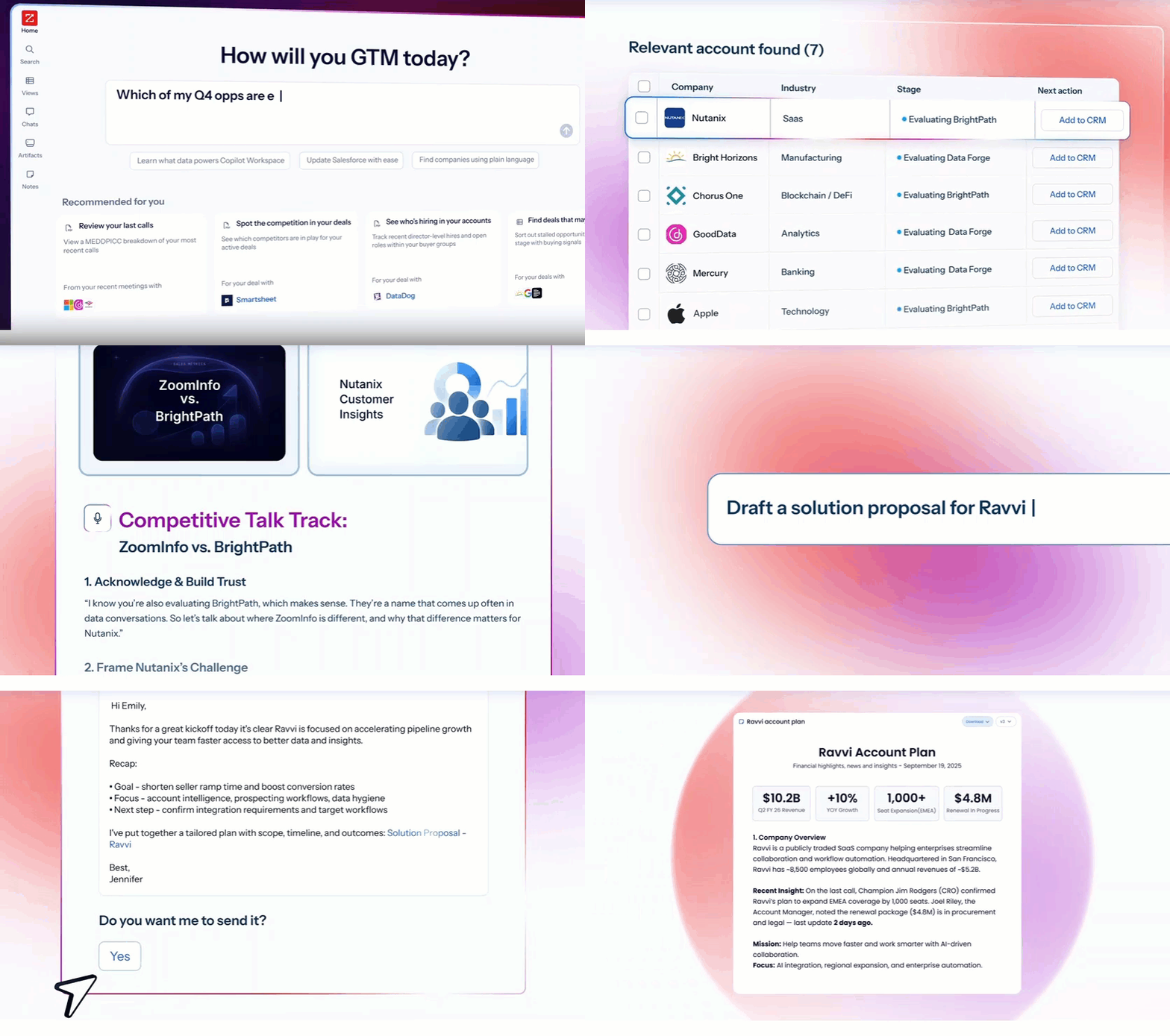
Source: ZoomInfo
GTM Studio gives marketers, RevOps, and GTM engineers a canvas for building audiences in natural language, launching multi-channel plays, and measuring pipeline impact without engineering support. All three draw from one GTM Context Graph, so the same intelligence is available regardless of where a team works.
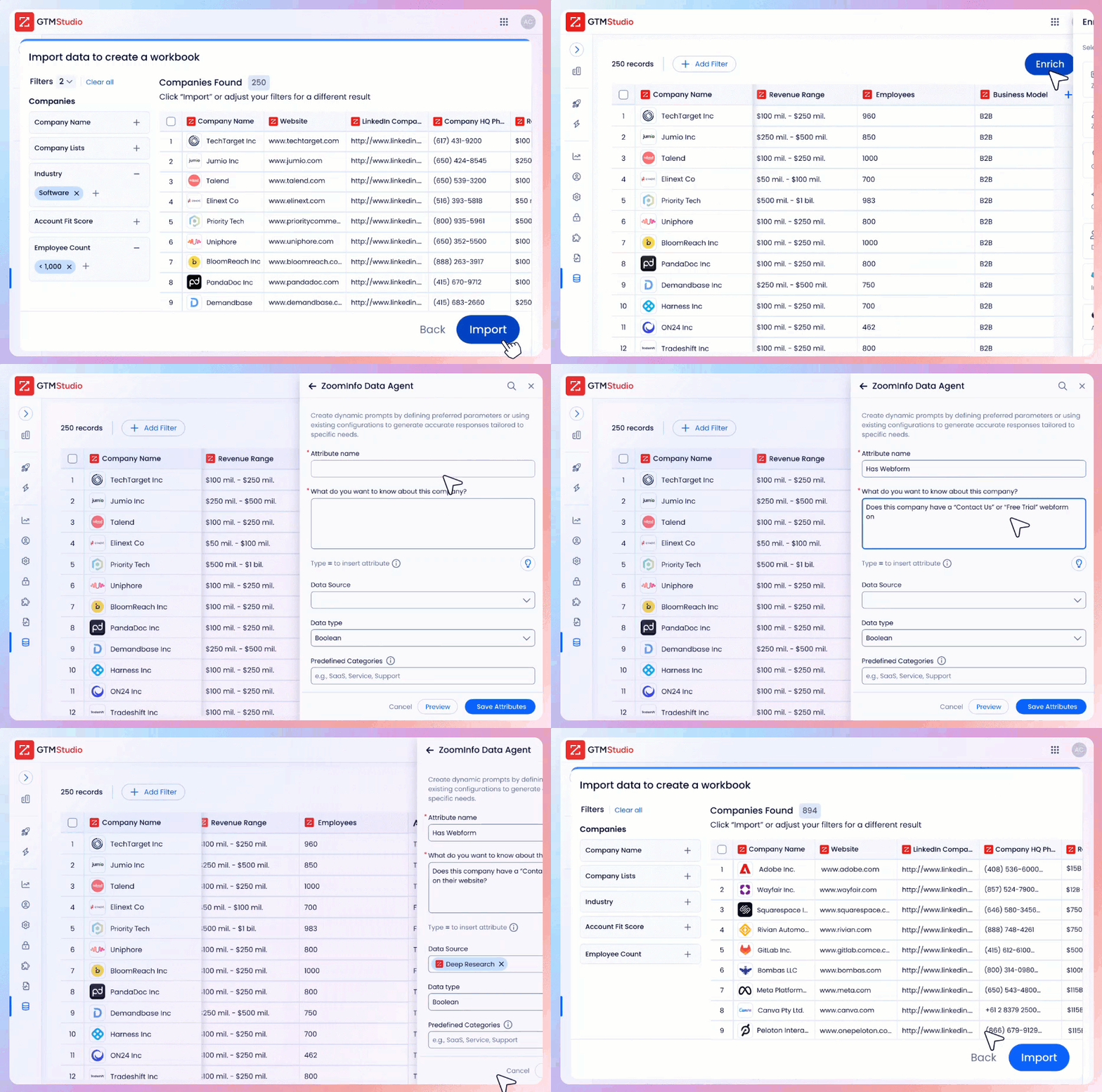
Source: ZoomInfo
BDO Canada's marketing intelligence team used ZoomInfo's API to cut time spent on internal data dashboard updates by 87%. (BDO Canada Case Study)
Twilio Segment and ZoomInfo: How They Work Together
Aspect | Twilio Segment | ZoomInfo |
|---|---|---|
Primary Focus | First-party data collection, routing, and activation | Third-party B2B intelligence and GTM execution |
Data Type | Behavioral events from your own properties | Contact, company, intent, and signal data across the B2B landscape |
Core Strength | Single API for 750+ integrations and identity resolution | 500M contacts, 135M+ verified phone numbers, GTM Context Graph |
Analytics | Routes data to external analytics tools | Built-in intent signals, account insights, and AI predictions |
Visitor Identification | Cross-device unification of your own known users | Company-level identification of anonymous B2B visitors with contact data |
Activation | Audience syncing and journey orchestration | Multi-channel outreach, GTM plays, and AI-drafted engagement |
AI Capabilities | Generative Audiences, Predictive Traits | GTM Context Graph, AI agents, Copilot API |
Free Tier | 1,000 MTUs, 2 sources, no credit card | ZoomInfo Lite (permanent free), 7-day free trial |
Workflow Position | Data collection and routing layer | Intelligence and execution layer |
Best For | Unifying first-party data infrastructure | Identifying, enriching, and engaging B2B target accounts |
Final Verdict
Twilio Segment and ZoomInfo serve different but complementary roles in a B2B company's data and go-to-market stack. They are not competitors. They are two layers that, used together, close the gap between knowing what your users did and knowing who to sell to next.
Choose Segment for your first-party data infrastructure. It is the right tool when you need to collect behavioral events from web, mobile, and server sources through a single API and route them to hundreds of downstream tools without maintaining separate integrations.
Its identity resolution, data governance, and warehouse-native capabilities make it a strong foundation for companies with engineering resources and modern data stacks. If your primary challenge is fragmented first-party data across too many tools, Segment solves it.
Add ZoomInfo for the third-party intelligence layer. It is the right addition when you need to know who your anonymous visitors are, which accounts are in-market for your solution, how to reach the decision-makers on a buying committee, and why your deals are moving or stalling.
ZoomInfo's data, GTM Context Graph, and access points (API, MCP, GTM Workspace, GTM Studio) provide the intelligence that turns first-party behavioral data into pipeline and revenue.
Get started with ZoomInfo here.
The strongest B2B data stacks use both: Segment to collect and route first-party signals, ZoomInfo to enrich those signals with verified B2B intelligence. Segment captures the behavioral event. ZoomInfo provides the identity, the company context, the intent signal, and the direct dial to act on it. Together, they connect data infrastructure to go-to-market execution.
Twilio Segment FAQ
What is Twilio Segment?
Twilio Segment is a customer data platform that collects first-party behavioral data from websites, mobile apps, and servers through a single API and routes it to over 750 downstream tools. Founded in 2011 and acquired by Twilio for $3.2 billion in 2020, Segment serves 25,000+ customers with products spanning data collection (Connections), identity resolution (Unify), and audience activation (Engage).
It does not provide third-party B2B contact or company intelligence. ZoomInfo fills that gap with 500M contacts, 100M companies, and verified contact data across the B2B landscape.
How much does Twilio Segment cost?
Segment's Free plan offers 1,000 Monthly Tracked Users at no cost. The Team plan starts at $120/month with 10,000 MTUs, with overage charges of $10-$12 per 1,000 additional MTUs.
The Business plan and full CDP (Connections + Unify + Engage) require custom pricing from sales, with enterprise contracts reportedly reaching $400,000 or more. Support plans add cost, starting at $250/month or 4% of monthly spend for Production-level support.
Does Twilio Segment have a free plan?
Yes. Segment offers a permanent free tier with 1,000 MTUs, 2 sources, 1 warehouse destination, and access to 700+ integrations. No credit card is required. A 14-day free trial of the Team plan is also available. The full CDP (identity resolution, audience activation, AI features) has no self-serve trial and requires contacting sales.
ZoomInfo also offers a permanent free tier through ZoomInfo Lite, which provides access to its B2B database with 10 monthly export credits, plus a separate 7-day free trial of paid features.
Does Twilio Segment provide built-in analytics?
No. Segment collects and routes data but does not analyze it. To get insights, dashboards, or reports from the data Segment captures, you need external tools like Amplitude, Mixpanel, Looker, or a BI platform connected to your data warehouse. This is by design: Segment positions itself as the data infrastructure layer, not the analytics layer.
Does Twilio Segment require engineering resources to implement?
For basic tracking, the barrier is low. A JavaScript snippet and a few analytics.track() calls can be live within an hour. But a production implementation involving identity resolution, Protocols governance, Reverse ETL, and Engage audiences requires expertise across data engineering, marketing operations, and IT.
Event taxonomy design is especially critical, as mistakes in the schema are expensive to correct after data starts flowing. Visual Tagger and Auto-Instrumentation features reduce some of the technical work, but most organizations need dedicated engineering time for a proper deployment.
What integrations does Twilio Segment support?
Segment offers 750+ integrations spanning advertising, analytics, CRM, email marketing, customer support, data warehouses, and more. Sources include JavaScript, iOS, Android, React Native, Flutter, Unity, server-side libraries in multiple languages, and Cloud Sources like Salesforce and Stripe.
Storage destinations include Snowflake, BigQuery, Redshift, Postgres, Azure, and AWS S3. All integrations are available on the free tier, though some destination features require paid plans.
How does Twilio Segment handle data privacy?
Segment holds SOC 2 Type II certification, is HIPAA-eligible on qualifying plans with a signed BAA, is certified under the EU-US Data Privacy Framework, and offers EU data residency. The platform includes a Privacy Portal for PII detection, data controls for blocking or hashing specific fields, consent management across all products, and API-driven user deletion and suppression for GDPR right-to-erasure requests.
ZoomInfo maintains ISO 27001, ISO 27701, SOC 2 Type II, and TRUSTe GDPR and CCPA certifications, with registered data broker status in California and Vermont.
Can Twilio Segment identify anonymous B2B website visitors?
Segment's identity resolution unifies anonymous and known sessions for your own users across devices and channels, but it does not identify which company an anonymous visitor belongs to or provide contact information for people at that company.
For B2B visitor identification, ZoomInfo's WebSights feature resolves anonymous website traffic to specific companies using 210 million IP-to-Organization pairings, then surfaces verified contact data for decision-makers at those companies, including direct-dial phone numbers and business email addresses.
Researching Segment? These comparisons and alternatives help you decide:
