
Seismic has spent over a decade building the largest sales enablement platform on the market. It brings content management, training, coaching, meeting intelligence, and buyer engagement under one roof, with an AI layer that ties the pieces together.
For enterprise sales organizations struggling with scattered content and inconsistent seller readiness, Seismic offers a single system to organize the chaos.
To write this Seismic review, we analyzed the platform extensively. We believe it's the right choice if:
You run an enterprise sales organization with 50+ reps who need governed, on-brand content
You operate in a regulated industry where content compliance is a legal requirement
You want to consolidate learning, coaching, and content management into one platform
You need personalized document assembly at scale with live CRM data
You have a dedicated enablement team to manage content governance and training programs
Seismic excels at equipping sellers with the right content and training, but it doesn't help them identify which accounts to target or signal when those accounts are ready to buy. Seismic can put a personalized pitch deck in a rep's hands, but it can't tell them which of their 200 accounts just started researching a competitor, which decision-maker changed jobs last week, or which buying committee is actively in-market. That upstream intelligence (knowing who to pursue and when) is a different problem.
This is where ZoomInfo enters the picture: a GTM platform built on one of the largest B2B datasets in the industry. ZoomInfo's GTM Context Graph processes 1.5B+ data points daily, unifying B2B data with your CRM records, conversation transcripts, and behavioral signals to surface which accounts deserve attention and when buyers are ready to act.
Where Seismic arms your sellers with content, ZoomInfo tells them which doors to knock on and when to knock.
We've included a detailed look at ZoomInfo later in this review as the natural complement for teams that want both buyer intelligence and seller enablement. If you're ready to explore the targeting side of your GTM motion, you can start a free trial.
What is Seismic?
Seismic is a revenue enablement platform founded in 2010 by Doug Winter, Nasser Barghouti, Marc Romano, Ed Calnan, and Fred Xie.

The founding insight came from direct observation: Winter watched financial advisors assembling client pitchbooks from three-ring binders filled with outdated charts and other clients' personal data. The gap between what marketing produced and what the field actually delivered was systematic.
Today, Seismic operates the Seismic Enablement Cloud, which spans five areas: Content Management, Learning & Coaching, Program Strategy & Execution, Meeting Intelligence, and Digital Sales Rooms.
An AI engine called Aura runs across the platform, powering content recommendations, learning content generation, meeting summaries, and conversational search.
The company has reached roughly $400M in annual recurring revenue and achieved its first profitable fiscal year in FY2025. It serves around 2,000 organizations worldwide, with 85 customers spending $1M+ annually.
Seismic is especially strong in financial services, where 400+ firms (including major banks and asset managers) rely on it for compliant content distribution.
In February 2026, Seismic announced its intent to merge with Highspot, combining the two largest standalone enablement platforms under the Seismic brand, led by CEO Rob Tarkoff. For a side-by-side look at how the two platforms compared before the merger, see our Highspot vs Seismic breakdown.
Seismic Pros & Cons
Pros | Cons |
|---|---|
Unified platform covering content, training, coaching, and buyer engagement | Implementation timelines of 4+ months for enterprise deployments |
LiveDocs content automation with live CRM data connections | Steep learning curve, especially for administrators |
150+ integrations with CRM, sales engagement, and collaboration tools | No published pricing; enterprise deals reportedly start at $20K+ annually |
Compliance-grade governance for regulated industries | Content search quality degrades without disciplined metadata tagging |
Aura AI embedded across every capability area | No free plan or self-serve trial |
Named a Leader by Gartner, Forrester, and IDC | Requires dedicated enablement staff for ongoing governance |
90% gross customer retention rate | No buyer identification or prospecting intelligence |
Seismic Review: How it Works & Key Features
Content Management & Library: A governed, AI-powered system for storing, personalizing, and tracking sales content.
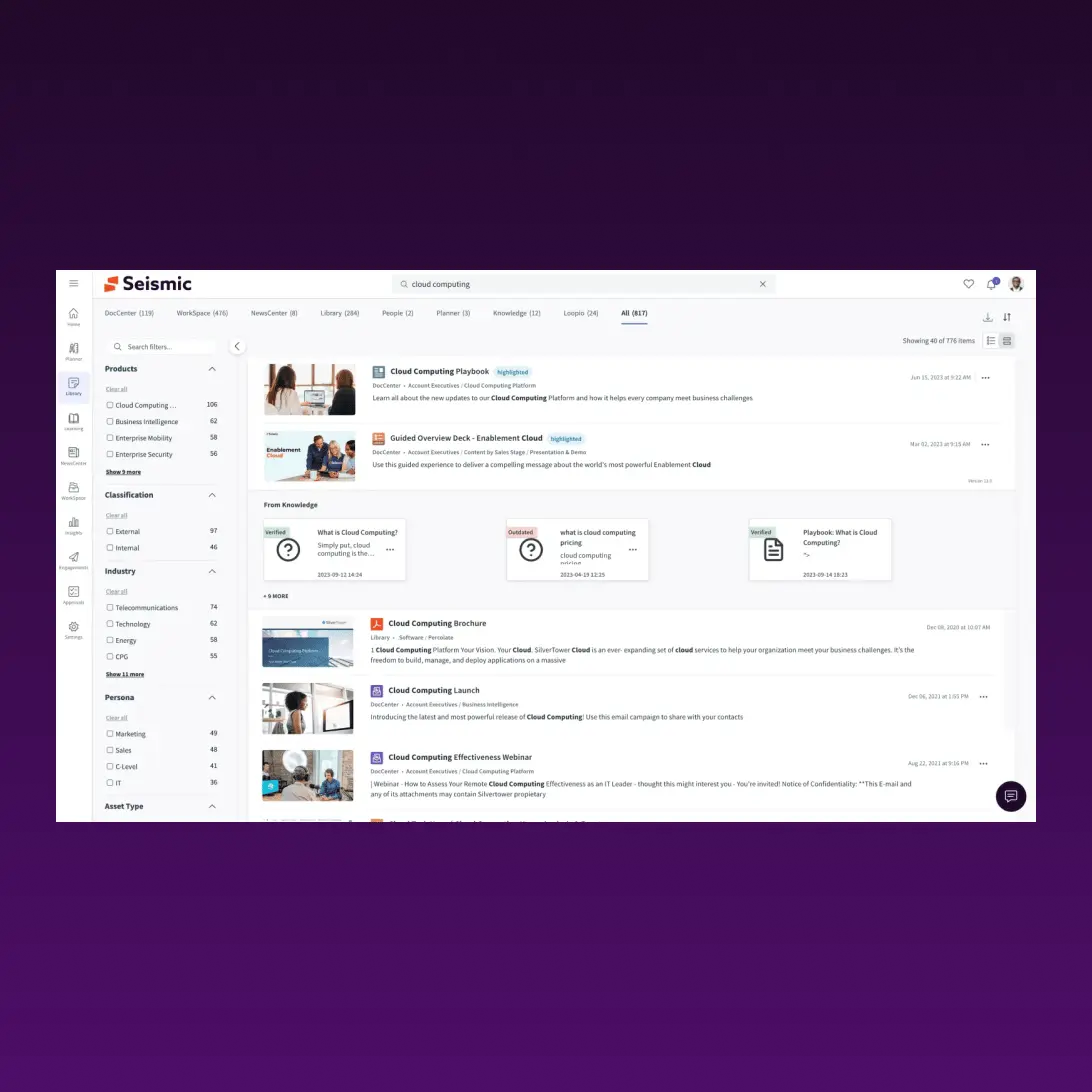
Seismic Content is the platform's foundation. It centralizes all sales and marketing assets in a single library with version control, role-based permissions, content expiration settings, and audit trails.
Source: Seismic
When marketing updates a file, the old version retires automatically and every rep sees only the current approved asset.
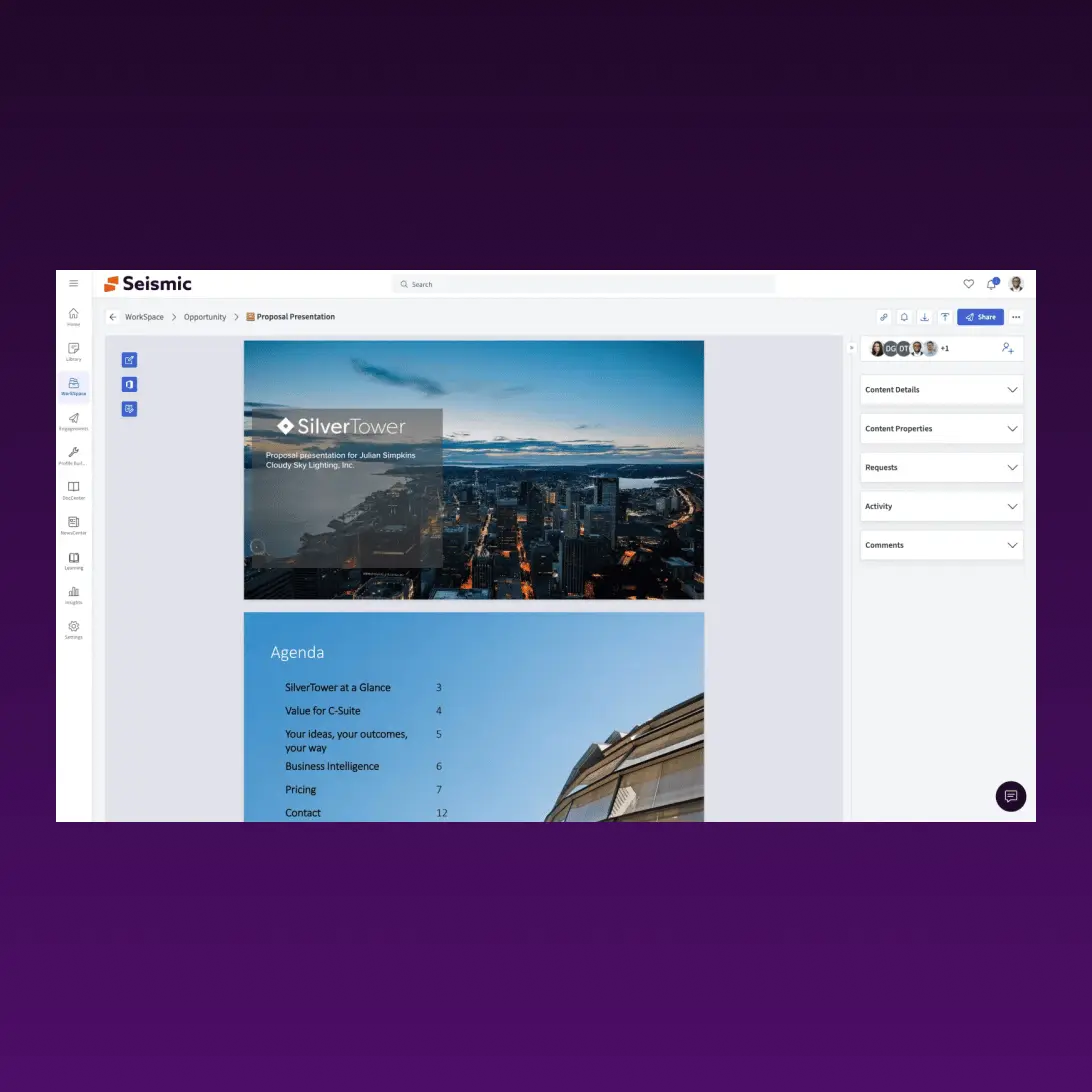
The key feature is LiveDocs, Seismic's content automation engine. LiveDocs turns standard PowerPoint or Word files into templates with modular placeholders, data connections, and business rules.
Source: Seismic
Administrators define which elements are variable (customer name, logo, pricing data) and which are locked for brand compliance.
When a rep needs a personalized deck, they complete a guided Q&A wizard and LiveDocs assembles the document by pulling live data from connected CRM sources.
Finding content relies on Aura AI, which auto-generates content tags and descriptions during upload and flags duplicates. Reps can search by persona, buying stage, or deal context from within Salesforce, Microsoft Teams, Slack, and other tools via 150+ integrations.
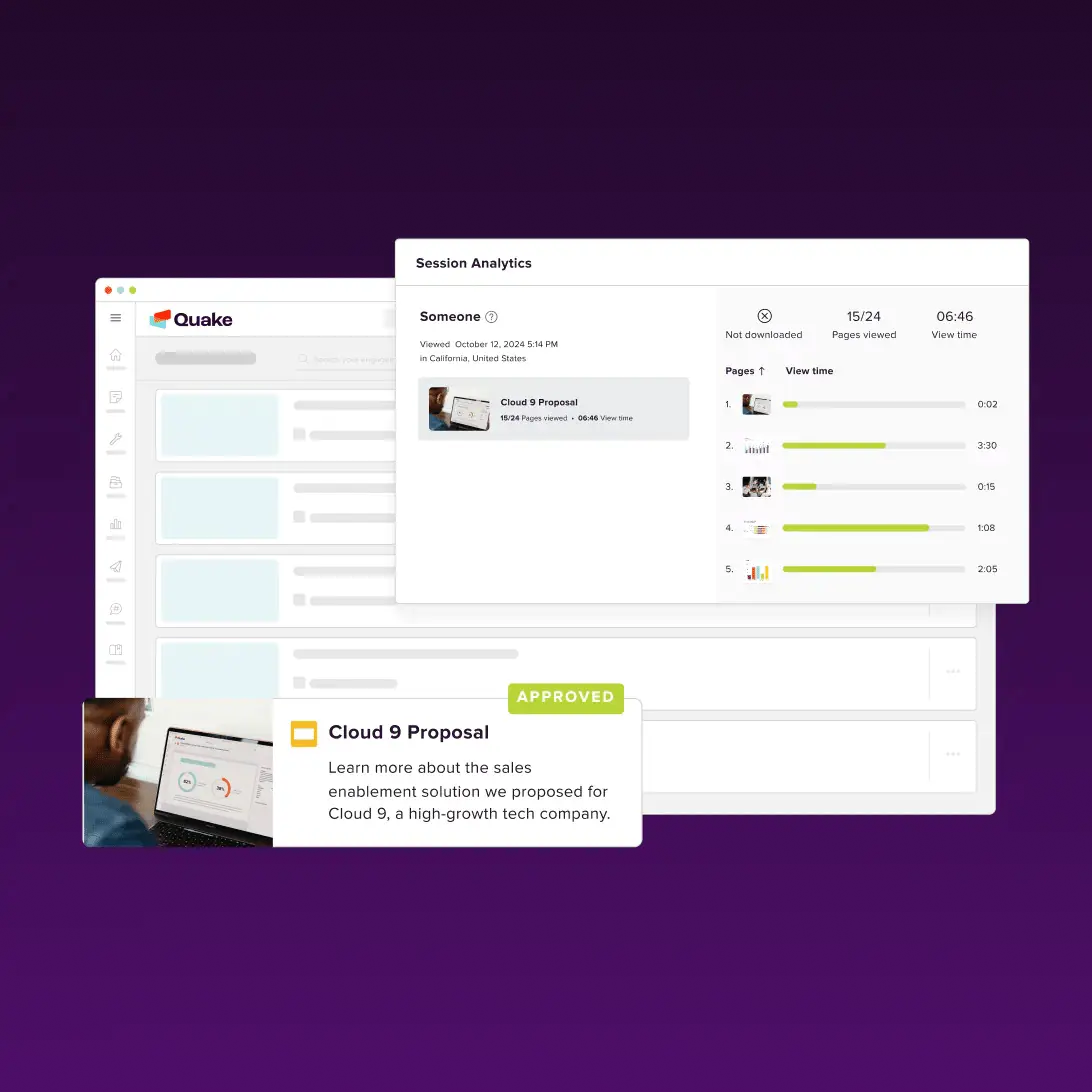
Distribution happens through LiveSend, which replaces email attachments with trackable links. Sellers get real-time notifications when a buyer opens a link, along with page-level engagement data.
Source: Seismic
Learning & Coaching: Sales readiness built for revenue teams, not generic corporate training.
Seismic Learning & Coaching fills the gap between knowing product features and actually selling them. Traditional LMS platforms focus on compliance completion rates; Seismic Learning ties training outcomes to revenue results like deal velocity, ramp time, and win rates.
Enablement teams build interactive lessons combining video, quizzes, written material, and content from the Seismic library. These are organized into role-specific learning paths segmented by role, region, or experience level.
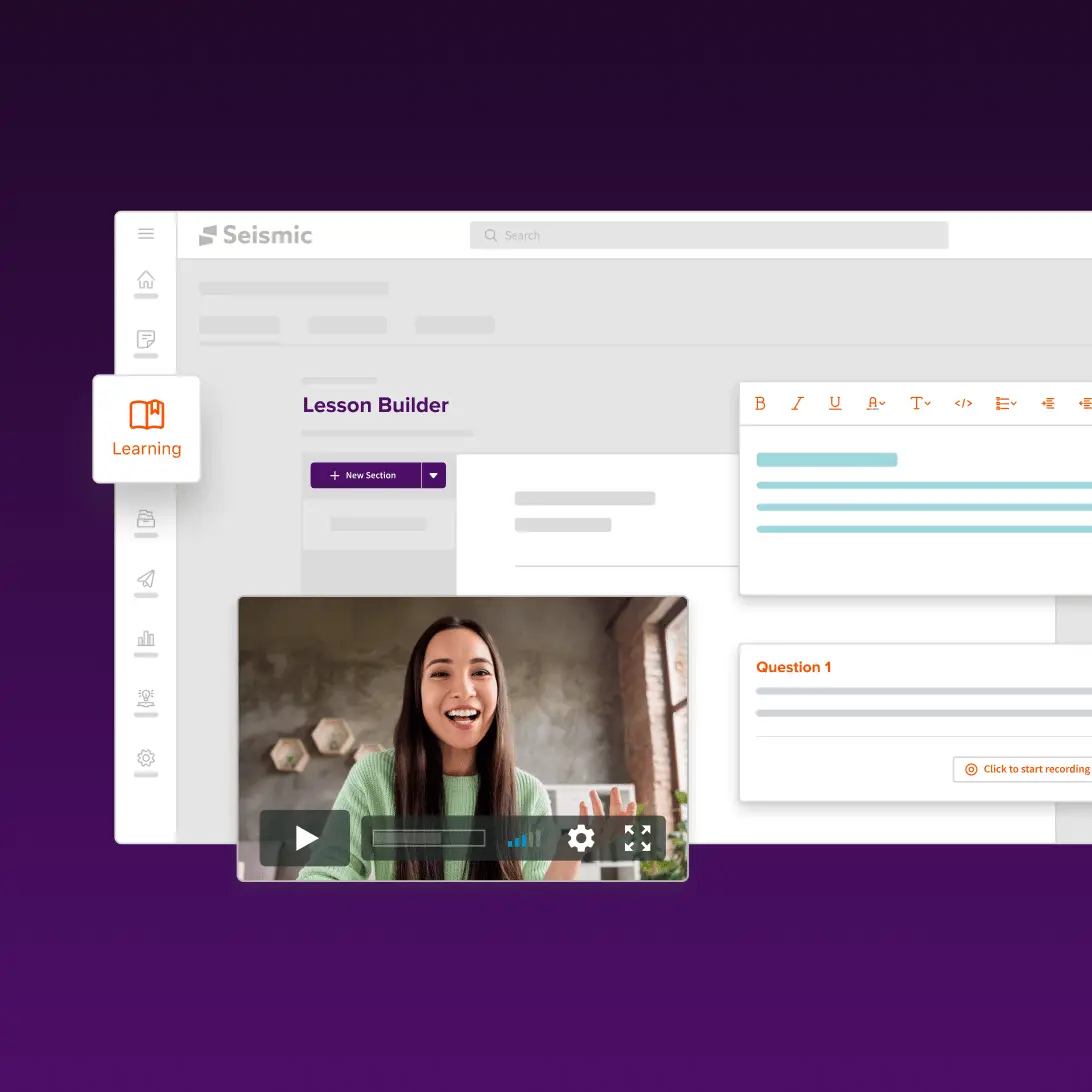
Source: Seismic
The AI role-play feature lets reps practice scenarios against AI personas. The system analyzes each session and delivers feedback on pacing, keyword usage, filler words, and confidence.
Skill scores update automatically from both practice sessions and actual customer meetings, creating a closed loop between rehearsal and live performance.
For managers, the platform surfaces coaching recommendations that identify which reps need attention, on which skills, and what actions to take. Video coaching lets reps submit recorded pitches for asynchronous review with timestamped feedback.
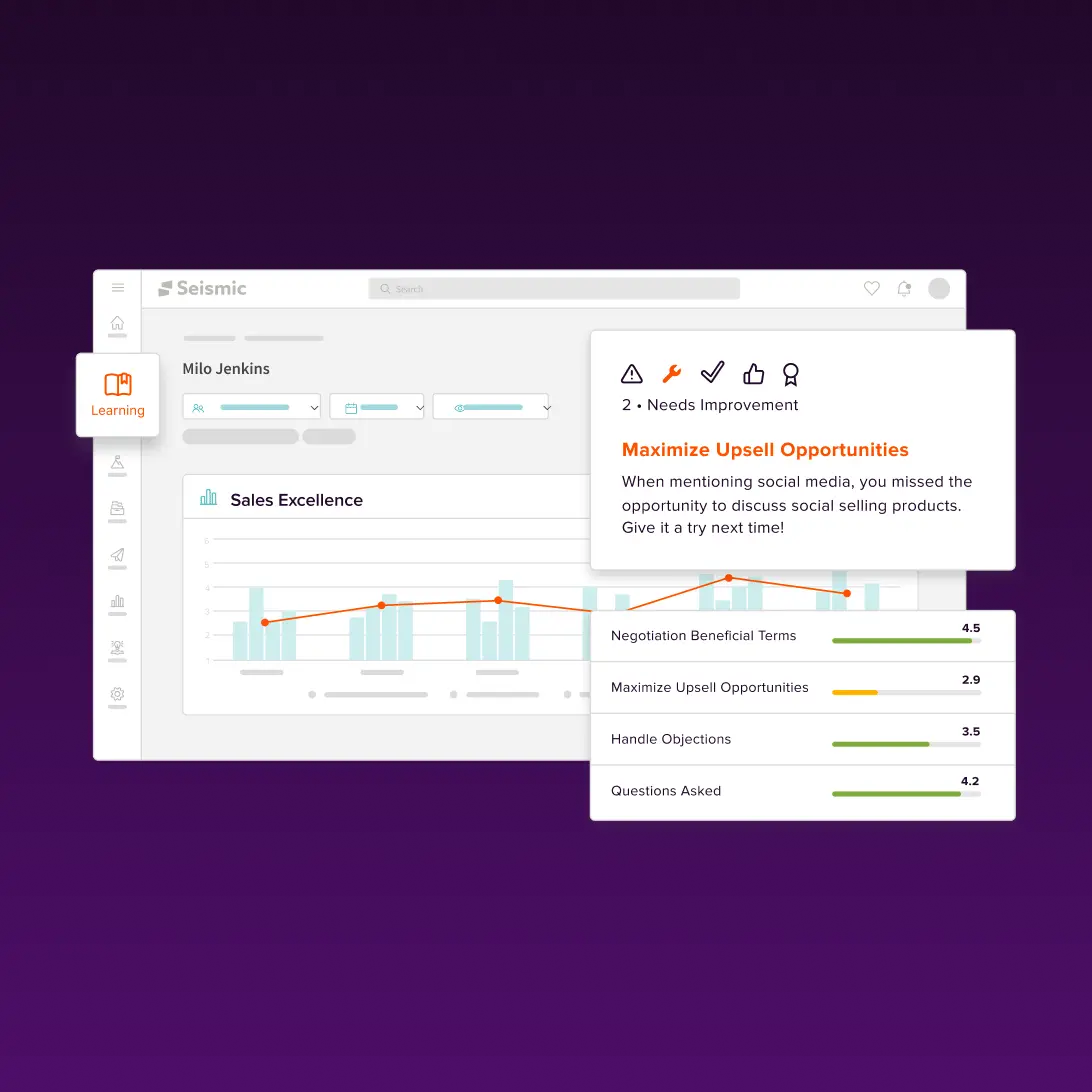
Source: Seismic
Aura AI: Built into the platform, not bolted on.
Aura AI runs across every part of the Seismic Enablement Cloud. It works against an organization's own approved content, not generic open-web data, so every recommendation, generated asset, and search result reflects the company's knowledge base and permissions.
Aura operates in four modes:
In content discovery, it combines keyword matching, auto-tagging, and contextual analysis with CRM signals to surface relevant assets for a given selling moment.
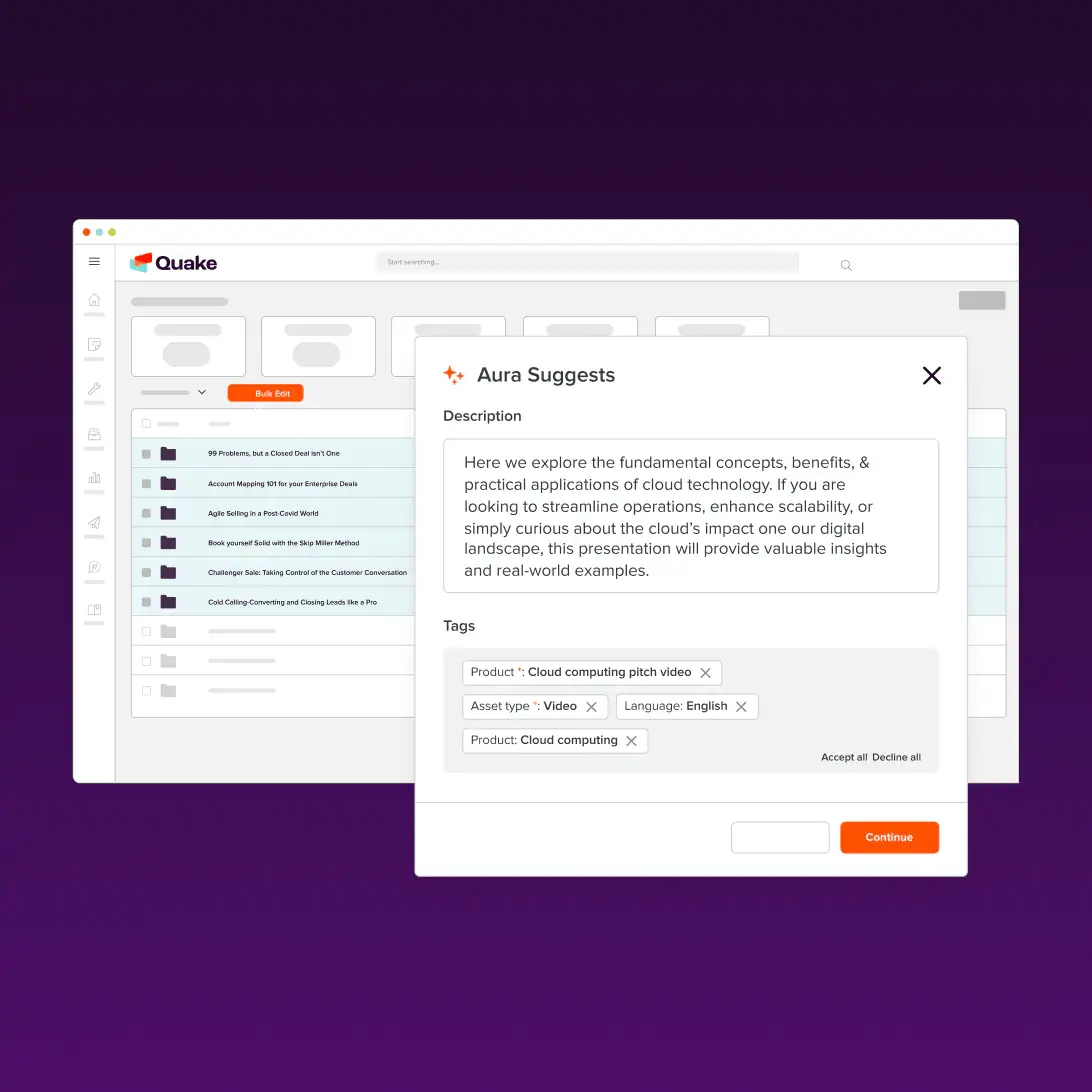
Source: Seismic
In content generation, it produces presentations, training lessons, social posts, and email drafts from prompts or existing materials. The Presentation Agent, embedded inside Microsoft PowerPoint, pulls live CRM data alongside approved content to assemble personalized decks via natural language.
In task automation, Aura handles meeting transcription, skills assessment scoring, content translation, and metadata tagging.
In advisory mode, Aura Chat provides multi-turn conversations where sellers can research topics, get summarized answers, or draft communications.
Seismic holds ISO 42001 certification (the AI management systems standard) and states that customer data is never sent to third parties for model training. The AI layer enforces permission rules: users only receive insights from materials they are authorized to access.
Meeting Intelligence & Digital Sales Rooms: Covering both live conversations and asynchronous buyer engagement.
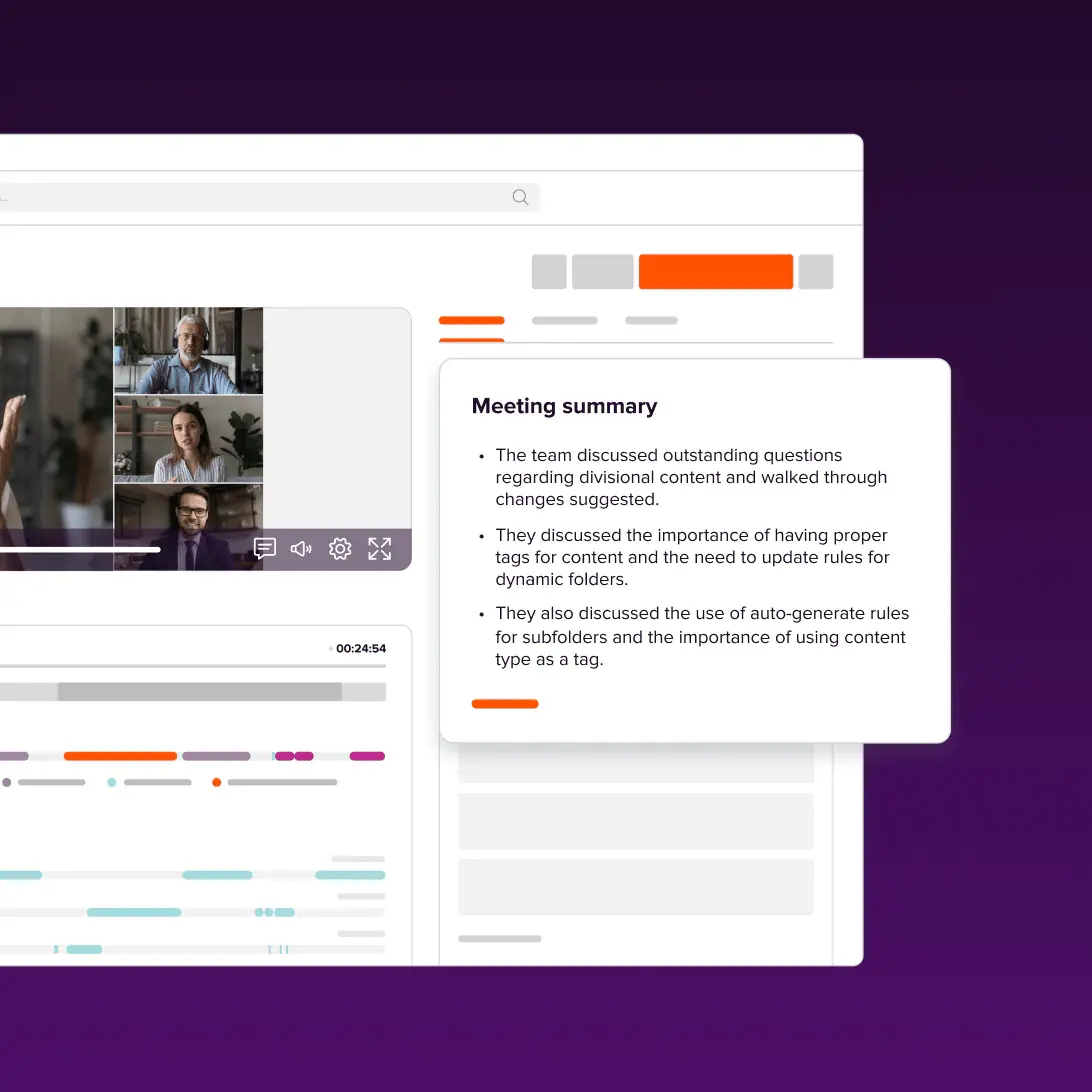
Seismic for Meetings structures sales conversations into three phases. Before the meeting, Aura surfaces content recommendations and supports pitch rehearsal. During the meeting, the system records and transcribes in real time via integrations with Microsoft Teams, Zoom, and Webex.
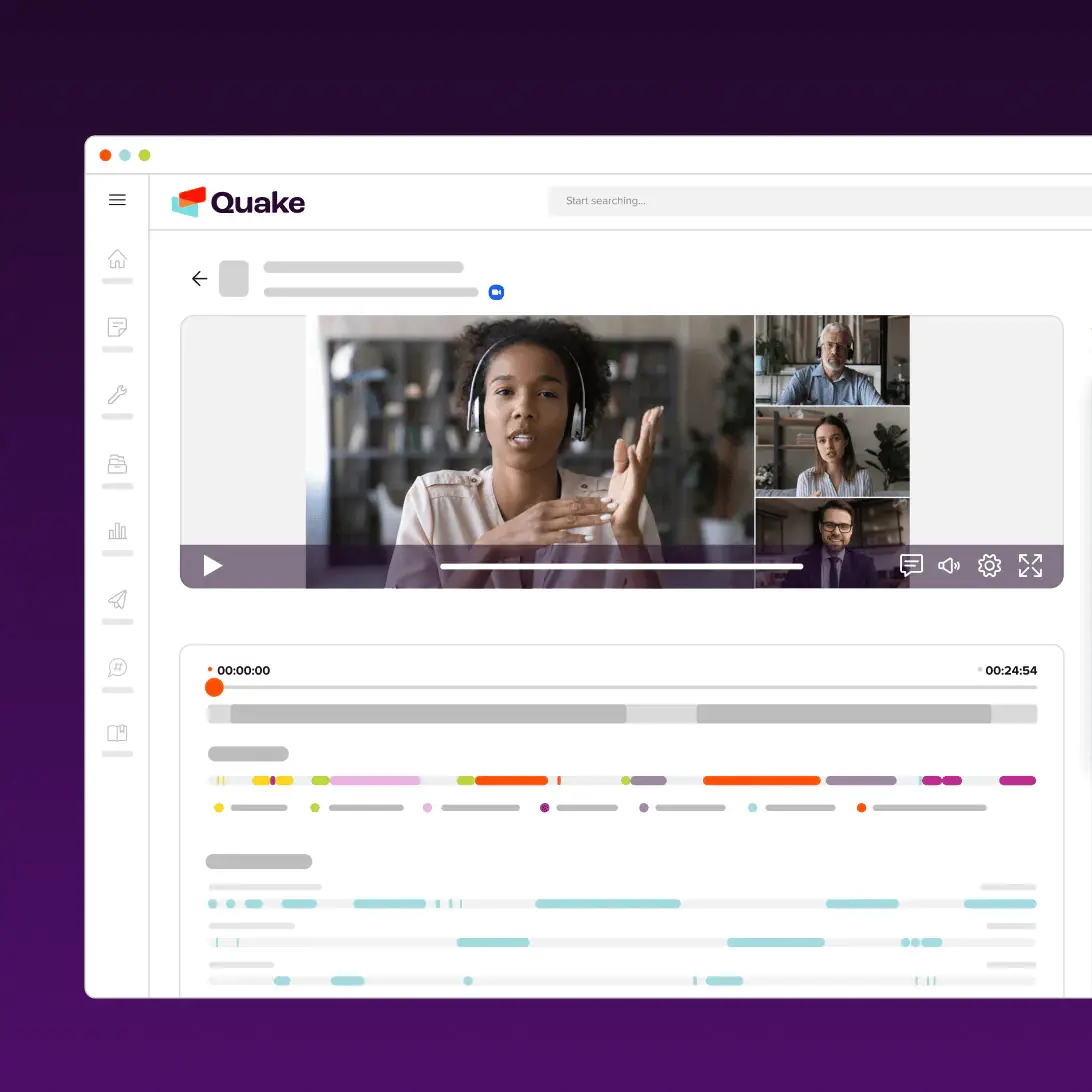
Source: Seismic
After the meeting, Aura generates summaries, extracts action items, identifies questions asked, and recommends follow-up content.
Source: Seismic
Digital Sales Rooms address the problem of fragmented deal communication across email threads. B2B buying involves an average of 13 stakeholders, making centralized deal spaces essential.
Sellers create personalized microsites using drag-and-drop templates, curate deal-specific content, and record video introductions. Buyers access the room via a LiveSend link with no Seismic account required. Inside, they can view documents, leave comments, and tag colleagues.
A recent addition, Mutual Action Plans, lets sellers and buyers set shared timelines with milestones and overdue action flagging directly within the Digital Sales Room.
Pricing: Enterprise-only, custom-quoted, with no self-serve option.
Seismic does not publish pricing on its website. All purchases require a negotiated order form, and prospects must request a demo to begin commercial discussions.
The platform sells two separately purchased product lines on a named-user licensing model: Seismic Content (available in Professional and Enterprise Premier editions) and Seismic Learning (purchased separately).
A newer packaging structure offers Essential, Advanced, and Ultimate bundles under the Seismic Enablement Cloud brand.
Professional edition includes the content library, LiveSend, Digital Sales Rooms, basic content assembly, analytics, and CRM integration. Enterprise Premier adds LiveDocs (the data-integrated template engine), Seismic Knowledge, Seismic for Slides, advanced data tools with Snowflake access, and the Enablement Planner.
Several features require add-on purchases regardless of edition, including Seismic for Meetings, Dynamic Watermarking, and Microapps. All contracts are invoiced annually in advance, are non-cancellable, and seat quantities cannot be reduced mid-term.
A structured trial program is available by arrangement through an order form, but there is no self-serve free trial and no permanent free plan.
Where Seismic Falls Short
Seismic's limitations follow from its focus on enterprise enablement rather than broad GTM coverage. They matter most for teams whose needs extend beyond content and coaching.
Implementation Demands Serious Investment. Enterprise deployments typically take four months or longer, and organizations commonly hire Seismic's professional services team for initial setup.
The platform requires dedicated enablement staff to manage content taxonomy, tagging, permissions, and governance. Companies without an in-house enablement function often find the setup overwhelming.
Seismic even offers an "Accelerating Adoption Change Management" app on its marketplace, which signals that structured change management is a recognized part of most deployments.
Content Discovery Breaks Down Without Governance Discipline. As content libraries grow, search relevance declines without disciplined metadata tagging.
Aura AI auto-tags content at upload, which helps, but organizations with thousands of assets still need ongoing administrative investment to keep the library functional. The larger the library, the more maintenance it requires.
Enterprise Pricing Creates Access Barriers. With no free tier, no self-serve trial, and reported enterprise deals starting at $20,000+ annually, Seismic is inaccessible to companies without mature sales operations and the associated budgets.
Non-cancellable annual contracts with no mid-term seat reductions add financial rigidity.
The Admin Burden Never Stops. Beyond initial setup, the platform requires continuous governance: tagging new content, archiving outdated assets, managing permissions, updating learning paths, and maintaining content compliance.
Organizations that underinvest in ongoing administration risk the content decay that erodes the platform's core value.
No Buyer Intelligence or Prospecting Capability. This is the most significant gap for GTM teams thinking about the full sales cycle. Seismic answers "what should sellers share and how should they be trained?" but not "which accounts should sellers pursue?" or "when is a prospect actively in-market?"
There is no contact database, no intent signal monitoring, no website visitor identification, and no account prioritization. A rep can have a polished, AI-personalized presentation, but if they're presenting to the wrong account at the wrong time, the enablement investment is wasted.
This gap isn't a flaw in Seismic's design. It reflects a deliberate focus on enablement. But it creates a clear need for a complementary platform that handles upstream intelligence: identifying who to target, when to engage, and what signals indicate readiness to buy.
The Perfect Complement to Seismic: ZoomInfo
ZoomInfo is a GTM platform built on a large B2B data foundation: 500M contacts, 100M companies, 135M+ verified phone numbers, and 200M+ verified business emails.
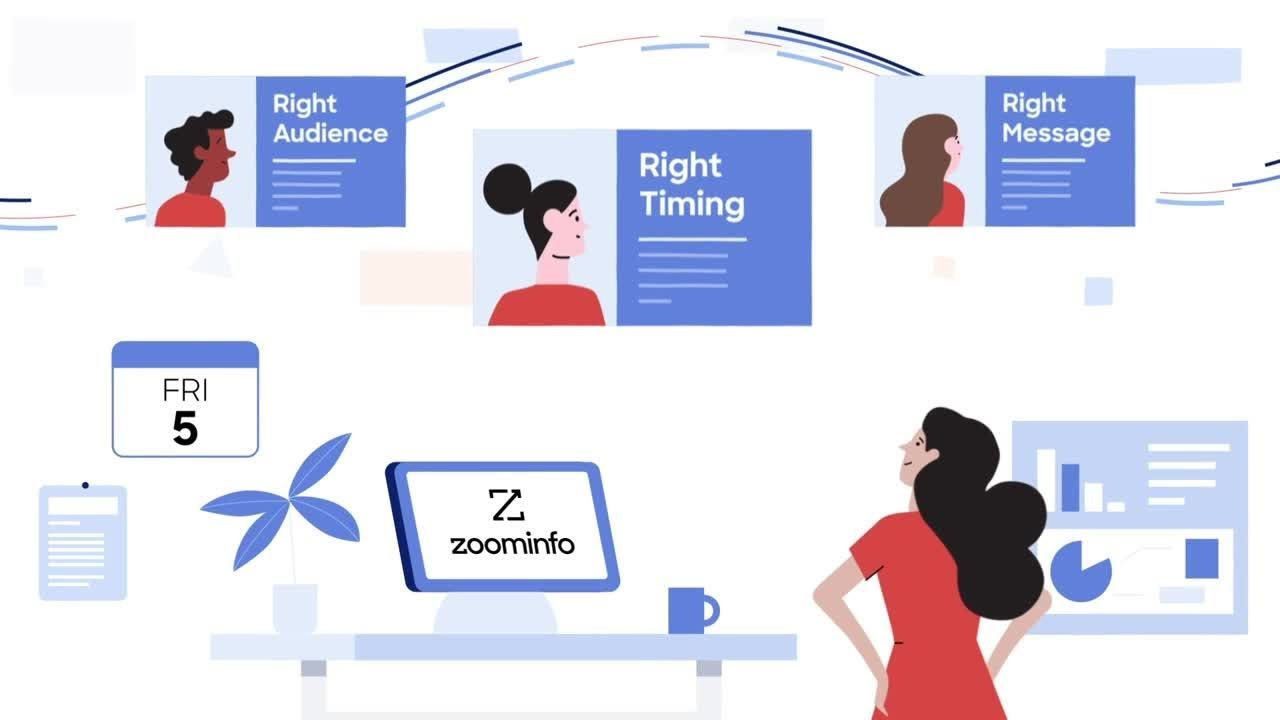
Its GTM Context Graph processes 1.5B+ data points daily, unifying this data with your CRM records, conversation transcripts, and behavioral signals to reveal the full context behind your accounts. That context fuels AI that shows not just what happened, but why, and what to do next.
Where Seismic owns the enablement workflow (what to share, how to train, how to engage buyers with content), ZoomInfo owns the targeting workflow (who to pursue, when to engage, and what intelligence to act on). Together, they form a complete GTM system.
The proof is in Seismic's own adoption. As a ZoomInfo customer, Seismic's sales team attributed 39% of pipeline to opportunities identified or influenced by ZoomInfo signals, boosted productivity by 54%, and saved 11.5 hours per week per seller.

Source: ZoomInfo
Comprehensive B2B Data: The foundation Seismic doesn't provide.
Seismic tells sellers what to share. ZoomInfo tells them who to share it with.
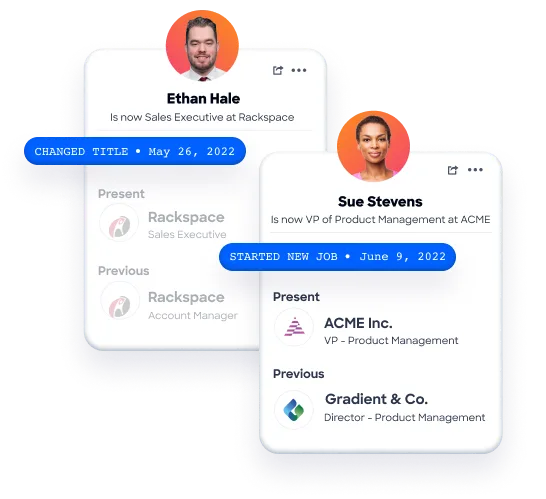
ZoomInfo's data covers three dimensions: identity data (who buyers are, where they work, how to reach them), company context (firmographics, org charts, technographics across 100M companies), and dynamic signals (intent data, job changes, funding events, and technology adoption that reveal when accounts are in-market).
Source: ZoomInfo
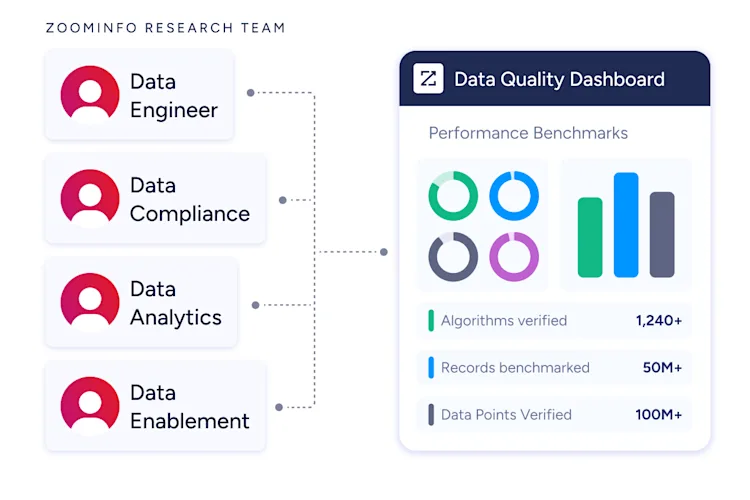
ZoomInfo builds this data through a multi-source verification process: automated ML scanning of 28 million site domains daily, third-party partner data covering 95 million businesses, a community of 200,000+ users who share data back, and an in-house Data Training Lab of 300+ human researchers. First-party data reaches up to 95% accuracy.
Source: ZoomInfo
These aren't self-reported claims. In a Fortune 500 competitive RFP analyzing 25 million contacts across vendors, the independent consultant concluded that "no other competitor came even close."
ZoomInfo was named a Leader in Gartner's Magic Quadrant for ABM Platforms for the second consecutive year, a Leader in Forrester's Wave for Intent Data Providers, and the only vendor in Gartner's Customers' Choice quadrant with a 4.7/5.0 average rating.
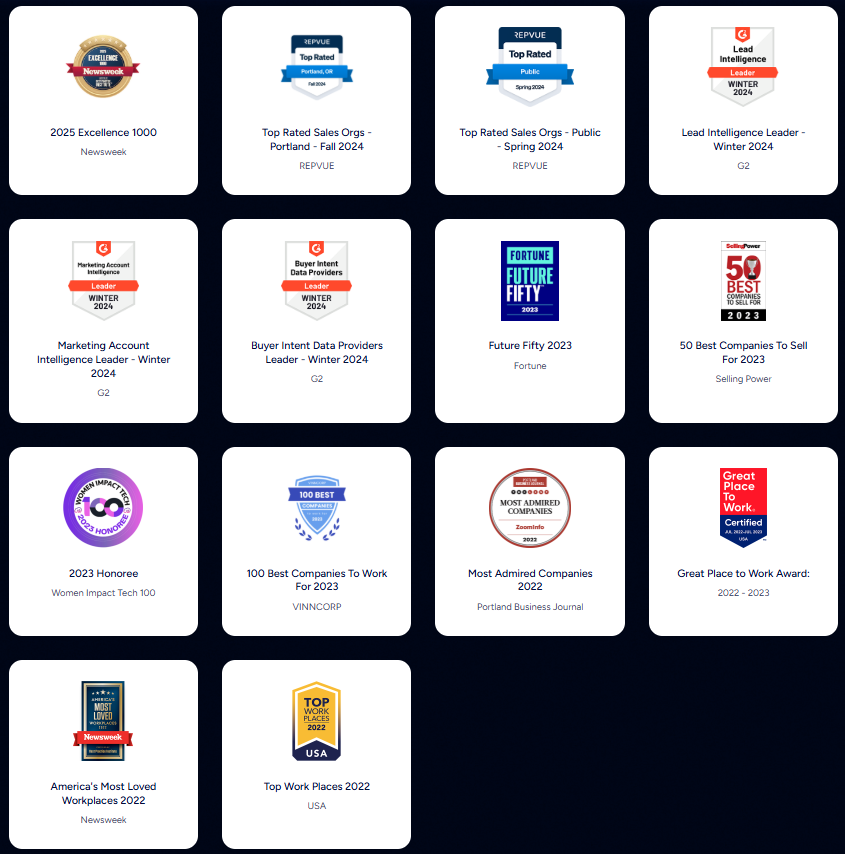
For Seismic users, the practical value is direct: when a rep opens a Digital Sales Room or assembles a LiveDocs presentation, they need to know the account is worth the effort.
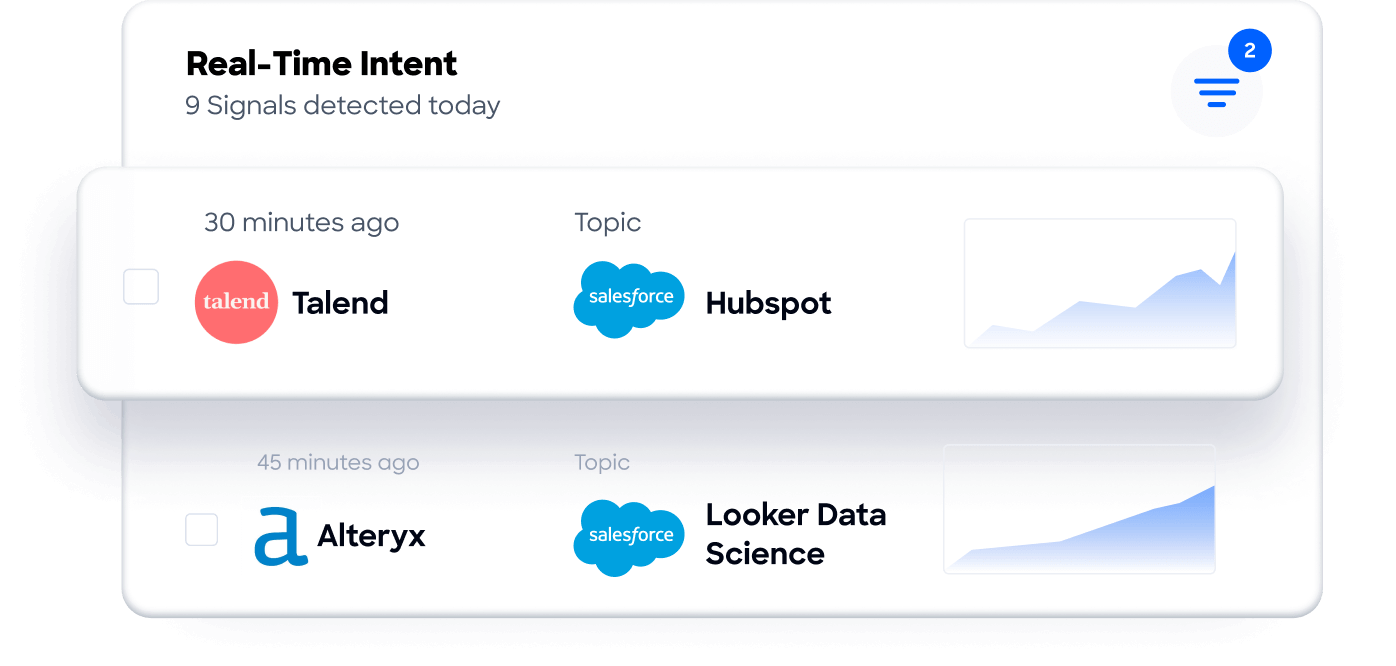
ZoomInfo's Buyer Intent signals, which track data from 210 million IP-to-Organization pairings and 6 trillion+ new keyword-to-device pairings monthly, surface which accounts are actively researching solutions.
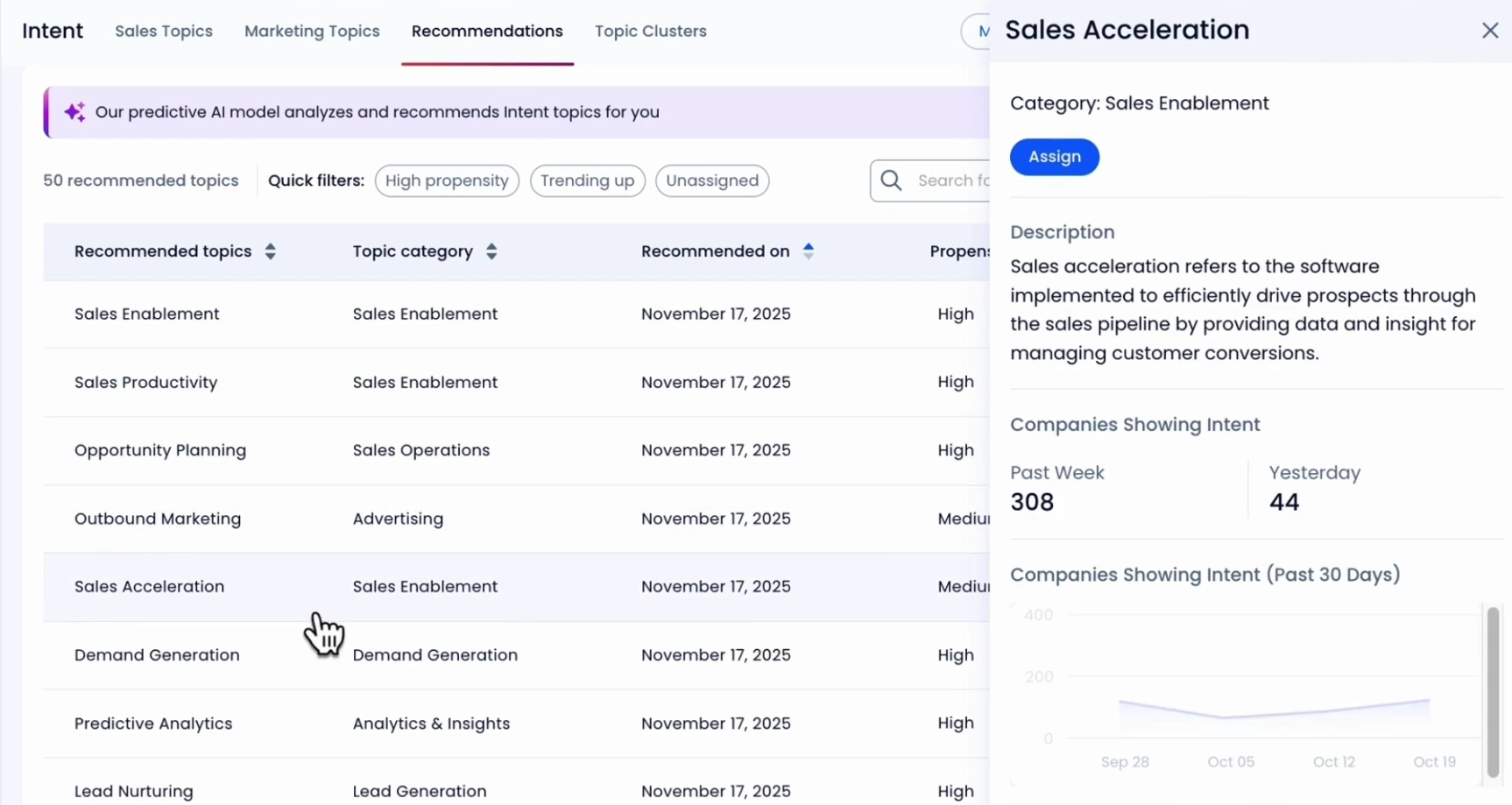
Guided Intent, exclusive to ZoomInfo, identifies topics historically correlated with deal success rather than requiring manual topic selection.
Source: ZoomInfo
Snowflake embedded ZoomInfo data into its Account Propensity Scoring model, feeding over 70 firmographic and technographic fields. Accounts scored with ZoomInfo data showed 90% higher opportunity open rates and 2x higher conversion rates. (Snowflake Case Study)
The GTM Context Graph: Intelligence that explains why deals move.
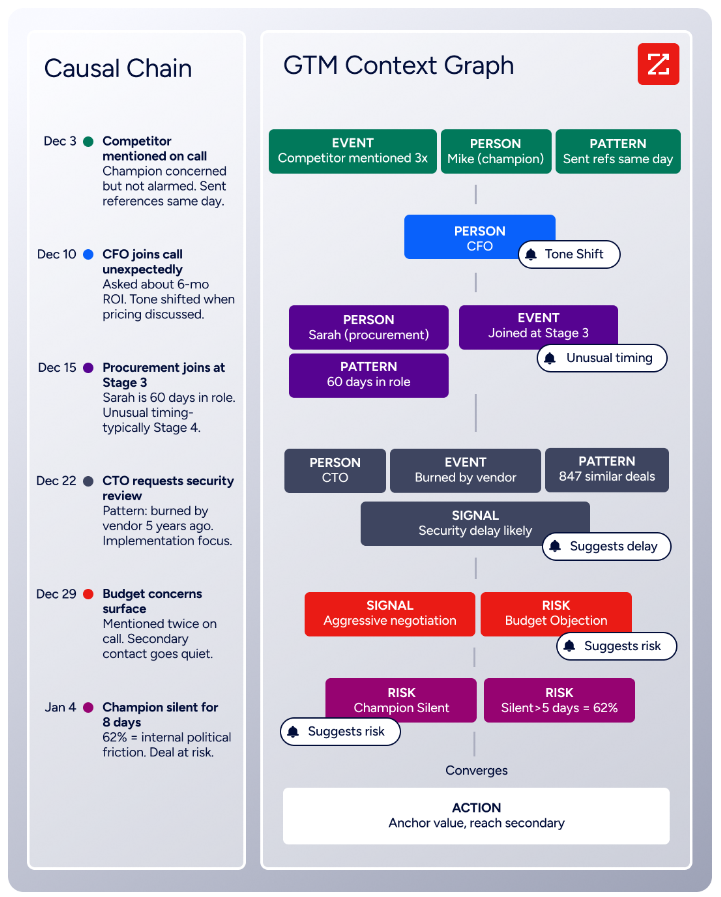
Data alone tells you the facts. ZoomInfo's GTM Context Graph explains the meaning behind them.
The GTM Context Graph unifies ZoomInfo's B2B data with a customer's own first-party data: CRM records, conversation intelligence from calls and meetings, email interactions, and behavioral signals. The result is an intelligence layer that captures not just what happened in a deal, but why it happened.
Source: ZoomInfo
As ZoomInfo's Chief Product Officer Dominik Facher writes: "The CRM recorded the state change. It has no record of why it happened." Perhaps the CFO joined the last call and asked about ROI, which accelerated the deal. Perhaps the VP went quiet for eight days because of an internal budget battle, which nearly stalled it.
CRMs were never designed to capture these signals. The GTM Context Graph makes this decision context machine-readable.
This matters for Seismic users because enablement content works best when matched to the real dynamics of a deal.
A rep preparing for a meeting in Seismic benefits from knowing that the CFO's participation signals executive sponsorship (a closed-won pattern), or that a competitor came up in the last call (time for a battlecard). ZoomInfo provides that intelligence; Seismic provides the content and coaching to act on it.
"That combination of our internal CRM data, external signals, and AI that's given all that context has helped us craft very specific account- and persona-based messages. And people have responded to them right away." — Toby Carrington, CBO, Seismic (Seismic Case Study)
Universal Access: Use ZoomInfo's intelligence in any tool, including Seismic's workflow.
ZoomInfo delivers its intelligence through three channels, so nothing is locked inside a single interface.
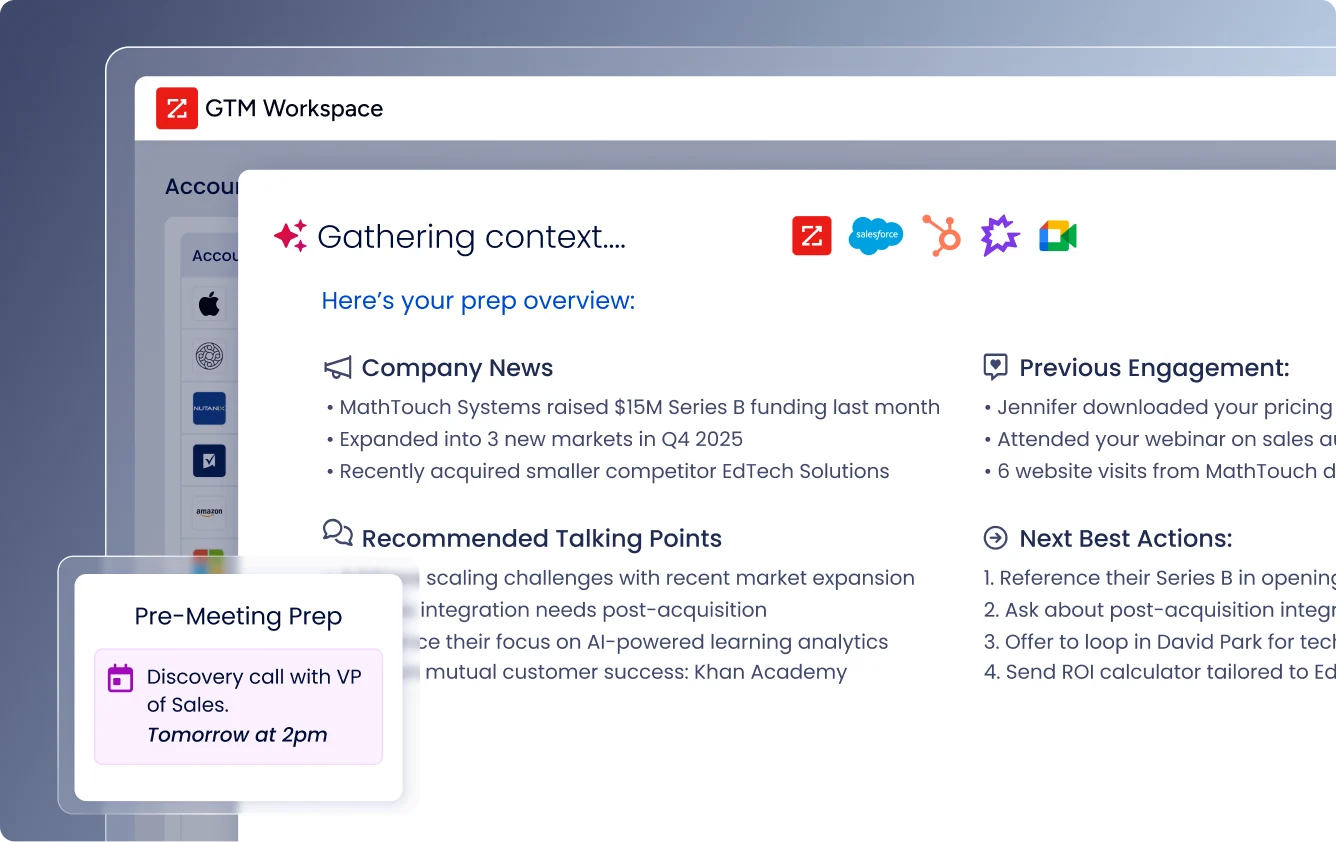
GTM Workspace gives sellers a single screen where prioritized accounts, AI-drafted outreach, and deal execution come together. AI agents handle account research, outreach drafting, CRM updates, and signal monitoring.
Source: ZoomInfo
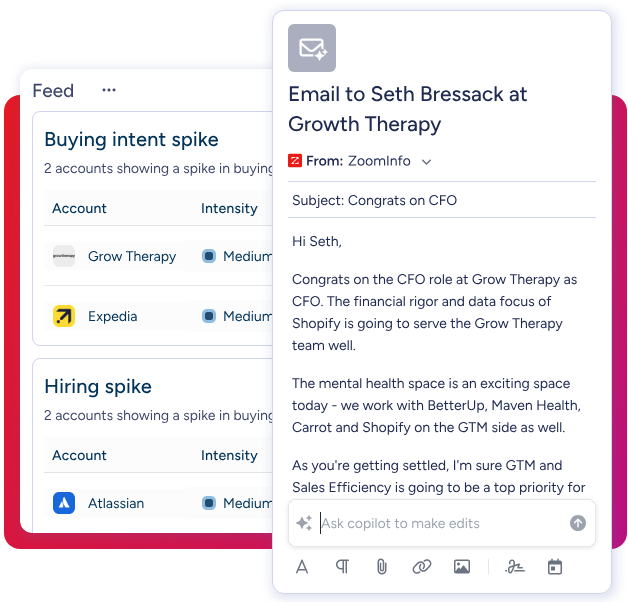
The Action Feed delivers a live stream of in-market buyers matched to target criteria, with pre-drafted actions on every signal.
Source: ZoomInfo
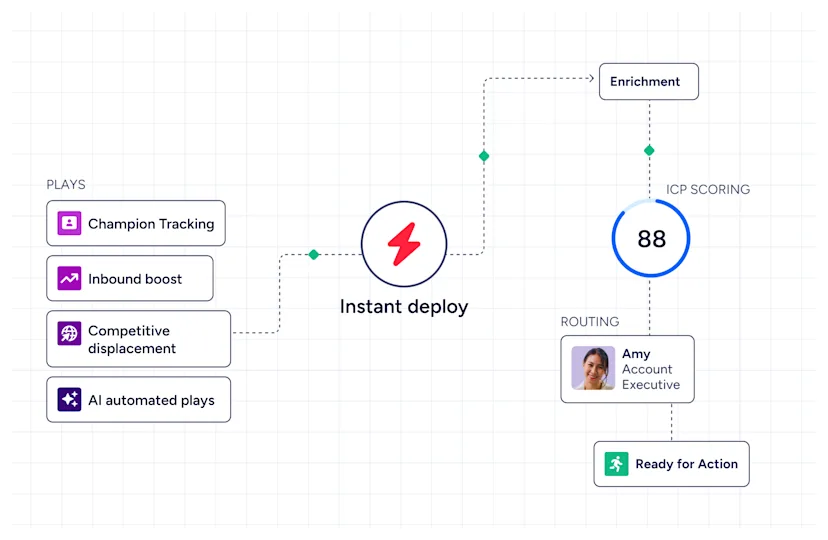
GTM Studio gives marketers, RevOps, and GTM engineers a builder for audience definition, campaign orchestration, and pipeline measurement, all in natural language. Expansion plays that used to take three weeks now launch in 30 minutes, without engineering support.
Source: ZoomInfo
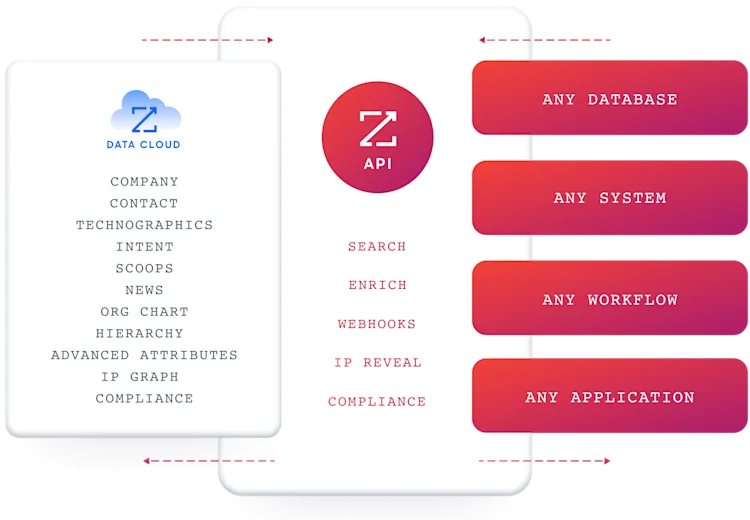
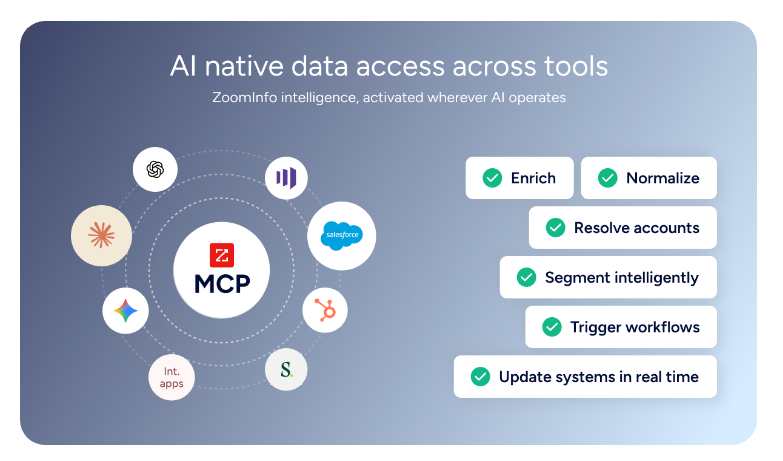
For teams building beyond ZoomInfo's own products, APIs and MCP expose the same intelligence to any custom agent, internal tool, or partner platform. API access is included in all relevant plans.
Source: ZoomInfo
The MCP server connects AI models directly to ZoomInfo's data and is available through partners including Anthropic Claude.
Source: ZoomInfo
All three channels draw from one GTM Context Graph: the same data, the same reasoning, the same model. Where you choose to work never limits the intelligence available.
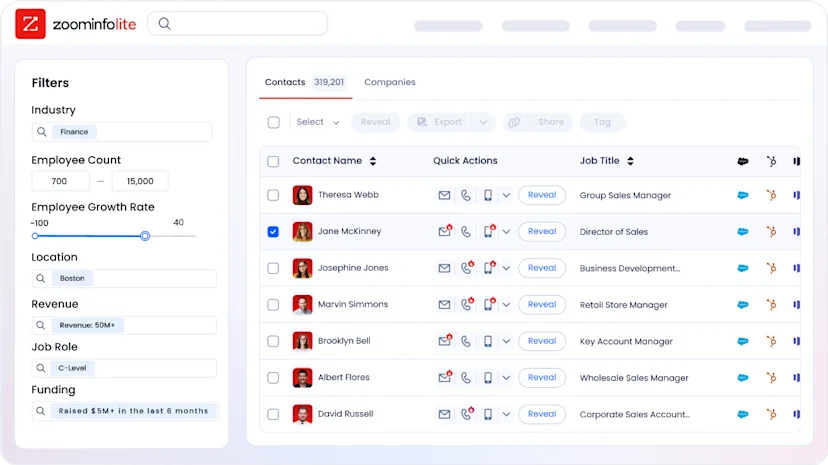
ZoomInfo also offers ZoomInfo Lite, a permanent free tier (no credit card, no time limits) with access to the B2B database, 10 monthly export credits, the Chrome extension, and website visitor identification. This lets teams evaluate the data before committing, unlike platforms that gate all access behind sales conversations.
Source: ZoomInfo
"Anything that minimizes our team's need to switch contexts is beneficial. ZoomInfo offers a unified view, eliminating the need to navigate between systems." — Ben Perceval, RevOps Manager, Spekit (Spekit Case Study)
Seismic and ZoomInfo: How They Work Together
Aspect | Seismic | ZoomInfo |
|---|---|---|
Primary Focus | Revenue enablement: content, training, coaching, buyer engagement | GTM intelligence: buyer data, intent signals, account prioritization |
Core Question Answered | "What should sellers share and how should they be prepared?" | "Who should sellers target and when are buyers ready?" |
Data Foundation | Organization's own sales and marketing content library | 500M contacts, 100M companies, 135M+ verified phone numbers, 200M+ verified emails |
AI Engine | Aura AI (content recommendations, coaching, content generation) | GTM Context Graph (deal intelligence, buyer signals, outcome reasoning) |
Content Management | Centralized library with LiveDocs, LiveSend, governance | Not applicable (not a content platform) |
Buyer Identification | Not applicable (no contact database or intent signals) | Intent data, website visitor tracking, contact and company search |
Sales Training | Learning paths, AI role-play, coaching analytics | Not applicable (not a training platform) |
Outreach Execution | Digital Sales Rooms, personalized content delivery | AI-drafted outreach, multi-channel engagement via GTM Workspace |
CRM Integration | Salesforce, HubSpot, Microsoft Dynamics | Salesforce, HubSpot, Microsoft Dynamics |
Free Access | No free plan or self-serve trial | (permanent free tier) + 7-day free trial |
Best For | Equipping sellers with the right content and skills | Identifying the right accounts and timing for engagement |
Final Verdict
Seismic and ZoomInfo cover two distinct halves of go-to-market execution. One without the other leaves a gap.
Seismic excels at enablement. If your organization struggles with scattered content, inconsistent seller readiness, or compliance-sensitive content distribution, Seismic provides a single system that addresses all three.
Its LiveDocs content automation, AI-powered coaching, and Digital Sales Rooms give enterprise sales teams the tools to engage buyers with personalized, on-brand materials at every stage.
The platform fits mid-market and enterprise organizations with dedicated enablement teams best, particularly in regulated industries like financial services and healthcare where content governance is non-negotiable.
ZoomInfo excels at intelligence. If your team needs to know which accounts to prioritize, when buyers are in-market, and how to reach the right decision-makers, ZoomInfo provides the data foundation and contextual reasoning that make those answers precise.
The GTM Context Graph turns static CRM records into dynamic deal intelligence, and its three access channels (GTM Workspace, GTM Studio, APIs/MCP) ensure that intelligence reaches every team and tool without lock-in.
Get started with ZoomInfo here.
The strongest GTM teams use both. ZoomInfo identifies and prioritizes the accounts worth pursuing. Seismic equips sellers to win those accounts with the right content, training, and buyer engagement. It's not a question of one or the other. It's a question of whether your team has both sides covered.
Seismic FAQ
What is Seismic used for?
Seismic is a revenue enablement platform that centralizes sales content management, training and coaching, meeting intelligence, and buyer engagement in a single system.
Enterprise sales teams use it to ensure reps always have access to current, on-brand materials, to onboard new hires faster, and to create personalized Digital Sales Rooms for buyer engagement. It is particularly strong in regulated industries like financial services, where compliant content distribution is a legal requirement.
How much does Seismic cost?
Seismic does not publish pricing. All contracts are custom-quoted through a negotiated order form, and prospects must request a demo to begin discussions.
Enterprise deals reportedly range from $20,000 to $120,000+ annually depending on the edition, user count, and add-on modules. Contracts are invoiced annually in advance and are non-cancellable.
Seismic Learning is purchased separately from Seismic Content, and several features (including Meeting Intelligence and Dynamic Watermarking) require add-on purchases.
Does Seismic offer a free trial?
There is no self-serve free trial. Seismic offers a structured trial program available by arrangement through an order form, with terms and duration determined case by case. There is no permanent free plan.
ZoomInfo, by contrast, offers both a permanent free tier (ZoomInfo Lite, with access to the B2B database and 10 monthly export credits) and a 7-day free trial with no credit card required.
How long does Seismic take to implement?
Enterprise deployments typically take four months or longer. The platform requires dedicated enablement staff to manage content taxonomy, tagging, permissions, and ongoing governance. Organizations commonly hire Seismic's professional services team for initial setup.
Seismic offers an "Accelerating Adoption Change Management" app on its marketplace, recognizing that structured change management is part of most deployments.
ZoomInfo's GTM Workspace, by comparison, deploys in weeks rather than months.
What integrations does Seismic support?
Seismic offers 150+ integrations covering CRM (Salesforce, Microsoft Dynamics 365, HubSpot), sales engagement (Salesloft, Outreach), communication (Microsoft Teams, Slack, Zoom, Webex), and content tools (Adobe AEM, Google Slides, Dropbox).
The platform supports SAML-based SSO and SCIM provisioning for Okta and Microsoft Entra ID. It is hosted on Microsoft Azure.
Does Seismic help with prospecting or identifying target accounts?
No. Seismic focuses on the enablement side of the sales process: content management, training, coaching, and buyer engagement. It does not include a contact database, buyer intent signals, website visitor identification, or account prioritization.
Teams that need buyer intelligence alongside enablement typically pair Seismic with a platform like ZoomInfo, which provides 500M contacts, intent signals from 210 million IP-to-Organization pairings, and AI-powered account prioritization.
What is Seismic's Aura AI?
Aura AI is Seismic's embedded intelligence layer, operating across every part of the platform. It powers generative search (synthesized answers from the organization's content library), content generation (presentations, training lessons, social posts), automated content tagging and duplicate detection, AI role-play for sales practice, meeting transcription and summarization, and conversational guidance via Aura Chat.
Aura draws from the organization's own approved content rather than generic training data, and Seismic holds ISO 42001 certification for AI governance.
Is Seismic suitable for small businesses?
Seismic targets mid-market and enterprise organizations, with the strongest fit at companies with 200+ employees and dedicated sales teams of 50+ reps. The implementation complexity, enterprise pricing, and ongoing administrative requirements make it a poor fit for small businesses or teams without a dedicated enablement function. Organizations under 50 employees would likely find the platform's overhead disproportionate to their needs.
