

A developer evaluating an API integration with a digital intelligence platform asks one question: can I pull this data into my own pipeline, at the volume I need, without the platform's UI bottlenecking me?
Similarweb's API is a REST surface backed by one of the larger digital data repositories on the market, covering 100M+ websites, 4M+ apps, and 10 years of historical data.
The developer docs are public across two portals (V4 and the newer V5), the endpoint catalogue spans website analytics, app intelligence, keyword research, company data, and ecommerce datasets, and a Batch API can pull up to one million domains in a single request. That is a broad programmatic surface for a digital intelligence platform.
But breadth of data and fitness for your build are different questions.
Similarweb's API delivers digital performance data: website traffic, engagement metrics, keyword analytics, app usage, technographics, and ecommerce signals. If you need to pipe competitive web analytics or market intelligence into a dashboard, a data warehouse, or an AI workflow, the API fits that job. But if your pipeline also needs B2B contact data (verified emails, direct-dial phone numbers, org charts), buyer intent signals tied to specific companies, or AI-powered account intelligence, that is a different data layer entirely.
This is where ZoomInfo's API enters the picture: the Enterprise API is a REST suite covering search, enrichment, and AI intelligence across 500M contacts and 100M companies, with OAuth 2.0 authentication, tiered rate limits up to 35 req/sec, and an MCP server for AI-agent workflows.
The two APIs sit at different layers: Similarweb tells you what is happening on a website or in a market; ZoomInfo tells you who is behind those companies and whether they are ready to buy.
This review covers the Similarweb API in full technical depth first, then reviews ZoomInfo's API as the B2B intelligence layer that picks up where digital analytics stops.
Similarweb API at a Glance
Attribute | Detail |
|---|---|
API type | REST over HTTPS, JSON responses |
Authentication | API key passed in the api-key request header |
Base URL | https://api.similarweb.com |
Current version | V5 (V4 still active at developers.similarweb.com) |
Rate limits | 10 requests per second (REST API) |
Pricing / access | Not publicly priced; sold as part of the Data as a Service offering through enterprise sales |
SDKs | No official SDKs in any language |
Webhooks | Supported on both REST and Batch APIs |
Batch API | Yes, asynchronous bulk extraction for up to 1M domains per request |
Documentation | developers.similarweb.com (V4) and docs.similarweb.com/api-v5 (V5) |
Similarweb API: What Works Well & What to Plan Around
What works well | What to plan around |
|---|---|
Public docs with interactive API reference, no login required to browse | API access is enterprise-only: no self-serve signup, no published pricing |
Batch API handles up to 1M domains per request for large-scale extraction | REST API rate limit is 10 req/sec, with no documented higher tiers |
V5 supports multi-metric requests in a single call | No official SDKs: all integrations are raw HTTP |
Data credits model lets you pay for what you query | Credit costs per endpoint are not publicly documented |
OpenAPI spec and llms.txt index available for AI tooling | Scope is digital analytics only: no B2B contact data, no direct dials, no org charts |
Public changelog tracks deprecations and new endpoints | API key auth only: no OAuth, no scoped delegated access |
Similarweb API: Authentication & Getting Started
Source: Similarweb
API access is not available on Similarweb's free tools or self-serve plans. The API is part of the Data as a Service offering, and both the API marketing page and the integrations page direct prospects to "Speak to a data expert." There is no developer-tier signup, no free API credits, and no trial API key.
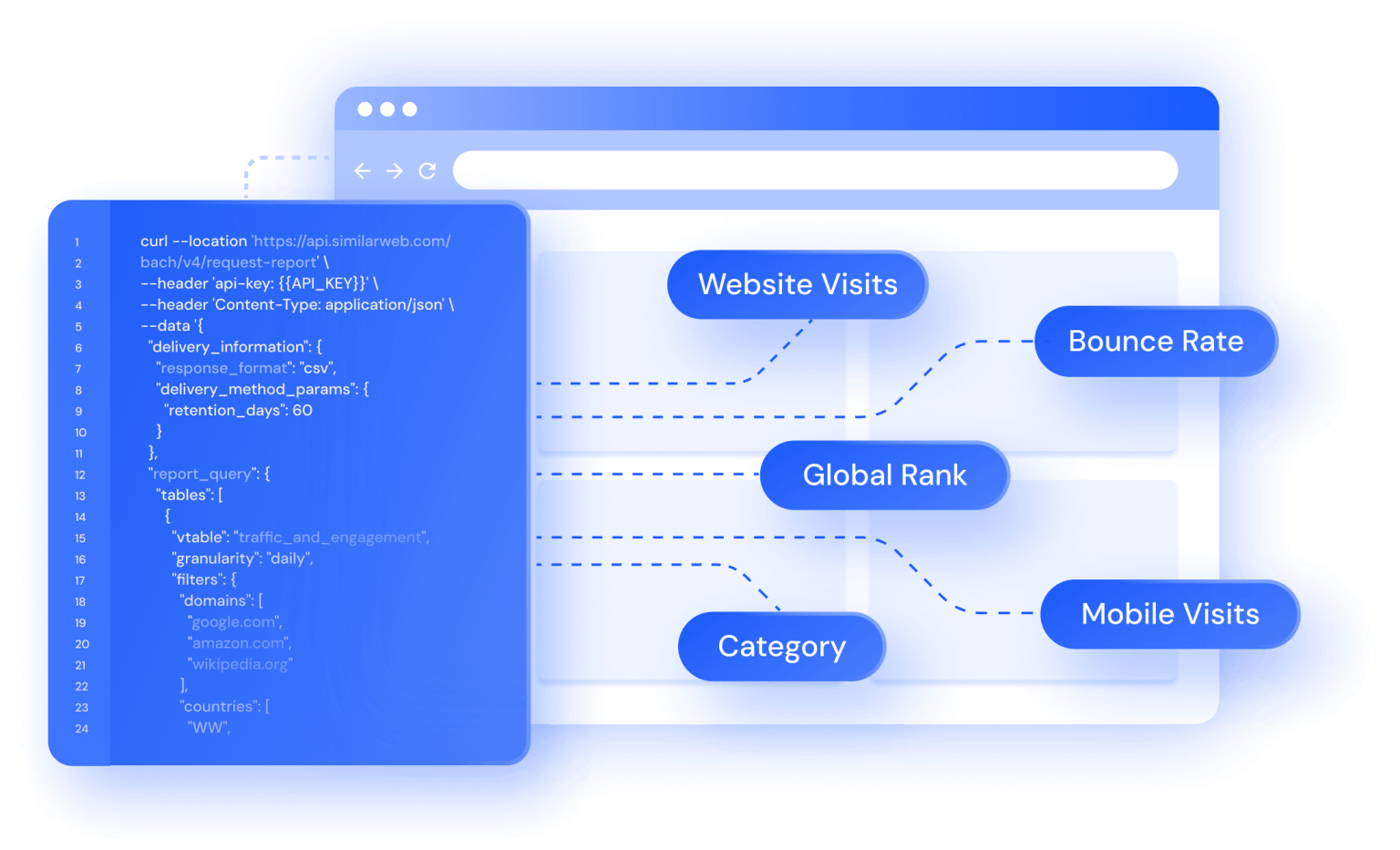
Once you have a subscription, account admins generate API keys through the Similarweb platform under Settings, Account, API. Admins can create either a Standard API key (for REST endpoints) or a Batch API key, and can assign keys to specific users by email address. A generated key must be activated before it will accept requests; an inactive key returns an "Invalid API key" error.
Authentication is straightforward. Pass the key as an api-key header in each request:
curl "https://api.similarweb.com/v4/website/example.com/total-traffic-and-engagement/visits?api_key=YOUR_API_KEY&start_date=2026-01&end_date=2026-03&country=world&granularity=monthly&main_domain_only=false"
There is no OAuth flow, no token exchange, and no credential rotation mechanism. In V5, a single API key covers both REST and Batch endpoints, eliminating the need to manage separate keys. That is a practical improvement for teams running both real-time queries and bulk extraction.
One detail worth noting: the Check Capabilities endpoint lets you query what data your subscription authorizes before you start building. The Check User Usage and Check Credit Balance endpoints let you monitor consumption programmatically. These help you avoid surprises in production.
Similarweb API: Core Endpoints & Capabilities
Source: Similarweb
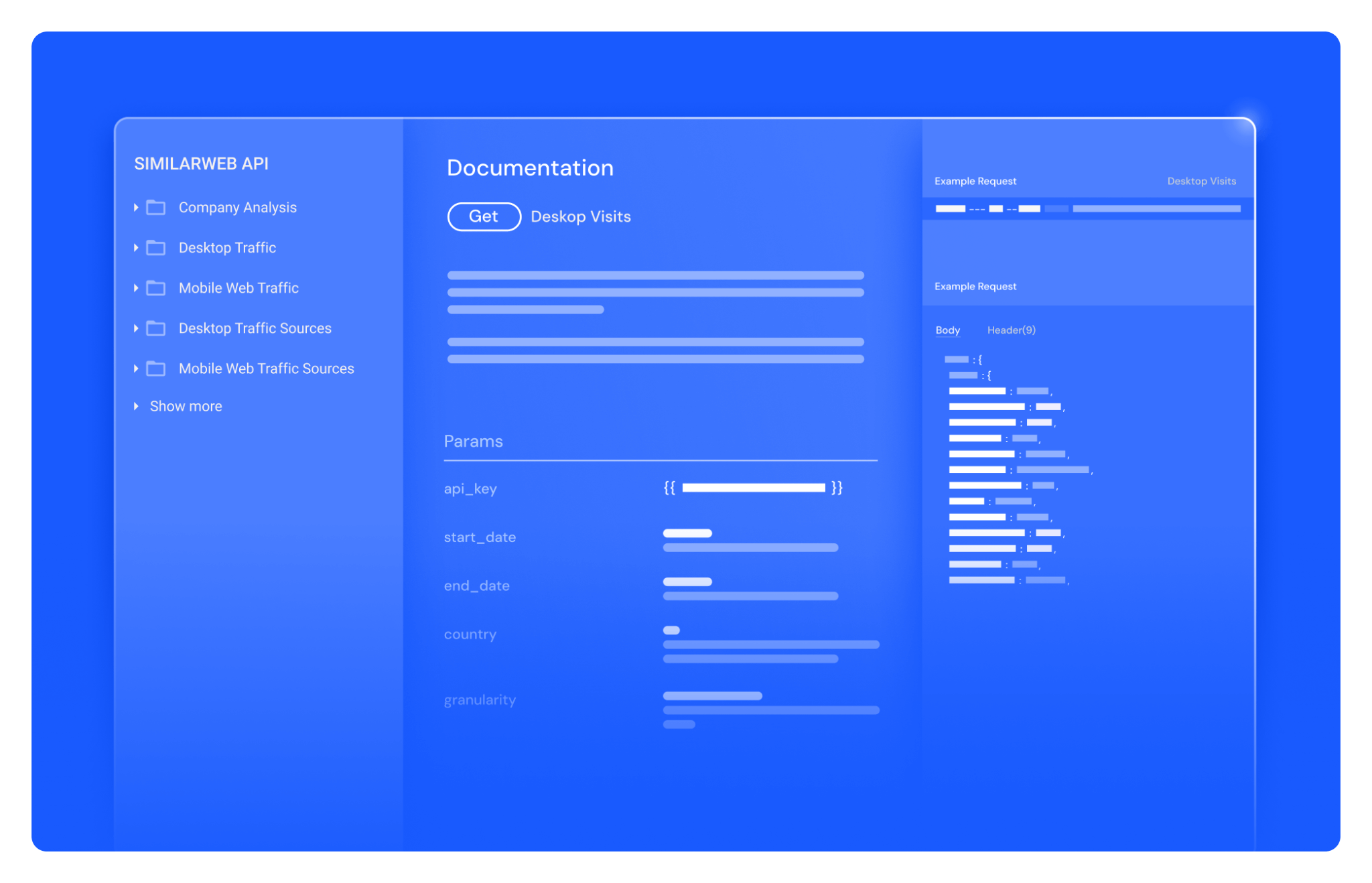
The API is organized around several resource areas, all returning JSON. The endpoint catalogue covers website traffic, search and keywords, app intelligence, company data, and ecommerce.
Two delivery modes serve different integration patterns: the REST API for real-time, on-demand queries and the Batch API for large-scale, asynchronous extraction.
Website Analysis
This is the primary resource area and the deepest part of the API.
Traffic & Engagement: Endpoints cover visits (desktop, mobile, and combined), unique visitors, bounce rate, pages per visit, and average visit duration. You can slice data by country and by time granularity (daily, weekly, monthly).
Geography: Traffic breakdowns by country are available for desktop, mobile, and all traffic separately.
Rankings: Global rank, country rank, and industry rank for any domain.
Traffic Sources: A traffic sources overview breaks down where a site's visitors come from, with dedicated endpoints for referrals, social referrals, display publishers, ad networks, and PPC spend.
Audience: Demographics by age and gender, audience interests, audience overlap between domains, new vs. returning visitors, and desktop vs. mobile split.
Pages: Popular pages, subdomains, and folder-level breakdowns.
What you would build with this: a competitive intelligence dashboard that tracks your domain's traffic against five competitors, broken down by source and geography, refreshed daily. Or a market-sizing pipeline that pulls traffic estimates for every domain in a category to estimate addressable audience.
Keywords & Search
Keyword analysis endpoints cover organic and paid keyword competitors, SERP players by clicks over time, keyword overviews, landing pages, and branded distribution by clicks.
What you would build with this: an SEO monitoring system that tracks keyword movement for your domain and your competitors, feeding into a BI tool for weekly strategy reviews.
App Intelligence
Endpoints cover monthly, daily, and weekly active users for iOS and Android, app downloads, sessions, retention, demographics, app rankings, top iOS and Android apps by category, app details, and related sites/apps cross-mapping.
Company Analysis
Company-level analytics aggregate traffic and engagement data across all domains a company owns, plus a lead enrichment endpoint that returns company attributes and digital performance data for a given domain.
Technologies & Segments
The website technologies endpoint detects the tech stack running on a domain. Custom segments let you define and query traffic data for specific sections of a site.
Batch API: Bulk Extraction
The Batch API handles large-scale data pulls. It supports dataset-level exports across Websites, Websites Audience & Demographics, Search, On-Site Search, Apps (with SDK/technographics detection), Companies (company attributes), Technologies, and Ecommerce (Shopper Intelligence, including conversion analysis).
Batch jobs are submitted asynchronously and results can be routed directly to S3, Snowflake, or Google Cloud Storage. The capacity is up to one million domains in a single request, which makes this the right path for any pipeline pulling data at portfolio or market-wide scale.
V5 Improvements
V5 added multi-metric requests in a single call, a unified API key for REST and Batch, and standardized response formats across all endpoints. If you are starting a new integration, V5 is the recommended surface.
Similarweb API: Webhooks & Events
Similarweb supports webhooks on both the REST and Batch APIs.
The primary use case is the Batch API: after you submit a bulk report, Similarweb sends a POST notification to your registered endpoint when the report is ready to download. This eliminates polling and enables automated reporting pipelines.
REST API webhooks are managed via dedicated endpoints: subscribe, unsubscribe, list subscriptions, and authorize. You can subscribe to Daily or Monthly events, receiving notifications when new data becomes available for tracked domains or metrics.
Webhook authentication uses an X-sw-authorization token that expires five minutes after issue. You can validate your endpoint with the test webhook endpoint:
POST https://api.similarweb.com/v3/batch/webhooks/test
{ "webhook_url": "http://your-endpoint.com/example" }
Two constraints to plan around:
Webhook delivery has a 5-second timeout. If your endpoint does not respond within 5 seconds, the call fails.
No retry behavior or dead-letter queue is documented. Design your receiver to handle missed deliveries, and confirm the delivery contract with Similarweb if your pipeline depends on guaranteed notification.
Similarweb API: SDKs, Docs & Rate Limits
SDKs & Libraries
Similarweb does not publish official SDKs in any language. All code examples in the developer documentation use raw HTTP calls via Python's requests library or generic HTTP tools. No official packages exist for Python, Node.js, Ruby, Go, or any other language.
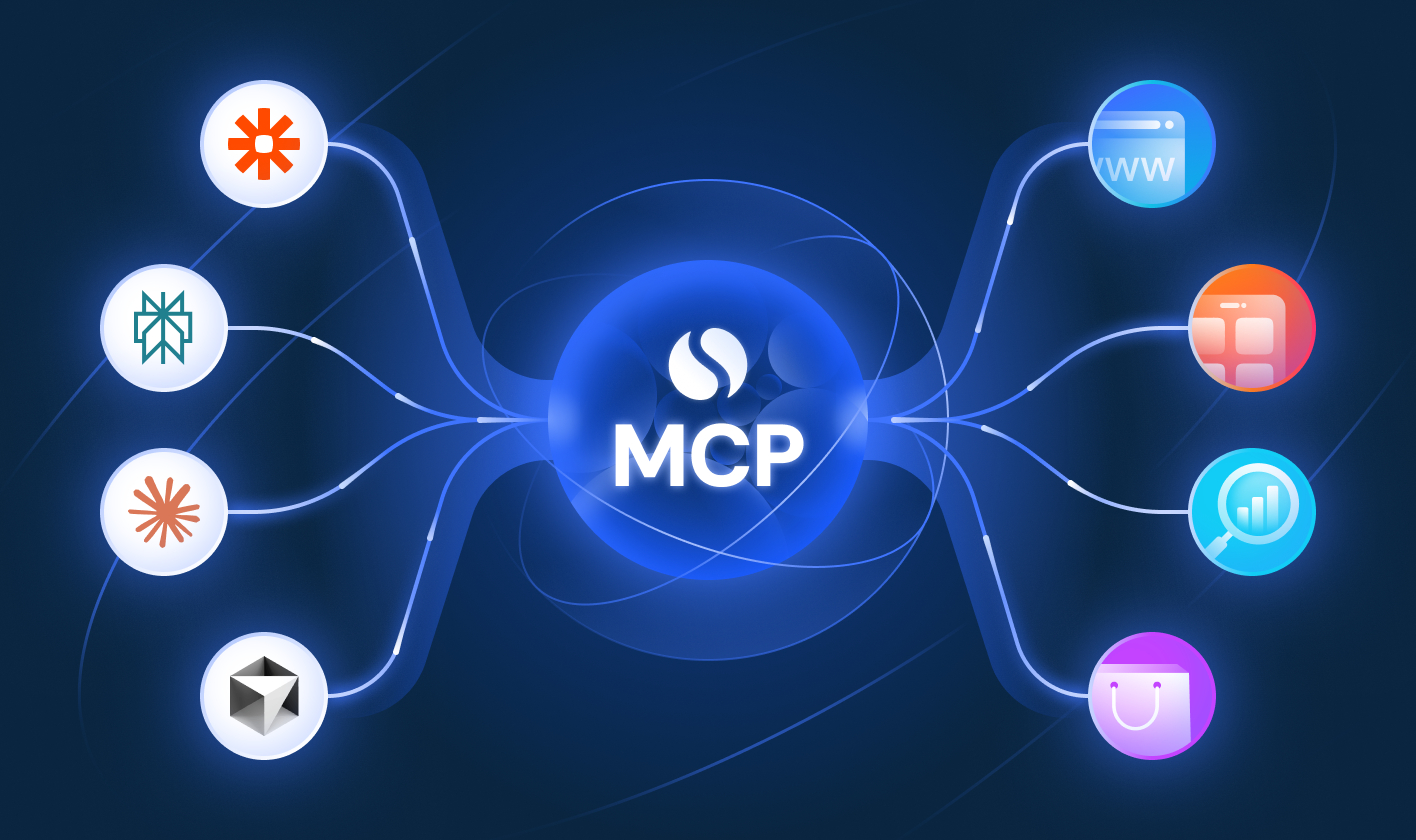
The Similarweb MCP Server is the closest thing to a higher-level client: it wraps the API in the Model Context Protocol so that AI assistants (Claude, Cursor, Microsoft Copilot Studio) can query Similarweb data via natural language without direct API calls. If you are building AI-powered workflows, the MCP path may be simpler than the raw REST API.
Source: Similarweb
No official SDK means you own the authentication layer, request construction, error handling, rate-limit backoff, and response parsing. For a simple dashboard integration, that is manageable. For a production pipeline making hundreds of calls across multiple endpoint groups, it adds real engineering overhead.
Documentation & Developer Experience
Similarweb maintains two active developer portals:
V4 portal at developers.similarweb.com: includes Guides, Recipes (step-by-step walkthroughs with Python code), and the full API Reference with an interactive "Try It!" explorer. Hosted on ReadMe.
V5 portal at docs.similarweb.com/api-v5: launched with V5 in early 2026.
The V4 reference is well-structured, with individual pages per endpoint showing request parameters, authentication headers, and sample responses.
An OpenAPI specification is available via developers.similarweb.com/llms.txt, providing a machine-readable index of all pages and endpoints for AI tooling and code generators.
A public changelog tracks new endpoints, deprecations, and integration additions. The changelog shows active maintenance with multiple endpoint additions over the past year. Deprecated endpoints get advance notice (the Demographics 1.0 deprecation, for example, was announced months before its cutoff).
Developer support is available via a contact support form with routing to technical specialists. No public developer community forum, Slack workspace, or Stack Overflow tag is referenced in the documentation.
Rate Limits & Constraints
The REST API is capped at 10 requests per second. Exceeding this returns HTTP 429 "Too many requests." Similarweb recommends capping any integration at 10 requests per second.
No higher rate-limit tiers are documented. If your pipeline needs sustained throughput above 10 req/sec on the REST API, you would need to negotiate with Similarweb directly. The Batch API has no per-second rate limit since it operates asynchronously: you submit a bulk job and retrieve results when they are ready.
API calls consume Data Credits, a usage-based metering system. Credits are charged based on what data you request rather than a flat per-call fee. The deprecated API Lite endpoint charges a fixed 350 data credits per call, but credit costs for individual V4/V5 endpoints are not publicly documented.
Three utility endpoints help you manage consumption:
Check User Usage: your account's current consumption
Check Credit Balance: remaining credits
Check Capabilities: what data your subscription authorizes
V4 added pagination across 60+ endpoints via limit and page parameters, which matters for endpoints that return large result sets (popular pages, keyword lists, referral domains).
Similarweb API Pricing & Access Costs
Similarweb's API has no public pricing. Both the API marketing page and the integrations page direct prospects to "Speak to a data expert," indicating a sales-led, enterprise purchasing process.
What is known:
API access is part of the Data as a Service offering and is sold separately from Similarweb's standard web intelligence subscriptions.
Users with a Business package or higher reportedly receive API access at no additional cost, though the Business package itself is not publicly priced.
API usage is metered via Data Credits. Credits refresh on a set schedule, but the per-endpoint credit cost is not published across the board. The only first-party credit cost documented is the deprecated API Lite endpoint at 350 data credits per call.
Certain integrations (for example, the Snowflake connector) require speaking to a Similarweb representative to enable.
For a developer sizing costs: without published prices or credit rates, you cannot estimate the cost of a specific integration without engaging Similarweb's sales team. This is a real barrier for developers evaluating this API against alternatives with transparent pricing.
Where the Similarweb API Falls Short
These are practical limits a developer should plan around, not criticisms. Several are scope decisions that reflect what Similarweb's API is (a digital analytics data surface) and what it is not.
No B2B contact data. The API covers websites, apps, keywords, companies (by their digital footprint), and ecommerce signals. It does not include verified business email addresses, direct-dial phone numbers, employment history, org charts, or buying-committee intelligence. If your pipeline needs to go from "this company's website traffic spiked" to "here is the VP of Marketing's verified email and phone number," you need a second API.
No buyer intent signals. Similarweb tracks what is happening on the web (traffic trends, technology adoption, competitive shifts), but it does not surface which companies are actively researching your category or showing in-market buying behavior. Intent data tied to specific accounts requires a separate provider.
Enterprise-only access with no published pricing. There is no free API tier, no self-serve signup, and no published price list. A developer evaluating the API cannot estimate costs without a sales conversation. This contrasts with APIs that publish per-call rates or free tiers for testing.
10 req/sec rate limit with no documented upgrade path. The REST API ceiling is 10 requests per second with no published higher tiers. For real-time integrations that need sustained higher throughput, this is a hard constraint. The Batch API handles volume at scale, but it is asynchronous: you cannot use it for real-time queries.
No official SDKs. Every integration is raw HTTP. You build and maintain the auth layer, the request serialization, the error handling, and the rate-limit backoff logic yourself. For a platform with as many endpoint groups as Similarweb has, the lack of maintained client libraries is a real gap.
API key auth only, no OAuth. Authentication is a static API key. There is no OAuth flow, no token rotation, and no scoped delegated access. For multi-tenant integrations where each customer authenticates with their own Similarweb account, API-key auth is limiting.
No AI intelligence endpoints. Similarweb offers AI Studio and AI Agents in its platform UI, but does not expose these capabilities as API endpoints. There are no programmatic surfaces for AI-generated account research, lookalike expansion, or buying-committee recommendations.
ZoomInfo API: The B2B Intelligence Layer Beyond Digital Analytics
ZoomInfo is an AI-powered GTM platform built on the largest B2B dataset in the industry. Where Similarweb's API tells you what is happening on the web (which websites are growing, where traffic comes from, what keywords are trending), ZoomInfo's API tells you who is behind those companies, how to reach them, and whether they are ready to buy.
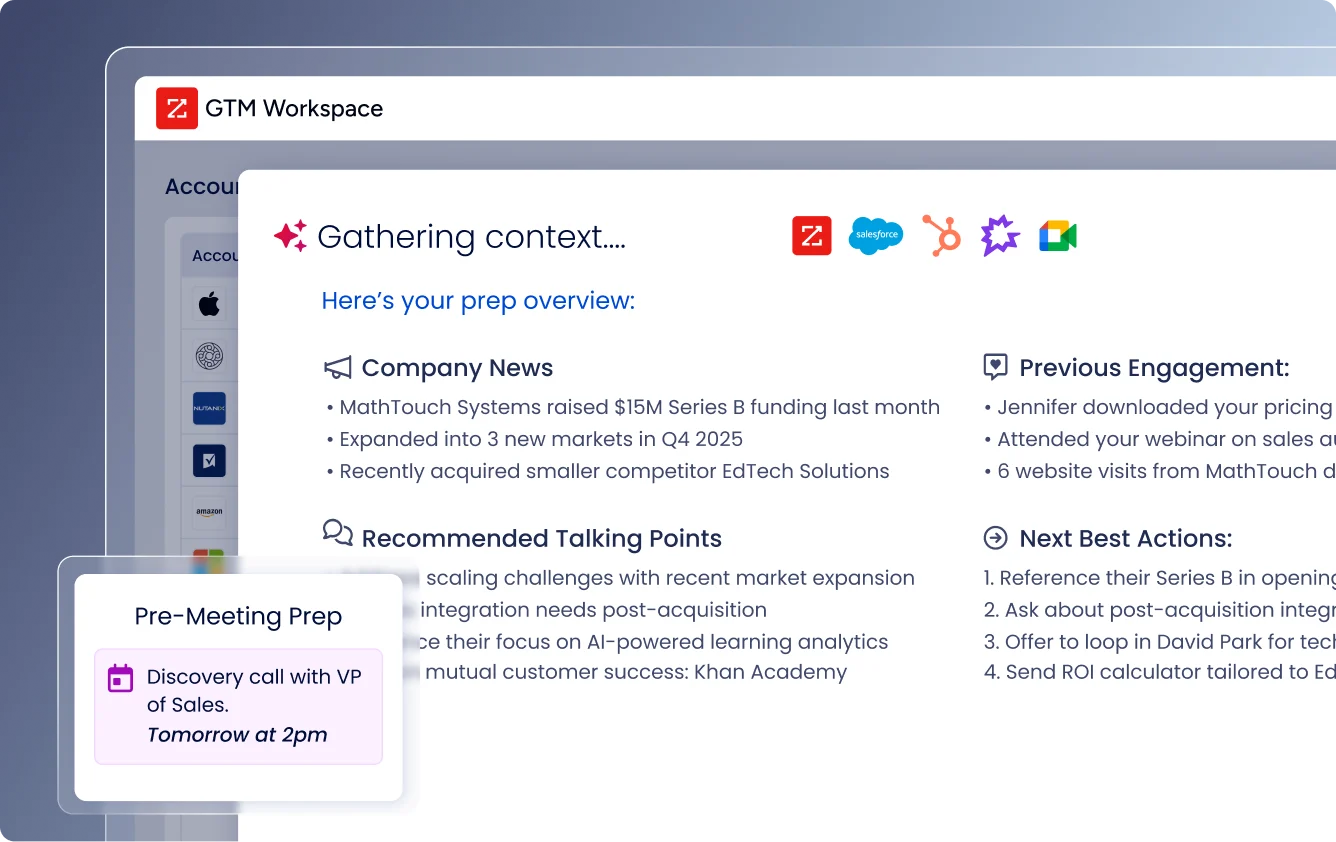
Its GTM Context Graph processes 1.5B+ data points daily and fuses ZoomInfo's B2B data with your first-party CRM records, conversation transcripts, and behavioral signals to show not just what happened, but why it happened and what to do next.
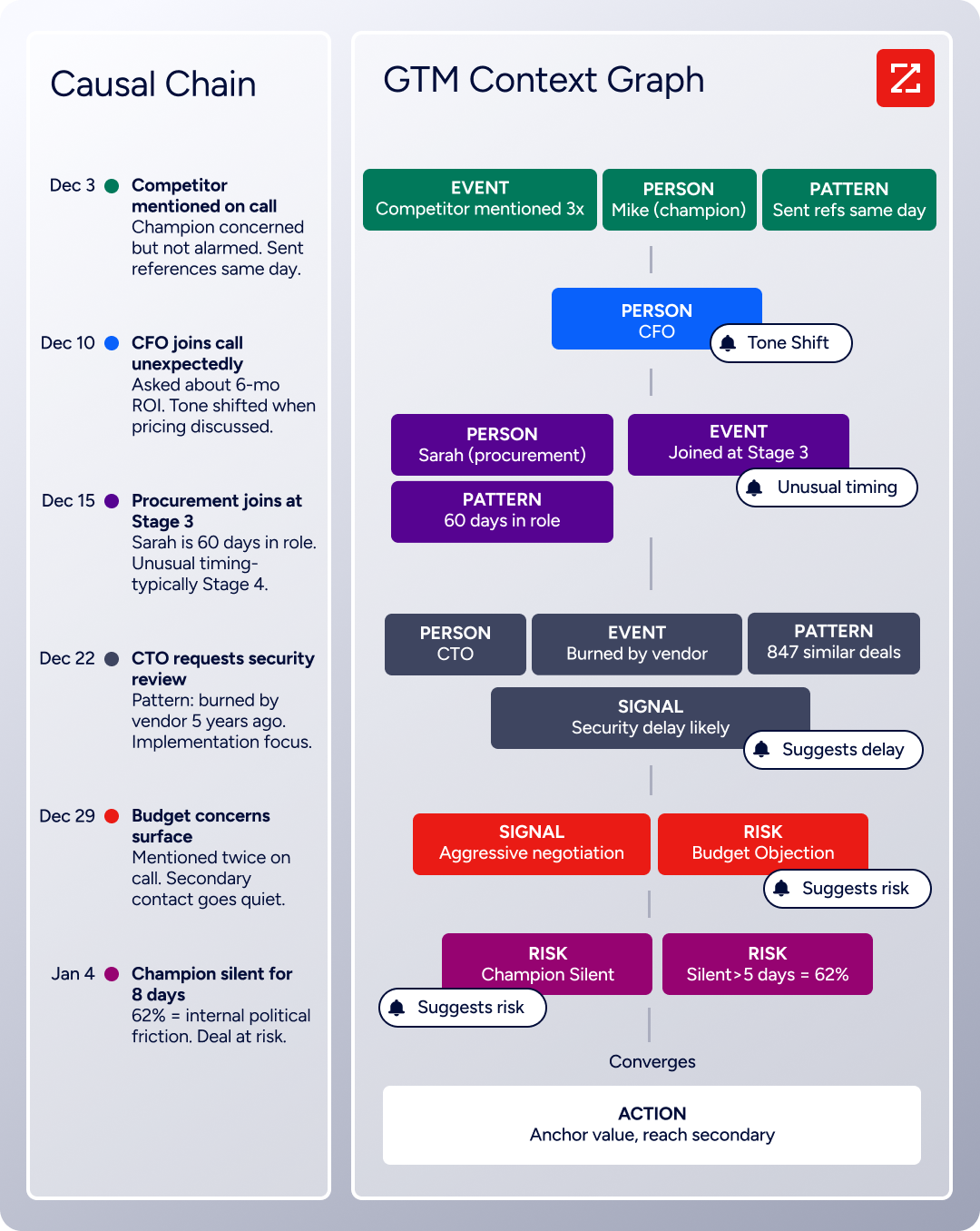
Teams access this intelligence through the GTM Workspace for sellers, GTM Studio for marketers and RevOps, or the Enterprise API and MCP in any front-end.
The two APIs sit at different layers of a GTM data pipeline. A developer building a complete market intelligence system would use Similarweb's API for the digital performance view and ZoomInfo's API for the B2B contact and intent intelligence that digital analytics cannot provide.
What the API Covers
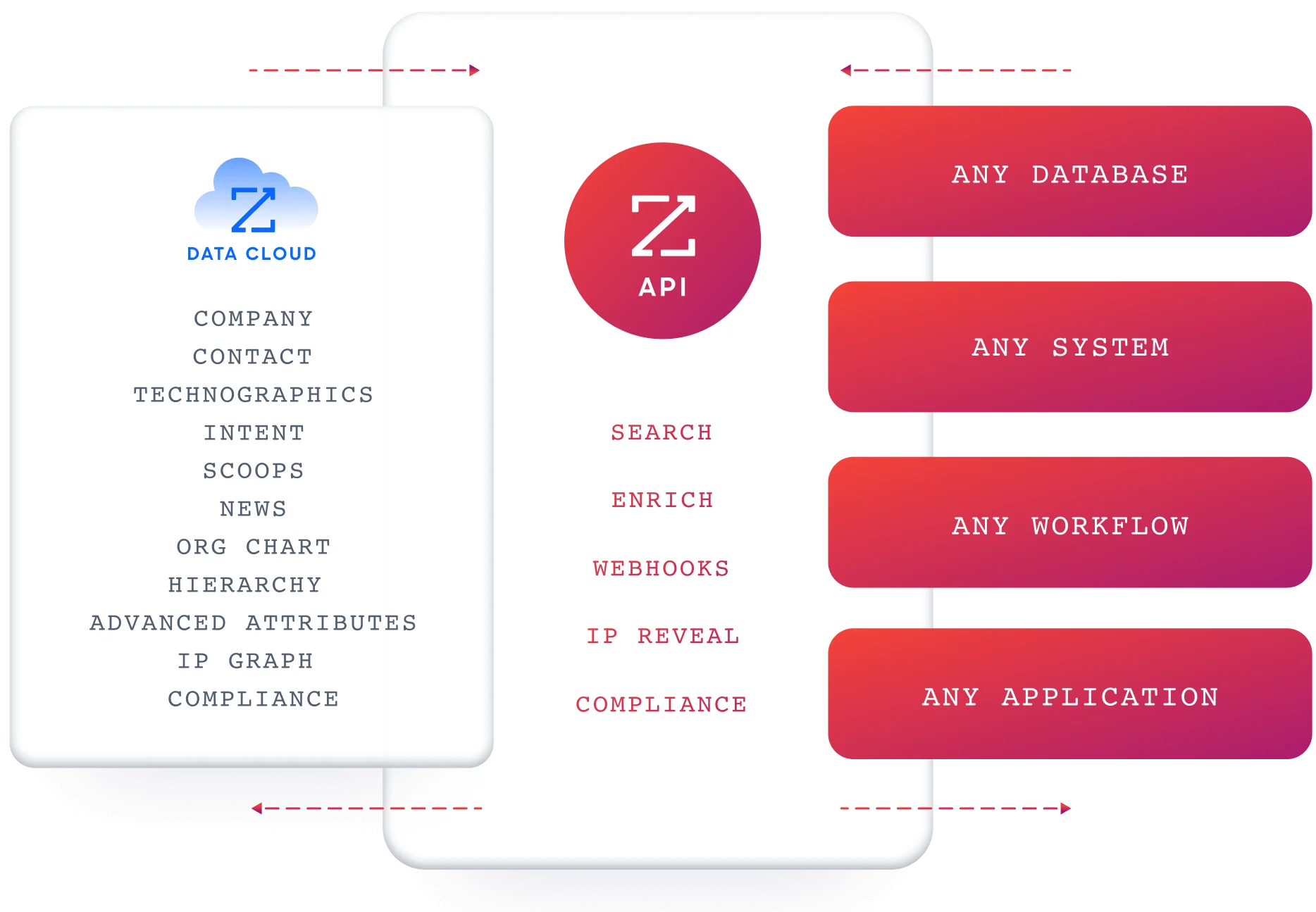
ZoomInfo's Enterprise API is a REST suite served from https://api.zoominfo.com/gtm, organized into four areas documented in the interactive API reference:
Data API (Search & Enrich): Search endpoints cover Contacts, Companies, Intent, News, and Scoops, returning matched records without consuming credits. Enrich endpoints unlock the full payload: business emails, direct dials, employment history, corporate hierarchy, org charts, technographics, and hashtag signals, up to 25 records per call. The underlying dataset spans 500M contacts and 100M companies, 135M+ verified phone numbers, and 200M+ verified business email addresses.
Copilot API (AI Intelligence, part of GTM Workspace): Account Summary returns structured account intelligence with a free-form Q&A endpoint. Find Similar Companies performs lookalike expansion. Contact Recommendations returns AI-ranked buying-committee suggestions by motion (prospecting, deal acceleration, renewals).
Marketing API: CRUD endpoints for programmatic audience management.
Platform API (Engagements, Beta): Bidirectional engagement data via the Engagements API.
The pairing with a digital analytics API is direct: use Similarweb to identify which companies are growing, shifting traffic sources, or adopting new technologies, then use ZoomInfo to find and enrich the decision-makers at those companies. The search-then-enrich pattern means you filter freely and pay only for the records you commit to.
Authentication & Access
ZoomInfo uses OAuth 2.0 with PKCE via Okta, supporting three flows: Authorization Code with PKCE (web applications), Client Credentials (server-to-server), and Refresh Token. Access tokens are 24-hour Bearer tokens with rotating refresh tokens.
Teams register applications through the ZoomInfo Developer Portal, where they generate credentials, define scopes, and test endpoints.
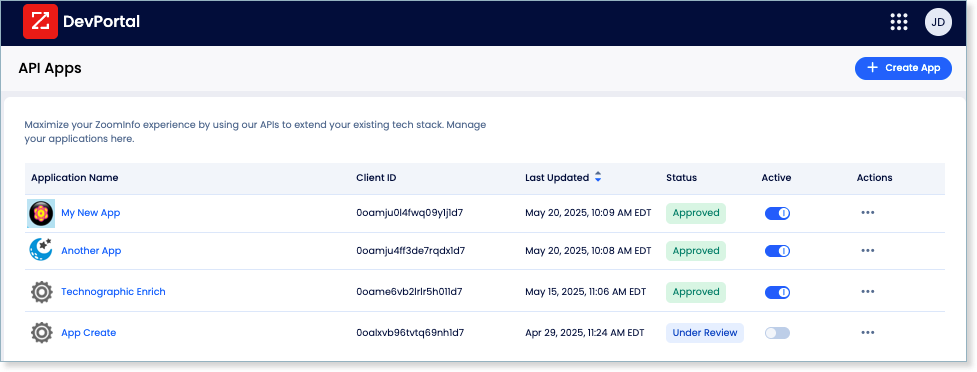
This is a different authentication model from Similarweb's static API key. OAuth 2.0 supports delegated access, credential rotation, and scoped permissions, making it the right choice for multi-tenant integrations and enterprise security requirements.
Rate Limits, Credits & Developer Experience
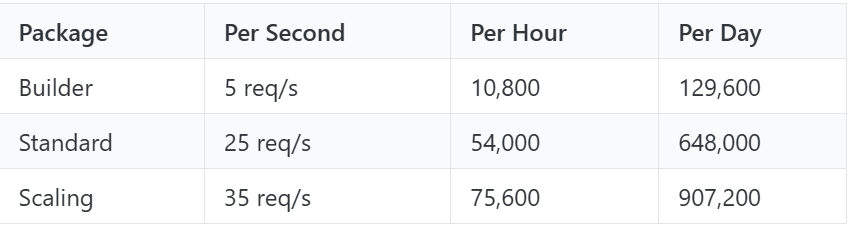
Rate limits are published by tier: Builder (5 req/sec), Standard (25 req/sec), and Scaling (35 req/sec), with per-hour and per-day sliding-window limits enforced simultaneously. Every response includes quota headers with remaining capacity, and 429 responses include a Retry-After header with exact backoff timing.
Credits follow a rolling 12-month window: enriching a record for the first time consumes one credit; re-enriching the same record within the year is free. Search and lookup operations do not consume credits.
ZoomInfo's MCP server at https://mcp.zoominfo.com/mcp exposes search, enrich, and account research as native tools for MCP-compatible assistants, currently supporting Claude and ChatGPT.
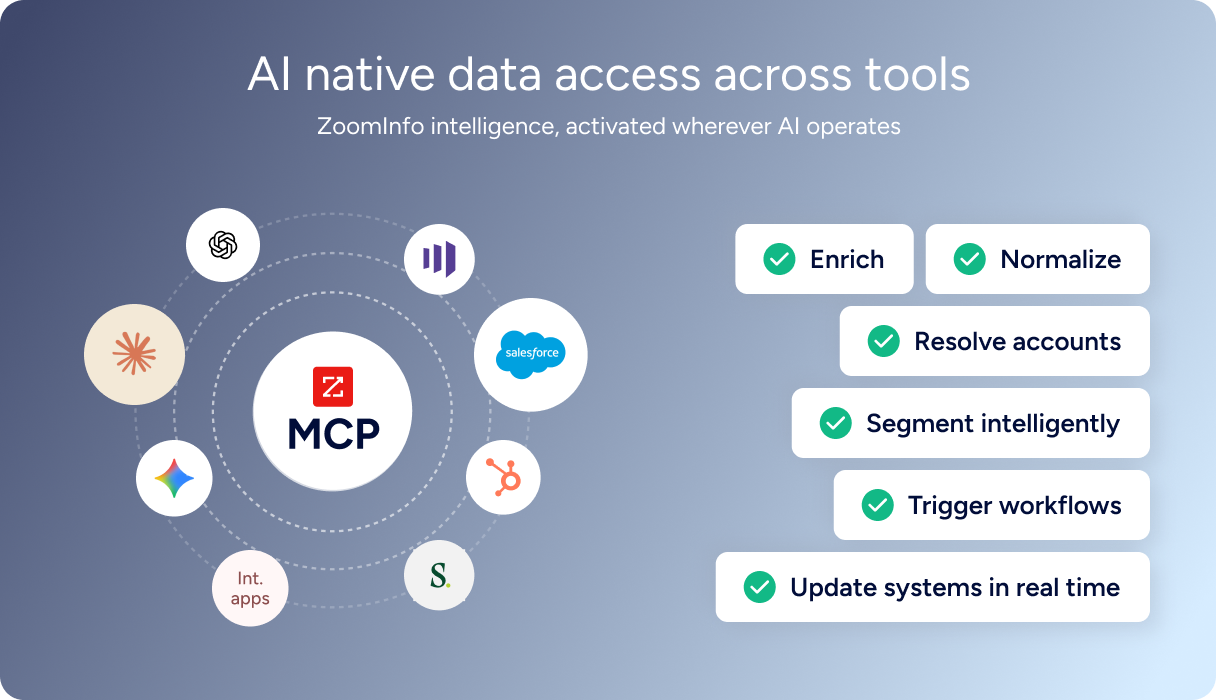
Documentation lives at docs.zoominfo.com with an interactive API reference, OAuth recipes in five languages, and an llms.txt index for AI development tools.
ZoomInfo does not publish official SDKs either, so both platforms require direct HTTP integration. ZoomInfo has added API access to all relevant plans, though consumption-based pricing remains custom-quoted.
Webhooks are available via the Agents API, with retry behavior and throttling configurable per event type.
BDO Canada reported an 87% reduction in time spent updating internal data dashboards using the ZoomInfo API, with one analyst describing the integration as plug-and-play across any process. (ZoomInfo)
Final Verdict
Similarweb's API is a broad, well-documented surface for digital performance data: website traffic, keyword analytics, app intelligence, technographics, and ecommerce signals, delivered through both a real-time REST API and a high-volume Batch API that handles up to one million domains per request.
The V5 upgrade, the public changelog, the OpenAPI spec, and the MCP server for AI workflows show a platform investing in its developer surface.
Its limits are limits of scope and access: no B2B contact data, no buyer intent, enterprise-only pricing, and 10 req/sec on the REST API.
Choose the Similarweb API if your build is digital-analytics-first: competitive benchmarking dashboards, market-sizing pipelines, SEO monitoring systems, app performance tracking, or ecommerce intelligence feeds.
The Batch API's million-domain capacity and the breadth of datasets (68 available) make it the right surface for large-scale digital intelligence extraction.
Choose the ZoomInfo API if your build needs to go from digital signals to B2B intelligence you can act on: finding verified contacts at companies showing growth, enriching records with org charts and technographics, detecting buyer intent, or powering AI agents that research accounts and recommend buying-committee contacts.
The search-then-enrich pattern (search is free, enrich consumes credits) and the Copilot API's AI intelligence endpoints (part of GTM Workspace) cover the contact, company, and intent data that digital analytics APIs do not.
Explore the ZoomInfo Enterprise API or start with the developer docs to see the endpoint surface directly.
A developer who needs both digital performance data and B2B contact intelligence should treat them as complementary layers: Similarweb identifies the market signals, ZoomInfo identifies the people and companies behind them.
FAQ
Is the Similarweb API free?
No. API access is part of Similarweb's Data as a Service offering, sold through enterprise sales with no published pricing. There is no free API tier, no self-serve developer signup, and no trial API key. Users with a Business package or higher reportedly receive API access, but the package itself requires a sales conversation.
API usage consumes Data Credits, and per-endpoint credit costs are not publicly documented.
Does Similarweb have a GraphQL API?
No. Similarweb exposes a REST API (currently V4 and V5) that communicates over HTTPS and returns JSON responses. There is no GraphQL endpoint. If you need a GraphQL interface for digital intelligence data, you would need to build a wrapper layer on top of the REST API.
What is the Similarweb API rate limit?
The REST API is capped at 10 requests per second. Exceeding this returns HTTP 429. No higher rate-limit tiers are publicly documented. The Batch API has no per-second rate limit since it operates asynchronously, handling up to one million domains per request with results delivered to cloud storage destinations (S3, Snowflake, Google Cloud Storage).
Are there official Similarweb SDKs?
No. Similarweb does not publish official SDKs in any language. All integration examples in the developer documentation use raw HTTP calls, primarily via Python's requests library. The Similarweb MCP Server wraps the API for AI assistants (Claude, Cursor, Copilot Studio), but there are no maintained client libraries for direct REST API integration.
Does the Similarweb API support webhooks?
Yes. Webhooks are supported on both the REST and Batch APIs. Batch API webhooks notify your endpoint when a bulk report is ready to download. REST API webhooks can be subscribed to Daily or Monthly data events. Webhook authentication uses a short-lived token (5-minute expiry), and delivery has a 5-second timeout. No retry behavior or dead-letter queue is documented.
What does ZoomInfo's API add to a Similarweb build?
ZoomInfo's API adds the B2B intelligence layer that Similarweb's API does not cover. Where Similarweb tells you a company's website traffic grew 40% last quarter, ZoomInfo tells you who the VP of Marketing is, provides their verified email and direct-dial phone number, shows the company's org chart and tech stack, and surfaces buyer intent signals indicating the account is researching solutions in your category.
The two APIs use different authentication models (API key vs. OAuth 2.0) and different pricing structures (Data Credits vs. annual credit-based enrichment), so plan the integration layer accordingly. ZoomInfo's MCP server extends the same intelligence to AI-agent workflows, adding a capability Similarweb's MCP server does not cover.
