

Surfe does one thing in B2B sales: it sits on top of LinkedIn and lets reps add contacts to their CRM, find verified emails and phone numbers, and log conversations without leaving the browser. For outbound teams that live on LinkedIn, it cuts the manual work of copying data between tabs and spreadsheets.
To write this Surfe review, we analyzed the platform closely. It's a good fit if:
You prospect primarily on LinkedIn and need a fast way to push contacts into your CRM
You use HubSpot, Salesforce, Pipedrive, or Copper
You want waterfall enrichment that queries multiple data providers automatically
You value quick setup and easy onboarding
Your team is small to mid-sized and focused on outbound email
However, Surfe might not be the best choice if:
You need intent data, buying signals, or account-level intelligence beyond contact details
You require conversation intelligence or deal tracking across your pipeline
You want a platform that covers marketing, advertising, and multi-channel orchestration
You're managing enterprise accounts with multiple stakeholders on the buying committee
You need firmographic, technographic, and org chart data at scale
In that case, consider ZoomInfo: a go-to-market platform that covers far more than contact enrichment. It draws on a verified database of 500M contacts and 100M companies, combining intent signals, conversation intelligence, and CRM data in what it calls the GTM Context Graph. Sellers use GTM Workspace, marketers and RevOps use GTM Studio, and engineering teams use APIs and MCP in any third-party tool.
We've included a detailed look at ZoomInfo later in this review for teams that need more than LinkedIn enrichment. If you're ready to explore a full go-to-market platform, you can start a free trial here.
What is Surfe?
Surfe is a sales intelligence platform founded in 2020 by David Maurice Chevalier and Romain Ginestou, who met at UC Berkeley and experienced the friction of moving contact data between LinkedIn and CRMs. Originally launched as Leadjet, the company rebranded to Surfe in October 2022 alongside a €4 million seed round led by 360 Capital.
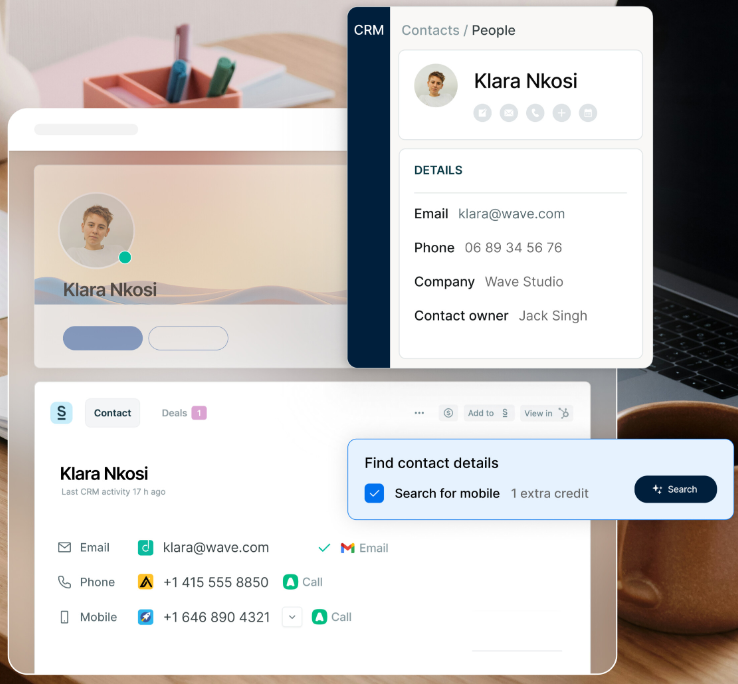
The platform is built around a Chrome extension that overlays CRM controls on LinkedIn profiles. When a rep views a prospect on LinkedIn, Surfe shows whether that person is already in the CRM, displays deal stages and contact ownership, and lets the rep add new contacts or log messages with one click. Behind the scenes, a waterfall enrichment engine chains 15+ data providers to find verified emails and mobile numbers.
Source: Surfe
Surfe claims 40,000+ users and 1 million+ enrichments per month, with native CRM integrations for HubSpot, Salesforce, Pipedrive, Copper, and Google Sheets. The company is ISO 27001 certified and GDPR compliant, headquartered in Paris with roughly 50 employees across 14 nationalities.
Surfe Pros & Cons
Pros | Cons |
|---|---|
One-click LinkedIn-to-CRM contact transfer | Only 150 email credits/year on $39/month Essential plan |
Waterfall enrichment across 15+ providers (93%+ find rate) | Limited to four CRMs (HubSpot, Salesforce, Pipedrive, Copper) |
30-second CRM setup, no credit card required | No intent data or buying signals beyond basic job changes |
Triple-verified emails via ZeroBounce validation | Chrome extension reliability issues reported by users |
ISO 27001 certified, GDPR compliant | One-directional CRM sync (extension to CRM only) |
Job change alerts with automatic email re-enrichment | No refunds once a billing period starts |
Free plan available with basic functionality | No conversation intelligence or deal tracking |
Surfe Review: How It Works & Key Features
CRM Chrome Extension: Surfe embeds CRM controls into LinkedIn, replacing tab-switching and manual data entry.
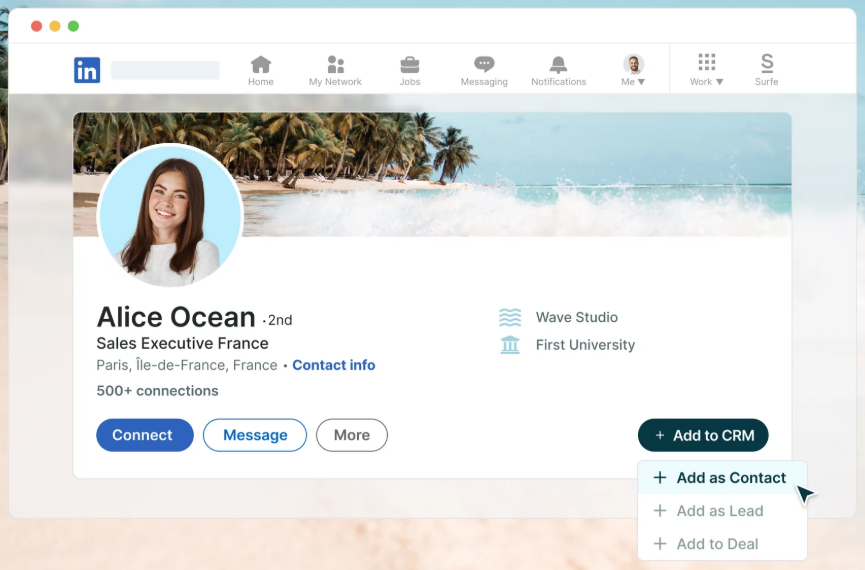
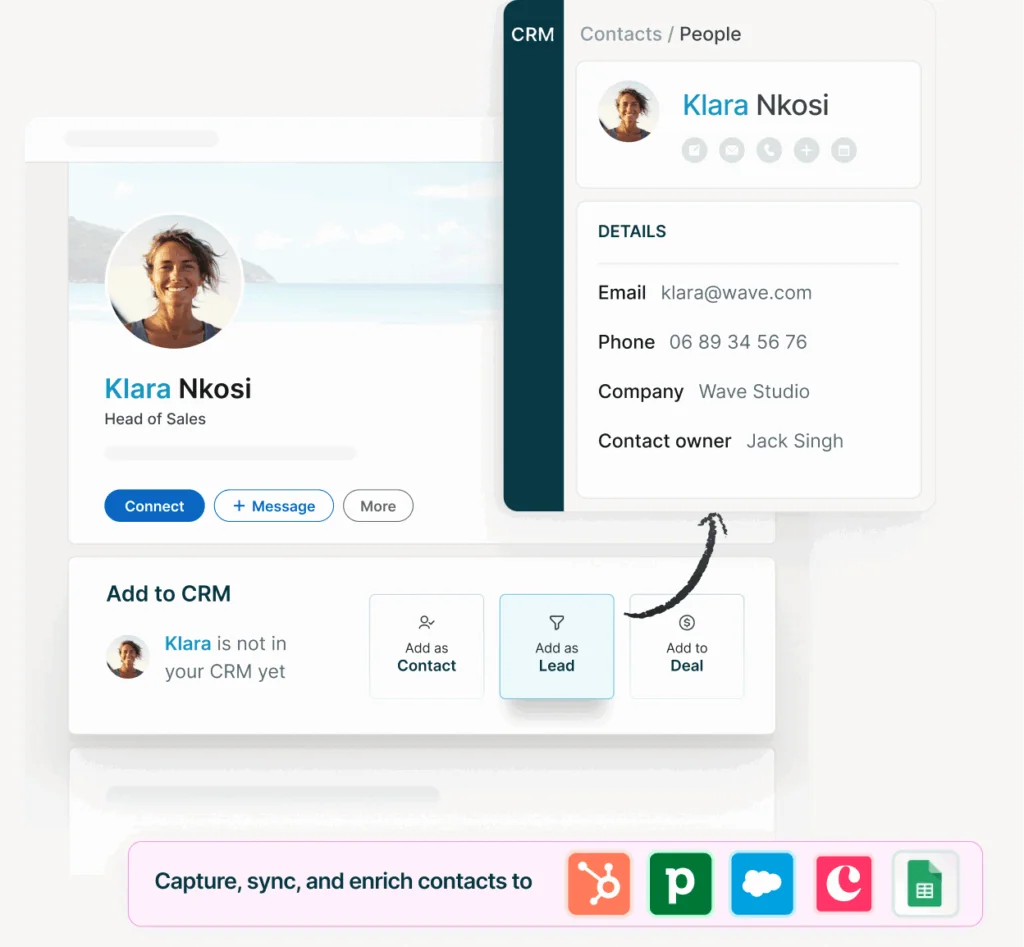
Surfe's Chrome extension is the core product. Install it and connect a supported CRM (a process Surfe says takes about 30 seconds), and a side panel appears on every LinkedIn profile. If the person isn't in your CRM, you get an "Add as Contact" button. If they are, you see their CRM data on the profile: contact owner, lifecycle stage, open deals, and task progress.
Source: Surfe
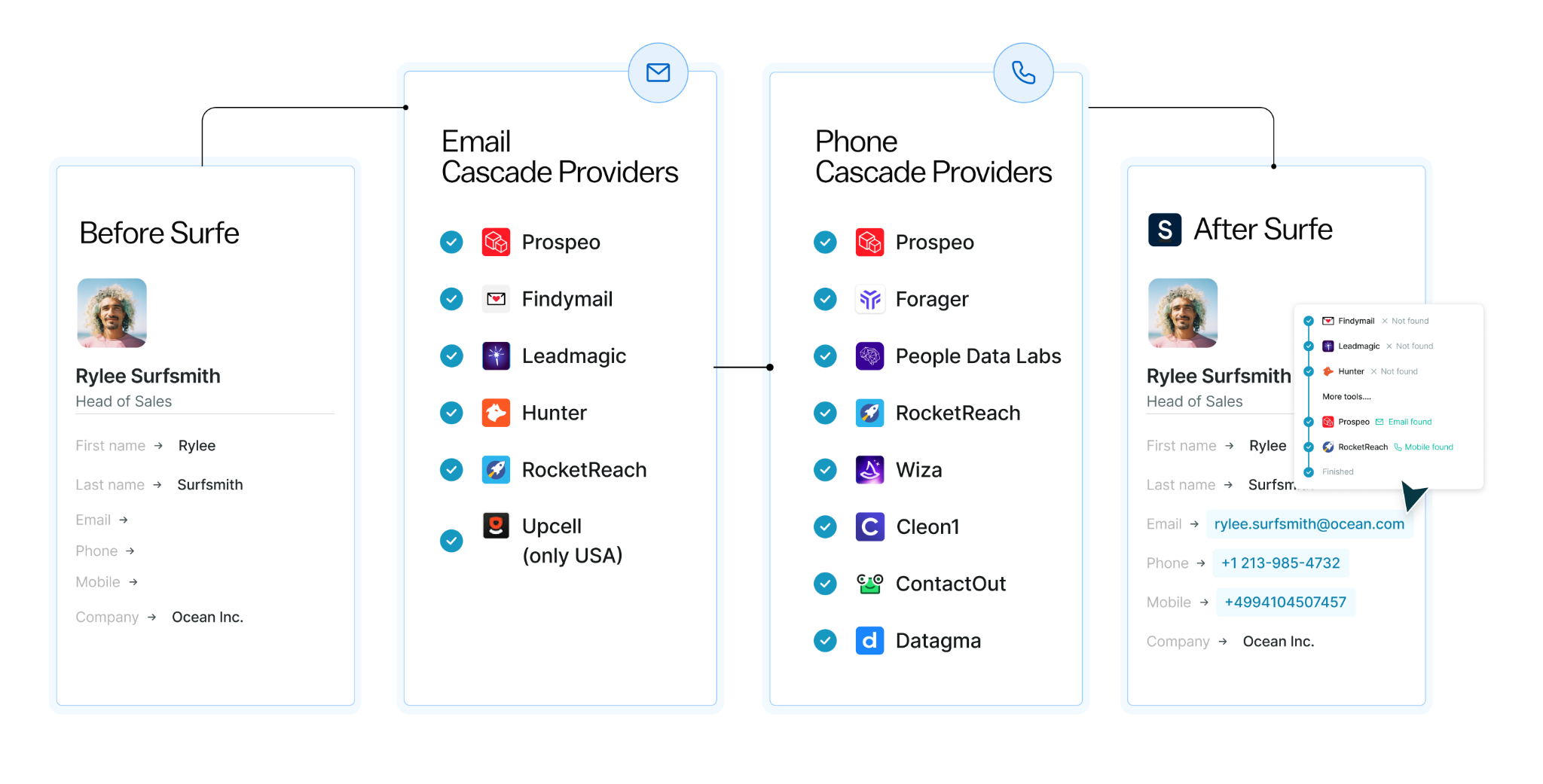
When you add a contact, Surfe runs waterfall enrichment at the same time, querying providers like Apollo, RocketReach, Dropcontact, Hunter, and People Data Labs in sequence to populate verified emails and mobile numbers. All emails pass through ZeroBounce validation before writing to the CRM.
For bulk prospecting, users can export up to 25 contacts at a time from LinkedIn Sales Navigator to their CRM with enriched details. A sync button inside LinkedIn Messages lets reps log conversation threads to the CRM without leaving the chat. Pre-built message templates with dynamic variables (contact name, company, position) round out the workflow.
HubSpot users can enroll contacts in HubSpot Sequences from a LinkedIn profile with one click. Surfe is the #1 workflow automation app on the HubSpot Marketplace and the #1 Pipedrive app for social integration.
Waterfall Enrichment: Surfe chains 15+ data providers to find contact details that no single database can deliver alone.
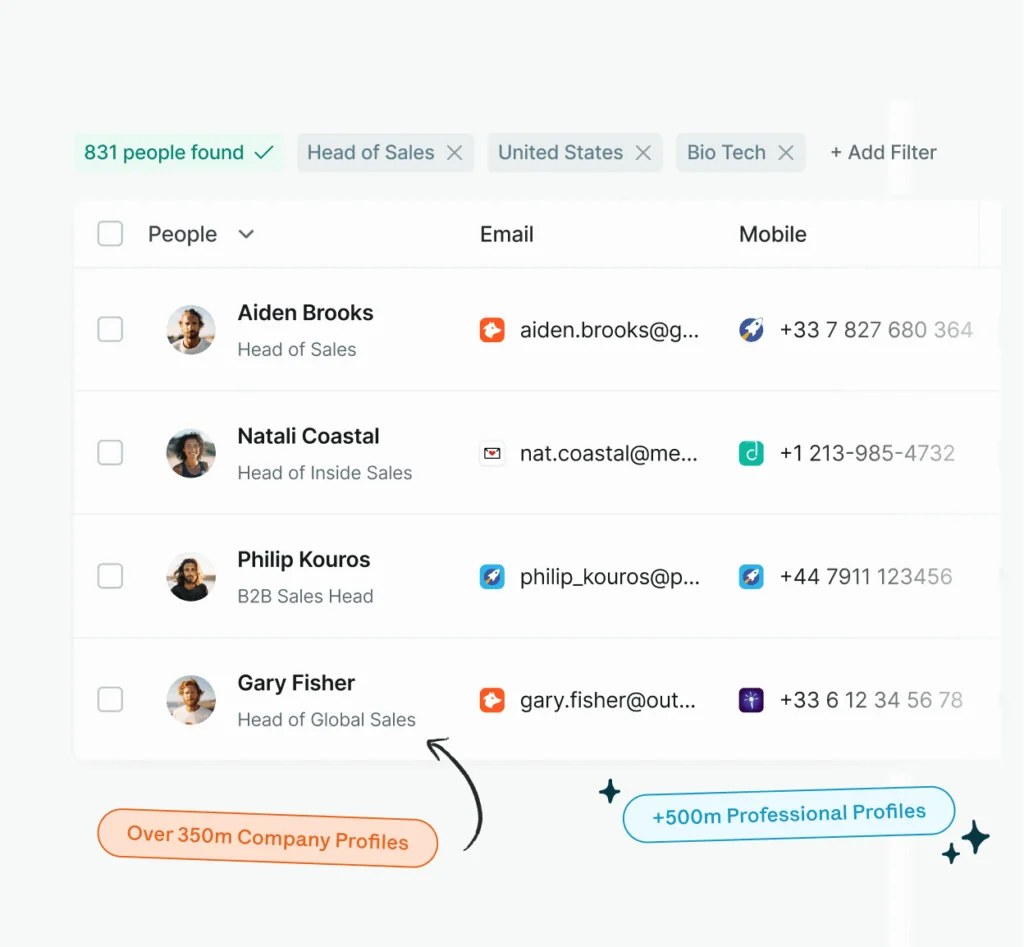
Rather than relying on one vendor's database, Surfe's waterfall enrichment queries providers in sequence. When the first provider can't find a verified email, the engine advances to the next, continuing until it finds a match or exhausts the chain. Surfe claims this produces a 93%+ contact find rate across 500M+ professional profiles and 350M+ company profiles.
Source: Surfe
The system validates results through multiple layers before delivering them. Surfe's own validation engine plus ZeroBounce verify every email, and the platform applies a no-match, no-charge policy: if no valid result is found, the credit isn't consumed.
Surfe's data team benchmarks enrichment providers each month, adjusting the waterfall ordering based on accuracy, match rates, and regional coverage. Teams can also connect their own providers into the waterfall, adding proprietary data sources on top of Surfe's built-in vendors.
Enrichment runs in four places: the Chrome extension (on LinkedIn), the Surfe web app, bulk CSV uploads, and a REST API supporting up to 10,000 people per request.
Contact & Company Search: Surfe provides a filterable B2B database for building prospect lists outside LinkedIn.
Beyond the Chrome extension, Surfe offers a Contact & Company Search through its web app. Users can search across the company database using filters including industry, employee count, revenue range, technologies, NAICS codes, geography, and free-text keywords. People searches accept job titles, seniority, departments, and location, combined with company-level filters.
Source: Surfe
Job title matching uses bidirectional acronym matching ("CTO" also matches "Chief Technology Officer") and semantic matching ("Director of Engineering" may surface "VP of Engineering"), which reduces false negatives when filtering by role.
On the Free plan, search returns up to 1,000 results per week. On the Pro plan, that rises to 10,000 results per day. Pro users also get Account Lookalikes, which generates prospect lists matching the firmographic profile of a user's best-fit customers, refreshed daily and deduplicated so the same company won't reappear.
Job Change Alerts: Surfe monitors CRM contacts for role changes and re-enriches their details automatically.
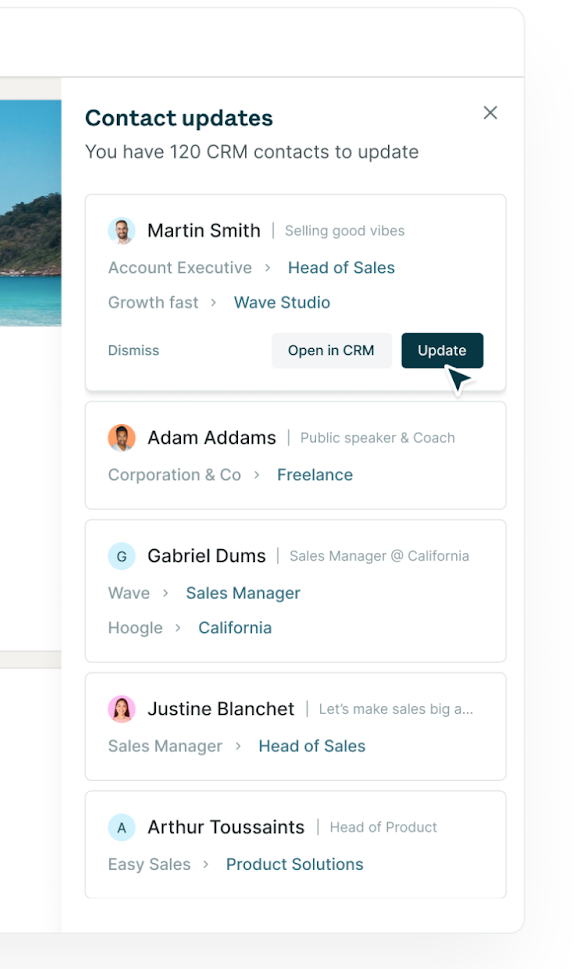
Surfe's Job Change Alerts scan connected CRM contacts daily, comparing existing records against LinkedIn profiles and external data to detect title and company changes. When a change is found, it appears in the Surfe side panel. The rep clicks "Update contact" to push corrected data into the CRM. If the contact moved to a new company, Surfe re-enriches their email to supply the new work address.
Source: Surfe
Surfe reviews over 2 million profiles each week for changes. Job change activity also works as a prospecting filter, letting users target recently promoted or recently hired decision-makers. Pro plan users get unlimited contact updates per month; other plans are limited to 3 updates per month.
Pricing: Surfe offers three tiers with annual credit allotments that gate enrichment volume.
Surfe uses a per-seat subscription model with credits for contact lookups allocated annually. Monthly and annual billing are available, with annual billing offering up to 25% off.
Free ($0/user/month):
20 email finder credits/year
5 mobile phone finder credits/year
Company & People Search: 1,000 results/week
LinkedIn-to-CRM integration (limited to 1 contact/day)
No credit card required
Essential ($39/user/month):
150 email finder credits/year
50 mobile phone finder credits/year
Company & People Search: 1,000 results/week
Unlimited CRM adds per day
Contact list sync from Surfe app to CRM
Pro ($79/user/month, labeled "Most popular"):
1,000 email finder credits/year
100 mobile phone finder credits/year
Company & People Search: 10,000 results/day
Account Lookalikes
Prospect List Builder
Unlimited job change updates
All plans include a 14-day free trial of the Pro plan. Subscription fees are non-refundable once a billing period starts. Unused credits expire at the end of the subscription period. Cancellation requires 10 days' notice before the end of the current period.
Where Surfe Falls Short
Surfe does its core job well: it makes LinkedIn prospecting faster by connecting the browser to the CRM. But several limitations appear when teams need more than contact enrichment.
Restrictive Credit Limits on Lower Plans: The Essential plan at $39/user/month includes 150 email credits and 50 mobile credits per year. That works out to roughly 12 email lookups per month. Any rep doing regular outbound hits that ceiling within weeks. Reaching a useful volume requires the Pro plan at $79/user/month, doubling the cost. Users on G2 flag this as the most common frustration.
LinkedIn Dependency: Surfe's value is concentrated on LinkedIn. Teams that prospect through other channels (company websites, trade show lists, purchased databases) get less value. The extension is built for one platform, and the web app's search database, while functional, lacks the depth to replace a dedicated sales intelligence tool.
No Intent Data or Buying Signals: Surfe surfaces contact details (email, phone, title, company) but not signals that indicate when an account is ready to buy. There's no intent tracking, no website visitor identification, no integration with third-party signal providers. Teams that need to prioritize accounts by purchase readiness must add separate tools on top of Surfe.
No Conversation Intelligence or Deal Tracking: Surfe cannot capture, transcribe, or analyze sales calls. It doesn't track deal momentum, identify pipeline risks, or surface patterns from won and lost deals. These capabilities matter to sales teams operating beyond the top of the funnel, and their absence keeps Surfe focused on prospecting only.
Limited CRM Support: Surfe works with HubSpot, Salesforce, Pipedrive, and Copper. Teams on Microsoft Dynamics, Zoho, Freshsales, or other CRMs cannot use the core integration. No CRM expansion has been announced on Surfe's public roadmap.
Source: Surfe
One-Directional CRM Sync: Data flows from Surfe into the CRM, but not back. If a colleague updates a contact record in the CRM, that change doesn't appear in the extension. For larger teams, this creates inconsistency between what reps see on LinkedIn and what exists in the CRM.
These are not failures. They reflect a tool designed to do one thing well: move contacts from LinkedIn into a CRM with enriched data. But for teams whose needs extend beyond that workflow, the gaps point toward platforms built for the full go-to-market cycle.
Top Surfe Alternative for Full GTM Execution: ZoomInfo
ZoomInfo fills the gaps Surfe leaves. Where Surfe handles contact enrichment, ZoomInfo spans the go-to-market workflow: identifying which accounts to pursue, understanding why deals move or stall, and executing outreach across every channel.
B2B Data: ZoomInfo operates a large, verified B2B database that covers far more than contact details.
ZoomInfo's data covers three areas. Identity data includes 500M contacts, 135M+ verified phone numbers, 120M direct-dial numbers, and 200M+ verified business email addresses. Company data covers 100M companies with firmographics, org charts, and technographics tracking 30,000+ technologies across 200+ categories. Intent signals show when accounts are actively researching solutions through intent data sourced from 210 million IP-to-Organization pairings.
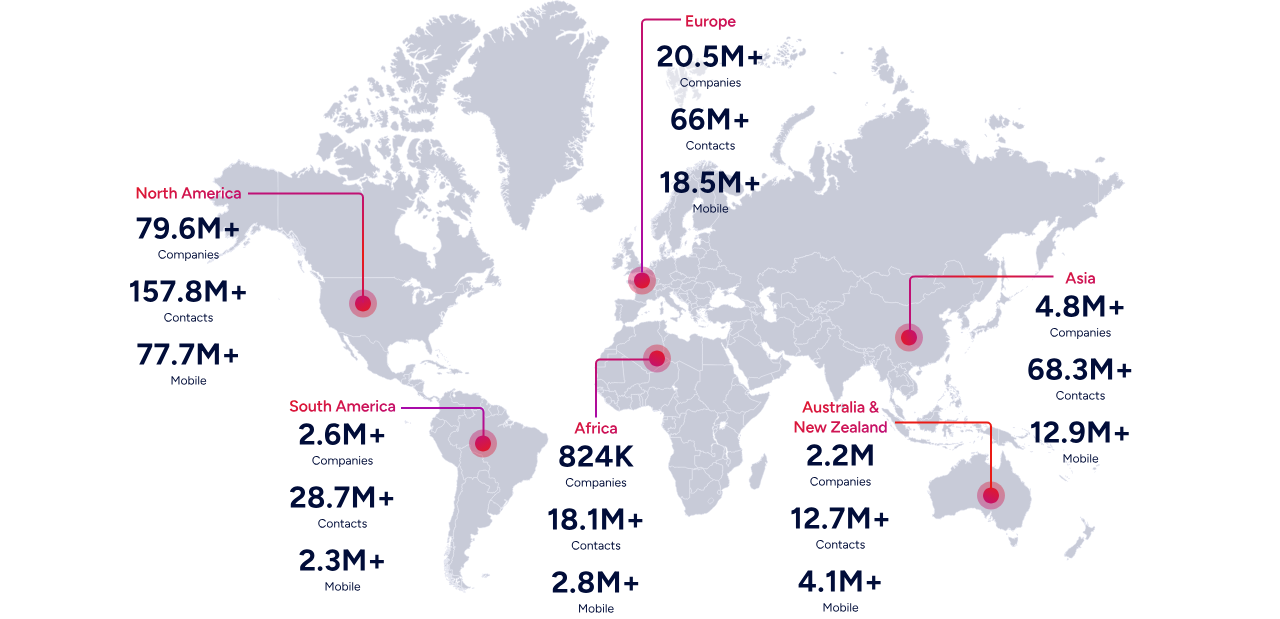
This data runs through a verification pipeline backed by 300+ human researchers and achieves up to 95% accuracy on first-party data. In a Fortune 500 competitive RFP analyzing 25 million contacts across vendors, an independent consultant concluded that "no other competitor came even close."
Surfe's waterfall approach aggregates data from 15+ providers, which works well for email and phone lookups. ZoomInfo's data doesn't stop at contact details. It includes department org charts with verified direct dials, parent-child company hierarchies, technology stack data, and real-time buying signals, all in one platform.
"ZoomInfo gives us the information we need to execute. We don't have to go through and spend our time digging. It's already there, so we can be three steps ahead." (Vensure)
GTM Context Graph: ZoomInfo's intelligence layer combines CRM data, conversation history, and market signals to show why deals move or stall.
Contact data tells you who to reach. ZoomInfo’s GTM Context Graph tells you why to reach them now.
The GTM Context Graph processes 1.5B+ data points daily, combining CRM records, conversation transcripts from Chorus (ZoomInfo's conversation intelligence platform), email interactions, and product usage data with ZoomInfo's third-party intelligence. The result is a system that captures not just what happened in a deal, but why it happened.
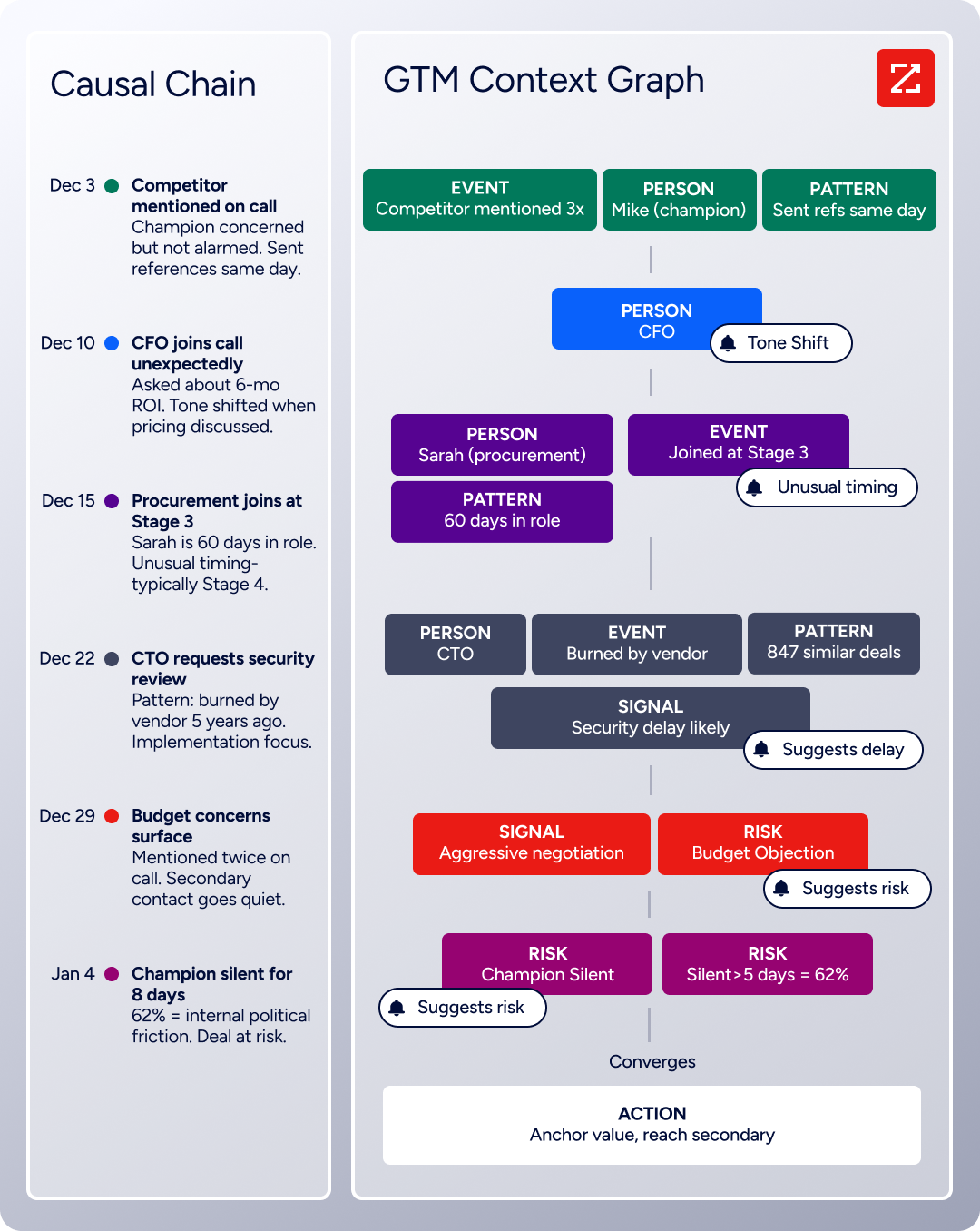
A CRM records that a deal moved from stage 3 to stage 4. Chorus transcribes what the VP of Finance said on the last call. ZoomInfo's intent data logs a spike in research activity. The GTM Context Graph reasons across all three to identify the actual driver: executive sponsorship at this stage, combined with ROI-focused questions, matches the pattern behind closed-won deals in your segment.
Surfe offers none of this. Surfe can tell you a contact's email and title. ZoomInfo can tell you that their company just hired three VPs, is researching your competitor's category, and matches the signal pattern of your best deals.
"It's bringing data together faster than anyone could. It's both a time saving and a quality improvement," with Seismic attributing 39% of active pipeline to ZoomInfo signals. (Seismic)
Multiple Interfaces: ZoomInfo delivers intelligence through separate seller and marketer interfaces, plus APIs and MCP for any third-party tool.
ZoomInfo’s GTM Workspace is the seller's front-end. It brings together prioritized accounts, AI-drafted outreach, deal context, and CRM updates in one place. AI agents (built on Anthropic's Claude) handle account research, signal monitoring, and follow-up drafting. Thomson Reuters increased closed-won deals by 40% and achieved 115% average quota attainment each month using it.
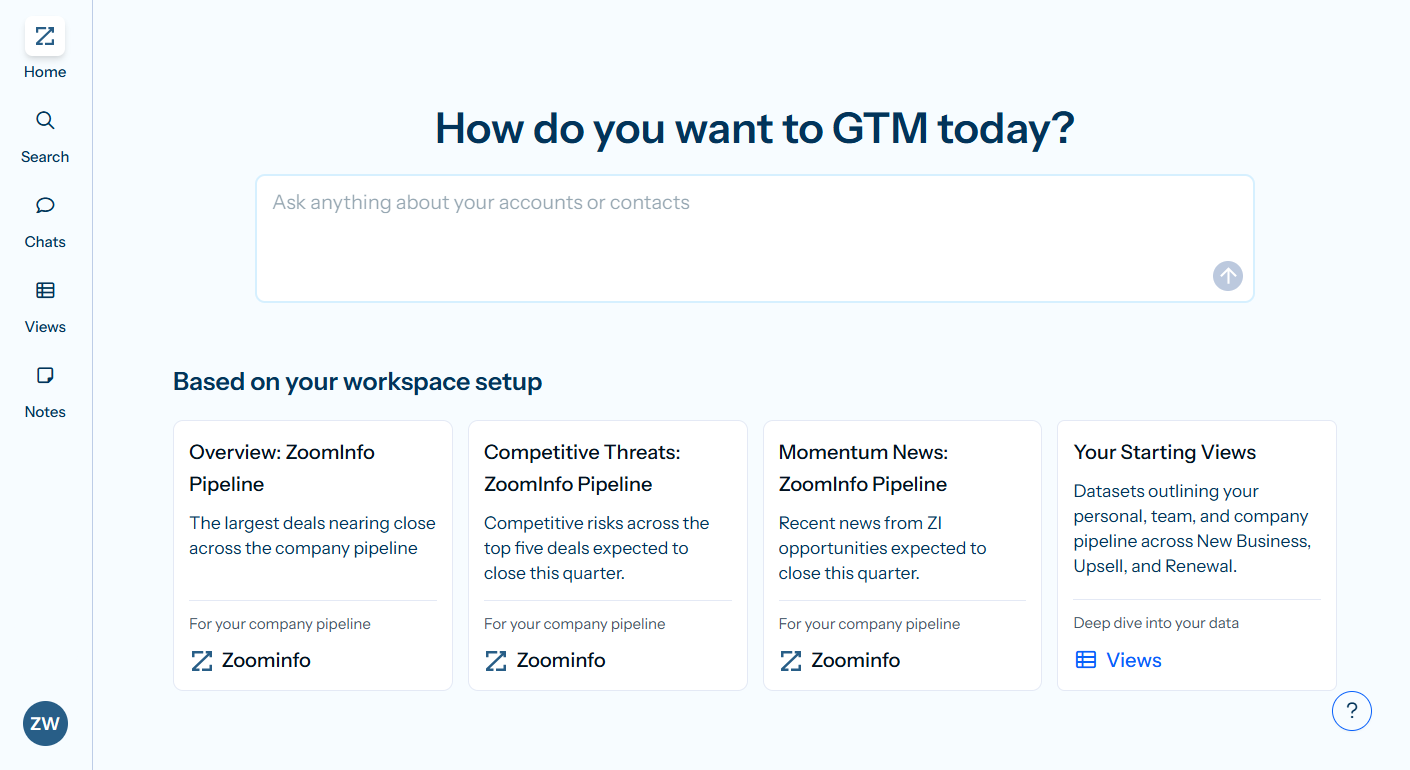
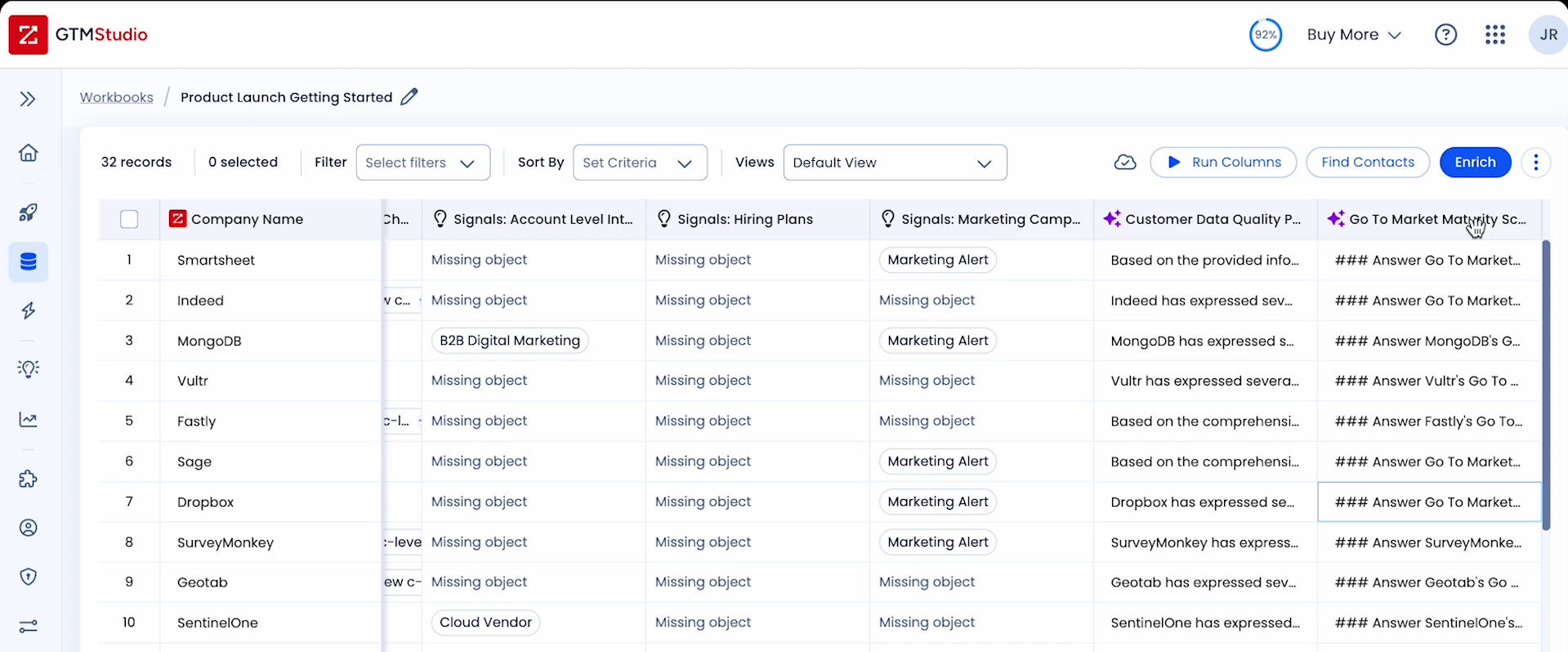
GTM Studio serves marketers, RevOps, and GTM engineers. Teams describe audiences in natural language, build multi-channel plays (email, ads, calls, direct mail), and launch them without engineering support. Expansion plays that used to take 3 weeks now launch in 30 minutes.
For teams building beyond ZoomInfo's own products, APIs and MCP expose the same intelligence to any custom agent, internal tool, or partner platform. API access is included in all plans. The MCP server connects AI models to ZoomInfo's data without custom coding and is listed in Claude's directory.
All three interfaces draw from the same GTM Context Graph. The data quality stays the same regardless of which one you use.
"The plug-and-play aspect of the API means I can integrate it very easily into any process and get information at a moment's notice." BDO Canada reported an 87% reduction in time spent on dashboard updates. (BDO Canada)
Enterprise Compliance and Analyst Recognition: ZoomInfo holds certifications and analyst rankings that Surfe has not achieved.
ZoomInfo maintains ISO 27001, ISO 27701, SOC 2 Type II, TRUSTe GDPR, and TRUSTe CCPA certifications, all renewed annually. The platform is a registered data broker in California and Vermont, with a dedicated Trust Center.
ZoomInfo has been named a Gartner Magic Quadrant Leader for ABM Platforms for two consecutive years, a Forrester Wave Leader for Intent Data Providers, and holds 133 G2 No. 1 rankings across Sales Intelligence, Buyer Intent, Data Quality, and related categories. Surfe holds ISO 27001 and GDPR compliance but has not appeared in major analyst reports.
Surfe or ZoomInfo: Comparison Summary
Surfe | ZoomInfo | |
|---|---|---|
Primary focus | LinkedIn-to-CRM sync and contact enrichment | Go-to-market intelligence and execution |
Contact database | 500M+ profiles via 15+ aggregated providers | 500M contacts, verified by 300+ human researchers |
Company database | 350M+ company profiles | 100M companies with company attributes, org charts, technographics |
Phone numbers | Mobile numbers via waterfall enrichment | |
Email verification | ZeroBounce validation, 93%+ find rate | Multi-source verification, up to 95% accuracy |
Intent data | Not available | 210M IP-to-Organization pairings, Guided Intent |
Conversation intelligence | Not available | Chorus (calls, meetings, emails) |
Website visitor tracking | Not available | WebSights with company and contact identification |
AI execution tools | Message templates on LinkedIn | AI agents in GTM Workspace, GTM Studio orchestration |
CRM integrations | HubSpot, Salesforce, Pipedrive, Copper | Salesforce, HubSpot, Microsoft Dynamics, 120+ marketplace integrations |
API access | REST API with webhook support | |
Compliance | ISO 27001, GDPR | ISO 27001, ISO 27701, SOC 2 Type II, GDPR, CCPA |
Analyst recognition | G2 Leader in Lead Capture (Mid-Market) | Gartner Leader (ABM), Forrester Leader (Intent), 133 G2 No. 1 rankings |
Pricing | $0 to $79/user/month (published) | Custom-quoted; ZoomInfo Lite free tier available |
Best for | LinkedIn-centric outbound teams | Revenue teams across sales, marketing, and ops |
Final Verdict
The choice between Surfe and ZoomInfo depends on how much of the go-to-market workflow you need one platform to cover.
Choose Surfe if your sales process centers on LinkedIn prospecting and you need a fast way to move contacts into your CRM with verified email addresses. It does this well. The Chrome extension installs in seconds, the waterfall enrichment finds contact details that single-source tools miss, and the job change alerts keep your CRM current. For small outbound teams running a straightforward prospecting motion on LinkedIn with HubSpot, Salesforce, Pipedrive, or Copper, Surfe saves time at a transparent price.
Choose ZoomInfo if you need more than contact details. ZoomInfo covers the revenue cycle: identifying which accounts are in-market, understanding the buying committee, tracking deal signals across conversations and engagement data, and executing outreach through AI-powered tools. The GTM Context Graph connects first-party CRM data with third-party intelligence in a way that individual enrichment tools cannot match. For teams ready to move from finding contacts to running a coordinated go-to-market operation, ZoomInfo provides the platform to do it.
Start your ZoomInfo free trial here.
Surfe solves the LinkedIn-to-CRM data transfer problem well. ZoomInfo solves the broader question of how to find, prioritize, engage, and win accounts across your go-to-market operation. Your choice depends on which problem your team needs solved today.
Surfe FAQ
What CRMs does Surfe integrate with?
Surfe integrates natively with HubSpot, Salesforce, Pipedrive, Copper, and Google Sheets. It also connects with sales engagement tools including Salesloft, Outreach, and Lemlist. Teams using Microsoft Dynamics, Zoho, Freshsales, or other CRMs cannot use Surfe's core LinkedIn-to-CRM workflow.
How does Surfe's waterfall enrichment work?
Surfe chains 15+ contact data providers in sequence. When you request an email or phone number, the engine queries the first provider. If no valid result comes back, it advances to the next, continuing until a match is found or every provider has been tried. Surfe claims this achieves a 93%+ find rate. All emails are verified through ZeroBounce before writing to the CRM, and credits are only consumed when a valid match is found.
How much does Surfe cost?
Surfe offers three tiers: Free ($0/user/month with 20 email credits/year), Essential ($39/user/month with 150 email credits/year), and Pro ($79/user/month with 1,000 email credits/year). Annual billing offers up to a 25% discount. Credits are allocated annually, not monthly. ZoomInfo uses custom-quoted pricing based on seats, credits, and features, with a permanent free tier called ZoomInfo Lite offering 10 monthly export credits.
Does Surfe offer intent data or buying signals?
No. Surfe focuses on contact-level data: emails, phone numbers, job titles, and company names. It does not track intent signals, website visitor activity, or account-level buying behavior. The Market Signals feature provides curated prospecting lists with basic company growth and hiring indicators, but this is not comparable to intent data platforms. ZoomInfo provides intent data sourced from 210 million IP-to-Organization pairings and offers Guided Intent, which identifies topics historically correlated with deal success.
Is there a free version of Surfe?
Yes. Surfe offers a permanent free plan with 20 email finder credits per year, 5 mobile phone finder credits per year, and a limit of 1 contact added to CRM per day. All new accounts also receive a 14-day free trial of the Pro plan. ZoomInfo offers a permanent free tier (ZoomInfo Lite) with 10 monthly export credits and the ReachOut Chrome Extension.
Can Surfe be used outside of LinkedIn?
Surfe's Chrome extension is designed for LinkedIn. The Surfe web app provides a contact and company search database that works independently, and the API enables enrichment from any system. However, the platform's core value (CRM overlays, message sync, one-click contact adding) is tied to the LinkedIn browsing experience. Teams that prospect across multiple channels will find the platform's utility concentrated on one surface.
Does Surfe offer conversation intelligence or deal tracking?
No. Surfe does not record, transcribe, or analyze sales calls. It has no deal tracking, pipeline analytics, or forecasting capabilities. The platform focuses on prospecting: finding contacts, enriching their data, and syncing them to a CRM. ZoomInfo includes Chorus for conversation intelligence, capturing customer calls, meetings, and emails to extract signals behind deal movement and feed that context into the GTM Context Graph.
What happens if Surfe can't find a contact's email?
Surfe applies a no-match, no-charge policy. If the waterfall enrichment engine queries all 15+ providers and cannot return a valid, verified email address, no credit is consumed. This protects users from paying for failed lookups. Users can also connect their own enrichment providers into the waterfall to increase coverage for specific regions or industries.
More Surfe comparisons and alternatives:
