
If you're comparing Tegus vs. GLG, you're weighing two different approaches to the same problem: how institutional investors and corporate strategists get firsthand intelligence from industry practitioners.
The real questions you should be asking are:
Do you need on-demand access to a library of past expert conversations, or do you commission custom calls tailored to your specific thesis?
Is your research volume high enough to justify an annual subscription, or do you run expert calls episodically?
How important is it that your expert research sits alongside financial data, broker reports, and AI-powered analysis in a single platform?
Does your compliance team require a specific level of MNPI controls and audit infrastructure?
Are you investing primarily in North American and European markets, or do you need emerging-market expert coverage?
In short, here's what we recommend:
Tegus (now part of AlphaSense) is built for investment teams that want to move fast. Its transcript library of 260,000+ investor-led interviews across 27,000+ companies lets analysts review what other investors already asked before scheduling a single call.
Combined with AlphaSense's AI search, 4,000+ Canalyst financial models, and a 500M+ document content library, Tegus functions as a full research operating system. Expert calls use transparent pricing: the expert's own rate plus a flat $75 transcription fee, with no markups.
GLG is the established name in expert networks, with 1.2 million verified professionals and nearly three decades of operating history. GLG's strength is breadth and service range: expert calls, surveys, sample sourcing, events, deal advisors, board placements, and expert witness services under a single relationship.
Its compliance infrastructure (including 50+ dedicated professionals, a Disclosure Management System covering 400,000+ subject nodes, and Bloomberg Terminal integration plus FactSet) makes GLG the default for large institutions where regulatory rigor is non-negotiable.
Both platforms fill the qualitative research gap that quantitative data alone cannot close. But expert conversations only answer half the question. Before you can talk to the right expert, you need to identify the right companies, map their buying committees, track competitive signals, and enrich your CRM with verified contact data.
ZoomInfo is an AI-powered go-to-market platform that supplies the B2B intelligence expert networks don't provide.
With 500M contacts, 100M companies, 135M+ verified phone numbers, and 200M+ verified business email addresses, ZoomInfo gives research and deal teams the contact data, company attributes, technographics, org charts, and buyer intent signals they need to prioritize targets before engaging experts.
Its GTM Context Graph processes 1.5B + data points daily, combining this B2B data with your CRM records and behavioral signals to show the full context of your accounts, including not just what happened, but why, and which actions to take next.
For PE firms running commercial due diligence, corporate strategy teams scoping competitive landscapes, or investment analysts mapping buying committees, ZoomInfo fills the data gap that expert networks assume someone else has already closed.
If B2B intelligence would sharpen the research your expert network delivers, see how ZoomInfo works.
Tegus vs. GLG at a glance
Tegus (by AlphaSense) | GLG | ZoomInfo | |
|---|---|---|---|
Expert network size | 1M+ pre-qualified experts | 1.2M+ verified professionals | N/A (B2B contact intelligence, not an expert network) |
Transcript library | 260,000+ investor-led transcripts | 25,000+ compliance-reviewed transcripts | N/A |
AI capabilities | Generative Search, Deep Research, AI-Led Expert Calls | myGLG AI agents, AI-Moderated Calls, MCP Connector | GTM Context Graph, AI-powered account research, GTM Workspace AI agents |
Financial data | 4,000+ Canalyst models, earnings, filings | Expert Content Library only | Company attributes, technographics, intent signals |
Compliance infrastructure | 75+ person team, $100M+ annual investment | 50+ person team, 400,000+ subject node disclosure system | ISO 27001, ISO 27701, SOC 2 Type II |
Service model | Self-serve platform + call scheduling | High-touch service teams + AI platform | Self-serve platform + API/MCP |
Expert call pricing | Expert rate + $75 flat fee, no markups | Not published, premium pricing | N/A |
Free trial | Sales-led trial request | No free trial (60-day Content Feed trial for data teams) | 7-day free trial + permanent free tier (Lite) |
Best for | Investment teams wanting research speed and transcript access | Large institutions needing full-service research with strong compliance | Teams needing verified B2B data, intent signals, and contact intelligence |
Two models of expert research, one fundamental trade-off
Tegus and GLG represent two distinct philosophies about how expert knowledge should be captured, distributed, and priced.
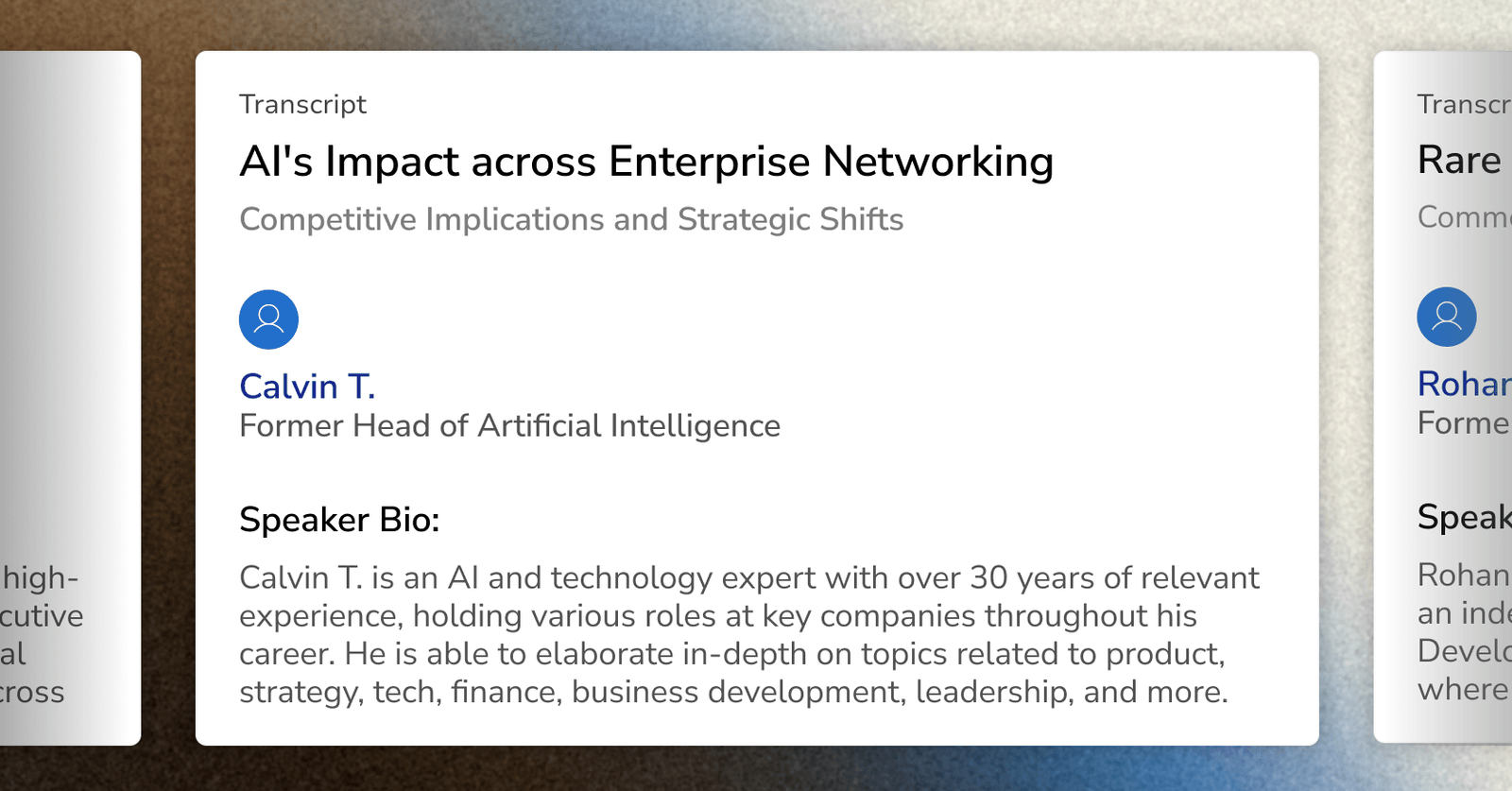
GLG invented the expert network model in 1998 and refined it for over two decades. The approach is service-led: a client submits a research question, GLG's team sources and vets experts, schedules calls, and manages compliance.
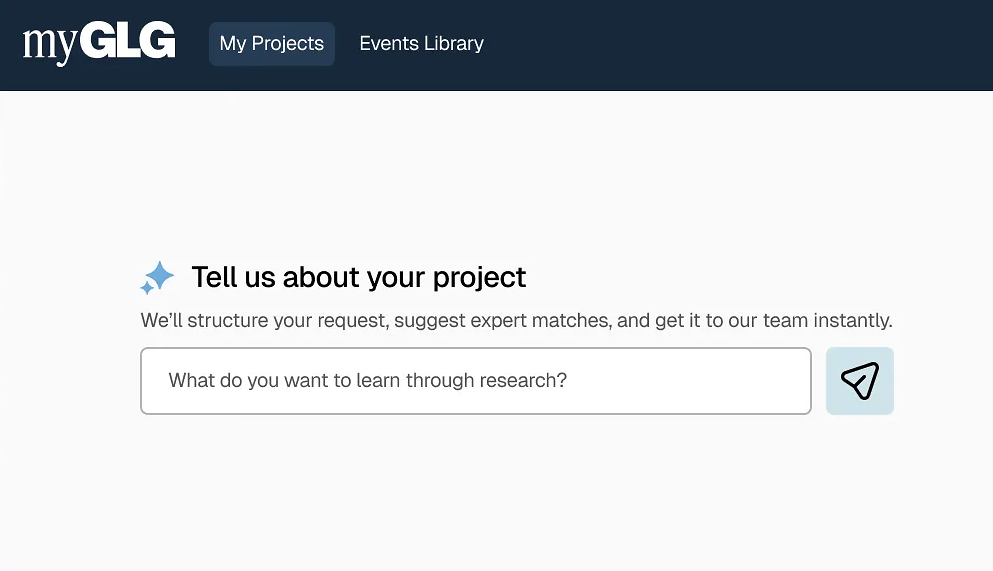
Source: GLG
Each call is a private, custom engagement. The expert's identity is known to the client, every transcript is compliance-reviewed before distribution, and 1:1 call transcripts are never published or shared across the library.
Tegus flipped this model. Founded in 2015 by twin brothers who'd worked at both a hedge fund and an expert network, they saw that expert calls weren't proprietary alpha but shared intelligence the entire market needed just to stay current.
So they built a contribution cycle: when a subscriber conducts a call, Tegus owns the transcript and publishes it (after compliance review and anonymization) to a shared library. Every new subscriber makes the library more valuable. Every new call adds to it. The result is 260,000+ transcripts growing by 7,000-8,000 per month.
Source: Tegus
The trade-off is straightforward. GLG gives you private, named-expert conversations where you control the questions and own the relationship. Tegus gives you a large library of prior conversations that may already answer your question, plus the ability to schedule your own calls at lower cost.
For a PE firm conducting a dozen due-diligence calls per deal, GLG's service model and compliance depth may justify the premium. For a hedge fund analyst covering 50 companies who needs to ramp on a new name in two hours, Tegus's searchable transcript library compresses that work from days to minutes.
Transcript libraries are not created equal
Both platforms maintain expert content libraries, but the scale, structure, and access channels differ.
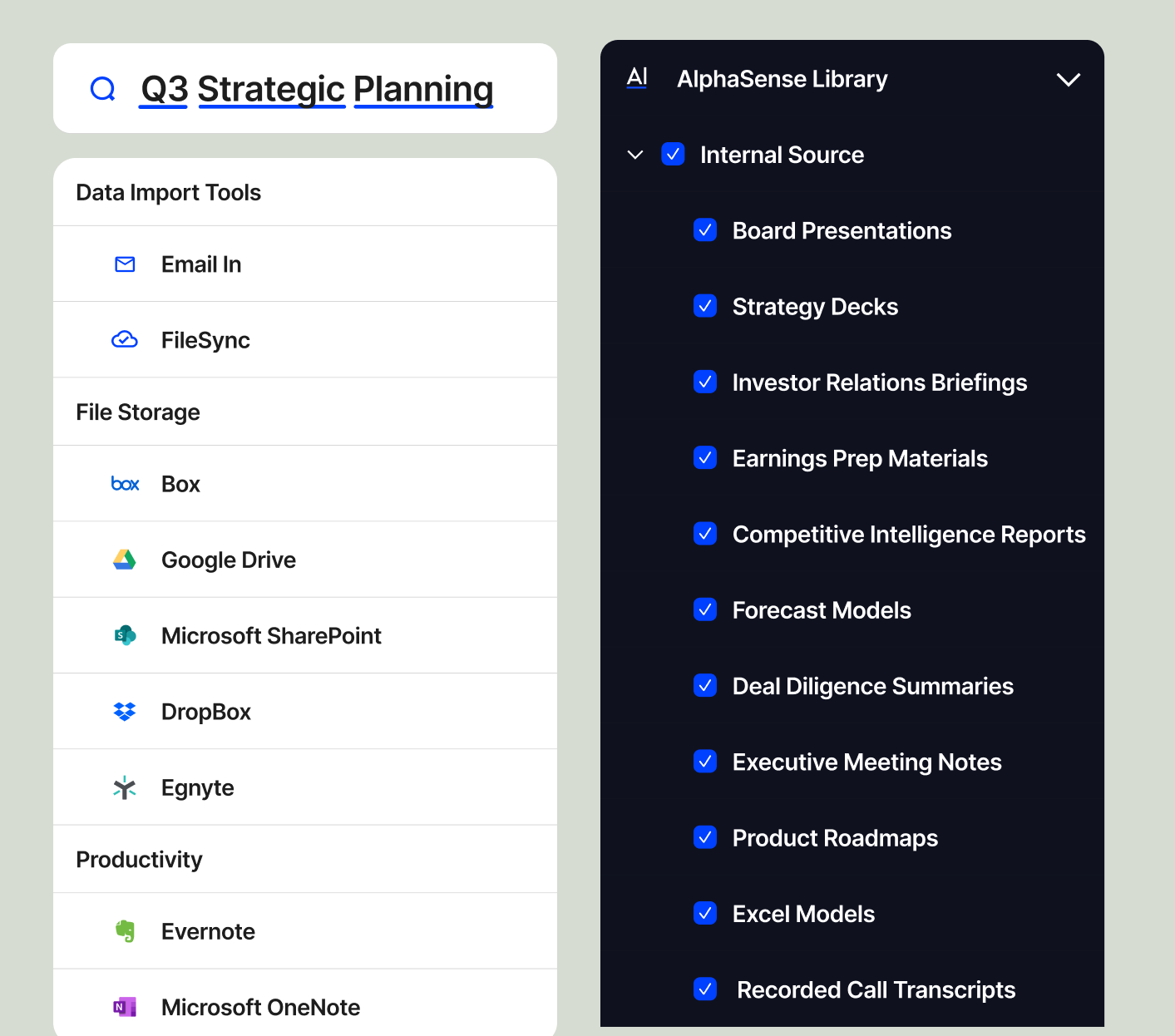
Tegus operates the larger library: 260,000+ transcripts covering 27,000+ public and private companies, with three types of content. Investor-led transcripts capture buy-side and sell-side analysts asking the questions that matter to real investment decisions. AlphaSense-led transcripts are conducted by in-house research analysts for consistent sector coverage.
And AI-led transcripts are generated by an autonomous AI interviewer. Every transcript includes AI-generated summaries, top investor questions, and topic tags. Users can filter by expert type (former executives, customers, competitors), analyst perspective, and transcript focus (company deep-dive, channel check, voice of customer).
Source: Tegus
Expert identities in Tegus transcripts are anonymized, identified only by role and company descriptor. This protects experts but means readers cannot independently assess the source's credibility or tenure.
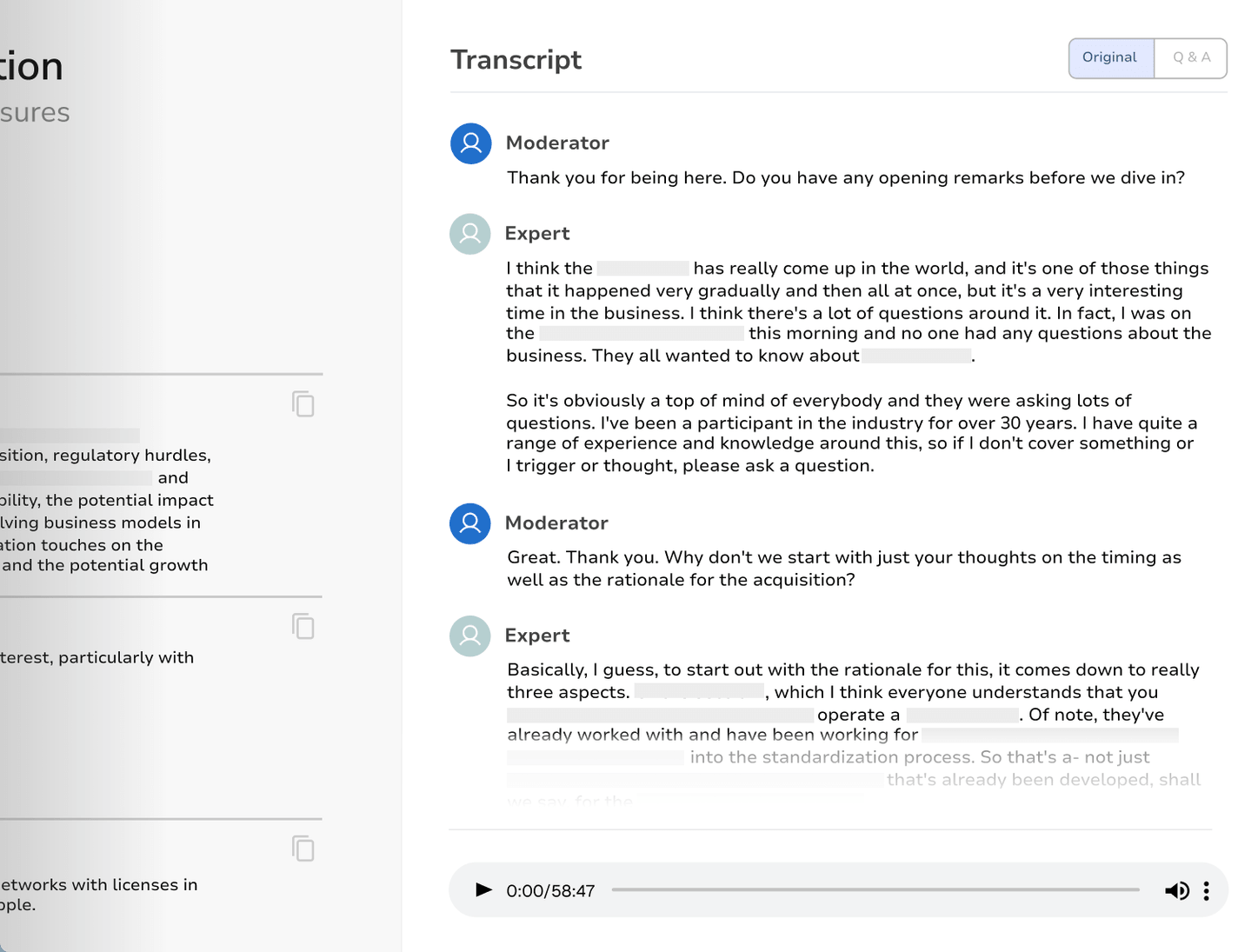
GLG's Expert Content Library is smaller but structurally different: 25,000+ transcripts with approximately 450+ added monthly. Every GLG transcript is original and named, and every transcript is compliance-reviewed.
Source: GLG
The expert's identity and professional background are visible, allowing readers to weigh each insight against the expert's specific experience. GLG also positions its library as distinct from competitors that "recycle the same transcripts".
GLG distributes its library more broadly across financial terminals. Transcripts are accessible via the myGLG portal, Bloomberg's ASKB conversational AI, FactSet, and the GLG MCP Connector for AI platforms like Claude. No competing expert network matches this terminal distribution.
Tegus transcripts live within the AlphaSense platform alongside 500M+ documents including broker research, SEC filings, and earnings calls. The integration advantage: an analyst can run a single query across expert transcripts, financial filings, and sell-side research simultaneously.
AI is reshaping how both platforms deliver expert research
Both Tegus and GLG have made large AI investments in 2025-2026, but with different architectures and entry points.
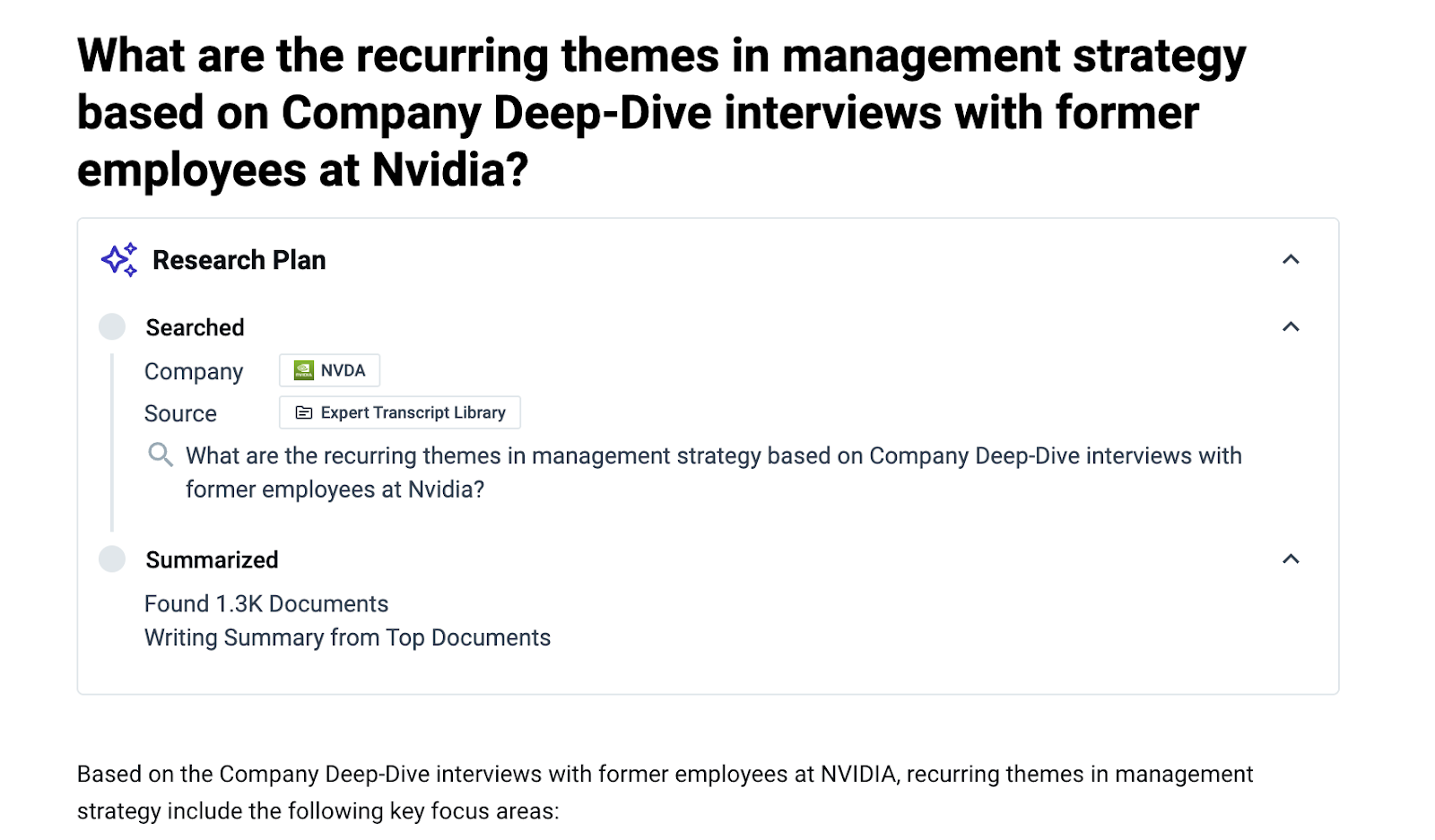
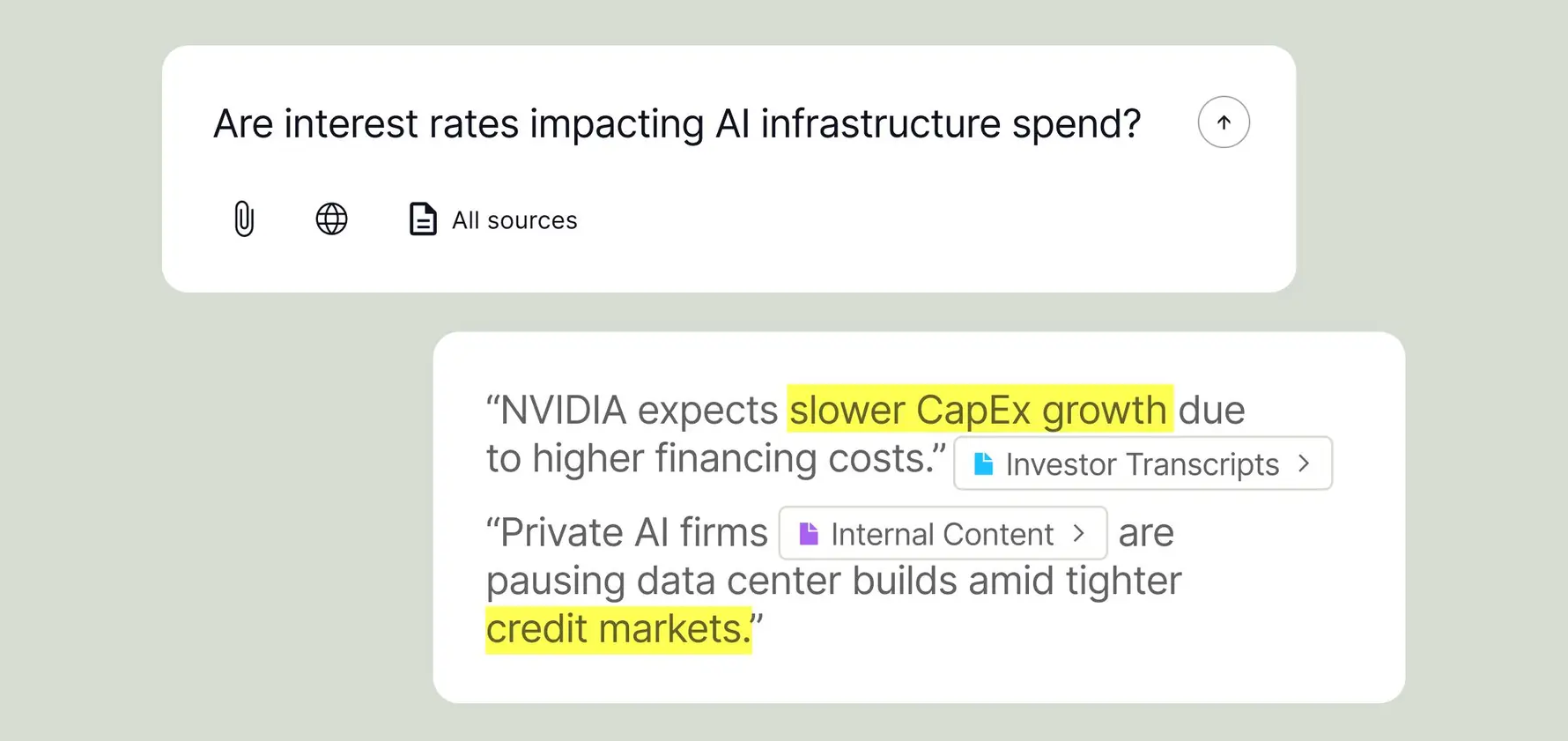
Tegus (via AlphaSense) treats AI as the primary research interface. Generative Search lets analysts ask natural-language questions and receive cited answers drawn from the full 500M+ document library. Deep Research automates in-depth analysis, running dozens of searches and parsing thousands of results to produce company or industry briefs in minutes.
Source: AlphaSense
AI-Led Expert Calls use an autonomous AI interviewer to conduct calls 24/7, informed by AlphaSense's content library, with compliance-reviewed transcripts delivered in approximately 24 hours. AlphaSense describes these as "Agentic AI That Thinks Like Analysts", multi-step agents that run research workflows without manual prompting.
GLG has rebuilt its platform around myGLG, relaunched in May 2026 with three AI capabilities: a Strategic Research Agent that converts research questions into structured project briefs; an AI Moderator for expert calls that runs structured interviews autonomously across time zones; and Precision Synthesis Tooling that generates attributed summaries across transcripts, audio, and video with traceability to specific expert quotes.
The GLG MCP Connector, launched July 2026, embeds GLG's expert content as a live context source inside AI tools like Claude, with ChatGPT next on the roadmap.
Source: GLG
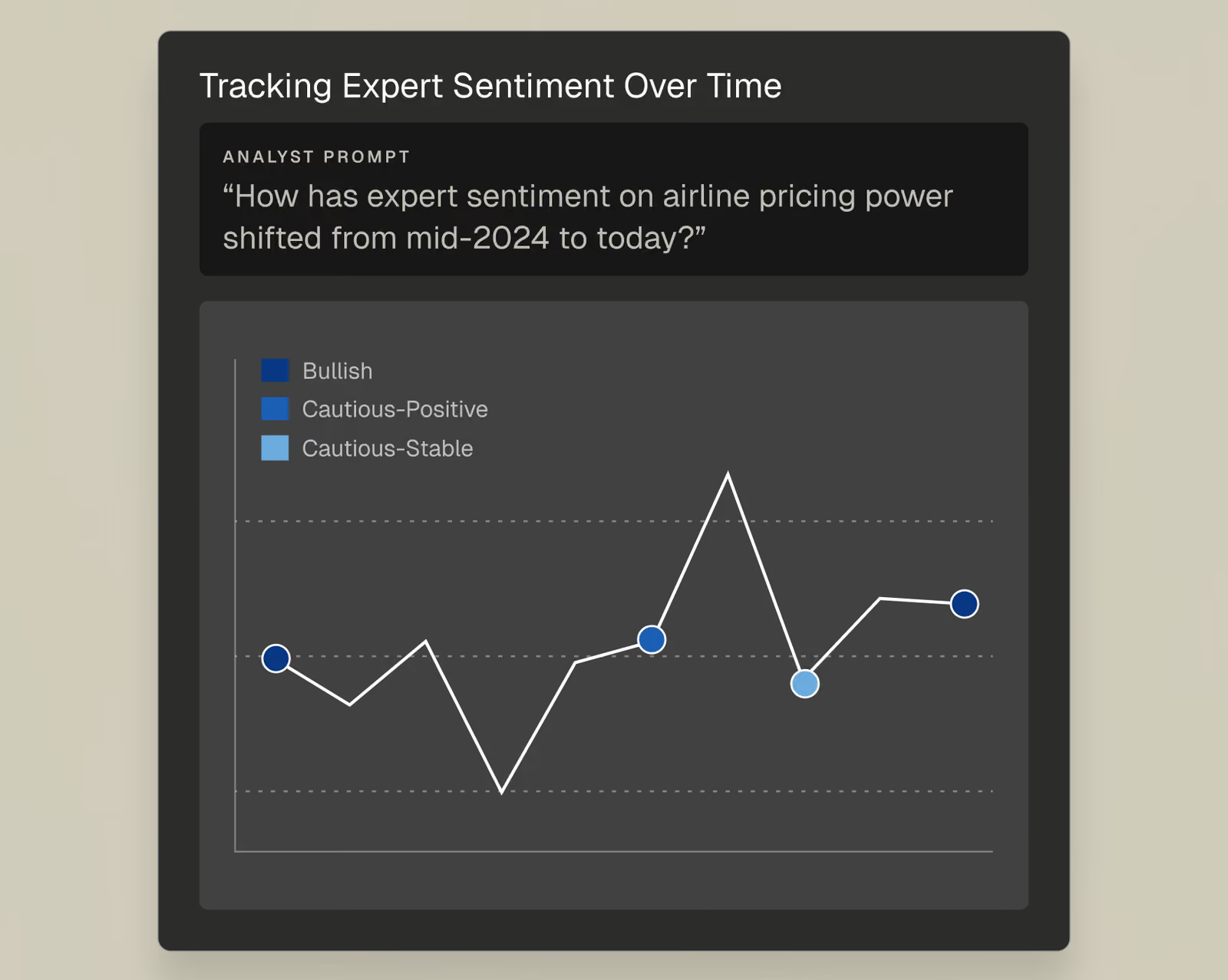
The philosophical difference matters. Tegus positions AI as a research accelerator: get answers faster by letting AI search, synthesize, and even conduct calls on your behalf. GLG positions AI as a trust layer: "The power of AI, the trust of human expertise", with every AI-generated insight anchored to a named human source.
Both platforms commit to not training AI models on client data, a critical requirement for regulated-industry clients.
Compliance infrastructure reflects different client bases
For institutional investors, compliance isn't a feature. It's a procurement gate.
GLG has the deeper and more visible compliance apparatus. Its 50+ person compliance team runs mandatory expert training in 20 languages, annual recertification for all 1.2M + network members, an Institutional Expert Registry where employers register consulting restrictions, and a Disclosure Management System with 400,000+ subject nodes tracking expert-declared conflicts.
Project Oversight tools give compliance officers real-time monitoring dashboards, custom attestations, and call chaperoning. G2 reviewers consistently cite GLG's compliance infrastructure as its clearest structural advantage.
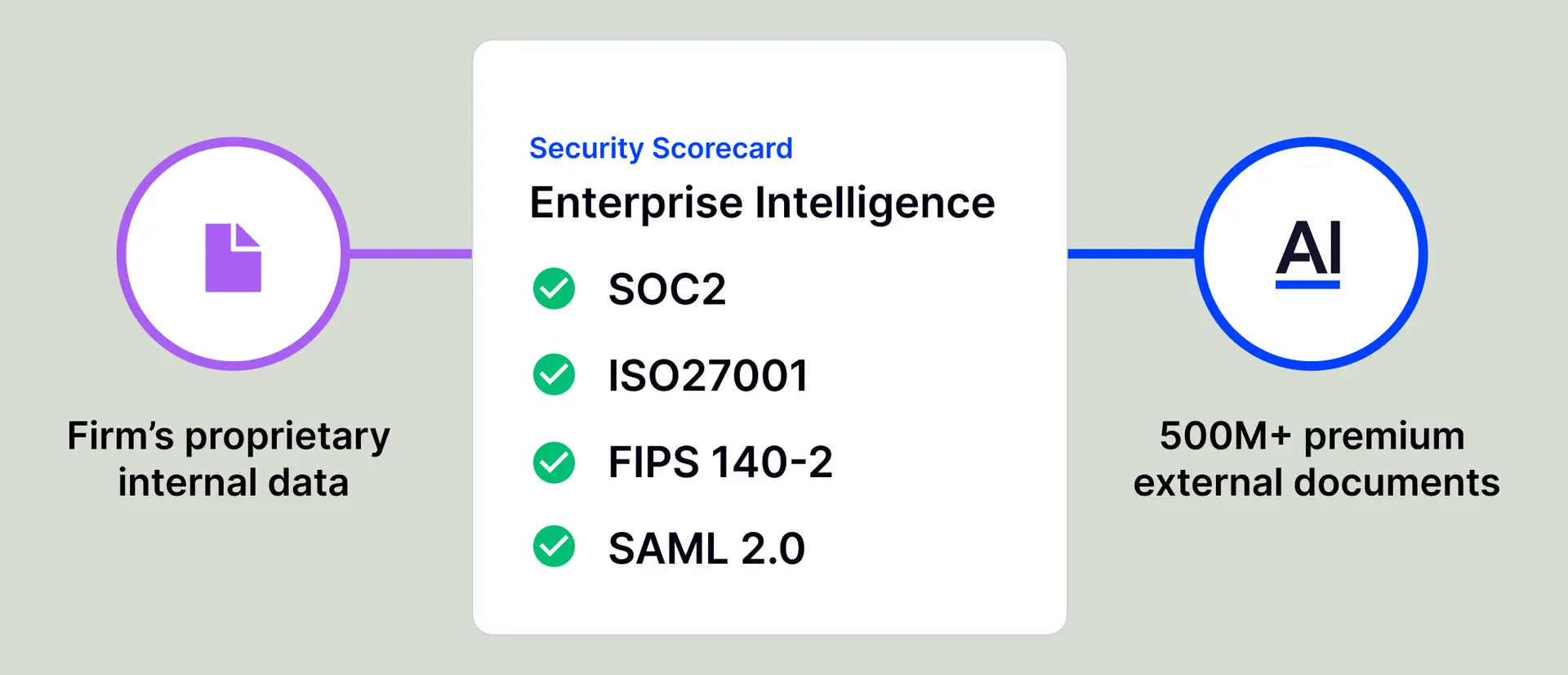
Tegus backs its compliance with scale. AlphaSense invests over $100 million annually in compliance, with a dedicated team of 75+ professionals. Every transcript undergoes multi-layered AI and human review before publication. Experts must be at least six months removed from any prior role at the target company.
The compliance portal provides centralized approval management, real-time reporting dashboards, and audit-ready reports. The combined platform holds SOC 2 Type II attestation and ISO/IEC 27001:2022 certification.
Source: Tegus
GLG's compliance edge is granularity and visibility: the 400,000-node disclosure system, the employer registry, the call-chaperoning option. Tegus's edge is dollar investment and automation. For most institutional buyers, both pass the compliance threshold. The decision usually comes down to other factors.
Expert calls: service depth vs. platform efficiency
The live expert call experience reveals the sharpest contrast between the two platforms.
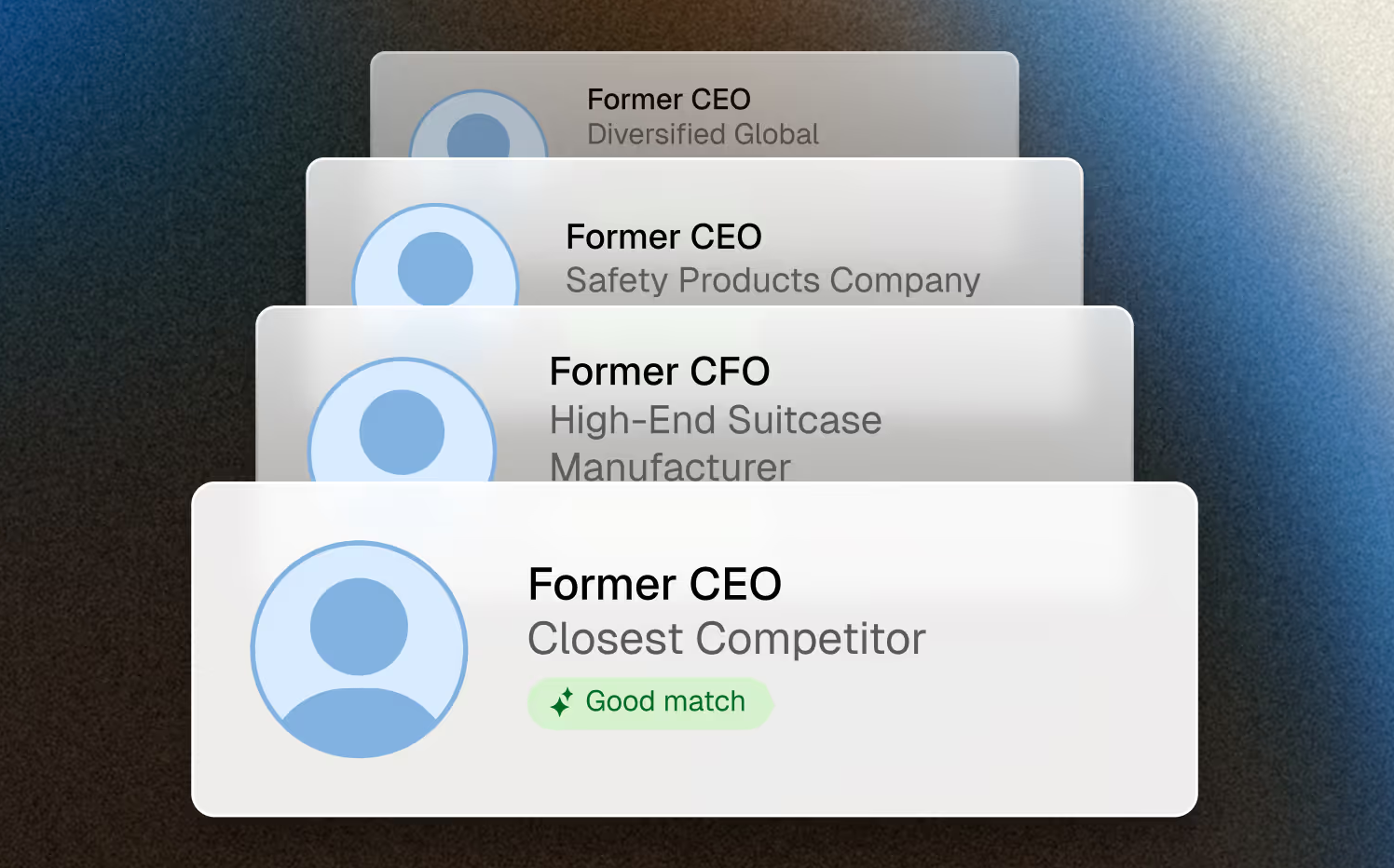
GLG runs on a high-touch service model. Clients work with dedicated service teams operating around the clock. The AI-powered matching engine analyzes 25+ years of proprietary data to surface experts, and clients can also browse and search the network directly.
Source: GLG
Calls are private 1:1 conversations led by the client, with AI-generated transcripts featuring speaker identification and time stamping. GLG offers capabilities other networks don't match: expert exclusivity (blocking competitors from accessing a specific expert), written expert follow-ups, and a clear escalation path from call to deal advisor to board director.
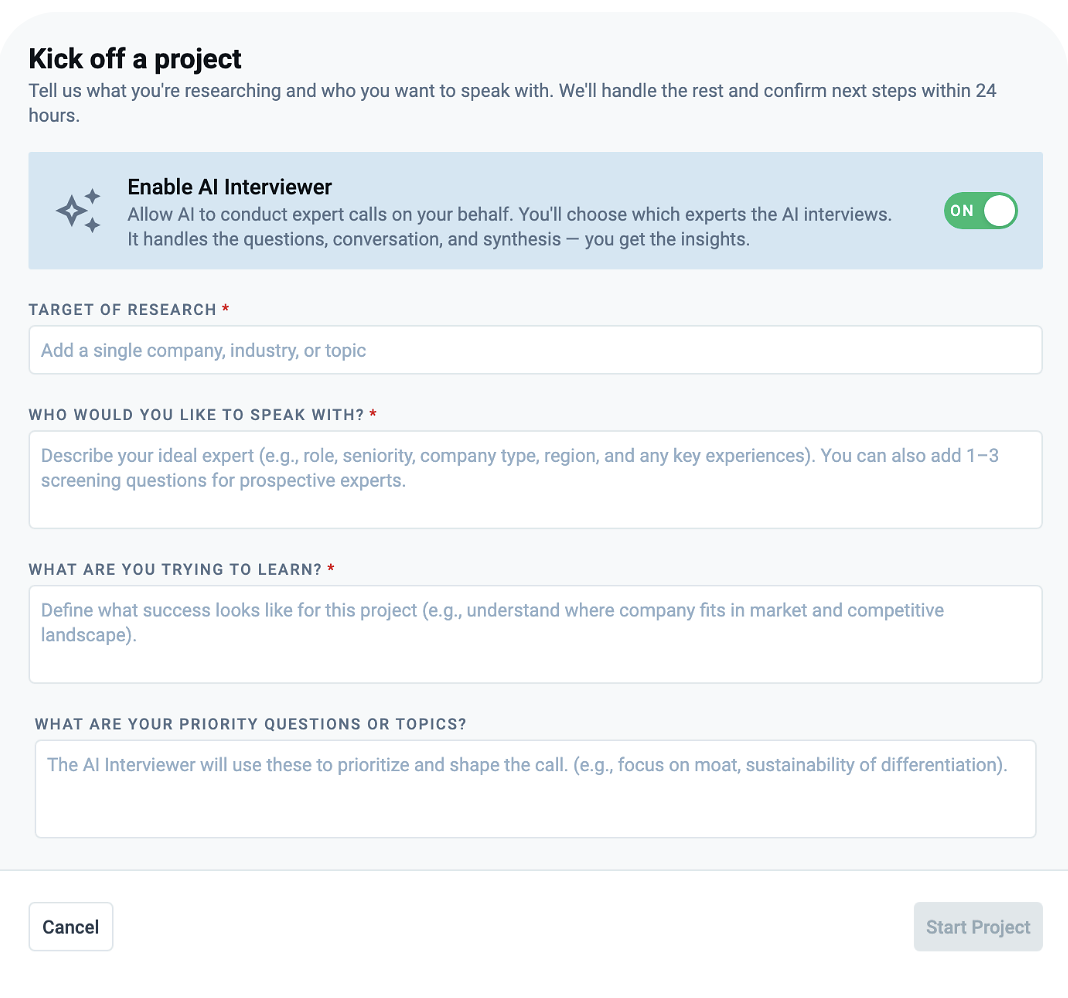
Tegus routes call services through a centralized portal inside AlphaSense. Clients specify their research objective, and expert recommendations for many topics arrive within 24-48 hours.
The differentiator is the transcript library as pre-call intelligence: analysts review the 260,000+ transcripts on a company before deciding whether a live call is even necessary. When a call does happen, Tegus offers both human-led and AI-Led Expert Calls where an autonomous interviewer conducts conversations 24/7.
Source: Tegus
The pricing contrast is stark. GLG does not publish pricing, and G2 reviewers consistently cite cost as a friction point. Tegus positions its model as transparent: the expert's own rate plus a flat $75 transcription fee, no markups, claiming approximately 70% cost savings compared to traditional expert networks.
For teams running 100+ calls per year across multiple deal workstreams, GLG's service depth and expert lifecycle (call to advisor to board seat) may justify the premium. For teams that value self-directed research efficiency and want to use the transcript library to reduce their live call volume, Tegus offers a more cost-effective model.
Beyond expert calls: where the platforms diverge
GLG offers services that Tegus doesn't attempt, and Tegus offers data products that GLG doesn't match.
GLG's extended services:
GLG's Advisory & Placements division places practitioners into live workflows. PE firms can engage deal advisors within one week on a pay-at-placement basis, source independent board directors, and find trial-ready expert witnesses in 24-48 hours.
Source: GLG
GLG's survey and sample sourcing products run quantitative research against its 1.2M-member network, supplemented by panel partners covering 10M+ professionals and consumers. These services make GLG a full research partner, not just a call-booking platform.
Tegus's data and analytics products:
Tegus brings 4,000+ Canalyst financial models into the platform: analyst-built Excel workbooks covering 10 years of historical data and 5 years of linked forecasts. The Automatic Earnings Updater pushes new quarterly data into custom models without breaking analyst modifications.
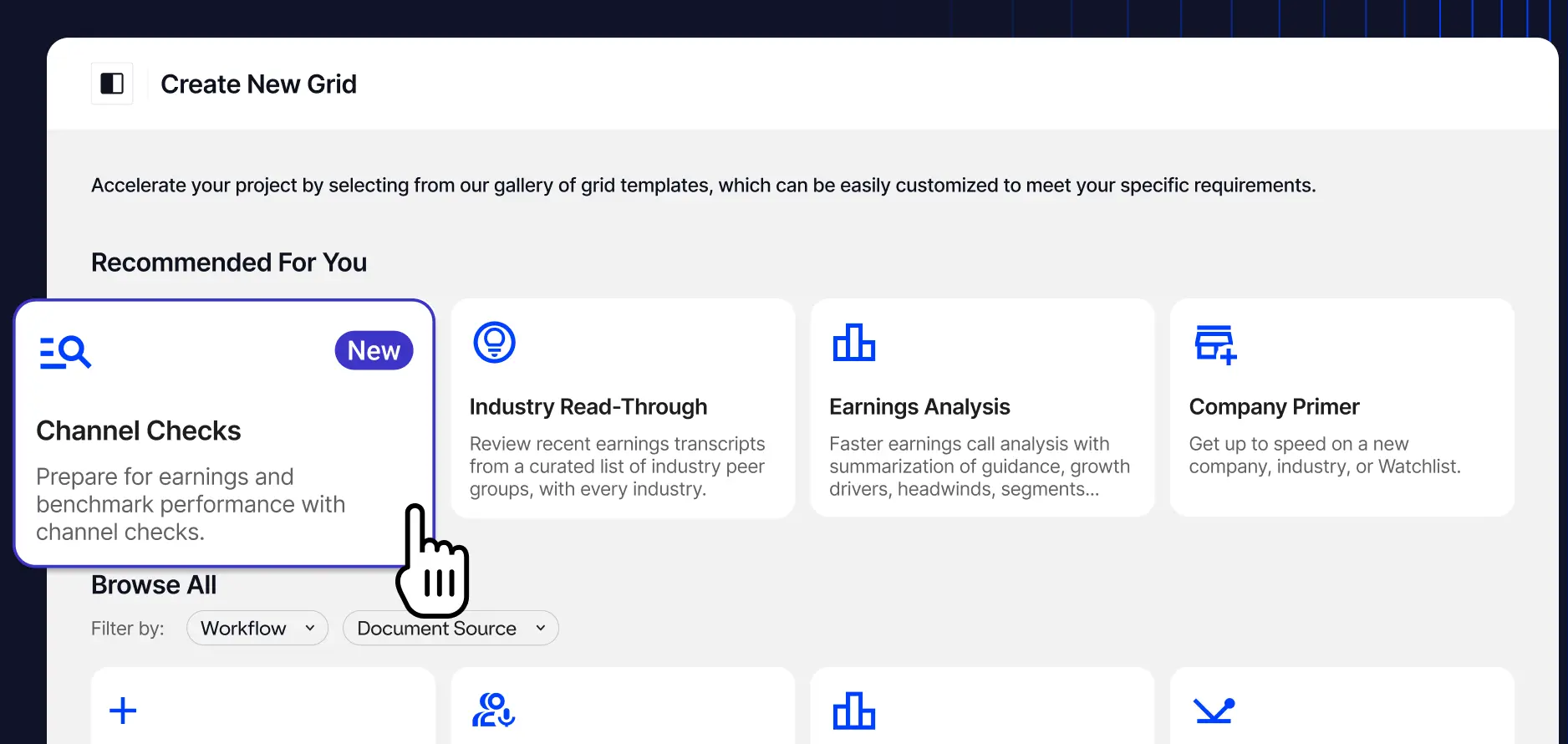
Channel Checks run AI-led interviews targeting real-time market signals across 350+ tickers, surfacing demand shifts and pricing changes weeks before traditional reports. And the combined AlphaSense platform puts expert transcripts alongside broker research from 1,500+ global partners, SEC filings, and earnings transcripts, all searchable through a single AI query.
Source: Tegus
The choice depends on what "expert research" means in your workflow. If it means sourcing practitioners for qualitative engagements including surveys, advisory, and expert testimony, GLG covers more ground. If it means a combined quantitative and qualitative research platform where expert transcripts sit next to financial models and filings, Tegus is further along.
Where ZoomInfo fits: the data layer expert networks assume you already have
Expert networks connect you with people who can answer your questions. But those questions need to be well-targeted, and the companies, contacts, and signals informing them need to be accurate. That's where ZoomInfo fills a gap neither Tegus nor GLG addresses.
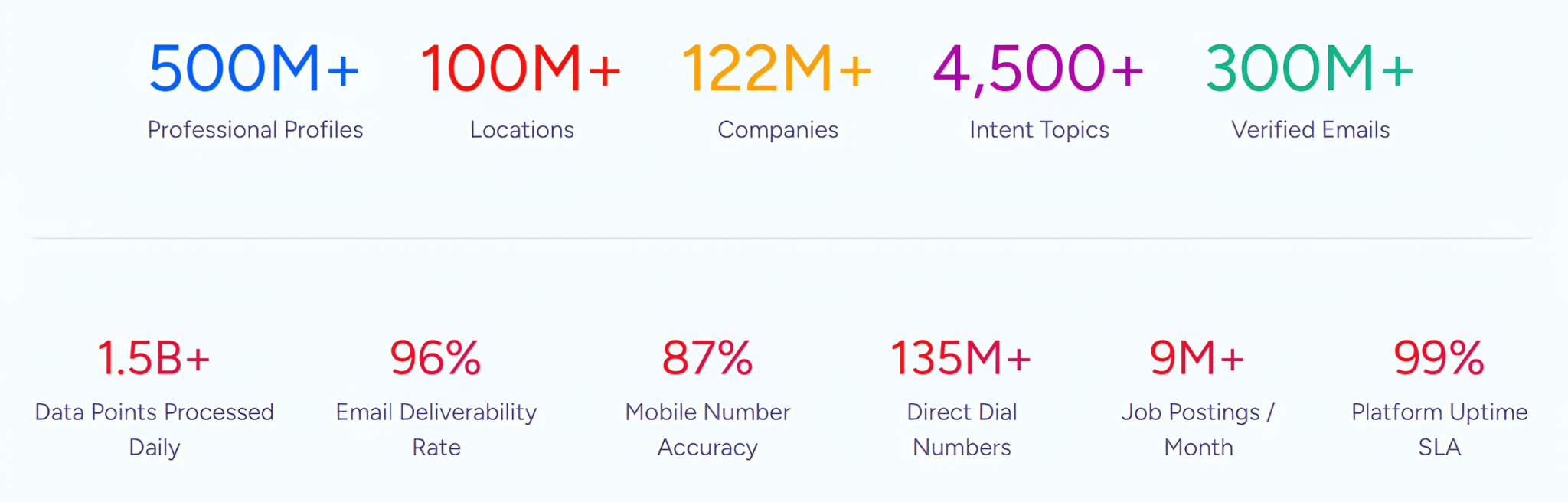
ZoomInfo is not an expert network. It's an AI-powered go-to-market platform built on a broad B2B data foundation: 500M contacts, 100M companies, 135M+ verified phone numbers, and 200M+ verified business email addresses.
Source: ZoomInfo
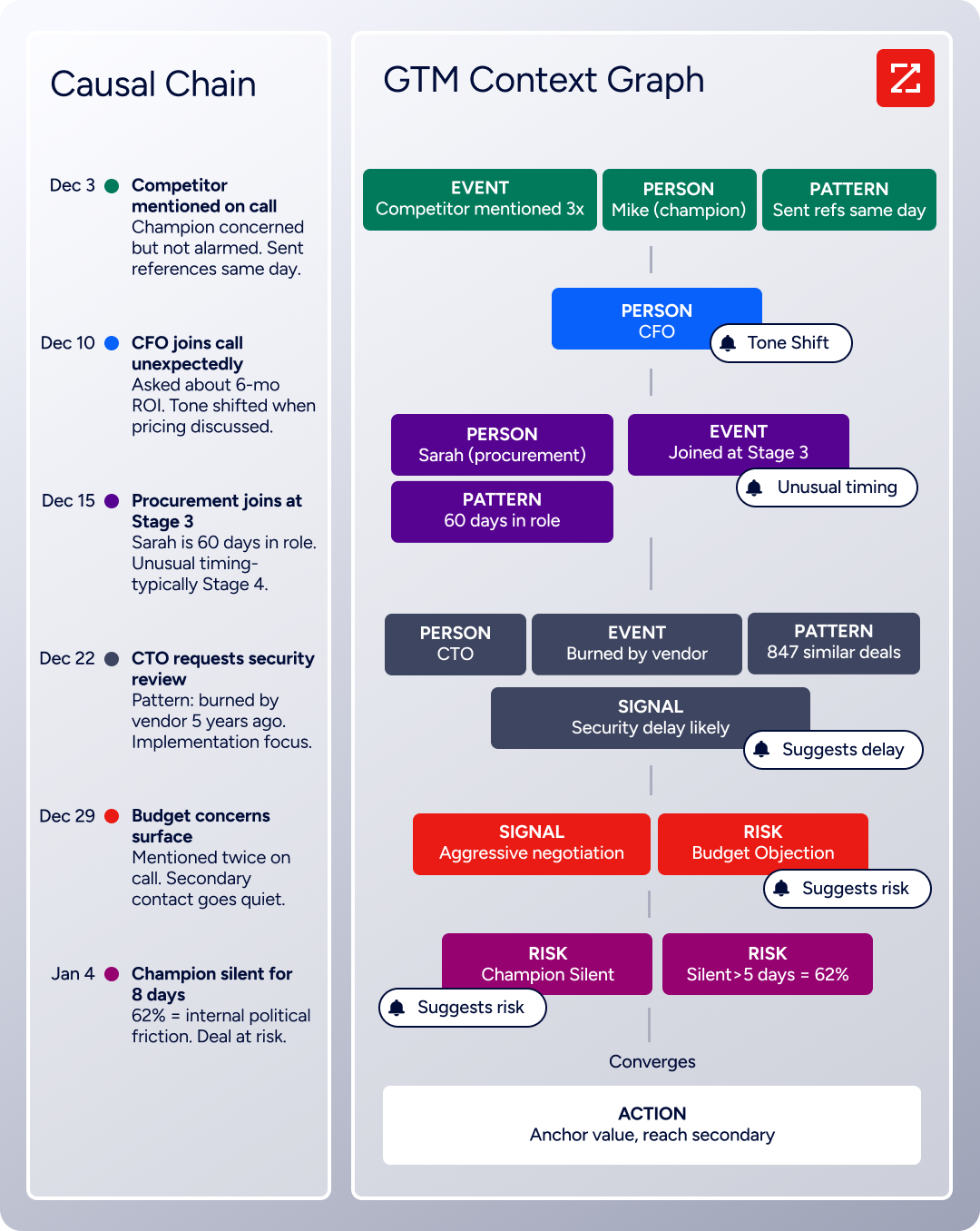
Its GTM Context Graph processes 1.5B + data points daily, combining this B2B data with your CRM records and behavioral signals to surface not just what happened in an account, but why, giving research teams the context to ask sharper questions before an expert call begins.
Source: ZoomInfo
Where Tegus and GLG deliver qualitative intelligence from practitioners, ZoomInfo delivers the verified quantitative intelligence that makes qualitative research more precise.
For PE due diligence teams, ZoomInfo's company attributes, org charts, and technographics help map a target's organizational structure and technology stack before an expert call begins.
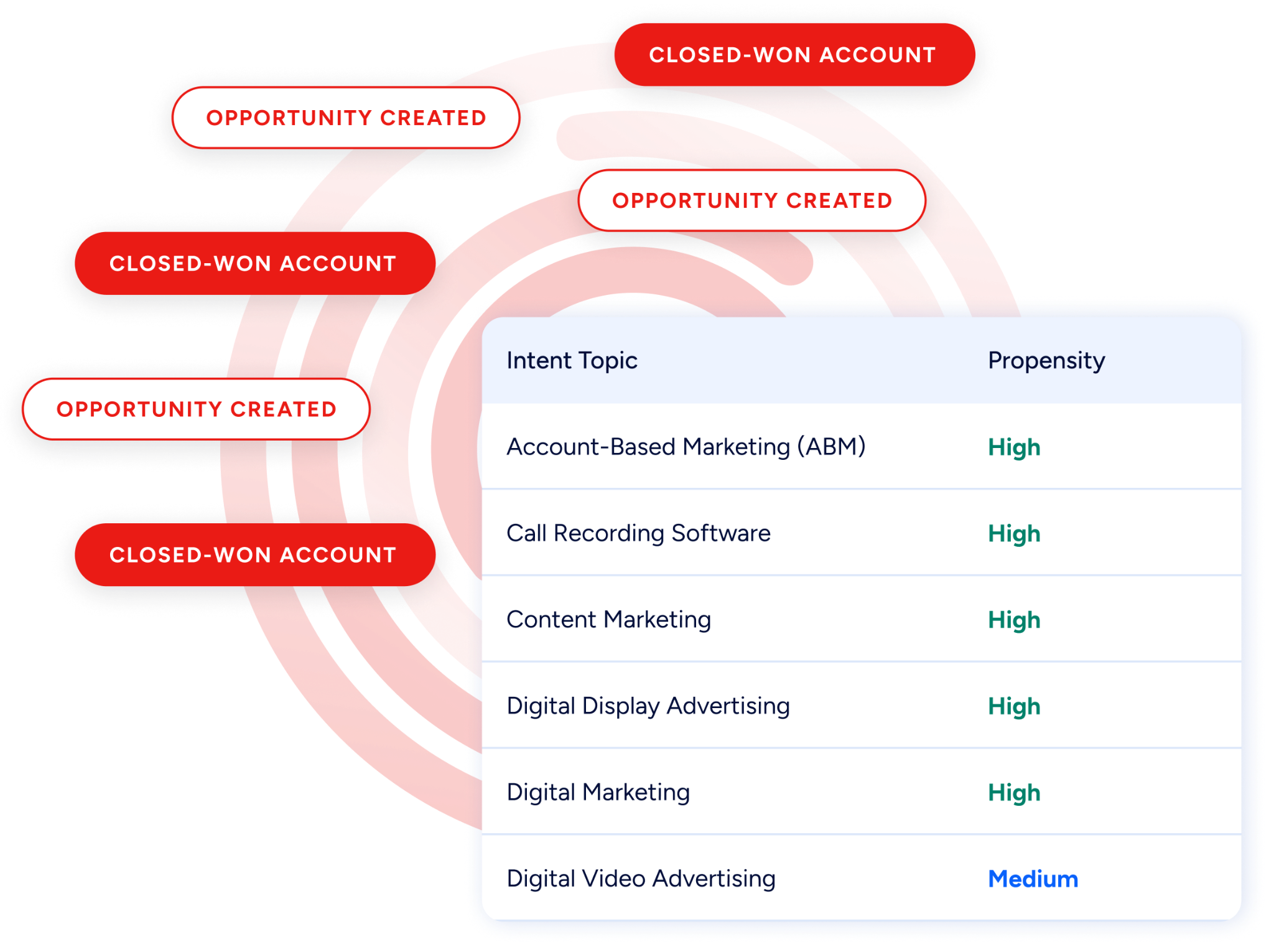
ZoomInfo's buyer intent signals, tracking signals from 210 million pairings of IP-to-Organization data, surface which companies are actively researching specific solutions, an early indicator that complements the qualitative detail an expert provides.
Source: ZoomInfo
For corporate strategy teams, ZoomInfo's search and enrichment across 300+ attributes identifies the competitive landscape and potential market entrants that inform the questions you bring to an expert call.
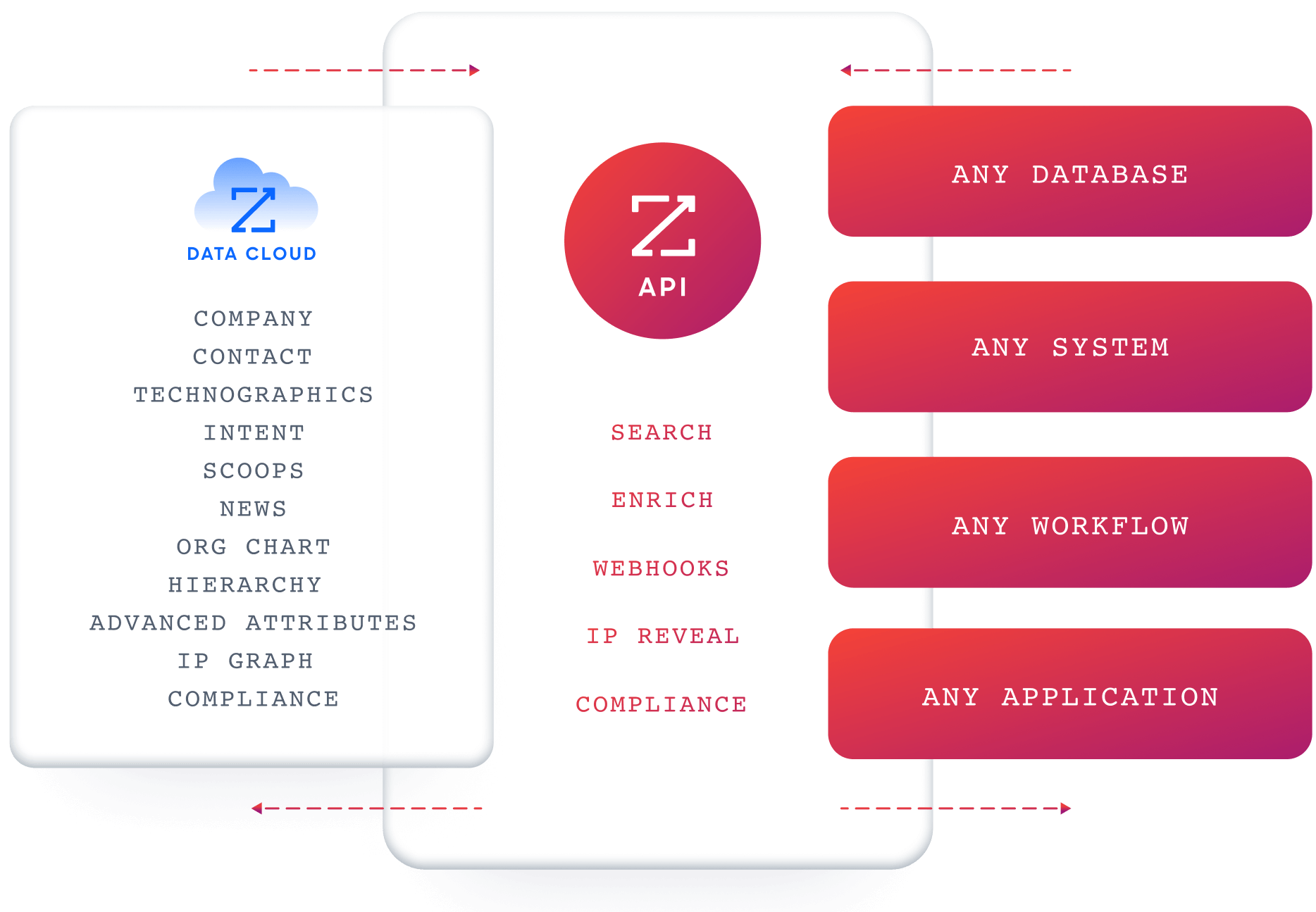
For investment analysts, ZoomInfo's Enterprise API and MCP server let teams programmatically pull company data, contact intelligence, and intent signals into their own research systems or AI workflows, enriching the same workstreams where Tegus transcripts and GLG expert calls generate qualitative insights.
Source: ZoomInfo
"You'll get 10x the value if you think of ZoomInfo as a full platform and not just a tool for one team." - John Kotsuros, Founder and CEO of SpringDB, which saw 2x-3x increases in campaign conversions and 30-50% uplift in average deal size using enriched data. (SpringDB Case Study)
ZoomInfo also provides a permanent free tier (ZoomInfo Lite) and a 7-day free trial with no credit card required, something neither Tegus nor GLG offers.
Pricing and commercial models compared
Neither Tegus nor GLG publishes prices, but their commercial structures are clear enough to compare.
Tegus (AlphaSense) operates on an annual subscription model with two platform tiers: Market Intelligence (base tier with the transcript library, filings, broker research, and news) and Enterprise Intelligence (adds AI search on internal content, private cloud hosting, and professional services).
Expert calls are a separately purchased add-on, with clients paying only the expert's own rate plus a $75 transcription fee. Canalyst financial models are a second optional add-on. Contracts auto-renew with 30 days' notice required to cancel, and payment obligations are non-cancelable.
GLG uses a negotiated-contract model where every engagement is governed by a custom Schedule specifying fees, scope, and access rights. Each service line (expert calls, content library, surveys, events, advisory, placements) appears to be priced independently.
There is no public pricing page, no free trial, and no self-serve entry point. The sole exception is a 60-day free trial with up to 100 downloads for the Expert Content Feed product, aimed at data engineering teams.
ZoomInfo uses consumption-based pricing across Sales, Marketing, and Operations product lines, each with multiple tiers (Professional, Advanced, Enterprise). Credits determine export volume (1 credit = 1 contact or company export), while tiers determine feature access (intent signals, AI capabilities, advanced integrations). API access is included in all relevant plans.
ZoomInfo offers the most accessible entry points: ZoomInfo Lite (free, permanent, 10 monthly export credits) and a 7-day free trial with no credit card required.
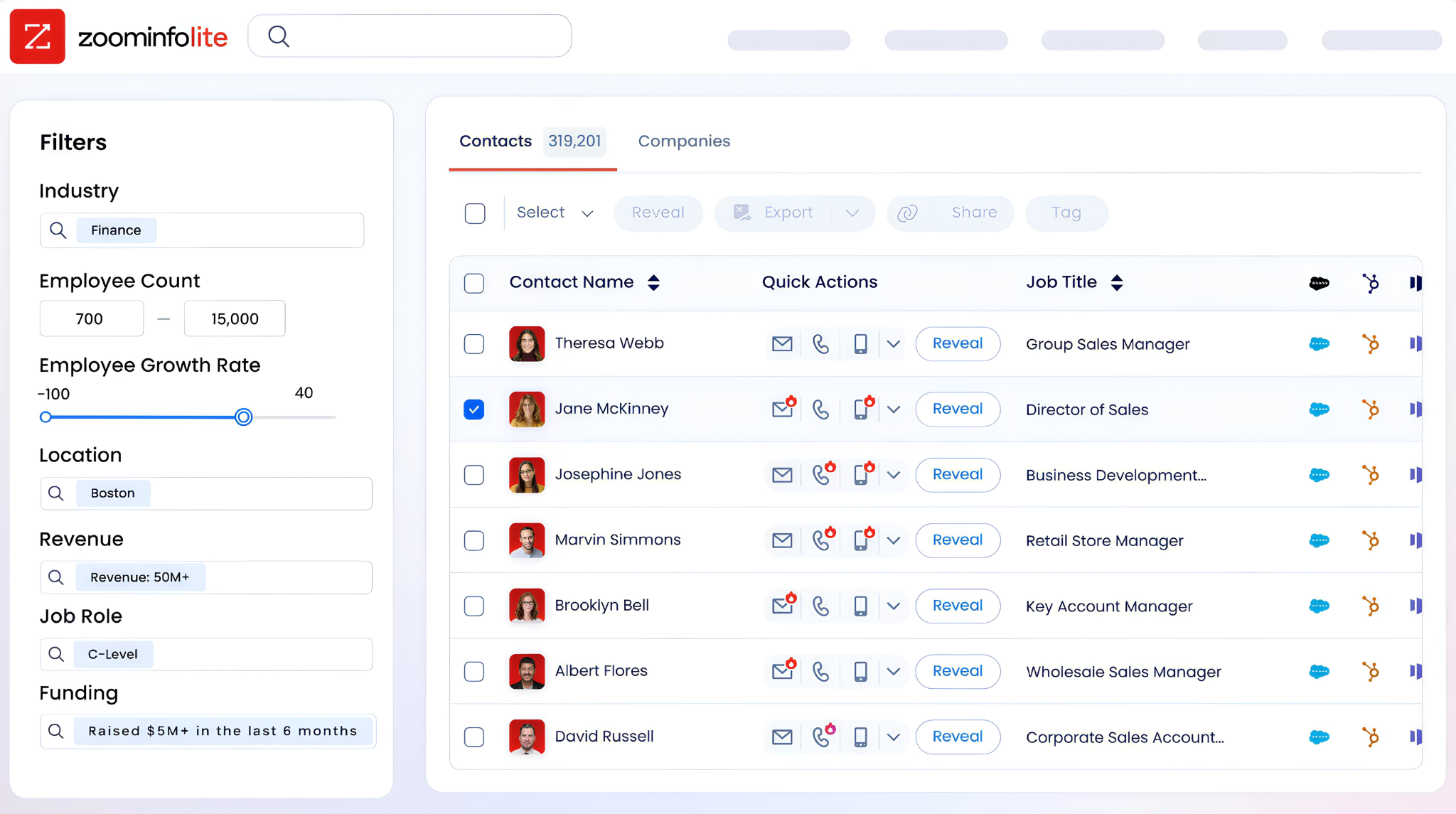
Source: ZoomInfo
Post-acquisition, Tegus pricing has reportedly moved upmarket. GLG has always commanded a premium. For teams evaluating total cost, the comparison isn't just platform-to-platform. It's whether Tegus's transcript library reduces live call volume enough to offset the subscription cost, and whether GLG's service breadth justifies paying a premium per call.
Coverage gaps: where each platform falls short
No research platform covers everything. Understanding the gaps helps you avoid buying into a blind spot.
Tegus skews toward TMT, healthcare, and North American markets. Firms researching industrials, commodities, energy, or niche sub-sectors may find thinner transcript coverage.
Geographic and language coverage tilts toward English-language markets, with APAC and LatAm coverage reportedly inconsistent. Tegus also does not offer survey services, advisory placements, or expert witness sourcing. It's a research platform, not a full-service research partner.
GLG's network is strongest in North America and Western Europe. G2 reviewers note expert-client skill mismatch as a recurring friction point, particularly on niche or fast-moving topics where database-driven matching surfaces frequently used profiles rather than fresh recruits.
GLG's subscription model is optimized for high-volume institutional buyers; organizations running fewer than a few dozen calls per year face unfavorable economics compared to per-call alternatives. There is no self-serve or SMB-accessible entry point.
ZoomInfo is a B2B data platform, not an expert network. It does not provide expert calls, qualitative research transcripts, or practitioner interviews. Its value to an expert research workflow is upstream: enriching the companies and contacts that inform your research agenda. Teams that need both qualitative expert intelligence and quantitative B2B data will use ZoomInfo alongside (not instead of) Tegus or GLG.
Tegus vs. GLG vs. ZoomInfo: Which should you choose?
The right choice depends on what role expert research plays in your organization and how much infrastructure you need around it.
Choose Tegus if:
Your team's research speed depends on accessing prior expert conversations before scheduling new calls
You want expert transcripts, financial models, filings, and broker research in a single AI-searchable platform
Transparent, no-markup expert call pricing matters to your budget
You invest primarily in TMT, healthcare, or well-covered public and private companies
AI-powered research synthesis (Deep Research, Generative Search) is important to your workflow
Choose GLG if:
Your compliance requirements demand the strongest available expert network controls (400,000-node disclosure system, call chaperoning, employer registry)
You need services beyond expert calls: surveys, deal advisors, board placements, or expert witnesses
You value named expert attribution and private, custom research engagements
Your research spans geographies and sectors where GLG's 1.2M-member network provides the broadest coverage
Bloomberg Terminal or FactSet integration for expert content is a workflow requirement
Add ZoomInfo if:
You need verified B2B contact data, company attributes, org charts, and technographics to inform your research targeting
Buyer intent signals would help you identify which companies to prioritize for expert calls
Your CRM data needs enrichment to support PE due diligence, competitive analysis, or market mapping
You want to programmatically access B2B intelligence via API or MCP alongside your expert research workflow
You want to start immediately with a free tier or 7-day trial
Start with ZoomInfo Lite for free, or request a full trial.
Tegus and GLG both solve the same core problem from different angles. Tegus compresses research time through its transcript library and AI-powered synthesis. GLG provides breadth and full-service research infrastructure. Neither replaces the need for accurate B2B data, verified contacts, and market signals, and that's where ZoomInfo adds value as a complementary layer in the research stack.
Tegus vs. GLG FAQ
What is the key difference between Tegus and GLG?
Tegus is built around a shared expert transcript library of 260,000+ investor-led interviews that subscribers can search before scheduling live calls. GLG is built around private expert engagements supported by high-touch service teams and nearly 30 years of compliance infrastructure.
Tegus prioritizes research speed and self-directed discovery. GLG prioritizes service depth, named-expert attribution, and full-lifecycle research support including surveys, advisory placements, and expert witness sourcing.
Which platform has the larger expert network?
Both networks are comparable in scale. GLG has 1.2 million verified professional members, while Tegus (via AlphaSense) references 1 million pre-qualified experts. The more relevant differentiator is what each network produces: GLG's network feeds private, named-expert engagements and a curated content library, while Tegus's network feeds the world's largest shared transcript library.
Which platform is more cost-effective for expert calls?
Tegus positions itself as significantly cheaper, advertising transparent pricing with no markups: the expert's own rate plus a flat $75 transcription fee, claiming approximately 70% savings versus traditional expert networks. GLG does not publish pricing and operates on negotiated contracts with premium rates. However, cost-effectiveness depends on volume.
Tegus's subscription model favors high-volume users, while GLG's per-call model may work for lower-volume needs if the contract terms support it.
Can Tegus and GLG both integrate with AI tools?
Yes. GLG launched the MCP Connector in July 2026, embedding its expert content as a context source inside Claude and (coming soon) ChatGPT. Tegus (via AlphaSense) offers a documented MCP server and a developer API with GenSearch, Deep Research, and AI-Led Expert Call capabilities. Both platforms commit to not using client data for AI model training.
Is ZoomInfo a competitor to Tegus or GLG?
No. ZoomInfo is a complementary tool. Tegus and GLG provide qualitative expert intelligence (practitioner conversations, survey data, expert transcripts). ZoomInfo provides quantitative B2B intelligence (verified contact data, company attributes, org charts, technographics, and buyer intent signals).
Investment and strategy teams often use ZoomInfo's data to identify and prioritize research targets, then use Tegus or GLG for the qualitative expert conversations that validate investment theses or strategic decisions.
Which platform is better for private equity due diligence?
Both serve PE firms, but with different strengths. GLG offers deal advisors who can join management meetings, board placement services for portfolio companies, and the ability to transition an expert from a single call into an embedded advisory relationship. Tegus offers strong private company transcript coverage and financial models that compress the quantitative modeling work.
Many PE firms use both: Tegus for initial ramp-up and thesis screening, GLG for custom deep-dives and post-close advisory.
What compliance certifications do these platforms hold?
Tegus (via AlphaSense) holds SOC 2 Type II attestation and ISO/IEC 27001:2022 certification, with active pursuit of ISO/IEC 42001 for AI governance. GLG relies on Persona for expert identity verification (SOC 2 Type II and ISO 27001 certified) and uses Axonius for internal cybersecurity management, though GLG does not publicly publish its own SOC 2 or ISO certifications.
ZoomInfo holds ISO 27001, ISO 27701, SOC 2 Type II, and TRUSTe GDPR and CCPA certifications, all renewed annually.
Which platform offers a free trial?
Neither Tegus nor GLG offers a self-serve free trial with instant access. Tegus provides a sales-led trial request through AlphaSense. GLG offers no general free trial, though its Expert Content Feed has a 60-day trial with up to 100 downloads for data engineering teams. ZoomInfo offers both a permanent free tier (ZoomInfo Lite with 10 monthly export credits) and a 7-day free trial with no credit card required.
