
ZoomInfo's Forrester TEI study: what the numbers mean for enterprise GTM teams
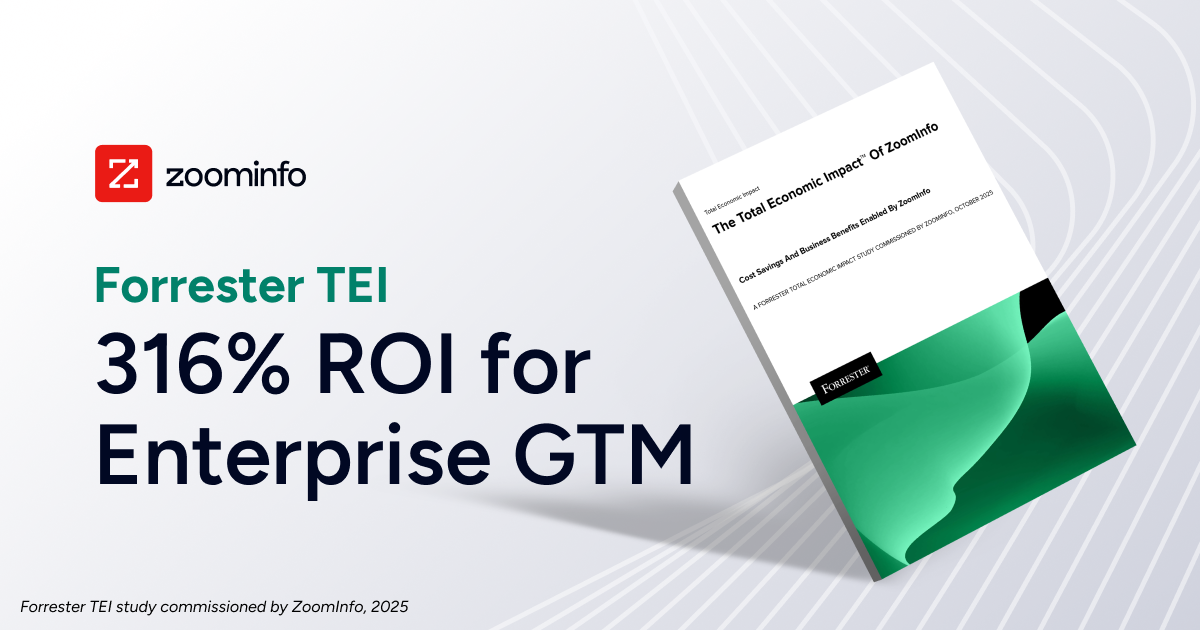
With 316% ROI over three years, $7.6 million in total quantified benefits, and a payback period of less than six months, the 2025 Total Economic Impact™ study conducted by Forrester Consulting on behalf of ZoomInfo provides independent, third-party validation of what ZoomInfo delivers for enterprise go-to-market teams.
Enterprise go-to-market leaders live by three simple words: return on investment. Delivering ROI for customers is their only path to growth, and partners have to meet the same expectations. The Forrester total economic impact analysis gives those leaders a rigorous, risk-adjusted framework for making that case internally.
Here's more about how the study was conducted, and insights from customers who shared how ZoomInfo is driving results for their GTM teams.
What is a Forrester Total Economic Impact™ study?
Forrester's Total Economic Impact™ (TEI) methodology is an independent, commissioned business value justification framework designed to help organizations quantify the full financial impact of a technology investment. Rather than relying on vendor claims alone, Forrester conducts structured customer interviews and constructs a composite organization to produce a conservative, third-party-validated business case.
The TEI framework evaluates four dimensions: benefits (the quantified value delivered by the investment), costs (the full cost of acquisition, implementation, and ongoing operation), flexibility (the option value created for future initiatives), and risk (the uncertainty in realizing projected benefits and costs). Each dimension is analyzed separately before being combined into a single financial model.
The key output metric is risk-adjusted net present value (NPV). Forrester discounts projected benefit values based on implementation risk, adoption risk, and market uncertainty before calculating NPV. This produces a more conservative figure than unadjusted ROI calculations, which is exactly why TEI results carry more weight in enterprise procurement conversations than a vendor's own ROI claims.
A Forrester TEI study is distinct from a Forrester Wave report. A TEI study quantifies the ROI of a specific vendor's product for a defined buyer profile, focused on financial impact. A Forrester Wave is an independent, comparative evaluation that ranks multiple vendors across a technology category.
Key findings from the Forrester TEI study
For this commissioned study, Forrester aggregated the experiences of multiple ZoomInfo customers and combined the results into a single composite organization representing a global B2B business with $1.5B annual revenue.
The firm's investment drove $5.8 million in risk-adjusted net present value over three years, delivered through improved data quality, more effective selling and marketing processes, automation, and enhanced targeting.
$5M additional margin from improved sales and marketing performance
The largest driver of value in the TEI study came from revenue improvement within normal sales, RevOps, and marketing practices. ZoomInfo's combination of high-quality data and buying signals, GTM process automation, and GTM Context Graph-driven intelligence delivered a 1.5% revenue improvement, translating to a $5M margin gain over three years (Forrester TEI study, 2025).
Key drivers of this improvement included:
Better data quality: Users no longer needed to double-check results, and contact attempts were far more successful
Time savings: According to an interviewed manager of cloud engineering in the technology industry, "ZoomInfo has reduced the time salespersons spend doing research by 4 to 5 hours per week, giving them more time to sell."
Faster campaigns: An interviewed managing director of data integration in the payment services industry reported, "Our campaign preparation time has been reduced from approximately five months to two to three weeks."
Improved signals: A senior manager of revenue technology in the technology industry noted that, "Accounts with ZoomInfo-sourced signals have shown a 2.7x increase in deal size."
GTM Workspace AI agents: The natural language interface simplified research and enabled interactive analysis, including multiple hypothetical scenarios
Interviews with actual customers drove home these aggregated results.
"Marketing-driven leads are presented to sales instantaneously with organization and contact information, when it previously took a day," a VP of revenue operations at one software company said. "This has improved our probability of closing a deal by around 25%."
$1.3M new revenue from personalized targeting
ZoomInfo customers interviewed for the TEI study also achieved significant results from hyper-personalized targeting, precision that was previously impossible or required extensive custom effort. ZoomInfo's capabilities enabled teams to:
Match contacts' roles to personas, which could then be matched to products and services
Identify champions who had moved to new employers, with current contact information
Target different individuals in the same organization with relevant product offerings
Execute focused campaigns with dramatically improved conversion rates
"A single alumni-tracking initiative using ZoomInfo generated $2 million in pipeline from 10 deals in just the first two weeks," said a senior manager of revenue technology at a technology company.
$1.1M in labor productivity through reassignments
The level of automation, elimination of manual tasks, and data analysis improvements enabled by ZoomInfo allowed the composite company to reassign several key employees to more valuable roles, representing $1.1 million in quantified benefits for the composite organization.
"We set up workflows to automatically identify and enrich contacts," a senior vice president of sales at a financial services company said. "It seemed like RevOps was manually enriching every record previously." (Forrester TEI study, 2025)
Lower costs for third-party tools and databases
The composite organization was able to reduce some existing tools, databases, and associated IT labor due to ZoomInfo's comprehensive data and capabilities.
While business priorities focused on driving new revenue rather than producing immediate cost savings, the natural transition of revenue-generating processes to ZoomInfo resulted in measurable avoided costs.
Strategic benefits that go beyond the numbers
ZoomInfo customers also reported several additional benefits that provide significant value but are harder to measure:
Authoritative source of truth: ZoomInfo serves as the sales and marketing data source of record, providing trusted, current, and valuable data that team members frequently use with confidence. (Forrester TEI study, 2025)
Compliance and security improvements: Organizations have seen significant improvements in their compliance and security posture through centralized data access controls, encryption, and built-in compliance features. (Forrester TEI study, 2025)
Employee satisfaction improvements: Sales, RevOps, and marketing teams are happier due to the ZoomInfo implementation. Eliminating manual tasks has allowed them to do more value-adding work, and the quality of data and tools has enabled them to produce better results. (Forrester TEI study, 2025)
Improved decision-making: ZoomInfo provides insights that inform strategy and tactical decision-making, including industry and global region knowledge that helps organizations improve their approach to different markets. (Forrester TEI study, 2025)
These outcomes trace back to the same infrastructure. The data foundation covers 500M contacts, 100M companies, 135M+ verified phone numbers, and 200M+ verified business emails, maintained by 300+ human researchers with up to 95% accuracy on first-party data. On top of that foundation sits the GTM Context Graph, the intelligence layer that processes 1.5B+ data points daily and fuses ZoomInfo's B2B data with customer CRM data, conversation intelligence, and behavioral signals into a unified reasoning layer that captures not just what happened but why. Access runs through three lanes built for different users: GTM Workspace for sellers, GTM Studio for RevOps teams and marketers, and APIs and MCP for custom tools and AI agents, so every team works from the same data and intelligence without lock-in.
How ZoomInfo's data and automation infrastructure drives these results
That three-pillar architecture only delivers compounding returns if the data layer underneath it stays current, and that's where most enterprise GTM stacks quietly break down. According to Forbes and Salesforce State of Sales research, 91% of CRM data is incomplete, a structural problem that batch append cannot solve. ZoomInfo's waterfall enrichment draws from 25+ sources and is maintained by 300+ human researchers, delivering up to 95% accuracy on first-party data through continuous enrichment rather than periodic snapshots. That distinction matters for RevOps teams building territory models, scoring models, or routing logic on top of CRM data: the foundation has to hold.
GTM Studio is where that data foundation becomes operational leverage. RevOps managers can configure waterfall enrichment from multiple sources, set routing logic, and launch an ABM play in the same afternoon, without writing a SOQL query, building a flow, testing in sandbox, or filing an engineering ticket. The pattern that transcript data confirms is frequent (RO_PP_04): marketing wants a new ABM segment, and the two-week engineering cycle becomes the bottleneck. GTM Studio's codeless interface eliminates that cycle, letting GTM teams self-serve on audience and play creation while keeping the underlying data pipeline governed and auditable.
Speed-to-lead is where enrichment sequence and routing architecture intersect most visibly. The TEI study's $1.1M labor productivity finding was enabled in part by automated enrichment running before routing decisions, compressing the time from inbound capture to rep notification. Momentive cut speed-to-lead from 20 minutes to 60 seconds using ZoomInfo Operations, a result that reflects exactly this architecture: enrichment completes before the routing decision runs, so leads arrive at the right rep with complete context rather than landing in a queue to be manually corrected.
What the Forrester TEI study means for enterprise GTM teams
The 2025 Total Economic Impact™ of ZoomInfo study demonstrated that ZoomInfo delivers substantial value to enterprises. The Forrester TEI study provides a detailed, data-driven examination of the results ZoomInfo has delivered for enterprise customers seeking to demonstrate ROI on their technology investments, overcome data quality challenges, and drive measurable revenue growth.
For enterprise procurement conversations, the payback period is often the metric that lands hardest with finance leaders, more than total NPV magnitude. A sub-six-month payback compresses the risk window significantly and makes the business case easier to defend in a budget review than a three-year NPV projection alone.
The TEI study figures are risk-adjusted and therefore conservative by design, as described in the methodology section above.
Download the full Forrester TEI report to explore the complete methodology, detailed financial analysis, and insights from organizations that have transformed their go-to-market operations with ZoomInfo.
How Forrester conducted this study
Forrester interviewed decision-makers with experience using the ZoomInfo platform at five organizations. These organizations represented industries including financial services, technology, payment services, and software, with annual revenues ranging from $100M to $50B.
For the purposes of this commissioned study conducted by Forrester Consulting on behalf of ZoomInfo, Forrester aggregated the experiences of the interviewees and combined the results into a single composite organization representative of a global B2B business with revenue of $1.5B per year. Forrester uses a composite organization rather than reporting individual customer results to protect confidentiality and to produce findings that generalize across a representative enterprise buyer profile.
The Forrester TEI methodology applies a risk-adjustment step before calculating NPV: projected benefit values are discounted based on implementation risk, adoption risk, and market uncertainty. This produces a more conservative NPV than unadjusted calculations. The $5.8M risk-adjusted NPV in this study uses a three-year time horizon with a standard discount rate, meaning the figure already accounts for the scenarios where adoption is slower or implementation is more complex than the median customer experience. The Total Economic Impact™ framework is Forrester's standard approach for commissioned business value studies.
See ZoomInfo's ROI for your team
The Forrester TEI study provides a validated, risk-adjusted business case for ZoomInfo as the all-in-one AI GTM Platform. The 316% ROI, $7.6M in total benefits, and sub-six-month payback reflect what ZoomInfo's data and automation infrastructure delivers for enterprise GTM teams operating at scale.
Request a demo to see how ZoomInfo delivers measurable ROI for enterprise GTM teams.
Frequently asked questions
What is a Forrester TEI report?
A Forrester Total Economic Impact™ (TEI) report is an independent, commissioned study that quantifies the financial impact of a technology investment. Forrester interviews real customers, constructs a composite organization profile, and calculates risk-adjusted ROI, NPV, and payback period across four dimensions: benefits, costs, flexibility, and risk. The result is a conservative, third-party-validated business case. See the ZoomInfo Forrester TEI study for a live example of the methodology applied to an enterprise GTM platform.
What ROI does ZoomInfo deliver according to the Forrester TEI study?
According to the 2025 Forrester Total Economic Impact™ study commissioned by ZoomInfo, the composite enterprise organization achieved 316% ROI over three years, $7.6 million in total quantified benefits, and a payback period of less than six months. The largest benefit driver was a $5 million margin gain from improved sales and marketing performance, followed by $1.3 million from personalized targeting and $1.1 million in labor productivity gains. Read the full Forrester TEI study to see the complete financial model.
How does a Forrester TEI study differ from a Forrester Wave report?
A Forrester TEI study is commissioned by a specific vendor to quantify the ROI of their product for a defined buyer profile, it is vendor-specific and focused on financial impact. A Forrester Wave is an independent, comparative evaluation that ranks multiple vendors across a technology category. TEI answers "what return will I get from this investment?" while the Wave answers "which vendor should I choose?"
How long does it take to see ROI from ZoomInfo?
The 2025 Forrester TEI study found that the composite ZoomInfo customer organization reached payback in less than six months, faster than many enterprise software investments. Individual outcomes vary based on team size, use case, and implementation depth, but the study's risk-adjusted methodology means the six-month figure is a conservative estimate, not an optimistic projection. Request a demo to see how ZoomInfo's data and automation infrastructure maps to your team's specific use case.