
If you're comparing Userflow vs. WalkMe, the first thing to sort out is what kind of adoption problem you're solving. Both platforms offer in-app guidance, tooltips, and checklists, but they're built for different audiences, budgets, and use cases.
The real questions you should be asking:
Are you onboarding external users to your own SaaS product, or training internal employees on enterprise software?
Do you need a tool your product team can set up in a day, or a platform that requires a dedicated team to implement over months?
Is your user base in the thousands or the hundreds of thousands?
Can your team operate independently, or do you need governance, compliance, and SSO?
Are you optimizing a single product's onboarding, or managing adoption across an entire tech stack?
In short, here's what we recommend:
Userflow is built for SaaS companies that want to onboard external users quickly without engineering help. Its no-code flow builder and AI-powered Smartflow (which auto-generates walkthroughs by observing how you click through your product) let product and customer success teams go from zero to live onboarding in a single day. However, its analytics lack a centralized dashboard, and usage-based pricing scales with monthly active users and AI credits as adoption grows.
WalkMe serves large enterprises driving adoption of internal software like SAP, Salesforce, and Workday across thousands of employees. As the company that created the DAP category, WalkMe offers analytics across your entire application portfolio, workflow automation, and DeepUI technology that automatically adapts guidance when applications update. That capability comes at enterprise cost: custom pricing with multi-year contracts, a steep learning curve for administrators, and implementation timelines measured in months.
Both platforms solve the adoption problem: getting users to actually use the software. But adoption is only half the equation. The other half is reaching the right users and buyers in the first place. The best onboarding flow in the world won't save a pipeline full of poorly targeted prospects.
ZoomInfo is a B2B go-to-market platform built on 500M contacts, 100M companies, 135M+ verified phone numbers, and 300M+ verified business emails. Its GTM Context Graph (an intelligence layer processing 1.5B+ data points daily) combines this data with your CRM records, conversation transcripts, and behavioral signals to show not just who your buyers are, but why deals move or stall. For SaaS companies using adoption tools like Userflow or WalkMe, ZoomInfo solves the upstream problem: identifying ideal customers and engaging them before competitors do, so the users entering your product are the ones most likely to succeed.
If reaching the right buyers before they start evaluating your competitors sounds like the missing piece, see how ZoomInfo works.
Userflow vs. WalkMe at a glance
Userflow | WalkMe | ZoomInfo | |
|---|---|---|---|
Primary purpose | External SaaS user onboarding | Internal enterprise software adoption | B2B sales and marketing intelligence |
Target company size | SMB and mid-market SaaS | Large enterprise (5,000 to 100,000+ employees) | Enterprise and upper mid-market B2B |
Setup time | Hours to days | Weeks to months | Deploys in weeks |
Learning curve | Minimal | Steep | Moderate (role-specific onboarding) |
Pricing | Starting at $100/month, transparent, usage-based | Custom enterprise quotes, multi-year contracts | Custom consumption-based; free plan available |
Free trial | 14-day free trial | No public free trial | 7-day free trial + permanent ZoomInfo Lite |
AI capabilities | FlowAI (auto-build flows, insights, translation) | WalkMe AI (contextual assistance, workflow automation, DeepUI) | GTM Context Graph, AI-powered outreach and account intelligence |
Key compliance | SOC 2 Type 2, GDPR | FedRAMP Ready, SOC 2 Type II, ISO 27001 | ISO 27001, ISO 27701, SOC 2 Type II, GDPR, CCPA |
Best for | Product teams onboarding SaaS users | IT and change management teams driving enterprise adoption | Sales, marketing, and RevOps teams finding and engaging buyers |
They solve different adoption problems
The Userflow vs. WalkMe comparison is misleading if you don't first clarify the type of adoption you need.
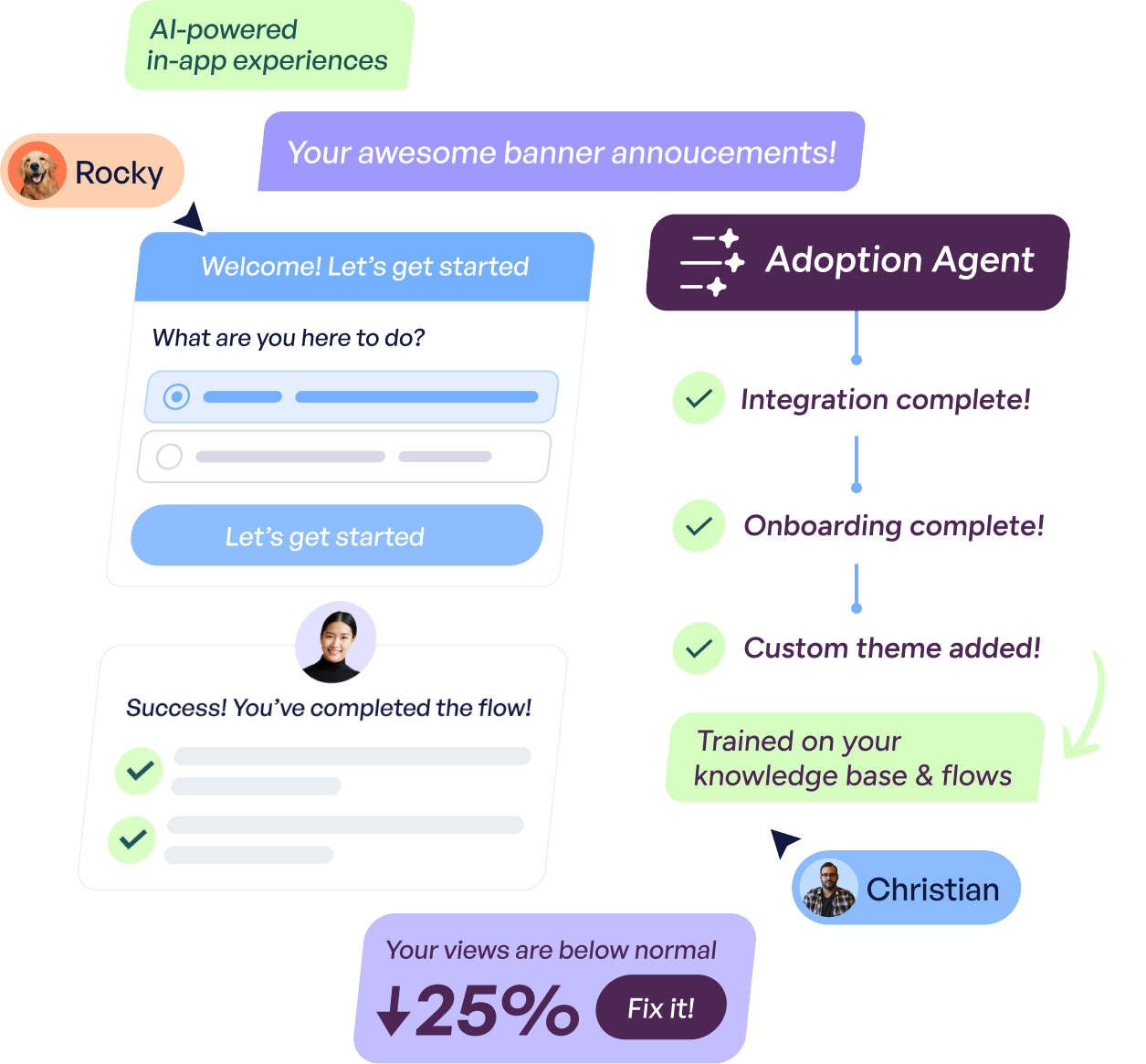
Userflow is built for SaaS companies that want to onboard new users to their own software product. The end users are your customers, people who signed up and need help getting started. Your product manager creates a flow, and your trial users see a guided walkthrough that cuts time to first value.
Source: Userflow
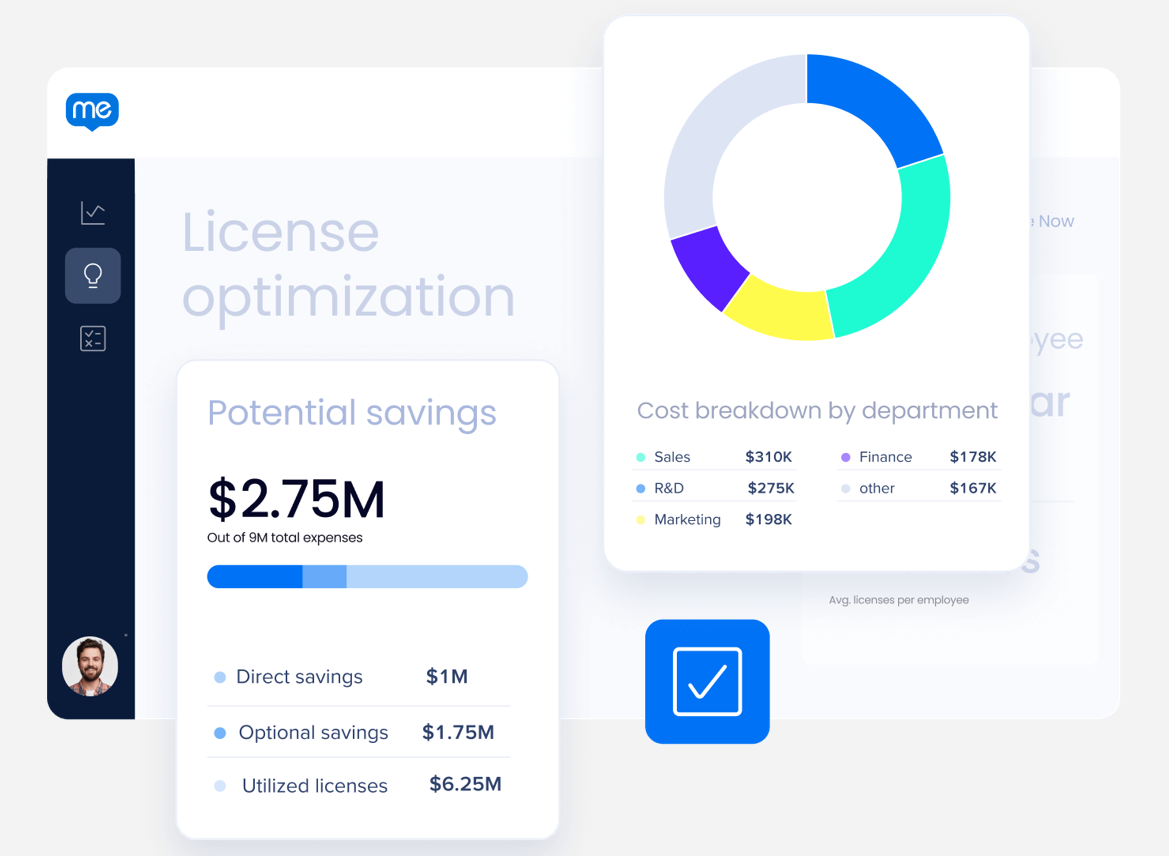
WalkMe is built for employee onboarding and training at scale. The end users are your employees, the people who need to learn SAP, Salesforce, or Workday to do their jobs. Your IT or change management team deploys WalkMe across the enterprise, and employees get contextual guidance inside the applications they use daily.
Source: WalkMe
This distinction shapes everything: pricing, implementation complexity, feature depth, and the skills needed to manage the platform. A SaaS startup with 3,000 users evaluating Userflow is in a different universe from a Fortune 500 company with 50,000 employees evaluating WalkMe.
Userflow wins on speed and simplicity
Userflow was built by a three-person team that bootstrapped to $4.6M ARR, and the product reflects that philosophy: do one thing well, keep it simple.
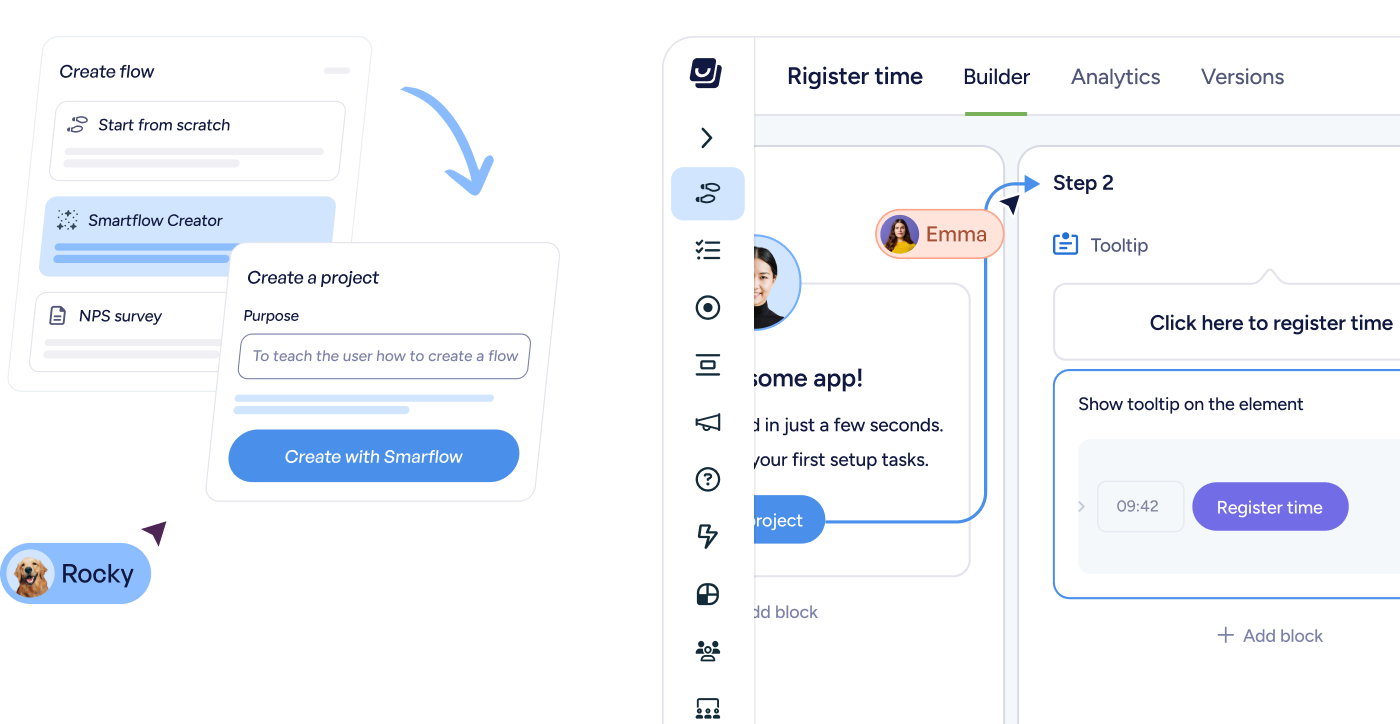
The no-code flow builder uses point-and-click element selection. Product managers, customer success leads, and growth teams build and publish flows, checklists, surveys, and resource centers without filing an engineering ticket. Most teams go from installation to their first live flow in a single day. The Smartflow AI builder takes this further: a team member clicks through the product as a user would, and Smartflow constructs a complete flow of up to 30 steps with contextual content and matching UI patterns.
Source: Userflow
All plans include unlimited flows, checklists, banners, launchers, and surveys. No feature gating on core content creation. The 14-day free trial requires no credit card.
The trade-off is depth. Userflow's analytics require navigating into each flow or checklist individually because there's no centralized analytics dashboard. Teams managing dozens of flows report difficulty organizing content at scale. And features like SSO and advanced permissions are locked behind the custom-priced Enterprise plan.
WalkMe wins on enterprise power and breadth
WalkMe was founded in 2011 and has spent over a decade building for the enterprise. The platform's 900+ employees and approximately 1,600 enterprise customers across 42+ countries serve a different market entirely.
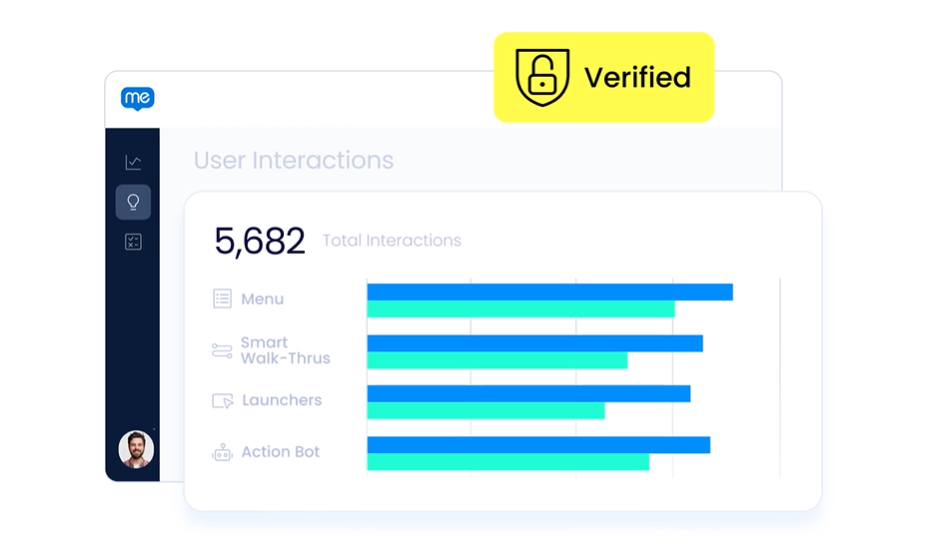
Where Userflow gives you flows and checklists for one product, WalkMe gives you adoption tooling across the stack: usage analytics spanning your tech portfolio, workflow automation that eliminates manual steps, field-level form analytics, and license optimization that identifies unused software spend. WalkMe's research estimates that enterprises manage an average of 625 applications, and WalkMe works across all of them without per-app integrations.
Source: WalkMe
DeepUI is WalkMe's standout technical feature. Traditional guidance tools break when applications update their UI. DeepUI uses AI to understand application interfaces at a structural level, automatically adapting published guidance when elements change.
That capability has a cost. G2 reviewers flag a steep learning curve for advanced configurations, and the platform requires dedicated internal champions and often a Center of Excellence approach to scale. TrustRadius reviewers consistently cite WalkMe as expensive, with custom quotes and multi-year contracts making budgeting difficult.
AI capabilities take different approaches
Both platforms invest in AI, but their approaches reflect their different markets.
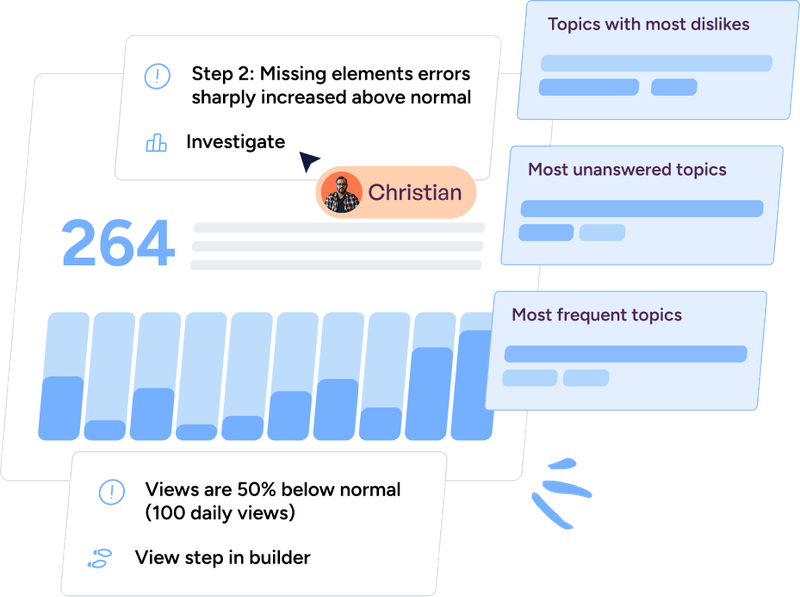
Userflow's FlowAI suite helps non-technical teams move faster. Smartflow auto-generates flows from observed product interactions. AI Translation localizes content across languages in a single click. FlowAI Insights monitors in-app experiences and surfaces engagement drops. The FlowAI Adoption Agent, powered by GPT-4, answers product questions in real time inside the application using the company's own knowledge base. These tools help small teams produce and optimize onboarding content quickly.
Source: Userflow
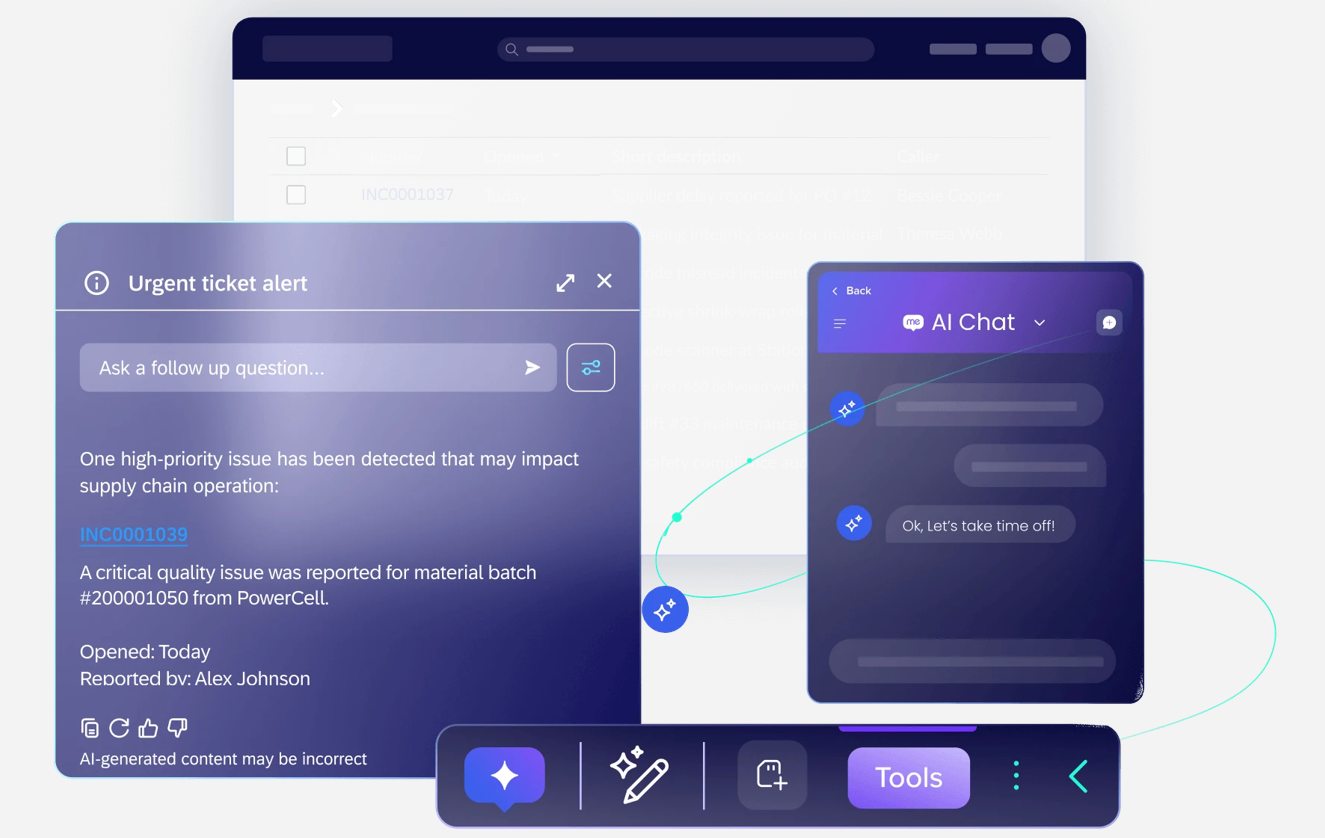
WalkMe AI operates at a broader scope. It delivers contextual AI assistance powered by DeepUI's screen-reading capability, reading what's on the user's screen across any application without API access. WalkMe AI includes next-best-action recommendations, natural language workflow automation (employees chat to complete multi-step processes), input validation, and reading and writing assistance. The system processes 7 billion+ annual interactions between people and software, giving its AI a large dataset for understanding enterprise software navigation.
Source: WalkMe
The WalkMe Learning Arc extends this into digital learning, where AI turns prompts and uploaded files into interactive courses.
The distinction: Userflow's AI helps you build onboarding faster for one product. WalkMe's AI helps employees work faster across every application they use.
Pricing reflects two different worlds
Userflow publishes its prices. Adoption Studio starts at $500/month ($400/month billed annually) and includes 1,000 monthly active users (MAUs), unlimited seats, unlimited flows, surveys, checklists, launchers, integrations, and three environments. Adoption Agent starts at $100/month ($80/month billed annually) and includes 500 AI credits/month, unlimited AI Agent-triggered flows, knowledge source training, core integrations, and unlimited seats.
WalkMe publishes nothing. The pricing page is a "Request a demo" form. All terms are set in custom ordering documents. Contracts are non-cancelable for the full commitment term, and fees are non-refundable except in cases of WalkMe's uncured material breach. For SAP customers, a WalkMe Standard plan is included in SAP subscriptions, with WalkMe Premium available for additional customization.
The pricing gap mirrors the market gap. Userflow's usage-based pricing scales with monthly active users and AI credits, making costs relatively predictable as adoption grows. WalkMe, by contrast, is designed for large enterprise deployments where pricing is negotiated case by case alongside implementation and support requirements.
The upstream problem both platforms can't solve
Userflow and WalkMe both answer the same question: how do we help users succeed inside our software?
But there's a question that comes before that one: how do we get the right users into our software in the first place?
For SaaS companies, onboarding outcomes tie directly to the quality of prospects your sales and marketing teams bring in. Poorly targeted leads convert to users who churn during onboarding, and no guided tour will fix a fit problem. For enterprises deploying WalkMe internally, the platform drives adoption of your own tech stack, but your sales and marketing teams still need to find the right accounts and decision-makers for your products.
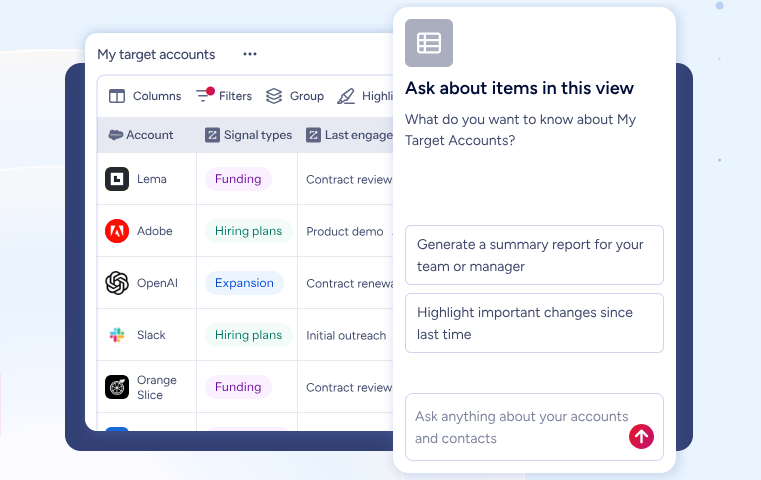
ZoomInfo addresses this upstream problem. Its data platform covers 500M contacts across 100M companies, verified by a pipeline backed by 300+ human researchers and achieving 95% accuracy on first-party data. The GTM Context Graph (an intelligence layer processing 1.5B+ data points daily) combines this B2B data with your CRM records, conversation transcripts, and behavioral signals to identify which accounts are actively in-market and why deals move or stall.
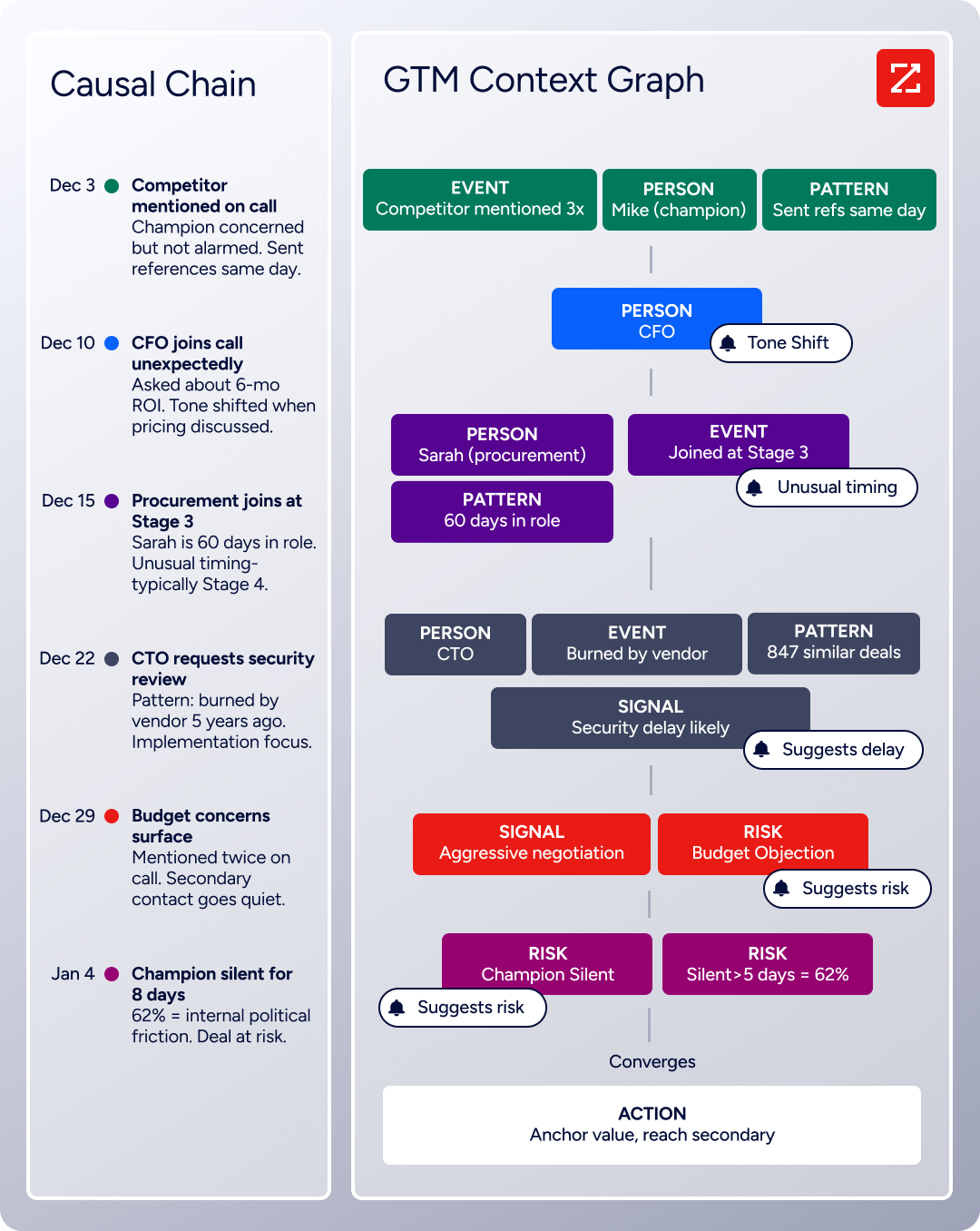
Sales teams use GTM Workspace to act on AI-prioritized accounts with pre-drafted outreach. Marketing teams use GTM Studio to build and launch targeted plays in minutes. For teams that build on their own tools, APIs and MCP expose the same intelligence to any application or AI agent.
Source: ZoomInfo
The result: users who enter your product through ZoomInfo-informed prospecting are pre-qualified against your actual ideal customer profile, making your Userflow or WalkMe investment more effective from day one.
Seismic's sales team attributed 39% of active pipeline to opportunities identified or influenced by ZoomInfo signals, boosted productivity by 54%, and saved 11.5 hours per week per seller. (Seismic Case Study)
Security and compliance comparison
Compliance requirements often determine which platform you can even consider.
Userflow holds SOC 2 Type 2 certification and is GDPR compliant. Data is hosted on Google Cloud in the US-Central1 region with cross-region replication. This covers most SaaS company requirements, but regulated industries should confirm specific certifications directly.
WalkMe carries the broadest compliance portfolio in the digital adoption category: FedRAMP Ready, SOC 2 Type II, ISO 27001, ISO 27701, ISO 27017, ISO 27018, and WCAG 2.1 AA accessibility compliance. For US federal agencies, healthcare organizations, and financial institutions, WalkMe's certification stack is hard to match.
Source: ZoomInfo
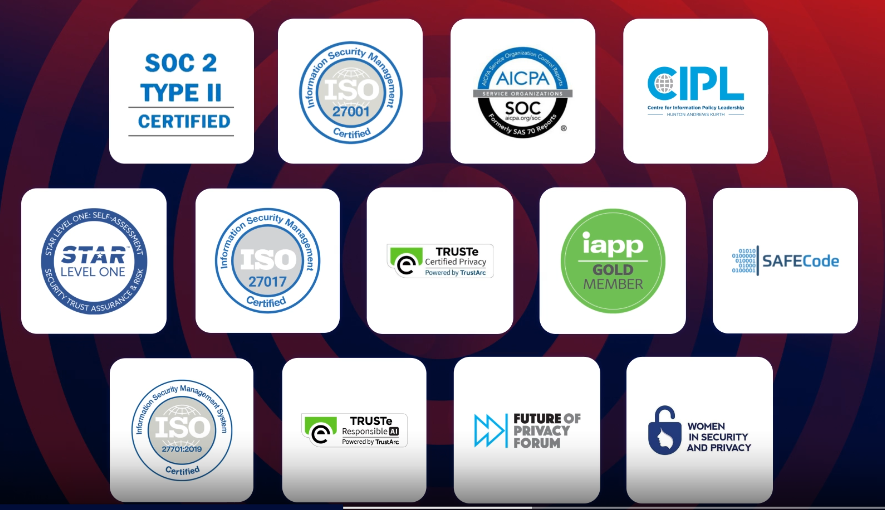
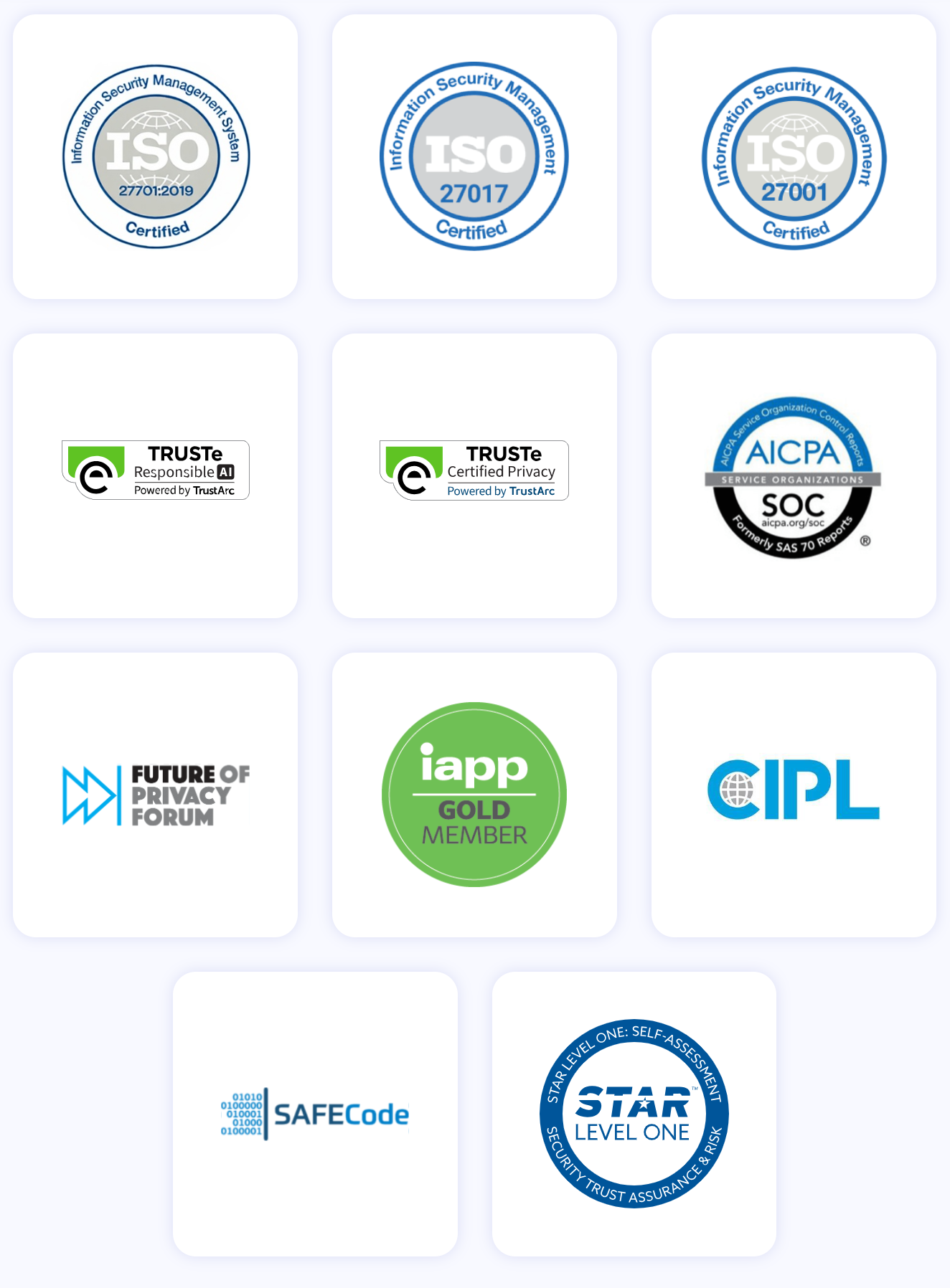
ZoomInfo maintains certifications including ISO 27001, ISO 27701, SOC 2 Type II, TRUSTe GDPR, and TRUSTe CCPA, all renewed annually. As a registered data broker in California and Vermont, ZoomInfo operates within a privacy compliance framework built for enterprise B2B data handling.
Userflow vs. WalkMe vs. ZoomInfo: Which should you choose?
The choice depends on what problem you're solving and at what scale.
Choose Userflow if:
You're a SaaS company onboarding external users to your own product
Your product and CS teams need to create flows without developer help
Speed to first live flow matters more than enterprise governance
Your user base is under 25,000 MAUs and you want predictable pricing
You value simplicity and fast iteration over cross-application breadth
Choose WalkMe if:
You're driving adoption of enterprise software (SAP, Salesforce, Workday) across thousands of employees
You need analytics across your entire application portfolio, not just one product
Compliance requirements include FedRAMP, ISO certifications, or accessibility standards
You have a dedicated team to implement and manage the platform
You need workflow automation, data validation, and license optimization at scale
Add ZoomInfo if:
You want your sales and marketing teams reaching the right prospects before competitors do
You need B2B data to identify and engage your ideal customers
You're building pipeline for the SaaS product you're onboarding users into
You want AI-powered prospecting and buyer intent signals to prioritize in-market accounts
You need your adoption investments to pay off faster by starting with better-fit users
Explore ZoomInfo with a 7-day free trial or get started with ZoomInfo Lite at no cost.
"ZoomInfo's not just a contact data company anymore. They've built a full system of execution. GTM Intelligence actually works the list, writes the outreach, triggers the play, and helps drive predictable growth." (Ian Brodie, CEO & Co-Founder, Levanta; Levanta Case Study)
Userflow and WalkMe solve different versions of the same problem: helping users succeed inside software. ZoomInfo solves the problem that comes first: making sure the right users find your software. For B2B companies serious about growth, you need both sides of that equation working together.
Userflow vs. WalkMe FAQ
What is the core difference between Userflow and WalkMe?
Userflow is built for SaaS companies onboarding external users to their own product. WalkMe is built for enterprises driving adoption of internal software like SAP, Salesforce, and Workday across thousands of employees. They share some overlapping features (in-app guidance, tooltips, checklists), but their target markets, pricing, implementation complexity, and feature depth differ.
Which platform is easier to set up?
Userflow is faster to implement. Most teams go from installation to their first live onboarding flow within a day, and the Smartflow AI builder can auto-generate complete flows from observed product interactions. WalkMe requires weeks to months of implementation, typically involving dedicated internal champions and often a Center of Excellence approach for large deployments.
How does pricing compare between Userflow and WalkMe?
Userflow publishes transparent pricing. Adoption Studio starts at $500/month ($400/month billed annually) for 1,000 MAUs, while Adoption Agent starts at $100/month ($80/month billed annually) for 500 AI credits. WalkMe does not publish pricing and instead uses custom enterprise agreements. The gap reflects their different markets: Userflow targets SMB and mid-market SaaS, while WalkMe targets large enterprises.
Which platform has stronger AI capabilities?
Both invest in AI, but for different purposes. Userflow's FlowAI suite helps non-technical teams build and optimize onboarding content faster, including auto-generated flows (up to 30 steps), AI translation, and an in-app AI adoption agent. WalkMe AI delivers contextual assistance across any application using its proprietary DeepUI technology, with capabilities including workflow automation, next-best-action recommendations, writing and reading assistance, and a digital learning product that auto-generates training courses.
Can Userflow handle enterprise-scale deployments?
Userflow's Enterprise plan offers SSO, advanced permissions, and custom contracts, but the platform is designed for SaaS companies onboarding their own product's users. Organizations that need to drive adoption of third-party enterprise software across tens of thousands of employees, with compliance requirements like FedRAMP or ISO 27001, would find WalkMe a better fit.
How does ZoomInfo relate to Userflow and WalkMe?
ZoomInfo is not an adoption platform. It is a B2B sales and marketing intelligence platform that helps teams identify and engage the right prospects using data and AI-powered insights. It complements adoption tools like Userflow and WalkMe by solving the upstream problem: ensuring the users entering your product are well-targeted and likely to succeed, which makes your adoption investment more effective.
Which platform is better for reducing support tickets?
Both reduce support volume, but through different mechanisms. Userflow deploys Resource Centers with help articles, flow launchers, and self-service content inside your SaaS product. WalkMe provides contextual self-serve answers inside any enterprise application, with workflow automation that prevents errors before they generate tickets. WalkMe customer Origin reduced support tickets by 70%.
Does WalkMe only work with SAP applications after the SAP acquisition?
No. WalkMe continues to support Salesforce, Workday, ServiceNow, Microsoft Dynamics 365, and any web or desktop application through its DeepUI technology. The SAP acquisition (completed in September 2024 for approximately $1.5 billion) provides deeper integration with SAP products and distribution through SAP's customer base, but WalkMe remains a multi-application platform.
More Userflow and WalkMe comparisons:
