
Veeva Systems has built something rare in enterprise software: a near-monopoly in an industry that demands it.
With roughly 80% of global pharma CRM market share and over 50 applications spanning the entire drug lifecycle, Veeva has made itself the default infrastructure for life sciences companies that need their software to understand regulatory compliance the way a stethoscope understands a heartbeat. But dominance in regulated workflows doesn't mean it covers every need a life sciences company has.
To write this Veeva Systems review, we analyzed the platform extensively. We believe it's the ideal choice if:
You operate in life sciences (pharma, biotech, MedTech) and need compliance built into your software
You want to consolidate clinical, regulatory, quality, safety, and commercial operations on one platform
You're managing global regulatory submissions across multiple markets
You need GxP-validated workflows with audit trails that satisfy FDA and EMA inspections
You have the budget and internal admin resources for an enterprise platform
However, Veeva might not be sufficient if:
You need B2B prospecting data and sales intelligence beyond HCP engagement
You're targeting health systems, GPOs, distributors, or other organizations where contact verification and intent data matter
You want to identify in-market accounts and buying committees outside the HCP universe
You need go-to-market intelligence for business development, partnerships, or expansion into adjacent markets
In this case, consider pairing Veeva with ZoomInfo: a GTM platform built on broad B2B data. Where Veeva handles the regulated side of life sciences operations, ZoomInfo provides the intelligence for everything else in your go-to-market, covering 500M contacts, 100M companies, 135M+ verified phone numbers, and 200M+ verified business emails, along with intent signals and account prioritization through its GTM Context Graph.
We've included a look at ZoomInfo later in this review as a complementary platform for life sciences companies whose go-to-market needs extend beyond regulated HCP engagement. If you're ready to explore what ZoomInfo can do for your sales intelligence, you can start with ZoomInfo's free trial here.
What Is Veeva Systems?
Veeva Systems is a cloud-based software company that builds applications exclusively for the global life sciences industry.
Peter Gassner (CEO), Matt Wallach, and several co-founders with backgrounds at Salesforce and PeopleSoft founded the company in 2007 with a single product: Veeva CRM, built on the Salesforce platform to automate pharmaceutical field sales.
That CRM captured most of the pharma market, and Veeva used its installed base to expand into adjacent regulated workflows.
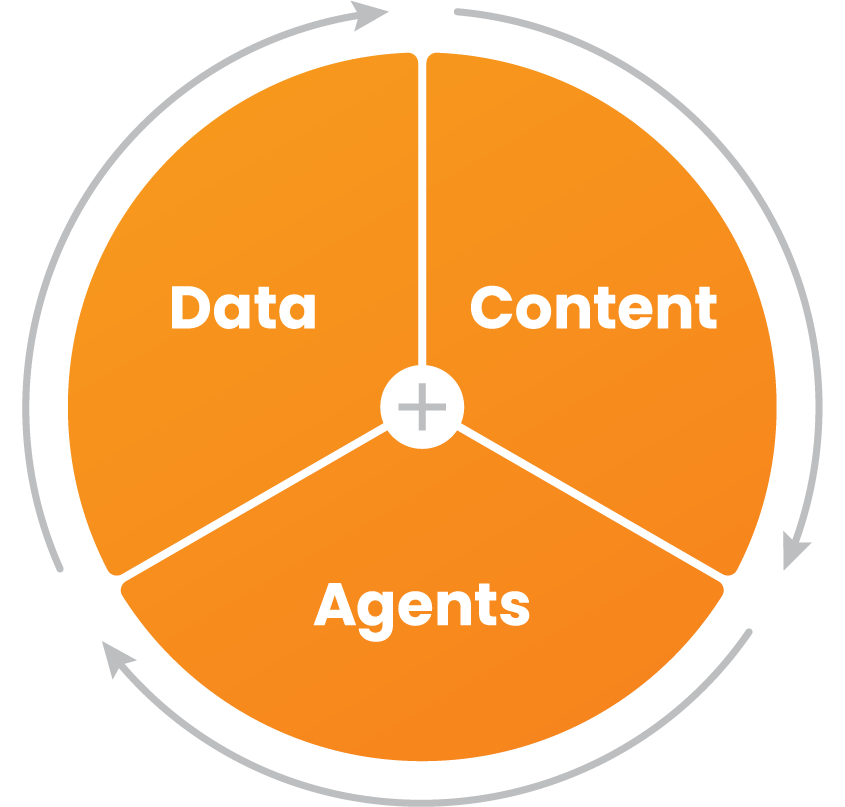
Today the company offers 50+ applications on its proprietary Vault Platform, covering clinical development, regulatory affairs, pharmacovigilance, quality management, medical affairs, and commercial operations. Compliance requirements (21 CFR Part 11, GxP, GMP, ICH standards) are built into the architecture rather than bolted on.
Source: Veeva Systems
Veeva went public on the NYSE in October 2013 (ticker: VEEV) and joined the S&P 500 in May 2026. In February 2021, the company converted to a Public Benefit Corporation, committing to balance shareholder returns with its mission to advance human health.
With approximately $3.195B in FY2026 revenue and around 7,928 employees, Veeva serves pharmaceutical companies, biotech firms, MedTech companies, CROs, and CDMOs worldwide.
Veeva Systems Pros & Cons
Pros | Cons |
|---|---|
GxP-validated compliance built into every application | High total cost of ownership across multi-cloud deployments |
~80% pharma CRM market share creates a strong partner ecosystem | Vault CRM migration (from Salesforce) still maturing through 2030 |
50+ applications on one shared Vault Platform | Steep learning curve, especially for smaller teams without dedicated admins |
Pre-built cross-cloud integrations via Connections Hub | Weak document search and discoverability in Vault |
Three annual General Releases with IQ/OQ validation packages | Performance issues reported with large document libraries |
AI agent roadmap across all suites by end of 2026 | Vendor lock-in due to proprietary data model |
Public Benefit Corporation structure signals long-term stability | No public pricing; enterprise sales engagement required |
Veeva Systems Review: How It Works & Key Features
Vault Platform: The shared infrastructure hosting all 50+ Veeva applications.
The Vault Platform is the foundation everything else runs on. It provides the data model, security layer, workflow engine, document management, API framework, and integration infrastructure that every Vault application shares. All applications run on a single multi-tenant cloud hosted on AWS, with AES-256 encryption at rest and TLS 1.2+ in transit.
What makes this matter for life sciences is the compliance layer.
Veeva delivers IQ/OQ validation packages with each of its three annual General Releases, so customers can re-validate their GxP systems without building test scripts from scratch. The Connections Hub provides pre-built integrations between applications (clinical to regulatory, quality to commercial), eliminating the point-to-point wiring that creates integration problems in multi-system environments.
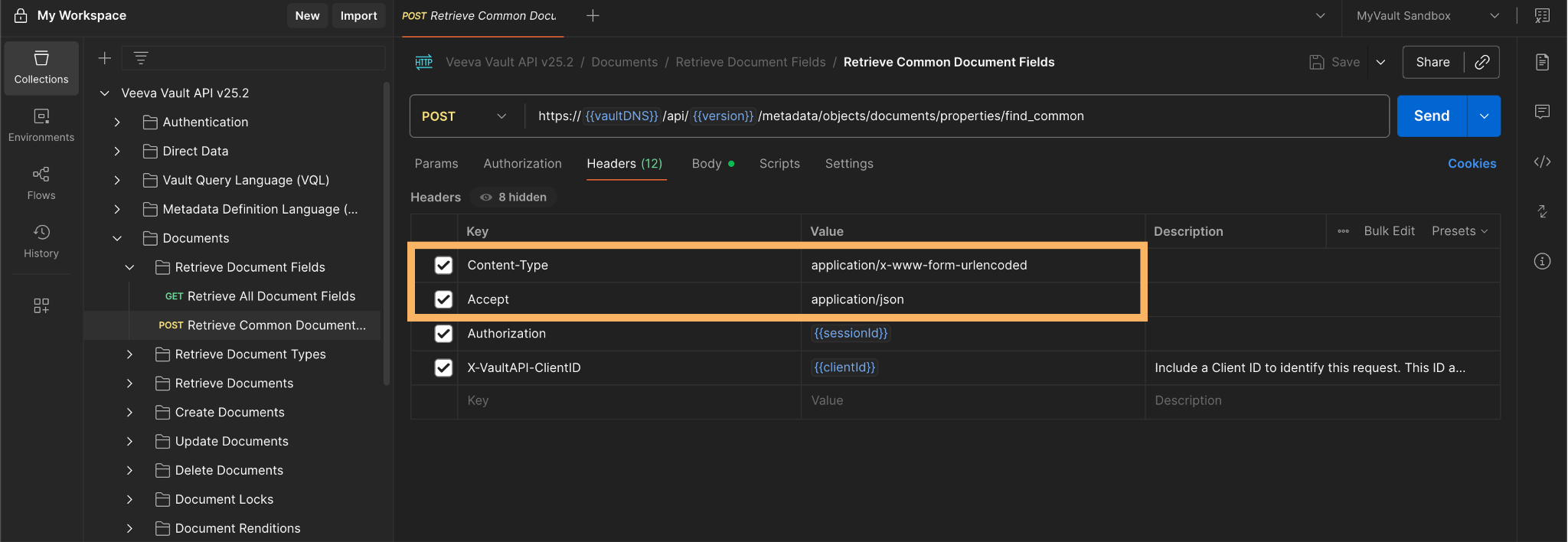
The Direct Data API enables bulk data extraction to Snowflake, Databricks, Amazon Redshift, and Microsoft Fabric at speeds Veeva claims reach up to 100x faster than standard REST APIs.
For developers, Veeva provides a REST API, a Java SDK for custom server-side logic within the validated environment, a Postman Collection, and an open-source VAPIL Java client.
Source: Veeva Systems
Commercial Cloud: Field force management, content compliance, and HCP master data for pharma sales teams.
Veeva Commercial Cloud is the company's most mature product area and the source of its market dominance.
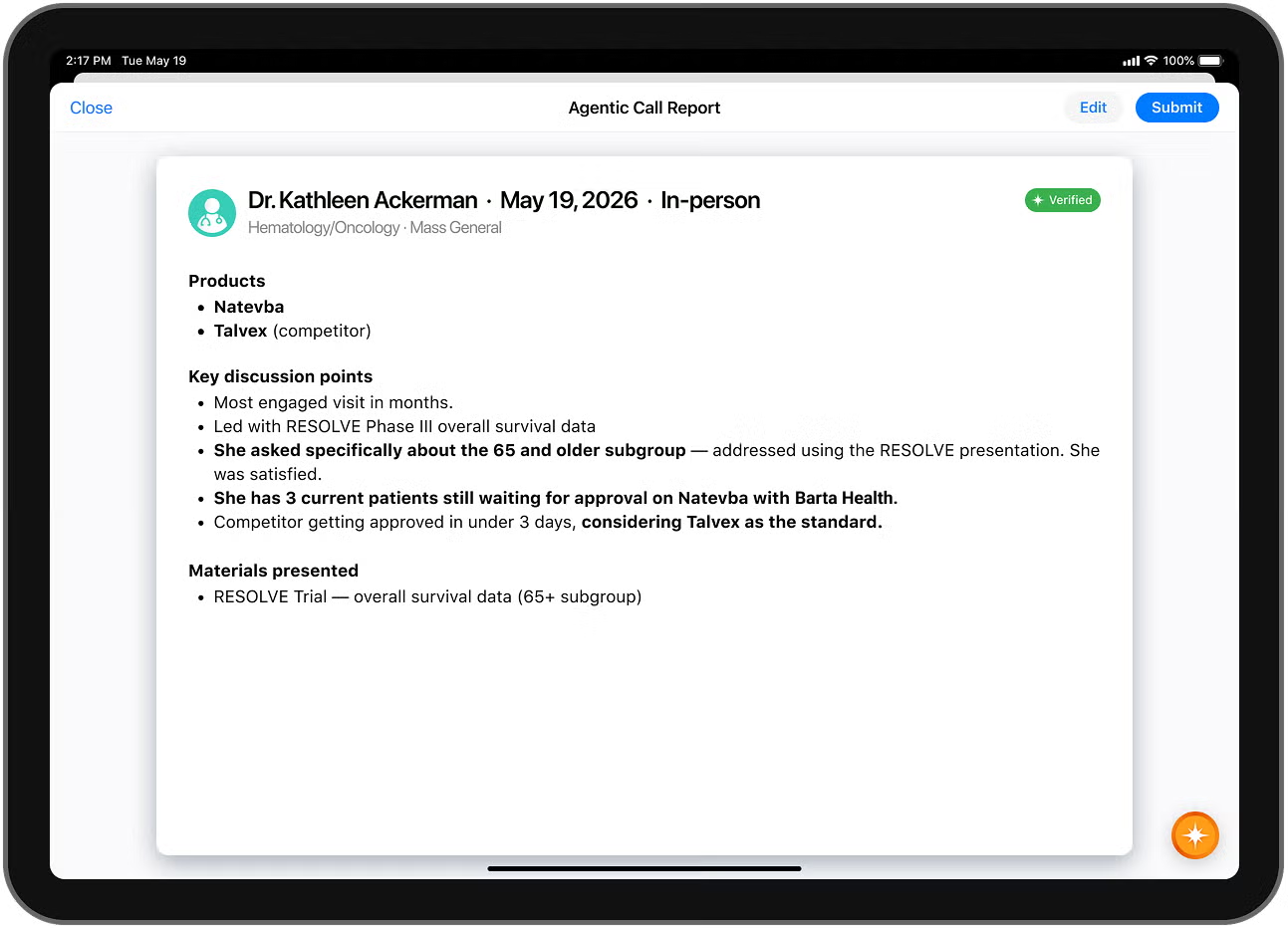
At the center is Vault CRM, which provides offline-first call reporting, approved email distribution, and sample management for field reps on iOS and Android. The ongoing migration from the legacy Salesforce-based Veeva CRM to native Vault CRM (targeted for completion by 2030) will move the product onto Veeva's own infrastructure.
Source: Veeva Systems
Vault PromoMats handles the medical-legal-regulatory (MLR) review of promotional materials with configurable approval workflows, modular content management, and claims-to-reference linking.
Supporting applications include Network for HCP/HCO master data management (7B+ records globally, 45,000+ field users), Align for territory and call plan management, and Crossix for privacy-safe marketing analytics across 300M+ patient records.
Clinical Development Cloud: Integrated trial management from study startup through data collection.
Veeva Clinical Development is where Veeva sees its largest growth opportunity, targeting companies still running fragmented legacy clinical systems.
Source: Veeva Systems
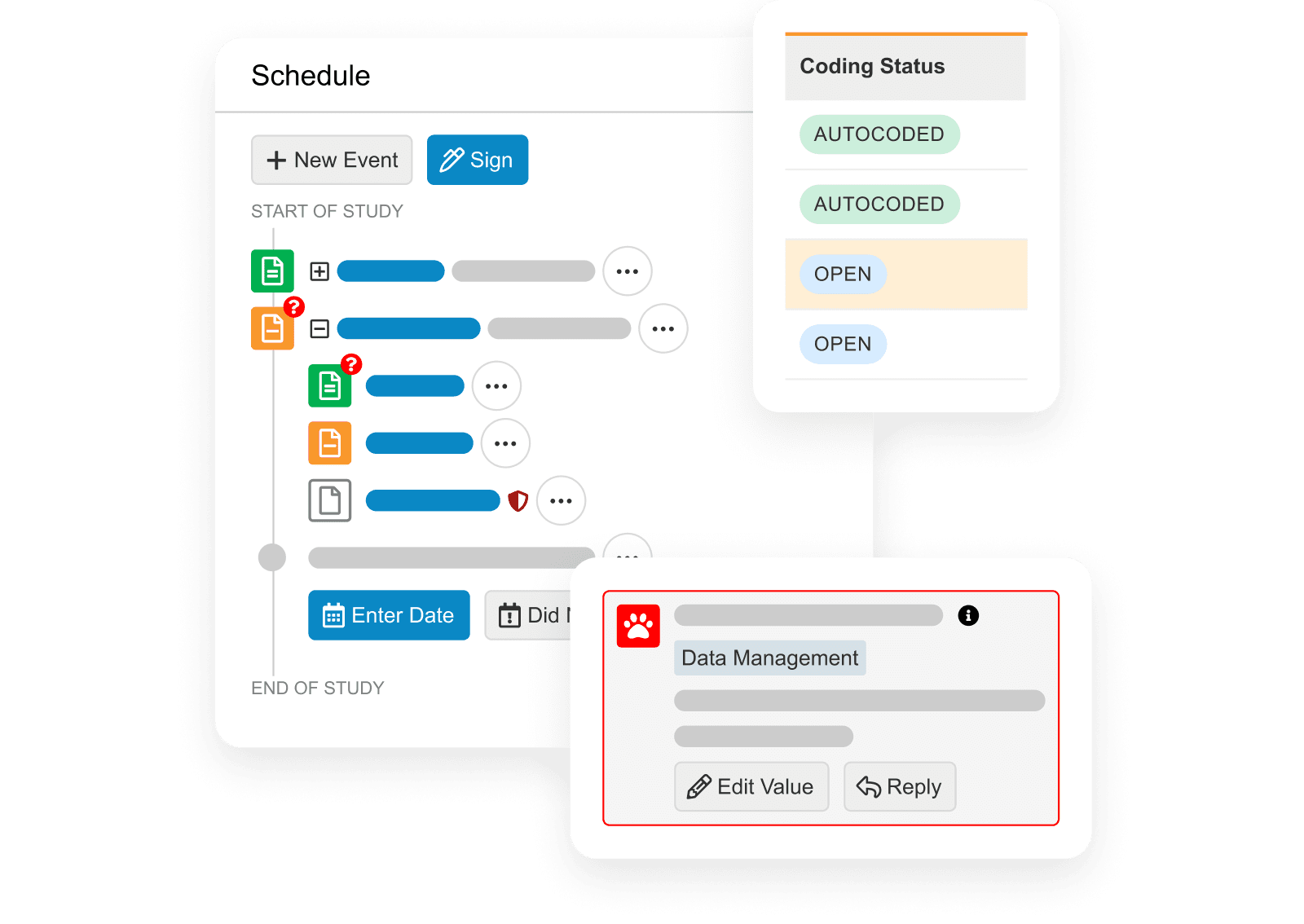
The suite connects trial master file management, clinical trial operations, electronic data capture, and patient-facing tools on the shared Vault Platform.
Vault eTMF (500+ customers) handles trial master file management with auto-filing from other Vault applications.
Vault CTMS (200+ customers) manages site and study operations with auto-filed monitoring visit reports.
Vault EDC provides electronic data capture without requiring custom SAS functions; Veeva claims 50% faster study build times, and 8 of the top 20 pharma companies have switched from legacy EDC systems.
Vault CDB aggregates clinical data from EDC, labs, eCOA, and external sources, with reported 30 to 50% reductions in manual data cleaning.
Regulatory, Safety, and Quality: Compliance-native applications for the rest of the drug lifecycle.
Vault RIM manages global regulatory submissions, registration tracking, and health authority interactions.
Vault Registrations (400+ customers, 15 of the top 20 pharma) has consolidated an average of 88 IT systems per customer.
Vault Submissions Publishing submits directly to FDA, EMA, and other agencies through gateway connections, with a reported 50% reduction in submission creation time.
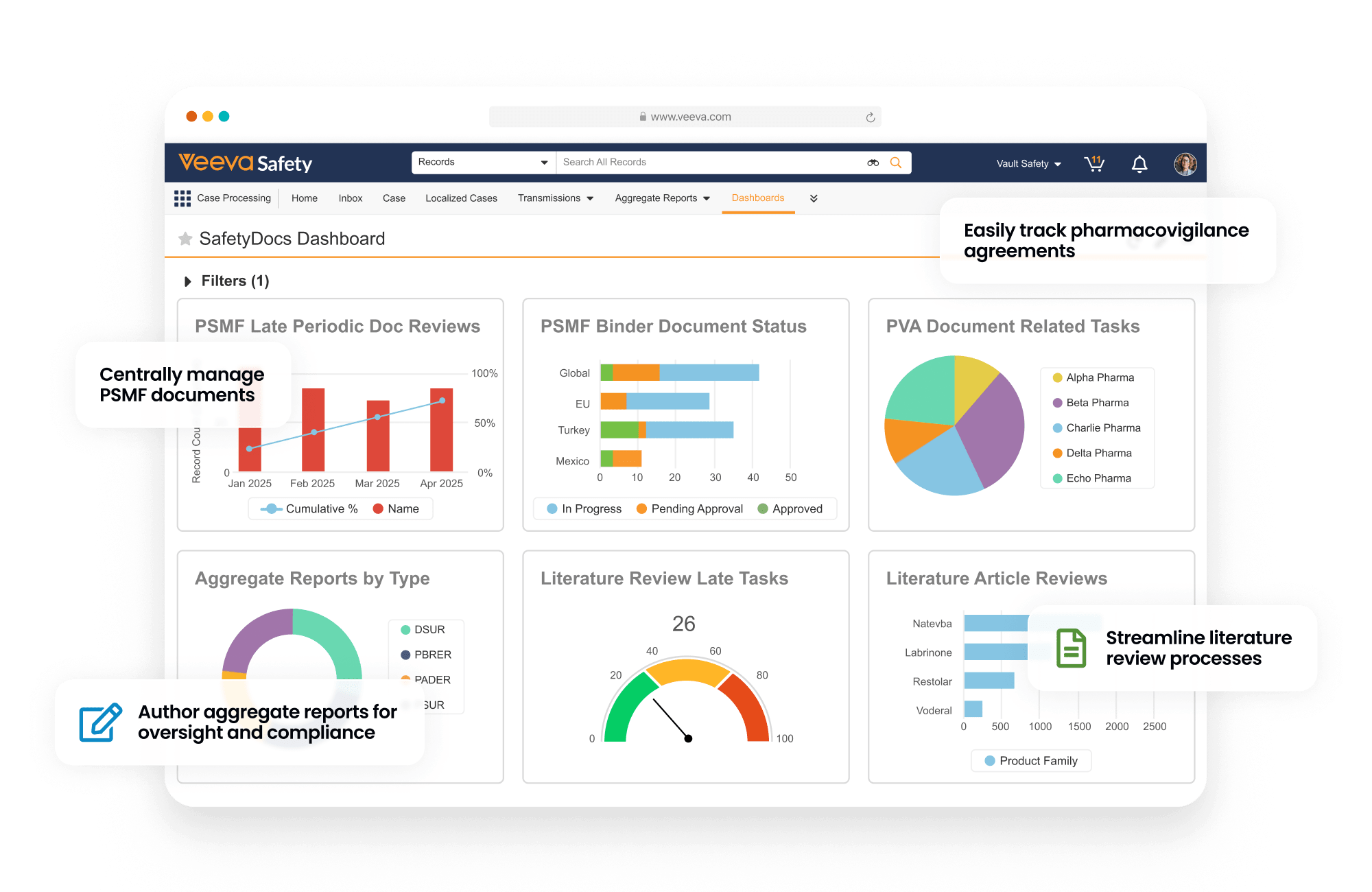
Vault Safety handles pharmacovigilance, processing individual case safety reports from intake through expedited and periodic reporting.
Veeva reports 50% reduction in case processing time, with AI-assisted intake and narrative generation agents on the April 2026 roadmap. Vault SafetyDocs reduces pharmacovigilance system master file generation from hours to under 30 minutes.
Source: Veeva Systems
Vault QualityDocs (500+ customers) manages controlled documents with GxP-native workflows and a pre-configured reference model. Vault QMS (300+ companies) handles quality events. Vault Training (300+ companies) automatically reassigns training when document versions change, closing a compliance gap that manual systems cannot reliably enforce.
Veeva AI: AI agents across Vault applications, designed for compliance.
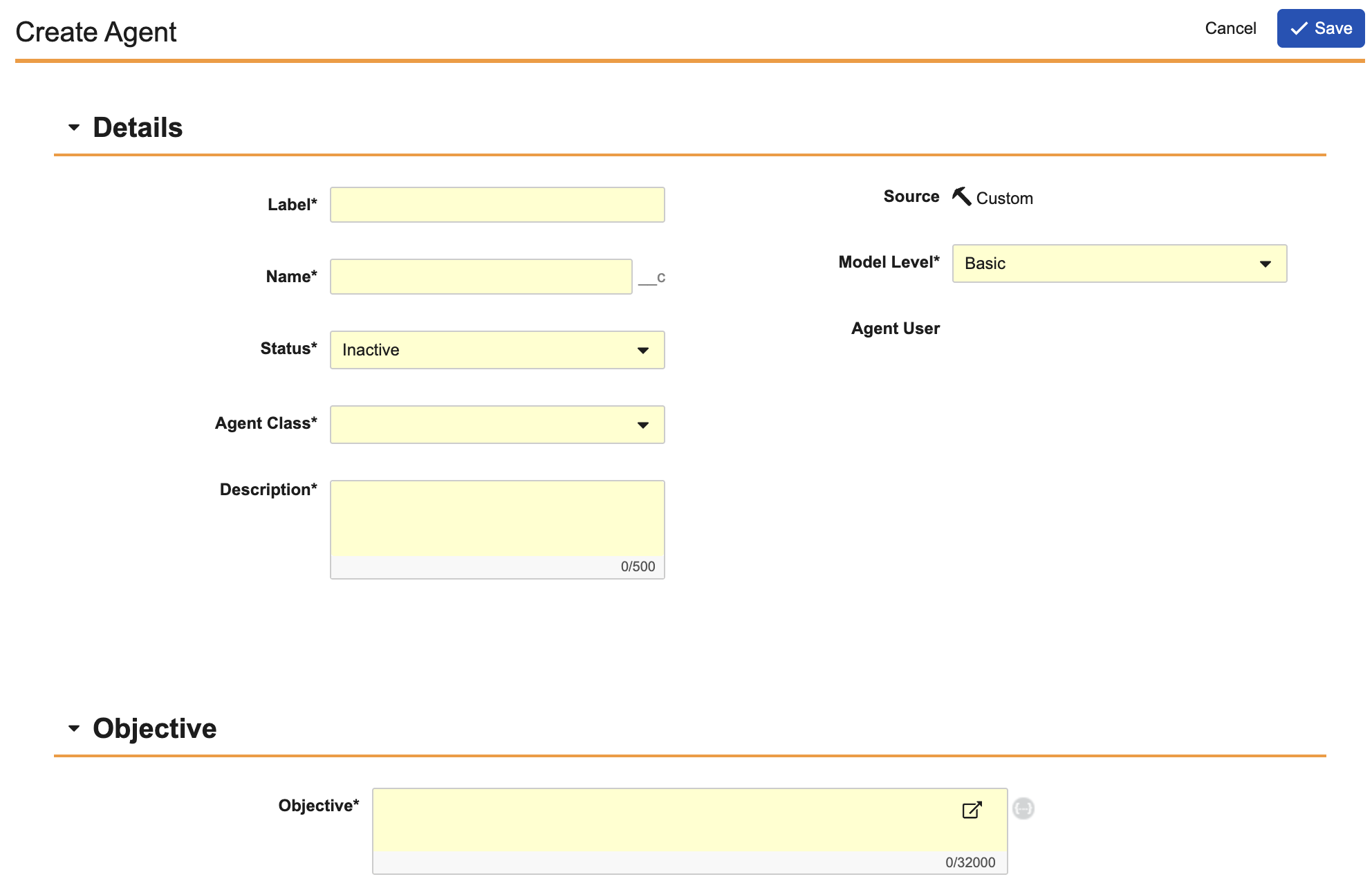
Veeva AI launched its standard agent portfolio on December 3, 2025, running on Anthropic and Amazon LLMs via Amazon Bedrock within the existing Vault security and compliance framework.
Available agents include the Free Text Agent and Voice Agent for converting call notes into structured CRM data, a Pre-call Agent for surfacing intelligence before meetings, and Quick Check and Content Agents for automated compliance screening of promotional content.
Source: Veeva Systems
The rollout continues through 2026: Safety and Quality agents in April, Clinical and Regulatory agents in August, and Clinical Data agents in December. Customers can also deploy custom AI agents by connecting their own models hosted on Amazon Bedrock or Microsoft Azure AI Foundry.
Every AI action runs within the GxP-validated Vault environment with full audit trails, so companies do not need to validate AI outputs separately for regulatory purposes.
Where Veeva Systems Falls Short
While Veeva excels at regulated life sciences workflows, several limitations reflect a platform built for compliance depth over operational breadth.
High Total Cost of Ownership. Enterprise Vault implementations require large investments in professional services, internal admin headcount, and multi-year subscription commitments. TrustRadius reviewers note that getting the platform's full value requires buying into multiple clouds, which drives costs up. Veeva does not publish pricing, and there is no free trial for enterprise products.
Vault CRM Is Still in Transition. The migration from Salesforce-based Veeva CRM to native Vault CRM is underway with a 2030 completion target. Early adopters report feature gaps compared to the legacy product. Companies evaluating CRM now face a timing decision: commit to a product still catching up to its predecessor, or wait and miss the benefits of native Vault integration.
Steep Learning Curve. Capterra reviews consistently flag UI complexity and the depth of configuration options as adoption barriers, especially for smaller biotech teams without dedicated Vault administrators. The platform assumes users have (or will hire) staff who can navigate its configuration tools.
Search and Discovery Weaknesses. Customer reviews across G2 and Capterra cite weak document search as a recurring pain point. For a platform that manages thousands of regulated documents, the inability to find what you need quickly is real operational friction.
Vendor Lock-In. The proprietary Vault data model and Veeva-specific configurations create high switching costs once a company standardizes on the platform. Veeva itself acknowledges this risk in its SEC 10-K filings. Once you're in, moving off becomes a multi-year, multi-million-dollar project.
No B2B Sales Intelligence Beyond HCP Data. Veeva's data products (OpenData, Network, Compass) focus on HCP/HCO reference data and prescriber analytics.
Life sciences companies that also need to prospect health systems, GPOs, distributors, payers, or other organizational buyers find no tools within Veeva for identifying decision-makers, tracking buying signals, or prioritizing outbound engagement at those accounts.
These limitations aren't failures. They're the natural result of building for one industry's compliance requirements. But they leave gaps for companies whose go-to-market needs extend beyond regulated HCP interactions.
Complementary Tool for Life Sciences Go-to-Market: ZoomInfo
Veeva handles the regulated workflows. But life sciences companies don't only engage HCPs. They sell to health systems, negotiate with group purchasing organizations, partner with CROs and CDMOs, pitch to payers and PBMs, and recruit clinical trial sites.
These activities require different intelligence (verified B2B contact data, buying intent signals, and account prioritization) that Veeva was never designed to provide.
ZoomInfo fills this gap.
Built on broad B2B data, it gives life sciences commercial and business development teams the prospecting intelligence and go-to-market tools that complement what Veeva delivers on the compliance side.
B2B Data at Scale: The contact, company, and signal data Veeva's HCP-focused platform doesn't cover.
ZoomInfo's data platform spans 500M contacts, 100M companies, 135M+ verified phone numbers, and 200M+ verified business emails.
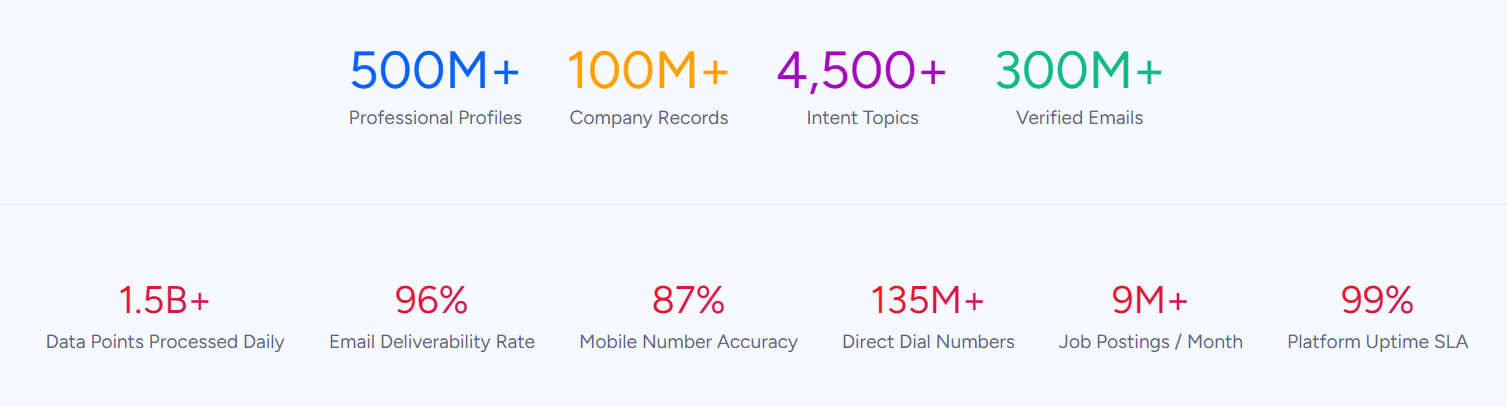
For life sciences companies, this means access to decision-makers at health systems, hospital networks, GPOs, payer organizations, distributors, and potential CRO/CDMO partners (the organizational buyers that Veeva's HCP-centric Network and OpenData products don't address).
The data goes through a multi-source verification pipeline backed by 300+ human researchers, reaching up to 95% accuracy on first-party data. In a Fortune 500 competitive RFP analyzing 25 million contacts across vendors, an independent consultant concluded that "no other competitor came even close."
Beyond static contact records, ZoomInfo tracks buyer intent signals from 210 million IP-to-Organization pairings, technographic data across 30,000+ technologies at 30+ million companies, and real-time alerts for leadership changes, funding rounds, and competitive displacement signals.
Guided Intent, exclusive to ZoomInfo, identifies topics historically correlated with closed deals rather than requiring manual topic selection.
"ZoomInfo gives us the information we need to execute. We don't have to go through and spend our time digging. It's already there, so we can be three steps ahead." (Vensure)
GTM Context Graph: Intelligence that connects signals to outcomes across your accounts.
While Veeva's data products tell you which HCPs prescribe what, ZoomInfo's GTM Context Graph tells you why a deal at a health system is advancing or stalling.
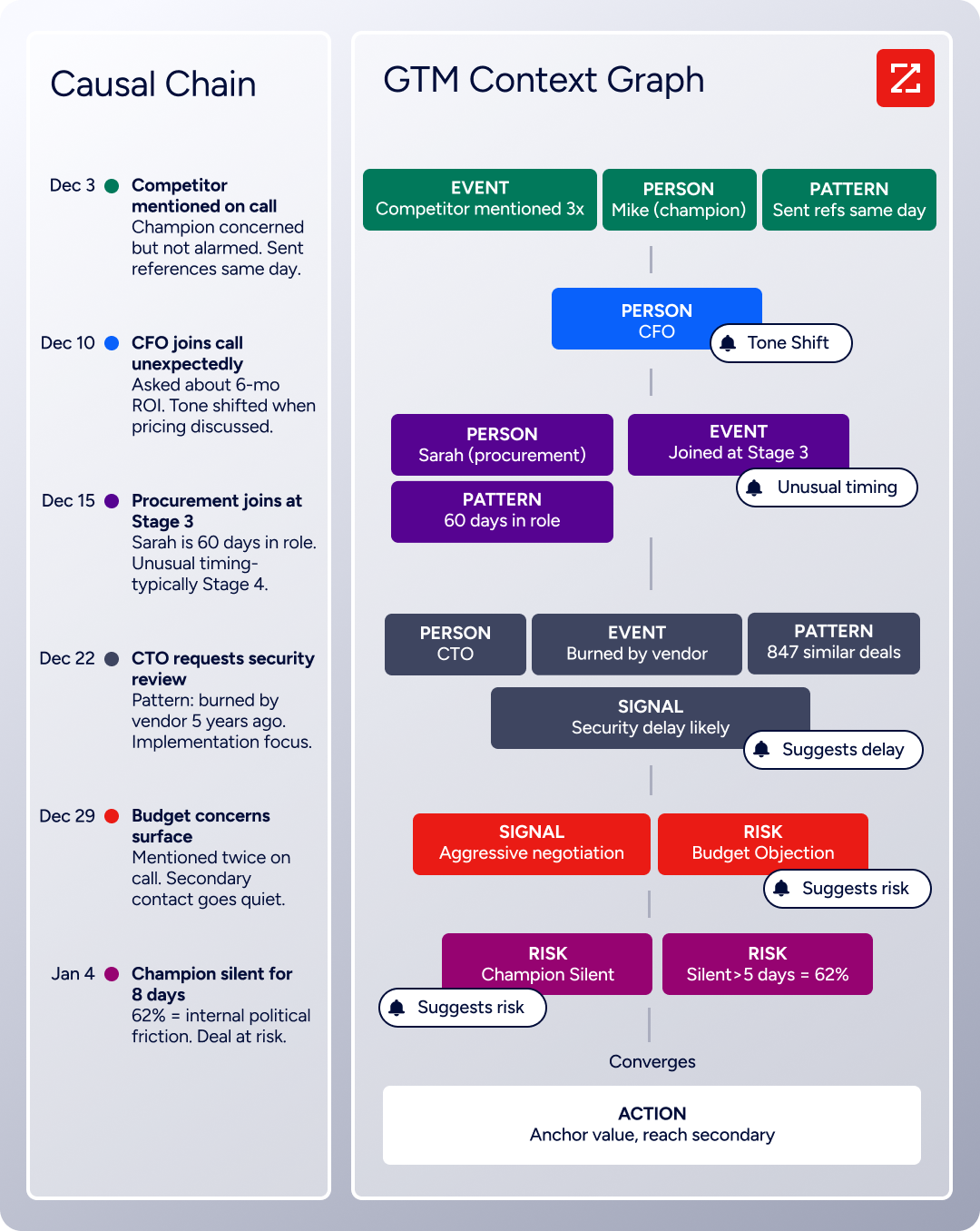
Processing 1.5B+ data points daily, it combines ZoomInfo's B2B data with a customer's CRM records, conversation transcripts, email interactions, and behavioral signals.
The result: AI that doesn't just know the VP of Procurement joined the last call, but recognizes that executive involvement at this stage, combined with questions about implementation timelines, matches the pattern behind closed-won deals in your segment. That intelligence flows into every downstream action, from the follow-up email to the forecast.
Seismic attributed 39% of active pipeline to opportunities identified or influenced by ZoomInfo signals, with sales teams reporting 54% productivity gains: "That combination of our internal CRM data, external signals, and AI that's given all that context has helped us craft very specific account- and persona-based messages. And people have responded to them right away." (Seismic)
Universal Access: Use ZoomInfo's intelligence in any tool, including alongside Veeva.
ZoomInfo delivers its intelligence three ways.
GTM Workspace gives sellers a workspace where prioritized accounts, drafted outreach, and deal execution come together. GTM Studio gives marketers and RevOps a builder for audience targeting, campaign orchestration, and pipeline measurement using natural language. And APIs and MCP expose the same intelligence to any custom agent, internal tool, or partner platform.
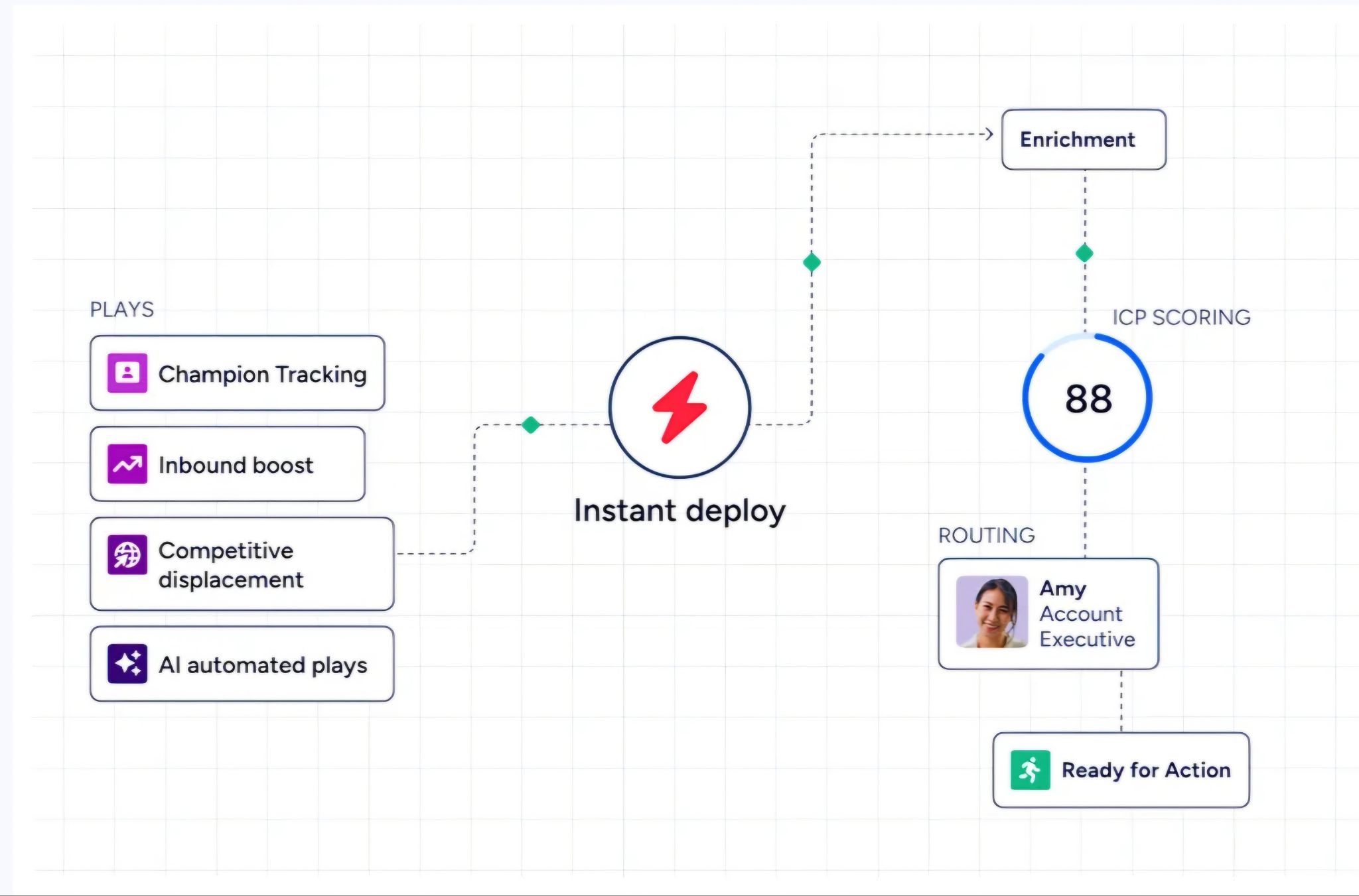
Source: ZoomInfo
For life sciences companies, this means ZoomInfo's data can power internal applications, feed CRM systems alongside Veeva's HCP data, and connect to AI agents through MCP (currently supporting Claude and ChatGPT). All three draw from the same GTM Context Graph, so the choice of interface never limits the intelligence available.
"The plug-and-play aspect of the API means I can integrate it very easily into any process and get information at a moment's notice," with an 87% reduction in time spent on internal data dashboard updates. (BDO Canada)
Pricing: Custom-quoted with a permanent free tier for evaluation.
ZoomInfo uses a custom-quoted, consumption-based pricing model with tiered plans for Sales (Professional, Advanced, Enterprise) and Marketing (Marketing Demand, ABM Lite, ABM Enterprise).
Like Veeva, dollar amounts aren't published; both platforms require sales engagement for pricing.
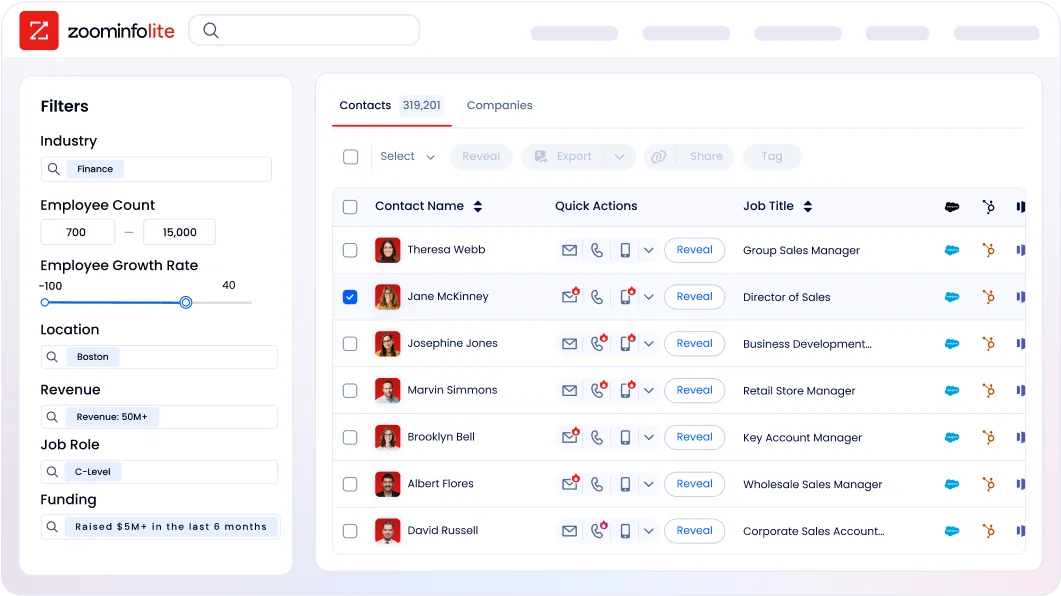
Unlike Veeva, ZoomInfo offers two free entry points. ZoomInfo Lite is a permanent free tier (no credit card, no time limit) with access to the B2B database, 10 monthly export credits, individual and company searches, the Chrome extension, and HubSpot integration. A separate 7-day free trial provides broader access to core platform features.
Veeva Systems and ZoomInfo: How They Work Together
Aspect | Veeva Systems | ZoomInfo |
|---|---|---|
Primary focus | Regulated life sciences workflows | B2B sales intelligence and go-to-market execution |
Data strength | HCP/HCO reference data, prescriber analytics, patient data | 500M contacts, 100M companies, verified phone/email, intent signals |
Target users | Clinical, regulatory, quality, safety, and commercial teams in pharma/biotech | Sales, marketing, RevOps, and business development teams |
CRM approach | Vault CRM for compliant HCP engagement (offline-first, sampling, approved email) | GTM Workspace for prospecting and deal execution |
AI capabilities | Compliance-focused agents for call notes, content screening, case intake | GTM Context Graph agents for account research, outreach, and signal monitoring |
Data compliance | 21 CFR Part 11, GxP, GMP, ICH-aligned | ISO 27001, ISO 27701, SOC 2 Type II, GDPR, CCPA |
Integration model | Vault Connections Hub (cross-Vault), REST API, Java SDK | 172+ marketplace integrations, REST API, MCP for AI agents |
Pricing transparency | No public pricing, no free trial | No published prices, but permanent free tier and 7-day trial available |
Best for together | Managing regulated drug lifecycle operations | Identifying and engaging organizational buyers outside the HCP universe |
Final Verdict
Veeva Systems and ZoomInfo serve different layers of the life sciences go-to-market stack. The choice depends on which problem you're solving.
Choose Veeva Systems if your primary need is compliant, industry-specific software for clinical development, regulatory submissions, quality management, pharmacovigilance, or HCP-facing commercial operations. No other platform matches Veeva's depth in life sciences compliance.
The Vault Platform's pre-built data models, validation packages, and cross-cloud integrations remove the customization burden that horizontal enterprise software imposes on regulated companies. For organizations managing the drug lifecycle from trial to market, Veeva is the infrastructure standard.
Pair it with ZoomInfo if your go-to-market extends beyond regulated HCP engagement. Life sciences companies targeting health systems, GPOs, payer organizations, distributors, CROs, CDMOs, or other organizational buyers need verified contact data, buying intent signals, and account prioritization that Veeva's HCP-focused data products don't provide.
ZoomInfo's GTM Context Graph gives business development and commercial teams the intelligence to identify, prioritize, and engage these accounts through GTM Workspace, GTM Studio, or any tool via API and MCP.
Get started with ZoomInfo here.
Together, Veeva and ZoomInfo cover both sides of the life sciences go-to-market equation: Veeva ensures every regulated interaction is compliant and documented, while ZoomInfo ensures every organizational buyer is identified and reachable.
Veeva Systems FAQ
What industries does Veeva Systems serve?
Veeva Systems builds software exclusively for the life sciences industry. Its customers include pharmaceutical companies, biotech firms, MedTech and medical device companies, contract research organizations (CROs), and contract development and manufacturing organizations (CDMOs).
The platform is designed around the compliance requirements of drug development and commercialization, including FDA, EMA, and ICH standards.
How much does Veeva Systems cost?
Veeva does not publish pricing. All costs are negotiated through enterprise subscription agreements under a Master Subscription Agreement (MSA). Fees cover annual subscriptions (non-cancellable for the term), professional services billed per Statement of Work, and education/certification courses ranging from approximately $1,900 to $4,750 per course.
The only free product is SiteVault Free, available to clinical research sites managing 20 or fewer active studies.
What is the Vault Platform?
The Vault Platform is Veeva's shared cloud infrastructure hosting all 50+ Vault applications. It provides the data model, security, workflow engine, document management, and API layer that every application shares.
Built on AWS with AES-256 encryption and TLS 1.2+, the platform delivers three annual General Releases with IQ/OQ validation packages, so GxP customers can re-validate systems without building their own test scripts.
Is Veeva Systems migrating off Salesforce?
Yes. Veeva is migrating its legacy Salesforce-based CRM to Vault CRM, built on Veeva's own Vault Platform. The migration was announced around 2022 with a target completion date of 2030. The move eliminates Veeva's dependency on Salesforce infrastructure and enables deeper cross-cloud integration with clinical, regulatory, and quality applications on Vault.
What are Veeva AI agents?
Veeva AI is an AI agent layer across Vault applications, running on Anthropic and Amazon LLMs via Amazon Bedrock.
Standard agents launched December 2025 for commercial and content workflows, with Safety and Quality agents scheduled for April 2026, Clinical and Regulatory agents for August 2026, and Clinical Data agents for December 2026. All agents operate within the GxP-validated Vault environment with full audit trails.
Does Veeva handle B2B prospecting or sales intelligence?
No. Veeva's data products (OpenData, Network, Compass) focus on HCP/HCO reference data, prescriber analytics, and patient-level data for life sciences commercial operations.
For broader B2B prospecting (identifying decision-makers at health systems, GPOs, payers, distributors, or potential partners), life sciences companies typically use a complementary platform like ZoomInfo, which provides verified contact data, buying intent signals, and account intelligence across 500M contacts and 100M companies.
What compliance certifications does Veeva hold?
Veeva holds ISO 27001:2022, ISO 27018, ISO 9001:2015, and SOC 2 Type II certifications. The platform is designed for 21 CFR Part 11 compliance (FDA electronic records and signatures), GxP/GMP compliance, HIPAA, GDPR, EU-U.S. Data Privacy Framework, and French HDS (health data hosting) requirements. Annual third-party penetration testing is conducted per Veeva's published security practices.
Who competes with Veeva Systems?
Veeva faces different competitors across its product lines: IQVIA OCE in pharma CRM, Medidata (Dassault Systemes) and Oracle Health Sciences in clinical operations, OpenText/Documentum and MasterControl in quality and regulatory, ArisGlobal and Oracle Argus in safety, and IQVIA and Komodo Health in data analytics.
No single competitor matches the breadth of Veeva's cross-lifecycle platform, which is a key reason companies consolidate on Vault.
