
Choosing between Vtiger CRM and Zoho CRM comes down to five questions:
Do you need a single platform that handles sales, marketing, and support, or would separate tools serve you better?
Is your team small enough to benefit from a focused CRM, or large enough to need a broader business platform?
Do you need the option to self-host your CRM for data residency or compliance?
How important is having finance, HR, project management, and dozens of other tools from the same vendor?
Is the quality and freshness of the data inside your CRM as important as the CRM itself?
In short, here's what we recommend:
Vtiger CRM is built for small and mid-sized businesses that want sales, marketing, and help desk in one platform without paying enterprise prices. Its One View customer record gives every team the same context on every contact, and features like Deal Room, Playbooks, and Process Designer come included at price points where competitors charge extra.
Vtiger also offers an open-source edition for businesses that need to self-host. The trade-offs are real: setup takes patience, performance can lag under heavy use, and the platform fits teams of 10 to 200 better than large enterprises.
Zoho CRM serves companies that want their CRM at the center of a full business stack. With 55+ integrated Zoho applications spanning finance, HR, project management, and customer support, Zoho CRM becomes the hub of an ecosystem that covers most business functions.
Zia AI handles predictive scoring, generative content, and autonomous sales agents, while tools like Blueprint, Canvas Design Studio, and CommandCenter give admins fine control over processes and interfaces. The downside: that breadth creates configuration complexity, and getting full value takes real setup work.
Both platforms are good CRM choices for their audiences. But a CRM manages the relationships you already have. It doesn't tell you which companies are researching your category right now, whether that email you imported last quarter still works, or who the new decision-maker is at a target account. That intelligence gap is where deals die quietly.
ZoomInfo fills that gap as a B2B data intelligence and GTM platform built on 500M contacts, 100M companies, 135M+ verified phone numbers, and 200M+ verified business emails. Its GTM Context Graph combines this data with your CRM records, conversation transcripts, and behavioral signals to show not just what happened in your pipeline, but why.
That intelligence reaches your team through GTM Workspace for sellers, GTM Studio for marketers and RevOps, or APIs and MCP inside any tool you already use. ZoomInfo integrates with CRMs including Zoho, making whichever CRM you choose more effective.
If better data quality and buyer intelligence sound like what's missing from your sales process, see how ZoomInfo works.
Vtiger CRM vs. Zoho CRM vs. ZoomInfo at a glance
Vtiger CRM | Zoho CRM | ZoomInfo | |
|---|---|---|---|
Primary function | All-in-one CRM (Sales + Marketing + Support) | All-in-one CRM + broader business suite | B2B data intelligence and GTM execution |
AI engine | Calculus AI (scoring, recommendations, content) | Zia AI (predictive, generative, agentic) | GTM Context Graph (buyer intelligence, intent, signals) |
Integrations | 500+ | 1,100+ | 172+ marketplace partners + APIs/MCP |
Open-source option | Yes | No | No |
Self-hosting | Yes (open-source edition) | No (cloud only) | No (cloud only) |
Ecosystem breadth | CRM-focused (5 built-in apps) | 55+ Zoho apps | GTM-focused (data, intent, engagement, conversation intelligence) |
Analyst recognition | Gartner SFA Niche Player (7 consecutive years) | Gartner SFA Visionary (15 consecutive years) | Gartner ABM Leader; Forrester Intent Data Leader |
Paid starting price | $12/user/month (annual) | $14/user/month (annual) | Consumption-based |
Free plan | Yes (10 users, 3,000 records) | Yes (3 users, 5,000 records) | Yes (ZoomInfo Lite, 10 credits/month) |
Best for | SMBs wanting feature depth at a lower price | Mid-market companies wanting a full ecosystem | Teams that need verified buyer data and intent signals |
Two CRMs with different philosophies
Vtiger and Zoho both promise all-in-one CRM, but they define "all-in-one" differently. Their shared origins make the divergence clearer: Vtiger's founder, Sreenivas Kanumuru, spent years at AdventNet (which later became Zoho Corporation) before co-founding Vtiger in 2004. The two platforms share DNA but took different paths.
Vtiger built a single product.
Sales, marketing, and help desk run on one shared data model with no middleware connecting separate applications. When a support agent opens a case, they see the same customer record the salesperson works from, including open deals, past quotes, and conversation history.
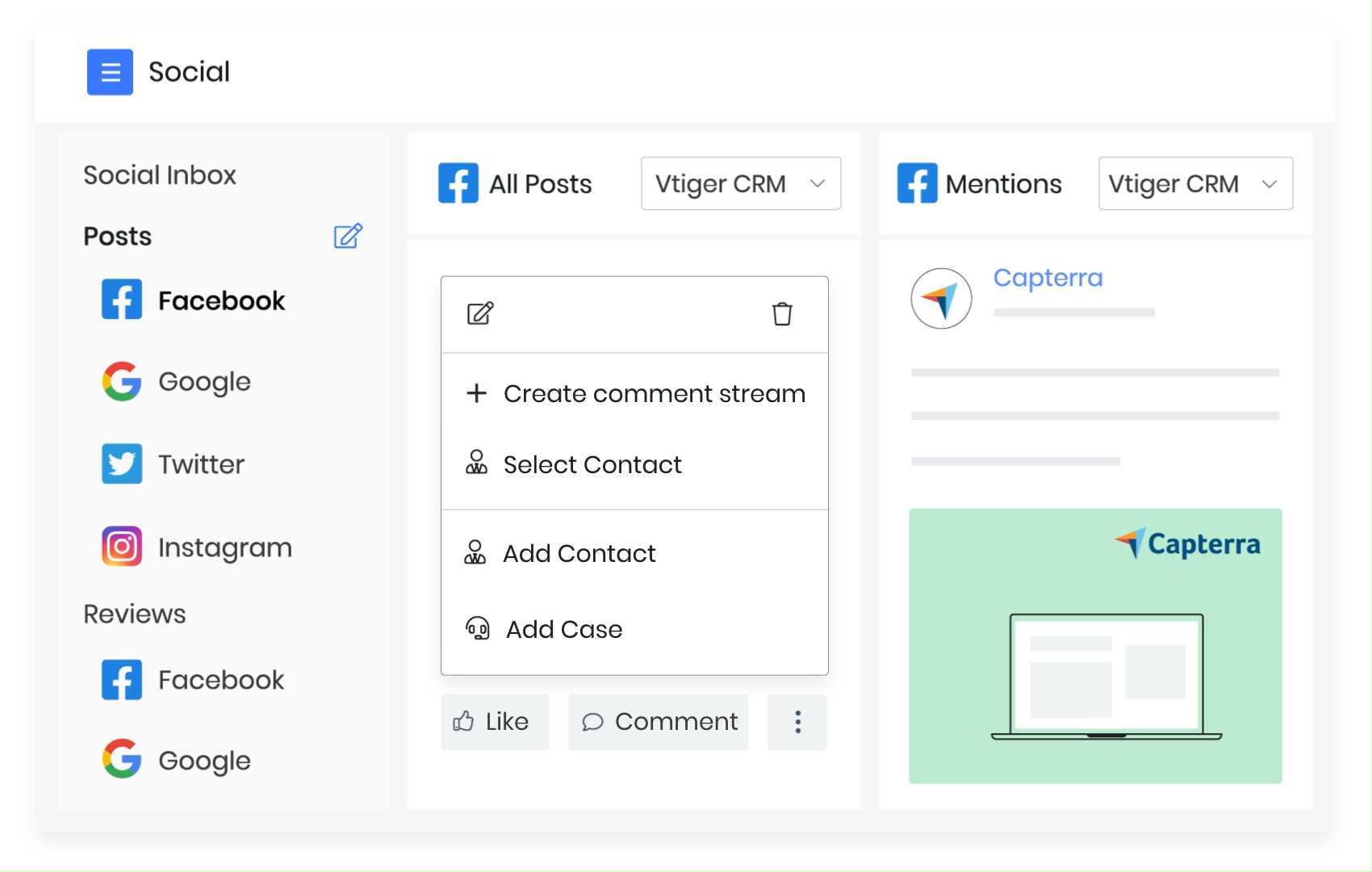
Source: Vtiger
That architecture is Vtiger's defining strength. It works because everything was designed as one system, not assembled from acquisitions.
Zoho built an ecosystem.
Zoho CRM is one of 55+ applications that include accounting (Zoho Books), help desk (Zoho Desk), email marketing (Zoho Campaigns), project management (Zoho Projects), HR (Zoho People), and analytics (Zoho Analytics). Each was developed in-house, and they share common authentication and data exchange. The CRM is the hub; the ecosystem is the moat.
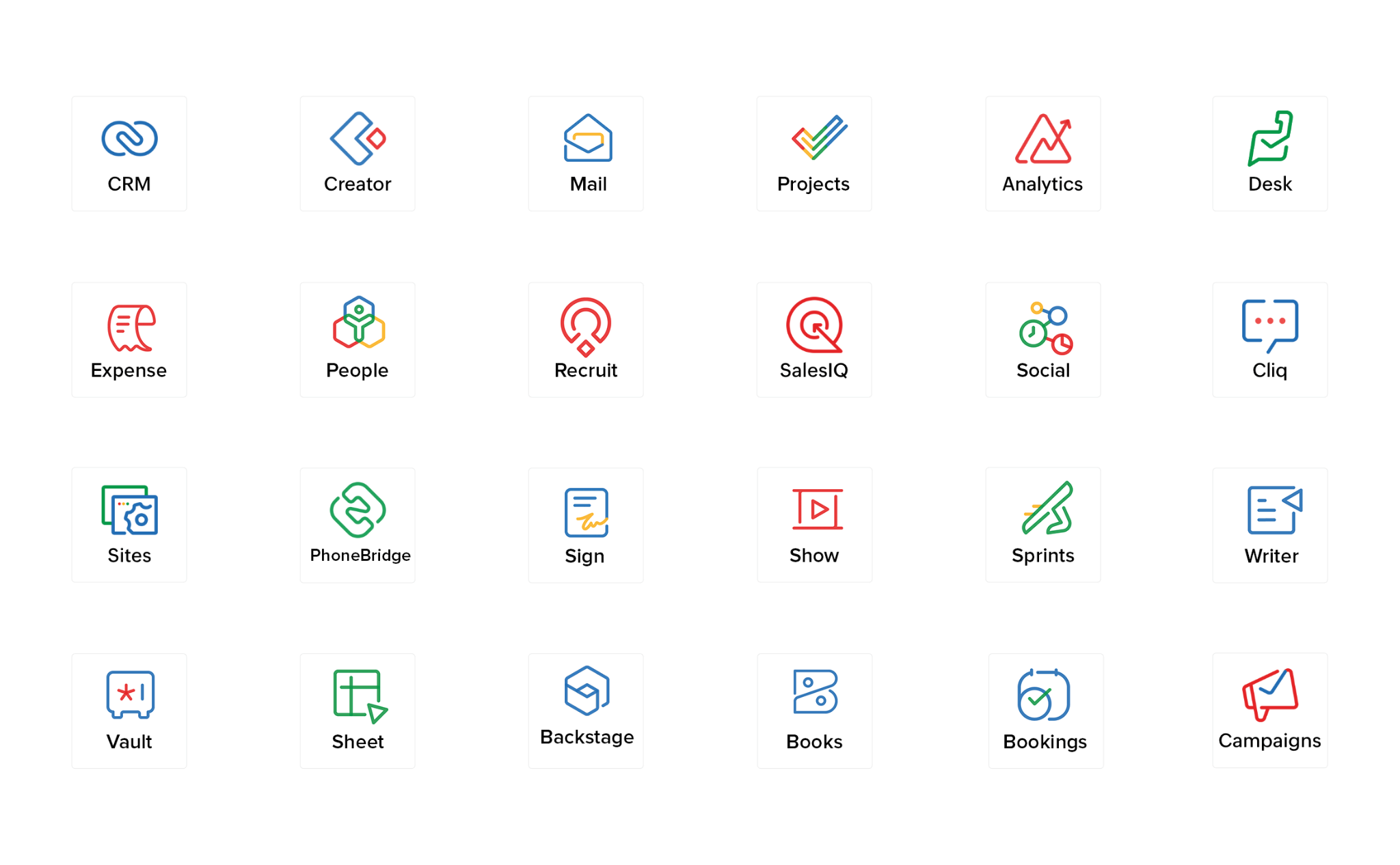
Source: Zoho
This difference shapes every downstream decision. A 20-person manufacturing company evaluating CRM and help desk software faces two paths: buy Vtiger and get both in one subscription, or buy Zoho CRM and add Zoho Desk as a second application. Vtiger is simpler. Zoho is broader. The right answer depends on whether you need a focused CRM or a full business platform.
Vtiger gives you enterprise features at SMB prices
Vtiger's advantage is feature density per dollar.
Capabilities that competitors reserve for premium tiers or sell as add-ons come included at Vtiger's mid-range pricing.
Deal Room is a customer-facing microsite created per deal, with shared next steps, a Q&A tab, document library, and a timeline that captures every buyer action. Playbooks define required tasks at each pipeline stage and block advancement until those tasks are complete, turning stage gates from labels into enforced checkpoints.
Process Designer is a visual automation engine for cross-department workflows. CPQ handles product configuration, pricing, and discount approval as an add-on ($8/user/month). Most of these ship at the $30/user/month Professional tier.
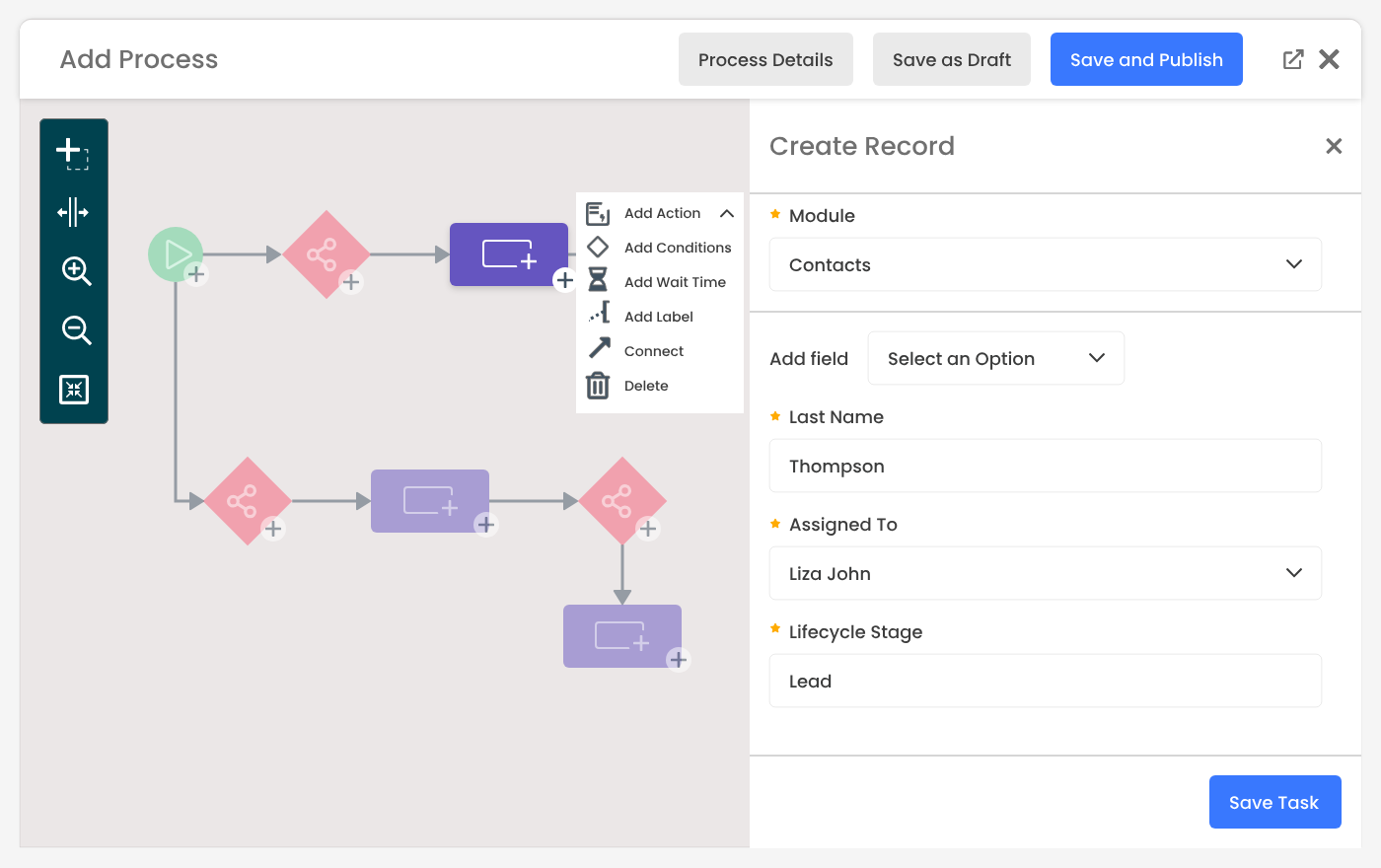
Source: Vtiger
The open-source edition adds something no cloud-only competitor can match. For companies in regulated industries (pharma, legal, financial services) or countries with strict data residency requirements, self-hosted Vtiger means CRM data never leaves your infrastructure.
Over 5 million downloads of the open-source edition have built a developer community that extends Vtiger's reach well beyond its commercial customers.
The limitations are clear. G2 and Capterra reviewers cite a steep learning curve, with users noting the platform "requires a dedicated person to be a Vtiger expert."
Performance issues surface under daily use, including slow loading times and unreliable search. While Vtiger advertises 500+ integrations, depth varies across connectors. The mobile app lags behind the desktop experience, which matters for field sales teams.
Zoho's ecosystem is the moat competitors can't replicate
Zoho CRM's individual features are comparable to Vtiger's. Where Zoho pulls ahead is in what surrounds the CRM.
A Zoho customer using CRM, Books, Desk, Campaigns, and Analytics operates from one vendor with shared billing, shared authentication, and native data flow between applications. A Vtiger customer (or any non-Zoho CRM customer) matching that coverage needs four or five separate subscriptions with integration middleware between each. That consolidation is Zoho's pitch, and it holds up.
The CRM itself runs deep.
Blueprint enforces process stages with mandatory exit criteria, preventing reps from advancing deals on optimism instead of buyer progress. Canvas Design Studio lets admins redesign record views with a drag-and-drop editor. Kiosk Studio creates guided multi-step workflows embeddable anywhere in the UI.
CommandCenter orchestrates customer journeys across teams and channels, with PathFinder mapping how customers move through touchpoints. Cadences handle multichannel follow-up sequences that branch on prospect behavior, not fixed timers.
These tools layer from simple (workflow rules at Standard) to complex (CommandCenter at Enterprise), letting teams grow into them. The CRM for Everyone initiative extends CRM access to non-sales teams through Teamspaces, workspaces for legal, finance, marketing, and support that connect to core CRM data without exposing the full interface.
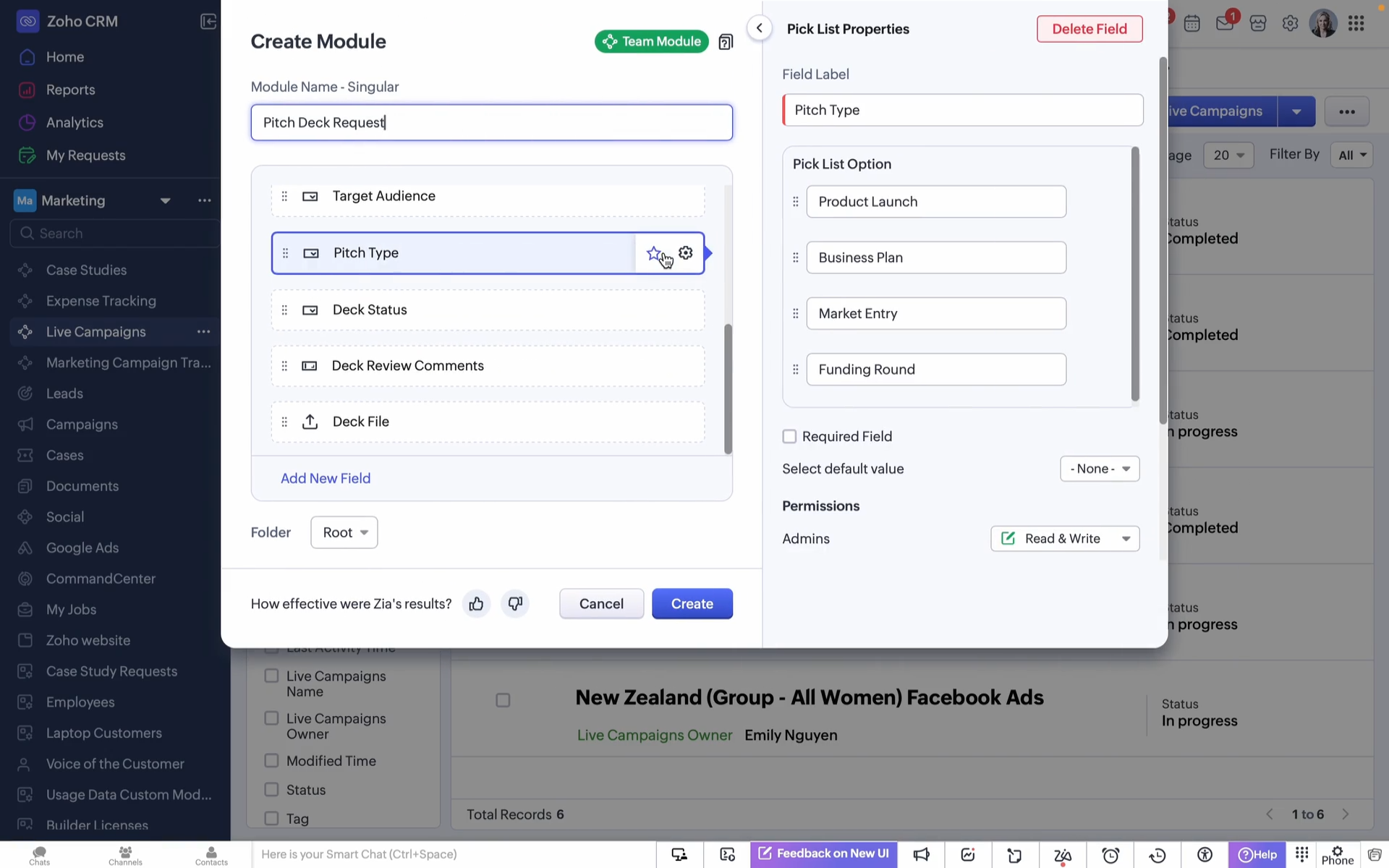
Source: Zoho CRM
Zoho's weaknesses mirror its strengths. SoftwareReviews notes that "success requires investing time in setup and configuration rather than expecting immediate out-of-box functionality." The feature density can overwhelm occasional users, and the interface, while improved by Canvas, feels dated in places.
Support quality on lower tiers draws criticism, with 24/7 support available only as a paid add-on. The third-party marketplace (~1,000 extensions) is thinner than Salesforce's AppExchange (7,000+), which matters for niche vertical integrations.
AI comparison: Calculus AI vs. Zia
Both platforms invest in AI, but the implementations differ in scope.
Vtiger's Calculus AI focuses on operational intelligence.
It scores deal health by combining fit, sentiment, and engagement signals. It identifies the best time to contact each prospect. It analyzes calls for talk-to-listen ratio, talking speed, monologues, and negative mood.
The Agent Builder lets teams create AI agents that handle deal summaries, record updates, and follow-up scheduling without code. The Prediction AI Designer provides a no-code model builder for custom predictions from historical CRM data.
Calculus AI works well for small teams. A sales manager at a 30-person company doesn't need a data science platform. They need to know which deals are at risk and which reps talk too much on calls. Calculus AI answers that.
Zoho's Zia covers more ground.
Beyond the predictive and generative capabilities Vtiger offers, Zia includes agentic AI with autonomous agents that plan and execute multi-step sales tasks, a pre-built agent store with 100+ agents integrated with 60+ applications, email intent classification across eight emotion categories, competitor mention alerts with sentiment context, and custom ML model building via QuickML on Ultimate-tier plans.
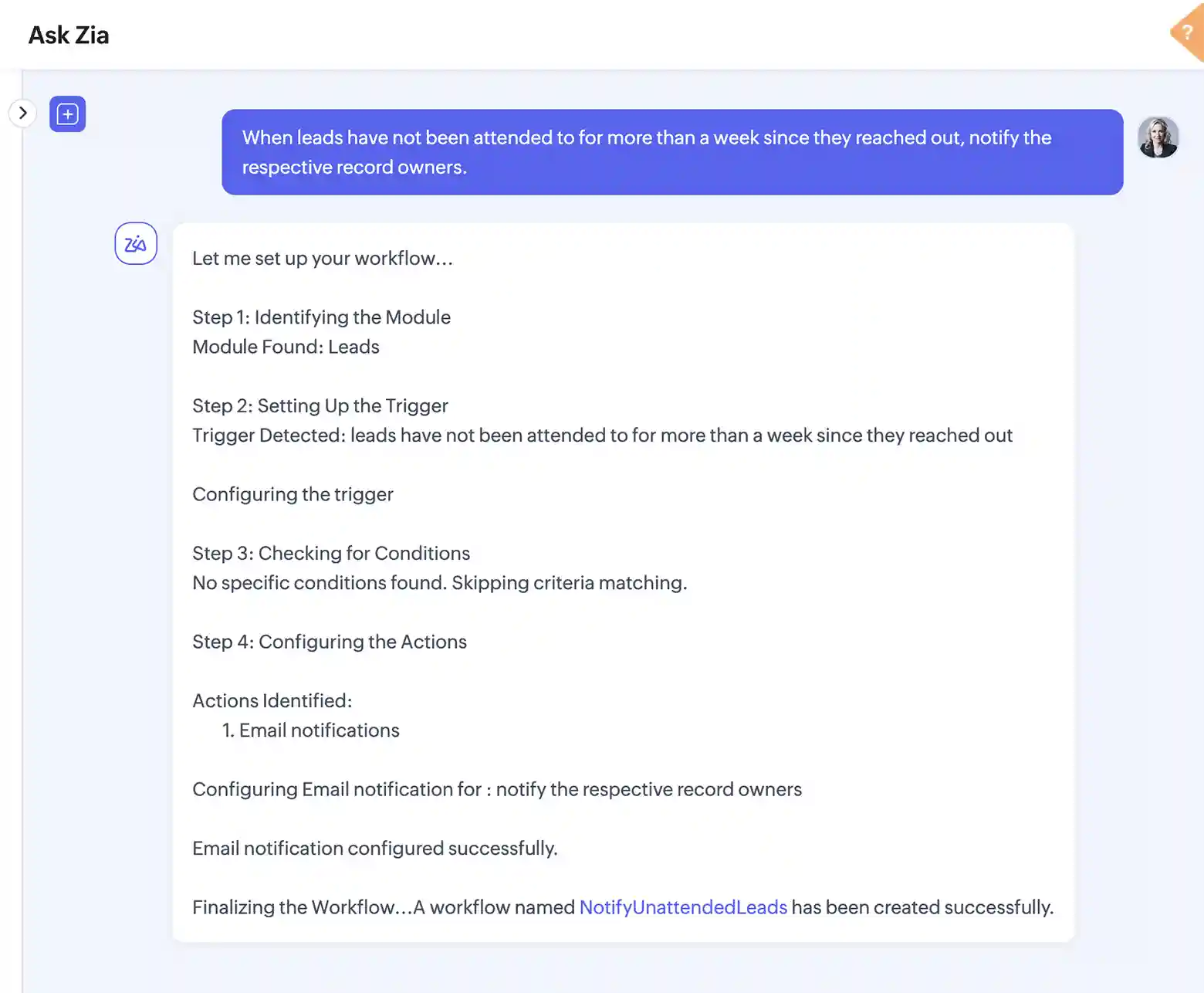
Source: Zoho CRM
Zia runs on proprietary language models rather than third-party AI providers, so customer CRM data isn't fed into external training pipelines. For privacy-conscious buyers, that matters.
The gap between them is scale. Zia has more capabilities, but most unlock at the Enterprise ($40/user/month) and Ultimate ($52/user/month) tiers. Calculus AI delivers useful AI at lower price points. The decision depends on whether your team will actually use the additional features.
Both platforms share a limitation: their AI only reasons about data already in the CRM. Neither can tell you about signals outside your system (companies researching your category, contacts changing jobs, funding events). That's the intelligence layer a platform like ZoomInfo provides.
Pricing reflects different ambitions
Both platforms offer free plans and tiered pricing, but the value curves diverge as you scale.
Vtiger CRM pricing (annual billing):
Plan | Price | Key features |
|---|---|---|
Free (10 users) | Core CRM, 3,000 records, 1,000 emails/month | |
$12/user/month | AI features, lead routing, 100K records, max 15 users | |
$30/user/month | Telephony, unlimited users and records, 2-way email sync | |
$42/user/month | Process Designer, audit logs, IP whitelisting | |
$50/user/month | Full Calculus AI suite |
Vtiger also offers a Single App User license ($20-$38/user/month on Professional and above) for team members who need only one module (Sales, Marketing, or Help Desk), reducing per-seat costs for mixed teams.
Zoho CRM pricing (annual billing):
Plan | Price | Key features |
|---|---|---|
$0 (3 users) | Leads, contacts, deals, 5,000 records | |
$14/user/month | Cadences, custom reports, sales forecasting | |
$23/user/month | Blueprint, CPQ, email intelligence | |
$40/user/month | Zia AI, territory management, CommandCenter | |
$52/user/month | Custom AI/ML via QuickML, data preparation |
At entry level, the two are close: Vtiger starts at $12/user and Zoho at $14/user for comparable functionality. The difference emerges in the middle. Vtiger's $30/user Professional plan includes unlimited users and records, telephony integration, and 2-way Office 365 email sync.
Zoho's $23/user Professional plan includes Blueprint and inventory management but locks AI (Zia), territory management, and journey orchestration behind the $40/user Enterprise tier.
For a 25-person sales team, the annual costs:
Zoho Professional: $6,900/year
Vtiger Professional: $9,000/year
Zoho Enterprise (for AI and territory management): $12,000/year
Vtiger costs less than Zoho Enterprise but more than Zoho Professional. The decision hinges on whether you need the capabilities gated at Zoho's Enterprise tier.
Both platforms carry add-on costs that can surprise budgets.
Vtiger sells Booster Packs for additional workflows, custom fields, and API calls ($10-$25/month each), plus add-ons like the Calculus AI pack ($12/user/month on lower tiers) and CPQ ($8/user/month).
Zoho charges separately for premium support, Jumpstart implementation ($200/hour, 10-hour minimum), and additional data storage (~$20/month per GB).
The intelligence gap both CRMs share
Here's the problem neither Vtiger nor Zoho solves: your CRM only knows what you and your team put into it.
A CRM records that a lead came from a webform, that a rep sent three emails, that the deal moved from Stage 2 to Stage 3.
It doesn't know whether that prospect's company just raised funding, whether the VP who championed your deal left for a competitor, whether three other companies in the same industry are researching your category right now, or whether the email address your rep has been sequencing still works.
This isn't a flaw in Vtiger or Zoho. CRMs were designed to manage relationships, not discover them. But the quality of every CRM workflow (lead scoring, pipeline forecasting, marketing automation, outreach) depends on the quality of the data feeding it. Stale contacts, missing decision-makers, and invisible buying signals degrade every downstream motion.
That gap is what ZoomInfo was built to fill.
ZoomInfo provides the intelligence layer
ZoomInfo is a B2B data intelligence and GTM platform that operates at a different level than a CRM.
While Vtiger and Zoho manage the deals and contacts you already know about, ZoomInfo identifies the buyers you should be pursuing and gives your team the context to win them.
The foundation is data.
ZoomInfo maintains verified profiles for 500M contacts and 100M companies, including 135M+ verified phone numbers, 200M+ verified business emails, and technology usage data across 30,000+ technologies at 30M+ companies. A pipeline backed by 300+ human researchers and multi-source verification delivers up to 95% accuracy on first-party data.
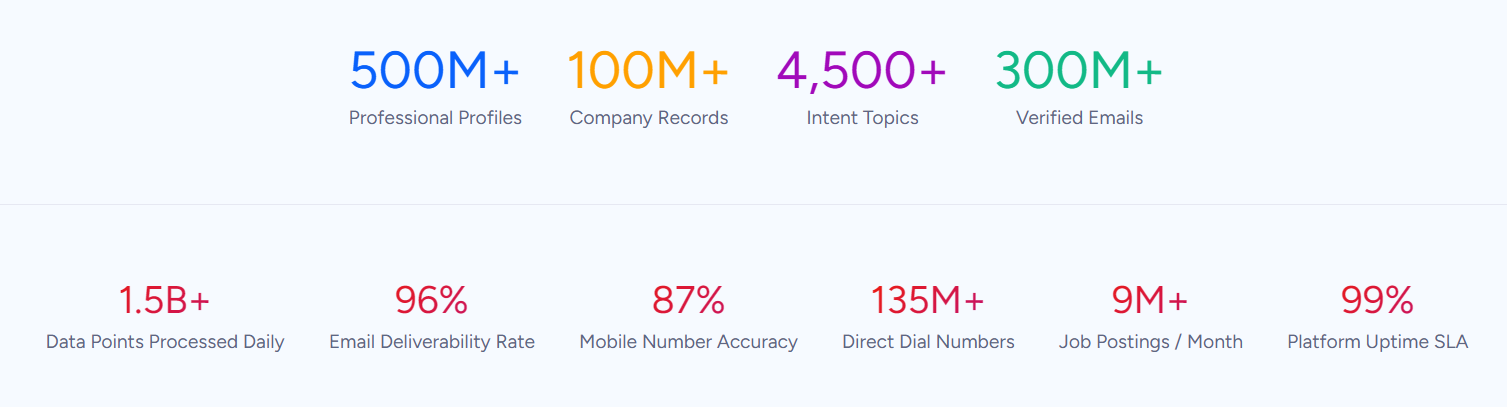
In a Fortune 500 competitive RFP analyzing 25 million contacts across vendors, the independent consultant concluded that "no other competitor came even close."
That data becomes intelligence through the GTM Context Graph, which processes 1.5B+ data points daily by combining ZoomInfo's third-party data with your CRM records, conversation transcripts, and behavioral signals.
The result: your team knows not just that a deal moved to Stage 3, but why (the CFO joined the last call and asked about ROI), what's likely next (based on patterns across thousands of similar deals), and which accounts are researching solutions in your category now (via intent signals from 210 million IP-to-Organization pairings).
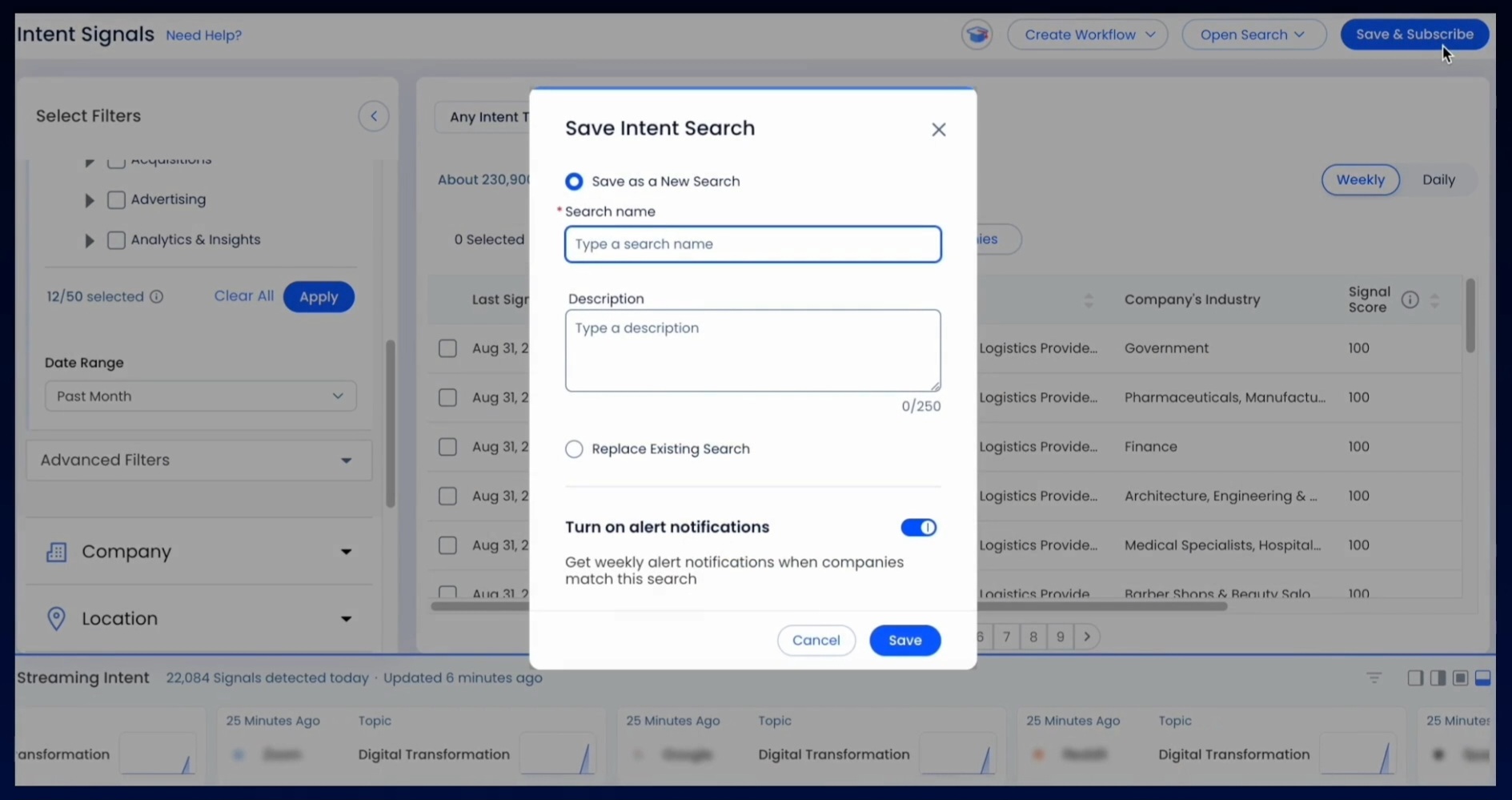
Source: ZoomInfo
You access this intelligence three ways:
GTM Workspace gives sellers a view of their accounts with AI-generated briefs, action feeds driven by buyer signals, and AI-drafted outreach based on account context.
GTM Studio gives marketers and RevOps a workspace for building audiences in natural language, launching multichannel campaigns, and measuring pipeline impact without engineering support.
APIs and MCP deliver the same intelligence into any CRM, custom agent, or third-party application. ZoomInfo integrates with CRMs including Salesforce, HubSpot, Microsoft Dynamics, and Zoho.
Source: ZoomInfo
For teams using Vtiger or Zoho, ZoomInfo acts as the intelligence engine feeding the CRM with verified contacts, enriched company data, and buying signals. Instead of relying on reps to research prospects manually or hoping webform data stays current, ZoomInfo keeps the data layer accurate and surfaces opportunities the CRM alone would miss.
Seismic's sales team attributed 39% of active pipeline to opportunities identified or influenced by ZoomInfo signals, reported 54% productivity gains, and saved 11.5 hours per week per seller. "It's bringing data together faster than anyone could. It's both a time saving and a quality improvement," said Toby Carrington, Chief Business Officer. (Seismic case study)
Vtiger CRM vs. Zoho CRM vs. ZoomInfo: Which should you choose?
The right choice depends on your team's size, technical maturity, and what's limiting your pipeline.
Choose Vtiger CRM if:
You're an SMB (10-200 employees) that needs sales, marketing, and support in one subscription
Access to features like Deal Room, Playbooks, and Process Designer matters more than ecosystem breadth
You need an open-source or self-hosted option for compliance or data residency
Your team can invest time in setup and configuration
You want a focused CRM, not a sprawling platform
Choose Zoho CRM if:
You want your CRM as the hub of a broader business platform (finance, support, HR, analytics)
Your team can configure Blueprint, Canvas, and automation workflows
You need Zia AI's breadth (agentic AI, custom ML, journey orchestration)
You're already using or planning to use other Zoho applications
Fifteen years of Gartner SFA recognition matters to your evaluation
Add ZoomInfo if:
Your pipeline depends on finding new buyers, not just managing existing relationships
Stale contact data, missing decision-makers, or blind prospecting hurt your conversion rates
You need verified B2B data (500M contacts, 135M+ phone numbers, 200M+ emails) feeding your CRM
Buyer intent signals would change how your team prioritizes accounts
You want AI that understands why deals move, not just that they moved
Start with ZoomInfo Lite for free or request a demo of the full platform.
SpringDB used ZoomInfo's enriched data to achieve 2x-3x increases in campaign conversions, a 300% increase in database usability, and 30-50% uplift in average deal size. "You'll get 10x the value if you think of ZoomInfo as a full platform and not just a tool for one team," said John Kotsuros, Founder and CEO. (SpringDB case study)
A good CRM manages your relationships. A good data intelligence platform makes sure you're building relationships with the right buyers at the right time. Most growing B2B teams need both.
Vtiger CRM vs. Zoho CRM vs. ZoomInfo FAQ
What is the fundamental difference between Vtiger CRM and Zoho CRM?
Vtiger CRM is a single platform where sales, marketing, and help desk run on one shared data model. Zoho CRM is the centerpiece of a 55+ application ecosystem spanning finance, HR, project management, and more. Vtiger offers depth in one product at lower prices. Zoho offers breadth across a full business stack with enterprise capabilities at higher tiers.
The two share roots (Vtiger's founder worked at the company that became Zoho Corporation) but took different architectural paths.
How does ZoomInfo relate to Vtiger and Zoho CRM?
ZoomInfo is not a CRM. It is a B2B data intelligence and go-to-market platform that works alongside your CRM. ZoomInfo provides verified contact data (500M contacts, 200M+ emails, 135M+ phone numbers), buyer intent signals, and AI-powered account intelligence.
It integrates with CRMs including Zoho to keep records accurate, enrich company profiles, and surface buying opportunities the CRM alone cannot detect.
Which platform is cheaper for a 25-person team?
Zoho CRM Professional costs the least at $6,900/year ($23/user/month annual).
Vtiger Professional costs $9,000/year ($30/user/month) but includes unlimited users and records plus telephony integration. Zoho Enterprise, which adds Zia AI and territory management, costs $12,000/year ($40/user/month).
ZoomInfo uses consumption-based pricing, with a free tier (ZoomInfo Lite) for individual users and small teams.
Which CRM has better AI capabilities?
Zoho CRM's Zia AI is broader: predictive scoring, generative content, agentic AI agents, custom ML models (QuickML), and email sentiment analysis across eight emotion categories. But most of Zia's capabilities require the Enterprise ($40/user) or Ultimate ($52/user) tier.
Vtiger's Calculus AI delivers useful AI (deal scoring, call analysis, no-code prediction models, AI agent builder) at lower prices, making it more accessible for smaller teams.
Neither platform's AI can reason about external market signals the way ZoomInfo's GTM Context Graph can.
Can Vtiger CRM be self-hosted?
Yes. Vtiger offers an open-source edition with over 5 million downloads that you can install on your own servers. This is a real differentiator for organizations in regulated industries or regions with strict data residency requirements. Zoho CRM and ZoomInfo are cloud-only.
Does ZoomInfo integrate with both Vtiger CRM and Zoho CRM?
ZoomInfo lists Zoho among its supported CRM integrations alongside Salesforce, HubSpot, and Microsoft Dynamics.
For Vtiger, ZoomInfo's APIs and MCP server can deliver data into any system, though a pre-built native connector is not listed in ZoomInfo's marketplace. Teams using Vtiger can access ZoomInfo data through the API or middleware tools like Zapier.
Which platform is easiest to set up?
None of the three is plug-and-play for complex use cases. Reviewers describe Vtiger's advanced features as "not intuitive out of the box," requiring a dedicated admin.
Zoho CRM requires "investing time in setup and configuration rather than expecting immediate out-of-box functionality," per SoftwareReviews.
ZoomInfo's onboarding spans 90 days across planning, implementation, education, and adoption. For the simplest start, Vtiger's free One Pilot plan or Zoho's free plan offer low-risk entry points.
How do the platforms handle data security and compliance?
Vtiger holds ISO 27001 and ISO 27701 certifications with data centers across eight global regions, and offers self-hosting for full data control.
Zoho holds ISO 27001, ISO 27701, SOC 2 Type 2, and HIPAA certifications, operates its own data centers globally, and runs a no-advertising business model that does not monetize customer data.
ZoomInfo holds ISO 27001, ISO 27701, SOC 2 Type II, and TRUSTe GDPR/CCPA validations, and is a registered data broker in California and Vermont.
