
WalkMe pioneered the Digital Adoption Platform (DAP) category and now operates as a wholly-owned SAP subsidiary after a $1.5 billion acquisition in September 2024.
The platform sits on top of enterprise applications (SAP, Salesforce, Workday, ServiceNow) and provides in-app guidance, workflow automation, and usage analytics designed to close the gap between what companies spend on software and what they actually get out of it.
According to WalkMe's research, that gap is large: enterprises lose 51 workdays per employee annually to technology friction.
To create this WalkMe review, we analyzed the platform extensively. We believe it's the right choice if:
You're a large enterprise rolling out complex applications like SAP S/4HANA, Salesforce, or Workday
You need to reduce IT support tickets and eliminate repetitive training sessions at scale
You require enterprise compliance credentials (FedRAMP, SOC 2, ISO 27001)
You have a dedicated team to build and maintain in-app guidance content
You're managing software adoption across multiple regions and languages
However, WalkMe is not a good choice if:
You're a small or mid-sized business without dedicated admin resources
You need published, transparent pricing before engaging a sales team
You want a tool that's production-ready in days, not months
Your primary need is lightweight customer-facing onboarding for a SaaS product
Your budget requires modular purchasing (paying only for the features you need)
While WalkMe excels at helping teams adopt enterprise software, it doesn't address a parallel challenge: the quality of B2B data flowing through your go-to-market stack. WalkMe can ensure your sales team uses Salesforce correctly. It can't ensure the contacts and buying signals inside Salesforce are accurate. For GTM teams, that data layer is what turns adopted tools into revenue.
This is where ZoomInfo enters the picture: a GTM platform that fills your CRM with verified B2B data (covering 500M contacts and 100M companies) and buyer intent signals, so the tools your team has learned to use actually drive revenue.
We've included a look at ZoomInfo later in this review as a complementary platform for GTM teams that have solved the adoption challenge and need to get more from their technology stack. If you'd like to explore ZoomInfo's data and intelligence capabilities, you can start with a free trial here.
What is WalkMe?
WalkMe is a cloud-based Digital Adoption Platform founded in 2011 in Tel Aviv, Israel by Dan Adika, Rafael Sweary, Eyal Cohen, and Yuval Shalom Ozanna.
The founding idea grew from a simple frustration: complex software is hard for ordinary users to navigate, and training delivered outside the application is quickly forgotten.
The company launched its first product in April 2012 and spent the next seven years building the category it now leads. In 2019, Gartner formally created the "Digital Adoption Solutions" category, validating the market WalkMe had defined.
After raising approximately $307.5 million in private funding and going public on Nasdaq in 2021, WalkMe was acquired by SAP in September 2024 for roughly $1.5 billion. SAP's stated rationale: "WalkMe X's AI capabilities will supercharge SAP's copilot Joule with context-aware and proactive help across workflows."
Today, WalkMe serves approximately 1,600 enterprises with 35 million users across 42+ countries, including 27% of the Fortune 500.
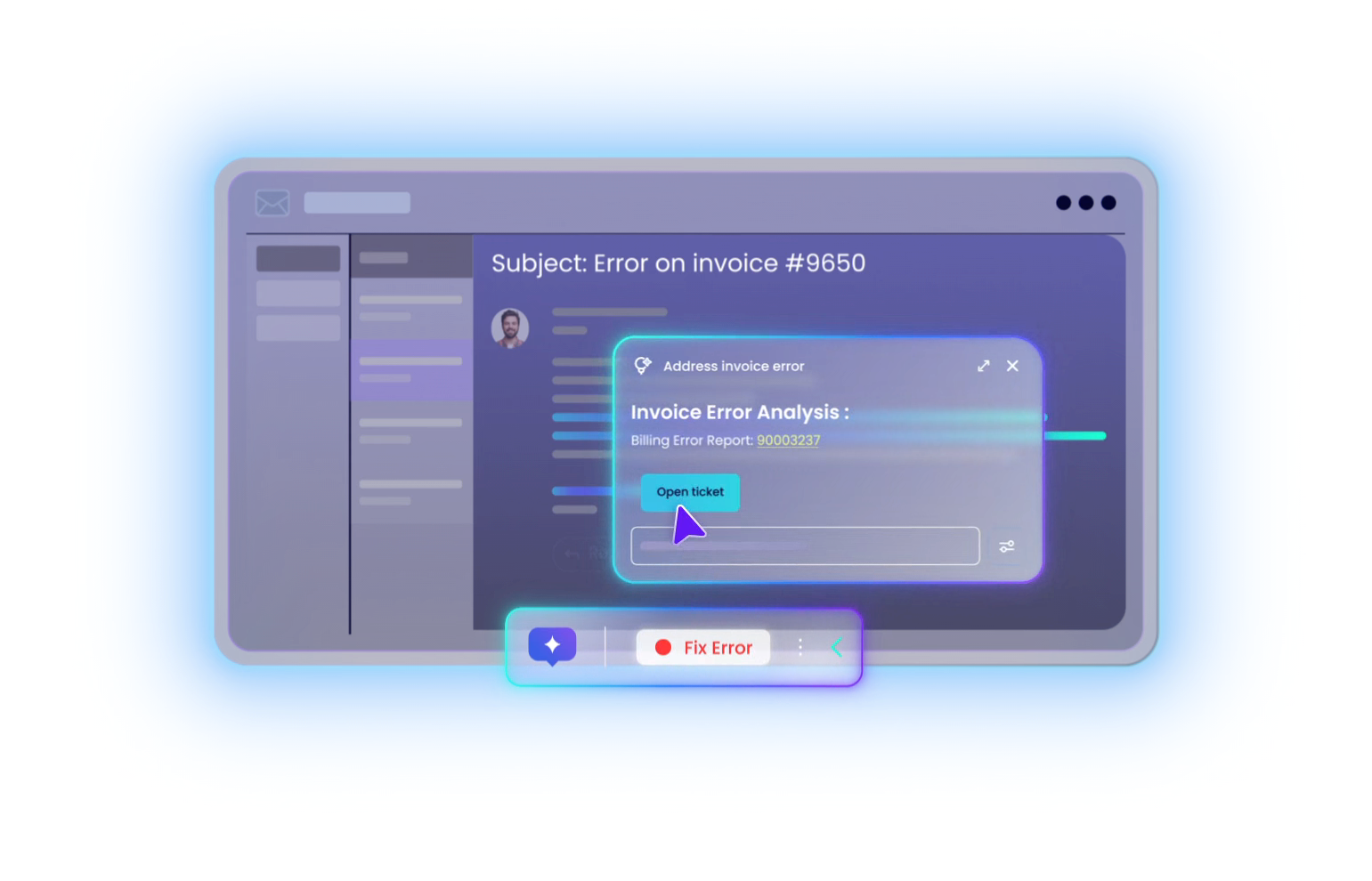
The platform is organized around three pillars: Data (understanding how software is actually used), Action (intervening with guidance and automation), and Experience (delivering contextual help through in-app overlays and conversational interfaces).
The platform is embedded natively into SAP applications with a WalkMe Standard tier included in SAP subscriptions, while continuing to support Salesforce, Workday, Microsoft Dynamics 365, ServiceNow, and SAP SuccessFactors.
WalkMe Pros & Cons
Pros | Cons |
|---|---|
Category leader with Forrester, IDC, and Gartner validation | No published pricing; enterprise contracts only |
DeepUI technology auto-adapts guidance when applications update | Steep learning curve for advanced configurations |
Works across any web or desktop application without code changes | Multi-month implementation timeline typical |
FedRAMP Ready status for US federal deployments | SAP acquisition raises neutrality concerns for non-SAP stacks |
494% 3-year ROI validated by IDC | Large content libraries require ongoing maintenance |
AI-powered contextual assistance across applications | No free trial or self-serve onboarding available |
Point-and-click content builder (no coding required) | Not accessible for SMBs or budget-constrained organizations |
WalkMe Review: How It Works & Key Features
Analytics & Usage Intelligence: WalkMe reveals how your software is actually being used, at the click level, across every application.
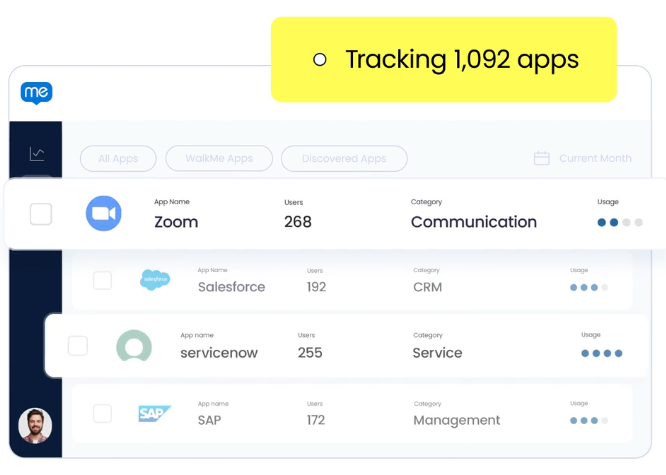
WalkMe's Data pillar addresses a fundamental blind spot: enterprises have no reliable way to see which applications employees actually use, whether they use them correctly, or how many licenses sit idle.
Source: WalkMe
Deployed as a browser extension across user endpoints, WalkMe captures interaction data (clicks, field entries, page visits, session duration) across every web-based application without requiring per-app integrations.
App Discovery & Analytics surfaces all web-based applications in use, including shadow IT and unsanctioned AI tools, segmented by department, role, and organizational unit.
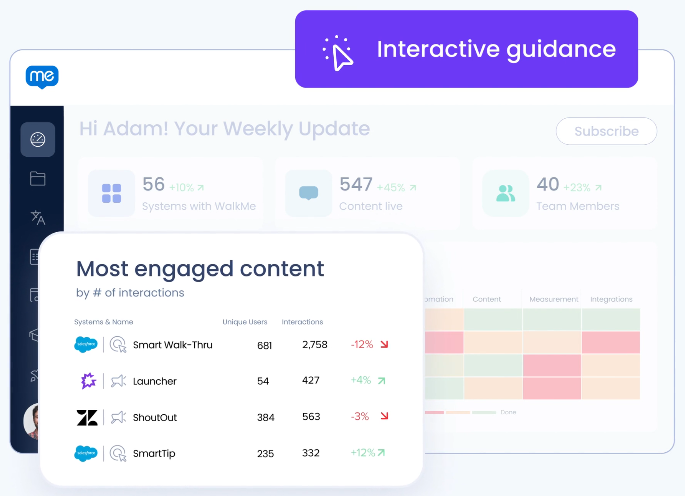
WalkMe Insights maps user interactions against defined workflows, identifying where people get stuck or stall, while also tracking whether WalkMe's own guidance produces the intended behavior change.
Source: WalkMe
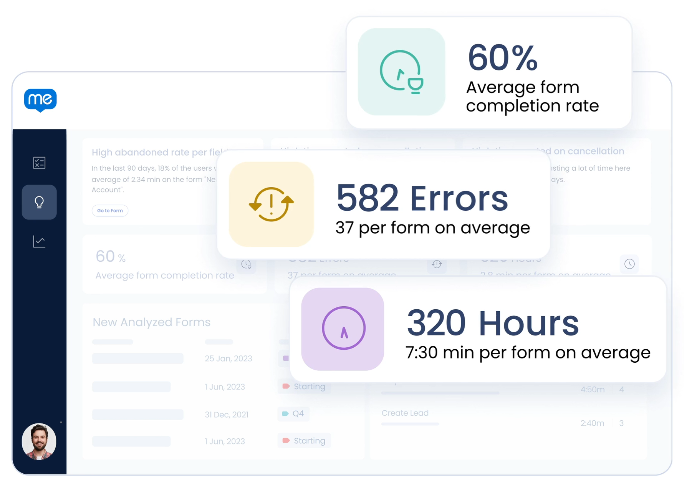
Form Analytics goes deeper, capturing completion rates and error patterns, time spent on individual fields, and drop-off points. The system uses AI to generate recommendations for eliminating identified friction.
Source: WalkMe
For sales teams struggling with CRM data quality, this means pinpointing which fields cause reps to abandon records.
Discovery License Optimization overlays financial data on usage metrics to produce financial reports showing which licenses to reallocate, eliminate, or expand. With WalkMe's research estimating that enterprises wasted $104M on underused tech in 2024, the financial case for usage visibility is hard to ignore.
The differentiator across all four analytics products: WalkMe captures this data through a single browser extension, with no per-app integrations required. Most SaaS management platforms depend on first-party application integrations that limit them to shallow signals like last login.
Guidance Creation & Workflow Automation: WalkMe lets non-technical teams build in-app guidance that survives application updates.
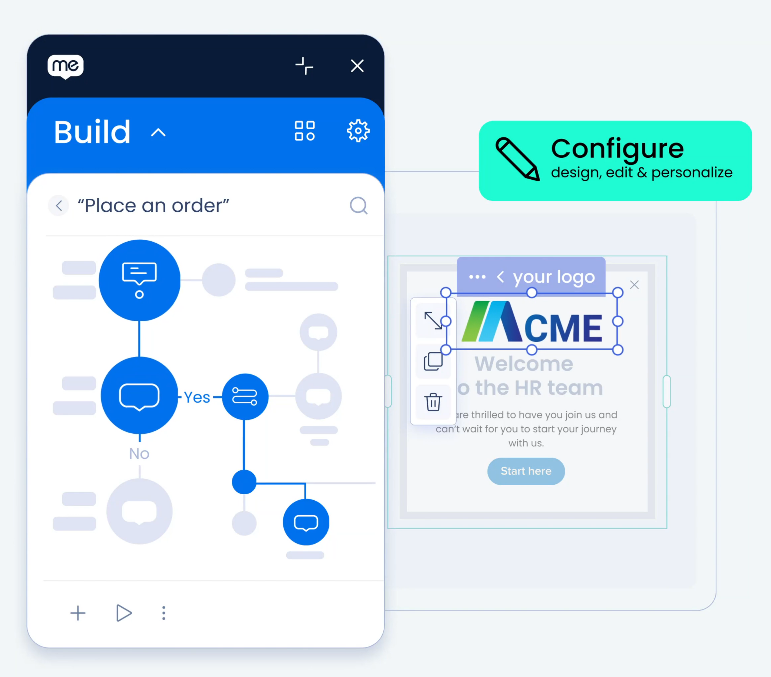
WalkMe's Action pillar is the execution layer. The WalkMe Editor is an Electron-based desktop application paired with a browser extension that lets builders point-and-click on UI elements to create guidance steps, triggers, and conditions, with no coding required for most use cases.
Source: WalkMe
Content types include Smart Walk-Thrus (step-by-step guided tours with branching logic and user conditions for multi-path workflows), SmartTips (contextual tooltips attached to specific UI elements), and ShoutOuts (proactive in-app announcements).
Segmentation rules control which content appears to which users based on role, department, or behavior.
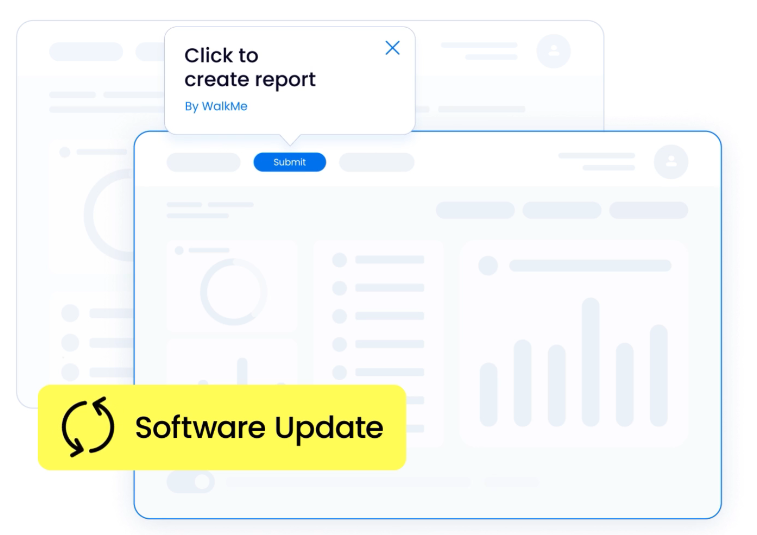
The feature that separates WalkMe from simpler tooltip tools is DeepUI, its proprietary AI technology. Traditional in-app guidance breaks when applications update because it relies on hardcoded references to UI elements.
Source: WalkMe
DeepUI uses AI to interpret application interfaces the way a human would (reading visual elements, layout, and text) and automatically adapts guidance when UIs change.
ENGIE reports eliminating the need to test and correct over 100 digital adoption solutions for each new Salesforce release.
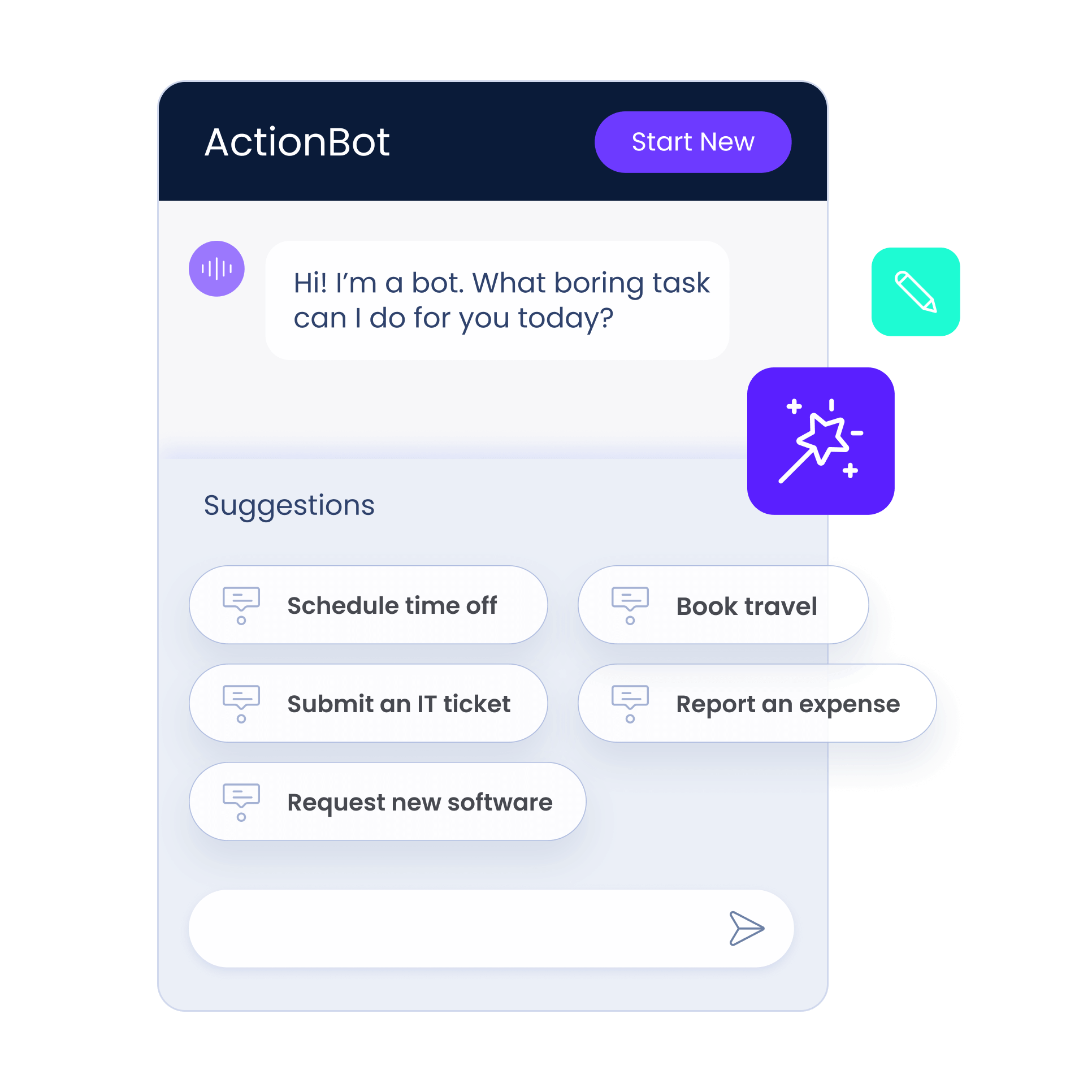
Workflow Automation operates at the UI layer, automatically clicking buttons and advancing screens inside target applications. A conversational interface lets employees complete common tasks by chatting rather than navigating complex menus.
Source: WalkMe
Workflow Accelerators provide pre-configured packages built from more than 2,000 enterprise implementations, giving customers a starting point rather than a blank canvas.
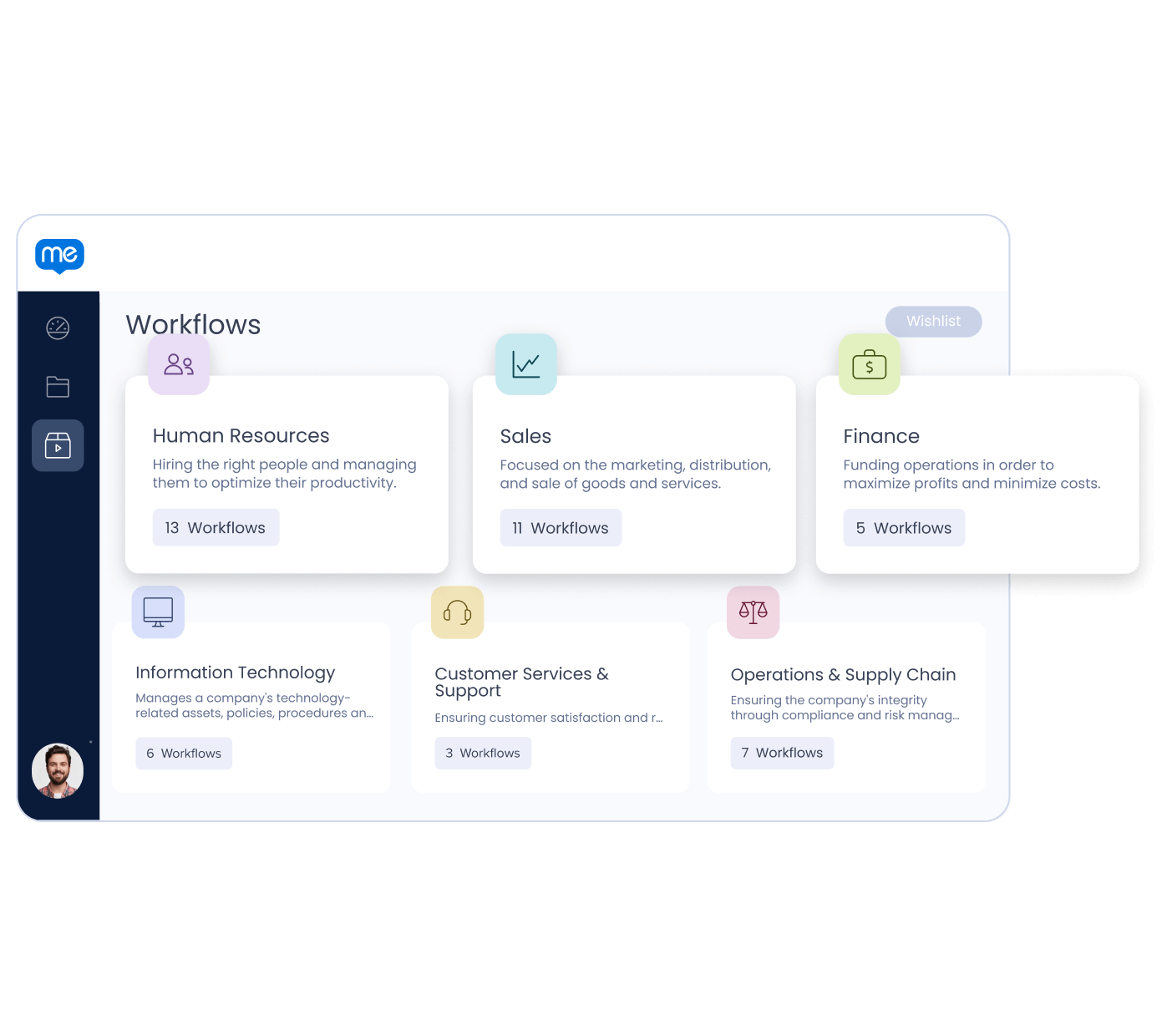
Source: WalkMe
In-App Experience & AI: WalkMe delivers contextual, screen-aware assistance across every application without requiring users to switch tools.
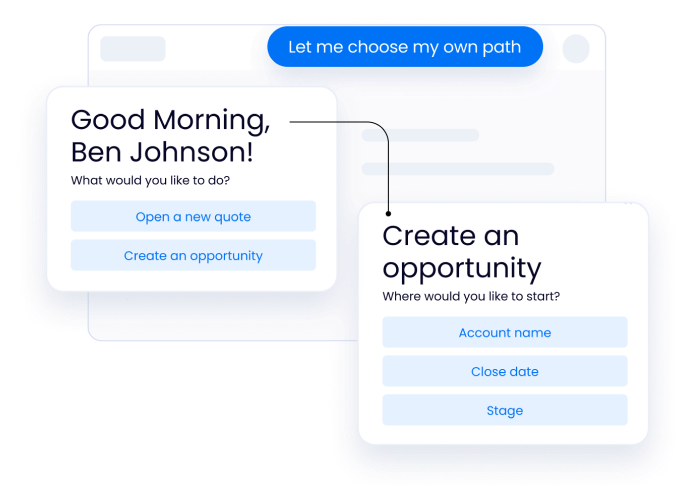
WalkMe's Experience pillar is the visible layer. In-App Guidance delivers interactive overlays on top of applications via the DeepUI layer, without modifying the host application's source code.
Source: WalkMe
Guidance supports conditional branching and error-handling so the same walkthrough handles multiple user paths. Validation safeguards intercept errors at the point of data entry.
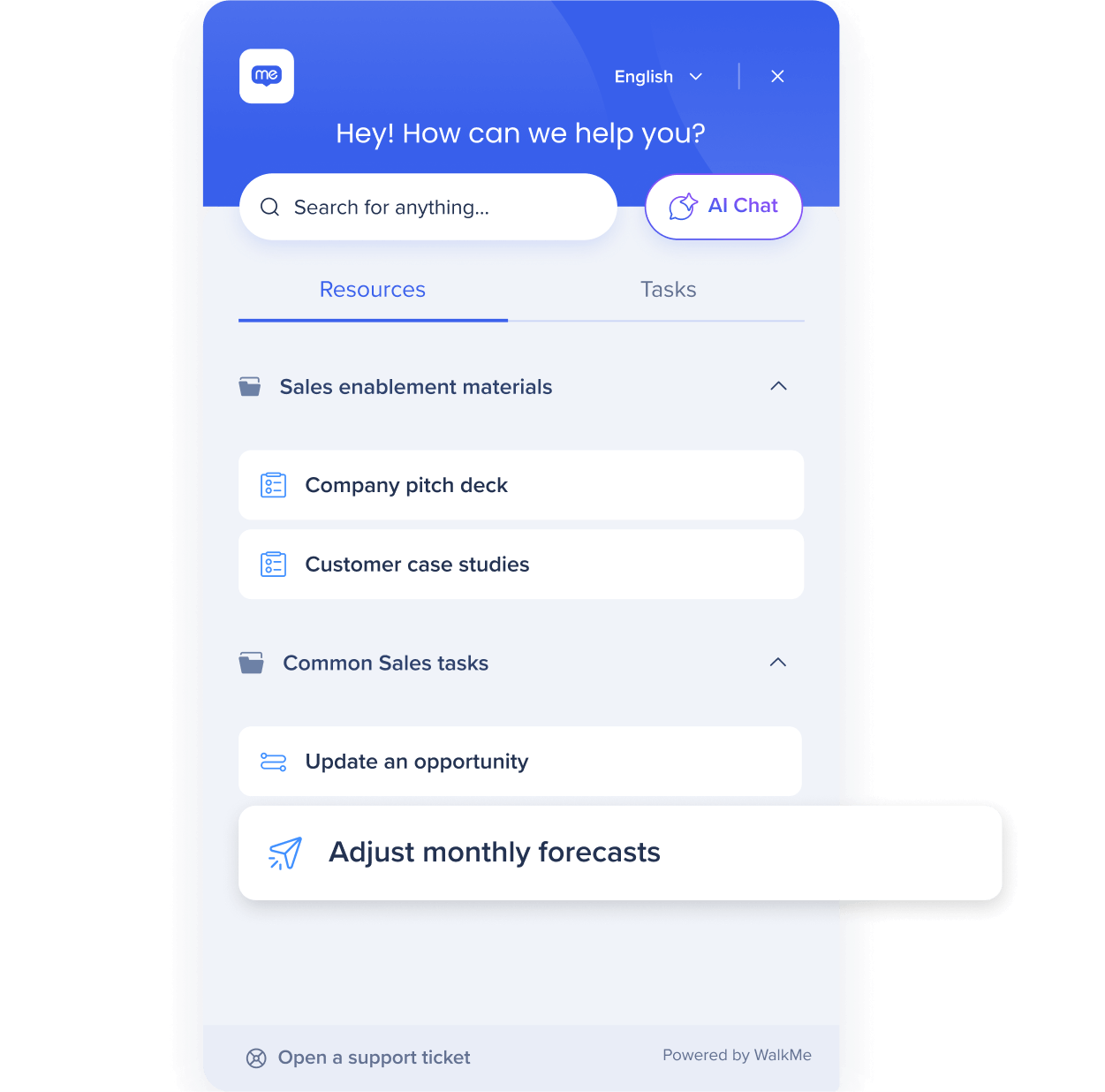
The WalkMe Menu is a persistent widget that appears in every application, providing a single access point to AI chat, guidance, company knowledge, and task checklists. It supports custom branding and allows organizations to integrate their own enterprise AI or use WalkMe's built-in offering.
Source: WalkMe
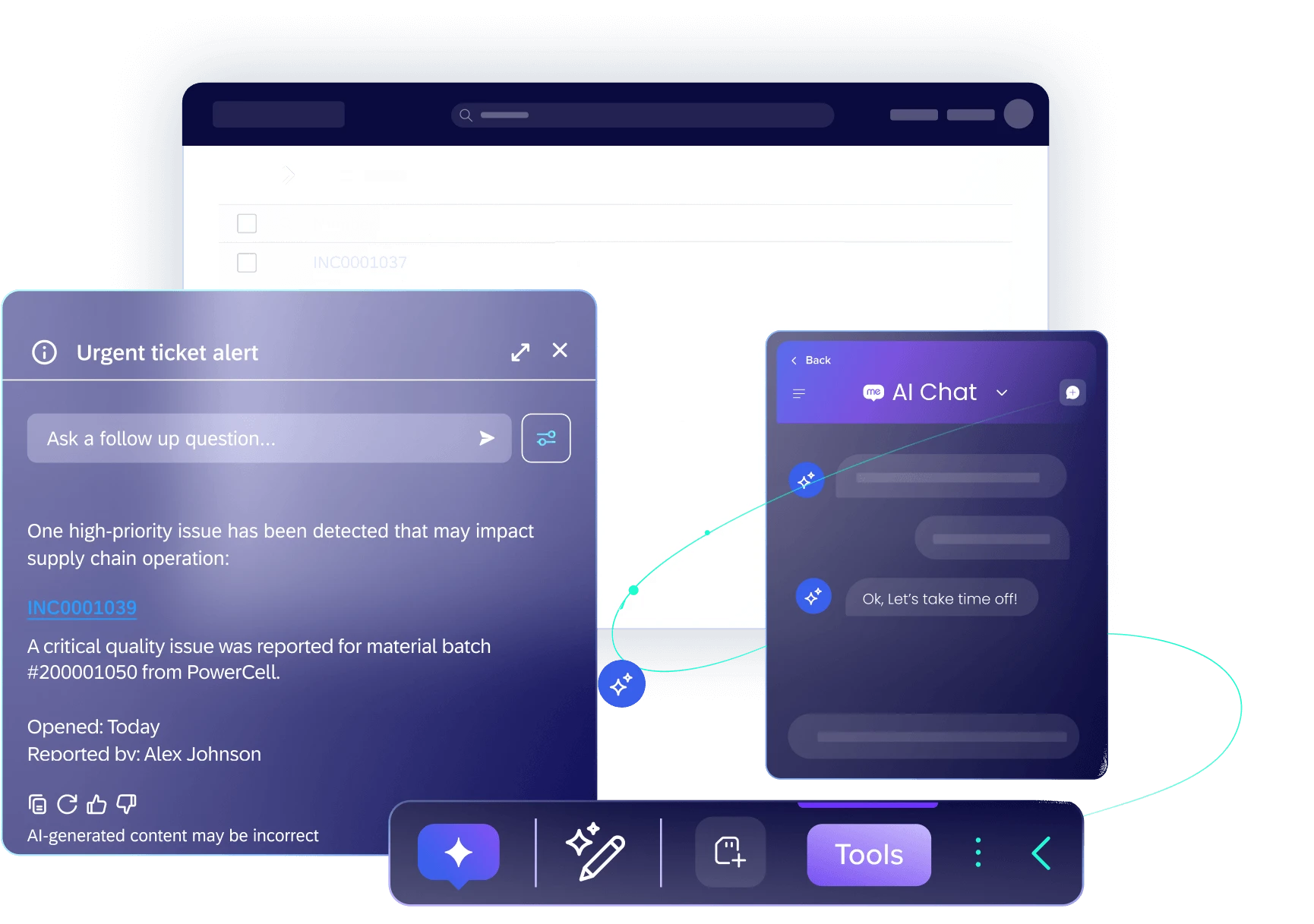
WalkMe AI is the platform's contextual intelligence layer. Built on over a decade of enterprise DAP data (7 billion interactions between people and software every year), WalkMe AI combines screen-based understanding (via DeepUI), business knowledge, and opt-in user memory to deliver seven capabilities: next best actions, memory-based personalization, multi-step workflow automations triggered by natural language, conversational chat grounded in business data, input validation, reading assistance, and writing assistance.
Source: WalkMe
The AI determines five context dimensions: who the person is, what they are trying to do, where they came from, what workflow they are performing, and where they are going. Automations execute via front-end automation, interacting with the UI directly across systems with no development work required.
The newest addition is WalkMe Learning Arc, a digital learning product. Authors can turn prompts and uploaded files into ready-to-launch courses and record web sessions to auto-generate simulations. Learning Arc is the designated successor to SAP Enable Now (reaching end of maintenance November 30, 2030), giving it a built-in migration pathway across the SAP install base.
Pricing: WalkMe uses custom enterprise pricing with no published rates.
WalkMe does not publish pricing. The pricing page is a "Request a demo" gateway with no listed rates, confirming a custom, enterprise-negotiated model. All commercial terms are set through signed Ordering Documents referencing the WalkMe Master License and Services Agreement.
The underlying structure is a subscription license model based on a negotiated number of users (End Users and Builders) and Target Applications.
Two license categories exist: WalkMe for Employees (internal workforce applications) and WalkMe for Customers (external-facing applications). AI feature consumption is metered via SAP AI Units, though specific rates are not publicly disclosed.
Contract flexibility is limited. Per the MLSA, fees are non-refundable, contracts are non-cancelable for the full commitment term, and the fee obligation is not conditioned on actual deployment or usage.
Contracts auto-renew, and unpaid fees past 14 days accrue interest at 1.5% per month compounded daily. Overage fees apply if usage exceeds contracted limits.
For SAP customers, WalkMe is embedded into SAP applications with a Standard tier included in SAP subscriptions and a Premium tier available for additional customization. This is the only publicly disclosed tier structure.
Additional costs to consider include professional services fees for implementation and training, tax obligations excluded from base fees, SLA tier selection, and potential partner channel markups.
Where WalkMe Falls Short
WalkMe leads its category, but several limitations become clearer with extended use. These reflect the natural consequences of building for enterprise scale rather than broad accessibility.
High Price with Low Transparency. TrustRadius reviewers consistently flag WalkMe as expensive, with custom quotes, multi-year contracts, and add-ons making budgeting difficult. There is no modular option to buy only the features you need.
For mid-sized organizations or departments exploring digital adoption for the first time, the lack of published pricing creates friction before a single conversation begins.
Significant Learning Curve. The WalkMe Editor is accessible for basic guidance, but advanced configurations involving complex selectors and dynamic elements require substantial time investment.
G2 reviewers flag the learning curve as a recurring challenge, with 34 mentions in recent reviews.
WalkMe recommends a Center of Excellence approach to scale programs, which implies dedicated internal staffing before the platform delivers full value.
Content Maintenance at Scale. Despite DeepUI's ability to auto-adapt guidance when UIs change, G2 reviewers note that large WalkMe content libraries can become outdated and require ongoing maintenance and creative workarounds.
Organizations managing guidance across dozens of applications need a content governance strategy from day one.
SAP Acquisition Creates Uncertainty. The $1.5 billion SAP acquisition gives WalkMe enterprise credibility and distribution across SAP's 300,000+ customers. But it also raises questions about long-term neutrality.
WalkMe continues to support Salesforce, Workday, and ServiceNow, but the strategic direction increasingly prioritizes the SAP ecosystem.
For enterprises running primarily non-SAP stacks, this shift warrants attention during vendor evaluation.
No Self-Serve Entry Point. Unlike some competitors that offer free trials or freemium tiers, WalkMe has no public trial or self-serve onboarding. Evaluation requires engaging the sales team, which filters out smaller teams and individual buyers who want to test before committing.
These limitations are design choices, not defects. WalkMe is built for enterprises with the resources to invest in a long-term digital adoption program. But they draw a clear line: organizations below that threshold, or those wanting fast, transparent access, will need to look elsewhere.
Even for organizations where WalkMe is the right adoption platform, there is a parallel challenge WalkMe does not address: the quality and completeness of B2B data powering your go-to-market stack. WalkMe can guide your revenue team through every CRM workflow. It cannot verify that the contacts, company data, and buying signals populating those systems are current or complete. For GTM teams, that data layer is what turns well-adopted tools into revenue.
Complementary Platform for GTM Teams: ZoomInfo
ZoomInfo addresses the other side of enterprise technology effectiveness. Where WalkMe ensures your teams can use the tools, ZoomInfo ensures those tools contain the data and intelligence GTM teams need to find, win, and grow customers.
ZoomInfo is a GTM platform built on one of the largest B2B data foundations in the market. Founded in 2007 by Henry Schuck, the company is publicly traded (NASDAQ: GTM) with $1.25 billion in annual revenue and 35,000+ enterprise customers including Adobe, Snowflake, and JPMorgan.
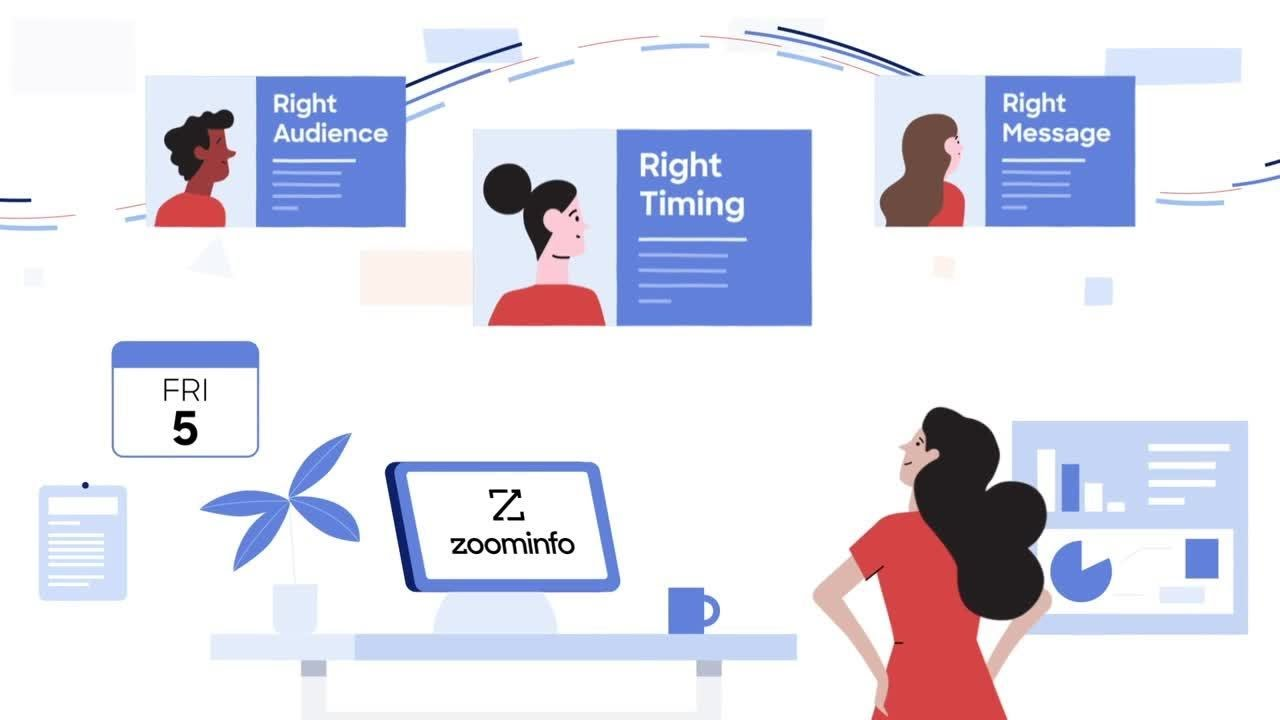
B2B Data Foundation: ZoomInfo provides the verified contacts, company intelligence, and buying signals that power your GTM stack.
ZoomInfo covers three data dimensions at once: identity data (who buyers are and how to reach them), company context (firmographics, technographics, org charts), and dynamic signals (buying behavior indicating when a company is actively in-market).
Scale: 500M contacts, 100M companies, 135M+ verified phone numbers, 120M direct-dial phone numbers, and 200M+ verified business email addresses.
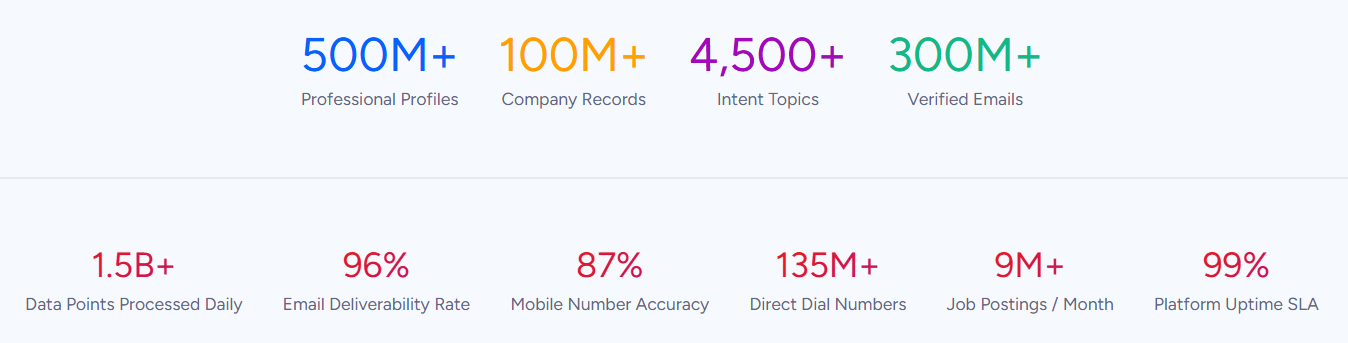
Source: ZoomInfo
Data flows through a proprietary verification pipeline backed by 300+ human researchers and reaches up to 95% accuracy on first-party data.
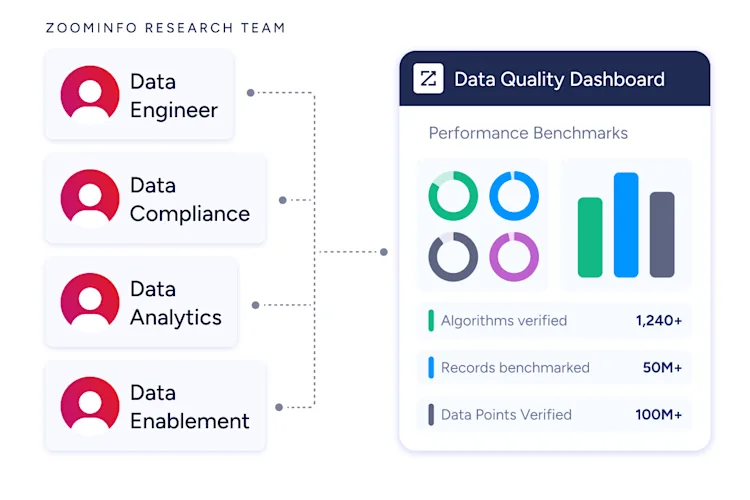
Source: ZoomInfo
This matters for teams using WalkMe to adopt CRM platforms. A well-adopted Salesforce instance with incomplete or stale data still produces poor results.
ZoomInfo's data enrichment automatically appends and updates CRM records with verified contact information, company attributes, and technographic data, ensuring the system your team knows how to use is populated with data worth acting on.
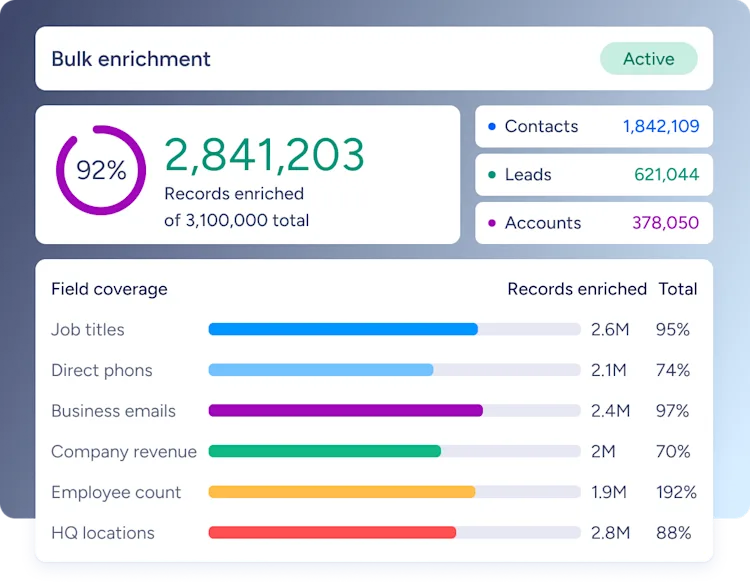
Source: ZoomInfo
The data advantage is externally validated: in a Fortune 500 competitive RFP analyzing 25 million contacts across vendors, the independent consultant concluded that "no other competitor came even close."
Vensure's VP of Revenue Operations noted: "ZoomInfo gives us the information we need to execute. We don't have to go through and spend our time digging. It's already there, so we can be three steps ahead." (Vensure)
GTM Context Graph: ZoomInfo's intelligence layer captures not just what happened, but why.
Where WalkMe's analytics reveal how employees interact with software, ZoomInfo's GTM Context Graph reveals how deals actually move.
Processing 1.5B+ data points daily, the GTM Context Graph combines ZoomInfo's B2B data with a customer's CRM records, conversation transcripts, email interactions, and behavioral signals into a single intelligence layer.
The distinction matters. A CRM records that a deal moved to Stage 4 and the close date was pushed two weeks. But as ZoomInfo's Chief Product Officer Dominik Facher writes: "The CRM recorded the state change. It has no record of why it happened."
The GTM Context Graph captures that context: the CFO who joined the last call and asked about ROI, the champion who went quiet during an internal budget battle, the intent signals showing the company is actively researching competitors.
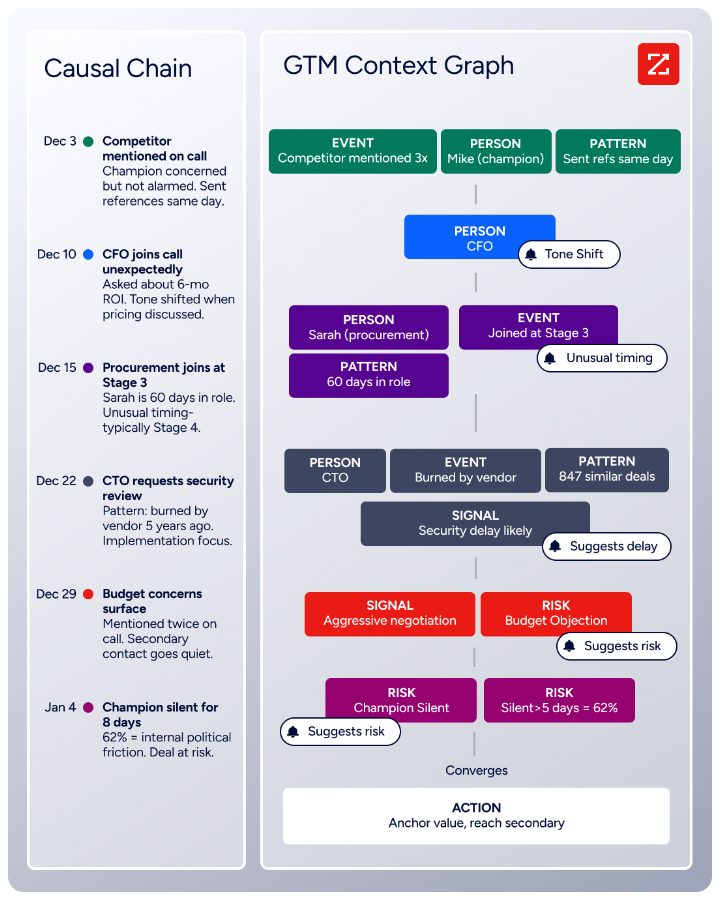
Source: ZoomInfo
Buyer Intent Data tracks signals from 210 million IP-to-Organization pairings and 6 trillion+ new keyword-to-device pairings sourced monthly.
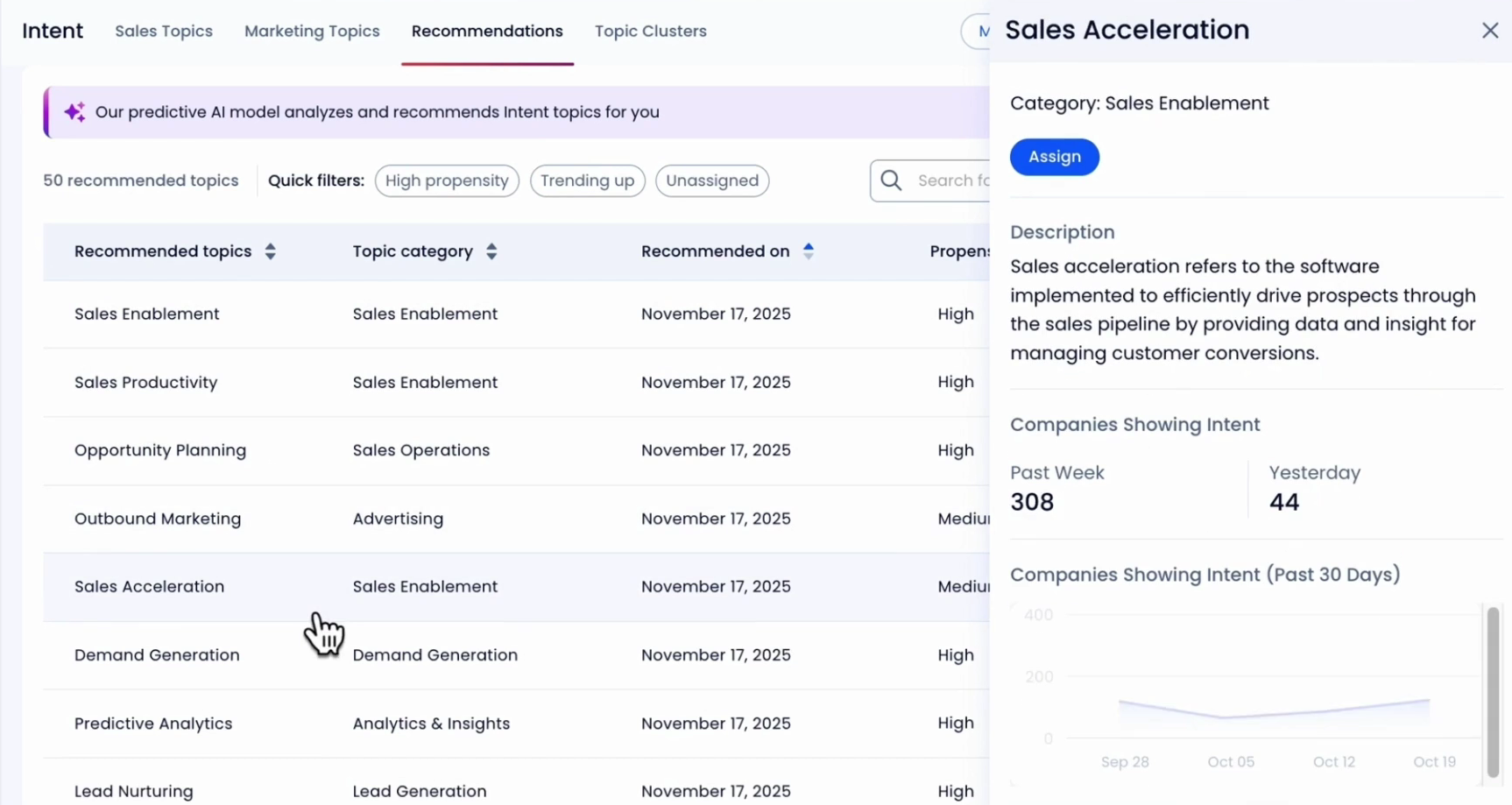
Guided Intent, exclusive to ZoomInfo, identifies topics historically correlated with deal success rather than requiring manual topic selection.
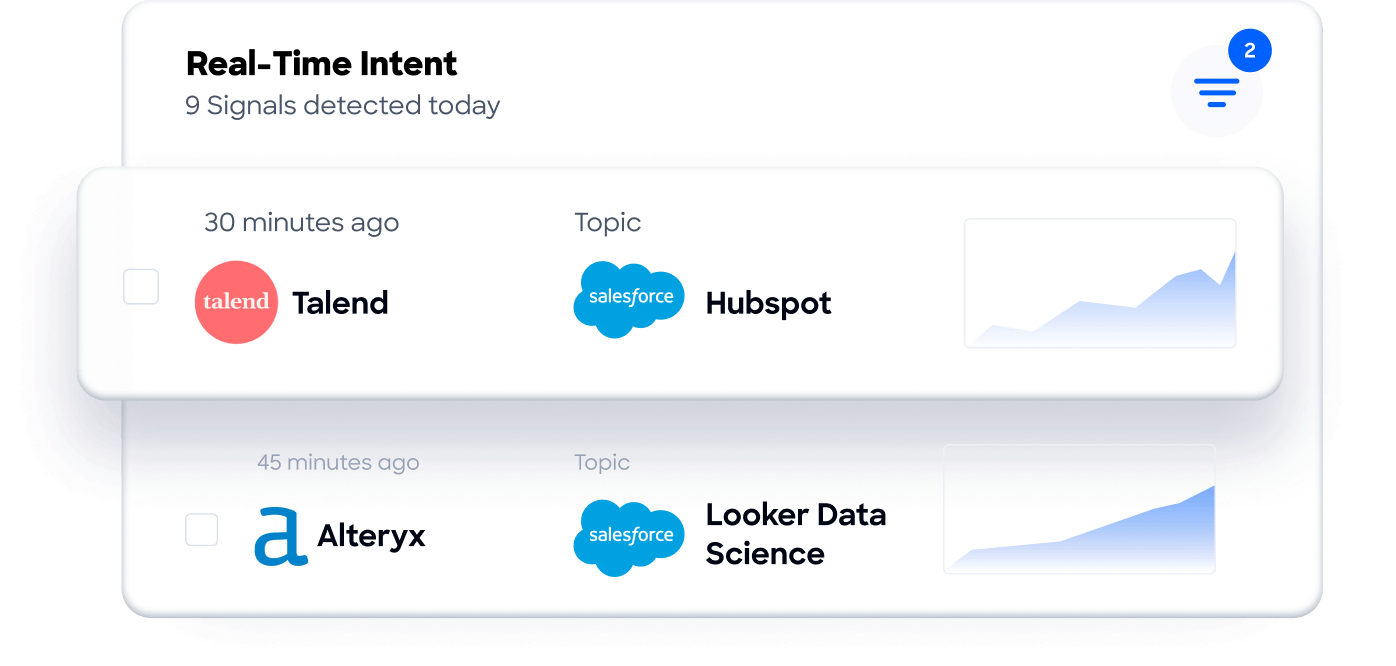
Source: ZoomInfo
Seismic attributed 39% of active pipeline to ZoomInfo-influenced opportunities. Chief Business Officer Toby Carrington noted: "It's bringing data together faster than anyone could. It's both a time saving and a quality improvement." (Seismic)
Universal Access: ZoomInfo delivers intelligence through seller workspaces, marketing tools, and open APIs.
ZoomInfo provides three ways to access its data and intelligence:
GTM Workspace is the seller's front-end, combining prioritized account feeds, AI-drafted outreach, real-time buying signals, and CRM updates in a single view. AI agents (built on Anthropic's Claude) handle account research, outreach generation, signal monitoring, and CRM field updates.
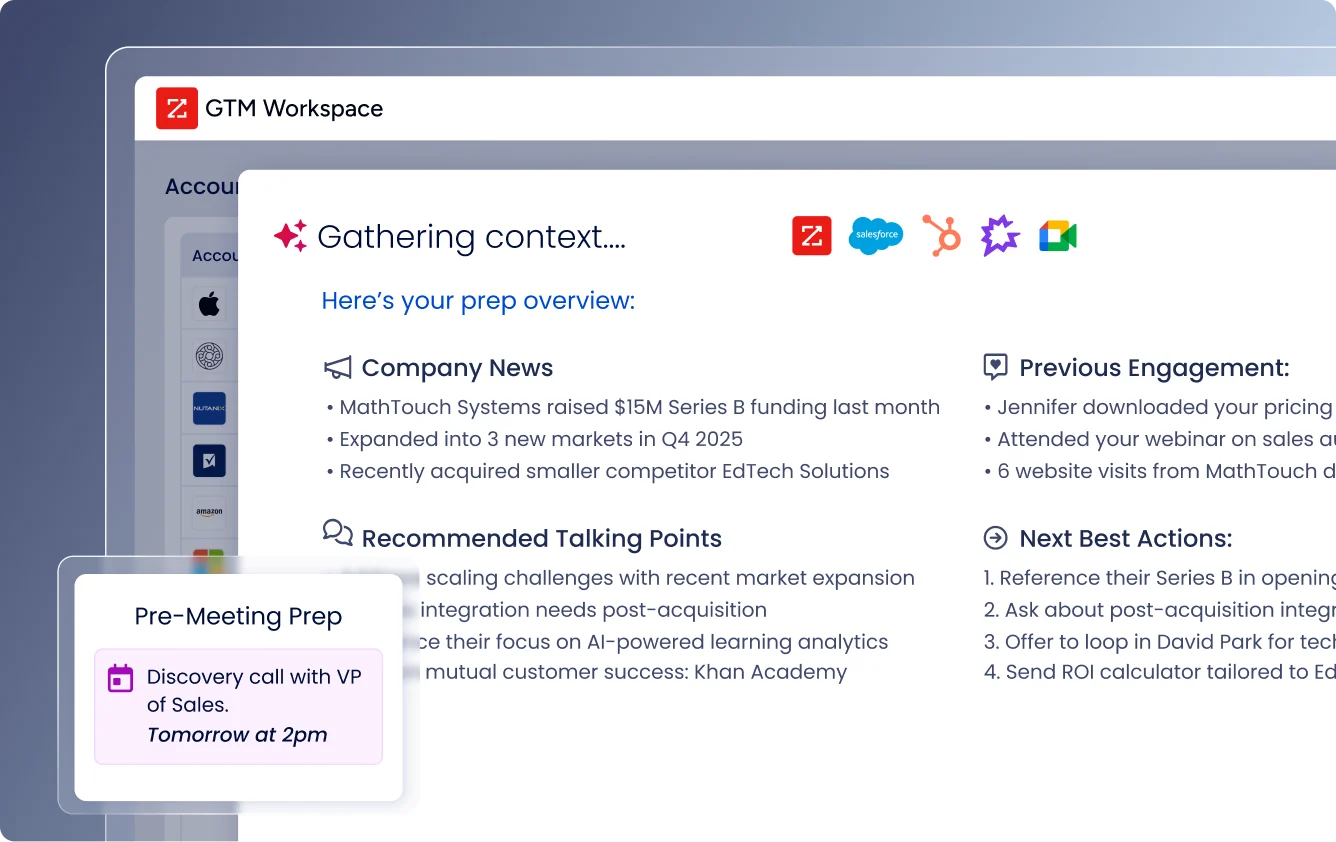
Source: ZoomInfo
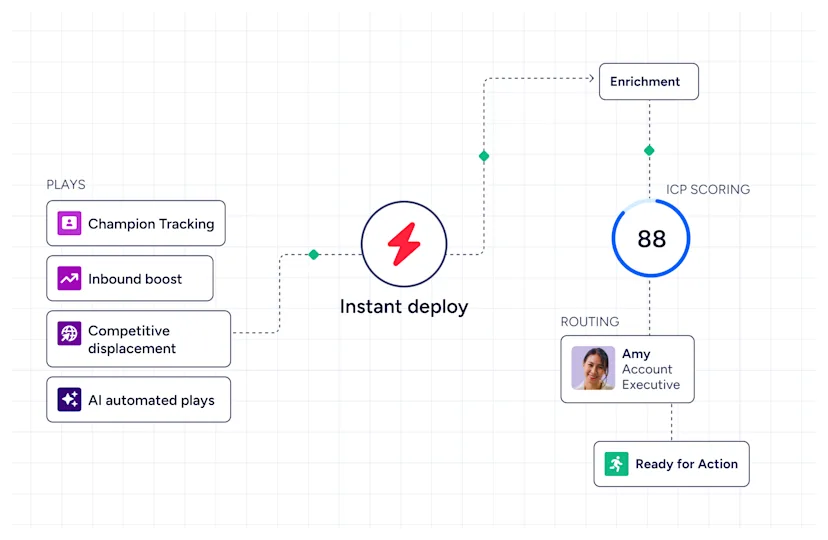
GTM Studio is the marketing and RevOps front-end, where teams build audiences in natural language, define triggers, and launch multi-channel plays (email, calls, ads, direct mail) that run continuously and improve as prospects respond.
Source: ZoomInfo
APIs and MCP expose the same intelligence to any custom agent, internal tool, or partner platform. The MCP server connects AI models directly to ZoomInfo's data, with no custom coding required. API access is included in all relevant plans.
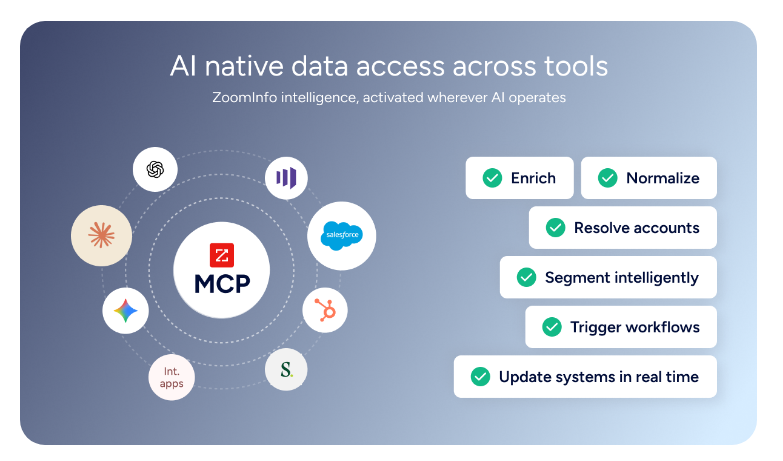
All three access methods draw from one GTM Context Graph, so the intelligence is consistent regardless of where a team works.
Spekit's RevOps Manager Ben Perceval noted: "Anything that minimizes our team's need to switch contexts is beneficial. ZoomInfo offers a single view, eliminating the need to navigate between systems." (Spekit)
Pricing: ZoomInfo offers a permanent free tier, a 7-day trial, and custom enterprise plans.
ZoomInfo uses a consumption-based pricing model with no publicly listed prices for paid tiers. Plans are organized into Sales (Professional, Advanced, Enterprise) and Marketing (Marketing Demand, ABM Lite, ABM Enterprise) product lines, each with distinct capabilities gated by tier.
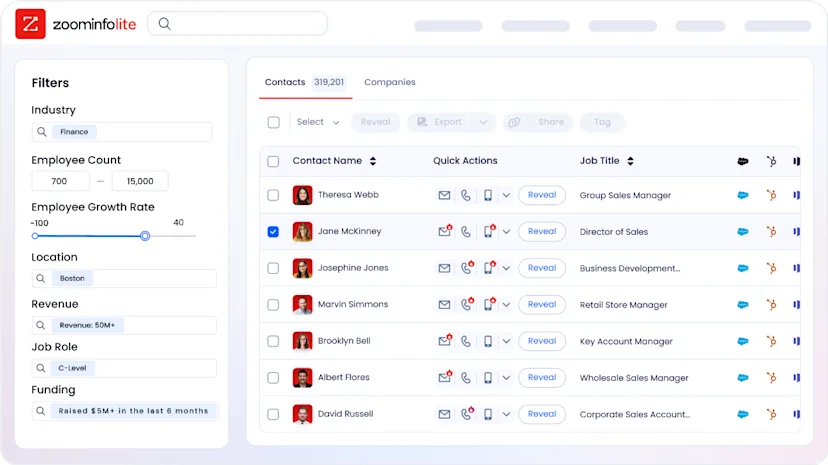
Unlike WalkMe, ZoomInfo provides two free entry points: ZoomInfo Lite, a permanent free tier with access to the B2B database, 10 monthly export credits, and WebSights Lite (no credit card or time limit), and a separate 7-day free trial with broader feature access.
Source: ZoomInfo
This makes it possible to test the platform before committing to an enterprise contract.
WalkMe and ZoomInfo: How They Complement Each Other
Aspect | WalkMe | ZoomInfo |
|---|---|---|
Primary purpose | Enterprise software adoption and guidance | B2B data, intelligence, and GTM execution |
Core problem solved | Employees struggle to use complex software correctly | GTM teams lack accurate data and buying context |
Target users | IT leaders, HR, Change Management, Digital Adoption teams | Sales, Marketing, RevOps, GTM Engineers |
CRM contribution | Guides users to enter data correctly and follow workflows | Enriches CRM with verified contacts, company data, and signals |
Data focus | Software usage analytics (internal behavior) | B2B market intelligence (external buyer behavior) |
AI capabilities | Screen-aware contextual guidance and workflow automation | Deal reasoning, buyer intent, AI-drafted outreach |
Deployment model | Browser extension and desktop application overlay | Cloud platform, APIs, MCP, CRM integrations |
Pricing transparency | Custom enterprise quotes only | Free tier (Lite), 7-day trial, custom enterprise |
Compliance | FedRAMP, SOC 2, ISO 27001, ISO 27701, GDPR | ISO 27001, ISO 27701, SOC 2 Type II, GDPR, CCPA |
Best for | Enterprises adopting complex software at scale | GTM teams needing accurate B2B data and intelligence |
Final Verdict
WalkMe and ZoomInfo address different layers of enterprise technology effectiveness, and the choice between them depends on which problem is more pressing.
Choose WalkMe if your primary challenge is software adoption. If employees struggle to use SAP, Salesforce, Workday, or other enterprise applications, if support tickets pile up after every software update, or if expensive implementations fail to deliver expected ROI because users can't navigate the tools, WalkMe is the proven solution.
Its DeepUI technology, contextual guidance, and usage analytics make it the category leader for a reason. Be prepared for enterprise-level pricing, a multi-month implementation, and the ongoing investment in content maintenance that comes with managing digital adoption across a large organization.
Choose ZoomInfo if your GTM teams have the tools they need but lack the data and intelligence to use them effectively.
If your CRM is well-adopted but poorly populated, if your sales team knows how to navigate Salesforce but doesn't know which accounts to target, or if your marketing team can build campaigns but can't identify in-market buyers, ZoomInfo fills that gap. Its verified B2B data, GTM Context Graph, and AI execution tools turn adopted GTM platforms into revenue engines.
Get started with ZoomInfo here.
For many enterprises, the answer is both. WalkMe ensures your team can use the tools. ZoomInfo ensures those tools contain the intelligence worth acting on. Together, they address two sides of the same objective: getting full value from your technology investments.
WalkMe FAQ
What is WalkMe used for?
WalkMe is a Digital Adoption Platform that sits on top of enterprise applications like SAP, Salesforce, and Workday, providing in-app guidance, workflow automation, and usage analytics. Organizations use it to accelerate software rollouts, reduce IT support tickets, enforce data quality in CRM systems, and improve employee productivity. It serves approximately 1,600 enterprises and 35 million users across 42 countries.
How much does WalkMe cost?
WalkMe does not publish pricing. All plans are custom-quoted through the sales team, with subscription terms set in signed Ordering Documents. Contracts are non-cancelable for the full commitment term, fees are non-refundable, and overage fees apply if usage exceeds contracted limits.
For SAP customers, a WalkMe Standard tier is included in SAP subscriptions, with WalkMe Premium available for additional customization.
Does WalkMe offer a free trial?
No publicly available free trial or freemium tier exists. Evaluation requires engaging the WalkMe sales team. The contractual framework references a provision for services provided at no fee, suggesting pilot engagements may be offered on a case-by-case basis, but no standard trial is publicly available.
ZoomInfo, by contrast, offers both a permanent free tier (ZoomInfo Lite) and a 7-day free trial with no credit card required.
What is WalkMe DeepUI?
DeepUI is WalkMe's proprietary AI technology that interprets application user interfaces the way a human would, reading visual elements and layout rather than relying on hardcoded element IDs.
When an application updates, DeepUI automatically detects UI changes and adapts published guidance without manual intervention.
ENGIE reports that DeepUI eliminated the need to test and correct over 100 digital adoption solutions for each new Salesforce release.
Who is WalkMe best suited for?
WalkMe is built for large enterprises (typically 5,000 to 100,000 employees) that have dedicated IT or digital adoption teams. The primary use cases include organizations undergoing ERP implementations, major CRM deployments, or AI adoption initiatives. It is not designed for SMBs, startups, or organizations looking for lightweight, self-serve onboarding tools.
Is WalkMe still independent after the SAP acquisition?
WalkMe operates as a wholly-owned SAP subsidiary with Dan Adika remaining as CEO. The platform continues to support non-SAP applications including Salesforce, Workday, ServiceNow, and Microsoft Dynamics 365.
However, the strategic direction and product roadmap increasingly prioritize the SAP ecosystem, including native embedding into SAP applications and the designation of WalkMe Learning Arc as the successor to SAP Enable Now.
What analyst recognition does WalkMe have?
WalkMe is named a Leader in the Forrester Wave for Digital Adoption Platforms (Q4 2024), receiving the top score in the AI/ML criterion. It is a Leader and Star Performer in the IDC MarketScape for Digital Adoption Platforms (2024), and is featured in the Gartner Market Guide for Digital Adoption Platforms. WalkMe was also named a 2025 Gartner Customer Choice for Digital Adoption Platforms.
How does ZoomInfo complement WalkMe?
WalkMe ensures your teams adopt and use enterprise software correctly. ZoomInfo ensures the B2B data flowing through those tools is accurate and actionable.
For GTM teams specifically, WalkMe guides sales reps through CRM workflows and enforces data quality at the point of entry, while ZoomInfo enriches CRM records with verified contact data, company intelligence, and buyer intent signals.
Together, they address both the adoption layer and the data layer of enterprise GTM effectiveness.
Researching WalkMe? These comparisons and alternatives help you decide:
