
Xactly has spent over two decades building what it calls the Intelligent Revenue Platform, a suite of tools covering incentive compensation, territory planning, quota management, revenue forecasting, and comp plan design. For finance and revenue operations teams managing complex commission structures, Xactly has become one of the more established names in Sales Performance Management (SPM), backed by a proprietary dataset spanning 20+ years of pay and performance benchmarks that powers its AI capabilities.
To create this Xactly review, we analyzed it extensively. We believe it's the right choice if:
You manage complex commission structures across multiple sales roles (AEs, SDRs, channel partners, overlays)
ASC 606 / IFRS 15 compliance and audit readiness are requirements for your organization
You're replacing spreadsheet-based compensation with an automated, auditable system
You need territory and quota planning grounded in historical performance data
You want AI-powered forecasting and compensation plan simulation before rollout
Xactly excels at managing compensation and optimizing sales performance, but those plans are only as good as the market intelligence behind them. Territory designs need accurate account data. Quotas need realistic market sizing. Forecasts improve when paired with real-time buyer signals.
This is where ZoomInfo enters the picture: a B2B data and GTM platform that provides the account intelligence, buyer signals, and contact data that make revenue planning more informed and sales execution more effective.
We've included a detailed look at ZoomInfo later in this Xactly review, as the intelligence platform that complements Xactly's planning and compensation capabilities. If you're ready to explore how B2B data intelligence can strengthen your go-to-market strategy, you can start with ZoomInfo's free plan here.
What is Xactly?
Xactly was founded in 2005 by Chris Cabrera, who recognized the early potential of cloud computing and built the company's first product, Incent, a cloud-based incentive compensation management tool. The company claims it was "the first to take ICM to the cloud" for broad commercial use.
Since then, Xactly has expanded through acquisitions: AlignStar for territory mapping (2017), OpsPanda for AI-based capacity planning (2018-2019), and TopOpps for sales forecasting (2020-2023). The company went public on the NYSE in 2015 before being taken private by Vista Equity Partners in 2017, where it has remained.
Today, Xactly positions itself as an "AI-Powered Sales Commission & Performance Management Platform". The product suite covers six core products: Incent for commission administration, Forecast for pipeline prediction, Plan for territory and quota planning, Design for comp plan simulation, Manage for GTM operations, and Xactly Intelligence as the AI and agent layer. The platform targets finance, compensation, operations, and sales leaders at mid-market to large enterprise B2B companies. Customers include Zoom, LinkedIn, Illumina, Accenture, FICO, Gainsight, Drata, and Pendo.io.
Xactly Pros & Cons
Pros | Cons |
|---|---|
- 20+ years of proprietary pay and performance benchmarking data | - No public pricing; all plans are quote-based |
- 99.8% on-time commission payment accuracy | - Requires dedicated comp admin or RevOps team |
- Built-in ASC 606 / IFRS 15 compliance automation | - Not suited for small teams with simple comp plans |
- Full platform: compensation, territory, quota, forecasting | - Significant onboarding and learning curve |
- AI agents for plan configuration and dispute resolution | - Private company since 2017; limited financial transparency |
- Enterprise scale (billions of transactions monthly) | - Strategic Planning modules priced separately from Incent |
- Contract rated in the top 13% for customer favorability | - No self-serve trial available from the website |
Xactly Review: How it Works & Key Features
Incentive Compensation: Xactly Incent automates commission calculations with full audit trails.
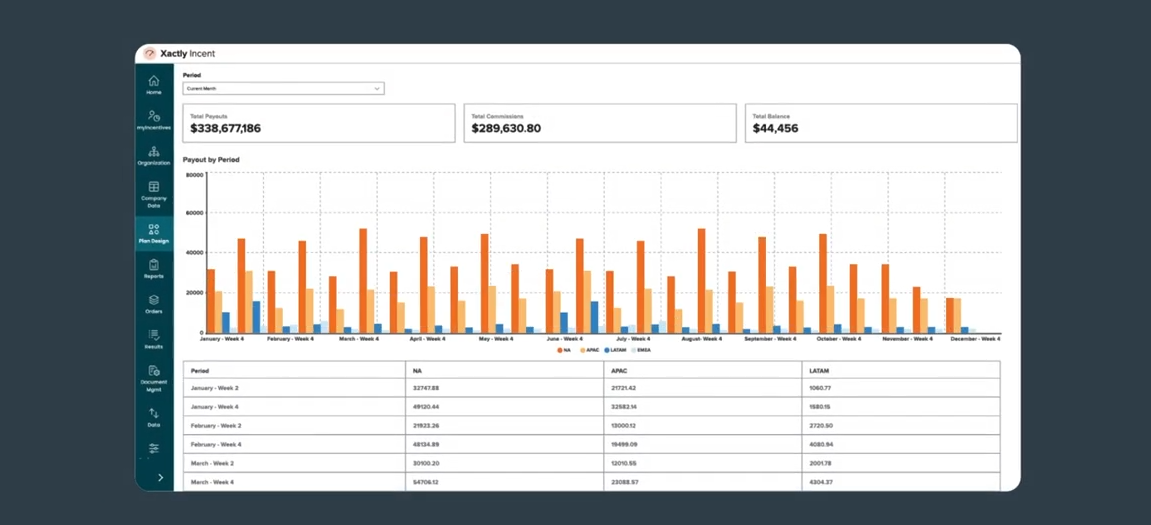
Xactly Incent is the platform's core product, designed to replace spreadsheet-based commission programs with automated, auditable calculations. Xactly says Incent processes over $7 billion in commissions and bonuses monthly.
The system works in layers. Administrators use the Compensation Configurator to build plans from reusable rules, quotas, and rate tables, with AI assistance available at the Ultimate tier to speed up plan setup. A calculation engine processes transactions across global organizations, handling splits, draws, accelerators, clawbacks, and MBOs. Drag-and-drop hierarchy management controls reporting structures, deal credits, and organizational relationships.
Source: Xactly
On the seller side, reps receive Customized Incentive Statements with deal-level drill-down, accessible through native Android and iOS apps. This transparency targets a specific problem: the "shadow accounting" reps do when they don't trust official payout numbers.
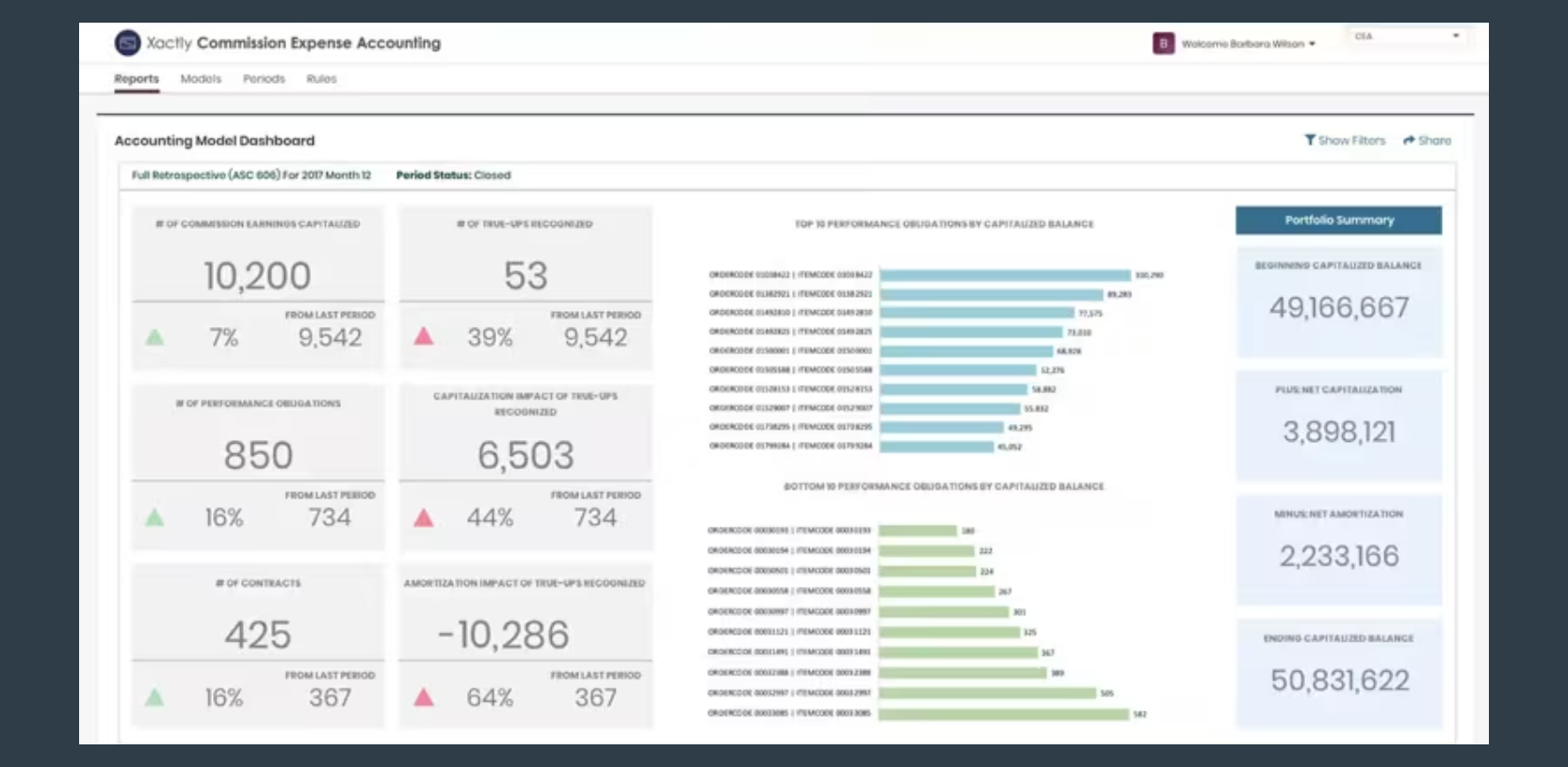
For finance teams, the Commission Expense Accounting (CEA) module automates ASC 606 and IFRS 15 compliance, including dynamic true-ups for contract events, capitalization and amortization schedules, and pre-built auditor reporting. The module integrates with CRM, HRIS, CLM, CPQ, and downstream accounting ledgers.
Source: Xactly
Incent comes in three tiers. Core covers automation for organizations moving off spreadsheets, including the calculation engine, plan configuration, performance dashboards, AI Assistants, and standard data integrations. Plus adds compliance features (ASC 606 via CEA, Prior Period Processing, full sandbox environment, business group security, and advanced data connectors). Ultimate adds AI agents and proactive insights, industry benchmarking against Xactly's proprietary dataset, MBO and objective management, advanced modeling, and custom process extensions.
Territory and Quota Planning: Xactly Plan and Manage bring data-driven structure to go-to-market design and execution.
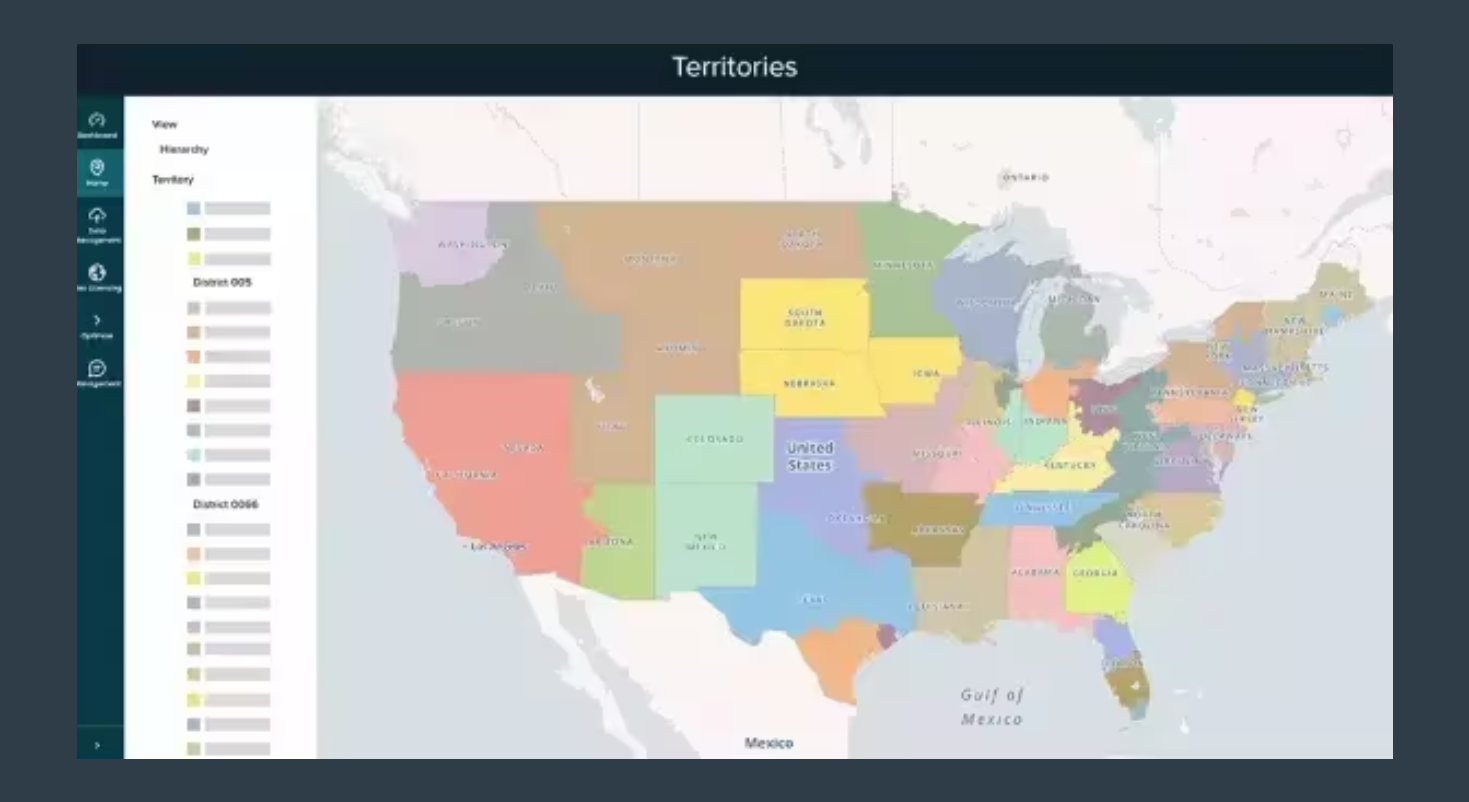
Xactly Plan handles the strategic side of sales planning: capacity modeling, territory design, and quota allocation. The included AlignStar sub-product provides an interactive map-based interface for building and adjusting territories by geography, industry, or named account, with drag-and-drop reassignment, heat maps, and an automated Alignment Report Card that grades territory balance against company objectives. An Optimizer runs "what-if" analysis, showing how proposed territory changes would affect performance before you commit.
Source: Xactly
The planning workflow connects three steps. Capacity modeling determines how many ramped reps you need to hit revenue targets, accounting for ramp time and attrition. AlignStar handles geographic and account-based territory design, with organizations reportedly operational in hours. Quota allocation distributes revenue targets across the team, validated against real sales capacity as a "crucial reality check".
Xactly Manage handles the operational execution of those plans. It creates a single source of truth across territories, people, opportunities, credits, and quotas, with effective-dated roster changes that preserve historical accuracy while cascading updates to downstream assignments. Automated credit rules apply when territories and rosters change, and structured dispute resolution workflows route credit disputes through a defined process.

Source: Xactly
Because Plan and Manage sit on the same platform as Incent, territory and quota changes flow directly into compensation calculations without re-import or re-mapping.
Revenue Forecasting: Xactly Forecast replaces gut-feel pipeline management with AI-driven prediction.
Xactly Forecast addresses a problem Xactly frames with three statistics: more than 80% of sales organizations don't achieve forecast accuracy above 75%, roughly 67% have no formalized forecasting approach, and only 6% of CSOs are confident they will make their numbers.
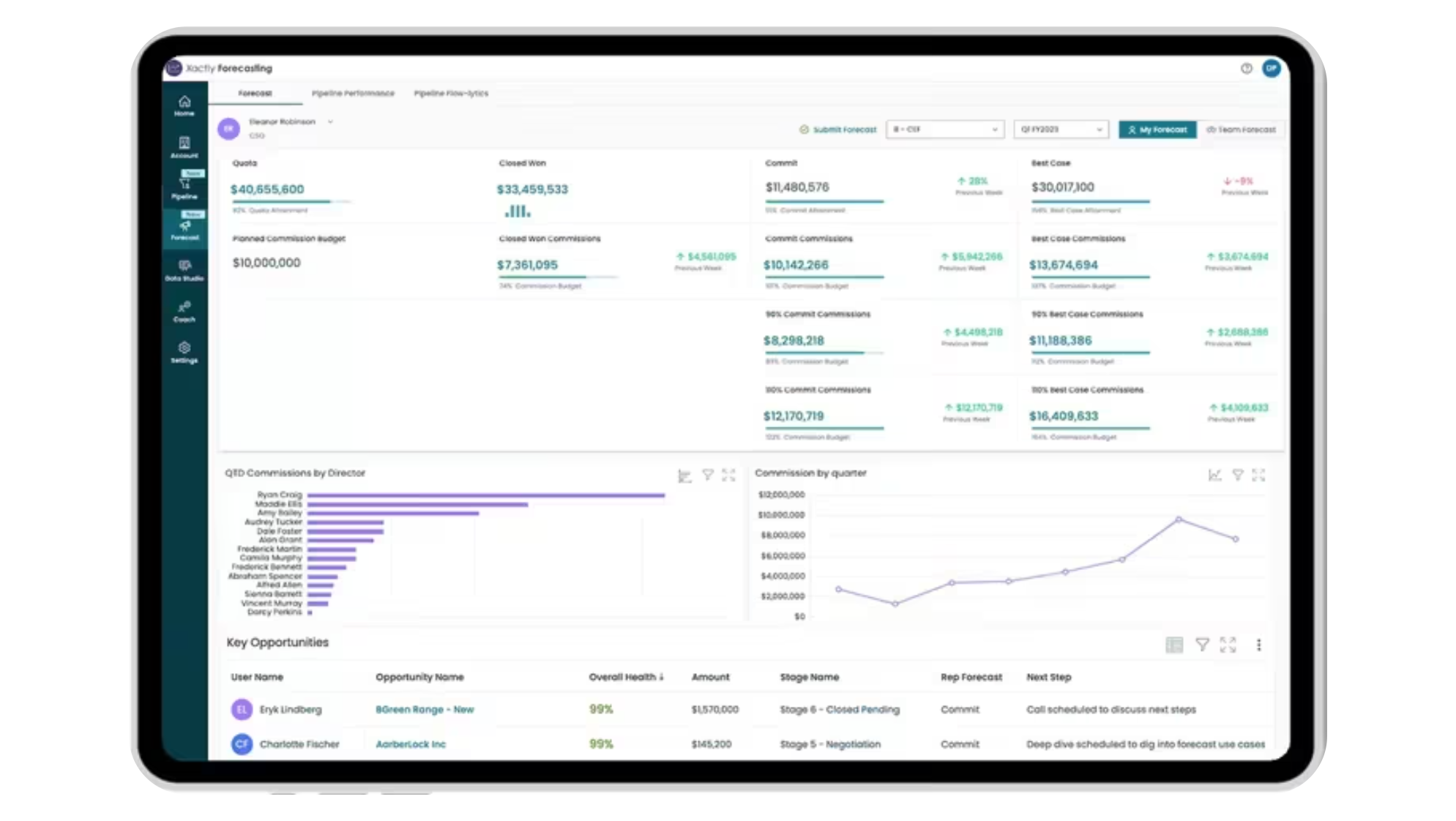
The product consolidates CRM and ERP data into a single dashboard and layers on AI and machine learning metrics tailored to each organization. These models generate deal Health Scores by analyzing thousands of data points (email sentiment, meeting frequency, historical rep performance) to flag at-risk revenue before managers notice it.

Source: Xactly
Sellers receive alerts and next-best-action recommendations to move deals forward, and sales leaders can identify coaching opportunities with data-driven insights. The pipeline change detection feature surfaces where deals have moved, stalled, or slipped in real time.
What distinguishes Forecast from standalone forecasting tools is that it folds compensation data into the picture. The Commission Earnings Forecasting add-on combines pipeline data with Incent data to show reps how new deals affect their earnings, turning the forecast into a motivational tool as well as a management one. For finance leaders, it automates commission exposure tracking to project incentive costs.
Source: Xactly
AI and Intelligence Layer: Xactly Intelligence adds autonomous agents to revenue operations workflows.
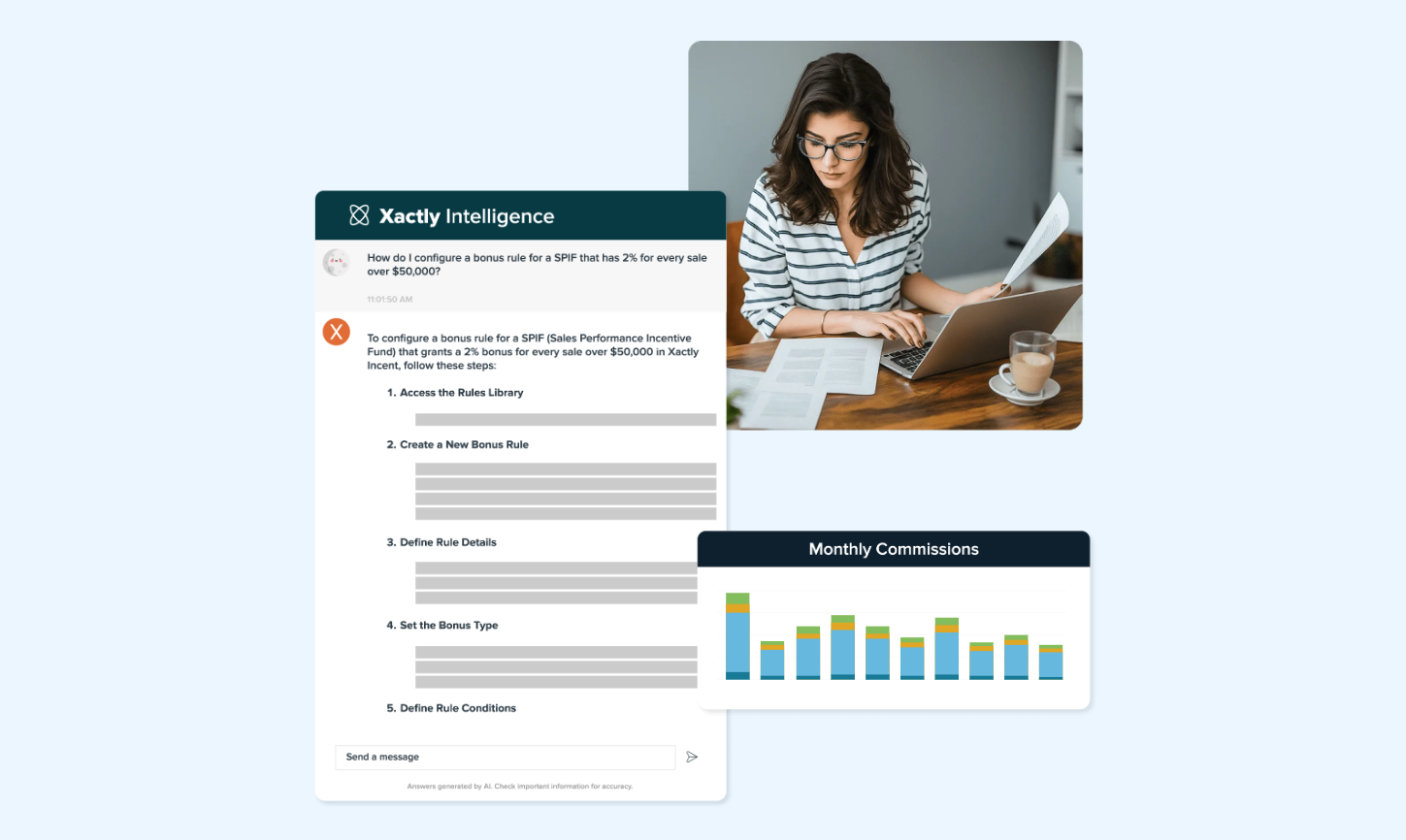
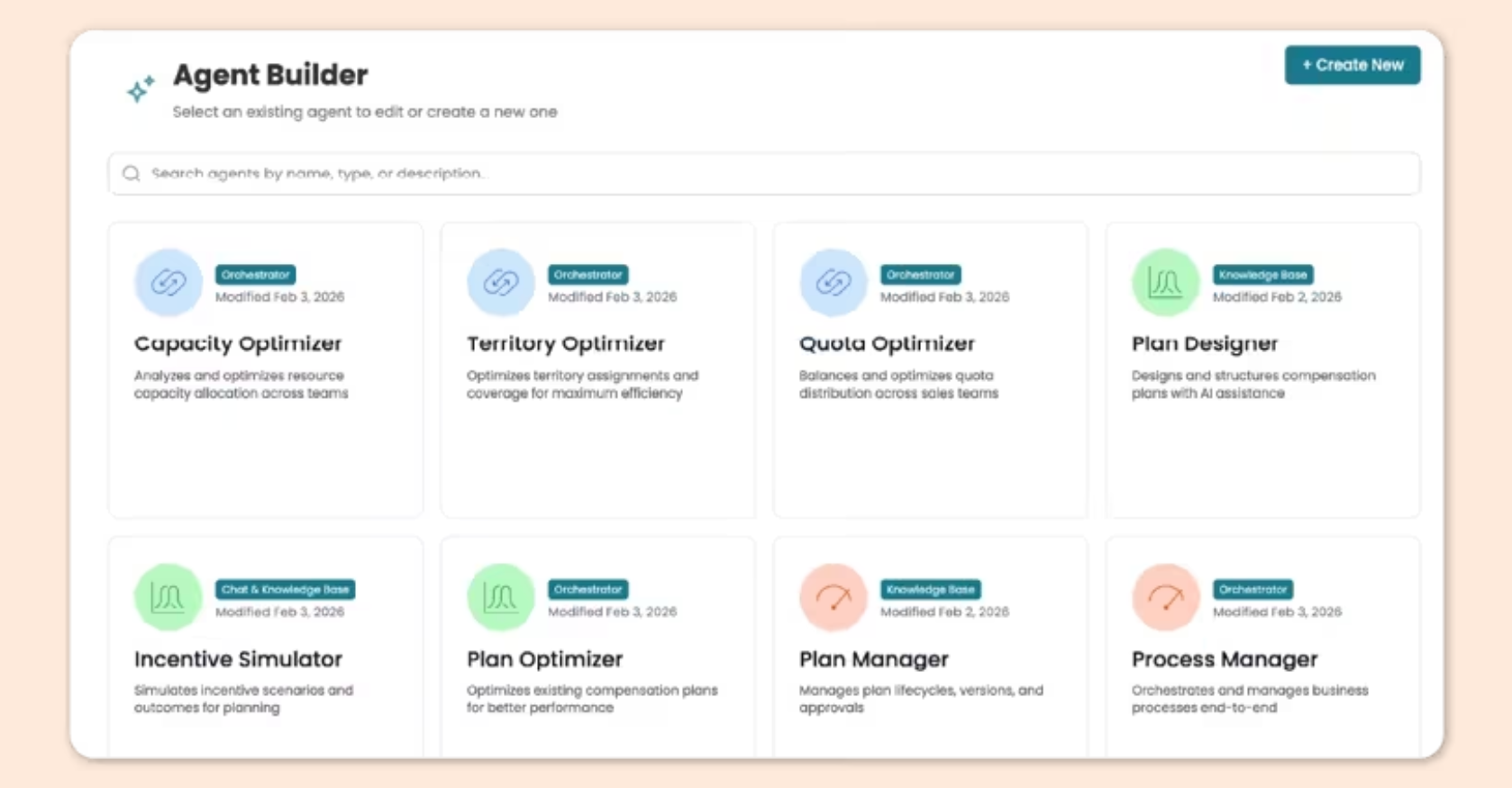
Xactly Intelligence is the AI layer across the platform, delivering three tiers. Insights use predictive models embedded in products like Forecast to surface risks and recommendations before administrators ask. Assistants provide a conversational interface where users ask natural-language questions about compensation data, quota performance, or plan documents, with the assistant maintaining context across a session. Agents, launched in May 2026 as the Fleet of Agents, are pre-built AI agents that automate revenue workflows across planning, compensation, and RevOps.
Source: Xactly
The agent types include Workflow Agents for multi-step process automation (such as dispute resolution without human intervention at each step), Optimization Agents for surfacing recommendations grounded in empirical benchmarks, Builder Agents for creating custom agents via natural language or drag-and-drop tools in Intelligence Studio, and External Agents for connecting with platforms like Workday, Salesforce, and ServiceNow. The Dispute Management Agent, built with ServiceNow using Model Context Protocol (MCP), was the first production deployment of Xactly's agent-to-agent framework.
Source: Xactly
All AI capabilities draw from Xactly's 20+ years of proprietary pay and performance data, a dataset the company argues no competitor can replicate. Intelligence Connect, an MCP server, gives enterprise tools secured access to live Xactly data via whichever LLM front-end teams already use (Claude, ChatGPT, Salesforce, or ServiceNow Now Assist).
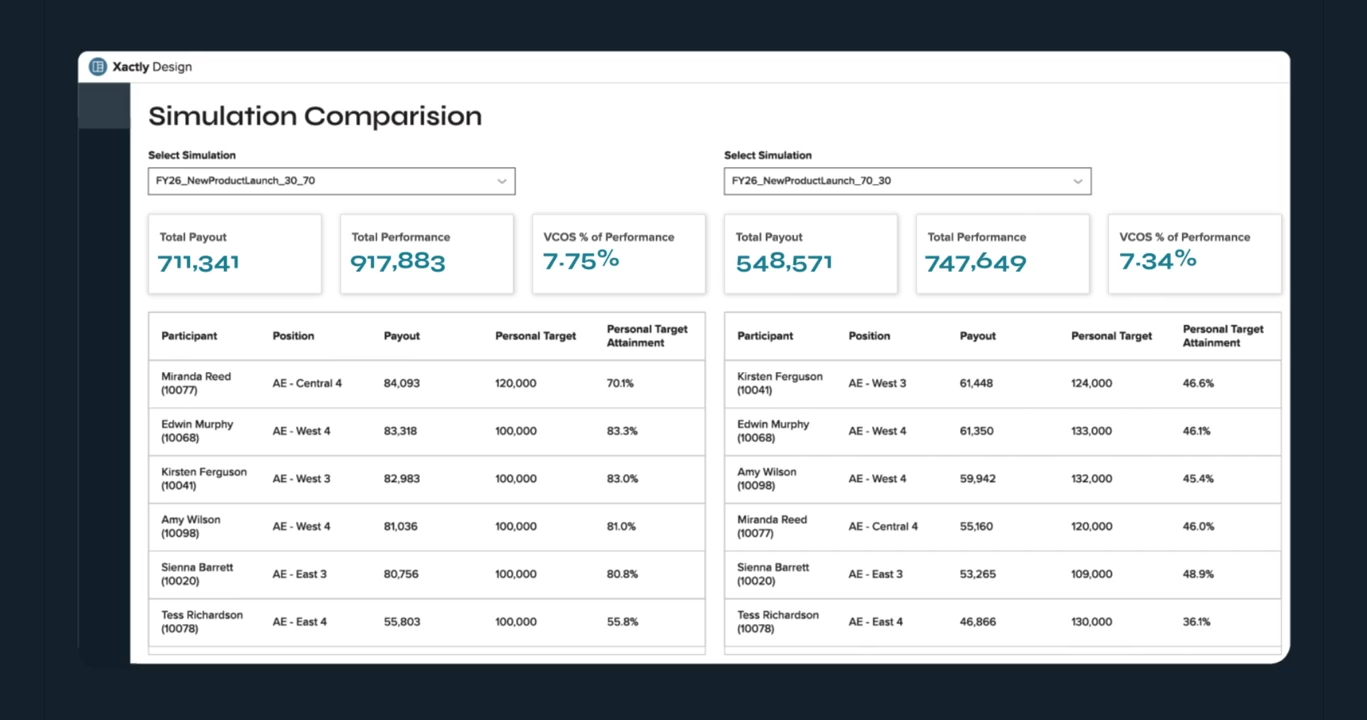
Separately, Xactly Design applies this intelligence to comp plan simulation. Compensation teams can simulate "what-if" scenarios against historical data to test how plan changes affect total spend, pay equity, and seller behavior, all before a plan goes live. The module uses 20+ years of proprietary pay and performance data to benchmark plan structures, pay mixes, and OTE levels against industry norms.
Source: Xactly
Where Xactly Falls Short
Xactly delivers strong SPM capabilities, but several limitations surface when you measure it against broader revenue operations needs. These are the natural consequences of a platform built for compensation and planning depth rather than full GTM coverage.
Enterprise-Only Pricing with No Transparency. Xactly does not publish pricing for any product or tier. Every engagement starts with a quote request, and the Strategic Planning modules (Plan, Design, Manage, Forecast) are each priced separately from the Incent tiers. Implementation services, Technical Account Manager add-ons, and professional services carry additional costs negotiated at sale. For organizations comparing tools, this opacity makes it hard to evaluate total cost of ownership without a sales conversation.
Significant Administrative Investment. The platform spans seven products, AI agents, custom extensions via Extend, and multiple workspace apps. That breadth means real onboarding overhead. Xactly maintains Xactly University with certification courses, instructor-led training, and role-specific learning paths. Dedicated workspace apps exist for admins, sales reps, and managers because navigating the full platform requires role-specific interfaces. Organizations without a dedicated compensation team or RevOps function may find the learning curve steep.
Not Built for Simple Compensation Structures. Xactly's own comparison pages position it as the platform for companies that have outgrown simpler tools. A small sales team with one or two commission tiers does not need (and likely cannot justify) the implementation cost of a full SPM platform. The fit is mid-market to enterprise organizations with multi-role plans, overlays, and compliance requirements.
Private Company, Limited Financial Visibility. Since Vista Equity Partners took Xactly private in 2017, the company has not disclosed revenue, headcount, or growth figures publicly. Enterprise procurement teams assessing long-term vendor viability may need NDA-gated conversations to evaluate.
Planning Without Native Market Intelligence. Xactly's territory, quota, and forecasting tools operate on data you bring to them from CRM, ERP, and HCM systems. The platform does not provide its own B2B account intelligence, buyer intent signals, or contact data. The quality of your territory designs and quota models depends entirely on the completeness of the data in your connected systems. When the underlying data has gaps, even well-designed plans risk misallocating resources, setting unrealistic quotas, or missing emerging opportunities.
These limitations aren't failures. They reflect a platform built for compensation management and planning depth rather than breadth across the entire go-to-market workflow. But they highlight the importance of pairing Xactly with an intelligence layer that provides the market data those plans depend on.
The Natural Complement to Xactly: ZoomInfo
ZoomInfo addresses the intelligence gap in Xactly's planning workflow. As a B2B data and GTM platform, ZoomInfo delivers the account intelligence, buyer signals, and contact data that make territory plans more accurate, quotas more realistic, and forecasts more informed.
Where Xactly answers "how should we compensate our team and structure our territories?", ZoomInfo answers "who should we target, when are they buying, and how do we reach them?" Together, they form a complete revenue operations stack: intelligence that informs planning, and planning that drives execution.
Comprehensive B2B Data: ZoomInfo provides the market intelligence foundation that SPM tools depend on.
ZoomInfo operates a B2B data platform covering 500M contacts, 100M companies, 135M+ verified phone numbers, 120M direct-dial phone numbers, and 200M+ verified business email addresses. This data is maintained through a multi-source pipeline backed by 300+ human researchers and reaches up to 95% accuracy on first-party data.
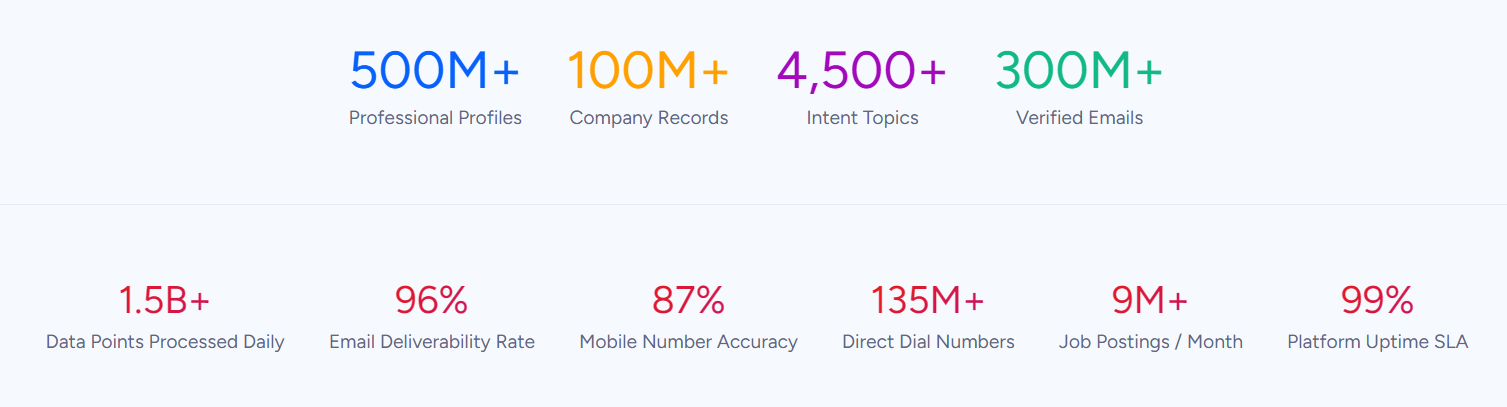
For teams using Xactly Plan to design territories, ZoomInfo's data provides the missing layer: which accounts exist in each segment, what their company attributes look like, what technologies they use, and where decision-makers sit in the org chart. Territory plans built on complete account data avoid the imbalances that occur when coverage models rely on incomplete CRM records.
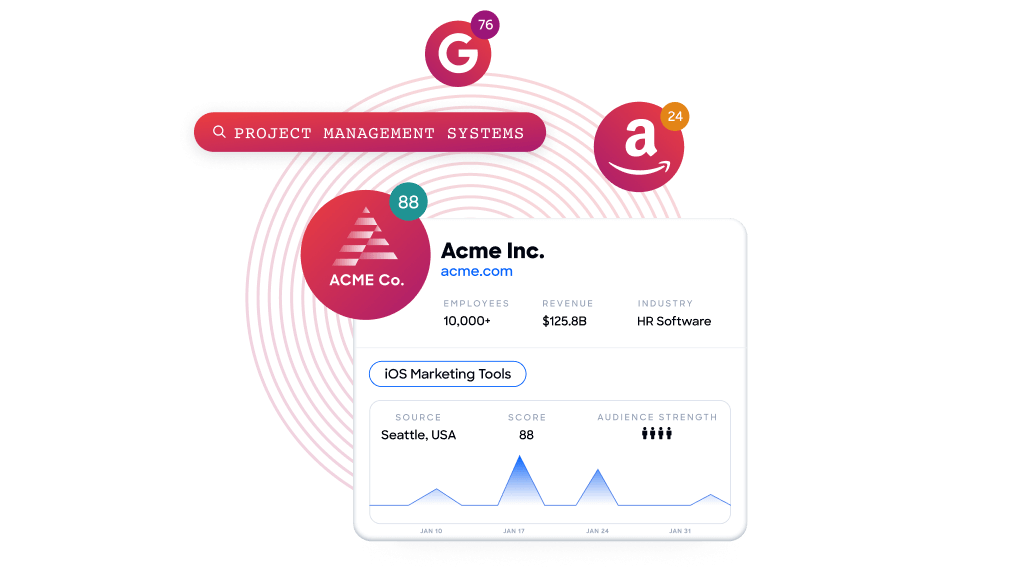
Beyond static company data, ZoomInfo's Buyer Intent tracks signals from 210 million IP-to-Organization pairings and 6 trillion+ new keyword-to-device pairings sourced monthly, surfacing which accounts are actively researching relevant solutions. Guided Intent, exclusive to ZoomInfo, identifies topics historically correlated with deal success rather than requiring manual topic selection. Technographic data profiles the tech stacks of 30+ million companies across 30,000+ technologies.
In a Fortune 500 competitive RFP analyzing 25 million contacts across vendors, the independent consultant concluded that "no other competitor came even close."
Vensure scaled prospecting with ZoomInfo's B2B data: "ZoomInfo gives us the information we need to execute. We don't have to go through and spend our time digging. It's already there, so we can be three steps ahead." (Vensure)
GTM Context Graph: An intelligence layer that captures not just what happened in a deal, but why.
ZoomInfo's GTM Context Graph processes 1.5B+ data points daily, fusing ZoomInfo's third-party B2B data with a customer's own CRM records, conversation intelligence from calls and meetings, email interactions, and behavioral signals into a single intelligence layer.
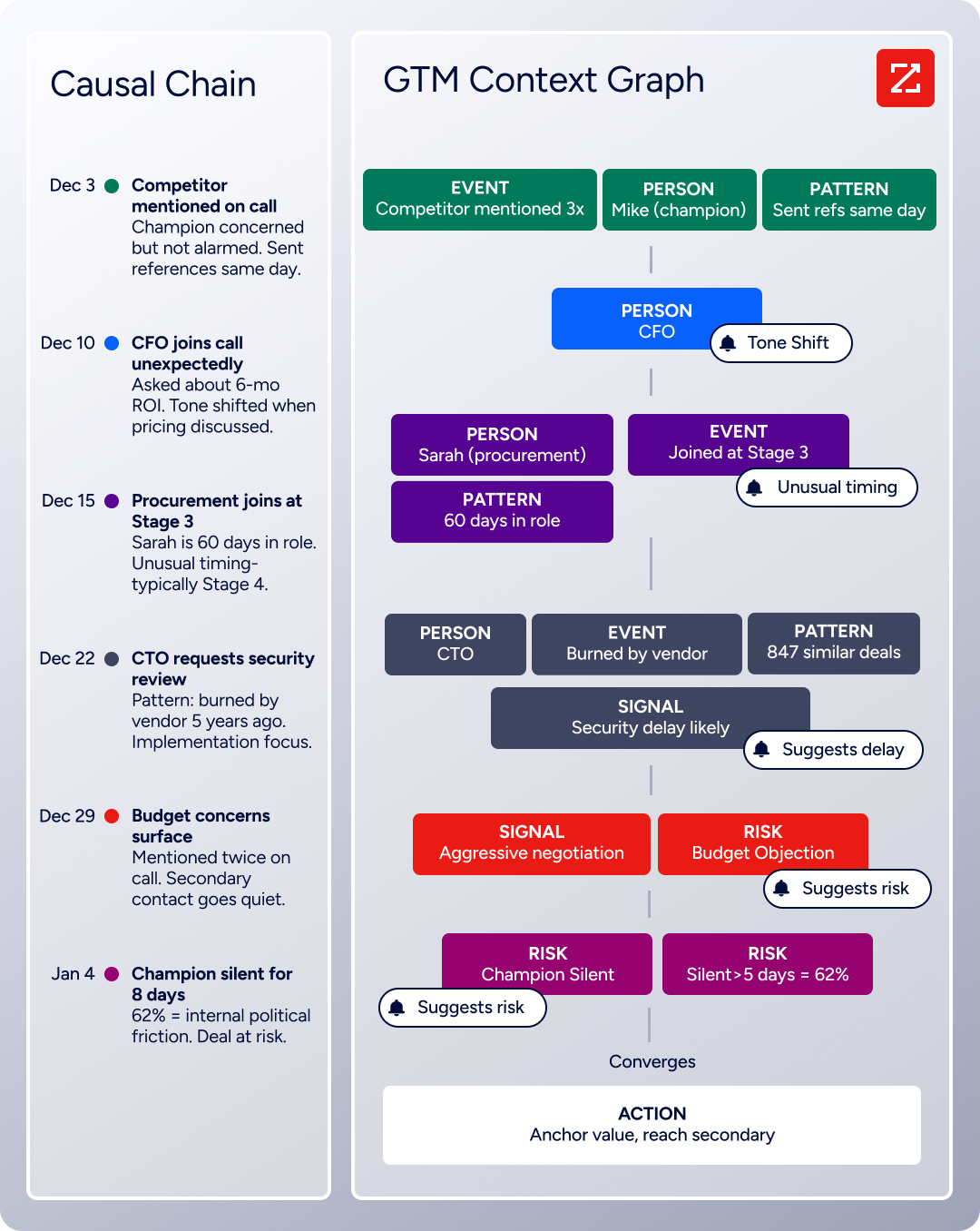
The distinction matters for revenue operations teams using Xactly. CRM data records that a deal moved stages and the close date shifted. But as ZoomInfo's CPO Dominik Facher writes: "The CRM recorded the state change. It has no record of why it happened." Perhaps the CFO joined the last call and asked about ROI, or the VP went quiet because of an internal budget battle. The GTM Context Graph makes this decision context machine-readable, capturing relationships between people, outcomes of specific actions, patterns across thousands of similar deals, and explanations for why deals stall.
For Xactly users, this context directly improves the inputs to forecasting and planning. Quota targets set against Xactly Forecast's pipeline data become more accurate when that pipeline is enriched with buyer intent, deal health signals, and conversation intelligence. Territory adjustments become proactive rather than reactive when real-time market signals highlight where opportunity is concentrating.
Seismic attributed 39% of active pipeline to opportunities identified or influenced by ZoomInfo signals, with the sales team boosting productivity by 54%. "That combination of our internal CRM data, external signals, and AI that's given all that context has helped us craft very specific account- and persona-based messages." (Seismic)
Universal Access: Use ZoomInfo's intelligence in any tool, any workflow, any AI agent.
ZoomInfo delivers its intelligence through three channels. GTM Workspace gives sellers a single place where prioritized accounts, AI-drafted outreach, and deal execution converge without toggling between tools. GTM Studio gives marketers, RevOps, and GTM engineers a builder environment where audience definition, campaign orchestration, and pipeline measurement happen in natural language. And APIs and MCP expose the same intelligence to any custom agent, internal tool, or partner platform.
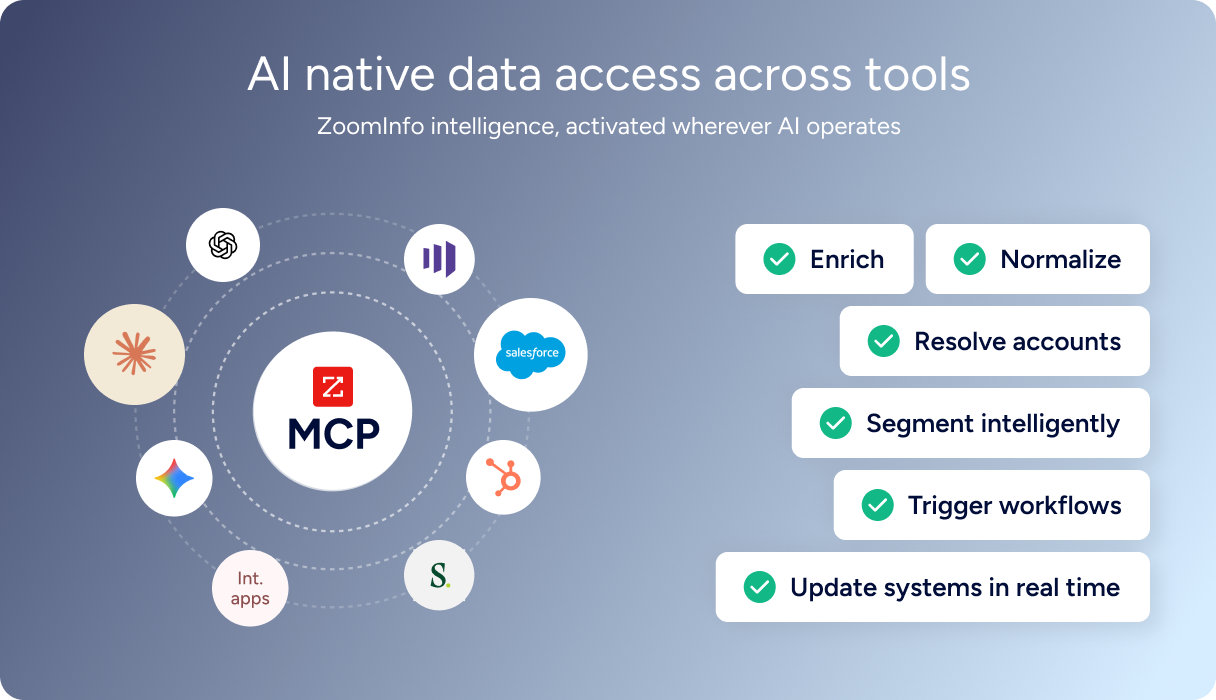
This matters for organizations running Xactly. ZoomInfo's data can flow into the CRM and ERP systems that Xactly connects to, enriching the upstream data that powers territory plans, quota models, and forecasts. The Enterprise API integrates with Salesforce, HubSpot, Microsoft Dynamics, Snowflake, and 120+ other tools in the ZoomInfo App Marketplace, ensuring data consistency across the systems Xactly draws from. All three channels draw from one GTM Context Graph: the same data, the same reasoning, the same continuously learning model.
ZoomInfo also offers a permanent free tier. ZoomInfo Lite provides access to the B2B database with 10 monthly export credits, individual and company searches, the ReachOut Chrome Extension, website visitor reveals, and HubSpot integration, with no credit card or time limit.
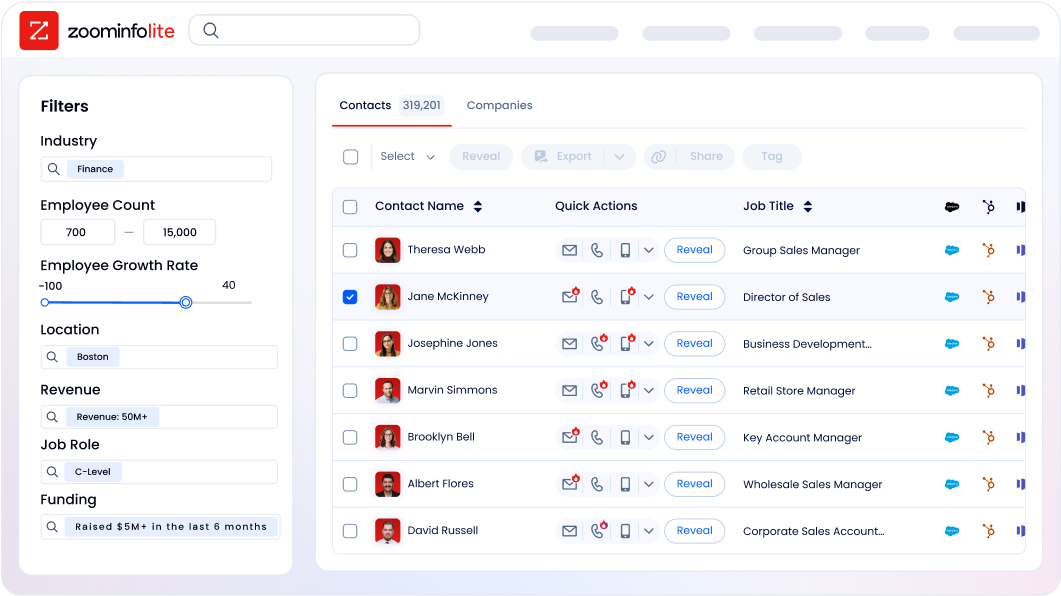
BDO Canada activated data directly within internal systems using ZoomInfo's API, achieving an 87% reduction in time spent on data updates: "The plug-and-play aspect of the API means I can integrate it very easily into any process and get information at a moment's notice." (BDO Canada)
Xactly and ZoomInfo: How They Work Together
Aspect | Xactly | ZoomInfo |
|---|---|---|
Primary Focus | Sales performance management and compensation | B2B data intelligence and GTM execution |
Core Strength | Commission automation, plan optimization, territory planning | B2B data, buyer signals, AI-powered GTM |
Revenue Operations Role | Compensation and planning layer | Intelligence and prospecting layer |
Data Model | Processes compensation and quota data from connected CRM/ERP systems | Provides 500M contacts, 100M companies, intent signals, and buyer intelligence |
AI Capabilities | Plan configuration agents, dispute resolution, commission forecasting | GTM Context Graph, deal health scoring, AI-drafted outreach |
Target Users | Comp admins, Finance, RevOps, CROs | Sales, Marketing, RevOps, GTM engineers |
Pricing Model | Quote-based, per named seat | Consumption-based pricing, with permanent free tier (ZoomInfo Lite) |
Integration Approach | Connects to CRM, ERP, HCM systems for compensation data | Enriches CRM, ERP systems with B2B intelligence via API/MCP |
Best For | Automating compensation and optimizing sales plans | Finding buyers, enriching data, and powering sales execution |
Final Verdict
Xactly and ZoomInfo serve different but connected functions in the revenue operations workflow. Each solves a distinct problem, and together they address the full lifecycle from intelligence to execution to compensation.
Xactly excels at the compensation and planning layer. It automates complex commission structures, enforces compliance, and gives finance and sales operations teams the tools to design fair territories, set achievable quotas, and forecast revenue. For mid-market and enterprise organizations managing multi-role commission plans across global teams, Xactly provides a proven system of record that has processed over $7 billion in monthly commissions with 99.8% on-time payment accuracy. If your priority is replacing spreadsheets, ensuring audit readiness, and giving your finance team confidence in compensation accuracy, Xactly delivers.
ZoomInfo powers the intelligence layer. It provides B2B data, buyer intent signals, and account intelligence that make territory plans more accurate, quotas more realistic, and pipeline forecasts more reliable. When the CRM and ERP data feeding your Xactly instance is enriched with ZoomInfo's 500M contacts and 100M companies, and the GTM Context Graph adds decision context behind pipeline movement, the entire planning and compensation workflow operates on a stronger foundation. For revenue teams that want their sales plans to reflect real market conditions rather than stale CRM snapshots, ZoomInfo closes the gap.
Get started with ZoomInfo's free plan here.
The strongest revenue operations stacks pair planning tools with intelligence tools. Xactly ensures your team is compensated accurately and your go-to-market design is sound. ZoomInfo ensures the data behind those decisions reflects what's actually happening in the market. Together, they give revenue leaders both the plan and the intelligence to execute it.
Xactly FAQ
What is Xactly used for?
Xactly is a Sales Performance Management platform used to automate sales commission calculations, design and simulate incentive compensation plans, plan territories and quotas, manage roster and credit changes, and forecast revenue. It serves mid-market to enterprise B2B organizations that need to replace spreadsheet-based compensation with an automated, auditable system. The platform covers the full compensation lifecycle from plan design through payout, including ASC 606 and IFRS 15 compliance.
How much does Xactly cost?
Xactly does not publish pricing. All plans are quote-based and require contacting the sales team. The core product (Incent) comes in three tiers: Core, Plus, and Ultimate. Strategic Planning modules (Plan, Design, Manage, Forecast) are priced separately. Implementation services, Technical Account Manager support, and professional services carry additional costs negotiated per deal. Xactly's contract was independently rated in the top 13% of SaaS vendor contracts for customer favorability by TermScout.
Does Xactly offer a free trial?
Xactly maintains a Trial Subscriptions Services Agreement, indicating trial access exists, but no self-serve trial is available from the public website. The standard path is to request a demo through the sales team. ZoomInfo, by contrast, offers both a permanent free tier (ZoomInfo Lite with 10 monthly export credits and no time limit) and a 7-day free trial with no credit card required.
What integrations does Xactly support?
Xactly Connect, the platform's integration product, provides native connectors for Salesforce, HubSpot, Microsoft Dynamics, NetSuite, Snowflake, and Workday. The Xactly for CRM add-on integrates natively into Salesforce, ServiceNow, and Microsoft Dynamics. Connect uses REST APIs, ODBC/JDBC drivers, and ETL capabilities built on ANSI SQL syntax. The Xactly Marketplace hosts pre-built apps from Xactly and certified partners. Advanced Data Connectors are available at the Incent Plus tier and above.
Is Xactly suitable for small businesses?
Xactly is designed for mid-market to large enterprise organizations with complex commission structures, multiple sales roles, and dedicated compensation administration resources. Xactly's own positioning says it is the destination for companies that have outgrown simpler tools. Organizations with a small sales team and straightforward commission tiers are unlikely to justify the implementation cost and administrative overhead.
What compliance standards does Xactly support?
Xactly's Commission Expense Accounting module automates compliance with ASC 606 and IFRS 15 revenue recognition standards, including dynamic true-ups, capitalization and amortization schedules, and pre-built auditor reporting. The platform maintains SOC 2 certification, uses TLS 1.2 encryption, and operates secure data centers with 24/7 monitoring, biometric access controls, and regularly tested disaster recovery procedures. Xactly reports 99.97% actual SLA uptime and a 95.9% customer support satisfaction rate.
How does Xactly's AI work?
Xactly Intelligence operates across three tiers: Insights (predictive analytics surfacing risks and recommendations), Assistants (conversational AI for compensation and quota queries), and Agents (autonomous task execution). The Fleet of Agents, launched in May 2026, includes Workflow Agents for multi-step process automation, Optimization Agents for data-driven recommendations, Builder Agents for creating custom agents via natural language in Intelligence Studio, and External Agents for connecting with platforms like ServiceNow and Salesforce. All AI capabilities draw from Xactly's proprietary 20-year dataset of pay and performance benchmarks.
Can Xactly help with revenue forecasting?
Yes. Xactly Forecast consolidates CRM and ERP data into a single dashboard and applies AI-generated deal Health Scores to flag at-risk pipeline. Its distinguishing feature is Commission Earnings Forecasting, which combines pipeline data with compensation data so reps can see how individual deals affect their earnings. Standalone forecasting tools typically lack this. For organizations that also use ZoomInfo, enriching CRM data with buyer intent signals and verified contact information before it flows into Xactly Forecast can further improve accuracy by providing a more complete picture of pipeline health.
Researching Xactly? These comparisons and alternatives help you decide:
